



Abstract
Company salary practices vary in terms of the average rate differential between upper- and lower stratum employees. Those companies with high interstrata rate multiples—typically run by a small, oligarchic leadership—are likely to evoke perceptions of vertical inequities among employees paid below the top echelon. This is especially a concern for small companies where all employees may work in close proximity. To mitigate the risk of dysfunctional behavior (e.g., turnover) stemming from interstrata rate disparities, companies with more oligarchic practices are predicted to engender greater salary dispersion within the lower stratum of employees, relative to those with more egalitarian practices, to “camouflage” the phenomenon. This article presents the results of an archival study that lends support for this prediction.
The distribution of employee salary rates within a company may exemplify a tacit struggle between the forces of power and rationality. Compensation orthodoxy has it that a company salary practice is a consequence of neutral, administrative processes founded on information pertaining to the supply and demand for labor and other objective factors. This information enables companies to monetize differences in the value of jobs and employees. In reality, certain company constituencies—particularly those of the managerial elite—often exert disproportionate influence, if not control, over their own salary rates as well as those of the rest of the employee population.
In most companies, employees in the upper stratum (e.g., top 10%) earn significantly higher salary rates, on average, than those in the lower stratum (e.g., bottom 90%). However, the interstrata ratio of average salary rates is heterogeneous across companies. A higher interstrata rate multiple indicates a salary practice of a more “oligarchic” type, and a lower intrastrata rate multiple indicates a salary practice of a more “egalitarian” type. Since the type of salary practice could have implications for company functioning and success, compensation professionals should have an understanding of this phenomenon. Specifically, an attempt should be made to discover other salary practice properties that may predict (i.e., correlated) type.
When upper stratum employees receive an outsized portion of the company salary budget, lower stratum employees are likely to perceive the oligarchic practice to be inequitable. In the event their perceptions lead to employee dissatisfaction, it could adversely affect company performance or result in an increase in turnover. In fact, these ramifications could ultimately pose a risk to the lucrative arrangement enjoyed by the upper stratum employees themselves. Since these employees are naturally committed to preserving their comparative advantage within an oligarchic salary practice, it stands to reason that they might contrive to camouflage its existence or deflect the focus of the lower stratum employees.
One camouflaging mechanism is to shift the frame of reference, from an inter- to intrastratum comparison point, by introducing greater variance in salary rates across the lower stratum of employees. In particular, as salary dispersion within the lower stratum increases it may become more salient and thus serve to redirect attention away from the fact that much higher rates are concentrated among the top echelon. Do those companies with more oligarchic salary practices also display greater salary variance, as a percentage of the mean rate, across lower stratum employees? In other words, do large “spreads” in salary rates within the lower stratum mask large “gaps” in average salary rates between strata? This article addresses the question of whether employee salary dispersion within the lower stratum is predictive of an oligarchic pattern of rates within small companies.
The Nature of Salary Variance
Base salary dollars are a limited resource that companies must prudently allocate to ensure the attraction and retention of employees. In aggregate, employee salaries are an investment in the human capital necessary to produce economic results for the company. Salary variance surfaces as an artifact of differences in the value of jobs and incumbents. Those employees in jobs with more highly valued duties and responsibilities, either defined through market comparisons or based on size of job content (i.e., job evaluation), tend to earn higher salary rates. Moreover, employees who currently, or are expected to, contribute relatively more to company success, by virtue of their performance or application of credentials, also tend to earn higher salary rates.
The pattern of employee salary rates in most companies reflects a history of programmatic changes. Salary rates emanate from decisions in setting budgetary expenditures and executing structural adjustments over time. Within these program parameters, the salary rates for employees within and between jobs encompass both systematic and unsystematic attributions. The salary (range) rates for jobs usually increase in response to competitive pressures given market movement as tracked be means of salary survey data. In addition, the salary treatment of employees may follow a predictable trajectory stemming from a formalized merit pay program based on appraised performance. Typically, the company salary distribution is such that there are relatively few employees with high rates and relatively many employees with low and moderate rates. With movement up the company hierarchy, there is generally an inverse relationship between the number of employees per level and the average employee salary rate per level. Although rate distinctions across a salary practice are commonly taken for granted, companies feature greater or lesser multiples in the average rate difference between employees in the upper and lower strata.
Salary Rate Configurations in Small Companies
A skewed stratification of salary rates is evident in many small companies. It is often assumed that companies endorse a rational salary practice in which those employees who receive higher rates do so through the application of prescribed criteria and empirical analysis. However, because compensation procedures in small companies are often subject to less bureaucratic constraints, the configuration of salary rates can be somewhat idiosyncratic. In some cases, given employees are, in keeping with the prominence of their roles vis-à-vis business exigencies, deserving recipients of exceptional salary rates. In other cases, exception salary rates may be seen as largess traceable to employee self-dealing or bias. In particular, it is quite common for upper stratum employees in small companies to be in a position to exercise material power by steering the distribution of rates to their benefit.
An oligarchic salary practice is one in which upper stratum employees capture a disproportionate share of company payroll dollars. In a small company, an oligarchical pattern of salary rates may be ascribed to extraordinary differences in job value or to the special endowments of key employees. On the other hand, such a salary practice could come about by means of “rent seeking”. Upper stratum employees have the power to extract “rent” 1 when they can command salary rates above that which is commensurate with the marginal revenue product of their work output. Still, there is likely to be uncertainty as to whether an oligarchic salary practice is a function of discrete policy choices meant to slant the distribution of salary rates or whether it has simply evolved over time through some nondeliberative process. Irrespective of intent, lower stratum employees are likely to prefer a more egalitarian versus an oligarchic salary practice.
Many small companies can be construed as undemocratic political entities in which a select group of managers—if not the business owner exclusively—holds the dominant station in determining “who gets what.” Salary rates are established in accordance with the dictates of an empowered minority rather than by popular consensus resulting from a participative endeavor. The emergence of a more oligarchic salary practice is testament to the clout they possess to manipulate rates in the company either by fiat or by lobbying those with prerogative. As with any fixed cost, cumulative employee salary rates are limited by the business imperative of not exceeding a ceiling amount that would jeopardize the viability of the enterprise. Likewise, in recognition of market discipline, the company’s desire to maintain workforce stability imposes a floor (relative to minimum wage) below which employee salary rates would not be set. However, within these bounds of remunerative discretion, the distribution of salary rates can be levered in favor of upper stratum employees. An oligarchic salary practice implies a zero-sum game in which the premium salary rates garnered by upper stratum employees are funded by suppressing the salary rates of lower stratum employees. One must discern whether this material power dynamic holds true in small companies by scrutinizing specific salary actions.
In a small company, members of the managerial elite can be considered agents of the business owner. Employees of this upper stratum might logically view budgeted salary dollars, in total, as both a necessary business expense to be minimized for profitability enhancement and a source of personal gain to be maximized. There arises an inevitable tension between the upper stratum and the lower stratum as to the appropriate claim each has on the salary budget. Obviously, the upper stratum employees are motivated to produce, and have the authority to implement, a more oligarchic salary practice in which a greater percentage of the budget is retained by them. This motivation, however, is tempered by the knowledge that if an excessive claim on the salary budget is realized, resentment over the imbalance may prompt undesirable repercussions in the form of disengagement or attrition by lower stratum employees.
Material Power Index
The field of political science offers insight into the expression of oligarchic salary practices. Winters 2 put forward a “material power index” (MPI) as an operational measure of income concentration within a population. One version of MPI is that it is the ratio of the average income for the top 10% of the population (nominator) relative to the average income for the bottom 90% of that population. Although based on an artificial dichotomy, MPI serves as a useful measure for the construct of salary practice type. As adapted to compensation, MPI quantifies a salary practice along the egalitarian–oligarchic dimension in comparing the average rate for upper stratum employees to that of the masses. Those companies with a relatively high MPI are identified as more oligarchic.
The composition of jobs and the number of employees within each job varies across companies and will likely have an impact on MPI. Companies with higher MPIs are frequently found in industries typified by a large percentage of lower paid, multi-incumbent, jobs. These companies include jobs that require routinized labor and offer little potential for penetration to the managerial ranks. A company in an industrial bakery, for example, has many employees involved in basic manual tasks and performing simple mechanized operations. In contrast, one might imagine that companies with lower MPIs to be represented in industries comprising more specialized, professional-level jobs. For instance, in an engineering consulting firm, the technical expertise of employees constitutes the major, albeit intangible, assets of the company, and work activities are characterized by collegial interactions. Here, there are likely to be fewer hierarchical distinctions between jobs.
Whether it is in the best interest of the company to cultivate a salary practice that has a relatively high MPI or to cultivate a salary practice that has a relatively low MPI is a matter for debate. One might argue that a salary practice with a higher MPI fosters a tournament orientation in which employees are encouraged to strive to earn significantly greater salary rates than others as a “prize.” Thus, an oligarchic salary practice holds the prospect of inducing employees to maximize their individual performance levels as a condition for entry to the upper stratum. This may be more desirable for the company if employees operate in a relatively autonomous manner and where key business processes involve few exchanges within teams. Conversely, a salary practice with a lower MPI is more compatible with a work environment that requires collaborative behavior among employees. In situations where company performance depends on the results of coordinated projects, a more egalitarian salary practice would be recommended to avoid the internecine friction attendant to an extreme disparity in average rates between strata.
Vertical Inequities
Employees are apt to draw inferences as to the configuration of salary rates that materialize within a company. Compensation administration in most companies involves the concealment of the salary practice, if not the policy. That is, the actual salary rates of employees are usually kept secret, although many companies will disclose the salary structure grades and ranges for jobs. In large companies, employees will normally be unclear as to the distribution of salary rates since their exposure to other departments/units and levels in the hierarchy is limited. However, in small companies, all employees, including the most highly salaried, may work in close proximity where the duties and responsibilities of others are fairly transparent. This more immediate work context is conducive to employee comparisons. Employees are likely to acquire a perspective into their own internal salary standing and that of others from the various signals and symbols (e.g., office size) present. Such a perspective may lead to speculation as to the average salary rate ratio between the upper stratum and the rest of the workforce, as well as the (horizontal) salary rate dispersion within the lower stratum.
Lower stratum employees can be expected to make internal salary rate comparisons with both peers and those at the higher echelon. Salary variance between and within groups of a small company could engender “positional concerns” among employees. The rightfulness of an oligarchic salary practice may be undermined if the interstrata average rate differential becomes too great. Beyond some MPI “tipping point,” employees in the lower stratum may perceive their salary rates to be vertically inequitable when evaluated against those in the upper stratum. As perceived, these vertical inequities may lead to feelings of fraternal deprivation and trigger negative reactions among those disaffected. 3 Such negative reactions could be demonstrated through behavioral outcomes that are dysfunctional for the company (e.g., shirking, sabotage).
Academic research has yielded mixed results regarding the relationship between salary dispersion and performance. However, various studies indicate that size of the gap between the average salary rates of top managers and lower level employees may affect morale and productivity. In one study, Bloom 4 showed that pay dispersions had a detrimental effect on measures of individual and company performance. Another study by Cowherd and Levine 5 found that small pay differentials between lower level employees and upper echelon managers led to higher product quality due to an increased commitment to goals and greater cooperation. These findings suggest that lower level employees are sensitive to the overall configuration of salary rates when making upward comparisons.
Camouflage Tactic
Upper stratum employees may be disposed to camouflage an oligarchic salary practice in an effort to preempt any adverse effects that would threaten the status quo. One obvious camouflage tactic is to alter the comparative referent of the lower stratum employees by creating a compensation diversion. Specifically, risk to the oligarchic salary practice could be mitigated by the managerial elite instituting greater rate dispersion within the lower stratum. The scope of employee salary comparisons within the lower stratum becomes more diffused as the variance in rates increases. To the extent that employee salary rates within this stratum are broadly dispersed, vertical inequities are likely to be obscured or less prone to detection.
This camouflage tactic can be achieved through the adoption of a salary structure as one of several policy devices. A salary structure governs the placement and progression of employee salary rates consistent with measures of job value and individual performance level. These structures can be customized to deliver calibrated rates along a wide continuum, within and between jobs, around the average of the lower stratum. For instance, a structure could be designed with salary grades comprising broad rate ranges in which to assign jobs; large percentage differentials between adjacent grade midpoint rates could be set as well. The span of possible salary actions afforded by the structure would thus facilitate the camouflage.
Under this scenario, interstrata salary distinctions are muted, if not disguised, as the relatively high rates of some employees in the lower stratum will be in close proximity with the relatively low rates of some employees in the upper stratum. Moreover, the greater the dispersion of salary rates within the lower stratum, the greater the outward appearance of prospective salary advancement without necessarily ascending to the upper stratum. This allows employees in the lower stratum to anticipate, and to some degree experience, meaningful salary increases over time, hence lessening the impetus toward a more egalitarian practice. In other words, high salary dispersion is predicted to occasion lower stratum employees to be less cognizant of, or at least have greater tolerance for, an oligarchic salary practice.
Hypothesis
For exploratory purposes, a study was undertaken to ascertain whether the salary practices of small companies exhibited a positive relationship between interstrata average rate differentials and lower stratum rate dispersions. The hypothesis for the study is that small companies with more oligarchic salary practices show greater variance in salary rates across lower stratum employees, as a percentage of their average rate, than those with more egalitarian salary practices. Specifically, it was posited that companies with higher material power indices will display greater horizontal salary dispersion within the lower stratum. This hypothesized relationship is depicted in Figure 1. The study involved the collection and analysis of actual salary rate data of employees in small companies to test this hypothesis. The methods and results of the study are described below.
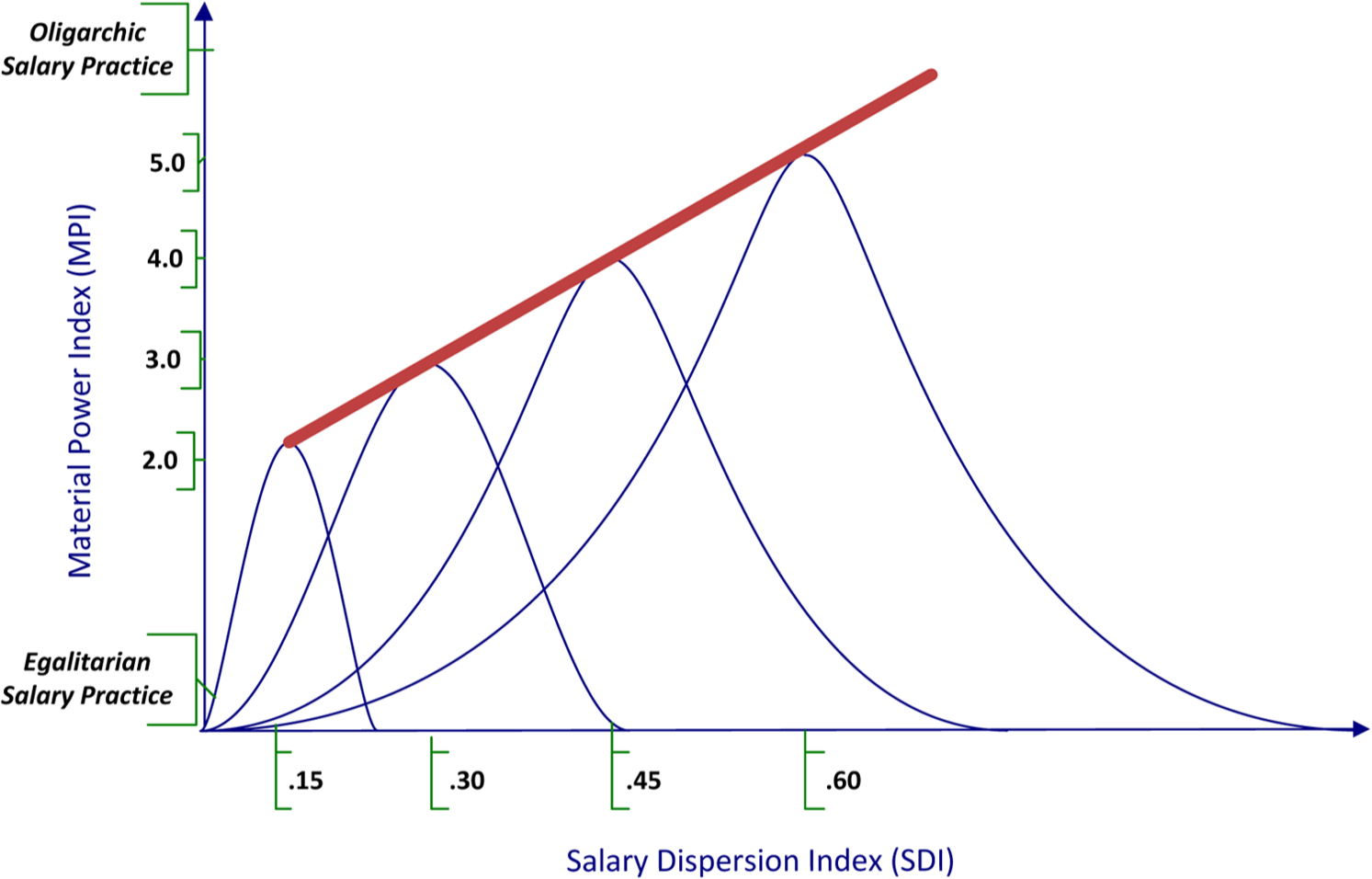
Hypothesized relationship between salary dispersion index and material power index for small companies.
Method
The salary rates of employees in 43 client companies were extracted from a payroll database maintained by a professional employer organization. This sample of companies consisted of a cross section of small businesses (e.g., regional bank, medical laboratory, information storage firm, etc.) with head counts ranging between 150 and 1,000 employees. The distribution of employee salary rates within each company was rank ordered and then delineated into upper stratum (i.e., “top 10%”) and lower stratum (i.e., “bottom 90%”) groups. An MPI was then computed for each company by dividing the mean (i.e., average) salary rate of the upper stratum group by the mean salary rate of the lower stratum group. A salary dispersion index (SDI) was also calculated for each company by dividing the standard deviation of salary rates for the lower stratum group by the mean salary rate of this group. Finally, regression analysis was applied to these data to test the above hypothesis.
Results
Relevant descriptive statistics were obtained. Across the sample, the mean MPI was slightly less than 3 (i.e., 2.96), with a standard deviation of 0.73; the mean SDI was .367, with a standard deviation of .085. Regression analysis revealed support for the hypothesis: Namely, a moderate relationship in the predicted direction was shown between SDI and MPI (i.e., b = 4.40, p < .001; R2 = .26). Companies with higher SDIs within the lower stratum group evidenced more oligarchic salary practices, as denoted by higher MPIs (see Figure 2). For instance, a company with an SDI of 0.5 was estimated to have an MPI equal to 3.55, whereas a company with an SDI of 0.3 was estimated to have an MPI only equal to 2.67.
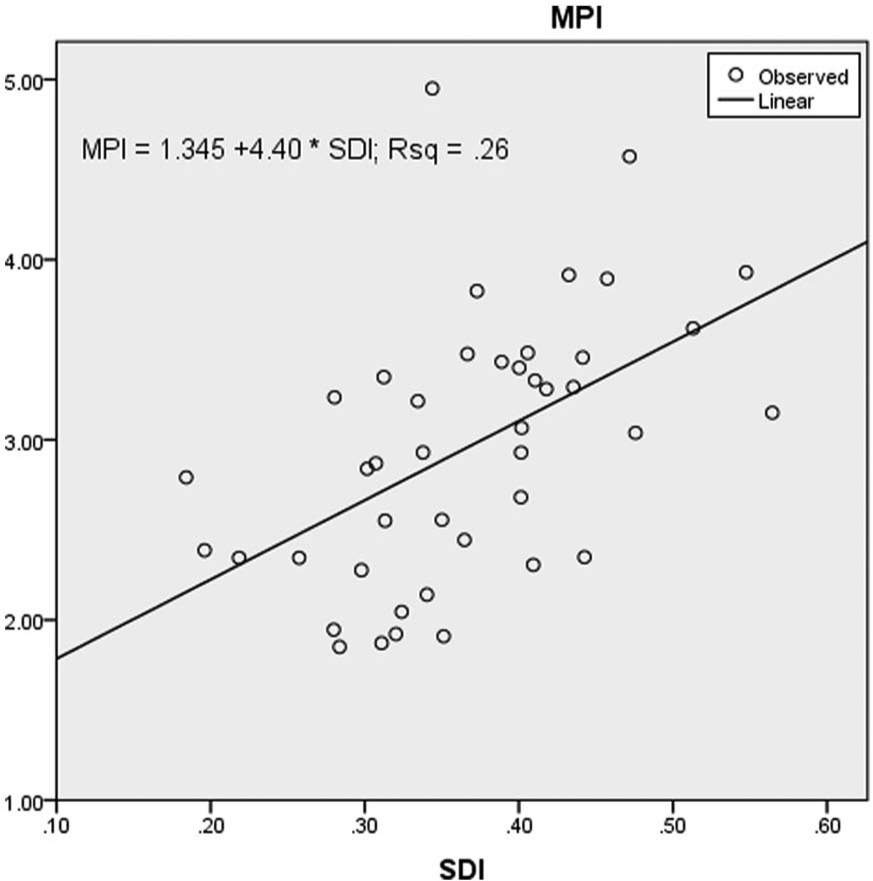
Actual relationship between the salary dispersion indices of lower stratum employees and the material power indices of small companies.
The results of this study are interpreted to lend credence to the notion that salary dispersion within the lower stratum of employees is predictive of interstrata average rate differentials in small companies. In other words, the findings imply that small companies with more oligarchic salary practices may be masking the fact by promoting greater salary rate variance across lower paid employees. Although it is not possible to draw a causal connection between the magnitude of salary dispersion below the top echelon and the percentage differential in average salary rates between strata from this study, further research appears warranted.
The current study only addressed the salary practice relationship within small companies. Clearly, the outcome may be more pronounced if total cash compensation were to be used as the pay metric instead of base salary. In many companies, eligibility for incentive plans is restricted to employees with higher salary rates, particularly those in the upper stratum. Moreover, under these plans, the target incentive payout for “at-goal” performance is generally specified as a percentage of the employees’ salary rate—with greater percentages for the higher tiers of the company hierarchy. Holding constant incentive payout differences owing to individual performance levels, total cash compensation should amplify both the material power and salary dispersion indices above that for base salary alone.
Even if one supposes that managerial elites consciously engineer the occurrence of high lower stratum salary dispersion to make opaque an oligarchic salary practice within their companies, a question remains. Are oligarchic salary practices justified from a commercial standpoint? This study did not assess company performance or productivity differences associated with salary practices of varying material power indices. An oligarchic salary practice is instrumental insofar as the distribution of rates across employees is aligned with the strategic emphasis of the company. Otherwise, one might contend that hidden transfer payments are embedded in the high interstrata average salary differential. That is, unless a case can be made that an oligarchic salary practice furthers the financial prosperity of the company, lower stratum employees are being exploited in that their lower salary rates are being partially subsidized by the higher salary rates of the high-stratum employees.
Compensation Populism
The sustainability of an enterprise hinges on employees collectively generating future surplus wealth from current salary expenditures. One would assume that the implicit consent of the lower stratum employees to the prevailing configuration of salary rates is important to this mission. If the interstrata average rate differential becomes too polarized, the esprit de corps necessary for positive economic returns could be imperiled. Therefore, it may be advisable for those companies opting for a more oligarchic salary practice to effect greater rate dispersion within the lower stratum so as to counteract any latent divisiveness among that subset of employees seen as most critical to perpetuating the business. Research indicates that employees with higher internal standing in a salary practice perceive greater equity than those with lower internal standing with increases in salary dispersion. 6 In other words, by increasing the salary rates of the already relatively well-paid employees in the lower cohort, the managerial elite can create a “buffer” against perceptions of vertical inequity.
Notwithstanding a possible stealth revolt of the masses (i.e., “peasants with pitchforks”), upper stratum employees ought to be vigilant in monitoring emerging antipathy toward an oligarchic salary practice. It might behoove the company to conduct a perception survey with items (i.e., agree/disagree) aimed at understanding the extent to which lower stratum employees see the salary practice as fair (e.g., “My salary rate is fair in comparison to the salary rates received by other employees at higher levels of the company”). Responses to such a query may disclose performance concerns relating to perceived vertical inequities. This knowledge should, in turn, enable the company to assuage feelings of fraternal deprivation by adjusting salary rates or providing alternative forms of recompense (e.g., more vacation time). Of course, to borrow a line from Kris Kristofferson’s song “To Beat the Devil,” for some companies, “the truth remains that no one wants to know.”
Footnotes
Declaration of Conflicting Interests
The author(s) declared no potential conflicts of interest with respect to the research, authorship, and/or publication of this article.
Funding
The author(s) received no financial support for the research, authorship, and/or publication of this article.