



Abstract
Intrinsic motivation is a subject that receives sporadic, low key coverage in human resources (HR) management. Interest tends to peak periodically when a well-publicized, non-HR professional criticizes the use of extrinsic rewards and suggests intrinsic rewards as a more effective alternative. Periodic surveys on employee engagement levels mention the importance of specific intrinsic factors but lack a full discussion of the general topic. Otherwise, little is said in the current HR literature about using intrinsic rewards. The fallout is that many HR professionals may not realize how important intrinsic rewards are to employees, how satisfied they are with what they have and what, if any, actions should be taken as a result.
Intrinsic motivation is a subject that receives sporadic, low key coverage in human resources (HR) management. Interest tends to peak periodically when a well-publicized, non-HR professional criticizes the use of extrinsic rewards. Typically, the person draws attention by attacking the “misguided” thinking behind the use of financial rewards and by suggesting that intrinsic rewards as a more effective alternative. Periodic surveys on employee engagement levels identify the importance of specific intrinsic factors, but it comes across more as interesting background information than actionable intelligence. Otherwise, little is said in the HR literature about using intrinsic rewards.
In recent years, there have been two points in time when the spotlight was clearly on intrinsic rewards. In1993, Alfie Kohn, an educator and author, criticized the use of extrinsic rewards and made a case for using intrinsic rewards in his popular Harvard Business Review article, “Why Incentive Plans Cannot Work,” and book, Punished by Rewards. In 2009, Daniel Pink, lawyer, speechwriter and author, covered the same ground in his bestselling book, Drive: The Surprising Truth about What Motivates Us. The heart of the criticism is that extrinsic rewards harm an individual’s intrinsic motivation, an idea that even its leading proponent, the psychologist Edward Deci, admits is lacking adequate research support in work organizations. 1
Leading thinkers in human resources responded to these works by defending the use of financial rewards, but had little to say about the value of using intrinsic ones. They seem willing to acknowledge their importance but offer no specific guidance on when and how to use them. This may be the result of having limited practical experience with intrinsic rewards and a substantial amount with extrinsic rewards. The fallout is that many HR professionals may not realize how important intrinsic rewards are to employees, how satisfied they are with what they have and what, if any, actions should be taken as a result.
Before examining these issues, it is helpful to define extrinsic and intrinsic motivation and present common theories of intrinsic motivation that identify the characteristics of intrinsic rewards.
The Basics: Intrinsic Versus Extrinsic Motivation
Intrinsic motivation is driven by forces from within the employee, while extrinsic motivation is driven by outside forces. Employees will find an activity intrinsically motivating to the degree that it is interesting, challenging and has personal meaning based on the satisfaction they receive from performing the activity itself. An example is nurses motivated to care for patients because of the satisfaction they receive from relieving the suffering of others.
Extrinsic motivation involves performing a job primarily for separate, external consequences to which the activity leads, such as a pay raise or promotion, not for the satisfaction that comes from the activity itself. An example is a salesperson striving to sell a certain number of medical instruments for the satisfaction of receiving a commission payment, not for the number of lives saved. 2
Intrinsic Motivation Theories
There are several theories that explain why intrinsic factors are important in motivating employees. Two well-known ones that have research support are job characteristics theory and self-determination theory.
Job Characteristics Theory
Frederick Herzberg’s theory of motivation states that a job will enhance employees’ motivation to the extent that it embodies certain intrinsic motivators—achievement, responsibility and opportunity for growth. This thinking led to efforts in the 1970s to design “enriched” jobs that tap into intrinsic motivators, by enhancing a job’s task variety, task identity, task significance, autonomy and feedback. These five core dimensions are seen as producing psychological states of the meaningfulness of work, responsibility for work outcomes and feelings of competence.
The five job characteristics are defined as follows:
Variety: Various activities involving a number of different skills and talents
Task identity: Completion of a whole or identifiable piece of work and doing a job from beginning to end with a visible outcome
Task significance: Substantial impact on the work or lives of others, inside or outside the organization
Autonomy: Substantial freedom, independence and discretion in performing work
Feedback: Individual information about work results. 3
Self-Determination Theory
Self-determination theory asserts that people have three innate needs that can be satisfied at work—autonomy, relatedness and competence. The concept of competence adds to job characteristics theory and is defined as a person’s inherent need to feel effective in interacting with the environment. It is tendency to explore and control the environment and to engage in challenging tasks that test and extend one’s skills. 4
Job characteristics theory and the competence aspect of self-determination theory will be used to understand what employee surveys have uncovered about the value of intrinsic rewards.
Intrinsic Motivators in Recent Surveys
The importance of intrinsic motivators can be found in the results of recent surveys conducted by six respected organizations. Two of the surveys deal with employee motivation and the others with employee engagement. The concepts of motivation and engagement appear to be related. Motivation addresses an interest in accomplishing specific tasks, while engagement is related to a general interest in contributing to a company’s success.
Engagement has become a popular measure of employee effectiveness, as regular reports are issued by HR consulting firms on the alarmingly low levels of employee engagement in the workforce. Similar reports on employee motivation levels are hard to find, perhaps because surveys have not been developed to measure it on an organizational level. Despite the popularity of engagement, there is no widely accepted definition and standard survey to measure it. It has been defined by one of its most knowledgeable proponents, the HR consulting firm of Towers Watson, as an employee’s willingness and ability to contribute to company success. 5
The following recent major surveys show that intrinsic rewards are very important to employees:
2007 Towers Watson Global Workforce Study. This survey of 88,612 full-time employees of midsize to large organizations in 18 countries across all regions found that improved skills and abilities over the past year, input into decision making, challenging work assignments that broaden skills and an organization that encourages innovative thinking were among the top 10 most important drivers for engaging employees.
2008 Harvard Business School Study: Employee Motivation a Powerful New Model. This survey of 350 employees at two global companies and employees of 300 Fortune 500 companies found that job design is one of the four primary levers employers have to motivate and retain employees, as it satisfies the basic human drive to make sense of the world around us. The researchers believe that employees are motivated by challenging jobs that enable them to grow and learn and are demoralized by those that are repetitive and have no future. The area is best addressed by designing jobs that have distinct and important roles in the organization and allow employees to make meaningful contributions.
2009 Sibson Consulting Rewards of Work Study. This survey of more than 2,000 U.S. workers from all regions and more than 25 industries found that job responsibility and feedback from the job were the fifth and eighth most important drivers of employee engagement of the five areas measured—work content, affiliation (e.g., organizational support and trust in management), career (e.g., job security and training opportunities), benefits and compensation.
2009 McKinsey & Company Study Motivating People: Getting Beyond the Money. This survey of 1,047 executives, managers and employees around the world, representing all regions and most sectors, found that an opportunity to lead projects or task forces was a more effective motivator than the three highest-rated financial incentives—base pay increases, cash bonuses and stock options. McKinsey believes that nonfinancial motivators play a critical role in making employees feel that their companies value them and strive to create opportunities for growth. The firm claims that this theme appears frequently in most studies on the ways to motivate and engage employees.
2010 WorldatWork Study: The Impact of Rewards Programs on Employee Engagement. This survey of 736 WorldatWork members, representing small to large companies from many different industries around the world, found the nature of the job or quality of the work was the highest rated factor for improving employee engagement—outpacing base and incentive pay programs.
2012 Society for Human Resource Management (SHRM) Employee Job Satisfaction and Engagement Survey. This survey of 600 randomly selected U.S. employees found that intrinsic motivators—opportunity to use skills and abilities, the work itself, meaningfulness of job, autonomy and independence and variety of work—were among the top 10 conditions, out of total of 34, under which employee engagement can be maximized.
SHRM Job Satisfaction Surveys
The importance of intrinsic rewards is directly measured in annual job satisfaction surveys sponsored by SHRM. These surveys ask 600 randomly selected employees to rate the importance of various aspects of work, as well as their level of satisfaction with them. Although the main topic here is employee motivation and engagement, not job satisfaction, it is unlikely that intrinsic factors can be significant motivators if employees believe they are not important elements of a job, as job satisfaction surveys indicate. 6
Importance of Intrinsic Factors
From 2002 to 2012, SHRM asked employees to rank the importance of about 26 factors that contribute to their job satisfaction, using a 5-point scale ranging from “very unimportant” to “very important.” The factors ranked covered compensation, benefits, work–life programs, job security, opportunities to use skills and abilities, supervisory relationship, an organization’s financial stability and five intrinsic factors. The intrinsic factors are the same as or are closely related to those identified in the research-based job characteristics and self-determination models of intrinsic motivation.
Table 1 shows the percentage of employees rating intrinsic factors as “very important” to their job satisfaction, as well as the average ranking of the 5 factors out of the 26 rated in SHRM’s 2012 Employee Job Satisfaction and Engagement Survey.
2012 Employee Satisfaction With Intrinsic Factors.
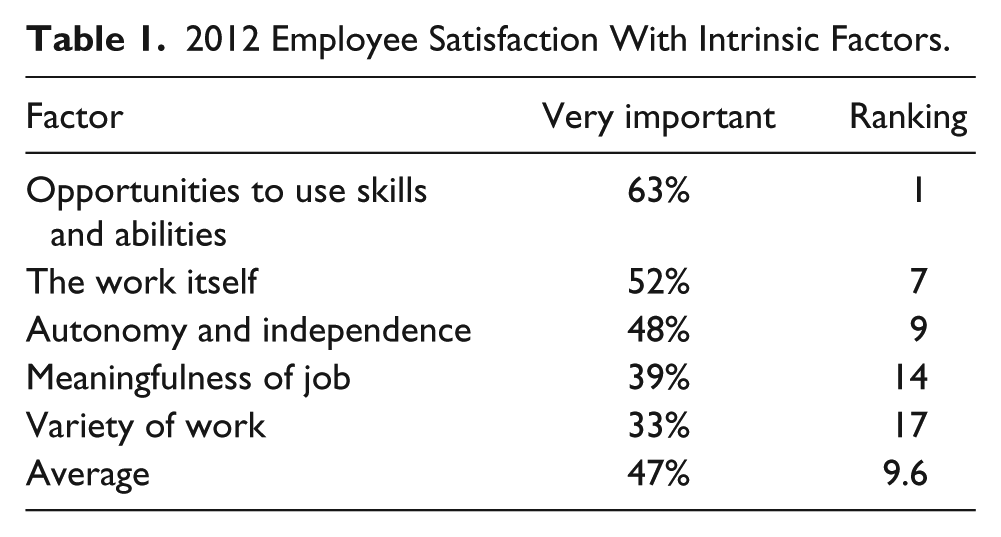
In 2012, three out of the five intrinsic factors were among the top 10 aspects of work that employees rated as “very important” to their job satisfaction. The average rating of 9.6 for the five factors exceeds the overall average of 13 for the 26 factors. From 2008 to 2012, “opportunities to use skills and abilities” was ranked among the top five “very important” factors driving job satisfaction, and in three of those years, “the work itself” was rated fourth and fifth in importance.
In the 10 surveys conducted from 2002 to 2012, the average importance ranking of the five factors shown above was 9.1, which is above the 10-year average of 11.3 for all surveyed factors. Thus, on average, intrinsic factors are in the upper half of the factors that are important to employees, and in 2012, three were among the top 10. The surveys also show that executives and managers generally place significantly greater importance on intrinsic factors than other salaried and hourly employees. 7
Level of Satisfaction With Intrinsic Factors
Beginning in 2008, SHRM asked employees to rate how satisfied they were with the job factors that were “very important” to their job satisfaction, using a 5-point scale from “very dissatisfied” to “very satisfied.” SHRM does not use a “satisfied” rating category to measure positive levels of employee job satisfaction, only “very satisfied” and “somewhat satisfied,” and has generally used the “very satisfied” category in its comparisons of job satisfaction levels.
The percentage of employees rating intrinsic factors both “very important” and “very satisfied” from 2008 to 2012 are shown in Table 2.
Change in Satisfaction: 2008 to 2012.
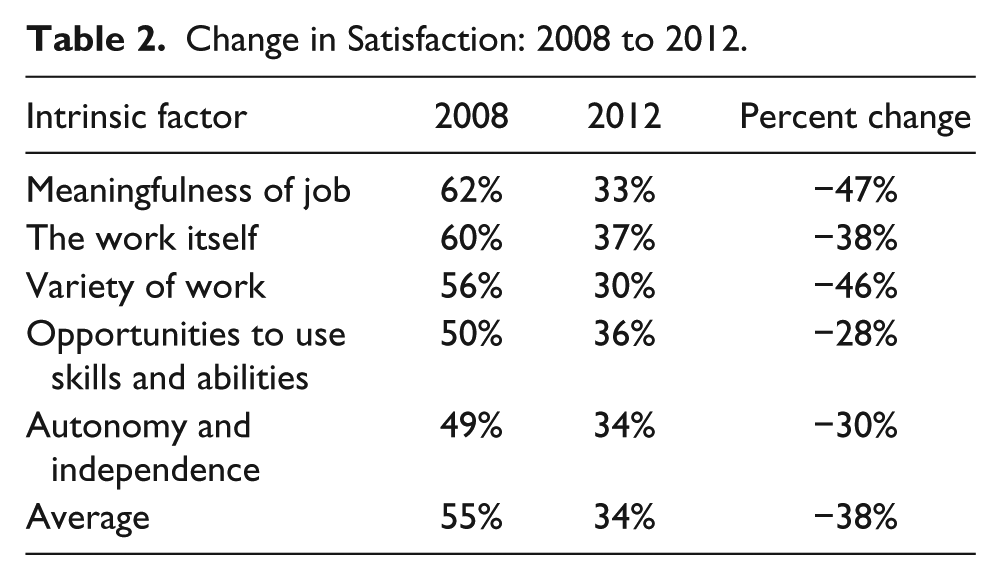
For all of the intrinsic factors, there has been a sharp decline from 2008 to 2012 in satisfaction for employees who believe intrinsic factors are very important to their job satisfaction.
In Table 3, the comparison for 2012 highlights the discrepancies between the percentages of employees rating them as “very important” to their satisfaction and as “very satisfied” with them.
Employee Satisfaction With Intrinsic Factors: 2012.
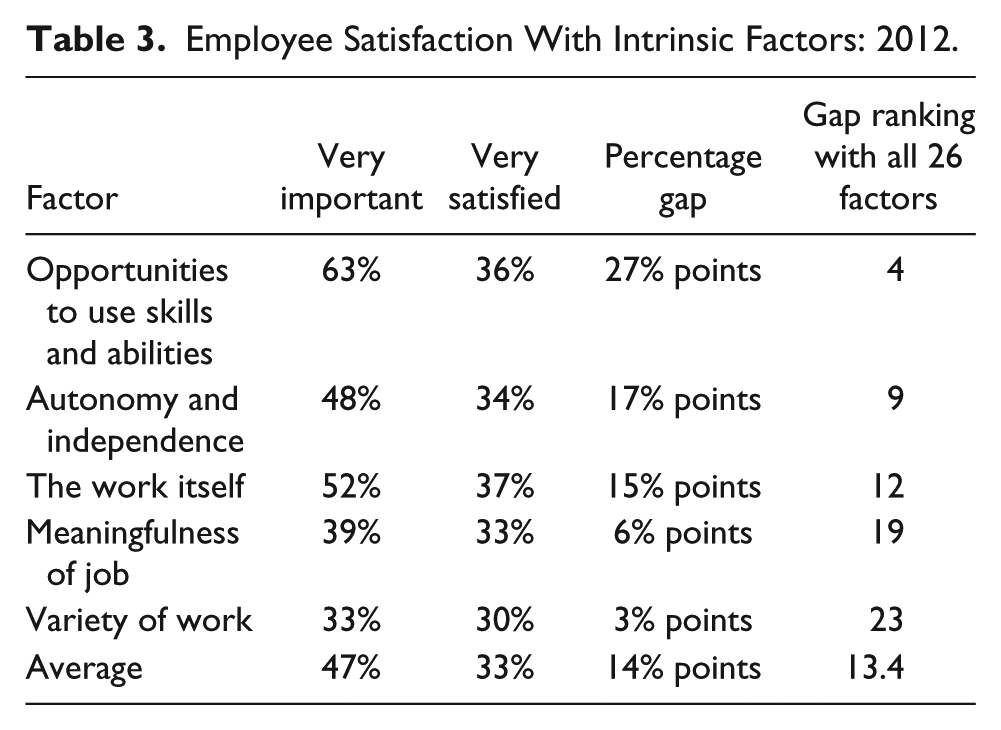
This comparison shows that these employees are substantially dissatisfied with three of the five intrinsic motivators—(a) opportunities to use skills and abilities, (b) autonomy and independence and (c) the work itself—when compared with other facets of work. The average gap of 14 percentage points between what they consider as “very important” and are “very satisfied” with across all five factors is slightly above the average of 13.4 for all of the 26 factors. Thus, according to this survey, there is considerable room for improving job satisfaction levels with three intrinsic motivational factors for employees who place a premium on intrinsic rewards.7,8
The Conference Board Job Satisfaction Surveys
Each year, from 1987 to 2011, The Conference Board surveyed a nationwide representative sample of 5,000 American households to determine the level of job satisfaction of working adults. The job satisfaction questions are based on a 5-point scale, ranging from “least satisfied” to “most satisfied.” “Satisfied” employees are those in the top two categories—“satisfied” and “most satisfied.”
From 2010 to 2011, the surveys showed an improved level of satisfaction with their interest in their work—from 48.7% to 56.1%. However, their satisfaction has declined substantially from the original 1987 survey in which 69.7% reported being interested in their jobs. 9 This 19.5% decline in satisfaction with the job itself compares with a decline in satisfaction of 21.5% and 11.2% for job security and pay, respectively.
In addition to considering how employees regard intrinsic rewards, it is also important to know the extent to which HR professionals realize how important they are to employees.
SHRM Surveys: Employees Versus HR Professionals
From 2002 to 2010, SHRM surveyed a random sample of 400 to 600 HR professionals to see what they believe are the most important drivers of job satisfaction for all types of employees in their organization. Over this period, HR professionals have never rated intrinsic factors, on average, at the same or higher level than employees. In fact, employees rated intrinsic factors 37% higher than HR professionals.
Over the years, SHRM has noted a substantial disconnect between the opinions of employees and HR professionals who in general have predicted that employees would be more concerned with relational aspects of the work, such as relationships with their supervisor and employee communication with senior management, than with other aspects of work.
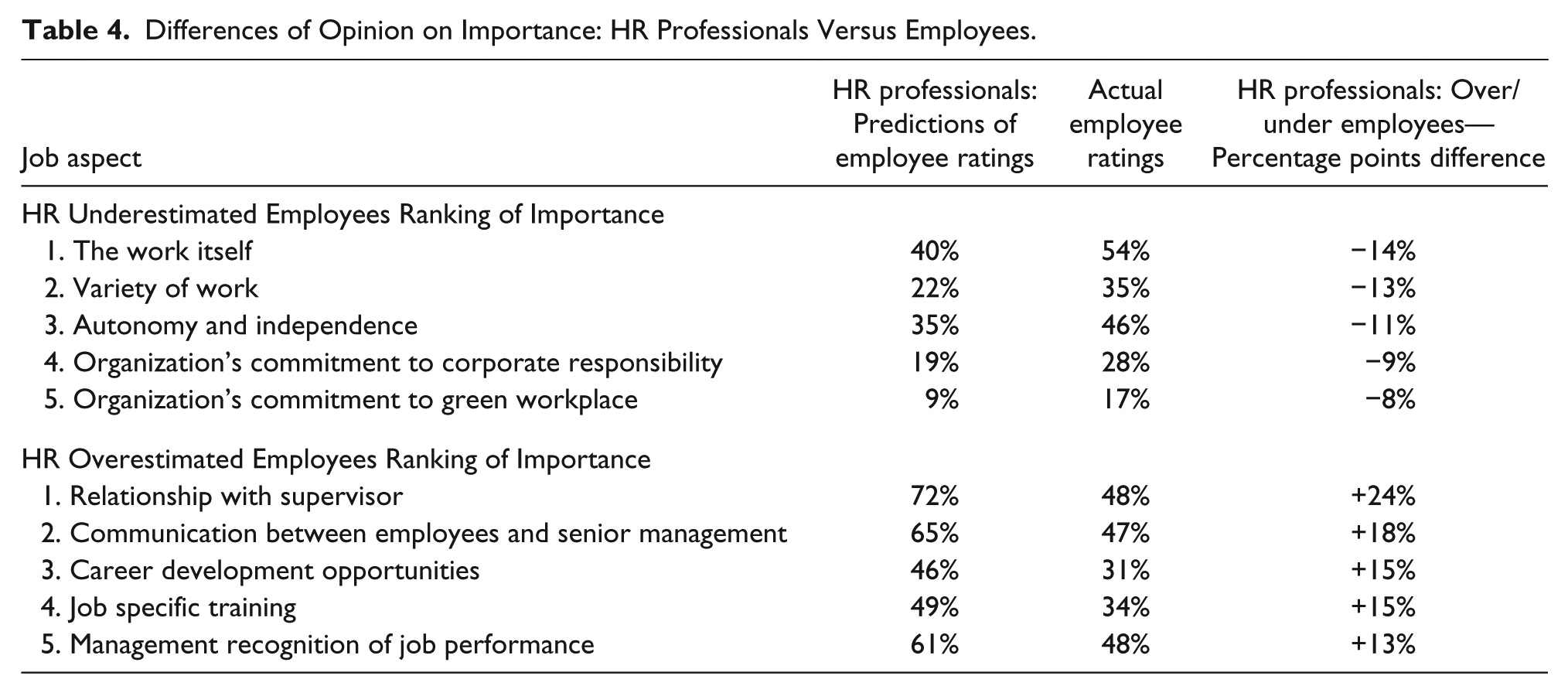
This pattern held true in 2010 with respect to intrinsic rewards. Three of the top five “underestimations” by HR professionals of what employees believe are important aspects of work are intrinsic factors. Three of the top five of their “overestimations” of importance are relational aspects of work—relationship with supervisor, communication between employees and senior management and management recognition of job performance. 10 Further details are shown in Table 4.
Differences of Opinion on Importance: HR Professionals Versus Employees.
Are Intrinsic Rewards on HR’s Agenda?
Every 2 years, SHRM conducts a survey as part of its Workplace Forecast to obtain the views of HR professionals on key issues that will affect the workplace in the coming years. The survey identifies actions their organizations are taking or are planning to take to address trends, changes and challenges. Results of the 2012 SHRM Workplace Forecast survey, based on responses of 487 randomly selected SHRM members, are described below. 11
Trends for 2013
The intrinsic aspects of work were not directly involved in the top 10 workplace trends for 2013 and beyond. The top five trends were (1) the continuing high cost of U.S. employee health care coverage, (2) implementation of health care legislation, (3) a shortage of skilled workers, (4) large numbers of Baby Boomers leaving the workforce and (5) implications flowing from the 2012 presidential and congressional elections. Similarly, in the surveys conducted from 2003 to 2011, intrinsic work factors were not directly reflected in the top ten trends.
Challenges Confronting HR
More than one-half of HR professionals believe that retaining and rewarding the best employees (59%) and developing the next generation of corporate leaders (52%) will be the greatest challenges HR executives face over the next 10 years. About one third predict the challenges will be creating a corporate culture that attracts the best employees (36%), being competitive in the talent marketplace (34%) and finding employees with the required specialized skills (33%).
HR Program Priorities
Providing flexible work arrangements (40%) and a culture of trust, openness and fairness (37%) were the top two tactics for attracting, retaining and rewarding the best employees over the next 10 years. One-quarter stated that offering a higher total rewards package than competitors (26%) and providing career advancement opportunities (26%) would be the most effective actions. Demonstrating a commitment to career development and providing meaningful work were cited by 24%.
This survey indicates that a majority of HR professionals are not currently giving intrinsic workplace matters a high priority from a strategic or tactical standpoint, despite the fact that, in general, they are important to employees who are not satisfied with what is being offered.
Accumulated Evidence
Following is a summary of the evidence about intrinsic rewards as noted in the above surveys:
Six recent surveys of employees and HR professionals conducted by well-regarded organizations—Towers Watson, Sibson Consulting, McKinsey & Company, Harvard Business School, WorldatWork and SHRM—indicate that intrinsic factors are very important elements in motivating and engaging employees.
Since 2002, SHRM job satisfaction employee surveys show that intrinsic workplace factors have been important elements of a job for many employees, especially managers and executives.
From 2008 to 2012, SHRM employee surveys show that there has been a sharp decline in satisfaction with intrinsic rewards for employees that value them highly.
From 1987 to 2011, Conference Board surveys show that employee satisfaction with the job itself has declined substantially.
From 2002 to 2010, SHRM surveys of HR professionals and employees show that HR professionals are out of touch with the importance that employees assign to intrinsic rewards.
A 2012 SHRM workplace forecast indicates that HR professionals are not currently giving intrinsic motivational matters a high priority in their work agenda.
Generally, intrinsic rewards contribute substantially to job satisfaction, engagement and motivation, are considered important to many employees who are not satisfied with what they have and are not receiving commensurate attention from HR professionals.
Possible Reasons for HR’s Lack of Attention to Intrinsic Rewards
There are several possible reasons why this situation exists.
HR professionals are unaware of the importance that intrinsic rewards have to employees, if they are unaware of national employee survey results and do not conduct surveys of their employees that includes this topic.
HR specialists do not champion the use of intrinsic rewards and have not made job design part of their charter. Compensation professionals, who are the most likely group to do so, have not expressed an interest in taking on this responsibility. Although they are heavily involved an analyzing and designing jobs, their certification program does not include the topic of job design. 12 Although their professional association, WorldatWork, is in the forefront of promoting the total rewards concept that expands the concept of rewards beyond the traditional rewards of pay and benefits, intrinsic rewards is not among the five elements in the total rewards model. 13
HR professionals do not seem inclined to think about the workplace from the standpoint of intrinsic rewards and job design. Despite being a major part of its annual job satisfaction surveys, SHRM has not featured intrinsic rewards as a separate topic in the analysis and discussion of the survey results. Individual job characteristics, which are covered thoroughly, are not grouped under one topic, such as intrinsic rewards or job design. For example, “job autonomy and independence” is discussed under the topic of “employee relationship with management”; “the work itself” and “meaningfulness of job” are discussed under the work environment; and the “ability to use skills and abilities” falls under “career development.” 7 A grouping under such as topic makes sense thematically and would show the total importance of intrinsic rewards.
HR specialists customarily work at the program or system level, whereas job design activities are at a more basic level that depends on knowledge of organizational psychology, an area in which they may lack deep knowledge and are not be comfortable working in.
There is no large body of widely accepted research showing that intrinsic factors motivate employee behavior more effectively than extrinsic rewards, so there is no compelling reason to explore nonfinancial motivational approaches. Research is also lacking on the optimal combination of intrinsic and extrinsic rewards.
Reports of major companies that have substantially improved employee productivity or other key metrics by using intrinsic motivators are hard to find.
Increasing the variety and authority in a job could be grounds for a job upgrade and pay increase, a result budget conscious companies may not welcome.
At times the suggested approach for using intrinsic rewards is impractical. For example, both Kohn and Pink advocate “taking money off the table” so employees can focus on the job itself.14,15 Unfortunately, such a move usually involves paying employees above market rates, which many companies cannot afford to do or deem necessary to attract and retain the right employees.
In the 1970s, job enrichment efforts were for the most part unsuccessful as planned changes were often overwhelmed by entrenched operating systems, organizational structure and management practices. 16 The same conditions are possibly obstacles today for firms considering intrinsic work improvements.
Final Thoughts
Realizing the potential value of intrinsic rewards is hindered by legitimate questions about their effect, practicality, entrenched management attitudes and practices, lack of professional interest and other factors. In select situations, however, consideration seems justified, as follows.
Managers and executives place greater importance on intrinsic rewards than other employees, so designing their jobs with intrinsic characteristics in mind will have the greatest acceptance and return with this group.
Employers that cannot compete on the basis of financial rewards could attempt to level the playing field by offering a superior package of intrinsic rewards, which typically cost much less than financial ones, and by developing a corporate culture that promotes the intrinsic satisfactions of work.
Company-wide programs to redesign all jobs are likely to be costly, disruptive and meet with considerably more resistance than opportunistic efforts that focus on open or new positions, which sometimes occur during company reorganizations and mergers.
Since many firms do not appear to be giving intrinsic rewards a high priority, those that do so will have a competitive advantage in recruiting, retaining and rewarding employees.
If the economy improves to the point where a war for talent exists, companies with a strong intrinsic dimension could have an edge in attracting employees.
The bottom line is that employers may be overlooking an opportunity to separate themselves from their competitors by capitalizing on the fact that intrinsic rewards are a relatively inexpensive and powerful motivating force in many people’s lives.
Footnotes
Declaration of Conflicting Interests
The author declared no potential conflicts of interest with respect to the research, authorship, and/or publication of this article.
Funding
The author received no financial support for the research, authorship, and/or publication of this article.