



Abstract
Ever-increasing competitive markets, changing business dynamics, technological advancements and specialization have made the traditional supervisor–employee feedback largely obsolete. To better compete globally, organizations have started to move from traditional hierarchical structures to team-based, flattened structures. Rating sources both inside and outside the organization provide key information that can help companies to be more adaptive. The practice of gathering performance feedback from multiple sources i.e 360-degree feedbackhas evolved from an innovative technique to a must-have tool in the overall performance and human resource management strategy. This article aims to explore the implementation of 360-degree feedback mechanisms in select IT organizations. Also, the article aims to explore the problems and challenges faced by employees in the implementation of multisource feedback. The article also provides suggestions for the improvement of 360-degree feedback process in IT industry.
Introduction
While the traditional approach to providing performance feedback to employees started changing years ago with concepts like Management by Objectives (MBO) new approaches to the organization of work and developments in technology made the traditional supervisor–employee feedback inadequate. To better compete globally, organizations started moving from traditional hierarchical structures to team-based, flattened structures. They outsourced non-core activities and moved to boundaryless organization structures that led to wider spans of control. In some situations managers now rarely see an employee performing his or her job. In this emerging business environment, managers need the perspectives of those who work with or otherwise interact with employees. That is the primary reason 360-degree feedback has become popular. Rating sources both inside and outside the organization have important perspectives of an employee’s performance.
The 360-degree or multirater feedback has evolved from an innovative nice-to-have technique limited to the most senior levels to a must-have tool for integrating the overall performance and human resource management strategy. 1 Hoffman 2 explains that 360-degree feedback is an approach that gathers behavioral observations from many layers within the organization and can include self-assessment. It can be viewed as a boundaryless appraisal extending feedback to include direct reports, colleagues and also the customers. Yukl and Lepsinger 3 define it as a “performance appraisal approach that relies on the input of an employee’s superiors, colleagues, subordinates, sometimes customers, suppliers and/or spouses.”
The four most common sources of performance feedback are self, supervisors, peers and subordinates. A supervisor’s rating on various performance dimensions has been the most common and is often referred to as “downward” feedback. This has been the common source throughout history.
However, a comprehensive feedback process embraces feedback from multiple sources. “Upward” feedback is gaining momentum as a vital source as it gives a say to the subordinates to rate their manager. No one is in a better position than direct reports to evaluate the leadership styles and the manner in which they are led. Thus, they provide valuable and qualitative information that can be used to improve the style and behavior of managers.
While subordinates provide significant inputs on the managerial and leadership styles of the supervisor, peers provide relevant information on the teamwork and other interactional aspects of coworkers. Kane and Lawler 4 define peer appraisal as the “process of having the members of a group judge the extent to which each of their fellow group members have exhibited specified traits, behaviors or achievements.” With employees working in teams and with the growing importance of self-managed teams, where there is no direct supervisor, a major concern is the lateral assessment of a team member’s performance which calls for the ever-increasing significance of peer appraisals. Colleagues at work are often in a better position to provide relevant information on behavioral dimensions such as team spirit, cooperation, communication and interpersonal skills.
Besides downward feedback, upward feedback and lateral feedback, self-assessment is the most significant phenomenon where an individual is the rater as well as the recipient of feedback. The performer himself/herself rates his/her own performance and behaviors and expresses his/her perception about their work behavior. Albright and Levy 5 point out that individuals tend to assess their own performance irrespective of whether they are formally required to do so. Also, self-assessment forces employees to reflect on their strengths and weaknesses and work on their grey areas. 6 Thus, it makes sense that self-assessment should play a role in the performance appraisal process.
Objectives of This Study
To understand the 360-degree feedback process in each organization under study.
To explore the problems/challenges faced by managers and employees in using the 360-degree process along with their suggestions for its effective implementation in IT Organisations
Information Gathering
Semistructured interviews were conducted with 30 line managers and 10 HR managers. The objective was to gain an understanding of the 360-degree feedback mechanism followed in their companies and to explore the challenges faced by employees in the use of this approach. Also, the suggestions provided by the employees and HR managers are reported.
The common features of 360-degree feedback process studied are as follows:
All the organizations have a 360-degree feedback mechanism in place.
All the organizations use 360-degree feedback for developmental purposes and do not link ratings with salary and/or promotion decisions.
The distinctive features of 360-degree feedback process in organizations under study are provided below.
Company A
In Organization A, the system was adopted in 2005.They refer to the system as a risk-free platform to give honest opinions. All employees at middle and senior levels and who have completed a minimum service of 6 months in the organization are eligible to receive feedback, whereas all employees irrespective of their band or tenure can give feedback. The feedback is kept confidential at all levels.
Both HR and line managers have high opinions about the process. One of the HR managers commented that “360-degree feedback fosters a collective learning environment that is used for identification of blind spots and managerial development.” The 360-degree competency framework has been revamped and eight competencies are associated with eight job roles. Each manager is evaluated on the top three competencies critical to his/her job role and an individual development plan is suggested accordingly.
Some of the eight competencies are People Sensitivity, Cross-Cultural Competency, Team Work, Passion for Work Excellence and Customer Orientation. Each competency includes several elements. Ratings are done on a 9-point scale ranging from Never to Always. The process in the organization is used for developmental purposes and is not linked to pay and/or promotion decisions.
As remarked by an HR Manager, “Reports generated from 360-degree feedback are used for developmental purposes and are used to identify the blind spots and chart out the individual development plan for employees.”
The training team in this company facilitates the use of the individual development plans to harness their technical, behavioral, functional and other soft skills. Derived from the unique philosophy of the organization of placing employees first, the training philosophy is to empower the employees through a process of continued learning. One of the unique and distinctive features in this organization is the posting of the multisource feedback voluntarily. If a manager agrees to do so, the feedback is posted on the intranet for all employees to see. Mangers at the top level of the organization also voluntarily post the feedback on the intranet portal as a sign of acceptance of feedback and commitment to change.
The 360-degree process in the organization has proven to be a true step in making the idea of reverse accountability a reality. The organization does it by implementing the following process:
Making it open: It was reflected in the interviews with HR and line managers that the organization believes in the quality of influence a manager has on others rather than on the number of employees reporting to him. Also, the employees are quite open in sharing the feedback and accepting it when it comes from an employee’s entire area of functioning (i.e., from managers, peers and direct reports). Their acceptance is reflected by the number of employees who share their feedback voluntarily as an acceptance of commitment toward change, taking an ownership for learning and development. Every year the number of employees sharing their feedback on the intranet has increased.
Making it confidential: Care is taken in the organization that at no point in the process the number of feedback providers or their identity is revealed. The feedback is kept anonymous at all levels. The feedback process and application has been reviewed externally and is also supervised by the Internal Audit Head to ensure compliance to this important aspect of the process. The organization believes in maintaining confidentiality and in motivating employees to give honest feedback to managers.
Making it democratic: The organization provides sufficient opportunities for employees to participate in decision making and in various other activities where they can positively contribute through innovative thinking and creativity.
This researcher’s observation confirmed that the company has replaced the traditional hierarchical structure of control with an employee-centric culture that is team based, open and democratic. This organization believes in shifting the focus from volume to value, from processes to people and from customers to employees as they believe that satisfied employees can only lead to satisfied customers. The organization provides a platform for the successful implementation of 360-degree feedback through a culture of openness, transparency and trust. Management believes that all developmental initiatives will result in the development of employees and thereby the development and growth of the organization.
The responses from both HR and line managers reflected that the organization offers various platforms to encourage the importance of multirater feedback and to recognize the employees who have contributed significantly by their feedback to the process of growth of other employees. The organization rewards its employees depending on the number of feedbacks given by them. Also, the company identifies outstanding and exemplary leaders. These leaders have been successful in creating a positive and effective span of influence in the organization and are deemed as Role Model Leaders.
Company B
The 360-degree process in this organization was implemented over the past 6 years and is now used at all levels. This company uses it for developmental purpose only; it is not linked to pay and/or promotion decisions. Management believes behavioral competencies are critical for effective performance, and therefore emphasizes 360-degree feedback for the development and improvement of behavioral and emotional competencies. The line managers reflected that developmental activities should be enforced at all levels, and therefore they see the process as significant at all levels. The organization has identified five competencies that are deemed important to the organization such as Customer Sensitivity, Team Participation and Cooperation, Interpersonal Communication and Strategic Thinking.
An employee receives feedback from managers, peers and direct reports annually on these competencies on a 5-point scale from does not meet expectations to exceptionally exceeds expectations. The company provides training on both technical and behavioral competencies. The technical training group takes care of the technical requirements and a behavioral training department assists in the development and enhancement of those behavioral competencies that are critical for effective performance.
All the training programs are based on an experiential learning approach (i.e., learning by doing philosophy) whereby the participant’s own experiences and reflection about the subject matter, rather than lecture and theory, serves as a means of generating understanding and transferring skills and knowledge. The company provides training on various aspects such as team building, communication skills, diversity management, conflict management and people management. The organization uses the 360-degree feedback to identify employees who have the potential to operate as change agents and introduce a lateral thought process in the organization by contributing in high-impact roles. These candidates are mentored by the senior leadership team and groomed to take on managerial or techno commercial roles.
The organization focuses on taking every measure at improving customer satisfaction and believes in the philosophy that the customer lies at the center of every activity. The organization believes that customer’s expectation is critical to survival, especially in the IT industry. Customer expectation management is the key to maintaining and developing customers. That makes it vital to understand what customers want, what their expectations are and ensuring that customer needs are met on time without compromising the quality. The organization conducts a customer satisfaction survey every 6 months and incorporates the feedback for continual improvement in client satisfaction. As was observed and as evident through discussions, the organization believes in keeping customers at the center of every activity.
The organization believes in rewarding the employees on the basis of commitment to the company’s growth through sustained high-quality efforts and excellence, living the values of the organization, role models for one and all, participation and contribution in activities of strategic importance, contribution to organization development and continuous and long-term association with the organization.
Company C
The 360-degree feedback process in this organization started in 1996 and became web-enabled in the year 2000. The feedback process is applicable to all employees in the organization who have completed a minimum of 1 year of service in the organization and is used as a purely developmental tool and is not used for making decisions such as promotion or compensation changes.
As remarked by a line manager,
The 360-degree feedback process eliminates any bias as the views are taken from the entire exposure area. The rater’s team is made on the basis of work-related interactions. The feedback is based on critical work-related behavioral competencies. Each competency is broken down into statements known as behavioral indicators, and the behavioral indicators for the same attribute differ according to the level of competency mapped for a role.
As per the inputs provided by the HR and line managers, the purpose of 360-degree feedback is to provide information as to how the behavior of employees is affecting or influencing others in the organization. Here the process is used for personal growth, learning about self, gaining insights about hidden self and creating an open environment for effective interpersonal communications.
The interviews also disclosed that the company collaborates with leading B-Schools such as XLRI, IIM and MDI to facilitate training programs to develop managerial and behavioral competencies. The feedback is used only for developmental purposes. The 360-degree process focuses on attributes such as analytical and conceptual ability, customer orientation, impact and influence, initiative, integrity, result orientation and team work and cooperation. Employees are rated by the supervisor, subordinates, self and peers on the above-mentioned attributes.
Ratings are based on a 4-point scale. The scores are averaged for each competency and the average scores provided by raters are shown for each attribute against self-rating scores. The purpose is to provide an employee insights about the difference in his or her self-assessment versus how others see him or her with the differences being the basis for individual development. Also a comparison on the same attributes from the prior year is provided to chart the improvements attributable to training completed by the employee.
A line manager stated that “the organization encourages employees to speak to people in confidence and gather personal feedback to validate the assessment and make development plans in accordance with the feedback.”
The entire process of multisource feedback is a self-developmental tool focused on building key competencies for the role that he/she is performing and does not affect his/her performance assessment. Also, the organization uses a customer survey on a yearly basis to identify satisfaction on various projects and to bridge the gap between desired and actual employee performance.
The organization uses the 360-degree feedback to create an open environment for effective operational and interpersonal communication and aids in preparation for the future, not dwelling on the past. It helps in the identification of blind spots and provides clarity on behavioral expectations for the current role. It also guides employees in inculcating certain attitudes through behavior indicators. The company also assists employees in understanding the feedback and organizes training sessions to help them accept negative feedback and to work on their weak areas. A goal is to foster an environment of inclusivity whereby female employees are encouraged to participate in various activities to place them on a level playing field. There is also a special initiative to keep employees informed about the latest developments in the industry as well as new work opportunities before they are opened up externally. The organization collaborates with business schools and invites industry experts to assist employees in achieving their career aspirations, improving weak areas and in acquiring new skills. The company believes in creating an atmosphere that fosters work–life balance through a stress-free environment, events and celebrations. It also believes in having a participative culture where every employee matters and is encouraged to participate in the activities of the organization. The intent is to create an environment where employees are encouraged to take risks, knowing that mistakes are permitted if they contribute to the learning and growth of employees.
Company D
This company has been using 360-degree feedback since 2005. The 360-degree process is used for middle-level and senior-level managers. Employees provide feedback through a web-enabled competency-based tool for the growth and development of managers. The parameters used in the 360-degree process include customer satisfaction orientation, team work, result orientation, innovative thinking and initiative.
The responses of the HR and line managers reflect the purpose is to help managers gain invaluable self-awareness and knowledge to help them create meaningful development plans for their growth and improvement. Also feedback provides managers with insights into their leadership styles and areas of needed improvement. Leadership programs are organized to help leaders in bridging the gap between observed and desired behaviors. One of the HR managers stated that “the organization focuses on the leadership development through a leadership framework to achieve the organization’s strategic imperatives.” HR managers also commented that leadership training and workshops are conducted under this program.
The company uses the 360-degree process to support leadership development. The purpose is to enhance a manager’s self-awareness through this process and help them create a meaningful development plan. Various leadership development workshops are offered to help managers understand leadership behaviors across geographies and cultures. The organization also creates various training programs to enhance the contribution of managers in achieving organizational goals and success. The organization also organizes webinars, quizzes, learning surveys and other activities to help employees learn new skills. The organization believes in making employees individually responsible and increasing their accountability for results. The organization rewards employees on the basis of goal achievement and project acceleration. The organization believes in imparting systematic training on technical skills. It believes in being successful by deeply understanding customers and committing the entire organization in offering exceptional service and value.
Company E
This company was amongst the earliest to adopt the 360-degree feedback process. The organization’s goal is developing leaders from within. HR managers expressed that the organization believes in filling the senior positions from within, which requires development of leaders from within, which in turn requires a well-established system in the organization. To start, they identified eight Leadership Qualities, which were based on the organization’s vision, values and business strategy.
In order to identify and help leaders develop these competencies, they adopted the 360-degree survey process referred to as Leadership Quality survey. Some of the examples of eight parameters used include strategic thinking, commitment to excellence, building star performance, global thinking and acting, self-confidence and aggressive commitment.
Each of the above-mentioned parameters covers four to five observable behaviors, for a total of 35 statements. Feedback is given on a scale of five and is assessed on the frequency of qualities displayed by the leader. The scale ranges from “Almost always” to “Almost never.” There is also a column “Cannot rate.” A line manager stated that the questionnaire also provides an opportunity for the rater to provide qualitative comments regarding what the leader should “continue doing because he/she was good at it,” “start doing because it was needed,” and “stop doing because that was not required” or was viewed as a negative trait.
The process was initially adopted for senior managers but now because of its increased acceptance and significance, it is used with the middle-level managers also. The purpose is purely developmental in nature. Based on this feedback, the company identifies 25 “Star Leaders” who have above par performance on the given parameters. These Star Leaders are on the fast track and are provided with opportunities to excel on a preferred basis. The list of Star Leaders is reviewed annually.
The organization believes in a participative culture where the philosophy is to work together—in teams. The philosophy is not winning at the cost of others but realizing that success comes through partnering. The company believes in the satisfaction of all stakeholders including employees, customer, suppliers and public at large. It believes in developing leaders from within and organizes training programs on subjects such as empathy, innovation, creativity and participative style . It believes in fostering a culture of mutual respect for each other, spirit of democracy, equity amongst employees, necessity for diversity and offering a platform of inclusivity at all levels and ethos of justice.
Another important feature in the organization is to foster trust among employees by offering a platform to learn to enable employees to grow and realize their full potential. It believes in acting with integrity without any compromise and believes in establishing the foremost standards of honesty and fairness. The organization believes in not just grooming the talent of its employees but bringing out the leader in them. The various leadership programs are targeted to uncover the potential in employees and help them be good leaders—heading large and strong teams. It believes in promoting an open culture where feedback is encouraged. The organization believes in listening to what its employees have to say through formal surveys as well as through informal discussions. Ample learning opportunities and training facilities are provided at continuous intervals to offer excellence in quality and customer service.
The organization considers its employees as the biggest asset and promotes them without any discrimination and is committed to creating a workplace where each employee is respected and is treated with dignity. It believes in individual growth and overall development. It recognizes employees and rewards them on the basis of team spirit, performance and innovation.
The Problems Faced by Line Managers
Across the five organizations, a total of 30 line managers were interviewed to understand the problems experienced with the 360-degree feedback process. They also provided suggestions to avoid or minimize the problems.
The responses from line managers are summarized in Table 1. As is evident from the responses, line managers felt that the purpose in using 360-degree feedback should be made clear to all employees. Frequent two-way communication should take place and town hall sessions conducted to help employees understand the process. Also, raters should be selected only if there is adequate interaction between the rater and the employee, ensuring that raters have a good perspective of the candidate.
Summary of Problems and Suggestions for Improvement in the Use of 360-Degree Feedback by Line Managers.
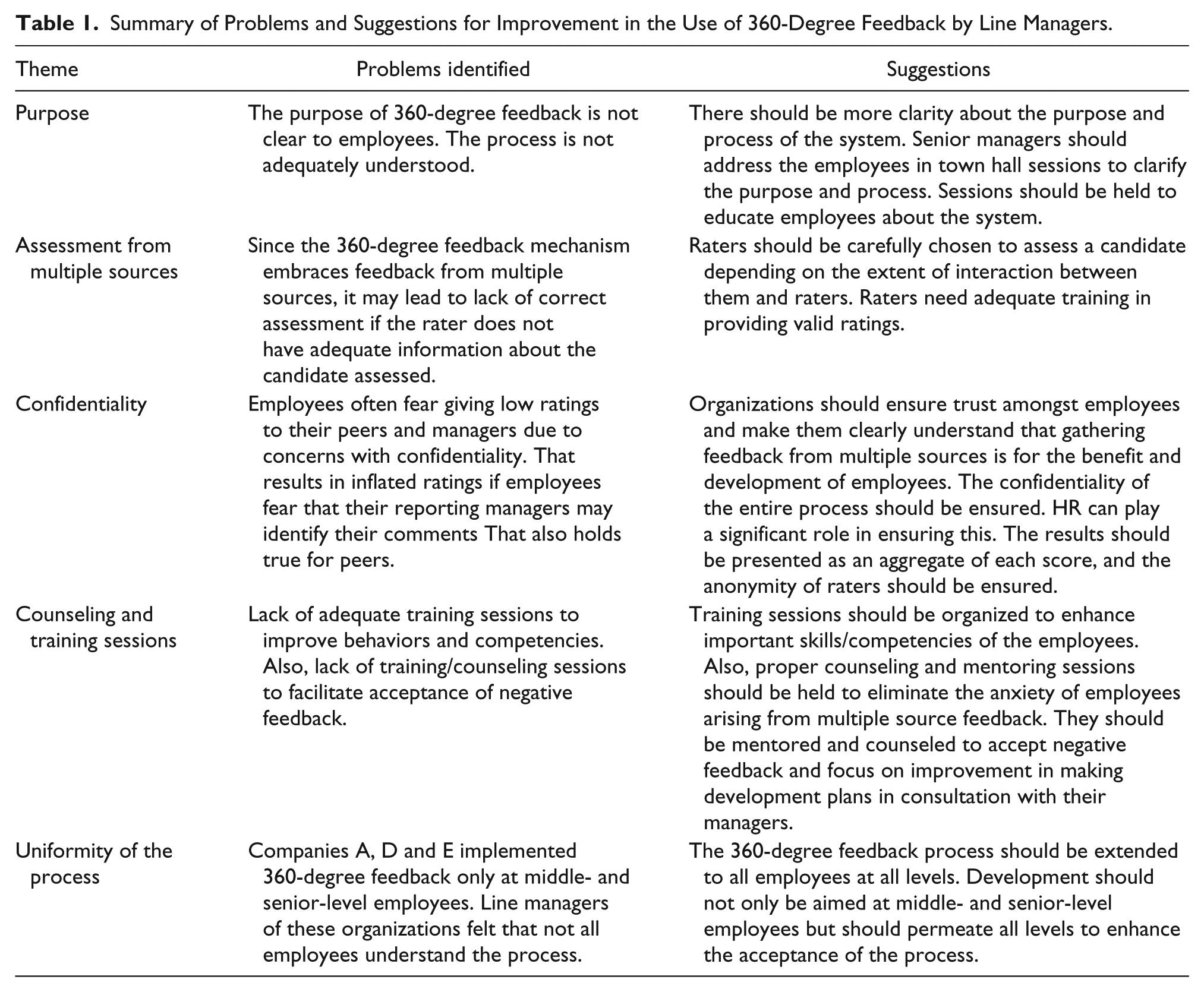
Also building trust amongst employees is quite important to success. Unless and until employees trust that the system is used for their benefit and career development they are likely to be hesitant to participate in the process and in providing accurate ratings. It is essential for organizations to ensure confidentiality. It was also emphasized by line managers that managers perceive difficulty in accepting negative feedback when it comes from direct reports and peers. For that reason mentoring and counseling sessions should be organized to help individuals accept negative feedback and work on improvement areas. Mangers believed that since this process is quite significant, it should be implemented at all levels. All employees should understand and participate in the process since development is required at all levels.
Conclusion
The interviews with HR and line managers gave valuable insights into the 360-degree feedback process followed in these organizations. In each it was found that the process was for developmental purposes only and was not linked to salary and/or promotion decisions. Also, all five organizations were using distinctive parameters/competencies that they deemed significant. Companies A, D and E used 360-degree feedback only at middle- and senior-level managers, while organization B and C used it across all levels of employees. All individuals involved in the 360-degree feedback process prepared developmental plans in consultation with their manager to work on the improvement areas identified during the process.
The interviews with line managers shed light on their problems in implementing the process and gave suggestions for improvement in the process. The line managers of organizations A, D and E recognized that multisource feedback is a significant process that can meaningfully contribute to the organizations as well as employees and can contribute to significant improvement in performance and behavior when used at all levels in their organizations.
It was also emphasized by the line managers that the purpose of the feedback process should be made clear. Town hall sessions should be conducted to introduce employees to the process and to make certain that they understand the purpose and process. They also suggested that raters should be identified on the basis of interaction level of raters and ratees to ensure that the rater has adequate information to assess an employee. Also, suggestions were made that the confidentiality of the raters should be ensured by the organization.
Footnotes
Author’s Note
Many researchers and practitioners have written quite insightful articles on 360-degree feedback but in my article I wanted to introduce the concept of 360-degree feedback and reflect on its mechanism in five IT organizations; therefore, I have not included the academic literature on the subject in this article.
Declaration of Conflicting Interests
The author declared no potential conflicts of interest with respect to the research, authorship, and/or publication of this article.
Funding
The author received no financial support for the research, authorship, and/or publication of this article.