




Abstract
This article applies new insights into business strategies and compensation to examine why organizations adopt pay polices based on the performance of the entire organization (i.e., organization-level incentives such as profit sharing and gain sharing). Results based on a longitudinal national sample of 1,974 Canadian workplaces show that organizations with product leadership business strategies are more likely to adopt organization-level incentives, which in turn have a positive impact on innovation performance. Implications of the findings for theory, future research and management practice are also discussed.
Introduction
Compensation programs based on the performance of an entire organization (i.e., organization-level incentives such as profit sharing and gain sharing) have been found to be able to improve employee morale, increase productivity and contribute positively to company financial performance.1,2 However, employers’ responses to this type of collective incentives have varied widely. Some employers have adopted organization-level incentives and others have not. Even among those who do adopt the incentives, there is a great deal of variation as to the type of programs adopted. In examining why some organizations have programs in place and others do not, some researchers argue that the emphasis on flexibility and cooperative efforts in contemporary organizations is conducive to collective incentive plans, such as gain sharing and profit sharing. 3 These incentive plans link rewards to the performance of entire units, which reflects the cumulative contribution of all teams and employees. 4
Other researchers find that companies were more likely to implement collective incentive plans when managers reported higher levels of employee cooperation, 5 or the companies faced capital requirements and financing constraints. 6 The research findings provide extensive explanations regarding why some organizations are more responsive towards organization-level incentives than others. However, relatively little research has considered the role that business strategies may play in this issue. According to Barney, a business strategy is “a firm’s theory about how to compete successfully” (p. 6). 7 As an all-encompassing and long-term organizational objective, a business strategy may well determine what kind of incentives a company adopts.
Also lacking in the literature is a consideration of the mechanisms through which business strategy may influence an organization’s decision to adopt collective incentive programs. One of the potential mechanisms may be human resources (HR) strategy. An organization’s business strategy influences strategic orientations of the entire organization, including HR strategy. Carefully designed and executed HR strategies can motivate employees to work harder towards an organization’s strategic goals. In addition, HR strategic implementation require employees’ commitment and engagement to function well, and organization-level incentives can help an organization foster these attitudes and behaviors.8,9 Therefore, HR strategy is likely to play an important role in connecting business strategies with the adoption of organization-level incentives.
This study attempts to extend the theoretical and empirical work of previous studies on the issue of organization-level incentives adoption in light of new insights into an organization’s business strategy and HR strategy. Specifically, this study explores the issue through a behavioral perspective and contributes to the literature in the following ways.
First, we adopt the behavioral perspective from strategic human resource management (HRM) to examine the strategic choice behind an organization’s compensation policy for all its employees. The behavioral perspective of strategic HRM emphasizes the congruence between an organization’s business strategy and its HR strategies (including compensation strategy). Synergies among these strategies can contribute to organizational performance by signaling and rewarding behaviors that are consistent with the organization’s strategic goals.10-12 Therefore, by linking compensation polices to an organization’s business strategy, the behavioral perspective of strategic HRM provides a lens to understand the organization’s strategic choice of compensation practices.
Second, we empirically test a framework of how business strategy affects an organization’s choice of organization-level incentives (i.e., gain sharing, profit sharing and employee stock purchase plans). Extant literature shows that many modern organizations require the utilization of interdependent teams with a high level of knowledge sharing and interaction among all employees to adapt to the “knowledge economy.”13,14 This is especially relevant when organizations pursue product leadership as their strategic goal because product leadership strategy is characterized by rapid growth, continual resource development and flexible production methods. To motivate employees’ efforts in this work context, their performance should be measured by performance metrics that are achievable through all employees’ contribution rather than individual efforts. Also, more recent studies have demonstrated that the alignment between an organization’s strategic goal and its compensation practice is a key factor to the execution of its business strategy. 15 We complement this strand of literature by showing that organizations with a product leader business strategy are more likely to choose organization-level incentives as compensation practices.
Third, we investigate the effect of compensation policies on an organization’s innovation performance. Existing compensation studies usually focus on the relation between compensation policies and financial returns.16-18 While financial performance is an important organizational goal that is worthy of investigation, an organization’s success is increasingly dependent on its ability to bring innovative products or services to the market. 19 As Keupp, Palmie, and Glassman pointed out, an organization’s ability to innovate is crucial to long-term profitability and sustainable growth. Therefore, it is important for organizations to foster an environment of innovation and creativity. 20 Few studies, however, have investigated what kind of compensation practices can help build such a working environment. This article is among the few studies that examine whether group incentive plans contribute to an organization’s innovation performance.
Finally, we expand our understanding of compensation strategy to a broader context. Previous research on compensation strategy often relied on cross-sectional data and a limited number of industries.21,22 It is difficult to determine causal relationships from such a limited data set or to generalize such findings to other industries outside the data set. The present study uses a longitudinal, nationally representative sample including organizations of different size and multiple industries. The large, nationally representative data set allows for appropriate controls in data analysis and increases the external validity of the research results. The longitudinal research design also provides increased confidence in finding a causal relationship.
In sum, this study investigates whether an organization’s business strategy shapes its compensation policies and whether those compensation policies influence the organization’s innovation performance. To foreshow our hypotheses and highlight our contributions, we elaborate a model of how product leadership business strategy affects the adoption of organization-level incentives through HR strategy and how the incentives affect innovation performance. Figure 1 shows this model.

Theoretical Model.
Theory and Hypotheses
Behavioral Perspective of Strategic HRM
The basic premise of the behavioral perspective of strategic HRM is that HRM is a major means through which an organization communicates, solicits and maintains certain desired employees’ behaviors that are important for the organization’s success. 23 According to this theory, organizations do not perform by themselves. Instead they adopt HR practices to encourage desirable employee behaviors in order to achieve organizational outcomes. 24 More importantly, the behavioral perspective recognizes that characteristics of external and internal factors, such as business strategy, organizational culture and organization size, influence the desirability and the use of certain employee behaviors. In other words, business strategy, like other factors, determines the types of desired employees’ behaviors, and HRM helps elicit such behaviors through all processes of HRM. This echoes the argument by Ulrich and Lake 25 and Wright and McMahan 26 that the success of any business strategy depends on the adoption of appropriate HR practices. Specifically, if an organization’s strategy is to differentiate itself from its competitors through superior products and services, the organization’s HR practices are likely to focus on (1) developing employee skills and knowledge, (2) paying higher than average salaries to attract and retain innovative employees and (3) encouraging employee participation. This set of HR practices aims to communicate with employees that the organization values participation, innovation and creativity. Behavioral perspective advocates further argue that the congruence among an organization’s business strategy, HR strategy and HR practices positively affects organizational performance. Conversely, they believe that conflicts between business strategy and HR practices could prevent an organization from reaching its strategic goals.27,28
Empirical studies have tested the behavioral perspective of strategic HRM. However, not many studies have found evidence that good alignment between HR and business strategy directly influences organizational performance.29,30 After analyzing existing empirical evidence, Wright and Sherman argued that this dearth of evidence is partially caused by measurement problems in HR practice. 31 For example, Becker and Gerhart proposed a four-level architectural approach—from the highest level of guiding principles to the lowest level of practice alternatives—to measure HR practices, whereas most studies test the alignment effect within the highest HR concept level. 32 Because the highest concept level (i.e., how employees’ performance is evaluated and rewarded) is theorized to have a universal effect on organizational performance, 33 it is not surprising that these studies found no empirical support that aligned HR and business strategies directly affect organizational performance. Alternatively, Wright and Sherman postulate that the lower level of more specific measures of HR practices (i.e., practice alternatives) offer a better environment within which to test the behavioral perspective. 34 In the present study, we follow Wright and Sherman’s suggestion and use a set of specific HR practices, that is, organization-level incentives, to test a model that connects business strategy, HR strategy and organizational innovation performance. 35
Product Leadership Business Strategy, Commitment HR Strategy and Organization-Level Incentives
Business strategy is an organization’s long-term plan to compete successfully in the market. 36 There are at least three generic strategies: cost leadership strategy, product leadership strategy and focus strategy. 37 Cost leadership strategy aims to gain a competitive advantage through lower costs. Product leadership strategy focuses on creating a distinctive or unique product or service that is unsurpassed in quality, innovation or other features. Under focus strategy, organizations concentrate on satisfying a segment of the market with low priced or highly distinctive products. Very few organizations focus on only one strategy and instead adopt two or more strategies simultaneously. 38 With the ever-changing customer demand and dramatic organizational changes that are driven by the increased use of information technology and globalization, most organizations are forced to adopt some product differentiation strategies and produce highly creative products or services. 39 Accordingly, in the present study, we focus on product leadership business strategy and examine how product leadership business strategy determines the choice of HR strategy and compensation practices.
As a comprehensive and long-term organizational objective, product leadership strategy influences policy decisions of an entire organization, including its HRM decisions. This argument is based on the behavioral perspective of strategic HRM, which proposes that the selection and the mix of HR practices are determined by specific strategies an organization adopts. 40 Product leadership business strategy is characterized by rapid growth, continual resource development and flexible production methods. It relies on a committed workforce to improve the quality of products and services. Employees’ commitment and discretionary efforts are the key to the successful implementation of this business strategy. 41
Commitment HR strategy is conducive to developing such a devoted workforce. 42 It attempts to foster a commonality of interest between an organization and its employees. To develop this common interest, the HR department hires predominantly from within the organization, invests extensively in employee training, encourages high level of employee participation, implements both individual and organization-level performance measures and provides a considerable amount of employee security.43,44 Because these HR practices are not mandated by government policies or union contracts, they symbolize organizational recognition of employees’ contribution and show organizational caring. After perceiving this caring behavior from employers, employees are likely to reciprocate by engaging in devoted and loyal behaviors. 45 Based on the above argument that a product leadership business strategy needs a devoted workforce and that a commitment HR strategy can develop such a workforce, we propose the following hypothesis:
In addition to the vertical fit between business strategy and HR strategy, the behavioral perspective of strategic HRM focuses on the horizontal fit among all HR activities. 46 It requires that all HR practices be aligned with one another to achieve a common HR objective. Thus, all HR practices in an organization with a commitment HR strategy should be designed to develop a committed workforce to help achieve the organizational goal of providing unique products and services. An important characteristic of a commitment HR strategy is its emphasis on collaboration among employees. 47 Most innovations today result from an accumulation of ideas from a group of people. Thus, collaboration becomes essential for any organization to achieve its innovation objective. According to the behavioral perspective, the entire range of an organization’s HR practices—including its job design, staffing, training, performance management and compensation—needs to encourage cooperation among employees. For example, jobs and projects should be designed such that success is dependent on the cooperation of multiple employees. 48 Recruitment and project assignments aim to attract and hire candidates with a collegial spirit and problem-solving skills. 49 Training is offered to enhance communication among all employees.50,51 To be aligned with these HR practices, compensation policies and pay-for-performance plans should shift away from individual incentive systems to organization-level incentives. 52
Unlike individual incentive systems, which have performance measures that are based on individual performance, profit sharing and gain sharing are based on the performance of an entire organization. They affect all employees and can create an environment that motivates individuals to achieve organizational goals. 53 Synchronization of compensation policies with other HR practices to promote cooperation is critical to organizational performance. When compensation policies are out of synch with an organization’s HR policies, employees may be confused as to what behaviors are expected and valued.54,55 For example, employees will receive inconsistent feedback as to what they are expected to do if performance appraisal measures group achievement while compensation policies reward individual performance. 56 Such inconsistency may also result in employees’ perceptions of role ambiguity, interpersonal conflict and lower levels of cooperation among employees. Based on the argument that a commitment HR strategy focuses on employee cooperation, and compensation policies should be designed to align with this objective, we propose the following hypothesis:
Compensation policy is a crucial HR lever to influence employee behaviors to achieve an organization’s strategic goals.57,58 The better the fit between compensation policy and business strategy, the greater the competitive advantage an organization will gain.59,60 However, business strategy does not affect compensation policy directly. As discussed previously, business strategy influences compensation through its effect on the overall HR strategy. As Walker
61
notes, The challenge of managing human resources is to ensure that all activities are focused on business needs. All human resource activities should fit together as a system and be aligned with human resource strategies. These strategies, in turn, should be aligned with business strategies. (p. 2)
Therefore, an organization with a product leadership strategy is more likely to have a commitment HR strategy in place first and then to adopt incentive programs based on organizational performance to develop a committed workforce. Consequently, we expect that the relationship between business strategy and organization-level incentives is indirect and hypothesize the following:
Organization-Level Incentives and Innovation Performance
It is widely believed that properly designed compensation practices can promote desirable employee behaviors, which are instrumental to successfully implementing business strategies.62,63 However, organization-level incentives have not always been found to contribute to organizational performance.64-66 We argue that this lack of evidence may be attributed to a lack of fit between organization-level incentive programs and the measure of organizational performance. The behavioral perspective of strategic HRM argues that HR practices need to be aligned with business goals to achieve optimum results. Organization-level incentives are not designed to achieve all organization goals. They are effective when the performance measures are based on all employees’ performance, and when it is difficult to separate the contribution and performance of individual workers. Empirical findings suggest that when tasks are interdependent, performance may be more accurately and reliably measured at the organization level rather than at the individual level. 67 Performance-based compensation practices have been consistently found to be more effective for interdependent teams, which require a high level of knowledge sharing and interaction. 68 Therefore, we expect that organization-level incentives have positive effects on organizational performance that relies on team work and cooperation among all employees.
Innovation performance is a type of organizational outcome that is built on employee cooperation. Traditionally, innovation studies have focused on individuals and assumed that creative people work alone. However, most innovations actually result from employee cooperation and team work. 69 A group of people tend to produce more creative ideas than individuals do. People share diverse backgrounds are more likely to use a broader range of experiences in problem solving and idea developing. 70 Dunbar (1995)’s study finds that highly innovative laboratories typically draw staff from a variety of relevant backgrounds, of which increases diversity of available knowledge and encourages active collaboration among staff members when working on projects. 71 More recently, Barrett, Vessey, and Griffith show that successful innovative endeavors are characterized by capitalizing on an environment that provides a diverse background of workforce with relevant knowledge and experience. 72 Thus, to improve innovation performance, organizations need to develop cooperative environments and provide a mechanism to influence the collective motivation of team members. 73
Organization-level incentives can help achieve this goal by promoting cooperative behaviors. Unlike individual incentives, which may undermine teamwork and encourage short-term individual focus, 74 organization-level incentives motivate employees to focus on mutual interaction 75 and link pay to performance at an organizational level. In addition, organizations are able to use organization-level incentives to target innovation performance because these incentives are customizable. 76 Thus, organization-level incentives are more likely to be successful when applied in jobs where collaboration and team work are important elements of performance and where innovation is a key aspect of organizational success. We therefore propose the following hypothesis:
Method
Sample
The data used in this study were derived from the 2001 to 2006 Workplace and Employee Survey (WES), which is a unique Canadian data set collected by Statistics Canada. The target population is defined as all businesses operating in Canada with the following exceptions: (1) employers in Yukon, Nunavut and Northwest Territories and (2) employers operating in crop production and animal production; fishing, hunting and trapping; private households; religious organizations and public administration. As cooperation with Statistic Canada is obligatory, and Statistic Canada enforces extensive legal protections to ensure the confidentiality of responses, the response rates are near 90%, with businesses with no paid employees comprising most of the nonresponders. 77 The high response rates significantly reduce selection bias.
WES only asked about business strategy, HR strategy and compensation practices for workplaces in odd year surveys (i.e., 2001, 2003 and 2005). To mitigate possible endogeneity and reverse causality among business strategy, HR strategy, compensation practices and innovation performance, we use 1-year lagged value for innovation performance variables (i.e., 2002, 2004 and 2006). As a result, the final sample is a balanced panel with three waves of business strategy, HR strategy and compensation practices from 2001, 2003 and 2005 and three waves of innovation performance from 2002, 2004 and, 2006. We also exclude workplaces with fewer than 10 employees because these workplaces usually do not have an explicit business strategy or HR strategy. The final sample includes 1,974 workplaces and 5,922 workplace-year observations.
Although the dataset is over 10 years old, it is the only existing dataset that is well suited for our study. In addition to the various organizational characteristics that we want to examine (i.e., business strategy, commitment HR strategy, compensation policies and innovation performance), the dataset is longitudinal and provides a picture of practices across the nation. The longitudinal dataset allows us to know whether business strategies and HR policies have been in place for a minimum amount of time. Moreover, there is no evidence showing that the HR practices and policies have been undergoing dramatic change in the past decade in Canada. Thus, we believe this is the best available dataset that addresses the questions we are asking. Other countries have similar data but they do not have longitudinal data in consecutive years (e.g., British Workplace and Employee Survey and Australian Workplace Relations Study).
Variables and Measures
Organization-level incentives: The variable is a dummy variable that is assigned a value of 1 if a workplace adopts profit sharing, gain sharing or employee stock plans as part of its group incentive plans. It is assigned a value of 0 if a workplace does not adopt any of them.
Product leadership strategy: In the WES, employers were asked to rate the relative importance of 15 items for their workplace’s general business strategies on a scale from 1 to 5. Following the study of Wang and Verma, 78 we measured product leadership strategy by taking the mean score of undertaking research and development, developing new products/services and developing new production/operating techniques. Product leadership strategy has a range from 1 to 5 with a reliability coefficient (Cronbach’s alpha) of .80.
Commitment HR strategy: Similar to product leadership, WES employer survey respondents were asked to rate the relative importance of five items for their workplace’s general HR strategies on a scale from 1 to 5 (i.e., from not important to crucial). Similar to Lee and DeVoe, 79 we measured commitment HR strategy by computing the mean score of enhancing labor–management cooperation, increasing employee skills and increasing employee involvement/participation. Commitment HR strategy has a range of 1 to 5 with a reliability coefficient (Cronbach’s alpha) of .84.
Innovation performance: We measure innovation performance by creating three separate dummy variables. WES asked the employers whether a workplace had introduced new goods/services and improved goods/services. We coded answer of “yes” as 1 and “no” as 0 to create two dummy variables, namely, new product/service and improved goods/service. We also create a third dummy variable called overall innovation performance to capture a more general effect of compensation policy on performance. The variable is assigned value of 1 if a workplace has any of the following practices: (1) new goods or services, (2) improved goods or services, (3) new processes and (4) improved processes. A value of 0 is assigned if the company does not have any of these practices.
Controls: In addition to the above mentioned key variables, we also include several control variables based on previous studies. The control variables are industry dummy variables, 80 number of employees 81 and firm age. 82 We dummy-coded the 14 industrial categories listed in the WES survey and used the first industry group (i.e., forestry) as the reference group in all regressions. Number of employees is defined as the total number of employees at a workplace. Firm age is defined as the age of a workplace since it was established. For a detailed definition of variables and questionnaires, please see the appendix.
Analysis strategy: As WES is survey data and workplaces are chosen to represent the population workplaces in Canada, we use a workplace random effects regression model to test our hypotheses. Through this approach, we take advantage of the longitudinal setting and analyze the relationship among business strategy, HR strategy, organization-level incentives and innovation performance across workplaces. In all regression models, we first regress control variables on dependent variables, and then add key independent variables (e.g., business strategy, HR strategy).
Results
Descriptive Statistics
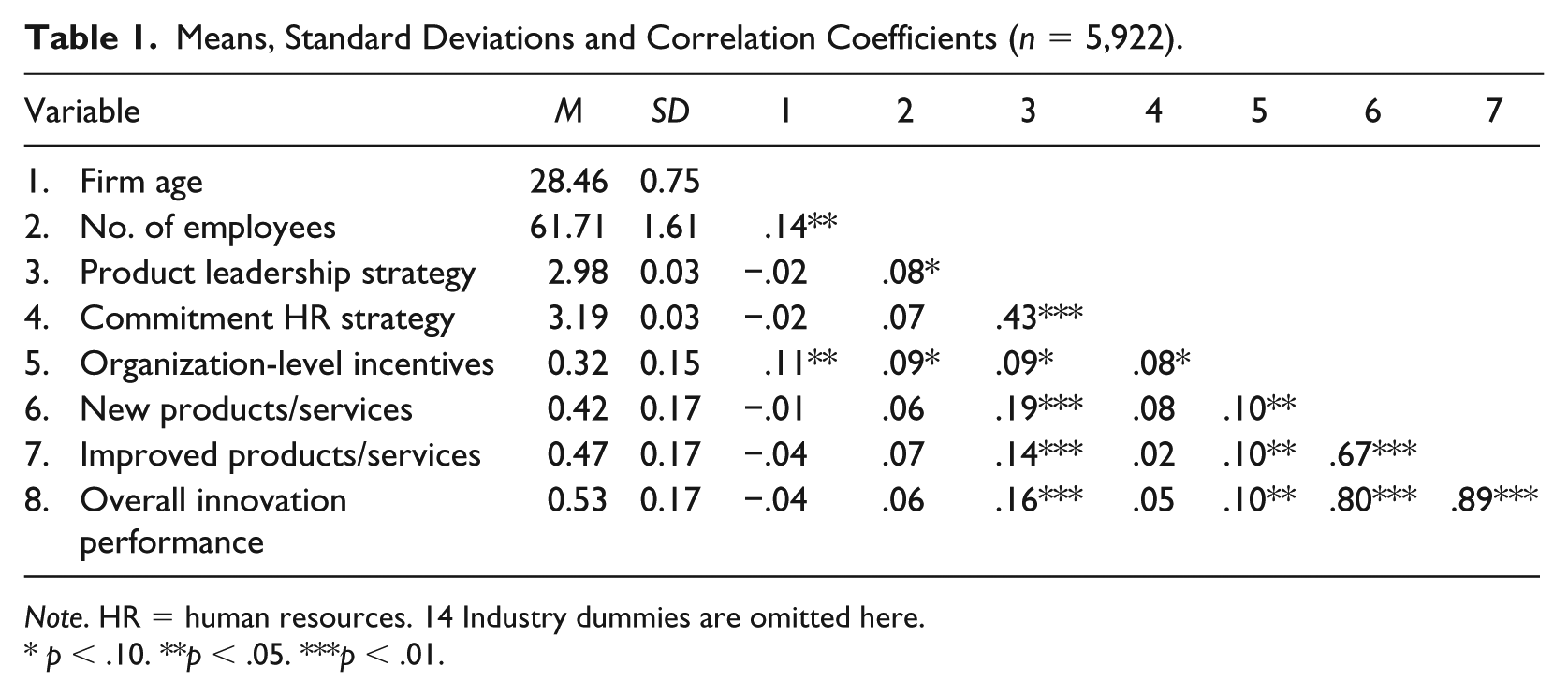
Table 1 presents the descriptive statistics and correlations among all of the variables. The three dependent variables are highly correlated (i.e., new products/services and improved products/services have a correlation of .67; overall innovation performance and new products/services have a correlation of .80; overall innovation performance and improved products/services have a correlation of .89), consistent with expectations. Product leadership strategy is positively related to the number of employees, indicating that larger organizations are more likely to adopt product leadership business strategy. Organization-level incentives are positively related to an organization’s age and number of employees, which shows that larger and older organizations are more likely to have organization-level incentives as part of their compensation system. These correlations are small, ranging from .09 to .11
Means, Standard Deviations and Correlation Coefficients (n = 5,922).
Note. HR = human resources. 14 Industry dummies are omitted here.
p < .10. **p < .05. ***p < .01.
Regression Results
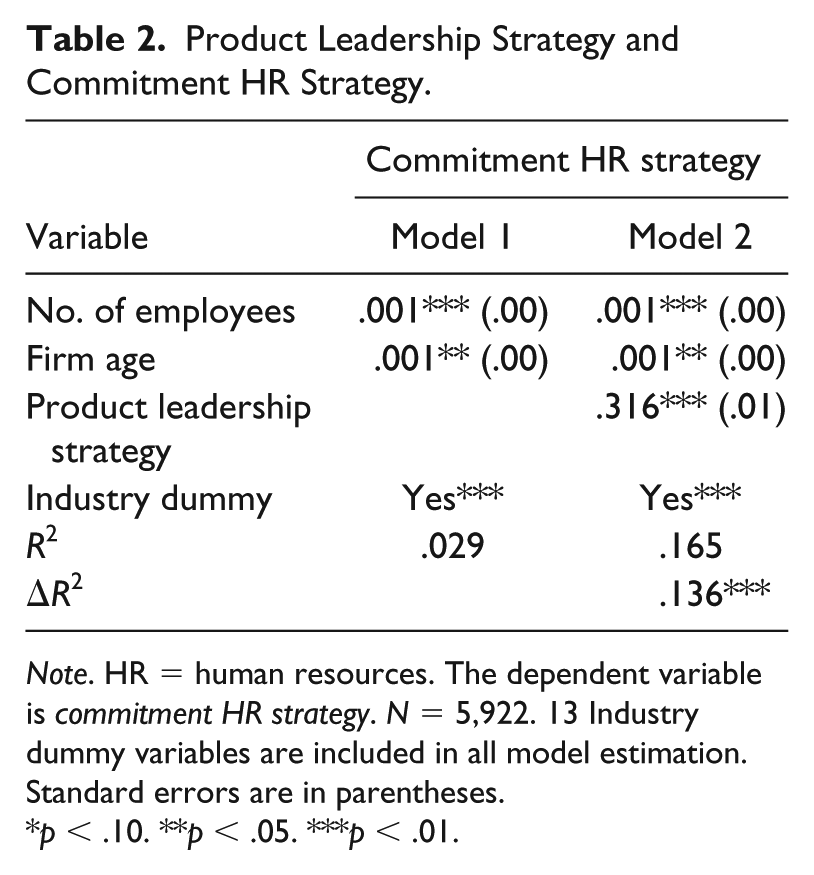
Table 2 presents the multilevel regression results. Model 1 presents the control variables only. In Model 2, the coefficient representing product leadership strategy is statistically significant and positive (β = .316, p < .01), and the change in the R2 for the model is also significant. This shows that organizations with a product leadership business strategy are more likely to adopt a commitment HR strategy. Therefore, Hypothesis 1 is supported.
Product Leadership Strategy and Commitment HR Strategy.
Note. HR = human resources. The dependent variable is commitment HR strategy. N = 5,922. 13 Industry dummy variables are included in all model estimation. Standard errors are in parentheses.
p < .10. **p < .05. ***p < .01.
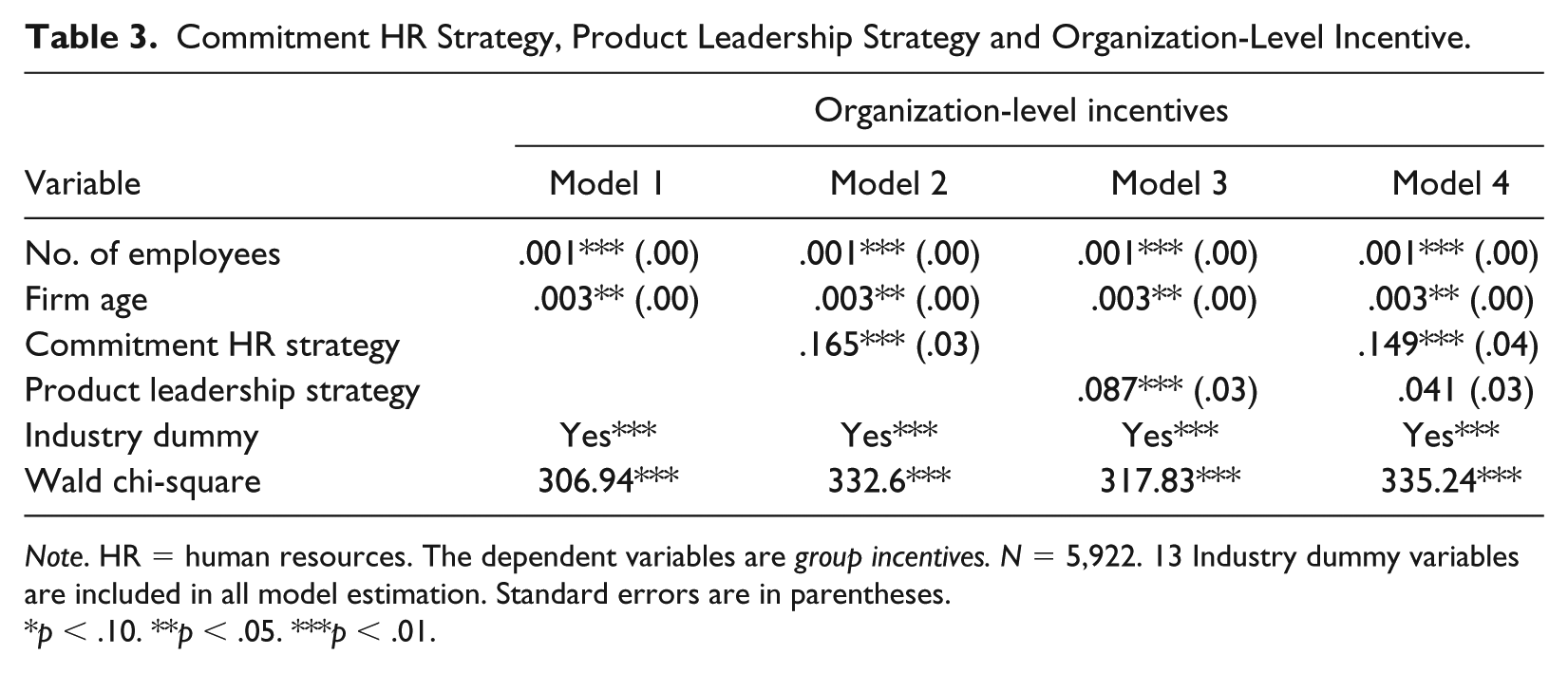
To test Hypotheses 2 and 3, we run several regression models with organization-level incentives as the dependent variable. Table 3 presents the regression results. As organization-level incentives are a binary variable, we use a probit regression model to test all the hypotheses. In Model 2, commitment HR strategy is significantly and positively related to the dependent variable (β = .165, p < .01). The results lend support to Hypothesis 2: commitment HR strategy is positively related to the adoption of organization-level incentives. Next, we examine the combined effects of product leadership business strategy and commitment HR strategy on the adoption of organization- level incentives. First, as shown in Model 3, we find that product leadership strategy is significant (β = .087, p < .01), suggesting that workplaces with product leadership strategy are more likely to adopt organization-level incentives. Then, in Model 4, we add commitment HR strategy as an additional independent variable and find that the coefficient of product leadership strategy is substantially reduced and becomes statistically insignificant (β = .041, p > .10), while commitment HR strategy has a positive and significant impact on the adoption of organization-level incentives (β = .149, p < .01). The change in the coefficients of product leadership strategy measure (magnitude and significance level) suggests that the effects of product leadership strategy on the adoption of organization-level incentives are fully mediated by commitment HR strategy. To further test the mediation effect, we conduct a Sobel-Goodman meditation test. 83 The test results support the full mediation conclusion and show that over 26% of the total effects between product leadership strategy and organization-level incentives are mediated through commitment HR strategy. The combined results from Model 3 and Model 4 suggest that product leadership strategy is positively related to organization-level incentives and that the relationship is fully mediated through commitment HR strategy. Therefore, we find support for Hypothesis 3.
Commitment HR Strategy, Product Leadership Strategy and Organization-Level Incentive.
Note. HR = human resources. The dependent variables are group incentives. N = 5,922. 13 Industry dummy variables are included in all model estimation. Standard errors are in parentheses.
p < .10. **p < .05. ***p < .01.
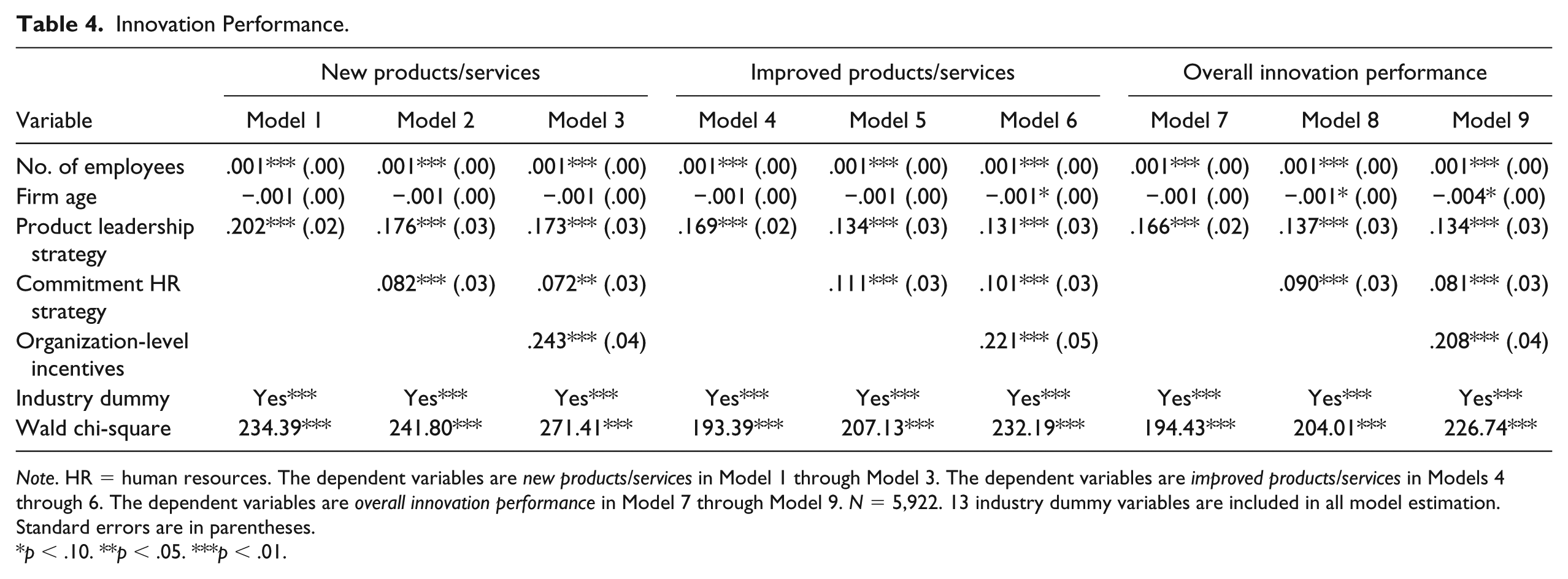
Table 4 reports the regression results of the effects of product leadership strategy, commitment HR strategy and organization-level incentives on an organization’s innovation performance. For control variables, the Wald test suggests that including the full set of industry dummy variables creates a statistically significant improvement in all of the models. For innovation performance, we use three different measures as dependent variables: new products/services, improved products/service and overall innovation performance. As all three dependent variables are binary variables, we use probit regressions to test all the hypotheses. We find that the adoption of organization-level incentives is positively related to innovation performance at workplaces with all three innovation performance measures (β = .243, .221 and .208, p < .01). Hence, the results from Table 4 support Hypothesis 4.
Innovation Performance.
Note. HR = human resources. The dependent variables are new products/services in Model 1 through Model 3. The dependent variables are improved products/services in Models 4 through 6. The dependent variables are overall innovation performance in Model 7 through Model 9. N = 5,922. 13 industry dummy variables are included in all model estimation. Standard errors are in parentheses.
p < .10. **p < .05. ***p < .01.
Discussion
Motivating employees to develop creative ideas is a matter of increasing concern for organizations around the globe. To fully understand how compensation programs will contribute to this process and provide useful information to practitioners, we examined the role of organization-level incentives in the relationship between business strategy and innovation performance. We found that workplaces with product leadership business strategies are more likely to adopt organization-level incentives, which in turn will have a positive impact on innovation performance. We next discuss the theoretical and practical implications of our findings.
Theoretical Contributions
Our findings contribute to strategic compensation literature in following four ways. First, this study responds to the call for studying the antecedents of organization-level incentives. 84 Over the past several decades, many organizations have adopted collective incentives to reward employee performance at plant, division and corporate levels. However, not many studies have investigated the antecedents of this important practice. 85 We found that organizations with a product leadership business strategy are more likely to adopt organization-level incentives. We also investigated the possible mediating factors that help develop a deeper understanding of why organizations vary in using collective incentives. We provided evidence that an employee commitment HR strategy mediates the relationship between business strategies and the adoption of organization-level incentives. According to our results, when we introduced commitment HR strategies into the regression, the coefficient of the product leadership strategy on the adoption of organization-level incentives is reduced and becomes statistically insignificant.
Second, this study extends the previous theoretical framework on compensation from agency theory to strategic HRM. Agency theory has been used extensively in previous studies on strategic compensation. While agency theory has certainly explained some of the variance among compensation programs, especially for executive compensation, it fails to provide an intuitive theoretical argument for compensation programs where it is difficult to link a principal’s interests with an agent’s interests. For example, agency theory cannot explain why pay for performance cannot improve employees’ performance when a job requires creative thinking and innovation. 86 In this study, we used the behavioral perspective of strategic HRM to examine both the determinants and the consequences of collective incentives. The behavioral perspective focuses on a vertical and horizontal fit between business strategies and workplace practices. If all organizational practices and polices align with the overall business strategy, organizations would achieve the optimal results in its strategic implementation. Our results, which show that HR strategy mediates the relationship between product leadership business strategy and organization-level incentives, prove that this perspective is an important theoretical lens to understand compensation practices for nonexecutive employees. Organizations with product leadership business strategies need to change production and organizational processes quickly to meet ever-changing market and customer preferences. This uncertainty requires a greater depth and breadth of skills, a high concern for quality and a commitment to the organizations’ goals. An employee commitment HR strategy treats employees as one of the most important assets in an organization and aims to develop a loyal and creative workforce. As one of the most important components of a commitment HR strategy, organization-level incentives motivate employees to work harder towards organizational goals of improving innovation performance.
Third, this study enhances our understanding of how compensation practices can contribute to innovation performance. Traditionally, studies on innovation have focused on individuals and assumed that creative people work alone. However, most current innovations occur in team settings. 87 This is not surprising when we take into account the complex nature of recent innovations and the variety of resources required to solve problems. Our finding—that organization-level incentives programs have a positive impact on an organization’s innovation performance—provides empirical evidence that motivating performance at organization level is an effective tool to encourage innovative and creative behavioral. Organization-level incentives connect pay to performance at the organization level and can be customized to target certain organization objectives such as innovation performance and customer satisfaction. By rewarding performance at the organization level, organization-level incentives can motivate employees to share their ideas and experiences with other employees to solve problems and improve products or services.
Finally, this article used a unique data set to address the methodological limitations of previous research. The national representative sample and the large sample size increase the generalizability and external validity of the results. The data set also allows us obtain the dependent variables a year later than the independent variables to mitigate possible missing variable bias and ensure the direction of causality within our model.
Practical Implications
Our study also offers two suggestions for HR professionals to help their organizations improve innovation performance. First, our findings reaffirm that HR practices do make a difference. Specifically, our results suggest that organization-level incentives play an important role in an organization’s innovation performance. As Hollenbeck et al. 88 noted, the success of jobs and projects depends on the cooperation of multiple employees. When projects need group work but employees are rewarded based on their individual performance, aggregated individual performance cannot yield the best organizational performance. Individual reward systems cause employees to compete with one another and attain personal success at the expense of other employees. 89 Thus, we suggest that organizations evaluate and reward performance at the organizational level to maximize the motivation effect of compensation programs.
Second, our findings show that organization-level incentives are not adopted in a vacuum. Rather, they occur within a group-oriented organizational context. Most of the organizations in our sample that have adopted organization-level incentives have also adopted commitment HR strategy and focused on being a product leader in the market. Different business strategies require employees with different attitudes and behaviors to achieve the best results. 90 HR professionals and executives need to spend time synchronizing HR and business strategies. They can develop and adjust individual HR practices according to the business strategy and overall HR strategy to achieve optimal results. If an organization seeks to improve innovation performance, it has a plethora of incentive mechanisms available such as gain sharing and stock options. In our nationally representative sample, organizations that have aligned business strategy, HR strategy and organization-level incentives perform better than those who lack such an alignment.
Limitations and Future Study
Despite the theoretical and practical contributions of our study, it has several limitations. First, despite our longitudinal and lagged design, we only have three waves of data for each workplace. Investigating the relationship among business strategy, group incentives and innovation performance over a longer period of time could serve as an important extension of our findings.
Second, although our findings pertaining to mediators were promising, we did not examine the contextual influences in the relationship between organization-level incentives and innovation performance. Some powerful contextual influences, such as personnel traits, work values and the competitive environment, may reside at both the individual and organizational levels. For example, current theories have suggested that both employees’ hierarchical position and market competition affect the effectiveness of compensation practices on organizational performance. Rajagopalan argues that employees at different hierarchical positions have different types of discretionary power to execute business strategies. 91 A reward system for employees at higher hierarchical levels may have a stronger impact on performance because these employees could be crucial in executing business strategies. 92 Similarly, market competition can offset free-riding concerns about organization-level incentives because employees’ efforts can be evaluated by observing relative performance among competitors. 93 Thus, organization-level incentives are more effective in encouraging teamwork and collaboration when organizations are in highly competitive markets. Hence, future studies can contribute further to the theory of strategic compensation by investigating these contextual factors. A multilevel approach would be especially important to identifying additional contextual variables at the individual level that may influence the effects of organization-level incentives on innovation performance. These studies should be of interest to employers, who face the pressure of increasing innovation performance.
Finally, due to data restrictions, we only studied group incentives. It would be interesting to see whether a behavioral perspective can be used to examine other forms of compensation such as merit pay and bonuses. We believe that organizations that have an alignment between business strategy, HR strategy and compensation polices perform better than those who do not have such alignment. Future research can examine these compensation policies and test whether a behavioral perspective can be applied.
Footnotes
Appendix
Declaration of Conflicting Interests
The authors declared no potential conflicts of interest with respect to the research, authorship, and/or publication of this article.
Funding
The authors received no financial support for the research, authorship, and/or publication of this article.