



Abstract
Pay equity is one of the most increasingly complex, sensitive and visible people issues facing organizations today. Understanding how to diagnose, quantify and address pay gaps, as defined by equal pay for equal work, has never been more important or more challenging. Today’s business, regulatory, political, and social climates are combining to place unprecedented levels of scrutiny on what organizations are doing—or not doing—to ensure they are fostering an inclusive environment in which all employees have equal opportunity to thrive and develop.
Keywords
Pay equity is one of the most increasingly complex, sensitive and visible people issues facing organizations today. Understanding how to diagnose, quantify, and address pay gaps, as defined by equal pay for equal work, has never been more important. Today’s business, regulatory, political, and social climates are combining to place unprecedented levels of scrutiny on what organizations are doing—or not doing—to ensure they are fostering an inclusive environment in which all employees have equal opportunity to thrive and develop.
More than 80 countries have some form of equal pay for equal work legislation, and more than a quarter of those have some sort of mandatory reporting requirement. Within the United States, several states and cities recently have enacted legislation that precludes employers from enquiring about salary history during the recruitment process in an effort to ensure more equity in pay across all demographic groups. In the United Kingdom, medium and large size organizations are required to report data on their organization’s gender pay gap.
CEOs and HR leaders in forward-looking organizations are placing a strategic focus on this issue, rather than solely checking the box on pay equity compliance. Why? Because it makes good business sense to do so. Organizations with diverse leadership teams, fair reward systems and talent management processes that foster development and increased capacity for all employees financially outperform those who do not. C-suite leaders see this as an opportunity to improve trust and engagement in the organization and to improve its employer brand.
Korn Ferry research in the United States shows that a majority of companies say gender pay is an issue for them, but 40% of those companies have not taken any substantive action on the issue, although most say they are likely to in the near future. The status quo is quickly becoming less of an option—at least because of the new regulatory and reporting environments.
An effective pay equity management process supports a complete effort within organizations to measure and close pay and human capital program gaps as well as to implement high impact and sustainable change.
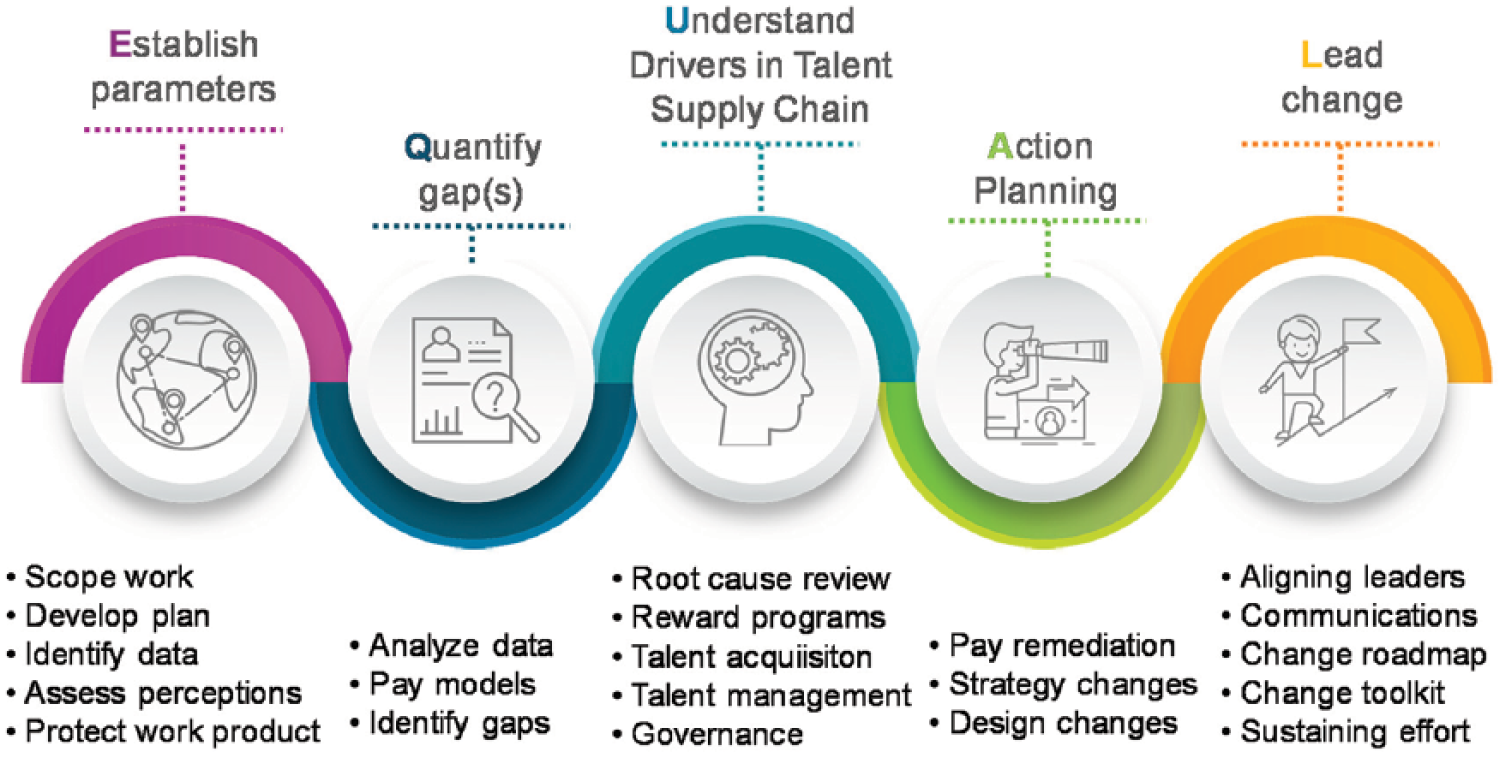
To ensure a robust assessment of a pay equity management program, the entire talent supply chain should be reviewed to focus on the following drivers of pay equity:
Reward management: Work structures, job evaluation, base pay delivery, promotion guidelines, bonus calibration and payouts.
Talent acquisition: Hiring guidelines, candidate distributions, compensation offers and offer approval processes, employer branding.
Leadership: Beliefs and values of leaders that drive an inclusive approach to leadership and behaviors in attracting, motivating, developing, promoting and retaining key talent.
Culture: Organization values, tolerated and encouraged behaviors, employee engagement.
Talent management: High potential candidate identification, career management, promotion practices and distributions, succession management.
Performance management: Performance goal setting, coaching, assessment and pay-for-performance.
Organizations that focus on addressing pay equity management proactively will not only reduce their risk of litigation, they will also benefit by increasing the trust and engagement levels of their employees and better position their organizations as an employer of choice.
Footnotes
Declaration of Conflicting Interests
The authors declared no potential conflicts of interest with respect to the research, authorship, and/or publication of this article.
Funding
The authors received no financial support for the research, authorship, and/or publication of this article.