




Abstract
Wage inequality in America is ballooning. The issue is receiving significant attention in the public discourse but to what avail? It is an issue that affects the entire economy although the suffering thus far has focused primarily on the lower 90% of wage earners. The long-term impacts, however, may be even more encompassing. Regardless of the potential costs, under the currently understood societal roles of corporate leaders and politicians, the issue of wage inequality is currently no one’s specific responsibility to address, but everyone’s problem. We examine the current wage status of the economic classes, the compensation practices that contribute and potential societal and economic costs if no action is taken. Finally, we consider the roles that potential players currently perform and should consider in the future to strategically address this issue.
Keywords
Introduction
Between 1979 and 2015, income for the bottom 80% of Americans grew an average of 32%, while it grew 233% for the top 1% of wage earners. 1 After 50 years of the wage gap between the economic classes growing virtually unchecked, its current size and the realization that this may be bad for all of America has brought the topic to the forefront of the national dialogue.2,3 But what are those speaking out about wage inequality hoping for from this focus? Are they just giving the topic some visibility or are they hoping that the debate will spur those who have the power to make a change into action? If it is the first, we get it. The distribution of income and power has always been a topic of great interest and examination throughout history and the growing disparity in the United States today has only increased that attention.4-6 If it is the second, intent on capturing the interest of corporate or government leaders in the hopes that they, who hold the power, will make the financial and legislative changes necessary to alleviate this problem, we argue that, at present, it specifically is not their jobs. Corporate leaders have a primary responsibility to act in the best interests of their shareholders, not society overall. Government leaders are actively discouraged from intervening, beyond minimum standards, into market pay levels and income redistribution. This article is intended to add to the discussion on the growing threat of wage inequality, an issue that is seemingly no one’s responsibility, but everyone’s problem.
Corporate leaders are primarily compensated for providing shareholders with the highest return possible under sound and ethical business practices and that includes strategically controlling wage costs of the rank-and-file. Both of these compensation practices further reinforce the growing wage gap. As a country that prides itself on its capitalism and a free market as the cornerstone of our economic success, it follows that the market for wages should be allowed to find its own balance unimpeded by artificial controls or governmental intervention. But with the imbalance of income and power so large, and the magnitude of its current and long-term threat to our overall economy, now is the time for business leaders to reconsider their traditional responsibilities to their individual organizations in order to work with other private sector leaders to tackle this societal problem.
Social activists and political leaders are actively engaged to increase awareness and wages. They have thus far succeeded in passing legislation in seven states and numerous cities to increase the minimum wage to $15 per hour and proposals are progressing in others.7,8 Change is happening, but the aggregate impacts are yet to be discovered, and there is no evidence that such piecemeal changes are part of a sound, strategic approach that will benefit the economy in the long term. Business executives have an opportunity now to lead a coordinated strategic approach to address this issue or risk having to react one by one as change comes to their organizations in the form of new legislation or social/market pressures, both of which are already happening with or without them.
While there are different perspectives on the economic statistics being reported on wage inequality in the United States, the growing awareness of how wage inequality is and will affect the entire economy is creating concern throughout our society, including in the boardrooms of Wall Street and corporate America. 9 For instance, according to a recent survey by the Federal Reserve, 40% of Americans say that they do not have sufficient savings to cover a $400 unexpected expense. 10 A report from the University of California, Berkley, states that U.S. taxpayers pay $153 billion per year to provide federal subsidies to families who work but whose employers do not provide a living wage. These include some of the richest companies in America such as Walmart, McDonalds and Amazon. 11
The strength and ongoing potential of the U.S. economy rely in large part on a strong middle class, and a strong middle class is not just a result of a strong economy, but it is also an important source of its growth.
12
Political and business leaders should recognize that growing wage inequality damages the middle and lower classes and that their diminished capacity will affect overall U.S. potential for sustained economic growth. Adam Smith, noted economist and philosopher, considered by many to be the father of economics and capitalism, and a staunch supporter of limited government intervention into commerce, reminds us that if capitalism is to succeed, the laborers who deliver that success need to participate in that success as well. He stated, Servants, laborers and workmen of different kinds, make up the far greater part of every great political society. But what improves the circumstances of the greater part can never be regarded as an inconvenience to the whole. No society can surely be flourishing and happy, of which the far greater part of the members are poor and miserable. It is but equity, besides, that they who feed, clothe, and lodge the whole body of the people, should have such a share of the produce of their own labor as to be themselves tolerably well fed, clothed and lodged.13(p36)
A clear imbalance of power exists between those at the top of the economic ladder and the vast majority of Americans. Corporate boards and executives have the primary responsibility of maximizing the interests (generally financial) of shareholders. Holding costs in line, including wages and benefits, helps them do just that. The federal and state governments have implemented a great many laws, taxes and social programs that provide a degree of protection for rank-and-file employees, but in a free market, it is not their role to intervene too far, if at all. But if it isn’t the role of the “1%” who are corporate leaders or government representatives to protect the middle and lower classes, then whose is it? And if no one steps up, what are the potential impacts on our country overall? Examples abound of the unintended consequences of well-meaning government intervention only exacerbating issues. So if corporate leaders with the power to change compensation practices have no overarching responsibility to build/support an economically strong middle and lower class and it isn’t the role of government to intervene, is the country rearranging deck chairs for the rich and powerful while the economic ship slowly sinks?
The purpose of this article is to consider the state of the middle- and lower-class wage gap and to analyze who is best to respond in light of current wage-setting practices in America. It is intended to add to the growing body of research on the impact of wage discrepancy by analyzing the current situation, considering the key actors that are best positioned to lead a response and suggesting potential avenues to address it.
Background
“America’s middle class is the economic engine of this nation. Our road to economic recovery begins with restoring the prosperity of working families and small business owners.” 14 It is hardly new or controversial to suggest that a strong middle class is essential to a strong U.S. economy. American politicians, economists and business people alike frequently cite the critical importance of this group to a strong economy and the country overall. After all, they make up the majority of both our workforce and our consumer base, but as the income inequality gap continues to expand, the country may inadvertently be gutting the engine of the economy and thereby diminishing the opportunity to remain a global economic powerhouse in the decades to come. Before considering the roles that various leaders and organizations have now or may have in the future addressing this issue, we will examine the current situation and potential ramifications.
Market-Based Compensation Model
Labor costs in the United States are, on average, 65% to 70% of an organization’s total operating costs, making it the single largest expense for most. 15 The ability to control labor costs and receive the highest return from them significantly affects a firm’s ability to achieve a competitive advantage and survive. Suggesting that organization leaders make financial decisions that increase their cost structure above what the market demands to improve the condition of the middle and lower classes in society overall runs counter to the objectives that most executives are hired to achieve. Importantly, it is also contrary to the objectives for which they themselves are most often compensated. In addition, while one organization maintaining minimum wage standards that provide for a “living wage” would positively affect their employees, a more coordinated approach across sectors and geographies will be necessary to truly affect an issue of this magnitude.
The typical market-based compensation model in use today supports the growing income disparity between economic classes in a number of ways. In the aggregate, by its very nature, one of the roles of businesses in our economy is to set market pay rates. While no single firm can make the market, when most actively work to keep labor costs down, over a few decades, together they do exert enormous downward pressure with no offsetting organized counterpressure. 16 With regard to the individual executives themselves, the owners/shareholders, through the board of directors, specify the areas of focus for the coming period through the objectives identified in their variable compensation plans, both short term and long term. These primarily focus on the achievement of the organization’s short-term financial objectives. Controlling costs, such as rank-and-file wages, to increase profitability supports this achievement, thereby increasing the potential payout for the executive and holding-down wages for most workers.
Human resource (HR) strategies and compensation strategies that drive practices are designed to support the attainment of firm-level objectives. These programs, when combined, are also designed to minimize the costs and maximize the benefits they provide, thereby making a positive financial contribution to the organization and its owners. The HR practitioners responsible for the design, implementation and evaluation of their organization’s compensation and benefit programs, therefore, are tasked to develop market-competitive pay packages that attract and retain the key talent needed while tightly controlling costs. The current focus on short-term financial metrics and returns to the organization and its leaders, however, ignores the impact, both short term and long term, on another key groups within their stakeholders. Before examining the potential risks associated with this current approach, we will consider the various factors that affect most market-based compensation decisions in the current environment (see Figure 1).
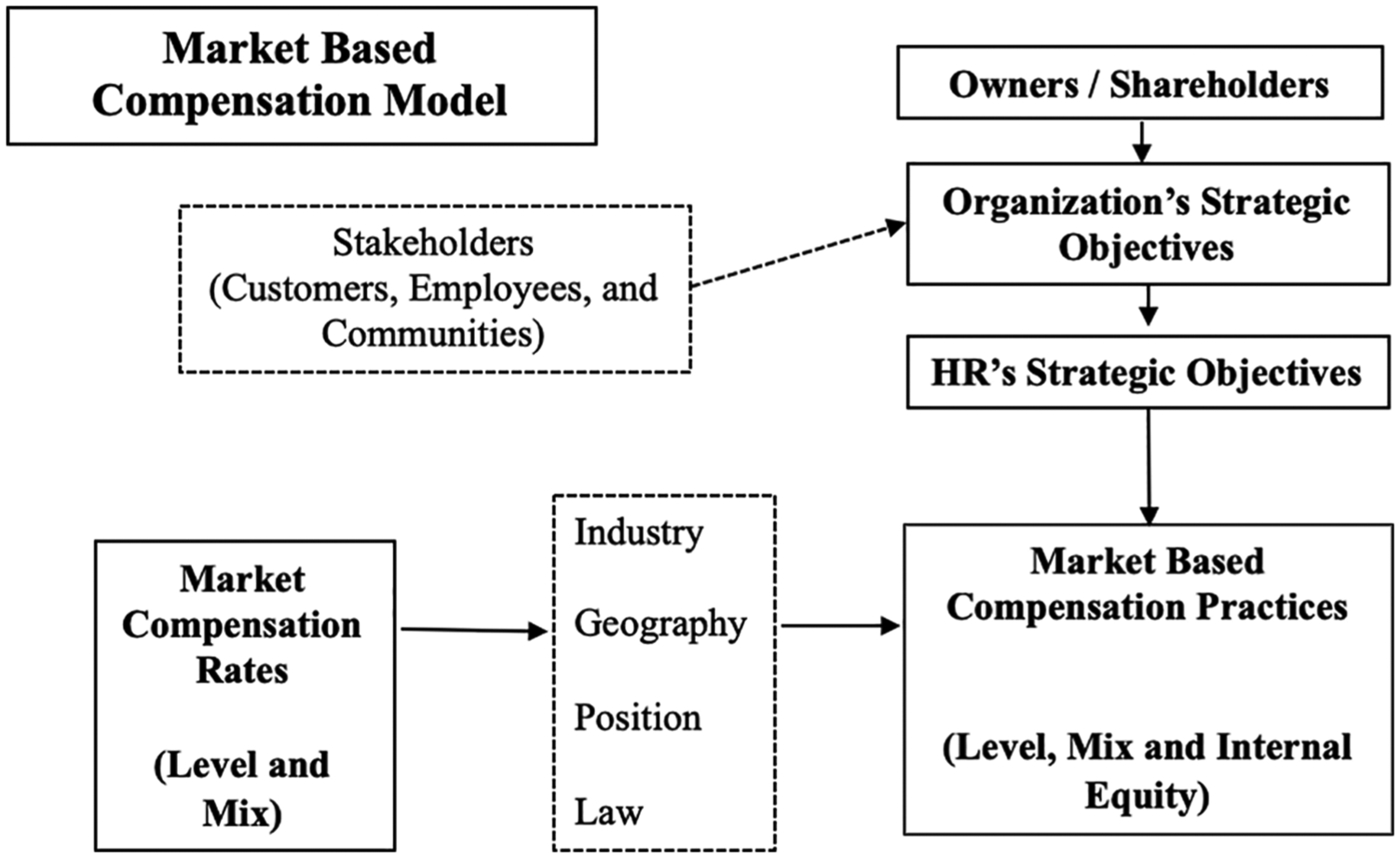
Market-based compensation model.
A typical approach to market-based compensation in the current U.S. private sector environment begins with the understanding that all practices and programs should be aligned with and supporting the achievement of the organization’s strategic objectives. These are established in accordance with direction from the owners/shareholders, represented by either the owners themselves or the board of directors, and tend to focus on the attainment of short-term financial objectives. Through their own unit-level strategies and various programs, HR in general, and compensation in particular, play a critical role in the alignment and execution of the firm’s strategy and objectives. This alignment naturally leads to compensation programs geared toward controlling the short-term costs of their pay programs while maximizing their return through the contributions of skilled and motivated employees.
While corporate and political leaders alike often cite the critical role that the interests of “key stakeholders” play in their decision making, and textbooks and articles abound supporting their importance, the data suggest otherwise. 17 The role that the wishes or long-term well-being of other stakeholders, such as customers, employees and local communities, actually play in decision making is unclear at best and negligible at worst. Consider, however, how business leaders are compensated. Because their incentive objectives have an almost singular focus on short-term internal financial objectives, without any inclusion of long-term impacts on stakeholders, executives should be expected to place a majority of their focus there.
With the various levels of strategies in place and aligned, a key input to all compensation program decisions is up-to-date information on (aggregate) market pay rates. This includes a breakdown of the pay mix and pay levels specific to the industry, profession, position and geography. (It is assumed that all market information is considered in light of existing federal and local laws, and we will not go over that issue here.) While internal equity within pay structures remains important, the ability to attract, retain and motivate the workforce is affected far more by external competitiveness, or how pay compares with other employers for the same/similar level of knowledge, skills and abilities. 18 This is truer now than ever before. Specific market pay data are readily available to anyone through a quick Internet search. (While the data have to be considered in light of the methodological approaches used to obtain the source data, these sites generally provide an adequate approximation of market conditions for individual jobs to prospective/current employees.) Job seekers today are more educated and have more ready access to data about market conditions than in the past. 19 This creates workers better informed about market pay levels. Based on economic data, however, while this may assist (potential) employees to negotiate within current market conditions, it has had little impact on assisting the pay levels of the rank-and-file to keep pace with the economic gains of top earners. 20
While acknowledging that the majority of business leaders make their decisions based on the best interests of their shareholders/owners as represented through their performance and incentive objectives, and that is the norm as currently defined, we suggest that the emphasis on satisfying shareholders through the achievement of short-term financial objectives that focus on the next quarter or fiscal year is detrimental to the long-term health of society and, in turn, to the organizations they are intended to support. When business leaders and compensation practitioners define how to “minimize the costs” and “maximize the benefits” of their programs, however, perhaps they should involve a number of factors that are currently being overlooked. Based on the declining size and average income of the middle class in America, it appears likely that the costs and benefits of stakeholders, namely, employees and society at large, are being overlooked in our compensation decisions, to the long-term detriment of organizations as well. These issues and their potential impacts are discussed in detail below.
Middle Class Defined
There are numerous schools of thought on how to define class varying from specific economic or social measures to aspirational attributes. The predominant approaches focus on (1) economic resources, (2) occupational or educational attainment or (3) culture and beliefs, depending on the discipline of the scholar/researcher. In addition, within each of these, multiple tactics exist on how to specifically breakdown the classes for analysis. 21 For the purpose of this article, we focus on economics—namely, income—to provide a guide as to what constitutes the middle class, and therefore, the lower and the upper classes as well. The economic approach allows greater ease of access to consistent financial indicators. It is also highly correlated with other indicators commonly associated with class, such as education levels, economic security and purchase behaviors. The analysis of their condition presented here—how it has changed over the past 80 years and who may be responsible—will be based on this perspective.
Economic approaches to studying the middle class generally define it as “those households that fall in the ‘middle’—that is, in the middle of the income distribution.”22(p24) From here, we must decide how to demarcate the various classes, and there is disagreement on specific methodology. Pew Research Center, whose approach is among the most commonly cited, defines household incomes between 66% and 200% of the national median income during the period under examination. 23 Other economic scholars have proposed bands of 50% to 150% 24 or 75% to 125% 25 thereby capturing very different population sizes. 26 While each of these approaches has merits, the Pew approach is used throughout this analysis. Extrapolating, this means that the lower class is defined as those households with 0% to 66% of the national median income at any point in time, the middle class includes those between 66% and 200% and the upper class are households with median income in excess of 200% of the national median.
Middle-Class Boom to Stagnation/Decline
Income (In-)Equality
The United States experienced broad-based economic prosperity across all rungs of the economic ladder following World War II that lasted for over three decades, well into the 1970s. Of special significance here is that this prosperity was shared equally among the classes. Incomes grew in relative tandem, doubling in inflation-adjusted terms, maintaining a stable income gap and significantly contributing to a strong and stable middle class. Average income for the middle class nearly doubled between 1947 and 1973. This was also a period of strong union membership and a general operating principle between labor and management that labor would participate in any growth in profits. 27
This consistent “sharing” of income and wealth distribution dramatically slowed between 1973 and 2012, with a shift toward maximizing share price and rewarding shareholders. The 1970s began a period of a widening income gap that continues through to today, with growth for the middle and lower classes slowing down sharply while income for the upper class continuing its strong growth 28 (see Figure 2). The percentage of Americans classified as lower class gradually rose from 25% in 1971 to 29% in 2016, while the middle class declined during the same period from 61% to 52%. Median income in the lower class rose from $18,799 in 1970 to $25,624 in 2016. During the same period, the median income for the middle class rose from $54,682 to $78,442 and for the upper class rose from $118,617 to $187,872. While all classes showed gains, the upper class gains of 58.4% far exceeded the share of gains realized by the middle class at 43.5% and the lower class at 36.3% and far below what should have been expected based on the productivity increases during the same period 29 (see Figure 3). Three factors are considered core elements to growth in U.S. family incomes. These include overall economic productivity growth, labor force participation and the extent to which gains are equitably distributed among workers. While productivity growth slowed in recent decades, there has also been a significant increase in inequality of how gains are distributed across economic classes. 30

Economic class size from 1971 to 2016.

Change in real annual earnings (1979-2017).
Median household income (adjusted for inflation) declined from 1989 to 2014. To exacerbate the situation, living expenses continued to increase with health care and higher education among those with the most significant gains. Per capita health care costs from 1980 to 2012, adjusted for inflation, increased from $2,681 to $8,925. 32 A survey of self-identified middle-class Americans showed that 85% indicated that it was more difficult to maintain their standard of living during this time period. 33
Numerous factors have contributed to the increase in income inequality. The shift from labor income to capital income, rewarding organizational owners, and executives, with a higher portion of profits than in previous decades, has been another key contributor. Between 1947 and 1973, average worker compensation growth was closely correlated to increases in productivity and profits. Rank-and-file workers received a consistent share in the increased profitability of organizations. That relationship broke down in the years since with the growth being directed more toward organizational profit and thus capital income. During the same time period was a decline in union membership, which peaked in 1954 at 25.4% and fell steadily to 10.7% in 2017.34,35 An additional factor is the decline in the real value of the “minimum wage” that provides a safety net to low-income workers. The U.S. federal minimum wage fell, in real terms, by 34% between 1968 and 2003 and by a further 13% between 2003 and 2012. 36
Wealth (In-)Equality
The past 50 years have not been kind to the middle class with regard to their share of the overall wealth of our nation either with an even greater concentration of wealth being held by the upper class than for income distribution. Wealth here is defined as “the value of a household’s property and financial assets, minus the value of its debt.”37(p1) The changes in the wealth gap between classes, demonstrated by median net worth, are even more striking and have a compounding effect on income inequality. While the percentage of the nation’s wealth held by the top 1% of Americans from the late 1920s through the late 1970s showed a slow but steady decline, that trend has reversed in the years since. Specifically, the top 1% saw their share of America’s wealth grow from just under 30% in 1989 to 39% in 2016 while the bottom 90% had their share fall from 43% to 23% during the same period. 38 Demonstrating the concentration of wealth further, the share held by the top 0.1% in 2012 was almost as high as at its peak in 1929, the year of the stock market crash that led to the Great Depression. It should be noted that while the disparity in top incomes compared with those of the middle class is the key driver of wealth inequity, the higher incomes create a snowball effect on wealth itself. Higher wage earners tend to save at much higher rates, which leads to higher capital income as well. 39 With a growing share of wealth at the top, that of the bottom 90% fell conversely. Pension values and home ownership rates drove their share from 20% in the 1920s to 35% in the mid-1980s. The sharp rise in debt (mortgage, consumer and student) and financial deregulation that allows predatory lending practices geared toward the middle and lower classes are primary drivers of the decline to 23% as of 2012. From 1983 to 2013, wealth held by the average lower-class household fell 18% from $11,544 to just $9,465. The middle class gained only 2.2% from $95,879 to $98,057, while the upper class had a 101% increase from $323,402 to $650,074. 40
Risks of a Declining Middle Class
The economic indicators over the past 50 years demonstrate that the income inequality gap in the United States is widening. While many of the immediate short-term costs and benefits are calculable, insufficient attention and analysis has been given to examining the detrimental long-term costs that may be inflicted on our economy as a whole if the situation is allowed to continue or gets worse. Researchers and analysts may disagree on who is responsible for its growth, who should fix it or even if efforts should be made to address it, but prior to deciding, the inherent risks on the economy overall of not acting must be considered. Low wages and little to no net worth have a deleterious effect on an individual’s standard of living, but the situation may have far more serious consequences in the aggregate, including for those at the top of the economic ladder, if an effective, strategic response is not found. The following discusses only a few.
Economic Growth
According to the Organisation for Economic Co-operation and Development (OECD), an intergovernmental “think tank” with the goal of generating policy that encourages economic development and cooperation, income inequality has significantly curbed economic growth in recent years, and this can be expected to continue if the gap persists or continues to grow. 41 In a meta-analysis of the relationship between income inequality and economic growth, 11 of 23 studies showed a significant and strong negative effect of inequality on growth. The remaining 12 showed either a negative but inconsistent relationship or no relationship at all. Not one found the relationship to be positive. 42 While hardly conclusive in itself, it does strongly suggest that varying levels of income inequality between the classes may be harmful to economic growth and warrants further examination.
Education and Training
Research also informs us of how a strong middle class affects specific social aspects that are essential to future growth. For example, when the middle class is economically strong, it provides quality education and training to citizens at all levels. 43 Inherent talent and the willingness to put forth the necessary hard work to develop that talent are evenly distributed across all classes of people. What differs is the investment made and ease of access to quality education, more readily available as one moves up the economic ladder. By decreasing access to quality education to children born to lower- and middle-class families, and specifically the opportunity to pursue higher education to all who have the ability and are willing to work hard for it, our country will be denied the enormous potential that these talented individuals may provide. Not only are the benefits of this talent lost, but also undereducated and underemployed individuals make less money in both the short term and long term and create a drag on the economy.44,45
Demand for Goods and Services
An economically strong middle class also creates stable demand for goods and services and provides a nurturing environment for entrepreneurship. The U.S. population continues to grow steadily, but the percentage of those in the middle class has been declining and therefore so has their relative purchasing power. According to the World Bank, our population has grown 58% between 1960 and 2017, from 180.7 million to 325.7 million. 46 This increase should provide significant growth for demand for goods and services, but with the middle class declining as a percentage of the overall population, the impact on growth potential has also diminished. 47 Economics has long informed us that those making the least spend a higher percentage of that income to purchase goods and services and that those making the most save at higher rates. With more of the nation’s income shifting to the upper class, inequality can be expected to inflict a drag on effective demand. 48
Government Subsidies
Stagnating wages and a declining middle class have had other hidden costs. While wage growth for the average American in 2018 brought some much-needed relief, it did not overcome 50 years of anemic growth. Due in part to the Great Recession, from 2003 through 2013, inflation-adjusted wages for the bottom 70% of wage earners was either negative or flat. 49 The wages paid to millions of hard-working American families today are insufficient to meet an even basic standard of living, qualifying them for various forms of federal and state subsidies. It is estimated that U.S. taxpayers are contributing $153 billion (yes billion) each year to subsidize wages paid to families who work, many for some of the largest and the richest companies in America. These programs include Medicaid, Children’s Health Insurance Program, Temporary Aid to Needy Families and Supplemental Nutrition Assistance Program (or food stamps).50,51 (Note that this figure omits many other programs due to the inability to access similar forms of data, making it a conservative estimate.) Let that sink in. The taxpayers, namely, the middle and lower class, are subsidizing the pay of working men and women so that some of the richest companies, owners and executives can increase their profits and net worth by paying poverty-level wages to many in their workforce.
Health Status
Another concerning cost to the growing inequity stems from the link between income and socioeconomic status and health. Research on health supports that income is a key determinant but a specific focus on income inequality is relatively new. Health care costs now represent 20% of U.S. gross domestic product, twice that of other developed countries. Despite this huge national expenditure, 70% of our youth (aged 17-24 years old) would be unable to pass basic military entrance standards due to poor health or academic skills. 52 Neither of these are positive for our economy. Early research is mixed on which specific factors (e.g., individual income, poverty and income inequality) are more closely correlated. The interconnectedness of these variables is evident, as is its short- and long-term risk to the economy overall. A less healthy work force suppresses productivity and increases costs of health care, both of which have a negative impact on the economy. 53
Discourse and Image
Public discourse surrounding wage inequity is hardly new. What is new is the extent to which it has captured so much of the national attention in recent years. This presents its own risks and challenges to corporate leaders who, along with their organizations, are affected by public image and government oversight. 54 The recently implemented Securities and Exchange Commission filing requirement that mandates public organizations to disclose their chief executive officer (CEO) to median worker pay ratio adds greater transparency of the disparity at the individual corporate level. This is expected to further increase public awareness and scrutiny by employees, consumers and investors. Corporate leaders should be aware of the potential impact of this transparency on all stakeholders. Depending on each company’s specific ratio, they may want to consider strategic changes to their compensation and benefit programs and a public response should it be needed.
Several recent studies have found that pay ratio disclosures do have an impact on consumer behavior and that given an informed choice, consumers would prefer to purchase goods and services from organizations with relatively low ratios of CEO to worker pay. 55 According to the Economic Policy Institute, a nonprofit and nonpartisan think tank, the average U.S. CEO to worker pay ratio has grown from 20:1 in 1965 to 311:1 in 2017 (see Figure 4). Organization leaders are being called to participate in public discussions of this issue by various stakeholders, including the press, employees, consumers and politicians. The responses thus far have varied considerably. Few, however, have exemplified a level of tone deafness displayed by Nigel Travis, the former chairman and CEO of Dunkin’ Donuts and Baskin-Robbins. During a 2015 interview with CNNMoney, while being asked his thoughts on New York’s Wage Board recommendation that all fast food employees receive a minimum of $15 per hour, Travis stated that the suggestion was “absolutely outrageous.” His compensation, as was highly publicized at the time, was $4,889 per hour. 56 Jeff Bezos, founder and CEO of Amazon, as well as the richest person in the world, received even greater backlash when it was revealed that a significant percentage of his employees received poverty-level wages so low that they required and qualified for various government subsidies just to meet a basic standard of living. In effect, the taxpayers are paying a portion of the wages of Amazon employees, and all workers are receiving these subsidies so that the company can boost their already enormous profits reported to be $3.03 billion in 2017. 57 The vocalized reaction from stakeholders was swift as was that of Senator Bernie Sanders, who introduced a legislation that would require all organizations with 50 or more employees to reimburse the government for every dollar of specific forms of subsidies received by their employees. To his credit, Bezos responded quickly, announcing a new $15 minimum wage for all Amazon employees and challenging his retail competitors to do even better. Target had recently announced an increase to $12 per hour and Walmart to $11 per hour. Transparency and public/government scrutiny made an impact, but are these individual responses, when considered in the aggregate, apt to generate an optimum strategic outcome? 58 We suggest that such reactionary responses are perhaps not the model for progress that will best serve the economy overall.
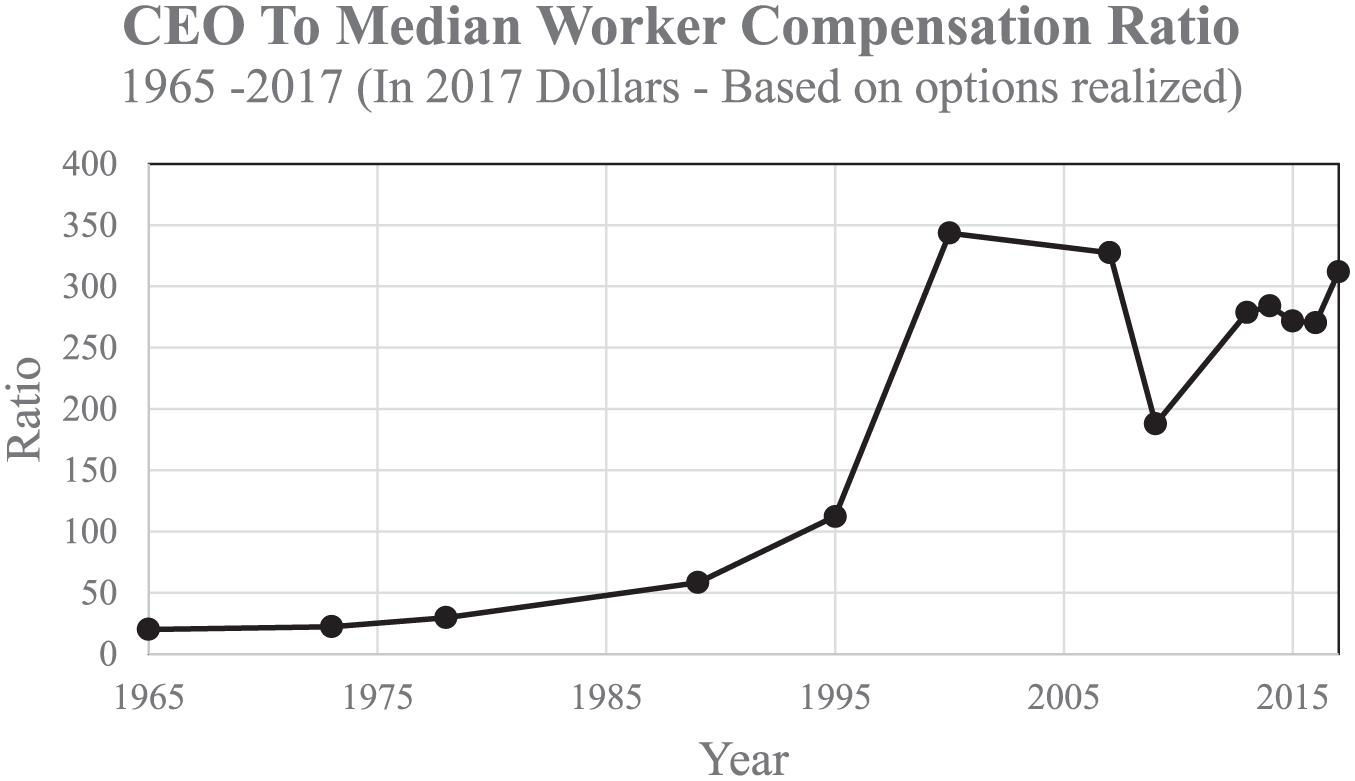
CEO to median worker compensation ratio (1965-2017)
Economic Mobility
Several recent studies have suggested that the United States has among the lowest economic mobility rates of other developed countries. 60 A meta-analysis by Corak 61 of 50 studies of nine countries found the United States and Great Britain tied as the least mobile. Canada, Norway, Finland and Denmark were the most mobile with Sweden, Germany and France in the middle. Suggested reasons were a thinner safety net, pay structures that highly favor education that is more readily accessible to the affluent, lower unionization and the size of the equality gap between the top 1% and the remaining 99% of the population.62,63 The opportunity for upward mobility, a cornerstone of the American dream, provides motivation for higher achievement in education and on-the-job training, both of which benefit not only the individual but also employers and the U.S. economy overall.
This is intended only as an overview of some of the more significant potential consequences of income inequality. We will leave the more detailed review to the economists. It does, however, provide some insights into the issues that are and may continue to develop if the current gap is allowed to continue to widen. Now, we turn our attention to the participants that are and should be part of the discussion.
Discussion
Leaders across industry sectors are openly debating the harm that our current level of income inequality is already doing and calling on those with the power to find a means to alleviate it.64,65 The United Nations, the World Economic Forum, the OECD, state and federal politicians, numerous noted economists and even Pope Francis are speaking out and calling for action on this issue.
66
Extreme power and income inequities have created conditions where the power to either continue on the current course or adjust in favor of minimally acceptable living standards and participation in the American dream for all our workers rests largely but not solely, with a very few. We suggest that, while it is not currently the job of our corporations’ leaders to tackle such macroeconomic issues, an optimal approach in this instance may require a coordinated private sector–led task force to address pay inequity themselves. Business’s pay policies are, after all, a main component of establishing/maintaining income inequality: It is there that value is created and divided between the various gradations of employees. It is there that the inequities, which necessitate redistribution, are set up. And it is there that America’s workers are most explicitly placed in a rank-ordered hierarchy, superiors and inferiors, bosses and subordinates.67(pp249-250)
The voices of activists, workers and politicians are getting louder, and their actions are growing. The alternatives to a strategic and coordinated market approach may be more strikes, consumer backlash and eventually stronger unions and new government legislation.
One option, of course, is for the government to intervene and take action to rectify the level and trajectory of income inequity. It is ultimately their role to care for the good of the country. There are any number of potential laws that legislatures could pass to immediately improve the lives of middle- and lower-class Americans. They could increase the minimum wage to some definition of a “living wage” and peg it to inflation. They could penalize organizations whose CEO-to-worker pay ratio is above a prescribed level. As recommended by Senator Sanders, they could assess organizations with more than 50 employees $1 for every dollar received by their employees in the form of government subsidies thereby encouraging them to pay higher wages directly.68,69 An extreme approach could also be considered that would allow governments to intervene directly in pay market rates and packages. The possible mechanisms of government intervention are of course endless, but this is still a capitalistic society where direct government intervention in these corporate decisions/strategies is generally considered inappropriate.
Caution is therefore warranted before any new forms of government intervention, short or long term, are considered. Some past examples of government intervention into corporate compensation practices show that the unintended consequences of federal policies can be far worse than the problems they are designed to rectify. For example, in 1993, President Bill Clinton signed into law Section 162(m) of the Internal Revenue Code. It was intended to curb excesses in executive compensation pay by limiting the tax deductions.70,71 Organizations could only deduct the first $1 million paid to their top five executives in the form of cash, bonuses and stock grants. A loophole inserted by Congress allowed performance incentives and stock option grants to be excluded, however, as these forms of performance-based pay reflected increased returns thought to be in the shareholders’ best interests. Rather than curtailing growth in executive pay, the following decade saw the greatest percentage increase in executive pay levels, and after 20 years, the average total annual CEO compensation had grown from $2.6 million in 1991 to $9 in 2011, a 246% increase, with performance-based pay elements comprising the lion’s share. 72 It should be noted that, with a great deal of research completed on the subject of pay for performance models, a meta-analysis found that firm performance accounts for less than 5% of the variance in CEO pay. 73 This suggests that shareholders are not receiving the performance they are paying for from these programs. Without the buy-in of businesses, on Wall Street and Main Street, any attempt to address the current pay gap may only create similarly unwanted and unintended consequences.
U.S. government representatives play an important role in any potential solution. They provide extensive data and analysis to the discussion of pay inequity. Their experts would be critical in understanding the existing situation and provide expertise to model the impact of any proposed alternatives. While it would be optimal if all organizations voluntarily participated in any final task force recommendations, it is unlikely. Government involvement may, therefore, also be necessary if legislative pressure and enforcement is required.
Numerous groups of social activists are working to address wage inequality through campaigns to increase awareness and organize employees. It has always been a key issue within union activism, and as union participation has declined, other groups have joined the discussion. The current “Living Wage” campaign began quietly in the 1990s by the Association of Community Organizers for Reform Now to bring greater attention to the growing number of Americans earning poverty wages. 74 Since then, its message has grown with many other groups joining the discussion. “Fight for $15,” created in 2012, consists of coordinated community organizers with hundreds of offices working at the local, state and national levels to bring about change. They have been involved with efforts to increase the minimum wage laws to $15 across the country and pressuring employers, through increased public scrutiny and strikes, to make the change themselves. Seven states have thus far passed legislation that does just that, and Delaware is close to being the eighth. 75 This past year also saw Amazon and Google announce a $15 minimum wage within their organizations. 76 The year 2018 was a significant year for unions with a wave of teachers’ strikes and walkouts across the nation, including West Virginia, Oklahoma, Arizona, Kentucky, North Carolina and Colorado. 77 These social activism campaigns have been successful both in raising public awareness of the wage gap and in achieving wage increases for workers. While activism at the local, state and national levels can exert varying degrees of pressure on specific employers and politicians, without the active and committed involvement of the business sector, change may be slow and bureaucratic. So far, we have considered the role of employees, social activists and the government. We suggest that an effective solution has select business involvement and leadership.
Businesses and their compensation practices are key drivers of wage inequities and are therefore important partners in addressing it. They determine hierarchical value to individual contributions and distribute wages accordingly, in a manner that creates and perpetuates the wage inequity. The constant pressure to control costs, and thereby wages, helps keep them low. While controlling wages to improve profitability is an important means of delivering success, we suggest that, especially in this instance, social responsibility may need to play a more significant role than ever before in order to protect long-term profitability.
The evidence suggests that social responsibility and engagement are tools to ensure long-term wealth maximization for organizations and our economy. While acknowledging that many organizations, large and small, have long participated generously in socially responsible activities, this issue has added new light to how organizations support the communities they depend on. Events such as the 2002 Enron, WorldCom and Tyco scandals, followed by the 2008 financial meltdown and subsequent Great Recession that hit the lower 90% of Americans far worse and for longer, and the multiple violations of ethical behavior by organizations such as Wells Fargo, have all affected the public’s perception of big business. Being seen by stakeholders as socially responsible provides an increasingly desired degree of legitimacy to an organization. Research suggests that positive engagement in the community is associated with increased firm value. 78 Porter and Kramer 79 suggest that organizations invest in socially responsible activities for four primary reasons: (1) moral obligation to one’s fellow man, (2) sustainability of successes without compromising the basic needs of others, (3) license to operate by being perceived as legitimate to a necessary minimum group of stakeholders and (4) to enhance one’s reputation. With the greater transparency of CEO and average worker pay now available and a heightened general awareness of the growing wage gap in America, large organizations, already feeling pressure to increase wages for the rank-and-file workers and justify total packages for executives, may consider the value of participating in a new and very significant form of social responsibility—a business-run effort, in consultation with employees, social activists and the government, where appropriate, to address the large scale issue of wage inequity.
Conclusion
As a society, America is gaining a much better understanding of the facts and long-term implications surrounding the issue of income inequality. To our benefit, it is being examined in the press, in politics, on university campuses and in board rooms across America. This increased examination and understanding allows (hopefully) for more informed decisions on what action is necessary or appropriate and if so, who should act. With a growing percentage of the U.S. workforce falling behind economically and the divide between the classes growing, no one should ignore the potential long-term damage this may have on our economy overall and our ability to compete globally in markets where knowledge and innovation will undoubtedly determine advantage.
However, if our leaders decide to act, how do they approach an issue of such social and economic magnitude when, in the current environment, no one in power has the specific mandate to address it. At present, wage inequality is no one’s responsibility, but everyone’s problem. In a proudly capitalistic society, it is specifically not the government’s role to intervene generally in determining pay levels for individual organizations or the market overall. Corporate strategies and the corresponding compensation and benefits programs that support them are typically focused on maximizing the short-term financial position of the owners/shareholders. Paying higher wages to rank-and-file employees, above what the market range suggests, without some form of offsetting return, runs counter to that. Even if Americans cannot agree on the inherent unfairness within the current situation, if they can at least agree that it is not good for our economy and country overall, and will likely be a considerable drag, perhaps discussion can begin about potential avenues to respond and by whom. An issue of this magnitude cannot effectively be the responsibility of one company, one politician or one activist group. If the country decides to act, it will take a village.
Footnotes
Declaration of Conflicting Interests
The authors declared no potential conflicts of interest with respect to the research, authorship and/or publication of this article.
Funding
The authors received no financial support for the research, authorship and/or publication of this article.
