




Abstract
Small business entrepreneurs face challenges in attracting investors and stabilizing their ventures, yet many adopt socially responsible HRM practices beyond shareholder demands, legal compliance, and union contracts. What drives these choices remains underexplored. Drawing on upper echelon theory, this study examines how CEO founders’ social-emotional skills and race predict the adoption of fair pay practices. We further suggest that access to market salary data and pay equity information (fair pay knowledge) serve as cognitive mechanisms linking founder characteristics to compensation decisions. Survey data from 125 women entrepreneurs in the U.S. indicate that higher responsible decision-making competency is associated with greater fair pay knowledge, which in turn predicts implementation of fair pay practices. Notably, after accounting for human capital, social-emotional skills, and firm revenue status, Black, Indigenous, and people of color reported lower adoption of fair pay practices, largely due to reduced fair pay information access relative to their White counterparts.
Keywords
Compensation is a central issue in organizations, functioning as a critical tool for motivating employees and allocating financial resources to recruit and retain key talent (Gardner et al., 2004; Trevor et al., 1997; Williams & Dreher, 1992). There has been growing interest in how organizations achieve equitable pay, driven by increasing demands from diverse stakeholders. For instance, legislative mandates in regions such as Colorado, Hawaii, and Washington require organizations to disclose pay ranges in job postings and prohibit inquiries about candidates’ salary histories to enhance pay parity (Martinez, 2023). Concurrently, organizational initiatives promoting diversity and inclusion have spurred voluntary pay equity audits to identify pay disparities and ensure alignment with market benchmarks (Miller, 2021). Research reports the benefits of perceived fairness of pay practices, linking it to reduced turnover, enhanced productivity, and stronger commitment (Fay & Thompson, 2001; Heshizer, 1994). Moreover, fair compensation serves as a strategic communication tool, fostering positive organizational cultures and signaling legitimacy to external stakeholders (Suchman, 1995). Given the growing interest and significance of fair pay to diverse stakeholders, this research focuses on the antecedents of fair pay practices, which we define as the extent to which firms have systematic processes for determining and communicating pay levels and evaluating pay equity (Barrena-Martínez et al., 2019).
Despite the theoretical and practical significance, research on the factors that influence the adoption of fair pay practices remains limited. The extant literature predominantly examines fair pay practices in large corporations, with limited attention to small ventures. Unlike large firms, small ventures face the liability of newness and smallness that constrain their ability to convert limited resources into the legitimacy and organizational capabilities necessary to pursue market opportunities (Zhang & White, 2016). In terms of deploying HR strategy, specialized HR activities such as compensation are performed infrequently or fall under the responsibility of the CEO (Longenecker et al., 2006), due to the high and often prohibitive costs of hiring well-trained HR professionals (Arthur, 1994). Consequently, while various factors influence fair pay–related decisions in both large corporations and small ventures, certain factors are more or less influential in small ventures compared to large firms.
Recognizing such differences, there have been persistent calls for more research on HRM in the context of small companies (De Winne & Sels, 2012; Hayton, 2003; Roumpi & Delery, 2019). These calls have grown increasingly urgent amid a sociopolitical climate, where diversity, equity, and inclusion (DEI) initiatives face heightened scrutiny and politicization (often characterized as a “woke” agenda) (DiTomaso, 2024). Examining the mechanisms that promote fair pay practices is thus timely and essential. While some critics view fair pay practices as potentially generating reverse discrimination, such practices, consistent with the definition we adopt in this study, focus on the equity of the pay-related processes and communication, improve transparency and minimize litigation risks. Thus, fair pay practices remain not only a defensible and socially beneficial set of practices, but also have strategic value for organizations (Avdul et al., 2024).
Previous research has also predominantly focused on firm-level factors and the personality or gender of CEOs and top executives. Importantly, much of this evidence has not clearly distinguished founder CEOs from non-founder CEOs. Studies have investigated, for example, firm ownership structure and robust pay communication (Connelly et al., 2016; Day, 2012) or the representation of female executives as factors that promote pay equity or the adoption of equity-focused business practices such as pay audits (Cohen & Huffman, 2007; Glass & Cook, 2018; Miller, 2021). Studies in entrepreneurship literature tended to focus on how entrepreneurs’ personality traits affect business practices (e.g., Kerr et al., 2017). However, emerging research highlights other characteristics, beyond gender and personality traits, that may influence equitable pay practices (e.g., political ideology, Briscoe & Joshi, 2017). Particularly, the omission of the research on the role of CEOs’ socio-emotional skills in shaping fair pay practices is noteworthy as demand for executives with strong social competencies has increased, reflecting the importance of the ability to motivate a young and diverse workforce (Sadun et al., 2022). These competencies likely affect CEOs’ capacity to recognize and address contemporary organizational challenges, including those related to achieving fair pay.
Moreover, while studies have linked the gender of executives to fair pay practices, we know little about how racial backgrounds of founder CEOs influence fair pay-related decisions. This is surprising, given longstanding evidence of racial disparities in entrepreneurial outcomes. Racial minority entrepreneurs often encounter compounded challenges such as limited access to capital and market opportunities (Fairlie & Robb, 2010), suggesting that these barriers may extend to implementing responsible business practices.
To address these issues, this study examines how the characteristics of founder CEOs influence the adoption of fair pay practices. Drawing on upper echelon theory, we investigate which founder CEOs are more or less likely to implement fair pay practices and why. Using survey data from female entrepreneurs leading small U.S. ventures, we focus on three key attributes: responsible decision-making competency, emotional intelligence, and race. We believe that insights from the broader literature on CEOs can be meaningfully extended to founder CEOs in small ventures, given that the central premise of upper echelon theory emphasizes the role of executive discretion in influencing strategic outcomes (Hambrick & Abrahamson, 1995). This reasoning aligns with the role of founder CEOs who typically hold concentrated decision-making authority and exert a lasting influence on organizational values and practices (Schein, 1983). Specifically, we propose that founder CEOs with higher levels of responsible decision-making competency are more likely to implement fair pay practices due to greater access to fair pay knowledge. We also hypothesize that emotional intelligence of founder CEOs would strengthen the indirect effect of responsible decision-making competency. Finally, we hypothesize that racial minority founder CEOs may face greater barriers in adopting such practices, stemming from limited access to fair pay knowledge. This theoretical model is illustrated in Figure 1. Proposed theoretical model.
This study offers several contributions to the field of human resource management (HRM) and compensation in particular. First, this research contributes to compensation literature by underscoring the critical role of founder CEOs’ social competencies. Social skills and competencies have increasingly been recognized as essential criteria in evaluating executive qualifications, given their positive influence on firm performance (Hansen et al., 2021). By shifting away from personality and human capital attributes (e.g., education and experience), this study broadens our understanding of the factors influencing the adoption of responsible human resource practices in small ventures. Moreover, it identifies access to fair pay knowledge as an important explanatory mechanism linking founder CEOs’ social competencies to the implementation of fair pay practices.
Second, this research enriches our understanding of the challenges in HRM faced by racial minority entrepreneurs, such as Black, Indigenous, and people of color (BIPOC). Prior studies have predominantly focused on immigrant, and male entrepreneurs, emphasizing individual characteristics like education, wealth, and personality (Kerr et al., 2017). Given that nearly 40% of new businesses in the U.S. were established by non-white individuals (Fairlie et al., 2016), this limited attention to the role of race in shaping HRM decisions is surprising. As Bruton and colleagues (2023) note, “entrepreneurship is not race-neutral, and entrepreneurship instead reflects the racialized quality of the society in which entrepreneurship unfolds (p. 493).” BIPOC entrepreneurs often encounter amplified barriers in areas such as education, financial access, and market opportunities (Bates et al., 2018). Our research underscores how racial disparities manifest in access to fair pay knowledge, contributing to the broader call for research on the racial dimensions of entrepreneurship and human resource management within the framework of upper echelon theory.
Lastly, it enriches the literature on compensation and HRM by examining small ventures—a context relatively overlooked in HRM research. Compensation practices in small ventures are not only critical for employee outcomes but also essential for securing venture capital and fostering organizational growth (Unger et al., 2011). By leveraging unique survey data from 125 female entrepreneurs in the U.S., this study examines when and why some entrepreneurs proactively promote fair pay practices. This approach advances our understanding of HRM in small ventures led by underrepresented entrepreneurs, addressing calls for more research on HRM practices in small and startup firms (Conroy et al., 2015; Roumpi & Delery, 2019). From a practical standpoint, given the importance of fair practices for employees and employers (e.g., minimizing the legal and mediation costs for unfair pay practices litigation, retaining valued human capital), it is imperative to understand the factors that influence the likelihood of adopting such practices. Our findings suggest that policy makers and professional organizations need to offer more resources regarding fair pay practices to founder CEOs of small ventures, and particularly BIPOC entrepreneurs. Raising awareness and offering access to information regarding fair pay policies (e.g., through targeted formal training or professional networking) can prove beneficial.
Theoretical Background and Hypotheses Development
Fair Pay Practices
Research into HRM practices within small and entrepreneurial businesses underscores that compensation commands the greatest attention at the intersection of HRM and entrepreneurship (Cardon & Stevens, 2004; Heneman et al., 2000). While pay practices serve as pivotal drivers of employees’ discretionary behaviors and firm performance (Hayton, 2003), recent discourse emphasizes the ethical and moral dimension of HRM due to the heightened internal and external stakeholders’ expectations (Braga et al., 2021; Winstanley & Woodall, 2000). Furthermore, several scholars have recognized fair pay practices as an integral component of socially responsible business practices (Barrena-Martínez et al., 2019) as well as a means for organizations to embody their values, morals, and virtues (Folger & Cropanzano, 1998).
Fair pay practices, such as conducting periodic pay equity analyses, prohibiting salary history inquiries, and determining pay levels based on systematic criteria and market data (Barrena-Martínez et al., 2019), are a fundamental facet of responsible HRM, grounded in the belief that “human resource management is intrinsically an ethical endeavor, deeply concerned with the fair treatment of individuals” (Greenwood, 2013, p. 355). From a justice theory perspective, fair pay encompasses not only the equitable allocation of outcomes (i.e., distributive justice) but also the fairness of the pay system rules (i.e., procedural justice) (Scarpello & Jones, 1996). When compensation is perceived as fair, employees tend to be motivated, engaged, and satisfied (Farndale et al., 2011; Holly Buttner & Lowe, 2017; Park et al., 2017; SimanTov-Nachlieli & Bamberger, 2021). Additional research has demonstrated that perceived equity of pay practices exert significant influence over employee turnover, productivity, and commitment (Fay & Thompson, 2001; Heshizer, 1994).
Past research has offered insight into the factors associated with pay equity and socially responsible business practices, often focusing on gender, personality traits, or ideologies of executives. For example, organizations led by female CEOs or those with greater representation of women in managerial roles tend to exhibit smaller gender pay gaps and are more likely to adopt equity-focused business practices such as pay audits (Cohen & Huffman, 2007; Glass & Cook, 2018; Miller, 2021). Other studies have shown that a CEO’s exposure to human resource ideologies, diversity beliefs, or social embeddedness can promote the adoption of diversity related practices (Frear et al., 2012; Ng & Sears, 2020). A recent review of the literature linking entrepreneur characteristics to business practices noted that the personality traits of founder CEOs (e.g., Big 5 and locus of control) have received particular emphasis (Kerr et al., 2017). However, this has led several scholars to point to the need to shift away from a trait approach (Berson et al., 2008; Mitchell et al., 2002; Tomczyk et al., 2013).
Building on this perspective, we draw on upper echelon theory to examine how responsible decision-making competence, emotional intelligence, and the race of founder CEOs influence the adoption of fair pay practices in small ventures. Although emotional intelligence is sometimes treated as a trait, it is more commonly conceptualized as an ability that can be developed over time (Joseph & Newman, 2010; Mayer et al., 2008). In particular, the trainable nature of emotional intelligence (Clarke, 2006; Groves et al., 2008) makes it different from other trait-based individual differences such as personality traits.
Responsible Decision-Making Competency and Fair Pay Practices
According to upper echelons theory, entrepreneurs have bounded rationality, implying inherent human limitations in accessing, processing, and utilizing information (Hambrick & Mason, 1984). The fundamental tenets of the theory suggest that executives’ characteristics filter and distort information through three mechanisms: executives’ experiences, values, and personalities shape their (1) field of vision, (2) selective perception, and (3) interpretation. In essence, entrepreneurs are susceptible to cognitive biases and schemas that steer their attention, shape their observations, and influence their assignment of meaning to observations, ultimately guiding their firms’ strategic decisions (Hambrick, 2007). Therefore, entrepreneurs’ personal values, cognitive foundations, or demographic attributes manifest in their firms’ strategic actions (Wang et al., 2016).
Notably, previous research informed by the upper echelon theory suggests that top management teams’ and CEOs’ cognitive and demographic characteristics impact their firms’ adoption of business practices. For example, CHROs with cultural intelligence have been found to positively influence their firms’ diversity practices (Turner & Merriman, 2022). CEOs’ educational backgrounds have predicted their firms’ compensation practices (e.g., stock options) and shareholder-value-oriented programs (Fiss & Zajac, 2004; Sanders & Tuschke, 2007). CEO’s political ideology and tenure have shown to exhibit significant influence on corporate engagement with CSR-related issues (e.g., employee relations, diversity, and environment) (Chin et al., 2013; Lee et al., 2018; Ren et al., 2023). These findings collectively indicate that executive-level differences in cognition, values, and ethical sensitivity are consequential for how information is prioritized and converted into firms’ practices.
Building upon these arguments, we propose that entrepreneurs’ social competencies enhance access to fair pay knowledge, which in turn promotes their firm’s adoption of fair pay practices. Responsible decision-making competency refers to the ability to make constructive choices and evaluations based on ethical standards and responsibility, safety concerns, and social norms (Collaborative for Academic, 2017; Durlak et al., 2022). This competency is rooted in the social and emotional learning (SEL) framework, which draws on multiple theories linking social and emotional capabilities to success in educational and life outcomes, including theories of emotional intelligence (Ross & Tolan, 2018). More broadly, social competency reflects an individual’s knowledge, skills, and abilities to work effectively with others, including demonstrating empathy, persuading others, and actively listening (Hansen et al., 2021; Shippmann et al., 2000). Importantly, this competency differs from stable personality traits or cognitive abilities in that it is malleable and involves moral reasoning and justification for one’s actions (Beauchamp & Anderson, 2010). It involves realistic evaluations of the consequences of various actions and considerations of multiple stakeholders’ well-being (Eklund et al., 2018), making individuals high in this competency especially attuned to information concerning societal and ethical standards.
Firms’ decisions to adopt specific business practices are shaped by the market opportunities and information that entrepreneurs perceive and interpret (Felin & Zenger, 2009). Entrepreneurs who possess a high level of responsible decision-making competency are especially attuned to ethical standards and social expectations, which motivates them to actively seek information related to responsible human resource management. In the domain of compensation, such individuals are more likely to investigate market wage benchmarks and review practices such as pay audits because they are aware of the normative implications of their compensation decisions (e.g., normative receptivity; Orlitzky et al., 2006). That is, their selective attention to societal impact and ethical standards prompts them to invest time and effort in collecting fair pay-related information through engagement with relevant stakeholders (Maak & Pless, 2006). Such access subsequently informs entrepreneurs’ choices of compensation practices that not only enhance organizational performance but also align with ethical principles and contribute positively to broader community (Eklund et al., 2018).
Conversely, entrepreneurs with lower levels of responsible decision-making competencies may pay more attention to and prioritize operational efficiency, focusing on maximizing profits rather than ensuring ethical operation and sustainability. Facing pressure to stabilize their business operations and secure funding from investors (Fisher et al., 2016), entrepreneurs with low levels of responsible decision-making competency are less likely to are attuned to the ethical aspects of human resource management. Consequently, they are less inclined to invest time in collecting fair pay information, resulting in infrequent implementation of pay audits and pay level decisions based on labor market data. In essence, entrepreneurs with high responsible decision-making competencies demonstrate a keen sensitivity to ethical standards and social norms, actively seeking for access to fair pay knowledge and influencing their conscientious decision to adopt fair pay practices. Thus, we formally hypothesize as below.
Responsible decision-making competency has indirect effects on fair pay practice implementation via entrepreneurs’ access to fair pay knowledge such that entrepreneurs high in responsible decision-making competencies are more likely to implement fair pay practices because of greater access to fair pay knowledge.
Entrepreneurs’ Race and Fair Pay Practice Implementation
While responsible decision-making competency captures cognitive and ethical sensitivity, race shapes structural access to the resources required to enact fair practices. According to the racialized view of entrepreneurship (Bruton et al., 2023), disparities exist between racial minority entrepreneurs and their White counterparts as entrepreneurship is an inherently agentic process, involving intentional, proactive, and goal-directed actions by individuals to create, develop, or transform opportunities into value. Racial disparities in entrepreneurial activities arise not only from structural inequalities embedded in society but also from differences in informal social networks, being evident in the limited access minority entrepreneurs have to critical resources such as human capital, labor market information, and economic opportunities (Kwon et al., 2013).
Although entrepreneurs rely heavily on interpersonal connections and networking throughout all entrepreneurial endeavors (e.g., business advice, labor market information, and innovative business ideas; Greve & Salaff, 2003; Hwee Nga & Shamuganathan, 2010; Kerr & Mandorff, 2023; Leyden et al., 2014), the dynamics of social networks tend to favor entrepreneurs of racial majority groups (Ruef et al., 2003). Social networks of racial minorities tend to be smaller and consist of the same racial group members. For instance, underrepresented racial group members are more likely to use their social category as a basis for social identification and make friends with those from the same racial groups, resulting in a structurally marginalized position of the social networks (Leonard et al., 2008; Mehra et al., 1998). People with low status (typically BIPOC in the American society; Dupree et al., 2021) tend to activate smaller and tighter social networks, having less access to labor market information compare to high-status counterparts (Smith et al., 2012). Furthermore, the social networks of BIPOC entrepreneurs are often less resource-rich than those associated with White entrepreneurs (Neumeyer et al., 2019; Somashekhar, 2019) because the networks of BIPOC entrepreneurs are predominantly composed of similarly resource-limited individuals or within racialized structures (e.g., education), often to the disadvantage of BIPOC entrepreneurs (Ruef et al., 2003). As a result, BIPOC communities in the U.S. generally face disparities in accessing business development and job-related information (McDonald et al., 2009), often being excluded from bidding on projects or securing funding (Feagin & Imani, 1994; Joshi et al., 2018; Pearson et al., 1994).
The same logic combined with upper echelon theory can be applied to BIPOC entrepreneurs’ access to fair pay knowledge. Although fair pay practices are critical for the success of small ventures, BIPOC entrepreneurs often lack access to fair pay-related information because their networks tend to consist of individuals with similar backgrounds who face comparable resource constraints. Such racial differences among entrepreneurs would make them susceptible to cognitive biases and schemas regarding fair pay that steer their attention (Hambrick, 2007). The insufficient access to knowledge about equitable pay and ethical standards regarding compensation diminishes BIPOC entrepreneurs’ focus on labor market information and fair pay initiatives. Consequently, this gap reduces the likelihood that they adopt equitable pay policies, such as conducting pay equity audits or prohibiting salary history inquiries. Therefore, we anticipate that BIPOC entrepreneurs may face more significant challenges in accessing fair pay information, resulting in a reduced likelihood that firms led by BIPOC entrepreneurs implement fair pay practices.
Race of entrepreneurs has indirect effects on fair pay practice implementation via their access to fair pay knowledge such that BIPOC entrepreneurs in small ventures are less likely to implement fair pay practices because of low access to fair pay knowledge.
The Role of Emotional Intelligence
While responsible decision-making competency, as theorized, is expected to influence the implementation of fair pay policies via access to fair pay knowledge, it is also important to consider potential boundary conditions to this process. Specifically, the focus here is on emotional intelligence, an individual difference that can be viewed as a constellation of various interpersonal abilities and skills that impact the processing and regulation of emotions (Petrides & Furnham, 2001). While responsible decision-making competency is directly tied to ethical standards and societal concerns, thereby motivating individuals high in this competency to cognitively seek out information and gain greater access to fair pay knowledge, we view emotional intelligence as exerting a more indirect influence as a moderator of the indirect effects of responsible decision-making competency on fair pay practice implementation via access to fair pay knowledge.
Emotional intelligence has garnered the interest of scholars and practitioners, particularly regarding its influence on leaders’ decision-making (Brown & Moshavi, 2005). Van Rooy and Viswesvaran (2004) defined emotional intelligence as a “set of abilities that enable a person to generate, recognize, express, understand, and evaluate their own, and others, emotions to guide thinking and action that successfully cope with emotional demands and pressures” (p. 72). It is comprised of four major sub-components: self-awareness (understanding one’s own emotions and understanding their impact), self-management (controlling one’s own feelings and adjust to different environmental stimuli), social awareness (recognizing and understanding others’ emotions), and relationship management (managing others’ emotions to inspire and influence them) (Goleman et al., 2002).
We expect entrepreneurs’ emotional intelligence to be a critical boundary condition for the indirect effects of responsible decision-making competency on the implementation of fair pay practice because both ethical ideologies and emotional competency are central to leaders’ responsible behaviors (Angelidis & Ibrahim, 2011; Maak & Pless, 2006). While decision-making involves cognitive reasoning, emotions—whether experienced by leaders or evoked by their decisions—inevitably influence these processes, making emotional regulation essential (Krishnakumar & Rymph, 2012). In the context of fair pay, entrepreneurs with high responsible decision-making competency actively uphold rigorous ethical standards, seek out fair pay knowledge, and implement fair pay practices. However, the financial pressures common in entrepreneurship can generate intense emotions, such as frustration or anxiety, that may weaken this relationship between responsible decision-making competency and fair pay practices. Consequently, entrepreneurs with high emotional intelligence are better equipped to recognize and manage such emotions, enabling them to leverage responsible decision-making competency to gain access to fair pay knowledge and implement equitable pay policies. Moreover, empathy, a core facet of emotional intelligence, facilitates understanding of employees’ perspectives and fosters prosocial, ethical behavior (Salovey & Mayer, 1990; Segon & Booth, 2015). By managing emotional dynamics within resource-constrained contexts, emotionally intelligent entrepreneurs are more likely to sustain the positive influence of responsible decision-making on fair pay practice implementation.
Conversely, the favorable impact of responsible decision-making competency on the adoption of equitable compensation practices may not be as pronounced when entrepreneurs exhibit lower levels of emotional intelligence. In cases where entrepreneurs struggle to comprehend the emotions of others and manage their own emotional responses, the effectiveness of responsible decision-making competency may be compromised due to the intense emotional upheaval often associated with the challenges faced by small business ventures. On these grounds and in response to calls for further exploration of how emotional intelligence influences ethical decisions (Holian, 2006; Mulki et al., 2009), we anticipate that entrepreneurs with elevated emotional intelligence will reinforce the indirect impact of responsible decision-making competency on the implementation of fair compensation policies.
Emotional intelligence moderates the indirect effects of responsible decision-making competency on fair pay practice implementation via access to fair pay knowledge such that the indirect effects are stronger for those high in emotional intelligence.
Method
Sample and Procedure
A survey was distributed as part of a study of the lived experiences of women entrepreneurs. This study was funded by a non-profit organization that provides support and training to small entrepreneurial firms with a particular interest in women- and BIPOC-owned businesses. The context of the study is rather important. While we expect our findings to generalize to both women and men founder CEOs, we test our hypothesis in a women-only sample. Research findings show that women face greater challenges than men in entering entrepreneurship and managing their start-ups, being spatially isolated and less networked (Kerr et al., 2017; Rosenthal & Strange, 2012). We would argue that our sample offers a more conservative assessment of the proposed relationships given prior evidence suggesting that women tend to be more other-oriented and place greater emphasis on societal and ethical standards (Miller, 2021; Shropshire et al., 2021).
Potential survey participants were entrepreneurs who had registered for and/or participated in at least one of the organization’s programs (e.g., fundraising or business training initiatives). From a total of 1921 potential survey participants, we identified women entrepreneurs aged 19 and older who were current residents of the United States. Invitations to participate in the online survey were sent to 826 eligible women entrepreneurs; a total of 168 usable surveys were returned (20.7% response rate). To assess the representativeness of the sample, we compared their demographic characteristics with data from the broader entrepreneurial community, obtained from registration surveys of previous training programs conducted by the same organization. Although our data did not permit direct gender comparisons between male and female founder CEOs, it allowed us to evaluate whether our sample differed from the general population of women entrepreneurs. The results indicated no statistically significant differences in age, racial composition, industry, or revenue distribution between our respondents and the broader community sample. However, compared with the national entrepreneur population reported in the American Business Survey, our sample included a higher proportion of BIPOC entrepreneurs, who historically have been underrepresented in such surveys.
Of the 168 survey participants, 16 respondents were excluded from the analysis due to missing more than 50% of their data. An additional 27 respondents were also omitted as they lacked key demographic and company information or had no additional employees. Consequently, 125 responses were used in the analysis. The participants’ mean age was 44.6 years and 50% possessed a master’s degree or higher. Notably, a considerable portion of the respondents reported experiencing income volatility, with 56% noting month-to-month income fluctuations. The companies in this sample had an average of 6.16 employees. Moreover, the distribution of companies’ funding and revenue statuses indicated that they were predominantly in the early stages of their business operations and funding. Approximately 57% of the companies were actively seeking funding, with 25% in the pre-seed/seed funding stage and 6% in Series A, B, or above funding stages. About 52% were in the revenue stage.
Measures
Responsible Decision-Making Competency
Responsible decision-making competency was measured using nine items from the Collaborative for Academic, Social, and Emotional Learning (CASEL, 2017), with a 5-point scale (1 = rarely, 5 = often). Sample items include “conducting a needs analysis and involving the staff to identify problems before starting a new initiative” and “involving others to generate multiple solutions and predict the outcome for key problems” (α = .82).
Emotional Intelligence
Emotional intelligence was measured by averaging 36 items that represent self-awareness, self-management, social awareness, and relationship skill in CASEL (2017) with a 5-point scale (1 = rarely, 5 = often). Sample items include “recognizing the relationship between my feelings and reactions to people and situations” (self-awareness), “staying calm, clear-headed, and unflappable under high stress and during a crisis” (self-management), “listening actively and can grasp another person’s perspective and feelings from both verbal and nonverbal cues” (social-awareness), and “communicating with and encouraging interaction with others (relationship skill)” (α = .95).
The BIPOC Race
Based on the prior research that identifies distinct characteristics demonstrated by Black and Latin entrepreneurs in contrast to their White and Asian counterparts (Fairlie & Robb, 2010), BIPOC race variable was constructed, using a dummy variable (Black, Indigenous, People of Color = 1).
Fair Pay Knowledge Access
Fair pay knowledge access was measured with 2 items developed for this study. Survey respondents reported the extent to which their company has access to (1) high-quality information about pay equity in general and (2) high-quality information about the pay ranges in their market, using 5-point Likert scale (1: Not much at all, 5: A great deal of access). All items were standardized before being analyzed.
Fair Pay Practice Implementation
Fair pay practice implementation was measured using five items developed based on the conceptualization of fair pay in Barrena-Martinez et al. (2019) and recent state legislations prohibiting inquiries about salary history (Dalrymple, 2023). These items include questions such as, “Does your company maintain clearly defined and accessible salary ranges (1: Yes, 0: No)?”, “Does your company determine the criteria for placing a candidate in specific portions of the salary range during the hiring process (1: Yes, 0: No)?”, “How often does your company ask about salary history or salary expectations when hiring new employees (1: Always, 5: Never)?”, “How often does your company engage in equity-based reviews during the hiring process (e.g., point-in-time analyses of base pay or review of recommended merit increases before finalization, 1: Never, 5: Always)?”, and “How often do your managers engage in intentional conversations about pay with their direct reports (1: Never, 4: Often)?’. All items were standardized before being analyzed.
Control Variables
For all analyses, we controlled for both entrepreneurs’ individual characteristics and their firms’ attributes. A separate dummy variable was included for Asian entrepreneurs, with White entrepreneurs serving as the reference category. Given prior findings that individuals with higher levels of human capital are more likely to engage in formal strategic planning (Karami et al., 2006), we controlled for education of entrepreneurs, with a dummy variable measuring whether the CEO holds a Master’s degree or higher. Additionally, the income volatility of entrepreneurs’ households was measured and controlled using one item obtained from the Federal Reserve’s Survey of Household Economics and Decision-Making (1; no income volatility, 3; frequent fluctuations in income). Several firm characteristics were also controlled, including the company’s revenue status, funding status, the number of employees, and business sector. Companies’ revenue status was coded as “1” if the company has any revenue. The funding status was controlled using dummy variables indicating no funding, pre-seed, seed, series A, and series B and above. The number of employees was also controlled. The business sector of the company was assessed across 18 different categories, with most of the participating companies belonging to finance and management (27%), other services (29%), and education (15%). As a result, dummy variables were introduced for these top three business sectors, while the remaining sectors were grouped as the reference category, including agriculture, public service, and transportation.
Analytic Approach
Multiple regression analysis was used to test our theoretical model. In addition, Full Information Maximum Likelihood (FIML) estimation was used to handle missing data in a multiple regression (Graham, 2009). Finally, our mediation (Hypotheses 1 and 2) and moderated mediation hypotheses (Hypothesis 3) were tested with Monte Carlo simulation to reflect the asymmetric nature of the sampling distribution of the indirect effects (Preacher & Selig, 2012).
Results
Descriptive Statistics and Correlations Among the Study Variables.
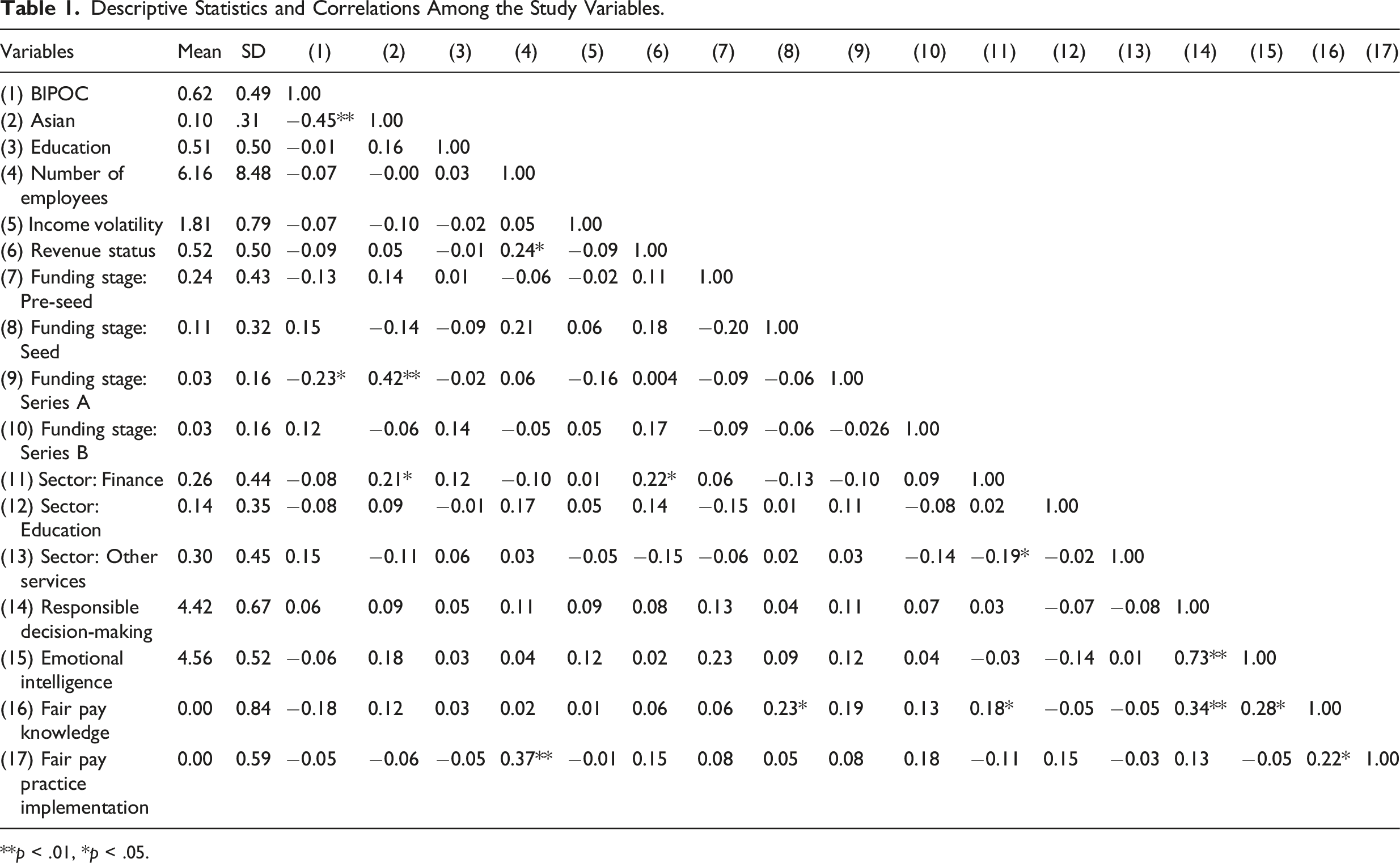
**p < .01, *p < .05.
Effects of Entrepreneur Characteristics on Fair Pay Latent Variables.

Standard errors in parentheses.
**p < .01, *p < .05.
Hypothesis 2 predicted a negative indirect effect of entrepreneur BIPOC status on fair pay practice implementation through access to fair pay information. Model 2 in Table 2 revealed a negative association between entrepreneur BIPOC status and fair pay knowledge access (B = −.612, SE = .191, p < .01). Monte Carlo simulation results indicated that the 95% confidence intervals for the indirect effect (BIPOC entrepreneur → fair pay knowledge access → fair pay practice implementation) (indirect effect = −.11; 95% CI = −.23, −.02) did not include zero, thereby providing support for Hypothesis 2.
Hypothesis 3 posited a conditional indirect effect, suggesting that entrepreneurs’ emotional intelligence strengthens responsible decision-making competencies’ indirect effects on implementation of fair pay practice through fair pay knowledge access. However, Model 3 of Table 2 revealed that the interaction between responsible decision-making competency and emotional intelligence was not statistically significant (B = .073, SE = .085, p = .387). This finding suggests that positive and significant effects of responsible decision-making on access to fair pay knowledge do not change depending on the founder CEO’s emotional intelligence. To test moderated mediation, we again used Monte Carlo simulation with 20,000 repetitions and followed Hayes’s (2015) approach using the index of moderated mediation. This approach requires us to calculate the 95% confidence intervals of the index of moderated mediation. We did not find support for Hypothesis 3 as the confidence interval of the index of moderated mediation included zero (index of moderated mediation = .013, 95% CI = −.02, .05). Furthermore, following a reviewer’s recommendation, we ran a supplemental analysis of testing whether emotional intelligence can be an antecedent of responsible decision-making competency. We found a significant effect of emotional intelligence on responsible decision-making competency (B = .778, p < .01).
Discussion
Under constant market pressures and business challenges, entrepreneurs of small ventures often exert significant influence on their firms’ decisions, including pay practices (Singh & Vohra, 2009). This study begins to address the question of how and why CEO founders’ social and emotional competencies shape their firms’ adoption of fair pay practices. With 125 female entrepreneurs in the U.S., we find that CEO founders’ responsible decision-making competencies increase the likelihood of their firms’ adoption of fair pay practices because of heightened access to the knowledge of fair pay. More importantly we discovered that after accounting for entrepreneurs’ human capital and social-emotional skills, as well as firm life stage (i.e., revenue stage), CEO founders from Black, Indigenous, and people of color backgrounds are less inclined to adopt fair pay practices, due to their constrained access to fair pay knowledge when compared to their White counterparts.
Despite the theoretical relevance of emotional intelligence, we did not find support for its moderating role in strengthening the indirect effects of responsible decision-making competency on fair pay practice implementation via fair pay knowledge access. This null finding may suggest that the execution of fair pay practices is driven primarily by moral judgment and reasoning concerning their decisions’ ethical and societal implications, rather than the ability to understand others’ emotions and situations. Or as our supplemental analysis results suggest, emotional intelligence may only have indirect effects on fair pay knowledge access through developing responsible decision-making competency. We also note that there is an ongoing debate about the construct validity of emotional intelligence with some research indicating that despite its lay-theory popularity, it is really a reflection of personality and not a separate construct in itself (Mayer et al., 2008).
In light of ongoing discussions and debates regarding DEI initiatives, particularly those related to compensation transparency and pay equity, our results demonstrate that fair pay practice adoption is driven not by identity-based preference, but by access to essential informational resources which has typically been more restricted among BIPOC entrepreneurs. Fair pay practices grounded in procedural and distributive justice principles enhance perceptions of legitimacy, trust, and fairness across all groups (Colquitt & Zipay, 2015). Fair pay practices are not zero-sum redistributions of advantage, but institutional mechanisms that improve transparency and accountability for all employees, thereby strengthening organizational ethics and performance. Situating fair pay practices within this broader DEI debate underscores that equity-oriented HR systems can serve as both a moral imperative and a strategic capability and, thus, can promote not only inclusion but also competitive advantage.
Theoretical Implications
This research makes several theoretical contributions. First, our study expands the scholarly discussion of UET in a small venture context. Prior research has established that firm-level characteristics (e.g., union status, firm size, past firm performance, and firm age) influence organizational decisions regarding compensation (Gomez-Mejia, 1992). Our study moves beyond organization, structural, and contextual characteristics and focuses on how executives’ ethical and cognitive competencies drive HRM practices. While prior studies based on the upper echelons perspective have predominantly centered on CEOs’ personality traits and values as determinants of firm-level business practices (Chin et al., 2013; Ormiston & Wong, 2013; Petrenko et al., 2016; Roumpi et al., 2020), this study shifts away from those factors, highlighting that CEO founders’ social competencies matter for HR practices particularly in the context of small ventures. In other words, our study expands the upper echelon’s explanatory scope from personality and demographics toward non-personality-based and trainable ethical capability.
Our finding is noteworthy because, in contrast to relatively stable personality traits, social competency constitutes a skill and ability that can be trained through targeted interventions and experience (Mitchell et al., 2022; Mumford et al., 2000; Zaccaro et al., 1991). This is also timely and meaningful discovery because the demand for social skills in top executive roles has markedly escalated in recent years, given their demonstrated importance for both firms and executive effectiveness (Hansen et al., 2021). Furthermore, the trait approach in the leadership phenomena has been challenged recently, and scholars call for more research on the role of leaders’ social skills (Mitchell et al., 2022). By showing strong influence of CEO founders’ responsible decision-making competency, this study underscores the importance of CEO founder’s social skills and extends the scope of upper echelon theory by investigating its applicability to small ventures and illuminating diverse ways to promote socially responsible compensation practices among small ventures. In addition, this research answers the call for more research regarding how and why entrepreneurs structure their reward systems in small-sized companies or start-ups (Conroy et al., 2015), extending previous research focused almost exclusively on the C-suite in large corporations (Santaló & Kock, 2009), by demonstrating that some small ventures, despite often times grappling with challenges like securing seed funding, endeavor to contemplate and implement socially responsible reward practices.
Second, this study takes an important step toward unpacking the long-debated “black box” of the upper echelon perspective (Lawrence, 1997). While prior research has linked executives’ demographic or personality attributes to organizational outcomes, such studies often rely on proxy variables, leaving the underlying cognitive and informational mechanisms largely unexamined (Hambrick, 2007; Neely et al., 2020). This omission has perpetuated what Lawrence (1997) termed the “congruence assumption,” the notion that observable demographic characteristics adequately capture the psychological and cognitive foundations of executive decision-making. Our study addresses this gap by identifying and empirically testing fair pay knowledge access as the mediating mechanism that translates entrepreneurs’ responsible decision-making competency into organizational practice. In doing so, we shift the focus of upper echelons theory from who executives are to how their cognitive orientations and informational environments shape firm behavior. Conceptualizing knowledge access as both a cognitive and structural mechanism, we show that ethical competencies must be coupled with informational resources to manifest in socially responsible HRM practices. This mechanism is particularly consequential in small ventures, where organizational structures tend to be flat, resource constraints are acute, and founders’ cognition directly drives HR and compensation systems. Thus, our findings illuminate how managerial cognition and information access jointly drive ethical and strategic behavior, offering a clearer view into the inner workings of upper echelons processes.
Third, existing literature on entrepreneurship has largely assumed that entrepreneurship is racially neutral and has not yet considered the racial implications of socially responsible business practices (For the detailed ongoing debate, please see Bruton et al., 2023; Garcia & Baack, 2023; Yang & Kacperczyk, 2024). Extending the perspective of racialized entrepreneurship, our findings highlight the informational disadvantages faced by entrepreneurs from marginalized racial groups. Thus, we unveil an unfortunate reality that marginalized racial groups, such as BIPOC entrepreneurs, struggle to access information about fair pay knowledge and labor market information. Paradoxically, racial minority entrepreneurs who may aspire to implement fair pay practices for their fellow minorities find themselves unable to do so due to limited access to fair pay knowledge. Thus, this research also contributes to the literature on entrepreneurship and inequality by illustrating the restricted access to fair pay information among minority entrepreneurs operating relatively small businesses.
Practical Implications
Beyond these theoretical implications, our findings also have several practical implications. First, this research highlights that fostering social and ethical competencies among entrepreneurs is not merely a developmental goal but a strategic imperative for sustainable firm growth. Our results suggest that social competencies—particularly those related to responsible decision-making—play a critical role in shaping entrepreneurs’ awareness and adoption of fair pay practices. Given that pay disparities persist across various occupations and sectors in the U.S. (e.g., Park et al., 2024; Park & Gough, 2025), and in an era of increased regulatory scrutiny and stakeholder activism, fair compensation practices not only reduce exposure to costly litigation but also enhance organizational legitimacy. Entrepreneurs who possess stronger social competencies are more likely to view equitable compensation as both a moral and strategic asset, linking fairness to firm legitimacy, employee trust, and talent retention (Treviño et al., 2014). This implies that entrepreneur training programs, business accelerators, and incubator initiatives should emphasize the cultivation of social and ethical decision-making skills and stakeholder sensitivity as part of their leadership development curricula. This aligns with existing recommendations for increased focus on integrative responsible leadership training (Maak et al., 2016).
Second, our research has meaningful implications for HR managers as well. Although the sample for this study focuses on founder CEOs, these individuals share similarities with line managers of small-to medium-sized teams due to the relatively modest scale of the ventures examined. Many organizations face challenges in implementing formal compensation policies, resulting in variability in the effectiveness of HR functions on pay equity and the application of specific HR practices (e.g., Hamori et al., 2024). This aligns with the broader research in strategic human resource management that emphasizes the gap between the intended (policies and practices designed by the organization’s upper echelons) and the implemented practices (those that the line managers actually implement) (Kehoe & Wright, 2013; Roumpi & Delery, 2019) as line managers intentionally (e.g., they fundamentally disagree with the designed practices) or unintentionally (e.g., they do not have a good understanding of the designed practices) alter the intended practices. One actionable recommendation for ensuring line managers adhere to fair pay policies is to provide targeted training aimed at enhancing managers’ social competencies. This recommendation aligns with recent calls for “ethical HRM” approaches that embed fairness, inclusion, and transparency into daily managerial practice (Greenwood & Freeman, 2018). Additionally, educating these managers on current legislation and the perspectives of stakeholders regarding equitable pay can further support compliance and effectiveness in fostering fair compensation practices.
Finally, our findings reveal that certain entrepreneurs, particularly those from underrepresented groups such as BIPOC, often lack access to critical knowledge about fair pay practices. This underscores the need for policymakers to develop systematic approaches to disseminate such information. Many minority entrepreneurs may not fully recognize the importance of fair pay knowledge or its specific components, highlighting the importance of targeted educational and financial support programs. Such initiatives could disproportionately enable racial minority entrepreneurs to embrace equitable pay practices. Relatedly, our research emphasizes the necessity of government-backed programs, such as grants or tax incentives for small ventures that conduct pay audits, participate in fair pay certification schemes, or demonstrate equity improvements over time, tailored to assist racial minority entrepreneurs in adopting socially responsible human resource management (HRM) practices. Government regulations, as shown in prior studies, can positively influence corporate social responsibility (CSR) activities, which are often driven by compliance (Worthington et al., 2006). Accordingly, there is a critical need for policies that not only encourage CSR initiatives but also provide access to resources and guidance to help entrepreneurs effectively implement these practices.
Limitations
As with all other studies, this study is not without its limitations. First, our sample consists of female entrepreneurs. To validate the representativeness of our sample, we conducted a post-hoc examination to assess potential differences between the women entrepreneurs who participated in our survey and the larger community, as evidenced by registration surveys, in which 826 entrepreneurs had taken. However, no statistically significant disparities were observed between our respondents and the broader community concerning age, racial characteristics, industry, and revenue distribution. Furthermore, given that female entrepreneurs often exhibit communal characteristics and a proclivity for responsible and sustainable development with elevated social values (Hechavarría et al., 2017), our sample composition may have imposed a range restriction in social competencies and fair pay practices, suggesting that even greater variability might be anticipated if both male and female entrepreneurs are included in our study. Despite the potential range restriction, we did observe a sufficient variability in responsible decision-making competencies and the execution of fair pay practices, revealing robust associations between entrepreneur social competency, fair pay knowledge, and the implementation of fair pay practices. Nevertheless, future research would benefit from utilizing a larger and more gender-balanced sample to investigate CSR activities more comprehensively.
Another potential limitation arises from our reliance on entrepreneurs’ self-reported assessment of fair pay practice implementation. Research in strategic HRM has demonstrated potential discrepancies among espoused (those the organization has designed), implemented, and experienced practices (Kehoe & Wright, 2013; Roumpi & Delery, 2019). However, our measurement focused on information that is typically not available to employees or supervisors, and therefore, collecting information from the entrepreneurs themselves was deemed appropriate. Relatedly, given the single-source survey design, we acknowledge that although our findings indicate indirect effects of entrepreneurs’ social competencies and racial background on fair pay practice implementation, these relationships cannot be interpreted as causal. It remains possible that the proposed mediator—access to fair pay knowledge—is correlated with both the predictors and the outcome rather than serving as a true causal mechanism.
Finally, the measures used to assess social competencies were originally developed and primarily validated within the fields of health, human development, and education. Although there is no theoretical basis to suggest that these constructs are inapplicable to adult populations, it is important to acknowledge the contextual origins of these instruments. Their use in the context of entrepreneurship and organizational behavior, while conceptually appropriate, warrants further validation in adult professional settings.
Directions for Future Research
Given the growing interest in social skills at the corporate executive level and their relevance to socially responsible business practices, this study focused on responsible decision-making competency and emotional intelligence. Nonetheless, there may be other trainable skills that could impact firms’ CSR activities. Future research should explore additional entrepreneurial characteristics as potential predictors of CSR activities at a broader level. For example, entrepreneurs’ values such as political ideologies may predict fair pay practices, as liberal entrepreneurs tend to prioritize egalitarian organization culture (Chin & Semadeni, 2017). Furthermore, future research should identify various HR practices related to CSR and explore ways to encourage firms to adopt such practices because fair pay practice is just one facet of socially responsible practices. For example, Barrena-Martinez and colleagues (2019) identified socially responsible practices in various functions within HRM process such as recruitment, staffing, diversity program, workplace safety, and employment relations.
Finally, our women-only design clarifies the impact of racial disparity among women founders but precludes formal intersectional tests (the intersectional effect of gender and race). Holding gender constant allows us to examine racial disparity in HRM decision-making among women entrepreneurs and to identify the informational mechanism through which responsible decision-making translates into fair-pay adoption. The theorized mechanisms (i.e., responsible decision-making competency and access to fair pay knowledge) are, however, not gender-bound. Thus, while we expect the logic to generalize to founders of other genders, we invite future work to test full intersectional interactions between gender and race to evaluate whether the proposed informational mechanism varies by intersectional status.
Conclusion
This study examined the relationship between entrepreneurs’ social competencies and their firms’ adoption of fair pay practices among small U.S. ventures. The findings underscore the critical role of responsible decision-making competency in facilitating the implementation of fair pay practices, while also revealing that BIPOC entrepreneurs encounter significant barriers to accessing fair pay knowledge. These results highlight the dual importance of developing social competencies and addressing racialized disparities in fostering socially responsible business practices. Given the central role of fair pay in effective talent management, this research contributes to a more nuanced understanding of the factors that promote equitable HRM practices in entrepreneurial contexts. We hope these insights stimulate further inquiry into the mechanisms through which firms implement socially responsible HRM practices.
Footnotes
Declaration of Conflicting Interests
The authors declared no potential conflicts of interest with respect to the research, authorship, and/or publication of this article.
Funding
The authors disclosed receipt of the following financial support for the research, authorship, and/or publication of this article: This research was funded by the Nasdaq Entrepreneur Center (NICHD P50 HD089922).
