



Abstract
The study explored meanings of success described by women educators in the textile and apparel (T&A) discipline by considering women educators as valuable resources driving the success of this unique discipline, while operating between several social identities in their professional careers and personal lives. The interpretation of 14 in-depth interviews with women educators from Midwestern high schools and universities revealed three theme categories (a) meanings of professional success, (b) meanings of personal success, and (c) work-life balance. The participants shared their struggle in balancing professional and personal success and the need for support to help achieve work-life balance. Implications derived from the results supported the importance of including both objective and subjective measures of success in reviewing women educators' performance. In addition, the need to understand from both the individual and organization on how women educators play several demanding roles within different social identities, ultimately affecting their performance and personal well-being.
In many ways, success is a very vague word. The first descriptor of success available in the Merriam-Webster dictionary (2011) is “result or outcome.” But what does a result or outcome mean for human beings? More specifically, what does it mean for women educators in the textile and apparel (T and A) discipline? The T and A discipline originated to empower women (Laughlin & Kean, 1995). Both the T and A discipline and the T and A industry have continued to evolve and respond to current economic and global environments. This creates unique challenges for T and A women educators who are continuously reacting to multiple influences. In addition, harsh economic times have created competitive environments for funding and resources in the U.S. universities and school districts, which threaten the T and A discipline (Laughlin & Kean, 2002).
Humans have the arduous task of defining their idea of identity and success, both of which are constantly evolving. Meanings of success may be measured objectively or subjectively depending on the person’s professional and personal goals. However, objective measures have conventionally been used by organizations on evaluation reviews (Katsikeas, Leonidou, & Morgan, 2000). The resource-based theory of the firm views employees as vital resources to obtain competitive advantage for an organization (Barney, 1991). Thus, understanding the success of T and A women educators is imperative to drive the discipline forward.
On an individual level, women take on several different social identities such as teacher, mentor, mother, wife, and friend. For some, these identities may conflict and create difficulty in understanding professional and personal successes. In the attempt to have both professional and personal success, women are now expressing the notion of “juggling” their lives (Fey, 2011). The struggle in juggling both a professional career and a personal life is that women are faced with sacrifices. Does she work over the weekend and give up that time to be with her children? Does she have a baby or achieve tenure or full professor? T and A women educators are faced with asking these questions and grapple with giving up on either professional or personal success. Thus, the purpose of the study was to explore women T and A educators’ professional and personal success through Barney’s (1991) resource-based theory and social identity theory.
Literature Review
Uniqueness of Textile and Apparel Educators
The T and A industry has been described as hyperdynamic and includes “complex market relationships, unpredictable environmental shifts, and intense competition for scarce environmental resources, coupled with accelerated business cycles” (Dyer & Ha-Brookshire, 2008, p. 52). To prepare successful and “society-ready” graduates, the T and A faculty members must also react and adapt to this ever-changing industry. In conjunction with the hyperdynamism, today’s T and A academic discipline is at risk due to unpredictable economic changes. These economic pressures also create a vulnerable academic atmosphere (Laughlin & Kean, 1995). Most recently, Ha-Brookshire and Hawley (2013) argued that the T and A discipline in U.S. higher learning environments looks a lot different from the past and lacks a clear identity.
To give a brief history, the T and A discipline is rooted in the fundamentals of home economics. Thus, according to Laughlin and Kean (1995), the T and A curriculum was built on a solid, comprehensive general education. The researchers also noted that a dominant theme of the discipline’s objective was to bridge the classical education of the past to the pragmatic education of the postindustrial era. The T and A discipline was created to advance the status of women by addressing the practical problems and concerns of education for this segment of society (Laughlin & Kean, 1995). From the postdepression period throughout the 1970s, the T and A discipline continually went through scholastic changes from the education curriculum to the development of working conferences (Laughlin & Kean, 1995).
As the discipline evolved into the 1980s, Horn (1984) identified contradictory aspects of the T and A discipline. The T and A discipline has strength to incorporate a multidisciplinary curriculum; however, it also shows a weakness with a lack of focus on a specific discipline. Horn (1984) continued by stating that the discipline needed to be driven by the requirements of employing graduates. A sacrifice of depth, for breadth of knowledge, would allow graduates a full range of employment in the ever-changing industry. Through the wide range of curriculum elements, the overarching goal of the T and A discipline was to prepare graduates with a broad education base and a proactive flexibility to interact with diverse cultures and individuals. With the shifts in society, today the T and A discipline has evolved from a focus on home to a focus on business (Ha-Brookshire & Hawley, 2013).
Historically, women have been one of the driving forces for the T and A education and industry (Kim, Pedersen, & Cloud, 2007). Women hold dominating managerial and executive positions in most T and A businesses as well as in academic units in the United States (Bureau of Labor Statistics, 2006). However, women have faced and are facing particular challenges society imposes, which are only exasperated by the difficult economic times. First, the traditional gender roles women are asked to play may affect their personal fulfillment as human beings (Emslie & Hunt, 2009). Second, through budget constraints, it is not uncommon to see many educators taking on additional classes and department responsibilities. This added workload can result in work stress (Kim et al., 2007), affecting scholarly productivity and overall sense of well-being. Finally, in addition to all of the challenges mentioned earlier and in response to the hyperdynamic industry, T and A women educators have changed curriculum, curriculum focus, research agenda, and teaching strategies. Thus, understanding this unique T and A faculty is important for the future of the discipline.
Measures of Success
From the business perspective, women are considered a unique organizational resource. Despite the importance of women as key resources, many organizations find it difficult to measure organizational performance beyond financial measures (Katsikeas et al., 2000). Traditionally, organizations have measured performance through tangible assets that can be given a monetary value, such as fiscal outcomes (Day, 1994). However, researchers such as Day (1994) and Barney (1991) argue that there are more important factors to consider when assessing an organization’s performance. Beyond traditional measures of performance, unique human capital, described as “complex bundles of skills and collective learning” (p. 38), joins together tangible assets and facilitates their successful use (Day, 1994). According to Barney’s (1991) resource-based theory (RBT) of the firm (or organization), a firm (or organization) is a collection of unique tangible and intangible resources. Through these resources, organizations gain and sustain competitive advantages. Thus, measuring both tangible and intangible resources is critical for any organization’s success, which can be different from pure financial performance (i.e., objective measures). In this light, the RBT of the firm includes and emphasizes nonfinancial performance measures, or subjective measures, such as relationships, personal insights, and morale (Dess & Robinson, 1984).
Applying this business perspective to the academic discipline, faculty members are important resources of human capital. Faculty’s unique knowledge, skills, background, and experience are important intangible resources, particularly for the T and A discipline that was originally created for women and their place in a modern society. In this light, women educators’ success and utilization of such resources are important for the T and A discipline’s success. In order for the T and A discipline to flourish and achieve academic and scholarly excellence, an understanding of women educators is required for the T and A unit, as an organization, to obtain and sustain competitive advantage within the academic realm (Laughlin & Kean, 2002).
Women Educators’ Success and Social Identity
Understanding T and A women educators requires a holistic perspective to capture various meanings of success. At the group level, according to Lobel (1991), individuals classify themselves as members of multiple social groups, such as employee, mother, and wife. The interactions, with these multiple social groups, result in various identities for the individual. Each social group identity is linked with certain emotions, attitudes, and behaviors characterized as role investment (Stryker & Serpe, 1982). However, a principal concern women may face today is the conflict that may arise from these multiple roles, the expected roles, and the relationships with individuals and organizations (Hall, 1972).
According to the social identity theory, an individual will classify himself or herself and others into various social categories such as organizational membership, gender, and age cohort (Tajfel & Turner, 1985). Social classification serves two purposes. First, social categories segment the environment and help the individual define himself or herself in relationship with others. Second, social identification gives an individual a sense of belongingness (Ashforth & Mael, 1989). The social identity theory may be applied to T and A women educators who may classify themselves into two different social environments—professional and personal—in order to define themselves. Thus, if they can clearly define themselves within social classifications, a clear understanding of professional and personal meanings of both successes and failures can occur. In addition, T and A women educators are struggling to optimize performance as teachers, researchers, mentors, mothers, wives, and friends. The challenge is the lack of understanding of T and A women educators’ success both professionally and personally, making it difficult to evaluate the overall academic organizational success (Laughlin & Kean, 1995).
Research Questions
Although struggle may occur with women in other academic disciplines or industries, the study focused on women educators in the T and A discipline for three reasons. First, the unique, hyperdynamic environment causes constant changes in the industry as well as academic discipline (Ha-Brookshire & Dyer, 2008). This environment requires constant changes in curriculum and academic focus. Second, the threats of reorganization for academic units cause educators to constantly face evaluation and justification of the academic unit’s success (Laughlin & Kean, 1995). Third, women have been dominating the T and A industry as well as the academic field. Thus, an exploration of women educators in the T and A discipline was expected to lay an initial groundwork for further research in women’s career development in the T and A industry. This study was therefore designed to explore the meaning of success described by selected U.S. women educators in the T and A discipline. The following research questions were developed: (a) How do T and A women educators define success in their professional and personal environments? and (b) How are professional and personal successes related for T and A women educators?
Method
Interpretive Approach
The purpose of this study was to explore professional and personal success described by women educators in the U.S. T and A discipline. Due to the lack of past research focusing on women educators who might have multiple social identities and from the vantage point of women as key resources in an organization, the study was organized to be exploratory as a basis for future research. Specifically, an interpretive approach was utilized to describe routine and problematic moments in each participant’s life (McCracken, 1988). Semistructured interviews were conducted to allow the participants to recall their own story (Anderson & Jack, 1991). Also, when possible, observations of participants in their natural setting were employed before, during, and after the interviews. Observation helps describe “a social world and its people” (Emerson, Fretz, & Shaw, 1995, p. 68), enabling the researcher to read and interpret the participants in their surroundings.
Sample
After the approval of the university’s Institutional Review Board, 14 participants were recruited by a purposive sampling of three participants and then snowball sampling, which led the researchers from one information-rich case to another (Patton, 1990). The three initial participants who possessed specific characteristics were purposively selected to illuminate the phenomena being studied rather than to choose a representative sample drawn from a population (Patton, 1990). Currently, in the United States, T and A curricula are offered to high school students as electives and college students as a major or minor. By the 14th participant, emergent themes became repetitive, indicating further interviews were unlikely to provide surprising or new information, achieving the goal of saturation (McCracken, 1988).
At the point of interviews, all participants held teaching and/or research positions in T and A programs at two major universities and three different high schools in U.S.-Midwestern cities. As with many people’s careers, each of them has worked in different universities and K-12 institutions prior to their current employment, representing various segments of women educators with different career paths, choices, or drive for success. Participants were selected based on their varied experience in teaching and research as well as different personal or family lifestyles, which was expected to elicit enriching information from different angles. However, the participants’ core commonality was the fact that they were all women educators in the unique T and A discipline at the time of the interviews. Table 1 describes the demographic characteristics.
Demographic Characteristics of Participants.
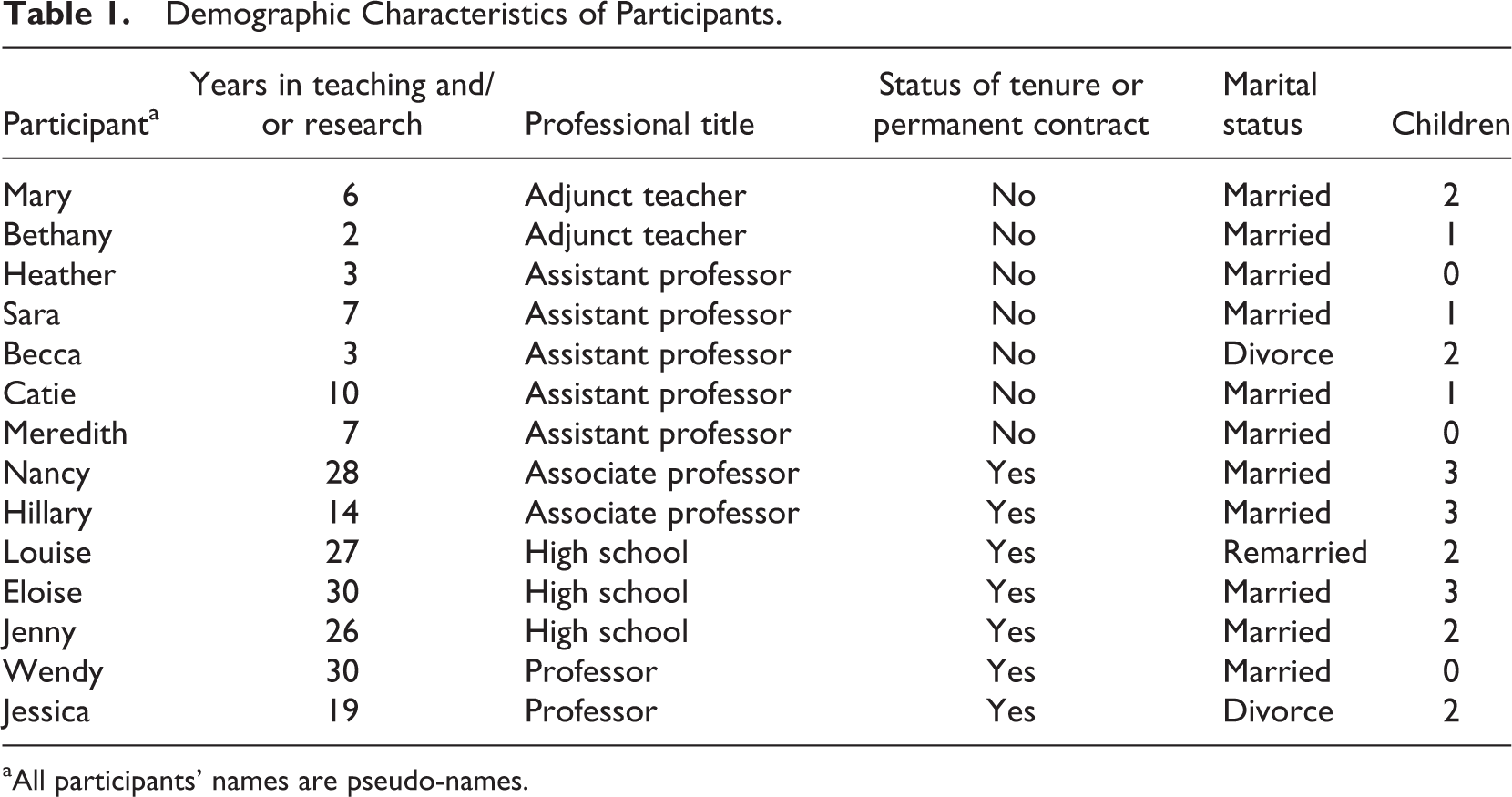
aAll participants’ names are pseudo-names.
Data Collection
After an explanation of the study and assurances about confidentiality, all participants were asked and agreed to give their informed written consent and whether their accounts could be audio recorded. The formal interviews lasted approximately 30 min. Before the formal interview began, rapport was developed between the participants and the interviewer with casual conversation about the connections in each other’s personal lives. This process lengthened some interview durations up to 60 min. These rapport-building conversations, as well as observations, were recorded in the field notes. During the interviews, most participants were interested in knowing the details of the interviewer’s life and how the topic of the study was developed. As the interviewer shared more professional and personal information, the participants revealed their own struggles more, which strengthened rapport. The interviewer, however, ensured the whole interview conversations were focused on the participants’ feelings and opinions and not dominated by the interviewer’s biases. This dynamic interaction prior to formal interviews appeared to influence the quality of the interview data, as it seemed to help create a more intimate environment to obtain deep emotions from the participants.
The formal interview had five overarching topics. They were (a) how they began their career, (b) what were their favorite and challenging aspects of their current professional role, (c) how they described success in their profession, (d) how they described success in their personal life, and (e) how professional and personal success were related, and if so, how they balanced the relationships between their professional and personal successes. One researcher conducted the interview that started with general questions and then moved to specific, personal questions, allowing the participants to present their stories in a retrospective way.
Before the interview, the researcher was able to explore the institute or school; sometimes this included observing the participant interacting with a colleague. During the interview, the researcher took notes and recorded field notes in the participant’s classroom or office, many times asking questions regarding family photos, desk artifacts, postings on office doors, decorations, and rapport conversations. The contents of the field notes were used to interpret the participants’ complex social situations combined with the interview data (Lang & Lang, 1991). As 12 of the 14 interviews took place in the participants’ office or classroom, a sense of identity materialized. However, the two participants who were high school T and A educators requested the interview location outside their work environment because “getting away from the office would be nice.” Because of this separation, fewer field note data were collected from these two participants; however, a sense of identity was still discerned.
Data Analysis
In qualitative interviewing, language is both a tool and an object of analysis. Once both interview and field note data were coded by emergent themes using constant comparative analysis, which allowed similarities and differences to develop among the cases, and interpreted (Creswell, 2007), then the four-cycle data analysis method was employed following Ha-Brookshire and Dyer (2008) and Thompson (1997).
Thompson’s (1997) four cycles of interpretation were used, which included (a) an intratext cycle, (b) an intertext cycle, (c) interactive movements between the intratextual and intertextual interpretive cycles, and (d) a final holistic interpretation. The data from the interviews, transcribed texts, and observations across participants were all analyzed. This four-cycle analysis provided the necessary qualitative reliability checks by allowing the researchers an opportunity to reflect at each cycle (Ha-Brookshire & Dyer, 2008). The four cycles of interpretation were repeated separately for each research question for all participants as well as for each question within one participant. Both processes were iterated constantly. Throughout the whole data analysis process, the researchers ensured that the results of each interpretive step reached 100% verbal agreement between the 2 researchers. This ensured reliability of the data analysis. This verbal agreement was important because both researchers have unique and different professional and personal backgrounds. These differences, or biases, helped uncover multiple layers of the study themes that would otherwise be difficult to obtain. During these processes, themes emerged naturally.
In addition, three validation strategies were employed as specified by Johnson’s (1997) strategies to promote qualitative research validity. First, low-inference questions were used to provide long, full quotes from the participants. This allowed the participant to describe her feelings and thoughts of success without paraphrasing. Second, through triangulation, all themes and categories were reviewed and validated between the two researchers during data collection, data analysis, and interpretation (Johnson, 1997). Third, method triangulation was used for incorporating field notes with formal interview transcripts to provide full descriptions of the participants and the interviews in order to maintain a holistic perspective.
Interpretation
Success is a subjective term that all humans try to grasp. This is especially true for T and A women educators who address the hyperdynamic market environments (Laughlin & Kean, 2002). The conflict between professional and personal success influences T and A women educators to feel as if they are constantly juggling to meet the expectations of different social identities as mother, wife, teacher, researcher, colleague, and so on. The interview data, which was also supported through the field note data, were organized into three categories: (a) meanings of professional success, (b) meanings of personal success, and (c) work–life balance. From these categories, two themes emerged.
Meanings of Professional Success
Through the analysis of the study data, professional success emerged as a dominant category. All participants seemed to be proud of their professional accomplishments and verbalized to a great extent their professional success. They loved to speak of their journey through their career. Some of the college professors specifically referred to plaques, awards, or diplomas displayed in their office as symbols of their professional success. The high school teachers walked around their classrooms, pointing out students’ projects and awards as tokens of their professional success. Regardless of the type of tangible proof of their professional success, the study data showed two distinctive themes: (a) “publish or perish” as research oriented and (b) “all about the students” as student focused.
Publish or Perish as Research-Oriented Success
Of the 14 participants who were all tenured or on the tenure track at universities in this study, 9 described professional success as research activities, such as grants, publications, or the result of tenure evaluation. In these nine participants’ opinions, research productivity seemed to be the main objective measure of professional success. The participants explained the pressure of achieving professional success as Catie (whose name has been changed and is an assistant professor up for tenure in a year) frankly puts it, “at the end of the day, they really are going to count how many publications you have.” Similarly, Nancy, an associate professor who has taught at a university for 28 years, also shared the feeling that success meant doing a lot of research, and that by doing so, a well-published professor or educator would gain reputation in the community:
I would say that those people that have been successful in their career generally have been great researchers. Really good researchers. That has gotten them far. They could be all good or bad teachers, that part does not make that much difference in terms of what gets them known or department chairs or dean or awards at the conferences for being outstanding this or that. It was all about LOTS of research.
To the participants, research meant “producing and facilitating knowledge” and it could “change people’s lives.” All nine participants who believed their professional success depended on research expressed their strong desire to foster new knowledge and improve their communities and students’ learning. Hillary, an associate professor of 14 years, clearly explained her drive, investment, and results of her research activities, leading to her professional success:
I am passionate about contributing new knowledge, so I think that’s sort of a measure of success professionally. You have invested so much in your area of scholarship that you’re contributing to new knowledge. I think that is a huge thing and, of course, all the measures that go with it: publications, exhibitions, all that.
Conducting research is one measure. However, producing research results within scheduled time constraints seemed to weigh heavy on everyone’s mind. Although Sara, an assistant professor, defines professional success as research oriented and spends much of her time in her area of research, she admittedly was not achieving expected output that was used to objectively measure her for tenure. That is the reason why she was denied tenure during her evaluation and her contract was not renewed. She expressed disappointment that timely research was so emphasized in the current performance evaluation in order for her to be seen as successful among her academic unit and peers:
Publish and perish is what got me into trouble ( …) I want to do the research and am doing the research but I am not producing it on schedule and that is the problem. That is so difficult ( …) The fact that when you go for tenure and the promotion guideline says in a year you need this amount of research, well it is very competitive.
All About the Students as Student-Oriented Success
Six participants, including the three high school teachers, two adjunct professors, and one tenure track professor, felt their success was determined by their students’ success, a subjective measure. The dynamic of teaching, which these women educators emphasized, was student focused. This group of women talked about how their professional purpose was to assist their students in achieving goals, which is seen as a more subjective measure. To these women, the objective measure of research was not the focus in evaluating their professional success. Instead, effective teaching and students’ success were more important. Heather, an assistant college professor teaching for 3 years, strongly criticized the narrow focus of research-oriented professional success and stressed more attention on student-focused teaching and outcomes. Mary, an adjunct professor with 6 years of teaching experience, also agreed that the bottom line of her professional success was to help her students: There are a lot of pressures to define your success by how many publications you have [in order to] achieve tenure. These factors don’t necessarily directly relate to teaching. So, I think my definition of success, at this point, is centered on teaching. It is all about helping them [students] succeed. It is so rewarding to help the students. I find it so rewarding. Bottom line I think it is about the students.
Particularly, the high school teachers seemed to view their students on a very intimate and on “a completely different” level, suggesting subjective measures of professional success. They could not help but to marvel at their students. They seemed to perceive that their entire professional motivation was to foster their relationships with students in order to build students’ ability to succeed. This was extremely evident in how Louise, a high school T and A teacher of 27 years, enthusiastically discussed how her success was her students:
Obviously the kids. How can it not be the kids? They are just so fun! They’re just such a joy, such a blessing. I get to know them on a completely different level and I have learned over the years they give me so much more then I give them (…) I can’t imagine doing anything else with my life. I am a very fortunate person and I know that.
Therefore, it seemed apparent that student-oriented professional success can be measured subjectively by how students feel about T and A educators’ teaching in class, after graduation, and throughout students’ career. If students enjoy, appreciate, and apply the knowledge given by these women, the participants seemed to feel as if they had succeeded in their profession. Although these measures seem quite subjective, they appeared to be a critical catalyst for these women’s future career endeavors. Bethany, an adjunct professor for the past 2 years, described how her students’ enjoyment of class and application of what they learned toward their future career contributes to her student-oriented success:
Success would mean to me that I have students that enjoy coming to class every day and they feel like they got one thing out of the lecture or class that day. By the end of their [students’] career in our department, [if] students feel like I contributed (…) and they feel they can go out into the industry and apply that, [I feel I have succeeded].
Meanings of Personal Success
Themes in the personal success category seemed less dominant or apparent compared to those in the professional success category. In this study, the participants appeared to have a particularly difficult time in expressing what personal success was for them. The question of personal success seemed to catch the participants off guard and, usually, there was a long silent pause as the women gathered their thoughts to answer how they would define their personal identity and success. This may suggest that success had been readily identified in their professional performance, while the topic of personal success required time for the participants to reevaluate themselves with a different social identity, such as mom, wife, and daughter. Through interpretation of the study data, two themes appeared for T and A women educators’ personal success: (a) “family comes first” as family-centered success and (b) “can’t have personal success without professional success” as they go hand in hand.
Family Comes First as Family-Centered Success
Although five participants (two of the high school teachers, two adjunct professors, and one tenured professor) had different job descriptions, expectations, and evaluation processes, all of them clearly defined their success as what they had achieved in their personal lives, such as family, children, and other nonprofessional interests—a subjective measure of success. However, these five participants gave the impression they subconsciously believed defining family-oriented success was taking a “step back” on their overall success. This seemed to be the result of societal pressure that, for women to have a dominant professional career, they must not focus on family. Although Bethany shared this feeling, she still felt she had to justify her priority on personal success:
I literally had an epiphany. I wanted a child and the world turned into what I define [as] success now. It has nothing to do with money or power or position. It has to do with me feeling like I am giving something at the end of the day and I am present in my son’s life, and my life, and what my work does (…) There is nothing wrong with taking a step back and being a mom.
Although some participants were rationalizing their personal success at the expense of professional success, others were openly prioritizing their family identity over professional success. For these women, family-oriented success was prioritized by the needs of their family. They highlighted the time they could spend with their family and children, and every other aspect was arranged around family. However, they also admitted that because of their family-oriented focus, their professional career path had to be either changed or compromised. Mary showed how her career path had been selective because “family is my first priority,” and Nancy explained her delay of professional accomplishments because of her family obligations:
Bottom line my family comes first. I want to be close to my family (…) Family is my first priority (…) My goal is to go back to my alma mater which is a teaching institute and be close to my family.
So once I had my kids it influenced my choices when I was going to the office to work on a grant. Or stay at home with them during the summer. The kids were my priority (…) That is why I am still an associate professor.
Interestingly, the high school teachers in this study seemed to express their family-oriented identity with ease. They appeared to be very confident in verbalizing their family-oriented successes. All three pulled out hundreds of pictures from digital cameras and wallets during the interviews to visually convey their family-oriented success. They were proud to say they focused and achieved a family-oriented life while developing a career they love. From their vantage point, their career and family were just one of the many descriptors that made up their success. When asked about success, Louise first described her identity as a good wife; her job was the fourth descriptor, followed by her hobby. Uniquely, she expressed herself in five different social identities:
I am married and have 2 children and have 4 grandchildren and I teach high school and I love my job and I am a quilter and that is what I do with my life! I am very successful.
Can’t Have Personal Success Without Professional Success as They go Hand in Hand
Eight of the participants appeared to find it difficult to separate professional success from personal success as well as their separate identities in both areas. In these women’s minds, professional and personal success were strongly related and had objective measures associated with them. If they failed at one, the other was usually a failure. Thus, they appeared to feel they could not fail in either area. Some, such as Heather, put more weight on professional success for her meaning of overall success. These two parts of their lives were completely integrated in their minds. This seemed to infer that their career defined who they were:
I think success in my profession is part of success in my personal life. I don’t think I would personally seem successful if I weren’t successful in my profession.
However, Eloise, a high school T and A teacher for 30 years, seemed to be the only one who had found a way to integrate both personal and professional success in a very productive way to achieve an even greater overall success. She shared how she feels privileged to have taught T and A, as she believes the content of T and A makes her a better person. Eloise constantly comes up with new class projects inspired by her personal life. Her personal projects help students better understand the role of T and A products in their lives. Her firm belief was that both her students and her family benefitted from her love of the T and A discipline. To her, all of her social identities seemed to be melded into one core identity, herself:
Everything I have taught I bring home. Because of the area I teach, it is all family oriented. The things we do in our field make us better parents, better spouses, and a better whole person.
Work–Life Balance
Work–life balance emerged as a sought-after idea of the participants’ meaning of success, especially for the university women professors. Work–life balance was a continuous topic that was discussed throughout the interview process to describe how the participants’ professional success interacted with their personal success in a less measurable or subjective meaning of success. In the T and A discipline, work–life balance seemed to be a struggle. Three of the women’s office doors had article clippings of “ways to balance” or “how successful women balance” at the time of the interviews. Two particular themes emerged under work–life balance: (a)“a needed sacrifice” for professional success and (b)“ok not to be a superstar” as balanced scales.
A Needed Sacrifice for Professional Success
All of the women in this study were perceived to be professionally outstanding as acknowledged with acclamations by their peers and community. Plaques, awards, and other artifacts of accomplishments were displayed in their offices. However, the downside of achieving a fruitful career seemed to be a sacrifice in personal life. The analysis of the study’s data revealed that when the individual woman focused on one aspect of success (e.g., professional success), then the other area of success (e.g., personal success) suffered. This seemed to create an imbalance between professional and personal success. The participants who emphasized research as their professional success were focused on advancing the discipline and thus constantly pushing for overachievement for the interest of the discipline. Hilary, a tenured professor, compares past T and A educators to those today, where the rigor of research is lacking because some educators are more concerned with work–life balance:
The reality is I’m fearful of what’s happening. I’m fearful of “have we lost a level of rigor as we have tried to balance?” It used to be the educators in our field had to prove themselves so much that they were overachievers. You didn’t have a life. You often didn’t have a spouse. You often didn’t have children. And they would go to the conferences and they would have a standard and rigor and people feared and admired them but you knew if got your degree under them you got a degree so I don’t know if we have become too watered down.
Coupled with the lack of rigor, the discipline itself is under scrutiny and faces program closings and funding challenges (Ha-Brookshire & Hawley, 2013). Louise, a 27-year high school T and A teacher, explained that the Department of Education in her state determined the T and A program will not receive future funding. The state projected the T and A industry will not grow at a rate of 14% in the next 10 years and will not have jobs with a minimum starting salary of US$10 an hour. Thus, Hilary, who seemed to be an overachiever with high expectations on her career development, emphasized a needed sacrifice among T and A educators. She shared that she devoted so much of her time and effort to her career that she had to sacrifice her personal life and fulfillment:
At some point it becomes you doing things for your own personal level [her own professional goal] which may be much higher than what is expected. I would stay till 1 and 2 in the morning editing their [grad students’] work just so they had it. Because I know there was no way they were getting it done unless I pushed [sacrificed my time].
Consistent with Hillary’s challenge of prioritizing her professional identity over her personal identity, Wendy, a college professor for 30 years, recounted her professional successes and identity with teaching awards, research grants, and exhibit awards throughout her career. However, this celebrated professor also shared great personal struggles on her pursuit for a successful career. She candidly expressed “it was what had to be done” to professionally succeed. In her opinion, giving up a personal life was the price to pay for her professional career:
I have been an utter failure in my personal life! It has only been in about the last 2 years that I have had one [personal life]. Until the last couple of years, I quit working at 9 p.m., because if I didn’t quit working at 9 p.m., I couldn’t sleep. Now, I take work home but I don’t tend to work on the evenings or weekends now. I would work from 7 a.m. to 9 p.m. Sometimes if I was really worried about something I would get up in the middle of the night and turn the computer on and get to work.
Ok Not to be a Superstar as Work–Life Balance
In stark contrast to the participants who sacrificed their personal lives for professional careers, there were five participants who taught in both universities and high schools and appeared to have succeeded at work–life balance. They all believed “success in life is that I have balanced my professional life with my personal life.” Although work–life balance had been achieved for these five women, the sensed sacrifice was that they were not able to excel at either “life.” As Nancy described, she could only be “pretty good” at both professional and personal life in order to fulfill all her life’s goals:
Being a superstar was not important to me. I was always ok not being the superstar. What I feel like is I can be good at a lot of different things; I am just not the best at any one thing. I am really a pretty good mom with a professional career, pretty good researcher, pretty good teacher (…) I am the superstar-balanced-mom-professional. I am good at balancing.
While many of the participants referred to balancing their lives as “a conscious effort to balance,” work–life balance did not seem to come naturally to most of the participants. Thus, some participants found different strategies for creating work–life balance. The strategy of Catie, an assistant professor, was to set clear boundaries between her work and personal identities:
I have my PhD and job where I can make a difference and have figured out a way to still have a family life. I think that, honestly, is one of big ways to define personal success (…) One of the things that has allowed me to be balanced is that I set boundaries, like I do not check my work e-mail after 5 p.m. and I do not check it on the weekend.
However, the participants also recognized “an ebb and flow” to balance their career and personal life. Throughout the different stages of life, sometimes they have to focus on their professional identity and development. At other times, personal matters are more important. Thus, depending on where you are in your life, the work–life balancing act could be different. Becca, a new assistant professor, expressed that she needs to consume most of her time to achieve professional goals, still expecting “the point” in her life to have balance:
I am trying to get to the point where I can have personal relaxation time as well as keeping focused on my physical, mental, and academic well-being. As a new faculty, it is very difficult for the academic portion of my life because it tends to be all consuming.
From the interpreted categories and themes, an overall conceptual model was created. Figure 1 is a pictorial representation of the researchers’ interpretation of the study’s themes, both objective and subjective meanings of success, described by the study participants. The model shows that all participants have different emphases on professional and personal success, with the goal of achieving the perfect balance. However, most of the participants seem to struggle with achieving balance that was influenced by the interaction between sacrificing personal success for the demanding professional success, depending on their life stage, job requirements, and personality. Thus, professional success seemed to weigh more than personal success.

Conceptual model for meanings of success. Note. Conceptual model for meanings of success: A pictorial representation of interpretive themes emerged from the study data. The model depicts that all participants have different emphases on professional and personal success, with the goal of achieving the perfect balance.
Conclusion
Due to the unique challenges that women educators have faced and are facing, this study sought to explore the professional and personal meanings of success and how these successes interact for women educators in the T and A discipline. The paucity of research in meanings of success for women educators led to the adoption of an interpretative approach utilizing in-depth interviews and field notes. Interpretive analysis of the study data gave rise to three categories: (a) meanings of professional success, (b) meanings of personal success, and (c) work–life balance.
The researchers found different meanings of success for T and A women educators. First, the meanings of professional success for T and A women educators were divided into research-oriented success or student-oriented success. Research-oriented success was objectively measured by journal publications, grants, and result of tenure evaluation. Conversely, student-oriented success prioritized subjective measures of support for students and their success over research-oriented success. Second, the findings revealed that meanings of personal success were identified as either family-centered success or can’t have personal success without professional success as they go hand in hand. Finally, work–life balance was a constant struggle but was a coveted meaning of success.
This study has several contributions and implications. First, in the measures of success literature, the study’s findings supported Barney’s (1991) resource-based theory with the need for both objective and subjective measures of success for T and A women educators. The current performance evaluation system tends to place an extensive emphasis on objective measures, such as publications, grants, and student enrollments. However, results indicate that subjective measures of professional success, such as job satisfaction and student–teacher relationship development, are vital for their overall achievement of professional success. This supports the resourced-based theory and could help academic organizations and administrators reevaluate their performance review systems to include both objective and subjective measures for women educators. In expanding evaluation measures, this result could help improve job satisfaction, which could increase work productivity and overall well-being.
Second, the work–life balance theme category illustrated further that women educators recognize themselves with several different social identities such as wife, mother, colleague, and so forth. However, a certain identity may often dominate, such as overachieving professionally or prioritizing family. The struggle with either a professional or a personal identity makes it very difficult for women educators to create balance in their lives, making them feel unsuccessful in either their professional careers or their personal lives. This result suggests that neither professional nor personal success represents success as a whole. Often, being a professional superstar may require personal sacrifice. Thus, it may be ok not to be a superstar, and this does not mean one is not successful. Women educators may need to be more realistic. Academic organizations may need to allow for flexibility in performance evaluation to accommodate fluctuating priorities in professional careers and personal lives throughout a woman’s life.
Third, the study’s findings further illuminated the unique challenges and dynamic environment of the T and A discipline. The participants expressed how they labor in both driving the discipline forward with rigor and justifying support from university administrators and school districts due to seemingly lacking future opportunities. Because of the T and A discipline’s rich history and the fact that T and A are fundamental for human existence and survival, the T and A discipline must go on for future students and generations. However, these women educators are challenged in balancing between their professional and personal success and the achievement of the perfect balance seemed to be a moving target. More support is necessary to help these women educators succeed in both their professional careers and their personal lives.
Finally, the results of work–life balance help raise awareness in the T and A educator community that they are not alone in their feelings and struggles. This awareness may help current and future faculty develop realistic expectations of professional and personal meanings of success. These realistic expectations may help women educators alleviate the unnecessary feeling of failure and open candid dialog among the T and A community regarding struggles both professionally and/or personally and may assist in acquiring balance.
As with other studies, this study had limitations and therefore offers future research opportunities. First, this study focused only on women educators in the T and A discipline. Further research on women’s success in the T and A industry would help validate the study’s themes and may show similarities and/or differences in women’s success between the industry and the academia. Second, although the study findings showed themes related to success of T and A educators across academic levels and positions, further studies are recommended for examining the perception of success of women who have different job requirements and expectations that may affect work–life balance. An understanding of the similarities and differences between high school teachers, 2-year institution professors, adjunct instructors, and tenure-track or tenured faculty would be fruitful to improve the overall well-being of women educators in the T and A discipline. Finally, the study’s findings also revealed the impact of women’s life stages on their views of success. Further research is needed to understand how particular personal situations, such as the age of children, family support systems, and marriage status, affect women educators’ view of success.
Footnotes
Declaration of Conflicting Interests
The author(s) declared no potential conflicts of interest with respect to the research, authorship, and/or publication of this article.
Funding
The author(s) received no financial support for the research, authorship, and/or publication of this article.