



Abstract
The purpose of this study was to investigate patterns and reasons for textile-making in women from non-Western culture, Korea, as well as to examine how these patterns and reasons reflected generational differences. Singelis's (1994) self-construal model was used to study values; Collier's (2011) survey was used to investigate patterns and reasons for making textile handcrafts. A total of 365 Korean participants completed the survey: 28% of the participants were young adults (18–25 years old), 42% were middle adults (26–45 years old), and 30% were older adults (46–97 years old). The results confirmed significant differences in the self-construals for different generations of Korean women. Older adults had the highest interdependence scores, followed by the middle adults; the young adults had the lowest scores. Significantly different patterns and reasons among the three Korean groups were also consistent with these results. By demonstrating significantly different patterns and reasons for textile-making between three generations in Korean culture, this study offers a unique contribution to the understanding of the resurgence of textile-making today.
Introduction
The resurgence of textile-making began in the late 20th century as part of a growing trend in crafting. Considered by some to be a response to tough economic times, crafting has become an international trend (Turney, 2010). The Craft Yarn Council (2011) estimated that approximately 38 million knitters and crotchers lived in the United States, whereas Rowan, a popular British yarn manufacturer, estimated that 11% of the British population regularly knits (Rowan News, 2011). According to Collins (2011), when the global economy slowed down in recent years, people turned to textile-making such as knitting, quilting, and sewing—not only to keep costs down but also to socialize with others. In addition, the rebirth of textile making has enabled people to cope with everyday emotional worries and concerns by helping them discover the joy, pride, and achievement associated with making something (Collins, 2011). Another explanation for this resurgence is that, as consumerism and globalization have increased, do-it-yourself (DIY) movements have become a popular way for people to reclaim production (Clifton, 2011; Williams, 2008). Finally, people are becoming conscious of green issues that have caused them to shift from a consumer culture to an anticonsumption and sustainable culture. Along these lines, some have suggested that DIY enthusiasts are motivated to use recycled and reclaimed materials in their artwork and crafts (Albinisson, Wolf, & Kopf, 2010; Clifton, 2011; Levine & Heimerl, 2008). As such, there has been a move toward experiential activities such as those offered in textile-making (Clifton, 2011).
Although the existing literature has noted this growth in handcrafting, only a few studies have actually examined it from a research perspective. Collier (2011) recently analyzed a multinational sample of primarily Caucasian female textile handcrafters from the United States, Europe, and the Pacific Rim. She reported that self-identified textile handcrafters had tried almost a dozen techniques, indicated an overall mastery with approximately five techniques, and had used three textile techniques during the previous 3 years. Knitting was the main technique the women in this study had tried, felt mastery over, and used most frequently, followed by sewing, weaving, quilting, and spinning. The women also reported that they created textile handcrafts in order to fulfill an aesthetic need, feel grounded, and cope with life.
As our world is becoming increasingly globalized, it is important to explore the resurgence of textile-making in non-Western cultures. Although the concept of generations has become one of the most important societal categories to study across social and personal values (Lyons, Duxbury, & Higgins, 2007), it has never been studied with regard to textile handcrafts. Given the economic and technological developments and increasing globalization, younger generations in traditional, collective societies have been rapidly shifting their values to those of the Western, autonomous ideal (Sun &Wang, 2010). Therefore, it is critical to study the reasons behind the growth in textile-making in Asian societies while considering generational differences. In this study, we explored Singelis’s (1994) self-construal model in conjunction with patterns of textile-making in three different generations of Korean women.
Literature Review
Meaning of Textile-Making
Few investigators have explored the psychological value of textile-making for women. The majority of research has involved qualitative studies with very small, localized, Western, and homogenous samples (Johnson & Wilson, 2005; Nelson, LaBat, & Williams, 2002, 2005; Reynolds, 1999, 2000, 2002; Schofield-Tomschin & Littrell, 2001). The study samples have typically been convenience samples; quite often the investigator, who is also a fiber artist, has interviewed friends and colleagues (e.g., Johnson & Wilson, 2005; Riley, 2008). The current study is the first to employ a large Korean sample of handcrafters while utilizing quantitative research methods.
By analyzing previously published work, Johnson and Wilson (2005) determined that textile-making gives women a sense of their place in the world, provides both tangible and intangible benefits, and connects them to their own personal histories. Riley (2008) suggested that textile-making provides women an enhanced sense of self and a collective identity; some women have reported that textile-making is an inner spiritual or psychological experience for them. In the United Kingdom, Frances Reynolds explored the role of the textile arts for women with unresolved grief (Reynolds, 1999), depression (Reynolds, 2000), and chronic illnesses including chronic fatigue syndrome/myalgic encephalopathy (CFS/ME; Reynolds, Vivat, & Prior, 2008), cancer (Reynolds, Lim, & Prior, 2008), and mixed chronic illnesses and long-term health problems (e.g., Reynolds, 2002, 2004a, 2004b). Across these studies, Reynolds and her colleagues (1999, 2000, 2002, 2004a, 2004b; Reynolds, Vivat, & Prior, 2008; Reynolds, Lim, & Prior, 2008) reported that the textile arts enabled women to successfully cope with a variety of impairments.
Collier (2011), in her multinational study, reported that textile handcrafters engaged in fiber arts primarily for enjoyment, not financial reasons. Collier and Hahn (2011) also reported that most Western textile handcrafters belonged to some type of textile-making group (68%), including social (45%), guild (41%), virtual (50%), and professional (7%) groups. Interestingly, the majority of textile handcrafters do not teach their handcrafts to others. In fact, knitting was the only textile technique that handcrafters taught to or learned from their friends or family.
Self-Construal
Self-construal is defined as a collection of thoughts, feelings, and actions regarding one’s relationship to others (Singelis, 1994). Individuals can see themselves as distinct from (independent self-construal) or associated with (interdependent self-construal) others with regard to their roles and positions in the society (Singelis, 1994). Both independent and interdependent self-construals have been employed to distinguish people within and across cultures (Hager, 2010).
In any study of culture and values, it is critical to consider the impact of individualism versus collectivism. Individualistic cultures are more concerned with individuals’ needs and include a focus on oneself and one’s immediate family or group (Hofstede, 2001; Triandis, 1989). In contrast, collectivistic cultures are more concerned with “others” and emphasize group goals (Hofstede, 2001; Triandis, 1989). Although both types of self-construal can be exhibited in one culture, people in Western and individualistic cultures tend to value the independent self-construal more, whereas people in non-Western and collectivistic cultures tend to value the interdependent self-construal more (Markus & Kitayaman, 1991). Kim, Kasser, and Lee (2003) examined individualistic, independent, and intrinsic aspirations in South Korean and American college students. The researchers demonstrated that, for American participants, the independent self-concept was predominant; for South Korean participants, the interdependent self-concept was predominant. They also found a direct relationship between values and self-construal (Kim, Kasser, & Lee, 2003). For example, people with an independent self-construal were more likely to emphasize intrinsically oriented goals (i.e., personally oriented values), whereas people with an interdependent self-construal were more likely to emphasize extrinsically oriented goals (i.e., socially oriented values). According to Kim et al. (2003), intrinsically oriented individuals were highly focused on goals for self-acceptance, affiliation, and community contribution; meanwhile, extrinsically oriented individuals were more concerned with enhancing their wealth, image, or popularity.
Self-construal varies not only across cultures but within cultures. For example, within a given culture, people might value either independent or interdependent self-construal to various degrees in different situations (Harb & Smith, 2008; Krishna, Zhou, & Zhang, 2008; Park & Ahn, 2008). In addition, self-construal can vary within situational behavior to determine how a person behaves and experiences an event or activity (Kwang, 2005). People with higher independent self-construal tend to be more sensitive and responsive to an event that emphasizes their personal roles, feelings, and thoughts. Interestingly, such sensitivity can sometimes have a positive influence on creative behavior (Kim & Markus, 1999; Kwang, 2005). On the other hand, people with higher interdependent self-construal are more attuned to events revolving around social interactions and collective activities (Marian & Kaushanskaya, 2004; Wang & Ross, 2005).
By exploring independent and interdependent self-construals in the current study, we hope to gain valuable information about the resurgence of textile-making in contemporary, non-Western societies such as Korea.
Intergenerational Differences
The concept of “generations” refers to an aggregate of people categorized by the societal, political, and historical events that they experience during their formative years (Murphy, Mujtaba, Manyak, Sungkhawan, & Greenwood, 2010; Sun & Wang, 2010). Thus, different generations might have different value systems, and each generation within a given culture is unique (Murphy et al., 2010). According to Crumpacker and Crumpacker (2007), “All members of a particular generation are typically recognized as having a shared awareness of or an appreciation of the events common to that generation” (p. 351). Inglehart and Norris (2003) explained that, as countries shift from agricultural societies to industrialization or from industrialized to postmodern societies, the challenges they face shape the generations differently.
Like all countries, Korea has experienced significant events that have impacted the lives of its current generations, including the Japanese colonization from 1910 to 1945, the Korean War, the government dictatorship in the 1960s, and the economic crisis in the 1990s. These dramatic changes have further influenced Korean social values and priorities, resulting in differences in morals and ethics between younger people and their elders. In general, older Korean generations are more strongly affiliated with their traditional cultural heritage that emphasizes social justice; meanwhile, younger Korean generations have adopted more universal manners associated with Western conventions (Lee, 2011).
Research Questions
In light of the previous literature on textile-making, self-construals, and intergenerational differences, we investigated the textile-making patterns of Korean women and how generational values were related to textile-making. More specifically, we sought to address the following research questions:
Method
Sample and Data Collection
We used the convenience sampling method. Participants who attended the Seoul International Quilt Festival in December 2011 were asked to participate; additional invitations to participate were posted at local fabric and yarn stores. To ensure data collection from younger generations, Korean university students majoring in clothing and textiles were also invited to participate. A total of 365 Korean participants completed the surveys; two were discarded due to incomplete data.
The first author, who speaks both English and Korean, translated the instruments from English into Korean. The translation was further verified by another bilingual individual. The instrument was subsequently back-translated from Korean to English by the first author. The accuracy of the content was again performed by the same bilingual individual.
Measures
Background Information
Respondents were asked to indicate their age, gender, income, work status, education, marital status, and number of children. As Korea is a homogeneous society with an absolute majority of the population having pure Korean ethnicity, ethnic background questions were not included.
Self-Construal
A slightly modified version of the independent and interdependent self-construal scales, developed by Singelis (1994), was used to measure self-construals in the present study. The scale comprises 24 items, half of which are concerned with the independent self (e.g., “My personal identity independent of others is very important to me”) and the other half of which are related to the interdependent self (e.g., “It is important for me to maintain harmony within my group”). Twenty-three items were used in the current study. One item (“I feel comfortable using someone’s first name soon after I meet them, even when they are much older than I am”) was dropped, because the item would be invalid in Korea, where addressing people by their first name occurs in nearly all circumstances. The participants rated the 23 statements (11 statements related to independent self-concepts and 12 statements related to interdependent self-concepts) on a 7-point Likert-type scale, ranging from strongly disagree (1) to strongly agree (7) to measure self-construals. Singelis (1994) reported internal consistency coefficients of .70 for independent self-construal and .74 for the interdependent self-construal items on the original self-construal scales.
Patterns of Textile-Making
The questionnaires used to assess textile-making patterns and social variables were based on the work of Collier (2011). Participants received a list of 18 textile handcrafts and were asked to indicate which techniques they had ever tried. The list included spinning fibers, dyeing fibers, knitting and crocheting, weaving, quilting, sewing wearable items, developing surface design (e.g., paint, embellishments), felting (e.g., wet, dry, needle), working with braiding, macramé, or kumihimo, doing needlework (embroidery, cross-stitching, needlepoint), doing beadwork, making basketry, working on bookcrafts, making paper, making lace (e.g., tatting, needle, cutwork, bobbin, tape, guipure), making rugs (e.g., braided, woven, hooking, rag, needle punch, prodded), working with mixed media, and making temari balls. The total number of textile handcrafts that participants had tried was then summarized.
Participants were also asked to specify the percentage (summing to a total of 100%) of their textile handcrafts that were made for “functional” (i.e., art pieces that can be used in everyday life) or “nonfunctional” (i.e., art pieces created purely for aesthetic reasons) purposes. Finally, participants were asked to indicate what they usually made with their textile handcrafts, general household items, wearable items, containers, items for play, items for sports, or items for transportation (percentage totaling 100%).
Social Aspects of Textile-Making
Participants were asked for whom they typically made their textile crafts (for themselves, for no one special, to sell, for family and friends), and how frequently their textile-making involved spending time with other people. Their responses were measured on a 5-point scale (1 = not at all and 5 = very often).
Data Analysis
The Statistical Package for the Social Sciences (v. 20) was used for all data analyses. Participants were grouped into several theoretical categories using their age—young adults (aged 18–25), middle adults (aged 26–45), and older adults (aged 46–97)—based on approximate age ranges for life stages in the Korean sample (i.e., young adults in college; middle adults in child-raising and career-building years; older adults beyond raising family and into the latter stages of their careers). Such age grouping is supported by the literature (Arnett, 2004).
A principal component analysis using Varimax rotation was conducted on items measuring self-construals. A multiple analysis of variance (MANOVA) was conducted with the three age groups (i.e., younger, middle, and older) for each of the dependent variables. Pillai’s trace criterion for significance was employed because of its robustness in response to violations of the assumption of homogeneity to unequal sample sizes. For post hoc ANOVA and MANOVA tests, we used the Least Significant Difference method. The related dependent variables were grouped together for MANOVAs in the following manner: (1) interdependent and independent self-construal; (2) functional and nonfunctional patterns of textile-making; and (3) type of handcraft items (i.e., general household items, wearable items, containers and vessels, items for play, items for sports, and materials that can be used for transportation). When the omnibus F was significant, we examined follow-up ANOVAs and planned comparisons.
To evaluate the social aspects of textile handcrafts, we used individual ANOVAs; to evaluate for whom women usually made textiles, we used an individual chi-square analysis. Given the 18 different techniques used, we evaluated only techniques that more than 35% of the women had tried. The age groups (i.e., younger, middle, and older) were used as the grouping variable.
Finally, we used logistical regression with the stepwise method to determine which of the independent variables best predicted the dependent variables—namely (1) making wearable items or (2) making functional items. The independent variables for each of these equations included age (actual), education level, percentage of textiles tried, interdependence, and independence.
Results
Participants
A total of 363 responses were collected; 22 participants were male. In order to minimize potential gender biases, we included only female participants (n = 341). Table 1 provides a review of the demographics. Overall, 28% of the participants were young adults (18–25 years old), 42% were middle adults (26–45 years old), and 30% were older adults (46–97 years old). The average age of the sample was 38.06 (ranging from 18 to 97 years; standard deviation [SD] 14.50; n = 341).
Sample Characteristics.
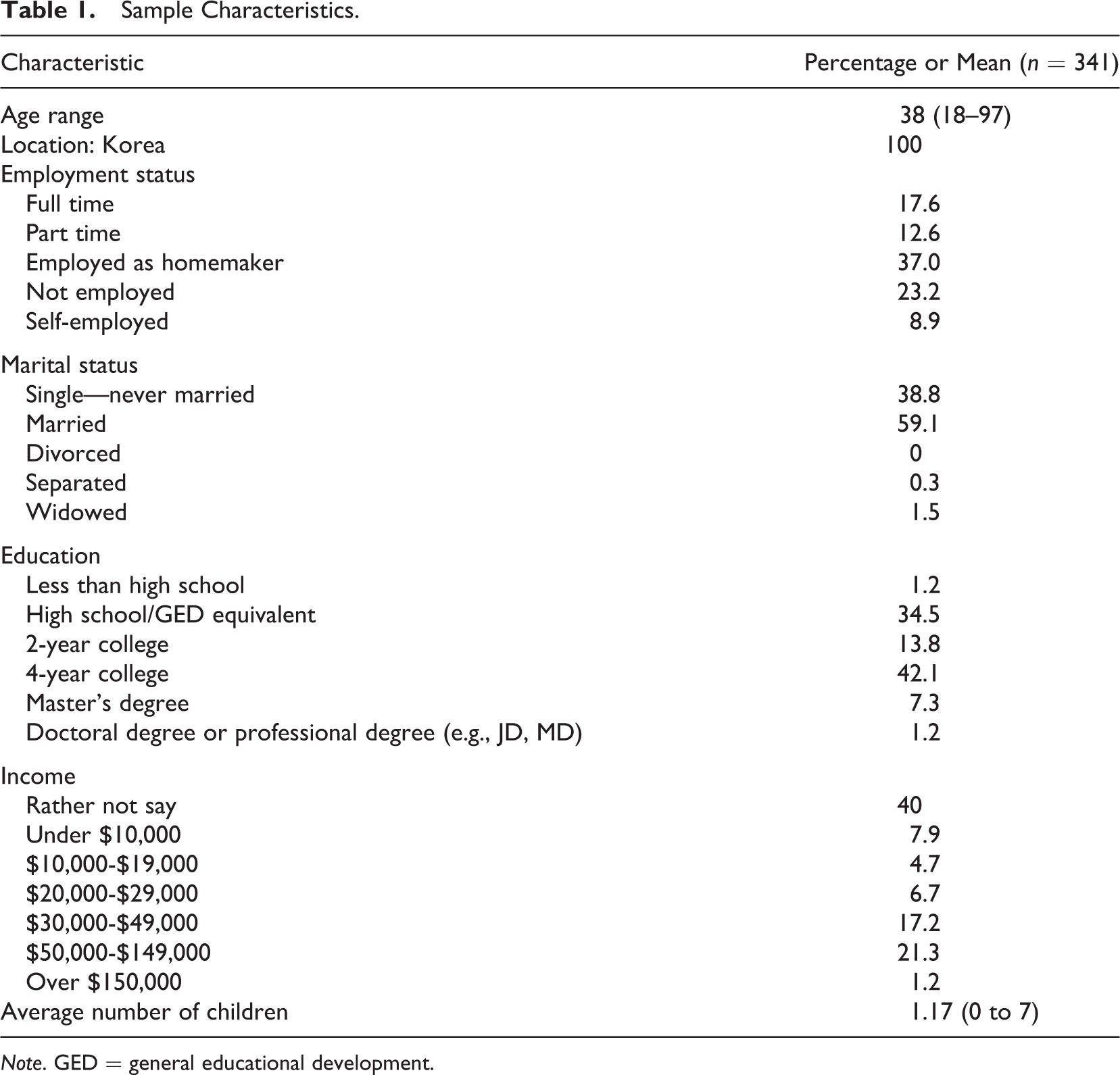
Note. GED = general educational development.
Construal
Although Singelis (1994) reported internal consistency of the two self-construals with high Cronbach’s α of .70 and above, the factor loadings of some items were not high enough; the factor loadings of all the items ranged from .35 to .63. Grace and Cramer (2003) and DeCicco and Stroink (2007) further identified a third factor in addition to independent and interdependent self-construals. Therefore, the present study conducted the principal component analysis for Singelis’ (1994) self-construal items rather than using the two self-concepts directly from Singelis’ study. Of the 23 original items, 17 remained, explaining 36.4% of the total variance. Factor 1, the interdependent self-construal, included 11 items and had a reliability score of .87. The items with the highest loading on the first factor were “It is important to me to respect decisions made by my group” and “I will sacrifice my self-interest for the benefit of my group,” and “It is important for me to maintain harmony within my group.” Factor loadings of all retained items ranged from .54 to .76. Factor 2, the independent self-construal, consisted of 6 items, with a Cronbach’s α of .74. The highest loading items on this factor were “My personal identity independent of others is very important to me,” “I enjoy being unique and different from others in many respects,” and “Having a lively imagination is important to me.” Factor loadings ranged from .55 to .75. Table 2 indicates the resulting factors and relevant statistics.
Factor Analysis and Reliabilities of Korean Textile Makers’ Self-Construal Dimensions (n = 363).

Self-Construal Across Age Groups
Summated scores were created for the three self-construal factors in each age group and divided by the total number of items included in each factor. A MANOVA was conducted to determine differences in the self-construals for the three age groups. The full model was significant: V = .153, F(4, 618) = 12.80; p < .001 (η2 = .076).
Follow-up ANOVAs revealed a significant main effect for both interdependence and independence by age group (see Table 3). The post hoc analysis for interdependence suggested that each age group was significantly different from the others, with the older adults showing the largest difference from both the middle adults, I-J = 4.56 (1.12); p < .001, and the younger adults, I-J = 7.13 (1.20); p < .001.
Younger, Middle, and Older Respondents Interdependence and Independent Self-Construal Scores.

Note. df = degrees of freedom; M = mean; SD = standard deviation.
For independence, results from the post hoc analysis suggested that the younger adults had significantly higher independence scores than both the middle adults, I-J = 2.46 (.757); p = .001, and the older adults, I-J = 2.05 (.817); p = .012. However, the middle and older adults were not significantly different from one another.
Patterns of Textile-Making
Across all ages, the six most frequently tried textile activities were quilting (64%), knitting (64%), needlework (59%), sewing (46%), beadwork (41%), and felt making (39%). A significant difference existed in the number of textiles that the women had tried, F = 36.23 (2, 336); p < .001. Younger adults had tried the most textiles (mean = 9.28; SD = 6.66), followed by older adults (mean = 5.55; SD = 5.48) and middle adults (mean = 3.42; SD = 3.70). Post hoc analyses indicated that these age group differences were each significant at p = .002 or less.
A MANOVA was conducted to determine differences in functional and nonfunctional textile-making across the three age groups. The full model was significant: V = .065, F (4, 648) = 5.43; p < .001 (η2 = .032). We observed a significant main effect in the follow-up ANOVAs for the making of both functional and nonfunctional items by age group (see Table 4). From our post hoc analyses of functional items, we found that the middle and older adults were not significantly different from one another. However, the younger adults made significantly fewer functional items than both the middle adults, I-J = 18.57 (4.08); p < .001, and the older adults, I-J = 14.94 (4.37); p = .001. A similar pattern emerged for the nonfunctional items: Younger adults made the most nonfunctional items and made significantly more than both the middle, I-J = 17.92 (4.06); p <. 001, and the older adults, I-J = 13.94 (4.35); p = 001. Although the middle adults appeared to make the fewest nonfunctional items, the number was not significantly different from that of the older adults.
Textile Making Patterns Across Generations.

Note. df = degrees of freedom; M = mean; MANOVA = multiple analysis of variance; SD = standard deviation.
A MANOVA was subsequently conducted to examine differences in the making of wearable items, items for the home, containers, toys, sports, and transportation across the three age groups. The full model was significant: V = .171, F(6, 302) = 4.70; p < .001 (η2 = .085). ANOVAs for wearable and general household items were significant and are presented in Table 4. We interpreted the post hoc analyses for wearable items to indicate that the middle adults made significantly fewer items than the younger adults, I-J = 29.05 (4.64); p < .001, and older adults, I-J = 11.01 (4.60); p = .017. Similarly, we interpreted the post hoc analysis for general household items to indicate that younger adults made significantly fewer items for the home than the middle adults, I-J =18.56 (3.50); p < .001, and older adults, I-J = 12.93 (3.72); p = .001. The middle and older adults did not indicate a significant difference from one another.
Social Aspect of Textile-Making Across Age Groups
The social aspects of textile-making were compared by age groups for each technique that more than 35% of the women had tried (i.e., quilting, knitting, needlework, sewing, beadwork, and felting) using individual ANOVAs (see Table 5). Significant differences emerged in terms of beadwork, felting, and quilting, and a near-significant trend was evident for sewing.
Younger, Middle, and Older Generations’ Use of Textile Handcrafts to Be With People.

Note. df = degrees of freedom; M = mean; SD = standard deviation.
Through examining the post hoc analysis, we found that the majority of the middle adult women used quilting as a way to socialize. Middle adult women indicated that they used quilting significantly more than younger adult women to socialize, I-J = 1.50 (.230); p < .001, but not significantly more than older adult women.
For beadwork, we observed that the younger adults rarely used beading to socialize with others, unlike older adults, I-J = .653 (.216); p = .003. The middle adults were not significantly different than the older adults but were significantly different than the younger adults, I-J = .500 (.225); p = .028.
Middle adult women used felting more frequently than the younger women to socialize; they made significantly more felting products in social situations than did younger adult women, I-J = .762 (.311); p = .017. However, the middle adult women did not show a significant difference from the older adult women in their felting for social reasons. For sewing, a near-significant trend emerged in which younger adult women appeared to sew wearable items the most to be with people, followed by middle adult women; older adult women sewed the least to be with people.
For all of the most frequently used fiber-making techniques, middle and older adults made significantly more textiles for family and friends than the younger women (χ2 p values ranged from .02 to .001). In contrast, the younger adult women made significantly more textiles for themselves or no one special than the other two groups of women did.
Regression Analyses
A multiple linear regression analysis was computed using the making of functional items as the dependent variable and age, education, percentage of textiles tried, interdependence, and independence as the independent variables. The analysis used a stepwise model. We found that the making of functional items was best predicted by the combination of age and the total percentage of textiles tried (see Table 6): R 2 = .079, F(2, 300) = 12.83, p < .001.
Regression Analysis for Making Functional Items and Textile Wearables.

Note. SE = standard error.
A multiple regression analysis was also computed with the making of wearable items as the dependent variable while using the same previously used independent variables. We observed that the making of wearable items was best predicted by the combination of education and independent self-construal (see Table 6): R 2 = .054, F(2, 286) = 8.13, p < .001.
Discussion and Implications
Overall, we found significant differences in the self-construals for different generations of Korean women. Older adults had the highest interdependence scores, followed by the middle adults; the young adults had the lowest scores. Likewise, younger Korean adults had the highest independence scores, and they were significantly higher than the scores of the middle and older adults. These findings confirm that younger generations are more likely to be motivated by their personal preferences and needs than older generations. In contrast, the middle and older generations are more likely to be motivated by norms and duties imposed by the group, rather than their own personal goals. These results are consistent with previous studies suggesting that younger generations in collective cultures are indeed shifting their values from traditional to Western ideals (Lee, 2011; Sun &Wang, 2010).
The results also suggested that Korean textile handcrafters—of all ages—were more likely to have tried quilting, knitting, needlework, sewing, beading, and felting than other handcraft techniques. It is not surprising that both quilting and sewing were among the most popular techniques for these women, as the majority of the sample came from an international quilting forum and a fashion design school. Interestingly, the younger adults indicated that they had tried the most textile techniques; the middle adults had tried the fewest. It is possible that the younger women, by virtue of being in college, had been exposed to more techniques, and the older women might have had more time to try various techniques than the middle adult women.
Results from the current study give us reason to explore the meaning behind the intergenerational differences of how women use their textile-making. We found significantly different patterns and reasons among the three Korean age groups studied. First, the middle and older adults were more similar to one another than to the younger adults. Second, younger adults made most of their handcrafts for themselves or no one in particular, unlike middle and older adults. Third, the younger adults made more nonfunctional, artistic items and had tried almost twice as many techniques as the middle adult women. The middle and older women tended to make more functional items for friends and family. We understood the regression analysis results to suggest that greater independence and lower education were associated with making wearable items (both more common in the younger women) and that older age and a restriction in textile experiences were associated with the making of functional items (both more common in the middle and older women).
We understand our findings as reflecting a new trend among young Korean people today. In the 1970s, a typical young Korean woman in her early 20s was married or about to be married, caring for a newborn child or expecting one soon, finished with education or about to be done, and settling into the role of being responsible for her family (“Koreans Marry,” 2011). In contrast, today’s younger Korean women (i.e., from their late teens to late twenties) are trying out various career possibilities available to them, focusing on themselves, and learning to stand alone as a self-sufficient person before they enter into a fully committed and enduring adult relationship (Arnett, 2004). In addition, economically active (working) females in their 20s increased from 32% in 1980 to 69% in 2010 (“South Korea’s,” 2012). Therefore, it is not surprising that today’s younger Korean adults tend to be more independent and make more wearable items, nonfunctional art, and items for themselves.
In contrast, today’s middle and older adults indicated that they had tried fewer techniques and were making more functional items for their family, friends, and homes. Thus, the middle and older adult generations were making textile handcrafts that were practical and for the people in their lives. In particular, the middle adults used the handcraft techniques of quilting, beadwork, and felting to socialize with colleagues, friends, and family more than the younger adults did. Middle and older adult Korean women are making textile handcrafts to reinforce their relationships with others, which supports our hypotheses. These behaviors, in turn, strengthen their connections and demonstrate their value of interdependence.
The middle and older women’s pattern of textile-making was also consistent with handcraft history in Korea; traditionally, handcrafts were used to make functional items, whereas today, nonfunctional handcrafts are made and considered to be artwork. For example, the bojagi quilting technique has been historically used for multiple functional items, such as bags, gift wraps, book covers, or blankets. More recently, bojagi and similar quilting techniques have been used by younger Korean people to create artwork for decorative purposes, such as wall hangings. Interestingly, none of the groups used the handcraft techniques of knitting or needlework to be around other people, suggesting that these techniques were used as more solitary activities.
Again, not many differences emerged between the middle and older adults in our study. It is interesting to note that the middle adults made slightly more functional and home items than the older adults and that the older adults made slightly more wearable items compared to the middle adults. This might be due to the fact that most of our middle adults were still actively engaged in child rearing and parenting (Arnett, 2004). On the other hand, older adults have passed through this developmental cycle and are instead more established and self-focused in the elder years of life (Arnett, 2004).
Although not statistically compared, all three generations of Korean women appeared to have tried fewer textile handcrafts than the Euro–American sample reported by Collier (2011). Younger Korean women indicated that they had tried approximately nine techniques, older Korean women had tried approximately five techniques, and middle-aged Korean women had tried approximately three techniques. Meanwhile, Collier (2011) reported that the Euro–American sample had tried approximately 12 techniques. If Collier had examined techniques across separate age categories, she might have found a similar generational pattern. It also appeared that needlework was much more popular in Korea than in Collier’s predominantly Euro–American sample. Needlework, defined as embroidery, cross-stitching, and needlepoint, has a long history in Korea. Needlework has also become much more popular today due to the recent DIY movement in Korea. It is easy for people to learn and quickly master and can be used for home decorations, such as for furniture cushions, bed covers, and curtains. Thus, it is interesting to note that the type of fiber arts used by women in contemporary Korean society might reflect the different values of their given culture, especially when generations are taken into account.
Very few researchers have examined the patterns of textile-making in contemporary society, and no researchers have considered these patterns in relation to intergenerational differences in values in non-Western societies. Therefore, by demonstrating significantly different patterns and reasons for textile-making among the three generations in Korean culture, we offer a unique contribution to the understanding of the resurgence of textile-making today.
According to Craftster.org, in 2010, online craft sales generated revenues of more than $29 billion in the United States alone (Crafters.org, 2011). Moreover, Esty.com’s (“Etsy 2011 Sales,” 2011) revenues increased 74% in just 1 year, from $180 million in 2009 to $314 million in 2010. Therefore, the current study also offers some practical implications for marketers related to textile-making, particularly the need to consider generational differences, especially in non-Western cultures. For example, when marketing textile-making techniques or materials to younger generations in Korea, independent self-construal, tendency to sew wearables, and orientation toward making nonfunctional items for themselves need to be considered.
Limitations and Suggestions for Future Research
We relied on a sample of college students studying fashion design as well as women attending a national quilting symposium. These samples are limited and obviously do not reflect all Korean women who make textile handcrafts. However, given the popularity of quilting in Korea today, this approach seemed to be a reasonable way to locate a sample of Korean textile handcrafters. The women in all three samples might also reflect values from their given groups. For example, younger women might reflect values taught at the university, such as trying out new behaviors and living independently. Conversely, middle adults are probably still actively engaged in family development (i.e., child rearing and parenting), whereas older adults are more established and have the opportunity to be more self-focused. Although we did not employ a random sample population from each age group, our results reflected values characteristic of each group. For example, younger respondents might be trying out various career possibilities available to them, focusing on themselves and learning to stand alone (Arnett, 2004), whereas older adults have passed through this developmental cycle and are instead in the elder years of life (Arnett, 2004).
Researchers could investigate textile handcrafting and intergenerational differences in other cultures. Furthermore, different types of textile handcrafts can be explored separately and in greater depth with regard to the specific culture studied in order to take into account the specific traditions of the people studied. Thus, researchers could consider how the historical and unique cultural traits might influence the textile handcraft-making process across the current and past generations. In addition, our study could be replicated using diverse Korean handcraft samples (e.g., knitters, felters) to determine whether similar findings occur. Finally, it is important to examine other aspects of the social meaning of textile-making (e.g., how social media networks influence textile-making) to determine whether generational differences exist with regard to the role of technology in textile-making.
Footnotes
Declaration of Conflicting Interests
The author(s) declared no potential conflicts of interest with respect to the research, authorship, and/or publication of this article.
Funding
The author(s) received no financial support for the research, authorship, and/or publication of this article.