



Abstract
This study examines the influence of specific physical factors (body size), demographic factors (age), and psychosocial factors (body satisfaction, social physique anxiety, and drive for muscularity) on apparel-specific (jeans, khakis, dress shirts, and polo shirts) fit preferences of male consumers. Data were collected through an online survey administered to 141 men in the age group of 19-66 years. Results revealed that increase in body size significantly predicted preferences for apparel (jeans, dress, and polo shirts) with looser fits, and jeans with higher waistlines. Increase in age also predicted preferences for dress and polo shirts with looser fits and jeans with higher waists. With respect to the body-image-related factors, increase in body dissatisfaction predicted increased preferences for dress shirts with looser fits and khakis with higher waistlines. Contrary to expectations, increase in men's drive for muscularity predicted preferences for jeans with lower waistlines. This study offers important implications and creates actionable market information on fit strategy for male consumer segments.
Finding garments that fit well is an important problem that both male and female consumers experience when purchasing apparel, and it is an important detriment to apparel retailers’ bottom lines (DesMarteau, 2000). One industry report found that 50% of male consumers could not find garments that fit well (DesMarteau, 2000). Giovis (2007) reported that 84% of women encountered fit problems and that about US$11 million was lost in women’s garment sales because of poor fit. Although both men and women experience fit dissatisfaction, scholarly research has almost exclusively focused on women, leaving a critical gap in the research on men’s fit issues and preferences.
According to MarketLine Industry Profile (2012), the menswear market in the United States reached US$107.7 billion in 2012, following a compound annual growth rate of 2.8% in the period 2008–2012. Further, the U.S. menswear market is forecasted to be worth US$139.2 billion in 2017, following a growth of 29.3% from 2012 to 2017 (MarketLine Industry Profile, 2012). Along with the evidence of growth in menswear sales, increasing obesity in the U.S. male population (Ogden, Carroll, Kit, & Flegal, 2012) contributes to the need for expanding research in men’s fit preferences. In the 10-year period between 2000 and 2010, the prevalence of obesity among men increased from 27.5% to 35.5%, whereas there was no significant change in obesity prevalence among women (Ogden et al., 2012). The fact that men tend to carry excess fat around the abdomen (Larsson et al., 2003) may be just one piece of the puzzle of how obesity affects clothing fit.
A consumer’s satisfaction with a garment’s fit involves the direct relationships between body, garment dimensions, and the expectations that the wearer has for how he wants it to fit. The latter, termed “fit preference,” is the more difficult to measure because it involves individualized perceptions. A consumer may think a garment does not fit correctly even when there is customized fit using 3D body scanned measurements or when a fit expert deems it to be correct (Ashdown & Dunne, 2006; Ashdown & O’Connell, 2006). Fit preferences of female consumers have been found to differ based on demographic, physical, and psychosocial factors (Alexander, Connell, & Presley, 2005; Chattaraman & Rudd, 2006; Newcomb & Istook, 2011; Pisut & Connell, 2007; Simmons & Istook, 2003). However, the influence of these factors on men’s fit preferences is yet to be examined. Hence, the purpose of this study is to examine the influence of specific physical factors (body size), demographic factors (age), and psychosocial factors (body satisfaction, social physique anxiety, and drive for muscularity) on apparel-specific (jeans, khakis, dress shirts, and polos) fit preferences of male consumers.
Literature Review
Body Size, Age, and Fit Preference
There have been fewer studies conducted on consumers’ fit preferences as compared to studies on fit problems and dissatisfaction. Scholarly, nonproprietary research into men’s fit preferences appears nonexistent, and it is limited for women’s fit preferences. The following section discusses findings in the context of women’s fit preferences, which are then extended to propose factors influencing men’s fit preferences. Consumers may know how they want a garment to fit but verbalizing that can be difficult (Ashdown & Dunne, 2006). In focus group discussions, boys aged 9 to 14 articulated their fit preferences for jeans as “not too big or too small,” or somewhere between “skin tight” and “not falling off” (Johnson, Ulrich, & Connell, 2008). Hence, visual representations of fit offer a better alternative to verbal descriptors. Two different types of visual measurement scales have been developed to explore women’s fit preferences. One is a semantic differential scale (Chattaraman & Rudd, 2006) that incorporates two graphic images of the female body with graded lines superimposed to specify degrees of circumferential fit (i.e., suggesting the amount of ease between body and garment) and horizontal line placements (e.g., neckline and hemlines). The other (Alexander et al., 2005; Pisut & Connell, 2007) offers line drawings of six garment types (dresses, jackets, blouses, skirts, pants, and jeans) with each type illustrated in fitted, semi-fitted, and loosely fitted versions. These fit preference scales were used to probe links with physical characteristics (body size and shape) and age.
Body Shape and Size
Application of the garment-type fit preference scale with 1,026 adult women (Pisut & Connell, 2007) and 190 adult overweight and obese women (Fu, 2004) showed that semi-fitted options were selected the most across garment types. Pisut and Connell’s (2007) subjects (aged 19–55) self-designated their body shape; those who said they were rectangular or pear-shaped were less likely to prefer fitted garments; those who reported an hourglass or inverted triangular shape were more likely to prefer them. Fu’s (2004) sample of overweight and obese adult women reported no overall fit preference differences among individuals with different body shapes with one exception. Among obese participants, individuals with a pear body shape favored a loose fit significantly more than those with a rectangular shape. Yoo (2003) examined the design preferences of working females and found that jacket silhouette preferences were dependent on body type. Yoo’s results indicated that although most women preferred fitted or semi-fitted garments, women with a diamond shape preferred a loosely fitted silhouette.
In relation to body size, Chattaraman and Rudd’s (2006) undergraduate female subjects (mean age of 21) who had a larger upper body size (measured through self-reported ready-to-wear sizes) preferred tops with looser silhouettes, and those with a larger lower body size preferred a looser fit and higher waist level for bottoms. In essence, the study found that body size has a positive relationship with body coverage through clothing. Similarly, Feather, Herr, and Ford (1997) examined the fit preferences of female collegiate basketball players and found that the larger an athlete’s body, the more likely it was that the athlete would prefer baggy shorts, implying a positive relationship between body size and preference for looser fits.
Indirectly, insights into fit preferences may be derived from research on perceived fit problems and dissatisfaction. Shim and Bickle (1993) investigated garment-specific (blouses/sweaters, pants, skirts/dresses, and jackets) fit satisfaction of women aged 55 and older. Satisfaction with attributes that were dimensional (e.g., sleeve width, leg length), and styling specifications (e.g., pocket and button placement) differed for petite, medium, and tall women and across garment types. Bickle, Kotsiopulos, Dallas, and Eckman (1995) found differences in small, medium, and large women’s satisfaction with jeans fit at varied body sites and with performance attributes related to fit and styling specifications (e.g., waist placement).
Age
Manuel, Connell, and Presley (2010) segmented their sample of African American women by age and found a difference for jacket fit preference when employing a new scale first published by Alexander et al. (2005) and Pisut and Connell 2007). Participants in their 20s preferred a fitted jacket, whereas those in their 30s preferred a loose fit. In Alexander et al.'s study (2005), young female adults reporting bust fit problems did not want a fitted blouse; those with problems at the hip and armhole did not want a fitted jacket or dress. In the study (Richards, 1981) of mature and older women (aged 55–84), most complained about inaccurate fit because of extreme garment length in the shoulder, skirt, sleeve, and bodice. Richards (1981) also found that fit problems of the shoulder length and bodice length increased with age, suggesting these body areas may undergo the most physical change with increasing years. Howarton and Lee’s (2010) findings on the fit preferences of female baby boomers (born between 1946 and 1964) indicated that almost all of the subjects preferred clothing that was comfortable (91.3%), 79.9% preferred garments that fit well, and 76.9% preferred garments that were figure flattering. The subjects also chose explicit garment preferences of knee-length or longer skirts, pants over dresses or skirts, particular necklines, and specified sleeve lengths over sleeveless styles. These boomers pointed out that garment fit was an important part of the decision-making process for garment purchases. Other findings from a study by Hobson (2002) on female baby boomers’ fit preferences revealed that these consumers prefer their pants to drape instead of cling and prefer a comfortable waistband with adequate ease in the garment to feel relaxed while sitting. They also wanted their top to be shapely but not form fitting.
Based on the aforementioned literature regarding women’s fit preferences, we propose the following hypotheses relative to men’s fit preferences. Body shape is not included within the scope of this study due to the inadequacy in male body shape classification systems.
Body Image and Fit Preference
Research among female consumers has revealed that psychosocial factors such as body image and satisfaction (Alexander et al., 2005; Chattaraman & Rudd, 2006; LaBat & DeLong, 1990; Pisut & Connell, 2007) influence preferences for specific fits in apparel or are related to garment fit satisfaction. Although perceptions that men are relatively unconcerned about apparel fit and body image are quickly dissipating, no empirical study has investigated the fit preferences of men in relation to body image concepts. Men’s repertoire of styles has been increasing, as has their style and fit consciousness. These trends have been accompanied by an increase in men’s body and appearance consciousness. Although the topic of male body image has received much less attention than female body image (Pope, Phillips, & Olivardia, 2000; Tager, Good, & Morrison, 2006), researchers posit that male body image concerns are more diverse since they reflect a complex combination of shape, weight, and muscularity issues (Corson & Anderson, 2002).
Media glamorizes the “ideal” male as young and very muscular, with “6-pack” abs, huge biceps, and a rock hard chest (Cafi & Thompson, 2004; Kassarr, 2008). In actuality, studies have shown that male models have become more muscular, gaining 27 pounds of muscle over the last 25 years (Leit, Pope & Gray, 2001; Pope et al., 2000). Men’s efforts to achieve the ideal image of masculinity have resulted in a range of body-image-related issues including body dissatisfaction (Neighbors & Sobal, 2007), high drive for muscularity (Bergeron & Tylka, 2007), and social physique anxiety (Martin, Kliber, Kulinna, & Fahlman, 2006).
Body Dissatisfaction
Body dissatisfaction arises from the difference between an individual’s current body image and their idealized body image, which is the body image valued by their culture as a whole. The construct has been further subdivided into body weight dissatisfaction and body shape dissatisfaction (Neighbors & Sobal, 2007; Thompson, Heinberg, Altabe, & Tantleff-Dunn, 1999). In general, women have been found to experience greater body dissatisfaction than men (Neighbors & Sobal, 2007); however, in recent years body dissatisfaction has been on the rise among men as well (Adams, Turner, & Bucks, 2005). Recent researchers also suggest that there are qualitative differences in the body dissatisfaction experienced by men and women (Adams et al., 2005). Women experience more dissatisfaction with body weight and try to reduce their weight in their struggle to achieve a thinner ideal body image. Men, on the other hand, experience greater dissatisfaction with muscularity and strive to increase their body weight and lean body mass (McCabe & Ricciardelli, 2004). Tiggeman and Pennington (1996) examined body dissatisfaction over the course of life and found that gender differences become apparent at about age 13 (or onset of adolescence) and continue well into adulthood.
A recent cross-cultural study found that most U.S. undergraduate men (over 90%) desired to be more muscular, while fewer men in Ukraine (69%) and Ghana (49%) had the same desire (Frederick et al., 2007). Apart from muscularity, men’s desired body composition and shape also includes leanness and height (Ridgeway & Tylka, 2005). A study by O’Dea and Abraham (2002) found that one fifth of male college student subjects worried about their weight and body shape, while 9%–12% were unhappy with their body shape. “Longitudinal studies show that men’s dissatisfaction with their body image has tripled over the last 30 years, and that 40–60% of male respondents reported a significant body image disturbance” (Kassarr, 2008, para. 3). Signs of this dissatisfaction include hiding or camouflaging body part/parts they dislike (wearing baggy clothes, not tucking a shirt in) and/or the excessive amount of time spent at the gym to increase their muscularity (Kassarr, 2008).
With respect to the effects of body dissatisfaction on apparel-related attitudes and behaviors of women, researchers have found significant relationships with garment fit satisfaction (Feather, Ford, & Herr, 1996; LaBat & DeLong, 1990) and preference for garment fit or silhouette (Alexander et al., 2005; Chattaraman & Rudd, 2006; Pisut & Connell, 2007). Using a fit preference scale that offered three options (fitted, semi-fitted, or loosely fitted) for each of six garments (jacket, dress, blouse, skirt, pants, and jeans) with a sample of female undergraduates (ages 18–28), Alexander et al. (2005) found that those who were more satisfied with their weight or who wanted to emphasize their body preferred the fitted dress, jacket, blouse, or skirt, but those who were dissatisfied with their weight preferred loose-fitting dresses. Participants who were more satisfied with physical features like the bust, waist, or hips preferred fitted garments for those areas of the body. Pisut and Connell (2007) similarly found a significant relationship between high scores in body satisfaction and the desire for more fitted clothing.
Using their fit preference scale with female undergraduates, Chattaraman and Rudd (2006) found that a decrease in body satisfaction correlates with preferences for greater body coverage and a less fitted/revealing silhouette in apparel. Additionally, itemized correlations revealed that the apparel features of the fit of tops and waist level of bottoms were the most closely related to women’s body image. The above literature suggests that the level of body satisfaction could similarly influence fit preferences of male consumers particularly with respect to the fit of dress and polo shirts as well as the fit and waist preferences of jeans and khakis.
Drive for Muscularity (DM)
DM refers to those attitudes and behaviors that reflect the extent to which an individual is preoccupied with increasing his or her muscularity (McCreary & Sasse, 2000) and is an important facet of men’s body image. Researchers have found that DM and body dissatisfaction are not parallel constructs and are individual components of men’s body image that need to be assessed separately (Bergeron & Tylka, 2007). Interestingly, DM is also unrelated to an individual’s actual level of muscularity. This suggests that men’s experience of DM can be attributed to misperceiving the degree of muscularity (McCreary, Karvinen, & Davis, 2006). Despite the importance of this construct in men’s body image and its effects on men’s self-esteem, depression (McCreary & Sasse, 2000), and psychological distress (Olivardia, Pope, Borowiecki, & Cohane, 2004), few researchers have examined the behavioral effects of DM. It has, however, been found that the construct is associated with dieting to gain weight among men (McCreary & Sasse, 2002). The influence of DM on appearance management behaviors of men is alluded to in a qualitative study on appearance management among men (Frith & Gleeson, 2004). Interviews revealed that men who are not confident about their muscle tone choose clothing with loose fits to make them seem larger than they are. Others avoided wearing clothing such as vests and tanks till they had broadened their arms and upper body. These interviews indicate that men’s appearance management behaviors related to choice of apparel fit and silhouette are closely linked to their perception of muscularity and DM.
Social Physique Anxiety (SPA)
SPA is an affective dimension of body image, which refers to the anxiety experienced by individuals when they perceive that their body is being evaluated by others (Hart, Leary, & Rejeski, 1989). SPA has been frequently examined among women; however, few studies have been conducted among men. In one study, researchers found that male college students experience moderate levels of SPA, and this anxiety was strongly correlated with their appearance evaluations (Martin et al., 2006). In this same study, muscularity perceptions were an important predictor of SPA among men. With respect to the effects of SPA, researchers studying women have found that the anxiety influences sport and exercise behaviors (Crawford & Eklund, 1994) as well as coping strategies and health behaviors (Sabiston, Sedgwick, Crocker, Kowalski, & Mack, 2007). Sabiston et al. reported that coping strategies were divided into cognitive and behavioral coping, with appearance management being one of the behavioral strategies influenced by SPA. Adolescent females in that study reported wearing tight/revealing or loose/baggy clothing to hide their shape in response to the SPA that they experienced. This suggests that SPA could similarly influence appearance management strategies among men, particularly with respect to preferring and wearing certain apparel fits over others. Based on the aforementioned literature, we hypothesize that:
Method
Sample and Data Collection
Data collection was initiated after the institutional review board at the University approved the study. A nonprobability, convenience sample of 141 male consumers (19–66 years of age) was recruited through e-mails (to male faculty members in the college housing the researchers’ department) and ads placed in the local newspaper. The e-mail list was procured through the college office. Data were collected over 3 weeks. After arriving at the data collection site, the project was explained to participants, consent forms were collected, and the men completed a self-administered, online questionnaire. Following this, participants were scanned using the three-dimensional (3D) body scanner housed in the department. The body scanning data are not included in the scope of this article.
Instrument
Dependent Measure—Apparel Fit Preference Scale (AFPS)
Fit preference was measured using a scale developed by the authors. Prior to scale development, a review of literature on existing fit preference scales for men and women was conducted, and a multistep scale-building approach was then employed. In the first step, we conducted a field study to compare and contrast prevalent fit classifications used in the menswear apparel industry. Based on the data gathered from the field study, we identified four or five industry-relevant fit classifications for each apparel product including jeans, khakis, dress shirts, and polos (Table 1), which were then employed to build the scale.
Industry-Relevant Fit Classifications for Men’s Apparel.
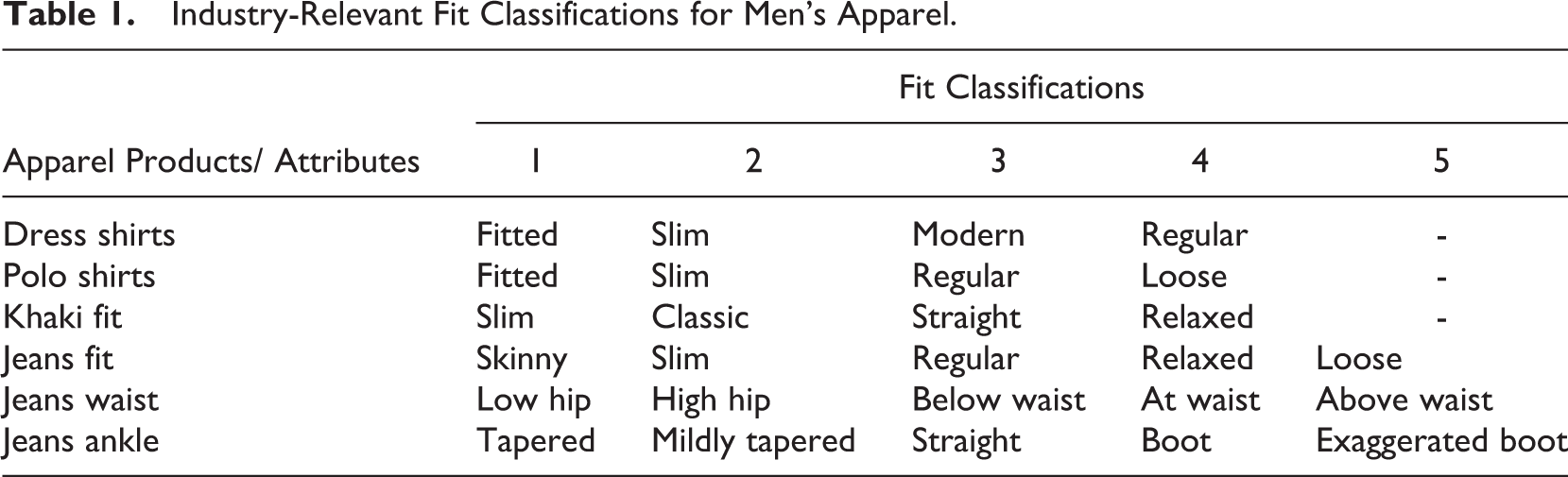
The fit classifications for each product were then transformed into two-dimensional (2D) line drawings using Adobe Illustrator, a vector-based graphics software program. The fit classifications for each apparel product were combined into an interval-based rating scale that was used with a 4-item measure as shown in Table 2. The industry-relevant fit terminology was not included in the rating scale since there is inconsistency in the terminology used by different manufacturers to refer to the same fits. Instead, each fit classification was represented through an image with a number, and participants indicated their fit preferences using the desired number in their response to each item in the 4-item measure (see Figure 1). This procedure was repeated for each garment type and ensured that the men evaluated garment fit based on perceptual analysis of fit classifications for each garment type. The scale merges two methods: one developed by Chattaraman and Rudd (2006) and another depicting 3 levels of fit variations in specific women’s style types (Alexander et al., 2005; Fu, 2004; Manuel et al., 2010; Pisut & Connell, 2007). A pilot study with 5 male students enrolled at the university (recruited through snowball sampling) was conducted to assess the comprehensibility and clarity of the questions and validity of the various measures. The following open-ended question was included at the end of the questionnaire for qualitative comments, “Did you have any difficulty in responding to any of the questions in this survey? Please describe the difficulty that you encountered and include the question number/description in your response.”
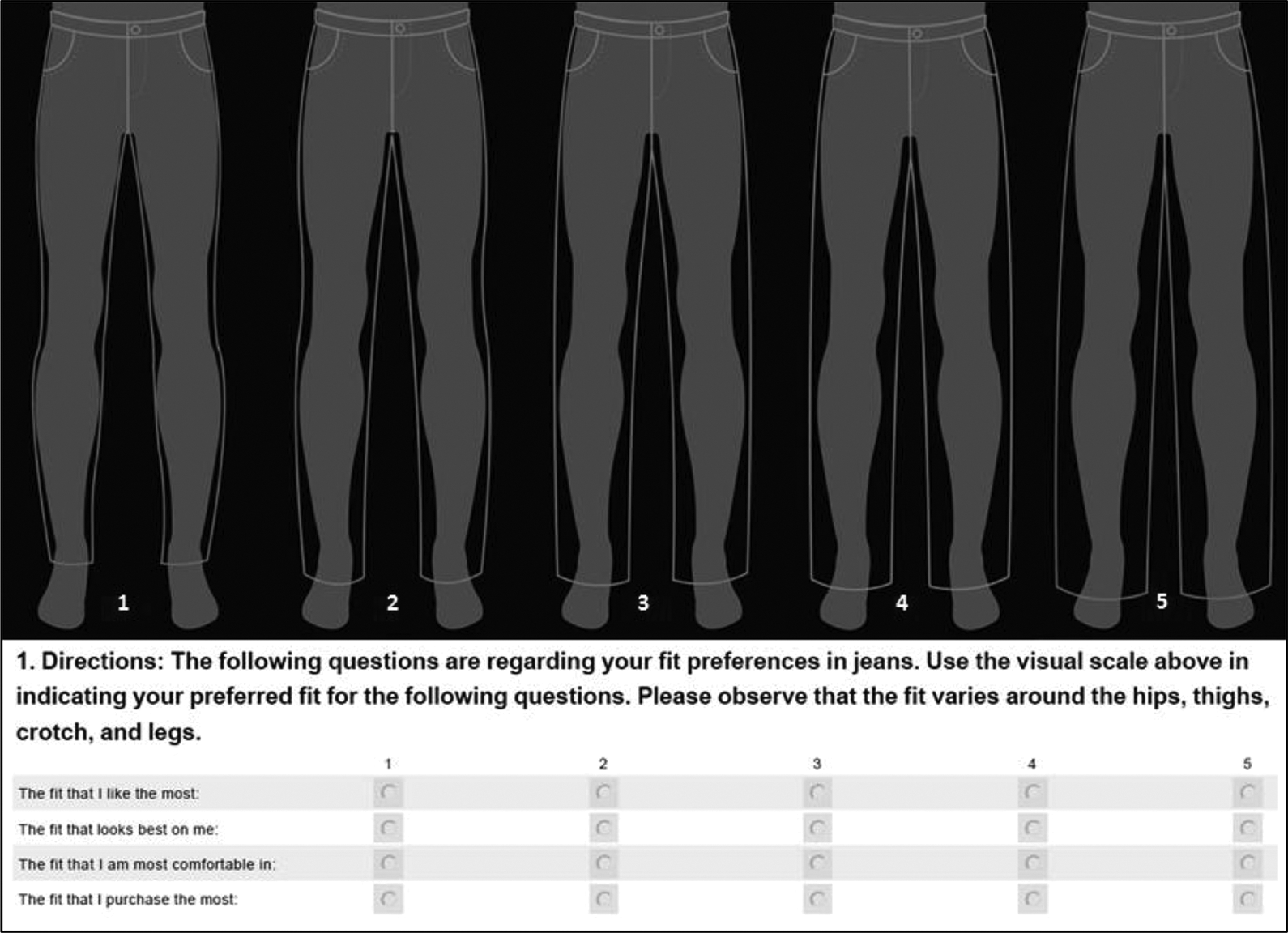
Apparel fit preference scale for jeans.
Examples of Scale Items.
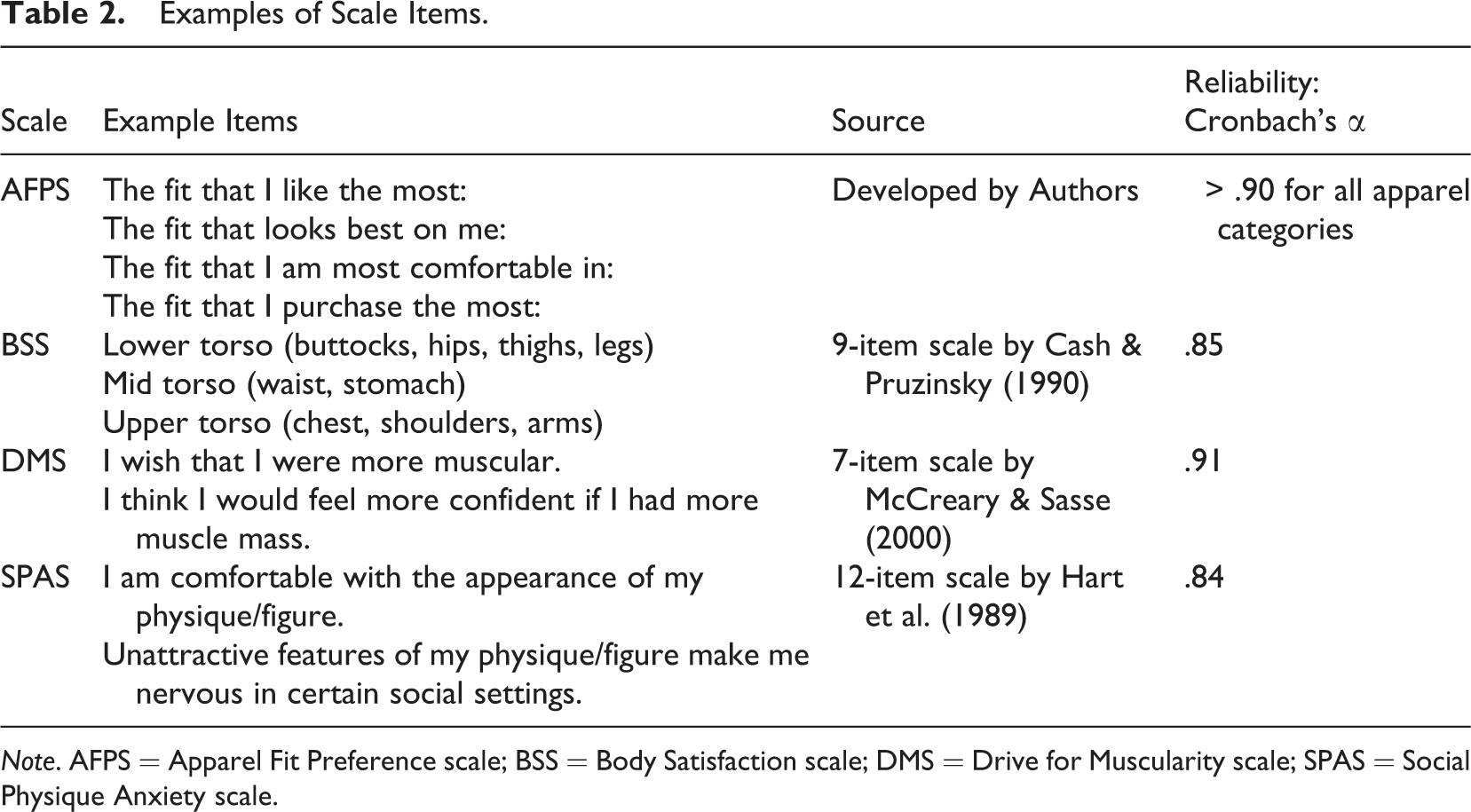
Note. AFPS = Apparel Fit Preference scale; BSS = Body Satisfaction scale; DMS = Drive for Muscularity scale; SPAS = Social Physique Anxiety scale.
Independent Measures
Body Satisfaction scale (BSS), a subscale of the Multidimensional Body-Self Relations Questionnaire (MBSRQ) developed by Cash and Pruzinsky (1990), was used to measure men’s body satisfaction with different body areas rated on a 5-point scale anchored by 1 = Very Dissatisfied and 5 = Very Satisfied. Details of the scale including the number of items and typical items are shown in Table 2. Men’s DM was measured using the Drive for Muscularity scale (DMS) developed by McCreary and Sasse (2000). The items in this scale (Table 2) were rated on a 6-point scale with end points 1 = Never and 6 = Always, with higher numbers indicating a greater DM. The Social Physique Anxiety scale (SPAS) developed by Hart, Leary, and Rejeski (1989) was used to measure men’s appearance-related anxiety (Table 2). The items were rated on a 5-point Likert-type scale anchored by 1 = Strongly Disagree and 5 = Strongly Agree, with higher numbers indicating greater SPA. All the dependent scales had demonstrated adequate reliabilities (Cronbach’s α > .70) in previous studies. Reliabilities obtained using the current study are also adequate and reported in Table 2.
Demographic Items
Demographic data pertaining to age, ethnicity, height, weight, occupation, annual household income, and apparel (polo, dress shirt, jeans, and khaki pants) size were also collected. In this study the physical factor, body size, was measured using body mass index (BMI). Participant BMIs were calculated using self-reported heights and weights and the formula recognized by the U.S. Centers for Disease Control ([CDC, 2011).
Results
Preliminary Analysis
Descriptive statistics were conducted in SPSS to derive sample characteristics. All participants were male and their ages ranged from 18 to 66 years with a mean age of 26 years. Most participants were single (80%), non-Hispanic White (72%) undergraduate students (66%) with some college or technical school education or greater (95%) and an annual income of less than $30,000 (56%). Participant BMIs ranged from 18.6 to 41.6, with a mean BMI of 25.5, which falls within the overweight BMI category. While there were no participants in the underweight category, the distribution of individual BMIs revealed that a little over one half (52%) of the participants had a normal BMI, while the other one half of the participants were overweight (31%) or obese (17%).
Hypotheses Testing
Simple regression analyses were used to test Hypothesis 1, which examined the influence of the physical factor, body size (measured through BMI), on apparel fit preferences for jeans, khakis, dress shirts, and polo shirts. Results revealed that body size (BMI) had a significant positive influence on jeans fit preferences (β = .228, p = .01), jeans waist preferences (β = .208, p = .02), dress shirt fit preferences (β = .341, p = .00), and polo shirt fit preferences (β = .181, p = .04). These findings with respect to Hypothesis 1 imply that as BMI increases, preference for jeans with looser fit and higher waists increases, and preference for dress and polo shirts with looser fits increases. The influence of body size on khaki pant fit preferences was nonsignificant (β = .172, p = .06); as was its influence on khaki pants waist preference (β = .07, p = .43), which indicated that preferences for these attributes are relatively stable and unrelated to participants’ BMIs. Thus, Hypothesis 1 was partially supported. To further examine the results with respect to Hypothesis 1, clustered bar charts were prepared based on cross-tabulations between preferred fits/waists and participant BMIs (Figure 2). For the purposes of the cross-tabulation, participant BMIs were categorized based on CDC standards into the normal, overweight, and obese categories.
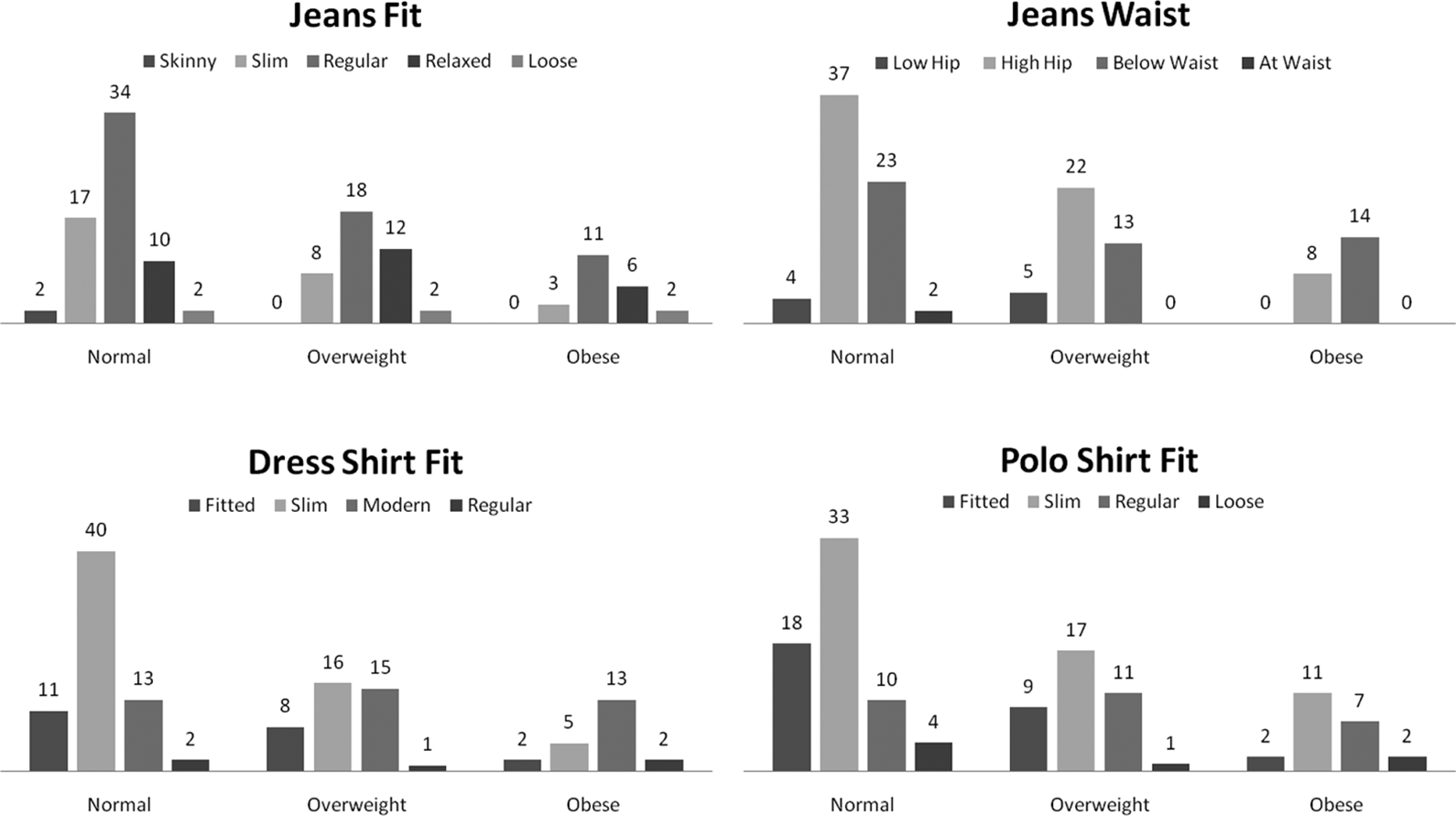
Apparel fit preferences by body mass index (BMI).
The clustered distributions revealed both similarities and differences in preferences between different BMI groups. With respect to jeans fit preference, while regular fit was the most preferred category in all three groups, preference for relaxed fit of jeans was relatively higher in the overweight and obese categories. Similarly, with respect to jeans waist, preference for “below waist” jeans was relatively higher in the obese BMI category, whereas preference for high hip jeans was relatively higher in the normal and overweight BMI categories. With respect to dress and polo shirts, relative preference for slim fits declined in the higher BMI categories, whereas relative preference for modern fits in dress shirts and regular fits in polo shirts increased.
Simple regression analyses were used to test Hypothesis 2, which examined the influence of the demographic factor of age on apparel fit preferences for jeans, khakis, dress shirts, and polo shirts. Results revealed that age had a significant positive influence on jeans waist preferences (β = .337, p = .00), dress shirt fit preferences (β = .339, p = .00), and polo shirt fit preferences (β = .292, p = .00). This implies that as age increases, preference for jeans with higher waists increases, and preference for dress shirts and polo shirts with looser fits increases. The influence of age on khaki fit and waist preference and jeans fit preference was nonsignificant. Hence, Hypothesis 2 was partially supported. To further qualify the aforementioned significant results with respect to specific fit preferences of different age groups, clustered bar charts (Figure 3) were prepared based on cross-tabulations between preferred fits/waists and participant age groups (18–24; 25–29; 30 and above).
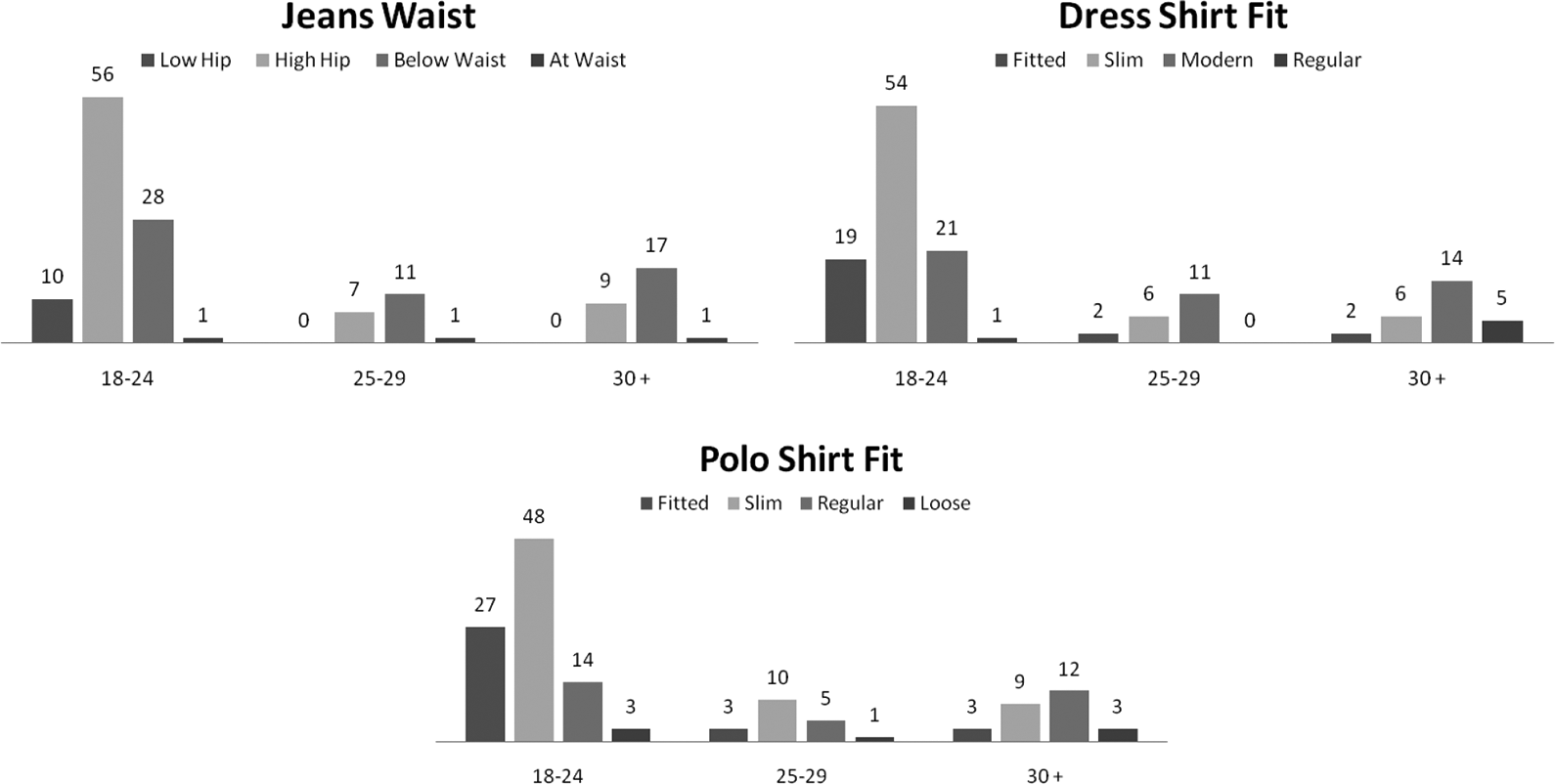
Apparel fit preferences by age.
Similar to the BMI distribution, the clustered distributions by age group revealed (1) with respect to jeans waist, preference for “below waist” jeans was relatively higher among the higher age groups (25–29 and 30+), whereas a preference for high hip jeans was relatively higher among the 18–24 age group; and (2) with respect to shirt and polo fits, relative preference for modern dress shirts and regular polo shirts was greater among the older age groups, whereas a preference for slim dress and polo shirts was greater among the 18–24 age group.
Multiple regression analysis was used to examine the influence of the psychosocial factors (body satisfaction, SPA, and DM) on apparel fit preference. The results revealed partial support for Hypothesis 3a. Specifically, body satisfaction had a significant negative influence on dress shirt fit preferences (β = −.257, p = .02) and khaki waist preference (β = −.262, p = .02). This implies that as the body satisfaction decreases, preference for dress shirts with looser fits increases and preference for higher khaki waistlines increases. However, body satisfaction had a nonsignificant influence on fit preferences for jeans (β = .163, p = .17), khakis (β = −.025, p = .83), and polo shirts (β = −.074, p = .53), and waist preferences for jeans (β = −.181, p = .12).
With respect to SPA, Hypothesis 3b was not supported. SPA has a nonsignificant influence on fit preference for jeans (β = .105, p = .37), khakis (β = .053, p = .65), dress shirts (β = .139, p = .21), and polo shirts (β = .111, p = .35), and waist preferences for jeans (β = –.001, p = .99) and khakis (β = –.197, p = .09). With respect to DM, Hypothesis 3c was partially supported. Specifically, drive for muscularity had a significant negative influence on jeans waist preferences (β = –.217, p = .01]. This implies that as the DM increases, preference for jeans with higher waists decreases. However, DM had a nonsignificant influence on fit preference for jeans (β = .119, p = .20), khakis (β = –.026, p = .78), dress shirts (β = –.135, p = .13), and polo shirts (β = –.136, p = .15), and waist preferences for khakis (β = –.061, p = .51).
Discussion
In this section, the findings are discussed in the context of each of type of apparel examined. Increases in body size predicted preferences for looser fits and higher waistlines in jeans. Preference for higher waistlines in jeans was also predicted by increases in age. This indicates that preferences for jeans fit and waist level are more subjective than stable and are susceptible to the influence of body size and age. A possible reason for this subjectivity in fit preferences is the availability and acceptability of varied fits and waist levels in jeans, giving the consumer more options and experience with the fit differentiations. The findings with respect to the influence of body size are consistent with Chattaraman and Rudd (2006), who similarly found that increases in body size among women correlated with preferences for looser fits and higher waist levels for bottoms. Similarly, Feather, Ford, and Herr (1996) found that female athletes with larger body sizes were more likely to prefer baggy shorts. On the other hand, contrary to expectations, as DM among men increased, preference for jeans with a lower waistline also increased. Hence, increased DM influenced a preference for more torso-revealing jeans. A possible explanation for these results is that men with a greater DM engage in muscle-gaining strategies through diet and exercise, which influence their appearance management behaviors such as revealing more of their torso through lower waist jeans.
Unlike with jeans, men’s preferences for khaki pant fit and waist level were fairly stable and less susceptible to the influence of body size or age. This could be because these preferences are determined by a visual standard rather than personal body size or age. However, increases in body dissatisfaction did predict greater preferences for higher khaki waistlines. This can be inferred as an attempt to conceal the body that is a source of dissatisfaction. This suggests that psychosocial factors may not always influence apparel fit preferences in a similar way. Certain psychosocial factors such as DM may influence body-revealing strategies in appearance management, whereas others such as body dissatisfaction may influence body-concealing strategies as we found in this study.
Findings on men’s dress shirts and polo shirts were similar and are hence discussed together. Increases in body size and age predicted men’s preferences for both dress shirts and polo shirts with looser fits. A possible explanation for these results is that as men age they accumulate more fat in the middle region of their body, particularly the waist (Schwartz et al., 1990). This explains their need for greater ease at waist and preference for looser fits in dress shirts and polo shirts. Chattaraman and Rudd (2006) had similar findings—increases in body size among women correlated with preferences for tops with looser fits. With respect to age, Manual et al. (2010) similarly found that female participants in their 20s preferred a fitted jacket, whereas those in their 30s picked a loose fit.
Men’s preference for dress shirts with looser fits was also predicted by increases in body dissatisfaction. Again this link between body dissatisfaction and body concealment or coverage has been shown in several studies conducted among female consumers (Alexander et al., 2005; Chattaraman & Rudd, 2006; Pisut & Connell, 2007). For women, body satisfaction is most closely related to apparel features such as the fit of tops and waist level of bottoms (Chattaraman & Rudd, 2006). The results in the current study demonstrate that men’s body satisfaction is most closely related to apparel features such as the fit of dress shirts and the waist level of khakis (as discussed previously).
Implications
Results on men’s fit preferences in the apparel types related to BMI and age have important implications for men’s apparel manufacturers and retailers. The implications below arise from the significant findings of this study. Jeans offerings for larger men’s sizes should be distributed between “regular” and “relaxed” fits since men with higher BMI’s prefer regular fit the most, followed by relaxed fit. Jeans offerings for normal men’s sizes should emphasize regular fit, the most preferred fit among men with normal BMIs.
With respect to jeans waist levels, these should be distributed between “below waist” and “high hip” waist levels for larger men’s sizes. Men in the overweight BMI category preferred the “high hip” waist levels the most, whereas men in the obese BMI category preferred the “below waist” level the most. Men in the normal BMI category preferred “high hip” waist the most, followed by “below waist”; hence the offering for this group should lean toward the “high hip” waist. Similarly, retailers targeting men over 25 years of age would benefit from increasing the offering of jeans styles with “below waist” levels since this level was the most preferred by these age groups of men (25–29 and 30+). Conversely, retailers targeting men under 25 would benefit by increasing their offering of jeans styles with “high hip” waist levels.
With respect to dress and polo shirts, for larger men’s sizes, men’s retailers need to distribute the offering of styles, colors, and patterns between slim and modern fits for dress shirts and slim and regular fits in polo shirts. Slim fits in dress and polo shirts were the most preferred among men in the overweight BMI category; whereas modern fits in dress shirts were the most preferred by men in the obese BMI category. For normal men’s sizes, slim fits in both dress and polo shirts clearly emerged as the preferred category. Similarly, retailers targeting men less than 25 years would benefit by increasing their offering of styles and colors in slim fits for both dress and polo shirts, whereas retailers targeting men over 25 years of age would benefit by increasing their offering of styles and colors in modern fit dress shirts and regular fit polo shirts.
Limitations
In this study, we did not examine the influence of body shape on men’s apparel fit preferences, which is its main limitation. In the future researchers need to address this important gap in the literature by developing standardized body shape classification systems for men and examining the linkages between men’s body shape and apparel fit preferences. In addition, the relative impact of body shape versus body muscularity on fit preferences needs to be examined. Muscularity may be a more important determinant of men’s fit preferences than body shape. Despite the fact that the sample in this study was recruited from the broader male population of the area, the sample was fairly homogeneous in its characteristics. Future research on this topic would benefit from a more generalized male population.
Footnotes
Declaration of Conflicting Interests
The author(s) declared no potential conflicts of interest with respect to the research, authorship, and/or publication of this article.
Funding
The author(s) received no financial support for the research, authorship, and/or publication of this article.