



Abstract
This paper reports a study that investigated the synergies of influence (that which shapes the context for creative ideas) and inspiration (that which inspires the content) during the creation process of ten seasoned textile designers towards a better understanding of creativity. The behaviors and rhythm of textile designers were mapped using participant observation with multiple methods including field observation, capturing visual records using video equipment and photography, note taking, auditory records using mp3 recorders, and conducting informal dialogue during studio sessions. The results provide detailed interpretive information in the form of themes focused on understanding how they used and transformed inspirational sources towards the completion of their projects and how designers use their personal thesauruses through their sociocultural capital as influences. No two designers used and transformed inspirational sources in exactly the same way, yet each designer exhibited multiple methods of transformation by including an element of inspiration in their design process. Four separate themes emerged when we looked at how the designers used their personal thesauruses as influences. These themes were: (a) connections made to their sociocultural capital and through research, (b) narratives found or told to focus their projects, (c) emotions related to their attachments and reactions, and (d) design elements they referenced that aided in their decision making. Our rich descriptions of when and how often influence and inspirational sources play into the creative and problem-solving processes are a step toward a better understanding of creativity as a dynamic, complex, and diverse endeavor.
The creative process in art and design is both extremely complex and highly individual. To understand creativity, it is important to understand the related roles influence (that which shapes the context for creative ideas) and inspiration (that which inspires the content) play in the creative process and how inspirational sources are subsequently transformed into projects. Available literature has examined the thought processes of designers, design processes in general, and inspirational sources for design in retrospect, such as Blanchard, Feather, and Wilson (1991) who looked at inspiration sources of depression-era quilts. However, few researchers have highlighted apparel and textile designers and their use of different inspirational sources. Researchers continue to reinforce the idea that inspirational sources are vital to the creative process of textile design as means of eliciting new ideas, facilitating future reference points, inspiring design, and seeking new sources of inspiration (Dazkir, Mower, Reddy-Best, & Pedersen, 2013; Mete, 2006). Terzin and Strickfaden (2014) propose that, while sources of inspiration are used at every part of the design process, “a final design may not have any attribute of the original source” (p. 48). Eckert and Stacey’s (2000, 2003a, 2003b) research on inspirational sources among knitwear designers provided a framework toward the study of inspirational sources as well as the research design; Goldschmidt’s (1995) research on linkography supplied structure to data analysis; while Strickfaden and Heylighen’s (2010) research on sociocultural capital and Strickfaden’s (2006) design process milieu theory provided lenses for interpretation.
According to Bye (2010), “Research based on practice” is considered “critical to the design discipline” (p. 211). With this in mind, we chose a practice approach, where 10 seasoned textile designers’ behaviors and rhythm of designing were mapped using participant observation. The following research illustrates an in-depth examination of the process they took to create ideas toward the design of an artifact of their choice using a provided set of inspirational sources (i.e., butterflies, beetles, and shell specimens). Five of our designers were given actual or real specimens and the other five were given representations in the form of photographs of the identical specimens in order to understand the effects of different forms of sources. To maintain parity between the two groups, all designers were also given supplementary information about the specimens, regardless of whether they had actual or photographic examples. The supplementary information showed an image for each specimen along with a brief description and its scientific nomenclature. Our research followed designers’ actions and behavior patterns while designing. Our aims were 2-fold: (a) to query whether and how designers used their personal thesauruses of sociocultural capital toward the design of a project when they were asked to focus on inspirational sources and (b) to follow the rhythm of designing during a design project with a focus on tracking how inspirational sources are used. As such, we report on details of the design process rather than the projects that were designed, which also means that it was not important whether the designers finished their projects.
Background: Influence, Inspiration, and Creativity
Influence and inspiration are often used interchangeably within design studies (Pashkow, 2005; Rodgers, 2004), yet influence and inspiration are two different concepts that are easily differentiated. Influence and inspiration are distinguishable through whether references are generally or specifically used by designers when creating a design. Influence is a consequence of what the designer already knows, and acts upon, generally to produce overall impressions or basic ideas during the creative process. Strickfaden and Heylighen (2010) refer to influence as sociocultural capital, which is the body of knowledge and experience that designers amass during their lives and as designers. The design environment is a complex, multifaceted space where designers access references that are influential. According to Strickfaden (2006), “the context of artefact creation is relative to the individual designing the artefact and the immediate (inside) and external (outside) environments that he or she is exposed to” (p. 3). Strickfaden’s “design process milieu” (p. 90) explores four different arenas that classify designers’ references while they discuss design and the design process (see Figure 1). For example, designers could be referring to local spheres of events or practice they encountered or of other personal experiences. Strickfaden and Heylighen’s (2010) characterization of sociocultural capital is based on the work of Bourdieu (1986) who describes “capital” as the resources that people use to assert power within sociocultural settings (p. 51). Whether it is through education or shared experiences with other designers and design groups, influence is about the events, things, people, and relationships that are embodied (unconsciously) or currently known (consciously) to designers; they do not act as specific sources of creation, but allow for general impressions that influence their work.
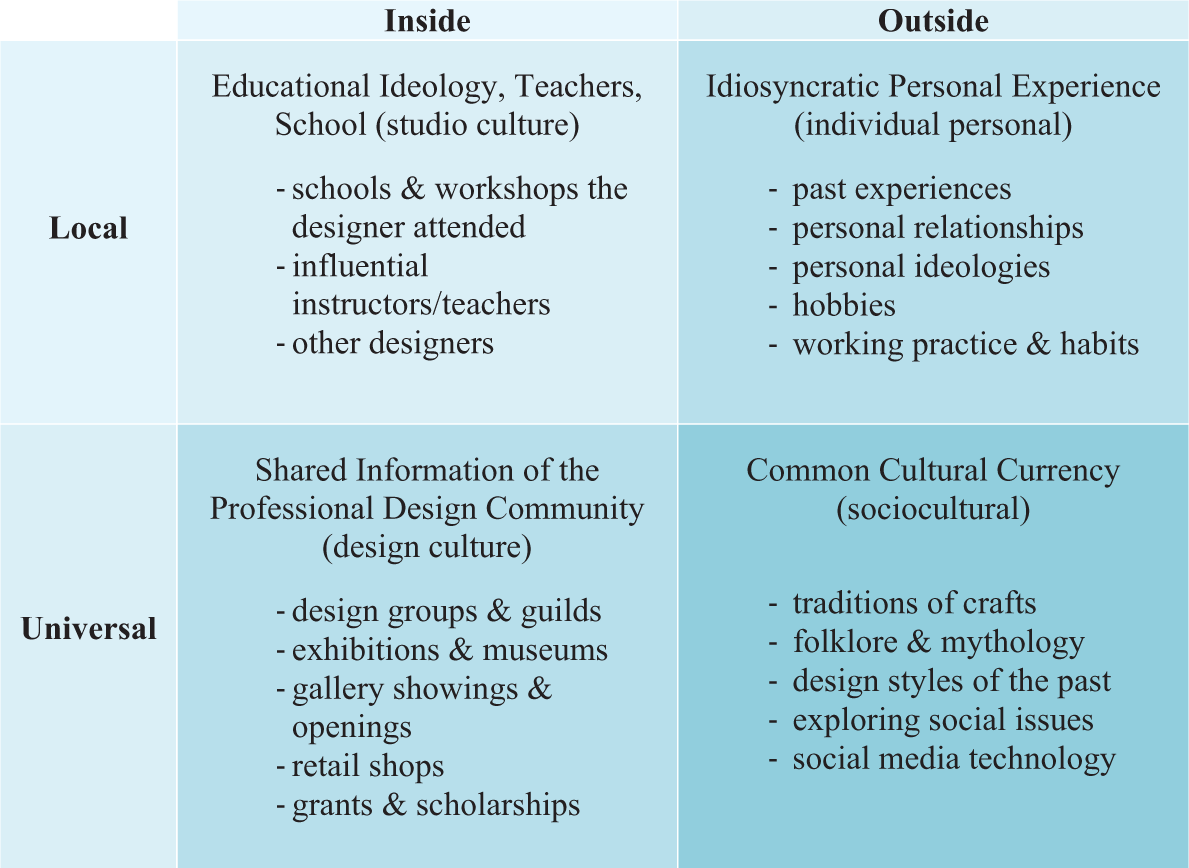
The “Design Process Milieu” adapted from Strickfaden (2006, p. 91) with details of the references from our study participants.
Inspiration, in comparison to influence, uses sources that have been researched (often through observation) and are directly connected to the project at hand. Some inspirational sources are clearly connected to the final outcome, while others are connected to the creative process itself. Either way, according to Eckert and Stacey (2000), inspirational sources can come from many means and are the driving force behind design processes from inception to completion of any project. Sources of inspiration facilitate thinking, referencing, and practicing within the design process. Eckert and Stacey’s (2000, 2003a) research on the knitwear industry identified five specific methods used to transform inspirational sources to projects during the process of designing. These included (a) literal adaptation, (b) conscious simplification, (c) abstraction, (d) modification to source, and (e) association and deviation (Eckert and Stacey, 2003a).
Influences from the lives of textile designers and their use of inspirational sources can be tracked through the design process to better understand which references are responsible for the resulting ideas. When looking at the designed artifact, there is an evident relationship to the original inspiration, either directly or through the series of steps the designer took during creation. Researchers have mapped this relationship with a technique referred to as linkography (Goldschmidt, 1995). By following each critical step in the design process, through visual and verbal dialogue, researchers map which ideas lead to other ideas. Researchers record each move to determine the path from the inspirational source to the final outcome. Furthermore, linkography is used to map the steps in the design process when designers are given various sources of inspiration (Cai, Do, and Zimring, 2010; Goldschmidt, 1995).
Influence and inspiration, while different concepts, are naturally linked to the notion of creativity. According to Boden (2004), “Creativity is the ability to come up with ideas or artefacts that are new, surprising, and valued” (p. 1). She explains that there are basically three ways of being creative; however, the one most relevant to our work is the idea of “making unfamiliar combinations of familiar ideas” (Boden, 2004, p. 2), which essentially involves a form of what could be termed sociocultural creativity. That is, people draw upon their personal capital (aka “familiar ideas”) in order to create a new “unfamiliar” thing. Furthermore, Csikszentmihalyi (1996) states that creativity “arises from the synergy of many sources and not only from the mind of a single person” (p. 1). This aligns with Strickfaden’s (2006) work suggesting that an individual’s relationship to the environment or context is beyond the mind of a single person. Therefore, Goldschmidt’s (1998) notion that designers are “exposed to multiple visual images that could potentially be significant for a design search” is related to the idea that influence comes from exposure to the world “stored in the designer’s memory” (p. 263).
Goldschmidt (1998) states that imagery used by designers is infinitely variable because each designer is an individual with a different subjective approach and furthermore, the imagery used by a designer is referenced in an infinite number of ways during designing; this is often considered to be at the heart of creativity and problem solving. This became one of the assumptions in our research, that is, that each person has a wealth of information about the world around him or her and will use it specifically and randomly, intentionally and unintentionally toward the creation process. Boden’s (1998) work on cognition and creativity states that the “human memory acts as a thesaurus” (p. 42). Our research explored the designers’ use of their personal thesauruses, which consist of their sociocultural capital. Sociocultural capital is sometimes used in a focused way by referencing imagery and experiences that relate strongly to the task at hand or more randomly by referencing things that have a greater distance from the task. No matter how it is used, it is clear that using influence through personal references, and looking directly at things for inspiration, is a type of sociocultural creativity, meaning that designers are using their capital to aid them in the creative process toward what they consider to be better design solutions.
Participants and Methods
This study involved 10 seasoned textile designers, who were solicited through an invitation in a textile-related newsletter. The focus of this study was on design processes; therefore, it was necessary for the participants to have a background in design. This ensured that they were able to use the language of design to express their thoughts and actions and that they could create a designed artifact during the course of a research session. Even though the language of design varied with each designer, an understanding and ability to express how their project was evolving during the research session was essential. The experience of each designer was varied but extensive, with each of them contributing to a variety of outcomes and a mix of styles, tools used, and references made. Karen and Ann were full-time textile designers; the other eight were part-time or freelance designers (Table 1).
Overview of the Participants (Pseudonyms Are Used to Maintain Anonymity).
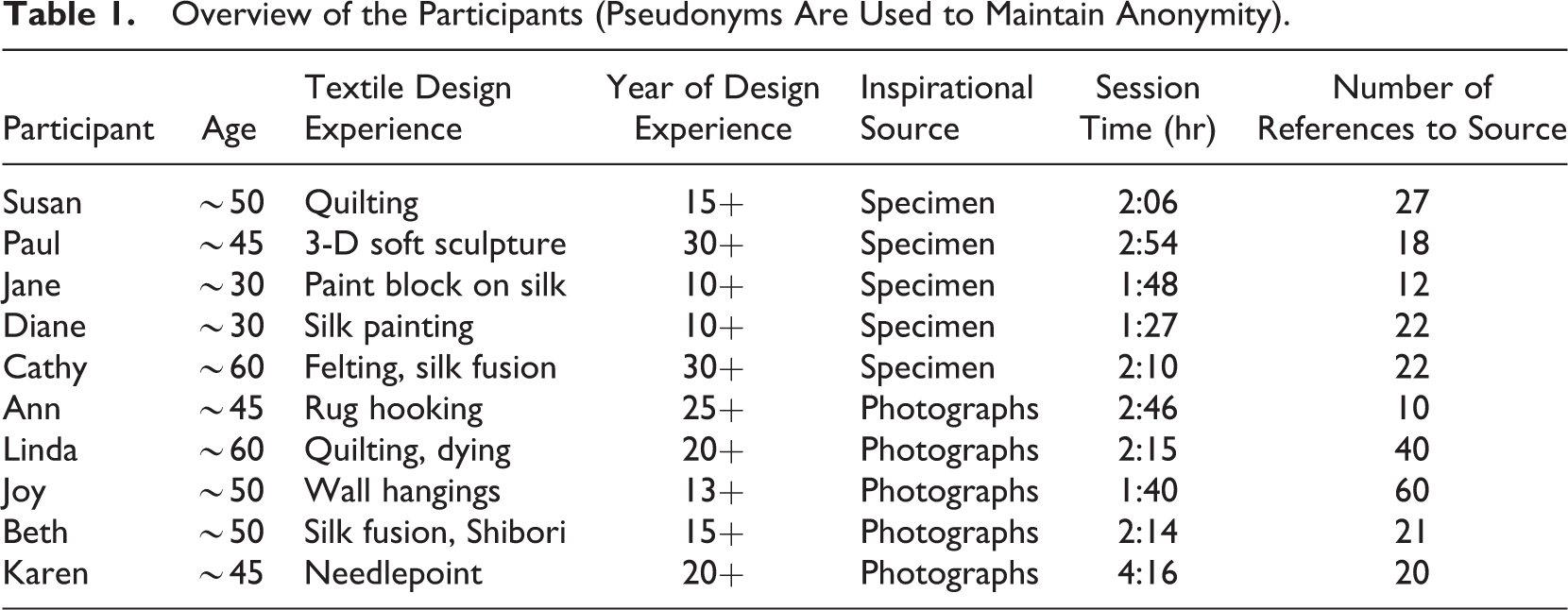
Five of our designers had access to 19 actual specimens and specialized equipment to view these specimens in various ways. Among the equipment available to facilitate close inspection of the three-dimensional specimens were magnifying glasses and cameras. Each designer was able to photograph the specimen, enlarge the photo, and look at the specimen under a magnifying glass from any angle (top, bottom, side, etc.). The other five designers were given a set of 11 photographs created identically for each of the 19 specimens (i.e., representing different magnifications from various angles: in actual size, magnified 10 times, magnified 100 times, etc.), which was meant to replicate the different ways that the actual specimens could be viewed. Although it seems that the designers with actual specimens had fewer things to look at, when the specialized equipment to view the specimens is factored in, all 10 designers had the opportunity to access very similar information for the same set of specimens.
This research is a qualitative, ethnographic study that used participant observation, which involved observation, natural conversations (dialogue), unstructured queries, and an overall unobtrusive approach to watching, listening to, and documenting designers at work (Bernard, 2006, p. 342). The nature of participant observation identifies that the researcher rather than the survey or the questionnaire is the instrument, because, “When it’s done right, participant observation turns fieldworkers into instruments of data collection and data analysis” (Bernard, 2006, p. 344). It is understood that results from studies such as this are rarely generalizable to large populations, such as the whole design community, but rather provide detailed interpretive information (often in the form of themes) about a particular group.
To facilitate a complete and dense source of information, the data collection used multiple methods that included field observation, capturing visual records using video equipment and photography, note-taking, auditory records using MP3 recorders, and conducting informal dialogue during the studio sessions. The participants were asked to think out loud while they worked whenever possible; however, they were given space to create their designs at a comfortable pace and were asked questions when they seemed to be internalizing the process. The participants’ actions and behaviors were captured in video and photography. Information was created by counting the number of visualizations that the designers created, and coding the number of times they referred to the sources of inspiration, their lived personal experiences, and design in general. When the participants were quiet for a period of time, the researchers would ask what they were thinking; if they switched to a new sketch or erased part of one, they were asked why they did that. This led to either a thoughtful explanation of the choices they were making or sometimes the simple statement, “I am not sure, it just doesn’t feel right.” Each explanation added to the overall picture of what the designers thought about and how they reacted during their design process. The researchers never suggested or forced the use of inspirational sources, or mentioned them beyond the introduction when the session began.
This naturalistic process meant that the majority of participants chose to complete their projects in their own studio, where they worked the way they wanted to with their own tools and materials to produce sketches, renderings and, in some cases, finished pieces of work. All participants worked independently and did not discuss their process during the course of the study with anyone other than the researchers.
The sessions ranged between 1 hr 27 min and 4 hr 16 min, but on average they were 2 hr 30 min. The participants decided at which point the project was complete. Therefore, each session had a natural ending. After the data were collected, the audio recordings were transcribed verbatim in order to capture the details and nuances of the design process. This included transcribing the exact words of the researchers to check for any leading phrases or comments. The fieldnotes were typed and used to complement and triangulate the transcripts. The sketches, diagrams, and actual artwork of the participants, along with the photographs taken by the researchers, were placed in sequential order to represent the flow of the design process. Much of the data analysis focused on what the participants said and what they produced while designing. A data-led approach allowed themes to emerge during analysis.
Influence Through References To Sociocultural Capital
Sociocultural capital is all the experiences, events, and practices amassed during the designer’s life that can be used specifically and intentionally, or randomly and unintentionally, toward creating a design project. Some aspects of a designer’s sociocultural capital will have been mindfully developed (e.g., through formal education and self-taught skills), while other aspects are taken for granted (e.g., everyday occurrences and relationships with family and friends). Strickfaden’s (2006) theory of the design process milieu assisted us in understanding sociocultural capital through her framework, which classifies designers’ experiences into four quadrants. These four quadrants take into account both local and universal realms and realms that are inside design and outside design, all of which have the potential to exert influence while designing.
Strickfaden’s (2006) theoretical framework (shown in Figure 1) was used to aid in interpreting the data collected from the study participants. Every time a designer referenced his or her local spheres of events, practice, or personal experiences from their lives that were not directly related to the provided inspirational source, it was noted, and the references were sorted into influences and inspiration.
The first quadrant of “inside local” of the design environment is the educational ideology, teachers and school, or the studio culture (Strickfaden, 2006, p. 92). This includes the schools the designers attended and teachers they had during the course of their education. Not surprisingly, most of our participant designers had some formal design education and all had further developed their craft through continuous engagement in skill development. Many of them taught workshops and two taught at design schools (Susan and Diane). Three of them spontaneously mentioned influential instructors or teachers who made an impact in the work they do today, even though they were not asked directly about this. While sketching from an actual specimen, designer Jane made the comment that one of her instructors always stressed the importance of sketching from real life to get the “essence” of the source of inspiration. Additionally, some of them referenced other designers and people who are known to them, which classifies these references as “local” (inside local and outside local simultaneously).
The second quadrant of “outside local” encompasses the idiosyncratic personal experiences of each designer (Strickfaden, 2006, p. 93). This includes the designers’ past experiences, personal relationships, hobbies, and the working practice and habits they adopted to move forward with design projects. Indications of personal experiences include their personal ideologies; Susan explained how she may be “right-brained in creativity, but works very left brained” and very “logical” when designing. Designer Joy talked about “working slow and working small,” which was evidenced when watching her methodically create her small wall hanging. Hobbies played a large role in what designers created. For instance, some participants said they like spending time in nature, which was also a common source of inspiration. Related to their personal relationships, many of the designers talked of friends and about how they struggled to balance family, employment, and design work, while somehow finding time to do what they love. Most have carved out personal spaces where they set up design studios at home or elsewhere, and this lends itself to allowing work to be picked up and worked on easily, without having to put everything away each time they design.
The third quadrant of “inside universal” encompasses the shared information of the professional design community (Strickfaden, 2006, pp. 92–93). One of the most interesting references that fell within this classification was that each of our designers indicated their love of the design process, including purchasing and selecting materials; playing with colors, textures, threads, and so forth; discussing design ideas with others; researching ideas at museums, in nature, and so forth; and relating their ideas to their interests. Additionally, the designers referenced the many ways they shared their work with the community (e.g., exhibitions, gallery showings, and retail shops). To a great extent, a lot of their work was influenced by where they will be showing or selling their work. Designer Karen prefers to create realistic, rather than abstract, works because they sell well. Designer Susan enters many exhibitions and so her work is dictated by the guidelines of each show. Over half of the designers mentioned the importance of obtaining grants and scholarships from local, national, and international sources to help financially and for the publicity. Many of the designers belong to local design organizations such as a weavers’ guild, a quilters’ guild, and a fiber arts network. The designers indicated that these groups sometimes influenced how they work.
The fourth quadrant of “outside universal” encompasses the broadest sociocultural aspects: the common cultural currency (Strickfaden, 2006, p. 93). The designers spoke of how they built on traditions of craft, folklore, and design styles of the past to enhance and explain their design work. They also use their work to explore societal issues such as immigration, migration, and honor killing. Another reference to the common cultural currency was the trend toward using social media, such as Facebook, or personal websites to share information about their work. Embracing technology was important to many of the designers when they worked on their projects.
Transformations of Inspirational Sources
How the designers used and transformed inspirational sources toward the completion of their projects during the design process reveals some interesting nuances about creativity and problem solving. What was particularly noteworthy was that no two designers worked in exactly the same way. The only consistency among them was that each designer took time, initially, to examine the sources of inspiration, whether they were actual specimens or photographs. The amount of time spent with the specimens, however, differed greatly. Some worked very methodically and logically through certain specimens. Others jumped around to whatever captured their attention. The five designers who had the actual specimens picked one inspirational source only; designer Ann hardly referred to any specimens, while designer Jane sketched one specimen for a while and then experimented with painting it. One designer, Susan, spent a long time examining and exploring many potential ideas from the one specimen.
A significant difference between the two groups using real specimens or photographs is that four of the five designers who used the photographs actually proceeded to bring their project to completion. They took it to a point where they chose fabric, cut and/or dyed it, and made something (see Figure 2). Of the group that used the actual specimens, only one (Cathy) finished, while the others left off at the visualization phase of the design process and did not even attempt to start a project. One explanation for this is that when using photographs, the designer may already be bypassing one of the steps in the problem-solving process because the inspirational source is already in a two-dimensional format. Many of the designers spoke of how they photographed or sought out images of sources of inspiration when they were working.
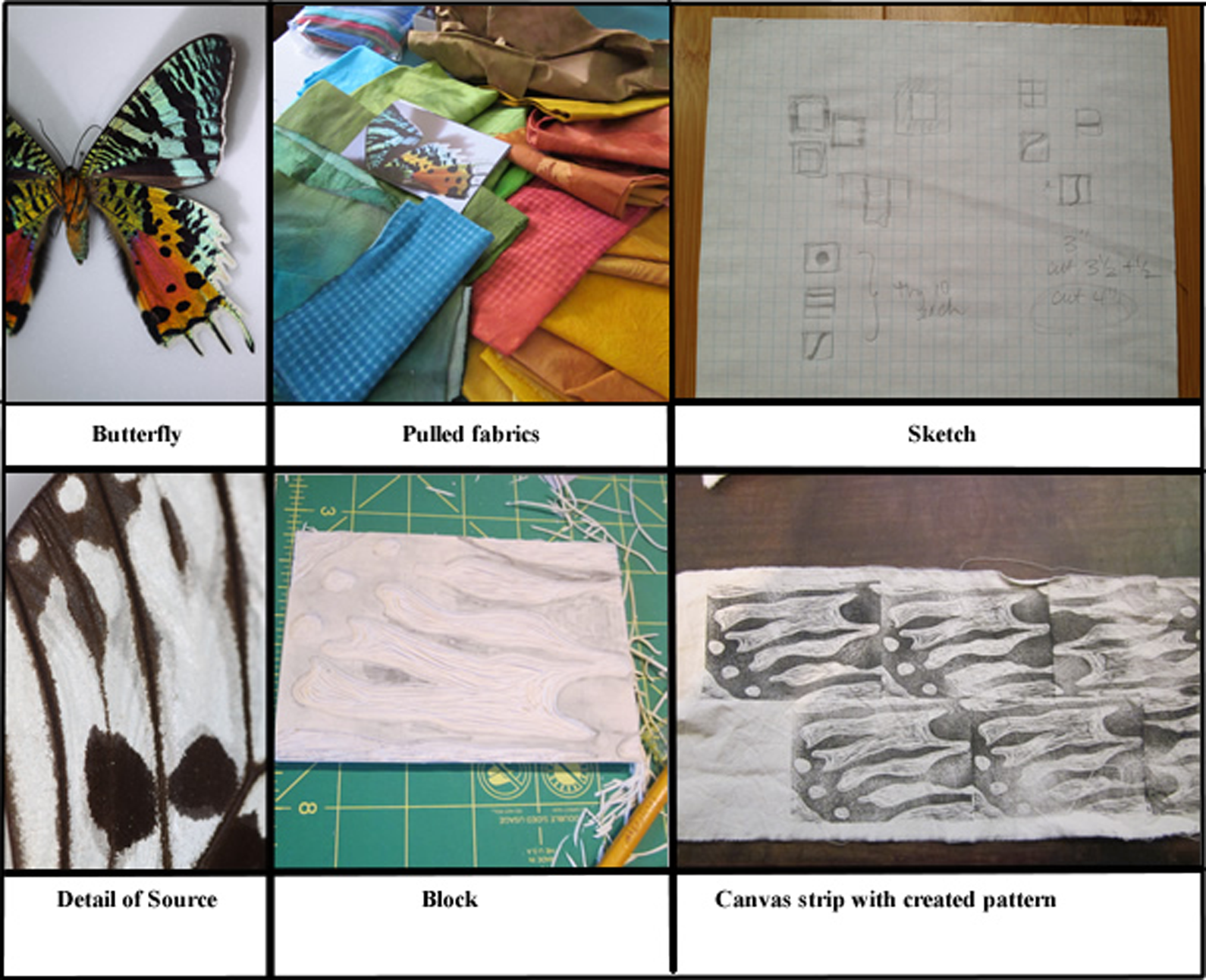
Two photographs of a Madagascan sunset moth as sources of inspiration (left, top, and bottom), artifacts resulting from the design process (center, top, and bottom; right, top, and bottom) from Linda. Linda was given photographs as her inspirational sources.
Nevertheless, whether the designers focused on visualizations or finished a project, there were few differences in the types of transformations completed. Each of Eckert and Stacey’s (2003a) possible transformations were apparent in our research: (a) literal adaptation, (b) conscious simplification, (c) abstraction, (d) modification to source, and (e) association and deviation. Each designer exhibited at least one of the methods of transformation by including an element of the specimen or photograph in their design process. There was no correlation of types of transformations between those using specimens and those using photographs.
Each of the designers created at least one sketch that exemplified literal adaptation. This was a starting point for each to explore the inspirational sources that were previously completely unknown to them. Ann, Cathy, and Susan did not explore any other kinds of transformation in their work. They each used literal textures, lines, and colors directly related to the specimens (see Figure 3 for Ann’s work). Beth, Jane, and Linda took portions of the wings of butterflies or viewpoints of shells and modified them to create a new pattern. In all cases, the designers used the sources as motifs in a repeat pattern, a technique often used by textile designers, as well as a form of conscious simplification.
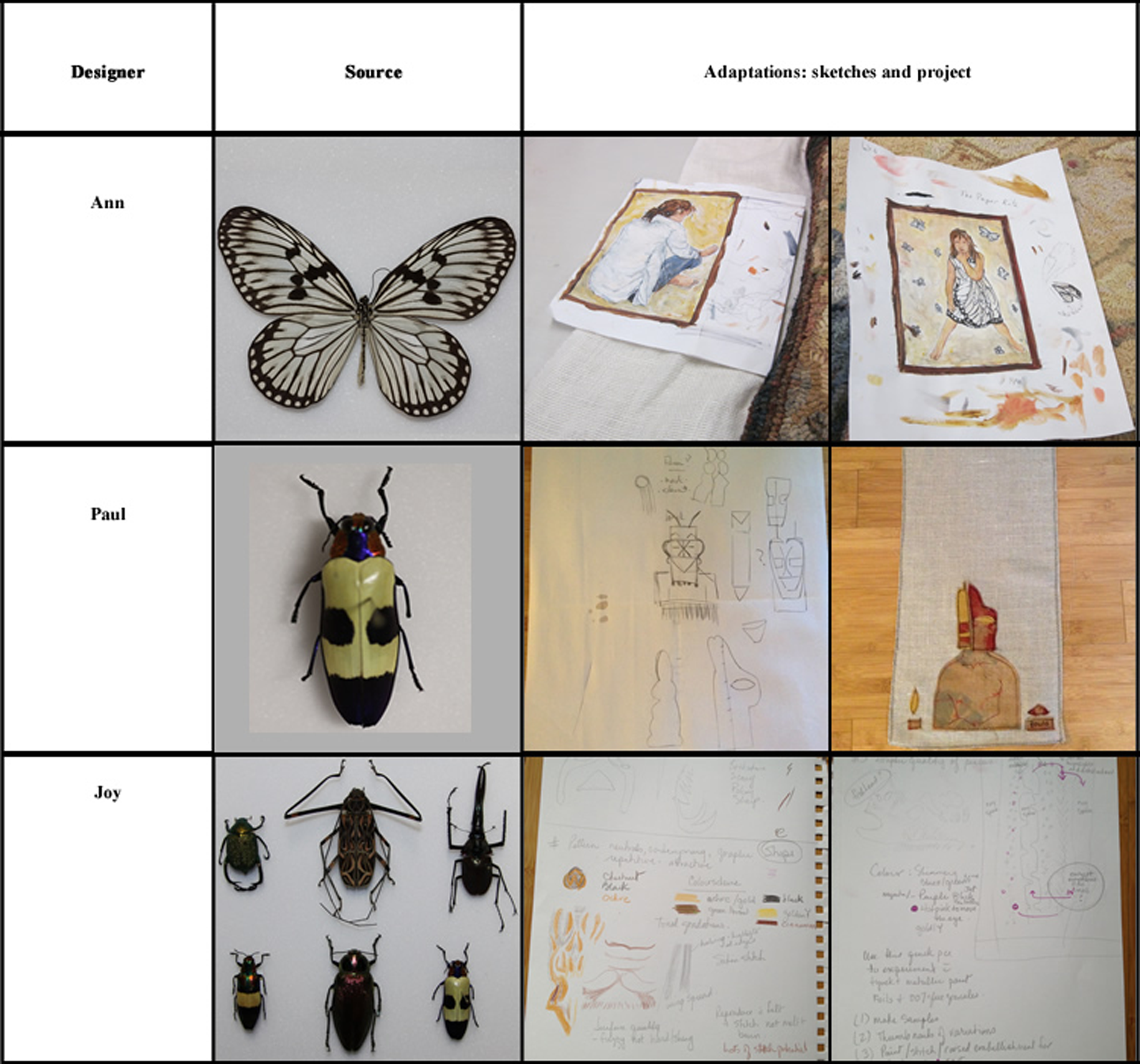
Sources of inspiration for designer Ann (paper kite butterfly), Paul (metallic wood boring beetle), and Joy (shining leaf chafer, harlequin beetle, red speckled jewel beetle, and Ceiba borer beetle). Ann uses a sketch from her previous work (middle) and uses butterfly’s wing pattern as an explicit graphic element on the dress of the girl in her finished product, shown here as a sketch (top right). Paul uses the inspirational source on a very small scale and predominantly uses previous work to influence his final project, a wall hanging (middle). Joy refers to every beetle specimen provided whereby she makes copious notes of design ideas for future projects. Two pages of her seven page exploration of sketches about pattern, textures, shapes, and colors are shown here (bottom middle and right). Paul was given specimens as his inspirational sources, whereas Ann and Joy were given photographs.
Designers Diane, Joy, and Susan transformed the sources of inspiration through abstraction. They did this by using a certain feature of the source material and changing or discarding other elements of that source to create something else. For example, Diane looked at several specimens, picked the design element that excited her, and manipulated it to create a pattern that would work with silk painting. When using abstraction, each designer maintained some resemblance to the original sources (see Figure 3 for Joy’s work).
Modification to source was evidenced in Karen’s work; she combined elements from different sources and created a project that was totally abstracted from all the sources by using (a) color of two different butterfly wings to create the sunset, (b) lines from the pattern on the conus shell for the linear layout of trees, and (c) iridescent color from a beetle to make the color of the trees. This was a complex process and differs from abstraction in that there are no resemblances to the original sources whatsoever.
Paul was the only designer who used association and deviation. The beetles reminded him of tribal art, and he used sketches he had drawn previously as well as other elements from his work (see Figure 3). While Paul did use one small marking from a beetle specimen, he kept transforming the project through elements that came from his previous design work. This kind of transformation is a free association that deviates toward his personal influences where it seemed like he tried to make the inspirational sources fit into his work.
Creative and Problem-Solving Processes
Four separate themes emerged when we looked at how the designers explored their ideas through dialogue, visualizations, and designed projects. These themes were (a) connections made to their sociocultural capital and through research, (b) narratives found or told to focus their projects, (c) emotions related to their attachments and reactions, and (d) design elements they referenced that aided in their decision making.
Connections: Sociocultural Capital and Research
A key aspect of how inspirational sources are used is to understand how designers make connections to the new source through their sociocultural capital. It was quite apparent with all the designers that they sought to create meaning through connections with something they already knew and cared about. Therefore, the sociocultural capital of each designer was an obvious and vital aspect to how the designers worked. Although the inspirational sources were new to them and were the catalyst to spark their creativity, the connections the designers made were more about the influences that drove their work. That is, this influence came directly from what they already knew. For example, books were mentioned and used by a number of participants. Images from books were pointed to and referenced as sources of inspiration in addition to the ones supplied by the researchers. In respect to their previous design work, the designers often referenced how they liked to engage in their design process and what kinds of materials they liked to work with. The sources of inspiration made them think of the types of fabrics, tools, and styles of work (e.g., blind contour drawing, taking photos, and entering into Adobe Illustrator) known to them: “I was always a stitcher,” “I have a linen addiction,” and “Here is my magpie stash of fabrics and shiny bits.” More than one designer began searching for and pulling fabrics after looking at the sources of inspiration (Cathy, Joy, Linda, Paul, and Susan).
The designers used other sources in addition to the ones supplied, such as styles they remembered or liked (e.g., 1970s pottery, Swedish modern design, landscapes). It is clear that the designers liked to zero in on the details of objects and things that reminded them of a feature or element from the provided inspirational source. They were influenced by exhibitions they saw, entered, or were entering in the future that connected to historical work, their personal past, and future work. Their affiliations with local design groups (e.g., weavers’ guild, quilters’ guild, etc.) and educational outlets (e.g., workshops, teaching, and design environments) were all part of their sociocultural capital.
The designers all mentioned how they liked to develop their design projects through research by consulting collected imagery through Internet searches, visiting the library, taking personal photographs, and sketching from a source. Many designers claimed that they never worked as quickly as they did during the research session. They indicated that they would often work for weeks or months on the same project, letting thoughts and ideas percolate before making significant moves in the design process, often working on more than one project at a time. The designers seemed surprised about the sources provided and had to make sense of the sources of inspiration. The most natural way to do this was by making connections through their sociocultural capital to something that they already knew and cared about.
Narratives: Found or Told
One common aspect among all of the designers during exploration was that each of them spoke about the importance of narratives that needed to be found or told through their work. They commented on how the source of inspiration either “spoke to” them or suggested the need to “tell a story.” Alternatively, the designers indicated how one or more of the sources could work within a themed project they were currently working on by enhancing an already familiar narrative they would like to continue telling. The majority of the designers seemed to seek out a narrative to tell and even picked a specimen that aided in the quest. Designer Linda spoke of the need to always have a “conversation with the project” and a need to “revisit the source” to “remind oneself of that conversation.” After Susan had been working with the same beetle for over an hour, she suddenly proclaimed that “This is a piece with something to say and it has to be big.” Paul claimed that he always does something with text in his projects. He said that one of his goals in producing textiles was to “put the text back into textiles,” which was his explicit way of saying that he felt narratives should be told through letters and words (text) on textile designs (note: Paul included phrases and poetry in the majority of his prior projects). Interestingly, five of the designers wondered about where the species came from and were also curious about the species’ ability to camouflage. This curiosity seemed to feed a need for the designers to understand and relate to the information about the sources of inspiration as well as translate these into their own narratives.
Although the designers did not have any contact with one another, they all indicated that the specimens reminded them of things that are part of bigger narratives when they looked at the patterns and colors inherent to the sources. They spoke of seeing landscapes, native culture, and totems, and their need to create narratives that communicated to audiences about societal issues. For instance, Ann spoke of wanting to narrate her move from Quebec to Alberta as pictorial landscapes (something she had done previously in her design work), because the colors in a butterfly reminded her of these two landscapes. Paul and Ann each spoke of their needs to approach societal issues such as sexism, gender politics, and the ever-shifting dynamics of relationships and family. Karen was drawn to painting and stitching the Alberta landscape, which was also linked to the colors of a specimen. She mentioned that her audience prefers narratives that depicted realistic landscapes rather than abstract ones, because they can make a connection to a “land” familiar to them. More uniquely, Joy went through the process of making up fantasy narratives about the inspirational sources as she methodically went through and examined each beetle. She said things like, “This one must live in Pine Park,” and “This one reminds me of a super hero who lives under the sea.” Consequently, for each designer, the sources of inspiration became more than just a beetle, a butterfly, or a shell: They were instruments for narrating stories that communicated about the material and natural worlds, events, places, and fantasies that were deeply meaningful and often personal.
Emotions: Attachments and Reactions
Emotions play a huge role in the design process, particularly when designers are in exploration mode. Each designer indicated a deep emotional attachment to his or her craft, including the process of creation. They spoke of being drawn into their work, including the “meditative quality of creation.” Whether emotions were implicit through the mood of the designers when they were creating, explicit through their dialogue, or considered as a mode of expression to communicate to their audiences, it was one aspect that was evident during the design process.
The emotions of the individual designers manifested while they worked, and these were linked to obvious reactions of like or dislike of the specimens. Seven of the designers (Ann, Beth, Cathy, Jane, Linda, Paul, and Susan) immediately rejected certain groups of sources of inspiration while later adopting one or more sources that they considered acceptable for their project. Comments such as “butterflies are overdone,” “I feel a connectedness with the shells,” or “Bugs are often thought of as scary and ugly, but these are beautiful” were just a few pieces of dialogue that illustrate the emotional reaction the designers felt when encountering the specimens. Emotional reactions to the inspirational sources were instant and visceral, and often led to the inclusion or exclusion of what the designers continued to look at as possible subjects for their projects. The emotional connections to the specimens were obvious in the way they talked about them. “This guy is scary, pokey, and evocative” (Joy). “This is a very feminine shell” (Susan). “I like to feel what I am drawing. I need to get to the essence of the source of inspiration” (Jane). “On the surface all is calm, but I add the blackbirds to depict the difficulty of that day” (Ann). Throughout each session, it was obvious that an important part of the design process included emotional attachments that the designers felt toward the sources of inspiration and the project at hand.
Another way that emotion was apparent during the design projects was the designer’s reactions to the nature of the session itself. Each designer was asked to work for a time in as natural a way as possible, while being watched, photographed, and audio recorded. At the same time, the designers were asked to talk about what they were doing throughout the session, which naturally made each designer a bit nervous and tentative. The designers had very little idea of what to expect before they started their session, other than that they had the opportunity to work on a project in the presence of researchers interested in inspirational sources. All of the designers reflected that it was quite an unnatural way of working. Besides the fact that they were being so closely observed, many also indicated they usually spent weeks and months researching ideas; some even came prepared with their own inspirational sources. In addition, having inspirational sources provided for them was a very unusual scenario for every one of the designers. Beth commented, “I don’t usually design on demand.” But even given the constructed and unnatural atmosphere of the sessions, each designer was able to focus on the task at hand. The sessions seemed to be very enjoyable and challenging for each of them. Most of the designers made comments about how much fun it was to use the specimens, because there was no real pressure for the piece to be exhibited, for it to be made to a certain size specification, or even for it to be finished. Paul made the comments, “It’s a kamikaze kind of day” and “It must be the bee’s knees” when he referenced the project he was designing. Linda said, “I am enjoying this.” Cathy, Diane, and Karen had not worked in their studios for a length of time and were inspired to “get back to it.” The emotions of the designers in this study were linked to deep attachments that often caused reactions in the way they perceived their design projects and processes, to the specimens provided, and to the pace at which they expected to work.
Design Elements: References and Decision Making
Design elements can be considered the building blocks of design and are part of the general knowledge related to the design process. They include things such as color, texture, line, form, and shape, to name a few. The designer’s exploration with design elements can be summarized as 2-fold: (a) the references that the designers make about design elements, such as color and texture; and (b) the design decisions they make during the design process based on the design elements that interested them in the first place.
The first link to the design elements is how the designers spoke about and referenced them. This kind of dialogue seemed to help the designers to organize their thoughts, to articulate their visions for the project, and to focus on what the various inspirations offered. The designers said things like; “I could use this fabric, in this color and melt it” (Joy), or “I will sketch this out in this color of pencil crayon and draw out this pattern” (Diane). By using the elements of design to connect their work to the inspirational sources, the designers were given a chance to evaluate where they were going with their ideas and decide whether they needed to change the direction or move on to something completely different.
During the analysis of how the designers referenced design elements, there were two noteworthy differences between the two groups of designers. One was that the group that used the specimens referred much more often to “form” and “shape” as design elements than the group that used the photographs. Another difference was that the group that used the photographs alluded to “line” twice as often. It is clear that the nature of the real specimens were about three-dimensionality, whereas the nature of the photographs highlighted parts of the specimens that translated into two-dimensional lines.
If sketching is a rendering or visualization of an idea, then references by the designers to various design elements add layer upon layer of detail to aid in making decisions and moving forward in the design process. For example, if a designer discussed the sheen of the beetle’s shell, there was also talk of metallic fabrics or silk fibers that could emulate the color and quality of the shell. Talk of texture often led designers to picking out fabrics they had on hand and also to using techniques of melting, embossing, stitching, and/or quilting that could be done to achieve a look that would represent the texture of the specimen. Each design element led to thinking around what to do, how to do it, when to do it, and if it was important to do. These thoughts and questions were part of the evaluation phase of the design process, which in this case was instigated by providing unexpected inspirational sources and led to specific decisions about the direction in which to take the design project.
Another aspect of the referencing of design elements was the relationship of individual elements (same or different) to each other and how these were interpreted into design decisions. Some of the design decisions faced were about whether to make the project as one big piece or many smaller pieces to be placed together afterward (Beth). Other issues were whether the overall piece should be two-dimensional, like a scarf (Linda) or wall hanging (Paul), or three-dimensional like a soft sculpture (Cathy). When the designers spoke of clothing items, such as scarves, they discussed placement of the motifs on the surface and where they would be when a person would wear the finished piece. Some of the designers saw potential for many different projects while others zeroed in on one source and transformed it to fit in one or two projects. Early on in the design process, all the designers were thinking ahead to a vague idea of what the finished project would be and adjusted their decisions and consequently their design moves to fit the picture they had of that vision. This did not mean that they did not allow for spontaneity or serendipity. For instance, there was evidence of a few “Aha! moments” (Csikszentmihalyi, 1996, p. 80) that ended up taking the project in a different direction. What it did allow for, in some cases, was complete rejection of certain, or the majority of, sources of inspiration as they focused more and more on their final project. This was important to free the designers from distraction of all the other sources to complete the decision-making process.
Understanding Creativity Through Influence and Inspiration
To begin to make sense of the roles of influences and inspirational sources in the design process and particularly how these are related to creativity, we turn to the wisdom of Csikszentmihalyi (1996) who indicates that “the inspiration for a creative solution comes from a conflict suggested by the state of the art” (p. 87). He describes how each domain, whether art or science, has its own “internal logic, its pattern of development” (p. 87). The inherent patterns of the creative processes of textile designers emerged through the “conflict” where we provided sources of inspiration. These sources were not unusual in terms of content, but they were a surprise and new to the designers. This created a type of conflict of information that amplified the sociocultural capital of our designers in their attempts to make sense of how to use the sources. Thus, we had the privilege of witnessing the creative and problem-solving processes unfold.
The first aim of our study was to investigate whether and how designers used their personal thesauruses of sociocultural capital toward the design of a project when they were asked to focus on inspirational sources. By interpreting the designers’ actions, dialogue, and visualizations during the design process, we were able to find evidence of many ways the designers used their personal thesauruses related to events, practices, and personal experiences. Each of our designers made numerous spontaneous references that were not related to the inspirational sources and that could readily be placed in the four quadrants of Strickfaden’s (2006) theoretical framework. In fact, despite being asked to focus on the provided inspirational sources, all the textile designers used their sociocultural capital in profound ways. Whether it was their educational experiences, hobbies, books, working practices, and habits, or design guilds they belonged to, these were catalysts toward specific design decisions and drivers throughout their design processes. The designers’ personal thesauruses of sociocultural capital were used to make sense of specimens, develop ideas, create visualizations, make decisions about material use, evaluate ideas, and shift project focus.
The second aim of our study was to follow the rhythm of designing with a focus on tracking how inspirational sources were used and transformed into visualizations and projects. Through interpretation, we witnessed each textile designer’s creative rhythm and noted how varied these were in length and pattern. That is, some designers spent a great deal of time scrutinizing the specimens while others used them relatively superficially; some used prior attachments for ideas while others used the specimens directly; and some created dozens of visualizations while others created only one or two. As expected, each of our designers used one or more of Eckert and Stacey’s (2003a) five transformations. Even so, each designer followed similar kinds of patterns in their rhythm of designing that included making connections with their sociocultural capital, giving context to their work, making connections with research, deriving or telling a narrative, expressing personal emotions, and using inspirational sources to aid them toward steps to take when designing.
In line with prior research, we know that inspirational sources are important in design practice for eliciting new ideas and facilitating future reference points. Along with this, as evidenced through the numbers and roles of references to both influences and inspiration, we believe that influences come from all spheres of designers’ lives and are equal to or sometimes even more important to the design process. That is, influences brought forward by the designers were used to make sense of the inspirational sources provided and sometimes even became inspirational sources. As such, influences and inspirational sources are entwined and not easily separated from one another, which may be a key reason why the terms are often confused. This is a reminder of the complexity of the creative forces, which cannot be underestimated in terms of the diversity of ways that designers go about designing.
Conclusion and Further Research
Our study results reveal interesting insights about influence and inspirational sources as part of creativity not previously reported. We used both specimens and photographs to provoke designers so that we could map their actions and behaviors, to track inspiration and creativity. We provided details about how ideas are elicited at various points in the design process in explicit and implicit ways through influence and inspiration, and how future points are often sought and found by shifting from an influence to an inspiration or vice versa. Even though influence and inspirational sources were not always apparent in the final products designed, they are ever present while engaged in designing.
Our research explored more holistic theories on influences and inspiration, while revealing further questions for future research on the topic. Are there differences between the ways that photos and actual sources are used? Which are the most important kinds of influence and inspiration? How do designers work with influences and inspirational sources? How can influence and inspiration be better taught and capitalized on in practice?
In closing, our textile designers used their personal thesauruses through their sociocultural capital along with supplied inspirational sources toward visualizations and end products. As indicated by Csikszentmihalyi (1996) and evidenced through our study, “It is important to keep in mind that most breakthroughs are based on linking information that usually is not thought of as related” (p. 329). This information came from the things that influence designers as well as through direct research where they look for sources of inspiration that propels their work forward. Our rich descriptions of when and how often influence and inspirational sources play into the creative and problem-solving processes are a step toward a better understanding of creativity as a dynamic, complex, and diverse endeavor.
Footnotes
Declaration of Conflicting Interests
The author(s) declared no potential conflicts of interest with respect to the research, authorship, and/or publication of this article.
Funding
The author(s) received no financial support for the research, authorship, and/or publication of this article.