



Abstract
An increased interest in compression garments has led to a new golf fashion trend that includes wearing a long-sleeve compression top layered with a short-sleeve T-shirt over the compression top. The purpose of this study was to investigate the effects of wearing a commercial compression top on golfers' kinematic variables required in full swing. This pilot study compared eleven male golfers' trunk rotations in a transverse plane recorded during ten full golf club swings under two conditions: wearing a golf T-shirt with and without a compression top. The results showed that wearing a compression top slightly restricted golfers' trunk rotational movement, but only marginally increased the peak velocity of the golf club during swing, though the increase was not statistically significant. The results of this study could help elite golfers make apparel decisions if they elect to use compression garments in order to reduce muscle soreness and aid muscle recovery post exercise.
Golf has become popular all over the world, especially in the United States, Japan, South Korea, China, India, and the United Kingdom (Berenberg, 2012). According to Berenberg (2012), the golf industry has had a consistent increase in participants over the last 5 years. It is safe to say that golf is a multibillion dollar global industry (Wilson, 2011). The generally accepted upper body apparel for golf has been a T-shirt that provides fit that does not restrict the movement of a full swing (“The Importance of Adequate,” 2013). However, some popular professional golfers have taken part in major competitions wearing a long-sleeve compression top with a short-sleeve T-shirt layered over it (Hochswender, 2010). Companies providing compression products have made claims that the compression garments enhance proprioception, provide faster recovery, reduce muscle fatigue, increase power, and improve athletic performance (Lee, Katie, & Aaron, 2008; Pickles, n.d.). Although these claims lack evidence, they still have contributed to the popularity of compression garments (Kraemer et al., 1996). More recently, one of the major compression sportswear companies developed a compression top specifically for golfers. The company indicated that the top helps golfers achieve the perfect swing by wrapping key muscle groups to help reduce vibration, risk of injury, and delayed onset muscle soreness (Skins, 2015). As a result, more golf participants have been wearing compression garments, leading to the new golfing fashion of long-sleeve compression garment with a short-sleeve T-shirt layered on top (Hochswender, 2010). However, little research evidence exists on golfers’ performance in connection with this clothing trend.
Most research done on compression garments to date has concentrated on analyzing whether the compression garments enhance athletic performance and increase power during exercise as well as facilitate a quick recovery after exercise (Doan et al., 2003; Duffield, Cannon, & King, 2008; Duffield & Portus, 2007). Since torque in the golf swing needs instantaneous rotational speed to generate maximum power, many golfers have experienced back-muscle soreness postexercise (Meister et al., 2011). Lower back pain is one of the most common problems for golfers (Gluck, Bendo, & Spivak, 2008). Several researchers have shown positive effects of wearing compression garments on reduced muscle soreness and faster muscle recovery postexercise (Duffield & Portus, 2007; Gill, Beaven, & Cook, 2006; Montgomery et al., 2008).
Given the potential benefit of reducing muscle soreness and aiding muscle recovery postexercise, this study was designed to examine whether the new golf trend (wearing a compression top underneath a short-sleeve T-shirt) negatively affects golfers’ swing performance. Therefore, the purpose of this study was to investigate the effects of wearing a compression top on golfers’ trunk and club motions when executing a full swing. The results of this pilot study can provide golfers with data regarding potential range of trunk motion and swing performance if they elect to use compression garments.
Literature Review
Compression garments historically have been used for therapeutic purposes in applying compressive force to specific body parts (Heid, 2012; Higgins, Naughton, & Burgess, 2009). Compressive forces of garments have enabled people with blood circulation problems to decrease venous stasis and promote venous blood flow (Gandhi et al., 1984, cited in Lee et al., 2008, ¶ 2) as well as provide mechanical support for postexercise recovery (Kraemer et al., 2001). Several researchers have shown that compression tops for athletes not only improve blood circulation and have a positive effect on recovery of muscle fatigue but also impact athletic performance (Gill et al., 2006; Montgomery et al., 2008). However, there have been conflicting opinions about whether compression garments have positive effects on athletes’ performance during exercise (Doan et al., 2003; Duffield et al., 2008; Duffield & Portus, 2007; Kraemer et al., 1996). Senthilkumar, Anbumani, and Hayavadana (2011) stated that the effects of compression garments on athletic performances depended on the sports or activities for which they were used and the parts of the body under scrutiny. To isolate the benefit of compression garments for particular sports, many researchers have studied the effects of compression garments on cricket players’ repeat-sprint and throwing performance (Duffield & Portus, 2007), cyclists’ sprint and aerobic performance (Scanlan, Dascombe, Reaburn, & Osborne, 2008), and volleyball players’ repetitive vertical jump (Kraemer et al., 1996). However, little is known about the effects of the compression tops on golfers’ swing. Golfers have very specific needs for shoulder extension with no restriction of movement during full swing (Brumitt, Meria, Nee, & Davidson, 2008). Therefore, the effects of wearing compression garments must be examined in specific sports such as golf.
Lower Back Pain in Golfers
Friden, Sjostrom, and Ekblom (1981, cited in Gill et al., 2006, p. 260) noted that delayed onset muscle soreness, which is known as an indicator of exercise-induced muscle soreness (Jakeman, Byrne, & Eston, 2010), might easily lead to future injury. Jakeman, Byrne, and Eston (2010) held that minimizing the exercise-induced muscle damage and recovering quickly have become priorities for elite athletes and their coaches, and the combination of minimizing the exercise-induced muscle damage and recovering quickly is the best solution for athletes to have an edge over their rivals (Pickles, n.d.). Therefore, golfers, in an effort to prevent the lower back-muscle soreness postexercise, have been trying to achieve better, more consistent golf swing without overuse of muscles. The compression garments can be worn without negatively affecting their performance.
Golf Swing
Golf swings have been predominately divided into two swing styles: the classic swing and the modern swing, although many golfers vary their swing styles slightly (Ritchie, 2011). In the classic swing, a golfer’s upper body is completely rotated, and the pelvis is also rotated along with the upper body during the backswing. The golfer’s left heel lifts off the ground because of the pelvic rotation. Another feature of the classic swing is that the golfer has a relatively straight back at the end of the follow-through phase (McHardy & Pollard, 2005; Ritchie, 2011). The modern golf swing was introduced by professional golfer Jack Nicklaus in the 1960s. In the modern swing, a golfer’s shoulder is largely rotated in a similar manner to the classic backswing. However, golfers’ shoulders have to be turned completely with a fixed pelvis to generate maximum power to strike the ball. The upper body rotation with fixed pelvis results in a larger torque than the classic swing (Gluck et al., 2008; McHardy & Pollard, 2005; Ritchie, 2011). The modern swing allows golfers to strike the balls farther by generating more power than the classic swing (McHardy & Pollard, 2005). The differences between modern and classic swing styles proposed by McHardy and Pollard (2005) have influenced golfers’ range of motion. Therefore, this current study chose to utilize the modern swing style.
Biomechanical Factors for Analysis of Golf Swing
A golf swing is a complex biomechanical movement (Nesbit & Serrano, 2005; Ritchie, 2011), during which the trunk provides simultaneous postural stability and rotational motion to assist with the arm transport. Good trunk rotation allows generation of maximum swing distance, accuracy, control, and consistency in golf (Maddalozzo, 1987). Therefore, analysis of trunk motions during swing is important. Meister et al. (2011) suggested the use of X-factor parameter for analysis of trunk motions during golf swing. The X-factor is defined as the angular rotational difference between the shoulders and the hip at the top of backswing (see Figure 1), measured in degrees (P. Cheetham, 2013). Meister et al. found that peak X-factor was strongly related to golfers’ swing power, and better golfers showed more consistent values during the swings they executed. According to Cole and Grimshaw (2009, cited in Yang et al., 2011), a higher X-factor value represents a greater performance in golf swing. Subsequent researchers have expanded the analysis to include X-factor stretch. P. J. Cheetham, Martin, Mottram, and St. Laurent (2001) reported that X-factor stretch refers to an increase in X-factor of golfers early in the downswing. The increase in the downswing X-factor was caused by golfers’ pelvises immediately reversing direction before the upper torso rotated to follow the pelvic transition (Meister et al., 2011). P. J. Cheetham et al. found that while highly skilled golfers have had significantly greater X-factor stretch, there was no significant difference between X-factor in less skilled and highly skilled golfers. They therefore suggested that measuring X-factor stretch is as important as measuring X-factor when it comes to analysis of golf swing performance (P. J. Cheetham, Martin, Mottram, & St. Laurent, 2001).

Illustration for X-factor.
Both X-factor and X-factor stretch parameters were used in the present study to examine whether wearing a compression top influences golfers’ trunk motion during a full golf swing. Also, the peak velocity of the golf club during a full golf swing was measured to determine whether the compression top affects golfers’ swing performance. The following three null hypotheses were developed in this study:
Method
Prior to conducting the experiment, this study was approved by the institutional review board. Subjects were selected by a purposive sampling method. The participants consisted of 11 right-handed male golfers (age 46.27 ± 16.00) who met the following criteria: (a) have been playing golf more than 5 years, (b) have a handicap of less than 20, and (c) have used the modern golf swing technique. The handicap refers to a numerical measure that represents golfers’ potential playing level, and it can be calculated by taking the mean of the scores the golfer has accomplished by playing 10 times at a specific approved course, minus par of that course (Gregory, 1996–2015). A lower handicap normally indicates a better golfer (Meister et al., 2011).
All golfers participating in the study used a modern swing because the modern swing requires larger torque than the classic swing (Gluck et al., 2008; McHardy & Pollard, 2005; Ritchie, 2011). Based on the previous research conducted by P. J. Cheetham et al. (2001), Yang et al. (2011), and Meister et al. (2011), a handicap limitation and specific swing style were required in order to control golfers’ skill levels and their swing postures.
After recruiting potential participants from responses to flyers, all participants were given a Physical Activity Readiness Questionnaire (PAR-Q) from the National Academy of Sports Medicine in order to determine physical readiness to participate in this study. The PAR-Q included seven questions asking all participants about their heart condition, chest pain, dizziness, bone or joint problems, and any medications they may be taking (Lindsay & Horton, 2002). After the screening measurement, a sample of 11 participants who were physically ready based on PAR-Q results was selected. The age, height, weight, golfing experience, and handicap of all participants are shown in Table 1. All participants were given specific information of how golf swing measurements would be taken and then signed an informed consent that was approved by a midwestern university in the United States.
Sampling Population-Age, Physical Attributes, and Golfing Experience of Subjects.

Experimental Garments
The compression tops were purchased from an athletic wear company that provides high-performance sportswear for athletes. The compression top used in this present study was made of 5.0 oz. polyester/elastane HeatGear® fabric, an innovative fabric technology of the company. The company indicated that the fabric has a four-way stretch function, which can improve the range of body motion by stretching both vertically and laterally. The short-sleeve golf T-shirt used in the study was also purchased. The golf T-shirt was made of 50% cotton and 50% polyester and had a normal fit (see Figure 2). Based on the previous study conducted by Kraemer et al. (1996), participants’ bodily circumference at the waist and chest was taken. All experimental garments were individually assigned by these measurements according to the size guidelines of both compression top and golf T-shirt companies. All remaining clothing, such as underwear, pants, socks, and shoes, were not controlled and were provided by the participant.

Experimental garments; wearing a golf T-shirt without the compression top and wearing a golf T-shirt with a long-sleeve compression top.
Data Collection and Analysis
The experiment was designed to determine whether there were differences in trunk and golf club motion during full golf swing under two conditions: wearing a golf T-shirt with a long-sleeve compression top and wearing a golf T-shirt without the compression top (see Figure 2). All participants were asked to change into experimental garments and given 5 min for warm-up. Warm-up included body stretching and several practice swings before starting the actual experiment. This experiment included repeating a full golf swing 10 times with the same type and same weight club, the seven iron. Lindsay and Horton (2002) investigated the effects of different golf clubs on golfers’ trunk range of motion during full swing. They found that full swings using the shorter club, the seven iron, required more range of trunk motion compared to the longer club, the driver, to generate maximum power. After performing 10 swings with the initial garments, all participants were asked to change into the second experimental garment. 1 After donning the second garment, the participants were again given 5 min for warm-up and then a second set of 10 swings. During the activity, participants’ movements were recorded with the Qualysis system for motion analysis (Qualisys QTM, Gothenburg, Sweden) at 100 Hz, using 15 reflective markers placed on the major bony landmarks and the golf club. Twelve reflective markers were placed on participants’ upper body in the manner described by Vena, Budney, Forest, and Carey (2011) and as shown in Figure 3, and three markers were attached to the golf club: one on the hand grip, one on the middle of the shaft, and one on the club head (Meister et al., 2011).
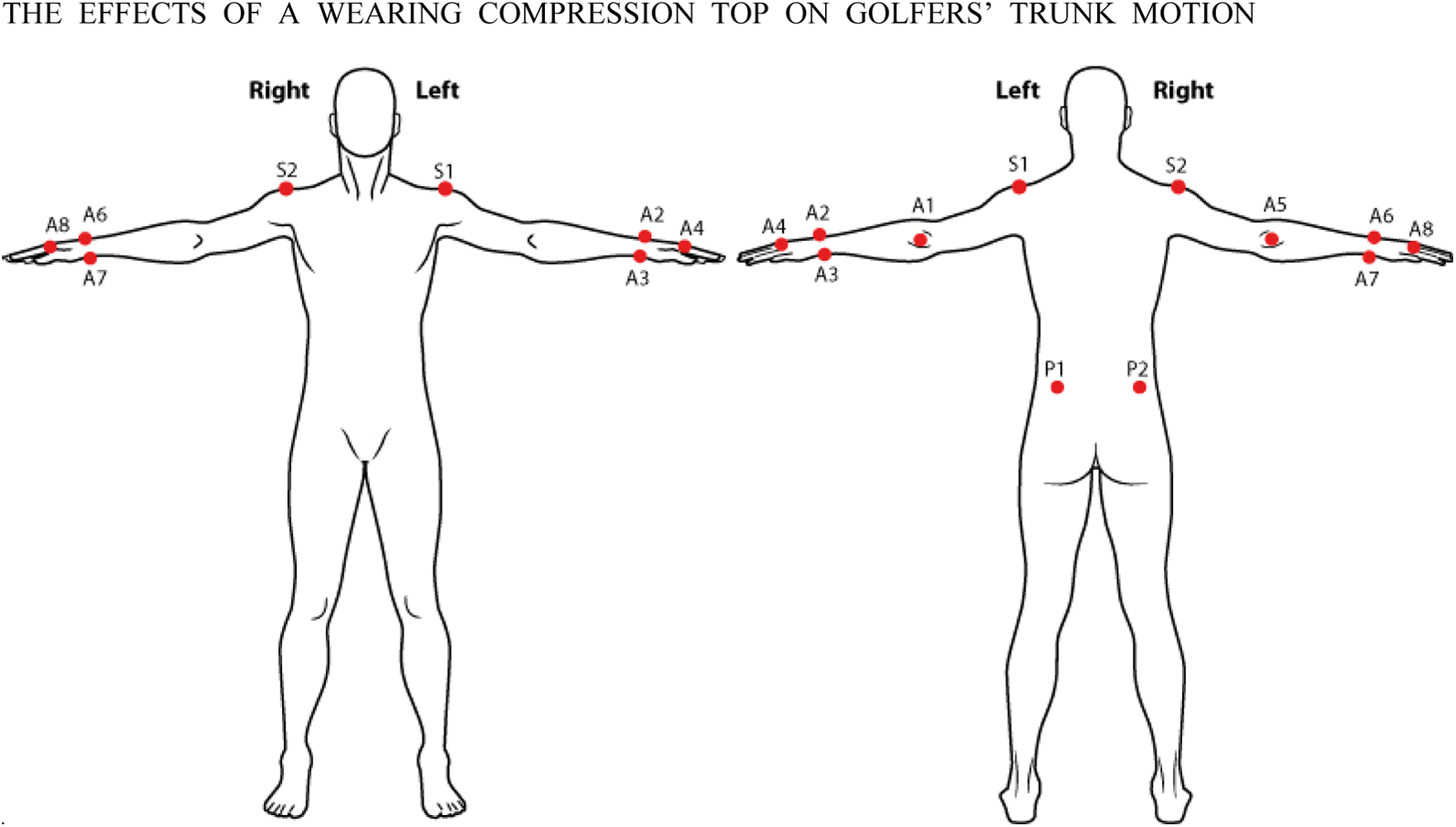
Anatomical landmarks guide for reflective markers; front view and back view.
All participants were asked to swing under two conditions: wearing a long-sleeve compression top underneath a short-sleeve golf T-shirt and wearing only a short-sleeve T-shirt. The two conditions were randomly determined for each participant, and all reflective markers were placed in the same manner. In order to minimize any errors caused by soft tissue artifact, some markers were wrapped by hypoallergenic 3 M Microfoam tape as needed. Also, two holes were made in both shoulders of the short-sleeve T-shirts, which allowed the markers to be fastened directly to the participants’ bodies when wearing only a golf T-shirt and fastened to the compression top when wearing a golf T-shirt with a compression top. This minimized the errors caused by the movement of reflective markers due to the shifting of T-shirts across the skin during swinging.
The sequences of the golf swing were defined according to the position (x, y, and z) of the club head (see Figure 4). The initiation of backswing was defined as start of rising club head. The top of the backswing was defined as maximum vertical position of the golf club throughout the backswing phase. Downswing phase was defined as the moment direction of the club head changed at the top of backswing. Impact phase was defined as the moment the club head passed the target point (which was intended as a ball).
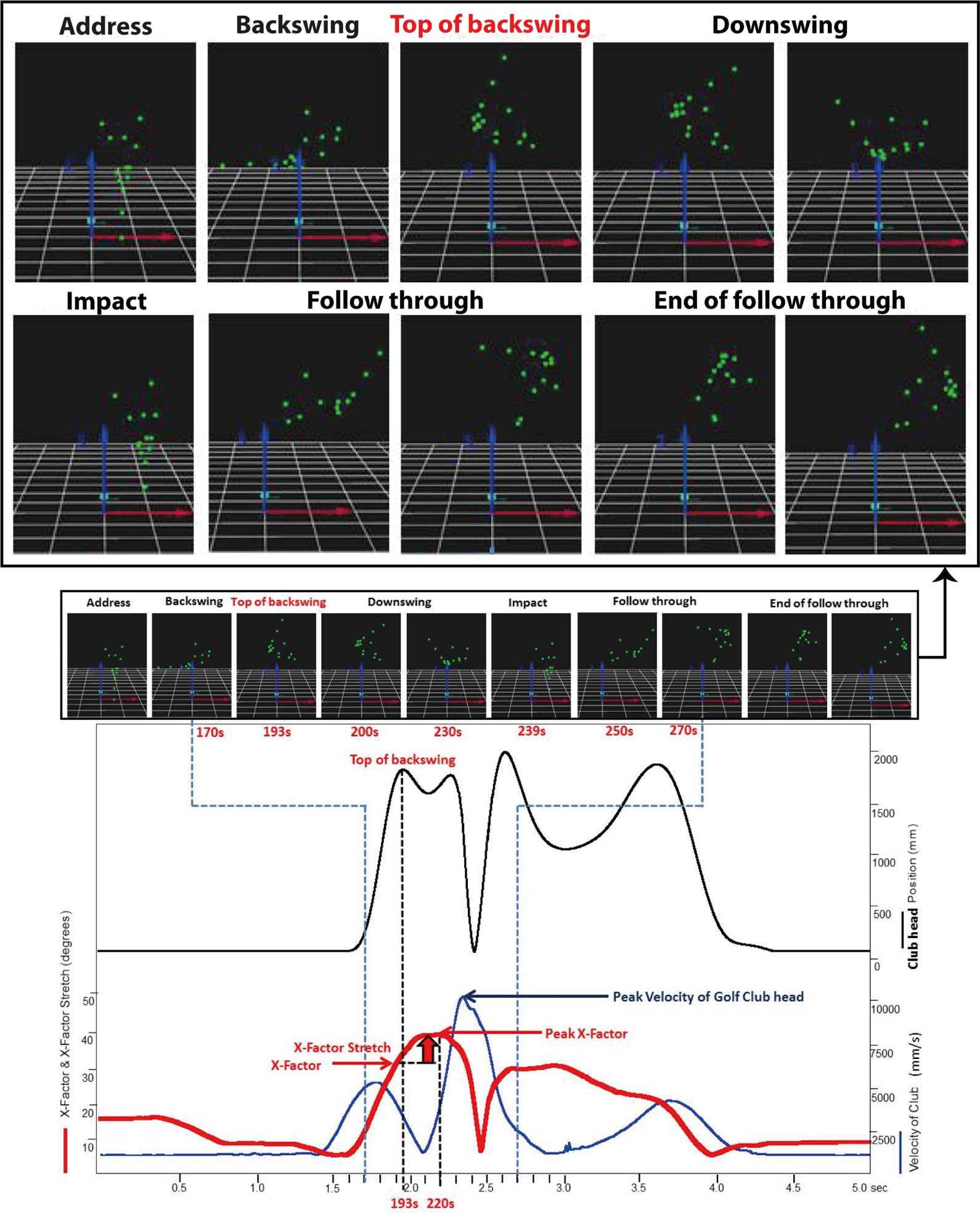
Individual trajectories of the golf club (black line), X-factor (red line), and velocity of the golf club (blue line) arrows indicate peak X-factor and peak velocity in the backswing and downswing phase, as indicated by dashed lines. Figure on top illustrates marker position in different phases of the golf club swing. (The color version of this figure is available in the online version at http://ctr.sagepub.com/.)
From the data captured, X-factor, X-factor stretch, and peak velocity of the golf club were extracted as shown in Figure 4. The red line in Figure 4 represents angular displacements between a participant’s shoulders and pelvis in transverse plane during a full golf swing. X-factor was computed as the value of angular displacement at the top of backswing phase. X-factor stretch refers to the X-factor’s increase on the downswing as a consequence of the golfer’s hip rotated first in the downswing. X-factor stretch was computed as a numerical difference between a maximum X-factor early in the downswing and X-factor at the top of the backswing. The values of X-factor stretch are defined as the degree at which the participants’ hips led their shoulders in the downswing. The blue line in Figure 4 represents velocity of the club during a full golf swing. The peak velocity of the club, as shown in the swing cycle, was during the downswing phase, right before impact phase.
To analyze the data from the experiment, SPSS v20.0 (SPSS Inc., Chicago) statistical software was utilized. The data collected were analyzed by paired sample t-test to see whether there were differences in X-factor and X-factor stretch of the golfers’ trunk rotation and peak velocity of the golf club throughout full golf swings based on wearing a compression garment (Cronk, 2011). The .05 level of significance was established a priori for statistical significance.
Results
X-Factor and X-Factor Stretch
X-factor and X-factor stretch were analyzed as the group data with a paired sample t-test. The mean X-factor of golfers wearing a golf T-shirt with a compression top was 33.76° (SD = 9.50°), and the mean X-factor of golfers wearing only a golf T-shirt was 35.46° (SD = 9.22°; Table 2). As the results show in Table 2, no significant difference in X-factor between the two conditions was found, t(10) = −1.422, p = .185. The results indicated that the mean X-factor of golfers wearing a golf T-shirt with a compression top did not differ from the mean X-factor of golfers wearing only a golf T-shirt.
Mean and Standard Deviations of X-Factor, Peak X-Factor, X-Factor Stretch, and Peak Velocity of the Golf Club With/Without Wearing a Compression Top.

Note. With = with wearing a compression top; without = without wearing a compression top.
*p < .05. **Numerical values necessary to calculate X-factor stretch (X-factor stretch = Peak X-factor − X-factor).
The mean X-factor stretch of golfers wearing a golf T-shirt with a compression top was 9.47° (SD = 5.28°), and the mean X-factor stretch of golfers wearing only a golf T-shirt was 10.99° (SD = 5.88°; see Table 2). As the results show in Table 2, a significant difference in X-factor stretch under the two conditions was found, t(10) = −3.544, p = .005. The results indicated that when the participants were wearing a golf T-shirt without a compression top, the mean X-factor stretch was higher than when they were wearing a golf T-shirt with a compression top.
Peak Velocity of the Golf Club
Peak velocity of the golf club was compared with the use of paired sample t-test throughout full golf swings between two conditions: wearing a golf T-shirt with/without a compression top. The peak velocity of the golf club while wearing a golf T-shirt with a compression top was 10,583.61 mm/s (SD = 1,030.88 mm/s), and the peak velocity of the golf club while wearing only a golf T-shirt was 10,548.09 mm/s (SD = 934.76 mm/s; see Table 2). As the results show in Table 2, no significant difference in the peak velocity of the golf club was found, t(10) = .174, p = .866. The results indicated that the peak velocity of the golf club while wearing a golf T-shirt with a compression top did not differ from the peak velocity of the golf club while wearing only a golf T-shirt.
Discussions and Conclusions
In the present study, we examined whether wearing a compression top influences golfers’ trunk motion during golf swing. No effects of wearing a compression top on golfers’ trunk motion measured by X-factor (Hypothesis0 1) and X-factor stretch (Hypothesis0 2) parameters, and golf club motion measured by its the peak velocity (Hypothesis0 3) were anticipated. We found that wearing a compression top underneath golf T-shirts slightly restricted golfers’ trunk motion early in the downswing, thereby accepting the first and rejecting the second null hypothesis. Wearing the compression top affected X-factor stretch but did not affect X-factor. This slight restriction in golfers’ trunk rotational movement did not affect performance measured by the peak velocity of the golf club. Thus, the third null hypothesis was accepted. The peak velocity of the golf club when wearing a compression top was marginally higher during the full swings. This pilot study is the first to investigate the effects of current apparel trends in golf (golfers wear a long-sleeve compression top and then layer short-sleeve T-shirts over the compression top) on golfers’ trunk rotational movement and performance measured by velocity of the golf club.
According to McLean (2008, cited in Yang et al., 2011, p. 625), the higher X-factor and X-factor stretch are indicators of the greater performance in golf swing. The results of the study indicated that when the participants wore a golf T-shirt without the compression top, their pelvises changed direction more quickly in the downswing, resulting in greater increase in the rotational differences between their shoulders and pelvises. With a minimal restriction in rotation when wearing a compression top, an adverse effect on game performance would not be anticipated.
Meister et al. (2011) found that a rotational difference between the golfer’s shoulders and the pelvis at the top of the backswing (X-factor) and peak rotational difference between the golfer’s shoulders and pelvis in the downswing (X-factor stretch) were strongly correlated to club speed at impact. The researchers also indicated that the rotational biomechanical factors were essential to generate maximum power during their golf swing. However, in this current study, even though the increase in rotational differences between the golfers’ shoulders and the pelvises in the downswing (X-factor stretch) was statistically different when wearing a compression top, there was no significant difference in peak velocity of the golf club.
In addition, an interesting finding was that the peak velocity of the golf club when wearing a compression top was slightly higher (M = 10,583.61, SD = 1,030.88) than the peak velocity of the golf club when not wearing a compression top (M = 10,548.09, SD = 934.76). The difference is not enough to say that golfers’ performance measured by peak velocity of the club improved with wearing a compression top. However, it should be noted that even slight improvement in performance is important for elite golfers in order to have an edge over their competitors. Also, the golfers’ higher peak velocity of the golf club was achieved with less trunk rotation in this present study. It does not appear that wearing a compression top would have any negative effects on elite golfers’ performance and could be considered as a training strategy to decrease postexercise muscle soreness.
In summary, based on the results of this pilot study, we found that wearing a compression top neither improved nor adversely affected swing performance. This means that golfers who have experienced muscle soreness postexercise could use a compression top to facilitate a quick recovery after exercise. Also, wearing a compression top could be used as a training strategy in order to prevent excessive trunk rotation and reduce golfers’ lower back pain. The athletic apparel industry could also use the results in marketing compression garments, emphasizing that there are no anticipated negative effects on golfers’ performance when wearing a compression top and that the top has the potential to decrease postexercise muscle soreness.
Limitations and Future Research
This study has several limitations worthy of consideration for future research. First, the trunk movements and golf performance were analyzed with the use of only a few parameters: the rotational difference between golfers’ shoulders and pelvis and the peak velocity of the golf club. A more complex biomechanical analysis could reveal greater differences in golf performance induced by wearing compression tops. Second, a very small sample of male golfers was recruited as participants for this pilot study, despite the fact that the new golf fashion has been worn by many female golfers as well. Third, we tested the effect of a single compression top made of 5.0 oz. polyester/elastane HeatGear fabric, while similar compression tops with a variety of different functions and fit are produced by an array of athletic apparel companies. Finally, the pilot study was conducted in a laboratory motion capture setting, which was dissimilar from outdoor environments, where golf has been typically played. This laboratory setting could affect the participants’ normal swing performance. All these limitations do not allow generalizing the current findings to a larger population of golf players or variety of golf outfits made of different fabric and having different mechanical properties. Therefore, this would suggest that further testing using a bigger sample size in a setting similar to a real golf environment is necessary to generalize this finding. The pilot data from this study will be used in designing a larger scale experiment, testing the effects of wearing compression tops on golf performance.
Footnotes
Declaration of Conflicting Interests
The author(s) declared no potential conflicts of interest with respect to the research, authorship, and/or publication of this article.
Funding
The author(s) disclosed receipt of the following financial support for the research, authorship, and/or publication of this article: The research project was performed with the use of software sponsored by the NSF MRI grant: CBET-1337511.