



Abstract
To capture diverse aspects of smart shopping for apparel, a comprehensive measurement based upon (a) shopping benefits and costs, (b) consumption economics, and (c) and consumer decision making stages was developed. Employing an extensive literature review, focus group interviews, personal interviews, and surveys, we developed the three-stage, seven-dimensional, and gender-neutral smart shopping measure for apparel. The smart shopping dimensions identified were: information search and planning in the prepurchase stage; effort/time savings, right purchase, and money savings in the purchase stage; and satisfaction and word of mouth in the postpurchase stage. The measure was validated with multiple tests and a structural model validated the significance of the proposed relationships among constructs. This study expanded the conceptualization of smart shopping for apparel by investigating cost and benefit components, by uncovering specific outcome constructs, and by identifying activities that generate smart shopper feelings. Suggestions for retailers as well as future research directions are provided.
Keywords
The U.S. marketplace has recently experienced an economic downturn that has led many consumers to focus on functional aspects of shopping such as getting a good value, getting low prices via sales and promotions, and shopping at convenient locations. Simultaneously, consumers want emotional impact when spending their discretionary dollars (Clark, 2012). In fact, consumers increasingly desire emotional or hedonic benefits from time, effort, and money invested in shopping (Atkins & Kim, 2012). Such changes are affecting all types of consumer purchases and are creating consumer desire for better outcomes (e.g., satisfaction and positive feelings) in exchange for their shopping participation (Kim, Sullivan, & Forney, 2007). The goal of such functional and hedonic shopping trips is feeling “smart” about the shopping experience/process.
A review of academic literature on smart shopping revealed several studies: Shimp and Kavas (1984) analyzed coupon usage based on the theory of reasoned action, Schindler (1998) described the ego or self-concept aspect of consumer emotions and excitement generated by price promotions as “smart shopper feelings,” Garretson and Burton (2003) investigated coupon- and sale-prone consumers to explain smart shoppers, and Mano and Elliott (1997) delineated smart shopping as “the tendency for consumers to invest considerable time and effort in seeking and utilizing promotion-related information to achieve price savings” (p. 504). These studies were all set in a grocery-shopping context and emphasized consumer efficiency related to monetary savings; therefore, an opportunity exists to expand smart shopping beyond monetary savings and grocery shopping.
The purpose of this study was to conceptualize and operationalize a smart apparel shopping measure by investigating consumers’ shopping activities and outcomes. Apparel products were chosen for this study because they are shopping goods for which consumers are willing to spend significant amounts of time and money searching, evaluating, and comparing product attributes. In contrast, convenience goods are products (e.g., groceries) for which consumers typically try to reduce time and energy costs, and specialty goods are products for which consumers are willing to expend time, energy, and money (Murphy & Enis, 1986). Within the category of shopping goods, apparel involves high levels of search effort and perceived risk that the product may not provide the expected benefits (Murphy & Enis, 1986), which motivates the consumer to be a smart shopper. Typical female teenagers often spend significant amounts of discretionary funds on fashionable apparel that boosts self-confidence. On the other hand, middle-aged men who do not have an interest in apparel often make purchases quickly, decisively, and purposefully with less perceived risk (Cleveland, Babin, Laroche, Ward, & Bergeron, 2003).
Gender differences are noted in the current body of research on shopping for apparel. For example, Hu and Jasper (2004) found that men are typically impulsive, utilitarian shoppers, while women are planned, hedonic shoppers. Furthermore, Bakewell and Mitchell (2003) reported that men do not take responsibility for clothing purchases. However, it is possible that these findings in gender differences are derived from using survey items that function differently for males and females. That is, items may be interpreted differently by male and female respondents. In general, shopping is viewed as a female activity because historically women have been the primary agents for buying household goods (Witkowski, 1999) and thus more involved in shopping than men. Hence, the possibility of different item interpretations between genders presents a need for a gender-neutral scale for smart apparel shopping.
To identify activities and outcomes of smart apparel shopping, a comprehensive literature review identified theories related to smart shopping. Next, a qualitative inquiry examined consumers’ perceptions of smart shopping. The literature review and qualitative inquiry provided a foundation for developing a conceptual model of smart apparel shopping. Finally, quantitative methods finalized and validated the measure of smart apparel shopping. In particular, differential item functioning (DIF) (Zumbo, 1999) detected scale items that are interpreted differently between genders and finally identified gender-neutral scale items of smart apparel shopping.
Review of Literature
The literature reveals that the concept of smart shopping encompasses preparation and information search prior to purchasing; saving money, time, or energy during the purchasing stage; and the resulting positive feelings after purchasing. Thus, the theoretical foundation of this study involves consumer efficiency theory and consumption economics framed within the consumer decision-making process.
Shopping Costs and Benefits
Traditionally, a consumer’s shopping activity has been linked to performing necessary functions at a minimal cost (Ingene, 1984) or as a trade-off between what they get and what they give (Zeithaml, 1988). More specifically, Downs (1961) discussed the theory of consumer efficiency, wherein the consumer seeks to minimize consumption costs relative to benefits received on a specific shopping trip.
Shopping costs have been explained with different variables. Downs (1961) separated shopping costs into monetary costs (i.e., price) and nonmonetary costs (i.e., time and energy). Bender (1964) extended the concept of shopping costs into prime costs (actual price of the goods) and secondary costs (additional costs of acquisition) that consisted of price (e.g., sales tax and alteration charges), time (e.g., search time and travel time), and psychological factors (e.g., aggravation and frustration). For apparel shoppers, shopping costs include time and money spent making the purchase but may also include search costs or the frustration of ill fitting garments. In each study discussed, reducing costs spent on purchases was the consumers’ goal, although the definition of costs differed among the studies.
The literature has identified many shopping benefits such as product performance (Swinyard, 1997), information (Ingene, 1984), shopping pleasure (Babin, Darden, & Griffin, 1994), low price and quality merchandise (Zeithaml, 1988), and convenience (Keeney, 1999). However, smart shopping has been primarily related to utilitarian benefits of price and price promotions in the grocery-shopping context (Garretson & Burton, 2003; Schindler, 1998; Shimp & Kavas, 1984). Researchers have further categorized shopping benefits into utilitarian benefits (i.e., rational, functional, and task related) and hedonic benefits (i.e., emotional, fun, and enjoyment) (Babin et al., 1994). For example, a bride’s satisfaction in finding the perfect wedding gown includes accomplishment of the task but also positive feelings evoked by a perfect style or fit.
Contrary to the traditional expectation that hedonic value is driven exclusively by enjoying an attractive atmosphere or relaxing while shopping, Kim and Kang’s (1997) study indicated hedonic shopping value can be obtained by making purchases at low prices. Cox, Cox, and Anderson (2005) also found consumers’ shopping pleasure derived from utilitarian activities such as bargain hunting and browsing in addition to hedonic activities such as being pampered and sensory stimulation. As such, smart shopping does appear to include a hedonic component that is desirable for apparel shoppers.
Consumption Economics
Consumption economics is the study of choice-making processes of consumers (Cochrane & Bell, 1956). According to traditional economic theory, consumers are rational and make choices that maximize their total utility (e.g., pleasure derived from the goods or services consumed) (Cochrane & Bell, 1956). In this view, problem of choice is the central issue because the consumers’ desire to satisfy their wants and needs frequently exceeds their resources. For example, a consumer may desire premium denim from J Brand or True Religion (costing approximately US$200) but only have discretionary income to afford jeans from Gap (costing approximately US$68). Consumers must make trade-offs and select some combination of goods limited by constraints of money and time allotted for each shopping trip (Stiglitz, 1997).
A concept related to consumption economics is “warm glow”—the feeling that comes from doing something believed to be good, which is a happiness factor (Andreoni, 1990). Warm glow is viewed as a benefit of the expenditure of resources. Purchasing the right product in an efficient and satisfactory manner maximizes a consumer’s total utility and thus creates a sense of happiness or satisfaction (i.e., warm glow), leading to positive outcomes (e.g., telling others about product promotions). Smart apparel shoppers can be viewed as desiring a warm glow from maximizing the total utility of their purchases.
Consumer Decision Making
Consumers typically go through a series of steps in their decision-making process. Blackwell, Miniard, and Engel (2005) depicted the consumer decision-making process with several decision stages: need recognition, search for information, prepurchase alternative evaluation, purchase, consumption, postpurchase evaluation, and divestment. Upon recognizing a need to buy an apparel item (i.e., need recognition), a consumer typically conducts a search for information about the apparel item, evaluates the alternatives they find, makes a purchase decision, consumes or uses the apparel item, and evaluates his or her satisfaction with the purchase. The consumer decision-making process has been employed by several researchers to examine consumer behavior related to buying apparel (Blackwell & Hilliker, 1978; Darian, 1998; Workman & Studak, 2006). For the present study, decision-making stages were condensed to prepurchase stage, purchase stage, and postpurchase stage because these labels specifically depict activities (i.e., prepurchase and purchase) and outcomes (i.e., postpurchase) associated with smart shopping for apparel.
Method and Results
The research process of this study followed the guideline suggested by Churchill (1979) and Singh and Rhoads (1991). This guideline has been utilized by many consumer behavior studies for developing scales (e.g., Arnold & Reynolds, 2003; Cleveland & Laroche, 2007; Kim, Lee, & Park, 2014).
Step I: Domain Specification
Domain specification involves developing the construct domain, identifying its dimensions, generating items for each dimension, and pretesting items (Singh & Rhoads, 1991). This step was accomplished by qualitative inquiry, model development of smart apparel shopping, and its scale development.
Qualitative inquiry
Qualitative inquiry was employed with focus group and face-to-face in-depth interviews to gather consumers’ perspectives about smart shopping beyond the focus on price and price promotions. In the present study, the focus group interview goal was to identify information regarding (a) meanings associated with the term “smart shopping,” (b) activities involved in smart shopping for apparel, and (c) behaviors involved in smart apparel shopping.
Two focus group interviews were conducted with participants who were selected from a convenience sample of graduate students, faculty, and staff members in consumer sciences at a major university in the southeastern United States. The first focus group consisted of nine females and one male, ranging in age from 21 to 50 years. The second group was made up of ten females with age ranging from 31 to 60 years. The participants responded to several open-ended questions such as “How would you describe the term smart shopping?” and “How does making a smart purchase make you feel?”
The focus group data were analyzed using an ethnographic approach that heavily uses quotations from the group discussions and seeks to uncover topics discussed by multiple participants in the group (Morgan, 1988). Upon review of the focus group interview notes, response categories based upon clear patterns that emerged from the data were created. Response categories included goals, activities/behaviors, feelings/outcomes, and importance. In the activities/behaviors category, focus group participants discussed topics such as searching for information and comparison shopping, which were included in the review of literature; however, other topics such as “waiting for a product to go on sale” were not found in the literature. In addition, the response categories provided a preliminary glimpse into the three proposed stages involved in smart shopping for apparel (i.e., prepurchase, purchase, and postpurchase). The response categories and stages were later referenced for model development.
In addition to the focus group interviews that provided a breadth of information, face-to-face in-depth interviews were conducted to obtain a depth of information about consumers’ views of smart shopping for apparel (Morrison, Haley, Sheehan, & Taylor, 2002). The researchers conducted audiotaped individual personal interviews that lasted approximately 1 hr each with 15 consumers (10 females and 5 males with participants’ ages ranging from 20s to 60s). Purposive sampling was chosen to allow the researcher to select participants with the appropriate characteristics (Zikmund, 2003).
The researchers annotated, sorted, and retrieved coded sections of text for studying patterns among the codes using Qualitative Data Analysis (QDA) Miner 3.0, a qualitative data analysis software program. Strauss and Corbin’s (1998) research methodology (i.e., open coding and axial coding) was used to analyze the face-to-face in-depth interviews. The researchers began open coding by reading the 15 interview transcripts, naming and categorizing phenomena (e.g., reading magazines and delaying purchase), as they progressed. Next, the researchers looked through the notes for commonalities in concepts identified in coding (e.g., using coupons and purchasing in bulk) and created subcategories such as planning or conducting research. The subcategories were clustered together to identify more abstract categories of smart shopping (i.e., prepurchase evaluation, purchase activities, postpurchase evaluation, and postpurchase behavior). Consequently, the researchers confirmed many smart shopping activities discussed in the focus group interviews and discovered additional smart shopping activities through the face-to-face interviews (e.g., getting the right fit and watching advertisements).
Model development
Incorporating the literature review and results of interviews, a model including smart shopping activities and outcomes for apparel was developed. The smart shopping activities were classified into prepurchase activities and purchase activities, while smart shopping outcomes represented postpurchase results. The subcategories were named information search and planning (in the prepurchase stage); saving effort, saving time, saving money, and right purchase (in the purchase stage); and satisfaction and word of mouth (in the postpurchase stage). The smart shopping variables are consistent with the theoretical framework of shopping costs and benefits in consumer efficiency (Downs, 1961); consumption economics (Cochrane & Bell, 1956); warm glow (Andreoni, 1990); and prepurchase, purchase, and postpurchase steps of consumer decision making (Blackwell, Miniard, & Engel, 2005). The variables identified from the qualitative inquiry were utilized in developing scale items.
Scale development
Based upon the review of academic literature and qualitative interviews, the researchers constructed scale items to conceptualize smart shopping for apparel. The initial item generation produced 130 smart shopping scale items organized in three stages: 29 items for prepurchase, 62 items for purchase, and 39 for postpurchase. The researchers used the Delphi method to evaluate content and face validity of the smart shopping measurement items by employing seven experts in consumer behavior (Skulmoski, Hartman, & Krahn, 2007). Using this method, the experts were identified and asked to review the smart shopping questionnaire for proper wording. Responses were collated and analyzed, and based upon feedback from the experts, scale items that were unclear, redundant, unnecessary, not representative of the domain, or open for potential misinterpretation were eliminated or reworded. The remaining pool consisted of 34 smart shopping items: 8 items for prepurchase, 17 items for purchase, and 9 items for postpurchase (see Figure 1).

Conceptual model of smart shopping.
The survey instrument contained three main sections: smart shopping constructs (for scale development), consumer characteristics (for scale validation), and demographic information (for descriptive purposes). The smart shopping items and consumer characteristics were formatted into a 6-point Likert-type response scale ranging from 1 (strongly disagree) to 6 (strongly agree).
To identify opportunities for modification of questionnaire wording, a pretest was conducted on a convenience sample (N = 63) of undergraduate students majoring in consumer sciences at a major southeastern university in the United States. The age range of participants was from 18 to 49, with the majority (81%) being between the ages of 20 and 22. Three of the participants were male and 60 were female. The self-administered questionnaire asked participants to identify an in-store apparel-shopping trip from the past 3 months in which they made a “smart purchase.” The present study was restricted to in-store clothing purchases because at the time of this survey, brick-and-mortar stores were a major shopping channel for clothing. Based on the results of the pretest, the survey instructions were changed to “Recall your most recent in-store shopping trip for apparel when you made what you would consider a smart purchase.” In addition, the stem of each questionnaire section was modified to clarify wording.
A pilot test was conducted to determine linkages between the observed items and their underlying dimensions. The data were collected by an online market research company with a prerecruited consumer panel member list. Panel members were sent an e-mail invitation to the smart apparel shopping survey. The pilot test sample (N = 91) consisted of consumers who had purchased apparel in a brick-and-mortar store in the past 3 months. The age range of participants was from 20 to 74 years, with a mean age of 43.1. About 60.4% were female, 93.4% were Caucasians, 59.4% earned bachelor’s degrees or above, 54.9% were married, and about 57% had a household income of US$30,000–US$89,999.
Principal component analysis with varimax rotation provided dimensional patterns of the pretest data. Due to the small sample size, focus was placed on item analyses in relation to the corresponding factor (Stevens, 2002). All item-total correlations were above .50 and no offending estimates (i.e., those with negative variance or loadings greater than 1.0) were found. Thus, all items were used in the quantitative study.
Step II: Scale Refinement
The scale developed from Step I was refined through the quantitative study. The quantitative study (N = 488) was conducted with consumers who had purchased apparel in a brick-and-mortar store in the past 3 months. The data were collected via the same online market research company that was used for the pilot test. The quantitative study sample was made up of 165 males and 323 females, with an age range of 18–83 years and a mean age of 44.9 years. The majority (82.6%) were Caucasians, 46.5% had bachelor’s degrees or above, 51.4% were married, and about 60% had a household income of US$30,000–US$89,999.
Exploratory factor analysis (EFA) was conducted using LISREL 8.80 to find a set of latent factors fewer in number than the observed variables. Since some correlations are expected among factors, promax-rotated factor loadings were produced with MINimum RESidual (MINRES) factor analysis. All scale items exhibited factor loadings above .40 (Stevens, 2002) except for one prepurchase item (“I had an organized shopping plan before making this apparel purchase”), which was deleted from further analyses. The saving effort and saving time subcategories resulted in one factor and was named effort/time savings. In summary, the final factor analysis produced two factors of prepurchase (information search and planning), three factors of purchase (effort/time savings, right purchase, and money savings), and two factors of postpurchase (satisfaction and word of mouth).
Confirmatory factor analysis (CFA) was employed to validate the overall factor structure of the smart shopping items. Prior to running CFA, the normality of the data was examined using PRELIS 2.80. The univariate normality test using skewness and kurtosis showed that 26 of 30 items deviated from normality; however, the nonnormality of these items was negligible because the values of skewness and kurtosis were less than 3 and 21, respectively (Dubauskas & Teresiene, 2005). Next, the robust maximum likelihood procedure was employed to improve the estimates of standard errors and model fit while analyzing a sample covariance matrix of asymptotic covariances implemented by LISREL 8.80. The λ coefficients of indicator variables ranged from .512 to .933. Chi-square (χ2), degree of freedom (df), comparative fit index (CFI), nonnormed fit index (NNFI), and root mean square error of approximation (RMSEA) were used to examine the fit of the measurement models (Hair, Black, Babin, & Anderson, 2009). Overall, the model fit was good, χ2 = 1,007.304, df = 329, CFI = 0.958, NNFI = 0.952, and RMSEA = 0.064.
Step III: Scale Validation
The refined scale was tested for validity. The scale validation was conducted by DIF, construct validity, and nomological validity.
DIF
Bias occurs when items are irrelevant or extraneous to the subgroup, affecting performance and becoming a potential threat to the validity of score interpretations (Joreskog & Sorbom, 2006). Teresi and Fleishman (2007) argued that different item functioning occurs when a response to the item is related to group membership after controlling for an estimate of the construct being measured. DIF has been employed to tackle issues of gender or cross-cultural differences in interpreting items (Molander, Holmstrom, & Taksic, 2011).
Gender differences are noted in the current body of research in consumer decision making (Bakewell & Mitchell, 2003) and shopping behavior (Noble, Griffith, & Adjei, 2006) by considering mean or factor score differences and similarities between genders in constructs. However, gender differences may result from using instruments containing items that function differently for males and females (O’Cass, 2000). Hence, examining the possibility of different item functioning furthers the determination of measurement equivalence (i.e., whether smart shopping items function in the same manner across gender groups).
Using Zumbo’s (1999) ordinary linear regression approach, the DIF test measured effect of group and interaction over and above the total scale score. In Model 1, the conditioning variable (i.e., the total scale score) was entered. In Model 2, the grouping variable (i.e., gender) was entered. This measured the effect of the grouping variable while holding constant the effect of the conditioning variable. In Model 3, the interaction term (i.e., Total Score × Gender) was entered into the equation to determine whether the difference between the group responses on an item varied over the latent variable continuum (i.e., low to high total score; Gomez, 2007). Each step provided a χ2 value, df, and a corresponding effect size estimator (R 2).
According to Zumbo’s (1999) method, possible items that indicate DIF across the groups and the interaction are detected based on two criteria: (a) the increases in χ2 value (Δχ2) across steps and (b) the increases in R 2 (ΔR 2) across steps. This is to confirm that the effect size of this difference is not due to the sample size because significant χ2 differences can be produced by small differences with large sample sizes. To determine a significant group effect, Δχ2 (Step 2 over Step 1) with 1 df must be equal to or greater than 6.63 (p < .01). An interaction effect is determined when Δχ2 (Step 3 over Step 1) with 2 df is equal to or greater than 9.21 (p < .01) and when Δχ2 (Step 3 over Step 2) with 1 df is equal to or greater than 6.63 (p < .01). Also, DIF is detected when ΔR 2 value is .13 or above. Overall, our results (see Table 1) indicated that DIF was present for 3 purchase items (“I did not waste time making this purchase,” “I got what I wanted at a price I was willing to pay,” and “I got a reasonable price on this purchase”) and 2 postpurchase items (“I had a fun experience making this purchase” and “I have gotten a lot of use out of this product”). Thus, these 5 items were deleted in further analyses and the final list without these 5 items endorses a gender-neutral scale.
Differential Item Functioning (DIF) of Smart Shopping Items.
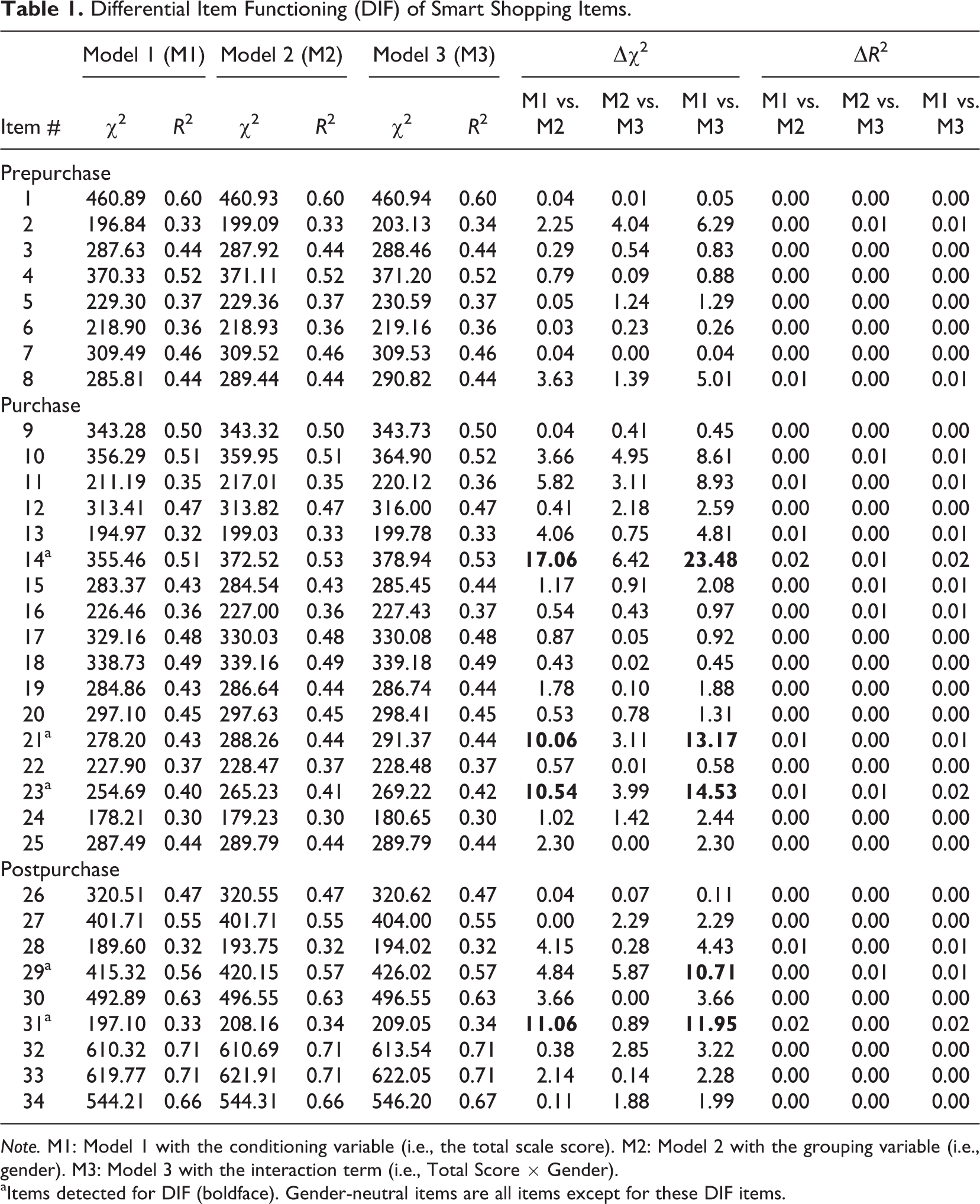
Note. M1: Model 1 with the conditioning variable (i.e., the total scale score). M2: Model 2 with the grouping variable (i.e., gender). M3: Model 3 with the interaction term (i.e., Total Score × Gender).
aItems detected for DIF (boldface). Gender-neutral items are all items except for these DIF items.
Construct validity
Construct validity was evaluated using convergent and discriminant validities. Convergent validity was checked with factor loading coefficients, construct reliabilities, and overall fit index of the model (Steenkamp & Trijp, 1991). As illustrated in Table 2, all λ coefficients of the indicator variables were above .50. All construct reliability values of the latent constructs were well above the threshold value (>.70; Bagozzi & Yi, 1988). Also, model fit was satisfactory: CFI and NNFIs above .95 and RMSEA below .08 (Hair et al., 2009).
Confirmatory Factor Analysis.
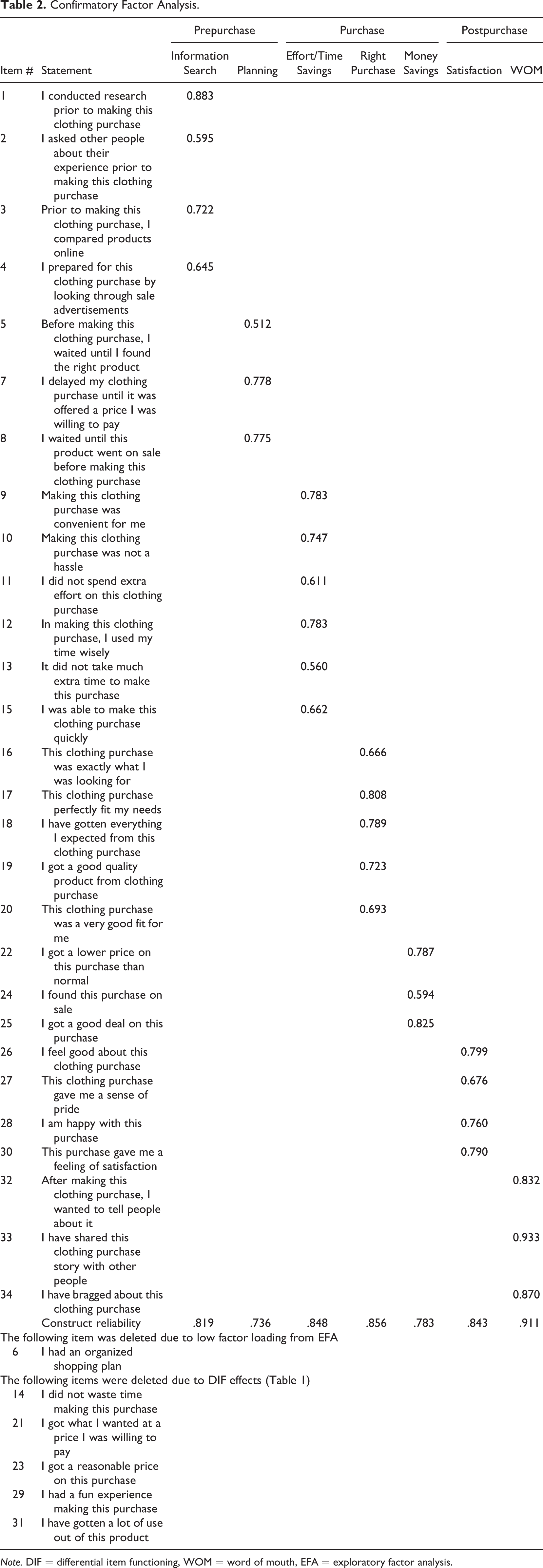
Note. DIF = differential item functioning, WOM = word of mouth, EFA = exploratory factor analysis.
Discriminant validity of each smart apparel shopping stage can be achieved if the fit of one-factor and/or two-factor models is significantly worse than the fit of the hypothesized two-factor and/or three-factor model (Steenkamp & Trijp, 1991). As illustrated in Table 3, the model fit with the two-factor model (prepurchase and postpurchase) and three-factor model (purchase) improved significantly from the one- or two-factor model, respectively. Further discriminant validity was assessed with a χ2 difference test. The final model of each stage showed the lowest χ2s and statistically significant Δχ2 at p = .001. These results provided sufficient evidence for discriminant validity.
Model Comparison for Discriminant Validity.
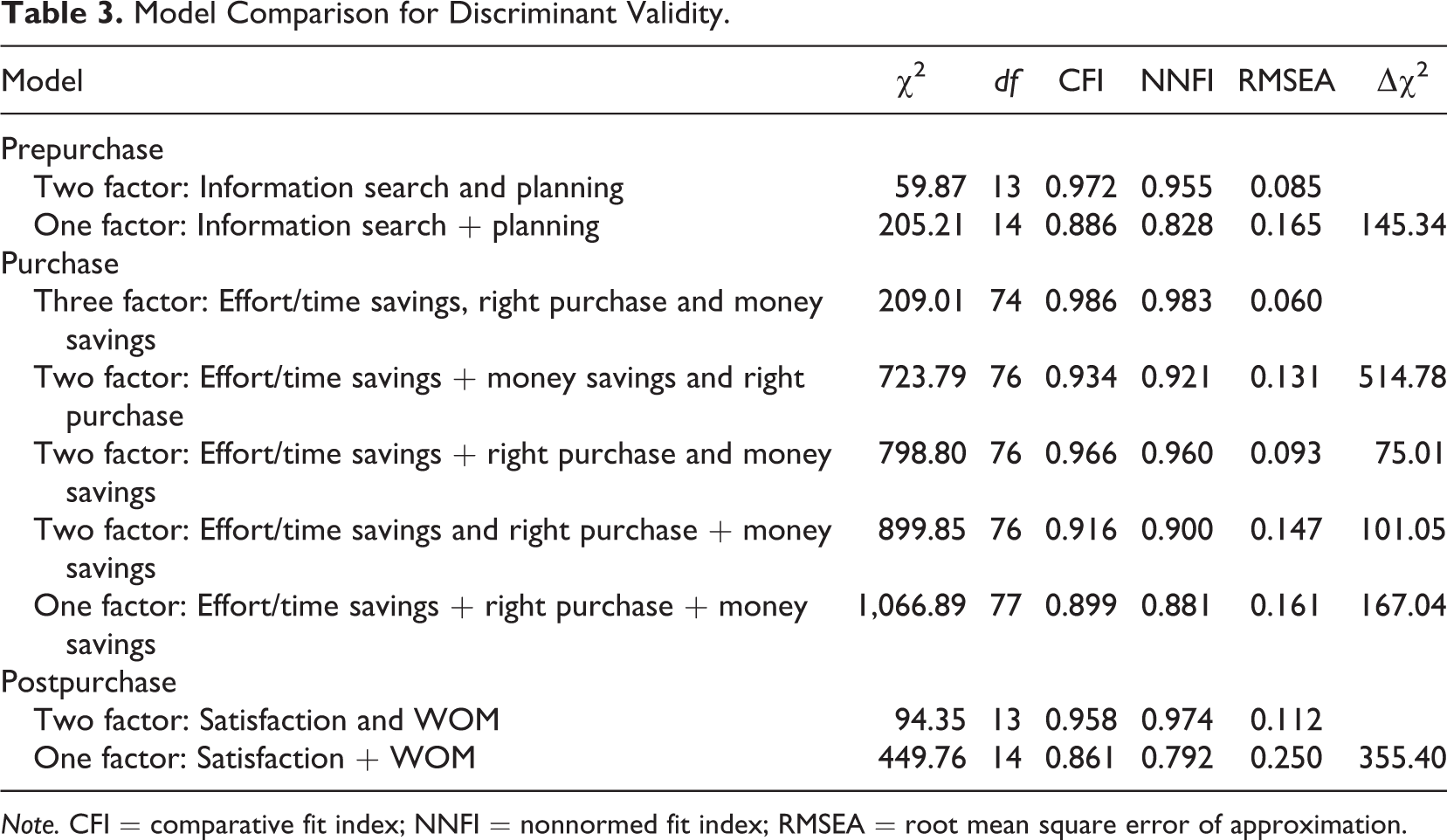
Note. CFI = comparative fit index; NNFI = nonnormed fit index; RMSEA = root mean square error of approximation.
Nomological validity
Nomological validity was used to assess “the relationship between constructs purported to assess different (but conceptually related) constructs” (Peter, 1981, p. 138). Correlation estimates between the smart shopping constructs and the theoretically related variables confirmed nomological validity through significant positive correlations (p < .001). Several constructs believed to be related to smart shopping were employed for this purpose.
The marketplace knowledge scale (e.g., “I am usually well informed about what is a reasonable price to pay for something”) measures the level of knowledge consumers have for factors such as price (Clark, Martin, & Bush, 2001). Thus, we hypothesized that marketplace knowledge would have substantial influence on information search and planning because it would impact consumers’ knowledge of factors such as prices and stores. Results revealed a positive correlation between marketplace knowledge and information search (r = .39) and planning (r = .40), confirming our hypotheses. The time consciousness scale (e.g., “I often combine tasks to optimally use my time”) measures one’s predisposition to consider time a scarce resource and therefore use it wisely (Kleijnen, de Ruyter, & Wetzels, 2007). It was hypothesized that time consciousness was related to planning and to effort/time savings because consumers with higher time consciousness want time-related benefits. A positive relationship with planning (r = .21) and effort/time savings (r = .34) supported the hypothesis.
Convenience seeking (e.g., “I want to shop in the least amount of time”) is the degree to which consumers strive to maximize shopping opportunities in addition to time savings in their shopping (Noble et al., 2006). It was posited that convenience seeking is positively related to effort/time savings and right purchase because these consumers strive to maximize their shopping opportunities. A positive relationship existed with effort/time savings (r = .31) and right purchase (r = .31), supporting our hypotheses. Price consciousness is the amount of focus a consumer places on paying low prices (Alford & Biswas, 2002). The price consciousness scale includes “The money saved by finding lower prices is usually worth the time and effort.” Our hypothesis of a positive relationship between price consciousness and money savings was based upon the previous study by Alford and Biswas (2002), which suggested that price-conscious consumers focus on product price at the exclusion of all other factors. This hypothesis was supported (r = .66). Finally, smart shopping self-perception is a consumers’ orientation that causes them to view themselves as less impulsive and more rational in their decision making (Burton, Lichtenstein, Netemeyer, & Garretson, 1998). This scale contains statements such as “When I go shopping, I take a lot of pride in making smart purchases.” This construct was hypothesized to be associated with right purchase, satisfaction, and word of mouth because of the consumer’s rational orientation. A positive relationship confirmed our hypotheses with right purchase (r = .31), satisfaction (r = .94), and word of mouth (r = .69).
Step IV: Model Validation
Because the smart apparel shopping model involves prepurchase, purchase, and postpurchase stages, the structural model was constructed to test hierarchical relationships among variables constituting these stages. The smart shopping model depicting seven dimensions and three stages was tested using structural equation modeling (SEM) (see Figure 2). Model fit was satisfactory, χ2 = 1,307.530, df = 339, CFI = 0.940, NNFI = 0.934, and RMSEA = 0.076.
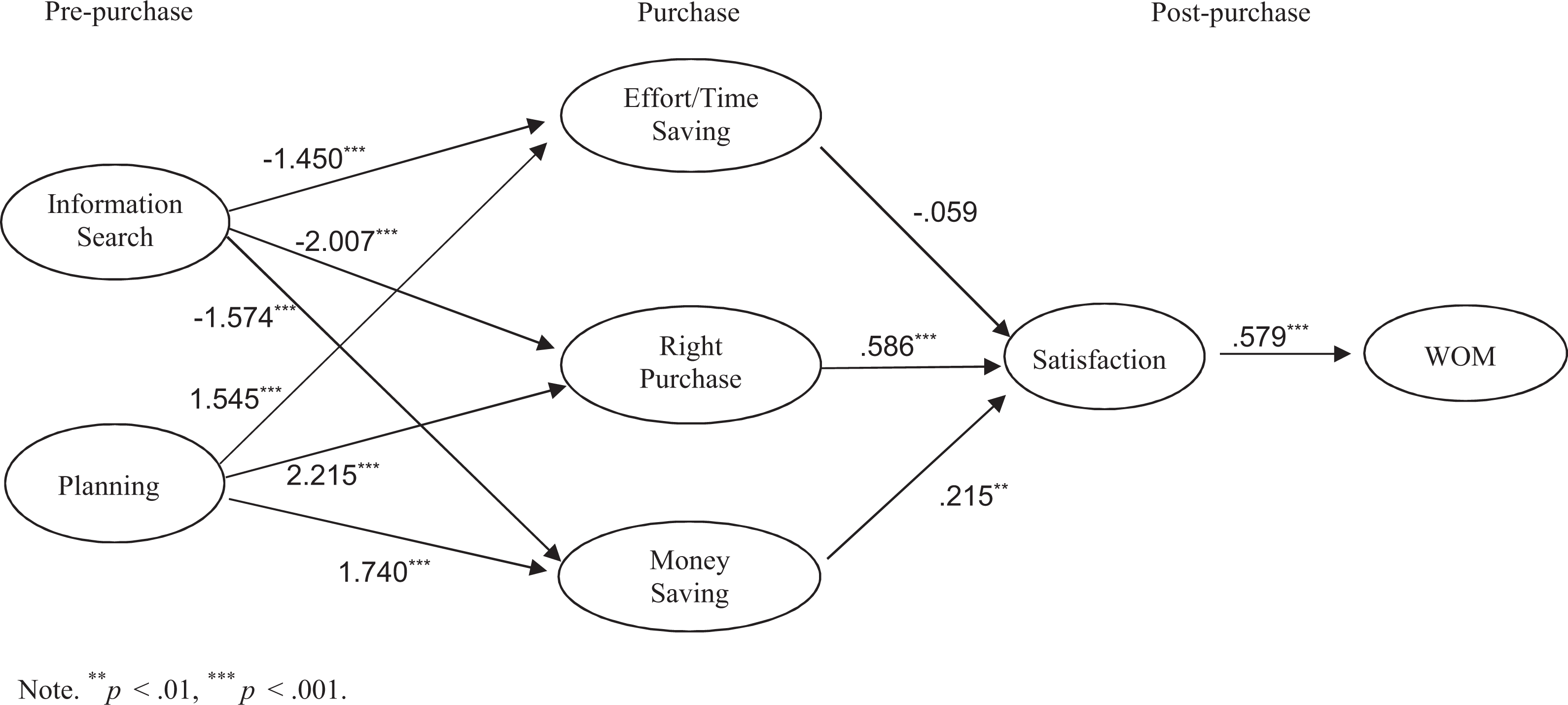
Structural equation model of smart shopping.
In terms of the influence of the prepurchase variables (information search and planning) on purchase variables (effort/time savings, right purchase, and money savings), the path coefficients were negative. This indicated that participants felt that the more information search they conducted before making a purchase, the less likely they felt they saved effort/time or money and the less likely they felt they made the right purchase. It is logical that the effort/time conducting an information search is considered part of secondary costs. Planning for smart shopping positively affected all three purchase factors. That is, when participants felt they did more planning before the purchase, they felt more strongly that they saved effort/time, saved money, and made the right purchase. Next, purchase variables (effort/time savings, right purchase, and money savings) were tested for their influence on postpurchase outcomes (satisfaction and word of mouth). The result shows that right purchase and money savings positively influenced satisfaction, but effort/time savings did not influence satisfaction. This may be because apparel shoppers are more concerned with making the right purchase and saving money than accomplishing the shopping trip in a quick, efficient manner. In the postpurchase stage, satisfaction positively influenced word of mouth. This indicates that apparel shoppers who are satisfied with their purchase tell others about their positive smart shopping experience. Overall, the structural model result validated the proposed relationships among smart shopping constructs: Prepurchase stage led to purchase stage, which in turn led to postpurchase stage. It also supported the existence of costs and benefits as well as satisfaction from smart apparel shopping.
Discussion
This study confirmed the smart shopping literature related to monetary savings (Schindler, 1998) that emphasized the utilitarian benefit of saving money. In addition, this study provided empirical support for including saving effort/time and right purchase as constructs depicting smart shopping activities for apparel. This study found costs and benefits as two main dimensions of smart apparel shopping. For example, the prepurchase and purchase stages represent smart shopping activities that involve the expenditure of costs (i.e., price, time, and energy), and the postpurchase stage represents outcomes associated with gaining benefits (i.e., goods, pride, and satisfaction) from smart apparel shopping. Previously, researchers examined smart shopper feelings associated with consumer emotions and excitement generated by price savings (Mano & Elliott, 1997; Schindler, 1998). The present study extended previous studies by identifying other outcome constructs of smart apparel shopping (i.e., satisfaction and word of mouth) and by identifying other activities (i.e., saving money and right purchase) that generate smart shopping feelings.
This study also supported the theory of consumption economics that consumers desire to receive warm glow from their shopping experience in exchange for their resources of time, money, and energy (Andreoni, 1990). Finally, this study supported the prepurchase, purchase, and postpurchase consumer decision-making stages presented by Blackwell et al. (2005). In the prepurchase stages, the consumer conducts an information search and plans for smart apparel shopping. In the purchase stage, the consumer desires to expend minimum levels of time, energy, and money, as well as make the right purchase, leading to satisfaction and positive word of mouth in the postpurchase stage.
Implications and Recommendations
The constructs in the smart shopping stages include information search and planning in the prepurchase stage; effort/time savings, right purchase, and money savings in the purchase stage; and satisfaction and word of mouth in the postpurchase stage. In order to compete for today’s smart apparel shopper who places importance on both price and nonprice dimensions of shopping for apparel, retailers need to develop strategies for the specific smart shopping stages.
Specific prepurchase strategies retailers could adopt to enhance smart apparel shopping include (a) online and in-store information kiosks requiring minimal effort or time to compare apparel features and benefits and (b) consumer subscriptions to retailer special events, price discounts, or new product arrivals via e-mail or postal service to be utilized by consumers in planning. Purchase strategies could include in-store pickup for online or telephone purchases to save shipping time and shipping costs or directional signage to assist customers in quickly finding the products they seek. Postpurchase strategies could focus on providing positive shopping experiences that increase hedonic benefits such as customer satisfaction. Such postpurchase strategies could include (a) tell a friend services for customers to alert others about good products, services, or sales and (b) rewards or rebates for purchases.
This study has several limitations, which provide opportunities for future research. First, the focus group interview, pretest, and pilot test had uneven numbers of males and females. Although gender-neutral scale items were empirically tested with the quantitative study, which had more balanced numbers of male and female consumers, employing relatively even gender distribution in the qualitative and preliminary stages would enhance the value of the measurement. Second, participants in the pretest, pilot test, and quantitative study were U.S. consumers; therefore, this study should not be generalized to other countries. Third, a future study can replicate the smart shopping study for other product categories (e.g., convenience goods and specialty goods) and retail formats (e.g., online and catalogs). Fourth, as the hedonic aspect of consumer shopping experiences is becoming more important than in the past (Kim et al., 2007), future studies may expand on the hedonic benefit of smart shopping, which may identify its multiple factors. Finally, this quantitative study for new scale development is limited by the use of only one sample of smart apparel shoppers. Further research is recommended using multiple samples to further enhance the validity of the scale following the suggestion of Singh and Rhoads (1991) who used two different data sets for cross validation.
Conclusions
The concept of smart shopping in this study was conceptualized and tested from a broader perspective than previous studies conducted in the grocery context and focused on saving money. The measure of smart apparel shopping was developed using a holistic approach that integrates different bodies of work: consumption economics, consumer benefits and costs, and the consumer decision-making process. Furthermore, an extensive review of literature, multistage data collection procedures, and the rigor of analytical strategies warranted development of the reliable, valid, and gender-neutral smart shopping measure for apparel.
Recognizing that consumers desire better outcomes in exchange for their participation in shopping activities, this study contributes to understanding the meaning of smart shopping for apparel, identifies ways of meeting needs of the smart shopper, and suggests marketing methods for targeting smart apparel shoppers. By choosing to meet the needs of smart shoppers, retailers can shift their focus from sale shoppers who make shopping decisions based upon monetary costs to smart apparel shoppers who want to reduce the time and effort of their apparel shopping trips while participating in positive shopping experiences.
Footnotes
Declaration of Conflicting Interests
The author(s) declared no potential conflicts of interest with respect to the research, authorship, and/or publication of this article.
Funding
The author(s) disclosed receipt of the following financial support for the research, authorship, and/or publication of this article: we received partial funding from the Department of Retail and Hospitality Management at the University of Tennessee.