



Abstract
University clothing and textile programs must respond to increasing pressure from stakeholders to prepare graduates for successful employment. This challenge calls for educators to connect with employers to identify competencies needed for entry level merchandising positions in order to develop strong curricula to meet industry needs. In this study, the authors explored the merchandising component through a survey of mid-level retail managers’ (n = 109) perceptions of the competencies needed by new graduates to succeed in early career positions. The International Textile and Apparel Association meta-goals served as a framework for assessing retailers’ views on the importance of knowledge, skills, and abilities for new graduates. Retail managers favored soft skills such as teamwork, leadership, and communication, over traditional clothing and textile content knowledge. The authors found support for curricular emphasis on experiential and collaborative learning, and continuing efforts to invigorate core clothing and textiles content knowledge.
Universities are experiencing increased pressure from employers, students, and the general public to improve student learning and demonstrate program effectiveness (Bridgeland, Milano, & Rosenblum, 2011). In response, higher education has stepped up efforts to ensure that graduates have the knowledge and skills needed to get hired and be successful (Hart Research Associates, 2013). As university clothing and textile (C&T) programs strive to remain viable and relevant in the 21st century (Ha-Brookshire & Hawley, 2013), it is necessary to identify the competencies that are most important to graduate success. To this end, members of the International Textile and Apparel Association (ITAA) have endorsed a set of educational goals (meta-goals) to guide curricular development and assessment in C&T programs at 4-year U.S. universities. The meta-goals include general statements outlining desired content knowledge and professional skills for graduates of C&T programs and are designed to encompass the broad and rich knowledge base represented by the C&T discipline (ITAA, 2008, ¶ 2). Although these goals have been extensively reviewed and discussed by C&T program faculty, a systematic investigation to determine how the goals align with industry employment needs has not been conducted.
University C&T programs have prepared graduates for merchandising careers in the retail industry for decades (Garner & Buckley, 1988; Hurst & Good, 2009; Laughlin & Kean, 1995). Many C&T merchandising graduates aspire to careers in retailing as buyers, managers, or small business owners. The retailing industry is the second largest employer in the United States, employing more than 15 million people (U.S. Census Bureau, 2013). The U.S. Bureau of Labor Statistics (2014) estimates that 1.4 million of these retail jobs are in the clothing sector. Retailing is expected to be one of the fastest growing job sectors for the next several years, with about 22% of new jobs requiring a bachelor’s degree (Carnevale, Smith, & Strohl, 2010). These statistics suggest continuing opportunities for college graduates in retailing and merchandising careers.
Twenty-first-century retailers are confronted with a rapidly changing social, political, and cultural landscape; escalating competition; expansion into new geographic areas and channels; forward integration by manufacturers; increasingly savvy consumers; and increased reliance on technology (Kim & Johnson, 2009). These changes have had a profound influence on the way retail managers work in the 21st century (Chida & Brown, 2011). This environment demands that C&T programs prepare graduates with the knowledge, skills, and abilities that match the challenges of this dynamic industry. However, retail employers have been especially critical of the job that universities do in preparing graduates in recent years (Johnson, 2011). In order to deliver value, it is essential that C&T programs align educational goals with the demands of the industry in which its graduates will work. The purpose of this study is to offer an industry perspective on the importance of knowledge and skills expressed in the ITAA meta-goals for college graduates entering the merchandising field. Results can provide educators with insights about the relative importance of the educational standards endorsed by ITAA that can be used to improve the quality of educational offerings for graduates.
Background
The ITAA Meta-Goals
In 1995, ITAA, whose membership is comprised of C&T educators and professionals, endorsed a set of competencies outlined in a document titled “The International Textile and Apparel Association Core Competencies for Four Year College/University Graduates Related to the Integrated Body of Knowledge for Textiles and Clothing.” The document outlined a set of core competencies that were intended for university C&T programs to use in developing learning goals and outcomes (Kunz, 1995). The document underwent a critical review by members a decade later and was updated in 2008. The current meta-goals “represent a general framework of knowledge, skills, and behaviors that ITAA members believe are necessary to competently and ethically perform the activities necessary for success in the textile and apparel industry” and are “flexible enough to adapt to a dynamic industry and environment” (ITAA, 2008, ¶ 2). The meta-goals are presented in the Appendix. A number of universities affiliated with ITAA have incorporated the meta-goals into curriculum development and student learning assessment (Cheek, Davis, Frazier, Pasricha, & Ruppert-Stroescu, 2012). Because the meta-goals were designed to meet diverse program structures, they do not offer specific guidance when structuring and critiquing the content of merchandising or retailing courses. Thus, if the meta-goals are to be used to guide curricular development and/or assessment of student learning in C&T merchandising programs, the question is raised as to how those who hire entry-level college graduates for jobs view the importance of attaining these goals in preparation for a career in the retail sector. Periodic assessment of industry perspectives regarding the goals articulated by the discipline’s professional association is critical in designing and delivering high-quality, relevant curricula.
Curricular Offerings in Merchandising
C&T programs at U.S. universities have prepared students for merchandising careers in the retailing profession for decades (Laughlin & Kean, 1995). As early as the 1960s, home economics educators deliberated about appropriate merchandising content in university curricula (Frey, 1990). The 1970s and 1980s saw significant growth in university merchandising programs that were focused increasingly on industry-based curricula (Frey, 1990; Rudd, 1981). Fair, Hamilton, and Norum (1990) noted the increasing impact of technology on the retail marketplace and the resulting shift in emphasis toward competence relating to merchandising processes and away from merchandise knowledge.
Laughlin and Kean’s (1995) comprehensive national review of postsecondary C&T programs revealed an emerging trend away from technical skill development, with more emphasis on broad-based, transferable skills such as critical and analytical thinking and application of scientific knowledge to solve problems. Hines and Swinker (1998) surveyed alumni of two fashion merchandising programs to assess the importance of educational objectives based in part on an earlier version of ITAA curricular competencies. Critical analysis, problem solving, and ethics were among the highest rated items related to ITAA-based competencies. Patternmaking and the influence of social/cultural, economic, political, religious, and technological factors were rated as unimportant in the study.
Several researchers have addressed broad trends affecting the textile and apparel industry, seeking to identify changes that have the potential to impact workforce development in the 21st century. Kim and Johnson (2009) synthesized predictions of industry professionals, revealing trends related to technology, global expansion, and changing consumer expectations that are likely to influence the direction of C&T curricula in the second decade of the 21st century. Ha-Brookshire and Hawley (2013) focused on envisioning the future of the C&T field in an article, calling for an increased emphasis on human factors in the education of professionals and advising added attention to sustainability, social responsibility, and consumer satisfaction in curricular planning.
The Academic–Industry Expectations Gap
A number of researchers have highlighted gaps between what is emphasized in university curricula and expectations of retail employers. These researchers have noted that retailers favor soft skills such as leadership, decision making, and analytical skills, while academics are more likely to emphasize cognitive skills and content knowledge as important to career success (Chida & Brown, 2011; Coates, 1971; Garner & Buckley, 1988; Keech, 1998; McCuaig, Lee, Barker, & Johnson, 1996). Service has taken a more dominant role in nearly all business transactions (Agnihotri, Rapp, Andzulis, & Gabler, 2014), suggesting that soft skills will continue to be valuable skills for retail employees. Several of these researchers point to a diminishing importance placed on discipline-specific knowledge by employers. A significant number of ITAA meta-goals emphasize competency in what can be termed C&T discipline-specific content, including knowledge of industry processes, appearance and human behavior, and aesthetics and the design process. The current ITAA meta-goals or other commonly used C&T standards as a basis for assessing industry perceptions of critical skills needed by C&T graduates pursuing retail careers were not part of any published research studies. Therefore, the researchers’ goals were to (a) assess perceptions of retail professionals on the relative importance of the knowledge and skills reflected in the ITAA meta-goals for early career success in the clothing retail sector; (b) explore the underlying factor structure of the meta-goals to discover patterns and relationships and discern differences in perceptions based on retailer characteristics; and (c) identify additional knowledge, skills, and competencies needed for success in the clothing retail sector.
Method
Survey Development
Perceptions of retail professionals about the importance of knowledge and skills reflected in the meta-goals were obtained via an online survey. Because the ITAA meta-goals are written in a form not suited for psychometric measurement, the researchers developed discrete statements with singular meaning for use in the study, striving to retain the intentions of the original concepts reflected in the meta-goals. The initial set of statements generated by researchers was reviewed by a panel of experts in the field to assess validity and alignment with the meaning of the meta-goals. Revisions to scale items were made based on expert feedback, resulting in 47 competency statements. The scale items were pretested, which resulted in clarification of the wording of several statements. The survey also included questions to obtain demographic and employment information and two open-ended questions.
Participant Recruitment
The researchers’ goal was to obtain perceptions of mid-level supervisory personnel who were currently working in the retail field and responsible for hiring or managing entry-level personnel. Mid-level managers were selected based on the researchers’ assumption that this group would be most likely to hire or supervise entry-level college graduates. Since response rates for business establishment surveys are typically quite low (Petroni, Sigman, Willimack, Cohen, & Tucker, 2004), the researchers used a chain referral method to identify potential participants (Brace-Govan, 2004). This method of participant recruitment ensures that respondents are qualified to answer study questions. Individuals who had been employed for at least 2 years and held a supervisory position in a retail business were eligible to participate in the study. In the first round, research partners in eight states provided contact information for individuals fitting the study parameters from their industry connections. Additional participants were identified by referrals from participants identified in the first round. This process resulted in a pool of 231 retail professionals who fit the study parameters. Data collection took place during October and November 2012. Potential respondents were mailed a letter explaining the study along with a US$5 bill as an incentive to participate. A link to the survey was e-mailed to participants 1 week later. E-mail reminders were sent 2 and 4 weeks after the initial request to participate in the study.
Analysis and Results
Respondents
One hundred nine individuals responded to the survey, yielding a 47.2% response rate. Forty-eight percent were aged 21–30, 21% aged 31–39, and 31% were aged 40 or older. Seventeen percent had less than 5 years’ retail experience, 33% had 6–10 years’ experience, and 50% had more than 10 years’ experience. Ninety-three percent had a college degree, with 61% apparel/fashion merchandising majors; 21% marketing, management, or general business; and the remainder in other degrees. Thirty-seven percent worked in department/discount stores and 14.8% in specialty stores; the rest were employed in online or catalog businesses or listed themselves as self-employed/owner.
The online survey asked respondents to rate each of the 47 competency statements based on how important they felt it was for an individual in an entry-level retail management position in their company to possess each competency (1 = not at all important and 5 = extremely important). The mean and standard deviation for each variable are presented in Table 1. All but one (interpret needs and wants of customers) of the competencies with a mean rating of 4.0 or more relate to concepts which are classified as professional attitudes and skills in the ITAA meta-goals document (see Appendix). Generally, competencies where the mean indicated moderate importance ratings (3.0–3.9) fell into the industry processes meta-goal classification. Those competencies with a mean rating below 3.0 are mostly found in the appearance and human behavior and aesthetics and design process sections of the meta-goals.
Importance of Competencies for Entry-Level Retailers: M and SDs.
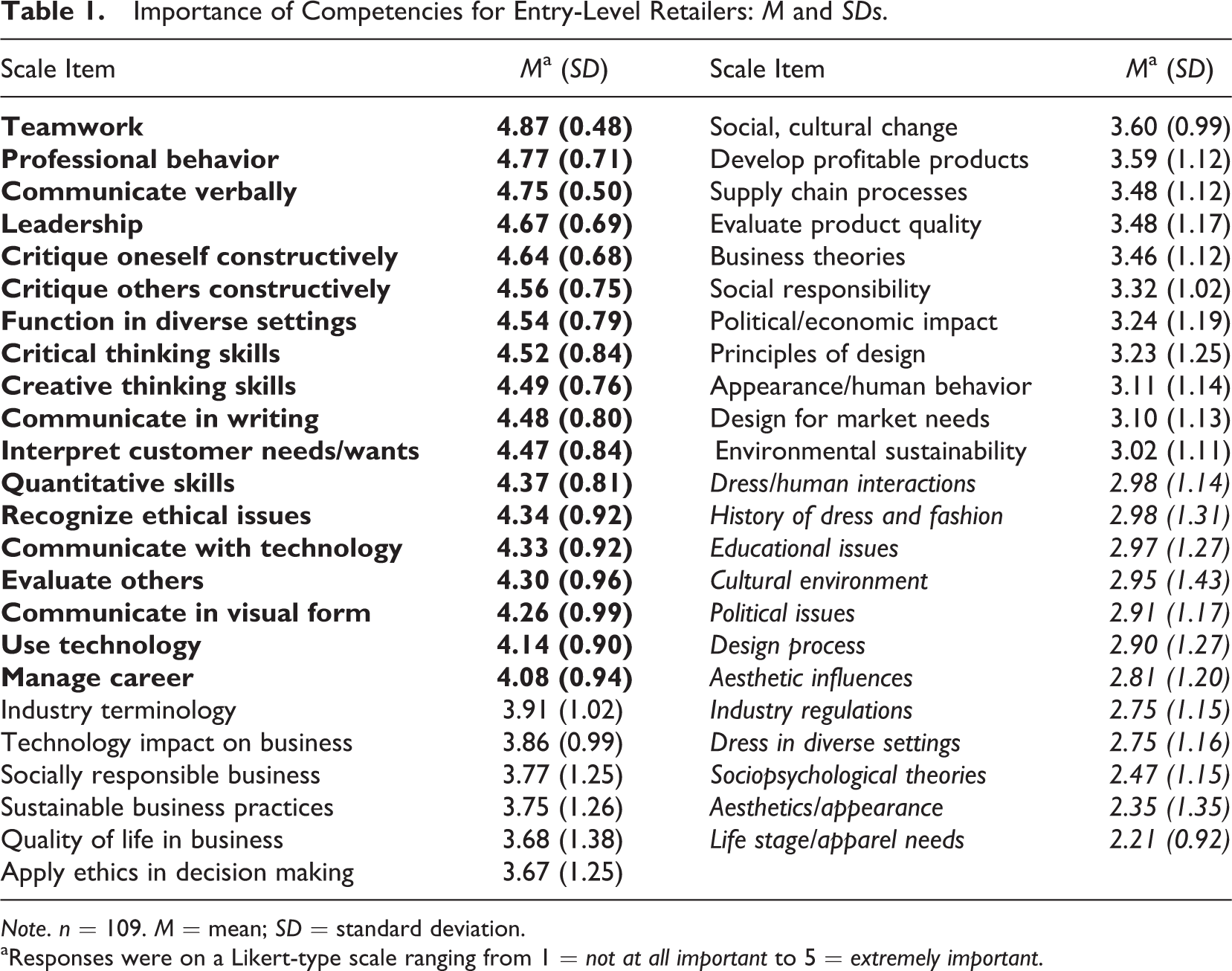
Note. n = 109. M = mean; SD = standard deviation.
aResponses were on a Likert-type scale ranging from 1 = not at all important to 5 = extremely important.
Highest and Lowest Rated Competencies
The highest rated competencies reflect the professional skills and attitudes competencies in the meta-goals, which appear to align with soft skills frequently mentioned in the literature. The 18 competencies with mean ratings above 4.0 (noted in
Factor Analysis
Next, the underlying structure of the variables representing the meta-goal statements was investigated. The purpose of this step was to explore patterns of thinking among respondents regarding competencies in order to identify broad themes. All 47 variables were entered into principal components analysis using IBM SPSS 20.0. Initially, nine factors were identified with an eigenvalue greater than 1.0. Six of the 47 items loaded below the cutoff point for practical significance of .40 (Peterson, 2000) and were eliminated from the analysis. Additionally, one factor consisting of a single item was eliminated. These steps resulted in retention of seven factors. Scale reliability was then assessed for each factor. Six of the seven factors had a Cronbach’s α greater than .70 and were retained for further analysis. The Cronbach’s α for a 2-item factor related to technology literacy did not meet the .70 reliability benchmark and was eliminated. The remaining factors and corresponding Cronbach’s α statistics are presented in Table 2.
Rotated Factor Loadings (Varimax) for Scale Items Representing Meta-Goal Competencies.
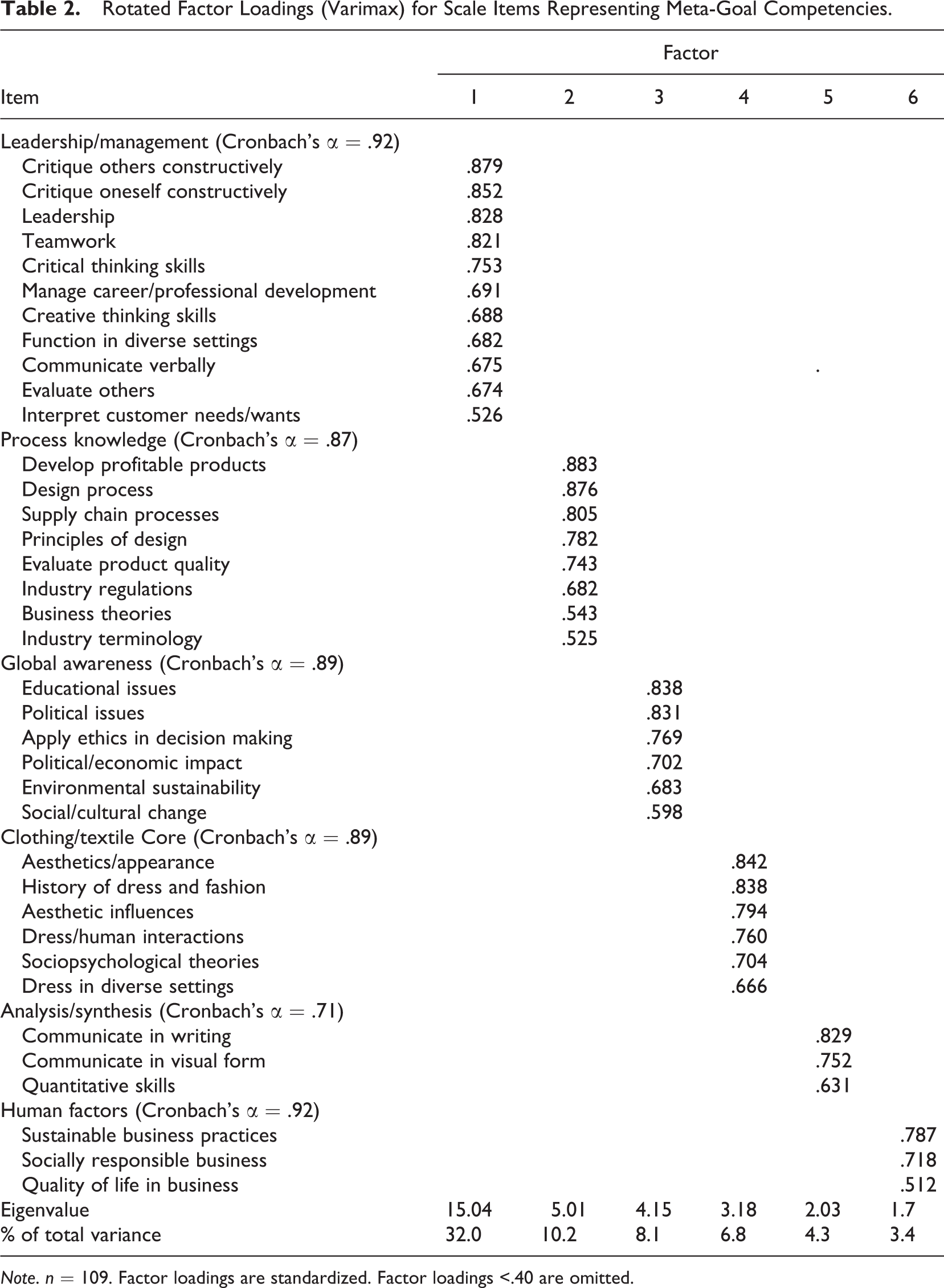
Note. n = 109. Factor loadings are standardized. Factor loadings <.40 are omitted.
The leadership/management factor represents skills needed to navigate jobs that are common for entry-level retail managers such as assistant buyers, department managers, and store managers. Individuals in these roles must balance obligations to customers, supervisors, and employees, fitting what is referred to as the boundary spanner profile (Vargo & Lusch, 2004). Effective boundary spanners are relationship oriented and are able to create value for firms by developing innovative solutions to customer needs (Agnihotri et al., 2014). Process knowledge encompasses the understanding needed to carry out various functions in a retail firm, such as product design, production and distribution tasks, quality control, and regulatory issues. Process knowledge also includes awareness of economic and market forces that influence business activities. Global awareness reflects a wider understanding of political, cultural, and social issues that enable individuals to function as informed citizens in the world. Universities have placed increasing emphasis on educating students in this regard in the last several decades as technology and commerce have expanded globally (Green, 2012). Sustainability and ethics are also incorporated in this factor and relate to several contemporary issues linked to the global C&T industry. The Clothing/textile core includes knowledge of the role of dress in history and in human interaction, which represents the theoretical and practical foundation of the C&T discipline (Ha-Brookshire & Hawley, 2013). Human factors represent an awareness and commitment to business practices that support human and environmental well-being, a topic that has been given increased attention in business and the wider culture in recent years, and connect to Ha-Brookshire and Hawley’s call for increased emphasis on these issues in C&T curricula. Analysis/synthesis skills reflect the critical thinking skills that enable professionals to investigate and evaluate problems and communicate solutions in a variety of forms.
Exploring Differences in Perceptions
Using the six factors retained in the previous step, t-tests and analysis of variance were conducted to determine whether there might be differences in perceptions of importance of competencies needed by entry-level graduates based on demographic and employment factors. We looked at respondents’ majors in college (apparel related vs. nonapparel related), years of retail experience (less than 5 years, 5–10 years, and more than 10 years), and employer size (fewer than 20 employees, 21–100 employees, and more than 100 employees). t-Test results revealed a significant difference in mean ratings for the importance of process knowledge based on type of firm. Respondents in nonapparel firms (e.g., gifts and home furnishings) rated process knowledge higher (3.75 vs. 3.26) than those working for apparel-focused firms, t(109) = 5.12, p < .05. Firm size accounted for a significant difference in importance ratings for leadership/management skills, F(2, 109) = 3.63, p < .05. Larger firms (more than 100 employees) rated this set of skills as significantly more important (4.59 vs. 4.14) than very small firms (fewer than 20 employees). It should be noted, however, that both groups gave this set of skills a high importance rating. No other differences were identified for further factors based on firm product focus or firm size. No differences in perceptions were found based on years of retail experience or college major.
Open-Ended Responses
At the end of the survey, participants were asked to list competencies not included in the study and invited to make general comments on the survey topic. Fifty-one participants (46.8%) responded to one or both questions. Content analysis using NVivo 9 was used to analyze responses. Participants offered a total of 164 unique comments. Sixty-eight comments were judged to duplicate meta-goal competencies and were not included in further analysis. Content analysis of the remaining statements revealed that all pertained to soft skills, as opposed to content knowledge. The analysis identified five themes that seemed to describe competencies not explicitly addressed in the meta-goals. One theme related to the ability to communicate at all levels of the organization, which fits into the boundary-spanning profile described by Vargo and Lusch (2004). Other unique themes related to self-management (self-motivation and work ethic), decision making/adaptability (able to plan and switch gears quickly), experiential opportunities (lifelong and applied learning), and career awareness (awareness of job requirements).
Importance of a Degree and Experience
We asked respondents about the value of a college degree when applying for entry-level management positions. Seventy percent felt that it was extremely or very important to have a bachelor’s degree. Nineteen percent were neutral, and 11% thought a bachelor’s degree was not very or not at all important. None of the participants felt it was extremely important to have a master’s degree. Only 15% thought a master’s degree was somewhat important, 25% were neutral, and 55% rated a master’s degree as not important or not at all important.
We also asked respondents about the importance of certain majors for graduates seeking their first job in retailing. Less than one half of respondents felt that a certain degree was extremely/very important (48% general business major, 46% management major, 41% apparel and textiles, and 31% marketing major). Employers in a recent national study also indicated they value “a demonstrated capacity to think critically, communicate clearly, and solve complex problems” over a specific undergraduate major (Hart Research Associates, 2013, p. 1).
Precareer work experiences, including internships, are valued by employers in national studies. For example, employers in a recent Chronicle of Higher Education survey (Fischer, 2013) rated internships as the single most important credential for recent college graduates. Retail/service employers in the Chronicle study rated prior work experience and internships as critical to the hiring decision. Mirroring this national trend, 15% of respondents in the current study indicated that it was extremely important for applicants to have at least 1 year of retail experience in preparation for a career in retailing, 52% indicated 2 or more years, and 33% advised 3 or more years of experience.
Discussion
The good news from this study is that mid-level retail supervisors rated many of the skills reflected in the ITAA meta-goals as highly important attributes for entry-level college graduates. The skills rated among the highest of the 47 items included in this study fall into the category of boundary-spanning skills (teamwork, communication, critical thinking, problem solving, and decision-making skills; Vargo & Lusch, 2004). Open-ended responses further support the importance of these skills. Successful boundary spanners are those who can interact with diverse individuals at a variety of levels, such as customers, supervisors, vendors, sales personnel, and corporate executives (Hurst & Good, 2009). The service sector favors boundary spanners who can create value through relationship development in an intensely competitive retail environment (Agnihotri et al., 2014). The U.S. Bureau of Labor Statistics (2014) reported that jobs requiring boundary-spanning skills are among the largest segments of the workforce and are expected to grow by approximately 18% by 2018.
The ability to work in a team environment was rated highest by respondents in this study, mirroring a recent survey by the National Association of Colleges and Employers (2015). The ability to accomplish organizational goals as part of a team has become essential in contemporary organizations (Brutus & Donia, 2010). Educators can assist students in developing teamwork skills by offering collaborative learning opportunities where students learn to work and solve problems in a team setting. Approaches range from study groups, team-based assignments, and writing to cooperative projects and research.
Participants in this study also gave high importance to written, verbal, and visual communication skills. The ability to use technology to communicate was also rated highly. Communication skills top the list of essential skills for college graduates in several recent national studies (American Association of Colleges and Universities, 2013). Most retail positions, including vendors, customers, supervisors, colleagues, and employees, require employees to communicate at multiple levels. Communication skills require the development of listening, interpreting, and speaking skills, which educators can support through a variety of experiential activities in the classroom. Communicating effectively via visual methods was also among the top-rated skills. Visual communication is a unique element of merchandising curricula and may set graduates apart from those with other degrees in the retail hiring decision.
Recent researchers have highlighted employers’ perceptions that graduates lack critical thinking and problem-solving skills (Selingo, 2015). Critical and creative thinking skills were also among the top 10 for college graduates in the current study. These skills are essential in the complex and complicated global environment in which retailing operates. The ability to collect, analyze, and synthesize information from a wide array of sources is critical for retailers who often must make numerous decisions daily. Being able to use technology effectively to manage information and communicate ideas was also rated highly by respondents. Teaching strategies that promote development of critical thinking and analysis, such as case studies and cooperative learning, are essential in preparing merchandising graduates for success in the retail environment.
Professional attitudes and skills, including leadership, the ability to exhibit professional behavior, the capacity to evaluate and manage others, and the aptitude to recognize and apply ethics in decision making, were among the most highly rated by respondents in this study. Factor analysis results showed that respondents in this study perceived leadership skills to encompass the ability to interpret customer needs and wants, function in a diverse environment, communicate clearly, solve problems, and analyze information. The factor also encompassed the ability to be self-critical and to successfully manage personal careers. Although supervisors in larger firms appear to favor leadership/management skills in new college graduates more than those in very small firms, it should be noted that mean scores for the leadership/management factor were above 4.0 on a 5.0 scale for all respondents, suggesting that these competencies are valued regardless of the work setting. Other researchers have also noted the importance of demonstrated leadership skills in the hiring decision (National Association of Colleges and Employers, 2015). Keech (1998) revealed that one of the few areas of agreement about skills needed for retail job success among professionals and faculty was the importance of leadership skills. In addition to introducing the study of leadership theory and practice in the classroom, internships and service learning activities may be effective ways to build leadership capacity. C&T educators can also reinforce the importance of participation in extracurricular activities such as student clubs, sports, and student government.
Awareness of political, cultural, economic, and educational issues generally received lower importance ratings by retail managers in this study. These topics are addressed often in the general education component of the bachelor’s degree. While some argue that the primary goal of a college degree is to get a job, other perspectives view the purpose of a degree to “empower individuals with broad knowledge and transferable skills, and a strong sense of value, ethics, and civic engagement” (American Association of Colleges and Universities, 2013, para. 1). The majority of employers in a national study agreed that college graduates should have an understanding of liberal arts and sciences (Hart Research Associates, 2013). These topics can also be integrated into C&T core curricula to reinforce the impact of externalities on the retail sector.
Mean scores for the importance of knowledge related to dress and human interactions, psychological and social aspects of dress, the history of dress and fashion, and the design process and aesthetics in relation to dress and appearance management indicated less importance placed on these topics by mid-level retail managers. This is a single study, with a narrow sample of retail managers. Nevertheless, the results offer an opportunity to reflect on how courses in historic costume, dress, and culture add value to our present degrees. It also points to the need for C&T educators to review regularly the content in our traditional courses in order to structure courses that remain relevant to the contemporary environment. It must not be overlooked that core C&T courses offer many opportunities for students to develop writing and research skills and hone critical thinking and analytical skills. Other researchers have noted the importance of communicating the value of C&T core knowledge to students, employers, and colleagues in other academic disciplines (Frey, 1990; Laughlin & Kean, 1995; Rudd, 1981). Although a shift from traditional home economics curricula to professional/industry orientation became evident in the 70s and 80s, courses related to dress and aesthetics remain a core element of C&T curricula and are considered by some educators to reflect the core of knowledge in the C&T discipline (Ha-Brookshire & Hawley, 2013). The results in this study reinforce the need to maintain relevance in C&T course content. To remain relevant, C&T educators must regularly monitor industry environments to learn what skills are needed for success. The pace of change in the retailing industry has been rapid in recent decades. Technology and globalization will continue to demand new skills; therefore, periodic assessment of industry trends and professionals’ perceptions is warranted. Feedback from advisory boards, employers, and alumni is critical to helping educators stay abreast of industry needs.
The relatively low importance given to a particular degree by retail supervisors in this study points to challenges faced by many college graduates, including C&T majors. Given that employers in many fields, including retailing, increasingly emphasize soft skills rather than discipline-specific knowledge, the question is raised as to what makes a C&T degree unique, special, and worth pursuing. A candidate’s major can be valuable in signaling interest in the field and personal abilities and motivation to an employer (Wolniak & Pascarella, 2005), and a person’s level of interest in their chosen major has an impact on academic performance and persistence (Tracey & Robbins, 2006). Choice of major has the potential to lead to relevant internships and extracurricular experiences, which gives job seekers a distinct advantage with employers (Nunley, Pugh, Romero, & Seals, 2014). Given the changing hiring climate, C&T programs may need to increase efforts to communicate the unique value of the degree to employers, students, parents, and university recruiting staff by demonstrating how the major’s learning outcomes align with employer needs. Additionally, it is worth noting that supervisors in nonapparel firms rated process knowledge competencies higher than supervisors in apparel firms. This finding illustrates the view that skills gained in a C&T major are valued outside of traditional merchandising career paths and can provide students with a broader view of career possibilities.
The sample in this study was small, and convenience sampling methods were used. Therefore, care must be taken in generalizing the results. The sample included many individuals who graduated from C&T programs, which may have biased the results. The study should be duplicated in other samples to provide a broader and more generalizable view of the importance of the ITAA meta-goals. Another path for research is to investigate differences and similarities in attitudes expressed in this study with those of professionals in other apparel industry sectors. For example, the design sector may favor a different set of competencies for early career success than for those in retailing. Since many C&T programs include both design and merchandising tracks, understanding the unique needs of each industry sector could assist in curricular planning and development. Additional studies may confirm new competencies for consideration beyond those reflected in the current meta-goal document.
Considering the importance given to work experience as preparation for career success, investigating best practices for field experiences and internships in developing important boundary-spanning skills would be valuable in structuring high-quality supervised work experiences. Research could address the types of work experience most valued by employers when hiring college graduates, and how much work experience is preferred. Research to explore the impact of extracurricular college experiences on job search and early career success would also be useful to C&T faculty in program development.
Finally, it is worthwhile to continue the discussion among C&T faculty on what constitutes the core knowledge of the discipline and how this knowledge contributes to the success of our graduates. The challenge seems to lie in preserving the unique contribution of our discipline to the wider body of knowledge, while remaining responsive to industry needs. Preservation of core C&T content in university curricula requires effort from multiple stakeholders. C&T researchers must continue to contribute to the generation of new knowledge that can be applied to solve important human and environmental problems. C&T educators need to stay in tune with cutting-edge research and develop innovative teaching practices to impart knowledge to students. All C&T scholars must be prepared to defend the value of C&T knowledge to students, university administrators, and industry partners. This requires close partnerships with industry and a systematic approach to curriculum improvement. It also involves sharing teaching and research innovations with colleagues through publications, presentations, and discussions. Keeping the conversation about what makes our discipline unique and our graduates special at the forefront is essential to continue to offer high-quality academic programs that produce successful professionals.
Footnotes
Appendix
Declaration of Conflicting Interests
The author(s) declared no potential conflicts of interest with respect to the research, authorship, and/or publication of this article.
Funding
The author(s) disclosed receipt of the following financial support for the research, authorship, and/or publication of this article: Partial funding to support this research was made available by the Eulalia Toms Family and Consumer Sciences Research Endowment fund, Western Michigan University and a College of Agriculture and Life Sciences Educational and General Mini-Grant, Mississippi State University.