



Abstract
This article is about the designer’s journey in design research where the designer has developed a body of work. The development of each project’s design process, method, technique, and practice-led research are addressed. The purpose of this article was to contribute to the design discipline by sharing an example of how a design researcher develops a body of work. This article first describes the designer’s design value and design process which has guided the designer’s creative work and practice. The 10 different creative works are presented in chronological order as the designer’s design development progressed. The designer’s design framework is presented along with the future direction of the designer’s design work.
Since embarking on my academic career, I have been passionate about my creative work, although I initially sensed that design scholarship did not carry the weight it has grown to hold in our field. Over the years, I have watched design scholarship grow into a thriving field, for which I am proud to have been present. Despite a long tradition of creative practice and apprenticeship in clothing and textile design, the discipline lacks formally captured knowledge (Bye, 2010). This article describes my design research goal and the design attitude that guided my creative work and practice, presenting 10 creative works in chronological order as my design development progressed. The evolving practice-led design research (Bye, 2010) expressed in this article aims to contribute to the design discipline by providing a framework that addresses my design iteration cycle of analyzing, reviewing, and reflecting on my previous work (see Figure 1).
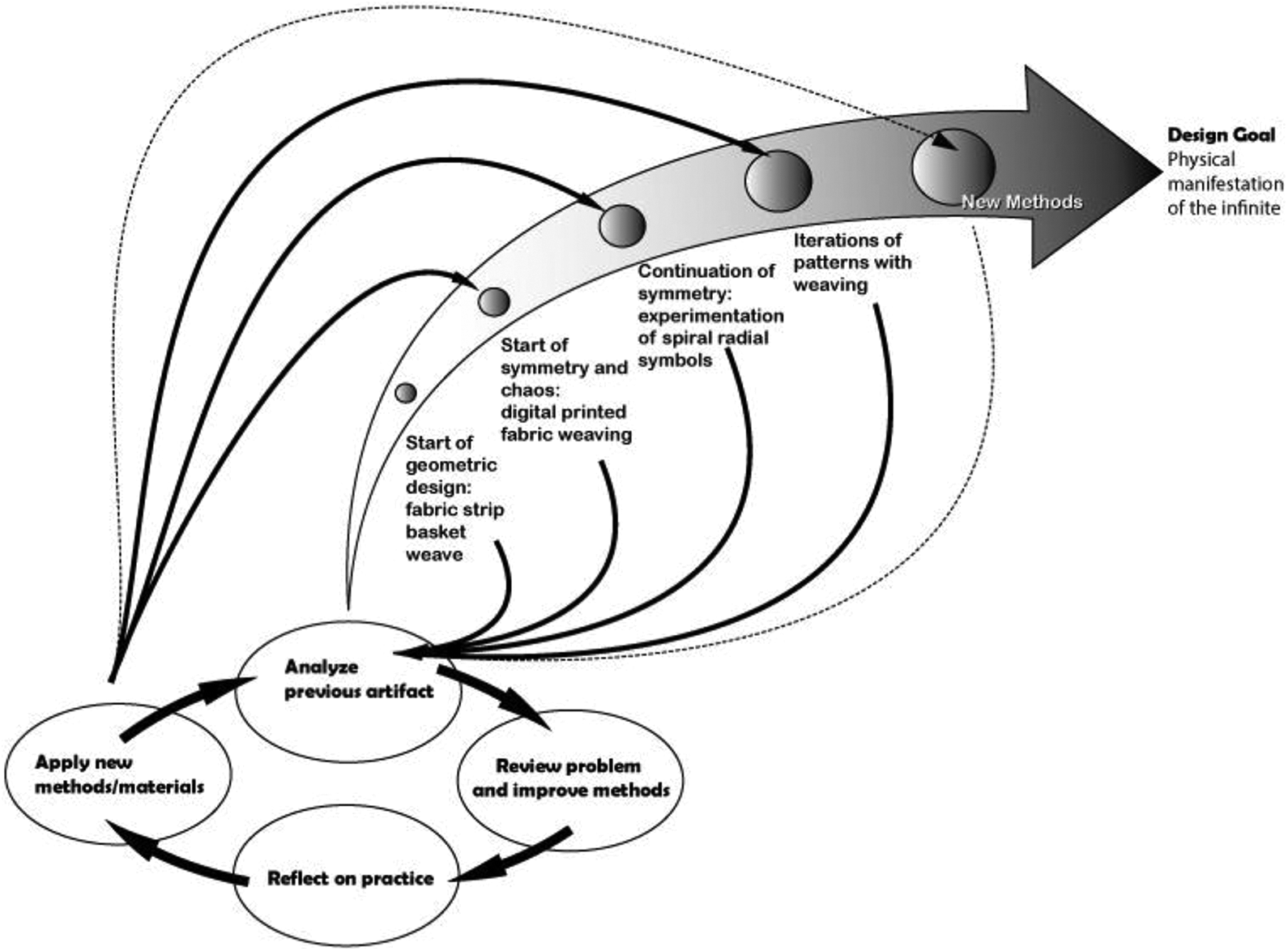
Body of work design framework.
My design research goal, which was not fully formed at the beginning, has been to create archetypal imagery stemming from an expression of a collective unconscious, combined with some iterative principles of chaos theory. The collective unconscious, originally defined by Swiss psychoanalyst Carl Jung, refers to the idea that a segment of the deepest unconscious mind is genetically inherited and that human beings also inherited images, myths, and symbols shared across time and culture (Clymer, 2013). For example, the mandala—a symbol emanating from our collective unconscious—can be found in ancient times, in religious symbols, and in most cultures. The term mandala, loosely translated from Sanskrit as “circle,” refers to a basic square form with four gates containing a circle, with dividing lines separating it into several quadrants (Clymer, 2013). Chaos-driven, mandala-like patterns also exist throughout the universe, from the intramolecular structures of DNA to spiral patterns of galaxies (Clymer, 2013). The pursuit of such a chaos-driven, mandala-like pattern guided my design research as I sought to create a pattern encompassing time and space, involving symmetry, and iterating chaos.
This pursuit led to my design research question, “How can surface designs be developed to express sacred geometric patterns with textiles?” The solutions have advanced with each stage of my design work. In topology, mathematical patterns and shapes are expressed on Cartesian grids using coordinate numbers on a measured-out surface in two or more dimensions. Trying to express these ideas led me to an exploration of the woven mathematical expressions of plain-weave patterns. Instead of using traditional materials, I used leather and upcycled materials, eventually expanding my work by employing a more complex woven pattern with different-colored fabric strips. Throughout my design research journey, I developed each subsequent design from the analysis of my previous work in a continued attempt to answer my design research question: How to develop a textile surface design of geometry, colors, textures, and lines that expresses sacred geometric patterns. The collection of work included in this exposition showcases studies in depth, volume, and transparency through surface design. This article presents the iterative design research that led to engineered patterns, triaxial weavings, and the future direction of my design work and design framework.
The pursuit of a vision initiated my design research and then directed the exploration of the surface design. I used my previous designs as data, discovering new knowledge from each practice with a continued goal of expressing my vision. It is my hope that the evolution of my body of work explained in this article can help future design scholars develop their own practice-led design research framework.
Design Research Process
Every type of research uses induction, deduction, and abduction as forms of logical reasoning to connect and generate our research ideas (Denzin & Lincoln, 2018; Kaplan, 2004). Having conducted both traditional research to study consumer behavior and design research to develop creative work, I have become familiar with different types of research reasoning processes. To explain and share my design research, I had to compare and reflect on how my design research processes differed from my consumer behavior research processes. I used the basic reasoning patterns that humans use to solve problems (Dorst, 2011).

When conducting consumer behavior research, I use either deductive or inductive reasoning methods to find results based on What (research question) and How (data collection and analysis); sometimes to know What, I use a hypothesis based on a theory to explain observed Results. These two approaches to the reasoning process are essential for a new discovery in the sciences or to predict and explain various phenomena in consumer behavior research (Dorst, 2011). Both processes have been used for problem-solving design research, which focuses on using quantitative and qualitative methods, related to functional garment design (Bye, 2010).
For my creative work, I realized that these two reasoning processes were not applicable for explaining my design work. The basic reasoning pattern in design and other productive professions is abduction (Dorst, 2011).

In abduction, the outcome of the process is Value rather than Result. Dorst (2011) identified two types of abduction processes: (a) when the researcher is missing What but knows How (working principle) to create/design to achieve the Value and (b) when the researcher only knows the end Value to achieve and needs to figure out both What and How.

According to Dorst (2011), “value” refers to “the aspired value” that we wish to achieve and can be shared by others (p. 523). At the beginning of my design research journey, I did not have a clear design value nor a goal to develop my design work, let alone either What or How. However, during my research through design practice, the How has become techniques such as handweaving and digital textile printing to create my design work. I built and developed my body of work over time by continually revising my previous design work. Throughout my design research practice, I have discovered new materials and techniques through experimentation and implemented them as I created each new piece. I then reflect on my design research goal as I create a new design artifact. In doing this, I have built up an evolving body of work, as well as a process, that can now be shared with others. Before going into detail about each design work, I address my design goal and attitude below.
Design Research Goal and Design Attitude
The foremost design research goal that guided my work is to achieve a textile surface design that showcases organic geometric archetypal patterns, emanating from a collective unconscious, driven by imagery that permeates time and culture, and binds our physical world together (Fritscher, 2019). This framework is presented at the beginning of this article (see Figure 1). By repeating naturally occurring geometric elements following simple arithmetic rules applied to both geometry and color gradations in a woven pattern, I produced a new surface design each time that, from a distance, creates an optical illusion that emulates growth-like patterns.
Razzouk and Chute (2012) define design thinking “as an analytic and creative process that engages a person in opportunities to experiment, create and prototype models, gather feedback, and redesign” (p. 330). Each step of the design thinking process is guided by a design attitude defined as “expectations and orientations one brings to a design project” (Boland & Collopy, 2004, p. 9). There are different design attitudes throughout the design thinking process, but the one I incline toward is “a thorough, ongoing expectation that each project is a new opportunity to create something extraordinary and do it in a way never done before” (Boland et al., 2008, p. 13). Along with my design goal, my design attitude compelled me to question and search for new methods and materials, which in turn led to the development of my body of work. My design research goal, overall framework, and attitude guided the development of a design iteration cycle consisting of four elements of design thinking research processes (Hassi & Laakso, 2011; Lockwood, 2009): analyzing a previous artifact; reviewing the problem/improving methods by exploring possibilities (Brown, 2008); reflecting on my practice; and applying new methods/materials, stemming from the urge to create something new (Boland et al., 2008). Below, I present and describe 10 of my design works in chronological order, how each design concept was developed and then made, and my journey to find solutions to the main design research goal.
The Start of Geometric Design: Handweaving
During my first academic position, we received a large donation of leather from Wilson Leather, headquartered in Minneapolis, MN. I immediately saw an opportunity to use the leather in my creative work, but I did not know what I would be creating or how.

The leather’s availability and durability challenged me, as did the norm of exploring the idea of woven leather garments inspired by woven leather bags. I decided to use handweaving as my design technique (i.e., How). I focused on developing the How technique through experimentation. I developed the first few designs following a general design thinking process, using both sides of the leather in the weave to create a variation in texture that created an organic geometric pattern. I wove the strips directly on top of a dress form, which created a sculptured look (see Figure 2, Meshes in the Afternoon I and Meshes in the Afternoon II). Using my design thinking process and different experimentations to resolve fit issues that presented themselves when weaving and draping simultaneously, I inserted an asymmetrical zipper between the lining and the edge of the leather fabric, creating the necessary tension for the weaving. I experimented with multiple woven patterns commonly used to weave strips, eventually settling on a simple plain-weave structure. During this process, I decided to explore simple geometric expressions using fabric strip weaving, marking the start of my body of work. I had not yet recognized this work as design research.
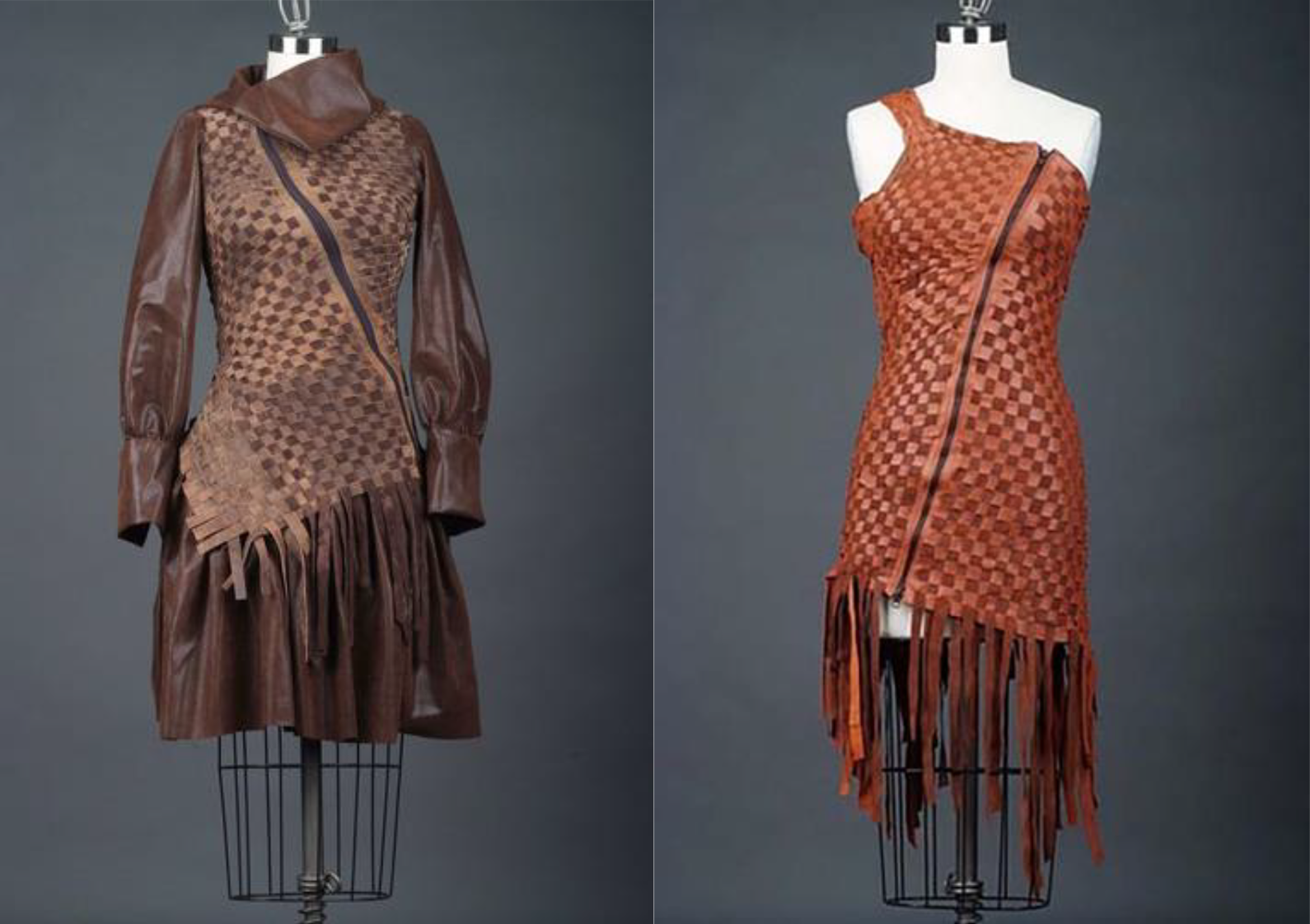
Meshes in the Afternoon I (2008) and Meshes in the Afternoon II (2008), front views.
Continuation of Geometric Design: Handweaving
Indigo Crosshatch
I subsequently used postconsumer denim jeans to further explore my handweaving techniques in Indigo Crosshatch. My design goal of expressing sacred growth patterns with textile surfaces through practice-led research was not fully developed at this time. My goal for this design was to simply explore other textile mediums for handweaving using postconsumer denim jeans while developing the handweaving technique used in the previous design (see Figure 2). I evaluated and improved my design practice, as the precursory garment taught me to create pattern pieces before weaving rather than applying weaving directly to the dress form. I minimized my trial and error, following what I now call my design iteration cycle by working with flat pattern pieces rather than simultaneous draping and weaving, resulting in a better outcome.
One element carried through from the previous garment because of the positive aesthetic appeal: using the reverse side of the textile (here, denim) to give the garments more texture. Thus, I was able to critically improve my design practice based on discovery from previous design work (see Figure 3). During the design process of creating Indigo Crosshatch, I discovered that by weaving different shades of denim in a specifically progressing order, I could create an interesting surface design that, from a distance, visually represented the Z coordinate axis (depth). The rudimentary contrast between X and Y values laid the groundwork for my evolving design research goal of expressing more complex mathematical ideas through weaving, ideas that stem from an expression of a collective unconscious, combined with some iterative principals of chaos theory. Weaving strips with gradually progressing color gradients gave rise to a visual illusion of a simple volumetric cross shape. My overarching design research question (how to create and develop surface designs that express sacred geometric textile patterns) started to emerge to move beyond the limit of available textiles, as I began to explore weaving with different shades of colors/gradients using digital printing to generate textiles.
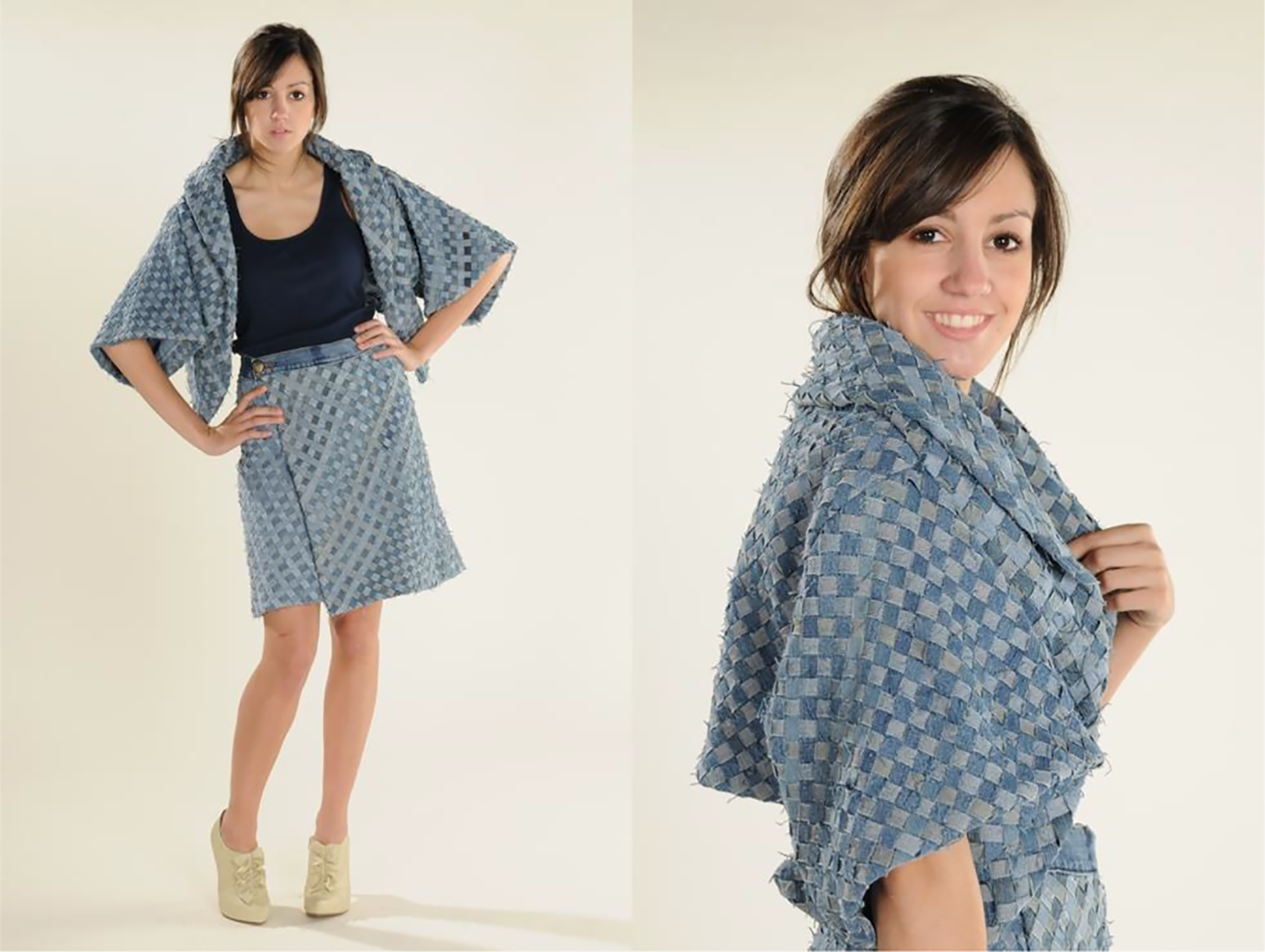
Indigo Crosshatch (2010), front view and detail. Modeled by Leah Becker.
Start of Symmetry and Chaos: Incorporating Digital Printing
Contemporary designers such as Miriam Ponsa, David Koma, Tony Ward, Iris van Herpen, and Anja Mlakar have recently incorporated weaving in their collections. Ponsa used basket-weaving techniques with large diameter cords and elastic bands in her 2016 spring/summer collection, using cotton, linen, and silk materials as well as a screen-printing technique (Ponsa, 2015). Koma (n.d.), a London-based fashion designer, created “sculptural statement dresses inspired by the feminine form” (para. 1) and integrated basket weaving as well as geometric cutout shapes for his 2014 fall/winter collection. Yet, few of these designers combined digital textile prints and manipulated gradients of color in their woven creations.
As I reviewed other designers’ woven garments and explored handweaving techniques in my own design work, I focused on weaving different shades of fabric strips in a specific mathematical sequence in an attempt to create a visual expression of archetypal sacred geometric-like textile patterns. Many traditional “strip weaves” (p. 23) in African textiles are strips of cloth woven on a narrow loom, cut to a specified length, and sewn together along the long edges to form a larger rectangle (Gillow, 2003). The weaving technique I use is instead more similar to a traditional plain-weave construction, but with nontraditional visual surface effects.
As I worked to advance my design research, I explored the possibility of using both digital printing and handweaving techniques in one design. The development of digital software and computer technology has greatly influenced the fashion industry and enabled designers to translate their innovative ideas and inspiration into reality. Designers now can choose from a wider variety of colors and develop their own patterns from those colors. But because the rapid technological advancements of this age are supplanting long-held traditional crafting techniques, I felt it important to balance the use of digital technology methods and the preservation of traditional handcrafted techniques. Artists such as Philpott (2012) have used computer-aided design/computer-aided manufacturing (CAD/CAM) technologies to create three-dimensional (3D) folded, pleated textile structures derived from traditional handmaking. Philpott (2012) used hybrid production processes combining handmaking and digital technologies to complement and further advance the process of handmaking, as the sense of touch is significant and important for the practitioner in acquiring and transmitting knowledge and innovation. Philpott (2012) noted that the introduction of automated machine production and CAD/CAM technology changed the relationship between maker and material “by reducing or removing the direct physical link between the practitioner and the process, and materials of their practice” (p. 56). In my design practice, I use digital technology to complement my handweaving process and create more complex surface designs through iterations of geometric woven pattern concepts with color gradients and digital textile printing.
Amber Refraction
For this design work, I had a clear direction for the How of my design research (i.e., using my handweaving technique with textile digital printing); however, I did not have a clear idea of what I would be creating. Before starting, I wanted to apply a fundamental idea of fractal theory, iterative feedback, to my weaving to create sacred (fractal-like) growth patterns. By following a preset pattern with my weaving strips with different color gradients in a progressing color order, I hoped to create a new and unexpected textile surface that might introduce a visual illusion of a third axis into my Cartesian grid idea. However, I could not visualize the outcome until I completed the garment. I created each strip with a progressing order of color gradients and wove them in a certain order for both weft and warp directions, thinking it might create an iterating radial pattern. Unexpectedly, it also created a volumetric pattern that showcased the illusion of a third axis through the gradual progression of color strips from the center and a 3D surface look. As a result, guided by my design attitude of creating something in a way never done before (Boland et al., 2008), I created both Amber Refraction and Magma Shrouds. When I began developing textiles using the color gradient strips, the result not only showcased a mandala (fractal-like) pattern but also an optical illusion of depth and volume in the surface design. After several design attempts, I discovered that the best mandala-like pattern and optical illusion could be created by contrasting two colors with different color values. I had already produced a design with complementary color fabric strips with similar values, and the optical effect was not as visible. Therefore, I chose yellow and black for this design due to their high levels of value and saturation contrast (see Figure 4). I began to realize how my design work has progressed, built on discoveries made from previous works.
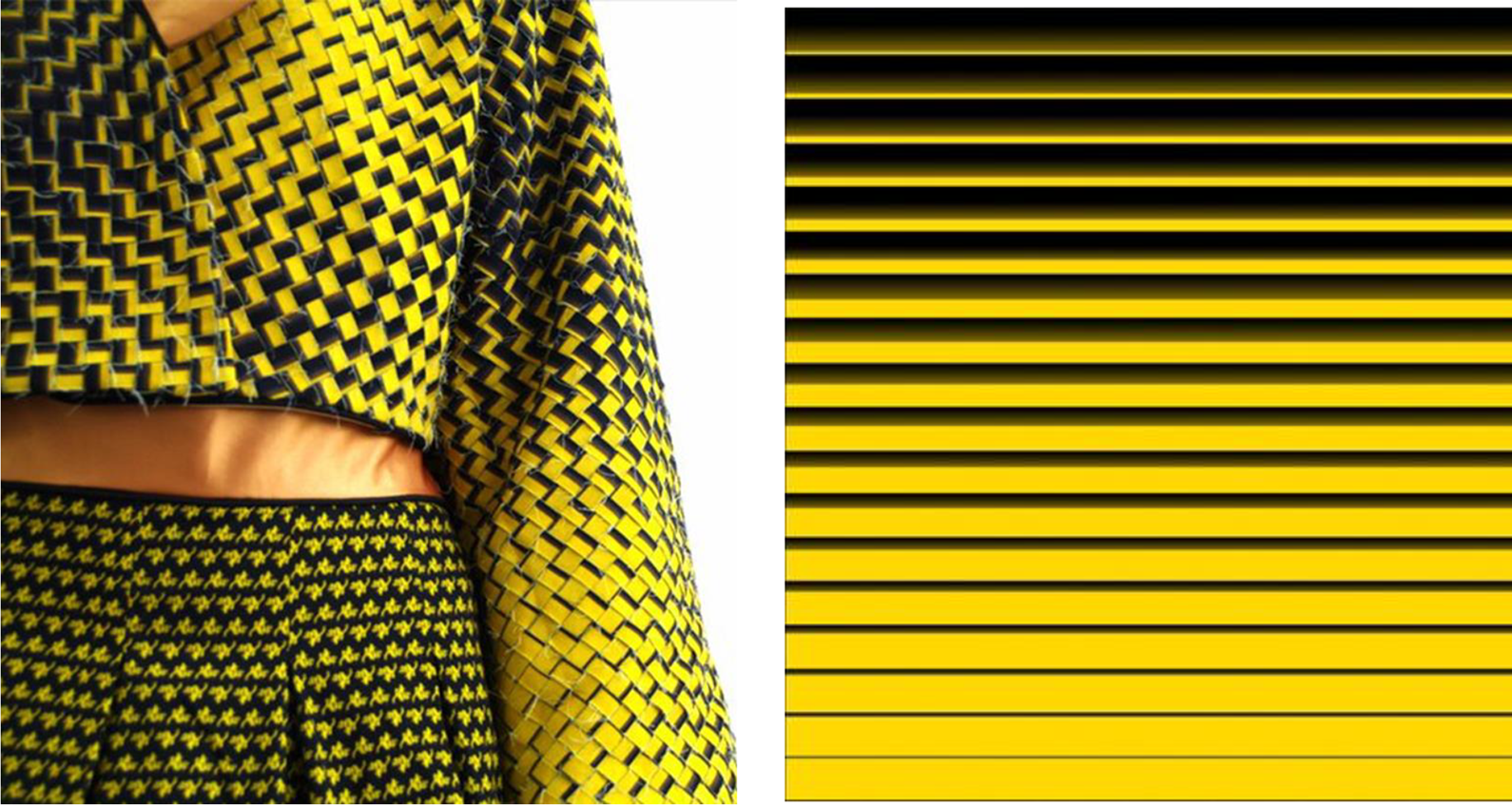
Amber Refraction (2013), detail and print design.
Magma Shrouds
When I cut the strips for Amber Refraction on the cross grain, the fabric edges raveled too much. Although the result was an interesting texture, cutting the strips on the bias prevented the fabric from raveling and gave a more consistent surface. This discovery occurred during my design iteration cycle as I was experimenting with weaving strips of different materials along different grain lines. Magma Shrouds is the first design in which I cut strips on the bias. As before, I started with the How variable, both creating a woven fabric surface with different color gradients and using a digital textile print to engineer strips in the bias direction. The gradual color changes of a sunset, from blue to red to orange, inspired this design. I also experimented with two sets of color gradients—blue to red and red to orange—with two color-contrasting strips in iterating gradient patterns, instead of just a one-color gradient set as used in previous designs. Again, I based these color selections on my previous experiments and failed attempts showing that two complementary colors with similar values for weft and warp need high levels of difference in saturated color gradients, rather than a simple complementary color contrast. The original pattern for the digital textile print before cutting (see Figure 5) was printed on the bias.
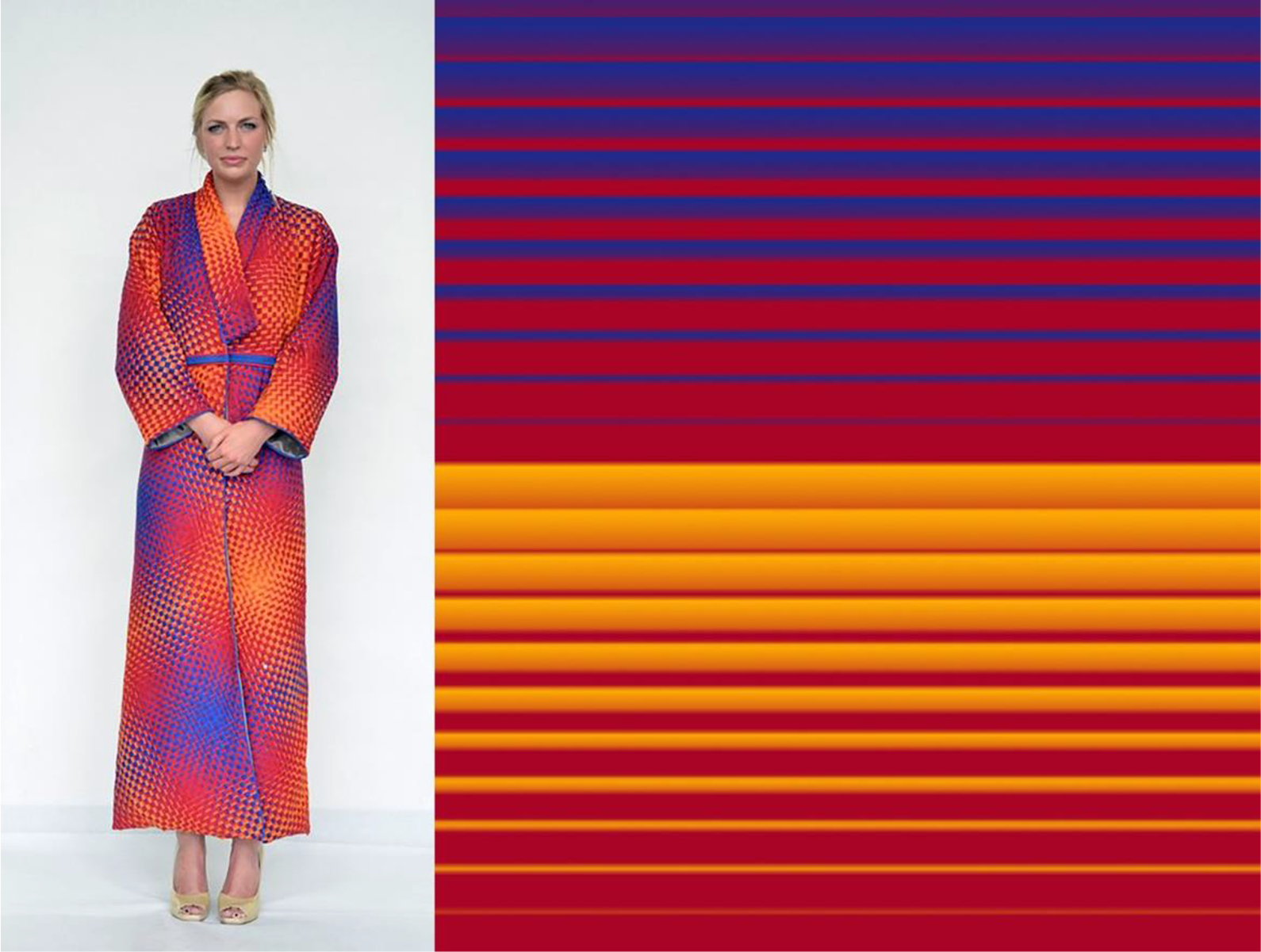
Magma Shrouds (2014), front view and print design. Modeled by Taylor Woytek.
Continuation of Symmetry and Chaos: Expansion to Include Transparency
Vitreous Fractures
After controlling the fabric raveling, I became brave enough to use different fabrics. In Vitreous Fractures, I used silk organza as the medium for my digital printing and handweaving technique. To express the iterating patterns found in all growing and living things, I investigated whether I could create a silk organza fabric surface with opposing color gradients that captured the changing color densities of sunlight passing through a translucent liquid media, as most life on Earth began growing in a liquid primordial medium. I again had a clear direction of the How (using transparent fabric with digital textile printing) without knowing What I would be creating. My previous design practice taught me that creating a continuous garment pattern with a simple silhouette complements the surface of a complex and dynamically colored handwoven textile surface. Thus, for Vitreous Fractures, I created a single, continuous pattern piece for the dress, eliminating shoulder seams, by using minimal waste pattern development methods (Ericson, 2010). After completing the weaving process, I discovered that the organza, more than the cotton used in Magma Shrouds, created an optical illusion of depth and volume as light passes through the parallel gradation of the three contrasting semitranslucent color gradients. The organza’s translucent properties allowed for gradual color changes representative of a sunset refracted through changing liquid densities, from blue to red to orange (see Figure 6) as light penetrates the layers.
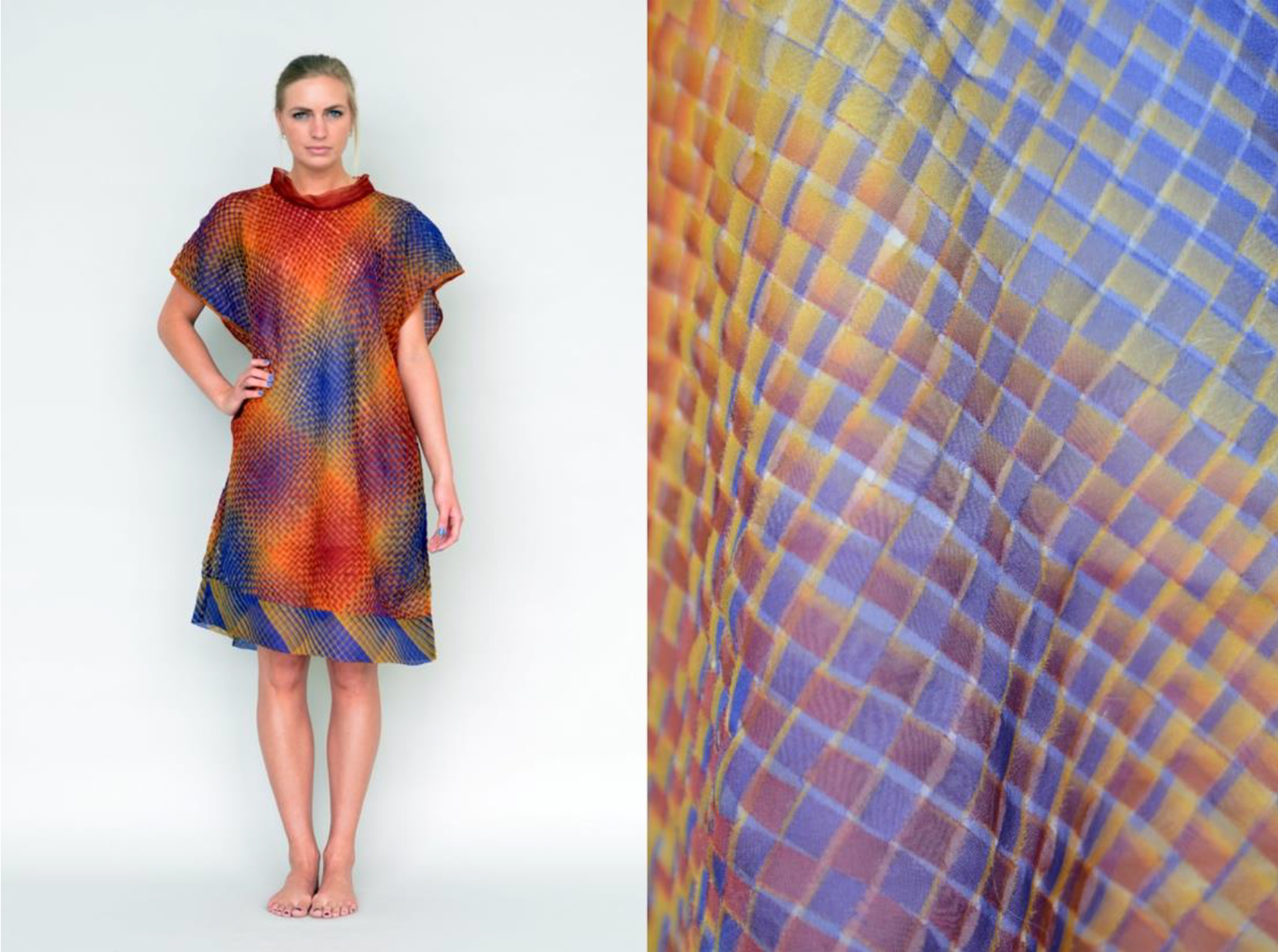
Vitreous Fractures (2014), front view and detail. Modeled by Taylor Woytek.
The overall design was transparent enough to create a dynamic interplay of light, shadow, and color gradients across the wearer’s body. This surface design, which displays an advanced expression of sacred geometric patterns, simultaneously projects a patchwork-like pattern on the body that visually interacts with the overall silhouette when viewed from a distance (see Figure 6).
Continuation of Symmetry: Applying Engineered Patterns
After combining digital printing with handweaving techniques, I experimented with digital printing by incorporating engineered patterns in the design process. I worked with a codesigner who had been collaborating with me to create digital patterns and computer-rendered previsualization. After I digitized the garment patterns, my codesigner worked on creating computer-rendered digital patterns and we worked together on previsualization of the fabric surface before the digital textile printing and my handweaving were implemented. Engineering garment patterns changed our design process by allowing us to customize fabric by previsualizing the completed work before digitally printing textiles and handweaving. The previsualization of simple, overlapping circle shapes as well as the use of mandala-like patterns enabled us to create a unique version of traditional sacred geometry often observed in nature and art. For the first time, our What became faintly visible at the start of our design process with previsualization. Yet, the outcome was still uncertain due to new challenges that developed such as using curved spiraling strips and strips of incrementally decreasing size when weaving. Pushing the boundaries of the How variable in my practice-led design research, we developed Euclidean Sunrise, Archimedean Flare, and Anahata Pulse by incorporating my handweaving process with my codesigner’s engineered digital patterns and digital textile printing.
Euclidean Sunrise
This was our first project in which we developed engineered garment patterns in conjunction with digital textile prints designed from a software-rendered previsualization (see Figure 7). The design process again began with a definite How, using engineered patterns, textile digital printing, and handweaving techniques, and we vaguely knew What we would produce. Previsualization of overlapping circles was developed with my codesigner, inspired by tangentially connected concentric rings of circles in an efficient hexagonal pattern found in nature. Such pattern motifs are often visible in the cell divisions of developing organisms or in architecture and ornamental motifs of ancient art, which were examples of the collective unconscious that sparked our surface design exploration (Fritscher, 2019). I digitized the jacket and skirt patterns and then my codesigner developed an engineered textile pattern using Adobe Illustrator CC Creative Cloud and Optitex O/18, a 2D computer software program (Chapman & Istook, 2002). We then developed two sets of textile patterns, one for weft strips and the other for warp strips, for both the jacket and skirt in Adobe Illustrator and Photoshop CC Creative Cloud, and printed them on 100% cotton percale in the bias direction (see Figure 7). Using the software, we rotated the weft circle patterns 45° off the north/south orientation and then wove them together, creating a new flower-like pattern from the 8-fold symmetry displayed in the woven intersecting circles in the skirt (see Figure 7). We developed this design as a new and original composition, creating a Euclidean (geometrically symmetrical)-inspired woven fabric surface by intersecting eight tangentially connected circles around a shared focal center using a handweaving technique.
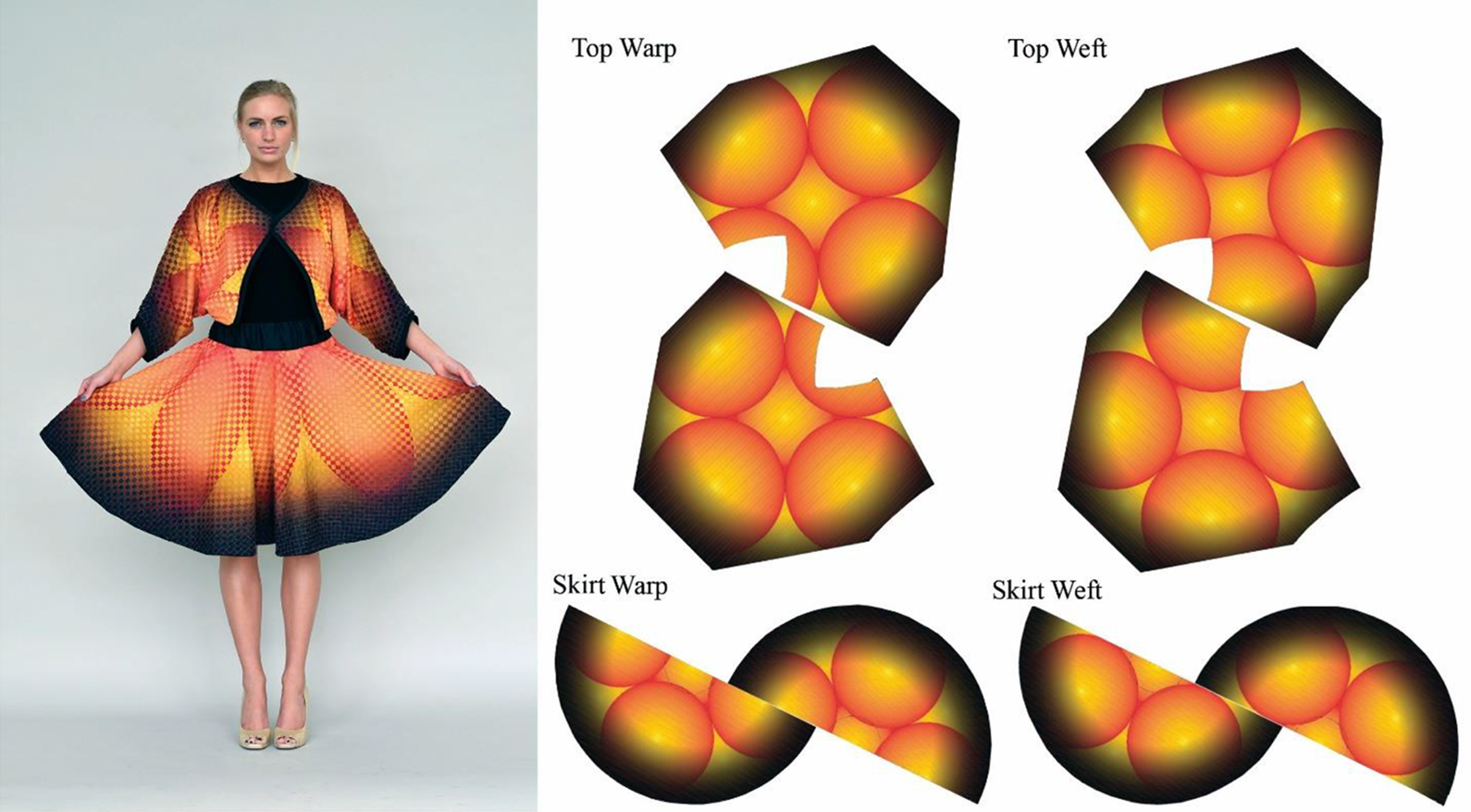
Euclidean Sunrise (2015), front view and print design. Modeled by Taylor Woytek.
Archimedean Flare
This was the first work in which we incorporated curved spiraling strips with widths of gradually decreasing size toward the center into our digitally printed textile patterns. By merging the yin (order/symmetry) and yang (chaos) with the spiral radial circle pattern using Illustrator and Photoshop, we could previsualize the outcome of the woven fabric’s surface. By digitizing the garment patterns, the codesigner and I were able to previsualize the finished woven pattern’s different curved widths and varying spiral patterns prior to the handweaving process; thus, we could modify colors and readjust the curved strip patterns to achieve the best outcome. We achieved specific optical illusions of volume and depth with the juxtaposed color gradients not by simply contrasting them but by predetermining each color gradient and pattern shape location digitally (see Figure 8). However, weaving curved semicircular strips of decreasing widths to create a distinctive spiral radial woven pattern was challenging.
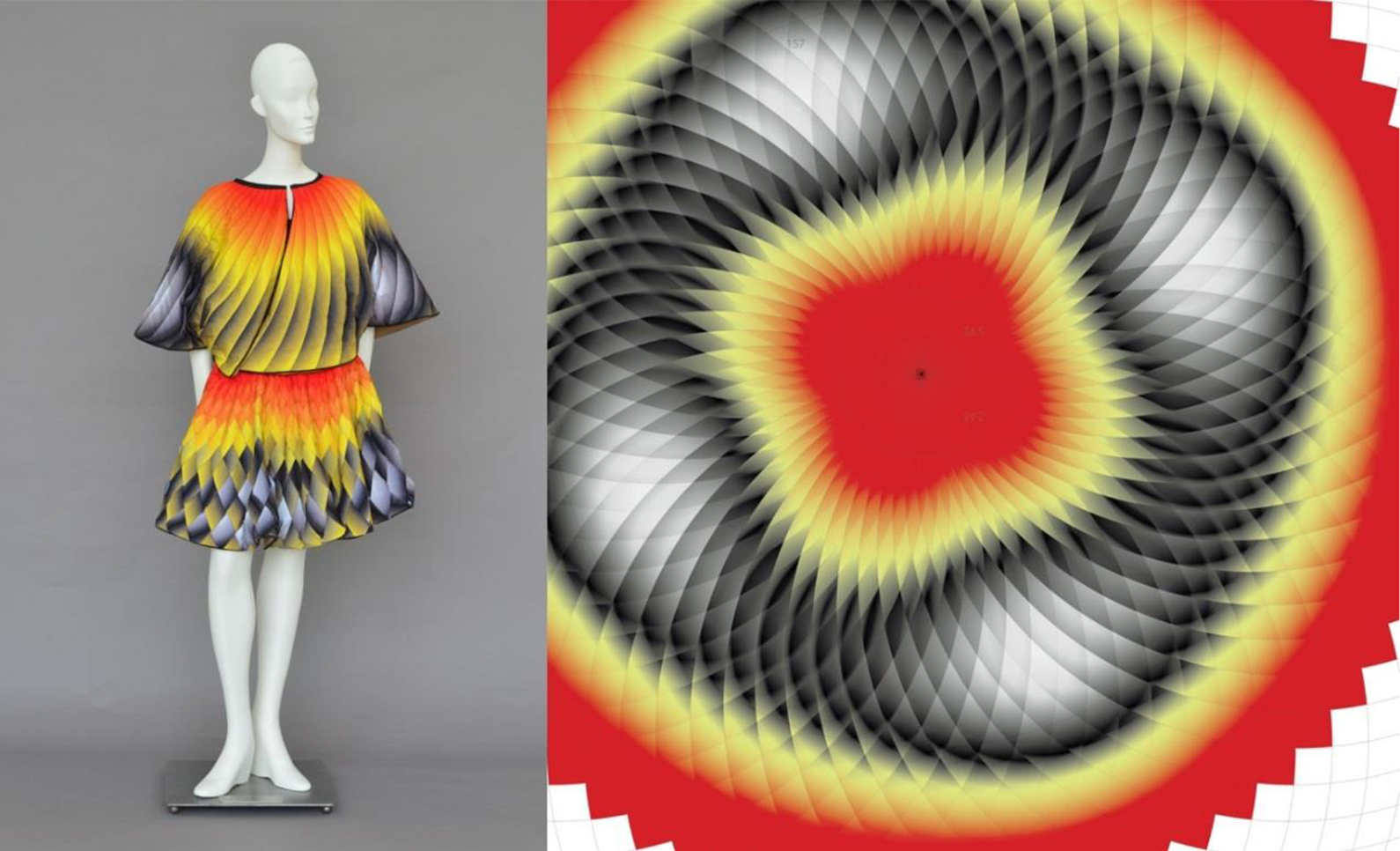
Archimedean Flare (2016), front view and print design.
After digitally printing all fabrics, I cut each strip following marked lines and laid each strip on muslin, one by one, to be interwoven with a maypole-like action. During this process, I ran into an unexpected problem (i.e., sagging gaps developing in the weave) and had to change my original jacket design. I still had the How but had to modify my What from the original intention through my design iteration cycle. Consequently, I used one of the uncut digitally printed textile patterns initially developed for the skirt to create a quilted jacket instead. This outfit was ultimately successful, as the skirt design became an accent piece and balanced well with the quilted jacket. I discovered that I needed more experimentation interweaving curved spirals, which led to a new direction with different garment designs.
Anahata Pulse
After struggling with the previous garment, my codesigner and I explored curved strips in a different way. Due to the challenge that was discovered while interweaving curved spirals (see Figure 8), we created a textile surface inspired by the fourth chakra, Anahata, a swirling wheel of energy some believe to be the source of love (Fondin, 2016). We created a woven surface with curved weft strips and straight warp strips to visually represent the resonant sound waves created by a beating heart. By digitizing the garment patterns, we could previsualize a radiating checkerboard-like pattern while weaving together curved strips with different-colored gradients and straight strips. We digitized a sheath dress pattern, then created concentric circles by incrementally increasing the radius of each circle such that every subsequent circle was exactly a 0.5 in. farther than the previous. When designing the semicircular strips, we realized that we could not attach them to anything, and they would not hold together even after completing the weaving. Therefore, to weave the curved semicircular strips with straight strips and create a distinctive radiating woven pattern, the semicircles had to be tacked down with hand sewing (see Figure 9). I continued to explore further possibilities for weaving with curved strips using my design iteration cycle.
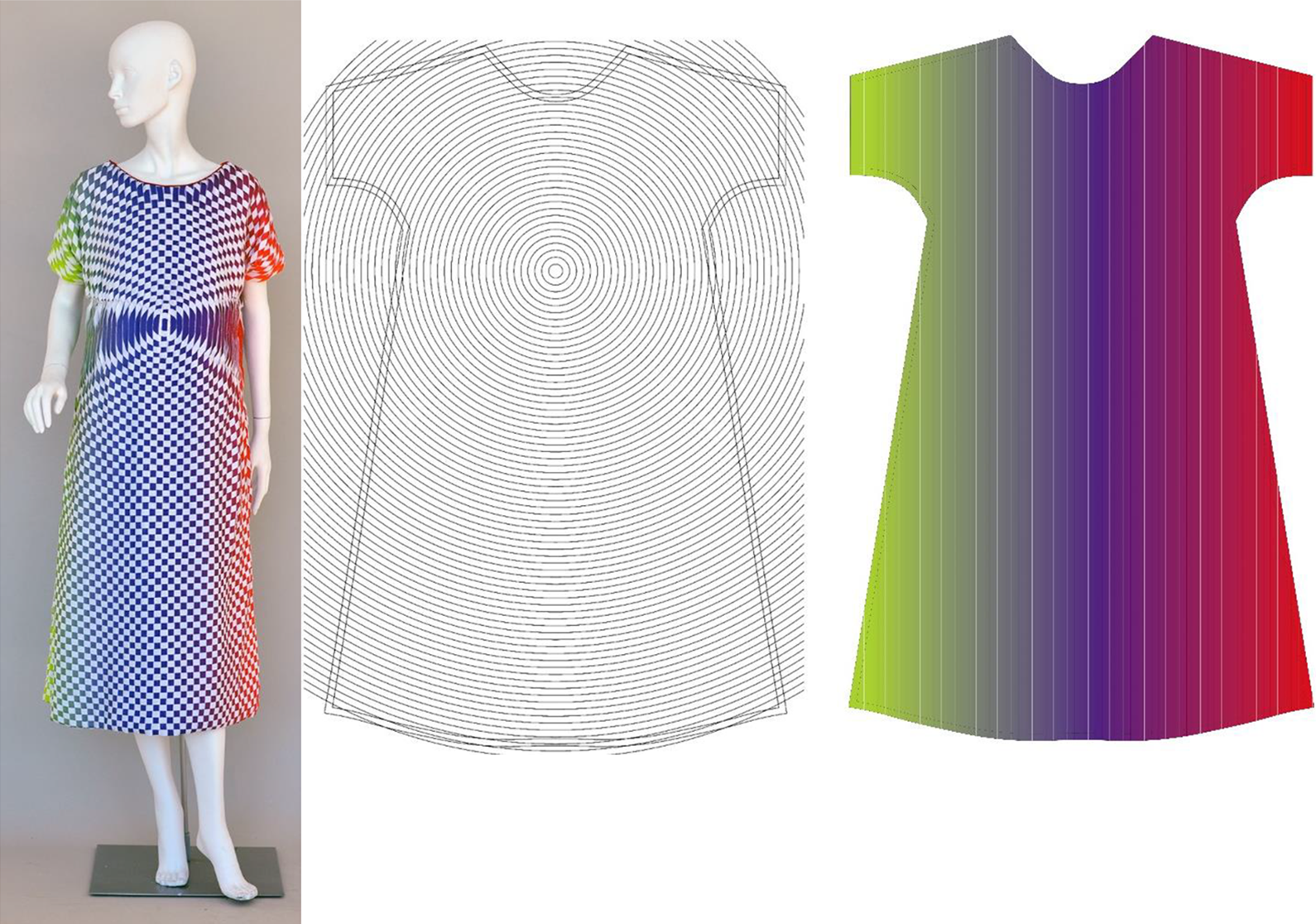
Anahata Pulse (2017), front view and print design.
Iteration of Patterns With Weaving: Triaxial Weaving
My practice-led design research to develop textile surfaces that express sacred growth patterns has grown by experimenting with handweaving, digital fabric printing, curved strips, and engineered patterns. Creating a triaxial pattern with fabric strip weaving is a more complex weaving strategy and goal. This triaxial pattern can be observed in math, art, and nature due to the inherent properties of 3D space. This naturally occurring hexagonal shape is due to the molecular angles of carbon and water, and is a common pattern in the universe, from snowflakes and embryonic cell division to plant structures, DNA, chemistry, and sacred geometry motifs around the world (Fritscher, 2019). Expressing these ideas seems ingrained in human consciousness.
I had seen triaxial patterns in various artwork around the world and had witnessed a few fashion designers and crafters who used either open triaxial weaving in their designs (“Dress Code,” 2012) or created small craft projects using fabric strip triaxial weaving (Boudreaux, 2018), but I had not seen triaxial patterns widely applied in wearable garments. As I began experimenting, I successfully completed a sample of triaxial weaving with paper strips; fabric strips were too difficult due to the lack of stiffness needed for the third strips to be woven under the top two layers. The discovery of fabric-weaving needles enabled me to complete a triaxial weaving pattern with fabric strips. Now that I had solved the initial challenge of the How, the What became a simple top using digital printing on linen. Tri-Axis is the first design where I incorporated triaxial weaving to accomplish my design research goal.
Tri-Axis
I used my handweaving technique and digital fabric printing to experiment with triaxial weaving, intertwining three strips to create the illusion of a 3D cube through a 2D woven hexagon pattern comprised of contrasting colored strips. I then created a skirt to go with the triaxial patterned top by upcycling a couple of postconsumer dresses, adopting my first sustainable design practice that remained consistent with my overall design practice (see Figure 10). Some of the color gradients in the top reflect the upcycled skirt’s colors. By weaving strips with different-colored gradients into a triaxial pattern, I created an optical illusion of volume and depth with color gradients, as well as a 3D cube pattern (see Figure 10). I learned that using three distinct sets of contrasting colored gradient strips results in a better 3D cube pattern surface, and I am looking forward to trying this process with my next triaxial garment.
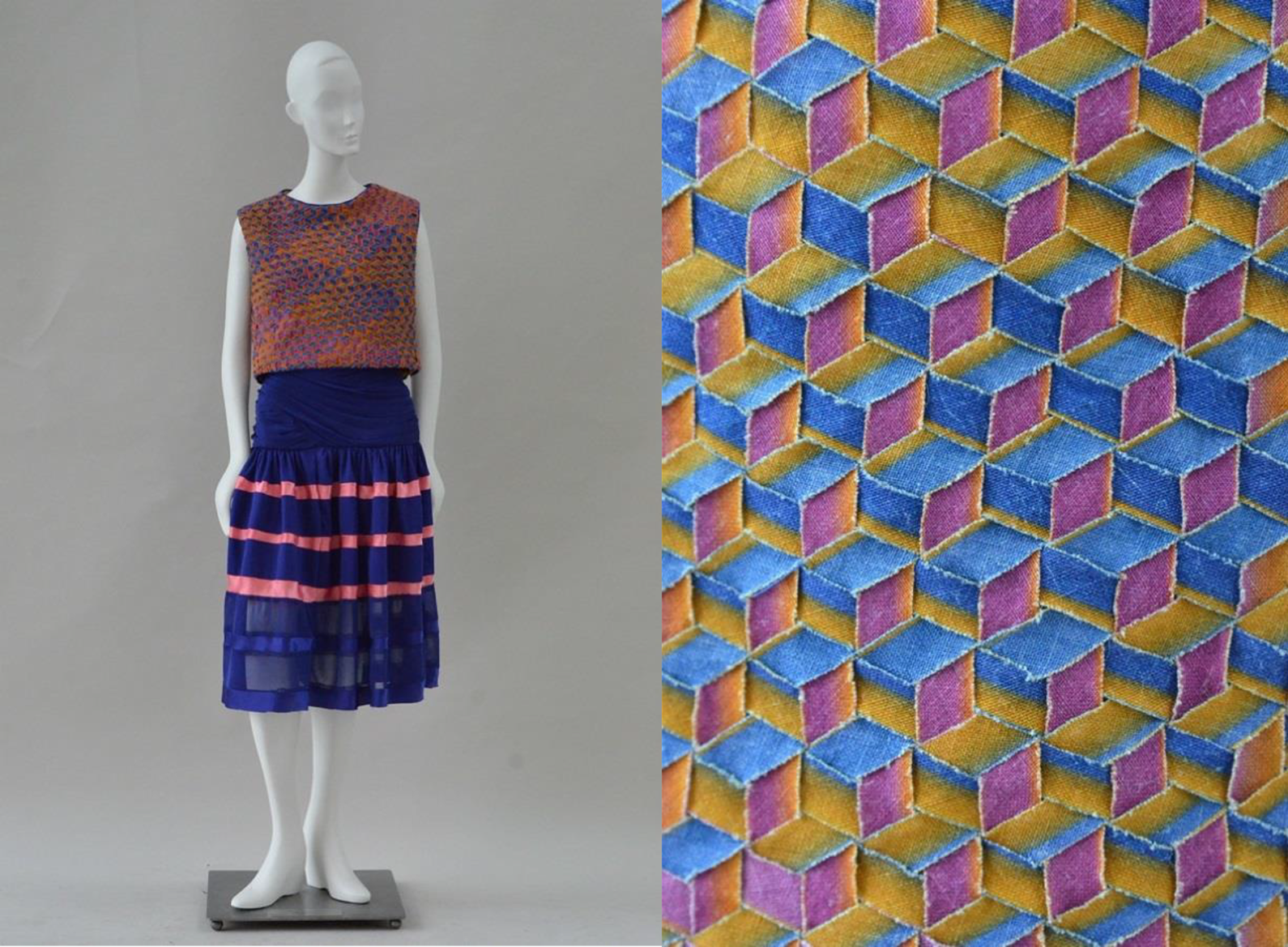
Tri-Axis (2018), front and detail views.
In the future, I want to combine my engineered pattern method with triaxial weaving to create textile surfaces with a 3D cube, as well as other 3D patterns to see what type of optical illusions of volume and depth might emerge that represent sacred geometric patterns.
Body of Work Design Framework
Based on the experiments within my design research practice and the development of my body of work, I developed a design framework (see Figure 1). My design framework is based on the works of Hassi and Laakso (2011), Dorst (2011), and Bye (2010). The core of my practice-led design research stems from studying math as art, as well as archetypal geometric patterns shared from a possible collective unconscious and observed in nature, the universe, and developing patterns of life. My overall design research goal has been driven by creating a physical manifestation of a shared infinite design motif that represents the core properties of the origins of life in a universe of three dimensions. Thus far, my design research has developed into four main frames that were built from the discoveries made from the previous frame: start of geometric design, start of symmetry and chaos, continuation of symmetry, and iteration of patterns with weaving (see Figure 1). Specific designs were developed using my design iteration cycle consisting of four elements of design thinking and research development: analyze previous artifact, review problem and improve methods, reflect on practice, and apply new methods/material. Each cycle started with an analysis of previous work and ended with the application of new methods/materials before starting over again. The focus has consistently been creating a physical manifestation of a surface design motif through fabric weaving. After completing each design work, I reviewed any challenges and reflected on them to improve my design practice. The discovery of new variables, such as new methods or materials that could be incorporated into my design research practice, further aided in the achievement of my ultimate design goal (see Figure 1).
Conclusion
This article sought to provide a model for developing a body of work to guide upcoming or ongoing design scholars through their design research journey. By developing my design and creative scholarship process, I learned about using an iterative design process as a research practice, as well as critically evaluating and developing my body of work. To express my interpretation of the collective unconscious, my entire practice-led design research has, from my perspective, been a cycle of new forced technical challenges and solutions to create a physical manifestation of an archetypal vision of the infinite. Each new discovery of a problem compelled me to challenge myself with the unknown, focus on problems, and create something new (Boland et al., 2008). According to Philpott (2012), practiced innovation is generated through the maker’s creative responses to unforeseen behaviors of both process and material. Until I wrote this article, I did not realize I had developed a body of work, let alone an evolving model of research through practice. My design research was led by analysis of previous design work, derived from practice, initiated from my pursuit of a vision, and directed by a surface design goal of expressing an ingrained vision possibly stemming from a collective unconscious. My design iteration cycle demonstrates that each artifact that I created was the data providing the evidence of new knowledge, which became a foundation for the development of a new design or practice. I hope that the design framework presented herein can guide future design scholars. Furthermore, I strongly encourage other designers to analyze their own work and incorporate this reflective practice and journal writing into their own design research process, as it has helped me clarify my own practice-led design research.
Having an overall design goal and using one’s design work as the research data are important elements of an evolving model of a practice-led design research. The critical analysis of my work was key to advancing solutions to my design research question visible in my artifacts. The analysis enabled me to explore traditional handweaving techniques combined with digital printing and engineered digital textile printing, and I experimented with different widths and unique weaving patterns, showcasing the physical manifestations of a conceptual surface design. I hope this article and the design research framework that I have presented here can serve as a viable approach toward the development of a design discipline that will further advance our creative scholarship.
Footnotes
Acknowledgments
The author would like to thank Dr. Sherry Haar and Dr. Elizabeth Bye, the editors, for creating this Focused Special Issue of the Clothing and Textiles Research Journal and their valuable insights. The author would like to thank her codesigner, David Hahn, for his thoughtful support, collaboration, and creative ideas. The author would also like to thank her graduate assistant, Evelyn Rossol, for helping to organize this article.
Declaration of Conflicting Interests
The author(s) declared no potential conflicts of interest with respect to the research, authorship, and/or publication of this article.
Funding
The author(s) received no financial support for the research, authorship, and/or publication of this article.