



Abstract
Denim is one of the most popular casual apparel all over the globe due to a variety of available looks, comfort, and convenience. Comfort and performance properties of stretched denim fabrics depend on the elastane content, which can be controlled through the linear density of elastane and draft-ratio in the core of the cotton yarn. Optimization of both of linear density and draft-ratio of elastane for the better performance of denim fabric were focused upon in this study. The results indicated that the elastane content inside the core of yarn affects the dimensional and mechanical properties of denim fabrics. Regression analysis indicated that elastane linear-density and draft-ratio had an almost equal significance on contraction after washing, stretchability, stiffness, skewness, and bow of fabric. However, the elastic properties of fabric were mainly dependent on the elastane draft-ratio. This study will be an endeavor for industry personnel to achieve more durable and dimensionally stable denim fabrics.
Keywords
Denim is undoubtedly one of the most popular textiles used in casual apparel all over the globe because of the variety of looks available, better comfort, and great convenience. Classical denim is made from 100% cotton, in which only the warp yarns are dyed with indigo, whereas the weft is kept undyed. Also, the comfort and performance characteristics of denim can be further enhanced by replacing the cotton weft of denim with core-spun yarns which contain elastane as the core and cotton as the sheath (Kincade & Dull, 2017; Marmaralı et al., 2017; Mihailovic et al., 2007; Qadir et al., 2013). The wearer feels comfortable due to stretch and recovery properties of elastane as core filament, and the cotton fibers are used as sheath material which provides the required tactile and aesthetic features (Qadir et al., 2019; Verdu et al., 2009).
In the past, the use of elastane/cotton core-spun yarns in knitted, woven, and denim fabrics were investigated by various researchers. The core-spun yarns are prepared after modifying the ring frame with additional yarn and elastane guiding devices. The elastane/cotton core-spun yarn structure and elastic properties are investigated in terms of elastane fineness, migration of elastane filament inside the core, draw ratio of elastane, and the feed-in angel (Helali, Babay, Msahli, & Cheikhrouhou, 2012; Qadir et al., 2014; Sinha et al., 2017). The elastane draw ratio was optimized resultantly, breaking tenacity was improved along with the elongation of the core-spun polyester yarn (Ortlek, 2006). One researcher compared the effect of core-spun yarn and stable yarn structure on the mechanical properties of polyester/viscose yarn (Babaarslan, 2001). Some other researchers reported the effect of elastane as core filament on the properties of core-spun yarn as a function of the feeding position of elastane (Babaarslan & Celik, 2001; Kakvan et al., 2007). The effects of spinning processing parameters on the sheath slippage of core yarn were also investigated and analyzed (Miao et al., 1996). The effect of the elastane ratio on the core-spun yarn was also studied, and it was found that the specimen length and extension rate has a significant impact on the mechanical properties of core-spun yarns (Dhouib et al., 2006). The rheological modeling of elastane core-spun yarn indicates that the elastane draft is significantly affected by the viscoelastic behavior during the spinning of yarn (Helali, Babay, & Msahli, 2012). The tensile properties of the core-spun yarns were anticipated and optimized by using the artificial neural network and linear regression modeling (Miao, 2009).
Apart from several core-spun yarn studies, the dimensional, physical, and comfort properties of different kinds of knitted fabrics made from elastane yarn have also been investigated. It was concluded by various researchers that the elastane quantity affected the viscoelastic properties of the knitted fabrics significantly (Ali, Zeeshan, Ahmed, et al., 2018; Ali, Zeeshan, Qadir, et al., 2018; Azim et al., 2014; Maqsood et al., 2016; Marmaralı et al., 2017). The effect of elastane as core-spun filament on the weavability was also reported (Qadir et al., 2014). It is clear that the elastane had a prominent effect on the anisotropy of woven fabrics (Klevaitytė & Masteikaitė, 2008). A researcher indicated that the bagging fatigue of woven fabric was decreased with increasing elastane draft ratio and decreasing the twist (Özdil, 2008). Another group of researchers indicated that the fabric structure mobility could be guaranteed if the elastane filament is used in both the fabric directions (Sacevičienė et al., 2011). The behavior of woven fabrics with elastane yarn during stretching was also investigated, and it was indicated that the elastane in the yarn affected the viscoelastic properties of the fabric (Jelka et al., 2005). The effect of cyclic loading on the structure of woven fabric containing elastane was also investigated (Adeli et al., 2011). The effect of weave structure and weft density on the skewness of woven fabrics containing elastane was also investigated and analyzed (Alamdar-Yazdi, 2004). Some researchers suggested that the elastane linear density and draft ratio were almost equally significant for the mechanical properties of the woven fabrics (Qadir et al., 2014). Physical properties of the elastic woven fabric were predicted and optimized by using the Grey–Taguchi method (Masaeli et al., 2015).
Another researcher indicated that the quantity of elastane improved denim comfort significantly (Özdil, 2008). The impact of different finishing processes on the mechanical properties of stretch denim fabrics having different elastane percentages was also investigated and analyzed by multiple research groups (El-Ghezal et al., 2009; Siddique et al., 2017).
To the best of our knowledge, no research has been carried out for the optimization and statistical characterization of the elastane’s linear density and the draft ratio of core-spun yarns on the resulting denim fabric characteristics, in particular, the skewness and bow which are important aspects of the comfort of denim fabrics. Thus, this article is an endeavor to fill this gap and an attempt to optimize and statistically analyze the mechanical properties of denim fabric having core-spun weft yarn. The global denim market was valued at US$57 billion in 2018 and is forecasted to witness a Compound Annual Growth Rate (CAGR) of 6% during 2018–2023 (Donaldson, 2018). United States is one of the top consumers of denim jeans with an estimated demand of 450 million pieces per year, followed by the European Union (EU). United States’s top three suppliers of denim jeans include China, Mexico, and Bangladesh. The largest supplier of denim garments to the EU is Bangladesh, followed by China. Demand growth for the next 5 years is expected to largely emanate from Asia (12%), Latin America (15%), North America (10%), Europe (4%), Mexico, and China ( World Denim Industry & Market Share Comparison, 2018). The global denim market has been categorized into jeans, jackets and shirts, dresses, tops, shorts, and so forth. In the perspective of this growing market, it is utmost necessary to solve the problems of the denim industry. The outcome of this study and statistical relations will be an aspiration for the denim clothing and apparel industry to minimize their trials to achieve better quality denim fabric economically with reduced waste. It will also be helpful to anticipate the physical properties of elastane-based denim fabrics.
Experimental Method
The parameters of the weft yarn in terms of cotton fibers (Pakistani cotton) and elastane filaments are summarized in Tables 1 and 2, respectively. For accurate prediction and better repeatability, 100 samples of cotton fibers were tested through American Society for Testing and Materials (ASTM) D4604-95 with high volume instrument (ASTM, 1995) for the properties of cotton (tenacity, elongation, length, mic, and so on), and mean and standard deviation values of these hundred readings are summarized in Table 1. The weft yarn was prepared through a conventional method after passing the raw cotton through a blow room, card machine, breaker, and finisher draw frame, rovings frame, and finally through a ring frame with an additional attachment for insertion of elastane filament in the core of the yarn.
The Characteristics of Cotton Fibers Used in This Study.
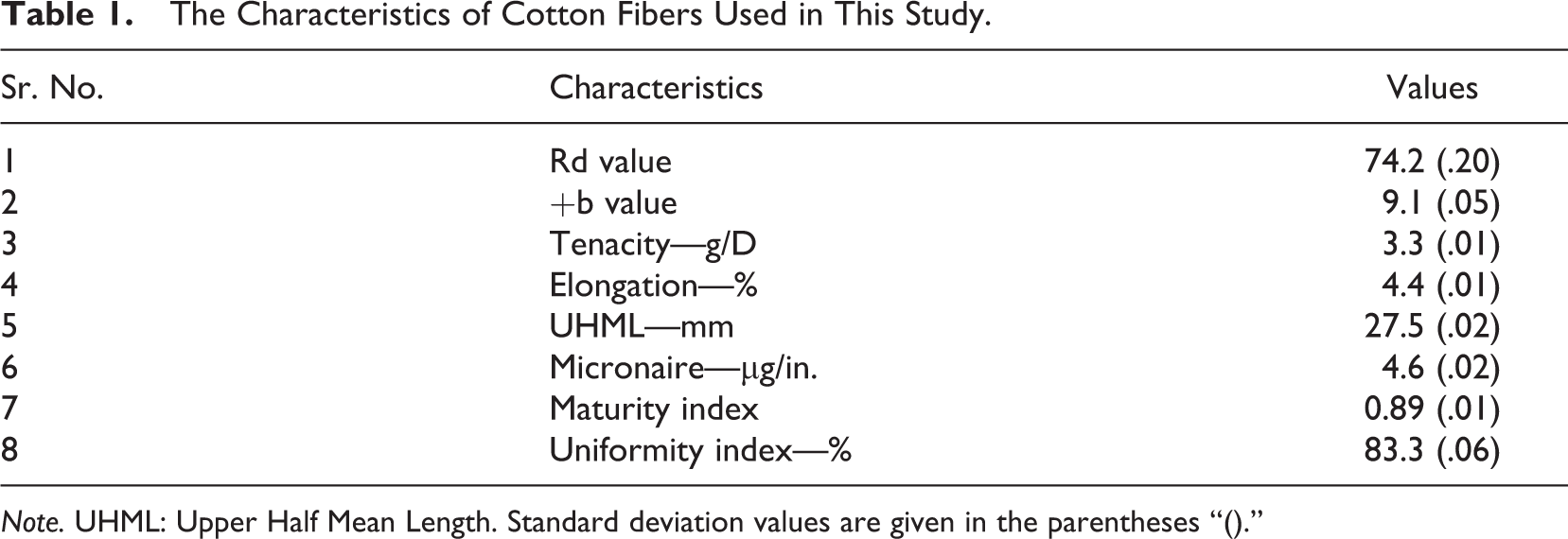
Note. UHML: Upper Half Mean Length. Standard deviation values are given in the parentheses “().”
The Characteristics of Elastane Filament Used in This Study.

Note. Standard deviation values are given in the parentheses “().”
Normally, core yarn is formed at ring spinning frame with an additional attachment for elastane filament (Qadir et al., 2014). The elastane filament is inserted into the core of the yarn soon after the drafting rollers but before the twist insertion to the fibers. The twist wraps the cotton fibers on the elastane filament to make a sheath. In this study, the effects of linear density and draw ratio of elastane filament on the weft yarn are investigated. The core-spun weft yarns of 10/1 Ne were prepared with two different linear density of 40 and 70 deniers of elastane filament at five peculiar draft ratios. The characteristics of elastane of both deniers are given as two columns in Table 2. The 10/1 Ne yarn was used as warp yarn without elastane. Tensile strength measurements of the yarn samples were carried out on USTER Tensorapid-1 (USTER, Switzerland) in accordance with ASTM D2256/D2256M-10 (ASTM, 2015a) and lea strength measurements of the yarn samples were carried out on lea strength tester in accordance with ASTM D1578-93 (ASTM, 2016a), and unevenness, imperfections, hairiness measurements of the yarn samples were carried out on USTER Tester-5 (USTER, Switzerland) in accordance with D1425/D1425M-14 (ASTM, 2014).
The warping of the 10/1 Ne carded yarn was carried out on a Karal Mayer ball warping machine at a warping speed of 50 m/min. The warp yarns were dyed with indigo color on a Morrison rope dyeing range at a speed of 50 m/min. Rebeaming of dyed warp was done on Karal Mayer rebeaming machine at 50 m/min. The warped beam was sized on the Benninger Ben-sizetec sizing machine. The quantity of warp size was 6% which included starch, wax, and fluorine. The weaving process of all the fabric samples was completed on the Vamatex-1995 loom at a speed of 700 picks/m. The fabric samples of 67 in. width were prepared with 64 warp ends/in., 46 picks/in., and 3/1 Z-twill weave. Then, desizing was carried out at 90 °C, followed by rinsing and washing.
After desizing and washing, all the fabrics were conditioned in the standard atmosphere at a temperature of 21 ± 1 °C and relative humidity of 65 ± 2% for testing purposes for 24 hr. The conditioning was done according to ASTM D1776/D1776M-16 (ASTM, 2016b), which is the standard procedure of conditioning the textile materials. The gram per square meter (GSM) of fabrics was measured according to ASTM D3776/D3776M-09a (ASTM, 2017). The stretch and recovery measurements of the fabric were done according to ASTM D 3107-07 (ASTM, 2015b). The stiffness and skewness and bow measurements of fabric were determined according to ASTM D 4032-08 (ASTM, 2016d) and ASTM D 3882-08(2016)e1 (ASTM, 2016c), respectively.
Results and Discussion
The characteristics of core-spun weft yarn with different linear density and the draft ratio of elastane are shown in Table 3. The effect of linear density and draft ratio of elastane on the different mechanical properties of the fabric samples are shown in Table 4. For accurate prediction and better repeatability, 100 replicates of yarns for each sample and for each test (tenacity, elongation, lea strength, IPI, and hairiness) and 50 replicates of fabric for each sample and for each test (contraction [%], stretch [%], recovery [%], stiffness, areal density, skewness [%], and bow [%]) were tested, and the mean and standard deviation values of these 100/50 readings are given in the tables with the values.
The Characteristics of Core-Spun Yarn With Elastane Filaments.

Note. Standard deviation values are given in the parentheses “().”
Mechanical Properties of Denim Fabric With Different Linear Density and Draft Ratio of Elastane Filament in the Weft Yarn.

Note. Standard deviation values are given in the parentheses “().”
MINITAB statistical software Version 17 was used for the regression analysis of all the data received after the testing of samples. The regression coefficient of each variable and p values (indicating the statistical significance with 95% confidence) are given in Tables 5 and 6. A lower value of the coefficient shows lower effect of the corresponding term and vice versa. A minus (−) sign indicates that the parameter (response) increases by decreasing the factor value and vice versa. The regression equations with statistically significant terms are given in Tables 5 and 6. The R 2 value indicates how much variation in the response is explained by the factors included in the regression equation/model. The higher the R 2, the better the equation fits the data.
The Regression Equations of the Fabric Contraction, Stretch, and Recovery After Washing as a Function of Linear Density and Draft Ratio of Elastane.

The Regression Equations of Fabric Tear Strength, Stiffness, Skewness, and Bow as a Function of Linear Density and Draft Ratio of Elastane.

Fabric Contraction
The effects of elastane linear density and draft ratio on the fabric contraction are shown in Figure 1. The contraction was measured in the weft direction. It can be concluded from the Figure 1 that the fabric contraction increases after washing when the elastane linear density and draft ratio increases. In addition, at the same draft ratio of elastane, the fabric contraction increases with an increasing linear density of elastane. This increase in contraction with an increase in elastane linear density can be attributed to a higher elastane percentage of the yarn.
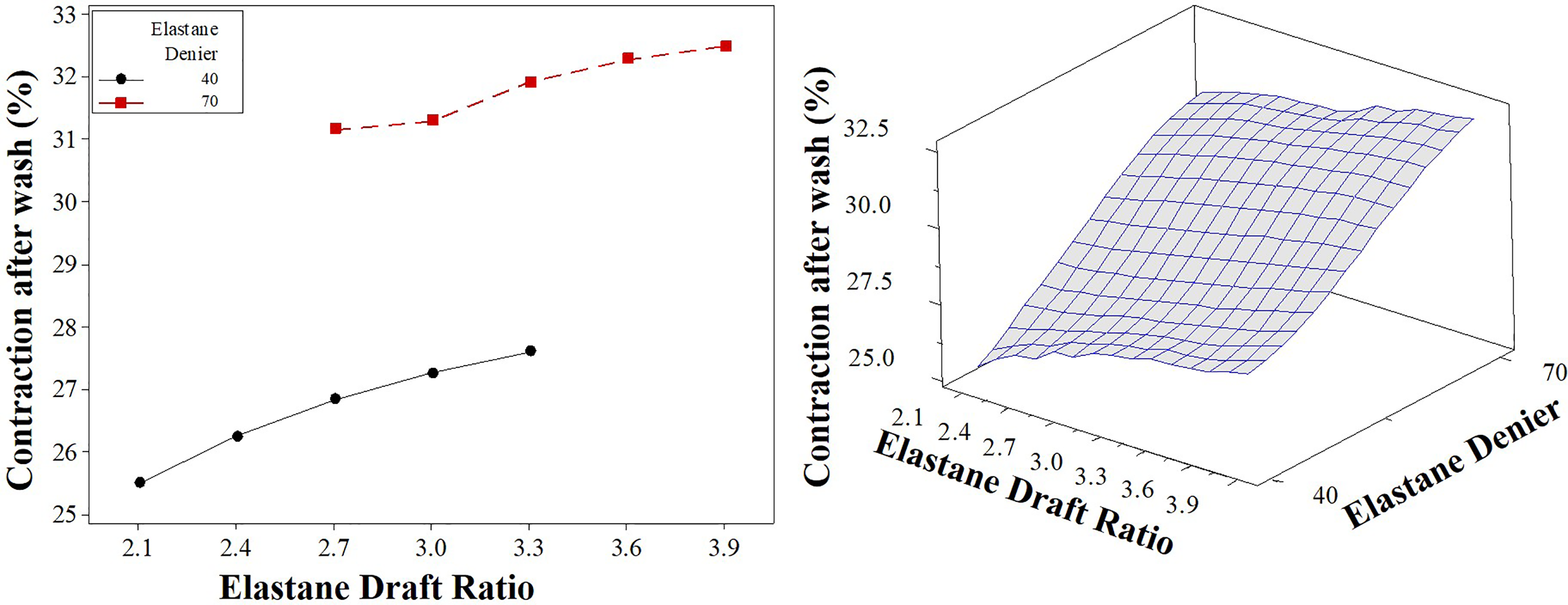
The effect of elastane linear density and draft ratio on the fabric contraction after wash (%) in the weft direction.
Furthermore, the increase in contraction with increasing the draft ratio of the elastane can be attributed to the larger retraction force, which enables the yarns to recover its structure largely. This is evident from a positive Pearson correlation of .596 and p value of .000 between the fabric contraction and the elastane contents. Also, a Pearson correlation of .753 with a p value of .000 between the fabric contraction and the elastane draft ratio is shown in Table 5. Furthermore, a significant relation between the fabric contraction and the elastane linear density with a Pearson correlation of .970 and p value of .000 is shown in Table 5. It can be noticed from Figure 1 and Table 5 that the effect of the elastane linear density on fabric contraction is higher as compared to the draft ratio. Here, the R 2 % is the coefficient of determination, which demonstrates the change in percentage. The factors affecting this change are those which are present in the regression equation. It can be suggested from the findings that the elastane content should be kept higher with a lower draft and higher linear density to achieve less shrinkage after washing.
Fabric Stretch
The fabric stretch percentage increases by increasing the elastane linear density and elastane draft ratio. The effects of elastane linear density and draft ratio on the fabric stretch in the weft direction are shown in Figure 2 (A, B). Furthermore, the regression equations and the R 2 values, which indicate that the elastane linear density has a larger effect on the fabric stretchability than the draft ratio, are shown in Table 5. This is also evident on the slopes of the lines and curves in Figure 2 (A, B). The elastane quantity increases with increasing elastane linear density which results in larger fabric stretchability. This is interesting to know that the fabric stretchability increases with increasing elastane draft ratio, although the elastane quantity decreases with the higher draft ratio. The higher stretchability of fabric due to the higher draft ratio can be explained by the higher crimp of the wrapping fibers caused by the higher retraction force. When the fabric is removed from the loom, the fabric contracts more in the width direction due to the higher retraction forces in comparison to that with a lower elastane draft ratio.
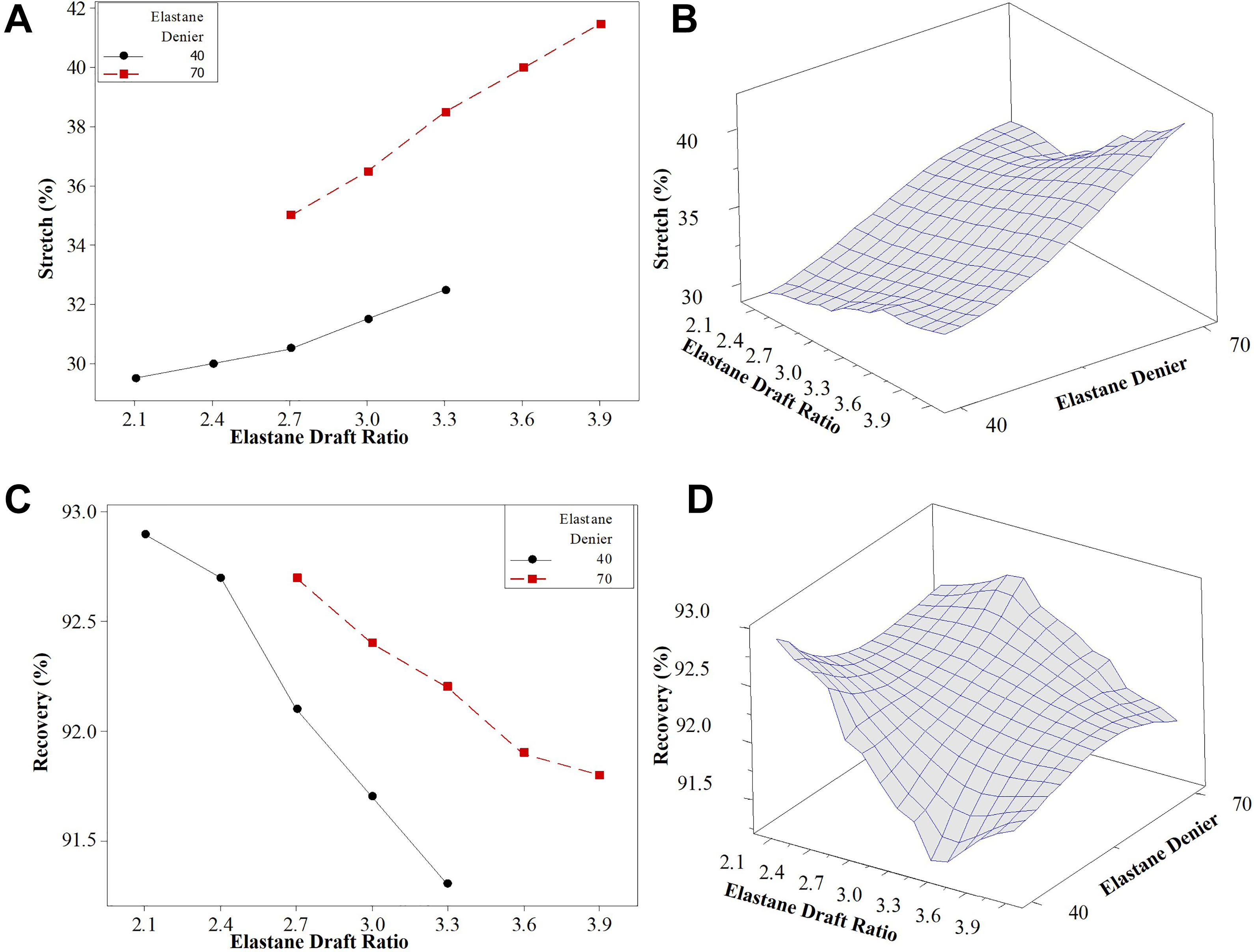
The effect of elastane linear density and draft ratio on the fabric stretch (%; A, B) and fabric recovery after removing stretch (C, D) in the weft direction.
Thus, the fabric with higher contraction is more stretchable than that which has less contraction. Therefore, it is difficult to suggest that the stretchability of fabric is only dependent on the elastane percentage in the fabric. This is possible to increase the elastane quantity by increasing the linear density of elastane with the lower draft. However, the stretchability of the fabric will be less due to reduced initial fabric contraction after removing it from the loom. This is evident from the statistical analysis that a positive correlation exists between the elastane percentage and fabric stretch with a Pearson correlation of .428 and p value of .000. Also, a positive correlation exists between the linear density of elastane and fabric stretch of fabric with a Pearson correlation of .899 and p value of .000. In addition, the elastane draft ratio is important with a Pearson correlation = .851 and p value of .000 with the fabric stretch.
Fabric Recovery After Stretch
The effect of elastane linear density and draft ratio on the fabric recovery after stretching it in the weft direction is shown in Figure 2 (C, D). The correlation analysis statistically revealed that the effect of linear density of elastane on the fabric recovery is not significant with a Pearson correlation of .060 and p value of .552. However, statistically, the impact of elastane percentage on the fabric recovery after the stretch is significant with a Pearson correlation of .0631 and a p value of .000.
The values of regression analysis and R 2 in Table 5 are in agreement with these results that the fabric recovery after the stretch is significantly dependent on the elastane draft ratio and decreases with an increase in the draft. Also, this is evident from the correlation analysis with a Pearson correlation of −.734 and p value of .000. The increase in the elastane draft ratio decreases the elastane percentage resulting in poor fabric recovery after stretch. The results suggest that the elastane percentage should be kept higher in fabrics to achieve better recovery after stretch. In addition, it is better to use a lower draft ratio instead of using a higher linear density of elastane.
Fabric Tear Strength
The effect of elastane linear density and draft ratio on the fabric tear strength in the weft direction is demonstrated in Figure 3 (A, B). The fabric tear strength and elastane draft ratio show a positive correlation with a Pearson correlation of −.986 and p value of .000. However, the fabric tear strength and yarn tenacity do not show any positive correlation with a Pearson correlation of −.172 and p value of .086. The fabric tear strength is highly dependent on the movement of yarn in the fabric when it is subjected to the tear force. That enables the yarns to gather at the tearing point to support each other. Another factor of importance is friction between the yarns, which plays a vital role in the tearing strength of the fabric (Ertaş et al., 2016).
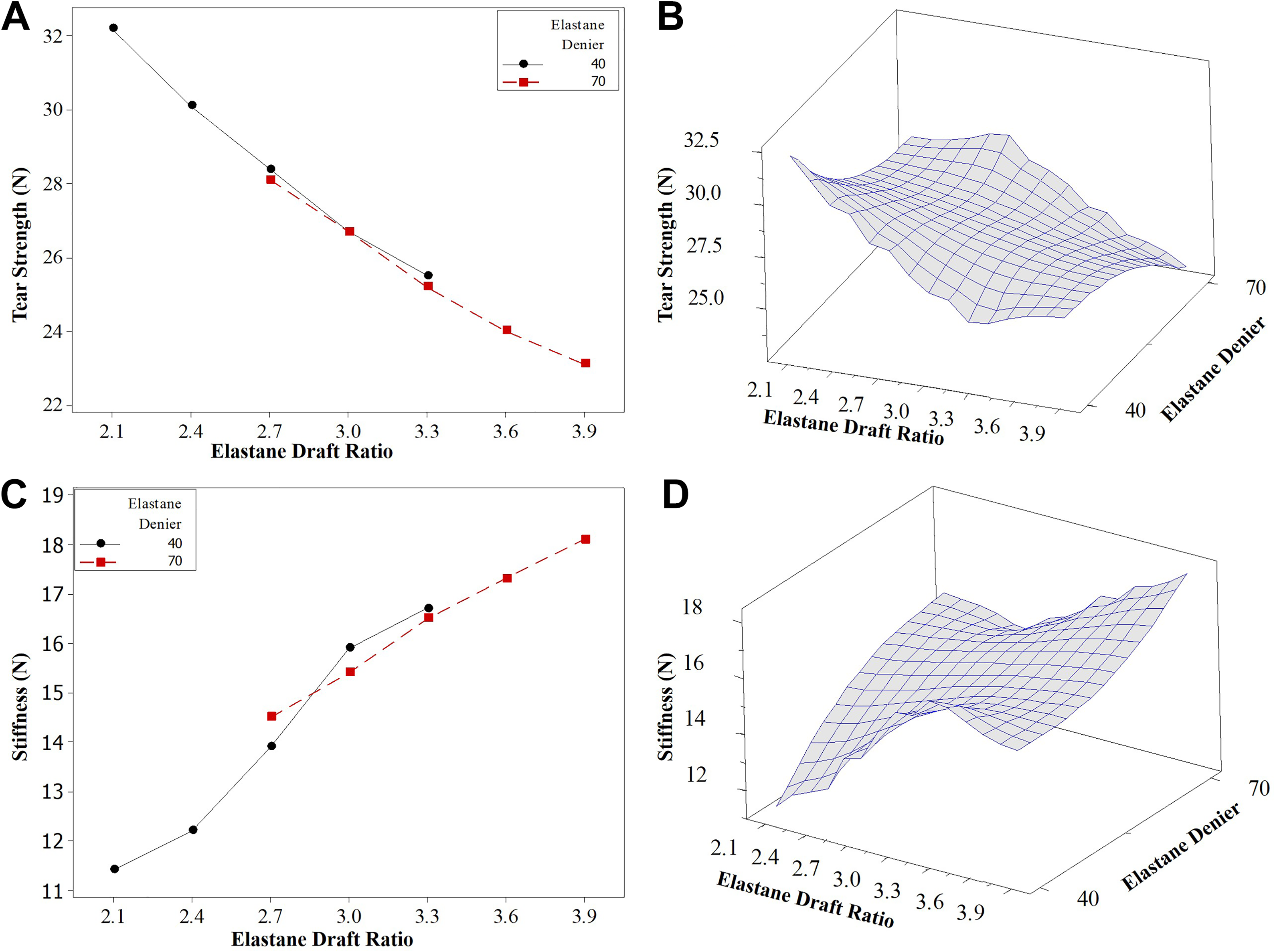
The effect of elastane linear density and draft ratio on the fabric tear strength (A, B) and fabric stiffness (C, D) in the weft direction.
The lower linear density and draft ratio of elastane results in the lower fabric shrinkage and lowers the friction between the yarns. Thus, the yarns could easily move in the fabric while applying the tear force, due to which more force is required to tear the fabric. Higher linear density and draft ratio of elastane causes higher retraction and frictional forces and hence higher shrinkage/compactness of fabric. This restricts the motion of yarn in the fabric due to less frictional force resulting in the poor tear strength of the fabric. Different predictors of fabric tear strength are given in Table 6. The R 2 values indicate that the elastane draft ratio affects the tear strength more than the elastane linear density. In addition, the fabric tear strength increases with increasing the elastane percentage by using a lower draft ratio. Also, the fabric tear strength increases with using the higher linear density of elastane. It is interesting to note that even though the elastane percentage is almost same in fabrics which are made either by yarns having a linear density of 40D and draft of 2.1 (elastane % = 3.59%) or yarns with elastane linear density of 70D and draft of 3.6 (elastane % = 3.66%), the tear strength of fabric with the lower draft is higher than that of the higher draft. This is also shown in Figure 3 (A, B).
Fabric Stiffness
The effect of elastane linear density and draft ratio on the fabric stiffness in the weft direction is shown in Figure 3 (C, D). In addition, the regression equations of fabric stiffness are given in Table 6. The Pearson correlation of .975 with a p value of .000 indicates a strong correlation between the draft ratio and fabric stiffness. However, the effect of linear density on the fabric stiffness is relatively less significant with the Pearson correlation value of .562 and p value of .000. It can be suggested from the equations and R 2 values that the elastane draft ratio has a more substantial effect on fabric stiffness than that of elastane linear density. This increase in fabric stiffness can be attributed to the larger GSM of the fabric given in Table 4. This is mentioned before that the fabric GSM increases with increasing elastane percentage in the weft direction after removing the fabric from the loom. Also, the retraction force increases with an increasing draft ratio. This contributes to increasing the GSM of fabric and hence higher stiffness of the fabric.
Fabric Skewness
Skewness is a situation in the woven fabric where the weft and warp yarns are not at the right angles but angularly displaced from a line perpendicular to the edge or side of the fabric. The skewed fabric may behave differently on each part of the body and cause difficulties during tailoring, sewing, and three-dimensional forming.
The effect of elastane linear density and draft ratio on the fabric skewness in the weft direction are shown in Figure 4 (A, B). It is indicated in Figure 4 (A, B) that the fabric skewness increases with increasing elastane linear density and draft ratio. In addition, the regression equations of fabric skewness are given in Table 6. The correlation between the linear density and fabric skewness is statistically significant with the Pearson correlation value of −.620 and p value of .000. However, a larger value of Pearson correlation of .986 with a p value of .000 between elastane draft ratio and fabric skewness indicates a larger effect of elastane draft ratio on fabric skewness. The larger effect of the elastane draft ratio than the elastane linear density on fabric skewness is also evident from the equations and R 2 values. This larger effect of the elastane draft ratio on fabric skewness can be linked with the larger retraction forces when the fabric is removed from the loom as shown in Table 4. In a twill weave, float length and free spaces are higher, so more will be the contraction as well as skewness. Although the elastane content decreases by increasing the draft ratio, the higher draft ratio results in higher retraction force for fabric contraction resulting in higher fabric skewness.
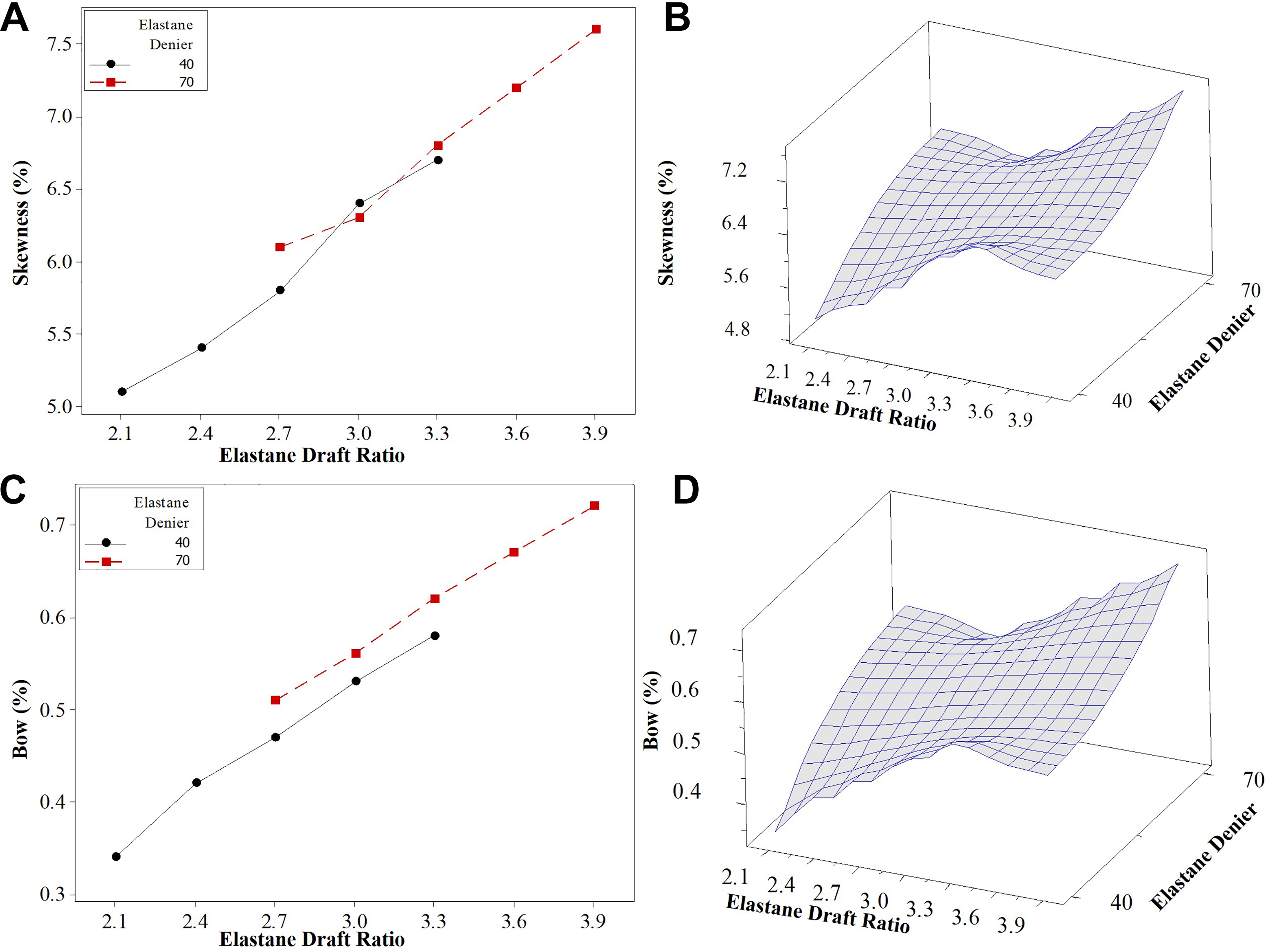
The effect of elastane linear density and draft ratio on the fabric skewness (%; A, B) and fabric bow (%; C, D) in the weft direction.
Fabric Bow (%)
Bow in a woven fabric is a shape when the filling yarns are displaced from a line perpendicular to the selvages across the width of the fabric in the shape of an arc. The effect of elastane linear density and draft ratio on the bow of fabric in the weft direction is shown in Figure 4 (C, D). The bow of the fabric increases with increasing the elastane linear density and draft ratio. The regression equations for fabric stiffness are given in Table 6. The p value and R 2 % indicate that the elastane draft has a larger effect on the fabric skewness than that of elastane linear density. This correlation of fabric skewness and elastane linear density can be attributed to the increase of elastane percentage in the fabric. This causes the increase in retraction forces in the weft direction of the fabric after removing it from the loom. Also, this factor is the reason for an increase in fabric contraction as given in Table 4.
In addition, the larger draft ratio of elastane causes an increase in retardation forces. This causes a larger increase in fabric contraction and crimp percentage. These factors cause the filling yarn to shape in the form of an arc across the width. These results were further ascertained by the correlation between the elastane linear density and bow of the fabric with the Pearson correlation of −.675 and p value of .000. However, the correlation between the draft ratio of elastane has a larger effect on fabric stiffness with a Pearson constant of .978 and p value of .000.
Conclusion
The effect of elastane linear density and draft ratio as a core filament in the yarn on the mechanical properties of denim fabric was analyzed using linear regression equations and Pearson correlation. In the weft direction of the fabric, the contraction is significantly affected by the elastane linear density and the draft ratio. The fabric stretchability, stiffness, skewness, and bow were also significantly affected both by the elastane linear density and the draft ratio. These same variables were also directly proportional to the fabric contraction. However, fabric recovery after stretch was not significantly affected by the elastane denier but only by the elastane draft ratios, with poor recovery at higher draft ratios.
Footnotes
Declaration of Conflicting Interests
The author(s) declared no potential conflicts of interest with respect to the research, authorship, and/or publication of this article.
Funding
The author(s) received no financial support for the research, authorship, and/or publication of this article.
