



Abstract
Self-sexualization is an emerging area of research relevant to clothing researchers as evaluations of sexual appeal often stem from specific items and uses of dress. Our research purpose was to systematically review the available research on self-sexualization. In our review we focused specifically on three topics: what precedes self-sexualizing? What outcomes are associated with self-sexualizing? And how has self-sexualization been operationalized? The time frame for this review was 2007–2020. To locate the 31 journal articles that supplied the data for this research, multiple data bases were searched using the following search terms: self-sexualization, self-sexualizing, and sexual self-presentation. Important precursors to self-sexualization include exposure to media and social media, self-objectification, internalization of sexualization, and desiring attention from others. Empowerment has been studied as an outcome of self-sexualization along with negative inferences concerning both young women and girls that self-sexualize. Operationalization of self-sexualization is varied and likely contributes to inconsistent findings.
The sexualization of people entails endowing them with a sexual nature. Although sexualization can occur with any gender, sexualization is often linked to women and girls. Consequences of sexualization are multilayered. At the personal level, sexualization has been linked to decreases in cognitive abilities, body dissatisfaction and appearance anxiety, support of sexist beliefs, tolerance of sexual violence against women, and mental health concerns (APA, 2007; Smolak & Murnen, 2011, Ward, 2016). At the interpersonal level, sexualization can impact relationships. Women and girls who appear “sexy” (i.e., make self-sexualized presentations) are judged as less attractive, less intelligent, socially appealing, moral, and less human (i.e., as an object) by both men and women (Daniels, 2016; Graff et al., 2012, Heflick et al., 2011; Smith et al., 2018; Starr & Zurbriggen, 2019). Women who are depicted as sexy are also attributed blame in instances of sexual harassment or assault (e.g., Jang & Lee, 2013; Johnson et al., 2016). In addition, women who indicate they enjoy sexualization experience objectification by their partners and low relationship satisfaction (Ramsey et al., 2017). At the societal level, living in a society that equates attractiveness with being sexy and rewards women and girls for striving to reach an unattainable level of desirability, it is not surprising that these individuals might be relegated to a second class standing as they opt to spend time and energy on their appearance rather than on developing competencies that could enable them to gain economic and political status.
The American Psychological Association (APA), an organization with a history of involvement in issues related to children, formulated a task force on the sexualization of girls in response to expressions of concern by several groups (e.g., journalists, psychologists, parents, and child advocacy groups) noting at the time the prevalence of the sexualization of girls in the media
1
(APA, 2007). Cultural anxiety about girls’ sexuality at an early age led to concerns about their developing negative body image and self-esteem (Cook & Kaiser, 2004). One outcome of the APA task force was defining sexualization. The task force identified four components of sexualization, suggesting any one is sufficient for sexualization to occur. These components are: (1) a person’s value comes only from his or her sexual appeal or behavior, to the exclusion of other characteristics; (2) a person is held to a standard that equates physical attractiveness (narrowly defined) with being sexy; (3) a person is made into a thing for others’ sexual use, rather than seen as a person with the capacity for independent action and decision making; and/or (4) sexuality is inappropriately imposed upon a person. (2007, p. 1)
Our research purpose was to conduct a narrative critical literature review (Jessen & Lacey, 2006) of available research on self-sexualization. Reviews provide an important foundation for research and contribute to the knowledge base, as they summarize key findings, assist in identifying knowledge gaps that provide impetus for research, identify strengths and limitations of extant knowledge, identify theories that can be helpful in developing research questions and important concepts to investigate, and identify research strategies employed. On a practical level, reviews can also inform teaching (Creswell, 2015; Jessen & Lacey, 2006). In our review, we focused on research that addressed the following: what precedes self-sexualizing; what outcomes are associated with self-sexualizing; and how is self-sexualization operationalized?
Method
As the APA task force issued their report on the sexualization in 2007, the time frame for this review was 2007–2020. To locate the data for this research, multiple available data bases were utilized (e.g., Academic Search Premier, Google Scholar, Web of Science, Psych Info, ABI/INFORM Global, ERIC EBSCO, and ERIC ProQuest) using the main terms for the concept of interest: self-sexualization, self-sexualizing, and sexual self-presentation. Cited reference lists were also reviewed to identify articles (i.e., ancestry approach). The sample was limited to studies that met three criteria: reported empirical research, were published in English, and included self-sexualization as a variable. The search was also limited to studies located in refereed journal articles because such articles have gone through a vetting process (review by an editor/reviewers) enabling the assumption that the research process was done correctly and information reported was accurate and useable. After omitting seven studies in four articles that did not meet the three listed criteria, the final sample consisted of 33 studies published in 27 journal articles.
Results and Discussion
Our review of the self-sexualization literature is organized into three sections: precursors to self-sexualization, outcomes associated with self-sexualization, and measurement of self-sexualization. Within each section, we present major findings and illustrative examples of research, research strategies used, major theoretical perspectives employed, participant type, discussion, and suggestions for future research. Figure 1 presents a visual summary of major findings concerning precursors and outcomes of self-sexualization. We end with limitations of this body of research.
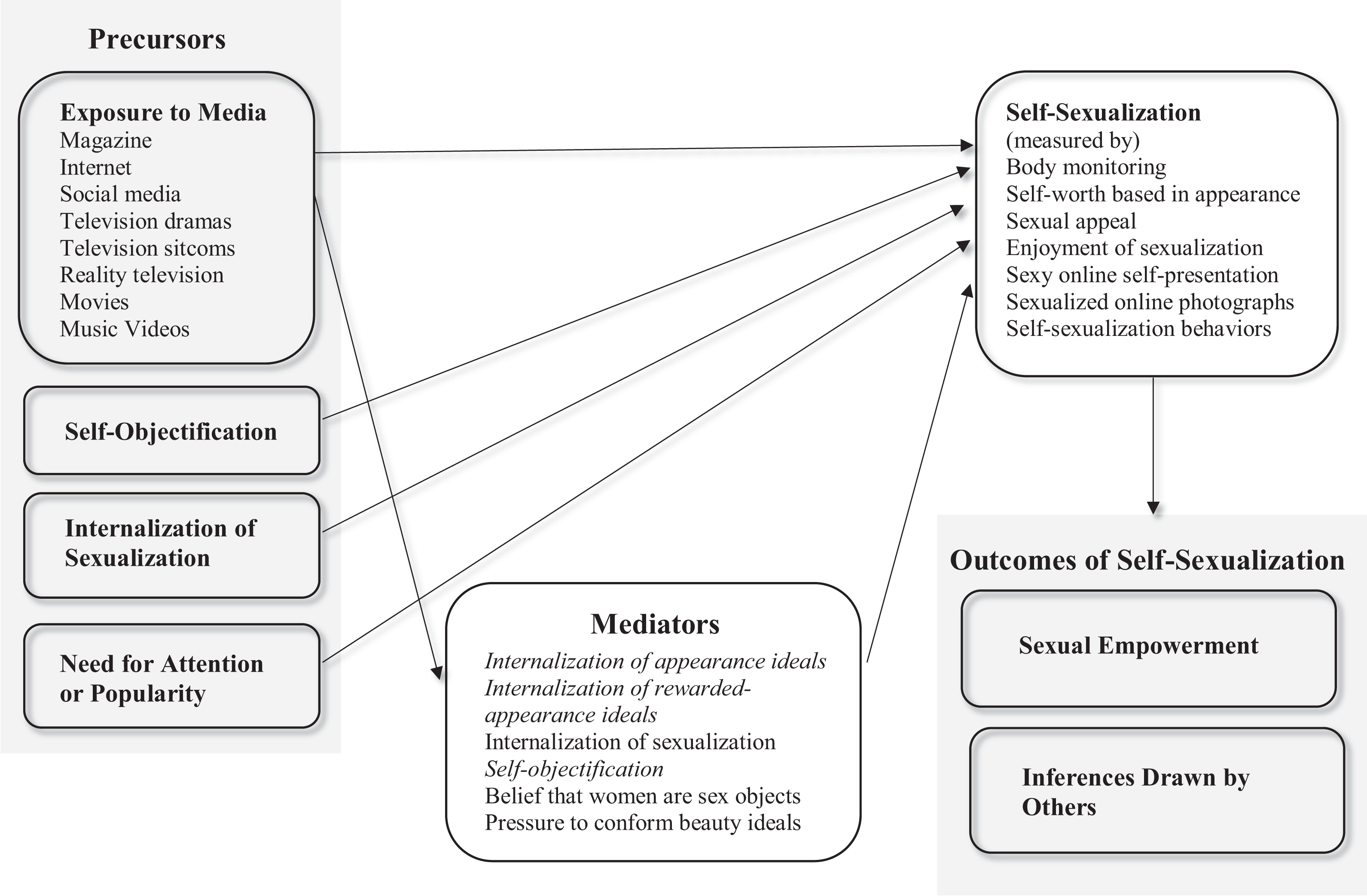
Visual summary of the research of self-sexualization. Note. Italicized variables indicate inconsistent or non-significant relationships.
Precursors to Self-Sexualization
Researchers interested in antecedents to self-sexualization have focused their attention on exposure to mass media as well as use of social media for their influence. They have also examined body surveillance, internalization of sexualization, and need for attention or need for popularity as antecedents (see Figure 1). To study these topics, researchers primarily used survey methods and convenience samples. The dominant theoretical framework employed was objectification theory (See Table 1).
Summary of Major Characteristics of Research.
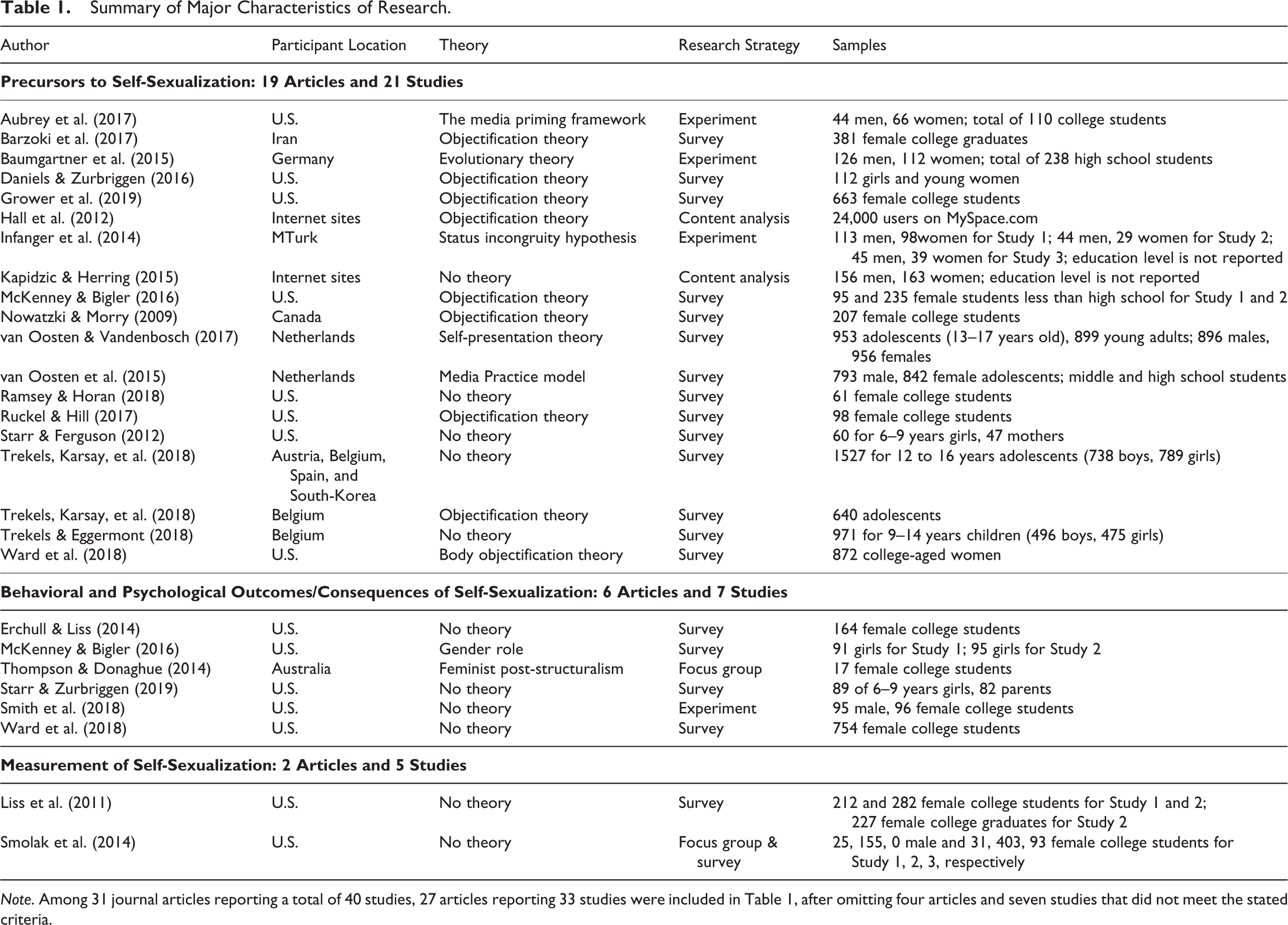
Note. Among 31 journal articles reporting a total of 40 studies, 27 articles reporting 33 studies were included in Table 1, after omitting four articles and seven studies that did not meet the stated criteria.
Exposure to media
Researchers have investigated the influence of media featuring sexual content on self-sexualizing behaviors. These researchers have often tested several types of media at the same time (e.g., television viewing, magazine exposure) as well as tried to assess whether it was simple exposure to this content or conversations about this content that actually motivated self-sexualizing behaviors. Researchers also attempted to predict multiple aspects of self-sexualization such as enjoyment of sexualization, willingness to participate in self-sexualizing behavior and acceptance of others' self-sexualizing behaviors. Often researchers tested internalization of appearance ideals along with other variables for their possible mediating or moderating influences on the relationships between media use and self-sexualization. For example, Grower et al. (2019) were interested in uncovering possible mediators in the relationship between media consumption and self-sexualization with undergraduate women. They investigated four different forms of media (i.e., magazine, situation comedies, television reality/drama programs, Facebook) and whether the influences of these forms of media on self-sexualization were mediated by either internalization of the thin ideal, belief that women are sex objects, or pressure to look like a media ideal. They employed three scales to measure self-sexualization. The first scale assessed the extent to which individuals engaged in body monitoring. The second scale assessed the extent to which individuals attempt to and enjoy emphasizing their own sexiness. The final scale assessed the extent to which individuals base their self worth on their sexual appeal. Of the forms of media investigated, magazines and Facebook investment were indirectly related to self-sexualization through internalization of the thin ideal. Reality television was indirectly related to self-sexualization through internalization of the thin ideal and the belief that women are sex objects.
Several researchers were interested in how media influences adolescents’ self-sexualizing behaviors. Trekels and Eggermont (2018) conducted a longitudinal study of Belgian adolescent boys and girls. They were interested in whether it was simple viewing of media content or discussions of that media content that fueled self-sexualizing behaviors. In addition, they wanted to uncover possible mediators (i.e., pressure to have an attractive appearance, pressure to attain an attractive appearance) and/or a moderator (i.e., reward sensitivity) of relationships between media and sexualizing appearance behaviors. They examined these variables over three points in time (6-month intervals). They developed their own measure of self-sexualizing appearance behaviors. Frequency of viewing teen television programs and conversations about media content at the first data collection (time 1) was positively related to self-sexualizing behaviors at the final data collection 1 year later (time 3) for both boys and girls. Participants who indicated beauty ideals were attainable at the first data collection (time 1) were more likely to engage in sexualized appearance behaviors 6 months later. In turn, these participants indicated increased pressure to comply with beauty ideals 6 months later (time 3). Participants’ reward sensitivity was not a significant moderator in their model. Overall, boys reported engaging in self-sexualizing behaviors more frequently than did girls.
Consequently, Trekels, Ward, & Eggermont (2018) addressed the question of whether it was simple use of social media or appearance conversations using social media that fueled Belgian adolescents’ self-sexualizing behaviors. They reasoned that since Facebook provides opportunities for users to comment on and rate the appearance of other users, it is likely that conversations about others’ appearances using Facebook could have a greater impact on self-sexualizing than simple hours spent using Facebook. They also were interested in whether internalization of rewarded appearance ideals mediated the relationships between self-sexualizing behaviors and both social media use and appearance conversations or whether internalization of appearance ideals had a direct influence on self-sexualizing behaviors. Finally, they reasoned that internalization of appearance ideals should be linked to self-objectification and that self-objectification should directly influence self-sexualizing behaviors. Neither internalization of appearance ideals nor self-objectification mediated the relationship between amount of Facebook use and self-sexualizing behaviors. However, both internalization of appearance ideals and self-objectification mediated the relationship between appearance conversations and self-sexualizing behaviors.
Self-objectification
Self-objectification results from regular exposure to objectifying experiences that socialize individuals to internalize a view themselves as an object or as a collection of body parts. Outcomes of self-objectification include self-surveillance that can result in both negative consequences to mental health and detract from cognitive functioning (Fredrickson & Roberts, 1997; Quinn et al., 2006). People with high body surveillance constantly monitor their appearance and think about how their appearance looks to others. Researchers interested in antecedents to self-sexualization have investigated body surveillance as an outcome of self-objectification.
Ruckle and Hill (2017) assessed to what extent body surveillance, along with other personal traits (i.e., self-worth contingent on appearance, internalization of thin ideal), were precursors to self-sexualizing behaviors with undergraduate women. Researchers had undergraduate women complete a questionnaire containing measures of the personal traits. Researchers next had participants provide access to their Facebook photographs. Researchers collected images and then coded them according to their degree of self-sexualization. Participants who displayed high levels of self-sexualization in their photos (e.g., exposed breasts, flaunting buttocks, wearing clothing emphasizing the genitals) reported engaging in high levels of body surveillance and indicated their self-worth was contingent on their appearance. Internalization of the thin ideal was not directly related to level of self-sexualization in the photographs. It did exert an indirect effect through body surveillance.
Barzoki at al. (2017) reported similar results with a sample of Iranian women. These researchers used the Smolak et al.’s (2014) measure of self-sexualizing behaviors. Both body surveillance and body shame positively predisposed women to engage in self-sexualizing behaviors and negatively influenced their self-esteem. In addition, these researchers linked self-sexualization to compulsive buying.
Internalization of sexualization
Many women and girls live in cultures that are full of messages that are sexually objectifying. Living in these environments can result in sexual attractiveness becoming an important part of young girls’ identities perhaps due to the rewards and positive outcomes associated with being sexually attractive. Interested in the role of internalization of sexualization on self-sexualization among U.S. adolescent girls, McKenney and Bigler (2016) assessed whether girls were likely to internalize sexualization and consequently engage in self-sexualizing behaviors (e.g., wear sexualized clothing). They videotaped their participants and had them complete a questionnaire. Internalized sexualization was assessed with the McKenney and Bigler’s (2010) internalized sexualization scale. This scale consists of six subscales that assess the following: preference for sexualized clothing items; endorsement of sexualized beliefs about their own and other females’ bodies; preference for sexualized media; the degree to which peers talk about, and engage in, sexualized activities; endorsement of the notion that one’s appearance should be sexually appealing to males even at a cost to one’s own values or desires; and endorsement of the idea that being sexually attractive gives them power. They measured self-sexualizing behaviors by coding the participants’ appearance (video). As compared to girls with low internalized sexualization, girls with high levels of internalized sexualization dressed in clothing that was tighter and more skin-revealing.
Need for attention and popularity
Desire for attention or popularity was also identified as a precursor to self-sexualization in survey research. Utilizing a data collection technique similar to that of Ruckle and Hill (2017), Ramsey and Horan (2018) reported that undergraduate women who desired social attention were likely to post self-sexualized photos. This strategy appeared to garner the desired results as self-sexualized photos received the highest number of followers and likes. Similar findings were reported earlier by Baumgartner et al. (2015) in their experimental research with German high school students. Need for popularity along with believing that peers posted similar photos were consistent predictors for posting self-sexualized photos (i.e., sexy pictures, pictures featuring a sexy pose, or pictures in swimwear or underwear).
Daniels and Zurbriggen (2016), interested in teenagers’ and young adult women’s attitudes toward posting sexualized photographs on Facebook, had participants share their views about posting photos if they wore two types of outfits: a swimsuit and underwear. Participants completed a questionnaire, were interviewed, and provided access to their Facebook profile photos. Overall, participants did not post sexualized images. Both girls and young women indicated they posted self-sexualizing images to gain attention or due to low self-esteem. In addition, the acceptability of posting such images was conditional. For example, it was acceptable to post a swimsuit photo if an individual was at a beach or engaged in activities wherein swimsuits were worn. It was less acceptable if this were not the case. Reasons for not posting swimwear or underwear images included privacy concerns, inappropriateness, body image concerns, and knowing significant others (e.g., parents, peers) would disapprove.
Discussion
As content analyses have documented that sexualized content abounds in print magazines (Stankiewicz & Rossellu, 2008), music videos, and posted social media photographs (Ramsey & Horan, 2018; Ruckel & Hill, 2017), the fact that repeated exposure to this media content fuels engagement in self-sexualizing behaviors is not too surprising. However, results have been inconsistent when researchers tried to identify important mediators of the relationship between media use and self-sexualization. The roles of both internalization of appearance ideals and self-objectification as mediators are unclear. The lack of clarity in findings could be as a result of the variety of scales and techniques employed to measure self-sexualization. For some of these scales, indicators of validity were not presented. In addition, researchers relied almost exclusively on objectification theory to guide their research.
Moving forward, researchers may want to consider additional mediators and moderators of the relationship between media use and self-sexualization to determine whether the impact of traditional media and social media is direct or indirect. For example, researchers may want to consider to what extent individuals’ self-esteem or social acceptance is derived from the feedback and likes they receive as a result of posting self-sexualized images on social media. Personal attributes such as impulsivity, narcissism, and personality traits such as openness along with social influences (e.g., peers, teachers) might be moderators or mediators to the influence of media use on self-sexualizing behaviors. Further investigations of the role of internalization of appearance ideals and self-objectification are warranted to clarify under what circumstances and with what age groups these variables are important.
In addition, further research uncovering what specifically it is about media use that motivates self-sexualizing would be beneficial. Trekels, Ward, and Eggermont (2018) found when simple social media use (passive activity) was tested against conversations (active activity), it was conversation that exerted the most influence. Additional motivations for self-sexualizing could be identified by the application of theoretical frameworks such as self-discrepancy theory (Higgins, 1987). This theory proposes that motivations for behavior come from perceived discrepancies between individuals’ actual selves and their ideal/ought selves. Researchers might also apply the tripartite influence model (Thompson et al., 1999) which proposes simultaneous investigation of the influence of media, parents and peers on behavior. Finally, only one team of researchers included participants representing a range of ethnicities (Trekles, Karsay, et al., 2018). Moving forward, researchers could include participants representing diversity in all of its forms to add to our understanding of motivations for self-sexualization.
Outcomes of Self-Sexualization
Researchers specifically interested in outcomes from engaging in self-sexualization have focused their attention on sexual health and inferences drawn by others (see Figure 1). To study outcomes, all researchers gathered data from convenience samples. Overall, researchers did not utilize theory in developing their research (see Table 1).
Sexual empowerment
Women residing in the United States and some other westernized countries live in sexualized cultures. There exists debate over whether women’s self-sexualizing in such contexts is reflective of cultural expectations or results in true sexual empowerment (i.e., a condition of positive sexual health). To address this debate, Erchull and Liss (2014) utilized a snowball sampling technique and survey methods to collect data from young adult women described as sexually active and heterosexual. Researchers operationalized sexual empowerment with three variables: self-sexualizing behaviors (Nowatzki & Morry, 2009), enjoyment of sexualization (Liss et al., 2011), and use of sex to exert power (Erchull & Liss, 2014). They investigated relationships between sexual empowerment and several sexual outcomes (e.g., sexual assertiveness, sexual esteem, sexual pleasure, faking orgasms, permissive sexual attitudes, self-perceived attractiveness). Engagement in self-sexualizing was positively related to sexual assertiveness (i.e., being confident about what one wants in a sexual encounter), sexual esteem (i.e., the extent to which one thinks they are a good sexual partner), having faked an orgasm, permissive sexual attitudes, and a high number of sexual partners. Thus, some of the positive relationships (e.g., sexual assertiveness) suggest women that self-sexualize do experience a sense of empowerment yet other positive relationships (e.g., faking orgasms) can be interpreted as indicating women that self-sexualize are doing it for the benefit of others and not themselves.
Also interested in empowerment, Thompson and Donaghue (2014) held focus groups with heterosexual women recruited from an Australian university. Conversations focused on experiences of self-sexualization, benefits of such activity, and the topic of self-sexualization as a choice and as being for women rather than for men. Experiences of self-sexualization (i.e., wearing body revealing clothing, engaging in sexualized performances) and subsequently getting positive attention from men was construed as enjoyable, as a boost to self-esteem, and as self-chosen. Participants also noted that self-sexualizing can reduce self-confidence when one does not get the desired attention from men, can feel required, and can make one feel like an object. Benefits from practicing self-sexualization included feeling good and getting a boost to confidence. However, these women felt good or got a confidence boost because men paid attention to them. These women made no mention of empowerment as an outcome of self-sexualization.
Infanger et al. (2014) contended that self-sexualization is a woman’s main source of power in a patriarchal society. However, when women self-sexualize it could be perceived as threatening to the status quo because sexual women could be perceived as too powerful or too dominant. To test their ideas, researchers conducted three experiments with adult women recruited using MTurk. They assessed the impact of self-sexualization on likability, communality, and dominancy. Participants were given a verbal description of a target women described as either self-sexualizing (i.e., wearing a tight dress and high heels) or not self-sexualizing (i.e., wearing jeans and a t-shirt). The self-sexualizing woman was rated as less likeable, less communal, more dominant, and more likely to be penalized due to their dominance than the non-sexualized woman.
Inferences drawn by others
To investigate inferences about women that self-sexualized, Aubrey et al. (2017) had undergraduate men and women view music videos of female artists that either did or did not self-sexualize. Criteria for self-sexualizing videos were that the artist had a high degree of body exposure, the video featured close-up shots of her body parts, the artist danced or moved in a sexually suggestive way, and the video featured the presence of a male spectator. Compared to viewing non-sexualized videos, viewing the self-sexualizing music videos made thoughts about sex, but not power, accessible. Among women who liked the artist, watching the self-sexualizing videos predicted enjoyment of sexualization. Among men that liked the artist, watching the self-sexualizing videos predicted several beliefs: that sex is power for women, women are sex objects, and men are sex driven.
Smith et al. (2018) were also interested in the impact of women’s self-sexualizing but within a leadership context (i.e., a university campus election). They noted that women have been advised to “dress in a sexualized way to gain power and influence.” Thus, their experimental study tested the effects of a conservative versus a sexualized appearance on a woman’s leadership competence and electability. They had undergraduate men and women view a candidate for a campus presidency wearing either a knee length skirt, a red-striped, loose-fitted blouse, and a black cardigan (conservative) or a mid-thigh length skirt, a red cardigan that was pinched around the waist, and a low-cut black top that emphasized her breasts (sexualized). The candidate’s image was presented along with bulleted points that described her qualifications and platform. Participants’ eye movements were tracked as they viewed the candidate and accompanying information. As compared to the conservative appearance, the candidate in the sexualized appearance was rated as less honest/trustworthy, competent, and electable. In addition, participants viewing the sexualized appearance stared longer at a candidate’s body (e.g., breasts) than at the accompanying text.
Shifting attention from inferences about adult women to inferences about adolescents that self-sexualized, Baumgartner et al. (2015) had German high school students make inference about a female or male peer who made a sexual versus a non-sexual self-presentation online. The sexual version was a photo of the upper body of a person wearing swimwear. The nonsexual version was a close up of the face of an individual. Evaluations consisted of ratings of popularity, coolness, attractiveness, and likability. The sexual girl was evaluated more negatively by girls than by boys. The sexual boy was rated more negatively by boys than by girls.
Starr and Zurbriggen (2019) studied outcomes of self-sexualization with preadolescents (6–9-year-old girls) recruited in the United States and their parents. These researchers identified self-sexualizers by having participants select which of two dolls (one sexualized, the other not) appeared to be the most similar to the participant. The sexualized doll was described as dressed in “sexy” clothing that was tight and revealing (e.g., a low-cut shirt with midriff showing) and had makeup, a complicated hairstyle, and pursed lips. The nonsexualized doll was dressed in stylish but nonrevealing clothing (e.g., a sweater and long flowing skirt), had similar length but less complicated hair, wore no makeup, and was smiling. The majority of the participants indicated they either looked like or wanted to look like the sexualized doll and were classified as self-sexualizers. Girls that self-sexualized also self-objectified and expressed concerns with their weight. In addition, self-sexualizing behavior influenced parents’ evaluations of their children. As compared to parents of girls that did not self-sexualize, parents of the self-sexualizing girls indicated their daughters had lower academic performance, lower enjoyment of school subjects, and held somewhat lower expectations for their children’s future academic success.
Discussion
As researchers have begun to investigate empowerment as an outcome of self-sexualization, preliminary findings suggest that the answer is not a simple one and findings are mixed. Erchull and Liss (2014) in their survey of adult women reported self-sexualization was linked to positive outcomes (e.g., confidence, sexual assertiveness). However, Thompson and Donaghue (2014) reported both positive and negative outcomes. They also suggested that whether the outcome of self-sexualizing was positive or negative depended on the pre-existing confidence level of a woman. In other words, self-sexualizing done by women with low levels of self-confidence could likely result in depression rather than in “feeling good.” In addition, Thompson and Donaghue (2014) noted that it was only as a result of male attention that participants experienced the stated benefits of their self-sexualization.
As the sexualization of western cultures is not on the decline, additional research could enable further clarification of the relationships between self-sexualization and women’s empowerment. Application of feminist perspectives could be useful to understanding this relationship as an important epistemology of this perspective is the avoidance of binary oppositions. Many of the studies conducted assume that individuals either present a self-sexualizing appearance or they do not. Viewing self-sexualization on a continuum could prove useful. In addition, feminist scholars recognize self-sexualization as a form of social power that challenges the gender hierarchy or inequality (Infanger et al., 2014; Lerum & Dworkin, 2009). These scholars contend that girls’ and women’s sexual agency and resistance are restricted due to the overdetermination of the negative impact of objectification and sexualization (Lerum & Dworkin, 2009). Further research into whether women who self-sexualize experience gender equality and/or positive outcomes in contexts that exclude men could further our understanding of the relationships between self-sexualization and empowerment. Additional use of qualitative research strategies with diverse women (e.g., age, gender, ethnicity) might also uncover additional key beliefs and variables about whether or not self-sexualization by women is truly an empowering experience or empty words that do little to change sexual politics or broaden the sexual expression of women. Future researchers could also investigate whether self-sexualization contributes to dismantling or reinforcing social roles and ideologies.
Although research findings concerning whether self-sexualization is an empowering and positive experience for women are inconclusive, research findings concerning inferences drawn about girls and women that self-sexualize are fairly consistent and negative (Baumgartner et al., 2015; Daniels & Zurbriggen, 2016; Graff et al., 2012; Smith et al., 2018). What is somewhat surprising is that negative inferences can come not only from peers but from close family members. Starr and Zurbriggen (2019) did not elaborate on why parents made rather negative comments about their self-sexualizing children. Moving forward, researchers may want to delve a little deeper into the roots of these types of inferences by parents. While these results came from a convenience sample and may be impossible to replicate, it would be useful to measure to what extent pre-adolescent girls actually engage in self-sexualization behaviors. Who makes the decisions concerning the appearance of these girls? Were the parents reacting to the self-sexualization activities of their children or were they influenced by other characteristics?
Measurement and Operationalization of Self-Sexualization
When researchers operationalized self-sexualization as an independent variable, they often used visual stimuli such as photos or videos of women wearing body revealing clothing or behaving in a sexualized manner. When self-sexualization was used as a dependent variable, researchers employed multiple existing scales, a single scale, or developed their own scale. When developing measures, researchers employed focus groups and/or survey methods and convenience samples (See Table 1).
Operationalization of self-sexualization using stimuli
Researchers interested in understanding how others react to self-sexualizing women and girls have treated self-sexualization as an independent variable and operationalized it by using dress. For example, Aubrey et al. (2017) described the self-sexualized videos of women as having a high degree of body exposure presumably achieved by selected items of dress (e.g., short skirts, tight clothing). Smith et al. (2018) operationalized a self-sexualized woman by depicting a woman wearing a mid-thigh length skirt, a red cardigan that was pinched around the waist, and a low-cut black top that emphasized her breasts. Similar operationalizations were done in research with adolescents (e.g., Baumgartner et al., 2015).
Discussion
One concern with this operationalization of self-sexualization is that this particular method (e.g., use of body revealing clothing items) is one of the means used to evoke both self-objectification and other-objectification (Lennon & Johnson, 2020). Self-sexualization researchers have failed to take that detail into account. This fact causes one to speculate on whether or not outcomes attributed to self-sexualized appearances are real and raises questions about whether self-sexualization is a distinct, measurable concept with independent effects. Moving forward, researchers need to consider methods to operationalize and test both self -objectification and other-objectification to assess their autonomous impact.
Also, of concern is the lack of reporting of pilot testing of stimuli. Although some researchers (e.g., Aubrey et al., 2017) reported conducting a pretest, others (Baumgartner et al., 2015; Smith et al., 2018) did not. Failure to conduct pilot tests of stimuli raises the question of whether participants in the studies agreed with researchers on what comprised self-sexualized appearances.
Operationalization of self-sexualization using scales
As noted previously, researchers have operationalized and measured self-sexualization using a variety of methods. Some of these researchers developed their own scale (e.g., Nowatski & Morry, 2009; Trekels & Eggermont, 2018). These researchers did not provide assessments of the validity of their scales that might have resulted from pilot testing. Often reports of reliability were missing or rather low (.68). Other researchers used multiple measures to assess self-sexualization that may or may not have captured actual components of self-sexualization. For example, both Ward et al. (2018) and Grower et al. (2019) used three different scales. The first one was the Surveillance subscale of the Objectified Body Consciousness Scale (OBCS; McKinley & Hyde, 1996). They noted that this scale measures the extent to which individuals engage in body monitoring. Body monitoring is not a component of sexualization as defined by the APA (2007). The second measure was the Enjoyment of Sexualization Scale (Liss et al., 2011) designed to assess the extent to which individuals enjoy their own sexiness. Enjoyment of one’s sexiness is also not a component of sexualization as defined by the APA. The third measure was the Sexual Appeal subscale of the Self-Worth Scale (SASW; Gordon & Ward, 2000) designed to assess the extent to which individuals based their self-worth on their sexual appeal. This last scale measures one component of sexualization as defined by the APA.
We located only two articles that reported on the development of scales designed to measure self-sexualization and corresponding testing of reliability and validity. These scales were the Enjoyment of Sexualization Scale and the Self-Sexualization Behavior Questionnaire. Theoretical frameworks were not identified as foundational to either of these measures (see Table 1).
Liss et al. (2011) developed the Enjoyment of Sexualization Scale (ESS) because they were interested in examining whether sexualization was either a method of oppression designed to control women or a means of female empowerment. This eight-item attitude scale assesses the extent that “women enjoy the attention they receive when men look at them in a sexual way” (p. 58) and was developed over a series of three studies. They demonstrated good reliability as well as convergent and discriminant validity of their scale. As noted previously, the scale does not address any of the components of sexualization as outlined by the APA (2007) and views women’s empowerment as derived from the attention of men.
Smolak et al. (2014) developed the Self-Sexualization Behavior Questionnaire (SSBQ) to measure self-sexualization behaviors engaged in or considered by women or men on a daily basis. To develop their scale, these researchers conducted a series of studies. First, they held focus groups to conceptualize heteronormative self-sexualized behaviors of college women and men. They found undergraduates engaged in behaviors that were intended to look sexy to others and were distinct from being attractive and their daily grooming. Next, they developed scales measuring sexualizing behaviors for women and men separately, in which frequency of doing specific things (e.g., styling hair, wearing cologne/perfume/scents, wearing tight or fitted clothing, low-cut clothing, high heels) was measured using 5-point scales ranging from 1 (never) to 5 (always). The scales demonstrated good internal consistency, construct validity, and discriminant validity.
Discussion
Although a range of scales and approaches have been used to assess self-sexualization, questions remain about whether these measures are valid and reliable. If we utilize the APA criteria for sexualization to occur and apply these as criteria for a measure of attitudinal and behavioral components of self-sexualization, that is, argue that an individual must do one of the four components of sexualization willingly to themselves, it becomes evident that the extant scales used may not be valid assessments. Moving forward, it is recommended that researchers develop a scale that captures both the breadth and depth of attitudinal and behavioral components of self-sexualization.
Limitations of Self-Sexualization Literature
There are several limitations with this body of work. First, there are issues with conceptual consistency and measurement. Although the APA (2007) provided a definition, many researchers did not appear to reference it when measuring this concept. Second, the relative absence of theory or heavy reliance on a single theoretical perspective such as objectification theory is problematic as theory building and application is critical to an area of research. Third, investigations of self-sexualization have focused primarily on Caucasian college students. Diverse samples (e.g., gender, age, ethnicity, sexual orientation) could enable identification of additional cultural contributors and inhibitors. For example, using a sample drawn from members of the LGBTQ community could enable the investigation of the intersection of sexual orientation and gender identity in self-sexualization. Fourth, self-sexualization research is dominated by survey methods, convenience samples, and cross-sectional designs. Even though convenience samples can provide useful qualitative data if participants are asked to indicate the reasons underlying their responses, reliance on convenience samples negates the possibility of representative results. In addition, results from convenience samples are difficult to replicate and, in several instances, sample sizes used were relatively small (e.g., n = 61; n = 82; n = 98; n = 107). Moving forward, those researchers employing survey methods are encouraged to draw probability samples to enable generalizability to the corresponding population. Longitudinal research is also recommended to assess onset and duration of self-sexualization. Experimental designs would be useful in answering research questions tied to causation. Qualitative research strategies would enable identification of additional factors important to the development of self-sexualizing behaviors as well as outcomes and provide in-depth understanding of self-sexualization experiences.
Footnotes
Declaration of Conflicting Interests
The author(s) declared no potential conflicts of interest with respect to the research, authorship, and/or publication of this article.
Funding
The author(s) received no financial support for the research, authorship, and/or publication of this article.
