




Abstract
The purpose of this study was to investigate the interactive effect of pandemic fear and weight gain on overweight and obese consumers’ decisions to purchase exercise apparel online based on the theory of planned behavior and body-related self-discrepancy theory. A sample of 515 male and female adults with BMIs of 25 and higher participated in this study. The effect of pandemic fear on the attitudes toward purchasing exercise apparel online was only positive for overweight and obese consumers who did not gain weight during pandemic. However, for those who gained weight during the pandemic, there was no significant effect of pandemic fear on the attitudes toward purchasing exercise apparel online. Attitudes, subjective norm, and perceived behavioral control were all significant predictors of intent to purchase exercise apparel online. This study extends the theory of planned behavior by adding the pandemic-related factors and provides practical implications for online retailers.
Despite the sales decline in the global apparel industry in 2020 compared to the 2019 baseline figure, sales in the activewear market in the United States were up 40% during the first week of April (Khusainova, 2020). This may be attributable to an increased interest in home workouts and online classes during the COVID-19 pandemic (Khusainova, 2020). Online apparel retailers’ increased sales during the pandemic may also be attributable to consumers’ concern about visiting brick and mortar stores (Khan et al., 2020). It was reported that 52% of consumers would avoid brick and mortar shopping and crowded areas, while 36% would avoid visiting stores until they receive a coronavirus vaccine (Khan et al., 2020). This indicates that consumers with a greater fear of the virus—pandemic fear—may be more likely to shop online during the pandemic than are those with less pandemic fear.
Overweight and obese adults in the United States face constant problems purchasing exercise apparel because of limited supplies and an inaccurate sizing system (e.g., Greenleaf et al., 2020). Because of their frequent negative experiences when shopping for exercise apparel in stores (Greenleaf et al., 2020), overweight and obese adults may prefer to purchase exercise clothes online, even more so during the pandemic. However, weight gain during the COVID-19 pandemic may weaken pandemic fear’s positive effect on their attitudes toward purchasing exercise apparel online, because their increased weight may create greater body image self-discrepancies between their actual and ideal body image, leading to lower intention to shop online.
Despite the risks associated with being overweight and obese, forced inactivity as a result of working from home and online education has triggered rapid weight gain (Khan & Smith, 2020). Americans have gained 12.5 pounds on average during the pandemic because of lifestyle changes, including reduced exercise due to gym closings and stress-eating (Walsh, 2020). This rapid weight gain requires both acknowledgment and corrective action (Khan & Smith, 2020). Acknowledging that 71.6% of adults in the United States are overweight or obese (Centers for Disease Control and Prevention, 2016) and that this rate has been increasing, it is crucial to develop corrective plans to help them engage in physical activities to maintain a healthy lifestyle and avoid gaining additional weight.
During the pandemic, overweight and obese individuals, represented by an increased body mass index (BMI), are at global health risk (Kwok et al., 2020). This may be “…an emerging independent risk factor for the susceptibility to and severity of coronavirus disease 2019 (COVID-19)” (Kwok et al., 2020, p. 1) because of the increased incidence of chronic low-grade inflammation that impairs both innate and adaptive immune responses (Kwok et al., 2020). According to the Centers for Disease Control and Prevention, the risk of severe illness for overweight and obese people who experience hospitalization because of COVID-19 infection increases at three times the rate of the normal-weight population (Centers for Disease Control and Prevention, n.d.).
Given that the pandemic began relatively recently, studies on pandemic fear and weight gain that may affect overweight and obese adults’ decisions to purchase online are still scarce. Thus, this study is designed to fill this gap in the context of purchasing exercise apparel online. Specifically, the study examined the interaction effect of weight gain and pandemic fear on attitudes toward purchasing exercise apparel online based on theory of planned behavior (TPB) and self-discrepancy theory. TPB helps predict human behavior that is influenced by both volitional (i.e., attitude toward the action and subjective norm) and non-volitional factors (i.e., perceived behavioral control; Ajzen, 1991). Self-discrepancy theory (Higgins, 1987) connotes that when individuals recognize differences between their actual and ideal body characteristics, this dissatisfaction discourages them to purchase clothing online.
Literature Review
Exercise Apparel for Overweight and Obese Adults in the United States
Exercise apparel plays a critical role in supporting overweight and obese adults’ efforts to engage in physical activities to remain healthy. Unfortunately, retailers provide neither sufficient nor satisfactory exercise apparel for the overweight and obese population. Larger women, in particular, had difficulty finding fashionable plus-size exercise clothes that were sized correctly at moderate prices (Greenleaf et al., 2020) and had their preferred styles and colors (Christel et al., 2016; Otieno et al., 2005). They had negative experiences often while shopping for exercise apparel both in-store and online, and reported feeling embarrassed, discouraged, frustrated, and angry (Greenleaf et al., 2020). According to qualitative findings of Greenleaf et al. (2020), larger women wanted more exercise clothes in correct sizes that were both fashionable and functional but often confronted a lack of availability and variety in stores. Compared to shopping for exercise apparel in stores, they preferred shopping online where they had less frequent negative experiences (Greenleaf et al., 2020).
Further, because of plus-size exercise apparel’s limited selections and higher prices, they felt stigmatized by retailers that sold plus-size apparel in a separate category (Greenleaf et al., 2020). The weight stigma experience discouraged them from engaging in physical activities by internalizing their weight-biased attitudes (Pearl et al., 2015), which also contributed to negative health outcomes, such as depression and anxiety (Pearl et al., 2014). The weight bias is considered an underlying mechanism in decision-making, where fashion designers and merchandisers hold negative stereotypes toward larger bodies, including those that are considered unattractive and inferior compared to thinner bodies (Christel, 2016).
Pandemic Fear
Pandemic fear refers to consumers’ fear caused by a new disease that has spread worldwide (Tran, 2021). As most people do not have immunity to a novel disease, it can become a significant threat to the world quickly (Harvard Medical School, 2020). Researchers have observed that pandemic fear affected “…the way consumers use e-commerce platforms to purchase products” (Tran, 2021, p. 102287). According to Witte (1992), fear is a negative sentiment with a high level of provocation, which can be provoked by a threat that is personally relevant and significant. The fear of COVID-19 infection (Laato et al., 2020; Prentice et al., 2020) has led to changes in consumers’ purchase behavior, such that they purchase products and services online increasingly because they feel safe in a virtual space. Solomon et al.’s (2017) study also supported the mechanism of consumer behavior in which, as a negative consequence of a specific event, fear can change consumers’ attitudes.
In a recent study, Tran (2021) investigated the interaction effect of the perceived effectiveness of e-commerce platforms and pandemic fear on sustainable consumption, and found “…purchasing products and services from e-commerce platforms to satisfy needs and wants, and to increase health safety for selves and community during a pandemic period” (p. 102287). These results are consistent with other previous findings that fearful consumers are generally defensive and try to minimize risk and uncertainty (Roseman, 1984; Zeelenberg et al., 2008). Thus, in this study, pandemic fear was considered to be a predictor of consumers’ decisions to purchase exercise apparel online to reduce the risk and increase the health- and safety-related benefits by using e-commerce platforms.
Weight Gain During the Pandemic
Weight gain has become a serious problem for the overweight and obese population during the pandemic’s lockdown period because of forced inactivity as well as altered eating habits (Khan & Smith, 2020). Even modest weight gains over a short period can result in health problems with long-term consequences (Khan & Smith, 2020). According to Zachary et al.’s (2020) recent study, roughly 22% of adults have gained weight during the COVID-19 pandemic. Predictors of weight gain included more hours of sleep per night and less time dedicated to physical activity. Overweight and obese adults’ weight gain during the pandemic is a fact that cannot be ignored, and that may discourage their decisions to purchase exercise apparel online. In this sense, weight gain served as a moderating variable between the effect of pandemic fear and attitudes toward purchasing exercise apparel online.
Theoretical Framework
Theory of Planned Behavior (TPB)
The Theory of Reasoned Action (TRA) was based upon TPB (Ajzen, 1991) and added the behavioral control function as a determinant of both behavioral intention and behavior. TPB explains the way three factors, attitude toward the behavior, subjective norms, and perceived behavioral control, influence individuals’ behavioral intention, which leads subsequently to their behavior. If individuals expect more positive consequences of performing a behavior (attitude), more normative pressures (subjective norm), and more anticipated capabilities (perceived behavioral control), they are more likely to intend to perform the behavior and actually do so. TPB has been used in many studies to predict individuals’ intentions and behavior, specifically to explain online purchase behavior (e.g., George, 2004). By applying TPB, it is possible to identify the strongest predictor of individuals’ decisions to purchase exercise apparel online among three antecedents of behavioral intentions, volitional (i.e., attitude and subjective norms) and non-volitional factors (i.e., perceived behavioral control).
Body-related Self-Discrepancy Theory
According to self-discrepancy theory (Higgins, 1987), individuals perceive self-discrepancies when they recognize differences between their actual self (attributes possessed) and ideal self (attributes they would like to possess), which causes negative emotions (e.g., depression and dissatisfaction). In studies on body image, body-related self-discrepancy has been tested with respect to discrepancies between actual and ideal body characteristics (e.g., Kim & Damhorst, 2010). Body-related self-discrepancy was found to increase if one internalized cultural standards of physical attractiveness, such as a thin body (Vartanian, 2012). Kim and Damhorst (2010) demonstrated that when shopping for apparel online, body-related self-discrepancies increased individuals’ body dissatisfaction and caused them to have greater difficulty imagining garments’ fit and size, which consequently decreased their online purchase intentions. Thus, in the context of online shopping for exercise apparel, the body-related self-discrepancy theory was applied to explain that the negative emotions caused by increased differences between ideal and actual bodies due to weight gain may dilute the effects of pandemic fear on attitudes toward purchasing exercise apparel online.
Hypotheses Development
Interaction Effects of Pandemic Fear and Weight Gain on Attitudes toward Shopping Exercise Apparel Online
The pandemic has provoked anxiety about infection, which has required social distancing (Tran, 2021) because the COVID-19 virus spreads primarily through human-to-human transmission within 6 feet of contact with respiratory droplets (Centers for Disease Control and Prevention, 2020). In addition to the direct contact from person to person, it is possible but less common that the virus spreads when individuals touch their own nose, mouth, or eyes after touching a surface and an object if respiratory droplets land on contaminated surfaces (Centers for Disease Control and Prevention, 2020). These two possible ways of spreading the COVID-19 may lead consumers to believe that purchasing exercise apparel online is a better option than visiting brick and mortar stores because they do not have to meet others or touch objects. This may be the case particularly for overweight and obese adults who are considered at greater risk when infected with the COVID-19 virus than are those with normal BMIs (Centers for Disease Control and Prevention, n.d.). Thus, if individuals have greater pandemic fear, they are likely to have a greater tendency to purchase exercise apparel online than are those with less pandemic fear.
However, weight gain during the pandemic may reduce the extent to which pandemic fear leads to positive attitudes toward purchasing exercise apparel online for overweight and obese adults. Individuals who gain weight are likely to have increased actual/ideal body image self-discrepancies compared to those who do not. Rogers (1951) noted that the two general ways of recognizing one’s body are through an ideal self-image and an existing self-image. The ideal body image refers to an “imaginary body shape that an individual wants to have,” while the actual body image is defined as “…a person’s body shape that an individual perceives based on his/her own body size” (Shim & Lee, 2011, p. 948). The ideal body image can be formed based on cultural values or celebrities’ appearance in the media (Jung & Nam, 1999; Labat & Delong, 1990).
According to self-discrepancy theory (Higgins, 1987), individuals are dissatisfied with themselves when they fail to achieve personal ideals. Further, individuals with a greater actual-ideal body image discrepancy tended to have negative moods and low self-esteem (Bessenoff, 2006). Overweight and obese adults who have gained weight during the pandemic are likely to have increased actual/ideal self-discrepancy and reduced self-esteem. The increased actual/ideal self-discrepancy has been shown to cause greater difficulty imagining online garments’ fit and size because of their increased body dissatisfaction (Kim & Damhorst, 2010), which may make them be skeptical about purchasing exercise apparel online. Hence, weight gain may dilute the positive effect of perceived pandemic fear on attitudes toward purchasing exercise apparel online. This indicates that regardless of their perceived level of pandemic fear, they are likely to believe that purchasing exercise apparel online is not a good idea because of their weight gain during the pandemic. However, for those who do not gain weight during the pandemic, overweight and obese adults with greater pandemic fear may have more positive attitudes toward purchasing exercise apparel online than those with less pandemic fear. Thus, the moderating hypothesis was proposed, as follows:
Factors that Influence Intentions to Purchase Exercise Apparel Online
According to the TPB, attitude toward behavior, subjective norms, and perceived behavioral control determine behavioral intentions (Ajzen, 1991). Attitude refers to the “…degree to which a person has a favorable or unfavorable evaluation of a behavior in question” (Ajzen & Madden, 1986, p. 454). Subjective norms refer to “…the perceived social pressure to perform or not to perform the behavior” (Ajzen & Madden, 1986, p. 454). The perceived social pressure that individuals feel to engage in a given behavior is influenced by others who are close and important to the person, such as close friends, relatives, and colleagues (Park, 2000). Therefore, important others can press individuals to purchase exercise apparel online. Perceived behavioral control is defined as “…the person’s belief as to how easy or difficult performance of the behavior is likely to be” (Ajzen & Madden, 1986, p. 457). Among the three antecedents in TPB, perceived behavioral control serves as an important role when one’s will determines the behavior in part (Ajzen, 1991). External and general factors such as resources and opportunities (Ajzen, 1989) are needed to perform the behavior as well. When individuals consider that they have sufficient resources and opportunities to purchase exercise apparel online, the purchase intention increases. In previous studies, these three antecedents (i.e., attitudes toward purchasing, subjective norms, and perceived behavioral control) were predictors of purchase intention in the context of apparel products, such as counterfeit products (Kim & Karpova, 2010) and environmentally-friendly products (Chi et al., 2019; Yan et al., 2012). Based on the previous findings, overweight and obese adults’ online purchase intentions may be positively affected by favorable evaluations of online purchase behavior, others’ expectation on online purchase behavior, and one’s perceived difficulty of performing online purchase behavior toward exercise apparel. Thus, H2, H3, and H4 were proposed:
In addition to the above-mentioned antecedents, pandemic fear will also increase intentions to purchase exercise apparel online. The pandemic fear caused by the COVID-19 outbreak has increased health concerns, which has led consumers and firms to use media (i.e., e-commerce) that do not require in-person contact (Tran, 2021). Laros and Steenkamp (2005) indicated that as the perceived level of risk increases, the intention to take an action to relieve it increases. Individuals with greater health concerns are likely to choose alternative channels such as e-commerce rather than visiting brick and mortar retailers (Pantano et al., 2020). Similarly, if overweight and obese consumers have greater pandemic fear, they are more likely to shop for exercise apparel online. Thus, H5 was proposed:
Method
Sample and Procedure
The data were collected through Amazon Mechanical Turk (MTurk). A sample of male and female adults in the United States with BMIs 25 or higher was collected using an online survey. After Institutional Review Board approval was received, a recruitment message was posted on MTurk, and a total of 700 participants completed the survey. Any participants who were under 18 years, had a BMI less than 25, took less than 3 min to answer the survey, or answered two screening questions incorrectly were eliminated in the screening process. As a result, data from a total of 515 participants were used in the analyses.
After agreeing to participate through their informed consent, participants were directed to a website with a BMI calculator and asked to enter their calculated BMI values before the main survey. Those who exceeded BMI values of 25 were asked to answer questions on their perceived pandemic fear, and their attitudes toward, and intentions to purchase, exercise apparel online. A question was also asked whether they gained weight during the pandemic using a dichotomous scale (i.e., yes or no). Their demographic characteristics were then recorded, including age, gender, ethnicity, height, and weight. SPSS was used to perform descriptive analysis, a univariate ANOVA with planned contrasts, and PROCESS analysis. MPLUS was used to run confirmatory factor analysis, structural equation modeling, and multiple group analysis.
Instrument
Pandemic fear was measured using three items Tran (2021) developed. Attitudes toward purchasing exercise apparel online were measured with five items from Kim and Karpova’s (2010) study. Three items of subjective norms were adopted from Fitzmaurice (2005). Perceived behavioral control consisted of four items: three items were adopted from Chang (1998) and one item was adopted from Taylor and Todd (1995). Purchase intentions were measured by three items from Madden et al. (1992). The 7-point Likert scale was used to measure subjective norms, perceived behavioral control, and purchase intentions, while a 7-point semantic differential scale was used to measure attitudes toward purchasing exercise apparel online.
Results
Sample Profile
Among the total sample (n = 515), approximately three fifths of the participants were female (n = 306, 59.4%) and two fifths were male (n = 209, 40.6%; see Appendix). The majority were between 19 and 55 (83.9%) years of age (M = 40.9 years, SD = 12.5). Their mean BMI was 31.2 (SD = 6.6) with a mean height of 5′6″ (SD = 4.28″) and mean weight of 195.22 lb (SD = 46.24 lb). Those with lower BMI of 25 were excluded after calculating the values of BMI based on height and weight. The majority were White or European American (n = 375, 72.8%), followed by Black or African American (n = 53, 10.3%), Asian or Asian American (n = 26, 5.0%) and Hispanic or Latino (n = 22, 4.3%). The largest number (approximately one third) of the participants spent $500–$1,499 (n = 202, 39.2%) on clothing annually, followed by less than $500 (n = 171, 33.3%), $1,500–$2,499 (n = 79, 15.4%), and more than $2,500 (n = 62, 12.0%). More than half of the participants did not gain weight (n = 274, 53.2%) during the pandemic, while 45.4% of them did (n = 234).
Preliminary Analysis
Confirmatory factor analysis (CFA) was conducted to evaluate the full measurement model with five latent variables: pandemic fear, attitudes, subjective norms, perceived behavioral control, and purchase intentions. The measurement model fit the data well (χ2 = 478.77, df = 151, p = .000, CFI = .96, TLI = .95, RMSEA = .07, SRMR = .03). As shown in Table 1, convergent validity was achieved based on the three criteria Hair et al. (2010) proposed: (1) all factor loadings were higher than .60 (range .61 to .98); (2) the values of CR were over .70 (range .84 to .96), and (3) the values of AVE were over .50 (range .56 to .88). Discriminant validity was also confirmed based on the square root of the AVE for each latent variable, which was larger than the correlation coefficients between the corresponding two factors.
Confirmatory Factor Analysis Results.

Note. CR = composite reliability; AVE = average variance extracted.
a Square root of AVE value for each construct.
Hypothesis Testing
Because the sample included both genders, multiple group analyses were performed to examine the group difference in the model. To compare the gender models, invariant and variant models were examined and a Chi-squared difference test was performed. The model that allowed the coefficients to vary (χ2 = 705.21, df = 281, p = .000) did not differ significantly from the model that forced the coefficients to vary, χ2 = 694.52, df = 276, p = .000); ▵χ2 = 10.59, ▵df = 5, p = .06, meaning that the path coefficients were not significantly different. Therefore, the two gender groups were combined to test the hypothesized model.
Based on the SEM analysis with five latent variables, H2 through H5 were supported (see Figure 1). The model fit was good (χ2 = 408.77, df = 125, p = .000, CFI = .96, TLI = .95, RMSEA = .07, SRMR = .03). Pandemic fear was positively related to attitudes toward purchasing exercise apparel online (b = .14, SE = .05, t = 2.98, p = .003). All of the factors of TPB—attitudes (b = .26, SE = .05, t = 5.44, p = .000), subjective norms (b = .16, SE = .04, t = 3.71, p = .000), perceived behavioral control (b = .45, SE = .05, t = 9.73, p = .000), and pandemic fear (b = .09, SE = .03, t = 2.91, p = .004)—were significant predictors of intentions to purchase exercise apparel online, supporting H2 to H5. The squared multiple correlation of purchase intentions was .61, indicating that attitudes, subjective norms, perceived behavioral control, and pandemic fear explained 61% of the variance in purchase intentions.
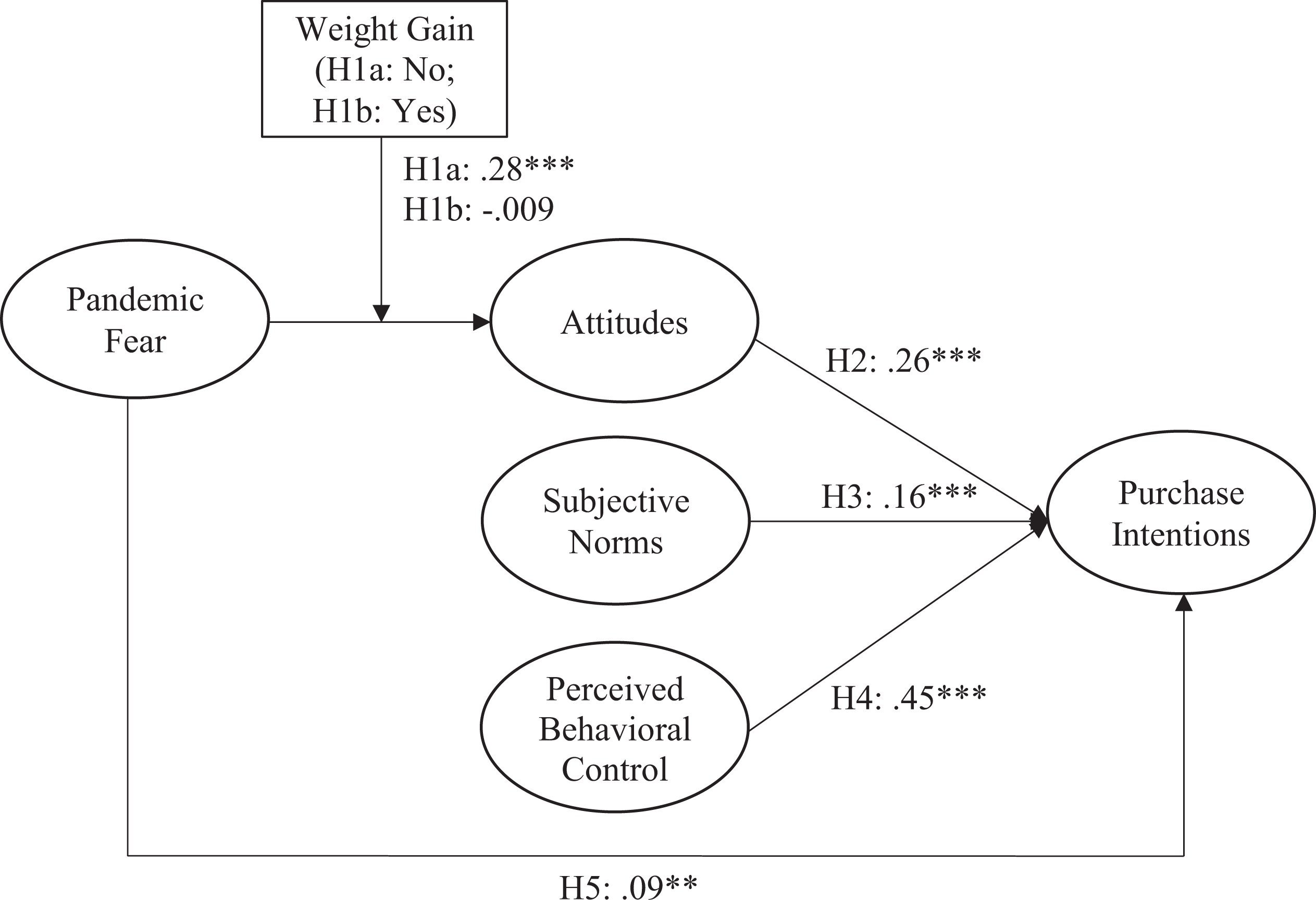
Research model of overweight and obese adults’ decision-making process toward exercise apparel online and hypotheses testing results. Note. The standardized regression coefficient for each hypothesis was indicated. *p < .05. **p < .01. ***p < .001.
A structural equation model with a multiple group analysis was examined to test weight change’s moderating effects on the relation between pandemic fear and attitudes. A constrained model (measurement invariance across two groups: gained weight vs. did not gain weight) and a partial unconstrained multigroup model (leaving the path between pandemic fear and attitudes free) were compared to test H1. Both models’ fit was acceptable (Constrained model: χ2 = 702.55, df = 281, p = .000, CFI = .95, TLI = .95, RMSEA = .08, SRMR = .06; partial unconstrained model: χ2 = 694.37, df = 280, p = .000, CFI = .96, TLI = .95, RMSEA = .08, SRMR = .03) The Chi-squared difference, ▵χ2 = 8.18, ▵df = 1, p = .004, showed that the relation between pandemic fear and attitudes differed significantly between those who gained weight during the pandemic and those who did not, which supported H1. Specifically, looking at pandemic fear’s conditional effect on attitudes depending on weight gain during the pandemic, pandemic fear on the part of those who did not gain weight was related positively to attitudes toward purchasing exercise apparel online (b = .28, SE = .06, t = 4.86, p = .000), which supported H1a. In contrast, pandemic fear had no significant effect on attitudes toward purchasing exercise apparel online on the part of those who gained weight during the pandemic (b = −.009, SE = .07, t = −.13, p = .89), supporting H1b.
Further, a univariate ANOVA with planned contrasts was performed to compare the means between groups (i.e., pandemic fear: high vs. low; weight gain: no vs. yes) on attitudes toward purchasing exercise apparel online. The pandemic fear groups were divided into two groups depending on the mean value of three items (M = 4.62). Weight gain was coded as a dummy variable (1 = no, 2 = yes). As shown in Table 2, the main effects of pandemic fear, F(1, 504) = 7.61, p = .006, and weight gain, F(1, 504) = 5.76, p = .02, on attitudes were all significant. Further, there was a significant interaction effect of pandemic fear and weight gain on attitudes, F(1, 504) = 4.91, p = .03. To better understand the interaction effect, the simple main effects of pandemic fear for two weight gain groups were examined using a one-way ANOVA with planned contrasts. The attitudes toward purchasing exercise apparel online among respondents who did not gain weight during the pandemic were more favorable for those with greater pandemic fear than those with less pandemic fear (M lowpandemicfear = 4.47, M highpandemicfear = 5.16, p = .000). However, among respondents who gained weight during the pandemic, there was no significant effect of pandemic fear on attitude toward purchasing exercise apparel online (M lowpandemicfear = 4.44, M highpandemicfear = 4.52, p = .71).
Mean Values and ANOVA Results for the Effects of Pandemic Fear and Weight Gain on Attitude.

Note. M = mean; SD = standard deviation.
A PROCESS analysis with the bootstrap method (Preacher & Hayes, 2008) was employed using model 7 to test the moderated mediation effect of weight gain on the purchase decision process. Hayes (2015) recommended the bootstrap confidence interval to explain the index of moderated mediation that quantifies the relation between the indirect effect and the moderator directly. Pandemic fear served as the independent variable, attitudes as the mediator, and weight gain as the moderator between the independent variable and the mediator. The dependent variable was purchase intentions. The results showed that weight gain had a significant moderated mediation effect between pandemic fear and purchase intentions through attitudes (index = −.15, −.26 < CI < −.05).
Pandemic fear’s direct and indirect effects on online purchase intentions through attitudes were tested to enhance our understanding of the results (see Table 3). A mediated moderation analysis using PROCESS showed a significant direct effect of pandemic fear on intentions to purchase exercise apparel online (.04 < CI < .17). This indicates that participants with greater pandemic fear were likely to have greater intentions to purchase exercise apparel online. Further, the results showed conditional indirect effects of pandemic fear on online purchase intentions through attitudes depending upon whether the participants had gained weight during the pandemic. Those who did not gain weight during the pandemic were likely to have more positive attitudes toward purchasing exercise apparel online, which consequently increased their intentions to do so (.08 < CI < .22). However, the attitudes and online purchase intentions of those who did gain weight during the pandemic did not increase as their pandemic fear increased (−.09 < CI < .07).
Direct and Indirect Effects of Pandemic Fear on Purchase Intentions Through Attitude.

Discussion and Conclusions
The results of this study provide empirical support to explain whether pandemic fear and weight gain influence overweight and obese consumers to purchase exercise apparel online. Considering the overweight and obese population faces significant impediments to shopping for exercise apparel online because of their negative experiences in finding a good fit, correct size, and varied options (e.g., Greenleaf et al., 2020), this study investigated whether pandemic-related factors, pandemic fear and weight gain, played roles in increasing online sales for exercise apparel. In the study, pandemic fear and weight gain during the pandemic were considered important factors that predicted the decision to purchase exercise apparel online. Further, based on the TPB, attitudes, subjective norms, and perceived behavioral control were confirmed to predict the intentions to purchase exercise apparel online.
The findings supported the research hypotheses that pandemic fear is or is not an important determinant of overweight and obese consumers’ decisions to purchase exercise apparel online depending on their weight gain. The results further suggested that success in weight management strengthened the positive effect of pandemic fear on attitude toward purchasing exercise apparel online, which subsequently increased their online purchase intentions. It is likely that those who did not gain weight during the pandemic are concerned about their health and therefore are aware of the risks of becoming infected by the virus. However, pandemic fear’s effect on the attitude toward purchasing exercise apparel online among overweight and obese consumers who have gained weight during the pandemic was not significant. Potential reasons for gaining weight during the pandemic include forced inactivity and altered eating habits (Khan & Smith, 2020), more hours of sleep per night, and less time for physical activity (Zachary et al., 2020). The results can be explained using self-discrepancy theory (Higgins, 1987), suggesting that because of the weight gain during the pandemic, their body image self-discrepancies may have increased. This negative body image diminishes online purchase intentions because of body dissatisfaction and difficulties imagining the fit and size of garments available when shopping online (Kim & Damhorst, 2010).
This study tested TPB in the context of overweight and obese American adults who do or do not purchase exercise apparel online. As the TPB proposes, attitudes toward purchasing exercise apparel online, subjective norms, and perceived behavioral control were related positively to the intentions to purchase exercise apparel online. This is consistent with the results of previous studies related to counterfeit products (Kim & Karpova, 2010). However, in the context of shopping for exercise apparel online, perceived behavioral control was found to be the most important predictor of purchase intentions, followed by attitudes. For example, if overweight and obese consumers find more resources (i.e., color, design, and size options in exercise apparel) and opportunities (i.e., promotions) available online, they are likely to have greater purchase intentions than do those who find fewer resources and opportunities.
Subjective norms appeared to be the least important predictor of intentions to purchase exercise apparel online. That is, others’ social pressure had least impact on intentions to purchase exercise apparel online. This is inconsistent with previous studies that found a strong effect of subjective norms on purchase intentions in the context of counterfeit products (Kim & Karpova, 2010) and sustainable cotton-made collegiate apparel (Chi et al., 2019).
Theoretical and Managerial Implications
This study contributes to the literature on pandemic fear’s effects on online purchase decisions depending on weight gain. In recent studies, researchers have focused heavily on pandemic fear’s effects in the health area (e.g., Cawcutt et al., 2020). This study showed that pandemic fear can be a significant predictor of overweight and obese consumers’ decision to purchase online as well. The study also provides insights to the way weight gain influences the effects of pandemic fear on online purchase decisions.
This study revealed that two pandemic-related factors (i.e., pandemic fear and weight gain) can explain intentions to purchase online through positive attitudes toward purchasing exercise apparel online. Thus, it is important for online retailers to enhance their customers’ positive attitudes toward shopping for exercise apparel online, as it also increased purchase intentions. To appeal to consumers with high pandemic fear, online retailers may want to consider including descriptions about the way they manage their stock with extra care. For example, they may want to include statements in their product descriptions that they deliver exercise apparel packed well and without direct human contact, which emphasizes their responsible business practices and eventually alleviates consumers’ fear during the pandemic. Further, because perceived behavioral control was the strongest predictor of purchase intentions, online retailers may want to promote that their exercise apparel is available exclusively online by using an “online-only” tag to show greater availability and variety in colors, sizes, and designs.
It is likely that overweight and obese consumers who gained weight during the pandemic, compared to their counterparts, are less confident about purchasing products online because of the increased self-discrepancies between their actual and ideal body image. This can intensify the impediment to shopping online, in which they cannot try on garments before purchase. Many previous studies have found that larger women had negative experiences purchasing exercise apparel because of insufficient sizes and improper fit (e.g., Greenleaf et al., 2020). Shim and Lee (2011) found that using 3D virtual models significantly reduced the perceived risk about four apparel attributes (i.e., silhouette, color, texture, and fit). For example, when individuals were exposed to images that represented their actual body shape, they were likely to perceive lower risk (Shim & Lee, 2011). Online retailers should consider adopting an external platform, such as Style.me, to serve as a virtual fitting room that allows consumers to try on clothes on their personalized 3D model, which will consequently increase their confidence in purchasing exercise apparel online.
A theoretical contribution to the TPB (Ajzen, 1991) is the extension of the theory by including pandemic-related factors in the context of overweight and obese adults’ shopping for exercise apparel online. As the theory proposes, empirical support was found for the positive relations among attitudes, perceived behavioral control, subjective norms, and purchase intentions. Further, this study was an initial attempt to understand overweight and obese adults’ behavioral decisions to purchase exercise apparel online during the pandemic.
Limitations and Future Research
This study used a national sample; however, the sample was not representative of all overweight and obese adults in the U.S. Thus, the findings should be generalized with caution. Future studies may include a more heterogeneous sample with respect to age, ethnicity, income, and geographic location to increase the ability to generalize the findings. Because perceived behavioral control was the most influential predictor of intentions to purchase exercise apparel online, future researchers could focus on determining antecedents that increase perceived behavioral control. Given that the topic is timely, but still relevant post-pandemic, future research may examine the way overweight and obese consumers’ perceived pandemic fear and weight gain can provoke intentions to purchase different apparel product categories online. Further, future research may explore overweight and obese adults’ needs for exercise apparel qualitatively through interviews and incorporate those needs into the research model using the TPB’s variables. Lastly, this study included overweight and obese consumers’ online purchase intentions based on the TPB. Future research may include actual buying behavior as a final outcome.
Supplemental Material
Supplemental Material, sj-docx-1-ctr-10.1177_0887302X211004892 - Pandemic Fear and Weight Gain: Effects on Overweight and Obese Adults’ Purchasing Exercise Apparel Online
Supplemental Material, sj-docx-1-ctr-10.1177_0887302X211004892 for Pandemic Fear and Weight Gain: Effects on Overweight and Obese Adults’ Purchasing Exercise Apparel Online by Eonyou Shin in Clothing and Textiles Research Journal
Footnotes
Declaration of Conflicting Interests
The author(s) declared no potential conflicts of interest with respect to the research, authorship, and/or publication of this article.
Funding
The author(s) received no financial support for the research, authorship, and/or publication of this article.

Supplemental Material
The supplemental material for this article is available online.
References
Supplementary Material
Please find the following supplemental material available below.
For Open Access articles published under a Creative Commons License, all supplemental material carries the same license as the article it is associated with.
For non-Open Access articles published, all supplemental material carries a non-exclusive license, and permission requests for re-use of supplemental material or any part of supplemental material shall be sent directly to the copyright owner as specified in the copyright notice associated with the article.
