



Abstract
The purpose of this study is to examine the effects of the “virtual try-on” technology (AR) and the “3D virtual store” (VR) incorporated in an apparel retail website on purchase intentions. This study highlights the mediating role of cognitive elaboration in the process through which these technologies influence purchase intentions, and examines the way consumers’ shopping goals (searching vs. browsing) interact with the website technology and influence their responses. The two experiments demonstrated that, for browsers, the website with VR was more effective in increasing purchase intentions than were the website with AR or a regular website with no technology, while for searchers, both the website with AR and the website with VR were more effective than was a regular website. In addition, cognitive elaboration mediated the interaction between a technology and a shopping goal on purchase intentions for browsers, while such a mediating effect was not found in searchers.
Brands’ investments in digital technology and virtual experiences have become ever more important in the era of COVID-19 when consumers need to access more products/brands from their homes rather than physical stores (Lee, 2020). Many industry experts have emphasized consistently that “virtual” technology including augmented reality (AR) and virtual reality (VR) will be the key in the retail industry because it can provide highly interactive, personalized experiences in a virtual environment (Taylor, 2020) and place “…consumers in quasi-physical store conditions” (Donaldson, 2020).
In the apparel retail sector, VR, which typically uses a wearable device, allows apparel retailers to provide consumers with immersive virtual experiences, such as 3D virtual store tours and virtual fashion shows, by creating an interactive computer-generated experience within a simulated environment (Bonetti et al., 2018). Because of social distancing and safety protocols attributable to coronavirus, VR-based marketing strategies are predicted to become even more powerful tools to improve customer engagement and satisfaction (McDowell, 2020). While similar to VR, AR enhances/augments a physical real-world environment by adding virtual computer-generated information and allows retailers to improve the ability to visualize products (Flavián et al., 2019). For example, such apparel brands as Nike and Gap have used AR technology like “virtual try-on” to allow their customers to try on products virtually by displaying product images on the customers’ reflections through the website or a mobile app.
Although the apparel industry is one of the leading sectors that have integrated AR/VR technology into the retail environment (IDC, 2019), there is a paucity of research on AR and VR’s practical applications in apparel retailing and their effects on behavioral outcomes. Further, little research has delineated clearly between the two applications in apparel retailing, which has created some theoretical confusion about what these “virtual” technologies mean for apparel retailing, and how they can be compared with respect to their influence on consumers’ responses. Researchers have also claimed that AR is a superior tool to VR in the online retail environment, as it provides more concrete product information and leads to product examinations and purchases (Verhagen et al., 2014; Yim et al., 2017). However, previous research has not investigated such a speculation. To the best of our knowledge, this study is the first to demonstrate the different effects that AR and VR have on consumer experiences in the online apparel retail context.
In exploration of these technologies, this research focuses on a specific AR technology (i.e., “virtual try-on”) and a VR technology (i.e., a 3D virtual store) and investigates each technology’s effect on consumers’ purchase intentions. Drawing from the literature in the area of virtual experience, interactive technology, and consumer shopping goals, this study examines the mediating role of cognitive elaboration in the process through which these technologies influence purchase intentions. It further examines the way consumers’ different shopping goals (searching vs. browsing) interact with the website technology and influence their purchase intentions.
Literature Review and Hypotheses Development
Virtual Try-on (AR) and a 3D Virtual Store (VR) in Online Apparel Retail
Milgram et al. (1994) developed the Reality-Virtuality Continuum to explain the difference between AR and VR. On this continuum, which spans the completely real environment (reality) and the completely virtual environment (virtuality), VR is positioned at the virtuality end, while AR is located somewhere between the ends. That is, AR generates a “mixed reality” in which physical and digital objects co-exist and interact in real time by combining a physical environment with virtual objects, such as text, pictures, and animation (Scholz & Smith, 2016).
Thus, VR isolates users from the real physical environment and immerses them in a virtual environment, while AR combines the real environment with computer-generated information (Flavián et al., 2019).
It has been predicted that AR and VR will generate $105 billion in revenue globally by 2022 (Digi-Capital, 2019), and the consumer goods and retail industry will become their largest markets (Murray, 2018). In online apparel retailing, one of the most popular applications of AR is virtual try-on, sometimes referred to as a “magic mirror,” which allows consumers to try on the product virtually via a mobile app or their own computer screen (Scholz & Smith, 2016). By overlaying a computer-generated product image (AR content) with a consumer’s reflection (targeted environment), this technology allows consumers to view themselves augmented by computer-generated product images as if they had actually put on the clothes. Several apparel retailers, such as ASOS and Gucci, have introduced the virtual try-on technology to offer a new way of viewing and trying on their products (Taylor, 2020).
Compared to AR, apparel retailers have used VR relatively less widely. One reason for this slow adoption may be that VR requires the consumer to use a head-mounted display (HMD) for a fully immersive experience. Among several different applications of VR technology in the apparel retailing area, including virtual fashion shows and virtual 3D avatars, this study focuses on a 3D virtual store, in which consumers walk into the brand’s retail store that displays products in a virtual environment. For a virtual store to work seamlessly, the 3D virtual store needs to be connected to an e-commerce site so that consumers are able to click on products in the virtual environment and examine the product details further or make a purchase. While some retailers like Walmart and Amazon have experimented with this seamless virtual store concept for their selective product collections (Morgan, 2018), it has been implemented only to a limited extent. Rather, retailers have created virtual stores to provide a virtual tour of their flagship stores or other virtual locations to immerse consumers in a brand-themed, entertaining experience (Ferere, 2020).
The Effect of Virtual Technologies on Cognitive Elaboration and Purchase Intentions
Cognitive elaboration is defined as the degree to which consumers think critically about, or process, new information cognitively (Chow & Luk, 2006). The theories of virtual experience proposed by many scholars claim that the controls and manipulation of the content in a mediated environment can trigger more active cognitive elaboration and develop concrete mental imagery (Choi & Taylor, 2014; Collins et al., 1988; Li et al., 2003). That is, interactive technology in the online environment requires consumers to engage in active user control and two-way communication (e.g., making choices in exploring a product), thereby increasing the likelihood of elaborative processing (Lee, 2012). Interactive product presentation technology may also enhance the availability of previously stored information in the consumer’s memory, which can stimulate product-relevant thoughts and cognitive elaboration of information (Flavián et al., 2017). In the context of online apparel product examination, virtual try-on allows consumers to modify the product image by overlaying it on the consumers’ own reflection. This interactivity may trigger active cognitive activities by helping them evaluate product information more critically (Li et al., 2003). Further, persuasion scholars argue that stimuli that provide more concrete information with attributes that are easier to imagine have greater influence on cognitive elaboration than do stimuli that do not provide such information or those that draw one’s attention away from the most relevant information (Kelley, 1989; Riddle, 2014).
Based on these theoretical arguments, we expect that virtual try-on may lead to greater cognitive elaboration compared to static pictures of a product or a 3D virtual store that has a limited capability to demonstrate product information (i.e., a 3D virtual store does display products but consumers cannot interact with products), since it can provide product information in a more interactive and concrete manner. Moreover, when product information is presented with virtual try-on in such a way that consumers can see themselves putting on the item, it may increase the consumer’s ability to image the product attributes thereby increasing cognitive elaboration on the product information, compared to when product information is presented without such technology. Thus, we propose the following hypothesis.
In addition, prior research has indicated that virtual try-on is an effective e-commerce tool that elicits positive behavioral responses, such as purchase intentions and brand relationships (Baytar et al., 2020; Kang, 2014). Researchers have found that virtual try-on increases perceptual curiosity about the product, thereby increasing purchase intentions (Beck & Crié, 2018) and product involvement and attitude (Jin & Bolebruch, 2009). Previous research provides empirical evidence that virtual try-on elicits stronger mediating variables, such as self-referencing, immersion, and media usefulness, as compared to a website without such technology (Huang, 2019, Yim et al., 2017). Yim et al. (2017) claim that AR (virtual try-on) is a more powerful tool than VR (3D virtual store) because it enhances consumers’ understanding of products by displaying products on images of consumers’ own features (vs. a 3D virtual store that generates the image of the entire real life setting). Thus, we hypothesize that virtual try-on technology leads to greater purchase intentions than does a website with a 3D virtual store or a website with static product pictures.
Shopping Goals and Website Technology
While virtual try-on may evoke greater cognitive elaboration and purchase intentions on the part of consumers than may a 3D virtual store and static pictures, this hypothesis will only be true when consumers visit the website to seek product information actively. When consumers lack the motivation to look for product information and simply want to browse the website with no specific goal in mind, virtual try-on may not necessarily lead to greater behavioral outcomes compared to a 3D virtual store and static pictures, as virtual try-on focusing on a deep product evaluation does not support their shopping goal. Rather, such consumers’ browsing is more exploratory and reflects recreational behavior (Hoffman & Novak, 1996), and relies more on other features of the website, such as a 3D virtual store.
Previous research has shown that consumers’ website visits may be either goal-directed (searching) or exploratory (browsing; Scarpi et al., 2014). Consumers in the search mode are goal-directed, have a planned purchase in mind, and are motivated to undertake a specific task to achieve their goal. Given that their concretely-defined goal is purchasing a product, they are likely to go through a highly-involved and deliberate process to acquire relevant product information to make the best decision (Moe, 2002). On the other hand, consumers in the browsing mode are less deliberate and are not necessarily seeking specific information. Rather, these consumers are looking for something new or interesting, and tend to be more stimulus-driven (Moe, 2002). Researchers have revealed that these two different shopping goals change consumers’ perceptions and website evaluations (Thielsch et al., 2014).
Several researchers have investigated searchers versus browsers’ online behavior and examined its relations with website features and behavioral outcomes. For example, Schlosser et al. (2006) found that searchers focused more on the retailer’s ability to perform its job (vs. non-performance-related qualities, such as benevolence), and consequently, their belief about the retailer’s ability (vs. belief about benevolence) was related positively to their purchase intentions. On the other hand, browsers focused more on their personal experience with the retailer, such as benevolence, and their belief about the retailer’s benevolence (vs. belief about ability) was related positively to their purchase intentions. Their findings suggest that distinguishing between consumers’ shopping goals has important implications for the relative effect of consumers’ perceptions of the retailer on purchase intentions. Based on the transactional theory that distinguishes between an efferent stance (i.e., concentrating on the information) and an aesthetic one (i.e., focusing on other aspects of the text) to reading a text, Schlosser (2003) argued that searchers and browsers behave and interact with the retailer’s website differently. When the website design matches the consumer’s shopping goal (searching vs. browsing), it results in more favorable attitudes. Through a series of experiments, she found that an interactively-designed retail website led to more favorable attitudes on the part of those who browsed the website for entertainment, while the text-based website led to more favorable attitudes on the part of those who searched for specific information on the website. Her findings indicate that the congruency between website design and the consumers’ shopping goals can have positive effects on behavioral outcomes.
In the context of this research, when consumers are in the search mode, virtual try-on may lead to greater purchase intentions than a 3D virtual store or static pictures, because searchers are motivated by a deep product evaluation that virtual try-on can enhance (Huang, 2019; Kang, 2014; Yim et al., 2017). Conversely, when consumers are in a browsing mode, a 3D virtual store may lead to greater purchase intentions than virtual try-on or static pictures because browsers like to explore new stimuli on the website like a 3D virtual store with hedonic motives. The experiential nature of a 3D virtual apparel store (e.g., enjoyment, pleasure, emotional and sensory experiences) and its positive effect on behavioral outcomes like purchase intentions have been demonstrated in prior research (Baek et al., 2020; Domina et al., 2012; Park et al., 2018). Thus, the effect of the type of technology (virtual try-on vs. a 3D virtual store vs. static pictures) on purchase intentions may be contingent upon consumers’ shopping goals (searching vs. browsing).
The Mediating Effect of Cognitive Elaboration
Researchers have revealed that cognitive elaboration is a critical mediator between information processing and attitudinal judgment (Keller & McGill, 1994; MacKenzie, 1986; Roggeveen et al., 2015). When consumers’ shopping goals are concerned, whether seeking specific information or simply browsing, both shopping goals require focused attention (Rosenblatt, 1965). Thus, when a retail environment supports the consumer’s goal, it is reasonable to assume that its relevancy to the shopping goal should support cognitive elaboration. Further, when product information is displayed in such a way that it is congruent with the consumer’s shopping goal, cognitive elaboration should result in favorable attitudes leading to purchase intentions (McGill & Anand, 1989).
Specifically, Schlosser (2003) has indicated that cognitive elaboration mediates the interactive effect of website and shopping goal on product attitudes. She found that participants in her experiment listed more thoughts when the website matched their shopping goals, and that the number of thoughts was significantly related to product attitudes. In the related vein, prior research has also demonstrated that when consumers experience congruence between their perception toward a product and its display, the product category knowledge can be more readily activated (Lam et al., 2017). As such, the congruence effect positively affects consumers’ cognitive response that comprises product attribute thoughts and product evaluation subsequently (Lam et al., 2017). As cognitive elaboration increases, individuals inspect thoroughly all information that is relevant to a product and thus hold greater purchase intentions (Grimmer & Bingham, 2013). Based on these theoretical arguments, we hypothesize that cognitive elaboration mediates the interaction effect between website technologies and shopping goals on purchase intentions.
Study 1
In Study 1, we tested whether virtual try-on leads to greater cognitive elaboration (H1a) and greater purchase intentions (H1b) than do 3D virtual stores and static pictures. A one-factor (technologies: virtual try-on, a 3D virtual store, and static pictures) between-subjects design was used.
Methods
Stimuli development and partipants
The mock e-commerce websites were developed using a web content management system, Wordpress. To control for possible confounding variables related to an existing brand, we developed a mock women’s apparel retail brand named Elatic and created three experimental websites. The first website offers virtual try-on technology and participants could virtually try on the apparel products by overlaying the product’s image on their own reflection using a webcam. The second website offers users the opportunities to walk through the 3D version of Elatic’s physical store while navigating on different hot spots to move around the space and observing apparel products. The 3D virtual store was modeled in a 3D modeling program, Sketchup, and rendered in a VR plugin, Enscape. The third website contains static pictures and text as product presentations. All other website features including product images and descriptions, layouts, and product options remained consistent across the three experimental conditions. The major differences among the websites were the visual form and website technologies over the shopping experience.
A total of 404 U.S. consumers were recruited from a national consumer panel of an online market research firm. The largest number of participants (27.2%) were aged 31–40, followed by 41–50 (18.8%), 51–60 (18.8%), and 61–70 (17.8%). Over 76% of the participants were Caucasians, followed by African Americans (13.4%), Hispanics (4.5%), Asians (4.2%), and other (1.4%). We randomly assigned the participants to one of the three conditions: virtual try-on (n = 124), a 3D virtual store (n = 141), and static pictures (n = 139). After the participants explored the website technology thoroughly, they completed a questionnaire that included dependent measures, a manipulation check, and demographic questions.
Measures
Cognitive elaboration was measured by four statements with responses on a 7-point Likert scale (1 = strongly disagree, 7 = strongly agree; Wilcox et al., 2011). Participants indicated their agreement with each of the following statements: “Product description on this website is informative,” “This website provides features to help me think in depth about the apparel product,” “This website includes features that help me concentrate on the apparel product,” and “This website includes features to help me focus on the apparel product.” The four items were averaged to form an index of cognitive elaboration (Cronbach’s α = .93). Purchase intentions were measured by three items with responses on a 7-point semantic differential scale (unlikely/likely, impossible/possible, and improbable/probable; Merle et al., 2012): “For style similar to those on this website, the likelihood that I would buy the apparel product is…” The three items were averaged to form an index of purchase intentions (Cronbach’s α = .97).
Results
Cognitive elaboration
The results of a one-way ANOVA indicated that cognitive elaboration differed significantly across different website technologies, F(2, 401) = 9.25 p = .00. Further, Bonferroni multiple comparison tests showed that the respondents in the virtual try-on condition demonstrated significantly higher cognitive elaboration than did those in the 3D virtual store and static pictures conditions (M virtual try-on = 4.88, M3D store = 4.26, M static picture = 3.75, p = .03). Thus, H1a was supported.
Purchase intentions
The results of a one-way ANOVA showed that purchase intentions differed significantly across different website technologies, F(2, 401) = 14.53, p = .00. Bonferroni multiple comparison tests showed that respondents in the virtual try-on condition had significantly greater purchase intentions than did those in the 3D virtual store condition (M virtual try-on = 5.03, M 3D store = 4.02, p = .00). Further, respondents in the virtual try-on condition showed significantly greater purchase intentions than did those in the static pictures condition (M virtual try-on = 5.03, M static picture = 3.80, p = .00). However, we found no significant difference in purchase intentions between the 3D virtual store and static pictures conditions (M 3D store= 4.02, M static picture = 3.80, p = 1.00). Thus, H1b was supported.
Study 2
The objectives of Study 2 were twofold. First, we tested H1 in a more controlled lab environment to minimize potential confounding factors related to an online experiment and increase internal validity. Although the online experiment with a national sample in Study 1 provided greater external validity, it had weaker experimental controls with respect to the way the research participants actually followed the experimental instructions. Besides, in Study 2, participants explored the 3D virtual store in a fully immersive environment using a head-mounted display (VTC Vive HMD systems) provided in the lab, whereas participants in Study 1 simply watched the 3D virtual store by clicking a video on the computer screen. Second, we examined the moderating role of shopping goals in the effect of website technologies on purchase intentions (H2), and tested cognitive elaboration as a mediator between shopping goals and website technologies (H3). We employed a 2 (shopping goals: browsing vs. searching) X 3 (website technologies: virtual try-on vs. a 3D virtual store. vs. static pictures) between-subjects design to test the proposed hypotheses.
Methods
Participants and procedure
A total of 196 female students from a large Southwestern U.S. university participated in exchange for a $10 cash incentive. A student sample is suitable for experimental studies because it is viewed as a homogeneous group and reduces random sampling error (Peterson, 2001). The average age of the participants was 20.2 years. The largest group (67%) of the participants were Caucasians, followed by Asians (9.8%), Hispanics (8.8%), Native Americans (7.7%), other (4.6%), and African Americans (1.0%).
When the participants arrived at the lab, we assigned them randomly to one of six experimental conditions: Browsing/virtual try-on (n = 34); searching/virtual try-on (n = 33); browsing/a 3D virtual store (n = 33); searching/a 3D virtual store (n = 34); browsing/static pictures (n = 32); and searching/static pictures (n = 30). The number of participants in each session did not exceed five, and their seats in a large computer lab were assigned apart so the participant was not distracted by other participants during the experiment. After the participant was seated, the researcher individually ensured each participant to explore the assigned technology during the experiment and briefly explained how to use it. Further, the participants were provided a separate, written set of instructions on the way to use the assigned technology, and received additional help from a lab assistant when they needed.
To prime shopping goals, we asked participants to read scenarios that Schlosser (2003) developed and validated to prime different shopping goals that described either a browsing or searching goal. The following scenario was presented in the browsing condition: “You have recently discovered the apparel retail brand named ELATIC. You will now visit ELATIC’s website just to have fun. Look at whatever you consider interesting and/or entertaining. You have 10 minutes to complete this activity.” In the searching condition, the following scenario was displayed: “You have recently discovered the apparel retail brand named ELATIC. You will now visit ELATIC’s website with the goal of efficiently finding something specific within the website. You have 10 minutes to complete this activity.” Next, they were provided with a URL link to one of the experimental websites and were allowed to explore one of the website technologies (virtual try-on, a 3D virtual store, and static pictures). Thereafter, the participants completed a questionnaire that included the dependent measures, a manipulation check, and demographic questions.
Measures
We used the same measures as in Study 1 for cognitive elaboration (Cronbach’s α = .92) and purchase intentions (Cronbach’s α = .88). The shopping goal manipulation was assessed with two 7-point bipolar scale items that asked how they described their shopping goal: “searching/just browsing” and “finding specific information/having fun and looking at whatever I consider interesting or entertaining” (Schlosser, 2003). Product involvement, which was used as a covariate, was measured by four items with responses on a 7-point Likert scale: “The apparel products on this website are interesting/exciting/appealing/involving to me” (Coyle & Thorson, 2001).
Results
Manipulation check
To assess the manipulation check for shopping goals, we performed an independent samples t-test. The results confirmed that participants in the searching condition perceived that their shopping goals were related to searching and finding specific information to a greater extent than those in the browsing condition (M searching = 3.93, M browsing = 4.80, t = 3.83, p = .00). Thus, the shopping goals manipulation was successful.
Purchase intentions
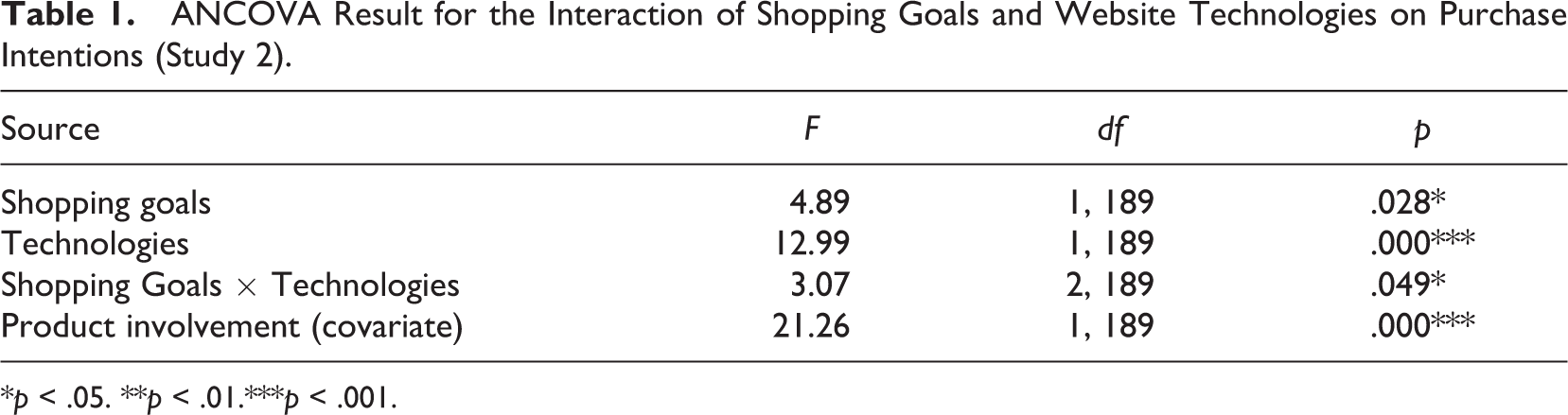
We performed a 2 (shopping goals: browsing vs. searching) × 3 (website technologies: virtual try-on vs. a 3D virtual store vs. static pictures) ANCOVA with purchase intentions as the dependent variable. Product involvement served as a covariate to assess possible bias that can occur from the participants’ purchase intentions, F(1, 189) = 21.26, p = .049. As Table 1 shows, we found significant main effects of shopping goals, F(1, 189) = 4.89, p = .028, and website technologies, F (1, 189) = 12.99, p = .00, on purchase intentions, which supported H1. In addition, we obtained a significant two-way interaction effect between shopping goals and website technologies on purchase intentions, F(2, 189) = 3.07, p = .049). Planned contrasts revealed that participants in the virtual try-on and 3D virtual store conditions reported greater purchase intentions than did those in the static pictures condition in the searching mode, M virtual try-on = 4.99, M 3D store = 5.00, M static picture = 4.15, F(2, 189) = 4.33, p = .02. However, no significant difference emerged between virtual try-on and a 3D virtual store (p = .97). Accordingly, H2a was partially supported. In the browsing condition, participants in the 3D virtual store condition reported greater purchase intentions than did those in the virtual try-on and static pictures conditions, M virtual try-on = 4.90, M 3D store = 5.92, M static picture = 3.66, F(2, 189) = 11.64, p = .00. Specifically, a 3D virtual store evoked greater purchase intentions than did virtual try-on (p = .001) and static pictures (p = .00), but there was no significant difference between virtual try-on and static pictures (p = .24) in the browsing condition (see Figure 1). Thus, H2b was supported.
ANCOVA Result for the Interaction of Shopping Goals and Website Technologies on Purchase Intentions (Study 2).
*p < .05. **p < .01.***p < .001.

Effect of website technologies and shopping goals on purchase intentions.
In summary, both virtual try-on and a 3D virtual store were more effective shopping tools than were static pictures in enhancing purchase intentions when consumers had searching shopping goals. However, a 3D virtual store was more effective than were virtual try-on and static pictures when consumers intended to simply browse the website.
Moderated mediation
Moderated mediation, known as conditional indirect effect, was performed to test how the effect of an independent variable (i.e., website technologies) on a dependent variable (i.e., purchase intentions) via a mediator variable (i.e., cognitive elaboration) differs depending on the levels of a moderator variable (shopping goals; Preacher et al., 2007). We conducted a moderated mediation analysis with 5,000 bootstrapped samples using Model 8 of the PROCESS SPSS macro (Preacher & Hayes, 2004). Findings relevant to the mediating role of cognitive elaboration is shown in Figure 2.
Results from this analysis showed that under the browsing condition, website technologies affected cognitive elaboration positively (β = .31, p = .002), and in turn, cognitive elaboration predicted purchase intentions positively (β = .54, p = .00). Website technologies had a significant direct effect on purchase intentions (β = .33, p = .001) and a significant indirect effect when cognitive elaboration was included (β = .59, p = .00). On the other hand, in the searching condition, website technologies did not predict cognitive elaboration (β = .06, p = .57) while cognitive elaboration predicted purchase intentions positively (β = .50, p = .00). Website technologies had no significant direct effect on purchase intentions (β = −.14, p = .17), yet showed a significant indirect effect when cognitive elaboration was included (β = −.25, p = .01). Accordingly, we found that cognitive elaboration did not mediate website technologies’ effects on purchase intentions when consumers had a searching goal.
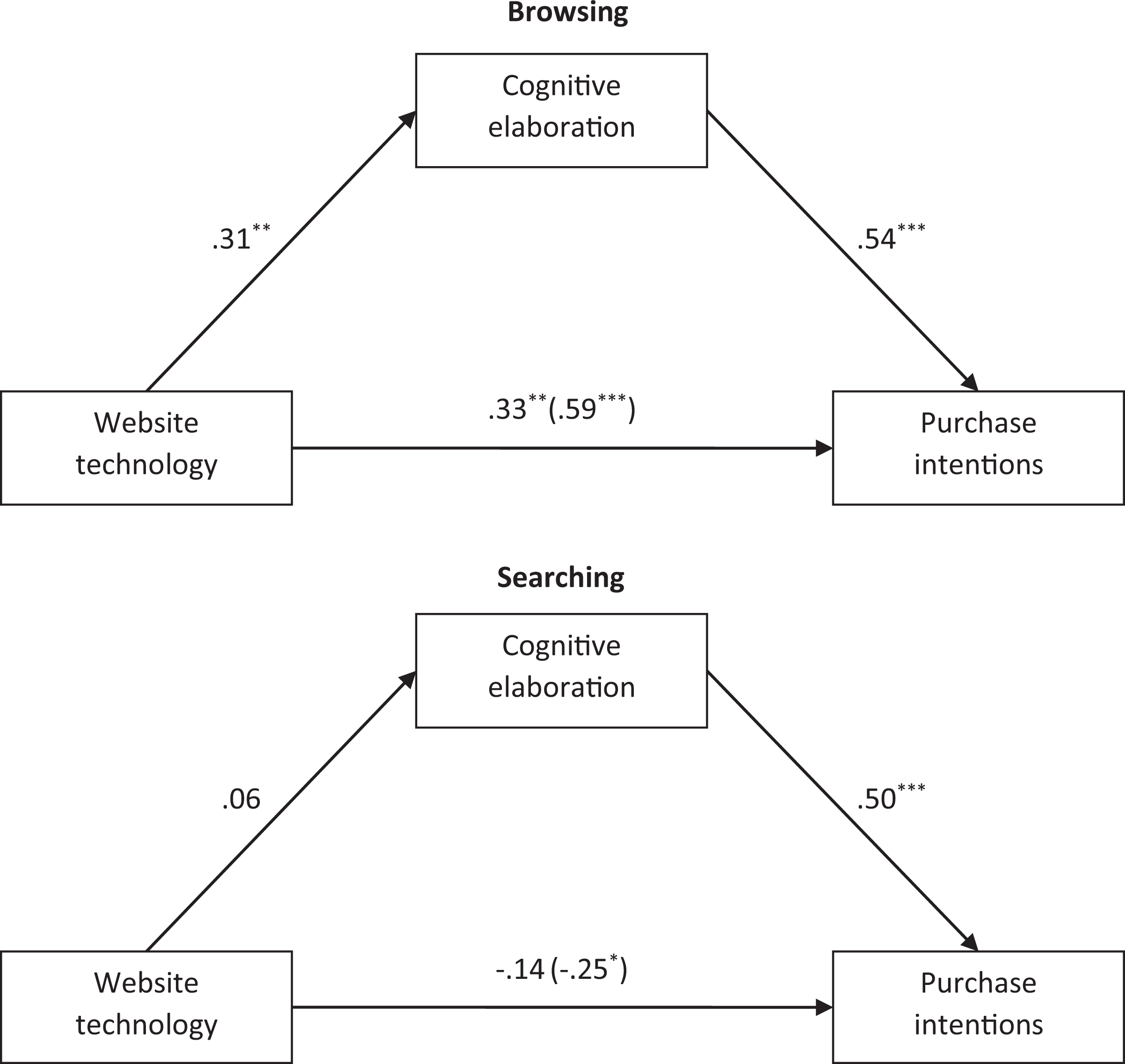
Moderated mediation model of cognitive elaboration: browsing versus searching. Note. Standardized coefficient values in parentheses indicate the effect of website technology on purchase intentions when controlling for cognitive elaboration. *p < .05. **p < .01. ***p < .001.
Specifically, the bootstrapping analysis showed that cognitive elaboration mediated website technologies’ conditional indirect effect on purchase intentions significantly when the shopping goal was browsing (B = .22, SE = .09, 95% CI [0.05, 0.41]), but not when it was searching (B = −.02, SE = .09, 95% CI [−0.21, 0.14]). A 95% confidence interval that does not include 0 confirms a significant mediation (Hayes, 2013). Accordingly, we found that cognitive elaboration mediated website technologies’ effects on purchase intentions fully when consumers had a browsing goal, but not when they had a searching goal. Thus, H3 was supported in part.
Discussion
This research sheds light on consumers’ experiences with three key website technologies, including virtual try-on, a 3D virtual store, and static pictures, by examining and comparing consumers’ responses to each technology. The two experiments demonstrated that, compared to a 3D virtual store and static pictures, virtual try-on led to greater cognitive elaboration and purchase intentions. Further, when consumers’ shopping goals are considered, a 3D virtual store was more effective in increasing purchase intentions than were virtual try-on and static pictures when consumers were in a browsing mode, while both virtual try-on and a 3D virtual store were more effective than were static pictures when consumers were in a searching mode. In addition, cognitive elaboration mediated the interaction between a specific technology and a shopping goal on purchase intentions for those consumers in a browsing mode, while such a mediating effect was not found in a searching mode.
Theoretical Implications
This research contributes to our understanding of the ways virtual try-on and a 3D virtual store influence consumers’ choices in the online retail environment. While both technologies are often referred to as “virtual” technology in consumer markets, virtual try-on and a 3D virtual store in the context of online apparel retailing differ clearly, both theoretically and practically, and exert different effects on consumers’ responses. Specifically, Study 1 showed that respondents who explored the apparel retail website with virtual try-on technology demonstrated significantly greater cognitive elaboration and purchase intentions than did those who explored the same website with a 3D virtual store technology or static product pictures. Study 2, which was conducted in a different setting with a different sample, replicated these results and also revealed virtual try-on’s stronger effect on behavioral outcomes.
Further, we attempted to make comparisons between virtual try-on and a 3D virtual store by adding a consumer’s shopping goal that may interact with website technology to influence purchase intentions. Based on the literature on shopping goals and virtual technologies, we hypothesized that virtual try-on would persuade searchers more than would a 3D virtual store and static pictures, while a 3D virtual store would persuade browsers more than would virtual try-on and static pictures. The matching effect between website technology and a shopping goal was clear in the browsing condition. Browsers who were primed to explore the website without looking for any specific information favored a 3D virtual store over virtual try-on or static pictures by exhibiting greater purchase intentions.
However, we found that searchers favored both virtual try-on and a 3D virtual store over static pictures. In other words, virtual try-on was more persuasive to searchers than were static pictures, but was not necessarily more effective than was a 3D virtual store in increasing their purchase intentions. One explanation for this result is that searchers are motivated to find every possible piece of information about the retailer, which may help them choose right products. In this respect, a 3D virtual store, which allows searchers to explore the brand’s physical store in an immersive environment in a way that is otherwise impossible, may be as persuasive as virtual try-on. By examining not only intrinsic cues inherent to products, but also extrinsic cues (e.g., store image, brand personality) that foster product evaluation (Forsythe et al., 1996), searchers may form favorable attitudes toward the retailer with a 3D virtual store as much as they would with virtual try-on. Taken together, the moderating effects of shopping goals found in this study indicate that incorporating virtual try-on and a 3D virtual store into e-commerce websites is more persuasive than is a website with no such virtual technology, regardless of the shopper’s goal. Nonetheless, a 3D virtual store was a more effective tool, particularly for those who simply browsed the website with no specific searching goals.
This research also advances our understanding of the mechanism underlying virtual try-on and a 3D virtual store’s effects on behavioral outcomes in the online retail environment. Cognitive elaboration’s mediating role between website technology and purchase intentions was found for browsers, but not searchers. First, for those who intended to simply browse the website, a 3D virtual store increased their cognitive elaboration, and ultimately their purchase intentions. This result is consistent with Roggeveen et al.’s (2015) research that examined a dynamic (vs. static) presentation format on a retail website. They found that, when the website presented product information in a dynamic format with video (vs. static format with pictures), more consumer chose the product in the dynamic format compared with the static format condition, mediated by consumers’ cognitive involvement.
Cognitive elaboration’s insignificant mediating effect in the searching condition was unexpected, as it is somewhat inconsistent with the results of previous research (Beck & Crié, 2018) that revealed the mediating role of perceptual curiosity about the product in the effect of virtual try-on on patronage intentions and purchase intentions. One explanation is that virtual try-on technology is not sufficiently sophisticated to engage searchers in cognitive elaboration. Because the current virtual try-on software relies on 2D product images that do not show the way the garment would actually fit on the three-dimensional body realistically (Krishna, 2017), this limitation may be a barrier to those who are motivated to examine products. In fact, recent research on virtual try-on revealed that consumers evaluated virtual try-on’s ability to display product performance and fit information significantly low compared to trying on actual garments (Baytar et al., 2020). However, this result may differ for other fashion product categories that can be visualized more realistically in a 3D environment, such as glasses and other accessories. Another explanation is that experiences with trying on clothes virtually may be associated more strongly with its hedonic than functional role, and thereby weaken virtual try-on’s effect on searchers’ cognitive elaboration. Previous research has found that, for apparel product virtualization technologies, such as virtual try-on using a 3D avatar, hedonic benefits were a stronger predictor of attitudes toward using it than were functional benefits (Kim & Forsythe, 2007). Thus, viewing themselves on the computer screen with product images may provide an essentially entertaining experience, rather than foster deep product evaluation that leads to greater cognitive elaboration.
Managerial Implications
This research has several important implications for online apparel retailers. First, the support we found for the hypotheses with respect to a 3D virtual store suggests that providing a 3D virtual store experience can increase consumer engagement and thus, purchase intentions, particularly on the part of those who visit the website with no specific goals in mind. Given apparel products’ hedonic nature, exploratory browsing behavior (vs. task-oriented searching behavior) may be fairly common among apparel shoppers (Kim & Forsythe, 2007). Our findings indicated that, although a 3D virtual store is not so technologically advanced that it allows shoppers to interact with products or make purchases, simply having them walk into the 3D store in an immersive environment alone can be an effective shopping tool that increases purchase intentions. There has been some skepticism about whether providing a 3D virtual store experiences that often focus on entertainment rather than product purchase can transform visitors into purchasers (Jiang, 2017). Our results provided empirical evidence that it actually can do so when shoppers are browsers. Further, our results suggested that a 3D virtual store may provide unique opportunities for online-only retailers that have limited customer touchpoints or small businesses that have difficulty reaching and expanding their markets. These retailers may consider setting up a 3D virtual store on their e-commerce websites that mimic their showrooms or physical stores so consumers can explore the virtual stores during their website visit. Offering a branded experience in a variety of formats (e.g., video, audio) within a virtual store environment can be a powerful tool that increases visitors’ attention and decision involvement, thereby increasing purchase intentions.
Another managerial implication of our findings is concerned with the insignificant moderating and mediating effects in the virtual try-on condition. It appears that searchers exhibited greater intentions to purchase from the retailer with virtual try-on (as well as a 3D virtual store) than they did from the retailer with no such technology; yet, cognitive elaboration did not necessarily mediate their increased purchase intentions. This result implies that virtual try-on may not be sufficiently persuasive to increase attention and decision involvement on the part of apparel shoppers who are task-oriented. It must be noted that visualizing clothes in virtual try-on software is more challenging than that of other fashion accessories, such as glasses and shoes, as the shape and dimensions of products with a soft surface vary depending on how they are put on a body (Krishna, 2017). Further, consumers’ need to evaluate a product’s fit on their body is the unique characteristic of clothes, and makes virtual try-on technology more challenging (Ryan, 2020). Indeed, virtual try-on technology has been actively used by several leading retailers for other product categories, such as glasses (e.g., Rayban, Warby Parker), cosmetics (e.g., MAC, NARS), and furniture (e.g., IKEA, Amazon). Recently, a few retailers like Amazon are investigating different ways to try on clothes virtually, such as creating a 3D model of the human body in motion and then dressing it in virtual clothes (Ong, 2018), which blurs the boundary between virtual try-on and a 3D virtual store. Whatever the format, overcoming the technological barriers in visualizing clothing products in virtual try-on appears to be a critical issue, as it may increase consumers’ engagement and attention, particularly among those who are eager to seek product information.
Limitations and Future Research
The findings of this study should be considered in light of its limitations. First, while our results demonstrated the interaction between a website technology and a shopping goal, the matching effect between the two variables was not supported fully. The moderating and mediating effects in the searching group may be further explored in future research by using different types of clothes (e.g., functional clothes) that require more cognitive evaluation or using a general sample (vs. college students, who may be more entertainment-oriented when shopping for apparel).
Another interesting direction for future research would be to compare existing, well-known apparel brands and new, unknown brands. It would be worthwhile to examine the way consumers’ pre-existing attitudes toward a familiar brand influence their experiences with virtual try-on and a 3D virtual store on the brand’s website. For example, consumers may form a more favorable attitude toward virtual try-on/a 3D virtual store for a new brand than they would for an existing brand with which they have experience. If they are familiar with the brand’s products (e.g., fit and sizing) and retail store, they may not be engaged with the brand’s virtual try-on and 3D virtual store as much as with a new brand. Taken together, future researchers are encouraged to examine different types of clothes and brands using various sample groups to generalize our findings beyond the scope of this study.
Footnotes
Declaration of Conflicting Interests
The author(s) declared no potential conflicts of interest with respect to the research, authorship, and/or publication of this article.
Funding
The author(s) disclosed receipt of the following financial support for the research, authorship, and/or publication of this article: This research project was funded by Research Project Grants in Humanities-, Arts-, and Design-based Disciplines at Oklahoma State University.