




Abstract
This study explores the relationship between the president, public opinion, and the media in regard to drug abuse policy in America from 1969 through 2004. The theory of presidential influence over public opinion is used to test the hypothesis that presidents influence public opinion of drug abuse. Using vector auto regression time-series analysis, the study finds that while presidents do not appear to influence the public directly, they influence the media which influences public opinion. These findings are different from previous findings regarding crime control policy, but are similar to past findings for drug policy. Reasons for these findings are discussed and future research proposed.
As I look over the problems in this country, I see one that stands out particularly: the problem of narcotics.
I think this is one of the gravest problems facing us internally in the United States.
We must return drugs to the center of our national agenda . . . as we battle a major, significant problem in America.
Presidential activity related to drug policy dates back to the passage of the Pure Food and Drug Act of 1906 and the Harrison Narcotics Act of 1914, but it was not until the presidency of Herbert Hoover that, drug enforcement would become part of the federal government’s administrative machinery resulting from the creation of the Bureau of Narcotics in 1930 (Courtwright, 2001; Friedman, 1993; Jonnes, 1996). Hoover’s successor, Franklin Delano Roosevelt, kept the enforcement level high, justifying his action by writing that narcotics were “an even more severe offense against society than murder itself” (Franklin Roosevelt, 1940). When the Bureau of Prohibition folded, it was absorbed into the Bureau of Narcotics headed by Harry Anslinger, and with pressure on Congress to pass the “Marihuana Tax Act of 1937,” a pseudo-war on marijuana commenced.
Presidential activity on drug abuse remained a part of the executive branch’s domestic policies through the next four presidents, before taking center-stage during the Nixon administration with America’s first, albeit short-lived, “war on drugs” (Bertram, Blachman, Sharpe, & Andreas, 1996; Goode, 1997; Jonnes, 1996; Walker, 2006). The next “war on drugs” came after some off-the-cuff remarks made by newly inaugurated President Ronald Reagan when asked by a reporter (Forrest Boyd) if the White House would have a policy on drug abuse (Reagan, 1982). 1 This answer would spawn the second “war on drugs,” Nancy Reagan’s “Just Say No” campaign, and place Vice-President Bush at the head of a drug-smuggling task force, who, after being elected president himself, would launch his own all-out “war on drugs” in 1989 (Bertram et al., 1996). More recently, as apparent from the epigraph, even after the events of 9/11, President George W. Bush reaffirmed America’s “war on drugs.”
There can be little doubt that presidents have increasingly focused their administrative efforts on the problems of illicit drugs in America (Jonnes, 1996; Marion, 1994a). Equally, there has been an increased focus on presidents and federal drug control policy by criminologists and other social scientists. The majority of this tends to be sociohistorical writing (Courtwright, 2001; Jonnes, 1996; Marion 1994b) or research that highlights the deficiencies in presidential policies related to the drug problem in America (Baum, 1996; Benavie, 2008; Bertram et al., 1996; Jensen & Gerber, 1998; Jensen, Gerber, & Mosher, 2004; Sharp, 1994). Some research has focused more specifically on presidential rhetoric regarding drug policy (Ellwood, 1994; Whitford & Yates, 2003, 2009) as well as the symbolic nature of that rhetoric (Jensen & Gerber, 1998), but very little has assessed the actual impact the president has on the drug policy process. In fact, only one study to date has attempted to analyze the president’s impact on public opinion and the media as it relates to the drug issue in a longitudinal analysis spanning the years 1984 to 1991 (Gonzenbach, 1996). Gonzenbach (1996) found that in the case of drug policy, the president was not the leader, but rather the follower—the follower of media attention to crime. These findings run counter to the theory that presidents influence public opinion/media (Cohen, 1997; Hinckley, 1990; Kernell, 2006) and previous research that has found support for this theory in the closely associated area of crime policy (Oliver, 1998, 2002, 2003).
In light of this discrepancy between theory and past research with Gozenbach’s findings, in addition to the fact there has been little research in the area of presidential influence as it relates to drug policy in America, this article proposes to address this gap in the literature. This study, drawing upon the theory that presidents influence public opinion, will test the hypothesis that presidents influence public opinion of drugs. It will do so through a longitudinal time-series regression analysis, specifically vector autoregression, spanning the years 1969 (the beginning of the first Nixon administration) through the end of 2004 (the end of G. W. Bush’s first term in office).
Presidents and Drug Policy
Every president since Hoover has put the issue of drugs on their agenda and has discussed drug policy to some extent. The first administration, however, to move it to the top of his agenda, was President Nixon, who discussed the drug problem more than any other president to date. He considered the drug problem to be the top domestic problem that concerned the American people (Nixon, 1973) and recognized the need for a concerted national strategy to battle drugs. His approach was threefold that is, stop it at the source, law enforcement to punish the pushers and the peddlers, and the treatment of people once they became addicts (Nixon, 1973). To stop drugs at the source, Nixon supported a program of international cooperation to destroy major criminal systems that imported and distributed narcotics and other dangerous drugs (Nixon, 1972). In terms of law enforcement, Nixon proposed new training for state and local officers (Nixon, 1970), stricter punishment for those who abused drugs, and a reorganization of agencies that dealt with drugs (Nixon, 1972). The new agency created was called the Drug Enforcement Agency (Nixon, 1974). Finally, in terms of treatment, Nixon supported treatment and rehabilitation for those who addicted to drugs.
President Ford’s approach to tackling the drug problem was similarly multifaceted. He sought to continue to provide treatment and rehabilitation programs (Ford, 1977). He supported a strong Drug Enforcement Administration to provide leadership in the fight against drug use, but at the same time supported international cooperation with foreign governments such as Mexico, Colombia, and Turkey (Ford, 1977). Besides that, Ford supported mandatory minimum prison sentences for people convicted of trafficking drugs (Ford, 1977), the right of a judge to deny bail to a defendant arrested for trafficking in drugs (Ford, 1977), and the forfeiture of any cash or property in the possession of a narcotics violate if the property was in connection with an illegal drug transaction (Ford, 1977).
The Carter administration was more focused on controlling the federal bureaucracy, to include the bureaucracy focused on drugs. Above and beyond that, Carter attempted to work with other countries to reduce drug importation to the United States. He sought to provide alternative crops for those countries that produced heroin and approached the United Nations to help stop drug trafficking (Carter, 1978).
President Reagan’s approach to the battle against drugs involved many different elements. His strategy focused on international cooperation, education, prevention, detoxification, treatment, and research (Reagan, 1983). He believed that the drug problem was an international one, and sought to eradicate drugs, wherever cultivated, processed, or transported (Reagan, 1983). He talked to the leaders of Mexico, Malaysia, and Thailand to discuss about drug abuse prevention (Reagan, 1987). Domestically, Reagan sought to expand public awareness and prevention (Reagan, 1983), and wanted to ensure that those abusing drugs had treatment available. One of Reagan’s goals was a drug-free workplace and drug-free schools for all Americans (Reagan, 1987). At the same time he sought to strengthen law enforcement. He asked Congress to pass tougher Federal penalties for drug trafficking (Reagan, 1983), and wanted to increase the number of judges, prosecutors, and law enforcement personnel to implement those new laws (Reagan, 1983). Of course, his most popular policy toward drugs was Nancy Reagan’s “Just Say No” to drugs and alcohol campaign (Reagan, 1987).
President H. W. Bush followed in Reagan’s footsteps in the battle against illicit drugs. He sought to combat drug abuse with education, treatment, enforcement, and interdiction. He proposed a quarter-of-a-billion-dollar increase in Federal funds for school and community prevention programs to help young people resist trying drugs (Bush, 1990). For those who were hooked on drugs, Bush wanted to expand treatment options (Bush, 1990). Bush supported a “zero tolerance” policy on drug use, which would enable judges to strictly apply the law on convicted drug offenders and provide severe sentences for dealers, increase Federal drug prosecutions, and result in increased prison sentences for drug-related crimes (Bush, 1990). He worked with leaders of Colombia, Laos, Argentina, Mexico, Spain, Bolivia, and Peru and the United Nation to control drugs (Bush, 1990).
President Clinton’s drug control strategy involved cutting off drugs at the source, stiffer punishments for drug dealers, more education, and prevention efforts to educate young people about drugs, and more treatment options. In 1997, he outlined his 5-point antidrug strategy. It included giving children the “straight facts” about drugs, a reduction in drug-related crime and violence, eliminating the social consequences of illegal drug use such as AIDS and HIV, working internationally to reduce drug importation, and reducing drug cultivation, production, and trafficking (Clinton, 1998). Clinton promised a stronger law enforcement effort, including 1,000 more Border Patrol agents and 100 new DEA agents who would use the latest technologies to reduce drug imports (Clinton, 1999). In 1996, he signed the Comprehensive Methamphetamine Control Act of 1996 that increased penalties for trafficking in meth, and toughened penalties for trafficking in the chemicals used to produce meth (Clinton, 1997).
President George W. Bush announced an “all-out effort” to reduce illegal drug use in America and promised that the federal government would do a better job than in the past (Congressional Quarterly, 2000). His approach included strengthening law enforcement strategies and institutions, as well as developing more trusting international cooperation. He sought to reduce the demand for drugs through education (Bush, 2002), and believed that addicts need to be treated, especially through faith-based programs (Bush, 2005). He supported drug courts and drug testing for prisoners, probationers, and parolees (Bush, 2002).
Presidential Influence
One of the informal or implied powers of the presidency comes from his command of the “bully pulpit.” The ability to command the attention of the media, the public and Congress, puts the president in a powerful position to advance his agenda (Baumgartner & Jones, 1993; Canes-Wrone, 2001; Cohen, 1995, 1997; Kingdon, 1995). Influencing the public gives presidents the ability to influence Congress for the passage of a particular bill, thus giving them the legislative success they seek—the mark of a successful president (Light, 1998). There is an extensive body of research that explores the president’s ability to influence public opinion, which typically falls into two categories (Cohen, 1995). The first category focuses on the president’s ability to manipulate his public approval ratings by engaging in such acts as foreign and domestic trips, giving major speeches, or “going public” through televised speeches (Brace & Hinckley, 1992, 1993; Hinckley, 1990; Kernell, 2006; Ostrom & Simon, 1985, 1988, 1989; Ragsdale, 1984, 1987). The second category focuses on the president’s ability to lead public opinion (Cohen, 1995; Denton & Hahn, 1986; Edwards, 1983; Edwards & Wood, 1999; Gelderman, 1995; Graber, 1982; Kernell, 2006; Mondak, 1993). It has been noted that there are qualifying elements to this ability as some research suggests that popular presidents can influence public opinion (Edwards, 1983; Page & Shapiro, 1984, 1992), while unpopular presidents cannot (Page & Shapiro, 1992; Page, Shapiro, & Dempsey, 1987), yet others have found no qualifying differences at all (Cohen, 1995, 1997). The policy area itself can also have an impact on presidential influence, for despite strong efforts on the part of those developing them, sometimes policies do not achieve legislative success (e.g., Carter and Energy policy or Clinton and Health Care policy). Research has also suggested that the media (Edwards & Wood, 1999; Wood & Peake, 1998) and the economy (Cohen, 1995, 1997) can play an intervening role, as will the election cycle (Yates & Whitford, 2005).
In regard to the president’s ability to influence public opinion of crime, there exists a growing body of literature. It has been suggested that presidents do in fact influence public opinion with their speeches on crime and drugs (Baumgartner & Jones, 1993; Friedman, 1993), and much of the research has found that president’s incorporate symbolic rhetoric in their crime speeches for greater influence (Marion, 1992; 1994a, 1994b, 1997; Meier, 1994; Oliver, 2001). One author has conducted longitudinal research specifically looking at presidential influence in the area of crime policy, finding that presidents through the sheer number of speeches (Oliver, 1998, 2003) and their state of the union addresses (Oliver, 2002), have the ability to influence public opinion of crime.
Research to date on the presidents’ ability to influence the public opinion on drug policy, however, is lacking. Some of the theoretical work on the problem suggests that presidents would have the ability to influence public opinion in this area (Baumgartner & Jones, 1993; Friedman, 1993). In addition, empirical research suggests support for this hypothesis (Oliver, 1998, 2002, 2003), but drug policy was aggregated with crime policy, hence making the true affects unknown. Other research looked at the president’s ability to influence the administrative process through his rhetoric, especially as it relates to the cases of the U.S. Attorneys (Whitford & Yates, 2003) and the federal and state bureaucracy’s enforcement of the drug problem (Whitford & Yates, 2009). Only one study to date, however, has actually focused on the president’s ability to influence public opinion on the problem of drugs in America and that was by Gonzenbach (1992, 1996).
Gonzenbach (1992) first assessed the drug issue in a longitudinal analysis that spanned the years 1985 to 1990, which he later expanded to cover the years 1984 to 1991 (Gonzenbach, 1996). Using ARIMA modeling and employing Granger causality, Gonzenbach (1996) looked at one-way and two-way (feedback) relationships between the presidential agenda, the media agenda, and public opinion. The data used consisted of monthly frequency of drug issue statements by the presidents from the Public Papers of the Presidents, drug stories in the New York Times and the three nightly network news broadcasts, and the averaged responses to any poll given (e.g., Gallup, NBC, Washington Post, and so on) that asked the question “what is the most important problem facing the country today?” respectively. Gonzenbach (1992, 1996) found, contrary to the theory that presidents neither influence public opinion of drugs, nor did they influence the media. Rather, he found that public opinion influenced the media, and that the media was the primary influencing factor on the president. This led him to conclude that, “when the media speaks, the president listens—not the reverse” (Gonzenbach, 1996, p. 90).
Gonzenbach’s findings are not in keeping with the consistent findings in this area of research—that presidents influence public opinion. We raise the possibility that Gonzenbach’s operationalization of his variables, especially the public opinion source, which used multiple sources of public opinion, rather than one consistent measure, may have led to erroneous findings. Also, the use of ARIMA modeling, a model of error aggregation that is inherently atheoretical (McDowall, McCleary, Meidinger, & Hay, 1980), raises questions about its suitability, especially in light of the literature that supports the theory that presidents influence public opinion (Cohen, 1995, 1997), and recent research that has found presidents influence public opinion of crime (Oliver, 1998, 2002, 2003), an area very similar to drugs. Therefore, using theoretically driven techniques, we intend to address these deficiencies by drawing upon the theory that presidents influence public opinion to test the specific hypothesis that presidents influence public opinion of drugs.
Method
The time frame selected for this study was the beginning of the Nixon administration as this is the first administration to move drug policy to the forefront of the presidential agenda. The time frame concludes with the end of the second Bush administration’s first term based on the availability of the data available and for the fact that it captures the first 3 years of post-9/11 activity. Due to the nature of early (1970s and 1980s) most important problem (MIP) data (see below) being polled more sporadically throughout a given year, data were collected monthly, but out of necessity was converted to quarterly data in order to avoid the issue of missing data. In later years (late 1990s and 2000s), the Gallup Poll’s MIP survey is collected every month.
Endogenous Variables
The endogenous variables for this study consisted of four primary variables such as, public opinion, presidential speeches, television news coverage, and presidential approval. The public opinion data for this study, unlike Gonzenbach (1996) who used multiple polling sources, drew on a more consistent measure of the public opinion of drugs, by solely using the Gallup Poll’s MIP data, drawn from the open-ended question, “what is the most important problem facing the country?” The question was asked at least once per quarter and the percentage responding drugs/drug abuse was used to operationalize public opinion. When the poll was asked more frequently in a given quarter, the averaged response was then used.
The presidential speech variable was collected in a similar manner to Gonzenbach (1996), which collected the number of speeches related to the issue of drugs in the Public Papers of the Presidents, using hard-copies, electronic copies, and the U.S. G.P.O. website search engines. This study emulated Gonzenbach (1996) in that, it used the same search terms as follows: drug abuse, drug traffic, drug smuggling, illegal drugs, drug policy, drug czar, cocaine, heroin, and marijuana. The data were collected monthly and aggregated quarterly for the purposes of this study.
The media agenda variable, like Gonzenbach (1996), was collected by accessing the Vanderbilt Television News Archive and collecting the number of broadcasts related to drug abuse each month for the time frame of this study and then aggregating to quarterly data. Unlike Gonzenbach (1996), this study did not also incorporate drug articles from the New York Times Index, as past research has demonstrated these indices and others (e.g., Reader’s Guide to Periodical Literature) tend to be highly correlated (Baumgartner & Jones, 1993; Van Belle, 2003).
Presidential approval was collected for the time series monthly and converted to quarterly data by averaging the 3 months in a given quarter. The data were collected from both Vital Statistics on the Presidency (Ragsdale, 1998) and the American Presidency Project (2010), as available online.
Exogenous Variables
The exogenous variables for this study consisted of economic data and the election cycle. The economic data used for the purposes of this study were the quarterly unemployment rates gathered from the Bureau of Labor Statistics (Bureau of Labor Statistics, 2010). The quarters for the presidential election variable were collected from the American Presidency Project at the University of California, Santa Barbara (2010) and coded as a dummy variable with 1 used in quarters where there was a presidential election, 0 otherwise. These, as with the other variables in the study, are all widely used within the presidential influence literature (Cohen, 1997; Edwards & Wood, 1999).
The series used in this analysis can be seen visually in Figure 1.
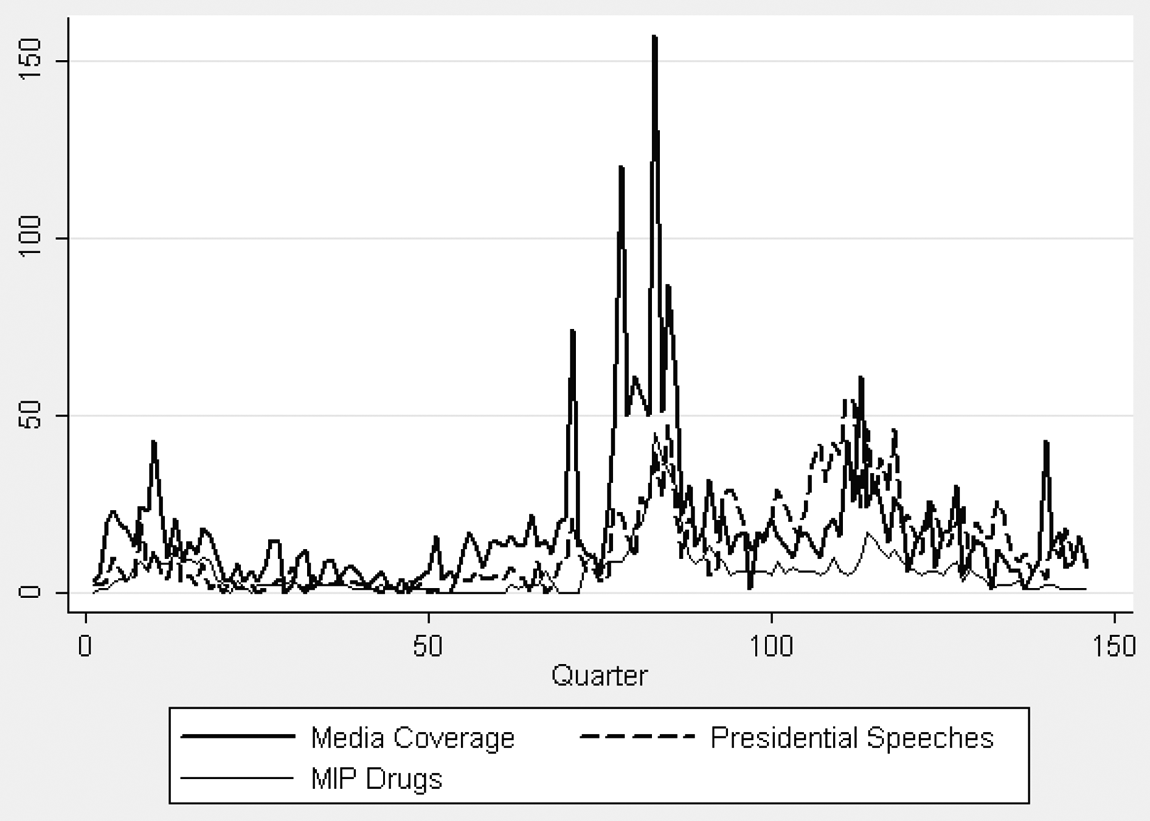
Significant VAR variables—MIP drugs, presidential speeches, TV coverage, and presidential approval
Statistical Methods
The primary statistical methodology used for this analysis is vector autoregression (VAR), a technique that allows various time series to be analyzed simultaneously for their impact upon one another. The technique is widely used within the political science literature and has been previously used to examine the impact of presidential rhetoric (Edwards & Wood, 1999). In addition, in more recent years, VAR has been used within a criminal justice and criminological context, having been applied to a variety of problems (Levitt, 1996; Witt & Witte, 2000).
VAR is a technique that regresses time series on one another and previous time periods of each (Brandt & Williams, 2007). While sometimes having issues with collinearity or degrees of freedom, the technique has been found to be useful in determining impacts of one series upon the others while controlling for the effect of each (Brandt & Williams, 2007). Furthermore, using tests for Granger causality alongside the VAR allows for statistically causal statements to be made about the series impact upon one another. In addition, both exogenous and endogenous series can be used to determine the impact of variables outside the immediate analysis at hand.
This technique is significantly different from that used in previous analysis, particularly that by Gonzenbach (1996), who used multivariate ARIMA. While ARIMA could have been used in this analysis, the fact that the data are prewhitened and may have to be differenced takes away parsimony and removes elements of the data that are particularly interesting, notably the trends in the MIP Drugs question. In addition, ARIMA’s atheoretical nature (Chamlin & Cochran, 1994) makes it difficult to apply any given theory of presidential influence and any statements regarding causal relationships among the series are meaningless.
There are a variety of tests to determine the appropriate length of the lags within the series to be tested, notably using the Akaike Information Criterion (AIC) and Bayesian Information Criterion (BIC) statistics (McQuarrie & Tsai, 1998), and in this case there was a tie between using a two-lag model and a five-lag model. The latter was selected because it captured more of the impact of each of the series and allowed for over a year for each to have an impact, the timing of which is consistent with previous literature (Oliver, 1998, 2003).
As mentioned above, there are frequently problems with collinearity within VAR analyses, however, those problems were not encountered with this data set. In addition, residual autocorrelation among the variables needs to be controlled for and with the five-lag model there was found to be no autocorrelation remaining in the residuals. In addition, the VAR model used satisfied the stability condition, with all eigenvalues lying within the unit circle. Upon further testing, the residuals were also found to be statistically indistinguishable from noise further supporting the model’s fit.
After fitting the VAR to the series, a test for Granger causality was done to assess any statistically causal impacts of the series on one another.
Results
VAR Results
The results for the VAR can be found in Table 1. Examining the impact of the series on the MIP Drugs question, the impact of previous values MIP Drugs can easily be seen being significant at lags one, two, four, and five (p < .001, .001, .05, and .01, respectively), though the impact of each of the lags change direction. In addition, TV coverage has a significant positive impact on MIP Drugs at lags two and five (p < .001 for both). Furthermore, presidential speeches have a significant (p < .05) impact on MIP Drugs. Presidential approval and election year were not significant at any lag. However, among the exogenous variables, unemployment had a significant, negative impact (p < .05).
Results for the Vector Autoregression Model of MIP Drugs, TV Coverage Presidential Speeches, and Presidential Approval
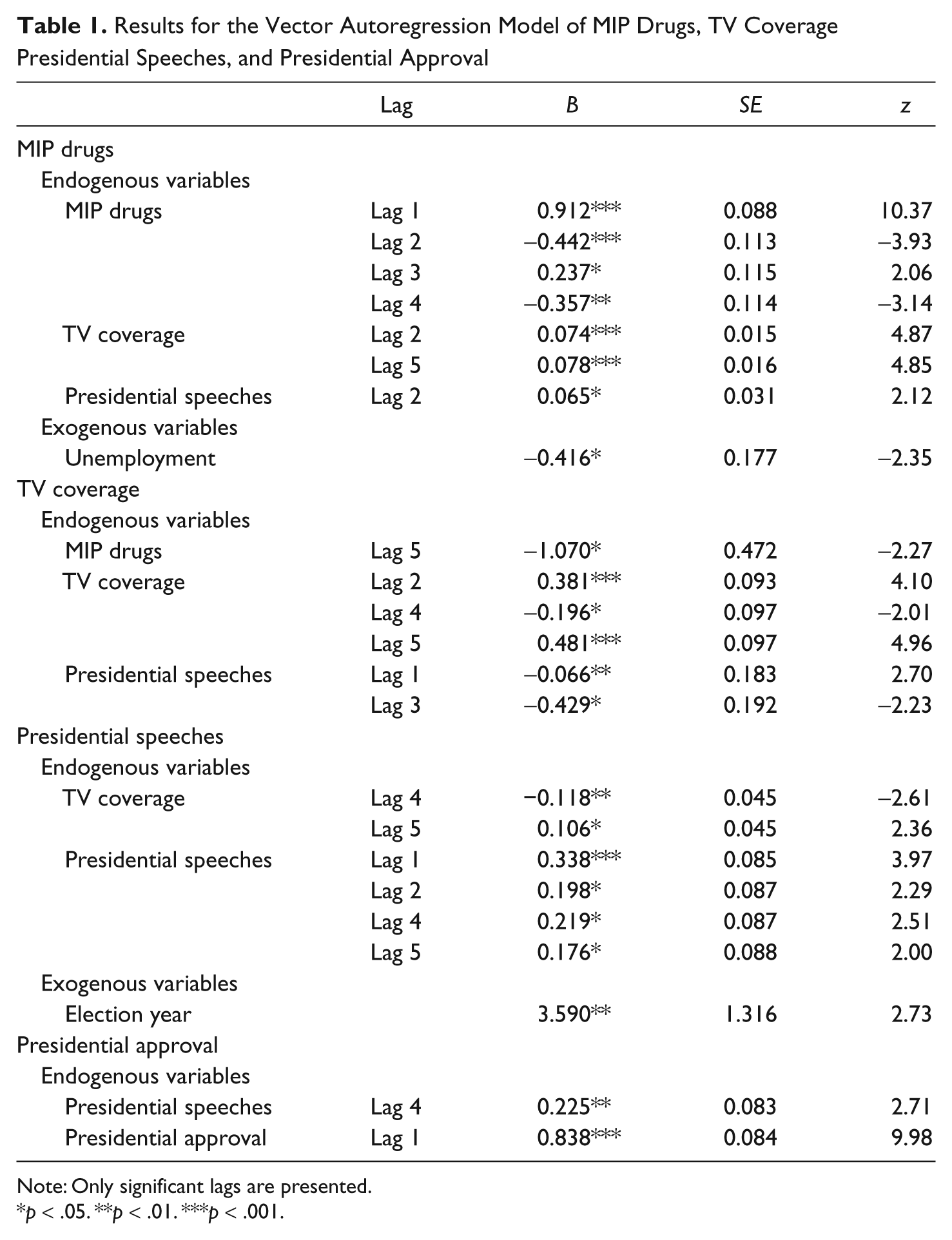
Note: Only significant lags are presented.
p < .05. **p < .01. ***p < .001.
Examining the effects of the series on TV coverage, MIP drugs have a significant negative impact at lag 5 (p < .05). In addition, TV coverage impacts itself at lags two, four, and five (p < .001, .05, and .001, respectively) though again the direction of impact changes between lags. Presidential speeches also have an impact, though in an unanticipated direction, having significant negative effects in lags one and three (p < .01 and .05, respectively). MIP drugs, unemployment, election year, and presidential approval have no significant impact at any lag.
Presidential speeches on drugs are impacted by TV coverage at lags four and five (p < .01 and .05, respectively) though the direction is negative at lag four. Previous values of presidential speeches are significant at lags one, two, four, and five (p < .001, .05, .05, and .05, respectively) and all in the positive direction. While MIP drugs, TV coverage, unemployment, and presidential approval have no significant impact at any lag, election years have a significant positive relationship with presidential speeches (p < .01).
Finally, examining the impact of the series on presidential approval ratings, only presidential speeches, at lag four, and previous values of presidential approval, at a lag of one quarter, have an effect (p < .01 and < .000, respectively). Both of the impacts are in the positive direction.
Granger Causality Results
Turning to the results for Granger causality among the series, which can be seen in Table 2, we can see that there seems to be an interesting relationship among the endogenous series in the models. Examining the Granger causal relationships regarding MIP drugs, there is a clear relationship between TV coverage and MIP drugs as well as one between previous values of MIP drugs and itself (p < .001 for both). The direction of impact for previous values of MIP drugs is difficult to determine given the changing nature of the relationship between lags (see Table 1). TV coverage, however, is clearly positive in direction as mentioned above. Presidential speeches, counter to the theory of presidential influence, have neither causal impact on MIP drugs, nor does presidential approval.
Tests for Granger Causality Among MIP Drugs, TV Coverage, Presidential Speeches, and Presidential Approval
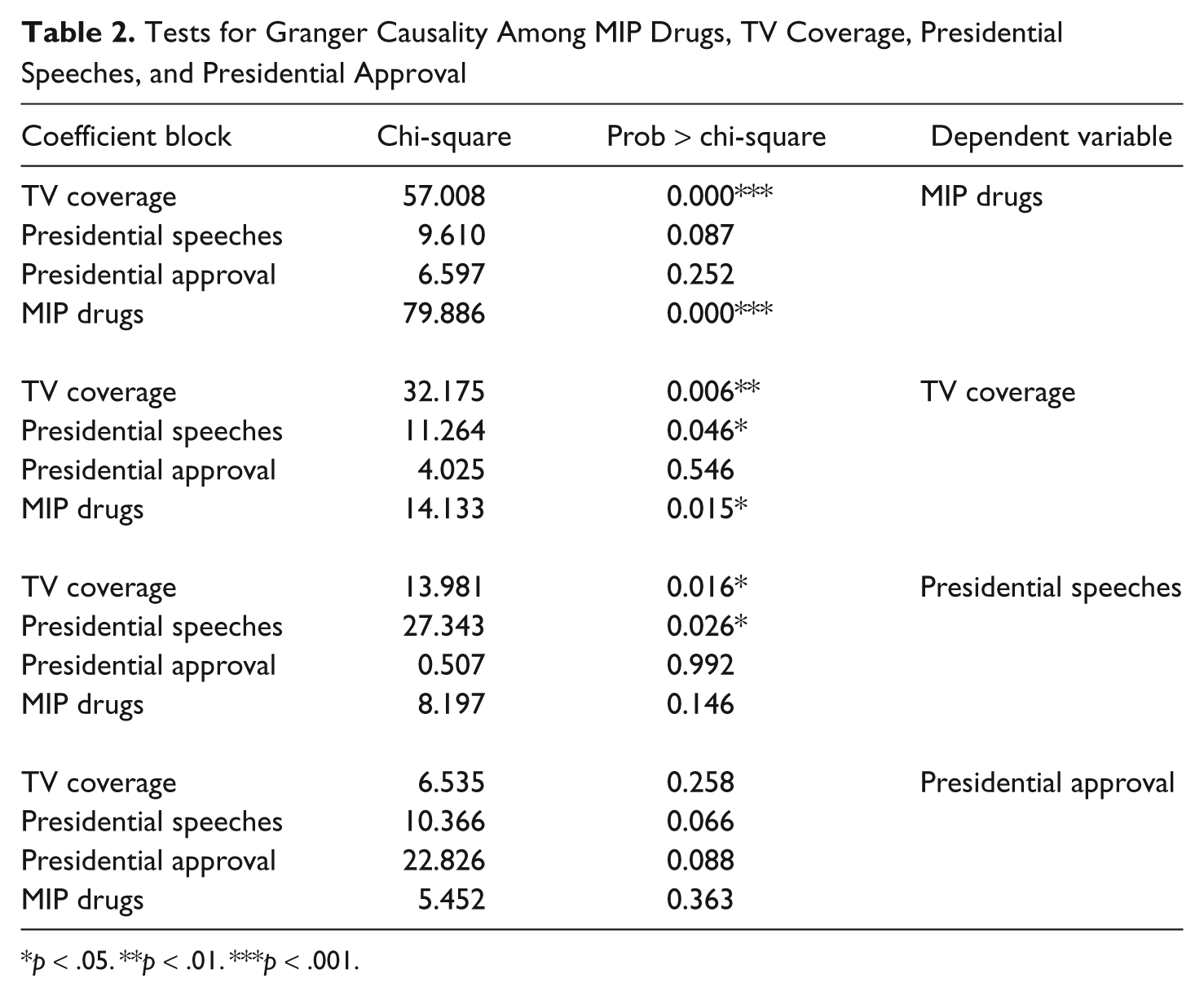
p < .05. **p < .01. ***p < .001.
TV coverage, on the other hand, is significantly Granger-caused by previous values of itself (p < .01) presidential speeches (p < .05) and MIP drugs (p < .05). Presidential approval has no significant causal effect on TV coverage. Direction of relationships, again based on the values in Table 1, is negative for MIP drugs, unclear for previous values of itself and, interestingly, negative for presidential speeches.
Looking at the impact of the series on presidential speeches, there is a clear Granger-causal effect of TV coverage (p < .05) and previous presidential speeches (p < .05). While for TV coverage, the direction of the impact of TV coverage is unclear, there is a strong positive influence from previous presidential speeches as seen in Table 1. Presidential approval and MIP drugs have no causal impact.
Finally, examining the causality among the series regarding presidential approval, we see that there are no significant Granger-causal relationships at all. In short, there is a complex relationship among the series in regard to their impact on one another. Figure 2 provides a summary of that impact.
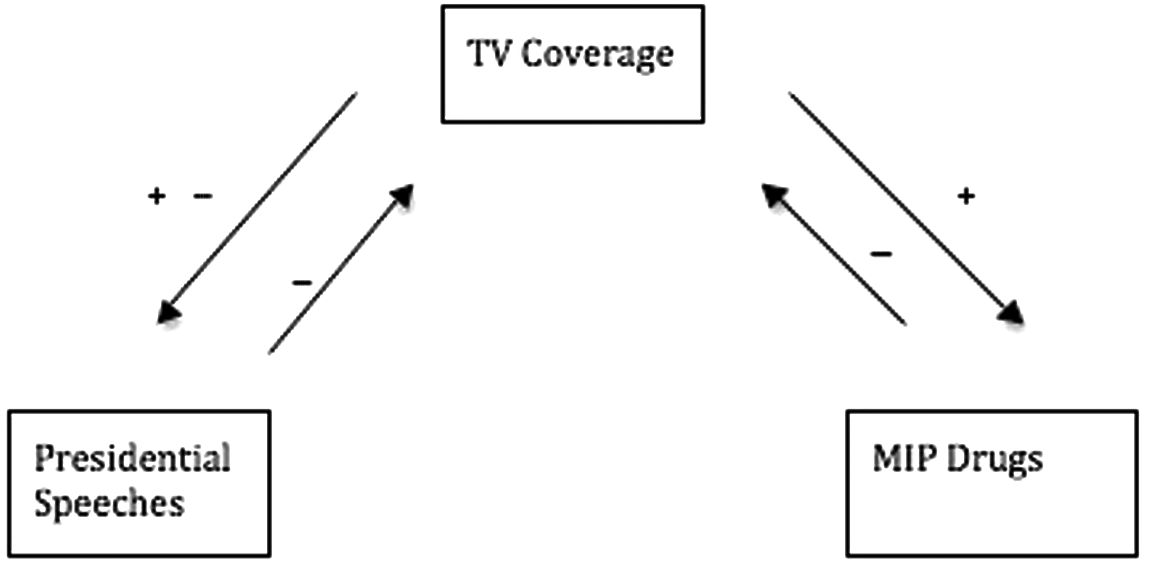
Granger-causal relationships between TV coverage, MIP drugs and presidential speeches excluding previous values for each series
Discussion and Conclusion
Deciphering the relationships among the series is clearly not as straightforward as the theory of presidential influence would indicate. Given the moderating impact of TV coverage between public opinion of drugs and presidential speeches, and the unclear directionality of some of the relationships, the relationship between presidential speeches and public opinion is muddy at best. However, most of the relationships have possible explanations, though more research must be done to tease out their exact nature.
Most significant, for this study, is the finding that presidential speeches have no direct impact on MIP drugs. This is contrary to much previous research (Oliver, 2002, 1998). However, intuitively there is little surprise in finding that the media tends to moderate between the public and the president. Indeed, Gonzenbach (1996) found much the same in his analysis of presidential rhetoric on drugs.
There are several possible considerations that may explain these findings. First, as we used a variable that dealt with presidential speeches that mentioned drugs (consistent with previous literature), there was no control involved for the connotation of the statements made by presidents regarding drugs. Perhaps presidents are more likely to mention drugs in a positive context such as “winning the war on drugs” than to report it as a continuing failure. This too, might explain the negative relationship between TV coverage and public opinion of drugs as the most important problem.
Similarly to the tenor of presidential mentions of drugs potentially influencing media coverage, there may be a reverse relationship between TV coverage and presidential speeches. If the coverage regarding drugs is positive in the way mentioned before, it may fall lower on the presidential agenda and therefore receive fewer mentions. Alternatively, if the media is seeing it as an increasingly problematic issue, it might provide for change within the presidential priorities.
While much of the above could explain the aberrant findings, there are some issues that this analysis makes clear. First, the media holds an incredibly important role in processing and interpreting presidential speeches and public opinion on drugs. Second, the president does not seem to have a direct impact on public opinion. While related to the first finding, the importance of this is hard to overstate. Also, several variables, unemployment, presidential approval, and the election cycle seem to have little or no causal impact on public opinion of drugs or presidential speeches on drugs.
Finally, in relationship to the only other study that examined the relationship between the media, public opinion on drugs, and presidential rhetoric (Gonzenbach, 1996) this study partially support and partially refutes the findings. Specifically, the contention that public opinion is not influenced directly by the president holds up. However, unlike Gonzenbach (1996), the finding that the president can influence the media is supported.
Limitations
As hinted at above, this study’s primary limitation is the fact that the tenor of presidential speeches and news coverage was not captured within the analysis. This problem is one that can be solved with future research into the content of presidential speeches and media output. Research that has a significant bearing on this has been conducted regarding presidential rhetoric and symbolic politics (Marion, 1994b). A second, minimal, limitation is the fact that the study used quarters rather than another measure for time. This may hide some of the nuance of the relationships, though there is no reason to suspect that the findings would differ using a smaller unit of time. A third limitation is the lack of a variable that would capture the actual level of drug abuse in the United States. Though crime rates would have been useful within the context of this analysis, national estimates at the quarterly level are unreliable and sometimes given the infrequent reporting of major cities in the Uniform Crime Report (Lynch & Jarvis, 2008). In addition, most of the other variables, such as the Drug Abuse Warning Network and self-report studies are not conducted monthly/quarterly but yearly.
Future research in this area of presidents and drug control policy should attempt to contextualize the presidential variable on drugs by looking not just at the levels of attention (as this study did), but looking at the nature of the attention. Future studies could assess the tone of coverage on an issue, such as whether it was positive/negative or if it was enforcement/rehabilitation oriented (Baumgartner & Jones, 1993). In addition, future research should look to assess presidential influence through what many consider to be his primary agenda-setting speech and that is the State of the Union speeches (Light, 1998). This would provide another means of operationalizing the variable of president’s agenda and tapping into that latent variable. Still further, while assessing the president’s ability to influence public opinion is important, it is the feedback that this provides to gaining influence with Congress that is more important as it moves him closer to legislative success. Hence, a study on the president’s ability to influence Congress, typically operationalized as the number of Congressional committee hearings held, and ultimately on the actual number of drug-related bills passed by Congress, are also warranted.
Footnotes
The author(s) declared no potential conflicts of interest with respect to the authorship and/or publication of this article.
The author(s) disclosed receipt of the following financial support for the research and/or authorship of this article: The study was funded by Delta Lambda Chapter Sigma Theta Tau International (Doctoral Research Award) in 2007.