



Abstract
As an anomaly of extant literature that maintains Blacks as a collective are less supportive of racial profiling than other ethnic groups, this article explores the backgrounds of Blacks who support the practice of racial profiling (referred to as Black Supporters). This study analyzed a national Gallup poll that included measures on profiling and had a significant number of Black respondents (N = 534). Black Supporters tended to be female; live in the Southern United States; and be politically conservative. Although multivariate analyses revealed few differences between Black Supporters and nonsupporters, the study represents an earnest attempt to explore Black support for a policing strategy that has both historically and contemporarily had negative effects on Black communities. We conclude the article by discussing the benefits of studying Black Supporters.
Introduction
The last decade has seen a meteoric rise in the scholarly interest in racial profiling. This increased scholarly interest has produced considerable research that has investigated racial profiling from nearly every angle (Del Carmen, 2008; Gaines, 2006; Greenleaf, Skogan, & Lurigio, 2008; Harris, 1999, 2002; Higgins, Vito, & Walsh, 2008; Novak, 2004; Rice & White, 2010; Russell, 1999; Withrow, 2006, 2010; Worden, McLean, & Wheeler, 2012). In most instances, the debate has inevitably morphed into methodological discussions about how best to study racial profiling (see, for example, Engel, 2008; Grogger & Ridgeway, 2006; Persico & Todd, 2008). An additional area that scholars have pursued has been public opinion on racial profiling (Weitzer & Tuch, 2002, 2005). In general, researchers have investigated public support for the practice of racial profiling, public perceptions of its prevalence, as well as personal and vicarious experiences with racial profiling. This, too, has led to an abundance of research that has attempted to sort through the nuances of public sentiment regarding racial profiling.
Within the growing literature on the topic, there has emerged a consistent set of findings related to public opinion on racial profiling. Most notably, Blacks followed by Hispanics are more likely than Whites to believe that racial profiling is widespread, and less likely than Whites to believe the practice is justified (Higgins, Gabbidon, & Vito, 2010; Reitzel, Rice, & Piquero, 2004; Rice, Piquero, & Reitzel, 2005; Reitzel & Piquero, 2006). To our knowledge, not one study has deviated from these findings. In addition, there have been equally obstinate findings regarding those groups that are more likely to report that they have experienced profiling. This is not surprising, as Blacks and Hispanics have unfailingly reported being racially profiled more than Whites (Weitzer & Tuch, 2006), with African Americans reporting the highest rates of racial profiling (Higgins et al., 2010; Weitzer & Tuch, 2005).
Views toward racial profiling are often confounded by the perceived prevalence of the practice, that is whether one has personally experienced racial profiling, has vicarious knowledge of such encounters, and/or believes racial profiling to be widespread (Brunson, 2007; Reitzel & Piquero, 2006; Weitzer & Tuch, 2005). The racial hierarchy of disapproval for racial profiling, that is, Blacks followed by Hispanics and then Whites, is not surprising and is consistent with research on attitudes toward, and experience with police more broadly (Bass, 2001; Barlow & Barlow, 2002; Fagan & Davies, 2000; Sampson & Jeglum-Bartusch, 1998; Weitzer & Tuch, 2002). There is, however, one trend that has also been consistently found in public opinion on racial profiling—that there are Blacks who believe that racial profiling is not widespread and support its use to identify criminal activity. We refer to these individuals as Black Supporters, and they are the focus of this article.
Typically, public opinion researchers who study racial profiling conduct analyses that produce respondents who might be considered the invisible Black minority. The term invisible, we believe, best reflects their current status in the established public opinion literature on racial profiling. In short, no one really knows who they are and/or why they support profiling. Our research examined data that can answer the first question, but we rely largely on speculative insights as to why they might be supporters of such a practice. Our focus is limited to Blacks as their experiences with racial profiling predate that of other racial minorities.
Conceptual Framework
We first consider the link between criminal behavior and race as it provides the ideological justification for supporting police practices that rely on racial considerations as a proxy for suspiciousness. Although some believe the association between race and crime within the United States is a fairly recent phenomenon that is purely incidental, others suggest this connection has very deliberate origins, beginning with the importation of enslaved Africans to the colonies and the enactment and enforcement of the laws that followed (Adamson, 1983; Anderson & Stewart, 2007; Gabbidon, 2010; Jones-Brown, 2000). From early defenders of slavery and lynching to contemporary explanations of mass incarceration, many have articulated positions that tout Blacks’ supposed predisposition toward criminality as justification for discriminatory treatment. African American exceptionalism has led to the persistence of racialized stereotypes of “Black crime” long after the criminal label of other European ethnic groups (Jewish, Irish, and Italians) was disregarded.
Although racial disparity in arrest and incarceration rates are not necessarily indicative of racial discrimination, the presentation of crime data that highlight disproportionate rates of African American offending particularly in the areas of robbery and homicide, as “objective, color-blind, and incontrovertible” analyses of criminal activity has led to individualized interpretations of White crime while simultaneously presenting an image of crime as collective Black phenomena (Muhammad, 2010, p. 4; see also Kennedy, 1997; Russell-Brown, 2009). Being mindful that there is not a direct correlation between crime rates and incarceration rates, Muhammad (2010) points to the publication of the 1890 census which included prison statistics as providing the basis for the first national discussions which presented Blacks as a “distinct and dangerous criminal population” (p. 3). Muhammad summarizes, For white Americans of every ideological stripe-from radical southern racists to northern progressives—African American criminality became one of the most widely accepted bases for justifying prejudicial thinking, discriminatory treatment, and/or acceptance of racial violence as an instrument of public safety. (p. 4)
Beginning with southern slave patrols in the 17th century, the evolution of American policing was predicated on maintaining a hierarchy of White racial dominance achieved through the excessive policing of Blacks. So much so was the case what many scholars have characterized the earliest forms of policing as efforts not to deter criminal behavior but to police “blackness” itself codified in southern slave codes, the Black Codes, and Jim Crow Legislation (Bass, 2001; Gabbidon & Greene, 2012; Jones-Brown, 2000; Kennedy, 1997; Muhammad, 2010). The term blackness is used here to reflect a tradition of equating Black skin with increased propensity for dangerous and criminal actions as to criminalize the very state of being Black. Articulating the position of racial criminalization as a means of social control, Dr. Amos Wilson suggests a “chief concern” of the White American criminal justice system “is with African American containment and the prevention of white victimization by Black criminals” (Wilson, 1991, p. 180). Considering this history, negative appraisals by Blacks of police behavior including the practice of racial profiling are not only understandable but expected.
As it is well established that Blacks have been the primary targets of racial profiling tied to traffic stops (Glover, 2009; Harris, 2002; Russell-Brown, 2009; Websdale, 2001), we are understandably curious as to why some African Americans would support a practice that is believed to unfairly target Black communities. More specifically, our objective for this study was twofold: first, to determine the basic demographic profile of Blacks who support racial profiling and second, to determine which factors are most likely to predict Black support for racial profiling. While it is no longer in vogue for members of any racial/ethnic group to openly support or defend practices which subjugate groups on the basis of race, many defenders of the racial status quo now do so within the framework of color blindness. In compliance with the shifting times, a new lexicon has emerged to explain the persistence of discriminatory practices.
Public support for criminal justice practices that produce disparate racial outcomes might best be understood through the lens of colorblind racism as presented by Eduardo Bonilla-Silva. In his work, Racism Without Racists, Bonilla-Silva (2006) posits that color-blind racism represents a “new racial ideology” which is indirect and subtle, relying on nonracial dynamics to explain and justify contemporary racial inequalities. Bonilla-Silva offers color-blind ideology as a dominant frame of reference whereby most “members (dominant and subordinate) of a social system have to accommodate their views vis-à-vis that ideology . . . (which) even provides the parameters to oppose the status quo” (p. 152). Color-blind racism ideology allows for the maintenance of White privilege without directly naming Blacks or any other racialized groups as its victims. For example, protection against crime via public support for racial profiling is presented as a collective goal of good law-abiding Americans without any direct reference to one’s racial propensity toward crime.
Burdened by association of blackness with crime, some African Americans may feel pressure to distinguish themselves from the “bad Negroes.” The politics of respectability, as defined by Evelyn Higginbotham (1993), highlights the desire for White acceptance among Blacks who strive for the same standards of White middle-class America even in the face of racial discrimination. Theoretically, the desire to be seen as respectable not only explains the rejection by some Blacks of anything remotely associated with Black culture (Kennedy, 1997) but also the support of activities that negatively affect Black communities such as racial profiling.
Our article begins with a concise discussion of the existing literature on public opinion on racial profiling. This is followed by a discussion of the methodology that describes the data set that is used to provide a glimpse of Black Supporters. The final section outlines the study’s findings and general thoughts about possible future directions for research on this important and understudied segment of the Black community.
Review of the Literature
Research on public opinion related to Blacks and crime-related topics has a long history in the discipline. Du Bois (1904) conducted an early study of public opinion on crime in the Black community that also investigated perceptions pertaining to the fairness of the justice system and also why so many Blacks were in the justice system. It is interesting that even in this early poll Blacks saw the system as being unfair while many Whites held opposing views. It is also interesting that when asked about Black over representation in the system, older Blacks did not view racial prejudice as the primary contributor. In fact, Blacks pointed to factors such as indolence and laziness, lack of home training, disobedience, bad, company, and ignorance before racial prejudice, as being key contributors to Black over representation in the justice system (Du Bois, 1904; Gabbidon, 2000). Ironically, recent research has pointed to similar factors (Unnever, 2008). There continues to be scholarly interest in public opinion as it relates to Blacks and the criminal justice system (Gabbidon & Higgins, 2009; Peffley & Hurwitz, 2010; Unnever, Gabbidon, & Higgins, 2011). In the 2000s, one significant concern that arose was racial profiling. In addition, although most of the early literature was devoted to researching whether racial profiling was occurring, there also emerged a body of public opinion scholarship on racial profiling.
Public Opinion on Racial Profiling
The Gallup Organization was among the first polling organizations to conduct a national survey that included questions on racial profiling during traffic stops. Not long after the release of the Gallup poll results, Weitzer and Tuch (2002) conducted multivariate analyses of the Gallup data and found that race and class were key factors in support for racial profiling. While “blackness” (or self-identifying as a Black person) was a significant determinant of disapproval for racial profiling, it was mitigated by social class in a way that was not consistent for Whites. In particular, the researchers “found that better educated African Americans are more likely than are less educated to disapprove of profiling, to view it as a pervasive practice, and to say that they have personally experienced it” (p. 450). The results also found that nearly 20% of Blacks and 40% of Whites did not feel that racial profiling was widespread. Although most of the respondents did not approve racial profiling, 5.7% of Blacks and 15.6% of Whites did approve of the tactic (p. 441). It is also noteworthy that 70% of the Black respondents felt that they were treated less fairly than Whites during traffic incidents, whereas 30% felt Blacks were treated better or the same (p. 444).
While not a specific assessment of public attitudes on racial profiling, Alpert and Dunham’s (1988) study offers an interesting contention concerning Black support for police use of ethnic suspicion as a proxy for action. Using a purposive sampling technique to assess race and class differences on attitudes toward police by neighborhood, the researchers found that Hispanics, more specifically Cuban residents, had the highest rate of disapproval toward the use of ethnic suspicion as a justified practice among Black, Hispanic, and White residents. Consistent with racial profiling literature, most ethnic groups were cohesive in their disapproval of the idea that some ethnic groups were more deserving of police scrutiny. The one exception, however, was lower-income Black residents whom offered a mean score that suggested they “either agreed or were undecided about the need to watch some ethnic groups more closely than others” (Alpert & Dunham, 1988, p. 86).
The 2000s continued to see interest in public opinion studies on racial profiling. Reitzel et al. (2004) examined the views of New York City area residents on profiling. Based on the New York Times, New York Police Department Poll, their study revealed that Blacks and Hispanics were more likely than other respondents to perceive profiling as being widespread and that they had personally experienced profiling (see also Rice, Reitzel, & Piquero, 2005; Reitzel & Piquero, 2006). In addition, taking advantage of the large Hispanic sample, Reitzel et al. (2004) conducted analyses that revealed no significant differences between Hispanics and non-Hispanics regarding support for profiling (p. 614). Even though Blacks and Hispanics were more likely to not support profiling, the series of articles tied to this poll exclude discussion of the minorities that support profiling.
Building on their earlier work (Weitzer & Tuch, 1999, 2002), Weitzer and Tuch (2005) conducted a national study examining racially biased policing. Of the nearly 1,800 participants, most of them—of all races/ethnicities—did not support racial profiling and felt the practice was widespread. Even so, the White respondents were more likely than Blacks and Hispanics to have opposing views. In addition, Weitzer and Tuch found that demographic factors such as education, location of residence, and residing in a high-crime area were significant predictors of perceptions of police bias. Interestingly, the researchers do report that 10% of Blacks and 23% of Hispanics supported racial profiling—yet there is no substantive discussion of these minority viewpoints.
In the wake of September 11, 2001, scholarship also emerged that revealed an increased level of support for the profiling of Middle Easterners (Fiala, 2003; Schildkraut, 2002). A study by Schildkraut (2009) found that most respondents were not supportive of racial profiling in general (77%), but a slightly lower percentage of respondents (66%) were not supportive of profiling tied to suppressing terrorism. Analyses by race revealed that Blacks, as in more traditional profiling studies, were less supportive than Whites of profiling tactics related to terrorism.
Higgins et al. (2010) conducted an analysis of a 2004 Gallup poll that examined the views of more than 2,000 respondents on racial profiling. In addition, they explored the influence of perceived race relationships on views on racial profiling. In support of earlier poll results, the researchers found that Blacks and Hispanics were more likely than Whites to perceive profiling as being widespread. Blacks were also more likely than Whites to not support racial profiling. Views concerning race relationships did influence respondents’ public opinion on profiling. Specifically, those who felt race relationships were bad felt that racial profiling was widespread; race relationships did not, however, influence views on support for profiling.
Current Study
Although scholars have most recently turned to group conflict theory (Weitzer & Tuch, 2005) or comparative conflict theory (Hagan, Shedd, & Payne, 2005) to explain why Blacks and Hispanics are more likely to not support racial profiling than Whites, there is no theoretical explanation that has been proffered to explain Blacks that hold the opposing viewpoint. Still, we offer the racialization of crime and the politics of respectability as a possible paradigm for understanding Black support for racial profiling. The exploratory nature of this work does not lead itself to the formulation of testable hypotheses.
In particular, our research centered on two critical research questions: First, what are the basic demographics of those Blacks that support racial profiling during traffic stops? Second, are there significant demographic differences between Black Supporters and nonsupporters? Here, we are especially interested in whether there are significant predictors of Black support for racial profiling. These questions are important because they provide a glimpse of respondents who are typically understudied. In addition, this research has the potential to begin the discourse on why Blacks might support such controversial policing tactics even though it is commonly believed that such practices often target and harm their communities. The research also highlights the diversity of Black thought even when concerning controversial criminal justice practices such as racial profiling.
Method
To identify Black Supporters, we used data from the 2004 Minority Rights and Relations/Black-White Social Audit poll conducted by the Gallup Organization from June 9-30, 2004. The poll represents one of the few national Gallup surveys that included direct measures on racial profiling. The poll included 2,250 randomly selected Americans that included a sample of 854 Black respondents. 1 We limited our study to the Black respondents.
Measures
To develop a demographic profile of Black Supporters of racial profiling, we used several measures, including age, income, gender, educational level, employment status, marital status, location (urban or other), political ideology, region, church attendance, and children in school. We also included in the analysis a measure that sought to determine whether the respondents had been unfairly treated by the police in the last 30 days. This provided a measure of whether personal experience with mistreatment by the police has any influence on Black support for racial profiling.
The perceptions of racial profiling were captured using two measures to gauge the extent to which the individuals felt that racial profiling was widespread and justified. The individuals were given the following two items:
It has been reported that some police officers or security guards stop people of certain racial or ethnic groups because these officials believe that these groups are more likely than others to commit certain types of crimes. For each of the following situations, please say if you think this practice, known as racial profiling, is widespread or not? How about when motorists are stopped on roads and highways?
Do you think it is ever justified for police to use racial or ethnic profiling, or is it never justified? Here, the individuals were prompted to consider the question in the following context: when stopping motorists on roads and highways?
Coding Approach
Age was measured using a 4-point scale (1 = 18-29, 2 = 30-49, 3 = 50-64, 4 = 64+). Income was measured using a 5-point scale (1 = less than US$20,000, 2 = US$20,000-less than US$30,000, 3 = US$30,000-less than US$50,000, 4 = US$50,000-less than US$75,000K, 5 = US$75,000 and above). Education was measured using a 4-point scale (1 = less than high school, 2 = high school graduate, 3 = some college, 4 = college graduate). Employment was dichotomized as 0 = unemployed and 1 = employed. Marital status was dichotomized as 0 = not married and 1 = married. Living in an urban area was dichotomized as 0 = no and 1 = yes. Political ideology was dichotomized as 0 = not conservative and 1 = conservative. Living in the South was dichotomized as 0 = no and 1 = yes. Gender was measured as 0 = female and 1 = male. Church attendance was measured as 0 = seldom/never and 1 = weekly/nearly weekly/monthly. The question related to children attending school was do you have children who will be attending school in kindergarten through Grade 12 this year? For this measure, 1 = yes and 0 = no. In addition, as noted above, we included a measure of whether the individual had been personally treated fairly by the police within the last 30 days. This measure was coded as (1 = yes and 0 = no).
For our substantive dependent measures, we coded the first question related to the prevalence of racial profiling as follows: (0 = yes, widespread and 1 = not widespread). The second measure that queried respondents about their support for racial profiling was coded as 1 = justified and 0 = never justified.
Analysis Plan
The analysis plan for the study included univariate and multivariate data analyses. The univariate analysis consisted of descriptive statistics that included means and standard deviations. These were used to develop a profile of Black supporters of racial profiling. The multivariate analysis provided an analysis of the covariates that relate to Black Supporters. In this study, we used logistic regression analysis, as the dependent measures were dichotomous, and the use of this type of measure with ordinary least squares regression would have been a violation of the normality assumption (Menard, 1995). To examine the covariates of Black Supporters, we included those Blacks who did not support racial profiling. In other words, we included the entire Black sample because the use of only Black Supporters would not have yielded variation in our dependent measures. Hence, we were able to distinguish between Black Supporters and Black Nonsupporters of racial profiling.
Multicollinearity is a potential concern any time a regression technique is used for analysis. Menard (1995) argued that the tolerance coefficient that measures the multicollinearity that comes with Ordinary Least Squares regression is robust with dichotomous dependent measures. Thus, we used the tolerance coefficient to examine whether the independent measures were collinear. From these two types of analyses, we were able to present a demographic profile of Black Supporters of racial profiling.
Results
As the purpose of this study was to develop a demographic profile of Black Supporters, we provide the mean levels of the measures for the Black sample, partitioned by whether they believed racial profiling to be widespread or justified. In total, 25% (n = 204) of the Blacks in the Gallup data set did not believe that racial profiling was widespread, and 21% of Blacks (n = 176) felt that racial profiling was justified.
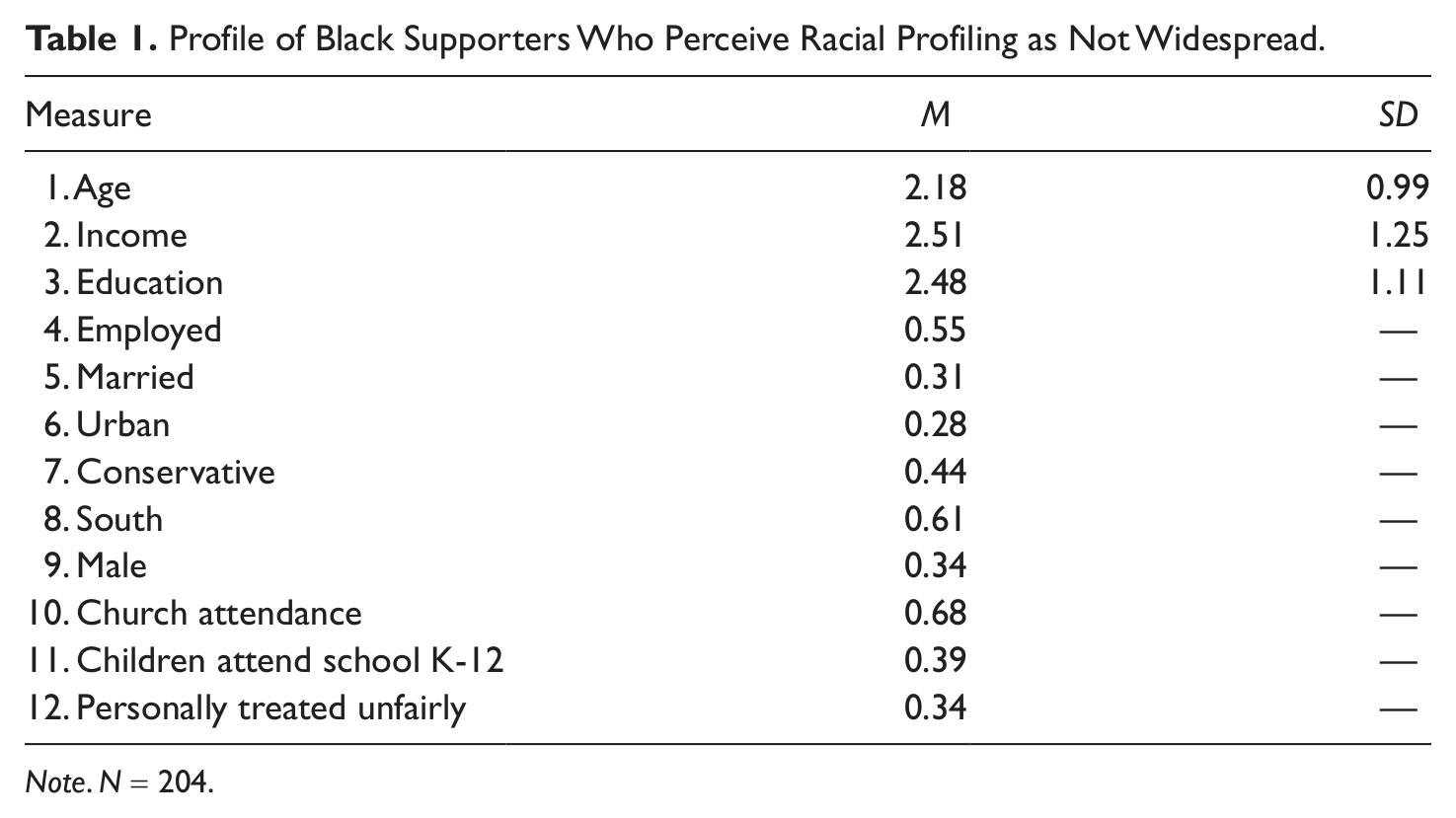
Table 1 presents the analysis for the Black individuals who viewed racial profiling as not being widespread. The average age of the supporters was 30 to 45 years old. The average income was between US$20,000 to less than US$30,000. The average education level was high school graduate. Slightly more than 55% of the Blacks who did not view racial profiling as widespread were employed. Furthermore, 31% of the Blacks who held this view were married; 28% of the individuals lived in an urban area; 44% were conservative; 61% lived in the South; 34% were male; and 68% attended church. Finally, 39% of the sample indicated that they had children who attended K-12 school.
Profile of Black Supporters Who Perceive Racial Profiling as Not Widespread.
Note. N = 204.
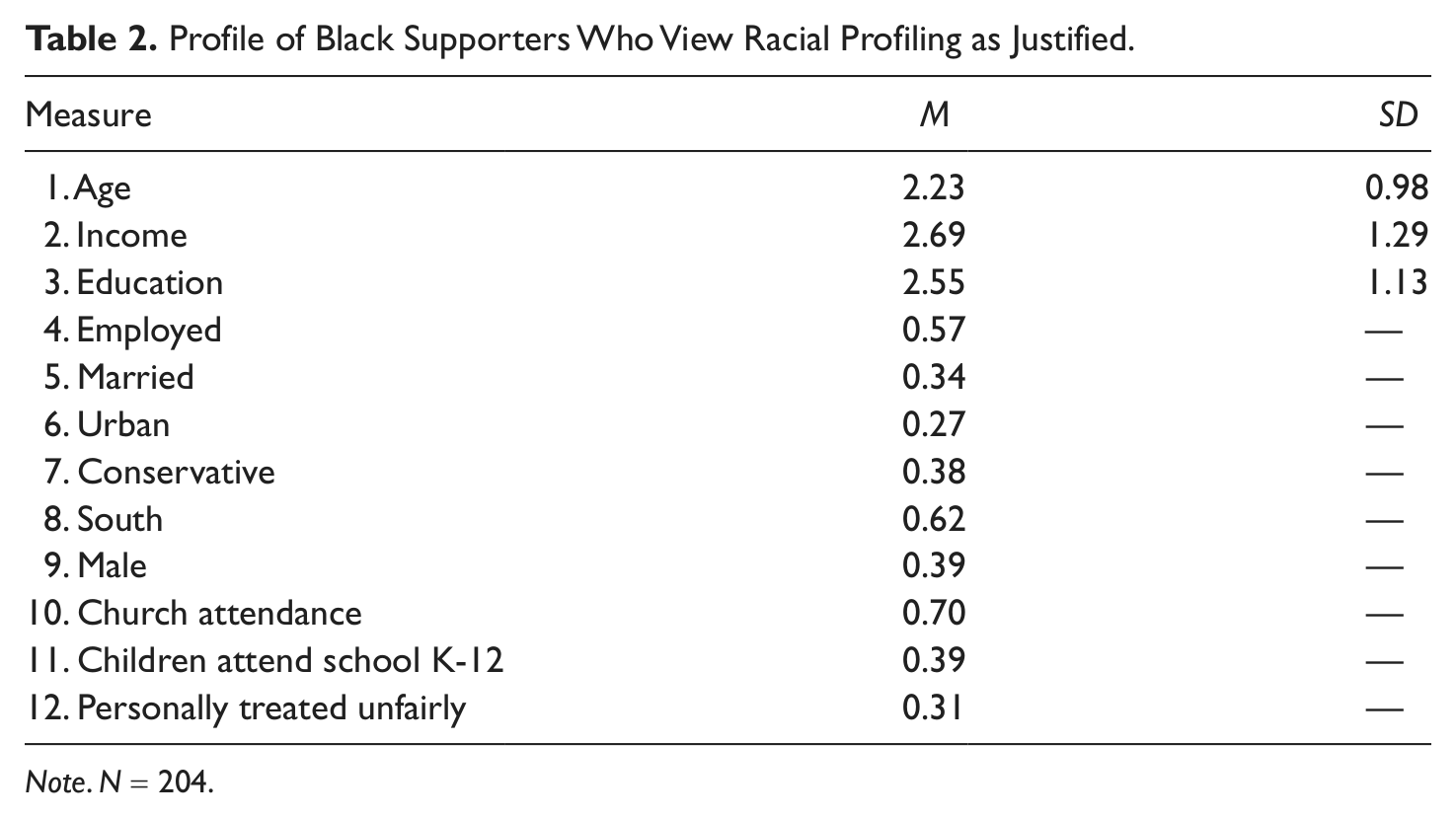
Table 2 presents the analysis for Black Supporters who believed racial profiling is justified. The average age was between 30 to 45 years old. The average income level was US$20,000 to less than US$30,000. The education level was high school graduate. For those respondents holding his view, 57% of them were employed, 34% were married, 27% lived in an urban area, 38% were conservative, 62% lived in the South, 39% were male, and 70% attended church. Finally, 39% of the respondents indicated that they had children who attended school K-12.
Profile of Black Supporters Who View Racial Profiling as Justified.
Note. N = 204.
Table 3 compares Black Supporters by sex. 2 Black females who believe that racial profiling was justified were typically 30 to 45 years old, had incomes that were US$20,000 to less than US$30,000, and were high school graduates. Fifty-seven percentage of the Black females were employed; 32% were married, and 24% lived in urban areas. Thirty-seven percentage of the Black females were conservative, and 50% lived in the South. Seventy-two percentage attended church. Finally, 46% of the Black females indicated that they had children who attended school K-12. Table 3 also shows the results for Black males. The Black male respondents largely fell in the 18- to 29-year-old category, and had incomes of US$20,000 to less than US$30,000. The Black males were high school graduates; 53% were employed; 28% were married; and 32% lived in urban areas. Fifty-three percentage considered themselves conservative; 50% lived in the South, and 48% attended church. Only 31% of the Black males indicated that they had children who attended school K-12.
Profile of Blacks Supporters by Sex.

Note. N = 204.
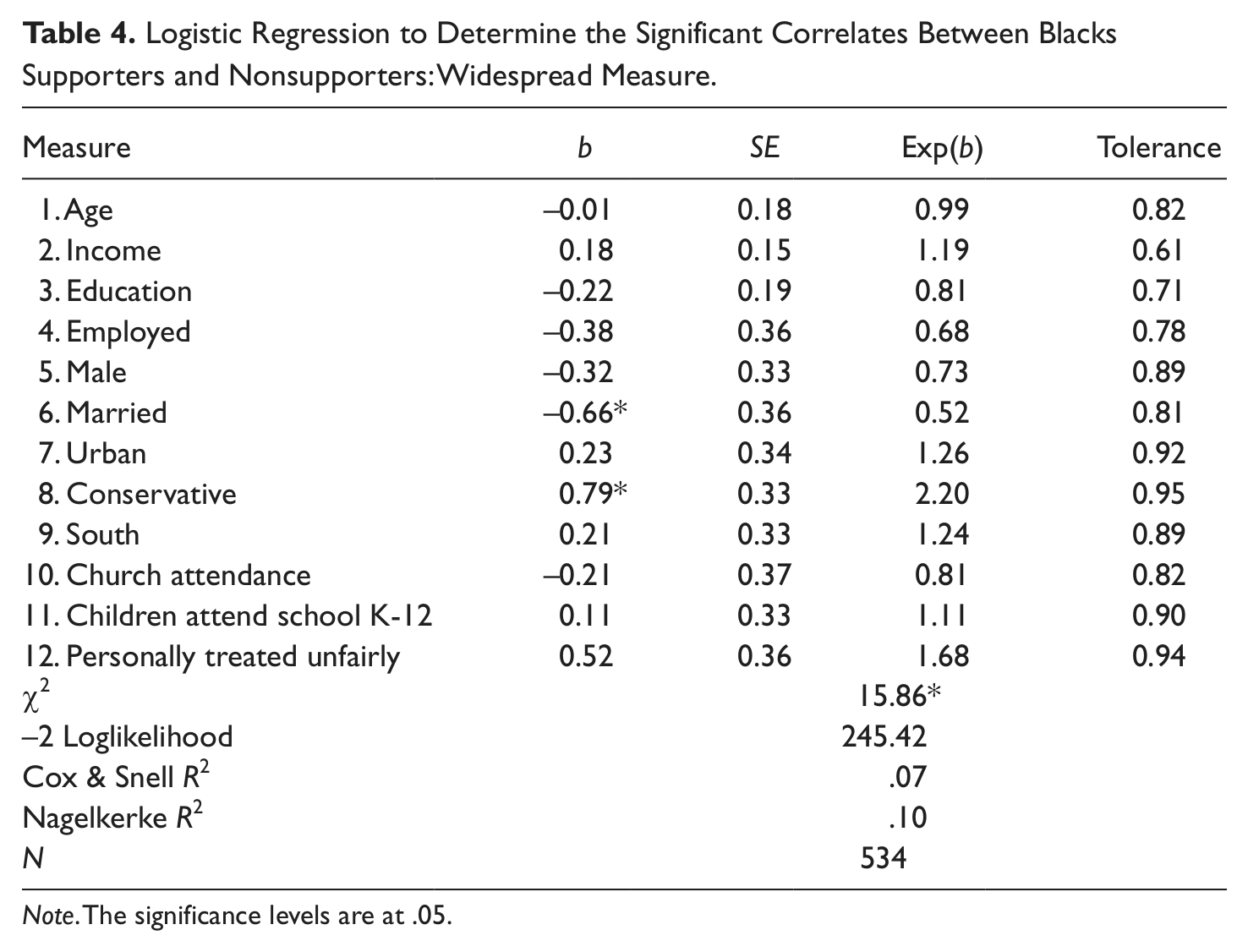
Table 4 presents the logistic regression analysis for Blacks who did not believe that racial profiling was widespread. In this analysis, two measures were significant. First, the analysis showed that married Blacks were less likely than nonmarried Blacks to believe that racial profiling was not widespread (b = –.66, Exp(b) = 0.81). Second, Black conservatives were more likely than liberal Blacks to believe that racial profiling was not widespread (b = .79, Exp(b) = 2.20).
Logistic Regression to Determine the Significant Correlates Between Blacks Supporters and Nonsupporters: Widespread Measure.
Note. The significance levels are at .05.
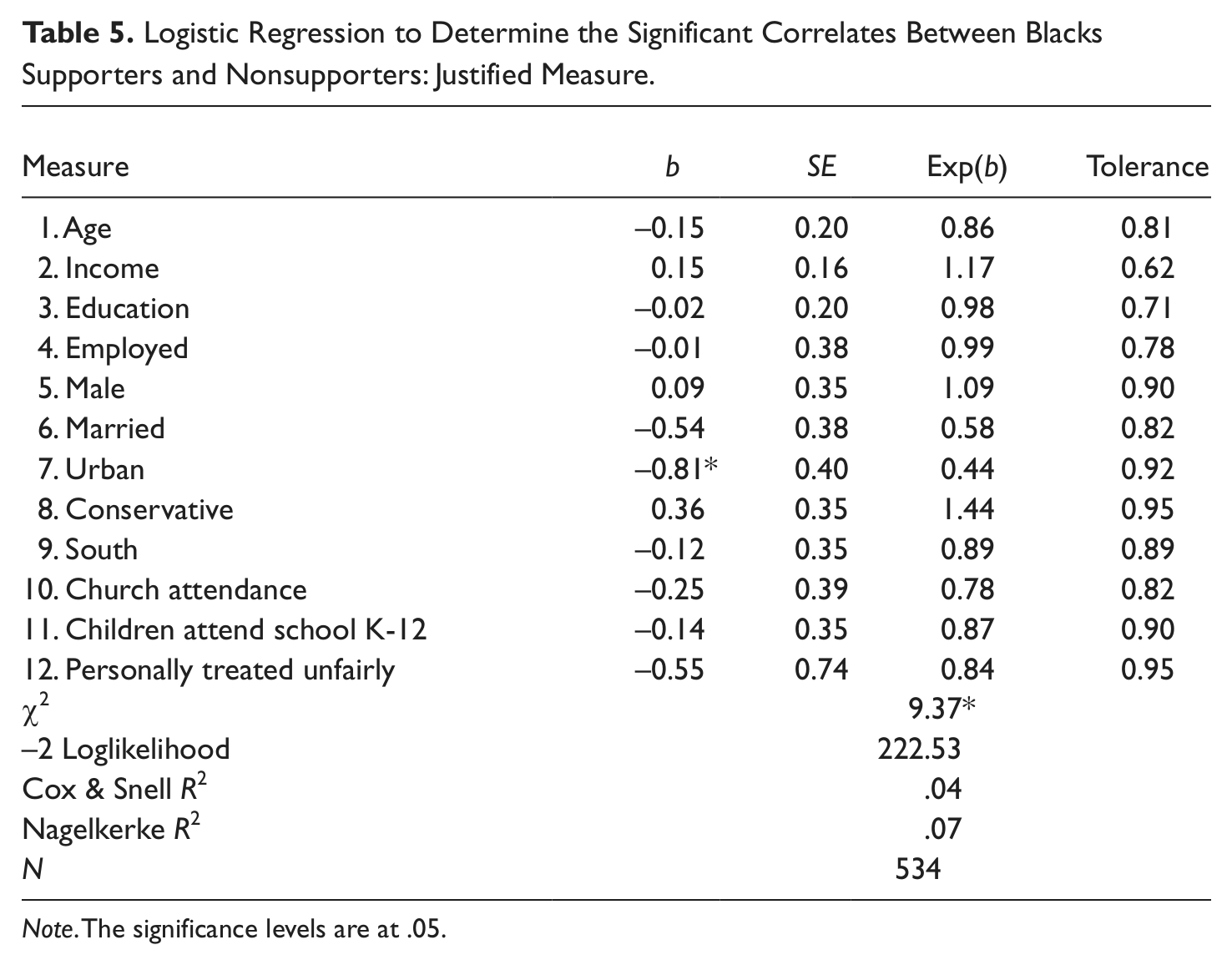
Table 5 presents the logistic regression analysis for Blacks who perceived racial profiling as justified. The results indicate that only one measure was significant. Urban Blacks were less likely than nonurban Blacks to believe that racial profiling is justified (b = –.81, Exp(b) = 0.44).
Logistic Regression to Determine the Significant Correlates Between Blacks Supporters and Nonsupporters: Justified Measure.
Note. The significance levels are at .05.
Discussion
This study sought to determine the demographic profile of Black Supporters of racial profiling and to assess whether there were substantive differences between Black Supporters and nonsupporters. Besides the fact that two thirds of the Black Supporters were females, there were few differences by gender so our discussion is primarily devoted to the data on the entire sample. We discuss the notable gender difference first. The fact that most of the Black Supporters of racial profiling were female could tell us several things. As Black males are overrepresented among perpetrators of violent crime, they may be perceived as a real threat and thus an appropriate target of racial profiling particularly in disadvantaged communities of color where violent victimization is most likely to occur. Black females might also be fed up with criminal activities they witness, hear about, or are victims of, so they are more supportive of profiling. Still, the complexity of support for such practices is not lost on the fact that Black males are the sons, boyfriends, and husbands of women in the community. It is apparent from the data that there is a contingent of Black males who possibly share this same sentiment (for discussion of support by Blacks of controversial police tactics, see MacDonald, 2003). This could also be tied to why there was a high level of church attendance among Black Supporters—especially among women. As recent research has shown, Black women are significantly more likely than Black men to attend church, which mitigates their fear about their personal safety (Jordan & Gabbidon, 2010).
Fear of victimization within their communities likely accounts for some support for racial profiling among Black females. Fear of crime including the promulgation of the “criminal Black man” stereotype might account for small but consistent rates of support for racial profiling among Blacks (Russell, 1999). As the face of crime in America, to some, Black men represent the justified target of police action (DeLisi, 2011). With media depictions offering ample evidence of Black male criminality, it would seem as least plausible that some Blacks believe that the majority of street criminals are Black, and thus see racial profiling as a justified and effective practice of crime control. With respect to the influence of church attendance, Black supports may feel they are abiding by the rules of society or are more morally astute and thus welcome efforts for police to seek out “criminalized Blacks.” The desire to distance one’s self from the negative stereotypes applied broadly to the entire ethnic group in pursuit of greater individual acceptance is discussed further in the politics of respectability (Higginbotham, 1993). Notably, our underlying premise behind these assertions is that Black Supporters believe that profiling is an effective practice While there is emerging evidence of this (see Higgins & Gabbidon, 2012), we suspect that this is what drives their support We can say, however, that one clear benefit of studying and interacting with Black Supporters is that researchers might better understand what accounts for their support of racial profiling.
Our review of the demographic characteristics also leads us to conclude that those Blacks who feel racial profiling is not widespread are largely the same Blacks who feel the practice is justified. This could mean that Black Supporters approve of profiling—but trust that the police will use it only when necessary. In other words, they simply do not believe that law enforcement officials indiscriminately racially profile. Hypothetically, one wonders here whether supporters would be less likely to endorse the practice if they were informed that profiling was indeed being widely used.
The Black Supporters sample also had a large number of Southerners who were conservative. As Southern Blacks have a long history of experiencing harassment and brutality at the hands of the police, it is unclear why Black Supporters would be largely found in the South. While it is possible that, because of national efforts to encourage community policing, some Southern Blacks are more trusting of the police and are willing to support profiling, we proffer a divergent perspective to explain this trend. This is likely a contingent of Blacks who show deference to the police as a way to navigate the racial minefields so they can live a peaceful existence in a racist society. Building on Fanon’s sociopsychological model of internal colonialism, Tatum (1994) outlines how structural economic, social, and political oppression of African Americans has behavioral consequences. According to the theory, African Americans, having developed feelings of alienation due to perceived racial oppression, respond by assimilation, crime and delinquency or protest. Assimilation thus requires an acceptance of the colonial/dominant culture, values, and lifestyle including reverence for its agents (see also Akbar, 1996; Fanon, 1967; Leary, 2005). Conservatives, whether they are Black, White, or of another race/ethnicity, have long been tied to the crime control model of policing, which provides law enforcement officials with unfettered discretion to do what is necessary to control crime (see Packer, 1968), including the use of profiling. It is natural, then, that a large share of Black Supporters would be conservatives. Though in the minority, Black conservatives as far back as Booker T. Washington have shown deference to white power. In the age of color-blind racism, it is conceivable that some Blacks may desire to dismiss racist police practices as evidence of growing social equality.
Our multivariate analysis confirmed some of the univariate findings. In our first model, there were only two significant findings. Blacks who identify themselves as conservative were more likely than liberal respondents to believe that racial profiling was not widespread. In addition, married Blacks were more likely than unmarried Blacks to believe profiling was not widespread. Although our explanation for the univariate findings regarding conservatism applies here as well, we have no clear answer for the significant finding regarding marital status. Future researchers are encouraged to further investigate these findings.
Only one of the variables was significant in the second model, that of location of residence. Specifically, Blacks from urban areas were less likely than Blacks living in other types of areas to support racial profiling. This finding makes considerable sense. As urban residents are likely to bear the brunt of profiling that occurs in relation to police crackdowns (Miller, 1996), they would be apprehensive about such selective policing tactics.
Clearly, many of our suppositions are merely speculative because both quantitative and qualitative researchers who have examined Black perceptions of police in general, and those specific to racial profiling, have simply not devoted any substantive discussion to countervailing opinions held by Black Supporters. We concede that there is strong negative sentiment by Blacks toward profiling in any context (Brunson, 2007; Brunson & Weitzer, 2011; Jones-Brown, 2007; Stewart, 2007). Yet, we know first-hand that data sets used by researchers include enough subjects who do not follow the majority opinion to better understand the opposing viewpoint. The vexing question is why scholars do not devote substantive research and discourse to those opinions that fall outside the majority opinion or represent a nontraditional view? To us, it was well worth pursuing such opinions to learn more about the nuances of profiling. We surmise that researchers possibly leave such data on the table to avoid scrutiny or scorn by colleagues who have one parochial view of a topic and are not open to other views that—in the end—might actually help them better understand the subtleties of the topic.
We acknowledge that this preliminary study had several notable limitations. First, our final sample was limited to 534 Blacks. A larger sample that is more evenly split between men and women will likely provide additional insights on sex differences. In addition, as we conducted a secondary data analysis, there were no questions in the Gallup data set that directly asked why the Black Supporters held their position. It is interesting, though, that in studies such as this one there is typically a lack of questions devoted to why people either support or do not support profiling. In other words, to date, just knowing whether someone supports profiling—and controlling for a host of demographics—has been the primary focus of research on the topic. There needs to be more expansive studies conducted that delve further into public opinion on racial profiling.
Conclusion
Though few scholars have studied the nuances of minority supporters of racial profiling, we anticipate that the more the topic is studied, the more the diversity of minority communities will become evident. In other words, it is easy to forget that all Blacks do not hate the police, think there is bias in the criminal justice system, or view profiling as being wrong. Even so, researchers currently downplay the significance of Blacks that hold nontraditional minority opinions. In general, to remain a dynamic discipline, scholars need to push the field forward by studying alternative and unpopular angles of even the most controversial topics, including public opinion on racial profiling. To do so, future researchers need to conduct studies that attempt to capture these views. It is apparent that simply analyzing close-ended questions does not fully capture the nuances of public opinion. Thus, we recommend that interested researchers consider including open-ended and/or contingency questions on surveys to investigate the reasons why some Black Americans support racial profiling. Doing so will assist in providing the discipline with a more comprehensive portrait of Black public opinion on racial profiling—something that should be welcome among criminologists—even if they disagree with the opinions being offered by respondents such as Black Supporters.
Footnotes
Declaration of Conflicting Interests
The author(s) declared no potential conflicts of interest with respect to the research, authorship, and/or publication of this article.
Funding
The author(s) received no financial support for the research, authorship, and/or publication of this article.