



Abstract
Consent searches during traffic stops offer police a way to expediently check motorists’ vehicles for contraband. Asking drivers for consent to search their vehicles, however, may cause them to feel negatively about the encounter and, consequently, to question officers’ motives for pulling them over. The present study analyzes stopped motorists’ reactions to consent requests; specifically, consent requests are theorized to damage these individuals’ perceptions of procedural justice and, moreover, of the legitimacy of the stop itself. Logistic regression analyses of a nationally representative sample support these hypotheses. Policy implications include the need for judicious use of consent searches, as they appear to be a form of procedural injustice that erodes police legitimacy.
Consent searches are a source of considerable controversy. These types of searches have become integral to the war on drugs, and are a popular way for officers to gain access to motorists’ vehicles that they would not otherwise be granted (Harris, 2002). Proponents argue that police officers’ ability to ask for consent to search is vital to effective crime control, but critics contend that consent searches allow police to circumvent the Fourth Amendment and to profile or harass certain classes of drivers. One context in which consent searches have not yet been fully considered, but that merits investigation, is that of the way that stopped motorists react to officers’ requests for consent to search their vehicles. Much research has used official data to attempt to determine whether police actually are engaged in racially disproportionate search behavior (e.g., Warren & Tomaskovic-Devey, 2009), but relatively little attention has been paid to the psychological impact of consent searches (for an exception, see Engel, 2005).
With regard to perceptions of police behavior, the theory of procedural justice and police legitimacy stands out. Procedural justice is a social-psychological construct that revolves around the authority differential between police and citizens, and around officers’ use of rational, neutral, and transparent decision-making (e.g., Reisig, Bratton, & Gertz, 2007; Tyler, 2006). When people see the police as treating civilians fairly and respectfully, their sense that the institution of policing is legitimate is heightened. Police legitimacy is said to exist when the public views the policing institution as possessing the moral authority to enforce the law and as deserving of respect and compliance (Tyler, 2006). Procedural justice is, essentially, tangible evidence demonstrating that police are trustworthy and are deserving of the coercive authority granted to them by the state.
Officers’ requests for consent to search, being a show of authority and display of suspicion, may violate the tenets of procedural justice and thereby be a source of diminished police legitimacy. Irrespective of a given officer’s subjective intent in issuing a consent request (see Engel & Johnson, 2006), the motorist on the receiving end of that request may feel targeted, singled out, or unfairly viewed as a possible criminal. Motorists may, moreover, extrapolate from the specific request and become suspicious of officers’ motives for conducting the stop in the first place, as people’s specific opinions about police actions may impact their overall levels of satisfaction with the institution as a whole (Brandl, Frank, Worden, & Bynum, 1994).
The present study posits the request to search motorists’ vehicles during traffic stops as a form of procedural injustice. Two hypotheses are made. First, it is predicted that consent requests will have a suppressive impact on drivers’ perceptions of stop-based procedural justice; that is, it is expected that the consent request reduces overall perceptions of the quality of treatment provided by officers. Second, it is hypothesized that drivers who are asked for consent will be more likely to suspect that the officers who pulled them over did so with insidious or duplicitous motives, and to therefore see those stops as being without legitimacy. These hypotheses are tested using the 2008 Police–Public Contact Survey (PPCS; U.S. Department of Justice, Bureau of Justice Statistics, 2011a). The results have implications for police policy in the use of consent searches during routine traffic stops.
Procedural Justice and Police Legitimacy
Under the procedural justice model (alternatively called the process-based or normative model), the focus is on gaining citizens’ trust and compliance through fair practices and high-quality treatment rather than through the rigorous law enforcement and manufactured fear that underpin deterrence-based policing styles. It has become part of the accepted wisdom among policing scholars that it is possible for police to be effective while still being fair (Skogan & Frydl, 2004) and that, indeed, fairness itself is a method by which effectiveness can be achieved (Tyler, 2004, 2006). The essence of the process-based model of policing is that state-sanctioned, legal authority is a necessary but insufficient condition for fostering widespread compliance with the criminal law—to effectively keep the peace, police must be seen by the populace as possessing the moral authority to represent and enforce the law. This moral authority is termed legitimacy.
The alternative version of legitimacy is instrumental in nature and is premised upon police officers’ prowess in ferreting out crime and apprehending offenders. The instrumental model is grounded in deterrence and holds that people obey the law and the commands of individual officers because they fear being arrested and punished. Several studies comparing the normative and instrumental models have suggested that process-based considerations of justice outweigh effectiveness in promoting positive attitudes toward police (Kochel, Parks, & Mastrofski, 2011; Tyler, 2006; Tyler, Schulhofer, & Huq, 2010; but see Tankebe, 2009), at least with respect to involuntary, police-initiated contacts (Murphy, 2009a). The impact of procedural justice on police legitimacy appears robust against macro-level concentrated disadvantage, suggesting that even residents of troubled areas respond favorably to high-quality treatment from officers (Gau, Corsaro, Stewart, & Brunson, 2012).
Police legitimacy is theorized to produce several positive outcomes. One is widespread voluntary compliance with the law. Studies have provided empirical support for the process-based model in this regard (Murphy, Tyler, & Curtis, 2009; Sunshine & Tyler, 2003; Tyler & Huo, 2002). Legitimacy is a way for police to ensure that people will comply with the law even when no officer is present and, in all likelihood, a minor offense would go undetected. Another predicted outcome is compliance with police commands during face-to-face contacts, though existing evidence is somewhat mixed with respect to just how much impact procedural justice has, particularly in high-intensity conflicts (Dai, Frank, & Sun, 2011; Gau & Brunson, 2010; McCluskey, Mastrofski, & Parks, 1999). Police legitimacy may result in a greater likelihood that people will cooperate with police by reporting their own victimization (Kochel et al., 2011), by informing authorities when they have information about crimes (Murphy, Hinds, & Fleming, 2008; Tyler et al., 2010), and by participating in police–community partnership activities (Reisig, 2007; Tyler & Fagan, 2008). All of these prosocial outcomes have the capacity to reduce crime and fear. However, when police behave badly and lose legitimacy, crime rates may increase (Kane, 2005) in part because people become cynical of the police (Sampson & Bartusch, 1998) and resort to retaliatory violence to solve their problems privately rather than calling upon the authorities for help (Kubrin & Weitzer, 2003).
One aspect of the normative model that constitutes a bit of a wild card for police is the fact that procedural justice is in the proverbial eye of the beholder. Certainly, some officer actions are clearly egregious (see Gould & Mastrofksi, 2004); however, beyond these objectively condemnable actions lurk citizens’ subjective interpretations of those police behaviors that are not unambiguously right or wrong. People bring various preconceived notions with them to their face-to-face encounters with officers (Brunson & Weitzer, 2011) as a result of their own past experiences and those of friends and family (Brunson, 2007). People’s personal characteristics and previously established beliefs shape their interpretations of police actions and color their judgment regarding the propriety of police actions (Brandl et al., 1994; Gau, 2010; Murphy, 2009b; Piquero, Gomez-Smith, & Langton, 2004; Rosenbaum, Schuck, Costello, Hawkins, & Ring, 2005; Wolfe, 2011). The subjective nature of procedural justice can cause tension between police and the public because officers may feel that they are acting in a neutral and professional way, yet citizens may still take issue with some aspect of the encounter that leads them to feel that they were treated unfairly.
The importance of police legitimacy has been established, but the search is still on for specific ways by which police can foster legitimacy via the process-based model. In other words, it is clear that procedural justice has positive impacts, but just what, exactly, procedural justice is in practice has yet to be determined. It is here that police requests to consent to search vehicles during traffic stops become relevant. Traffic stops are the modal way that citizens come into contact with police officers (Eith & Durose, 2011) and are therefore vital to the formation of the public’s attitude toward police. Searches of drivers and/or vehicles take place in approximately 5% of traffic stops, which extrapolates to roughly 870,000 stop-based searches per year, and the majority are conducted pursuant to driver consent (Eith & Durose, 2011; see also Warren & Tomaskovic-Devey, 2009). The routine, commonplace nature of consent searches may make the request very ordinary to officers themselves; they may operate under the assumption that “it can’t hurt to ask” (see also Harris, 2002). The literature on the subjective nature of procedural justice and police legitimacy perceptions, however—combined with the fact that consent searches are stigmatized as being associated with profiling, as will be discussed—suggests that requests for consent may erode stopped motorists’ perceptions of procedural justice and police legitimacy. The next section discusses consent searches and lays out the hypothesis that requests for consent are a form of perceived procedural injustice.
Consent Searches as Sourcesof Negative Attitudes Toward Police
The U.S. Supreme Court has addressed the matter of consent searches in numerous cases, leading with Schneckloth v. Bustamonte (1973). One of the legal theories used to justify the constitutionality of consent searches is that intelligent adults can voluntarily waive their Fourth Amendment right to be free from unreasonable searches and seizures (Maclin, 2008). Consent searches offer a way for police to search citizens’ personal property without the “red tape” of the warrant process, and even to search when they do not have probable cause and therefore would not be able to search a person or his property absent him allowing them to do so (Schneckloth v. Bustamonte, 1973; see also Kaplan & Dixon, 1997). Even when they do have probable cause to conduct a vehicle search, police might request consent (Gardiner, 1980) because searches based on consent can generally be broader in scope than those based on particularlized suspicion (see Jones, 2003), and they stand a greater chance of holding up in court should their constitutionality be challenged.
Consent searches are disliked by critics for many of the same reasons that they are lauded by proponents. Critics see consent searches as a watering down of Fourth Amendment restrictions on unreasonable searches and seizures (e.g., Justice Brennan’s dissent in Schneckloth v. Bustamonte, 1973) in part because they are used frequently and are often employed with agenda, such as in furtherance of drug interdiction mandates (see Justice Ginsburg’s concurrence in Ohio v. Robinette, 1996; Harris, 2002; Midgley, 1997). Of particular controversy is the fact that the Court declared in Bustamonte (and later reaffirmed in Ohio v. Robinette, 1996) that police officers are not required to inform citizens of their right to withhold consent and refuse a search, though the majority in both cases conceded that suspects’ knowledge of their right to refuse may be relevant to post-search, totality-of-circumstances reviews of consent voluntariness. Although the Court maintained that consent can be freely given because there is no reason to think that a motorist would feel compelled to acquiesce against his or her wishes (Schneckloth v. Bustamonte, 1973), critics contend that there is an inherent hypocrisy in the idea that a stopped motorist can act in a fully voluntary, consensual way during a decidedly involuntary, nonconsensual encounter. Some also claim that voluntariness is a legal fiction because of the coercion inherent in the power differential between police officers and stopped motorists (Gardiner, 1980; Maclin, 2008; Midgley, 1997; Strauss, 2002), especially motorists who are members of marginalized groups (Lassiter, 1998).
Another criticism directed at consent searches is that they are, allegedly, a way for police to advance biased agendas, particularly with regard to the race of stopped motorists. The concern is that police may use traffic stops as an opportunity to conduct consent searches of minority drivers’ or their vehicles (Harris, 2002; Jones, 2003; Midgley, 1997). The danger of racial bias in consent searches is compounded when Bustamonte is viewed in tandem with the U.S. Supreme Court’s decision in Whren v. U.S. (1996). In the latter case, the Court held that a police officer’s subjective motive for making a traffic stop is inconsequential to the legality of that stop, and that the relevant factor is whether or not the officer had probable cause to believe that the driver of the vehicle committed a traffic infraction. The Whren ruling raises concerns about profiling based on race, socioeconomic status, and other extralegal characteristics (see Lassiter, 1998; Strauss, 2002). Pretextual suspicion can form the basis for the initial stop, while a consent search may follow as a logical result of the officer’s initial desire for closer contact with the car and its driver (Whorf, 2001).
Most of the research pertaining to the frequency and effectiveness of consent searches has been conducted under the rubric of racial profiling. Drivers who are non-White, who are young, and/or who are male appear to stand the greatest risk of being subjected to consent searches (Fallik & Novak, 2012; Paoline & Terrill, 2005; Schafer, Carter, Katz-Bannister, & Wells, 2006; see also Warren & Tomaskovic-Devey, 2009; but see Smith & Petrocelli, 2001 for conflicting findings). The highest frequency of consent searches belongs to young Black males (Rosenfeld, Rojek, & Decker, 2012; Scheb, Lyons, & Wagers, 2009; Tillyer, Klahm, & Engel, 2012), a finding that may extend to young Latino and Native American males as well (Pickerill, 2009; Mosher, & Pratt, 2008). It is unclear how high-discretion searches of any kind—including consent searches—compare to low-discretion searches. Some studies indicate that discretionary searches are more likely than low-discretionary or nondiscretionary ones to uncover contraband (Tillyer & Klahm, 2011), whereas others suggest the opposite (Warren & Tomaskovic-Devey, 2009). Overall, the (sparse) research on consent searches’ effectiveness neither supports nor clearly refutes advocates’ claims that these searches are integral to good police work.
The present study posits that an officer’s request for consent to search may signal to a driver that she or he has been profiled, singled out, or otherwise unfairly targeted for enhanced scrutiny. The motorist may infer from the request that the stop itself had no legitimate basis and that the officer’s true intention all along was to try to search the vehicle. Engel (2005) found that among stopped motorists, a search of any kind significantly reduced procedural justice and perceived stop legitimacy. She did not, though, analyze the specific impact of consent searches, as will be done in the current study. Motive-based trust is an important element of police legitimacy, particularly in police-initiated encounters that are generally unpleasant for the civilians involved (Bouffard & Piquero, 2010; Myrstol & Hawke-Tourtelot, 2011; Paternoster, Brame, R., Bachman, R., & Sherman, 1997; Sherman, 1993). The goal of the current research is to extend the theory of procedural justice and police legitimacy to the context of police officer requests for consent to search during traffic stops. Consent requests are a specific police action that may shape motorists’ larger opinions about their interactions with police. This is an area not yet fully examined in the procedural justice and police legitimacy literature.
Current Study
Approximately 17.7 million people—or 8.4% of all drivers—are stopped by police each year, making this type of involuntary contact the most common reason for face-to-face encounters with officers (Eith & Durose, 2011). Traffic stops are, therefore, a crucial point for the transmission of the tenets of procedural justice. Consent searches are the most common type of warrantless search, and often occur in the context of traffic stops (Eith & Durose, 2011). The present study thus focuses on traffic stops as an important contributor to public perceptions of procedural justice and police legitimacy. Using data from the 2008 PPCS (U.S. Department of Justice, Bureau of Justice Statistics, 2011a), this study hypothesizes that people who were subject to consent requests during recent traffic stops will: (a) See considerably less procedural justice in officers’ actions; and (b) Be more likely to view those stops as having been illegitimate from the outset. In this way, consent requests are theorized to operate as a form of procedural injustice (a specific attitude) that leads to a more generalized negative belief about police intentions, motives, and actions (see Brandl et al., 1994). This hypothesis will be tested while controlling for other factors that may be relevant to motorists’ perceptions of stop legitimacy.
The primary importance of this work from a policy standpoint is that it moves past prior procedural justice research that has asked respondents about their general perceptions of police fairness and respectfulness. Although informative, these studies are not enlightening with respect to what, specifically, police can do to enhance (or harm, as the case may be) civilians’ perceptions of justice. Consent searches are a specific, identifiable police action that can be the targets of policy change should they prove problematic from a police–public relations standpoint. The present study thus offers insight into the impact of a single action engaged in by officers during traffic stops.
Method
Data
The hypotheses laid out above will be tested using the PPCS. The Bureau of Justice Statistics conducts the PPCS periodically as part of the National Crime Victimization Survey (NCVS) series. A random sample of NCVS respondents ages 16 and older are administered the PPCS module. The result is a nationally representative sample of older teens and adults who report on various aspects of the recent encounters they may have had with police (U.S. Department of Justice, Bureau of Justice Statistics, 2011b).
Variables
Dependent variables
The dependent variables are procedural justice and stop legitimacy. With respect to the former, the PPCS asked respondents whether the officers who stopped them behaved properly (0 = improperly; 1 = properly) and treated respondents respectfully (0 = disrespectful; 1 = respectful). These two items correlated at r = .665 (p < .001) and were summed to create an ordinal scale with values of 0, 1, and 2. A higher score on this scale represents greater perceived justice. This taps basic ideas that are central to the traditional procedural justice construct as being composed of fairness and good treatment (Gau, 2011; Reisig et al., 2007). Stop legitimacy is dichotomous, with values of 1 representing respondents’ beliefs that the officers who stopped them had legitimate reasons for doing so, and values of 0 indicating that respondents felt that their stops had no legitimate foundation. The descriptive statistics for these and all other variables in the analysis are located in Table 1, below.
Descriptive Statistics for Variables Used in the Analyses.
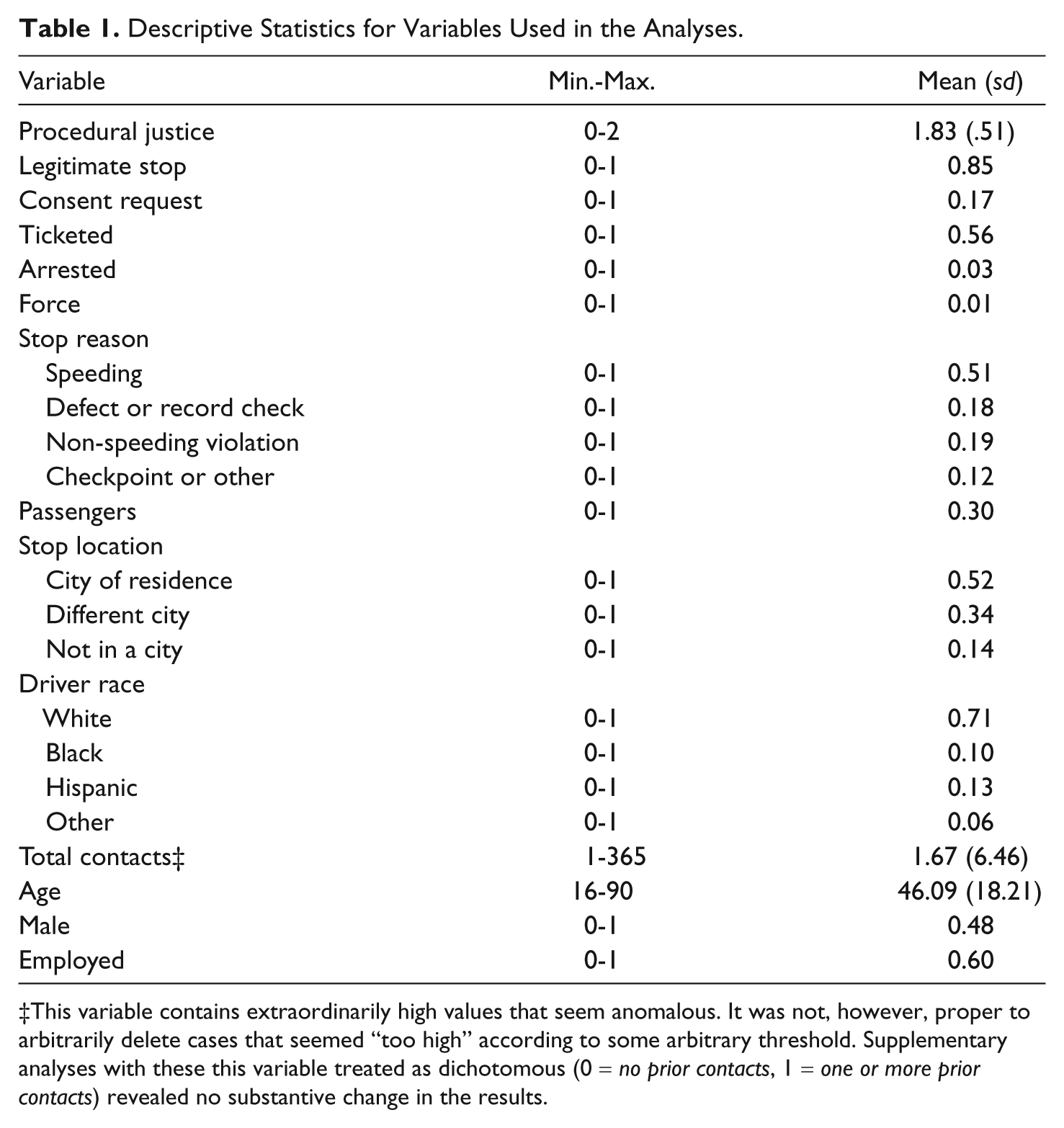
This variable contains extraordinarily high values that seem anomalous. It was not, however, proper to arbitrarily delete cases that seemed “too high” according to some arbitrary threshold. Supplementary analyses with these this variable treated as dichotomous (0 = no prior contacts, 1 = one or more prior contacts) revealed no substantive change in the results.
Independent variables
The primary independent variable is consent request. This variable measures whether the officers who stopped respondents asked for consent to search their vehicles (0 = did not ask; 1 = asked). 1 As explicated above, the matter being investigated in this study is stopped motorists’ reactions to officers’ requests that these motorists waive their Fourth Amendment rights and allow their vehicles to be searched. It is predicted that officers’ requests for consent will constitute procedural injustice that will compromise the legitimacy of the stop.
Outcome-based considerations are also controlled for. Although it has been found in past research that process-based considerations outweigh outcome favorability, outcome-based considerations are not inconsequential (Murphy, 2009b; Sunshine & Tyler, 2003). The analyses therefore account for whether or not a motorist was ticketed (0 = no; 1 = yes), arrested (0 = no; 1 = yes), or had force used or threatened against them (0 = no; 1 = yes).
Infraction type is also included in the analyses. A series of dummy variables compared vehicle defects or record checks, non-speeding violations (failure to wear seatbelts, stop sign/light violations), and DUI checkpoints or other reasons as compared with speeding. Prior studies have found that drivers stopped for reasons other than speeding were significantly more likely to be searched Engel and Calnon (2004) and to feel poorly about the overall encounter (Engel, 2005).
Also included were three items describing characteristics of the encounters. The number of passengers in the car was measured as 0 = no passengers and 1 = passengers. The location of the stop was captured as being inside the city in which the respondent resides, in a different city, or not being in a city at all (coded as a series of dummy variables with “same city” left out as the reference). Location is an important element of policing, as police may profile motorists on the basis of whether or not they seem to “belong” in a certain area (Meehan & Ponder, 2002). People who feel vulnerable to being treated badly by police, moreover, often feel more protected in their own neighborhoods of residence but less safe when they venture outside those areas (Stewart, Baumer, Brunson, & Simons, 2009; Weitzer, 1999).
Respondent demographic factors were included to control for the fact that trust in the police varies across demographic groups. Respondent race was measured as a series of dummy variables (Black, Hispanic, other non-White) with Whites left out as the reference category. Whites consistently display greater trust and confidence in the police relative to minorities (Skogan, 2005; Tyler, 2005; Weitzer & Tuch, 2002). The number of total contacts respondents reported having had with police in the past year was captured in a continuous variable. Those who have had repeated contacts with police may have more negative attitudes about their encounters (Brunson, 2007). Younger persons tend to express more negative attitudes toward police relative to older adults (Correia, Reisig, & Lovrich, 1996; Murphy & Worrall, 1999; Worrall, 1999). Whether or not respondents were male was considered (0 = female; 1 = male). Research suggests that there are gendered differences in experiences with and reactions to the police (Brunson & Miller, 2006). Whether or not a respondent was employed (0 = unemployed; 1 = employed) supplied a general indication of these motorists’ social status, which has been linked to attitudes toward police (Weitzer & Tuch, 2002).
Analytic Strategy
The analysis will begin with chi-square tests of independence to examine the bivariate relationships between consent requests, procedural justice, and stop legitimacy. This will allow for an initial sense of the overlap between these variables. Next, two regression models will be run to test the two hypotheses that are under examination while controlling for other variables’ impacts. The first model’s dependent variable is procedural justice, which was measured with a “0, 1, 2” coding scheme; in accordance with this scale’s level of measurement, the modeling strategy will be ordinal regression. The second model will use logistic regression to analyze the dichotomously coded measure of perceived stop legitimacy.
Results
As can be seen in Table 2, consent search requests were significantly related to both of the outcome variables, as evidenced by statistically significant chi-square values. The percentages are also telling—consent search requests are associated with marked reductions in both procedural justice and perceived stop legitimacy. Only 5.6% of respondents who were not asked reported a zero on the procedural justice scale (meaning they thought the police did not act properly and were not respectful), whereas a full 18.4% of those from whom consent was solicited viewed officer actions as being both improper and disrespectful. A similar pattern emerged with regard to perceptions about the legitimacy of the officers’ reasons for making the stop. Perceived illegitimacy jumped from 14.5% among respondents who were not asked for consent to 36.6% among those who were. At the bivariate level, consent searches were, indeed, a threat to both procedural justice and perceived stop legitimacy.
Percentages and Chi-Square Tests of Independence for Search Requests, Procedural Justice, and Stop Legitimacy.

Table 3 shows the results of the ordinal and logistic regression analyses predicting procedural justice and stop legitimacy, respectively. Both models had statistically significant chi-square values and modest-to-medium pseudo-R2 values (.100 and .227). Several of the independent variables proved significant.
Results of Ordinal Regression for Procedural Justice and Logistic Regression for Stop Legitimacy.
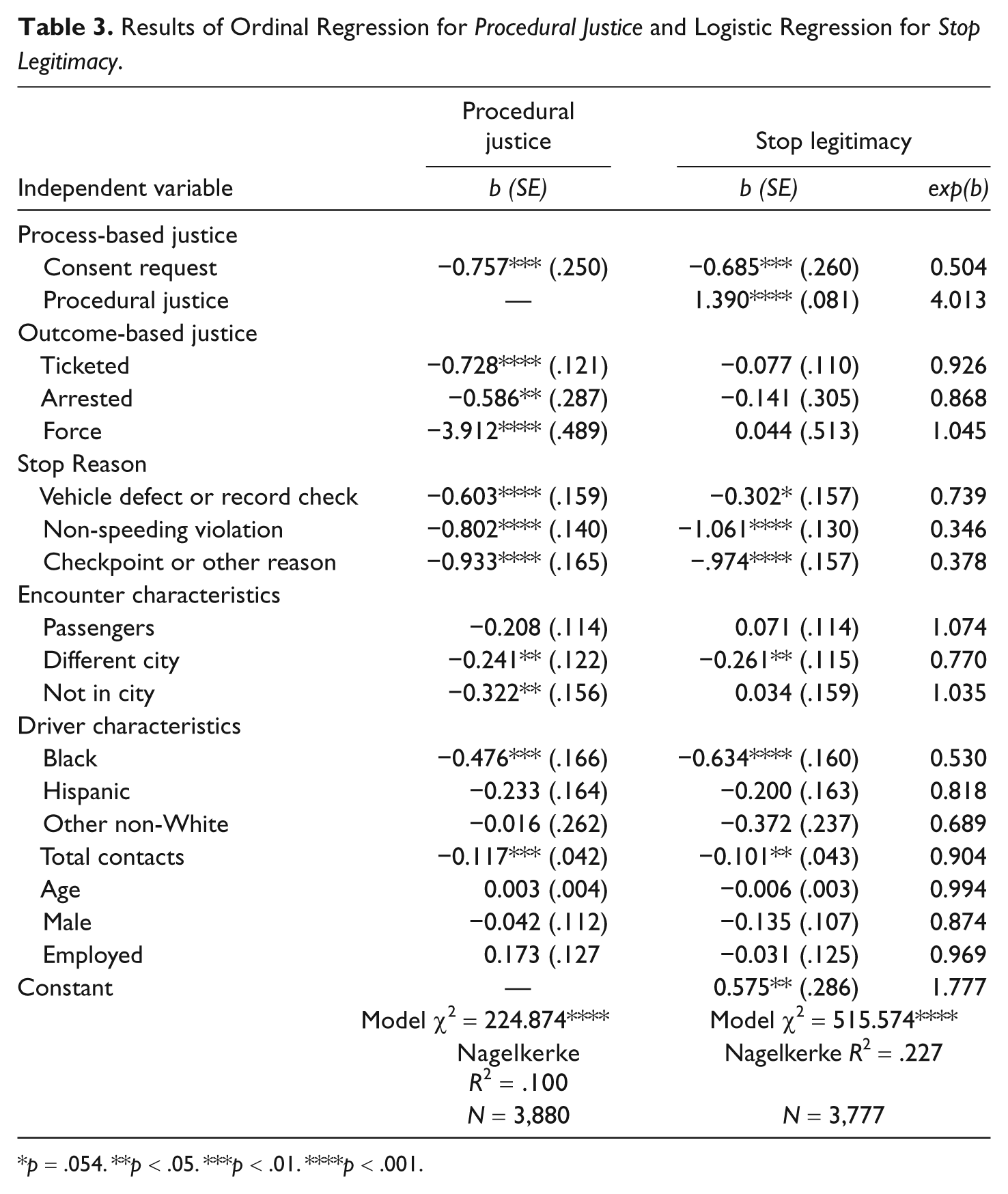
p = .054. **p < .05. ***p < .01. ****p < .001.
The most important finding is that, as hypothesized, consent requests were associated with statistically significant reductions in both justice (b = –.757, p < .01) and legitimacy (b = –.685, p < .01). This result emerged even controlling for a host of covariates, many of which were also related to both outcome variables. It appears that many drivers do react negatively in the face of an officer’s expressed interest in searching their vehicle.
Several of the controls were also significant. Procedural justice was a significant, positive predictor of stop legitimacy (b = 1.390, p < .001). This conforms to existing literature pertaining to process-based policing (e.g., Tyler, 2006)—when officers act properly and respectfully during traffic stops, drivers are more likely to view the stops as resting on legitimate bases. The variables tapping into outcome-based justice demonstrated an interesting pattern in that all three were significant predictors of procedural justice, but none were related to stop legitimacy. Procedural justice theory is predicated in large part upon the distinction between processes and outcomes (Tyler, 2006; Tyler & Huo, 2002). The present findings suggest, however, that stopped drivers conflate the two, insofar as they use negative outcomes as factors when they make post hoc determinations about the quality and fairness of police procedures. Apparently, though, the utilization of outcomes in opinion formation does not extend to judgments about the reasonableness of the initial stop itself.
The remaining patterns of significant findings were consistent with prior literature on police–public relations, particularly during involuntary contacts. Being stopped for any reason other than speeding was associated with significant reductions in both procedural justice and stop legitimacy (see also Engel, 2005). This may be evidence of a “profiling effect” whereby people stopped for reasons such as vehicle defects or stop sign violations feel that the officers intentionally targeted them in a pretextual way (Harris, 2002). It could also be that drivers thought that their violations were trivial and that it was petty of officers to pull them over for such minor infractions. Respondents stopped in cities other than the ones in which they resided were significantly less pleased with their encounters, which may also suggest that these drivers felt targeted, possibly on the basis of their race (Stewart et al., 2009; Weitzer, 1999) or the condition of their vehicle. Black drivers were significantly more skeptical of both the stop itself and of officers’ actions during the encounters, as were those who had experienced multiple police contacts within the past year. These findings make sense in light of existing research on police–minority relations (Weitzer & Tuch, 2002) and the negative impact that repeated encounters with police can have on people’s attitudes toward officers (Gau & Brunson, 2010).
In sum, the regression results yielded support for both of the hypotheses. Officers’ requests for consent to search the vehicles of stopped drivers were associated with a significant diminishing of procedural justice and an increase in the likelihood that those motorists would view the stop as having been illegitimate from the outset. This has implications for police policy, which will be discussed in the following section. Drivers who were ticketed, arrested, or had force used or threatened against them expressed a greater sense of injustice but were not less likely to perceive the stop as legitimate. Procedural justice, likewise, increased stop legitimacy, while being pulled over for a reason other than speeding reduced drivers’ sense that they were treated fairly. Black drivers, those persons who had experienced multiple recent contacts with police, and those stopped in cities outside their area of residence all reported significantly lower levels of justice and legitimacy.
Discussion
The present study framed consent searches as a form of procedural injustice that would raise the likelihood that stopped motorists would view officers’ actions as illegitimate infringements on their liberty and privacy. Consent searches are a common part of police work and may be seen by officers as an easy way to detect criminal offending and confiscate dangerous contraband such as guns and drugs. These types of searches, though, are controversial and, within the context of the normative model of policing, might be viewed by motorists as insulting or discriminatory. Pretext stops are a frequent target of profiling allegations, so when an officer asks a stopped motorist for permission to search the vehicle, the motorist may become suspicious of the officer’s motives for conducting the stop. Trust in the benevolence and good will of individual officers is central to the legitimacy of policing as an institution of social control (Sunshine & Tyler, 2003; Tyler, 2006; Tyler & Huo, 2002; Tyler & Wakslak, 2004). Procedural justice and police legitimacy involve subjective, psychological judgments (Murphy, 2009b; Piquero et al., 2004; Wolfe, 2011), so it was predicted here that officers’ requests for consent to search would be construed by drivers as derogatory or unethical, irrespective of officers’ actual reasons for making the stop or the request.
The empirical results confirmed that consent requests significantly reduced motorists’ beliefs that police acted in procedurally just ways, and increased the likelihood that these persons viewed the reason for the stop as illegitimate. Consent requests thus appear to function as a form of procedural injustice and, as such, cause people to question the motives and intentions of officers.
Two policy recommendations flow from these results. First, police executives in agencies that make liberal use of consent searches, or that do not have written directives pertaining to this class of searches at all, should reevaluate their approach. Traffic stops are the modal form of police–civilian contact and, therefore, vital to the public’s attitudes toward police. In an era of emerging consensus about the importance of democratic policing premised upon partnerships, voluntary compliance, and mutual trust between police and their communities (Maguire, 1997; Reisig, 2010; Reisig & Parks, 2004; Schulhofer, Tyler, & Huq, 2011; Sherman, 2011; Tyler, 2011), police actions that anger citizens and evoke feelings of distrust are a step in the wrong direction. Low levels of legitimacy have dire consequences for police departments in the long run. Citizens who do not trust and respect the police do not come forward with important information about crimes and offenders (Tyler et al., 2010). They may hesitate to report their own victimizations (Kochel et al., 2011) and be less enthusiastic about community policing partnerships (Reisig, 2007; Tyler & Fagan, 2008). Police sabotage their own efforts at crime control when they engage in procedurally unfair actions that undermine the public’s confidence in the institution of law enforcement (Kane, 2005; Tyler, 2004). Police executives, therefore, must make a choice, as there is a trade-off between the convenience and possible short-term benefits of consent searches and the longer-term and more enduring effects of a populace that trusts and cooperates with its police. Consent searches undoubtedly do unearth some useful evidence; however, most searches do not result in the detection of contraband (Warren & Tomaskovic-Devey, 2009) and they can threaten citizens’ rights to be free from unreasonable searches and biased law enforcement (e.g., Lassiter, 1998). The current study adds to these cautionary notes by uncovering additional detrimental ramifications of this class of searches.
A second policy implication pertains more generally to the importance of respectful, high-quality treatment of motorists during traffic stops, including and especially those stops that result in citations. This suggestion flows from the fact that procedural justice strongly impacted perceived stop legitimacy even net of the effect of search requests, a finding consistent with prior procedural justice research (Gau, 2011; Murphy, 2009a; Reisig et al., 2007; Sunshine & Tyler, 2003; Tyler, 2006; Tyler & Huo, 2002). The prevalence of traffic stops makes them ideal media through which police officers can distribute procedural justice and receive public trust in return. Importantly, the present results were derived from a sample of people who were the subjects of involuntary, police-initiated encounters. Most prior studies are based on community or national surveys rather than focused on those who have experienced contact with police under circumstances that are generally considered unpleasant. The current research thus contributes to the procedural justice literature by showing that officers can soften the blow of traffic stops by treating motorists fairly and respectfully. Of course, the results of this study also suggest that procedural justice is not enough to wash out the deleterious impact of consent search requests, so it is important that officers recognize that they cannot nullify the negative effects of consent requests by being polite and respectful.
The well-recognized tensions between, on the one hand, what the law enforcement community views as good police work and, on the other, a strict recognition of motorists’ individual rights to be free from the sort of arbitrary intrusions embodied within blanket consent request policies complicates the task of developing agency policy. If police operate as though consent requests do not threaten to harm public relations, they risk alienating their communities and the broader public; however, if police executives issue anti-consent search mandates that conflict with patrol officers’ beliefs about effective crime control, internal personnel strife and street-level subversion of those mandates may ensue. Executives may be wise to conduct focus groups made up of officers, community stakeholders, and a mix of the two. A bidirectional flow of information between police and the community might facilitate the development of policy reflecting a compromise—such policy might, for instance, contain parameters allowing consent searches under certain circumstances but prohibiting officers from asking for consent absent an articulable rationale as to why the motorist seemed suspicious. Though agencies with diffuse geographic jurisdiction, such as state patrols, might have a harder time with such an endeavor, local police and sheriff agencies can emphasize their intent to keep the community safe and can explain how consent searches advance public safety, while at the same time openly acknowledging the legitimacy of residents’ desires to not be treated as suspected criminals after having done nothing more than violate a traffic law.
This study’s strengths include the fact that the data set that was used is large and nationally representative, and that the sample employed in the analyses presented here was limited to people who experienced police-initiated contacts. The primary weakness of the study is that because the data are cross-sectional, it is not possible to determine what respondents thought about the police or the legitimacy of stops before officers issued consent requests (see Brandl et al., 1994; Brunson & Weitzer, 2011; Gau, 2010; Rosenbaum et al., 2005). The data also do not permit exploration into officers’ reasons for requesting consent to determine whether requests have differential impacts depending on the circumstances under which officers seek consent. Researchers should seek to determine whether the results found in the current analysis hold up equally across drivers of different demographic backgrounds. Investigation should be undertaken into whether there are interaction effects between driver characteristics such as race, gender, age, or a combination between these characteristics (e.g., Rosenfeld et al., 2012), or between driver, officer, and situational factors. The more that is known about stopped motorists’ perceptions of procedural justice during traffic stops, the more these stops can be used as a method of fostering widespread endorsement of police legitimacy as a means of effective crime control and prevention.
Footnotes
Declaration of Conflicting Interests
The author declared no potential conflicts of interest with respect to the research, authorship, and/or publication of this article.
Funding
The author received no financial support for the research, authorship, and/or publication of this article.