



Abstract
This study sought to determine whether legal and extra-legal factors such as type and severity of offense, prior criminal history, age, gender, and race influence decision making in juvenile court. Specifically, the study focused on the imposition of a blended, “determinate” sentence rather than a traditional indeterminate sentence, controlling for adult court transfers. Data for this study were obtained from the largest county in the state of Texas. The results indicated that juveniles sentenced to a blended sentence had committed more serious offenses than those sentenced to traditional indeterminate sentences. Unlike with transfers to adult court, however, minority juveniles (Black and Hispanic) were no more likely than non-Hispanic White youth to receive a blended sentence. Although findings from the current study generally support the imposition of blended sentences, the true test of their utility lies further downstream in the implementation process.
During the 1980s and 1990s, cases involving juveniles who committed violent crimes contributed to society’s view that juvenile crime was out of control and on the rise (Howell, Krisberg, Hawkins, & Wilson, 1995; Redding, 2003; Snyder & Sickmund, 1995). Many state legislators responded to this real or perceived problem by making changes to their state juvenile court statutes (Griffin, 2003, 2008). There was a philosophical shift from the conventional juvenile court practices emphasizing child saving and serving the best interest of children to one reflecting a need to hold youthful offenders more accountable for violent offenses, with an emphasis on protection of the community through retribution, incapacitation, and deterrence (Greenwood, 1995; Zimring, 1998). This “get tough” approach introduced myriad consequential changes within the juvenile court system, including reliance on public hearings, sentencing grids, and mandatory sentencing (Dawson, 1996; Greenwood, 1995).
The juvenile justice system has traditionally operated on the belief and assumption that children are not as responsible for their conduct as adults and are more amenable to treatment (Rosenberg, 1993). The juvenile justice system attempts to correct the child’s behavior through treatment and avoid the harsh punishments of the adult system. The rationale behind statutes concerning juvenile offenders is that a child has not reached a degree of intellectual and emotional maturity to be held fully accountable for his acts (Banay, 1947). Yet, when a juvenile’s offense is so horrific or distasteful, complete responsibility is placed upon the child, who then must face the full weight of the law after being transferred to adult court. Juveniles waived to adult criminal court are presumably the most serious, chronically violent offenders in the juvenile justice system. A primary objective of judicial waiver is to ensure that the adult criminal court can impose a more severe sanction on serious juvenile offenders than the juvenile court can provide (Champion, 1989; Fritsch, Caeti, & Hemmens, 1996; Fritsch & Hemmens, 1996; Zimring, 1991).
Transferring juveniles to adult court, however, risks several negative collateral consequences, such as labeling juveniles as outcasts, which interferes with efforts aimed at their future socialization into mainstream society (Applegate, Davis, & Cullen, 2009). Further, the adult correctional system is not generally equipped to provide the specialized treatment services needed by such youthful offenders. Such a disposition by a juvenile court places a negative stigma on juveniles that can extend far into their adult lives (Bernburg & Krohn, 2003; Sampson & Laub, 1997). Severe formal sanctioning by the juvenile court jeopardizes a juvenile’s individualized attention, rehabilitation, and subsequent conformity to the law. There has been a considerable amount of research comparing recidivism rates of juveniles transferred to adult criminal court with that of youth retained in the juvenile justice system (Bishop, Frazier, Lanza-Kaduce, & Winner, 1996; Fagan, 1996; Myers, 2001; Winner, Lanza-Kaduce, Bishop, & Frazier, 1997). The general consensus is that juveniles transferred to adult criminal court reoffend more often, quicker, and are more likely to commit felony offenses (Bernburg & Krohn, 2003; Paternoster & Iovanni, 1989).
In 1987, the Texas Legislature enacted the Determinate Sentence Act (DSA) for juveniles. This legislation provided the juvenile court with a third option—a “blended” juvenile-adult sentence. Instead of transferring the child to criminal court for prosecution, the DSA provided for keeping the child in the juvenile court system, while providing all the procedural protections that an adult being prosecuted in criminal court would possess (Dawson, 1996). Prosecutors may petition the court to proceed under this statute for more than 30 felony offenses for any juvenile age 10 through 16 at the time of the crime (17 years being the legal age of adulthood in Texas). The determinate sentencing legislation created an alternative procedure to transferring juveniles who have committed violent offenses directly to the adult criminal court for prosecution. These cases remain in the juvenile system but are placed in a special category designated for violent or serious offenders. A juvenile placed in this special category is given all the rights he or she would have possessed in a conventional delinquency case that is transferred to criminal court for felony prosecution. At the same time, the juvenile receives treatment in the juvenile correctional system during the initial stages of confinement. In the majority of cases processed under the DSA, juveniles have the adult portion of their sentence suspended at the successful completion of the juvenile portion of their sentence (Trulson, Caudill, Belshaw, & DeLisi, 2011). At this stage, the blended sentencing scheme also provides for the option of transferring the juvenile to serve the remainder of their sentence in the adult prison system.
Although a sentencing option in-between traditional juvenile indeterminate sentencing and immediate transfer to the adult system has intuitive appeal, only limited research on blended sentencing schemes has been conducted. Much of the available research centers on the relationship between institutional misconduct and recidivism of juveniles upon release from institutions (Lattimore, Macdonald, Piquero, Linster, & Visher, 2004; Trulson, DeLisi, & Marquart, 2011; Trulson, Marquart, Mullings, & Caeti, 2005). Most pertinent, Trulson, DeLisi, and Marquart (2011) examined the relationship of institutional misconduct to post-release rearrests relying on data from 1,804 serious and violent male offenders released from a juvenile correctional facility. The 1,804 represented 71% of all male offenders sentenced under the blended sentencing status since 1987 in Texas and released by 2004. Institutional misconduct was found to have only very limited effect on the rearrest outcomes for serious and violent delinquent offenders among this group.
Also relevant to the current examination is a recent study by Trulson, Caudill, Belshaw, and DeLisi (2011), which relied on a sample of 1,504 serious and violent male delinquents sentenced under the DSA from 1987 through 2007. Juveniles in their study had a post-adjudication determination hearing regarding the continuance or suspension of the adult portion of their blended sentence by year-end 2007. Of the 1,504 juveniles, roughly 40% received a post-adjudication determination by the juvenile court that required them to serve the adult portion of their blended sentence. The other 60% of the sample received a suspended adult sentence and were remanded back to the authority of the Texas Youth Commission (TYC) to serve out their sanction to a maximum age of 20. Logistic regression was used to model the post-adjudication decision either to invoke the adult portion of the blended sentence and transfer the juvenile offender to the adult department of corrections, or to suspend the adult portion of the blended sentence and remand the juvenile back to the custody of TYC. The predictor variables included youth and delinquency background characteristics (race, out of home place, total previous adjudication, gang affiliated at state commitment), commitment offense characteristics (age at commitment, type and severity of commitment offense), and institutional misconduct (omnibus misconduct, staff assaultive, ward assaultive). They found the strongest determinant of having the adult portion of their sentence invoked was related to commitment offense type and severity.
Unlike the vast literature surrounding transfers to adult court, little research has specifically focused on the relationship between legal and extra-legal factors on juvenile determinate sentencing case outcomes. Only one study has focused specifically on the initial decision to proceed under the DSA (Dawson, 1988). In the study, which analyzed the performance of the DSA from its inception in September 1, 1987, through December 31, 1988, Dawson (1988) found that only 53 cases had been concluded under the DSA statewide. The study revealed that 27 of the 53 juveniles referred to a grand jury under the DSA received a determinate sentence. Of those cases, the distribution receiving determinate sentences by race was almost equal, with 30% White, 32% Hispanic, and 37% Black. There was no evidence of discrimination in length of their sentences received. Dawson did find that legal factors, including prior involvement with the juvenile system and seriousness of the offense, were the main factors influencing whether a determinate sentence was imposed.
Although Dawson’s (1988) study suggests that legal factors were the primary drivers of selection and disposition of determinate sentences in Texas, the findings from his study are now over two decades old. Further, the study relied on a small sample of cases from immediately after the implementation of the DSA. Finally, the study did not consider the relationship between determinate sentences and transfer to adult courts. The current study represents an attempt to update and expand on the results from Dawson’s study. The research includes transfer decisions, in addition to determinate sentencing dispositions, and compares these case outcomes to those resulting in traditional juvenile indeterminate sentences drawing from an expanded pool of cases in the largest Texas county juvenile court system.
Method
A cross-sectional correlational design was employed to identify the legal and extra-legal factors that play a significant role in the juvenile court decision to transfer a felony offender to adult criminal court jurisdiction, or to retain the offender in juvenile court jurisdiction for processing under the determinate sentencing versus the indeterminate sentencing statute. This design focused on how variations in predictor variables correspond to variations in the sentencing outcome. Secondary data were used in a descriptive manner to determine a pattern of relationships between the legal and extra-legal factors hypothesized to play a significant role in these decisions.
Data and Sample
Data for this research were obtained from the Harris County Juvenile Probation Department (HCJPD). The HCJPD is the investigative branch of the juvenile court system in Harris County, Texas. Its functions include intake screenings, detention, pre-adjudication and presentence investigations, case management, and data collection for offenders referred to the Harris County juvenile court system. The HCJPD retains information on all juveniles referred for delinquent or criminal behavior.
Harris County was selected as the study site because it is the largest metropolitan area in Texas. Utilizing this county provides a large pool of cases in a comprehensive database without the need to control for jurisdictional differences in procedure, data collection, and coding that could impinge on the analysis. The data collected include legal and extra-legal predictors that were hypothesized to influence juvenile court decisions to transfer a juvenile to adult criminal court or retain in juvenile court and to invoke processing under the DSA versus traditional indeterminate sentencing procedures in juvenile court.
The start of the time frame for data collection in this study, 1999, was selected to allow ample time for the latest revisions in the DSA to take effect and to give a glimpse at case processing in its aftermath (Dawson, 1996). The cutoff date, 2004, was selected to provide an adequate sample size and to allow time for final case processing by the point of data collection. Information on the entire population of referrals during 1999 to 2004 was obtained. Because misdemeanants, technical violators of supervision, and status offenders are not eligible for determinate sentences, the pool of cases was restricted to felons with complete information concerning the type and severity of offense and the adjudicatory outcome. To maintain consistency with eligibility for certification to criminal court, it was decided that referrals under the age of 14 would be excluded. List-wise deletion of cases missing data and elimination of those under the age of 14 resulted in a large data pool (n = 10,517) to draw on for the analyses.
Owing to the imbalanced outcome variable—type of sentence, which was skewed by nearly 50:1—it was necessary to draw a sample of cases from among the pool of those cases receiving indeterminate sentences. A decision was made to include all of the cases receiving determinate sentences (n = 237). To prevent contamination of the analysis that could result from sample selection bias, the decision was made to include the population of cases transferred to adult court (n = 376) as well. Finally, a random selection procedure was used to draw a sample from among the cases resulting in indeterminate sentences (n = 300), for a total combined sample that contained as rough an equivalency among the three groups as possible (n = 913).
Measures
The literature identifies a number of factors that potentially influence decisions to transfer an offender to adult criminal court or to invoke blended sentencing in the juvenile court. For the purpose of the current study, these factors are categorized into two groups: legally relevant and extra-legal factors. The significance of predictor variables thus categorized has been described in a number of empirical studies (Mears & Field, 2000; Redding, 1997; Zimring, 1998). The legally relevant predictor variables include type of offense, offense severity, number of previous petitions, and age at the date of offense. Although the first three factors are obviously legitimate considerations, the age of the offender is included as legitimate because a juvenile’s age is a primary consideration, along with offense and prior criminal history, in statutes determining eligibility for transfers and blended sentencing. Further, the age of juveniles has been an important consideration in judicial determinations related to offender blameworthiness and culpability since the origin of juvenile courts. The two extra-legal predictor variables included gender and race/ethnicity.
The scale of measures naturally consisted of an assortment of types, including dichotomous, polychotomous, and continuous. A large number of empty and near-empty cells were found. To eliminate the possibility that the logistic regression procedures would not converge (Tabachnick & Fidell, 1996), categories were collapsed or deleted. After the categories were collapsed, dichotomous indicators and dummy variables were created.
The predictor variables used in the logistic regression were coded as follows: race was dummy coded as Black = 1; non-Black Hispanic = 1; White, non-Hispanic = 0, which served as the reference group. Age was dummy coded as 14 = 1, 15 = 1, and 16 = 0, which served as the reference category. Gender was coded as male = 1 and female = 0. Type of felony was coded as person = 1, nonperson felonies = 0. Severity of felony was coded as first-degree/capital = 1 and lower severity = 0. Number of previous petitions was coded as 0-1 petitions = 0 and 2 or more = 1. The outcome variables incorporated the type of juvenile sentence and transfer status (indeterminate sentence in juvenile court, determinate sentence in juvenile court, and transfer to adult criminal court). The outcome variable was coded as follows: indeterminate sentence = 0; determinate sentence = 1; and transfer to adult court = 2.
Analysis
χ2 tests were conducted to determine if the bivariate relationship between predictor variables and type of sentence were statistically significant. The analysis of determinate sentencing outcome relative to indeterminate sentencing and transfer to adult court necessitated reliance on multinomial logistic regression procedures. In the model, indeterminate sentences served as the reference category. As such, a bifurcated model reports the odds of receiving a determinate sentence or being transferred to adult court relative to the odds of being sentenced to a traditional indeterminate sentence. Because the predictor variables were equally empirically and theoretically relevant, they were entered into the regression model simultaneously in one block. No method of removing statistically insignificant variables was relied on; full models are reported (Bachman & Paternoster, 1997).
The analysis has some inherent limitations. Secondary data from the HCJPD are the sole data source. These data were compiled by the HCJPD for its own purpose and may contain some degree of error related to mistakes in reporting or data entry procedures. Further, only variables included in that dataset were available to researchers. Omitted variables could lead to specification error in the models to some unknown degree. For instance, socioeconomic status or presence/type of attorney, variables not available for inclusion in the analysis, could be expected to account for some of the observed relationship between race and the outcomes (Johnson & Secret, 1990; Leiber & Mack, 2003). Similarly, the lack of information on presiding judges further constrained the analysis, making it impossible to determine whether courtroom-level factors may have influenced outcomes (Trulson, Caudill, Belshaw, & DeLisi, 2011).
Results
Table 1 presents the breakdowns for race/ethnicity, gender, age, type of felony, severity of felony, and number of previous petitions by type of sentence received. When viewing Table 1, it is necessary to interpret findings in light of the sampling procedure. The table reports column percentages meant to describe the prevalence of particular case characteristics among the three samples. The statistical test for differences compares the transfer and determinate sentence populations to the indeterminate sentence sample. For predictors with three categories, ethnicity and age, the statistical tests compare particular categories (i.e., Black) to the reference category (i.e., White).
Disposition by Race, Ethnicity, Gender, and Legally Relevant Controls.
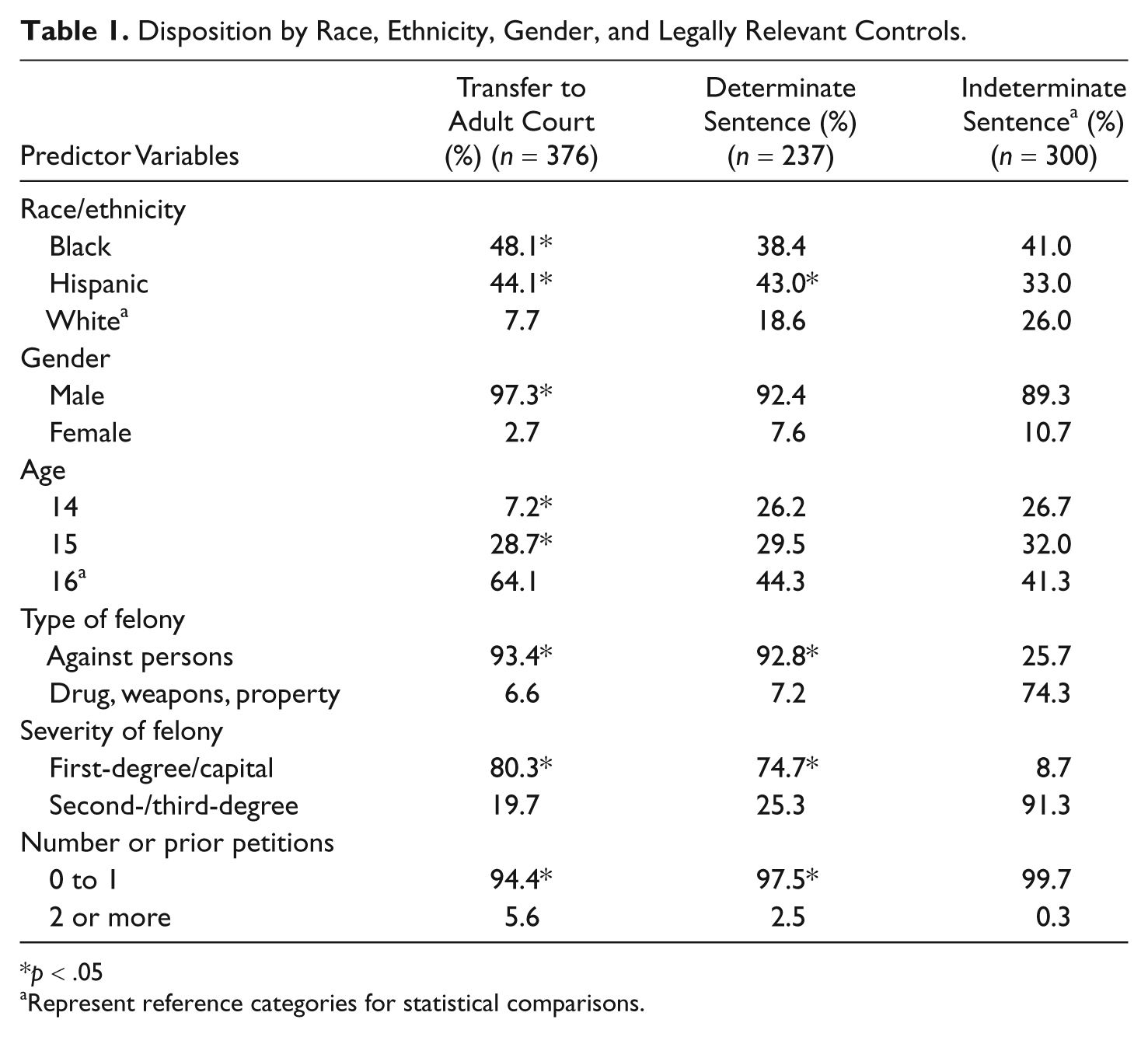
p < .05
Represent reference categories for statistical comparisons.
An interesting pattern among predictor variables and determinate sentences emerges from Table 1. First, and most importantly, extra-legal factors appear to be more highly correlated with transfer decisions than juvenile court dispositions. Only Hispanics were more prevalent among the determinate sentence sample relative to the indeterminate sentence sample, while both Blacks and Hispanics were more prevalent in the transfer sample. The prevalence of males was significantly higher among the transfer sample but not among the determinate sentence sample. It would appear from the bivariate relationships that more bias is present in dispositions resulting from the decision to transfer to adult court. Second, legally relevant considerations appear to influence disposition to determinate sentences. The severity and type of felony had an influence on juvenile court disposition similar to the transfer decision. Juveniles who committed first-degree/capital offenses and offenses against persons were more likely to receive determinate sentences than those who committed offenses of lesser degrees and nonperson offenses.
A multinomial logistic regression analysis was performed with disposition as a trivariate outcome (transfer to adult court, determinate sentence, and indeterminate sentence—reference category). A test of the full model with all predictors against a constant-only model was statistically significant (χ2 = 645.99, p < .001). Table 2 shows the observed to predicted sentencing outcomes. The classification table shows prediction success to be moderate, with an overall accuracy rate of 66.8%. The ability to classify cases, however, was uneven. The model was quite good at correctly classifying cases transferred to adult court (79.8%) and those resulting in indeterminate sentences (85.3%), but much less successful at classifying cases resulting in determinate sentences (22.8%). The high rate of false positive predictions among cases resulting in determinate sentences was due mainly to misclassification as adult court transfers. More than half of those receiving determinate sentences were predicted by the model to be transferred to adult court, suggesting that determinate sentences were often the result of leniency.
Observed Versus Predicted Outcomes Based on the Multinomial Logistic Regression Model.

For ease of interpretation, Table 3 contains the exponentiated logistic regression coefficients (odds ratios), and 95% confidence intervals for odds ratios, for each of the predictors. Because the outcome variable contained three categories, two sets of parameter estimates were obtained—one for transfer to adult court and one for determinate sentencing, with indeterminate sentences serving as the reference category. The regression coefficients estimated for the controls, cases resulting in transfer to adult courts, are in the expected direction. The relationship among legal and extra-legal characteristics and transfer mirror those reported in Table 1, although the influence of gender and prior record do not quite reach the .05 level of statistical significance. Ethnic minorities were three times as likely to be transferred to adult court. Age also had a strong effect on transfers, with 15-year-olds being less likely than 16-year-olds to experience transfer, and 14-year-olds being the least likely to experience a transfer. The type and degree of felony also had a strong effect on the likelihood of transfer.
Multinomial Logistic Regression Model Predicting Type of Disposition.

p < .05; † p < .10
Indeterminate sentence represents the reference category for statistical comparisons.
As with adult transfers, type and severity of the felony was related to determinate sentences. A youth who committed a felony against persons was nearly 12 times as likely to receive a determinate sentence in comparison to an indeterminate sentence, net of the effect of other predictors and transfer decisions. Similarly, a youth charged with a first-degree or capital felony had a net likelihood of receiving a determinate sentence nearly 9 times that of an indeterminate sentence. Age appeared to have no effect on determinate sentence, while the influence of prior record was too unreliable, due to small cell size, to discern.
By far the most interesting finding illuminated in the analysis involves the relationship between extra-legal variables and disposition in juvenile court. Black and Hispanic youth were no more likely to receive determinate sentences than were White youth, after controlling for other relevant factors. Similarly, males were no more likely to receive determinate sentences than females. In sum, minority status and gender had no net effect on the likelihood of a youth being processed under the DSA.
Discussion
This is one of the first studies to explore factors related to blended sentencing decisions in a juvenile court system, while controlling for the decision to transfer to adult court. The study relied on cases processed in the largest urban county in Texas (Harris County), utilizing records from 1999 through 2004. It was hypothesized that both legal and extra-legal factors would influence these decisions. Specifically related to legal factors, cases involving older juveniles, those with lengthier prior records, and those committing more serious felonies were expected to result in transfers and blended sentences more often than cases lacking those characteristics. Specifically related to extra-legal factors, cases involving minorities (Black and Hispanic) and males were expected to result in transfers and blended sentences more often than cases involving females and Whites.
Determinate sentencing was introduced as an alternative to judicial waiver and traditional juvenile justice processing for serious and violent juvenile offenders (Dawson, 1988: Redding & Howell, 2000). In this study, legally relevant considerations were shown to influence the disposition to determinate sentencing. The severity and type of felony had an influence on disposition similar to the transfer decision. Juveniles who committed first-degree/capital offenses and offenses against persons were several times more likely to receive determinate sentences than those who committed offenses of lesser degree and nonperson offenses. More than half of the juveniles who received a determinate sentence were incorrectly predicted to be transfers to adult criminal court based on the multinomial logistic regression model. These individuals probably would have been transferred to adult criminal court if a blended sentence statute had not been operational in Texas. In this regard, the results of the current study are consistent with the intent of the law, prior studies of the waiver process, and studies of blended sentencing (Bishop et al., 1996; Burrow, 2008; Kurlychek & Johnson, 2004; Poulos & Orchowsky, 1994; Rainville, 2008; Trulson et al., 2011).
Where the two procedures diverge is also important. Age was an influential determinant of transfer to adult criminal court, as expected, but was not predictive of determinate sentencing. Juveniles nearer to the upper age limit of jurisdiction of the juvenile court were more likely to be transferred to adult criminal court than younger juveniles. This is consistent with prior studies showing that sentencing decisions of judges make some allowances for younger juveniles early in their careers, perhaps first-time offenders, who may benefit from services of the juvenile court instead of requiring transfer to adult court (Tanenhaus & Drizin, 2004).
Prior record also appeared to have a stronger influence on the transfer decision, although the effect was less clear due to small cell size. These findings are consistent with the literature in that juveniles with serious offenses and a lengthy prior record appear to be resistant to treatment, or not amenable to treatment, or more sophisticated, and perceived as a future threat to society. Therefore, harsher sanctions, specifically in terms of transfers, may be used to protect society (Bishop et al., 1996; Bishop & Frazier, 1991; Fagan & Deschenes, 1990). At the same time, these concerns may not be as relevant to determinate sentencing where more youthful offenders with less severe prior records who have committed serious or violent offenses can be more effectively served by a blended sentencing system. They can be served directly by the juvenile justice system and later on by the adult system should the need arise.
The major point of divergence found in the current study concerns the influence of extra-legal factors. Although not as strong as the relationship to legal characteristics, extra-legal characteristics, including race/ethnicity and gender, exerted a consistent influence on transfers to adult criminal court. In this study, the odds ratio for race and ethnicity indicated that a Black or Hispanic juvenile was about 3 times as likely to be transferred to adult criminal court as a White juvenile. The disparity in transfer decisions between males and females was also sizeable. In stark contrast to the findings related to the transfer decision, the extra-legal factors, race and gender, failed to influence dispositions in juvenile court. The odds of Blacks and Hispanics receiving determinate sentences were similar to Whites. Males were no more likely to receive determinate sentences than females. Minority status and gender had no effect on the likelihood of a juvenile being processed under the DSA. This finding is consistent with Dawson’s (1988) study, wherein he concluded that extra-legal factors were not significant in case processing under the DSA in its first year of operation. Most of the bias in juvenile court dispositions noted in the current study resulted from the decision to transfer to adult criminal court.
Although it appears to have been implemented in a nondiscriminatory manner, the DSA has done little to resolve the overall problem of disproportionate minority overrepresentation in the juvenile justice system. During 2002, near the midpoint of this study’s data series, a report to the legislature by the Texas Juvenile Probation Commission (2003) showed continued statewide disparity in system contact and confinement of Black juveniles. While Black juveniles accounted for only 13.5% of Texas population, they accounted for 22.9% of referrals, 33.2% of TYC admissions, and 41.1% of transfers to adult court. Although the likelihood of a negative outcome increased with each step in severity for Black youth, the likelihood remained near their representation in the population for Hispanics (39.5% of youth population; referral, 42.7%; TYC confinement, 38.9%; and, waiver, 39.3%), while Whites experienced a reverse trend (44.0% of youth population; referral, 33.5%; TYC confinement, 27.3%; and, waiver, 17.8%). Though discretionary decisions by justice officials cannot be ruled out entirely, much of the disparity in outcomes resulted from the seriousness and frequency of offenses committed by the respective racial and ethnic groups (Davis & Sorensen, 2010).
In explaining disparities in juvenile court processing, observers often point to the courtroom workgroup members and organizational characteristics (Albonetti, 1991; Carr, Hudson, Hanks, & Hunt, 2008; Leiber & Mack, 2003). Judges and other court officials operate under organizational constraints and limited resources. They are likely to make decisions based on social characteristics such as race and gender when making decisions about blameworthiness and risks. Systematic disparities have been shown to surface in juvenile court processing because minorities and males may be perceived as more dangerous than Whites and females offenders (Leiber & Johnson, 2008). Further, females may benefit to some degree from sex-role stereotyping that occurs in the sanctioning process for more serious offenses (Carr et al., 2008; Chesney-Lind & Sheldon, 2004; Guevara, Hertz, & Spohn, 2006).
The findings from the current study suggest that these same extra-legal considerations may not be as influential when the decision involves an intermediate and remediable action such as determinate sentencing. In this regard, blended sentencing appears to encompass the best aspects of both—transfer to adult criminal court and traditional juvenile justice processing. Juveniles can be held accountable for the serious offenses they have committed, but are also offered the possibility of rehabilitation and redemption. Determinate sentencing affords even juveniles who commit serious offenses a greater range of treatment options and a chance to redeem themselves. Theoretically, if no change in behavior occurs while institutionalized with treatment interventions, the adult part of the sentence may be invoked and the juvenile serves the remainder of his/her time as an adult.
The current findings, however, are tempered by those of studies examining the effectiveness of the DSA. Although the sanction has the potential to provide for the rehabilitation of offenders and safety of the public, in practice researchers have found that it fails on a number of counts. First, Trulson, Caudill, et al. (2011) found that the decision to invoke the adult portion of the determinate sentence (transferring the juvenile to adult prison) has been based mainly on the seriousness of the offense and the youth’s age at commitment, rather than behavioral variables that may signify a “change” in the offender while serving the juvenile portion of the sentence. Second, Fritsch, Hemmens, and Caeti (1996) found that youth sentenced to blended sentences, on average, served less time incarcerated than they could have if given a traditional (indeterminate) juvenile justice sentence. Third, while studies have yet to directly compare propensity to reoffend with those receiving traditional juvenile sentences or waived to adult court, a cohort of youth released from their determinate sentences engaged in numerous violent felonies, with roughly half being rearrested for felony-level offenses (Trulson, Haerle, DeLisi, & Marquart, 2011). The ultimate success or failure of blended sentencing is a subject worthy of continued investigation.
Footnotes
Declaration of Conflicting Interests
The author(s) declared no potential conflicts of interest with respect to the research, authorship, and/or publication of this article.
Funding
The author(s) received no financial support for the research, authorship, and/or publication of this article.