



Abstract
Commonly perceived as rare, copycat crime has not been sufficiently studied. In an effort to encourage research, this research note offers a refined estimate of the proportion of offenders and at-risk individuals who report personal copycat crime histories. An analysis of 10 estimates spanning 50 years of self-reported copycat crime prevalence among just under 1,500 respondents was conducted. Collectively, the 10 study estimates indicate that about one in four respondents reported personal copycat crime histories. A random effects model indicated that prevalence estimates vary significantly across studies but effect moderators were not able to be identified. Copycat crime was indicated as a characteristic of a substantial number of offenders and at-risk youth. Copycat crime is deserving of more serious research and a number of associated research questions await attention.
The labeling of some social behavior as “copycat” behavior became popular in the late 1800s (Siegelberg, 2011). 1 And while the term copycat crime was not used, the idea of the media as a source of criminogenic models emerged during the same time period. 2 The adoption of the term “copycat crime” came more than a half century later and has been used regularly since the 1970s in both academic and popular press (see Berkowitz, Parke, Leyens, West, & Sebastian, 1978; Eysenck & Nias, 1978; Siegel, 1974; Toplin, 1975, for early copycat crime references). Despite a long history and a large number of studies on violent media’s relationship with social aggression, the rigorous study of copycat crime has lagged. The research question that is the focus of this note is how common is the copying of crimes that have been portrayed in the media. Because what comprises the media has evolved over time and crime-related content has been found to loop and appear in multiple media outlets (Manning 1998; Surette, 2011), the media are considered as collectives that include print, visual, electronic, sound, news, entertainment, infotainment, and new media. Copycat crime is in turn conceived as a crime that is linked in form or motivation to a prior media-portrayed crime.
One reason for the deficiency in copycat crime research is the difficulty in examining copycat crime levels. While other crimes are relatively straightforward to quantify and are routinely tallied in official law enforcement statistics, copycat crimes are not counted in any systematic way and there has existed controversy over whether a substantial copycat effect operated (Clarke & McGrath, 1992; Stack, 1987, 2000). Part of this invisibility is due to the nature of copycat crime. Recognizing a copycat crime first requires that a media content link between two crimes be correctly recognized. A media-portrayed crime and its subsequent copycat crime can be spatially and temporally separated so that an unknown number of copycat crimes invariably go unnoted. Therefore, what is thought to be known about copycat crime has been largely surmised from anecdotal reports of crimes labeled as copycats after their occurrence (Coleman, 2004).
Consequently, it is not surprising that estimations of the prevalence of copycat crime have rarely appeared in the research literature. This is unfortunate as an empirically grounded estimate of the prevalence of copycat crime is necessary to establish the magnitude and social importance of the phenomenon and would help to spur additional research efforts on related media-linked criminogenic processes such as the effect of violent video game play (Surette, 2013a). In addition, the study of copycat crime has relevance for a number of criminological theoretical perspectives, most obviously social learning theory and also subculture, cross-cultural, and life-course theories of crime.
For social learning theorists, an improved understanding of the role of media-supplied behavior models would provide additional insights into the social dynamics involved in broader noncriminal social learning processes. As new social media platforms such as Facebook allow social interactions, personal relationships, and communities to develop in new virtual ways, understanding how negative social behaviors diffuse via media would provide another window into contemporary general social learning processes. The study of copycat crime would also benefit sub- and cross-cultural studies of crime. Knowledge about differential effects of media content across delinquent subcultures would increase the understanding about how various cultural enclaves interact with and process criminogenic media models and help identify what factors might be insulators or catalysts in the mimicking of crime. If the dynamics of copying crimes are different for urban minority youths than for suburban Anglo youths for example, knowledge of the differences would advance the understanding of subcultural delinquency variance. Similarly, the study of copycat crime rates internationally and the comparison of high-crime media/low–copycat-crime cultures (Japan is a hypothesized example) with low-crime media/high–copycat-crime cultures (copycat terrorism in fundamental religious countries such as Afghanistan possibly) would advance the understanding of both copycat crime and cultural differences in crime rates. In addition, as emerging findings suggest that the copycat crime activity tends to occur early in criminal careers (Surette & Maze, 2013), the study of copycat crime’s role in the developmental life course of delinquents would be beneficial. If the copying of a media-modeled offense is a common pathway into initial delinquency for many youths, then the study of copycat crime would be revealing regarding who enters into, and perhaps stays on, career criminal trajectories.
Research on copycat crime would also be useful for disciplines that do not study crime and justice, such as those that study media and communication. Thus, the decision to commit a copycat crime involves the cognitive processing of media-supplied information. 3 For a copycat crime to occur, an offender must first break a media’s portrayal of a crime into step-by-step instructions. The instructions have to be determined to be a potentially successful and persuasive enough so that a decision to attempt to copy the media-portrayed crime results (Surette, 2013b). The study of copycat crime cognition would contribute to a wider understanding of how media-supplied information is utilized by consumers. The major conceptual division in this area is between systematic and heuristic decision making. Systematic decision making involves the purposeful culling and evaluation of media information and would be evoked in planned instrumental copycat crimes, such as bank robberies. Heuristic decision making involves shallow and rapid processing of media information and would be related to spontaneous emotional copycat crimes, examples would be sports rioting and rage-based assaults (Surette, 2013b). Along parallel lines, the communication and adoption of behavior scripts by individuals, which is of interest in communication studies, would be advanced through the study of the adoption of specific crime scripts by individuals who emulate a media-portrayed crime. 4 A media-modeled crime provides a behavioral script to potential copycat offenders and the study of criminal script acquisition would forward the understanding of the broader general process of behavioral script development in nonoffenders. Media researchers have recently begun to examine the impact of media immersion and narrative persuasion on social behaviors. 5 In that most media content is consumed within narrative stories and is not consumed in purposeful systematic or heuristic-driven searches for information and most media crime content is delivered within narratives (Surette, 2011), copycat crime studies would provide a platform for examining how specific stories in the media become personal behavior scripts that influence individuals to act in specific ways in the real world. Lastly, deep psychological immersion in the media content by individuals has been suggested as a significant factor in narrative persuasion and the copying of media-modeled criminal behavior (Meloy & Mohandie, 2001; Myers, Eggleston, & Smoak, 2003). The study of copycat crime would be helpful for understanding the importance of immersion in violent and criminogenic media narratives via new media platforms such as video games and their effects on game players (Surette, 2013b). In gist, the study of copycat crime will provide another window into how media content relates to criminal behavior and how behavior in general is leaned and diffused through society.
Existing research on copycat effects has empirically explored two areas. The first area of research involves imitative suicides. A media-generated copycat effect on suicides has been termed a Werther effect named after a fictional hero who committed suicide in the Johann Goethe (1774/1989) novel, The Sorrows of Young Werther. As a result of this research stream, the impact of media reporting and portrayals of suicide incidents on suicide behavior has been widely recognized (O’Carroll & Potter, 1994; Phillips, Lesyna, & Paight, 1992; Stack, 1987). The second research area examined terrorism. Within the research literature about terrorism, there are few doubts expressed about the media’s ability to motivate copycat terrorist acts and there is much anecdotal evidence that terrorist events such as kidnappings, bank robberies in which hostages are taken, airline hijackings, parachute hijackings, planting altitude bombs on airplanes, suicide bombings, and online showing of beheadings of hostages occur in media-linked clusters (Poland, 1988; Tuman, 2010). The bulk of the copycat terrorism anecdotes reports result from the news media observing similar events following a successful terrorist act. A recent example is the spate of beheadings of hostages that were posted on the Internet following the 2002 beheading of journalist Daniel Pearl. The basic weaknesses associated with anecdotal evidence are its validity and generalizability. Regarding validity, it is difficult and sometimes impossible to determine whether two terrorist acts are actually linked and if media were the linkages. Moreover, because awareness of anecdotal examples is dependent on news media recognition and reporting, whether the newsworthy ones that become known are unique or representative of terrorist contagion in general is indeterminable. Despite these concerns, the consensus regarding copycat terrorism is that it is especially strong following a well-publicized, successful act using a novel approach (Surette, 2011).
The anecdotal cases in combination with research on media-copied suicides and terrorism studies establish reasonable grounds for the hypothesis that copycat crime occurs at a significant rate (Helfgott, 2008; Pease & Love, 1984; Schmid & de Graaf, 1982; Surette, 2002; Wilson & Herrnstein, 1985). Despite research and public interest in copycat crime, few attempts have been made to gauge the prevalence of copycat crime. This research note looks to partially fill that gap and to encourage future copycat crime research. The 10 included studies used similar measures of copycat crime prevalence and provided an opportunity to estimate the prevalence of copycat crime based on nearly 1,500 respondents queried over a time span of 50 plus years.
Method
Criteria for Inclusion and Search Strategy
Studies were included where subjects were asked if they had “ever attempted a crime where they have gotten the idea from the media” with possible responses of yes, no, or unsure. Subjects who responded affirmatively self-determined whether they had copied a specific crime or a general type of crime. Reflecting copycat crime’s understudied status, no studies were located that estimated its prevalence in a different fashion. A limitation of this research is that the underlying search was not as exhaustive as a full meta-analysis methodology would require. Hopefully, the note will encourage additional research that includes full meta-analysis designs.
Qualifying studies were located by searching the academic journal search engines for articles addressing copycat crime or crime and imitation, 6 contacting researchers known to be working on imitation, media, and crime, and searching crime and media texts and research reports. Although only 10 studies were uncovered, the small number was not unexpected and reflected the limited research interest in this phenomenon. The included 10 studies queried various populations of respondents and all utilized self-reported measures. The most common subjects were incarcerated adults; however, nonincarcerated at-risk youths and students at low-risk public schools were also surveyed. What was consistent across studies was the measurement of copycat criminality. The 10 studies operationalized copycat crime prevalence in a similar manner so that the numerical values had a comparable meaning across studies (Lipsey & Wilson, 2001).
Self-Report and Copycat Crime
Asking individuals about their copycat crime histories suffers the usual weaknesses of self-reported measures. However, self-report has been found to be a valid process in the study of the social reality of crime. The reliability of self-reported copycat crime measures is bolstered by prior research that found that the reliability of self-reported measures was improved when a criminal behavior was measured via “ever” questions and for more rarely committed acts such as copycat crime (Bruinsma, 1989; Junger-Tas & Marshall, 1999, p. 346). In fact, the self-report method has been found superior to official sources, particularly in terms of measuring serious and rare forms of criminality (Farrington, Loeber, Stouthamer-Loeber, Kammen, & Schmidt, 1996; Junger-Tas & Marshall, 1999; Steinberg & Monahan, 2007; Thornberry & Krohn, 2000). Previous research also suggests that the copycat crimes that were recalled by the respondents would predominately be more serious copycat events, reducing the likelihood of trivial imitations being measured and increasing the probability of the measure differentiating true copycat from noncopycat offenders (Junger-Tas & Marshall, 1999). The nature of copycat crime as a relatively uncommon but unique activity makes estimating its prevalence a good candidate for self-report methods, and the validity and reliability concerns usually associated with self-report studies do not debilitate the estimation of the prevalence of copycat crime via self-report–based studies (Junger-Tas & Marshall, 1999; Thornberry & Krohn, 2000).
Summary of Studies
As previously noted, 10 estimates of the prevalence of copycat crime were uncovered. Reported in Table 1, the studies were conducted between 1975 and 2011. The 10 estimates were generated from seven separate research efforts and directed by five different researchers. Six used interviews to obtain their prevalence estimate, three used written questionnaires, and one used a mix of written and oral responses. The smallest study included 35 respondents, and the largest had 501 subjects. All but two studies involved the questioning of incarcerated individuals. Two studies included females and six sampled teenage youths, but overall, the majority of the respondents were adult males. Samples were drawn from four U.S. locations and one foreign country. As shown in Table 1, each study reported a significant nonzero copycat crime prevalence estimate that ranged across the 10 studies from a low of .13 to a high of .46. As nonrandom studies that vary significantly in their target populations and methodology, they provided an opportunity to calculate a collective estimate of the prevalence of copycat crime within offender and at-risk populations based on statistics commonly used in meta-analysis.
Copycat Crime Prevalence Studies.

Results
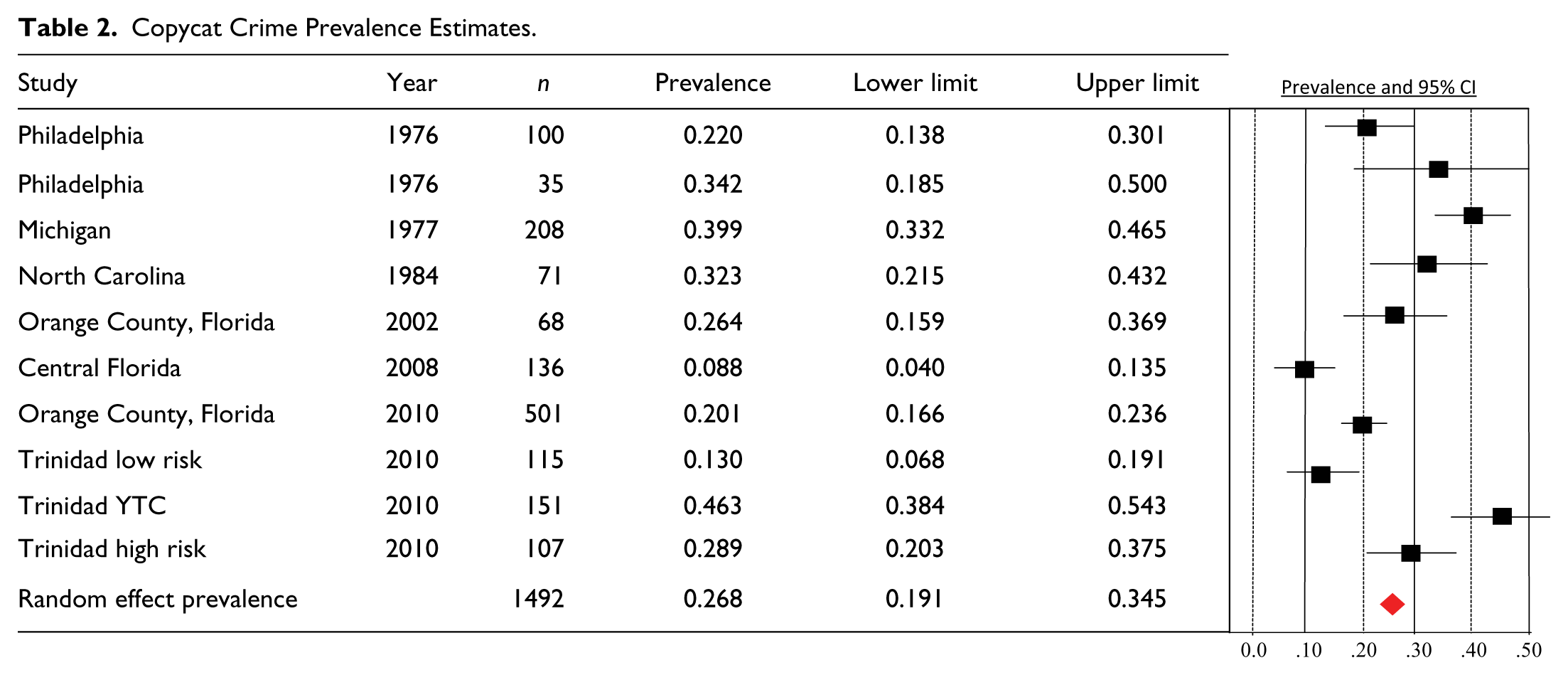
Reported in Table 2, the forest plot shows the prevalence value and 95% confidence intervals (CIs) for each individual study. The overall prevalence effect size is seen to be consistently and significantly above zero across all 10 studies. Due to a significant Q statistic value (Q = 111.29, df = 9, p = .000), the estimation of an overall prevalence effect size was conducted using a random effects model. The significant Q value also indicated that the studies were not homogeneous and that effect size moderators may exist. The random effects model provided an overall estimation of the prevalence of copycat crime of .268. 7
Copycat Crime Prevalence Estimates.
Prevalence Estimate Moderators
Parsing the studies along two dimensions, study characteristics and respondent characteristics, a set of possible estimate moderators was explored. While some subsets have substantial numbers of respondents, the limited number of studies in each subgroup and the fact that individual studies fall into multiple subsets cautions against drawing definitive conclusions concerning moderators (Lipsey & Wilson, 2001). With that caveat in mind, a comparison of study subsets grouped by various factors generated interesting speculations but no statistically significant effect size moderators.
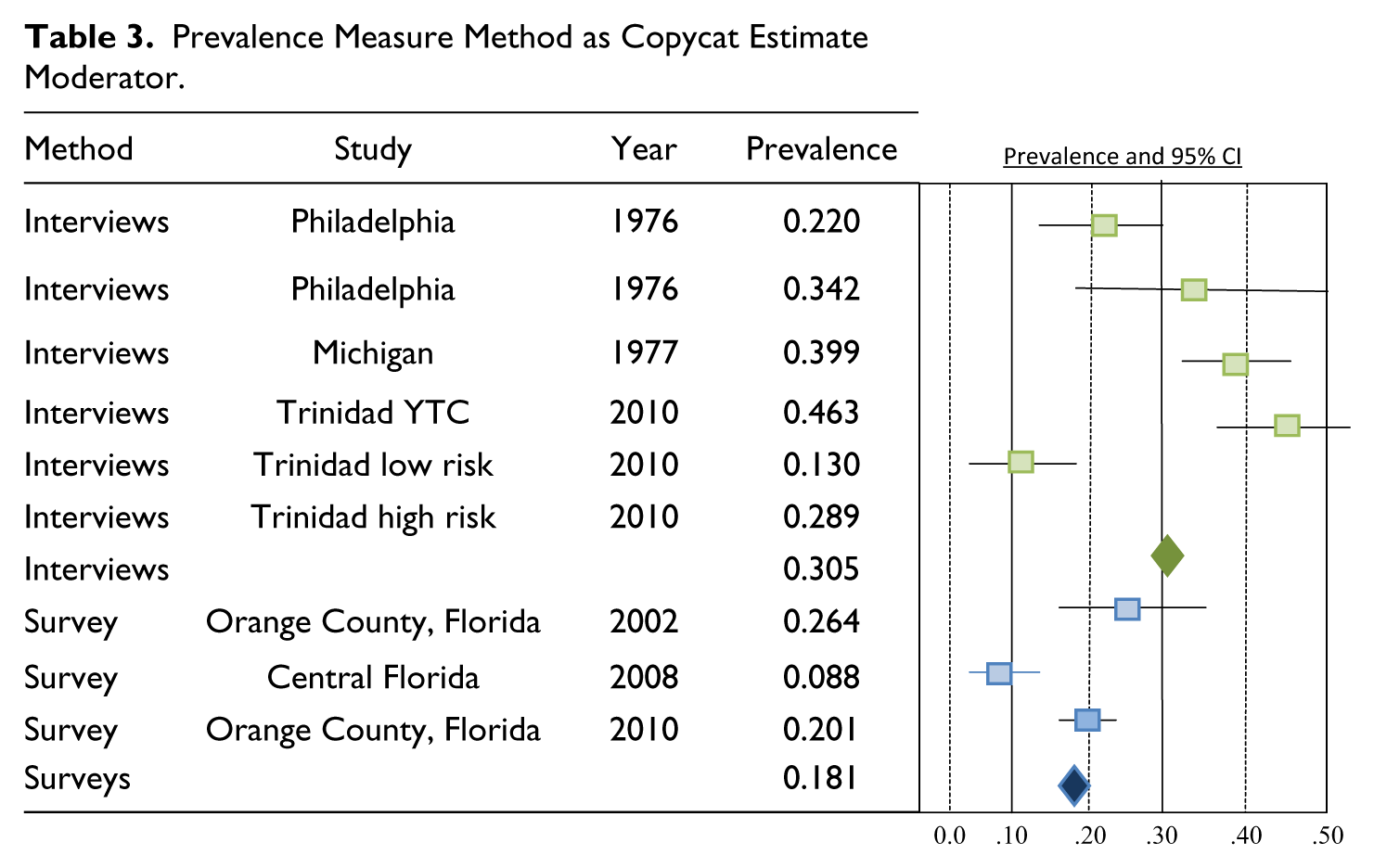
As demonstrated in Table 3 for example, the comparison of copycat prevalence levels among studies based on face-to-face interviews compared with written surveys produced different prevalence rates of .305 and .181 for interviews and written questions, respectively. This difference, however, was not great enough to conclude that collection methodology was a significant moderator of effect size (between-group Q = 1.19, df = 2, p. = .551). Along the same lines, studies conducted in Trinidad compared with U.S.-based studies produced estimates of .292 and .258, respectively (Q = .149, df = 1, p = .699). Looking at respondent characteristics also revealed suggestive but nonsignificant differences from this initial research effort. Thus, the three studies that queried U.S. adults compared with the three that asked U.S. youths produced respective prevalence estimates of .219 and .305 and an associated between-group Q statistic of .652 (df = 1, p = .419). Similarly, incarcerated U.S. youths compared with nonincarcerated U.S. youths provided estimates of .292 and .206, respectively. This difference is in line with prior speculation regarding the concentration of criminogenic media effects in offender populations (Lindberg, Sailas, & Kaltiala-Heino, 2012; Surette, 2011) but was not significant (Q = .485, df = 1, p = .486) within this research note’s limitations. In contrast, the author-provided access to the original data from the two studies that included both males and females allowed a standard t-test comparison between genders to be conducted. For these 618 respondents, a statistically different prevalence rate of .215 was found for males compared with .089 for females (t = 3.92, df = 616, p = .000).
Prevalence Measure Method as Copycat Estimate Moderator.
Publication Bias
A meta-analysis concern termed publication bias is the possibility that additional unpublished but unknown studies exist that, if included, would substantially alter the meta-analysis conclusions (Rothstein, 2008). In this work, the concern is that unknown estimates of copycat prevalence with low prevalence values exist, but were not located, that would lower the overall prevalence estimate to insignificance if they had been included. Following assessment, evidence of publication bias was not found in this analysis. First, half of the 10 estimates were obtained from unpublished surveys indicating some success in locating unpublished works and decreasing the probability of a substantial number of missed copycat estimates existing. 8 Second, a standard approach to consider publication bias, a funnel plot, was examined. The funnel plot of the 10 studies shown in Figure 1 indicated that the inclusion of the four hypothesized “unpublished” studies (dark dots) would have to be added to the analyzed 10 studies to obtain symmetry in the sample distribution. The addition of these four conjectured studies would slightly decrease the overall prevalence estimate (shifting the estimate from the observed clear triangle of about 26% to the hypothesized dark triangle value of approximately 25%). The four hypothesized “unpublished” studies would also have to report negative prevalence values less than zero—a logical impossibility. The null hypothesis that the copycat crime prevalence rate is near zero remained rejected.
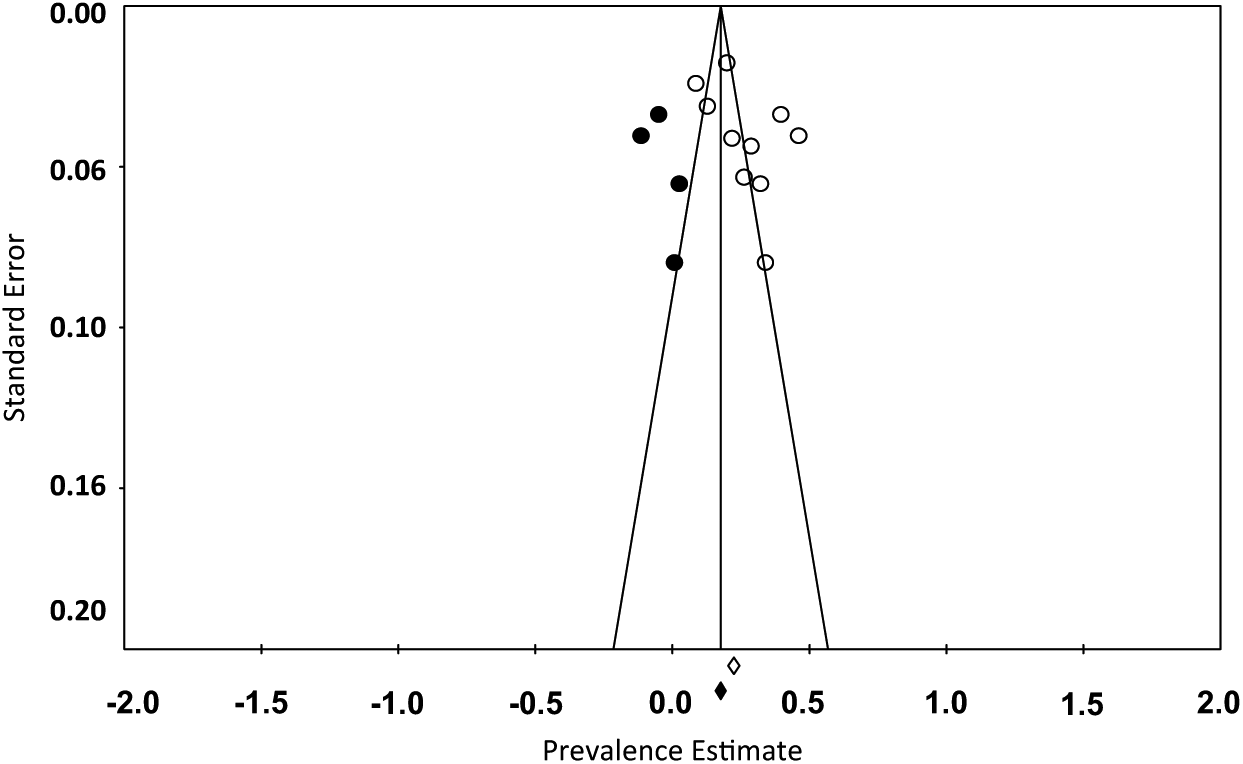
Funnel plot of standard error by prevalence estimate.
Discussion and Future Research
Available estimates of the prevalence of copycat crime collectively indicated that about one in four at-risk individuals has engaged in copycat crime. While this analysis provided an improvement in the estimation of copycat crime, it also revealed a number of research needs. The most basic needs are the completion of a full meta-analysis study of past copycat crime estimates and the future production of additional estimates of copycat crime’s prevalence. Furthermore, there remains a need to validate the self-report estimates via interviews with identified copycat offenders regarding specific dates, details, and dynamics concerning the copycat events they recall.
A second outstanding research question concerns low-risk, nonincarcerated, nonoffender populations, particularly involving juveniles and young adults. Only one study to date provides an estimate of such a population and it was limited to Trinidadian youths. In addition, notwithstanding the lack of a significant difference in prevalence in this analysis, a difference in copycat rates between incarcerated and nonincarcerated populations has been reported in prior work and remains a possibility (Surette, 2011). A related unexplored research question involves a hypothesized difference between offenders reporting past copycat criminality and those without such activity (Lindberg et al., 2012). What distinguishes persons who report that they have attempted a copycat crime from those who do not is an unexamined research question. Are there individual personality traits, life experiences, environmental, media, or other factors that discriminate copycat offenders from noncopycat offenders? Additional research questions revolve around cultural and gender differences. The results reported herein suggest that copycat offenders were most often, but not exclusively, male. And although not statistically substantiated in this analysis, whether a significant difference in copycat crime prevalence between countries and cultures exists deserves further examination.
If, as indicated in this research note, copycat behavior is a common element of a substantial proportion of offenders, that population should be the focus of criminal-justice–related policy attention. It is the copying of criminal behavior that lays at the crux of negative media-generated social effects, and the relationship of copycat crime offenders with criminogenic media should be a pressing criminal justice policy concern. An understanding of copycat crime dynamics would be relevant for developing a number of criminal justice and media social policies (Doley, Surette, & Ferguson, in press). For instance, if the characteristics of crime-related media content are found to be less important than the social context in which exposure occurs in the generation of copycat crime, depending on whether this statement is true, significantly different criminal justice policies would be appropriate. If the characteristics of media portraits of crime are more important, then media content should be a criminal justice policy focus. If the social exposure contexts and characteristics of media users are more important, then access by at-risk individuals to criminogenic programs should be the policy focus.
Solid research on copycat crime would also benefit the criminal justice system. At the front of the system, research on copycat crime would help law enforcement in the understanding, recognition, and prediction of shifts in crime trends and the emergence of crime clusters. Interdisciplinary research that bridges copycat behavior and unique crime types such as deliberate fire setting has also been indicated as needed and beneficial (Doley et al., in press). Furthermore, the ability to recognize and identify a copycat crime would be helpful in criminal investigations, helping to establish and clarify suspect motives and techniques, and providing additional information for crime prevention efforts. For example, recognition of an ongoing copycat crime sequence would allow tailored community crime alerts to be issued and targeted protective surveillance of potential victims. Similarly, recognition of falsely labeled copycat crimes would avoid unnecessary negative effects on fear of crime levels from the inappropriate news media generation labeling of a “crime wave” (Sacco, 2005).
In the judicial system, evidence of a copycat crime would be useful for prosecuting attorneys looking to establish premeditation or defense attorneys seeking mitigating factors in cases where pathological media immersion is apparent. An improved understanding of the mind-set of a convicted copycat defendant would help to improve sentencing and treatment decisions. For example, restrictions on access to specific media content and Internet sites would be a logical application from knowledge that a particular offender is a copycat crime at-risk individual.
The most direct impact of copycat crime research on the criminal justice system would be the development of treatment and rehabilitation programs. The identification of copycat crime risk factors in juveniles would allow the development of school-based curriculum programs that would debunk the attractiveness, utility, and impact of media-provided criminal models. Similar correctional programs could be developed to deprime the behavioral effects of criminogenic media on subsequent criminal decisions. Lastly, an understanding of how copycat crime works and who are most likely to become copycat offenders could improve overall media and criminal justice relations. Specific knowledge regarding what crime-related content is most likely to generate copycat crime would reduce calls for broad content restrictions on the media as well as encourage the timely release of nonproblematic crime information by authorities to the news media (Dill, Redding, Smith, Surette, & Cornell, 2011). Considering the research and policy benefits associated with the study of copycat crime, the provided estimate of copycat crime’s prevalence will hopefully serve as a spur for future copycat crime research. Copycat crime is a nontrivial social phenomenon deserving of more serious research attention and criminal justice policy consideration.
Footnotes
Declaration of Conflicting Interests
The author(s) declared no potential conflicts of interest with respect to the research, authorship, and/or publication of this article.
Funding
The author(s) received no financial support for the research, authorship, and/or publication of this article.