



Abstract
The reintegrative shaming experiments (RISE) were conducted in Canberra, Australia, between 1995 and 2000. RISE compared the effects of standard court proceedings to restorative justice (RJ)–focused diversionary conferences (DCs) with juvenile, young adult, and adult offenders who had been arrested for personal property, shoplifting, violent, or drunk driving offenses. We evaluated, using observational data, the effect of RJ conferences on objective procedural justice. We find that the DCs produced significantly higher levels of offender engagement within the adjudicative process and higher levels of ethical treatment, and that, when compared with standard trials, conduct within the conferences was attuned to the reintegrative shaming (RIS) process. These results reinforce the previous RISE findings by providing evidence that the conferencing process, as delivered, was in keeping with the overall goals of RJ and supports the prior attribution of RISE’s effectiveness to the RJ process.
Introduction
Criminal justice sanctions may be most effective when they encourage offenders to establish moral ties with their communities and promote beliefs concerning the legitimacy of legal authorities. Procedural justice theory holds that these goals can be met by treating offenders fairly, allowing them to develop increased respect for the law and to voluntarily conduct themselves in a law-abiding manner (Tyler, 1990). These obligations can be further reinforced through the positive reintegration of offenders back into their communities. Reintegration can occur through dialogue directed at increasing offender’s social support and crystallizing the moral harm of the offense without personally demoralizing the offender (Braithwaite, 1989). Restorative justice (RJ) techniques have been shown to achieve this result across multiple contexts (Kim & Gerber, 2010; Tyler, Sherman, Strang, Barnes, & Woods, 2007). When a reintegrative process occurs through RJ, preliminary evidence has suggested that offenders will report their experiences with the criminal justice system as being more fair and respectful, or “procedurally just” (Mazerolle, Bennett, Davis, Sargeant, & Manning, 2013; Sherman et al., 1998).
Background
Our investigation tests the hypothesis that RJ conferences will produce greater observed procedural justice than court experiences. Data are derived from the four randomized controlled trials (RCTs) of the reintegrative shaming experiments 1 (RISE), which were conducted in Canberra, Australia, between 1995 and 2000. RISE compared the effects of standard court proceedings to RJ-focused diversionary conferences (DCs) with juvenile, young adult, and adult offenders who had been arrested for either personal property, shoplifting, violent, or drunk driving offenses. RISE was designed to test a series of hypotheses about effects of diversionary conferencing (Strang, Sherman, Woods & Barnes, 2011 p. 3):
There will be less repeat offending after a conference than after court.
Benefits to victims will be greater in conferences than in court.
Both offenders and victims will find conferences to be fairer than court.
Earlier publications have begun to address the first two of these three hypotheses. Sherman and Strang (2007, 2012) demonstrated that participation in RJ conferences significantly reduced offending in some contexts, though these findings were not replicated in each of the four separate experiments. Other evaluations have found that conference-assigned victims were less angry with their offenders, less fearful of their offender, and more likely to receive a sincere apology than those whose cases were assigned to court (Strang, 2002). Our goal here is to provide a direct test of the third objective of RISE, focusing on the impact of RJ conferences on observed procedural justice.
Restorative and Procedural Justice
RJ, as a practice, is generally defined as “a process where those primarily affected by an incident of wrongdoing come together to share their feelings, describe how they were affected, and develop a plan to repair the harm done or prevent a reoccurrence” (McCold & Wachtel, 2001 p. 2). Philosophically, RJ is unique in that it is “concerned with much more than simply what is done to or with offenders” and overtly considers their engagement and perceptions of the process itself (Schiff, 2003, p. 330). To accomplish this, RJ conferences are designed to encourage offenders to reconnect with their families and communities, including victims, and reinforce the notion that, despite prior bad acts, they are not viewed as wholly criminal and to facilitate reciprocal respect (Ahmed, Harris, Braithwaite, & Braithwaite, 2001).
RJ is an appealing alternative to traditional, retributive processes because it claims to reduce offending while, at the same time, providing benefits to victims and communities. The underlying philosophical assumptions of the RJ process are that crime is fundamentally a violation of interpersonal relationships, that violations create obligations and liabilities, and that RJ seeks to heal and right specific wrongs (Zehr & Mika, 1998). This philosophy focuses on repairing the harm caused by an offense rather than on punishing the offender, requires that all parties perceive the alternative, conferencing process as valid, and that the offender experiences the requisite emotional responses (Harris, 2006). Braithwaite (1999) reviews the rather extensive literature linking RJ to criminal offending across many contexts, including multiple forms of conferencing, restitution programs, antibullying interventions and within corporate crime. Relying on the emotional impact of shame and guilt created by the conferencing process, future offending is prevented through the reinforcement of offender’s emphatic connection to the community (Harris, Walgrave, & Braithwaite, 2004).
Braithwaite’s (1989) reintegrative shaming (RIS) hypothesis has been central to understanding the process by which moral obligations are created and reinforced. According to the theory, RIS is a social process through which the offender’s close relations and the victims of the crime express disapproval of the offender’s behavior with the intention of creating remorse and shame. Following the expressed disapproval, efforts are made to demonstrate forgiveness and foster the offender’s return to the community of law-abiding citizens. This sequential process of shame, and then reintegration, is an important hallmark of RIS. The dialogue of successful shame and reintegration by close supporters of the offender has an opportunity to create a turning point for the offender.
The theory of RIS has been closely linked to procedural justice, which focuses on the types of interactions between criminal justice authorities that increase moral obligations of civilians to their communities and encourages law-abiding actions. This body of work is known as procedural justice. Procedural justice is broadly defined as the fairness and respectfulness of the legal process itself, and is viewed as something independent and distinct from the fairness of the decision or outcome that results from the legal process. Within the multidisciplinary body of literature, procedural justice is primarily considered an outcome of citizen’s interactions with criminal justice authorities, most notably including the police.
This line of research seeks to understand how fairness influences individuals to obey legal rules (Tyler, 2006a). Viewed from a procedural justice perspective, higher levels of fairness and respectfulness expressed by law enforcement encourage individuals to proactively self-regulate their conduct in law-abiding ways. Alternatively, when authorities are not perceived as procedurally just, legitimacy is undermined, leading to noncompliance and resistance (Fischer, harb, Al-Sarraf & Nashabe 2008. Broadly construed, procedural fairness takes into account the quality of the decision-making process, the quality of treatment received, and the extent to which the participant believes that the authorities are sincere and trustworthy (Tyler & Wakslak, 2004).
In many instances, procedural justice and RJ are practically linked through the practice of RJ conferences (Tyler et al., 2007). From a theoretical perspective, both RIS and procedural justice uphold the same core values: facilitating interactions between offenders and community members to create strong community ties and moral obligations toward others (Tyler, 2006b). The theory of RIS, which stipulates that offenders will be treated with respect and included in the decision-making process, reflects the same core values defined by procedurally just interactions. It is on that basis that RJ conferences, grounded in RIS principles, should produce procedurally just experiences for criminal offenders.
RJ is widely, but not universally, accepted as a means for reducing offending (Bazemore, 1994). Fulton, Levrant, Cullen, and Wozniak (1999) fault RJ for failing to provide a fully specified theoretical model for bringing about behavioral change, for lacking options to address serious offending, and, importantly, for not fully evaluating the relationship between crime and models of RJ. Daly (2000), while accepting the basic theoretical premises of RIS, notes that many implementations fail to adhere to these principles. Other scholars, more focused on traditional means of punishment, have criticized RJ approaches for failing to adequately sanction offenders, potentially leaving some victims with unresolved feelings (e.g., Garvey, 2003). Though many of these critiques are not unique to RJ (Morris, 2002) and lie outside the scope of this article, a clear understanding of how procedural fairness, as an essential component of the RJ model, can be delivered in multiple types of conferences (and for violent and nonviolent offenders) will provide a foundation that supports the relationship between RJ interventions, procedural justice, and offending.
Evaluations of RJ interventions have typically focused on the recidivism-reducing effects for offenders and upon changes in the victim experiences for conference participants (Sherman & Strang, 2007). Sherman and Strang (2012) analyzed the findings from 12 separate randomized trials conducted with juvenile and adult offenders that tested the impact of RJ conferences on offender recidivism. In 10 of the 12 tests, conferences reduced offending. The evidence of the effects of conference participation on victims has also been overwhelmingly positive (Angel et al., 2013; Sherman & Strang, 2007; Strang, 2002). Conferences have been shown to reduce victim’s anger toward their offender, desire for revenge, and symptoms of posttraumatic stress disorder. Victims have also reported increased satisfaction with the process and respect for the criminal justice system.
Research on the mechanisms through which RJ may affect crime rates has been more limited. Tyler et al.’s (2007) analysis of the RISE drunk driving experiment suggests that RJ conferencing leads to meaningful types of RIS (Braithwaite, 1989). Tyler and his colleagues found that, when compared to court, participation in RJ conferencing increased offender’s self-reported levels of shame and subsequent reintegration into the community. Kim and Gerber’s (2010) subsequent analysis of observational data on 136 youthful conference participants from the other three RISE experiments concluded that RIS occurs most often when offenders have strong existing ties to their supporters, are treated as individuals, and demonstrate observable remorse and emotional responsiveness.
RIS alone, however, may not be sufficient to deliver the full RJ experience. Additional research suggests that conferences are effective when they create an opportunity for increased “quality of treatment” of citizens and enhancements to the “quality of the decision making process” (Mazerole et al., 2013; Reisig, Bratton, & Gertz, 2007). Conferences should, therefore, produce a measurably larger amount of procedural fairness when compared to traditional court hearings (Tyler et al., 2007). To quantify and demonstrate this relationship, however, we must first determine what elements define the procedural fairness of a legal proceeding and determine how best to measure these elements within the confines of existing data.
A Theoretical Framework for Procedural Justice
The fairness of a legal proceeding is usually described using a multidimensional framework that draws upon decades of procedural justice research. Six key elements are used to define procedural fairness: representation (broken down even further into process control and decision control), consistency, impartiality, accuracy, correctability, and ethicality (see Table 1). One key difficulty of this framework, however, is that many of these elements are inherently subjective in nature, rely upon the perceptions of individual participants in a given proceeding, and may not be assessable merely by observing the procedure itself. Within the framework of the RISE evaluation, observational data on the representation and ethicality constructs shed the most light on the components of procedural justice present in the conferencing process.
A Summary of Elements Used by Citizens When Making Assessments of Their Legal Experiences.

The first of the relevant procedural elements, representation, has developed over time. Leventhal (1980) originally defined this aspect of procedure as a rule that “ . . . dictates that all phases of the . . . process must reflect the basic concerns, values, and outlook of important subgroups in the population of individuals affected by the . . . process” (pp. 43-44). In an effort to make this definition somewhat more concrete, procedural justice scholars have tended to accept the principle of “voice,” as an operational definition for Leventhal’s original concept of representation (Sheppard, 1985). Voice focuses on “ . . . giving all parties the sense that they have had the opportunity to express their point of view . . . ” (Casper, Tyler, & Fisher, 1988, p. 496).
Ethicality is the most vaguely defined of the six components of the theory (Makkai & Braithwaite, 1996). Leventhal (1980) characterizes ethicality as a rule that “ . . . dictates that . . . procedures must be compatible with the fundamental moral and ethical values accepted by [those assessing the fairness of a procedure]” (p. 45). In empirical practice, this final element has been represented with measures such as the degree of politeness exhibited by legal authorities, and the amount of concern shown for citizens’ rights (Makkai & Braithwaite, 1996). In a similar vein, Tyler (1988) describes ethical processes as “ . . . procedures used [which] support [the citizens’] sense of self-respect” (p. 129). When people make judgments about a legal procedure’s ethicality, they are thought to focus upon whether they were treated in a manner which implies that they and their viewpoints are valid and worthy of consideration (Paternoster, Brame, Bachman, & Sherman, 1997).
When these six elements were originally proposed, Leventhal had little or no evidence to suggest that they were used by citizens in making judgments about legal procedures, and he cautioned that these propositions were quite speculative (Leventhal, 1980). Additional development of his ideas by scholars such as Tyler (1990), however, has led to a categorical framework that is much more congruent with contemporary procedural justice theory. This research provides additional, methodologically rigorous evidence on the extent to which two of these constructs are applied within the diversionary conferencing framework of the RISE evaluations.
Linking RJ and Procedural Justice
Advocates of conferencing, and of RJ practices generally, assert that these methods deliver more procedurally justice experiences than traditional, retributive justice proceedings. In theory, participating in judicial and quasi-judicial proceedings with higher degrees of procedural justice should lead offenders to view authorities and sanctions as just which, in turn, encourages future compliance with the law (Tyler, 2000, 2003). Sherman (1993) notes that the relationship between procedural justice and authority remains important within the informal settings encouraged within the RJ framework.
This claim has been supported in multiple randomized investigations, as reported in Mazerolle et al.’s (2013) meta-analysis of the impact of police-led interventions using procedurally just dialogue on citizen perceptions of police legitimacy (Braithwaite, 1999; Tyler et al., 2007). Investigators identified two publications (Shapland et al., 2007; Sherman et al., 1998) reporting the results of five randomized experiments that evaluated the impact of DCs on procedural justice.
First, Shapland et al. (2007) reported on four investigations, two randomized experiments in which Northumbria, UK, victims and offenders were randomly assigned to either conventional final warnings by police or a warning and an RJ conference, and two London, UK, randomized experiments comparing conferences to traditional court hearings. Participants were interviewed regarding their perceptions of procedural justice, which was reflected in questions such as “whether all participants felt they were able to speak freely and cover all relevant aspects of the offense and what might happen afterwards; were listened to, without anyone dominating the proceedings; and were treated with respect” (Shapland et al., 2007, p. 22). Shapland found that conference participants had higher levels of satisfaction and basic elements of procedural justice. Next, Sherman et al. (1998), reporting on preliminary findings from the RISE evaluation, found increased levels in procedural justice for conference participants. Although only the preliminary analyses of RISE data were reported in Mazerole et al. (2013), the overall findings indicated that, within police-led conferences, increases in perceived procedural justice were associated with higher levels of the desired, primary outcomes (p = .001).
We hypothesize here that DCs, across all four experiments conducted during RISE, will be more effective in delivering the requisite components of a procedurally just offender experience. Though beyond the scope of this article, the conference experience should both encourage the RIS process and, in the long term, reduce offending. In this instance, we concern ourselves only with observed measures of procedural justice, particularly those recorded by impartial court and conference observers present in all four of the RISE experiments. These measures, though potentially subject to limited biases of the individual observers, represent the independent assessments and valuations of multiple observers, and are therefore considered more “objective” in nature than those reported by the offenders themselves. Within an experimental framework, these results provide compelling evidence of the relationship between procedural justice and RIS and the methodologically rigorous, empirical basis for the psychological mechanisms (see Braithwaite, 1999; Tyler, 2000) that underlie the RJ approach to crime prevention.
Method
Background
The reintegrative shaming experiments (RISE) consisted of four separate RCTs of diversionary conferencing, and were conducted in Canberra, Australia, from 1995 to 2000. The aim of the research program was to compare the effects of standard court processing with diversionary RJ conferences. The four experiments were defined by the nature of the presenting offense and the age characteristics of the offender(s) involved in the crime. These individual RCTs were the juvenile personal property (JPP), the juvenile shoplifting (JPS), youth (less than 30 years of age) violent crime (YVC), and drunk driving (DUI) experiments. The juvenile property and violence experiments featured offenses in which an identifiable person was the victim of the crime, while the cases in the shoplifting and drunk driving experiments had no direct victims, and often used “community representatives” to explain the consequences of the offense during the RJ conferences.
The conferences in RISE, led by trained police facilitators, were based upon the “Wagga-Wagga” model (Daly & Hayes, 2001) of family group conferencing. This model is distinguished from alternative approaches to conferencing, including the non-police-led “New Zealand” model, though the theoretical integration of RIS is a key component of the program. The comparison groups, assigned to standard court hearings, were overseen by magistrates, and police were involved only for testimonial purposes.
Although the structure, pacing, and goals of the conferencing process varied between experiments, as discussed below, each of the components of RISE followed a general outline and shared a theoretical link to the RIS process (Braithwaite, 1989). In each instance, the offender, their supporters, including family and friends, and (where appropriate) the victims were brought together to discuss the crime and the impact that it had on all of the parties present. With the police facilitating the discussion and managing the lines of communication, the offender was expected to admit to the crime, to explain, in their own words, why they became involved in the illegal activity, and to express remorse. Victims were encouraged to communicate how they were harmed by the crime, as well as to discourage the offender from recidivating. These testimonials are designed to encourage the offender to feel the requisite remorse and to subsequently reestablish social ties (Braithwaite, 1999; Strang & Braithwaite, 2000.
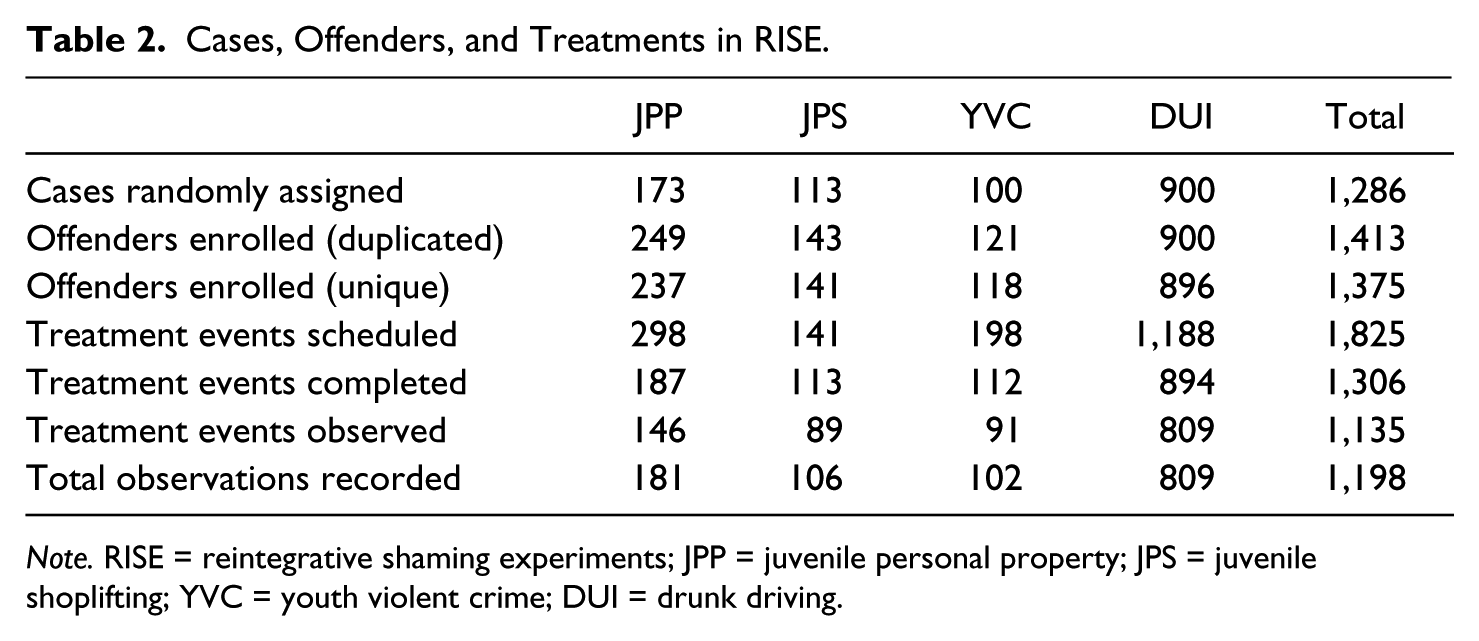
In each of the experiments, random assignment took place after arrest. It is important to note that random assignment was performed at the “case,” or incident level. In the property, shoplifting, and violence experiments, there were often multiple offenders involved in a single case, and the resultant random assignment was applied to all of the offenders equally. All of the cases in the DUI experiment, on the other hand, featured a solitary offender. RISE did not restrict individual offenders to only one case across the four experiments. This means that a single person could easily appear in multiple cases across the overall research project and have been randomly assigned several times for different criminal offenses. Over the full course of the project, 1,286 criminal cases were enrolled in the RISE experiments. These criminal acts were spread across a total of 1,413 offenders and co-offenders, amounting to 1,375 different individuals (see Table 2 for a more detailed breakdown).
Cases, Offenders, and Treatments in RISE.
Note. RISE = reintegrative shaming experiments; JPP = juvenile personal property; JPS = juvenile shoplifting; YVC = youth violent crime; DUI = drunk driving.
Once a case was randomly assigned to either the court group or the conference group, a series of “treatments” began in an attempt to handle each case in an appropriate manner. Over the length of the project, 1,825 different treatment events were scheduled, nearly all of which were court hearings or DCs. While a small number of these scheduled events never took place, 1,623 treatments were completed across all four experiments. At 1,306 (80.4%) of these completed events, RISE was able to place a trained observer in the room to record what took place and score the treatment across a range of systematic measures. When these events involved multiple offenders, the observers would record a separate observation record for each offender present. A total of 1,198 observations were collected during the RISE experiments. As discussed below, these observations were structured to “yield reliable information concerning the effectiveness of conferencing compared with court [and to capture the] value of RJ as an alternative to conventional criminal justice processing through the courts” (Sherman, Strang & Woods, 2000.
The RISE Experiments
Each RCT within the RISE project was unique in several meaningful ways: They varied in location, time, duration, sample size, and population. The randomization and assignment processes, however, were largely the same in all of the experiments. Managed properly, random assignment should produce two statistically indistinguishable groups of offenders and allow for determinations of causality. However, this equivalence cannot be simply assumed and should be demonstrated empirically (Boruch, 1997). Along with a basic description of each of the trials, we demonstrate this for each of the RISE experiments below.
Juvenile property
The JPP experiment enrolled a total of 249 offenders, representing 173 distinct criminal cases. The majority of these offenses were for theft, burglary, vandalism, or auto theft (Strang, Barnes, Braithwaite, & Sherman, 1999. As indicated in Table 3, there were no significant differences in the proportion of each treatment group that was either male or an Aboriginal native, in the age at time of arrest or in offender attitudes (at the time of arrest) toward law enforcement.
JPP Experiment, Equivalence at Random Assignment.

Note. JPP = juvenile personal property.
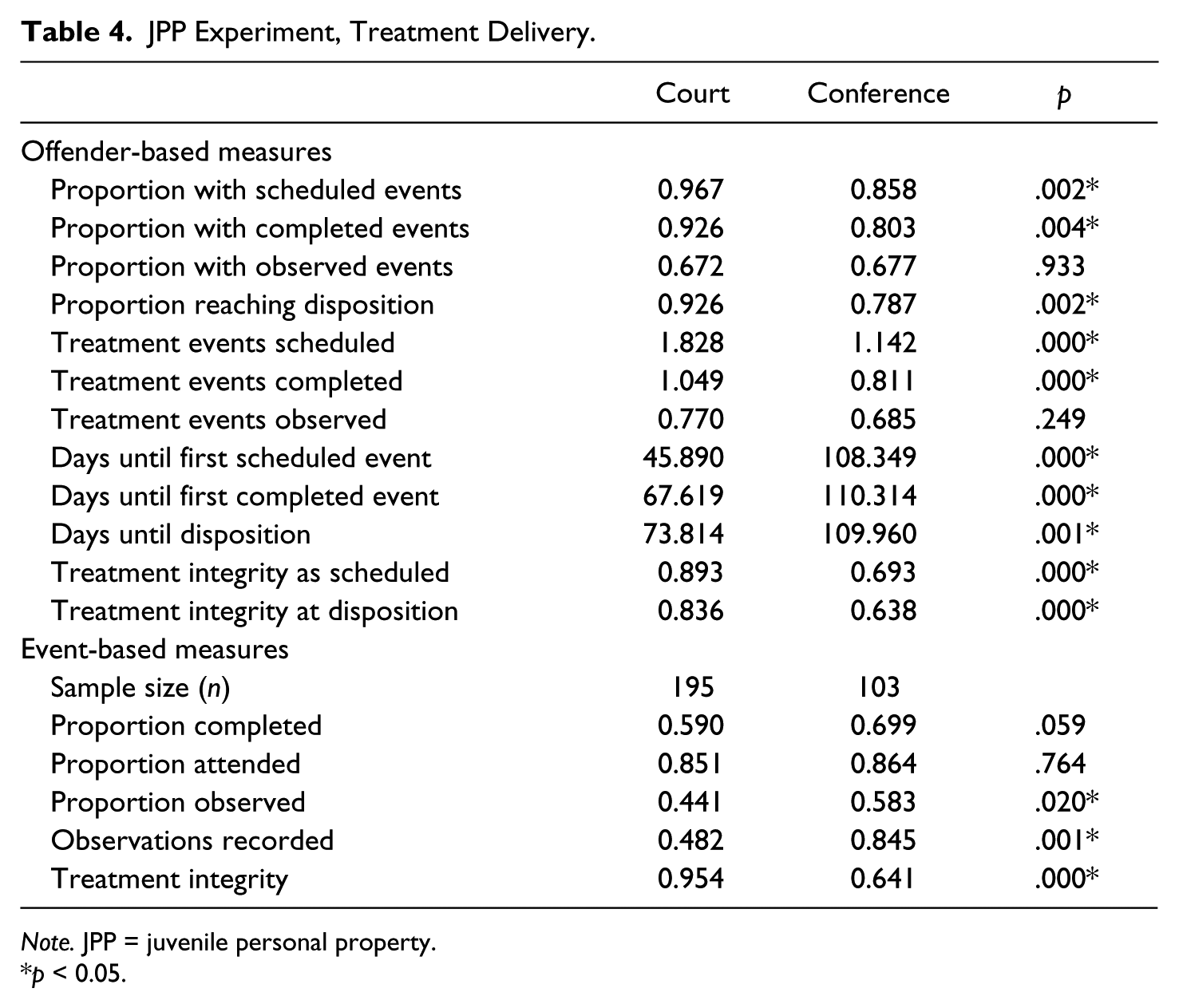
Once participants were enrolled in the JPP experiment, significant differences in the manner in which their cases were handled became readily apparent. The standard criminal justice process, as shown in Table 4, took only 67.6 days to resolve, while conferencing required 109.9 days (p = .001). In addition, 83.6% of the court-assigned offenders had their cases completed in court, while only 63.8% of those offenders who should have participated in a DC had their case resolved there (p = .000).
JPP Experiment, Treatment Delivery.
Note. JPP = juvenile personal property.
p < 0.05.
While this between-group difference in treatment integrity—which can be observed in all four of the experiments—may seem deeply concerning, it is largely an artifact of the experimental design. If offenders refused to cooperate in diversionary conferencing, the legal system could not simply disregard their offenses. Instead, those members of the conferencing group who were uncooperative or who failed to appear for scheduled conferences eventually had their matters referred to the courts, and were treated in the traditional manner. In a sense, RISE did not assign cases to receive a specific treatment, but instead assigned them to proceed down a path in which certain forms of treatment were offered and made available to those who wished to participate in them.
In the property experiment, as in each of the other juvenile-exclusive hearings, permission had to be obtained from the defendant and their family in order to have an observer present, as the Children’s Court in Canberra is closed to spectators (Sherman et al., 2000). Unsurprisingly, this resulted in significant differences in the percentage of events at which an observer was present; 58.3% of conferences were observed, while 48.2% of the court hearings were similarly observed (p = .020).
JPS
The second JPS focused on juvenile defendants who, after committing a shoplifting offense, were apprehended by the retail security staff. The 143 offenders who were enrolled in the experiment had, collectively, 113 active criminal cases. As was the case in the JPP experiment, and can be seen in Table 5, the court and conferencing groups were statistically indistinguishable on all of the measured variables, including prior attitudes toward authorities.
JPS Experiment, Equivalence at Random Assignment.

Note. JPS = juvenile shoplifting.
The shoplifting experiment enjoyed slightly shorter delays in resolving matters. The conferencing process took, on average, 73.7 days and court-based adjudication took 40.7 days (p = .001). Similar and significant differences were observed in the general timeline, including lapses between arrest and the first treatment event. This experiment had slightly higher rates of treatment integrity at the time of disposition. A total of 89.4% of court cases and 83.1% of conferencing cases were disposed of in the assigned manner (p = .277). Finally, and as shown in Table 6, though a higher proportion of conferencing events were observed, the difference between the two assigned treatment groups failed to reach statistical significance (p = .085).
JPS Experiment, Treatment Delivery.

Note. JPS = juvenile shoplifting.
p < 0.05.
Youth violence
Offenders enrolled in the third trial, focused on youth violence, were slightly older than those in the two other youth-focused experiments. The eligibility criteria for this trial allowed for the enrollment of offenders up to 30 years of age. The mean age at assignment was 18.0 years for the conferencing groups and 17.5 for youth in the comparison group, older than both the other juvenile trials but still well below the threshold for enrollment (p = .449). Although there was a difference in the proportion of each group that was male (93.5% for treatment and 69.5% for control), this can be attributed to natural random variation, and not to a breakdown of the assignment process or a systematic bias in treatment (p = .001). The remainder of the comparisons, including attitude and race, are statistically indistinguishable and can be seen in Table 7.
YVC Experiment, Equivalence at Random Assignment.

Note. YVC = youth violent crime.
p < 0.05.
The criminal behavior in the violence experiment was both more serious and complex, and usually resulted in an injured victim. It is unsurprising that there are differences in the way these cases were managed. Notably, though between-group differences were not significant, the conferencing group took, on average, 106.5 days, and court took 126.7 days, the only RISE trial where the diversionary process was shorter than traditional adjudication (p = .334). In addition, 97.7% of all court-assigned cases were concluded in that manner, while only 76.9% of the conference were resolved as assigned (p = .000).
The delay in court processing also made the observation of hearings more difficult. Scheduling of these matters was more complicated and, as the court cases required additional hearings (many of which did not produce substantive developments) the observation process was more complex for these violent cases. As indicated in Table 8, a total of 83.1% of the conferencing events were observed, on par with the rest of RISE, while only 36.1% of all court events resulted in an observation (p = .000), either due to refused permissions or a lack of any noteworthy events to record.
YVC Experiment, Treatment Delivery.

Note. YVC = youth violent crime.
p < 0.05.
Drunk driving
The largest of the randomized trials within RISE focused on drunk driving. A total of 900 offenders, each of whom had a blood alcohol concentration of more than 0.08 g per 100 ml (the Australian legal limit was 0.05) at the time of arrest, were included. With each case involving only a solitary offender, the 900 cases that were randomly assigned involved the same number of offenders. DUI offenders were, as shown in Table 9, much older than participants in the other trials (30.2 years in court group and 31.4 in the conference) but, as demonstrated for each juvenile experiment, random assignment resulted in two statistically identical groups (p = .079).
DUI Experiment, Equivalence at Random Assignment.

Note. DUI = drunk driving.
Despite differences in the population and characteristics of the instant offense, the treatment delivery within the DUI experiment was similar to the three juvenile-focused experiments. Both conferences (60.3 days) and court cases (54.2 days) were resolved in a similar amount of time (p = .190), and a higher proportion of the conferencing cases were observed (61.8% of court and 76.6% of conference; p = .000).
As indicated in Table 10, the DUI trial had relatively high levels of treatment integrity. That is, when individuals were assigned to one of the conditions, 95.8% of the control group and 89.3% of the experimental group had their case disposed of in the appropriate forum (p = .000). This high success rate holds across events as well, with nearly all (99.6%) of court-assigned events being held in the traditional format. Though 10.4% of conference-designated events were held in court (or a small number of other venues), the DUI experiment still enjoyed comparatively limited levels of treatment crossover.
DUI Experiment, Treatment Delivery.

Note. DUI = drunk driving.
significant at the p < 0.05 level.
Data Collection and Measures
RISE employed a wide range of data collection strategies, including systematic observations of treatment events by trained research staff and structured interviews of the offenders after treatment had been completed. The treatment observations are particularly relevant here, as it allows us to obtain relatively objective measures of what transpired at both court hearings and conferences, and provides a constituent measure of how much procedural fairness could be seen in these two very different treatment environments.
After observing a treatment event and continuously scoring what took place, the RISE observers were required to complete a Global Ratings Questionnaire, scoring each offender’s overall experience across a range of different measures. These questionnaires contained items relating specifically to procedural justice, including characterizations of offender participation in the proceeding and the extent to which the offenders contributed to determining their own outcomes (Barnes, 1999). As prior research has shown, relevant components of RIS can be observed reliably using systematic observation methods (Harris & Burton, 1998). These same reviews have shown the instruments used during the RISE experiments to have relatively high measures of interrater reliability (Ahmed et al., 2001) and, perhaps more importantly, to appropriately capture the dimensions of procedural justice and RJ necessary under the conferencing approach (Harris & Burton, 1997). Although not a part of this analysis, these elements of observed procedural justice were found to be correlated with the offender’s subjective perceptions of the court or conferencing procedures (Barnes, 1999; Tyler et al., 2007).
The observation data collected during each of the RISE trials and presented here fall under three categories. The first, ethicality, focuses on the characterization of the conference’s communication. Ethical procedures are those that “ . . . treat citizens with respect and dignity [and] convey the impression that such persons are valuable members of the [social] group” (Paternoster et al., 1997, p. 168). Measures relevant to ethicality focus on the emotional characteristics of communication during the hearing. Secondly, data were collected on dimensions that related to representation, equivalence, and problem solving. These items focused on the extent to which offenders were permitted to participate in the adjudication process and the extent to which secondary but related problems, including drug and alcohol abuse, were constructively discussed during the events.
Finally, data were collected on the individuals present, both as participants and as decision-makers, at the RISE treatment events. Instead of being drawn from the observers’ ratings, these participant counts are instead obtained from a series of face-to-face offender interviews conducted shortly after each case reached a final disposition. The use of interview data became necessary here due to the nature of the courtroom environment. While observers were able to gather excellent data on participant attendance at conferences, the same task proved to be impossible in both the public courtrooms used for adult offenders, and especially in the closed (and often unobserved) courtrooms used for juveniles.
Results
In the sections below, and for each of the four RISE trials, we report between-group differences in mean levels of observed procedural justice using Cohen’s (1988) d as a measure of effect size. Presenting these results as effect sizes allows different measures to be presented in the same table using a comparable scale, and also allows us to make comparisons between the four experiments that are not biased by their different sample sizes. As these effect sizes are presented here, positive values reflect observer ratings that were higher in the conferencing group, while negative values reflect items that scored higher among those assigned to traditional court processing. Cohen (1988) proposed rules of thumb for interpreting estimates of effect sizes; a “small” effect is defined using a value of 0.20, a “moderate” effect size is 0.50, and a “large” effect size is 0.80. We follow this general convention throughout our discussion of the results.
Treatment Duration and Ethicality
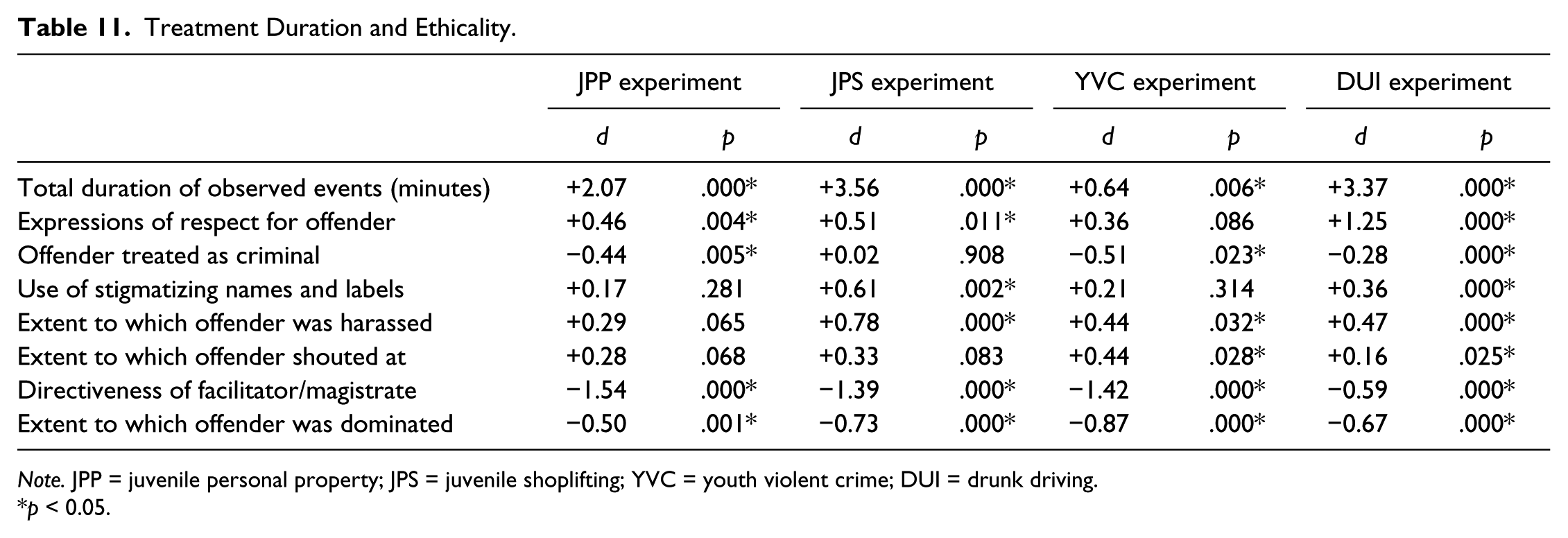
Participating in a DC, across all four trials, was associated with a large and significant increase in the overall time spent discussing and resolving the matter. Associated effect sizes can be seen in Table 11. In both the shoplifting and drunk driving experiments, for example, the length of the conferences associated with very large effect sizes, each in excess of 3.0. An average DUI hearing lasted just 7.3 for court-assigned offenders, while an average event for those assigned to conference took 87 min to complete (p = .000). Differences were of similar magnitude and significance in the property (19 vs. 91 min for court and conferencing, respectively; p = .000), shoplifting (10 vs. 72 min; p = .000), and violence (39 vs. 89 min; p = .006) experiments. To the extent that this increased time allowed for more discussion from all sides of the offense—including the offenders’—this fact alone should have provided improved representation and impartiality to those in the conference group.
Treatment Duration and Ethicality.
Note. JPP = juvenile personal property; JPS = juvenile shoplifting; YVC = youth violent crime; DUI = drunk driving.
p < 0.05.
In three of the four experiments, conference-assigned offenders were treated with significantly more expressions of respect than those who were assigned to traditional court proceedings. These effects were moderate in the three juvenile/youth experiments, and tended to be smallest where the offenses involved were the most serious. They were quite large in the DUI experiment, where no direct victims were involved in the offenses, and the victim’s role in the DCs was carried out, usually in a pro-forma manner, by volunteer community representatives (d = 1.25). It may be the case that having victims present at these conferences (in the property and violence trials) had a moderating effect on how much respect for the offender could be produced.
While diversionary conferencing may seem to promote procedural justice in expressing more respect for offenders, treating them less like criminals, promoting less directive behavior by the presiding official, and presenting a less “dominating” environment for offenders, Table 11 also suggests some reasons for concern. In various RCTs, RISE observers found that conference offenders had more stigmatizing names and labels applied to them, experienced more harassment, and were shouted at more than offenders who were randomly assigned to court. These facts suggest that conferences were not stress-free or unemotional experiences for the offenders. The inclusion of offender and victim supporters and the open discussions allowed in RJ conferencing can lead to conditions that are distinctly uncomfortable, and that certainly do not comport with the ethical and consistent treatment required for procedural fairness. Moreover, the use of stigmatizing names and insults can be especially problematic, as the application of deviant labels can have a lasting and durable effect on self-identity (Paternoster & Iovanni, 1989).
Representation and Problem Solving
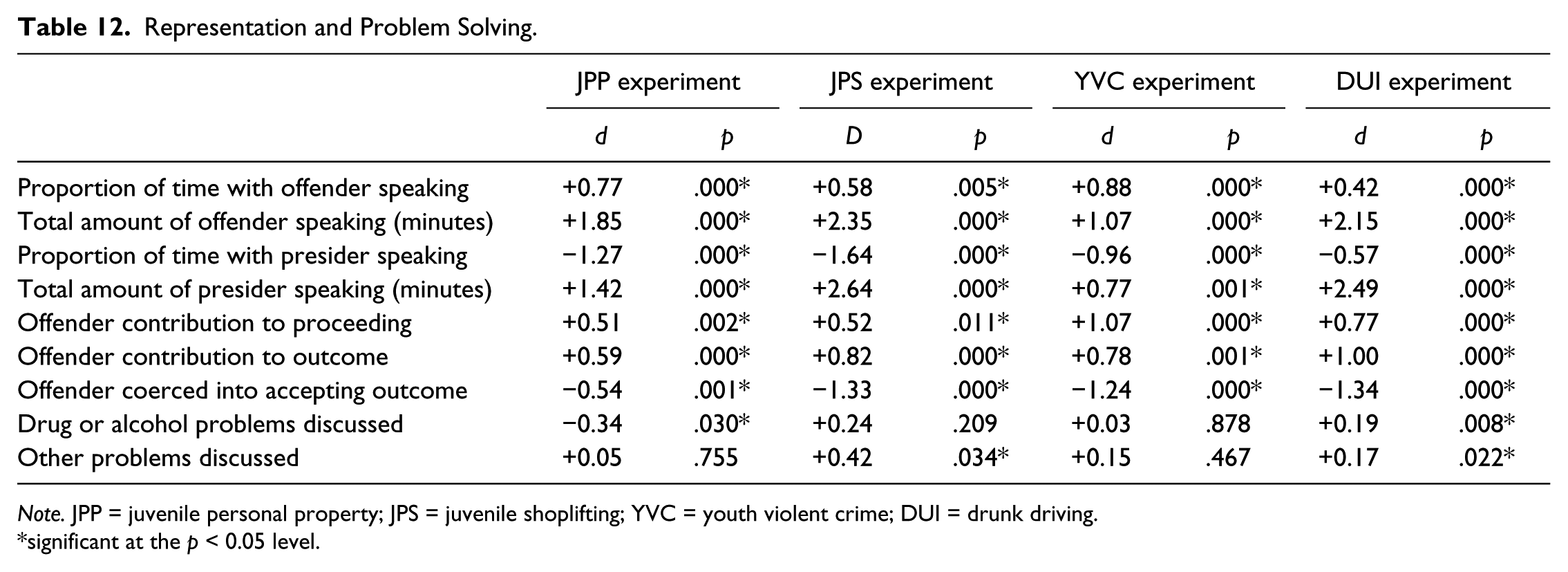
The conferencing process allowed offenders significantly more opportunities to participate in their adjudication process. These effects are present both in the amount of time (in minutes) the offenders spent speaking, in the differential in hearing lengths (noted above), and in the proportion of each event during which the offender spoke. These results, presented in Table 12, reveal what Barnes (1999) refers to as “one of conferencing’s most enormous and obvious benefits” (p. 156). Offenders assigned to conferencing spent vastly more time contributing directly to their own treatment than court offenders.
Representation and Problem Solving.
Note. JPP = juvenile personal property; JPS = juvenile shoplifting; YVC = youth violent crime; DUI = drunk driving.
significant at the p < 0.05 level.
These differences are also present in the extent to which authority figures, either the conference facilitator or judge, were involved in the event and the characteristics of that interaction. In all four of the trials, the effect sizes associated with the presider speaking were large and positive with regard to the actual minutes speaking, but the effects of the proportion of the total event the provider was speaking were all negative, large, and significant. This suggests that, though everyone at the conference spent significantly more time discussing the issue at hand, the offender was, in most cases, the primary speaker and the presider primarily acted to facilitate conversation between the offender and the victim.
The extent to which the offender played an active role in the conferencing process is also reflected in the consistent effect sizes associated with the determination of a mutually acceptable sanction. Offenders contributed more often in the determination of the outcome during conferences, which resulted in a moderate, positive effect on the personal property experiment (d = 0.59; p = .000) and much larger effect sizes, ranging from 0.82 to 1.0, within the other three trials (p = .000). This finding supports the conciliatory component of RJ. At the same time, the conferencing process had a negative effect on the levels of coercion that were objectively apparent in the event. That is, offenders were not forced to accept a unilaterally imposed sentence, as is the case in almost all court hearings, but rather accepted the sanction as reasonable and acceptable. As seen in Table 12, the decrease in coercive actions ranged in effect sizes from 0.54 to 1.34, all of which were statistically significant.
Finally, the conferencing process, when compared to court hearings, was associated with a stronger and broader approach to preventing recidivism that strayed beyond the instant criminal offense. For example, in the DUI experiments there were small but significant effects on the extent to which substance abuse (d = 0.19, p = .008) and other problems (d = 0.17; p = .022) were discussed at conference when compared with court. Although these same effects were sporadically significant across the other three RCTs, the direction of the effect is largely positive. This suggests that problem solving was generally more common at conference than it was in court. Although addressing these problems was beyond the scope of the DC itself, the fact that these secondary issues were discussed suggests that the holistic and integrative approach encouraged by the RIS process was being followed during the RISE trials. These kinds of discussions might also be seen as promoting procedural fairness, as they allow offenders to deal with the root causes of their criminal behavior, rather than merely punishing them for it.
Presence of Supporters
By their very nature, DCs required the inclusion of many additional participants, including victims and supporters, than were typical at court hearings. The presence of more members of the public—especially those who are known, trusted, and respected by the offenders—could also be seen as promoting increased procedural fairness. At the very least, having more witnesses to a legal proceeding makes any gross abuses of power less likely to occur. When these witnesses become direct participants in the procedure, and play active roles in its decision making, these effects could be enhanced even further.
It is clear that conferences had a significantly greater number of participants and supporters across all four RCTs. As shown in Table 13, the effect sizes associated with the treatment were large, significant, and positive. Between the four RISE trials, the DUI experiment was associated with the largest effect sizes, with far more participants overall present at the conferences than at court (d = 2.26; p = .000), and an even larger effect size in the additional numbers of the offender’s friends and family present at the DCs (d = 2.94; p = .000). In the two experiments that featured direct personal victims (property and violence), similar effect sizes were seen in the number of victim supporters present at treatment (d = 1.2 [JPP]; d = 1.47 [YVC]; p = .000 in both cases). Having larger numbers of people participating in both sides of the offense could be seen as promoting procedural fairness through impartiality, allowing everyone involved to have a say and all aspects of the offense to be discussed.
Participants Present at Treatment.

Note. JPP = juvenile personal property; JPS = juvenile shoplifting; YVC = youth violent crime; DUI = drunk driving.
significant at the p < 0.05 level.
Measures of the amount of respect that the offender had for the participants are calculated in a slightly different manner. These measures, unlike the other variables reported in this section, were provided by the offenders during their posttreatment interviews. Offenders were asked to rate each participant based upon how much respect the offenders had for them. What seems very clear is that, in all four of the RISE trials, conference-assigned offenders had more respected individuals participating in their treatments than those who were assigned to court. The mean respect scores that offenders provided for the participants in their treatments, however, produced consistently small effect sizes in the property, shoplifting, and violence experiments and moderate effect size in the DUI trial. Indeed, for conference-assigned offenders, the violence experiment reported having lower average levels of respect for their treatment participants than those assigned to court (d = −0.09), but this difference was not statistically significant (p = .701).
Discussion
Practically and philosophically, the RJ conferencing process in the RISE program was markedly different than the standard court-based adjudication process employed in Australia. Research on RJ and RIS indicates that, delivered appropriately, conferences can produce higher levels of satisfaction and commitments to stop offending than standard approaches. Conferences can also fall flat, with little emotional investment or return for the participants [when] the components of a ‘good’ conference, such as the development of conversational and bodily rhythm, a balance of power and perspective among participants, and a shared focus of their emotions [are lacking]. (Rossner, 2011 p. 96)
We show here that, with regard to engendering objective levels of fairness, the RISE conferences effectively developed the requisite structural and emotional dimensions.
The limitations of the RISE procedural justice measures are clear in the analyses presented above. In measuring objective fairness, the observation ratings provided no means for gauging a number of procedural justice elements, including consistency, impartiality, accuracy, and correctability (Barnes, 1999). Although the scales for ethicality, representation, and participation are quite thorough, the complete, theoretical elements of fairness are not measured in the same comprehensive manner used in other studies of procedural justice (see Tyler, 1990). However, even if the items developed for RISE are lacking comprehensive or complete indicators of procedural justice, the same instruments were used across both experimental conditions and consistently within the experiments. In addition, and for the purposes of these analytical comparisons, the random assignment process controls for instrumentation effects and allows these comparisons to be made with high levels of internal validity (Campbell & Stanley, 1963; Cook & Campbell, 1979).
All measures reported here are limited to the objective observations of trained observers. The aspects of the adjudication process that were considered important to the research team (and so measured during the experiment) may not mirror the components that were important to the offenders participating in the trial, at either the individual or aggregate levels. It is the subjective perceptions of equity and fair treatment that are most determinative of how an offender will assess the procedural justness of the hearing (Thibaut & Walker, 1975). As Barnes (1999) notes, [T]he causal chain itself is a largely psychological process that takes place inside the minds of individual offenders. As important as objective fairness is to initiating this chain of causal processes, subjective reactions are essential if these processes are to function in the manner predicted by theory. Offenders must not only be exposed to objective fairness, but must perceive themselves to be fairly treated.
These results do not, and cannot, address this deficiency. What they do provide, however, is evidence of a framework and external benchmarking process through which objective and subjective perceptions of fairness can be linked (Barnes, 1999; Strang et al., 2011; Tyler, 2003).
Conclusion
The RISE experiments presented an excellent opportunity for advancing research into the effects of procedural justice. As a randomized trial, RISE offers the opportunity to isolate and quantify the direct effects of enhanced procedural justice, as delivered in RJ conferences that were designed to produce an objectively fair legal experience. The analyses reported here attest to the integrity of the experiment itself, and verify that any observed differences between these groups in terms of overall fairness can be attributed to the fairness of their procedural experiences, and not to any preexisting differences between individual offenders. Objective measures of procedural justice, as recorded by trained observers, offer an unbiased, though potentially incomplete, picture of the participants experiences, both in court and at conferences.
We find that the DCs produced significantly higher levels of offender engagement within the adjudicative process, higher levels of ethical treatment, and that, when compared with standard courtroom experiences, conduct within the conferences was better attuned to procedural fairness. Although there was some between-trial variation, conference attendees engaged in an adjudicative experience better characterized as respectful and as less dominating than traditional court hearings. Offenders contributed more to the outcomes of their conferences and were less coerced into accepting those results. Finally, offenders had more members of the public, more supporters from their own community of care, and more participants for whom they had respect attend their conferences than court. In the aggregate, the conferencing process was one that, based on the principles of procedural justice, had many elements that should make it objectively fairer than traditional responses to crime and delinquency.
Despite these positive findings, however, there are also some reasons that RJ conferencing may also present opportunities for increased unfairness. Offenders assigned to conference experienced more shouting, harassment, stigmatizing name-calling, and increased anger than they would have experienced in the courtroom environment. In many ways, this may be an inescapable side effect of the increased emotions that are typically presented in RJ procedures, but they are worrying from a procedural justice perspective. It may be that certain offenses or specific types of offenders are more prone to having these kinds of negative experiences. Further research must examine whether the procedural justice benefits of conferencing may be attenuated, under certain conditions, by the amount of anger that is directed toward offenders.
These results reinforce the previous RISE findings by providing evidence that the DC process, as delivered, was in keeping with the overall goals of RJ and supports Sherman et al.’s (2000) attribution of RISE’s effectiveness to the RJ process. Additional research, on both subjective perceptions of fairness and a more in-depth evaluation of potential psychological mechanisms, are necessary to gain a more complete understanding of the role procedural justice plays in reducing crime. This analysis should, however, serve as a solid foundation for these future inquiries.
Footnotes
Declaration of Conflicting Interests
The author(s) declared no potential conflicts of interest with respect to the research, authorship, and/or publication of this article.
Funding
The author(s) disclosed receipt of the following financial support for the research, authorship, and/or publication of this article: This study was supported by Grant #70517 from the Robert Woods Johnson Foundation’s Public Health Law program. Supporters of the original RISE project included the Criminology Research Council (Australia), the Australian National University, and the National Institute of Justice (United States).