



Abstract
In recent years, correctional and community agencies have developed and promoted an array of policies and programs aimed at successfully facilitating the offender transition from prison to community. One model, the Reentry Partnership Initiative (RPI), emphasizes building collaborative partnerships in an effort to deliver a coordinated and continuous stream of supervision, services, and support during the transitional process and includes institutional, structured reentry, and community reintegration phases. The current study evaluates the outcome of an RPI-style model called the Missouri Prisoner Reentry Initiative (MPRI). The impact of MPRI participation was examined by comparing the reimprisonment of two MPRI treatment groups to the reimprisonment of a reference group having no MPRI involvement. The MPRI groups consisted of (a) offenders entering all MPRI phases and (b) offenders receiving MPRI assistance exclusively inside prison. MPRI was not successful in reducing reimprisonment for males but had benefits for females who entered all MPRI phases.
Introduction
One of the greatest challenges facing criminal justice during the last few decades is the massive growth in the number of offenders being released from prison. The number of inmates released from the U.S prisons in 2010 was 708,677 (Guerino, Harrison, & Sabol, 2011), which is staggering when considering that only 170,000 people were released in 1980 (Lynch & Sabol, 2001). The huge number of returning offenders has serious implications. Approximately 30% of released prisoners are rearrested within a 6-month period following release, and two thirds (67.5%) are rearrested within 3 years (Langan & Levin, 2002). An overload of returning ex-prisoners places tremendous strain on government resources, local economies, neighborhood networks, and family stability (Clear, 2007; Clear, Rose, & Ryder, 2001; Lynch & Sabol, 2001; Petersilia, 2000, 2003; Urban Institute, 2006). People coming home from prison are arguably more difficult for communities and agencies to absorb now than in earlier decades, given that offenders are incarcerated longer, participate in fewer treatment programs in prison, and receive less formal supervision due to higher parole and probation caseloads (Petersilia, 2001, 2003; Travis, Solomon, & Waul, 2001; Visher, La Vigne, & Travis, 2004).
The magnitude of the modern prisoner reentry phenomenon has ignited a surge in research and evaluation on a topic given scarce attention only a few decades ago. A number of studies have documented the challenges obstructing successful post-prison reintegration. Obstacles related to employment, housing, substance abuse, mental health, transportation, social stigmatization, and family reunification are routinely identified in the prison-to-community transition literature (Garland, Wodahl, & Mayfield, 2011; La Vigne, Visher, & Castro, 2004; O’Brien, 2001; Richie, 2001; Solomon, Gouvis, & Waul, 2001; Urban Institute, 2006; Visher, Kachnowski, La Vigne, & Travis, 2004; Wodahl, 2006). As a result, a number of specific programs have been advocated and implemented to address the problems of recently released ex-prisoners, such as education and job training programs, transitional housing units (THUs), drug-focused therapeutic community models, substance abuse and psychological counseling services, and various faith-based programs (Inciardi, Martin, & Butzin, 2004; Maruna & LeBel, 2003; Seiter & Kadela, 2003; Solomon, Waul, Van Ness, & Travis, 2004; Willison, Brazzell, & Kim, 2011; Wormith et al., 2007; Zhang, Roberts, & McCollister, 2011).
One new model to emerge from the modern prisoner reentry movement is the Reentry Partnership Initiative (RPI; Taxman, Byrne, & Young, 2002; Taxman, Young, Byrne, Holsinger, & Anspach, 2002). Prior to the RPI, prisoner reentry programming typically focused unilaterally on strategies for improving post-release adjustment. The RPI model emphasizes the entire correctional process and attempts to individualize reentry interventions through intensified case management and a network of agency and support team collaborations. The RPI process is divided into three distinct stages: (a) an institutional phase, (b) a structured reentry phase, and (c) a community reintegration phase. The institutional phase, beginning ideally at prisoner intake, focuses on screening, assessment, and classification as critical components to achieve optimal security and treatment placement. At this stage, treatment options target broader rehabilitative needs more so than delivering immediate, release-related transitional services. The structured reentry phase, stretching from a few months prior to release until 1 month following release, focuses on the actual physical transition from prison to society. This phase includes meeting with a reintegration team, framing a reentry plan, and enlisting collaborative partnerships among multiple entities, such as victims, treatment programs, social service agencies, law enforcement, and institutional and community corrections organizations. The final community reintegration phase starts the 2nd month after release and continues with supervision from the reintegration team. This phase emphasizes a heightened concentration on administering formal (e.g., drug testing, electronic monitoring, and graduate sanctions) and informal (mentors and self-help groups) controls to steer ex-prisoners toward productive, law-abiding behavior until an offender is released from formal correctional supervision.
A number of studies have examined outcomes of reentry programs that target one or a small number of reintegration needs. Seiter and Kadela (2003) reviewed the literature on 32 reentry programs that had both in-prison and post-release components, weighing study results with the methodological sophistication of the evaluation techniques. The authors concluded that participation in vocational training/work release, drug treatment, and halfway house programming reduced recidivism. Education-based reentry programs did not affect criminal offending but did increase levels of educational achievement. Transitional programming targeting violent and sex offenders was designated as promising but needing further research due to methodological limitations.
Broader RPI-style reentry initiatives are quite new, and consequently few evaluation results are available. Roman, Brooks, Lagerson, Chalfin, and Tereshchenko (2007) examined Maryland’s RPI that targeted transitional needs at the individual, community, and systems levels for Black male offenders released from a transitional center into a Baltimore neighborhood. Keeping with the RPI model, the Maryland initiative emphasized continuous case management delivered through a network of service providers bonded through a community-justice partnership model. In multivariate analyses, Maryland RPI offenders fared no better than a matched comparison group on prevalence of rearrest, time to rearrest, or three measures of reconviction, although RPI offenders did have fewer total arrests per person.
Lattimore and Visher (2009) evaluated 12 adult sites that received federal funding through the Serious and Violent Offender Reentry Initiative (SVORI). SVORI provided more than US$100 million in funding for 69 agencies in 2003 to “expand and enhance existing programs or to develop and implement new programs” within an RPI-like, three-phase reentry continuum supported by collaborative partnerships (Lattimore & Visher, 2009, p. ES-4). The goal of SVORI was to improve criminal justice, employment, education, housing, and health-related outcomes during the reintegration process. SVORI program participants in the 12 sites received more reentry-specific services and programming than a matched comparison group. Recidivism outcomes were not impressive for the 1,697 adult males and 357 adult females studied. Adult SVORI and non-SVORI males reported few differences on a range of self-reported criminal behavior measures and no statistically significant differences on official measures of rearrest and reimprisonment. Few differences were identified between SVORI and non-SVORI females on self-reported offending variables, and no statistical differences were observed in official data for rearrest and reincarceration up through 6 months and 9 months following release, respectively. Significant reductions in rearrest were found for SVORI females from 9 months to 2 years following release; however, SVORI females were significantly more likely to be reincarcerated between 1 and 2 years post-release.
Bouffard and Bergeron (2006) examined a SVORI program implemented in Fargo, North Dakota. A comparison of 71 SVORI participants and 106 control group offenders showed mixed results. The SVORI group had the same rate of parole revocation as the comparison group. In contrast, SVORI offenders were less likely to be arrested when analyzing all offenders who successfully completed parole. No recidivism results were provided during the parole supervision period, which is when the transitional aspect of reentry is most applicable. Severson, Bruns, Veeh, and Lee (2011) analyzed a SVORI-based program in a Midwestern state comparing 537 program participants to a similarly sized control group. The odds of reconviction were significantly lower for the program participants, although differences in reincarceration were not statistically significant. Interestingly, program participants returned to prison at a significantly faster rate than others.
Duwe (2012) evaluated the Minnesota Comprehensive Offender Reentry Plan (MCORP) that aims to strengthen service delivery and increase continuity between institutional and community components of reentry. The MCORP strategy involves building relationships between prison caseworkers and community supervisors and integrating evidence-based treatment strategies into the case management process in conjunction with motivational interviewing and targeted goal setting and planning. Although the MCORP designers intended the process to begin at the start of an offender’s prison sentence, actual MCORP assignment did not occur until late during a confinement period. In addition, MCORP strived to achieve smaller than average caseloads for institutional caseworkers, although actual MCORP institutional caseloads remained at normal levels of approximately 80 to 90 offenders. Caseload sizes were significantly reduced for field supervision agents, averaging approximately 35 to 40 offenders per agent. Using a randomized experimental design, Duwe found that MCORP participants (n = 175) did experience recidivism reductions over the comparison group (n = 94) during follow-up periods that averaged 16 months. The MCORP participants were less likely to be rearrested, reconvicted, and reincarcerated for a new offense net of controls.
Current Study
The current study examines the impact of an RPI-style model known as the Missouri Prisoner Reentry Initiative (MPRI). Like the RPI model, the MPRI has three distinct phases and is built upon a case management approach. The MPRI design is rooted in a social support framework. Social support theory maintains that the consistent presence of supportive social networks is associated with “low anger, a high, internalized sense of self-control, and a strong social bond based on a moral commitment to others” (Colvin, Cullen, & Vander Ven, 2006, p. 28). Taxman, Young, et al. (2002) observed that social support is an evidence-based programmatic component cited in the offender rehabilitation literature. In addition, Duwe (2012) found empirical evidence linking MCORP’s success to its ability to expand social support networks and link offenders to community support services such as mentoring, faith-based, and restorative justice programs. Beyond traditional case management practices, MPRI aims to establish supportive networks through videoconferencing technology that introduces prison inmates to field supervision agents and community service providers and strengthens outside personal support networks with key members of a reintegration team. After release, MPRI partners make offender-specific mentoring available with a particular emphasis on securing gainful employment.
The goal of the current study is to provide an outcome evaluation of the MPRI by exploring several key issues. The first issue is whether MPRI is effective in reducing reimprisonment. The second issue is whether the complete MPRI model that includes both institutional and community components is significantly more beneficial than only receiving MPRI assistance inside prison. The third issue is whether both males and females benefit equally from the MPRI. Although a sizable literature has examined the value of gender-specific services (e.g., Bloom, Owen, & Covington, 2003; Covington & Bloom, 2006; Grella, Scott, Foss, Joshi, & Hser, 2003; Lovins, Lowenkamp, Latessa, & Smith, 2007; Messina, Burdon, Hagopian, & Prendergast, 2006; White, 2012), studies that examine the effect of the RPI model by gender are limited. Outcome measures here include reimprisonment at 6 months and 1 year following release.
MPRI
In 2008, the Missouri Department of Corrections (MDOC) began implementation of the MPRI program for offenders returning to Greene County, Missouri. Springfield, the principal city in Greene County, has a population of 160,000 residents. The target offender population for the Greene County MPRI was male and female offenders aged 18 or older who were not convicted sex offenders. The MPRI’s three phases are discussed further.
Institutional Phase
A significant component of MDOC’s reentry preparation efforts involves targeted release preparation provided within THUs. Offenders enter THUs approximately 6 months prior to being released. THUs provide screening, assessment, and transitional services, which include obtaining identification, employability and life skills training, cognitive restructuring, medical and mental health treatment, substance abuse treatment, and education on rebuilding family relationships and pro-social community participation. The MPRI began inside THUs, with a unique emphasis on individualizing service delivery, developing strong social support networks, and creating a seamless continuum of services from prison to the community. All THU offenders were provided with MPRI information and given the opportunity to voluntarily participate. On the first day of each month, a list of offenders expressing interest in the MPRI was generated and names were submitted to institutional case managers for eligibility determination. Eligible candidates met with their institutional case manager to discuss MPRI requirements and confirm their commitment to participate.
Within 10 working days of meeting with the offender, the institutional case manager completed a referral notice for each MPRI participant and sent it to a community phase liaison, a representative from a local Springfield, Missouri, partnering agency called Metropolitan Employment and Rehabilitation Service (MERS)/Goodwill. At this point, the institutional case manager also updated the offender’s transitional accountability plan (TAP). The TAP in Missouri is a case management document that individualizes the transitional process for each offender, and thus it is not specific to the MPRI. The TAP specifically identifies an individual offender’s reentry goals, personal strengths and weaknesses, and potential barriers to successful transition. The TAP articulates a plan of action for attaining each goal and is revisited periodically to evaluate progress. The community liaison then contacted the relevant institutional case manager to schedule a video-conference meeting with the offender at the institution. This video-conference session generally occurred within 15 calendar days of the community liaison receiving a referral notice. This meeting’s purpose was to orientate the offender regarding the community aspect of the MPRI program, asses the offender’s risks and needs, and identify personal strengths and liabilities. The TAP was then again updated to better guide coordinated transitional efforts from institution to community.
Structured Reentry Phase
The structured reentry phase focuses on enhancing the delivery of release-focused transitional services and formally establishing continuity of care between the institutional and community components of reentry. During this phase, the institutional case manager designated the offender to continue participating in THU programming as deemed necessary and worked to set up referrals to community providers for post-release services and support. A key component of the structured reentry phase is to focus on building a network of family, community, and social service partnerships. The goal here is to promote a well-planned process that involves close communication and collaboration among prison staff, releasing authorities, community supervision personnel, social service providers, and social support mechanisms such as faith-based providers, mentors, and family.
Approximately 90 days prior to the offender’s scheduled release, the field parole officer met with the offender and his or her institutional case manager via videoconferencing technology. This meeting’s purpose was to identify specific transitional needs, set measurable post-release goals, and determine the persons and agencies responsible for coordinating each service or support function. Community treatment and service providers and members of the offender’s pro-social support network were invited to become part of a case management team and to provide input into the case planning process.
Approximately 60 days before the offender’s scheduled release date, an institutional parole officer, the prison staff member directly coordinating the pre-release transition among correctional agencies, sent a home and employment investigation request to the designated MPRI field parole officer in the receiving district. At least 30 days prior to the offender’s release, the institutional case manager, in conjunction with the community liaison and the field parole officer, collaborated to finalize a release plan.
Community Reintegration Phase
The MPRI community phase consisted of community-based reentry support programs offered through a collaborative agreement between the MDOC and MERS/Goodwill. In 2001, the MERS and Missouri Goodwill Industries merged to form MERS/Goodwill. The MERS/Goodwill and MDOC partnership aims to provide Missouri offenders facing employment barriers with the opportunity to work and live more independently in the community. MERS/Goodwill offers a variety of programs and services, including career counseling, education and literacy programs, employment services, and housing and clothing assistance.
MPRI participants were given the opportunity through the MERS/Goodwill and MDOC partnership to connect with a network of social service agencies and community-based organizations to receive mentoring and ongoing services. At this stage, the field parole officer provided regular assessment and modified the TAP to address the offender’s changing needs. Services were provided either on-site by MERS/Goodwill or through referrals to various community organizations. A caseworker from MERS/Goodwill met with each offender twice a day for 2 weeks to provide intensive job readiness training. This training focused on resume building, interview skills, filling out employment applications, and job placement. Moreover, offenders attended groups led by a mentoring coordinator once per week that focused on specific needs such as transportation assistance, child care assistance, medical and dental needs, spiritual needs, and other support services. The mentoring component aimed to enhance the coordination of services, fill gaps in service delivery, and provide additional offender support. The offender’s field parole officer and the MERS/Goodwill caseworker interacted to motivate the offender, stress personal accountability for goal attainment, and assist with setting new goals.
Method
Data and Measures
All data for this study were made available by the MDOC and submitted in electronic format through Excel spreadsheet files. The files contained information on MDOC offenders released to Greene County, Missouri, from January 2007 through September 2011. The analysis reported here begins with offenders released in 2009, as this is the year when the MPRI in Greene County was fully implemented. As the MPRI process was voluntary, inmates who completed the institutional side of the initiative were given the choice to continue with the post-release component. A sizable portion of the initial MPRI participants opted only for MPRI assistance inside prison. As a result, two MPRI treatment groups are analyzed: institution-only (IPRI) and institution and community (ICPRI) participants.
All offenders enrolled in the MPRI during the eligible time frame were analyzed. The number of females who did not attend the programs during the eligible time frame was relatively small (n = 51). As a result, all females not participating in one of the MPRI groups became part of the female comparison group. The number of males not participating in the MPRI groups during the eligible time frame was too large for a comparison population given that information from multiple electronic spreadsheets had to be cut and pasted for each individual case. Thus, a 100 person random sample of all males not participating in MPRI was drawn for the male comparison group. This number was selected as it is comparable with the size of each MPRI male group. Two cases in the data file were dropped from the analysis: one case due to inconsistent data and the other resulting from an offender appearing twice in the data file. The final number of offenders analyzed included 285 males (92 in IPRI, 94 in ICPRI, and 99 in the comparison group) and 174 females (65 in IPRI, 58 in ICPRI, and 51 in the comparison group).
Two dependent variables measured reimprisonment. These measures consisted of an offender returning to prison for a technical violation or new crime (a) within 6 months of release from incarceration and (b) within 1 year following release. Each dependent variable was coded dichotomously, where 1 = reimprisoned and 0 = not reimprisoned. To measure the impact of MPRI participation in logistic regression analysis, two dummy variables were created where IPRI and ICPRI participants were analyzed against the comparison group. Logistic regression analyses were run separately for males and females.
The comparison group could not be matched to precisely fit both MPRI groups for either males or females. This limitation necessitated the use of several controls to account for the effects of potentially intervening variables. Traditional demographic variables used as controls included age (in years), race (1 = White, 0 = Other) and education (1 = high school diploma or GED, 0 = no high school diploma or GED). Time served during one’s recent incarceration period was measured in months. Significant skewness in the time-served variable required the natural logarithmic transformation for regression analysis. Intake type was dummy coded (1 = new commitment, 0 = other intake type). Intake types other than new commitment included returns for violating the terms of parole, probation, and any other form of conditional release. Offense type was measured as a factor where violent and drug or Driving While Intoxicated (DWI) were compared against a nonviolent category.
Five custody levels are listed in the data file, although the vast majority of the study population is classified at the lowest (least severe) custody levels: levels one and level two. As a result, offenders designated as custody level one and custody level two were separately compared with custody levels three through five. The MDOC’s risk assessment instrument was used to control for risk of reoffending. This risk assessment incorporates criminal history items and dynamic risk indicators such as institutional behaviors and education and vocational skill. The MDOC’s risk score is a continuously coded measure, with scores ranging from −6 (lowest risk) to +8 (highest risk).
The data file ranked the mental health of MDOC offenders as 1 = emotionally stable, 2 = minimal impairment, 3 = mild/clinical care, 4 = clinical care/medication, and 5 = residential unit. At the recommendation of an MDOC research office representative, a dichotomous variable was created to measure the need for mental health clinical care (1 = clinical care needed, 0 = clinical care not required). To measure the existence and extent of substance abuse problems, the MDOC uses an instrument called the Substance Abuse Screening Assessment (SASA). Potential scores on the instrument are 1 = no substance abuse problems, 2 = intermittent use, 3 = moderate abuse requiring treatment program, 4 = severe abuse requiring institutional treatment, and 5 = severest abuse requiring long-term institutional treatment. Frequency table analysis indicated very few offenders scoring on the lower half of this scale. The most meaningful break in the data was the point where offenders were elevated to “severe” substance abuse status. This led to the development of a dichotomous substance abuse measure (1 = severe substance abuse, 0 = not severe substance abuse).
MDOC prisoners participate in an array of institutional programs that may also influence recidivism. Addressing this possibility, several dichotomous variables were created to control for the completion of various types of institutional programs. An overarching dichotomous variable was developed to indicate whether an offender had completed an institutional program other than MPRI, where 1 = completed and 0 = not completed or not admitted.
Study Participants
Table 1 shows descriptive characteristics for the male participants, which included 92 offenders from the IPRI group, 94 from the ICPRI group, and 99 in the comparison group. The average age of male participants was 36 years, with the comparison group having the oldest participants (M = 38) and the IPRI group the youngest (M = 34). The overall average for time served during one’s most recent incarceration period was 2 years. ICPRI participants had served the longest amount of time (M = 27 months), whereas the IPRI and comparison groups averaged 19 months served. Risk scores on the salient factor instrument ranged from an average of .21 for the IPRI group to .51 for the ICPRI group, with an overall average of .40. Approximately 23% of male participants’ most recent imprisonment was for a new commitment. The comparison group had the smallest proportion of new commitment offenders (18%), and the ICPRI group had a minutely greater proportion than the IPRI participants (25.5% to 25%, respectively). A slight majority of all male study groups were listed at custody level one in the MDOC database. The ICPRI group had the smallest percentage of offenders in the three highest custody levels: custody levels three through five (6.4%). Nonviolent was the most common offense type for the IPRI (49%) and ICPRI (42%) groups, whereas drug or DWI offenders were most frequently represented in the comparison group (43%). The male study participants can be characterized as overwhelmingly White (82%) and not in need of mental health clinical care according to the rating scale provided by MDOC (86%). A greater proportion of the comparison group was White (89%) than the IPRI (76%) and ICPRI (78%) groups. Male study participants also had largely received a high school diploma or GED (71%). The IPRI group had the smallest percentage of offenders at this educational level (61%) and ICPRI group the highest (79%). Based on the substance abuse screening instrument developed by the MDOC, 71% of the offenders had “severe” substance abuse problems that required institutional treatment.
Descriptive Characteristics for Male Prison Releases.
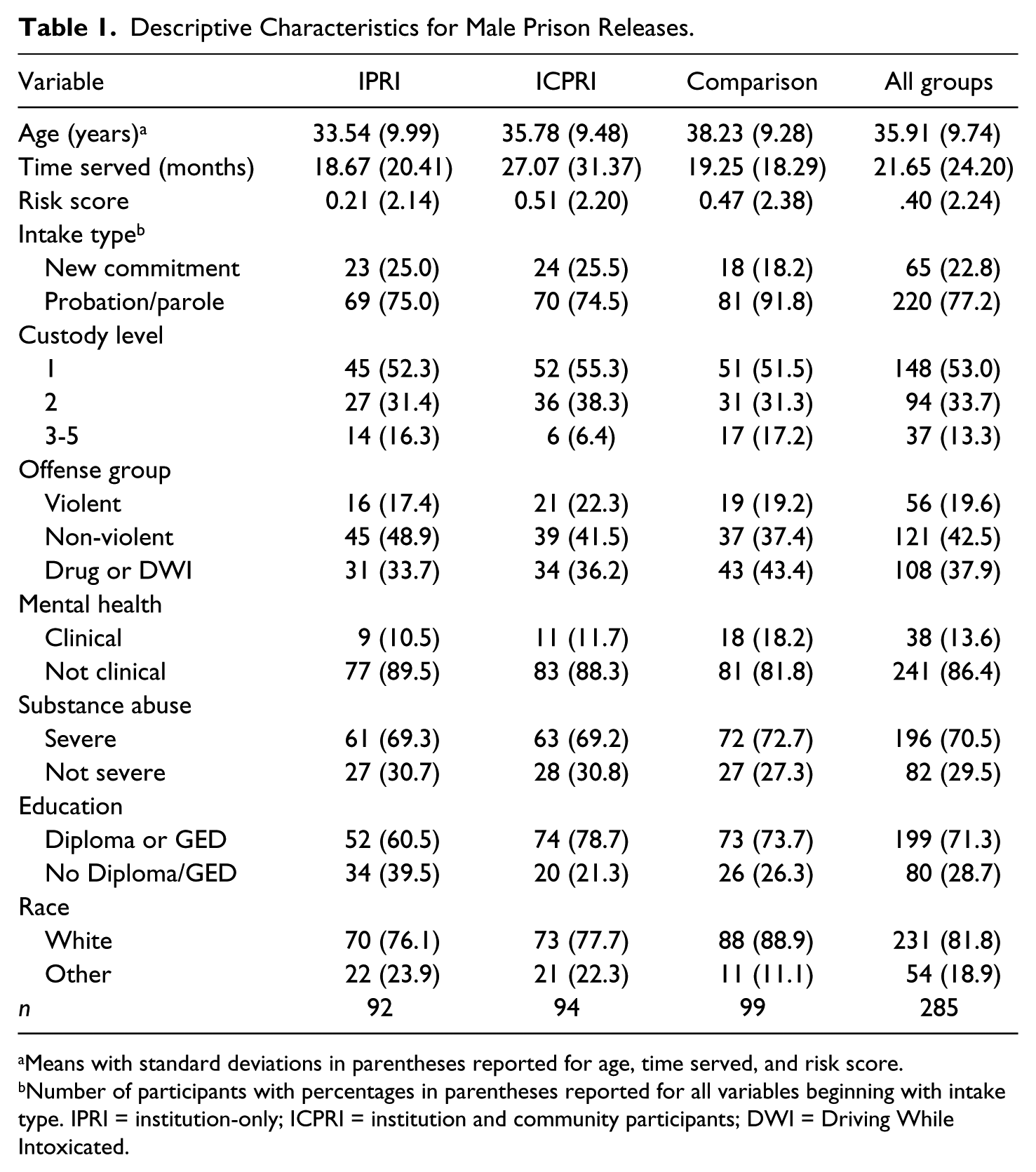
Means with standard deviations in parentheses reported for age, time served, and risk score.
Number of participants with percentages in parentheses reported for all variables beginning with intake type. IPRI = institution-only; ICPRI = institution and community participants; DWI = Driving While Intoxicated.
The female study participants are described in Table 2. The female participants included 65 IPRI offenders, 58 ICPRI offenders, and 51 women who did not participate in either program. The average age of female participants was 36 years, with very little variation among the three groups. Comparison group participants served the greatest amount of time during their most recent incarceration period (18 months), followed by the ICPRI and IPRI groups who served an average of 13 and 11 months, respectively. Risk scores on the salient factor instrument averaged .70, with ICPRI participants scoring the highest (M = 1.02) and IPRI the lowest (M = 0.35). Overall, a small percentage of females were new commitment inmates (12%); the IPRI group contained the smallest proportion of new commitments (8%) and the comparison group the largest (16%). The MDOC database listed 52% of the ICPRI group, 49% of the comparison group, and 46% of IPRI participants at custody level one. In contrast, approximately one quarter of the IPRI (23%) and ICPRI (24%) participants and one fifth of the comparison group offenders (20%) were listed at custody levels three through five. More than half of the comparison group was labeled in the MDOC as nonviolent (51%), with an additional 37% categorized as drug or DWI offenders. More even distributions between nonviolent and drug or DWI offenders existed for the IPRI and ICPRI groups (46% and 46% for IPRI and 43% and 45% for ICPRI participants). The vast majority of females were White (93%), with the lowest percentage of White offenders in the ICPRI group (88%). The proportion of females classified as not needing mental health clinical care was 53% for the comparison group, 60% for the IPRI group, and 66% for ICPRI participants. Three fifths of the IPRI participants had attained a high school diploma or GED, as compared with 71% of the ICPRI and 75% of the comparison groups. Around 68% of the IPRI, 69% of the comparison, and 74% of ICPRI participants were listed as experiencing “severe” substance abuse problems.
Descriptive Characteristics for Female Prison Releases.

Means with standard deviations in parentheses reported for age, time served, and risk score.
Number of participants with percentages in parentheses reported for all variables beginning with intake type. IPRI = institution-only; ICPRI = institution and community participants.
Results
Descriptive reimprisonment statistics for the three study groups are provided in Table 3. The table shows recidivism statistics for 6-month and 1-year time periods. Table 3 indicates that among all the male study participants, 32% of the IPRI group, 20% of the ICPRI group, and 18% of the comparison group returned to prison within 6 months of release. About 54% of the IPRI group, 48% of the ICPRI group, and 40% of comparison group male offenders returned to prison within 1 year of release. Females experienced less reimprisonment than males, with 22% of the IPRI group, 7% of the ICPRI group, and 12% of the comparison offenders returning within 6 months after release. About 33% of the IPRI group, 9% of the ICPRI group, and 23% of comparison group female offenders returned to prison within 1 year of release.
Frequency and Percentage of Males and Females Recidivating at 6-Months and 1-Year Following Release.

Frequencies of offenders who recidivated or did not recidivate for each group are reported. Percentages of recidivists or non-recidivists for each group are reported in parentheses. IPRI = institution-only; ICPRI = institution and community participants. IPRI = institution-only; ICPRI = institution and community participants.
The next step of the analysis involved running logistic regression analyses to determine whether differences between the MPRI groups and comparison groups are statistically significant when controlling for potentially intervening influences. Tables 4 and 5 report the results of the logistic regressions for males at 6 months and 1 year following release, respectively. Both regression models failed to reach statistical significance at the .05 level, rendering meritless any interpretation of specific independent variable effects. Tables 6 and 7 report the results of the logistic regression models for females at 6 months and 1 year after release. Both regression models for females are statistically significant. Table 6 shows that neither of the MPRI groups had a statistically significant impact on reimprisonment at the 6-month mark. Interestingly, the only statistically significant variable in the model was whether a female offender had completed some type of institutional program. The exponentiation of the B coefficient symbolized as Exp(B) in the far right hand column of the tables indicates how the odds of reimprisonment are affected by a one-unit change in the independent variable. The Exp(B) value of 5.100 for institutional treatment indicates that the odds of reimprisonment at the 6-month mark for females who completed an institutional treatment program are approximately 5 times greater than for females not completing a prison program, even taking into account potentially confounding influences such as custody level, type of offense committed, and time served.
Multivariate Logistic Regression Model Analyzing Predictors of Male Reimprisonment 6 Months After Release.
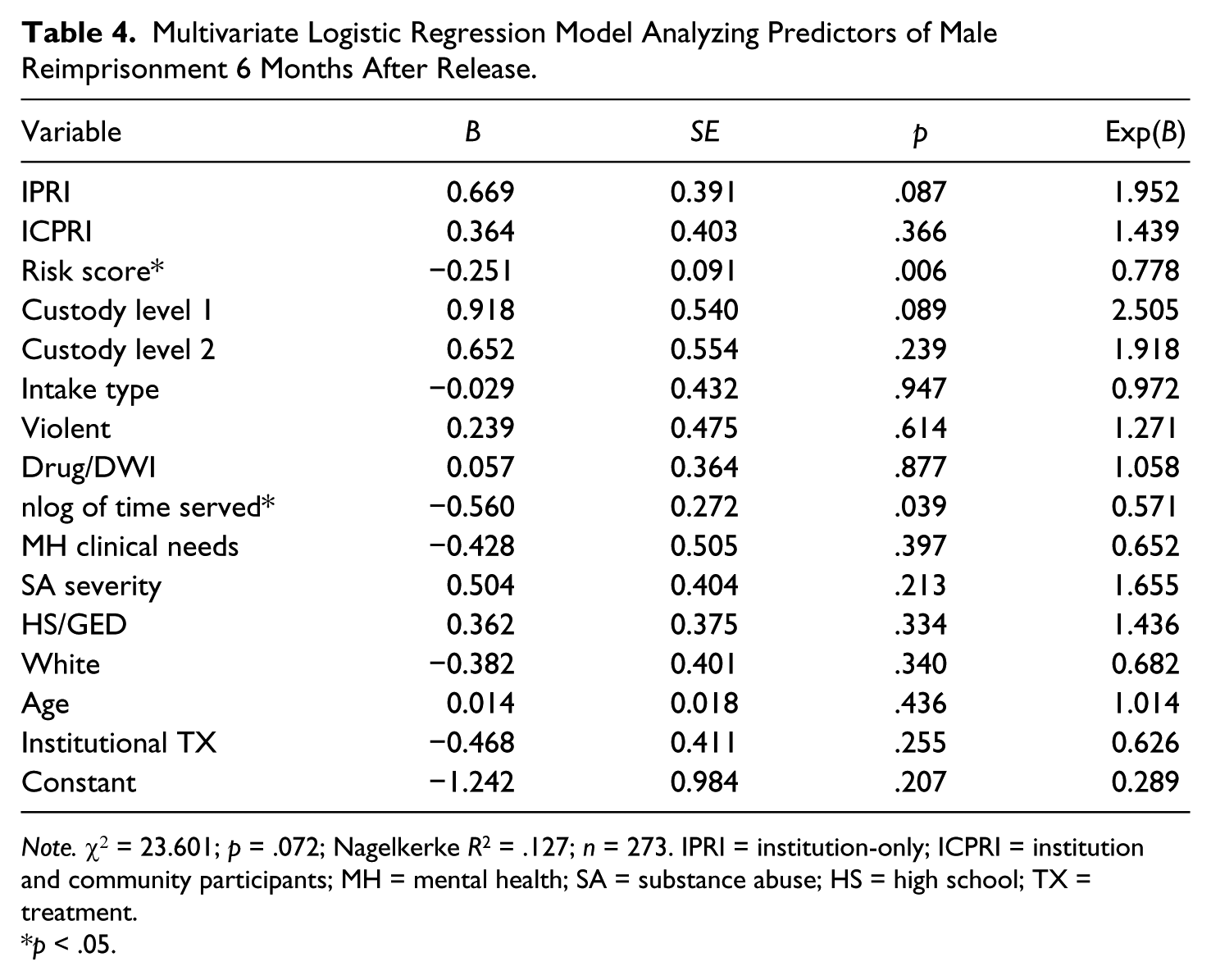
Note. χ2 = 23.601; p = .072; Nagelkerke R2 = .127; n = 273. IPRI = institution-only; ICPRI = institution and community participants; MH = mental health; SA = substance abuse; HS = high school; TX = treatment.
p < .05.
Multivariate Logistic Regression Model Analyzing Predictors of Male Recidivism 1 Year After Release.

Note. χ2 = 21.640; p = .118; Nagelkerke R2 = .146; n = 187. IPRI = institution-only; ICPRI = institution and community participants; MH = mental health; SA = substance abuse; HS = high school; TX = treatment.
p < .05.
Multivariate Logistic Regression Model Analyzing Predictors of Female Recidivism 6 Months After Release.
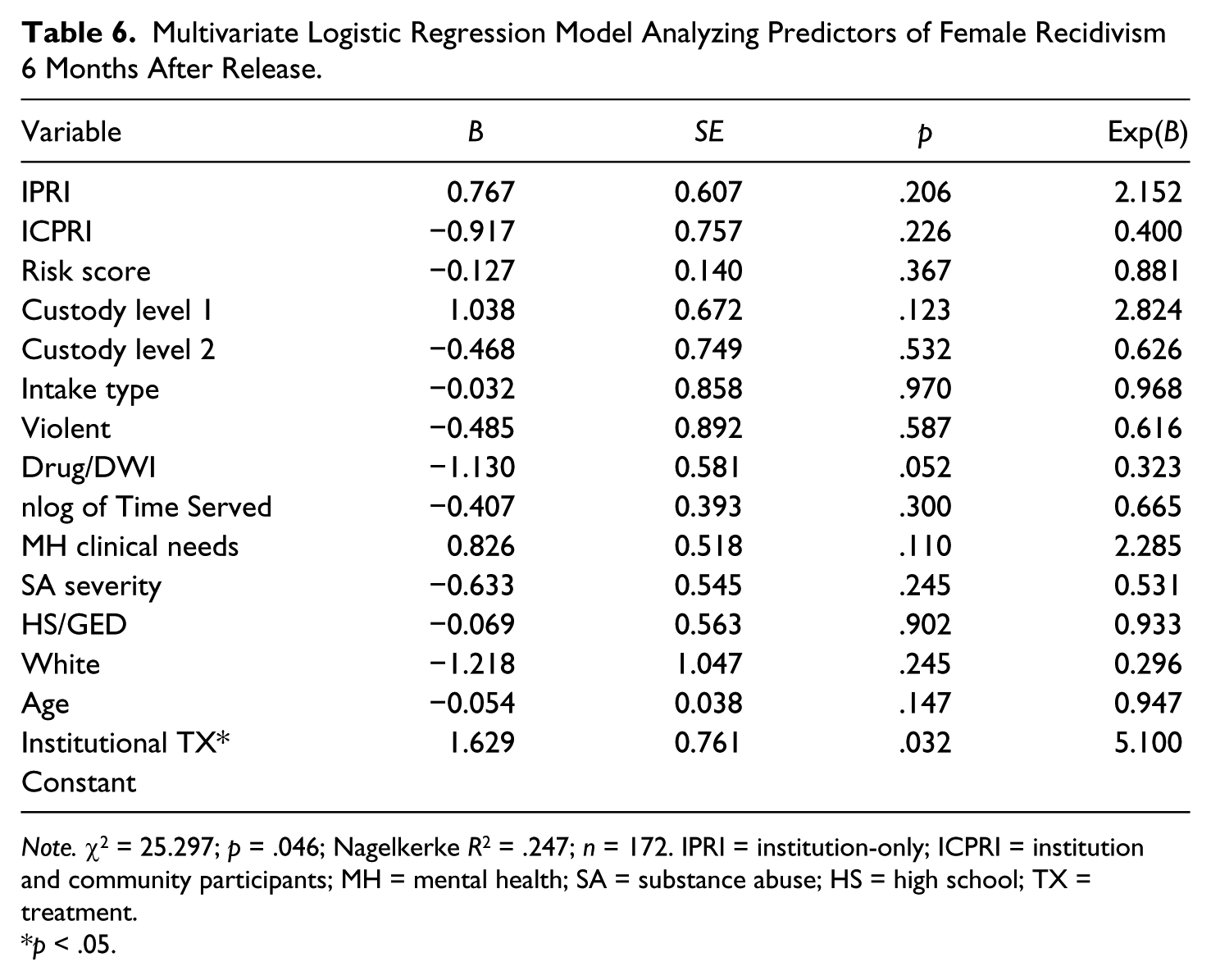
Note. χ2 = 25.297; p = .046; Nagelkerke R2 = .247; n = 172. IPRI = institution-only; ICPRI = institution and community participants; MH = mental health; SA = substance abuse; HS = high school; TX = treatment.
p < .05.
Multivariate Logistic Regression Model Analyzing Predictors of Female Recidivism 1 Year After Release.

Note. χ2 = 28.469; p = .019; Nagelkerke R2 = .286; n = 137. IPRI = institution-only; ICPRI = institution and community participants; MH = mental health; SA = substance abuse; HS = high school; TX = treatment.
p < .05.
Table 7 provides the most promising results for the MPRI model. The female ICPRI group who experienced MPRI attention in both the institution and community had lower odds of reimprisonment than the females who did not enter either phase of the MPRI. Specifically, the odds of the ICPRI group being reimprisoned at the 1-year mark were 79% lower than the comparison group. Although completing an institutional program was statistically significant for recidivists at the 6-month mark, it was no longer statistically significant when examining reimprisonment 1 year following release.
It is important to note that separate analyses of IPRI and ICPRI participants overstate the impact of attempting to implement the complete MPRI model. Participant attrition is a natural by-product of all correctional initiatives, and the fact that significant proportions of offenders did not continue into the community phase must be regarded as attrition given that all RPI phases are viewed as necessary and critical. Future applications of the MPRI may result in similar levels of attrition with participants dropping out after release. When comparing females who entered the MPRI (both IPRI and ICPRI participants) to the reference females, 28% of MPRI females were reimprisoned compared with 23% of non-MPRI females.
Discussion
Few topics have received more attention in criminal justice during the past two decades than prisoner reentry. A number of federally and privately funded initiatives have been launched to address multiple problems stemming from more than 700,000 ex-prisoners returning to cities, towns, and rural landscapes each year. One strategy proposed to generate better post-release outcomes is a structured partnership approach grounded in principles of case management and evidence-based practice. The current study expanded on the limited literature on RPIs by examining the effectiveness of an RPI-style strategy for male and female offenders.
Prior to the discussion of results, it is important to reiterate that offenders were not randomly selected into the treatment and comparison groups. The absence of random selection creates potential for selection bias by jeopardizing group equivalency, and thus raises questions about the validity of findings. Addressing this possibility, logistic multivariate regression was used to determine whether differences across groups existed when variation in group composition was considered. Differences in overall risk of reoffending, substance abuse needs and mental health status, time served, prison custody level, exposure to treatment in prison, and demographic characteristics were taken into account through the regression analysis. Unfortunately, all possible differences could not be tested due to data limitations. Inmates choosing to participate in the MPRI phases might have had greater or lesser motivation to succeed than non-MPRI participants. Differences in motivation levels could have affected recidivism independent of the IPRI or ICPRI influences.
With the possible selection bias in mind, the only clear benefit gleaned from this prisoner reentry initiative was the decreased odds of reimprisonment for ICPRI females at the 1-year mark. An interesting aspect of the female analysis was that completion of an institutional treatment program had a significant impact on reimprisonment at the 6-month mark, whereas ICPRI participation did not. At the 1-year point, the statistical significance of these variables was reversed. These results might suggest that the benefits of female-based prison programs in this state are short-lived, with community-level follow-up services guided by partnership initiatives and intensive case management aiding an extended post-release adjustment. The IPRI prison-only approach to a RPI did not show any favorable results regardless of gender.
Consistent with other evaluations of RPI-style programs (Lattimore & Visher, 2009; Roman et al., 2007), male recidivism was not influenced by the MPRI. Although the MPRI did not incorporate gender-specific programming, the MPRI’s emphasis on building social support networks could have affected females more favorably than males. Covington and Bloom (2006) noted that the study of female psychological development stresses social relationships as a central, organizing aspect of women’s lives that fuel positive growth and development. In a prisoner reentry context, relational theory emphasizes establishing strong social connections and repairing disconnected relationships before and during the transition from prison to community (O’Brien, 2001). Incarcerated women experience relationship strain resulting from physical separation caused by imprisonment and the compounding reality that female prisons are often farther from residences of family and friends than male prisons, which decreases visitation opportunities (Singer, Bussey, Song, & Lunghofer, 1995; Sobel, 1982). This latter problem especially applies to the females studied here, as female prisons are not in close proximity to where the women live. Dowden and Andrews (1999) meta-analysis of female offender programs identified that women are more successful when rehabilitative programming targets interpersonal criminogenic needs such as weak emotional ties with family and friends. Importantly, Spjeldnes and Goodkind (2009) cautioned that both men and women have benefited from social support following release and that no empirical evidence confirms that social support contributes to greater success for females than males during reentry.
The lack of any positive effects for male participants and limited results for females in the MPRI is troubling but could be attributable to multiple causes. First, the MPRI as administered in Greene County, Missouri, overlooked one of the most important principles of offender rehabilitation: the risk principle (Andrews, 2006; Andrews & Bonta, 2006; Cullen & Gendreau, 2000; Gendreau, 1996). This principle emphasizes the need for focusing intensively on high-risk-of-reoffending inmates to maximize recidivism reduction, and it warns against mixing lower-risk and higher-risk offenders in programs (Lowenkamp & Latessa, 2005). Although offenders were scored on a risk assessment instrument, MPRI placements were voluntary and not directed at high-risk offenders. An analysis of the distribution of risk scores across MPRI offenders revealed a rather normal distribution spread about a moderate risk value. A more promising strategy would have been to place only offenders at high risk of recidivism into the MPRI programs.
Another possible reason for the MPRI’s limited results is that all MDOC offenders receive transitional assistance, and thus the MPRI participants are being compared against offenders also receiving some type of assistance. All offenders analyzed were placed in THUs, which are modern housing units especially designed and equipped for soon-to-be-released offenders. Although the MPRI offenders received special attention, extra supervision, planning, and services may offer limited advantages over existing opportunities available to all (Lattimore & Visher, 2009). In the community non-MPRI offenders could seek out services and support from various sources and received supervision from parole officers. An unresolved issue in the literature is determining the dosage of case planning and reentry services necessary for an ex-prisoner to adjust satisfactorily to life on the outside. The extra amounts received through the RPI model may be inconsequential to post-release outcomes (Garland & Wodahl, 2014). In addition, an overload of services and requirements could create excessive strain on offenders and lead to greater rather than fewer adjustment problems (Petersilia & Turner, 1993).
The MPRI model aims to build partnerships and refer offenders to effective programs and services that match individual needs. Regardless of the intensity and quality of collaborative efforts and case management in this model, MPRI success ultimately hinges on the necessary programs and services being accessible in a specific geographical location. Best practices literature on correctional rehabilitation advises using cognitive and behavioral approaches in environments that address multiple criminogenic needs holistically, possess a theoretical grounding, administer adequate dosages of treatment during sustained time periods, enlist qualified and properly trained staff who are interpersonally sensitive, and provide directed services where offender interaction is closely monitored (Andrews, 2006; Cullen & Gendreau, 2000; Gendreau, 1996). The authors could find no evidence that the MPRI implemented in this specific jurisdiction conducted independent evaluations of the quality of community-level services available through the initiative. This omission is probably not unique to the MPRI. Other prisoner reentry initiatives are bound to make similar assumptions about the effectiveness of existing treatment programs (Duwe, 2012; Wilson & Davis, 2006). As a result, goal displacement may exist where the objectives of intensive case management and building agency partnerships and support networks overshadows the value and therapeutic integrity of the underlying services and support provided. For this reason, reentry initiatives rooted in case management and collaborative networks should carefully assess the strength of available community-based services and support systems to effectively address the reintegrative and criminogenic needs of post-release offenders. If local community programs and services are substandard, reintegration teams will have limited impact regardless of their skill, experience, and motivation (Garland & Wodahl, 2014).
Another challenge facing prisoner reentry initiatives is the limited knowledge of the reentry process as experienced by the offender. A number of key questions remain unanswered about prisoner reentry, such as: What indicators tell us that an ex-prisoner has successfully reintegrated into society? When does a prisoner typically begin the mental transition from dealing primarily with prison life to preparing psychologically for life in society? What programs and services most effectively facilitate the prison-to-community transitional process, and do they differ from those prescribed in the broader offender rehabilitation literature (Garland & Wodahl, 2014)? A study of ex-prisoners released for 3 months found that while employment and housing were concerns of post-release offenders, psychosocial adjustment issues were perceived as the greatest obstacles to reintegration (Garland et al., 2011), yet these obstacles receive little attention in the reentry literature. In many ways, prisoner reentry initiatives are handicapped by the underdevelopment of theoretically grounded and empirically based principles and practices specific to the prison-to-community transition. Recommendations guiding prisoner reentry policy and practice at this point are largely borrowed from the findings and conclusions of related but separate literatures (Garland & Wodahl, 2014).
Recognizing the limitations of this study, which foremost involve the voluntary rather than random placement of offenders into treatment groups, it adds to the mixed evidence regarding the potential for modern reentry programming to succeed (Lattimore, Steffey, & Visher, 2010; McGarrell, Hipple, & Banks, 2003; Wilson & Davis, 2006). RPI-style strategies like the MPRI are a relatively new addition to correctional practice and under-researched. Unfortunately, correctional history is full of examples of well-intentioned ideas implemented in “cart before the horse” fashion that failed to live up to their promise. Quite evidently, additional theoretical development and empirical justification are needed to categorize reentry initiatives like the MPRI as “best practice” models. Future evaluations of prisoner reentry initiatives are encouraged to create more structured assessments of how specific initiative components contribute to or hinder successful offender transition. For example, it would be interesting to learn if successful transition outcomes are influenced by the contributions of specific types of reintegration team members, amount of time spent communicating with case managers while incarcerated, characteristics of mentors, and the form and extent of transitional planning. Ultimately, it may be that we must acquire greater knowledge about processes and dynamics in prisoner reentry before positive results are achieved and sustained for both male and female offenders.
Footnotes
Declaration of Conflicting Interests
The author(s) declared no potential conflicts of interest with respect to the research, authorship, and/or publication of this article.
Funding
The author(s) disclosed receipt of the following financial support for the research, authorship, and/or publication of this article: The authors received funding from the Missouri Department of Corrections to conduct the evaluation.