



Abstract
Fear of crime has been recognized as one of the driving forces underlying the punitive turn in the criminal justice system. Despite this, evidence suggests that rehabilitative efforts are still supported by the general public. The current study uses a national random sample to examine the impact of fear on public preference for allocating resources to rehabilitative versus punitive criminal justice system policies. Contrary to prior studies, respondents are forced to make a choice between punitive and rehabilitative options, and both the emotional and cognitive aspects of crime salience—fear of crime and victimization risk—are evaluated to determine their independent and combined impact on crime policy preference. The findings suggest that the majority of the public prefers putting resources toward rehabilitative crime polices, but fear of crime and risk of victimization both reduce this tendency. The implications of our results for current criminal justice system policies are discussed.
Increases in crime beginning in the 1960s initiated a “tough on crime” movement by American politicians (Cullen, Fisher, & Applegate, 2000; Zimring, 1998). This punitive development was in stark contrast to the rehabilitative ideals that had dominated correctional policy in prior decades (Rothman, 1980). The shift in crime policy was, in part, a reaction to politically generated concerns about crime and criminal victimization among the public (Cullen et al., 2000). For example, Simon (2007) posits that an “ethos of fear of crime and mistrust of governing institutions has fueled the logic of mass imprisonment” (p. 155). Researchers suggest that the transition from a rehabilitative to punitive approach to crime reflects a change in focus from the well-being of offenders to the safety and concern for victims (Simon, 2007; Unnever & Cullen, 2010). Based on this theory, increased fear of crime among the public should explain a lack of support for rehabilitative policies, a sentiment reflected in governmental policies emphasizing deterrence, incapacitation, and retribution.
To this end, studies have explored the extent to which fear affects support for rehabilitative and punitive crime policies. This is typically done by looking at separate indices of support for punitiveness and rehabilitation, or dichotomous measures asking respondents the most important goal of prison (Applegate, Cullen, & Fisher, 2002; F. T. Cullen, Clark, Cullen, & Mathers, 1985; Langworthy & Whitehead, 1986; Mascini & Houtman, 2006; Sims & Johnston, 2004). Despite varying methods of measurement, prior research on crime policy has mostly failed to specify where individuals prefer the criminal justice system to focus more resources (Baker, Cleary, Pickett, & Gertz, 2013). In addition, prior studies are limited by their measurements of fear, often concentrating either solely on cognitive measures of fear, such as risk of victimization, or emotional measures of crime salience, such as fear of crime.
This study aims to bridge these gaps in the crime policy literature by examining the effect of both fear of crime and perceived risk of victimization on the crime policy preferences of the general public. This is particularly important considering that “how the public thinks creates boundaries and opportunities regarding what policies might be implemented” (A. R. Piquero, Cullen, Unnever, Piquero, & Gordon, 2010, p. 189). Using a national random sample of the general population we (a) examine how the public prefers criminal justice resources be allocated, that is, either for punitive or rehabilitative policies, and (b) consider the independent and combined effects of both fear of crime and risk of victimization on crime policy preference.
Fear and Crime Policy Support
There are several explanations that have been put forth regarding the shift to a more punitive ideology in America. It has been argued by some that the shift was a response to the growing concern among policy makers and the public regarding the perceived rise in crime, coupled with the notion that “nothing works” (Barkan & Cohen, 2005; Cullen, Skovron, Scott, & Burton, 1990; Roberts & Hough, 2005; Roberts, Stalans, Indermaur, & Hough, 2003). These concerns about crime are believed to have been generated by biased media representation, the work of victims’ rights movements, or even racial fear (Barkan & Cohen, 2005; Beckett & Sasson, 2004; Frost, 2010; Rosenberger & Callanan, 2011). At the core of most of these arguments, though, is the development of a sense of fear among the public—fear of the prospect of crime and fear of victimization.
The result has been a growing range of legislative and criminal justice practices (Andrews & Bonta, 2010; Shichor, 2000). Among these are Three Strikes Laws, an increase in incarceration rates, the reemergence of and support for capital punishment, a decrease in amenities for prisoners, and harsher punishment for juvenile delinquents (Applegate, Cullen, & Fisher, 1997; Applegate, Cullen, Turner, & Sundt, 1996; Baumer, Messner, & Rosenfeld, 2003; Beckett & Sasson, 2004; Jackson, 2011; Jan, Ball, & Walsh, 2008; Moon, Sundt, Cullen, & Wright, 2000; Shichor, 2000; Sundt, Cullen, Applegate, & Turner, 1998). These policies put an emphasis on the goals of deterrence, incapacitation, and retribution over the goal of rehabilitation.
Examining Crime Policy Preferences
In spite of the emergence of these punitive policies and the strong belief that the public is supportive of them (Monterosso, 2009), there are those who contend that the public is not as punitive as it seems, and may in fact be more supportive of rehabilitation (Applegate et al., 1997; Beckett & Sasson, 2004; Maruna & King, 2004; Monterosso, 2009; Roberts & Stalans, 1997; Sims & Johnston, 2004). Several recent studies have looked at the effect of fear on support for both punitive and rehabilitative crime policies. Generally, in these studies, two separate measures are created, one representing support for punitive responses to offenders (sometimes measured as support for the death penalty) and another representing support for the view that rehabilitation is a legitimate and valuable function of the criminal justice system (Applegate et al., 2002; Cullen et al., 1985; Mascini & Houtman, 2006). 1 Generally, the findings of these studies suggest that actual victimization does not have an effect on support for punishment, rehabilitation, and/or the death penalty (Cullen et al., 1985; Mascini & Houtman, 2006), although Applegate et al. (2002) did find that prior victimization leads to a greater reduction of support for rehabilitation and the importance of the rehabilitation goal among women. Fear of victimization, as opposed to actual victimization, does have an effect on support for punitiveness but is unrelated to support for rehabilitative policies (Mascini & Houtman, 2006). However, among women, fear of victimization does seem to lead to greater support for capital punishment and reduced perceptions that rehabilitation is an important goal of prisons (Applegate et al., 2002).
By creating separate measures, these studies imply a distinction between punitive and rehabilitative policy support. However, they do not determine whether fear influences the choice to dedicate more resources toward punitive versus rehabilitative crime policies. In an effort to explore this issue, some studies have tried to assess whether respondents believe that rehabilitation should be the main goal of prisons, but they fail to ask respondents about resource allocation, and they focus on correctional institutions, not the criminal justice system in general. For instance, Applegate et al. (2002) asked respondents what the main emphasis in most prisons should be and created a dichotomous variable that was coded 1 for those who indicated support for rehabilitation and 0 otherwise. Because their study focused on gender influences, they do not report the direct effects of fear and victimization on this measure, but acknowledge that fear and victimization did not explain away the effects of gender.
In addition, Langworthy and Whitehead (1986) examined a dichotomous measure based on whether respondents thought the purpose of prison was to punish criminals (coded 1) or to teach them to be useful, law-abiding citizens (coded 0). They found that vicarious and direct victimization did not have an effect on support for punitiveness over rehabilitation, but fear of victimization did have a strong positive effect on support for punitive crime policies. Sims and Johnston (2004) also asked respondents to assess the importance of the rehabilitation goal over other goals of prison, including retribution, deterrence, and incapacitation. They kept this question as an ordinal measure of attitudes toward the most important goal of prison, and did not find a significant effect for fear.
Prior Measures of Crime Salience
In addition to a lack of knowledge concerning the influence of fear on individuals’ preference to allocate resources to punitive versus rehabilitative criminal justice policies, the measurements of fear used in previous studies examining punitive and rehabilitative attitudes are limited. There is little consensus among researchers on the conceptualization and operationalization of fear of crime (Farrall, Jackson, & Gray, 2009; Gabriel & Greve, 2003; Jackson, 2006; Williams, McShane, & Akers, 2000). This confusion may be due to the fact that fear is a multidimensional concept composed of cognitive appraisals of risk, emotional responses to the threat of crime (the actual worry of being victimized), and behavioral responses to this threat (precautions taken against crime and reactions to a sense of threat; Eitle & Taylor, 2008; Farrall et al., 2009; Ferraro, 1996; Gabriel & Greve, 2003; Gerber, Hirtenlehner, & Jackson, 2010; Gray, Jackson, & Farrall, 2011; Hale, 1996; Williams et al., 2000).
It can be argued that there is a distinction between the concept of fear of crime, which embodies an emotional component of fear, and risk of victimization, which relates to a cognitive aspect of fear (Baker et al., 2013). This cognitive risk has only been loosely related to the actual risk of victimization (Ferraro, 1996; Gray et al., 2011; Hale, 1996), so it is possible that the perceived likelihood of victimization may foster more fear than actual victimization. Because fear of crime and risk of victimization are distinct components of a similar concept, inclusion of both operationalizations in studies of public attitudes has become more common (Chiricos, Hogan, & Gertz, 1997; Ferraro, 1995; Liska, Lawrence, & Sanchirico, 1982).
The studies that have looked at support for both punitive and rehabilitative crime policies have mostly incorporated measures of actual victimization and risk of victimization. Findings indicate that actual victimization has little effect, while perceived victimization risk does have an impact (Cullen et al., 1985; Langworthy & Whitehead, 1986; Mascini & Houtman, 2006). Applegate et al. (2002) also examined a multi-faceted index of fear composed of indicators representing fear of victimization and a sense of insecurity based on uncivil activities in the neighborhood. However, respondents are not asked to assess their level of fear about different types of crime (Applegate et al., 2002). Sims and Johnston (2004) actually asked respondents how often they worry about murder, robbery, sexual assault, and burglary, but the full effects of this emotional component of fear is difficult to determine, as their analyses rely on an ordinal measure of attitudes toward four different goals of prisons.
Current Study
The current study uses a national random sample to determine the effects of fear of crime and perceived victimization risk on the preference of respondents to allocate more resources to punitive or rehabilitative policies. Unlike prior studies, respondents have to decide whether their state criminal justice systems, not just prisons, should focus more resources on punitive or rehabilitative measures to deal with crime. By doing so, we are able to assess the extent to which crime salience, that is, fear and risk, affects crime policy preference. Thus, this study addresses the following research questions:
What crime policies do respondents prefer their state’s criminal justice system to focus more resources on?
What effect does fear of crime have on respondents’ preference to focus more resources on rehabilitative versus punitive policies?
What effect does perceived victimization risk have on respondents’ preference to focus more resources on rehabilitative versus punitive policies?
What is the combined effect of fear of crime and perceived victimization risk on respondents’ preference to focus more resources on rehabilitative versus punitive policies?
Data
The data used are based on a national sample of adults and were collected from January to March 2009. Employing random-digit dialing, 400 households were surveyed. Interviewers asked to speak with the individual in the household over the age of 18 who had a birthday most recently (O’Rourke & Blair, 1983). The overall response rate was 36.3%, which was determined by using the American Association for Public Opinion Research (2004) RR6 calculation. After listwise deletion of missing data, refusals, and “don’t know” responses, the final sample size for all models is 315 respondents.
Dependent Variable
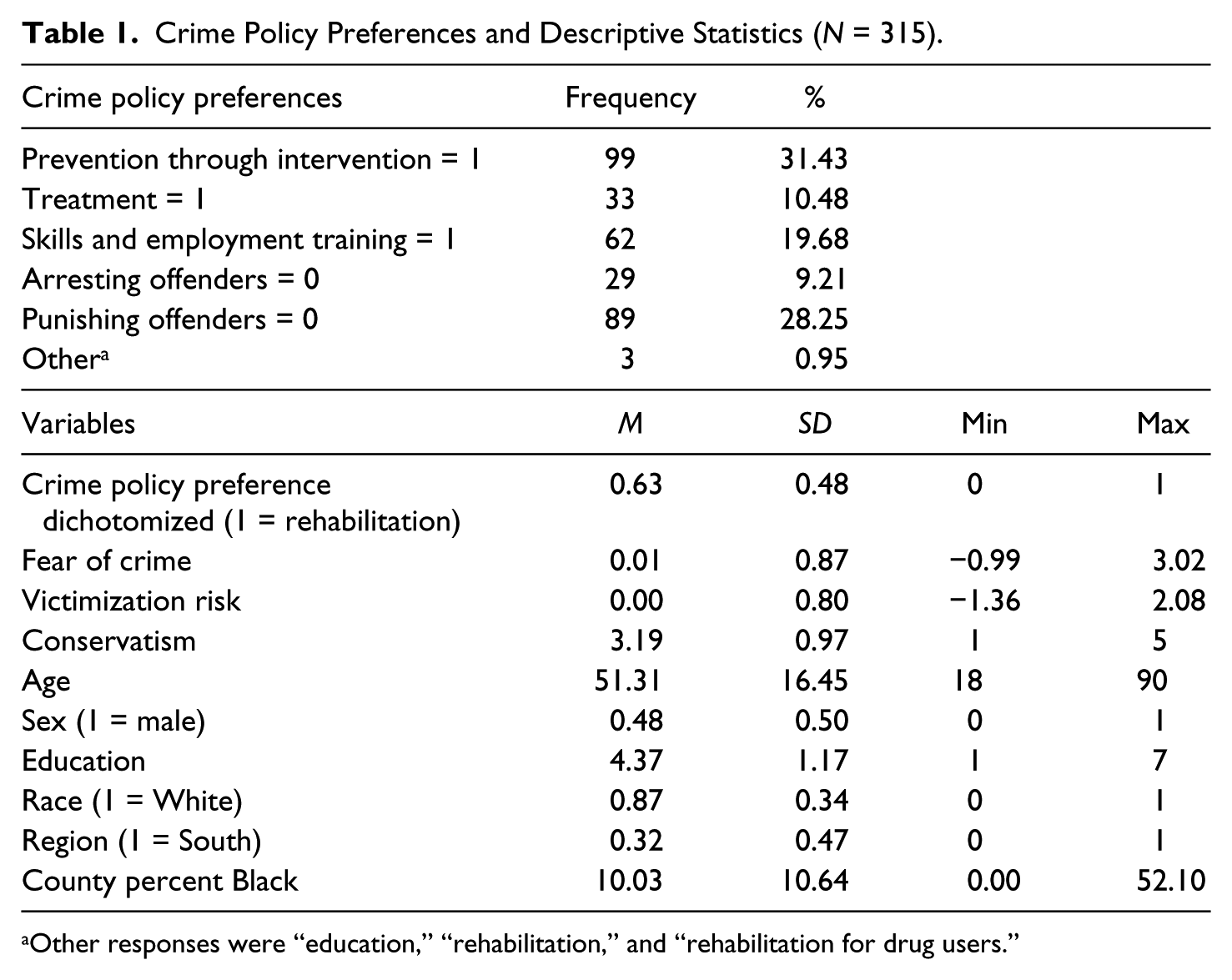
The dependent variable, Crime policy preference, is based on a question asking respondents, “Which of the following areas do you believe your state’s criminal justice system needs to focus more resources?” The response choices offered were (a) prevention through early intervention, (b) arresting offenders, (c) treatment, (d) skills and employment training, (e) punishing offenders, and (f) other (specify). Anyone who answered prevention through early intervention, treatment, or skills and employment training was coded 1. In addition, any rehabilitative responses given among those who specified the “other” category were also coded as 1. The punitive responses—arresting offenders and punishing offenders—were coded 0.
Independent Variables
Crime salience
The key independent variables are Fear of crime—the emotional measure of crime salience—and Victimization risk—the cognitive measure of crime salience. Fear of crime is a three-item index based on the questions: “On a scale from 0 to 10, with 0 being not at all afraid and 10 being very fearful, how much would you say you fear being . . . murdered? robbed or mugged? having your home broken into?” A standardized index was created from the responses, with higher values indicating greater fear of crime (α = .83).
Victimization risk is operationalized based on three questions. One question asked respondents, “Now I want you to rate the chance that the following type of crime will happen to you or someone close to you during the coming year. On a scale from 0 to 10, where 0 means not at all likely and 10 means very likely, how likely do you think it is that you or someone close to you will . . . be a victim of a violent crime? Be a victim of a nonviolent crime?” Respondents were also asked,
Compared to a year ago, how much more or less likely do you believe that you or someone close to you will be a victim of crime? Please use a scale from 0 to 10, where 0 means much less likely, 5 means the same, and 10 means much more likely.
Responses to these items were combined into a standardized index where higher values indicate greater perceived victimization risk (α = .73).
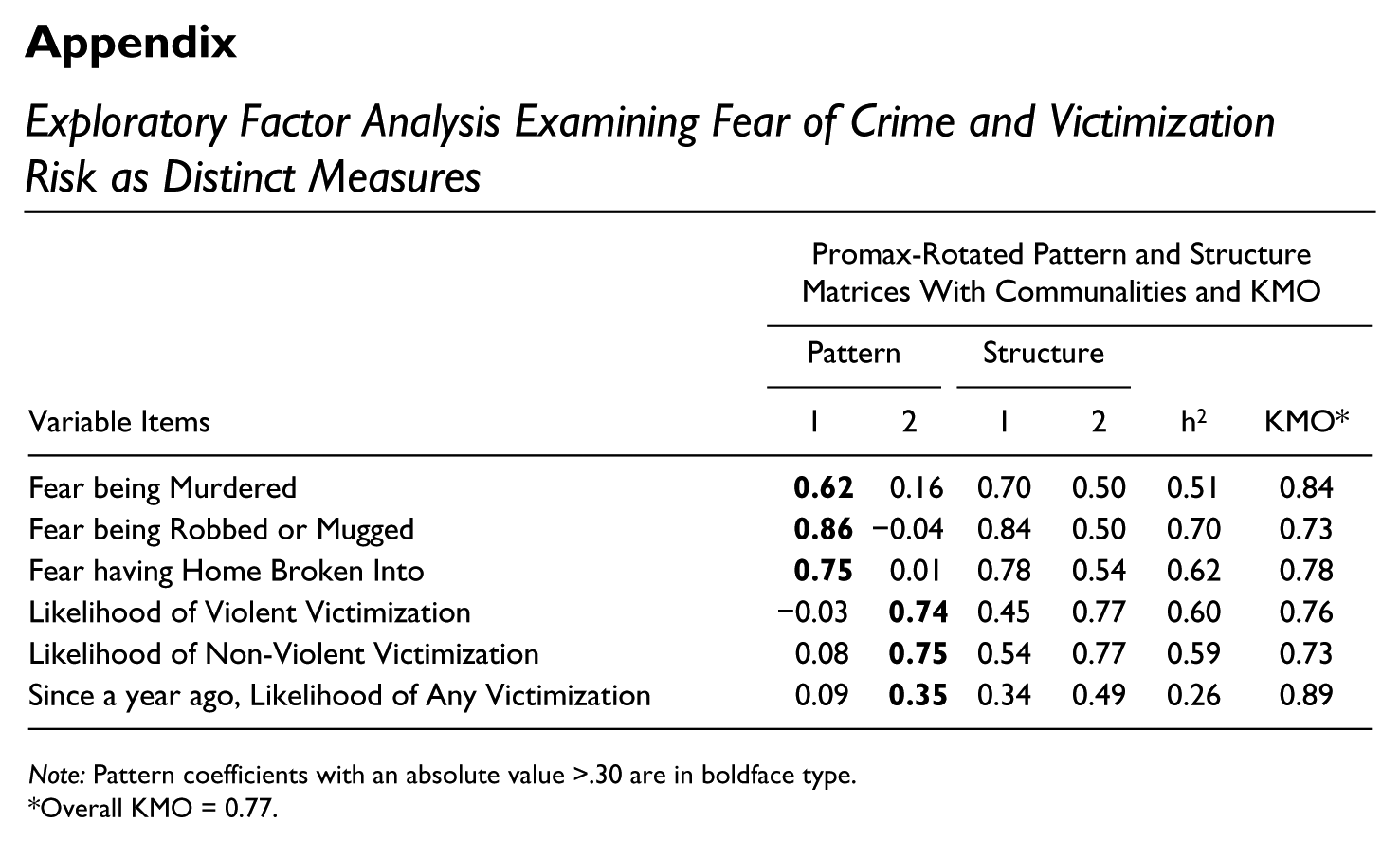
To further examine the discriminate and construct validity of our different dimensions of crime salience, an exploratory factor analysis was conducted examining all six risk and fear measures. Results of the factor analysis are presented in the appendix and indicate two separate and distinct measures. Along with the coefficients of reliability, the results of the factor analysis provide support for the discriminate and construct validity of our Fear of crime and Victimization risk measures.
Controls
Several variables were also identified as potential confounders based on prior research (Applegate et al., 1997, 2002; Costelloe, Chiricos, & Gertz, 2009; Hogan, Chiricos, & Gertz, 2005; Unnever & Cullen, 2009). Respondents were asked, “How would you describe yourself politically? Very liberal, liberal, middle of the road, conservative, or extremely conservative?” Higher values indicated that the respondent was more Conservative. Age is a continuous measure in years based on the respondent’s reported age, while Gender is a dichotomous measure indicating whether the respondent is male (1) or female (0). The respondent’s Education is an ordinal measure based on the highest grade or year of formal education, with responses including (a) 8th grade or below; (b) 9th through 11th grade; (c) 12th grade (finished high school); (d) some college, no degree, AA degree, trade school; (e) bachelor’s degree; (f) master’s degree, law, or similar graduate degree; and (g) PhD, MD, or any other degree beyond master’s. The race of the respondent is designated as White (1) or non-White (0).
To take into account contextual influences, two additional control variables were included. The first is region, such that all respondents located in the South were coded 1, while all others were coded 0. Because prior studies have linked punitive attitudes to racial threat (Blalock, 1967; Chiricos, McEntire, & Gertz, 2001; Liska, 1992; Tolnay, Beck, & Massey, 1989), the second contextual factor is the Percent Black in the respondent’s county in 2010.
Analytic Strategy
Pertaining to the first research question, descriptive statistics for Crime policy preference, both before and after the recoding into a dichotomous variable, are reviewed. To address the second, third, and fourth research questions, we use logistic regression to examine the separate and combined effects of fear and risk on respondents’ Crime policy preference.
Results
The descriptive statistics of the final sample indicate that, on average, respondents were middle of the road politically (M = 3.19), had some college education (M = 4.37), and were slightly over 51 years old. The sample was 48% male and 87% White. The majority of the respondents were from the non-South (68%) and lived in counties that were roughly 10% Black on average.
To answer our first research question, we examine the frequency distribution of respondents’ Crime policy preference and the descriptive statistics of the sample. The findings presented in Table 1 demonstrate that Americans generally support the allocation of resources for rehabilitative over punitive crime policies. The general policy preference of “prevention through intervention” (31.43%) received the greatest amount of support, though it is worth noting that “punishing offenders” (28.25%) was the second most supported option. In total, 63% of respondents preferred criminal justice resources be allocated to rehabilitative, as opposed to punitive, policies.
Crime Policy Preferences and Descriptive Statistics (N = 315).
Other responses were “education,” “rehabilitation,” and “rehabilitation for drug users.”
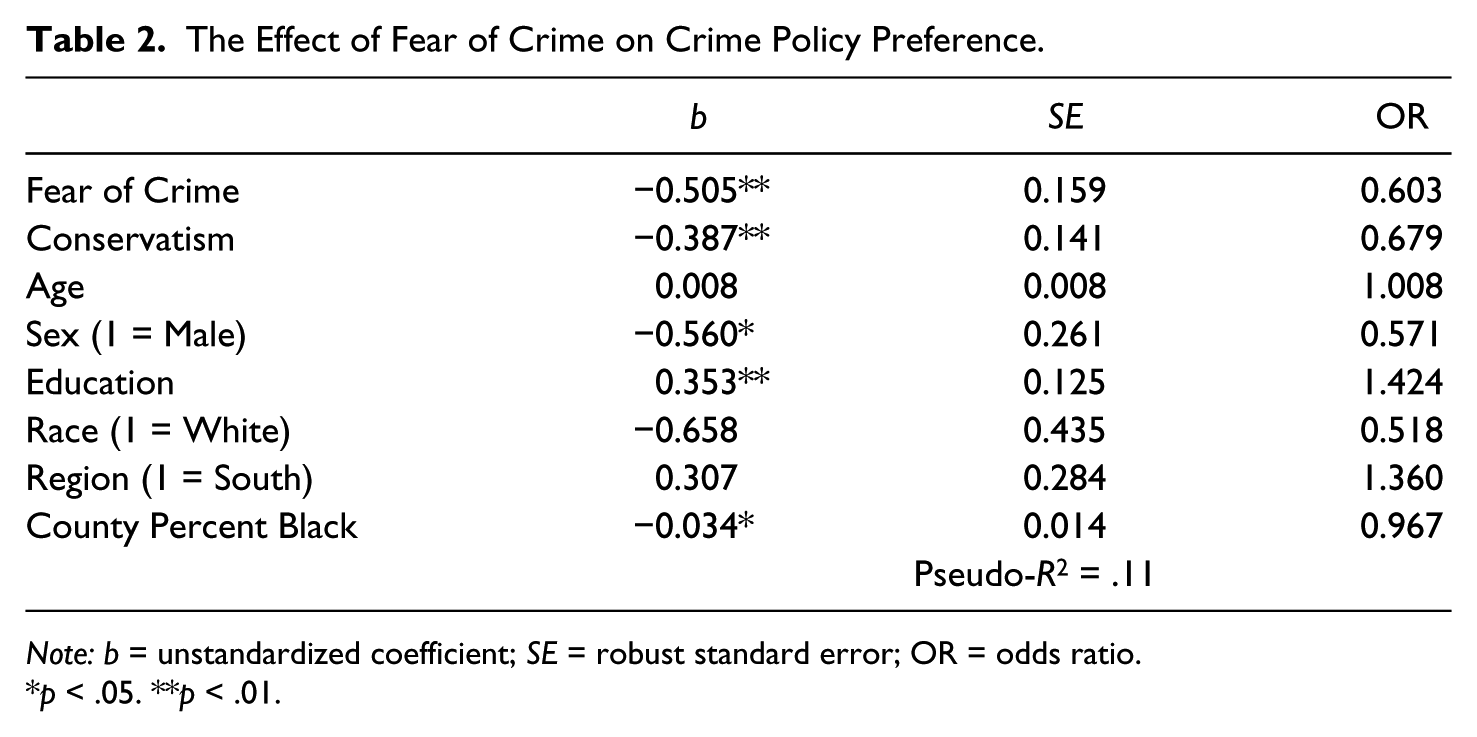
Next, we address our second research question by exploring the effect of Fear of crime on Crime policy preference. The results of this analysis are presented in Table 2 and indicate that if an individual is more fearful of crime, his or her odds of preferring rehabilitative policies is reduced by 40%. In addition, conservatives, males, and those living in higher percent Black counties are more likely to prefer punitive to rehabilitative policies, whereas more educated respondents prefer rehabilitation.
The Effect of Fear of Crime on Crime Policy Preference.
Note: b = unstandardized coefficient; SE = robust standard error; OR = odds ratio.
p < .05. **p < .01.
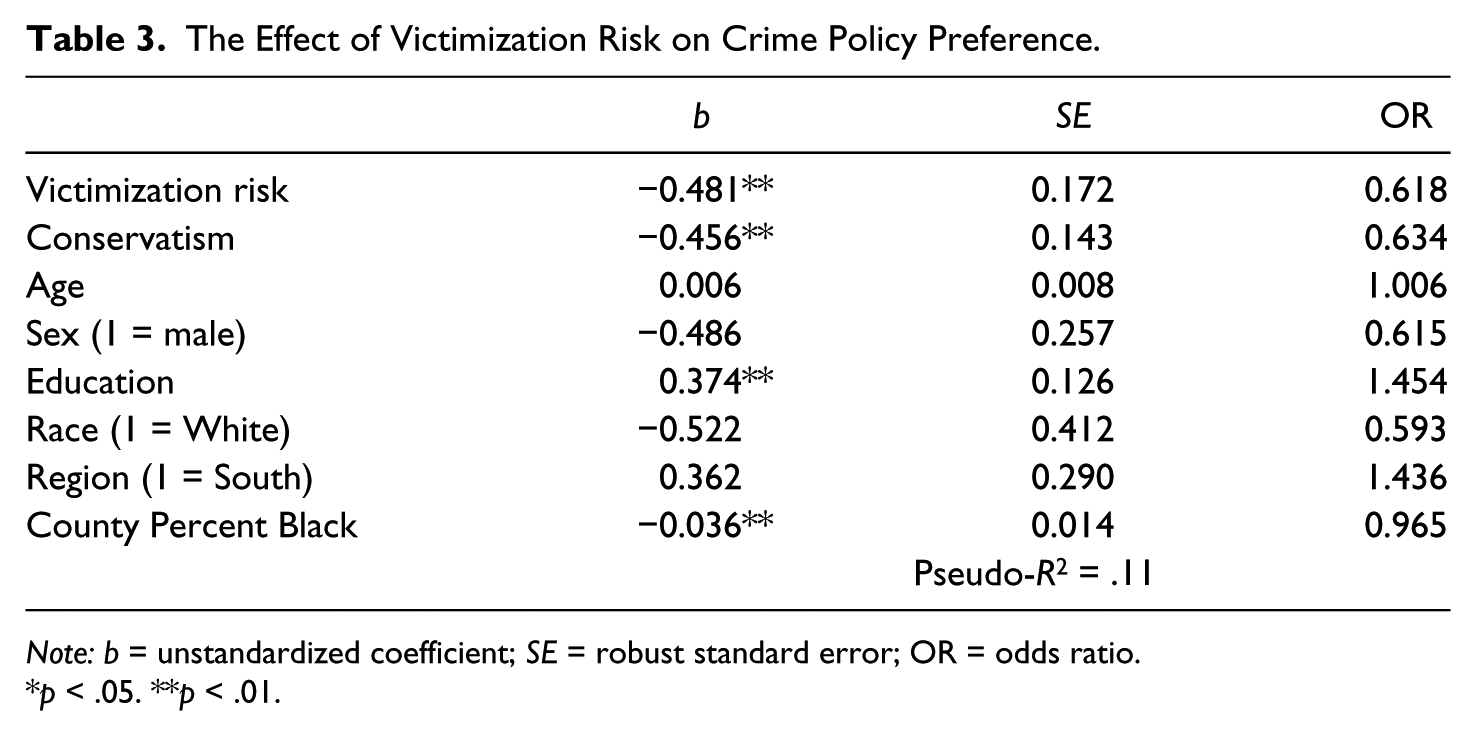
Based on our third research question, we also assess the effect of Victimization risk on Crime policy preference. The findings, reported in Table 3, are similar to those found in Table 2. If an individual perceives a greater level of victimization risk, the odds of him or her preferring rehabilitation are reduced by 38%. Again, conservatism and county percent Black are significantly and negatively associated with rehabilitative policy preferences, whereas education is positively and significantly associated with these preferences. 2
The Effect of Victimization Risk on Crime Policy Preference.
Note: b = unstandardized coefficient; SE = robust standard error; OR = odds ratio.
p < .05. **p < .01.
Our final analysis, presented in Table 4, addresses our fourth research question by examining the combined effects of Fear of crime and Victimization risk. The results indicate that the emotional (fear) and cognitive (risk) components of crime salience have a combined effect in reducing the odds that an individual will support the allocation of resources for rehabilitative policies by 32% and 26%, respectively. However, the effect of victimization risk is only marginally significant (p < .10). This may be the result of a mediating effect that the emotional component of crime salience has on the cognitive component, which is not unexpected considering prior research that has found victimization risk to be a significant predictor of fear of crime (Chiricos et al., 1997). Although this research did not extend to crime policy preferences, it seems likely that the marginally significant direct effect of Victimization risk on Crime policy preference may be because risk is partially mediated by Fear of crime.
The Effect of Fear of Crime and Risk of Victimization on Crime Policy Preference.

Note: b = unstandardized coefficient; SE = robust standard error; OR = odds ratio.
p < .10. *p < .05. **p < .01.
Discussion and Conclusion
Using a randomly drawn national sample of Americans, this study examined the effects of fear of crime and perceived victimization risk on support for the allocation of resources to either rehabilitative or punitive crime policies. The results indicated that fear and risk significantly reduced the odds that an individual would support the allocation of resources to rehabilitative policies, although the effect of risk may by partially mediated by fear. In addition, the racial makeup of respondents’ counties, political leanings, sex, and level of education affected crime policy preferences. Specifically, individuals who live in areas with a higher percent Black, identify as more politically conservative, are male, and have less education were significantly more likely to prefer resources be allocated to punitive over rehabilitative policies.
This study has important theoretical and policy implications. First, we use a measure of policy support that forced individuals to choose from several viable policy options, a strategy advocated by prior studies but rarely implemented (A. R. Piquero & Steinberg, 2010). The inherent strength of this method is the practicality of it. Considering that policy makers are often faced with the decision of where to allocate resources among a number of competing policies, measuring crime policy support as we did provides policy makers with the much needed information on where the public would like resources allocated (63% preferring rehabilitation, with the majority preferring early intervention, specifically). However, it is also important for policy makers to note that the second greatest amount of preference was given to policies that involve punishing offenders. This important fact highlights a necessary qualification of this measure: just because there are limited resources does not necessarily force policy makers to choose a single policy or type of policies, that is, rehabilitative or punitive. Instead they could opt to fund several policies at lower funding levels. By looking at fear and victimization risk, we are able to explain why some members of the public are supportive of these punitive policies—they may be fearful of crime or perceive themselves as likely to be victimized. Thus, policy decisions should be made in concert with attempts to assuage the public’s emotional and cognitive fears of crime, while also addressing public preference for rehabilitative measures.
Second, our findings indicate that support for crime policies may be partially racialized. Like prior studies that examine the effect of the racial composition of where people live, we find that support for punitive policies may be the result of perceived racial threat (Baumer et al., 2003; King & Wheelock, 2007). That is, individuals living in counties that are a greater percent Black may be more supportive of punitive policies as a means to socially control a population they deem threatening. Policy makers should take this into consideration when deciding on how to allocate criminal justice resources. While they should be responsive to public demands, they should also consider the sources of that demand. To the extent that support for punitive policies is driven by racial attitudes, policy makers should discount this support in favor of a more equitable approach to criminal justice.
Like all studies, ours is not without limitations. First, while we draw on a national random sample of Americans, our study over-represents Whites, and thus, under-represents racial minorities, which could influence our findings concerning county percent Black. Second, while we use a forced response method for our crime policy preference measure, more specific policies and additional options could increase the veracity of future findings. For example, we provided only five potential policies and provided respondents an unbalanced set of items: three rehabilitative and two punitive. While there was an “other” category for respondents who preferred more resources be allocated to a policy other than those listed, future studies that use forced preferences should be mindful of providing a balanced set of items for respondents to select from to avoid potential biases. Additional research should also examine the use of similar dichotomous measures, along with measures used in prior studies, to assess any empirical differences in the two competing approaches to measuring policy support. Also, research has suggested a distinction between global and specific attitudes. While our measures reflect a global measure of policy preference, future research may want to consider examining specific attitudes as well (Applegate et al., 1997; Cullen et al., 2000).
Third, our dependent variable contains some ambiguity in that the question asks where more resources should be focused and not where most resources should be focused. Because of this, it is possible that a respondent is mostly supportive of punitive policies but believes that his or her state should focus more resources on a policy such as prevention through intervention. While we are unable to parse out whether this occurred in this study, future research should consider using more specific questions. Studies should also seek to establish both overall policy preferences of respondents and their preferences for additional resource allocation to particular policies, as these two preferences could be different.
Fourth, we were limited by the available predictors of crime policy support in the data set used. Future studies should consider including additional theoretically relevant factors, such as attribution style and racial resentment, to further understand the drivers of support for rehabilitative versus punitive policies (Mascini & Houtman, 2006; Unnever & Cullen, 2009; Unnever & Cullen, 2010). Finally, our sample size was reduced as a result of missing data. Supplementary analyses using multiple imputation increased the sample size to 363 and produced substantively identical results. However, future research should consider sampling strategies that promote complete survey response, in addition to using mixed-methods to add contextual depth to our understanding of the public’s crime policy preferences.
Footnotes
Appendix
Exploratory Factor Analysis Examining Fear of Crime and Victimization Risk as Distinct Measures
| Promax-Rotated Pattern and Structure Matrices With Communalities and KMO |
||||||
|---|---|---|---|---|---|---|
| Pattern |
Structure |
h2 | KMO* | |||
| Variable Items | 1 | 2 | 1 | 2 | ||
| Fear being Murdered |
|
0.16 | 0.70 | 0.50 | 0.51 | 0.84 |
| Fear being Robbed or Mugged |
|
−0.04 | 0.84 | 0.50 | 0.70 | 0.73 |
| Fear having Home Broken Into |
|
0.01 | 0.78 | 0.54 | 0.62 | 0.78 |
| Likelihood of Violent Victimization | −0.03 |
|
0.45 | 0.77 | 0.60 | 0.76 |
| Likelihood of Non-Violent Victimization | 0.08 |
|
0.54 | 0.77 | 0.59 | 0.73 |
| Since a year ago, Likelihood of Any Victimization | 0.09 |
|
0.34 | 0.49 | 0.26 | 0.89 |
Note: Pattern coefficients with an absolute value >.30 are in boldface type.
Overall KMO = 0.77.
Declaration of Conflicting Interests
The author(s) declared no potential conflicts of interest with respect to the research, authorship, and/or publication of this article.
Funding
The author(s) received no financial support for the research, authorship, and/or publication of this article.