



Abstract
To expand the federal criminal justice role, Congress has generally used one of three authorities: (a) the interstate commerce clause, (b) the power to tax, and (c) the “power of the purse” to provide grants-in-aid to states and localities. This article, however, focuses on the use of the federal responsibility to protect the constitutional and statutory rights of citizens to expand this role. Specifically, it analyzes the instrumental (tangible) and expressive (symbolic) functions of civil rights laws on the (a) trafficking of persons; (b) civil rights of persons institutionalized in state prisons, jails, and juvenile justice facilities and systems; and (c) conduct of state and local law enforcement agencies. This analysis will contribute to our understanding of how such laws have expanded the federal criminal justice role by establishing new federal crimes and violations and defining good policy and practice for state and local criminal justice systems.
Although criminal justice in the United States is primarily a state and local function, the growth of the federal government’s criminal justice role since the Civil War, and especially since the 1960s, is well recognized. The U.S. Constitution establishes federal responsibility for combating certain specified crimes—counterfeiting securities and currency, piracy and felonies committed on the high seas and offenses against the law of nations, and treason. The subsequent expansion of federal responsibilities has usually rested on one or three powers (a) the interstate commerce clause (e.g., The White Slave Traffic Act or Mann Act, 1910); (b) the power to tax (e.g., the Harrison Narcotics Act, 1914); and (c) since the 1960s, the “power of the purse” to provide grants-in-aid to states and localities.
The subject of this article, however, is an additional authority that has been used to expand the federal criminal justice role—the federal responsibility to protect the constitutional and federal statutory rights of its citizens. Through civil rights legislation, Congress has enacted new federal crimes and extended federal protections of citizens. By defining good criminal justice policy and practice, this legislation has also affected state and local criminal justice systems. Historical examples of such laws include those making it unlawful to hold a person in debt servitude—peonage—and in conditions of compulsory service or labor against his or her will—involuntary servitude. More recently, Congress has passed civil rights statutes that address trafficking in persons crimes; the constitutional rights of institutionalized persons, including those housed in prisons, jails, and juvenile correctional facilities; and the conduct of law enforcement agencies, among others.
As products of the policy-making process, laws, including criminal laws, are both instrumental (tangible) and expressive (symbolic) (see, for example, Chandler, 1976; Stolz, 1983, 2007). That is, instrumentally, a law may be intended to produce some effect, a means to an end (Chandler, 1976). For example, Congress passed Medicare legislation to provide benefits to some constituents. Political acts may also be viewed as expressive acts or as symbols (e.g., Edelman, 1964, 1971; Gusfield, 1986). The symbolic politics framework focuses attention on policy makers and the audience to whom they direct their legislative attention—the general public, special populations, or state and local governments, among others. Political actions are viewed as symbols that serve to reassure or threaten, communicate a message, or educate the public or special audiences (Stolz, 2002).
This article examines federal civil rights statutes addressing (a) trafficking in persons; (b) the civil rights of persons institutionalized in state prisons, jails, and juvenile justice facilities and systems; and (c) the conduct of state and local law enforcement agencies. The selected statutes do not encompass all federal civil rights statutes that affect the administration of criminal justice in the United States. Nevertheless, the analysis of the instrumental and symbolic functions of these selected laws can be used to illustrate how Congress has used its responsibility to protect the constitutional and statutory rights of citizens to expand the federal criminal justice role. They were selected because they are rooted in different federal civil rights authorities (i.e., different amendments to the Constitution), differ in the scope of the federal role, and vary in the type of violation and how the law is enforced. The analysis of the instrumental functions will contribute to our understanding of how federal civil rights statutes have been used to establish new federal crimes and violations. The analysis of the symbolic functions (i.e., moral educative and model for the states) of such laws will contribute to our understanding of how civil rights laws can affect criminal justice systems across the country by defining and providing models of good policy and practice. Accordingly, this research should further our knowledge of federal government crime control policy making and how policy is made to reduce crime.
Background
The federal criminal justice role has evolved since the beginning of the nation, but especially since the 1960s with the increase in the number of federal crimes. The Constitution specifically mentions three areas of federal criminal justice responsibility: (a) counterfeiting securities and currency, (b) piracy and felonies committed on the high seas and offenses against the law of nations, and (c) treason. Since the Civil War, but especially since the 1960s, the federal government’s crime control efforts have expanded. Congress has responded to public concern over organized crime, street violence, drugs, and other social problems by passing new federal criminal laws and penalties.
Traditionally, Congress has primarily used two powers of the federal government—the interstate commerce clause and the power to tax—to expand the number and types of crimes and violations that the federal government investigates and prosecutes. For example, using its authority to regulate interstate commerce, Congress enacted the “White Slave Traffic Act,” more commonly known as the “Mann Act,” in 1910. The act prohibited the interstate transportation of a woman or a girl for the purpose of causing her to “give herself up to debauchery, or to engage in any other immoral practice” (Wallace, 1993, p. 10). Federal powers of taxation were used to regulate narcotics. The Harrison Narcotics Act of 1914, the first major federal drug control legislation with fines and imprisonment as penalties for noncompliance, was, in part, enacted to establish domestic legislation consistent with U.S. international anti-narcotics efforts (Musto, 1987).
Nevertheless, it should be underscored that federalizing a crime does not mean that the particular crime has been nationalized, nor does it eliminate the responsibility of state and local law enforcement to enforce existing state and local laws. While expansions of federal criminal justice responsibilities have sometimes overlapped or jurisdictional lines have blurred among the federal, state, and local governments, implementation of federal anti-crime laws is carried out by federal law enforcement agencies and through the federal courts. For example, sending a weapon through the mail is a federal crime, but all gun-related crimes are not federal and may remain subject to state and local variation and law enforcement. Enacting federal death penalty legislation does not nationalize the death penalty, but provides for a federal response to certain federal crimes (e.g., hijacking when a death occurs or drug kingpins). Each state legislature determines whether or not to institute capital punishment, and if so, establishes the crimes for and conditions under which such a penalty may be imposed.
In recent years, Congress has also used a third federal power—the “power of the purse”—to expand the federal criminal justice role by affecting state and local criminal justice policies across the country. This approach has included both the carrot and the stick. To promote certain policies or programs, the federal government may provide grants-in-aid to the states and/or localities to carry out good criminal justice policies or practices—carrot (e.g., providing funds to educate local law enforcement or implement drug treatment or education programs). Or, the federal government may support or encourage state and local action by making federal funds contingent on the states and/or localities doing or not doing something—the stick (e.g., threatening to withdraw state highway funds if drugged driving laws are not enacted). The Law Enforcement Assistance Administration and its successors, most recently the agencies comprising the Office of Justice Programs, have provided assistance to state and local criminal justice agencies since the late 1960s, thereby expanding the federal role in the state and local administration of criminal justice.
It should be noted, however, that the expansion of the federal criminal justice role has not been heralded from all quarters. For example, a 1998 commission, sponsored by the American Bar Association, reported that whatever the exact number of crimes that comprise today’s “federal criminal law,” it is clear that the amount of individual citizen behavior now potentially subject to federal criminal control has increased in astonishing proportions in the last few decades (The American Bar Association, 1998, p. 10). And, in the “face of serious and offensive incidents, it is becoming more and more frequent for citizens and legislators to simply urge that Congress should make the conduct a federal crime.” Moreover, fluctuations in the availability of federal funds to support state and local criminal justice initiatives also suggest differing congressional views as to the federal criminal justice role relative to states and localities. The purpose of this article is not to argue the efficacy of using federal law to address criminal justice concerns, but to examine this expansion through the use of civil rights legislation.
Federal authority to protect the civil rights of citizens has been applied by the federal courts and Congress to expand the federal criminal justice role by establishing new federal crimes and affect state and local criminal justice policy and practice by legislatively providing models of good criminal justice policy and practice. The evolution of the rights of all criminal defendants, including the right to an attorney, protection against self incrimination, and prohibition of unlawful search and seizure are well-documented in the legal and criminal justice literature (see, for example, Kadish & Paulsen, 1969; Marion, 1994; Robbins, 1980). The Supreme Court extended these protections through a series of decisions, applying the due process clause of the 14th amendment (Kadish & Paulsen, 1969). These actions are not the subject of this article. In addition, Congress has passed criminal justice legislation rooted in constitutional authority to protect the civil rights of citizens, including the 13th amendment, abolishing slavery and involuntary servitude, and the 14th amendment (Landsberg, 1997). 1 Among the issues addressed through this legislation are trafficking in persons; the constitutional rights of institutionalized persons, including those housed in prisons, jails, and juvenile correctional facilities; and the conduct of law enforcement agencies, among others. These laws, which are currently enforced by the Civil Rights Division of the Department of Justice (DOJ), are the focus of this article.
Framework
Laws, including criminal and civil rights statutes, are products of the policy-making process. Furthermore, any legislation, in reality, is both instrumental (tangible) and expressive (symbolic) (Chandler, 1976; Stolz, 1983). Accordingly, this framework will be used to analyze the statutes discussed in this article.
Instrumentally, legislation is intended to produce some effect, a means to an end (Chandler, 1976). Political scientists typically study U.S. legislation from the perspective of who gets what, when, and how (Dahl, 1961; Greenwald, 1977; Huitt & Peabody, 1969; Key, 1964; Truman, 1951). Such research usually focuses on how interest groups use the policy-making process to achieve a variety of tangible rewards. Federal agencies, however, may also seek tangible effects legislatively. In the criminal justice area, the tangible results of enforcing a particular criminal law may be indicated by the number of investigations opened or cases filed. Depending on the statute, civil rights legislation may involve civil remedies or criminal prosecutions.
Applying the symbolic framework to legislation extends our understanding of policy making beyond that of resolving competing interests and achieving tangible results (Stolz, 2002). The symbolic politics framework focuses attention on policy makers and audiences to whom they direct their legislative attention. Analyzing political acts, as symbols, usually focuses attention on the general public as the audience toward which political acts are directed and assumes that the audience’s perception of and/or reaction to the act is more important than its substance (Edelman, 1964; Gusfield, 1986). Political acts may also be directed toward a special public as audience, including state and local governments (Stolz, 1983, 1985, 2002, 2007). Political actions are viewed as symbols that serve to reassure or threaten, communicate a message, or educate the public or a special audience (Stolz, 2002). Symbolic policies are those in which government is acting to appease public concerns without necessarily directly or substantively addressing underlying problems (Oliver & Marion, 2008).
Criminal justice legislation has been found to perform a number of symbolic functions (Marion, 1995). For example, criminal laws and criminal justice policy may (a) reassure the public by communicating to the law-abiding that something is being done about a crime problem, (b) serve a moral educative function for both the law-abiding and the lawbreaker by drawing a line between right and wrong behavior, and (c) provide a model of good policy for the states (Baker & Meyers, 1980; Stolz, 1983, 1985, 2002, 2007).
Specifically, by passing legislation, lawmakers may reassure the public that steps are being taken to address a social issue or problem and send a threat to the potential lawbreaker (Stolz, 2002, 2007). Criminal justice legislation also fulfills a moral educative function for the lawbreaker and the law-abiding by communicating the line between right and wrong behavior and between the law-abiding and lawbreaker (Durkheim, 1966; Stolz, 1983, 1985, 2005, 2007). The association of negative consequences with certain behavior leads people to believe that the behavior is bad (Zimring & Hawkins, 1973). In addition, federal legislation may communicate a message to state and local agencies, as a special audience, regarding what is acceptable practice (e.g., law enforcement or corrections practices). Federal death penalty legislation may provide states with a model of “rational criteria” for imposing the death penalty, or the practices of the Federal Bureau of Prisons may be presented to the states as a model of enlightened correctional policies (Stolz, 1983, pp. 170-171). The analysis of federal statutes addressing trafficking in persons; the civil rights of persons institutionalized in adult and juvenile correctional systems; and the conduct of law enforcement, presented in this article, focuses specifically on the moral educative and model to the states.
Method
To identify federal civil rights statutes that have expanded federal criminal justice roles, the author reviewed statutes listed on the DOJ, Civil Rights Division’s web page. Specifically, this review focused on the statutes enforced by the Division’s Criminal Section, which prosecutes criminal cases (e.g., hate crimes, human trafficking, and intentional acts by law enforcement officers to use their positions to unlawfully deprive individuals of constitutional rights) and the Special Litigation Section, whose statutory responsibilities include institutional conditions and the conduct of law enforcement agencies. This article does not purport to identify all federal civil rights statutes that established new federal crimes or affected state and local policy and practice, but to provide illustrative examples of such statutes.
To demonstrate how civil rights statutes have expanded the federal criminal justice role, the author selected federal statutes in three areas enforced by Criminal Section and Special Litigation Section for further analysis. The analysis of the selected federal civil rights statutes, in part, synthesizes information from the author’s earlier research (Stolz, 2005, 2007; U.S. Government Accountability Office [GAO], 2007, 2009). Specifically, the analysis focuses on the Trafficking Victims Protection Act (TVPA) of 2000, Civil Rights of Institutionalized Persons Act (CRIPA), and Violent Crime Control and Law Enforcement Act of 1994, 14141. The statutes analyzed were selected because they are rooted in different federal civil rights authorities (i.e., different amendments to the Constitution), differ in the scope of the federal role, and vary in the type of violation and how the law is enforced. In addition, systematically collected and independently evaluated data were available to support the analysis of the instrumental function, demonstrating the expansion of the federal criminal justice role. Furthermore, these statutes could be analyzed from a symbolic perspective, illustrating how federal criminal laws can affect state and local criminal justice systems by defining and providing models of good policy and practice.
The case data presented in this article are used as evidence of the Justice Department’s enforcement of federal civil rights statutes over time. That is, the prosecution of trafficking in persons cases, agreements and cases filed to address conditions in adult correctional facilities, and investigations of state and local law enforcement agencies demonstrate that these statutes are being enforced, thereby performing an instrumental function.
Specifically, 2007 and 2009 GAO reports provide systematically collected and independently analyzed data on pertinent cases pursued by the Criminal Section and Special Litigation Section, respectively (U.S. GAO, 2007, 2009). The 2007 GAO report presents data on the number of trafficking in persons cases prosecuted by the Criminal Section and the U.S. Attorneys from 2001 through June 2007, subsequent to the implementation of the 2000 anti-trafficking in persons legislation. According to the report, the section reported an overall increase in the number of prosecutions for cases involving sex and labor trafficking, as defined by the section based on the facts of the case (U.S. GAO, 2007). The 2009 GAO report describes the enforcement efforts of the Special Litigation Section from fiscal years 2001 through 2007, identified from the Civil Rights Division’s Interactive Case Management (ICM) System. 2 As part of this analysis, GAO took actions to assess the reliability of the ICM data to ensure that they were sufficiently reliable for the purposes of the study (U.S. GAO, 2009). ICM data are not publicly available; therefore, this author chose to use the GAO data as an independent source of information on cases pursued by the Department. To show that the Justice Department continued to pursue human trafficking cases and violations of the constitutional rights of institutionalized persons, as well as enforcing the other statutes discussed in this article, data from department reports were also analyzed (U.S. DOJ, 2002, 2003, 2004, 2005, 2006a, 2006b, 2007, 2010b, 2010c, 2012a, 2012b, 2013a, 2013b).
To determine the impetus for the congressional action that led to the passage of the selected statutes discussed in detail in this article, the author prepared brief cases studies describing the legislative development of each. This information was used in the analysis of the instrumental and symbolic functions of the statutes. To develop each case study, the author reviewed (a) the underlying legal authority of each statute, (b) relevant congressional hearings (Civil Rights of the Institutionalized, 1979; Combating Trafficking in Persons, 2005; Examining U.S. Efforts to Combat Human Trafficking and Slavery, 2004; Federal Response to Police Misconduct, 1992; Hate Crime Statistics Act of 1988, 1992; Implementation of the Victims of Trafficking Protection Act, 2001; International Trafficking in Women and Children, 2000; Monitoring and Combating Trafficking in Persons, 2002; The Ongoing Tragedy of International Slavery and Human Trafficking, 2003; State of the Judiciary and Access to Justice, 1977; Trafficking in Persons, 2004; Trafficking of Women and Children in the International Sex Trade, 1999), (c) committee reports (H. Rep. No. 96-897, 1980; H. Rep. No. 96-80, 1979; H. Rep. No. 99-208, 1985; H. Rep. No. 100-575, 1988; H. Conference Rep. to Accompany H.R. 3355, 1994; S. Rep. No. 96-416, 1979) associated with development of each law, and (d) legislative proposals that led to the final legislation. In addition, to prepare the trafficking in persons case study, congressional staff who worked on the legislation for Democratic and Republic members, White House and federal agency staff who were involved in efforts to address the issue, and representatives of interest groups with diverse views on trafficking were interviewed using a semi-structured questionnaire that included questions on the development of the 2000 anti-trafficking legislation. As agreed to in advance of the interview, all information was provided on background. Statements were considered to be the opinion of the interviewee and not the official position of the agency or organization (see Stolz, 2007).
To interpret the legislative initiatives and enforcement results, Justice Department reports on the implementation of the legislation were reviewed (U.S. DOJ, 2002, 2003, 2004, 2005, 2006a, 2006b, 2007, 2010a, 2010b, 2010c, 2012a, 2012b, 2013a). These reports included information on the types of cases pursued under the selected statutes. In addition, cognizant Justice Department officials were interviewed regarding actions taken to enforce these statutes. Interview information was generally used in conjunction with written documentation. No direct references to these interviews are made in the text.
Federal Civil Rights Statutes Enforced by DOJ Civil Rights Division Impacting Criminal Justice Policy: Identifying the Statutes
Analysis of the enforcement responsibilities of the Criminal and Special Litigation Sections reveals a number of statutes, rooted in federal civil rights authority, that impact not only federal but also state and local criminal justice policy and practice. According to Landsberg (1997), the Reconstruction amendments that created rights designed to afford liberty, citizenship, equal treatment at the hands of the state, and equality to the newly freed slaves, greatly expanded Congress’s power. The amendments changed the relationship of the federal and statement governments in three ways. First, Congress could regulate state practices and the enforcement clauses provided a firmer basis for such legislation than, for example, the Interstate Commerce Clause. Second, the 13th amendment applied not only to state but also to private action. Third, the Supreme Court in Carolene Products (1938) recognized that congressional treatment of some issues, including racial discrimination, was justified because these types of issues warranted a higher standard of review when passing on the constitutionality of some state laws. 3 Statutes rooted in the 14th amendment extend equal protection and due process (Landsberg, 1997).
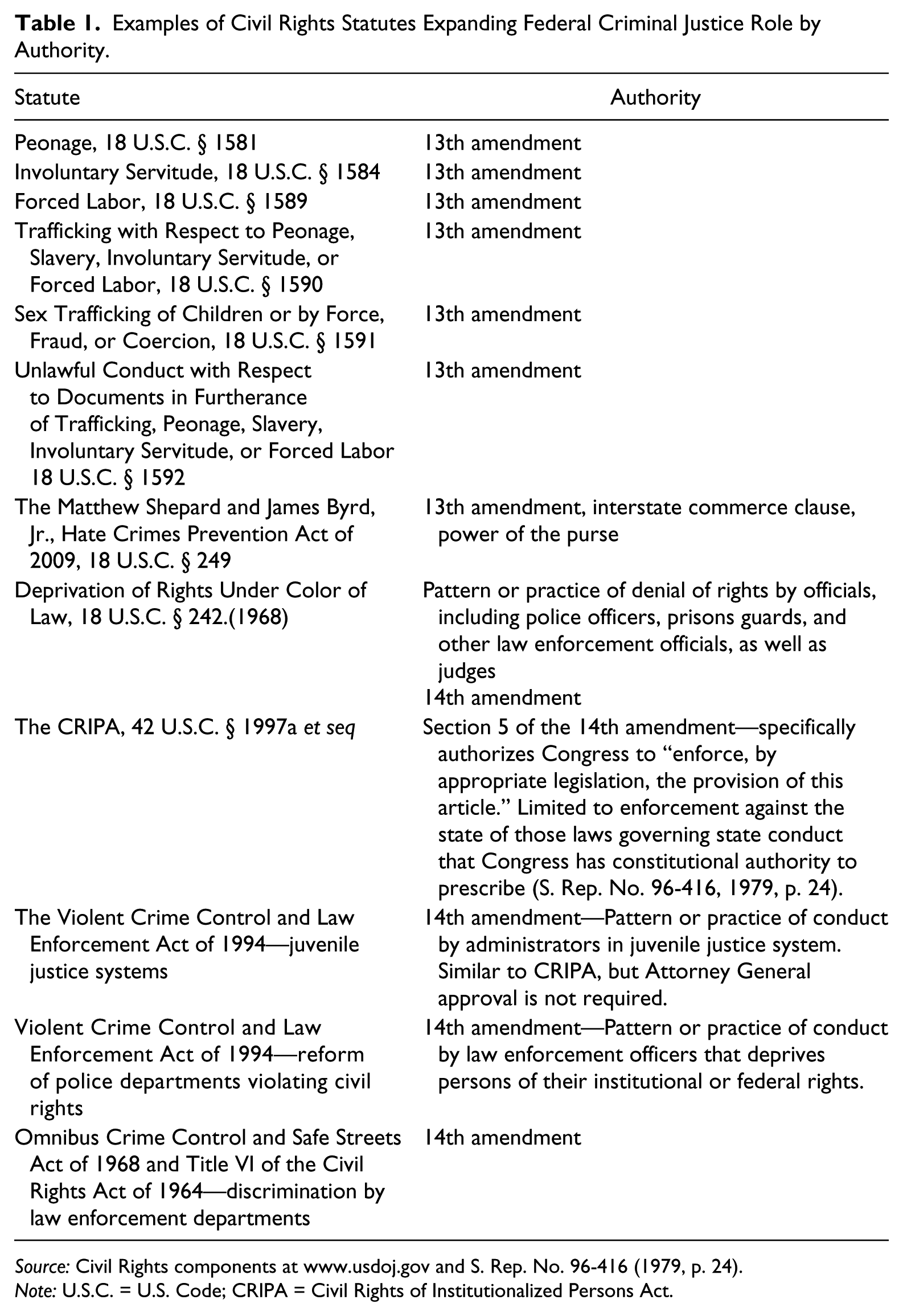
Table 1 identifies examples of federal civil rights statutes that have expanded the federal criminal justice role and the underlying authority of each statute.
Examples of Civil Rights Statutes Expanding Federal Criminal Justice Role by Authority.
Source: Civil Rights components at www.usdoj.gov and S. Rep. No. 96-416 (1979, p. 24).
Note: U.S.C. = U.S. Code; CRIPA = Civil Rights of Institutionalized Persons Act.
Federal civil rights statutes directed toward addressing criminal justice issues have evolved over time. Prior to 2001, Sections 1581 and 1584 of Title 18 of the U.S. Code (USC), which criminalize peonage and involuntary servitude, respectively, were the primary statutes prosecutors used in involuntary servitude and human trafficking cases. These statutes have been a priority of the Civil Rights Division for decades (U.S. DOJ, 2005). The trafficking in persons, civil rights of institutionalized persons, color of law, and hate crimes statutes are more recent, dating from the 1960s. 4
As described in Table 2, the selected civil rights statutes differ in a number of ways.
Criminal and Civil Rights Statutes Expanding Federal Criminal Justice Role.

Source: U.S. Department of Justice, www.usdoj.gov; U.S. GAO (2007); and U.S. GAO (2009).
Note: U.S.C. = U.S. Code; TVPA = Trafficking Victims Protection Act; CRIPA = Civil Rights of Institutionalized Persons Act; GAO = Government Accountability Office.
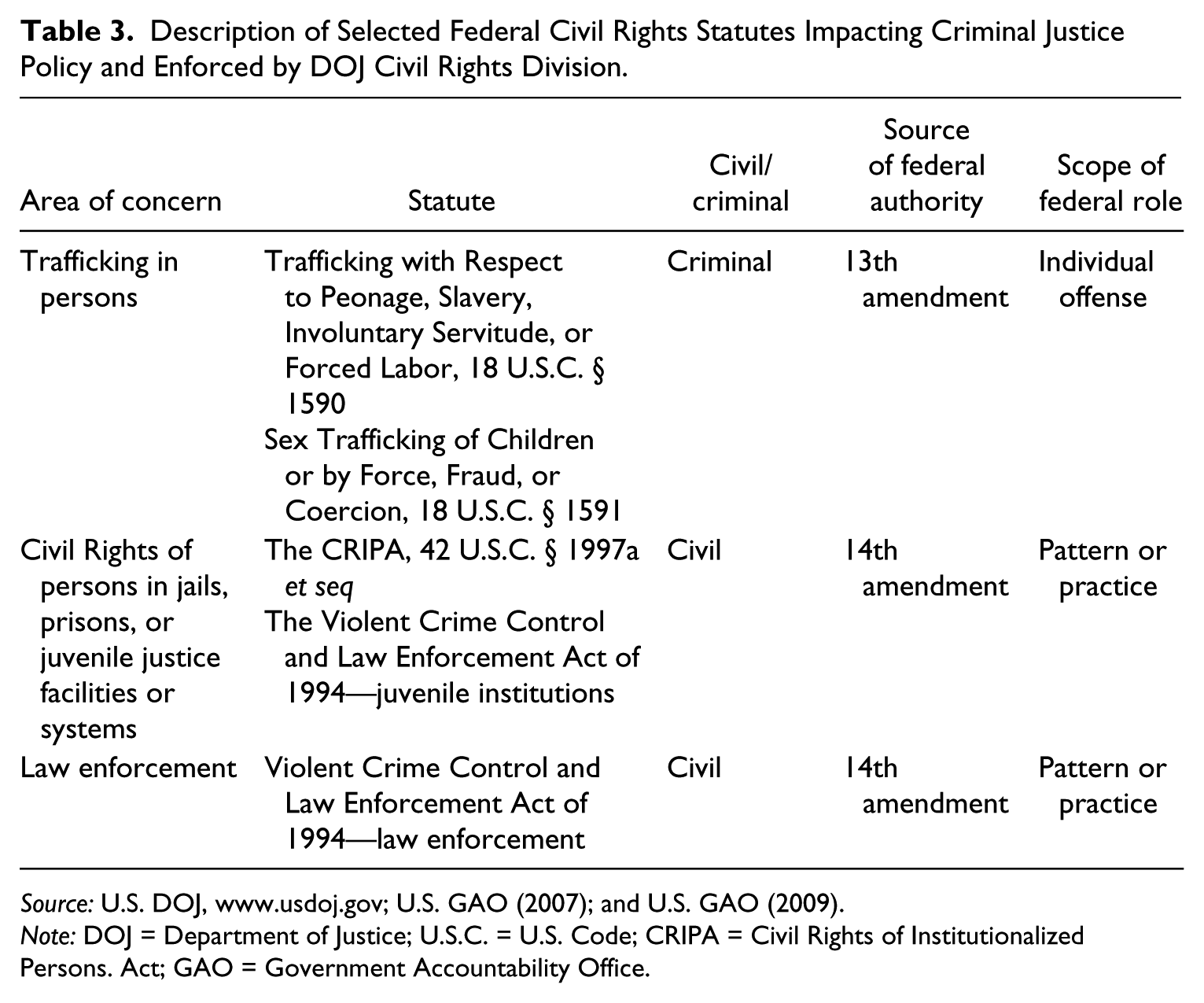
Specifically, these statutes may be criminal or civil. Modern civil rights laws have generally used civil rather than criminal mechanisms insofar as nonviolent deprivations of rights are concerned (Landsberg, 1997). The statutes also vary in terms of the type of violator. The statute may be directed toward an individual (e.g., the unlawful holding of a person in a condition of slavery), state and local officials (e.g., violations of residents’ federal rights in a prison, jail, or juvenile facility), or state and local systems (e.g., juvenile justice systems). Some statutes may not be used to pursue the violation of the rights on behalf of an individual, even repeated violations, or isolated instances of abuse. Generally, evidence of a pattern or practice of behavior—cases that attempt to show that the defendant systematically engaged in discriminatory activities—must be demonstrated before federal intervention. For example, the CRIPA provided the Attorney General with the authority to bring lawsuits where there is a pattern or practice of egregious and flagrant conditions that deprive institutionalized persons of their federal or constitutional rights. These distinctions are discussed in more detail in the context of the analysis of specific statutes.
Federal Civil Rights Statutes Enforced by DOJ Civil Rights Division Impacting Criminal Justice Policy: Analysis of Selected Statutes
Federal efforts to address trafficking in persons; the constitutional rights of persons confined in prisons, jails, correctional facilities or juvenile facilities; and behavior of law enforcement agencies that violates federal laws illustrate variations in the application of federal civil rights authority to criminal justice. As shown in Table 3, the three laws discussed in this section provide examples of civil and criminal mechanisms, are rooted in different authorities, differ in the scope of the federal role, and vary in the type of violator. Each of these federal laws, however, can be shown to perform both instrumental and symbolic functions. Analyzing the instrumental functions of these statutes demonstrates how these laws have expanded the federal criminal justice role by establishing new federal crimes and violations. Analyzing the symbolic functions of these laws, specifically the moral educative and model for the states functions, demonstrate how federal civil rights laws can affect state and local criminal justice systems by defining and providing models of good policy and practice.
Description of Selected Federal Civil Rights Statutes Impacting Criminal Justice Policy and Enforced by DOJ Civil Rights Division.
Source: U.S. DOJ, www.usdoj.gov; U.S. GAO (2007); and U.S. GAO (2009).
Note: DOJ = Department of Justice; U.S.C. = U.S. Code; CRIPA = Civil Rights of Institutionalized Persons. Act; GAO = Government Accountability Office.
Trafficking in Persons
In 2000, Congress passed and the president signed into law the TVPA to combat trafficking in persons. Prior to this legislation, the DOJ had prosecuted trafficking cases under a number of federal criminal statutes. These statutes included involuntary servitude (18 USC §§ 1581-1588), the Mann Act (18 USC §§ 2421-2424), and labor laws on workplace conditions and compensation (29 USC § 1851; U.S. DOJ, 2006a). According to a 2009 GAO report, the DOJ prosecuted 19 trafficking in persons cases, including 7 sex trafficking and 12 labor trafficking cases, from fiscal years 1995 through 2000 (U.S. GAO, 2009).
During the late 1990s, U.S. policy makers realized that because the existing statutes and the tools available to prosecute these crimes did not take into account some characteristics of contemporary trafficking in persons, they did not adequately protect trafficking victims, deter trafficking, and bring traffickers to justice (Stolz, 2005; U.S. GAO, 2007). The anti-trafficking tools were scattered across the U.S. government resulting in different outcomes depending on which charges were brought or which agency pursued the allegations (U.S. DOJ, 2006a). Moreover, victims were not always treated as victims. According to the Mann Act, which was considered to be the primary federal anti-trafficking tool prior to 2001, trafficking was perceived as the interstate transportation for prostitution. Yet, contemporary trafficking may or may not involve transportation across national or state borders; rather, it is perceived to be a compelled service (U.S. DOJ, 2006a). Furthermore, as a result of the Supreme Court’s decision in United States v. Kozminski (1988), involuntary servitude was restricted to cases of physical abuse, as opposed to the psychological coercion often used by today’s traffickers (Stolz, 2005; U.S. GAO, 2007). Yet, victims are generally held through force or threats of force in situations of sexual exploitation or forced labor. Consequently, human trafficking offenses transgress the victims’ human liberty in violation of the 13th amendment guarantee of freedom (U.S. DOJ, 2005).
Through the provisions of the 2000 Trafficking in Persons Act, Congress and the White House sought to address gaps in existing law and enhance the tools available to pursue modern-day trafficking in persons offenses. The act criminalized the obtaining or maintaining of persons for commercial sexual activity, using force, fraud, or coercion for those aged 18 or above (but not for those below 18), 5 and to use certain kinds of force or coercion to provide or obtain persons for any labor or services (e.g., work in farms, factories, and households). It also included nonviolent coercion and threats of harm to third persons in federal involuntary servitude laws; made attempted trafficking crimes punishable; criminalized the holding of actual or purported identitydocuments in the course of committing, or with the intent to commit, any trafficking crime; and increased the maximum penalty for slavery and involuntary servitude offenses from 10 to 20 years or to a life sentence if the offense involved factors like death, kidnapping, or aggravated sexual abuse, among other things (U.S. GAO, 2007).
As evidenced by the prosecution of federal trafficking in persons cases, the TVPA has instrumentally expanded the federal criminal justice role. The Criminal Section of the Civil Rights Division has primary responsibility for prosecuting cases of trafficking for sex and labor. U.S. Attorneys’ Offices also pursue these cases. The number of cases varies from year to year, due in part to the complexity of the cases. Overall, the number of federal cases prosecuted increased from fiscal years 2001 through 2006, as shown in Table 4.
Trafficking in Persons Prosecutorial Statistics for Civil Rights Division, Criminal Section, and U.S. Attorneys’ Offices, Fiscal Year 2001 Through 2006.

Source: U.S. GAO (2007, p. 49).
Note: The Civil Rights Division, Criminal Section classified cases as sex or labor trafficking according to the facts of the case; the categories are mutually exclusive. GAO = Government Accountability Office.
The Justice Department and U.S. Attorneys have continued to prosecute these cases under both Democratic and Republican Administrations. According to the Justice Department’s report on the 10th anniversary of the trafficking in persons legislation, the Trafficking Victim’s Protection Act’s broader criminal statutes, combined with the victim protections that have encouraged victims to report human trafficking crimes and increasing public awareness and law enforcement expertise in identifying human trafficking, have all contributed to the momentum. Specifically, the Civil Rights Division and U.S. Attorneys’ Offices brought charges of trafficking in persons in 32, 40, 43, and 53 cases in fiscal years 2007, 2008, 2009, and 2010, respectively (U.S. DOJ, 2010b). For example, in September 2010, the Justice Department announced that a federal grand jury in Hawaii had indicted 6 people for exploiting 400 Thai farm workers, the largest case prosecuted up to that time (U.S. DOJ, 2010a). In fiscal year 2012, the Division, in coordination with U.S. Attorneys’ Offices, initiated 55 prosecutions involving forced labor and sex trafficking of adults by force, fraud, or coercion. Of these cases, 34 predominantly involved trafficking for sex and 21 predominantly involved trafficking for labor (U.S. Department of State, 2013).
The federal anti-trafficking act also performed symbolic functions that affected state and local policy and practice by defining and providing models for good policy and practice. Specifically, the act performed (a) a moral educative function—drawing the line between what is acceptable and unacceptable behavior and (b) a model for the states. By defining trafficking in persons as a crime and enhancing the punishments for trafficking-related offenses, the 2000 TVPA sent a threat to traffickers. The law drew the line between the trafficked and traffickers. It redefined the trafficked as victims not criminals, although individuals who have been trafficked may have committed or abetted criminal acts such as alien smuggling or prostitution (Stolz, 2007). By doing so, the act changed the law enforcement paradigm, affecting state and local policy and law enforcement and prosecutorial practices in trafficking cases.
To support the promulgation of the new anti-trafficking policy and practices to state and local criminal justice systems, the Justice Department developed a model state law. The number of states with trafficking laws increased from 4 in 2004, at the time of the initial distribution of the model, to 42 states as of fiscal year 2009 (U.S. DOJ, 2010a). 6 By 2013, all states had enacted modern anti-trafficking criminal statutes. Some states passed additional protections, including asset forfeiture provisions, access to civil remedies, and training of law enforcement. Nevertheless, according to the 2013 Trafficking in Persons Report, although these laws reflect an increased effort by the state legislatures, observers reported that state anti-trafficking laws generally lack uniformity and consistency across jurisdictions (U.S. Department of State, 2013).
Civil Rights of Institutionalized Persons
Under the 1980 CRIPA, the Attorney General has explicit statutory authority to bring lawsuits where there is a pattern or practice of egregious and flagrant conditions that deprive institutionalized persons of their federal or constitutional rights. The statutory protections were extended to those persons confined in prisons, jails, correctional facilities, and juvenile correctional facilities. The act, however, does not provide the authority to redress isolated instances of abuse or repeated violations against an individual (S. Rep. No. 96-416, 1979). CRIPA requires that the Attorney General personally sign the complaint. This requirement, which was modeled after existing legislation, was included (a) to ensure that any decision to initiate suit would be made by the Attorney General himself, although not precluding an Acting Attorney General from doing so and (b) in recognition of the important issues inherent in litigation by the federal government against state and local officials (S. Rep. No. 96-416, 1979).
In protecting the rights of institutionalized persons, the federal government is to try to resolve allegations of CRIPA violations through settlements or other agreements not filed in court rather than going to court. Appropriate state officials have to be notified of the intention to commence an investigation and the Attorney General is to make efforts to consult with the jurisdiction about assistance from the United States to correct the unlawful conditions and encourage the appropriate officials to take corrective actions. A provision in the Prison Litigation Reform Act, enacted in 1996, provided additional reason for settling with state officials in jail, prison, and juvenile corrections cases rather than going to court 7 (U.S. GAO, 2009).
Under CRIPA, the Justice Department is authorized to seek relief only for constitutional violations with respect to jails, prisons, and correctional facilities. Investigations of and cases filed regarding conditions in adult correctional facilities—prisons and jails—may involve alleged violations of a pattern or practice of failing to protect inmates from harm or provide adequate medical and mental health care, sanitary living conditions, adequate inmate classification, among others. Prisoners, themselves, may contact the Justice Department through letters and phone calls to advocate on behalf of conditions (U.S. GAO, 2009).
For juveniles in correctional facilities, the Violent Crime Control and Law Enforcement Act of 1994, 14141 statutorily provides essentially the same protections as CRIPA, but does not require approval of the Attorney General to file a case. Allegations investigated may include physical abuse of residents, overcrowding, insufficient numbers of professional staff to provide the services legally required in these facilities, failure to provide services to residents (e.g., medical or psychiatric care), among others. The Justice Department may also investigate an entire state juvenile correctional system (U.S. GAO, 2009).
Federal laws protecting the civil rights of persons confined in adult or juvenile correctional facilities are both instrumental and symbolic. The Justice Department, under both Democratic and Republic Administrations, has brought actions involving state adult and juvenile correctional facilities.
Instrumentally, through agreements or cases filed, the federal government has taken steps to address conditions in adult correctional facilities. The 2009 GAO study reports that from fiscal years 2001 through 2007, the Special Litigation Section of the Civil Rights Division filed seven cases involving institutional conditions in six jails and one prison. The allegations included a pattern or practice of failing to protect inmates from undue risk of harm, adequately classify and supervise inmates, and provide adequate medical and health care and sanitary living conditions (U.S. GAO, 2009).
In August 2013, the Justice Department announced that it had entered into a comprehensive agreement with the Parish of St. Tammany, Louisiana, and the St. Tammany Parish Sheriff to correct conditions of confinement at the St. Tammany Parish Jail and to ensure that improvements made since the Department’s investigation will be maintained. The St. Tammany Parish Jail is located in Covington, Louisiana, and houses approximately 1,000 adult male and female prisoners. The jail is staffed by approximately 225 sworn law enforcement officers and civilian employees. According to the announcement, in April 2011, the Justice Department initiated its investigation of the St. Tammany Jail under CRIPA. The Department issued its findings in July 2012, concluding that certain conditions at St. Tammany violated prisoners’ constitutional rights to adequate mental health care, including adequate suicide prevention. The agreement outlines significant remedial measures to address deficiencies in correctional mental health care and suicide prevention. Under the terms of the agreement, St. Tammany will work to ensure that prisoners are safe and receive care and services necessary to meet their constitutional rights (U.S. DOJ, 2013b).
The Justice Department has also taken action against state juvenile correctional systems. The 2009 GAO study reported that the Special Litigation Section filed seven cases against juvenile correctional systems from fiscal years 2001 through 2009. These cases involved one or more facilities in seven states—Arkansas, Arizona, Hawaii, Indiana, Maryland, Mississippi, and Oklahoma. The allegations included a pattern or practice of failing to protect inmates from undue risk from harm, including risk of suicide and abuse from staff; failing to provide adequate services of various types (e.g., mental health, special education, or rehabilitation therapy); and using isolation or physical restraint, among others. According to the section, two cases were filed because the respective jurisdiction refused to cooperate with the section and settle the case, and in five cases because section officials believed the conditions in the facilities to be so egregious that filing a case was the appropriate action to monitor remedial actions by the jurisdiction (U.S. GAO, 2009).
From 2009 through 2012, the Justice Department continued to take actions against state juvenile justice systems. For example, the department issued findings that the state of Mississippi violated the constitutional rights of youth detained at the Walnut Grove Youth Correctional Facility through unsafe detention conditions, a lack of accountability and controls, and systemic sexual abuse. In 2011, the department reached an agreement with Louisiana to address suicide prevention, youth discipline, youth safety, and staff accountability. Furthermore, for the first time in 2012, the department used its authority under the Violent Crime Control and Law Enforcement Act to address violations of due process by a juvenile court. The Civil Rights Division found that the juvenile court in Shelby County, Tennessee, systemically violated the due process rights of all children who appeared for delinquency proceedings and the equal protection rights of African American children. The Division and the juvenile court entered into a comprehensive agreement to ensure that the juvenile justice system in Shelby County operates in an effective, constitutional fashion (U.S. DOJ, 2013a).
The legislation protecting the constitutional rights of institutionalized persons also performs the symbolic functions of moral education and model for the states as to what constitutes acceptable adult and juvenile correctional institutional policies and practices. That is, through these actions, the federal government draws the line between what is acceptable and unacceptable treatment of those confined in adult or juvenile correctional facilities by those responsible for their care. The allegations in these cases involve conditions affecting the physical and mental well-being of those confined in these facilities, which the federal officials find to be egregious. Federal actions—the remedial actions necessary to address the conditions—also provide examples of good correctional policy, as well as conditions and behaviors that violate the rights of individuals confined to these facilities. For example, as stated above, the agreement with St Tammany, Louisiana, outlined significant remedial measures to address deficiencies in correctional mental health care and suicide prevention. The agreement with the Shelby County, Tennessee, juvenile court included measures to ensure that a juvenile system operates in an effective, constitutional manner.
Behavior of Law Enforcement
The Violent Crime Control and Law Enforcement Act of 1994, 14141 authorizes the Attorney General to bring suit where there has been a pattern or practice of conduct by law enforcement agencies that violates federal law. Actions under this statute regarding conduct by law enforcement can involve, among other issues, systemic problems such as excessive force; false arrest; and discriminatory harassment, stops, searches, and arrests. Cases filed under 14141 have been brought against county and city police departments. Parties may enter into a consent decree after which the department is monitored by the Justice Department, for compliance. Investigations and cases filed demonstrate that the statute performs an instrumental function, as well as providing examples of what is acceptable and unacceptable behavior (U.S. GAO, 2009).
According to the 2009 GAO study, from fiscal years 2001 through 2007, the Special Litigation Section filed three cases against police departments in two cities and one county. The allegations in these cases included police use of excessive force. The parties in each case entered into a consent decree. From fiscal years 2009 through 2012, the Justice Department opened 15 investigations of police departments, issued 8 findings letters of misconduct, and reached 10 agreements for comprehensive reforms of the departments (U.S. DOJ, 2013a). Among the law enforcement agencies investigated were the police departments of New Orleans, Louisiana; Seattle, Washington, DC; Puerto Rico; East Haven, Connecticut; and sheriff’s departments in Maricopa County Arizona and Alamance, North Carolina. For example, at the invitation of Mayor Mitch Landrieu, the Civil Rights Division conducted a yearlong investigation of the New Orleans Police Department. The investigation found that the department engaged in patterns or practices of excessive force, gender-biased policing, racial and ethnic profiling, and failure to provide effective policing services to persons with limited English proficiency. The division reached a comprehensive reform agreement with the New Orleans Police Department (U.S. DOJ, 2013a).
In December 2013, the Department announced that the Civil Rights Division and the U.S. Attorneys’ Office for the Eastern District of New York had tentatively agreed to a settlement with the Suffolk County Police Department, which calls on the police department to implement new and enhanced policies and procedures to ensure nondiscrimination in the provision of police services to Latino communities in the county. The agreement requires the approval of the Suffolk County Legislature before it will be formally executed by the parties. The investigation, which began in 2009, was undertaken pursuant to the Violent Crime and Enforcement Act of 1994 and the Omnibus Crime Control and Safe Streets Act of 1968. The investigation focused on discriminatory policing allegations, including claims that the police department failed to investigate crimes and hate crime incidents involving Latinos. The agreement calls on the police department to ensure that it polices equitably, respectfully, and free of unlawful bias (U.S. DOJ, 2013c).
Justice Department actions to respond to a pattern or practice of conduct by law enforcement agencies in violation of federal law also perform symbolic functions. By identifying such misconduct, the department defines unacceptable law enforcement agency practices with respect to the Constitution. In so doing, the department also provides a model of acceptable behavior to other departments. For example, the comprehensive agreement reached with the New Orleans Police Department provided a road map to ensure respect for the Constitution, increased public confidence in the New Orleans Police Department, and more effective crime prevention (U.S. DOJ, 2013a). The Suffolk County agreement highlighted the development and maintenance of a true Community Oriented Policy enforcement program throughout the county (U.S. DOJ, 2013c).
In addition to investigations of state and local law enforcement agencies, the Civil Rights Division also prosecutes individual acts of misconduct by law enforcement officers. From fiscal years 2009 through 2012, the division with U.S. Attorneys’ Offices criminally charged 254 law enforcement officers in 177 cases for violating individuals’ civil rights. For example, they prosecuted a number of New Orleans Police Department officers for violating the civil rights of civilians in the wake of Hurricane Katrina. They successfully achieved convictions of 10 officers who participated in the shooting of six innocent civilians on the Danziger Bridge in the days following the hurricane, or who participated in the elaborate cover-up of the shooting that followed (U.S. DOJ, 2013a). These prosecutions send a message to law enforcement as to what is acceptable law enforcement practice, as well as communicating to the public that the federal government is there to protect the civil rights of individuals from misconduct by law enforcement.
Conclusion
The purpose of this article was to illustrate how federal civil rights authority has been used to expand the federal role in criminal justice. It does not identify all such federal statutes, nor does it propose to argue whether this practice is a good or bad. Nevertheless, by analyzing the instrumental and symbolic function of civil rights laws that expand federal trafficking in persons crime, extend federal protections of citizens to persons in state and local institutions, and address state and local law enforcement misconduct, this article contributes to our understanding of the U.S. criminal justice policy-making process and how federal law can affect state and local criminal justice policy and practice.
Specifically, federal civil rights legislation can expand the number and types of crimes enforced by federal enforcement and prosecutorial agencies. The statutes may provide for criminal, civil, or administrative remedies, but they do offer remedies and as such are instrumental. As investigations are pursued, cases brought, or agreements reached between the federal government and states, such statutes are instrumental—produce tangible results.
Federal civil rights statutes can also perform symbolic functions that affect state and local criminal justice systems. For example, federal statutes can serve a moral educative function, drawing the line between state and local correctional system and law enforcement behavior that is acceptable or not. These statutes can also provide models for the states. In some instances, model legislation has been promulgated to demonstrate what is or is not good policy and to provide a template for state laws. For example, federal anti-human trafficking legislation required the Justice Department to develop model human trafficking legislation, which they did. Agreements reached by the department with state correctional agencies or state or local law enforcement agencies provide examples of model remedies to address issues of unconstitutional policies or practices or misconduct.
As illustrated by the federal statutes discussed in this article, civil rights legislation has been and can be a tool for enhancing the federal role in criminal justice policy making. Accordingly, in teaching about criminal justice policy or developing research on federal criminal justice policy making, the role of civil rights legislation is an important component to be considered. Understanding how federal civil rights legislation relates to criminal justice policy and practice at the federal, state, and local levels furthers our knowledge of federal government crime control policy making, how policy is made to reduce crime, and how federal criminal justice policy making can affect state and local criminal justice system policy and practice across the country.
Footnotes
Author’s Note
An earlier version of this article was presented at the annual meeting of the American Society of Criminology Conference 2010, San Francisco, California. Initial work on this article was undertaken while the author was employed at the U.S. Government Accountability Office (GAO). The views expressed in this article are those of the author and not of the GAO.
Declaration of Conflicting Interests
The author(s) declared no potential conflicts of interest with respect to the research, authorship, and/or publication of this article.
Funding
The author(s) received no financial support for the research, authorship, and/or publication of this article.