



Abstract
Previous research suggests that American presidents resort to the use of symbolic rhetoric because of public opinion, party affiliation, election year politics, and divided government. This research, however, treated crime policy as a general topic, disregarding the nuances that emerge from different types of crime policies. The research at hand posits not all crime policies are the same or handled the same politically, and thus divides them into seven crime policy categories: law enforcement, courts, corrections, juveniles, guns, death penalty, and drugs. Drawing upon the theory of symbolic rhetoric and categorizing presidential speeches from 1948 through 2010 into these seven categories, this study employs logistic regression to explain the influencing variables upon the likelihood presidents will employ symbolic rhetoric for each of these crime policy types. Findings suggest that although the use of symbolic rhetoric is different for each crime policy issue, there are two key factors that matter overall: divided government and party affiliation.
The first American president to engage in the issue of crime policy was Herbert Hoover (Calder, 1993, 2013), yet crime policy did not become a perennial issue for American presidents until the Johnson/Goldwater debates in 1964 (Beckett & Sasson, 2000; Caplan, 1973; Cronin, Cronin, & Milakovich, 1981; Finckenauer, 1978; Marion, 1994a, 2011; Scheingold, 1984, 1991, 1995). Since then, crime policy has become a fixed part of the American presidents’ agenda, and just as scholars speak of the environmental (Daynes & Sussman, 2010; Soden, 1999) or economic presidencies (Dolan, Frendreis, & Tatalovich, 2007), there also appears to exist a law and order presidency (Oliver, 2003). Yet, it has been noted that not all presidents have focused on the same issues (Marion, 1994a, 2011). Johnson dedicated his administration to responding to the problems of street crime and riots (Flamm, 2007; Scruggs, 1980). Other presidents have focused on juvenile issues (Ford), drugs (Nixon, Reagan, Bush I), and homeland security (Bush II). Yet, since the Johnson Administration, American presidents have consistently used their political capital to influence both the public and Congress to obtain legislative victory in the area of crime policy.
The primary means by which presidents engage the public and Congress on crime policy, or any policy for that matter, is through the power of speech (Cohen, 1997; Light, 1998), or, as President Theodore Roosevelt referred to it, the power of the Bully Pulpit (Ellis, 1998; Goodwin, 2013; Strock, 2003). In more modern times, this power of speech has been called the Rhetorical Presidency and there is a wide-ranging body of research assessing the presidents’ ability to influence the public and Congress through this medium (Ceaser, 1985; Ceaser, Thurow, Tulis, & Bessette, 1981; Cohen, 1997; Kernell, 2006; Light, 1998; Medhurst, 1996; Tulis, 1988). The primary method for assessing the rhetorical presidency has been through analyses of presidential speeches, assessing a president’s use of substantive or symbolic speechmaking. In substantive policy making speeches, presidents offer tangible policy solutions, administrative and economic commitments, or guidance to bureaucratic agencies (Hinckley, 1990; Marion, 1994a). In symbolic political speeches, presidents use rhetoric “in which the specific object referred to conveys a larger range of meaning, typically with emotional, moral, or psychological impact” (Hinckley, 1990, p. 7). As Hinckley (1990) points out, “this larger meaning need not be independently or factually true, but will tap ideas people want to believe in as true” (p. 7). It should also be noted that often presidents will mix their substantive policy speeches with symbolic references, but rarely does it work the other way (Hinckley, 1990).
A growing body of research has also found that presidents, since at least Hoover, have employed symbolic rhetoric when it comes to the topic of crime policy (Calder, 1993). Whether on the campaign trail (Marion & Farmer, 2003; Marion & Oliver, 2011), in their budgetary requests to Congress (Caldeira, 1983; Caldeira & Cowart, 1980; Oliver & Marion, 2006, 2009), or through their executive orders (Oliver, 2001), presidents engage in symbolic rhetoric when it comes to the issue of crime. One recent study explains why presidents resort to entirely symbolic rhetoric in their crime policy speeches, and findings suggest that it is when public concern for crime rises, during presidential election years, that Democrats will use it to undercut the Republican “hold” on the crime issue, and when government is divided, that is, when the political majority of at least one branch of Congress differs from that of the president (Marion & Oliver, 2013). This study, however, treated crime policy as a generic issue. Yet, it is clear that not all presidents have focused on the same crime-related issues and it is questionable as to whether all crime policies are created equal. Some research has attempted to narrow the focus of the use of symbolic rhetoric to a particular type of crime policy such as drugs (Hawdon, 2001; Hill, Oliver, & Marion, 2012; Oliver, Hill, & Marion, 2011; Whitford & Yates, 2003, 2009), yet no study to date has attempted to assess the various types of crime policy in the same manner.
It is, therefore, the intent of this study to apply the theory of symbolic rhetoric to how presidents engage in crime policy by focusing on seven different crime policy types, namely, law enforcement, courts, corrections, juveniles, guns, death penalty, and drugs. It will do so by using logistic regression to assess when presidents are more likely to engage in purely symbolic rhetoric when addressing each of these seven crime policy subtypes.
Symbolic Rhetoric, Presidents, and Crime Policy Types
The theory of symbolic politics comes from Edelman (1964, 1971, 1988), who argued that every political action evokes a particular response in the receiving audience. While some political actions result in tangible outcomes for some groups, others simply serve as a means to educate, placate, or obfuscate. Those actions that are intended to reassure the public that their elected officials are concerned with the opinions and feelings of the voters are labeled as symbolic policies (Edelman, 1964). Their purpose is to restore the public’s confidence in elected officials that action is being taken to solve a problem, and thereby induce a feeling of well-being on the part of the public.
Typically, however, symbolic policies do not result in significant change. They are often lacking or devoid of any policy substance (Shull & Ringelstein, 1989; Stolz, 1983, 1985, 1992), are often not enforced (Gusfield, 1963, 1967; Oliver & Marion, 2008), and do not deliver what they promise (Anderson, 1990). As Edelman (1964) explains, symbolic language provides “well-publicized attention to a significant problem which is never solved” (pp. 38-39). Thus, the public’s perceptions of, and their reaction to, the symbolic act is more important than the content itself (Stolz, 2007). This means that when it comes to symbolic policies and action, the actual implementation of the act is less important than the fact that the act was proposed (Stolz, 1999, 2007). Symbolic actions serve other functions as well, including a moral educative function, whereby the laws reflect the moral consensus of society (Marion, 1994b; Stolz, 2007), a method for simplifying complex problems, so the populace may more easily understand them (Edelman, 1964; Stolz, 2007), and they help to maintain public order because people are content and pleased with the actions (language) of the policymakers (Edelman, 1964).
The earliest treatment of symbolic politics being applied to a crime control issue was by Gusfield (1963, 1967) in his study of the laws pertaining to prohibition, which he dubbed the symbolic crusade. In this study, he demonstrates that federal legislation outlawing the production and shipping of alcohol had elements of symbolism, because it served to satisfy the Protestant White middle class by reaffirming their perceived dominance over recent immigrants, while the enforcement of the laws themselves were mostly ignored at the state and local level, and marginally enforced at the national level. Since then, the theory of symbolic politics has been applied to Congressional crime control policy (Stolz, 1983, 1985, 1992, 1995, 1999, 2005, 2007), political party platforms and their focus on the issue of crime (Oliver & Marion, 2008, 2010), state legislatures (Galliher & Cross, 1982), and Governors (Marion, Smith, & Oliver, 2009). Nowhere, however, is there more evidence of symbolic politics being employed than in the research related to American presidents.
Extensive research on presidential rhetoric indicates that presidents use political rhetoric to influence both Congress and the public (Edwards & Wood, 1999). The primary object of influencing the public is to build support for their policy proposals to influence Congress, thus creating a feedback loop. The primary objective, however, is to have Congress pass president supported legislation, for one of the marks of a successful president is legislative victory (Kernell, 2006; Light, 1998). As presidential rhetoric is the primary means by which presidents can influence the public and Congress, the majority of the research in this area analyzes what the president says in his policy making speeches (Ceaser, 1985; Ceaser et al., 1981; Light, 1998).
Research into the rhetorical presidency is clear in demonstrating that presidents engage in symbolic politics when it comes to policy making (Edelman, 1964; Elder & Cobb, 1983; Hinckley, 1990; Light, 1998). The research also tends to divide these speeches into the two previously named categories, symbolic (Ceaser, 1985; Elder & Cobb, 1983; Hinckley, 1990; Tulis, 1988) and substantive (Kessel, 1974, 1977; Light, 1998). The analysis of presidential use of symbolic speeches, in particular, has been extensively applied in the area of crime policy, first by Cronin et al. (1981) and Scheingold (1984, 1991). As the latter has articulated, “the politicization of crime is frequently a symbolic exercise without serious policy intentions—particularly at the national level” (Scheingold, 1984, p. 181). Since then, there has been increased evidence that presidents engage in symbolic politics when it comes to their campaign speeches (Marion & Farmer, 2003; Marion & Oliver, 2011), executive orders (Oliver, 2001), and in their budgetary requests to Congress (Caldeira, 1983; Caldeira & Cowart, 1980; Oliver & Marion, 2006, 2009), which has the impact of influencing both the public and Congress. All of the research until recently, however, has been qualitative in nature, only recently has an attempt been made to explain when and why presidents employ symbolic rhetoric through the use of logistic regression (Marion & Oliver, 2013). In this study, the authors found that presidents were more likely to engage in wholly symbolic rhetoric in their crime speeches when facing divided government, in an election year, when the salience of crime was high in the public mind, and if the president was a member of the Democratic Party.
One drawback to this understanding of presidential use of symbolic rhetoric, when engaging in crime policy, is that all crime policies were treated equally (Marion & Oliver, 2013). As long as the subject matter was related to crime, it was incorporated into the analysis which included a stunning 4,119 crime-related speeches. Yet, crime policy consists of a wide variety of subject matter ranging from the police to the death penalty and not all of these policies are dealt within the same political manner. There is some evidence to suggest that there are nuances to each of these types of crime policies as evidenced in the literature regarding the public policy of such issues as the death penalty (Stolz, 1983), laws (Bridgmon & Bridgmon, 2010; McCoy, 1996; Sample, Evans, & Anderson, 2011; Stolz, 2007), gun control (Fox & DeLateur, 2014), juvenile justice (Benekos & Merlo, 2008; Merlo & Benekos, 2003), and especially drugs (Galliher & Walker, 1977; Hagan, 1983; Hawdon, 2001; Jensen, Gerber, & Mosher, 2004; Stolz, 1992; Whitford & Yates, 2003, 2009). It is, therefore, not too far of a reach to argue that there may be different factors influencing presidents to engage in symbolic politics.
The purpose of this study is to assess the same time frame and crime speeches of the presidents, but to categorize these speeches by topical areas, specifically those to which the president dedicated the most speeches. Then, by employing logistic regression, it will estimate the effects of the independent variables on the likelihood that presidents will engage in wholly symbolic crime rhetoric by crime topic areas.
Method
Data
This study employed multiple sources for the dependent variable, regarding presidential speeches related to crime. The primary source came from The American Presidency Project (2011), which has all of the presidential papers available online in an electronically searchable archive. Other sources, for cross verification, included the U.S. Government Printing Office (2011), which maintains some of the public papers online, and finally, physical copies of the Public Papers of the Presidents of the United States were also used. The American Presidency Project (2011) also provided additional information regarding the President, as well as Congress. Additional sources included the Federal Bureau of Investigation’s (1949-2011) Uniform Crime Reports, the U.S. Bureau of Labor Statistics (2011), Gallup Poll’s “Most Important Problem” indicator (Gallup, 1949-2011), and the H. W. Wilson database for the Reader’s Guide to Periodical Literature.
Dependent Variable
Using a collected database of 4,119 crime-related speeches, a content analysis was conducted reviewing every presidential speech from 1948 through 2010 related to crime (Marion & Oliver, 2013), by allowing the presidents’ use of words to define the categories. Similar words or phrases that had the same meaning were then linked together (e.g., police and law enforcement), to create each topical category. To make the final cut for the areas to be analyzed, it was determined that the threshold had to be 150 speeches or more, thus yielding seven categories: police, courts, corrections, death penalty, juveniles, guns, and drugs. It should be noted that speeches are not mutually exclusive of each other for categorization, as very often multiple crime topics are addressed by a president in the same speech, and therefore the sum total of speeches from each category will exceed the total number of speeches in the database.
Each speech was then read to assess whether the president used substantive/mixed language, or whether the speech was entirely symbolic. Symbolic rhetoric is a language which is devoid of any specific policy proposals or rhetoric pertaining to current legislative efforts. They are designed to demonstrate action on the part of the president and elicit an emotive response from the audience. For instance, when a president speaks of adding “100,000 cops” to the streets through a grant program, that type of rhetoric is labeled substantive. When a president speaks about getting “tough on crime” and “winning the war on drugs,” that rhetoric is labeled symbolic.
Speeches were assessed by word count and the percentage of the speech that employed symbolic language. Only speeches reported to be 100% symbolic were coded as a 1 in the database for symbolic, all other speeches were coded as a 0, thus creating a dichotomous dependent variable. The lead author also took the lead on data collection for the presidential variable. When completed, 10% of the final database speeches were randomly selected by the second author and recoded for comparison. An inter-coder reliability of .98% was found between the lead and second author in identifying a speech as symbolic or substantive/mixed, leading the authors to accept the reliability of the coding scheme.
Independent Variables
The president-related variables in this study consisted of presidential election year, presidential popularity, party affiliation, and divided government. Each of these variables, like the presidential speeches, was also obtained from The American Presidency Project (2011). It has often been argued that during a presidential election year, presidents will engage in more symbolic rhetoric to avoid making many policy proposals (Jacobs & Shaprio, 2000; Light, 1998; Marion, 1994b; Oliver, 1998). Therefore, it is hypothesized that presidents will more likely engage in symbolic crime rhetoric in an election year. This variable was coded as a 1 = presidential election year and 0 = not a presidential election year.
Researchers have also found that both presidential party and popularity can play a role in how presidents engage the public and Congress in their speeches (Kernell, 2006; Light, 1998; Lowi, 1985; Ragsdale, 1998). It has generally been argued that crime is a Republican policy issue, and one in which they are more likely to engage in symbolic rhetoric (Cronin et al., 1981; Scheingold, 1991). Thus, for the purposes of this study, the presidential party variable was coded as 1 = Republican and 0 = Democrat. In regard to the popular presidents variable, it has been found that popular presidents are more likely to have influence over the public and Congress, which results in more legislative victories, but it has also been found that they can avoid engaging in commitments, or substantive policy making, because their symbolic speeches are well received due to their high popularity (Kernell, 2006; Light, 1998). Hence, it is hypothesized that the higher the favorable popularity ratings, the more likely presidents are to engage in symbolic rhetoric. This variable uses the monthly favorable rating (The American Presidency Project, 2011).
The other president-related variable is the difference between unified and divided government (Fiorina, 2002). Presidents, when their party aligns with both chambers of Congress, have far more latitude to engage in substantive policy making. However, when one or both of the chambers of Congress differ from the party of the president, it is more difficult to obtain passage of legislation causing presidents to employ symbolic rhetoric as a means of coping (Brace & Hinckley, 1992; Davidson, 2000; Mayhew, 1991). For the purposes of this study, the divided government variable is coded as 1 = divided government, where at least one chamber is controlled by the opposition party, and 0 = unified government.
The four other variables for this study are crime, media, public opinion, and unemployment. It is anticipated that each of these will have an impact on the president for choosing whether to engage in substantive or symbolic rhetoric having to do with crime. It is hypothesized that as the crime rate increases, when media reporting on crime rises, when public concern for crime being the most important problem facing the country rises, and when the unemployment rate increases, presidents will engage in more symbolic crime rhetoric as a response.
The crime variable uses annual Part 1 Index crimes per 100,000 population and is measured as the rate of change from 2 to 1 year prior to the speech according to the Federal Bureau of Investigation’s (1949-2011) Uniform Crime Reports. Unfortunately, monthly crime rates do not exist, therefore, this study had to use the annual rate of change rather than the monthly measure, which would have complimented the unit of analysis for this study. The media variable is measured as the number of crime articles in major American periodicals, in the month previous to the speech, as measured by the Reader’s Guide to Periodical Literature, which has been found to be a highly reliable indicator of media attention and is highly correlated to the New York Time Index (Buamgartner & Jones, 1993). The public opinion variable is measured by the Gallup Poll’s “Most Important Problem Facing the Country” survey question in which the responses related to crime (e.g., crime, violence, illicit drugs, gangs, narcotics, gun control, etc.) are totaled for the percentage reporting the issue of crime to be of concern. The percentage reported in the month prior to the speech, or the closest percentage reported up to 6 months prior to the speech is utilized. Finally, the unemployment variable is measured as the unemployment rate in the month prior to the speech, as measured by the U.S. Bureau of Labor Statistics (2011).
Analytic Strategy
Descriptive statistics were generated for all of the variables used in the study. These initial analyses present an overview of the variables and reveal basic data characteristics for each of the seven categories. For the dichotomous variables, the n and percentage are presented for each category, and for continuous variables, the mean and standard deviations are presented. Bivariate analysis was then conducted for diagnostic purposes to check for multicollinearity (Menard, 2000, 2002). Next, logistic regression was used to estimate the effects of the independent variables (crime rates, divided government, media, party, popularity, presidential election, public opinion, and unemployment) on the likelihood of a president employing symbolic rhetoric (Menard, 2002, 2004, 2009; Pampel, 2000).
Findings
The descriptive statistics for all of the variables in each of the seven categories in this study are displayed in Table 1. In assessing the presidential variables, the percentage of speeches that are entirely symbolic, it was found that in six out of the seven categories, the majority of speeches were symbolic. Only in the topical area of corrections were there more substantive/mixed speeches than symbolic speeches. In regard to the divided government variable, however, all seven categories consisted of a majority of wholly symbolic speeches when presidents faced divided government. In regard to presidential election years, this study found that the majority of speeches were not entirely symbolic in presidential elections, but rather were consistently substantive/mixed. Finally, in regard to political affiliation of the president, there was a split. The majority of speeches that were symbolic for the Democrats were in the categories of police (60.2%), juveniles (83.1%), and guns (82.3%), whereas the Republicans were more likely to use entirely symbolic rhetoric when it came to speeches on courts (63.5%), corrections (59.0%), the death penalty (71.9%), and drugs (60.0%).
Descriptive Statistics for Each Criminal Justice/Crime Area.
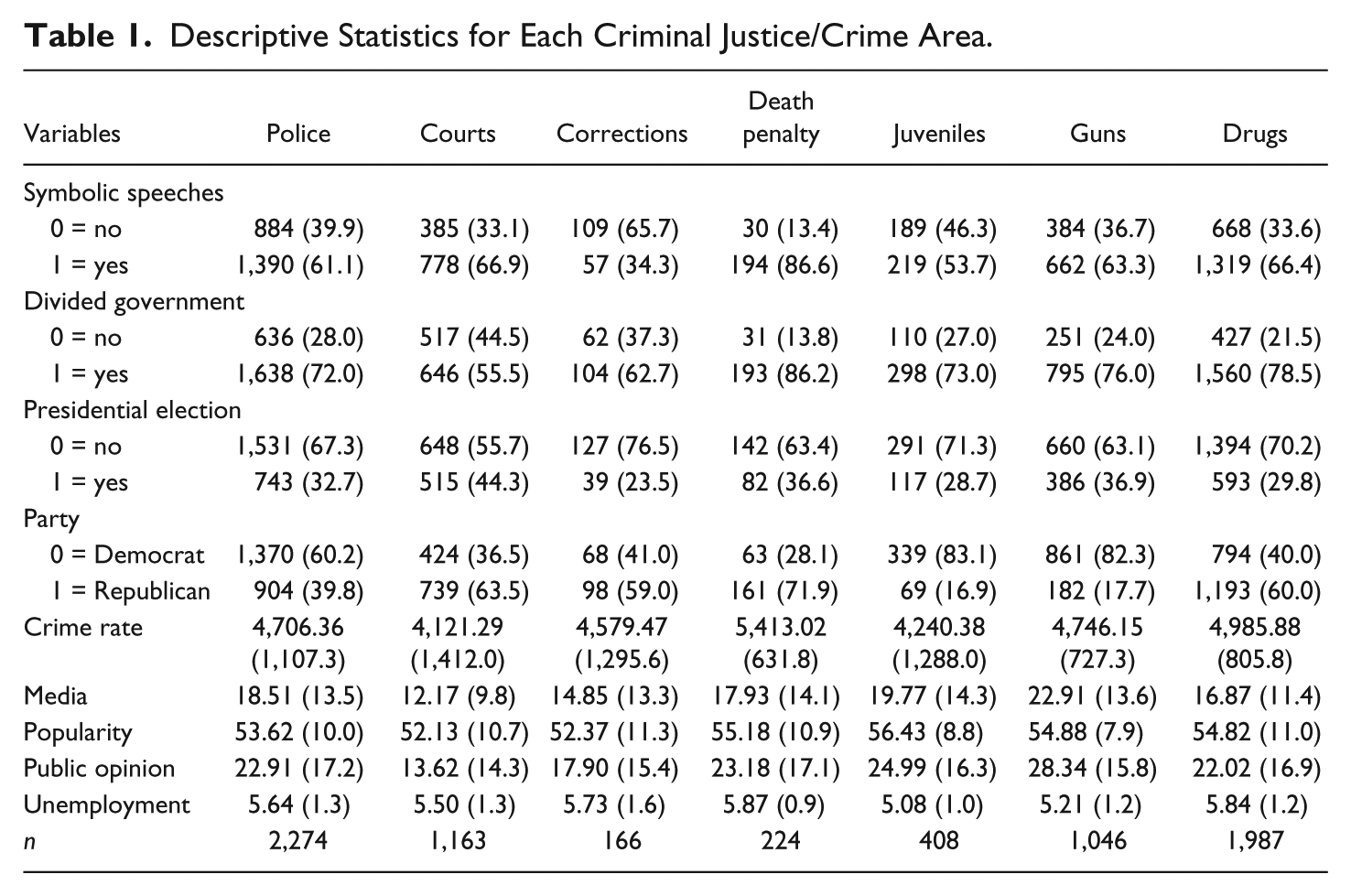
In assessing the continuous variables in the study, all five appear to remain fairly consistent across all seven categories. Crime rates in the year before the presidential speech, the number of crime-related news reports in the month before the president’s speeches, public concern for crime, presidential popularity, and the unemployment rates, all remain fairly stable. It should be noted, however, that each of these variables is crime generic and not specific to the topical categories. For instance, media reports are on crime, in general, not specifically police, guns, and so on. Or in the case of public concern for crime, this category is in general and not concern for guns or drugs.
Bivariate analysis was next conducted on each of the seven category databases using SPSS, and assessing the variation inflation factors (VIF) (Meyers, Gemst, & Guarino, 2006). Each independent variable was used as the dependent variable and the collinearity output was assessed. As no VIF exceeded a 2, it was determined that multicollinearity was not a problem for any of the databases.
Logistic regression analysis was then used to estimate the effects of the independent variables on the likelihood of a president employing symbolic rhetoric for each of the seven topic areas. Convergence was obtained in all of the models except for the subject area death penalty. In this case, because of the low number of speeches (n = 166), the relatively high number of independent variables (8) in comparison, and the fact there was almost no variation in the speeches (86.6% of the speeches were symbolic), the model would not converge and was therefore removed from final analysis. The study was then able to report on the six logistic regression models run (see Table 2), specifically those models regarding the police, courts, corrections, juveniles, guns, and drugs.
Logistic Regression of Entirely Symbolic Presidential Speeches by Criminal Justice/Crime Area.
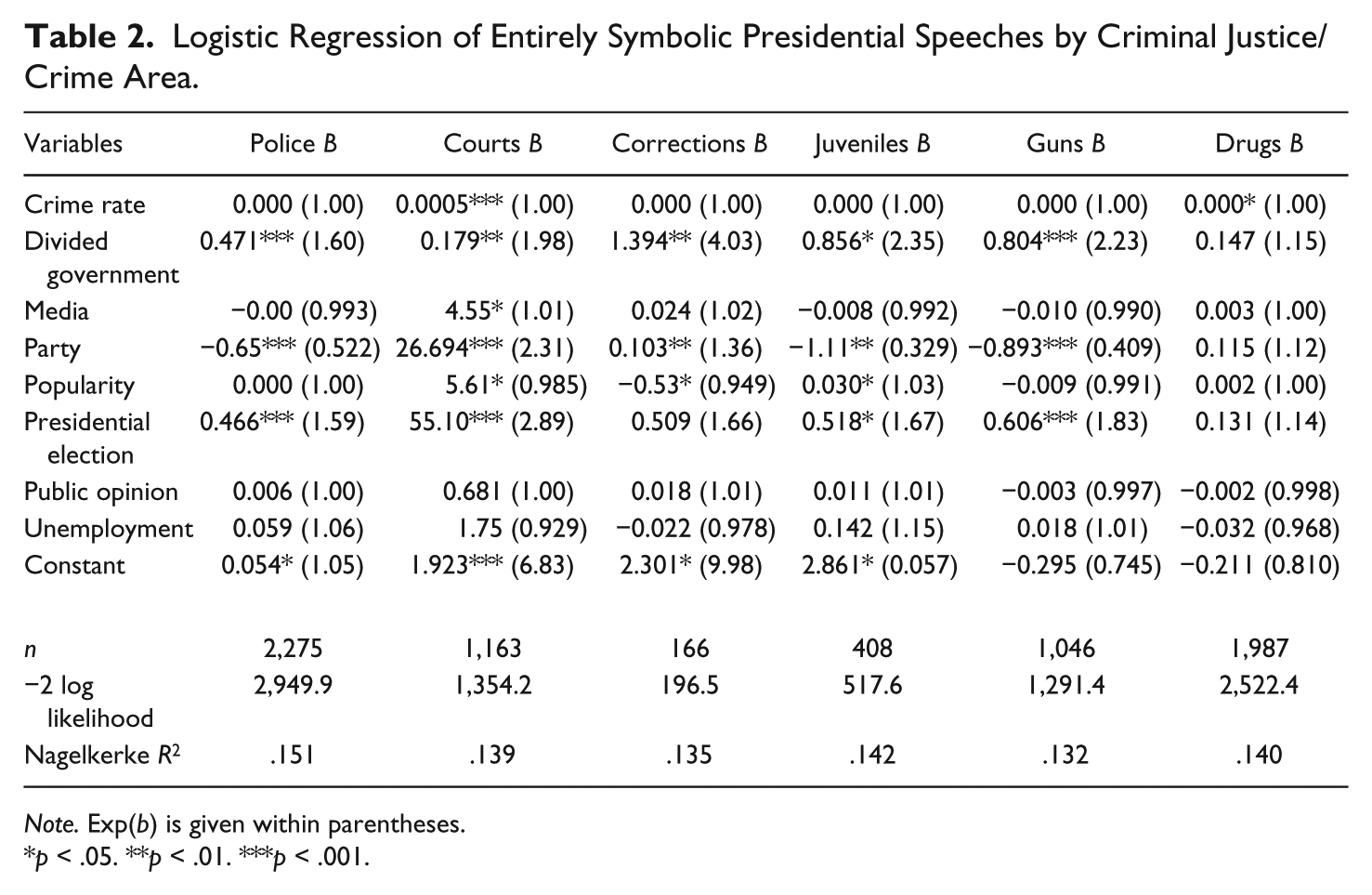
Note. Exp(b) is given within parentheses.
p < .05. **p < .01. ***p < .001.
In the police model, three variables were found to be significant. Divided government significantly impacted the likelihood that presidents would engage in symbolic rhetoric regarding the police, Wald= 16.04, exp(B) = 1.60, p < .001, as did when the presidents found themselves in an election year, Wald = 20.59, exp(B) = 1.59, p < .001. Presidential party was also significant in the police model, but in the direction of the Democratic Presidents, Wald = 28.93, exp(B) = 0.522, p < .001.
The courts model had the most reported significant variables with six, consisting of crime rate, divided government, media, party, popularity, and president election year. Crime rate was found to significantly impact the likelihood that presidents would engage in symbolic rhetoric on the courts, Wald = 16.75, exp(B) = 1.00, p < .001, and like the police model, so too did divided government, Wald = 4.04, exp(B) = 1.01, p < .01. Presidential party was reported as significant, but this time in the direction of the Republican Party, Wald = 26.69, exp(B) = 2.31, p < .001. Presidential election year was also found to be significant, Wald = 55.10, exp(B) = 2.89, p < .001. Two other variables were also significant in the courts model and they included media, Wald = 4.55, exp(B) = 1.01, p < .05, and presidential popularity, Wald = 5.61, exp(B) = 0.985, p < .05.
The corrections model found three variables to report significance and they were divided government, party affiliation, and popularity. Once again, divided government was found to significantly impact the likelihood presidents would engage in wholly symbolic rhetoric, Wald = 7.35, exp(B) = 4.03, p < .01, as was political party in the direction of the Republican Party, Wald = 2.04, exp(B) = 1.03, p < .01. The other significant variable, although in a negative relationship, was presidential popularity, Wald = 5.68, exp(B) = 0.94, p < .05, suggesting unpopular presidents are more likely to employ symbolic rhetoric in the area of corrections.
In the juveniles model, four variables were found to be significant and they were divided government, political party, presidential popularity, and president election years. Presidents were more likely to engage in symbolic rhetoric when faced with divided government, Wald = 5.74, exp(B) = 2.35, p < .05; with higher popularity ratings, Wald = 3.48, exp(B) = 1.03, p < .05; and in an election year, Wald = 4.35, exp(B) = 1.67, p < .05. Presidential party was also found to be significant in the direction of Democratic Presidents, Wald = 9.23, exp(B) = 1.32, p < .01.
In the guns model, three variables were found to be significant: divided government, party, and presidential election years. In this model, presidents were more likely to engage in symbolic rhetoric when faced with divided government, Wald = 14.33, exp(B) = 2.23, p < .001, when the party of the president was Republican, Wald = 14.39, exp(B) = 0.40, p < .001, and in presidential election years, Wald = 14.97, exp(B) = 1.83, p < .001.
The last model, drugs, had only one variable that was significant, and that was crime rate. Presidents were more likely to engage in symbolic rhetoric about drugs when the crime rate increased, Wald = 3.36, exp(B) = 1.01, p < .05.
Finally, it should be noted that in all six of the logistic regression models, the use of the Nagelkerke pseudo R2 remained fairly consistent in each of the models with a low of .132 in the guns model and a high of .151 in the police model. Although these goodness of fit indicators are weak, because of the model’s significance, the findings still have interpretable meaning.
Discussion
Research to date has continually demonstrated support for the law and order presidency, particularly noting that presidents engage in symbolic rhetoric when it comes to the issue of crime. Although a recent analysis found that presidents are more likely to engage in symbolic rhetoric when public concern for crime is high, in presidential election years, when faced with divided government, and when the president is from the Democratic party (Marion & Oliver, 2013), this study treated crime policy in a generic manner. The current study focuses more specifically on the types of crime policies in which presidents engage their rhetoric and theorized that not all policies would be equal.
The univariate analysis in this study provides some mixed support for this assertion. The study found that presidents more often employ wholly symbolic rhetoric in the areas of police, courts, death penalty, juvenile, guns, and drugs. Only in the area of corrections were they more likely to employ substantive rhetoric. This may be because the majority of speeches related to corrections were about prison expansion in this database, most of which was the allocation of additional funds to build more prisons, thus classifying most of these speeches as substantive (Marion, 1994a, 2007). Contrary to the differences in policy theory, there was one fact that was consistent among the descriptive statistics, in all seven policy areas, presidents more often chose to employ symbolic rhetoric in the presence of divided government then when faced with unified government.
Another consistency in the seven policy areas, although not as anticipated, was in presidential election years. It was hypothesized that in presidential election years, more speeches would be symbolic and that this would be the case in at least the majority of crime areas. The univariate data, however, demonstrated that the majority of speeches in presidential election years were not symbolic, but rather substantive. This may very well be for the fact that presidents feel they have to make campaign promises to communicate to the public what their agenda will be if elected president, so rather than engaging the public in symbolic rhetoric, they are more explicit in what they would do in all areas of policy making if elected (Marion & Farmer, 2003; Marion & Oliver, 2011).
In support of the argument that not all policies are created equal, the variable of presidential party affiliation offered some support. In the case of the Republican Presidents, when it came to courts, corrections, death penalty, and drugs, they were more likely to employ symbolic rhetoric. In the case of the Democratic Presidents, they were more likely to employ symbolic rhetoric in the area of police, juveniles, and guns. This holds well with previous research. Although there were some early assertions that crime was a Republican issue (Cronin et al., 1981; Scheingold, 1991), and some still argue this today (Beckett, 1997; Beckett & Sasson, 2000), the empirical research has consistently demonstrated the crime issue is not a Republican-only issue (Marion & Oliver, 2011, 2013; Oliver, 2002; Oliver, Hill, & Marion, 2011; Oliver & Marion, 2006, 2008, 2009, 2010). This is evident in regard to the Democrats for Presidents Johnson and Clinton spent an enormous amount of their capital on policing issues (Flamm, 2007; Marion, 1994a, 1997, 2007), the fair and impartial treatment of juveniles has been a cornerstone of Democratic Presidents (Ford excluded; Benekos & Merlo, 2008; Merlo & Benekos, 2003), and the issue of gun control has consistently been a perennial issue for the Democrats (Marion, 1994a, 2011).
Turning to the logistic regressions, again, support for the notion that not all policies are created equal has mixed support. One nearly universal variable appears to be divided government (Fiorina, 2002). When presidents face divided government, when at least one branch of Congress is politically in opposition to the president’s party, the president is more likely to engage in symbolic rhetoric. This makes sense in light of the fact that one chamber of Congress can frustrate a president’s legislative plans to maintain a level of rhetoric without committing to any particular policy, and the use of symbolic rhetoric is a tactic which presidents can readily employ (Brace & Hinckley, 1992; Davidson, 2000; Mayhew, 1991).
The other nearly consistent variable found to be significant was political party, but like the univariate analysis, the party affiliation of the president mattered. In the case of the crime areas, police, juveniles, and guns, Democrats were more likely to engage in symbolic rhetoric, whereas in the crime areas of courts and corrections, presidents were significantly more likely to engage in the symbolic rhetoric. In this case, the fact that certain issues favor certain party’s use of symbolic rhetoric offers support for the argument that not all crime policies are treated equally by presidents. There is some additional support for this assertion in that crime rate was only significant when it came to courts and drugs, the media variable was only significant in the courts model, and presidential popularity only proved significant in the courts, corrections, and juvenile models.
Knowing that presidents in today’s modern policy environment play an important role in crime policy and understanding that they engage in symbolic rhetoric on this issue does matter. But the recognition that presidents do not treat all policies the same is critical to our understanding of how presidents engage in the crime policy arena. Knowing that when presidents are faced with divided government, they will almost universally engage in symbolic rhetoric, which helps us to predict how presidents will react when faced with this dilemma. Knowing, also that in election years, they will overwhelmingly engage in substantive rhetoric is also telling. But perhaps the most important conclusion to be drawn from this study is the recognition that crime is not a Republican-dominated issue and that depending on the president’s party affiliation, their popularity, and the public salience of crime, the type of crime policy will determine the likelihood presidents will engage in symbolic rhetoric.
This study is not without its limitations and these should be noted. First, although the unit of analysis was the speech and most of the data were monthly data in the month preceding the speech, the FBI’s Uniform Crime Reports are not available at the monthly level and so the crime rate the year prior was used. Second, variables such as media and public opinion were crime generic and not reflective of the specific crime topic area for each of the seven crime topic areas. Third, the death penalty model would not converge, so the analysis lost the benefit of understanding the death penalty issue with more depth. Fourth, and finally, the limited findings in the drug model are suspicious in that one would suspect more significant findings. It is possible that the drug variable is so highly contextualized that it created too much variation in the use of the term and the type of drug policy discussed (e.g., the difference between illicit drug trade, prescription drug medicine fraud, and the legalization of medicinal marijuana), thus failing to tap into the latent variable. This may necessitate further research into this specific variable and policy area.
Future research should also revisit presidential speeches in general and State of the Union speeches more specifically based on their symbolic versus substantive content to assess, which has a greater influencing impact on public opinion of crime. Equally assessing the presidents symbolic versus substantive rhetoric to assess the impact the president has in pushing Congress to engage in the crime policy issue through committee hearings and through the passage of crime legislation. Finally, a more nuanced look at the drug policy area itself, in the same manner as this study, but focusing on the different drug policy types, may provide better answers to understanding presidential use of symbolic rhetoric when it comes to drug control policy in America.
Footnotes
Declaration of Conflicting Interests
The author(s) declared no potential conflicts of interest with respect to the research, authorship, and/or publication of this article.
Funding
The author(s) received no financial support for the research, authorship, and/or publication of this article.