



Abstract
Violence and active shooter situations in schools have been important issues to the public, policy makers, and scholars in recent years. School resource officers (SROs) are widely used in efforts to address school crime-related threats. Yet, little is known about the factors that influence key stakeholders’ (e.g., school principals) evaluations of such officers. The present study uses survey data from a sample of public school principals in South Carolina to examine the role of procedural justice theory in understanding evaluations of SROs. The results reveal that procedural justice is associated with principals’ support for SROs, perceived effectiveness of SROs, and level of trust and satisfaction in SROs. The policy implications of the results center on the importance of SRO procedural fairness in maintaining quality relationships with top school administrators which may ultimately have a wider impact on the success of SRO programs.
Keywords
On December 14, 2012, an individual murdered 20 first-grade students and 6 teachers and staff at Sandy Hook Elementary School in Newtown, Connecticut. Although mass shootings at schools such as Columbine High School and Virginia Tech have certainly shocked the conscience of Americans, the tragedy at Sandy Hook underscored the unfortunate reality that even elementary schools and young children are vulnerable to such events. Indeed, the mass murder served as a “tipping point” in the debate surrounding potential responses to school shootings (Shultz, Muschert, Dingwall, & Cohen, 2013). For weeks after the shooting, media outlets interviewed experts, survivors of school shootings, teachers, and citizens about potential solutions to school violence that ranged from greater mental health care access to arming teachers with firearms (Shultz et al., 2013). President Obama called for sweeping gun-control legislation reform and issued 23 executive actions directed at reducing gun violence. One of the president’s primary instructions was for the Office of Community Oriented Policing Services office to award more hiring grants to police agencies in an effort to place more school resource officers (SROs) in our nation’s schools (The White House, 2013). The supposed commonsense approach of using more SROs to prevent mass shootings resonated well with the public and led some to argue that a law enforcement presence is needed in all schools. Federal agencies responded to President Obama and the public’s call for more SROs by investing significant resources in researching the best ways to improve school safety. During fiscal year 2014, for example, the National Institute of Justice (NIJ; 2014a, 2014b) allotted more than US$61 million dollars to school safety research with a primary focus on SRO-related initiatives.
Indeed, the widespread use of SROs as a response to issues of school safety has been popular among policy makers and the general public for decades (Crews, Crews, & Burton, 2013; May, Cordner, & Fessel, 2004; Na & Gottfredson, 2011; Trump, 1998). Surprisingly, however, relatively little empirical research has focused on SROs. The limited amount of research typically examines whether SROs effectively address school crime and safety issues (Jennings, Khey, Maskaly, & Donner, 2011; Johnson, 1999; Na & Gottfredson, 2011; Theriot, 2009). What often gets lost in the debate surrounding SROs is how key stakeholders who must interact with such officers perceive their usefulness and legitimacy. More specifically, what are the factors that influence whether key stakeholders, such as school administrators, find SROs to be useful and legitimate? The importance of this gap in the literature cannot be underestimated. School administrators and SROs must work together on a daily basis to ensure the overall success of an SRO in a school—be it reduced crime or increased feelings of safety. If relationships between principals and SROs are strained, the overall function of SROs could be undermined. After all, similar to other law enforcement officers, SRO efficacy will be at least partially dependent on the level of trust and cooperation they have with school administrators (Sunshine & Tyler, 2003; Tyler & Huo, 2002). A negative relationship between an SRO and principal will make the SRO’s job more difficult because it will be less common for the principal (and possibly other staff members) to cooperate with the SRO or offer needed information and assistance. In short, how well SROs are able to do their job depends partially on the cooperation and “buy-in” from school staff—particularly the principal. Therefore, it is necessary to move the literature forward in an attempt to theoretically understand principals’ perceptions of SROs.
Fortunately, the emergent literature regarding perceptions of police procedural justice and legitimacy offers an ideal framework for beginning to understand school administrators’ evaluations of SROs. In particular, Tyler’s (1990; see also Tyler & Huo, 2002) procedural justice theory stipulates that individuals who perceive the police to exercise their authority in procedurally fair manners are more likely to view officers as legitimate authority figures. Evaluations of legitimacy are important because they are related to the public’s trust in the police, satisfaction with police services, and support for law enforcement (Nix, Wolfe, Rojek, & Kaminski, 2014; Sargeant, Murphy, & Cherney, 2014; Sunshine & Tyler, 2003; Tyler, 2003; Tyler & Huo, 2002). Thus, the degree to which school principals view SROs’ actions as procedurally fair may help explain whether they have positive or negative evaluations of such officers.
The present study moves the current literature forward by examining the role of procedural justice and legitimacy in school principals’ evaluations of SROs. Using survey data from a sample of school administrators in South Carolina, we estimate the effects of procedural justice and legitimacy on (a) support for SROs, (b) perceived SRO effectiveness, (c) trust in SROs, and (d) satisfaction with SROs. Doing so not only extends the scope of Tyler’s (1990) theory but also serves the broader purpose of determining the factors that may help facilitate positive working relationships between school principals and SROs.
SROs
Although the frequency of school shootings that involve multiple victims has remained relatively stable over the past 20 years, the publicity surrounding school shootings such as those at Columbine, Virginia Tech, and Sandy Hook has spawned increased efforts to ensure student safety (Center for Disease Control and Prevention, 2014; Lawrence & Mueller, 2003; Perumean-Chaney & Sutton, 2013; Rocque, 2012). Much of the policy discussion surrounding school safety issues has centered on using law enforcement to deter school violence by increasing the presence of SROs (Kupchik, 2010; Kupchik & Ward, 2014). An SRO is a law enforcement officer with arrest authority that is deployed by the officer’s employing agency to work within a school and in collaboration with its staff (May, Fessel, & Means,2004). SROs are generally seen as simultaneously serving a law enforcement, mentor/counselor, and teacher role within schools (Coon & Travis, 2012; McKenna, Martinez-Prather, & Bowman, 2014; Shuler-Ivey, 2012). While the Obama Administration supports such an agenda, the National Rifle Association also proposed the “National School Shield” program which outlines a strategy to place an SRO in every public school. Thus, support for more SROs in schools spans both liberal and conservative ideologies. Estimates of the number of SROs currently stationed in schools across the United States generally ranges from 17,000 to 20,000 (James & McCallion, 2013; Raymond, 2010). Despite such publicized support and widespread use, however, limited empirical research has focused on SROs.
Evaluations of SRO effectiveness are limited and the research that does exist provides conflicting evidence. One of the first attempts to evaluate the impact of SROs found that crimes in middle and high schools decreased after the introduction of SROs into schools (Johnson, 1999). Others have replicated this finding by demonstrating that both the presence and the number of SROs in a school are negatively related to school violence (e.g., assault and weapon arrests; Jennings et al., 2011; Theriot, 2009). In contrast, however, Na and Gottfredson’s (2011) analysis provides no evidence that SROs reduce crime (see also Tillyer, Fisher, & Wilcox, 2011). Using survey data from approximately 3,000 public schools, they compared principal-reported crime at schools that increased SRO presence with schools that did not. They found that the rates of crimes reported by principals were not significantly impacted by the increased use of SROs, thus raising questions about SRO effectiveness in reducing school crime-related issues. However, the results also indicated that students in schools with increased SRO presence were more likely to report non-serious offenses than those in schools that did not increase the number of SROs. This suggests that the police–school relationship that results from increased SRO presence may encourage students to report offenses that would otherwise remain unnoticed by school officials (see also Johnson, 1999; Theriot, 2013; Watkins & Maume, 2011). SRO effectiveness is clearly worthy of empirical study but, in comparison with this body of work, little research has explored individuals’ perceptions of these officers.
The literature focused on attitudes toward the police reveals the importance of understanding the factors that contribute to individuals’ evaluations of law enforcement. Favorable attitudes of the police, for instance, translate into greater citizen cooperation, assistance, and law obedience (see, for example, Brown & Benedict, 2002; Decker, 1981; Tyler, 1990). Yet, only a handful of studies have examined perceptions of SROs, most of which rely on samples of students (Johnson, 1999; Travis & Coon, 2005; Trump, 2001). This line of research demonstrates that variation regarding individual perceptions of SROs clearly exists. Jackson (2002) analyzed survey data from 271 Missouri high school students and showed that the use of SROs in schools does not improve students’ perceptions of the police. However, other studies find better relationships between SROs and students when there is more frequent interaction and communication between the parties (McDevitt & Panniello, 2005; Theriot, 2013). Research has revealed similar evidence regarding principals’ perceptions of SROs. May and colleagues (2004), for example, collected data from 128 school principals in Kentucky and demonstrated that a majority of principals have favorable attitudes of SROs (e.g., SROs improve school safety). In particular, most principals felt that fighting had decreased after the initiation of their schools’ SRO programs. Yet, a majority of respondent principals indicated that levels of drug use (and/or possession), weapon possession, and other illicit behaviors had stayed the same since having an SRO in their schools. The principals, however, still felt that SROs are an important part of their school safety plans. Multivariate analysis conducted by May et al. revealed that the frequency of communication (i.e., meetings) that takes place between SROs and principals is positively associated with principals’ perceptions of SRO effectiveness.
This line of inquiry is important but is limited in two ways. First, the perceptions of SRO literature relies almost exclusively on students perceptions of these officers. This leaves the factors that shape principals’ attitudes toward SROs a largely untapped avenue of research. Such a gap is important because as the top administrator within a school, principals are responsible for the successful implementation of school security programs, including the use of SROs. Principals who have negative feelings toward SROs may (unconsciously or consciously) undermine such officers’ authority and diminish their ability to adequately enforce rules and maintain order. Similarly, negative attitudes toward SROs may make it difficult for administrators to work with the officers in a joint effort to increase school safety. Second, research reveals that the frequency and quality of communication with SROs influences principals’ perceptions but the literature to date has been largely atheoretical. Accordingly, we have little understanding of why principals may have favorable or unfavorable attitudes toward SROs. In other words, what type of interaction is meaningful and why? Determining the factors that influence principals’ attitudes toward law enforcement officers placed in their schools is foundational to SRO programs being able to successfully accomplish their goals. Fortunately, Tyler’s (1990) procedural justice theory offers a useful framework to begin filling this theoretical gap in our understanding. Examining the ways in which school administrators’ evaluate SROs is important from a theoretical standpoint, but will also offer practical policy implications.
Procedural Justice and Police Legitimacy
The study of authority figure legitimacy has a long history in the social sciences (Cohen-Charash & Spector, 2001; Colquitt, Conlon, Wesson, Porter, & Hg, 2001; Lind & Tyler, 1988; Weber, 1946). However, Tyler’s (1990) classic study helped bring the study of individuals’ perceptions of criminal justice agent legitimacy into mainstream criminological research. In particular, the past 7 or 8 years have seen a surge in research focused on Tyler’s framework. The role of legitimacy has been explored in relation to various facets of the justice system but a majority of the literature to date focuses on police legitimacy (see for example, Higgins, Wolfe, Mahoney, & Walters, 2009; Higgins, Wolfe, & Walters, 2009).
Of course, this begs the question—What is legitimacy? This topic has received a tremendous amount of attention in the past few years with Tyler and other scholars actively debating the correct conceptual definition of legitimacy (see, for example, Bottoms & Tankebe, 2012; J. Jackson, Bradford, Hough, et al., 2012; J. Jackson, Bradford, Stanko, & Hohl, 2012; Tankebe, 2013; Tyler & Jackson, 2014). The current study will not attempt to reconcile this debate that is sure to continue in the near future. Rather, we focus on the conceptualization of police legitimacy that is widely used in the literature dedicated to procedural justice theory. An individual is said to view the police as a legitimate authority figure when he or she feels a duty to obey officers’ directives ( ; Tyler, 1990; Tyler & Huo, 2002; Tyler & Jackson, 2014). This definition focuses on the normative belief that police officers have the legal authority to enforce the law and dictate citizen behavior when necessary. In essence, the police attain legitimacy when citizens feel a moral and ethical responsibility to obey law enforcement orders and decisions.
How do the police attain legitimacy? Tyler (1990; see also Tyler & Huo, 2002) argued that evaluations of police legitimacy are rooted in individuals’ procedural justice judgments. Procedural justice is comprised of two key elements—quality of decision making and quality of interpersonal treatment. With respect to the former, people feel they are being treated fairly when officers exercise their authority in neutral and unbiased manners (Tyler, 1990, 2003, 2004). In other words, officers’ procedural fairness is based on the perceived evenhandedness and objectivity of their decision making. Ultimately, as Tyler (2004) succinctly reminded us, “people are seeking a level playing field in which no one is unfairly advantaged” (p. 94). The police enhance their perceived neutrality by clearly explaining the reasons for their decisions to the public (i.e., offering transparency).
The second element of procedural justice focuses on the degree to which people feel they are treated with respect and dignity by the police. Specifically, quality of interpersonal treatment deals with officer politeness during interactions with the public and the degree to which they allow citizens to express their side of the story. Procedures are perceived as fair when people feel as though they are treated respectfully and are allowed to participate in the decision-making process because it communicates status recognition to those the police are interacting with. In summary, officers who ensure objectivity, deference, and open mindedness to others’ viewpoints during their decision-making process and interpersonal communication with the public are more likely to be viewed as procedurally just.
Tyler’s (1990; see also Tyler & Huo, 2002) process-based model of policing—as it is often referred—has received considerable empirical support. Two foundational studies have served as the impetus behind most policing-related procedural justice and legitimacy research. Tyler (1990) analyzed data from telephone interviews with Chicago residents and showed that individuals who viewed the police as behaving in procedurally fair manners were more likely to view them as legitimate authority figures. Tyler and Huo (2002) replicated these findings among samples of New York City and Oakland residents by revealing that individuals are more likely to trust the motivations of law enforcement when they perceive officer actions to be procedurally fair. The procedural justice–legitimacy link has been shown to generalize across various samples in the United States (see, for example, Gau, 2009, 2011; Gau, Corsaro, Stewart, & Brunson, 2012; Wolfe, 2011) and several countries outside of the United States (J. Jackson, Bradford, Hough, et al., 2012; Jonathan-Zamir & Weisburd, 2013; Mazerolle, Antrobus, Bennett, & Tyler, 2013; Mazerolle, Bennett, Antrobus, & Eggins, 2012; Reisig, Tankebe, & Meško, 2012, 2014; cf. Tankebe, 2008, 2009). Procedural justice is also commonly observed as a key antecedent to legitimacy over and above the instrumental concerns of distributive justice and perceived police effectiveness (Jonathan-Zamir & Weisburd, 2013; Tyler, 1990, 2005; Tyler & Huo, 2002; cf. Bradford, Huq, Jackson, & Roberts, 2013; Tankebe, 2009) and is robust to intervening mechanisms such as individual personality differences and neighborhood influences (Nix et al., 2014; Reisig, Wolfe, & Holtfreter, 2012; Wolfe, 2011).
Evaluations of legitimacy are important because they have been shown to be associated with more favorable individual attitudes toward law enforcement. Using data from two New York City surveys, Sunshine and Tyler (2003) demonstrated that residents who view the police as legitimate have higher levels of support for law enforcement. Specifically, favorable legitimacy evaluations translated into greater police empowerment (e.g., affirmation that the police should have the power to decide how to combat crime) and cooperation with officers (e.g., reporting crime to the police). Consistent with the process-based model, procedural justice judgments were positively associated with individuals’ legitimacy evaluations and a portion of the procedural justice effect on support for the police operated through legitimacy (i.e., legitimacy partially mediated the procedural justice effect). Similar findings have been found in other research using a variety of samples (Kochel, Parks, & Mastrofski, 2013; Murphy, Hinds, & Fleming, 2008; Reisig & Lloyd, 2009; Tyler & Fagan, 2008; Tyler & Huo, 2002; Tyler & Jackson, 2014).
Research has also revealed that individuals who believe the police are effective at handling crime or other community problems are more likely to view the police as a legitimate power holder and authority (Kochel et al., 2013; Tankebe, 2008, 2010). The opposite causal pathway is also possible—perceptions of police legitimacy may lead citizens to believe that the police are more effective at their job. Lack of longitudinal data in the procedural justice and legitimacy literature makes it difficult to ascertain which proposed connection (or if both) has the most empirical support. Nonetheless, the evidence clearly demonstrates that police legitimacy and perceived police effectiveness are significantly and positively correlated with one another. Relatedly, research reveals that people who view the police as procedurally just and legitimate tend to be more satisfied with the services officers provide (Hinds & Murphy, 2007; Murphy, 2009; Tyler, 2003; Tyler & Folger, 1980; Tyler & Wakslak, 2004). For example, Tyler and Huo (2002) showed that individuals who believe officers behave in procedurally fair manners have a higher level of satisfaction with the police. Mazerolle and colleagues (2013) recently reported findings from a randomized field trial and demonstrated that individuals who were subjected to a procedural justice experimental condition (compared with the “business as usual” control group) during a random breath test traffic stop were more satisfied with the police and part of the procedural justice effect on satisfaction operated via increased evaluations of legitimacy. In other words, people who experience procedural justice are more satisfied with the police, partially because it increases the perceived legitimacy of law enforcement.
Finally, recent empirical evidence suggests that procedural justice is also associated with a greater degree of trust in the police (Nix et al., 2014; Sargeant et al., 2014; Tankebe, 2008; Van Craen, 2013). Simply put, when officers provide objectivity, respect, and the opportunity for members of the public to voice their opinions, citizens are more inclined to indicate that the police can be trusted to do what is right for the community. An important caveat to these findings is that trust in the police is sometimes conceptualized as a component of legitimacy (i.e., in combination with obligation to obey; see, for example, Tyler, 1990; Tyler & Huo, 2002). However, empirical scrutiny of the dimensionality of Tyler’s legitimacy scale indicates that obligation to obey and trust are separate concepts (Gau, 2011, 2014; Reisig, Bratton, & Gertz, 2007). Accordingly, researchers have begun to explore trust in the police as an important consequence of individuals’ internalized normative belief that the police are a legitimate authority.
In summary, legitimacy is important because it leads to public support, satisfaction, and perceived effectiveness of law enforcement and greater levels of trust in the police. It is important to emphasize that Tyler’s (1990) process-based model stipulates that such beneficial outcomes stem primarily from favorable legitimacy evaluations. As such, any connection between individual procedural justice judgments and trust, satisfaction, support, or perceived effectiveness should be largely accounted for by legitimacy. The empirical evidence reviewed above, however, tends to reveal that legitimacy evaluations only partially mediate the link between procedural justice and other favorable perceptions of the police.
The Present Study
Procedural justice theory offers a viable starting point for examining the factors that shape school principals’ perceptions of SROs. Furthermore, results from procedural justice-based studies typically offer clear implications for how police officers can adjust their behavior to mend negative public attitudes. The same may hold true in the present context regarding principals’ perceptions of SROs. The present study contributes to the research literature in several ways. First, we determine whether school principals’ procedural justice judgments are related to their overall evaluations of SRO legitimacy. Next, we examine whether procedural justice and legitimacy are associated with support, perceived effectiveness, satisfaction, and trust concerning SROs. Finally, we explore the degree to which legitimacy evaluations mediate the procedural justice effect. The overarching goal of this study is to provide a theoretical and empirical understanding of principals’ evaluations of SROs and, in so doing, expand the scope of Tyler’s process-based model. Furthermore, it is hoped that the results will provide insight regarding policy implications centered on improving SRO-principal relationships and the overall success of SRO programs.
Method
Data
Data for the current study were collected from a mail survey of school principals in South Carolina. A modified Dillman method was used to encourage participation in the study (Dillman, 2007; Dillman et al., 2009). An initial survey packet that included a cover letter outlining the purpose to the questionnaire was mailed to the school principal or lead administrator of the 1,086 public schools in South Carolina (representing all public elementary, middle, high, and intermediate schools). Respondents were asked to return completed surveys with the postage paid envelope included in the packet or, alternatively, they were given the option to fill out the questionnaire online using a secure website. To protect the anonymity of the respondent principals, no identifying information beyond basic demographic characteristics was collected on the questionnaire. Also included in the first-round survey packet was a letter of support from the Office of Program Evaluation in the College of Education at the University of South Carolina to encourage principals’ participation. Approximately 2 weeks after the initial round of surveys, a follow-up letter was sent to each public school principal expressing appreciation to those who responded and requesting participation from those who had not yet completed the survey. Finally, about 3 weeks after the reminder letter was sent, another survey packet including a cover letter and questionnaire was mailed to the principals. This strategy resulted in 487 principals returning completed surveys (44.8% response rate; more than 95% of respondents completed the mail version of the questionnaire). Research reveals that mail surveys typically yield similar response rates (Baruch, 1999). Missing data were imputed using the Stata 13 hotdeck suite (Allison, 2001; Andridge & Little, 2010; Fuller & Kim, 2005; Gmel, 2001; less than 1% of cells in the data set had missing values).
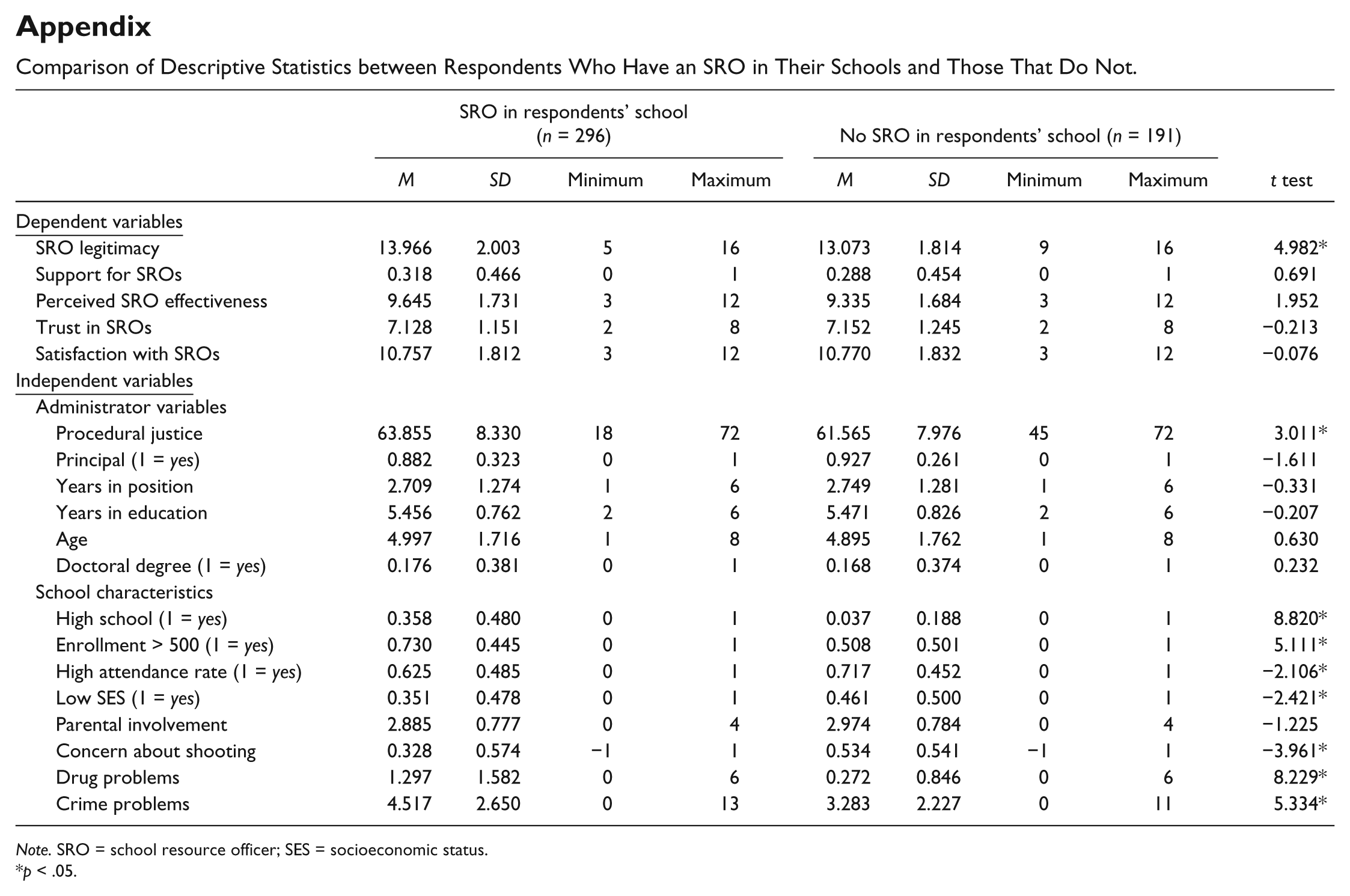
A majority of respondents self-reported that they were the principal of their respective school (90%; see Table 1 and Appendix). The remaining respondents were either assistant principals or other administrators (10%). Across the sample, the average respondent has been in his or her current position for between 5 and 9 years, has between 15 and 19 years of education-related work experience, and is between the ages of 46 and 50. About 17% of the sample holds a doctoral degree. With respect to school characteristics, 47% of respondents work in an elementary school, 22.6% in a middle school, 23.2% in a high school, and about 7% in some type of intermediate school (e.g., combined middle and high school). Compared with the population of South Carolina public schools, the current sample contains a slightly higher proportion of high schools.
Descriptive Statistics for Independent and Dependent Variables.
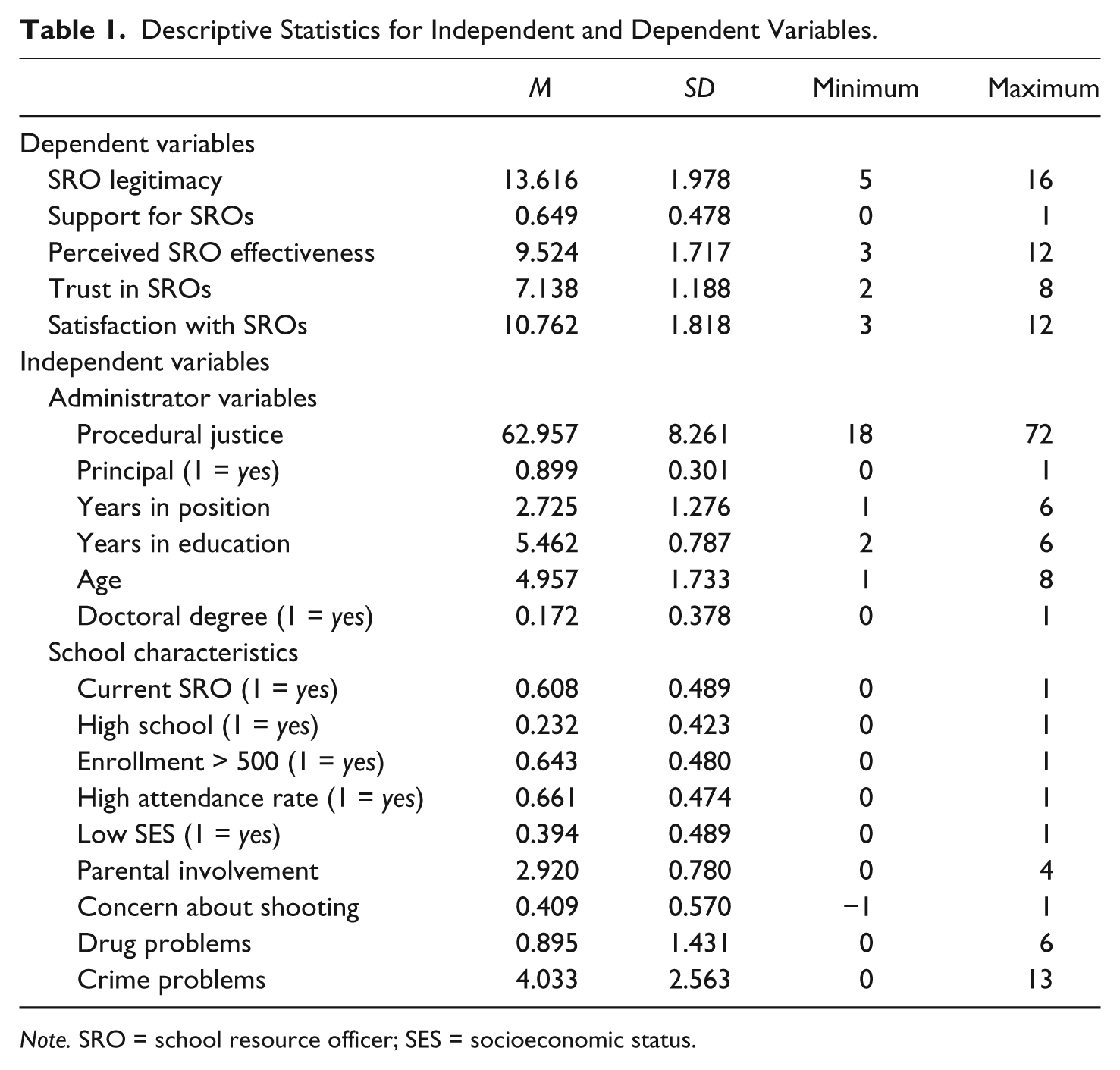
Note. SRO = school resource officer; SES = socioeconomic status.
Dependent Variables
SRO legitimacy
The influence of school administrators’ perceptions of procedural justice on evaluations of SROs was examined using five outcome measures. To begin, we conceptualize SRO legitimacy as a normative belief regarding obligation to obey police directives (Tyler, 1990; Tyler & Huo, 2002). The degree to which respondents felt that students and teachers are obligated to obey SROs was captured using the following four statements: “Students/teachers should obey SRO’s decisions because it is the proper thing to do” and “Students/teachers should obey the directions of SROs if they consider their actions to be lawful” (the items were asked separately regarding students and teachers). Response categories were anchored from 1 (strongly disagree) to 4 (strongly agree). The conceptualization of legitimacy and survey questions used to operationalize the concept are consistent with past research (Reisig et al., 2007; Tankebe, 2013; Tyler, 1990; Tyler & Huo, 2002). Principal-axis factor analysis (PAF) with varimax rotation revealed that the four items loaded onto a single factor (λ = 2.389, factor loadings > 0.738). 1 The items also demonstrated strong internal consistency (α = .855; see, for example, Cortina, 1993) and, therefore, were summed to create an additive SRO legitimacy scale with higher scores indicating that principals believe SROs are legitimate authority figures whose directives should be followed. Consistent with the mediation hypothesis, it is important to note that SRO legitimacy is used as an predictor variable in the models examining the remaining dependent variables discussed below (i.e., legitimacy should predict evaluations of SROs and partially mediate the effects of procedural justice). Table 1 provides descriptive statistics for all variables used in the analyses.
Support for SROs
The process-based policing literature provides strong evidence that people are more willing to support law enforcement activities when they believe police officers act in fair and unbiased manners and are perceived as a legitimate authority (see, for example, Sunshine & Tyler, 2003). To determine whether school administrators’ perceptions of SRO procedural justice and legitimacy were related to their overall support for SROs, survey participants were asked whether they “would support a policy that required at least one SRO in every public school if entirely district funded” (1 = yes, 0 = no). This item was used because affirmative answers to the question reflect a high degree of support for SROs regardless of whether the burden of funding such officers would land on the shoulders of the school district. About 30% of school administrators self-reported support for such a policy.
SRO effectiveness
Individuals who perceive the police to be procedurally just and legitimate may be more likely to believe officers can effectively perform their duties. The current study was part of a larger project exploring school administrators’ perceptions of SROs and alternative measures for dealing with school shootings. Accordingly, we captured administrators’ opinions regarding whether SROs can improve school safety and effectively combat school shootings by asking them to respond to the following statements: “An SRO would improve overall safety within a school,” “An SRO would prevent a school shooting from occurring,” and “An SRO would reduce the number of victims if a school shooting were to occur” (1 = strongly disagree to 4 = strongly agree). PAF with varimax rotation demonstrated a unidimensional factor (λ = 1.182, factor loadings > 0.535) and the items had adequate internal consistency (α = .696). Therefore, an additive perceived SRO effectiveness scale was constructed.
Trust in SROs and satisfaction with SROs
Finally, two dependent variables were assessed for the subsample of school administrators that self-reported currently having an SRO in their school (n = 295). Research reveals that individuals have greater trust in legal authorities when their actions are perceived as procedurally fair (Nix et al., 2014). 2 Tyler conceptualizes trust in the police as a belief that officers will exercise their authority with the larger community’s best interests in mind (Tyler & Huo, 2002; Tyler & Jackson, 2014; see also Jackson, Bradford, Stanko, & Hohl, 2012). Accordingly, we capture the amount of trust school principals have in their SROs by asking them how much they agree (1 = strongly disagree to 4 = strongly agree) that “Students trust the SROs in my school” and “Teachers trust the SROs in my school” (r = .844). The items displayed strong internal consistency (α = .855) and, therefore, were summed to form an additive trust in SROs scale. In addition, research suggests that people who perceive the police as procedurally fair and legitimate are more satisfied with their performance (Hinds & Murphy, 2007; Murphy, 2009). School administrators’ satisfaction with their current SROs was captured by asking them to indicate on a 4-point Likert-type scale (1 = strongly disagree to 4 = strongly agree) how much they agree that “SRO(s) have a good relationship with students in my school,” “SRO(s) have a good relationship with teachers in my school,” and “SRO(s) are doing a good job in my school.” These items are consistent with those used in the larger satisfaction with police and procedural justice literatures (Brandl, Frank, Worden, & Bynum, 1994; Reisig & Parks, 2000; Wu, Sun, & Triplett, 2009; Zhao, Tsai, Ren, & Lai, 2014). The three items loaded on a single factor (λ = 2.589, factor loadings > 0.895) and demonstrated strong internal consistency (α = .956). An additive satisfaction with SROs scale was constructed with higher values indicating greater satisfaction.
Independent Variables
Administrator variables
The first set of independent variables examined in the current study concern administrator-specific measures. The key predictor variable—procedural justice—was captured by asking the principals a series of questions that tap into their perceptions regarding the quality of SRO decision making (e.g., neutrality) and treatment (e.g., status recognition) of students and teachers they deal with (i.e., 9 questions were asked separately pertaining to students and teachers—18 total; Tyler, 1990). 3 Specifically, respondents were asked to indicate how strongly they agree (1 = strongly disagree to 4 = strongly agree) that SROs “make decisions based on facts, not their personal biases or opinions when dealing with students/teachers,” “treat students/teachers with respect,” “take time to listen to students/teachers,” “treat students/teachers fairly,” “clearly explain the reasons for their actions to students/teachers they deal with,” “use rules and procedures that are fair to students/teachers,” “are neutral and fair when dealing with students/teachers,” “consider students’/teachers’ views,” and “try to take students’/teachers’ needs into account.” These items are adopted from recent process-based policing studies (see, for example, Gau et al., 2012; Reisig et al., 2007; Sunshine & Tyler, 2003; Tankebe, 2013). A single underlying procedural justice factor was observed using PAF with varimax rotation (λ = 13.318, factor loadings > 0.701) and the items demonstrated strong internal consistency (α = .980). The items were summed to form an additive procedural justice scale with higher scores indicating principals believe SROs interact with students and teachers in procedurally fair manners.
Several demographic control variables were included in the analysis to provide unbiased estimates of the effects of procedural justice and legitimacy on school administrators’ evaluations of SROs. Principal is a dummy variable measuring whether the respondent self-reported being the school principal (1 = yes). Using ordered-categorical response categories (1 = less than 2, 2 = 2-4, 3 = 5-9, 4 = 10-14, 5 = 15-19, 6 = 20 or more), years in position captures the number of years a respondent have been in his or her current position and years in education accounts for the number of years respondents have been working in an education-related occupation. Respondent age was also measured with order-categorical response categories (1 = 30 or younger, 2 = 31-35, 3 = 36-40, 4 = 41-45, 5 = 46-50, 6 = 51-55, 7 = 56-60, 8 = 61 or older) and doctoral degree is a dummy variable coded 1 if the administrator has a doctoral degree. 4
School characteristics
The SRO literature indicates that certain school characteristics can influence individuals’ support for SROs (Devoe et al., 2004; McDevitt & Panniello, 2005). Accordingly, the second set of independent variables used in the present study includes items that were self-reported by the respondent administrators and pertain to the characteristics of the school they currently work within. It is important to remember that only one administrator was surveyed from each school and, therefore, our data do not have a nested (i.e., multilevel) structure. First, we accounted for whether an SRO was currently assigned to the administrators’ schools (current SRO; 1 = yes). Next, the dummy variable high school (1= yes) is used because high schools typically have more violence and drug-related issues than lower grades which may influence administrators’ perceptions of SROs (Devoe et al., 2004). Similarly, larger schools typically have greater risk of experiencing violence and drug-related issues so we accounted for school size with the dummy variable enrollment > 500 (coded 1 if the school has 500 or more students and 0 if less; Welsh, 2003). This threshold was used because two thirds of schools in the sample have 500 or more students which created a natural break between “large” and “small” schools. The binary indicator high attendance rate coded 1 if the school has a 96% or higher attendance rate was also used as a control variable in the multivariate models. This threshold was used because about two-thirds of respondent schools fell at or above a 96% attendance rate.
Schools situated in communities with greater structural disadvantages may be at increased risk of crime-related problems (Bowen & Bowen, 1999; Laub & Lauritsen, 1998). Consistent with prior education research, respondents were asked to indicate the percentage of their students who are eligible for the National School Lunch Program (NSLP) to serve as a proxy for student socioeconomic status. Analyses revealed that a natural cut-point in the distribution of this variable existed at 75%. Accordingly, low SES (socioeconomic status) is coded 1 if the administrator self-reported that 75% or more of his or her students were eligible for the NSLP. Conversely, greater parental involvement in school activities may serve as a protective factor for crime-related problems and result in administrators viewing SROs as less needed (Laub & Lauritsen, 1998). Administrators were asked the following question: “In general, how much parental involvement in school-related activities would you say there is at your school?” (1 = almost none, 2 = a small amount, 3 = a good amount, 4 = a lot).
Several variables were used to account for the level of concern currently surrounding crime-related problems in the principals’ schools. Survey participants were asked whether “the level of concern your school has received from parents or other community members regarding school shootings” has decreased, stayed about the same, or increased in the past year (concern about shooting; coded −1, 0, and 1, respectively). Finally, the administrators were asked to indicate how much of a problem a list of 11 crime-related issues are among students in their school (1 = not a problem, 2 = a slight problem, 3 = serious problem). PAF with varimax rotation revealed the presence of two underlying factors. Three items (i.e., alcohol use, drug use, and drug sales) loaded onto one factor (λ = 2.134, factor loadings > 0.777). In addition, the three alcohol/drug items displayed strong internal consistency with one another (α = .893). The remaining eight items (i.e., cyber-bullying, for example, online or other electronic means; in-person bullying; truancy; vandalism, for example, graffiti, destruction of property; violence, for example, fights between students and/or with teachers; theft, for example, items stolen from students and/or teachers; weapons; and gangs) loaded onto the second factor (λ = 2.626, factor loadings > 0.443). These items demonstrated adequate internal consistency with one another (α = .780). Accordingly, a three-item additive drug problem scale and eight-item additive crime problem scale were constructed with higher scores on each representing more perceived drug- or crime-related problems at the respondents’ schools.
Analytic Strategy
The analysis proceeds in a series of steps, each of which explores the effect of principals’ perceptions of SRO procedural justice and legitimacy on different evaluation-based outcomes. First, we use an ordinary least squares (OLS) regression model to estimate the effect of procedural justice on SRO legitimacy, net of statistical controls. This is an important step in the analysis because it is the first known study to test Tyler’s (1990) process-based model as it relates to school administrators’ evaluations of SRO legitimacy. Also, it establishes a necessary condition for detecting whether legitimacy evaluations mediate the link between procedural justice and the outcome measures (i.e., procedural justice is associated with the proposed mediator [legitimacy]; see MacKinnon, Krull, & Lockwood, 2000). Next, the analysis explores whether perceptions of procedural fairness and legitimacy are associated with positive evaluative outcomes. For each of the outcome variables under consideration (i.e., support for SROs, perceived SRO effectiveness, trust in SROs, and satisfaction with SROs), two multivariate regression equations are estimated. The first model examines the influence of perceived SRO procedural justice on the dependent variables. The second model for each outcome adds evaluations of SRO legitimacy to the equation to determine the extent to which it mediates the procedural justice effect. School administrators’ support for SROs is regressed on the key theoretical variables and statistical controls using logistic regression given the binary coding of the measure. OLS regression is used to estimate the effects of procedural justice and legitimacy on perceived SRO effectiveness, trust in SROs, and satisfaction with SROs given the continuous nature of the scales. 5
Results
Predictors of SRO Legitimacy
Table 2 presents the OLS estimates of SRO legitimacy regressed on procedural justice and the statistical control variables. Several important findings emerge from this analysis. To begin, the model’s explanatory power is greater than would be expected by chance (F = 28.12, p < .01) and the predictor variables account for about 41% of the variation in school principals’ evaluations of SRO legitimacy. Second, as expected the procedural justice scale has a statistically significant, positive relationship with legitimacy (b = 0.142, p < .01). School administrators who perceive SROs to exercise their authority in procedurally fair manners are more likely to view the officers as legitimate authority figures whose directives should be obeyed. This finding is important because it extends the scope of Tyler’s (1990) process-based model of policing to the explanation of SRO legitimacy. The only other variable to reach statistical significance was current SRO (b = 0.627, p < .01). Principals’ evaluations of SRO legitimacy were 0.155 standard deviations higher for those who indicated that they currently have an SRO in their school compared with administrators without an SRO. This is consistent with previous research that demonstrates individuals tend to have more favorable views of SROs when they have greater contact with them (May, Fessel, & Means,2004; Theriot, 2013). Nonetheless, it is important to note that the standardized procedural justice effect on SRO legitimacy (β = .594) is almost 4 times greater than the effect of currently having an SRO. With this baseline established, we next turn to analyses that explore whether procedural justice or legitimacy perceptions influence principals’ support for SROs, perceived effectiveness of SROs, trust in SROs, or satisfaction with SROs.
Principals’ Evaluations of SRO Legitimacy.
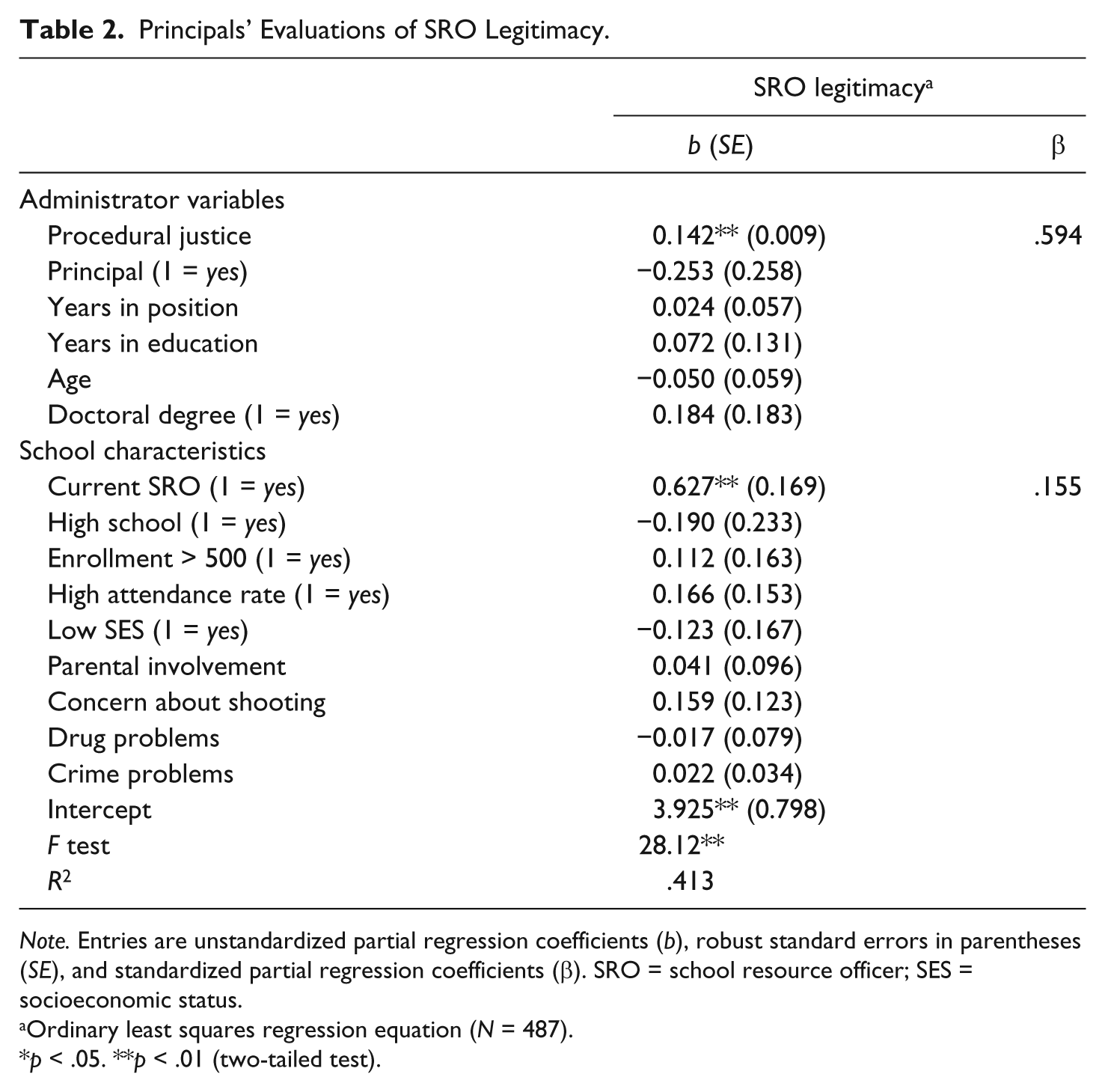
Note. Entries are unstandardized partial regression coefficients (b), robust standard errors in parentheses (SE), and standardized partial regression coefficients (β). SRO = school resource officer; SES = socioeconomic status.
Ordinary least squares regression equation (N = 487).
p < .05. **p < .01 (two-tailed test).
Support for SROs and Perceived Effectiveness
In Table 3, logistic regression is used to assess whether perceptions of procedural justice are associated with principals’ support for a policy that would require at least one SRO in every public school if entirely district funded (i.e., support for SROs; see Model 1). Consistent with previous research, procedural justice was significantly and positively associated with support for SROs (b = 0.031, p < .01). The odds ratio reveals that for every one-unit increase in the procedural justice scale, the likelihood of supporting SROs in every public school increases by about 3%. This percentage may appear trivial until one considers that the procedural justice scale ranges from 18 to 72 and has a standard deviation of 8.261. Thus, for every standard deviation increase in procedural justice, the likelihood of supporting the presence of SROs in all schools increases by nearly 25%. Simply put, school principals are more likely to support SROs if they perceive the officers as fair decision makers who treat staff and students with dignity and respect.
Principals’ Support for SROs in Every Public School and Perceptions of SRO Effectiveness in Improving School Safety.
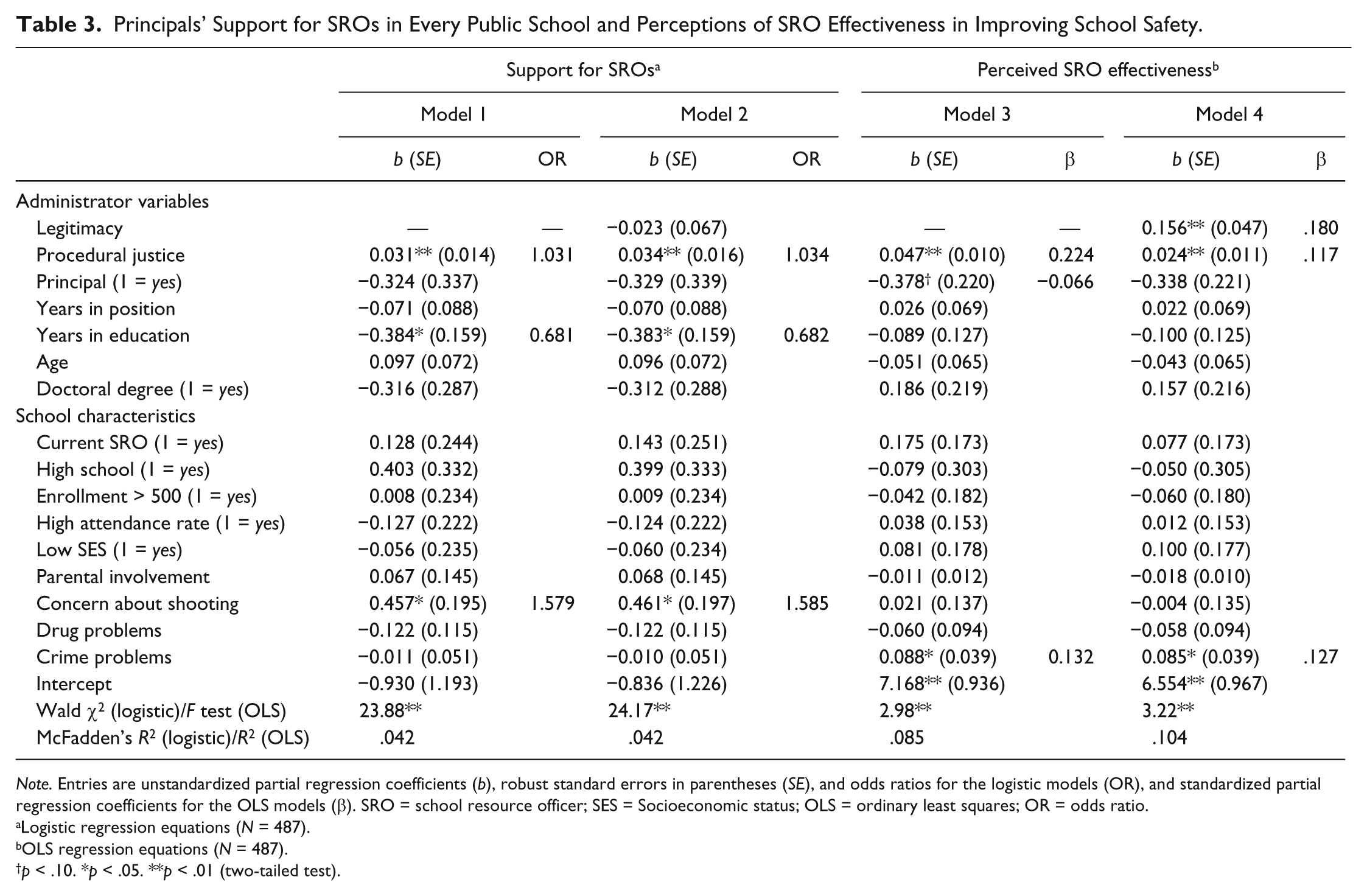
Note. Entries are unstandardized partial regression coefficients (b), robust standard errors in parentheses (SE), and odds ratios for the logistic models (OR), and standardized partial regression coefficients for the OLS models (β). SRO = school resource officer; SES = Socioeconomic status; OLS = ordinary least squares; OR = odds ratio.
Logistic regression equations (N = 487).
OLS regression equations (N = 487).
p < .10. *p < .05. **p < .01 (two-tailed test).
SRO legitimacy is added to the equation in Model 2. The data reveal several important findings. First, the explanatory power of the model does not increase with the inclusion of the legitimacy scale (i.e., the R2 and adjusted R2 remain the same in both models). Second, principals’ evaluations of SRO legitimacy are not significantly linked with support for SROs in all public schools. Procedural justice judgments are still positively associated with SRO support (b = 0.034, p < .01) and are not mediated by legitimacy evaluations. Accordingly, procedurally fair treatment by SROs appears to garner support from school principals and whether SROs are perceived as legitimate authority figures does not account for this relationship. Finally, two control variables exert statistically significant effects: principals with more years of education are less likely to support a policy that would place an SRO in every public school (b = −0.383, p < .05) and those who indicated that parents or community members have voiced more concern about school shootings in the past year are significantly more likely to support such a policy (b = 0.461, p < .05).
Models 3 and 4 in Table 3 examine the roles of procedural justice and legitimacy in predicting principals’ perceptions of SRO effectiveness in improving school safety. Model 3 presents OLS regression estimates of the effects of procedural justice and the control variables on perceived SRO effectiveness. Consistent with expectations, principals perceive SROs as more effective at improving school safety when they believe SROs are procedurally fair (b = 0.047, p < .01). This result is important because it suggests that SROs who fail to maintain procedural fairness during their interactions with school staff or students are less likely to cultivate a feeling from school administrators that they can effectively improve school safety. Negative perceptions of this sort may be detrimental to school safety as it may inhibit a collaborative working relationship between the SRO and principal. In addition, principals who self-reported more crime-related problems in their school were more likely to indicate that SROs are effective at increasing school safety (b = 0.088, p < .01).
Model 4 introduces the legitimacy scale to the equation and several findings warrant discussion. First, the explanatory power of the model improves when compared with Model 3 (i.e., an 18% increase in the R2 and 21% increase in the adjusted R2). Second, the relationship between legitimacy and perceived SRO effectiveness is in the hypothesized direction (b = 0.156, p < .01). Principals in the current sample who believe staff and students are obligated to obey SRO directives—that is, they perceive SROs as holding legitimate authority—are more likely to believe such officers are an effective means to increase school safety. Last, the unstandardized partial regression coefficient (b) for procedural justice is reduced by 49% (from .047 in Model 3 to .024 in Model 4) but remains statistically significant at the .01 level. A comparison of the standardized partial regression coefficients (β) also reveals that the legitimacy effect (β = .180) is about 35% larger than the procedural justice effect (β = .117). This evidence suggests that (a) both evaluations of legitimacy and procedural justice independently affect principals’ perceptions of SRO effectiveness (with legitimacy displaying a slightly stronger effect) and (b) SRO legitimacy partially mediates the connection between procedural justice and SRO effectiveness. Overall, the findings from Models 3 and 4 demonstrate that Tyler’s (1990) process-based model of policing is a viable framework for understanding school principals’ perceptions of SRO effectiveness. The results agree with prior research revealing a link between individuals’ legitimacy evaluations and perceptions of overall police effectiveness and that legitimacy partially accounts for the procedural justice effect. 6
Trust in and Satisfaction With SROs
The final set of regression equations analyze the subsample of principals that self-reported the presence of an SRO in their school (n = 295; see Table 4). For the sake of presentation clarity only the variables of key theoretical interest are presented in the table (full regression output is available upon request). Model 1 examines whether procedural justice influences principals’ trust in SROs. Importantly, the model accounts for a moderate amount of the variation in trust (R2 = .215) and the procedural justice scale is associated with trust in the expected direction (b = 0.060, p < .01). Principals indicate greater trust in SROs among students and teachers when they perceive SRO interactions with these individuals to be procedurally fair.
Principals’ Trust in SROs and Satisfaction with SROs.
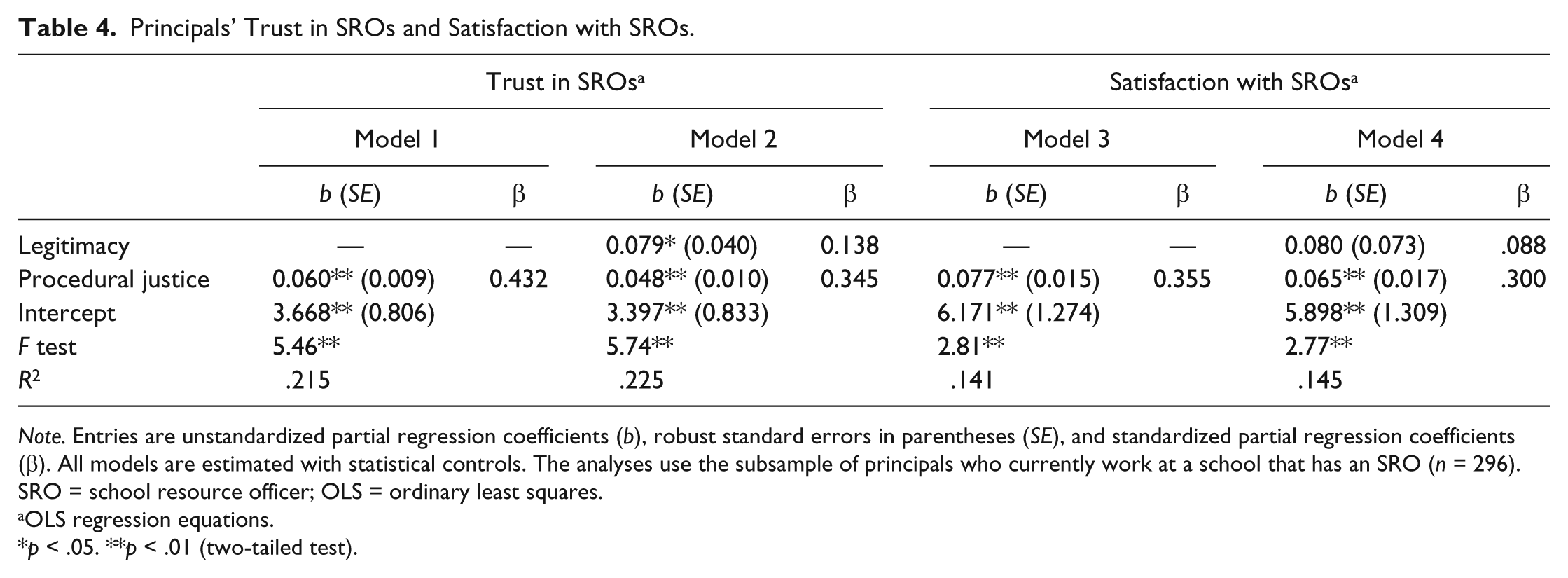
Note. Entries are unstandardized partial regression coefficients (b), robust standard errors in parentheses (SE), and standardized partial regression coefficients (β). All models are estimated with statistical controls. The analyses use the subsample of principals who currently work at a school that has an SRO (n = 296). SRO = school resource officer; OLS = ordinary least squares.
OLS regression equations.
p < .05. **p < .01 (two-tailed test).
Model 2 (see Table 4) incorporates SRO legitimacy into the regression equation and reveals several findings. For starters, while the predictive power of the model only increases marginally (from R2 = .215 in Model 1 to R2 = .225 in Model 2), respondents’ evaluations of SRO legitimacy are significantly and positively associated with trust in SROs (b = 0.079, p < .05). Next, similar to the previous analyses (see Table 3), the unstandardized partial regression coefficient (b) for procedural justice is reduced by 20% (from 0.060 in Model 1 to 0.048 in Model 4) with the inclusion of legitimacy but remains statistically significant (p < .01). What is more, the standardized partial regression coefficients (β) suggest that the procedural justice effect on trust in SROs (β = .345) is 2.5 times larger than evaluations of legitimacy (β = .138). Accordingly, both perceptions of procedural justice and legitimacy are important correlates of principals’ trust in SROs (with procedural justice having a stronger effect than legitimacy) and only a small portion of the procedural justice effect is confounded by legitimacy evaluations.
A slightly different pattern of results is observed in Model 4 (see Table 4). Procedural justice (b = 0.065, p < .01) has a statistically significant effect on respondents’ satisfaction with SROs but evaluations of legitimacy failed to have a significant effect. Principals who view SROs as procedurally just have greater satisfaction with the work the officers are doing in their schools. Thus, whether principals are satisfied with SROs in their schools rests on whether they perceive these officers’ to behave in respectful and honest ways and does not depend on the degree to which they believe SROs are a legitimate authority.
Further Tests
We performed a series of additional tests to gauge the robustness of our findings. First, it is possible that the length of an SRO appointment (i.e., how long the SRO has been in a school) will influence respondents’ perceptions of such officers more so than simply whether their schools have an SRO. To test this possibility we reestimated all regression equations and included a variable of how many years an SRO had been assigned to the respondents’ schools (coded 0 if the school did not currently have an SRO). All substantive findings remained unchanged in this sensitivity analysis. We present the results containing only the dummy variable “current SRO” because it was highly correlated with the “length of SRO appointment” variable and increased collinearity concerns. Furthermore, the “current SRO” dummy variable was the only variable to reach statistical significance in any of the models (see Table 2). The “length of SRO appointment” variable failed to research statistical significance in any of our robustness analyses. Accordingly, perceptions of SRO legitimacy seem to depend on whether a school has a current SRO and are not influenced by the length of SRO appointment. Most importantly, whether we use the dummy variable or “length of SRO appointment” does not influence the substantive findings pertaining to our theoretical variables of interest.
Another possibility is that our results may partially hinge on the inclusion of a small number of non-principal respondents (about 10% of the full sample). Recall that we accounted for possible attitudinal differences between principals and other school administrators with the dummy variable principal (1 = yes). Nonetheless, we reestimated all regression equations among the sample of only principals (full sample N = 438; schools with SRO subsample n = 261). The results of this sensitivity analysis produced identical results concerning the influence of our key theoretical variables of interest (i.e., procedural justice and legitimacy) in terms of coefficient size, direction, and statistical significance. As such, the results are not sensitive to the inclusion of non-principal respondents.
Finally, it is possible that the observed effects of our key theoretical variables (i.e., procedural justice and legitimacy) on our outcomes of interest (i.e., legitimacy, support, and perceived effectiveness) are conditioned by whether respondents’ schools have a current SRO. To explore this possibility, we created interaction terms between current SRO and procedural justice and legitimacy, respectively (continuous variables were mean-centered prior to creating the interactions). The interaction variables were then added to the appropriate regression equations to determine whether the key independent variables’ effects are conditioned by whether respondents work in schools with SROs. Importantly, none of the interactions reached statistical significance which indicates that our key theoretical relationships are not moderated by whether the respondents’ schools have an SRO.
Discussion
Following tragedies such as that at Sandy Hook Elementary School, widespread attention has been given to the use of SROs as a school security strategy. The federal government has called for increasing SRO presence in America’s schools (The White House, 2013) and provided funding for research on SRO programs (NIJ, 2014a, 2014b). Although scant pieces of research have considered the effectiveness of SROs, even fewer explore the nuances of school principals’ perceptions of SROs. Because principals are directly impacted by SRO presence in schools and interact with them on a daily basis, their attitudes toward SROs can shape the ability of these officers to effectively fulfill their duties. Using Tyler’s (1990; see also Tyler & Huo, 2002) process-based model of policing, the current study examined principals’ evaluations of SRO procedural justice and legitimacy on their overall attitudes toward these officers. In general, the empirical evidence to date demonstrates that positive evaluations of law enforcement are more likely when officer procedures are perceived as fair and unbiased and the public views the police as a legitimate authority (Mazerolle et al., 2012). With survey data from 487 public school administrators, the regression analyses showed that respondents have greater trust in and support for SROs, perceive them to be more effective, and report a greater sense of satisfaction with SROs when they perceive their actions as fair and their authority to be legitimate. These findings bear directly on several issues that require further discussion.
The first issue concerns the generalizability of procedural justice theory to understanding school principals’ evaluations of SROs. The results of the current study are consistent with previous research investigating the general public’s perceptions of law enforcement. Principals who perceive SROs to behave in a procedurally fair manner are more likely to view SROs as legitimate authority figures. Although SRO legitimacy is also related to whether or not principals currently have an SRO stationed in their school, the relationship is much stronger between perceived procedural justice and legitimacy. This is important because it suggests that SROs who treat students and staff with respect and dignity can garner perceptions of legitimacy from the top administrator in the school. In turn, perceptions of SRO procedural justice and legitimacy are associated with principals’ positive evaluations of SROs. This evidence suggests that the same social-psychological process that shapes general attitudes of the police guides principals’ views of officers working in their schools. That is, when principals perceive SROs to interact with students and staff in procedurally fair manners and when they believe students and staff should feel an obligation or responsibility to follow SROs’ directions (i.e., legitimacy), they are more likely to empower SROs, perceive them as an effective tool for improving school safety, and trust their intentions. However, the findings also show that perceptions of legitimacy do not influence respondents’ support for SROs or satisfaction with SROs. Accordingly, principals’ support for a policy that would place an SRO in every public school (even if entirely district funded) and the degree to which principals are satisfied with SRO services appears to be shaped largely by the perceived quality of treatment and decision making SROs engage in. Procedural justice leads to SRO empowerment (i.e., support for the policy) and satisfaction whereas normative beliefs concerning SRO legitimacy have no influence. The key for future research is to determine what specifically about legitimacy evaluations causes them to be associated with perceived SRO effectiveness and trust but not with support for and satisfaction with SROs.
A second point relates to the process-based model’s stipulation that evaluations of legitimacy should mediate the link between procedural justice and attitudes toward law enforcement officers. The findings suggest that perceived legitimacy only partially mediates the effect of procedural justice on principals’ evaluations of SRO effectiveness and trust in SROs. Although a strict interpretation of Tyler’s (1990) process-based model suggests that perceptions of procedural fairness increase evaluations of legitimacy which, in turn, produce more favorable attitudes toward the police, the empirical literature routinely demonstrates that procedural justice and legitimacy exert independent effects and procedural justice is typically only partially mediated by legitimacy (Kochel et al., 2013; Mazerolle et al., 2013; Tyler, 1990, 2003). Thus, the findings of the current study are consistent with prior research. South Carolina principal respondents who view SROs as effective at improving school safety and have more trust in SROs tend to harbor such attitudes both because they view SROs as procedurally fair and legitimate authorities that deserve to be obeyed.
Third, while procedural justice and legitimacy are both important in terms of predicting favorable evaluations of SROs, the relative predictive strength of each varies by the nature of the dependent variable under consideration. For example, legitimacy evaluations have a slightly stronger effect on perceived SRO effectiveness. This finding suggests that principals are more likely to view SROs as an effective strategy for impacting school safety if they view SROs as an authority that deserves reverence or obedience. Thus, while procedural justice is clearly relevant, perceived effectiveness seems to be gained more by SROs who have a strong, legitimate command presence.
Conversely, procedural justice has a much more prominent role in shaping principals’ feelings of trust in SROs. Unlike SRO effectiveness which is based on evaluations of SROs’ ability to perform their job duties (i.e., improve school safety), feelings of trust are based on principals’ perceptions of the manner in which SROs carry out their duties. Consistent with Tyler and Huo’s (2002) conceptualization of trust in the police, our data reveal that by acting in a procedurally fair manner, SROs are more likely to be perceived as making decisions with the greater good of the community (i.e., school) in mind (i.e., the SRO is trusted). Thus, it is imperative for SROs to be fair in their decision making and treat individuals with respect to gain principals’ trust. Without such trust, SROs’ authority could be undermined and their ability to effectively improve school safety compromised. In summary, the results suggest that procedural justice and legitimacy are both important, but concerns about fair treatment are the primary antecedent to support, trust, and satisfaction whereas concerns of SRO efficacy are based heavily on perceived legitimacy.
Finally, the results of this study provide important policy implications for SROs. The findings indicate that procedural justice not only enhances SRO legitimacy but also independently influences positive evaluations of SROs (i.e., support, effectiveness, trust, and satisfaction). This highlights the relevance of procedural justice as a tool by which SROs can improve principals’ perceptions. By ensuring procedurally fair treatment of students and school staff, SROs will be better equipped to ameliorate conflict, violence, and other school safety issues. When SROs are seen as making consistent and unbiased decisions and interacting respectfully with individuals within the school, they not only foster relationships with others but also establish their legitimacy as authority figures whose directives should be obeyed. Thus, SRO training could benefit by taking seriously the process-based model of police. By training officers to make unbiased decisions and to treat administrators, teachers, and students with dignity and respect, SRO programs can emphasize the legitimacy of SROs which could translate into other positive evaluations of these officers. As is clearly outlined by Tyler (1990, 2003), it is important to note that process-based policing is intended to be a supplement (not replacement) to “business as usual” law enforcement tactics that primarily rely on deterrence (e.g., the threat of force or arrest). At the same time, the process-based policing may be more applicable in the school environment than the typical patrol neighborhood because a primary goal for SROs is to mentor students rather than simply provide a visible deterrent against offending.
The importance of establishing SRO legitimacy and improving evaluations of SROs should not be discounted. Ensuring SROs are procedurally fair may help form the foundation for an intimate working relationship between these officers and principals, which could result in collaborative efforts between law enforcement and school administration in maintaining school safety. Moreover, it could also foster a stronger relationship between the SROs and the entire school, including teachers and students. Furthermore, the larger body of literature regarding procedural justice suggests that perceptions of procedural fairness and legitimacy can lead to other behaviors that benefit the school community, such as voluntary compliance and cooperation with law enforcement (Barkworth & Murphy, 2015; Reisig et al., 2007; Tyler, 1990). Research suggests that students are more likely to report incidents to SROs when they feel as though they have a good relationship with the officer (Theriot, 2013), a relationship that could result from perceptions that the SRO is procedurally fair.
The present study has several limitations. First, the analyses rely on cross-sectional survey data. This methodology is typical of the larger procedural justice and police legitimacy literature with only a handful of studies using data that can establish temporal order (see, for example, Mazerolle et al., 2013; Piquero et al., 2005). Future work in this area would benefit from using longitudinal data because it could help advance our understanding of the true antecedents of legitimacy (and other positive evaluations) and reveal possible reciprocal effects. For example, research has shown that perceived police effectiveness is a precursor to legitimacy (Kochel et al., 2013) and the current data demonstrate that legitimacy evaluations are associated with greater perceived SRO effectiveness. Longitudinal data would allow researchers to disentangle the causal direction of these relationships. In addition, our data come from public school principals in one southern state. While this is the first study to apply procedural justice theory to principals’ evaluations of SROs, replication studies are needed to determine if similar relationships are observed in different regions of the United States or in private schools.
In the end, the present study demonstrates that the scope of the process-based model of policing extends to the context of principals evaluations of SROs. In short, principals who view SROs as conducting themselves fairly and objectively are more likely to support policies that increase SRO presence, believe SROs can effectively increase school safety, trust SROs’ behavioral intentions, and be satisfied with SROs’ service to their schools. The present study’s findings are important for the small, yet growing, literature on SRO perceptions because they speak of the types of interactions and communication that may be most meaningful in sustaining favorable evaluations of SROs. As discussed earlier, frequent communication with principals appears to be related to more favorable attitudes of SROs. Our analysis suggests that procedurally fair SRO interactions may be the key to fostering such positive working relationships between SROs and principals. What is unique about the setting we investigated is that SROs are officers who are placed in environments where the main goal is to educate students. Nonetheless, evaluations of SROs seem to be grounded in the same normative beliefs as the typical street officer. In a similar way as has been shown among general population surveys regarding legitimacy and community relations (Kochel, 2012; Tyler & Wakslak, 2004), the safety and well-being of a school may depend heavily on the favorability of principals’ evaluations of SROs. The next logical step for the literature to take is to examine whether the process-based model also explains students’ perceptions of SROs. Such a study would be beneficial on both theoretical and policy-oriented grounds because the purpose of many SRO programs is to improve the safety of students in schools, achieve greater student compliance with rules, and improve lines of communication between students and law enforcement. The ability of the school and SRO to achieve such goals may depend on students’ perceptions of SRO procedural justice and legitimacy.
Footnotes
Appendix
Comparison of Descriptive Statistics between Respondents Who Have an SRO in Their Schools and Those That Do Not.
| SRO in respondents’ school (n = 296) |
No SRO in respondents’ school (n = 191) |
t test | |||||||
|---|---|---|---|---|---|---|---|---|---|
| M | SD | Minimum | Maximum | M | SD | Minimum | Maximum | ||
|
|
|||||||||
| SRO legitimacy | 13.966 | 2.003 | 5 | 16 | 13.073 | 1.814 | 9 | 16 | 4.982* |
| Support for SROs | 0.318 | 0.466 | 0 | 1 | 0.288 | 0.454 | 0 | 1 | 0.691 |
| Perceived SRO effectiveness | 9.645 | 1.731 | 3 | 12 | 9.335 | 1.684 | 3 | 12 | 1.952 |
| Trust in SROs | 7.128 | 1.151 | 2 | 8 | 7.152 | 1.245 | 2 | 8 | −0.213 |
| Satisfaction with SROs | 10.757 | 1.812 | 3 | 12 | 10.770 | 1.832 | 3 | 12 | −0.076 |
|
|
|||||||||
| Administrator variables | |||||||||
| Procedural justice | 63.855 | 8.330 | 18 | 72 | 61.565 | 7.976 | 45 | 72 | 3.011* |
| Principal (1 = yes) | 0.882 | 0.323 | 0 | 1 | 0.927 | 0.261 | 0 | 1 | −1.611 |
| Years in position | 2.709 | 1.274 | 1 | 6 | 2.749 | 1.281 | 1 | 6 | −0.331 |
| Years in education | 5.456 | 0.762 | 2 | 6 | 5.471 | 0.826 | 2 | 6 | −0.207 |
| Age | 4.997 | 1.716 | 1 | 8 | 4.895 | 1.762 | 1 | 8 | 0.630 |
| Doctoral degree (1 = yes) | 0.176 | 0.381 | 0 | 1 | 0.168 | 0.374 | 0 | 1 | 0.232 |
| School characteristics | |||||||||
| High school (1 = yes) | 0.358 | 0.480 | 0 | 1 | 0.037 | 0.188 | 0 | 1 | 8.820* |
| Enrollment > 500 (1 = yes) | 0.730 | 0.445 | 0 | 1 | 0.508 | 0.501 | 0 | 1 | 5.111* |
| High attendance rate (1 = yes) | 0.625 | 0.485 | 0 | 1 | 0.717 | 0.452 | 0 | 1 | −2.106* |
| Low SES (1 = yes) | 0.351 | 0.478 | 0 | 1 | 0.461 | 0.500 | 0 | 1 | −2.421* |
| Parental involvement | 2.885 | 0.777 | 0 | 4 | 2.974 | 0.784 | 0 | 4 | −1.225 |
| Concern about shooting | 0.328 | 0.574 | −1 | 1 | 0.534 | 0.541 | −1 | 1 | −3.961* |
| Drug problems | 1.297 | 1.582 | 0 | 6 | 0.272 | 0.846 | 0 | 6 | 8.229* |
| Crime problems | 4.517 | 2.650 | 0 | 13 | 3.283 | 2.227 | 0 | 11 | 5.334* |
Note. SRO = school resource officer; SES = socioeconomic status.
p < .05.
Declaration of Conflicting Interests
The author(s) declared no potential conflicts of interest with respect to the research, authorship, and/or publication of this article.
Funding
The author(s) received no financial support for the research, authorship, and/or publication of this article.