



Abstract
Justice reinvestment strategies have been proposed to allow financial resources originally allocated for imprisonment to be reinvested into community-based alternatives. According to this perspective, the government has the responsibility to fund strategies that reduce crime, and previous studies have questioned the effectiveness of prison as one solution. Furthermore, empirical support for community-based alternatives underscores the importance of delivering interventions in offenders’ natural environments. This study explores one state’s attempt to fund strategies that reduce crime and delinquency. Through the Targeted Reasoned and Equitable Community and Local Alternatives to the Incarceration of Minors (RECLAIM) initiative, the State of Ohio attempted to reduce the risk of recidivism by serving more youth locally, instead of in secure facilities in the six most populous counties throughout the state. Specifically, the findings suggest that the Targeted RECLAIM initiative was successful in reducing the risk of recidivism of participating youth.
There is a growing movement to alter sentencing and correctional policies in the United States, so that financial resources allocated for imprisonment are reinvested more effectively into community-based alternatives. This notion is consistent with the core principle behind global reinvestment strategies; that is, governments have a responsibility to develop and fund justice policies that reduce crime (Clear, 2011). In a recent forum on justice reinvestment, Clear (2011) identified three main types of justice reinvestment strategies: justice reinvestment through (a) policy analysis, (b) local incentives, and (c) social investment bonds. These various strategies have been proposed to allow for reinvestment in offender treatment programs as well as improvements in public safety, public health, education, and housing strategies in communities with a high concentration of offenders (Clear, 2011; Currie, 1998).
Reinvestment into community-based programming is not only encouraged by various justice reinvestment strategies, but it is also supported in the correctional treatment literature. Noteworthy, some research does suggest that the incapacitation effect from incarceration, while modest, does have a deterrent effect (see Nagin, 1998); however, there is also evidence that demonstrates longer incarceration is associated with higher levels of recidivism (Smith, Goggin, & Gendreau, 2002). Furthermore, previous meta-analyses have consistently replicated the finding that offender treatment programs delivered in a community-based setting are associated with greater reductions in recidivism as compared with institutional programs (see Andrews & Bonta, 2010, for a review). Several reasons to explain this pattern of results have been proposed. For example, it has been hypothesized that prisons are “schools of crime” where lower risk offenders learn more criminal behaviors from their higher-risk counterparts (Gendreau & Goggin, 2013). In addition, even the highest-quality institutional programs are offered in artificial environments where the skills learned by inmates do not necessarily generalize to their natural environments upon release (Gendreau & Smith, 2012). Others have characterized correctional institutions as a “one-size-fits-all approach” to offenders versus an intervention designed to target the specific criminogenic needs of individual offenders (Clear, 2007).
Attempting to manage the use of juvenile confinement and provide effective services to youth, justice reinvestment strategies are evident in various states across the county. For example, several states have created incentives for local courts to rely less on incarceration and more on community-based services to serve juvenile justice involved youth. Ohio, New York, Illinois, Pennsylvania, and Wisconsin are a few of the first states to provide incentives to local courts in an effort to decrease the overall reliance on incarceration (Butts & Evans, 2011). Ohio, in particular, has implemented a program, Targeted Reasoned and Equitable Community and Local Alternatives to the Incarceration of Minors (RECLAIM), as a means to reinvest a proportion of the resources allocated for juvenile commitments to community-based interventions in Ohio’s six most populous counties.
Given the empirical evidence that favors community-based programs over institutional treatment, several states have shifted resources to support services in the community. It is therefore imperative to investigate whether the implementation of these reinvestment strategies can reduce recidivism and improve public safety by reducing crime. Consequently, this study provides a unique opportunity to examine the state of Ohio’s attempt to implement a justice reinvestment strategy. This study begins with a review of the history of the practice of incarceration, followed by a discussion of the intention of incarceration, and some potential alternatives to incarceration, including a description of Ohio’s recent justice reinvestment efforts and the present study. By examining if youth confinement rates can be lowered without jeopardizing public safety, juvenile justice policy makers can find value in the results of the study. As this study shows, reducing reliance on incarceration can have an impact on the juvenile justice system as well as on the general public.
Incarceration in the United States
The United States began incarcerating offenders in the early 1800s as a means to deter future criminal behavior (Blomberg & Lucken, 2010). While the use of incarceration as a social control mechanism has not always been popular, the 1970s saw an escalation in incarceration rates (Austin & Irwin, 2012). Coupled with several political and criminal justice system changes (Cullen & Gilbert, 1982), the 1970s began what has been referred to as the “penal harm movement” (Clear, 1994). As a part of this movement, determinate sentencing became the norm, juveniles were eligible to be transferred to the adult court, and status offenders who violated court orders could be incarcerated (Moon, Applegate, & Latessa, 1997). By the end of the 1990s, this overreliance on incarceration resulted in the mass incarceration of millions of U.S. citizens with more than 100,000 juveniles sentenced to a secure juvenile justice placement (Sickmund, Sladky, Kang, & Puzzanchera, 2013).
With such a large number of Americans incarcerated, researchers began to question the ability of incarceration to prevent crime through incapacitation or deterrence. Some have even argued that youth incarceration rates and crime rates are not correlated in the way most would expect (Butts & Evans, 2011). There is a growing body of evidence that juvenile confinement does not improve public safety (Lambie & Randell, 2013; Petteruti, Velázquez, & Walsh, 2009; Stahlkopf, Males, & Macallair, 2010). For example, a little more than 1,000 youth from an ongoing longitudinal study of serious adolescent offenders found that institutional placement raised the level of offending among youth who reported the lowest level of offending behavior following placement (Mulvey, 2011). Furthermore, a slightly smaller subset of these youth showed no gain from placement in terms of reducing future offending (Loughran et al., 2009). Consistent with these findings, a comprehensive review of the literature, conducted by Nagin, Cullen, and Jonson (2009), concluded that a vast majority of studies point to a null or criminogenic effect of incarceration on subsequent offending.
Alternatives to Mass Incarceration
Correctional scholars have recently advocated for changes in sentencing and correctional control strategies to help address overcrowding, financial concerns, and a decrease in the overall delinquency rate (Butts & Evans, 2011; Clear, 2011; Cullen, Johnson, & Stohr, 2014; Currie, 1998). Accordingly, justice reinvestment strategies call for a proportion of the resources currently allocated to correctional facilities to be diverted to fund offender treatment and prevention programs in the community (Clear, 2011; Currie, 1998; Petteruti et al., 2009).
For example, the Justice Reinvestment Initiative (JRI) was launched between 2001 and 2003 as a public safety mechanism to downsize prison populations and reallocate savings to communities with high levels of offenders (Austin et al., 2013). First, initiated by the Council of State Governments (CSG) and now through its principal funders, Pew Charitable Trusts (Pew) and Bureau of Justice Assistance (BJA), JRI has evolved into a formal implementation strategy that includes identifying a set of clear policy goals, structuring incentives to reward justice and fair play, and developing effective strategies to reverse the overreliance on incarceration, including community reinvestment (Austin et al., 2013). While early impacts of JRI initiatives have shown mixed results, more recent efforts in New York and Colorado, for example, have demonstrated that state-level reforms are possible (Austin et al., 2013).
In 2009, the Juvenile Justice Policy Institute issued a policy brief detailing how states can alter the financial structure of their juvenile justice system. Specifically, in the policy brief, states were challenged to find ways to incentivize counties to serve youth locally, including (a) financially reimbursing counties for costs incurred to manage youth locally, (b) requiring the county to pay part of the cost of confining a child in a state institution, (c) increasing the costs for counties to send youth to state institutions, and (d) providing funding to develop programs locally (Petteruti et al., 2009). Several states have taken on this challenge to change their fiscal architecture by creating incentives for counties to provide community-based services, while also decreasing their reliance on incarceration, including Ohio, New York, Illinois, Pennsylvania, and Wisconsin.
These states and other proponents of justice reinvestment strategies can find support in empirical research. The meta-analytic results consistently demonstrate that correctional programming can be effective in reducing the recidivism rates of offenders (see Andrews & Bonta, 2010, for a review). In their review of the correctional treatment and sanctions meta-analyses, Lipsey and Cullen (2007) found that every one of the major meta-analyses that focused on recidivism outcomes found mean effect sizes favorable to treatment. Furthermore, interventions have been found to be more effective when delivered in the community as compared with those provided in institutional settings (Lipsey, 1992; Lipsey & Wilson, 1998). Therefore, the research certainly supports the notion that to achieve the best outcomes for youth offenders and the public, community-based, empirically supported interventions should be adopted as an alternative to incarceration.
Targeted RECLAIM
In 1993, the state of Ohio created the RECLAIM program to provide opportunities for all 88 Ohio counties to serve delinquents who were adjudicated for less serious felonies in the community and reserve state institutions for more serious youth offenders (Lowenkamp & Latessa, 2005). Targeted RECLAIM is an extension of this larger initiative and was developed in 2009 as a means to reinvest a proportion of the resources allocated for juvenile commitments to community-based interventions in Ohio’s six most populous counties (for more information, see Labrecque & Schweitzer, 2012). The goal of Targeted RECLAIM is to reduce the number of admissions to the Ohio Department of Youth Services (ODYS) from these counties by providing juveniles with quality services in their local community as an alternative to incarceration (National Center for Justice Planning, 2012).
To achieve this goal, Targeted RECLAIM has been designed to motivate these counties to serve youth in the community by allocating money to each county and allowing that county to choose whether each youth should be treated locally or sent to ODYS. As a JRI, each county is required to pay for each youth placed at ODYS. Furthermore, Targeted RECLAIM requires counties to commit to obtaining targeted reductions in ODYS admissions, and counties that fail to achieve their goals are subject to reduced funding. Therefore, Targeted RECLAIM gives counties a fiscal incentive to serve youth locally.
To best serve youth locally, the second part of Targeted RECLAIM is the provision of quality community-based services. Targeted RECLAIM funds are therefore reserved for the implementation of various structured cognitive and behavioral interventions that target criminogenic needs. Counties can choose to deliver the interventions in a group setting using structured curricula such as Thinking for a Change (Bush, Glick, & Taymans, 1997), Aggression Replacement Training (Goldstein, Glick, & Gibbs, 1998), and Pathways to Self-Discovery and Change (Milkman & Wanberg, 2012), in a family setting applying the principles of Functional Family Therapy or Multisystemic Therapy (Henggeler, 1998), or during individual contact sessions between a probation officer and youth using the Effective Practices in Community Supervision Model (Smith, Schweitzer, Labrecque, & Latessa, 2012).
Current Study
This study examines whether Targeted RECLAIM is an effective strategy for reducing recidivism. Previous studies have been limited to comparisons at the county- and state level, which does not take into account any historical factors (e.g., decreasing national crime rates, increasing costs associated with incarceration, changing social and political views on juvenile punishment), and the steady decrease of commitments in Ohio since 2010 indicates the need for more advanced empirical investigations. Therefore, this study uses a quasi-experimental matched comparison group design to provide a more comprehensive outcome evaluation of the effects of Targeted RECLAIM to date.
Method
Participants
The experimental group of this evaluation consists of all youth who participated in the Targeted RECLAIM program during the calendar year of 2011 (n = 239). A matched comparison control group was selected from those youth who were released from the ODYS custody during the same time period (n = 239). The ODYS sample was used as a comparison group because without the availability of the Targeted RECLAIM services, many of the youth in the experimental group may have alternatively been sent to ODYS custody.
Variables Examined
Sample demographics
Descriptive characteristics of the sample include gender (1 = male, 0 = female), race (1 = White, 0 = non-White), age, risk level, and county of conviction. Risk information was obtained through the Ohio Youth Assessment System (OYAS) computerized database system. The OYAS was designed to assist juvenile justice agencies in providing the most effective interventions for youth based on their likelihood to reoffend, their criminogenic needs, and their barriers to service (Latessa, Lovins, & Ostrowski, 2009). All youth were classified into one of three risk categories: low-, moderate-, or high-risk to reoffend (for more information on the OYAS, see Latessa, Lemke, Makarios, Smith, & Lowenkamp, 2010). County of conviction was limited to the six counties participating in the Targeted RECLAIM program.
Outcome measure
Recidivism is the outcome of interest in this study and is defined here as incarceration to the juvenile or adult prison systems on or before June 30, 2012, for any reason. This definition was selected because one major purpose of Targeted RECLAIM is to reduce the number of incarcerations to the youth system and invariably the adult prison systems. Given the method in which the samples were selected, the lengths of follow-up were significantly different between the two groups (p < .001). For the Targeted RECLAIM group, time at risk began when the youth was enrolled in treatment (M = 15.5 months, SD = 4.3, range = 6-33), compared with the ODYS group, whose time at risk began after they were released from custody (M = 12.4 months, SD = 3.2, range = 6-17). Therefore, the differences in time at risk were controlled for by applying the same length of follow-up to each matched set in the sample. For example, if a Targeted RECLAIM youth was at risk for 9 months and the matched ODYS youth was only in the community for 6 months, the length of follow-up for both individuals would be 6 months.
Matching Procedure
This study attempted to match the Targeted RECLAIM youth with a subsample of ODYS youth released during 2011 (n = 730) on the characteristics of gender, race, age, risk level, and county of conviction. However, a direct one for one matching of youth was not possible on two of the variables examined (age and county of conviction). First, it was not possible to match on the variable age because the Targeted RECLAIM youth were much younger than those released from ODYS custody. Second, it was not possible to obtain a direct match for all youth on the variable county of commitment. This is because there were two counties, in which there were more youth receiving Targeted RECLAIM services in 2011 than were released from ODYS custody. Thus, to obtain an equal size comparison group, youth released from the other participating Targeted RECLAIM counties were selected as matches.
Analysis
This study uses survival analysis to assess the ability of the Targeted RECLAIM program to reduce recidivism. In analyzing recidivism, survival analysis is a preferable technique because it uses time-dependent data, which is important for determining not only if a youth recidivates but also when the youth recidivates. Specifically, this study uses a Cox proportional hazards model (Cox, 1972), which uses both “time” and “status” variables in estimating the impact of the independent variables on recidivism. For the analysis presented here, the “time” variable measures the amount of time (in months) at risk in the community, and the “status” variable measures whether the youth was recidivated during this period.
Results
A description of the sample is presented in Table 1. Generally speaking, the majority of the youth in the sample are male (95%) and non-White (78.2%). The Targeted RECLAIM youth were significantly younger (M = 15.7) than the ODYS youth (M = 16.9), t(475) = 10.15, p < .001, d = .93. There were also significant differences between the two groups on the county of conviction variable, χ2 = 37.4, df = 5, p < .001. There are no statistically significant differences between the treatment and control groups on the variables of gender, race, or risk level.
Descriptive Statistics of the Sample by Group Type (N = 478).
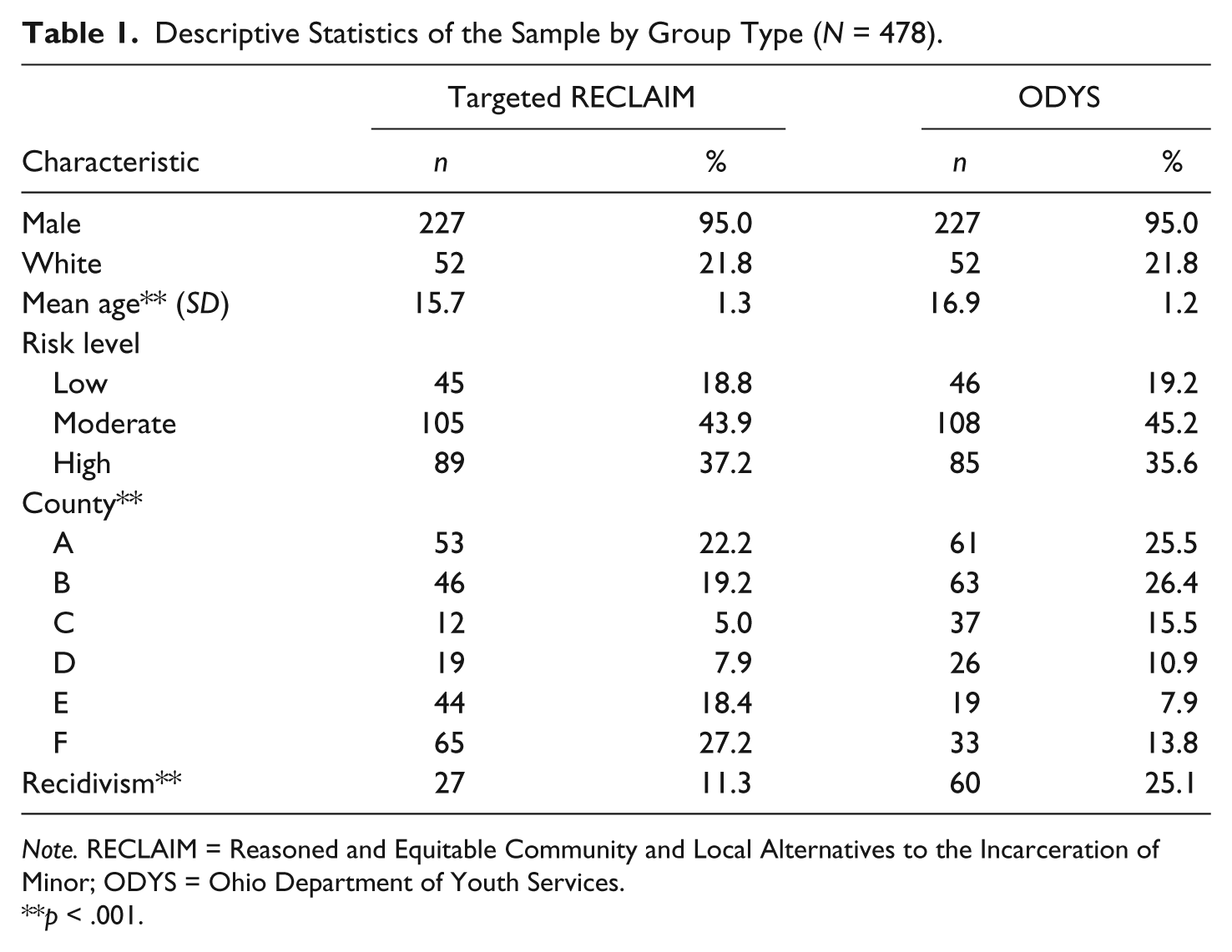
Note. RECLAIM = Reasoned and Equitable Community and Local Alternatives to the Incarceration of Minor; ODYS = Ohio Department of Youth Services.
p < .001.
Table 1 also examines the recidivism rates by group type. Of the 478 offenders included in the total sample, 25.1% of the ODYS group (or 60 youth) were incarcerated during the follow-up period compared with only 11.3% of the Targeted RECLAIM group (or 27 youth). This means the ODYS youth were 2.4 times more likely to be incarcerated during follow-up than the Targeted RECLAIM youth (χ2 = 17.53, Φ = −.18, df = 1, p < .001). It is possible, however, that the observed differences in recidivism rates between these two groups are due to other factors such as time at risk, county of conviction, offender risk for recidivism, age, gender, and/or race. To statistically control for the potential impact of these other factors, a Cox regression model will be estimated.
The results in Table 2 indicate that, controlling for the effects of the other independent variables in the statistical model, participation in the Targeted RECLAIM program significantly reduced the hazard ratio for recidivism during the follow-up period. That is, the youth in the Targeted RECLAIM group recidivated less often and more slowly than those released from ODYS custody. In particular, the hazard rate was more than four times lower for those in the Targeted RECLAIM group compared with those in the ODYS group. The results also showed that the hazard ratio was significantly greater for younger offenders. Every additional 1 year of age at the start of the study is associated with a 19% increase in the hazard of recidivating. The variables of county of conviction, risk, age, gender, and race did not have any significant effects on recidivism.
Cox Proportional Hazard Model for Targeted RECLAIM Participation (N = 478).

Note. RECLAIM = Reasoned and Equitable Community and Local Alternatives to the Incarceration of Minor.
Reference group is low risk.
Reference group is County A.
p < .05. **p < .001.
Discussion
This study explored one state’s attempt to fund programs and strategies that reduce crime and delinquency. Ohio, through Targeted RECLAIM, attempted to reduce the risk of recidivism by serving more youth locally instead of in secure facilities throughout the state. The evidence from this study suggests that the community-based programming provided to the youth through Targeted RECLAIM is effective in reducing commitments to juvenile and adult institutions. Even when controlling for the effects of time at risk, county of conviction, offender risk for recidivism, age, gender, and race, the results indicate that youth receiving Targeted RECLAIM services recidivated less often and more slowly than those released from ODYS custody.
This study supports the notion that sentencing and correctional control policies and programs can achieve meaningful reductions in recidivism and reduce reliance on incarceration as a social response to crime. States searching for ways to reduce commitments and reinvest in their communities might find Targeted RECLAIM to be a viable model to replicate. The finding that the hazard rate for the ODYS group was more than four times higher than that for the Targeted RECLAIM group provides evidence in favor of community-based programming over incarceration. This finding is also consistent with previous research finding that offender treatment programs delivered in a community-based setting are associated with greater reductions in recidivism as compared with institutional programs (Andrews & Bonta, 2010). As suggested by others, this could be because even the highest quality institutional programs are offered in artificial environments where the skills learned by inmates do not necessarily generalize to their natural environments upon release or because Department of Youth Services (DYS) takes more of a “one-size-fits-all approach” to the youth in their custody (Clear, 2007; Gendreau & Smith, 2012). With the confirmation that youth have a distinct advantage when receiving Targeted RECLAIM services over ODYS placement, this study demonstrates that justice reinvestment can be achieved through incentivizing local agencies to develop community-based programs for youth. Moreover, this study begins to fill in the empirical gap needed to demonstrate that the implementation of reinvestment strategies can improve public safety by reducing crime.
The findings from this study suggest that the Targeted RECLAIM initiative is on track to continue supporting local community-level programming options, while striving to improve public safety within the six participating counties. However, although the results from this study are certainly encouraging, there are a few limitations that should be understood before proceeding with any potential policy changes. First, the comparison group included juveniles released from the ODYS custody. Therefore, although it can be argued that the Targeted RECLAIM program produced fewer recidivists than did placement in ODYS, it is ultimately unknown if better results could have been achieved through the application of less punitive options (e.g., probation, no formal intervention). If juvenile justice policies are to be selected based on their ability to achieve the best reductions in crime, future studies will have to more adequately address these alternative comparison groups.
Second, this study has a follow-up period of 1.5 years or less. The use of an increased follow-up period would provide more confidence in the ability of Targeted RECLAIM to serve as a viable alternative to incarceration. Such an evaluation would be beneficial from a public safety and economic standpoint. Third, this study defined recidivism as incarceration to the juvenile or adult prison systems for any reason. Although similar studies have used this definition (see Lowenkamp & Latessa, 2005), the study could be further enhanced by using additional definitions such as arrest, adjudication, and conviction. Likewise, using such measures may also help with the study’s limited average length of follow-up period.
Finally, this study did not assess the effect of the specific services youth received; rather, it examined the effect of the Targeted RECLAIM program as a whole. Therefore, the present study did not permit the examination of whether or not the services provided to youth were new or existing services enhanced through Targeted RECLAIM funding. Furthermore, this study is not able to parcel out what specific services are most effective and for which youth these programs work best. With these limitations in mind, a forthcoming study by these authors will assess the differential impact of risk and type of treatment on recidivism (Labrecque, Schweitzer, Mattick, & Latessa, 2014). Such a study would expand the present study by identifying which offenders would benefit the most from participation as well as determine which programs are most effective and should continue to be invested in.
Footnotes
Declaration of Conflicting Interests
The author(s) declared no potential conflicts of interest with respect to the research, authorship, and/or publication of this article.
Funding
The author(s) received no financial support for the research, authorship, and/or publication of this article.