



Abstract
Recent critiques of the decision to make monetary sanctions a condition of probation have suggested that the practice could hinder the successful completion of probation. However, few studies have explored this relationship empirically, and among those that do, the findings are relatively inconclusive and often dependent on the sample and measures used. Building on this research, the current study examines the imposition of four monetary sanctions on a sample of felony cases involving indigent adult probationers from a Florida public defender’s office. The results indicate that although monetary sanctions have relatively little impact on probation violations generally, the effects of these penalties vary based on the severity of the violation. Legal factors are consistently the most significant predictors of the likelihood and severity of probation violations.
Introduction
The growing prison population has called for the increasing use of alternative sanctions, such as probation, instead of incarceration (Ruback, 2004; Ruback & Bergstrom, 2006). Although probation is often touted as less punitive and stigmatizing compared with incarceration, recent theoretical and empirical literature suggests that probation can actually be seen as a more severe punishment (Anderson, 2009; Beckett & Harris, 2011; Diller, 2010; Patel & Phillip, 2012). Although some offenders successfully complete their probation sentence, many others fail to comply with the terms of their probation (Grattet, Petersilia, Lin, & Beckman, 2009). Under certain circumstances, the conditions of probation are viewed as so impossible to meet that offenders would rather “choose” incarceration (Bannon, Nagrecha, & Diller, 2010; Crouch, 1993). As a result, it is not uncommon for offenders on probation to fail and return back into the system, creating a perpetual cycle (Harris, Evans, & Beckett, 2010; Vallas & Patel, 2012). The efforts of policy makers to both reduce costs and control prison growth by keeping offenders out of jail or prison and on supervision are diminished when the same offenders continue to return back to the system (Henrichson & Delaney, 2012). For these reasons, it is important to identify the factors that reduce the odds of successfully completing probation (Gray, Fields, & Maxwell, 2001; Rodriguez & Webb, 2007).
There are two loci of control structuring probation outcomes: (a) the probationer and (b) the criminal justice system. Although the probationer is obviously responsible for abiding by the conditions of his or her probation, agents of the criminal justice system also play a major role in a probationer’s success. Criminal justice personnel are initially responsible for crafting the original probation conditions. Prosecutors and defense attorneys generally agree on the terms of the probation sentence as part of the plea negotiation process and recommend the agreed on sentence to the judge, whereas judges are mostly responsible for making probation decisions after trial. In both instances, the attorneys and judges can rely on probation officer pre-sentence investigation reports. It is then left to the discretion of system personnel to handle violating behavior once the offender is placed on probation. Probation officers, police officers—by virtue of an arrest for a new crime—and judges may choose to officially issue a violation and revocation where warranted. As a result, both probationers’ adherence to probation conditions, coupled with the decision-making processes by the agents within the criminal justice system, can influence probation outcomes (Jones & Kerbs, 2007; Kingsnorth, Macintosh, & Sutherland, 2002; Rodriguez & Webb, 2007).
One aspect of probation that has received less attention in relation to probation success is the mandatory payment of monetary sanctions that are imposed by the system on criminal defendants and often made a condition of the probation sentence. These sanctions can range from administrative costs, such as court costs and fees and prosecution fees, to costs ordered as a condition of the criminal sentence, including victim restitution. A number of recent critiques of this practice suggest that the burden of financial payment as a condition of probation can be unnecessarily detrimental to probation success (Anderson, 2009; Bannon et al., 2010; Beckett & Harris, 2011; Harris et al., 2010; McLean & Thompson, 2007; Rosenthal & Weissman, 2007). Failure to pay these costs may be considered a violation of probation, in which a warrant may be issued and the offender arrested and potentially re-incarcerated (Weisburd, Einat, & Kowalski, 2008). However, it is still questionable whether these financial penalties are actually a handicap to probationers. Although there is a limited amount of work devoted to examining the consequences of monetary sanctions, this work suffers from mixed findings and methodological nuances that preclude any conclusion as to the effects of monetary sanctions on probation outcomes (Gordon & Glaser, 1991; Mayzer, Gray, & Maxwell, 2004; Minor, Wells, & Sims, 2003; Rodriguez & Webb, 2007).
The current study focuses specifically on the imposition of monetary sanctions by the criminal justice system and the effect of these penalties on the successful completion of probation. We first provide a detailed review of prior research, identifying and discussing important methodological issues among the existing studies. We then address these issues in analyses using a sample of probation cases from a public defender’s office in Florida. We explore whether (a) monetary sanctions increase the odds of a probation violation generally and (b) offenders involved in cases with monetary sanctions are more prone to certain violations, ranging from less severe and technical violations to more serious indiscretions.
The Imposition of Monetary Sanctions
A number of studies have focused on various legal and individual factors that could contribute to the failure of probation. Research suggests that probation violations are more likely among probationers who have extensive criminal histories, previous incarceration sentences, prior records, property and misdemeanor convictions, prior probation violations, charges for violent offenses, and histories with drugs or alcohol (Gordon & Glaser, 1991; Grattet et al., 2009; Green & Winik, 2010; MacKenzie, 1991; Mayzer et al., 2004; Minor et al., 2003; Morgan, 1993, 1994; Olson & Lurigio, 2000; Sims & Jones, 1997; Weisburd et al., 2008). Studies also show that probationers are more likely to have their probation officially revoked if they had an incarceration sentence prior to probation, prior convictions, drug-related convictions, and histories of drug abuse (Gordon & Glaser, 1991; Olson & Lurigio, 2000; Rodriguez & Webb, 2007; but see MacKenzie, 1991). However, an important, yet understudied, element of probation success is the burden of monetary sanctions placed on offenders as a condition of probation (Anderson, 2009; Bannon et al., 2010; Gordon & Glaser, 1991; Rosenthal & Weissman, 2007; Ruback & Bergstrom, 2006).
Three general rationales exist for having offenders assume the financial burden of court operations. First, the number of people under criminal justice supervision, including those on probation, has multiplied exponentially since 1980, from approximately 2 million to more than 7 million (Bonczar & Glaze, 2009). Consequently, the costs of incarceration have skyrocketed, resulting in increased budgetary allocations toward this effort (Schmitt, Warner, & Gupta, 2010) and an increased burden on taxpayers (Henrichson & Delaney, 2012). Second, in the wake of the President’s Task Force headed by Ronald Reagan in 1982, the victims’ rights movement and the development of criminological theories of victimization (e.g., routine activities theory, Cohen & Felson, 1979) sparked the development of legal protections and criminal justice policies, such as victim restitution, that reflect the more sympathetic perception and interests of the criminal victim (Garland, 2001; Roland, 1990). Last, as previously noted, the growing prison population has called for the increasing use of alternative sanctions, such as probation, whose conditions often involve mandatory payment of monetary penalties under threat of incarceration (Anderson, 2009; Bannon et al., 2010; Weisburd et al., 2008).
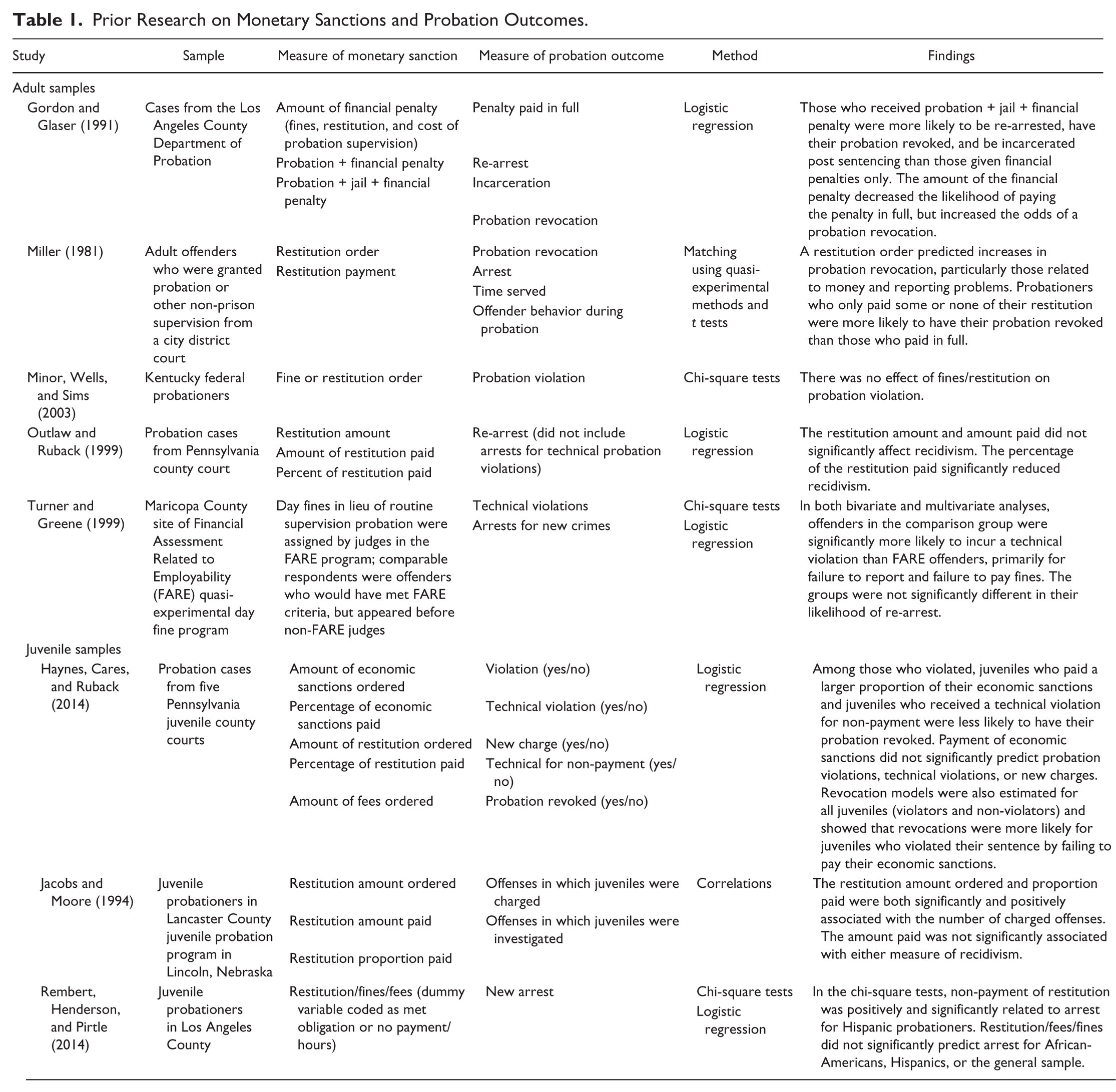
A review of the limited research pertaining to the monetary sanctions–probation success relationship (shown in Table 1) reveals fairly mixed findings. The ability to draw conclusions from these studies is further restricted by methodological issues regarding the (a) samples used, (b) measures of monetary sanctions, and (c) measures of probation outcomes. Below, we review the existing research, highlighting how each of the issues identified can limit our understanding of the monetary sanctions–probation success relationship. It should be noted that although studies have explored the imposition and effects of monetary sanctions on post-sentencing outcomes among general samples of offenders (e.g., Blattenberger, Fowles, & Krantz, 2010; Butts & Snyder, 1992; George & Olympia, 2012; A. L. Schneider, 1986; P. R. Schneider, Griffith, & Schneider, 1982), we focus only on those studies that specifically tested the impact of monetary sanctions on probation outcomes.
Prior Research on Monetary Sanctions and Probation Outcomes.
Issue 1: Sampling
The first issue to consider among the existing studies is the sample used. First, as seen in Table 1, studies with juvenile samples compose slightly more than a third of the research in this area (Haynes, Cares, & Ruback, 2014; Jacobs & Moore, 1994; Rembert, Henderson, & Pirtle, 2014). However, the conditions under which monetary sanctions are imposed and collected may be substantively different for juveniles versus adults (Haynes et al., 2014; Jacobs & Moore, 1994; Rembert et al., 2014). Parents can often be made to assume the burden of the child’s financial penalties (Raine, Dunstan, & Mackie, 2004). Consequently, the effect of mandatory payment of monetary sanctions is more representative of the parents’ ability to pay, rather than any real effort made by the sanctioned juvenile. Also, agents within the juvenile justice system may handle inabilities to pay differently than agents in the adult system (Kastner, Reed, & Selbin, 2013). Second, it may be misleading to use a sample of offenders who are eligible for participation in a day fine program (Turner & Greene, 1999). This kind of sample may only capture generally low-risk offenders who are more motivated to successfully complete their probation, and therefore less likely to recidivate. Finally, having a sample that is not entirely limited to probationers (see Gordon & Glaser, 1991) can make isolating the effects of monetary sanctions on probation success difficult.
Issue 2: Measures of Monetary Sanctions
In addition to sampling issues, it is also important to consider the operationalizations of monetary sanctions. As indicated in Table 1, restitution is by far the most common measure of monetary sanctions among studies examining the monetary sanctions–probation success relationship, measured either as a dichotomous outcome or in terms of the amount ordered, amount paid, and/or proportion paid (Miller, 1981; Outlaw & Ruback, 1999). Monetary sanctions have also been operationalized using composite measures of fines, fees, and restitution (Gordon & Glaser, 1991), dichotomous indicators of fines or restitution (Minor et al., 2003), the amount of fees or economic sanctions ordered or paid (Gordon & Glaser, 1991), and the imposition of day fines (Turner & Greene, 1999).
The focus of a study on one particular sanction versus another can make a difference in understanding the effect of monetary sanctions on probation outcomes. For instance, the imposition of restitution is decided in an entirely different context than other monetary sanctions, because restitution is an award given to the victim rather than a “user fee” of the criminal justice process (Beckett & Harris, 2011; Diller, 2010; McLean & Thompson, 2007). Because it is ordered to the victim, its imposition depends on the type and seriousness of the crime committed (Ruback & Bergstrom, 2006). Given that restitution is explicitly intended to serve as punishment for the offender, it is even possible that agents of the criminal justice system may weigh the failure to pay restitution more heavily in their decision to violate an offender’s probation than the failure to pay other costs and fees (Anderson, 2009; McLean & Thompson, 2007; Rosenthal & Weissman, 2007; Ruback, 2004). Alternatively, court costs, fines, and fees are often pre-set through state statute (Ruback, 2004), and are intended to recoup costs rather than explicitly serve as a form of punishment, like restitution. Despite this intention, it is common for these monetary sanctions to be reduced if there is evidence the probationer is making a “good faith” effort toward repaying the debt or demonstrates significant financial hardship, which would reduce their chances of violating (Bannon et al., 2010; Stearns, 2012).
Table 1 demonstrates that although costs/fines and restitution are both monetary sanctions, they are each distinct components, with varying conclusions regarding probation success depending on the monetary sanction measured. Among the studies using adult samples, the evidence indicates that a restitution order and the amount of total financial penalties increase the likelihood of a probation revocation (Gordon & Glaser, 1991; Miller, 1981). However, a combined order of fines/restitution and the amount of restitution have no impact on the likelihood of a probation violation or re-arrest (Minor et al., 2003; Outlaw & Ruback, 1999). Adult probationers who pay some or none of their restitution are more likely to have their probation revoked than those who pay in full, although paying a greater proportion of restitution still reduces the likelihood of recidivating (Outlaw & Ruback, 1999).
Another important consideration is additional forms of monetary sanctions other than fines, fees, and restitution. Theory and legal critiques have recognized prosecution fees and civil judgment reductions as important factors in determining probation success (Anderson, 2009; Beckett & Harris, 2011; McLean & Thompson, 2007; Rosenthal & Weissman, 2007). Prosecution fees ensure that criminal defendants contribute toward or reimburse the court for services rendered, whereas civil judgment reductions lower the original amount owed by offenders and keep offenders from being overburdened by the full array of costs (Diller, 2010). The lack of attention paid to these other sources of financial penalties fails to address whether using additional measures would highlight more of a consistent effect of monetary sanctions on probation success.
Issue 3: Measures of Probation Outcomes
The final issue to take into account is the measures used to capture probation success or failure. Table 1 indicates that re-arrest is the most common measure of probation failure (Gordon & Glaser, 1991; Miller, 1981; Outlaw & Ruback, 1999; Turner & Greene, 1999). Other studies considering monetary sanctions among probationers have concentrated on probation violations generally and probation revocations (Gordon & Glaser, 1991; Miller, 1981; Minor et al., 2003), with some focusing on probation violation severity as well (Gray et al., 2001; Rodriguez & Webb, 2007; Turner & Greene, 1999). As with the measures of monetary sanctions, the various operationalizations of probation outcomes can lead to inconsistencies in the findings regarding the monetary sanctions–probation success relationship.
There is a clear conceptual distinction between various types of violations. Less serious violations typically refer to technical violations, or behaviors or actions that violate the terms and conditions set forth in the probation agreement between the offender and the court, such as the failure to pay court-ordered monetary sanctions (Gray et al., 2001; Rodriguez & Webb, 2007). As seen in Table 1, the studies that have concentrated on outcomes related to general probation failure, which includes failure due to less serious violations, have found that monetary sanctions are linked to both probation violations and probation revocations (Gordon & Glaser, 1991; Miller, 1981; Turner & Greene, 1999). Violations for more serious reasons, such as the commission of new offenses, are conceptually distinct from technical violations, such that offenders are more active in their violating behaviors (Ulmer, 2001). Contrary to the studies that consider less serious violations, the studies in Table 1 that focus on re-arrest indicate that financial penalties do not impede probation success (Miller, 1981; Outlaw & Ruback, 1999; Turner & Greene, 1999).
In addition, using monetary sanctions to predict general measures of probation failure (e.g., probation violations and revocations) or only serious violations (e.g., re-arrest and new offenses) overlooks whether these sanctions are more predictive of certain kinds of violations. Of the studies that have examined probation violation severity, only two of these studies have considered technical violations as a separate category of violations, and none of the studies have considered what have been termed medium serious violations, such as the failure to complete treatment programs (Gray et al., 2001; Rodriguez & Webb, 2007; Turner & Greene, 1999). Ultimately, monetary sanctions may be more consequential for relatively minor violations (e.g., technical violations) rather than more serious violations (e.g., re-arrest, new charges) that could be more indicative of a criminogenic mind-set.
The Current Study
The current study uses data from a public defender’s office in Florida to examine probation violations among cases in which probation was ordered as part of the criminal sentence. Based on the issues of prior research noted above, we (a) focus on a sample of cases involving adults sentenced to probation, (b) use multiple measures of monetary sanctions, and (c) consider violations of probation at different severity levels. We pose two research questions geared toward expanding the existing research:
Data
The data used in these analyses were taken from a larger data collection of felony cases from a state circuit courthouse in Florida. The larger data set includes the full population of trial cases (n = 411) and a random sample of plea cases (n = 500) between 2002 and 2010 from the public defender’s office of a single county in the circuit. 1 For the purposes of the current study, the sample was limited to all cases in which probation was applied as part of the criminal sentence (n = 422, or 68% of all convictions). In 26 of these cases, the offender would still be in prison or jail at the time the data were collected, and therefore, it would have been impossible for a violation to have occurred. As a result, these cases were dropped from the sample. After listwise deletion of cases with missing values on the variables of interest, the final sample size was 358 cases. 2
The data are suited to address the proposed research questions for four reasons. First, the South is particularly appropriate for examining probation violations, because the use of probation has consistently been the highest in the South (Bonczar & Glaze, 2012). Second, the data include information specific to the monetary sanctions imposed on the offender at sentencing. This allows us to test the effect of a range of monetary penalties on the likelihood of violating probation and violation severity. Third, the sample is composed of cases involving offenders who used a public defender, meaning the offenders are all of relatively low socioeconomic status. It is among this group of offenders that monetary sanctions should be most consequential for their probation success (Anderson, 2009; Bannon et al., 2010; Beckett & Harris, 2011; Harris et al., 2010; Ruback, 2004). Last, the current data contain the specific reasons for violating probation, which offers the opportunity to examine the severity of the violations. 3
Variables
Dependent variables
Two separate measures were used to operationalize probation outcomes. The first measure, Probation Violation, is a dichotomous variable indicating whether the offender in each of the cases violated his or her probation (coded 1) or did not violate his or her probation (coded 0). Table 2 indicates that probationers in 65.9% of the cases violated their probation. This measure is used to address the first research question.
Descriptive Statistics (n = 358).

n = 122.
n = 108.
n = 66.
n = 62.
The second measure, Probation Violation Severity, is composed of four categories: no violation, less serious violation, medium serious violation, and serious violation (no violation is the reference category in the multinomial logistic regression described below). These designations were modeled after Rodriguez and Webb’s (2007) study of probation violation severity and are outlined in Table 3, which lists the types of violations considered within each category. Cases were sorted into each category based on their most serious violation if multiple violations occurred. Among the cases, 34.1% did not involve a violation, 30.2% involved serious violations, 18.4% involved medium serious violations, and 17.3% involved less serious violations. This means that the majority of violations were for serious reasons, including new charges, leaving the county, drug possession, and weapon possession. This measure is used to address the second research question.
Probation Violation Severity Categories.

Note. GED = general education development.
Monetary sanctions
Four monetary sanctions were included in the probation violation and violation severity models. Total Costs and Fees represents the amount owed by the offender for court fees and fines in each case. On average, probationers owed about US$796.26, although the standard deviation indicates that there is large variation in this amount. Prosecution Fees is a dichotomous measure indicating whether the offender was assessed a prosecution fee (typically US$50 or US$100). Cases were given a 1 if the offender was assessed a prosecution fee and 0 otherwise. Because the amount of the fee is mandated by the state, there is no variability in the actual amount imposed. Consequently, we chose to measure the decision to impose prosecution fees rather than the amount. Table 2 indicates that 31.6% of the cases were assessed fees for prosecution.
Restitution is a dichotomous measure that indicates whether the offender received a probation sentence with a restitution order (coded 1) or did not receive a sentence involving restitution (coded 0). Among the cases, 38.8% involved probationers who were ordered to pay restitution. 4 Reduced to Civil Judgment is also dichotomous and specifies whether all or the majority of the Total Costs and Fees were reduced to civil judgment (coded 1) or did not have civil judgment imposed (coded 0). As noted in Table 2, 23.5% of the cases had court fines and fees reduced to civil judgment.
Control variables
Our model accounted for a number of legal factors to reflect the composition of the cases, including history of confinement, prior record, prior probation violation, the nature of the primary offense, and the mode of disposition. The sample includes cases with offenders who were sentenced to either (a) incarceration and probation or (b) only probation (Bonczar & Glaze, 1999; Gray et al., 2001; Minor et al., 2003; Miofsky & Byrne, 2011; Morris & Tonry, 1991; Olson & Ramker, 2001; Sims & Jones, 1997). In light of this nuance, three aspects of incarceration and probation are considered. Incarceration is dichotomous, such that cases involving jail or prison time before the start of probation were coded 1 and 0 otherwise. This measure was designed to capture any deterrent or criminogenic effects the experience of incarceration may have on subsequent probation success, with a positive coefficient suggesting a criminogenic effect and a negative coefficient suggesting a deterrent effect. As Table 2 indicates, the vast majority (80%) of the cases involved offenders who were incarcerated prior to probation. Months Incarcerated was included as a second measure to account for the incapacitation effect of confinement. On average, probationers received about 6 months of incarceration before their probation sentence. However, the number of months varied substantially, with the maximum number being 108 months (9 years). Months Probation is the number of months offenders were sentenced to probation. On average, probationers were sentenced to about 29 months of probation, with a minimum of 1 day (0.03 months) and a maximum of 120 months.
The offenders’ prior criminal history was also controlled for to reflect the tendency to recidivate. In the original records, Prior Record was scored from −5 to 3. Offenders in each case were given a 3 if they had no prior convictions, 0 if they had misdemeanor convictions, −1 if they had a case pending or more than one failure to appear, −2 if they had prior felony convictions, and −3 if they had been incarcerated in prison in the past 5 years. These numbers were summed to create a prior record score. For instance, if a case had an offender with a prior record score of −5, she or he had a case pending or more than one failure to appear, prior felony convictions, and a prison stay in the past 5 years (i.e., −1 + −2 + −3 = −5). For ease of interpretation, this score was recoded on a scale from 1 to 8, with higher values representing a more extensive prior record.
Prior Probation Violation was a dichotomous indicator, coded 1 if the offender was already on probation when charged with the offense(s) in the current case and 0 otherwise. 5 Primary Offense Violent indicates whether the primary offense in the case was a violent or non-violent offense. 6 If the primary offense was a violent offense, the case was coded 1, and if it was a non-violent offense, the case was coded 0. In 22.9% of the cases, the primary offense was a violent offense. 7 Plead Guilty was a dichotomous measure reflecting the mode of disposition, such that the case was coded 1 if it was resolved by a plea of guilty and 0 if it was resolved by a bench or jury trial. In addition to these legal factors, the offender’s gender (Male = 1), race (Black = 1) and Age in years (continuous) were included as controls to reflect the composition of the cases. 8 The majority of the cases in the sample involved a Black male offender with an average age of 30. 9
Analysis
The current study proposed two questions regarding the monetary sanctions–probation success relationship. The first question asked whether a range of monetary sanctions predicted the likelihood of violating probation generally. Because of the dichotomous nature of the dependent variable, we used logistic regression to examine these effects.
The second question looked at whether the same variables affect the severity of a probation violation. We took two approaches in answering this question. We first conducted a series of t tests and chi-square tests among the independent variables by the probation violation severity categories. Because there are only 236 violations, comparisons among the severity levels using regression techniques would be unstable. We instead assessed the difference in the means of each of the independent variables between serious versus medium serious violations, serious versus less serious violations, and medium serious versus less serious violations. We then used multinomial logistic regression to examine the severity of probation violations by predicting the likelihood of violating for (a) a serious reason versus not violating, (b) a medium serious reason versus not violating, and (c) a less serious reason versus not violating.
Findings
Table 4 reports the results for the effect of monetary sanctions on the likelihood of violating probation generally. Contrary to the arguments of prior literature (Anderson, 2009; Bannon et al., 2010; Beckett & Harris, 2011; Harris et al., 2010; McLean & Thompson, 2007; Rosenthal & Weissman, 2007), monetary sanctions do not have a significant impact on the odds of a probation violation. However, the coefficients for Prosecution Fees, Restitution, and Reduced to Civil Judgment are in the expected direction, such that Prosecution Fees increase the odds of violating by 5.3%, Restitution increases the odds of violating by 17.3%, and Reduced to Civil Judgment lowers the odds of violating by 29.7%.
Logistic Regression of Probation Violation on Monetary Sanctions (n = 358).

Note. The coefficient and standard error for Total Costs and Fees were multiplied by 100 to obtain a non-zero value. b = unstandardized coefficient, SE = standard error, OR = odds ratio.
p ≤ .05. **p ≤ .01. ***p ≤ .001.
Table 4 also reveals that legal factors play a more significant role in predicting the likelihood of a probation violation, consistent with the findings of prior research (Gordon & Glaser, 1991; Grattet et al., 2009; Green & Winik, 2010; MacKenzie, 1991; Mayzer et al., 2004; Minor et al., 2003; Morgan, 1993, 1994; Olson & Lurigio, 2000; Sims & Jones, 1997; Weisburd et al., 2008). Although being incarcerated does not significantly increase or decrease the likelihood of violating probation, Months Incarcerated reveals an incapacitation effect. Cases involving offenders who were incarcerated for a longer period of time prior to probation had 3.6% lower odds of violating (odds ratio [OR] = 0.964, p ≤ .05). This finding is not surprising because these offenders have less time on the street to violate from the time they started probation to the time of data collection. Months Probation had the opposite effect. The odds that a case resulted in a probation violation increased by 2.3% the longer the offender was on probation (OR = 1.023, p ≤ .01). Prior criminal behavior was also a significant predictor, with both Prior Record and Prior Probation Violation increasing the odds of violating by 26.4% and 183.5%, respectively. Last, cases in which the probationer pled guilty had greater odds of resulting in a violation (OR = 2.226, p ≤ .05), whereas cases involving older offenders had lower odds of a violation (OR = 0.972, p ≤ .05). 10
Table 5 displays the results from the difference of mean tests between the violation severity categories. Although t tests and chi-square tests for all the independent variables are reported, we focus our discussion specifically on those relating to monetary sanctions. Table 5 presents initial evidence of differences among the key variables of interest in relation to the severity of probation violations. The t tests for serious and less serious violations revealed a slightly significant difference in mean Total Costs and Fees for the two groups (p ≤ .05). Compared with cases with less serious violations, cases involving serious violations had a significantly higher average for Total Costs and Fees (US$882.33 vs. US$697.47). That is, cases with serious violations had significantly more fees than cases with less serious violations. There were also significant differences among the categories of violations for Restitution and Reduced to Civil Judgment. In a greater percentage of the serious violations, the offender in the case was ordered to pay restitution, whereas in a greater percentage of the medium serious violations, the offender was not. However, when looking at (a) serious and less serious violations and (b) medium serious and less serious violations, more of the less serious violations involved offenders who were ordered to pay restitution. Last, a greater percentage of cases with serious violations had fines and fees reduced to civil judgment, whereas a greater percentage of cases with less serious violations did not have fines and fees reduced to civil judgment.
Difference of Means Tests and Chi-Square Tests for the Independent Variables by Probation Violation Severity (n = 236).

p ≤ .05. **p ≤ .01. ***p ≤ .001.
Table 6 displays the results of the multinomial logistic regression. In this model, the ORs represent the odds of violating probation for a serious, medium serious, or less serious reason, versus not violating at all. The results are fairly consistent across the models and are not substantively different than the results presented in Table 4. Legal factors consistently affected the likelihood of a serious, medium serious, and less serious probation violation, versus no violation. However, Restitution and Reduced to Civil Judgment emerged as significant factors in predicting the odds of a less serious violation. That is, cases in which the probationer had to pay restitution were more likely to result in a less serious violation than no violation (OR = 2.579, p ≤ .05), whereas cases in which court fees and fines were reduced to civil judgment were less likely to result in a less serious violation than no violation (OR = .374, p ≤ .05). 11
Multinomial Logistic Regression of Probation Violation Severity on Monetary Sanctions (n = 358).

Note. The coefficients and standard errors for Total Costs and Fees were multiplied by 100 to obtain non-zero values. The base category for the multinomial logistic regression is no violation of probation. b = unstandardized coefficient, SE = standard error, OR = odds ratio.
p ≤ .05. **p ≤ .01. ***p ≤ .001.
Limitations
As with all research, this study is not without limitations. First, although the sample is unique and fitting for testing our research questions, the cases used come only from the public defender’s office of one circuit courthouse in Florida. This limits the generalizability of our findings. Future research should continue to consider the research questions presented here using other samples. However, it is important to recognize that by relying on a sample of cases from a public defender’s office, the cases in our sample reflect offenders who would be most affected by the imposition of monetary sanctions. In addition, the majority of criminal cases are handled by public defender offices, so it is important to focus on this subset of offenders (DeFrances & Litras, 2000; Harlow, 2000).
Second, we were able to use multinomial logistic regression to look at the effects of monetary sanctions on the likelihood of violating for serious, medium serious, or less serious reasons, versus not violating at all. However, because of the sample size, we were unable to use regression techniques to look at the likelihood of violating for (a) serious versus medium serious reasons, (b) serious versus less serious reasons, and (c) medium serious versus less serious reasons. This is something that should be considered in future research. The effects of monetary sanctions and incarceration may be different in predicting violation severity when the reference category is another violation severity level as opposed to no violations.
Third, although we controlled for several legal and individual characteristics, we were not able to control for supervision scrutiny. Prior research controlling for supervision scrutiny has indicated that supervision may affect the likelihood of violating probation (Albonetti & Hepburn, 1997; Benedict & Huff-Corzine, 1997; Gray et al., 2001; Ulmer, 2001), particularly for technical violations (Gray et al., 2001; Sims & Jones, 1997). Given that a significant portion of our sample’s probation violations were for serious reasons (30.2%), it would be beneficial to assess whether the severity and nature of supervision affect the severity of probation violations (Gray et al., 2001).
Fourth, employment information was only known for a subset of cases within the sample based on each offender’s pre-sentence investigation report (n = 206). Because employment information was not known for almost half the sample (42.5%), we chose not to control for whether the offender was employed at the time of disposition. Prior research has indicated that employment significantly decreases the likelihood of a probation violation (Gordon & Glaser, 1991; Gray et al., 2001; Morgan, 1994; Rodriguez & Webb, 2007; Sims & Jones, 1997), especially because employment and job stability are known barriers against recidivism and are seen as positive indicators of reintegration by criminal justice agents (Rakis, 2005; Seiter, 2002). When offenders are more closely tied to or invested in their communities, they have more to risk by continuing to engage in criminal activity (Hepburn & Griffin, 2004). Given that the cases in our sample involved offenders who were primarily low-income (i.e., requiring the services of a public defender) with prior records, their opportunities for employment were likely limited, and maybe even more so for Black males, who make up the majority of these offenders (Bernburg & Krohn, 2003; Pager, 2003). Therefore, our sample is likely to reflect this disadvantage without explicitly controlling for employment status.
Discussion and Conclusion
It is clear from our findings that, despite concerns from academic and legal scholars, the imposition of monetary sanctions does not appear to significantly handicap probation success. The current study focused on the impact of a range of monetary sanctions, including court costs and fees, prosecution fees, restitution, and civil judgment, on the likelihood of violating probation. The findings suggest that these monetary sanctions have no real impact on probation violations. The absence of such an effect is especially noteworthy given that our sample of cases involved low-income offenders who would conceivably be most hurt by monetary penalties.
When exploring the monetary sanctions–probation success relationship further, we did uncover some effects of monetary penalties based on the severity of the violation. Cases in which restitution was ordered were more likely to result in a less serious violation (including the failure to pay restitution) versus no violation, whereas cases in which offenders were given civil judgment reductions were less likely to result in a less serious violation (i.e., more likely to result in no violation). Presumably, the effect of restitution may simply be a result of the fact that failure to pay restitution is one of the violations within the less serious category, and an individual has to be sanctioned with restitution to have such a violation. However, offenders in 34.4% of the cases that did not involve a violation (n = 122) were still ordered to pay restitution. The t tests also revealed significant differences in monetary sanctions between cases where offenders violated for serious versus medium serious reasons, serious versus less serious reasons, and medium serious versus less serious reasons.
Ultimately, legal factors, such as the offender’s prior record, prior experience on probation, length of incarceration, and time on probation, had the greatest impact on the likelihood of violating. The effects of both incarceration length and probation length on the likelihood of a probation violation and the severity of the violation were particularly interesting. There was evidence of an incapacitation effect, whereby cases involving offenders who were incarcerated for longer periods of time prior to probation were less likely to result in a violation of probation. To examine this further, we looked at the 310 cases in the sample where the offenders were able to serve the full term of their probation in the data collection period. 12 Among this group, 78.4% were given a period of confinement, with an average sentence of 4.46 months. Among this 78.4% who served time prior to probation, 84.8% served time in jail only, with 68% violating their probation. Among those given prison time, 64.5% violated their probation. In addition, the t tests revealed that the average months of incarceration were significantly higher for cases involving serious violations than cases involving medium serious violations. Therefore, despite the negative effect of incarceration length on the likelihood of a violation, these findings indicate that the length of incarceration did not necessarily deter offenders in these cases once they were released and placed under probation, considering that (a) the vast majority still violated regardless within the study period and (b) cases with serious violations had a significantly higher average incarceration length than cases involving medium serious violations.
As expected based on prior research, the findings showed that cases in which offenders were sentenced for a longer time on probation were more likely to result in a violation (Morgan, 1993, 1994; Olson & Lurigio, 2000; Sims & Jones, 1997). One possibility is that a longer period on probation increases the amount of time probation officers have to detect violations that occur, and offenders sentenced to longer periods of probation may become restless (Mayzer et al., 2004). The findings also demonstrated that offenders who were previously on probation were more likely to violate their probation. In sum, these findings indicate that confining offenders for longer periods of incarceration and supervision may be ineffective at breaking the cycle of system involvement (Harris et al., 2010; Vallas & Patel, 2012).
These conclusions lend to several important avenues for future research. First, although many of the cases in our sample had multiple probation violations, we followed prior research and grouped cases into violation categories based on the most serious violation (Rodriguez & Webb, 2007). This coding decision limited the number of less serious and technical violations we were able to consider. 13 Future research may want to examine whether monetary sanctions can predict violation severity levels for cases with multiple violations. In this scenario, violations can be considered nested within cases. This type of analysis would have the benefits of (a) increasing the sample size of probation violations to aid in comparisons across violation severity categories and (b) including all probation violations instead of only the most serious violation.
Second, an important next step would be to use some form of survival analysis to assess the risk of violating (i.e., time to violation) and determine whether this risk varies based on the severity of the violation. 14 This modeling strategy would have several advantages over traditional regression methods. One, survival analysis would be better able to explore the process by which a probation violation occurs. Probationers may be more prone to violating at certain times of the probation sentence (e.g., Mayzer et al., 2004). This strategy may be able to distinguish not only whether certain probationers are likely to violate, but also whether they are more likely to violate earlier (e.g., Albonetti & Hepburn, 1997; Benedict & Huff-Corzine, 1997; Gordon & Glaser, 1991; Mayzer et al., 2004; Minor et al., 2003; Morgan, 1993, 1994; Olson & Lurigio, 2000; Sims & Jones, 1997). Two, survival analysis may be able to offer more detail on the effect of sentence conditions on probation success. Most of the cases involved offenders who were incarcerated prior to probation (80%). Although this study was able to capture some of the incapacitation effect of confinement, the intricacies of it need to be investigated in further detail. Survival analysis may more clearly differentiate whether offenders who were imprisoned prior to going on probation are more likely to violate within a shorter period of time once released from confinement onto probation or violate after a longer period of time.
Third, future research may also aim to explicitly consider the role criminal justice personnel play in structuring probation outcomes. In the current article, we examined whether probationers were issued a violation for probation, and for what reasons. Implicitly included within this violation is the decision made by system personnel to issue the violation, especially for medium serious and less serious violations. Police, probation officers, and judges may differentially exercise discretion in officially recording violating behavior or revoking probation based on their sociodemographic backgrounds, as well as other occupational and organizational factors (Jones & Kerbs, 2007; Kerbs, Jones, & Jolley, 2009; Rodriguez & Webb, 2007).
Last, although we were able to look at the short-term effects of monetary sanctions by focusing on probation violations, there is little known regarding the long-term effects of the imposition of monetary sanctions. Although civil judgment reduced the likelihood of less serious probation violations, this effect does not take into account the potential social consequences of civil judgment in the long term. Civil judgment reduces the total amount of financial debt accrued by probationers, but this debt is subsequently transformed into a lien. Civil liabilities are entered onto credit records, where they will remain until the probationer is able to pay them in full (Rosenthal & Weissman, 2007). Credit records are increasingly accessible to employers, and can reduce the likelihood of obtaining employment, which would affect household income (Bannon et al., 2010; Harris et al., 2010; Rosenthal & Weissman, 2007). This affects the ability to obtain housing and can trigger the temporary or permanent revocation of the offender’s driver’s license (Anderson, 2009; Diller, 2010; Patel & Phillip, 2012). Consequently, the strongest effects of monetary sanctions on criminological outcomes may only be visible within a longitudinal analysis. Future research should examine the effects of monetary penalties on sanctioned offenders over time to address this possibility.
Footnotes
Declaration of Conflicting Interests
The author(s) declared no potential conflicts of interest with respect to the research, authorship, and/or publication of this article.
Funding
The author(s) received no financial support for the research, authorship, and/or publication of this article.