



Abstract
Escape research has debunked the powder keg theory that all escapes are inherently violent and may explode into violence at any given time. The vast majority of escapes takes place from minimum secure facilities and do not involve force at time of escape or recapture. Nevertheless, federal defendants often receive unduly harsh sentences based on prior escape convictions because courts assume that the majority of escapes are violent for purposes of sentencing enhancement. This study analyzed all 50 U.S. state escape statutes to determine which states classify escapes in a manner consistent with the powder keg theory. Results indicated that the majority of state statutes neither concurred with the powder keg theory nor favored a more nuanced understanding of the relationship between escapes and potential violence. Policy implications of these findings and potential pathways for future escape research are discussed. This article concludes that criminal acts of escape must be reconsidered for sentencing purposes in relation to their potential violence, risks, and intentions.
In 1984, Congress enacted the Armed Career Criminal Act (ACCA), which requires a minimum 15-year sentence for individuals with three prior violent felony convictions who are subsequently convicted of unlawful possession of a firearm. Federal courts often judge custodial escapes as categorically violent under the ACCA despite the lack of reliable evidence to substantiate this judgment. Misconceptions about the degree of violence in custodial escapes are largely due to popular culture and fear-based news stories that disproportionately report on violent crimes (Beckett, 1997; Cavender & Fishman, 1998; Pollak & Kubrin, 2007). Peterson (2014) found that sensational prison escapes involving elaborate escape plans or violence were over-reported in a national newspaper’s crime stories between 2006 and 2010. Prison administrators are sensitive to public safety risks and political ramifications of escapes, explaining why escape rate is one of two correctional public safety national performance indicators (Wright, 1991). In this atmosphere, numerous court rulings have held that escape convictions are categorically crimes of violence, and state and federal legislators continue to impose harsh penalties for criminals who escape. Alabama, Arkansas, and Texas, for example, impose sentences up to 10 years for non-violent third-degree escapes (Ala. Code §3A-10-33, 2013; Ark. Code Ann. §5-54-112, 2012; Tex. Bus. & Com. Code § 38.06, 2012).
The powder keg theory ties these different institutional views together, assuming escapees may explode into violence during escape and their efforts to avoid recapture (United States v. Gosling, 1994). Research, however, challenges the powder keg theory that escapes are categorically violent. In recent years, a more nuanced portrait of escapes has evolved. Courts have recognized that modes of escape from custody such as failure to return and walkaways are less serious and that no sentencing enhancement should be triggered (United States v. Chambers, 2007; United States v. Stout, 2013). Even prison and jail breaks, often referred to as “forced” escapes because they entail overcoming physical barriers, are rarely violent from the time of the escape through recapture (Culp, 2005; Peterson, Fera, & Mellow, 2016; U.S. Sentencing Commission [USSC], 2008).
This research underscores the need to understand how each state punishes escapees in accordance with their statutes or penal codes. The objective of this study is to determine whether state escape statutes reflect the misperception that escapes are categorically violent or whether the laws have evolved to reflect empirical research and recent court decisions on escapes.
Defining Escapes
Although escape definitions vary by state, they usually refer to an unauthorized departure from custody or correctional facilities. Escapes can be divided into several categories from more serious to less (USSC, 2008) as follows:
i. Leaving Secure Custody: the escapee left or attempted to leave the custody of a location with a secure perimeter, such as a prison or jail. ii. Leaving Law Enforcement Custody: the escapee left or attempted to leave the custody of a law enforcement officer, such as during transport between institutions. iii. Leaving Non-secure Custody (“Walkaway”): the escapee left or attempted to leave custody with no significant physical restraint, such as a halfway house, a prison camp, home detention, or a supervised work detail. iv. Failure to Return: the escapee failed to return to custody after being released temporarily, such as for unsupervised work release. v. Failure to Report: the escapee failed to report to custody to serve an incarceration sentence. (pp. 4-5)
Despite the broad ranges of seriousness of escape categories, lawmakers have tended to take a punitive stance toward custodial escapes regardless of escape type (Anson & Hartnett, 1983). Escapes are often considered a great threat to the public; they are portrayed as aggressive, brutal, and above all, seriously violent with the potential to harm others. Anson and Hartnett (1983) noted that state legislators believe custodial escapes are a serious public safety issue and escapees need to be incarcerated to no longer harm society.
Background of ACCA
The ACCA is a federal sentence enhancement statute that applies to any felon who, having three or more felony convictions, is subsequently arrested and convicted of possessing a firearm (Armed Career Criminal Act, 18 U.S.C. § 924(e), 1984). Burglary and robbery were the only two predicate felony offenses under the original versions of the ACCA. However, Congress re-codified the ACCA in 1986 to expand predicate felonies beyond robbery and burglary to resolve certain issues of interpretation. This revision of the ACCA made the statute more expansive and ambiguous. Specifically, the ACCA defines a violent felony as
(B) Any crime punishable by imprisonment for a term exceeding one year, or any act of juvenile delinquency involving the use or carrying of a firearm, knife, or destructive device that would be punishable by imprisonment for such term if committed by an adult, that (i) has as an element the use, attempted use, or threatened use of physical force against the person of another; or (ii) is burglary, arson, or extortion, involves use of explosives, or otherwise involves conduct that presents a serious potential risk of physical injury to another. (18 U.S.C. 924 (e)(b), 1986)
The “otherwise” clause in subsection (ii) is known as a “residual clause” and has been the main subject of recent court cases interpreting whether or not escapes should be considered as violent (e.g., Chambers v. United States, 2009; United States v. Templeton, 2008). Although there is no specific similarity among the named crimes in subsection ii, they all have the potential for violent consequences. Because burglary requires “breaking and entering,” it may involve violence to property and physical injury. Arson may result in physical injury in addition to the destruction of a building. Extortion may involve theft and injury. The use of explosives may put persons and property at risk if used recklessly (Holman, 2010).
Powder Keg Theory and Judicial Interpretation of Violence in Escapes
Although ACCA focuses on the special danger created when a violent criminal or drug trafficker possesses a firearm, the powder keg theory might account for the courts generally regarding escape as a “violent felony” under the ACCA. The theory is that escapees may explode into violence and cause physical injury to another at any given time to not to be recaptured. As a result, this belief drives escapes to fall under the “residual clause” of ACCA, considered as “involving conduct that presents serious potential risk of physical injury to another” (U.S.S.G. § 4B1.2 (b)).
To quote United States v. Gosling (1994),
[E]very escape scenario is a powder keg, which may or may not explode into violence and result in physical injury to someone at any given time, but which always has the serious potential to do so . . . [A] defendant who escapes from a jail is likely to possess a variety of supercharged emotions, and in evading those trying to recapture him, may feel threatened by police officers, ordinary citizens, or even fellow escapees. Consequently, violence could erupt at any time. (p. 1142)
Under this theory, even walkaway escapes present a serious potential risk that injury will result during recapture. In United States v. Bryant (2002), Bryant was sentenced to 78 months of imprisonment under the ACCA when the court held that the failure to return to a halfway house, as a category, is a crime of violence. The sentence was based on the idea that an “an escape always constitutes conduct that presents a serious potential risk of physical injury to another” (United States v. Moudy, 1998, p. 621) and that
even in a case where a defendant escapes from a jail by stealth and injures no one in the process, there is still a serious potential risk that injury will result when officers find the defendant and attempt to place him in custody. (United States v. Ruiz, 1999, p. 677).
In United States v. Golden (2006), Golden, who pleaded guilty of possessing a firearm as a felon under the ACCA, was sentenced to 200 months of imprisonment because his failure to report to jail constituted a crime of violence. As a result, the court ruled that “failing to report to jail has the potential for a violent confrontation that arises between the defendant and law enforcement during the recapture” (p. 615).
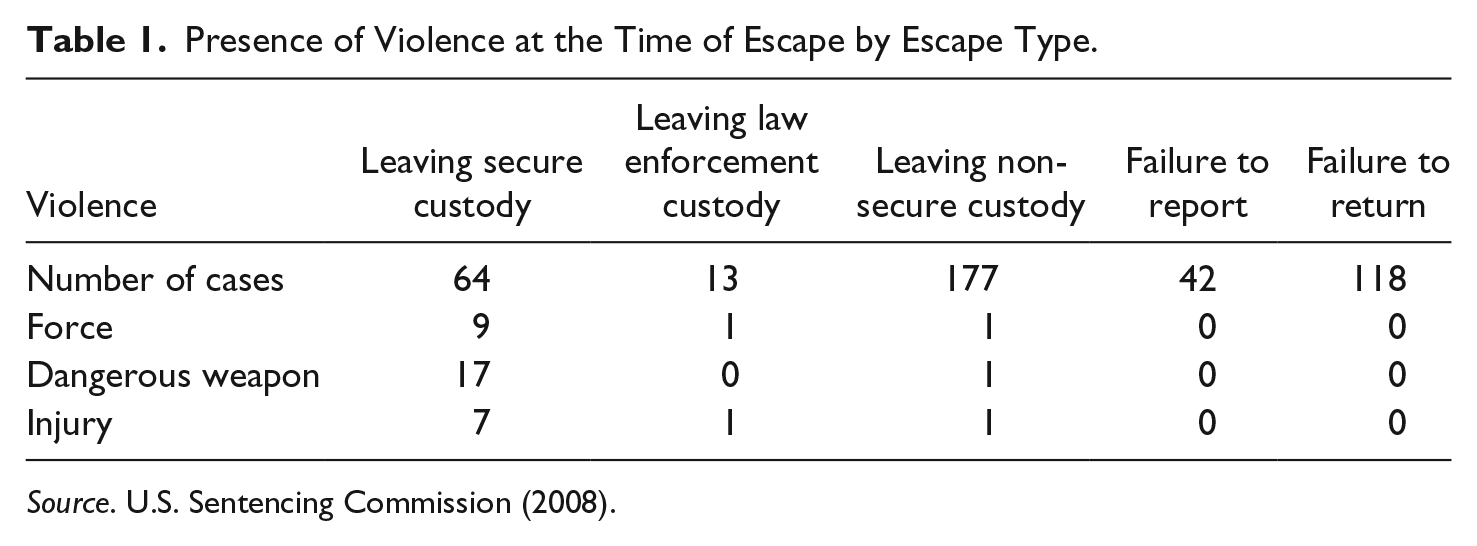
However, the powder keg theory lacks empirical support. Unlike United States v. Gosling (1994) and other court cases that describe all types of escapes as having the “potential risks and harms” due to their explosiveness, recent studies provide evidences to the contrary. In a report on federal escape offenses in fiscal years 2006 and 2007, the USSC (2008) identified 461 escape cases in 2 years. Five different types of escapes were reported, as shown in Table 1. Most of the escape cases are either walkaways or failure to return to custody, under the category of “other types of escapes” that are low-risk level offenses. This study also assessed the presence of violence involved during the escape. According to their findings, out of the 461 cases, 3.4% involved use or the threat of force against a person, 7.2% involved a weapon, and 2.9% involved injury (United States Sentencing Commission Report, 2008).
Presence of Violence at the Time of Escape by Escape Type.
Source. U.S. Sentencing Commission (2008).
The Sentencing Commission’s escape report indicated that in 160 cases of failure to report or return, none involved force or injury at the time prisoners left the facilities or when they were apprehended. Blanchard and Silva (2010) also noted that these statistics are consistent with the reports of the FBI, Sentencing Commission, and other state authorities. Moreover, it is rare for inmates to use actual physical violence or force against staff in an escape. Similarly, tunneling and breaching a perimeter from outside was found in only 1.4% and 2.8%, respectively, of escapes although these methods are prominently featured in entertainment and news media (Blanchard & Silva, 2010). A vast majority of escapes were benign incidents, and 88.5% of the escapes occurred in minimum-security facilities (Culp, 2005; Culp & Bracco, 2005). It is questionable whether escapes generally have the potential of violent consequences similar to a burglary or arson. This is particularly true for escapes in which a person goes absent without official leave (AWOL), fails to return, fails to report, or walks away. There is no evidence that escapee’s intent is to victimize others, as is often the case with burglary, arson, extortion, or the use of explosives. Rather, the most common motivations for escapes have been found to be family problems, boredom, and aspirations for freedom (Culp & Bracco, 2005; Johnston & Motiuk, 1992).
Changes of Trends in Judicial Interpretation of Custodial Escapes
The courts have recently begun to understand the variance in risks levels for different types of escapes. In Begay v. United States (2008), the U.S. Supreme Court required that felony criminal acts may not be considered as violent for purpose of sentencing enhancement under the ACCA if they are notably different from the purposeful, violent, and aggressive crimes enumerated in the ACCA.
In Chambers v. United States (2009), the U.S. Supreme Court held that the crime of failure to report for confinement did not qualify as a violent felony because it is rather a form of inaction, remote from the “purposeful,” “violent,” and “aggressive” conduct at issue in the enumerated crimes. It appears that there is a definite difference between individuals who overcome physical barriers to freedom and those who walk off the grounds, such as those who leave a “facility without removing a physical restraint, without breaking a lock on a door, without climbing over a prison wall or security fence” (United States v. Ford, 2009).
Similar to Chambers v. United States, the decision in United States v. Bethea (2010), a Fourth Circuit Court of Appeals case, addressed two questions in the relationship between the South Carolina statute and the ACCA. They were whether a conviction under the state’s escape statute constitutes a “violent felony” under the ACCA, and if not, whether the defendant’s conviction involved the type of violent conduct described in the ACCA. The Court described that the categorical approach (i.e., an approach in which the underlying facts of a case are irrelevant when determining whether a state criminal conviction triggers consequences under federal law) was not applicable because the statute broadly criminalizes conduct that could be “generally committed” in multiple ways, some violent and some not (Taylor v. United States, 1990).
These recent court decisions suggest that a conviction under the federal escape statute as a categorical crime of violence is no longer appropriate. In sum, more empirical evidence regarding the nature of an escape would likely deter the application of “legal imagination to a state statute’s language” (Koehler, 2012, p. 1533). The recent evidence that escapes from non-secured facilities are overwhelmingly non-violent challenges the judicial assumptions that the benchmark in making a risk determination is on the “possibility of violent confrontation, not whether one can postulate non-confrontational hypothetical scenario” (United States v. Davis, 1994, p. 217). Thus, the change in judicial interpretation of escapes highlights the importance of examining how each state interprets custodial escapes and whether or not their escape statute concurs with recent trends of Supreme Court decisions.
Method and Data
The current study examined state escape statutes in an effort to influence policy makers to redraft escape codes based on research proving that not all escapes are categorically violent. The primary objective was to determine which states classify escapes in a manner consistent with the powder keg theory.
To explore this question, a content analysis of U.S. state escape penal codes was conducted for all 50 states. The District of Columbia and the United States territories were not included due to different government structures from those in the states. Content analysis was used which is broadly accepted as “a research method that uses a set of procedures to make valid inferences from text” (Weber, 1990, p. 9).
State escape statutes were accessed using the LexisNexis® Academic State Statutes and Regulations legal research database. Each state’s statutory codes were searched separately using a Boolean search for the keywords “escape,” “breakout,” “failure to report,” “failure to appear,” “failure to return,” “walkaway,” “absconding,” or “AWOL.” The search term “or” allows one to broaden the search to ensure identifying the universe of escape statutes. The first author reviewed all results and identified only the statutes focusing on escapes (see the appendix for a table showing state codes regarding the escape definition and punishment). State statutes focusing only on attempted escapes, escapes from custody in another state, escapes from juvenile, residential treatment, or psychiatric facilities were not included in the analysis.
A coding instrument was developed to identify the between-state variation in the structure and content of escape statutes and included (a) the term escape defined within a state’s escape statute(s), (b) escape types included in state escape statute(s), (c) number of grading levels of severity in state escape statute(s), (d) legal elements of harm text within the state escape statute(s), and (e) predicate offense text in state escape statute(s). Two coders reviewed the statutes for each state using the coding scheme and compared results. To insure interrater reliability, any inconsistencies were discussed and a consensus was reached.
Finally, to determine the number of states that used the powder keg rationale to find that escapes are categorically violent, a final score, ranging from 0 to 6, was calculated based on the following four statutory elements: (a) escape was specifically defined, (b) multiple escape types were described, (c) the number of legal elements of harm, and (d) sentencing was predicated on violence (see Table 2). Lower scores indicated states that did not distinguish escape type or seriousness and, therefore, included all custodial escapes as categorically violent.
Method for Identifying Powder Keg Theory State Escape Statutes (N = 50).
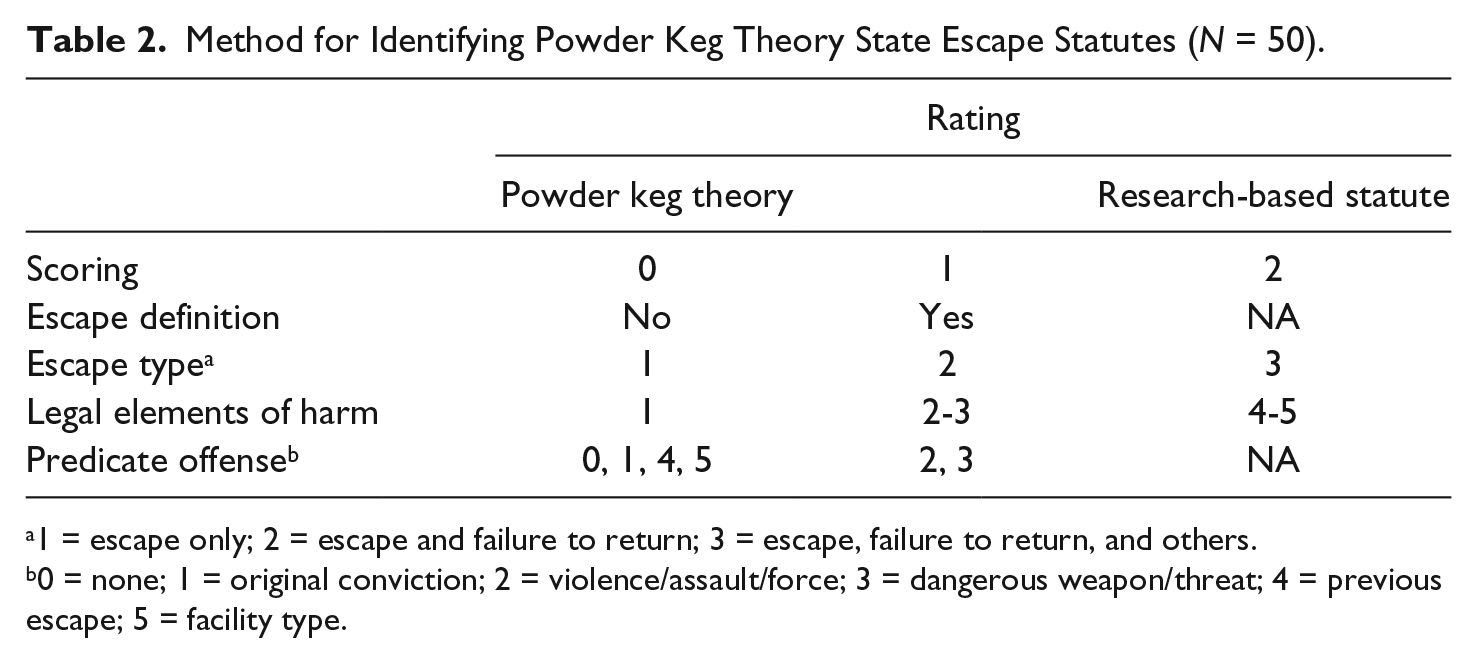
1 = escape only; 2 = escape and failure to return; 3 = escape, failure to return, and others.
0 = none; 1 = original conviction; 2 = violence/assault/force; 3 = dangerous weapon/threat; 4 = previous escape; 5 = facility type.
Data Analysis and Results
Escape Definition
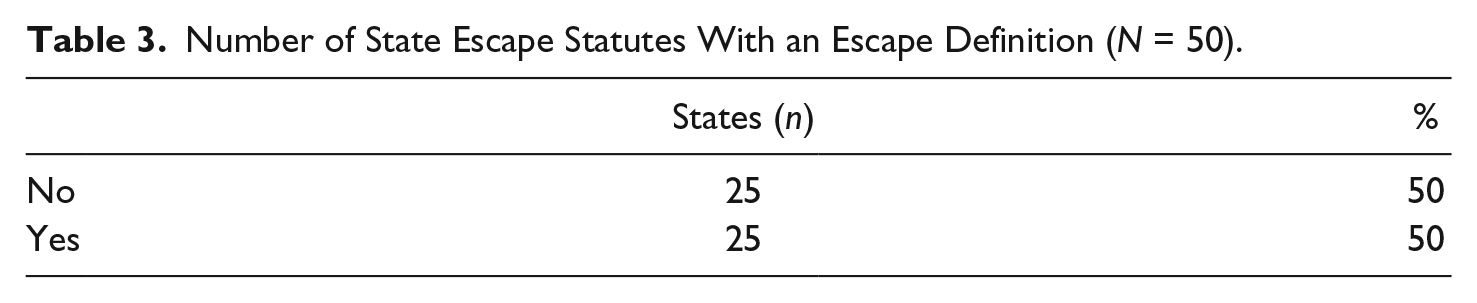
As shown in Table 3, one half of the states did not include an escape definition within their escape statutes. Robinson and Dubber (2007) argued that “an undefined [code] term invites judicial law-making” (p. 10) making it less clear and more subjective as to what constitutes a custodial and/or violent escape. For the one half that did include a definition, Pennsylvania provided a common definition of escape: “A person commits an offense if he unlawfully removes himself from official detention or fails to return to official detention following temporary leave granted for a specific purpose or limited period” (Pa. Cons. Stat. 18, § 5121, 2013).
Number of State Escape Statutes With an Escape Definition (N = 50).
Escape Types
Acknowledging different types of escape in the statutory language recognizes that the escape method is relevant when determining the level of seriousness of the crime. Only 13 states, however, were nuanced in language identifying escape types. Such states used specific terms such as absconding, walkaway, or failure to report (see Table 4). The Minnesota’s statute quoted below, for example, includes the word and phrases “escape,” “departure without lawful authority,” “failure to return,” and “absconding.”
Escape Type Mentioned in State Statute (N = 50).

609.485 Escape from Custody Subdivision 1. Definition.—“Escape” includes departure without lawful authority and failure to return to custody following temporary leave granted for a specific purpose or limited period. Subd. 2. Acts prohibited.—Whoever does any of the following may be sentenced as provided in subdivision 4: (1) escapes while held pursuant to a lawful arrest, in lawful custody on a charge or conviction of a crime, or while held in lawful custody on an allegation or adjudication of a delinquent act; For purposes of clause . . . (1) . . . “escapes while held in lawful custody” . . . includes absconding from electronic monitoring or removing an electronic monitoring device from the person’s body. Subd. 3. Exceptions.—This section does not apply to a person who is free on bail or who is on parole or probation, or subject to a stayed sentence or stayed execution of sentence . . . (Minn. Stat. § 609.485, 2013)
The remaining 37 states were more generic in their statutory language. Either the “escape” term only or both the “escape” and “failure to return” terms appear within their escape statutes (see Table 4). For example, Kentucky mentions only the term escape in its statutes:
Escape in the first degree A person is guilty of escape in the first degree when he escapes from custody or a detention facility by the use of force or threat of force against another person. (2) Escape in the first degree is a Class C felony. (Ky. Rev. Stat. Ann. § 520.020, 2013) Escape in the second degree (1) A person is guilty of escape in the second degree when he escapes from a detention facility or, being charged with or convicted of a felony, he escapes from custody. (2) Escape in the second degree is a Class D felony. (Ky. Rev. Stat. Ann. § 520.030, 2013) Escape in the third degree (1) A person is guilty of escape in the third degree when he escapes from custody. (2) Escape in the third degree is a Class B misdemeanor. (Ky. Rev. Stat. Ann. § 520.040, 2013)
Grading Levels of Escape Severity
In addition, there was also no consensus among state statutes when grading the offense seriousness of escapes. South Carolina alone had a single grading system. The other 49 states had either a tiered system of punishment for escapes with the relevant statute divided into separate sections (e.g., first-, second-, third-degree felonies) or sub-parts based on some criteria for assessing the level of each escape violation and, therefore, its penalty (see Table 5). Eighty-two percent of the states had a two- or three-tiered system. The eight states (i.e., Alabama, Wisconsin, Ohio, North Carolina, Kentucky, Nebraska, Kansas, and Mississippi) with a four- to five-tiered system had more appropriate escape categories to guide judges in their sentences. Missouri, for example, had a five-level tiered system, ranging from a Class A felony in which a “a deadly weapon or dangerous instrument or by holding any person as hostage” was involved to a Class A misdemeanor in which an individual is under arrest for a misdemeanor and escapes from custody (Mo. Rev. Stat. § 575.200, 2012).
Tiered System of Escape Punishment Level (N = 50).

Legal Elements of Harm
The legal elements of harm that must be proven to convict an escapee of a certain felony grade were also analyzed. States that classified escapes in a manner consistent with the powder keg theory would not include aggravating (e.g., use of violence, dangerous weapon) factors when determining the punishment level. Seventeen states required no element of harm to convict an individual of a felony escape (see Table 6). New York statutory language, for example, does not differentiate between levels of harm:
Legal Elements of Harm (N = 50).
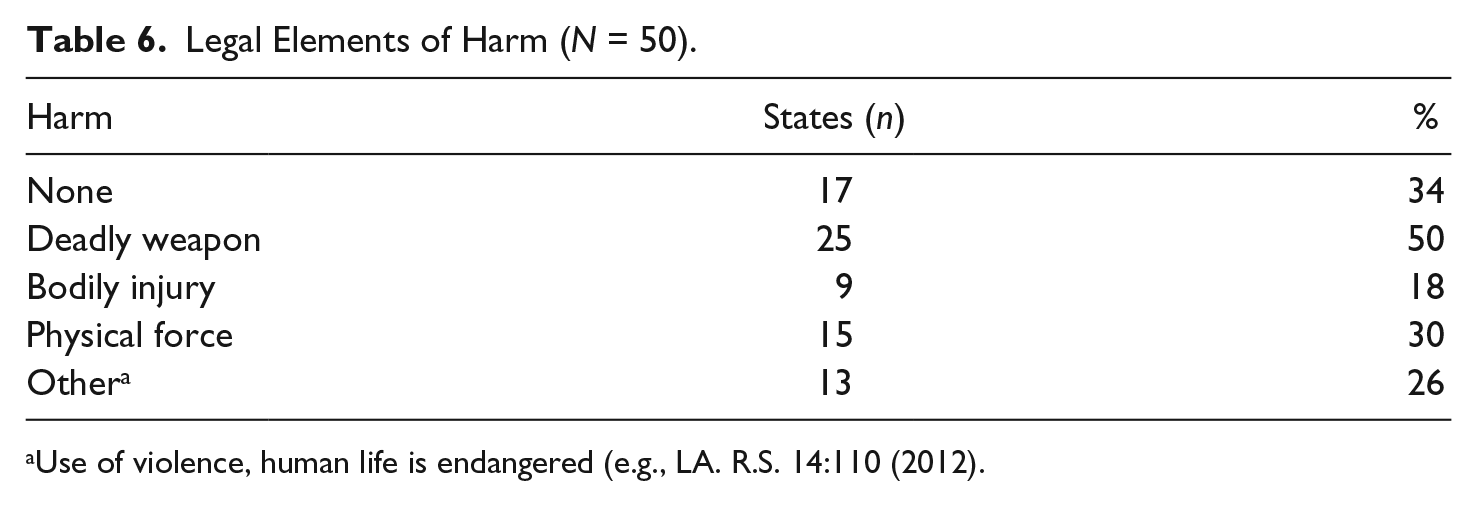
Use of violence, human life is endangered (e.g., LA. R.S. 14:110 (2012).
Escape in the first degree A person is guilty of escape in the first degree when: 1. Having been charged with or convicted of a felony, he escapes from a detention facility; or. 2. Having been arrested for, charged with or convicted of a class A or class B felony, he escapes from custody; or 3. Having been adjudicated a youthful offender, which finding was substituted for the conviction of a felony, he escapes from a detention facility. Escape in the first degree is a class D felony. (N.Y.U.C.C. Law § 205.15, 2013)
In contrast, Oregon’s escape statute in subsection 1b reserves its most punitive sentences for escapees who threaten or use violence or a weapon during a custodial escape:
162.165 Escape in the first degree (1) A person commits the crime of escape in the first degree if: (a) Aided by another person actually present, the person uses or threatens to use physical force in escaping from custody or a correctional facility; or (b) The person uses or threatens to use a dangerous or deadly weapon escaping from custody or a correctional facility. (2) Escape in the first degree is a Class B felony. (Or. Rev. Stat. § 162.165, 2011)
Predicate Offense Text
Table 7 shows types of predicated sentencing scheme for each escape state statute. More than half of the state statutes included an escapee’s original conviction, as well as the use of a dangerous weapon, physical force, and threat as predicate acts to enhance an escapee’s sentence. Forty-four percent also included the type of facility escaped from as a predicate offense. The cumulative percent is more than 100% because the statutes often have more than one predicated sentencing scheme. Three states (i.e., Florida, South Carolina, and Wisconsin) did not mention any elements that play a role as either aggravating or mitigating factors as predicated sentencing scheme. The Florida statute reads in part as follows:
Predicate Offense in Escape Statute.

Two states that mention previous escape are Missouri and North Carolina.
Any prisoner confined in any prison, jail, private correctional facility, road camp, or other penal institution, whether operated by the state, a county, or a municipality, or operated under a contract with the state, a county, or a municipality, working upon the public roads, or being transported to or from a place of confinement who escapes or attempts to escape from such confinement commits a felony of the second degree, punishable as provided in s. 775.082, s. 775.083, or s. 775.084. The punishment of imprisonment imposed under this section shall run consecutive to any former sentence imposed upon any prisoner. (Fla. Stat. § 944.40, 2012)
Fourteen states align themselves with the powder keg theory by including original conviction, previous escape, and/or facility type escaped from without including violence or dangerous weapon at time of escape in their predicated sentencing scheme.
“Failure to Return” as Violence
Analyzing the term “failure to return,” the least violent type of escapes can be used as a litmus test in determining whether a state statute designates all escapes as categorically violent (Table 8). Of the 27 states that include the escape type “failure to return,” five of the states are judged to be overly punitive with the minimum sentence ranging from 24 to 60 months. In the other 22 states, minimum penalties range from no time to 16 months.
Grading Scheme for “Failure to Return” (n = 27).

Final Powder Keg Theory Score
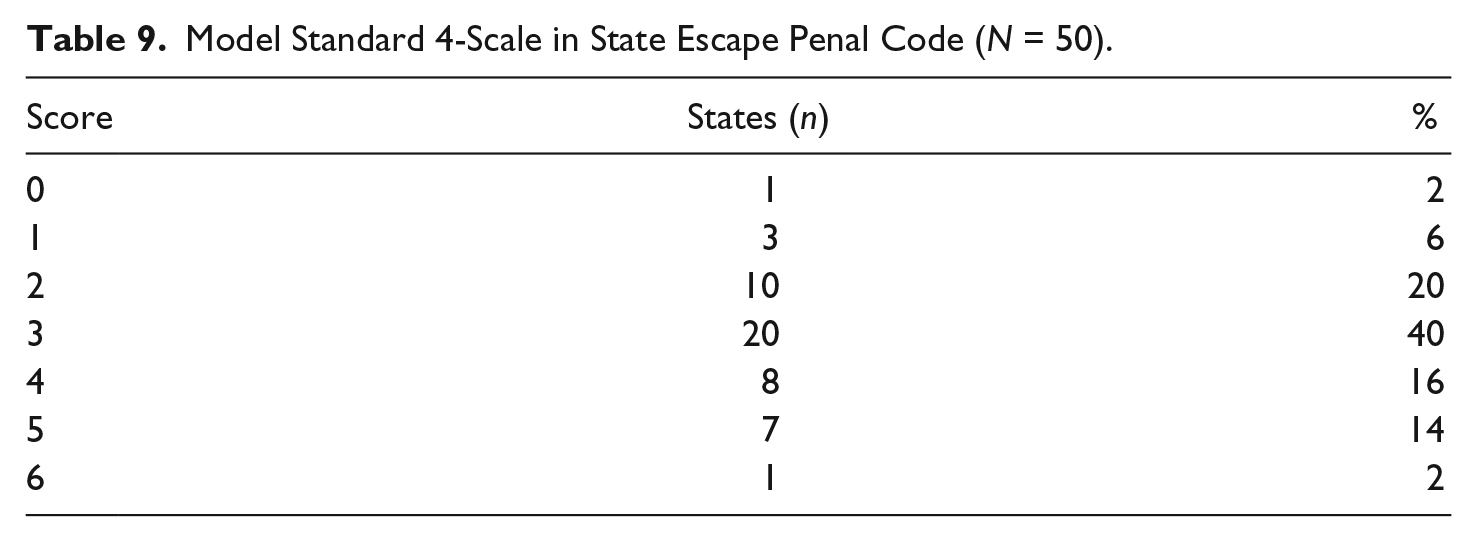
The findings show that the majority of states (30 states) had a final score of 2 or 3, indicating that they were rather moderate neither concurring with the powder keg theory nor favoring a more nuanced understanding of the relationship between escapes and potential violence (see Table 9). Only one state, South Carolina, with a 0 score, was found to be highly concurrent with the powder keg theory and ACCA, imposing harsh sentencing by considering all escapes as violent despite the variety of escape types and different risk levels. South Carolina’s statute has no consideration of predicate sentencing, no definitions, only one-tiered level punishment scheme, and no differentiation of escape type.
Model Standard 4-Scale in State Escape Penal Code (N = 50).
Unlawful escape or possessing tools or weapons therefor; penalty (A) It is unlawful for a person, lawfully confined in a prison or local detention facility or while in the custody of an officer or another employee, to escape, to attempt to escape, or to have in his possession tools, weapons, or other items that may be used to facilitate an escape. (B) A person who violates this section is guilty of a felony and, upon conviction, must be imprisoned not less than one year nor more than fifteen years. (C) The term of imprisonment is consecutive to the original sentence and to other sentences previously imposed upon the escapee by a court of this State. (S.C. Code Ann. § 24-13-410, 2012)
However, Minnesota, Montana, Nebraska, Oregon, South Dakota, Utah, Wyoming, and Missouri’s escape statutes scored 5 and 6, respectively, which indicates that these states have the most acceptable escape penal code standards. Such states permit a comprehensive consideration of escape offense seriousness resulting in punishment proportionate to the serious nature of the escape.
Discussion
The purpose of this study was to identify which of the 50 states classify escapes in a manner consistent with the powder keg theory. Only four states had escape statutes textually supporting the powder keg theory that escapes are categorically violent. These state statutes do not mention differences between escape types or predicate sentencing on violence during an escape. These states have a legal basis for sentences not proportionate to the different risk level of escapes.
At the other end of the spectrum, eight states had statutory language in their escape statutes that clearly recognized the variability in escape types and their potential for violence. The majority of remaining states (76%) display a moderate understanding that not all escapes are inherently violent, but lack sufficient clarity to prevent punishment not proportionate to the different risk levels of each escape type. The majority of state statutes did contain certain mitigating factors or aggravating factors to consider in sentencing. However, the actual escape-grading scheme and the sentencing practices indicate that a number of states still take punitive approaches in imposing imprisonment terms for escapes even in the case of failure to return. This result implies that a state’s lack of understanding on the seriousness level of escapes can result in low-risk escapees (e.g., walkaways, failure to report, or failure to return) receiving overly punitive sentencings not proportionate to the seriousness of the offense. Clearly, these findings denote that a greater consensus among the states in the understanding of escapes is needed and there must be statutory revisions for those states which lack language differentiating characteristics related to violent and non-violent escapes.
Despite the significant findings, certain measures are imprecise by the study design, which limits the extent of conclusions regarding the phenomenon they are meant to capture. Because this study is a content analysis, a descriptive method, it does not provide an underlying rationale for the observed findings. Most significantly, we do acknowledge that judges consider mitigating and aggravating factors when sentencing escapees even in the categorical approach. In this connection, our findings indicate that 21 states’ (46%) statutes consider a person guilty in the second degree if the person fails to return to custody following an assignment or temporary leave.
Although it is true that judges take into account mitigating and aggravating factors, no one can doubt the court’s statutory power of decisions. Our purpose was to interpret statutory language to determine state’s assumptions regarding the violent nature of escapes. More specifically, we believe it was important to examine whether or not state escape statutes reflect the most recent court rulings (i.e., post-Chambers) in recognizing the distinct level of escape seriousness involved in different escape types.
Further quantitative and qualitative studies are needed to provide a more comprehensive interpretation of state escape penal codes. As a next step, researchers should analyze the legal and extra-legal factors judges consider when imposing sentences greater than the mandatory minimum for a defendant convicted of an escape.
Policy Implications
This research produces several findings of importance at the legislative, individual, and institutional levels. The overall findings of the research suggest that few states actually mirror the ACCA in presuming all escapes are categorically violent. However, the state escape statutes and the imposition of sentencing terms indicate that not only are there punitive approaches to sentencing escapees, but also there is a significant variability in the approaches across state escape penal codes. As a result, developing a categorical approach for punishing escapes presents two problems. First, the sentencing guidelines for judges contain large sentencing term ranges with consequent inconsistent imposition of sentencing. Second, because the courts can revisit prior decisions for similar escapes, prior inconsistent escape court decisions may adversely affect judicial decisions in future escape cases. The role of statutory language of state escape penal codes is critical to curb the abuses of mandating harsh sentences based on the powder keg theory as seen in pre-Chambers cases. Therefore, we highlight some policy implications as a means to realign judicial decisions when sentencing escapees.
Two major practical policy implications for sentencing in custodial escapes can be suggested: situational approach and graduated sanction. Custodial escapes are not solely based on individual-level factors but on the security level of correction facilities. In terms of legal element of harm, the facility’s security level in which the escape occurred should be a factor when determining the sentence. Escapes from maximum-security facilities are inherently more violent than walking away from a minimum-security facility with no perimeter fencing. From a situational prevention approach, Culp (2005) indicated that common escapes happening within secure facilities have contributing factors of “poor control, poor maintenance, leaving items that could be used as ladders unsecured, and negligence in checking staff and inmate identification” (p. 27). Assuming that inmates motivated to escape are always present in correctional settings, the availability of suitable target, or the escape, is highly dependent on the presence or lack of capable guardians (e.g., perimeter security systems, professional staff). Therefore, state escape penal codes must recognize that an inmate’s intent to do harm during the escape is oftentimes much greater when a capable guardian exists, and, as such, this escape situations should be graded more severely.
This institutional fact-based approach in determining the severity of escapes champions the necessity of graduated sanctions for escapes. If the escape is not a matter of individuals but rather a lack of institutional controls, the escape from high-security institution must be regarded as “potentially violent and possess serious harms to others” as stated in the ACCA. Thus, if the inmate escaped from a maximum-security institution, the incident can be interpreted as a more serious escape with an increased risk for violence. Unlike the rare escape from maximum-security facilities, escape from minimum-security facilities has more varied situations (i.e., time and place) where lack of guardians facilitates the escape situation. In sum, graduated sanctions become imperative, and custodial escapes should not be presumed to all be the same.
Conclusion
In brief, this research examined whether there was a national consensus on defining and grading offense seriousness of escapes. The main findings are that (a) there is no single consensus on the definition of escapes, (b) there is no consideration of multiple escape types, (c) there is no grading on offense seriousness of escapes, and (d) there is no adoption of legal elements of harm within the act of escapes.
In states that consider escapes as “felony” level offenses under the ACCA provision, the question is whether custodial escapes are truly violent and always carry potential harm that is reasonable to fall under the felony degree equivalent to escapes. For instance, felonies that receive equivalent sentences are aggravated assault, forcible rape, arson, robbery, and burglary. These crimes actually involve some type of violence, threat, or both mental and physical injury. These crimes are evidently different from custodial escapes. Moreover, all these crimes have a “potential target,” whereas the escape is an act for the freedom of oneself. Therefore, one can argue that it is presumptive to believe escapees always carry the intent to harm others. The criminal acts of escape must be reconsidered in regard to their potential violence, risks, and intentions with evidence-based research questioning whether current state grading systems of escapes are truly reasonable.
Footnotes
Appendix
State Codes Regarding the Definition and Punishment of Custodial Escapes.

| State | Legal citation |
|---|---|
| Alabama | § 13A-10-31. Escape; first degree |
| § 13A-10-32. Escape; second degree | |
| § 3A-10-33. Escape; third degree | |
| Alaska | § 11.56.300. Escape in the first degree |
| § 11.56.310. Escape in the second degree | |
| § 11.56.320. Escape in the third degree | |
| § 11.56.330. Escape in the fourth degree | |
| Arizona | § 13-2504. Escape in the first degree; classification |
| § 13-2502. Escape in the third degree; classification | |
| § 13-2503. Escape in the second degree; classification | |
| Arkansas | § 5-54-110. First-degree escape |
| § 5-54-111. Second-degree escape | |
| § 5-54-112. Third-degree escape | |
| California | § 107. Escapes of felony prisoners from specified places of detention |
| § 836.6. Escape or attempted escape; punishment | |
| § 4530. Escape or attempted escape from state prison, camp, farm, or custodial work site; punishment; failure to return from authorized absence | |
| Colorado | § 18-8-206. Assault during escape |
| § 18-8-208. Escapes | |
| Connecticut | § 53a-168. Escape: Definitions |
| § 53a-169. Escape in the first degree: Class C felony | |
| § 53a-170. Escape in the second degree: Class D felony | |
| § 53a-171. Escape from custody: Class C felony or Class A misdemeanor | |
| Delaware | § 1253. Escape after conviction; Class B felony; Class C felony; Class D felony |
| § 1252. Escape in the second degree; Class G felony | |
| § 1251. Escape in the third degree; Class A misdemeanor | |
| § 1258. Escape and offenses relating to custody; definitions | |
| Florida | § 944.40. Escapes; penalty |
| Georgia | § 16-10-52. Escape |
| Hawaii | § 710-1020. Escape in the first degree |
| § 710-1021. Escape in the second degree | |
| Idaho | § 18-2505. Escape by one charged with, convicted of, or on probation for a felony—Escape by a juvenile from custody |
| § 18-2506. Escape by one charged with or convicted of a misdemeanor—Escape by a juvenile from custody | |
| Illinois | § 720 Illinois Compiled Statutes 5/31-6. Escape; failure to report to a penal institution or to report for periodic imprisonment |
| § 730 Illinois Compiled Statutes 5/3-6-4. Enforcement of discipline—Escape | |
| Indiana | § 5-44.1-3-4. Escape—Failure to return to lawful detention |
| Iowa | § 719.4 Escape or absence from custody |
| Kansas | § 21-5911. Escape from custody; aggravated escape from custody |
| Kentucky | § 520.020. Escape in the first degree |
| § 520.030. Escape in the second degree | |
| § 520.040. Escape in the third degree | |
| Louisiana | ß 14:110. Simple escape; aggravated escape |
| Maine | ß 755. Escape |
| Maryland | ß 9-404. Escape in the first degree |
| ß 9-405. Escape in the second degree | |
| Massachusetts | ß 83C. Penalty for escape from prison camp |
| ß 15A. Escape—From city or town jail | |
| ß 16. Escape—From penal institutions; Attempt—Penalty | |
| Michigan | § 750.193. Breaking prison, escaping, attempting to break prison, or attempting to escape as felony; penalty; place of trial; “prison” defined; escaping from lawful custody outside confines of prison; escape from mental health facility; violation by person released under work pass program; person violating parole not escapee |
| Minnesota | § 609.485. Escape from custody |
| Mississippi | § 47-5-409. Escapes |
| § 97-9-45. Escape of prisoners; penalty; willful failure to return to jail after being entrusted to leave | |
| § 97-9-47. Escape of prisoners; penalty for penitentiary convicts serving less than life term; attempt by force or violence | |
| § 97-9-49. Escape of prisoners; penalties for convicts in jail and persons under arrest or custody; willful failure to return to jail after being entrusted to leave | |
| Missouri | § 217.390. Escape, defined—Penalty |
| § 575.195. Escape from commitment, detention, or conditional release | |
| § 575.200. Escape or attempted escape from custody | |
| § 575.210. Escape or attempted escape from confinement—Penalty | |
| Montana | § 45-7-306. Escape |
| § 53-30-326. Escape from custody | |
| Nebraska | § 28-912. Escape; official detention, defined; knowingly permitting an escape; penalty; defense to prosecution |
| Nevada | § 212.090. Penalties for prisoner who escapes |
| New Hampshire | § 212.090. Penalties for prisoner who escapes |
| § 135-E: 21. Escape | |
| § 642:6. Escape | |
| § 651:24 Failure to report deemed escape | |
| New Jersey | ß 2A:36-1. What constitutes escape |
| ß 2C:29-5. Escape | |
| New Mexico | § 30-22-8. Escape from jail |
| § 30-22-8.1. Escape from a community custody release program | |
| § 30-22-9. Escape from penitentiary | |
| § 33-2-46. Inmate-release program; escape | |
| New York | ß 205.05. Escape in the third degree |
| ß 205.10. Escape in the second degree | |
| ß 205.15. Escape in the first degree | |
| North Carolina | § 14-256. Prison breach and escape from county or municipal confinement facilities or officers |
| § 148-45. Escaping or attempting escape from state prison system; failure of conditionally and temporarily released prisoners and certain youthful offenders to return to custody of Division of Adult Correction of the Department of Public Safety | |
| North Dakota | § 12.1-08-06. Escape |
| Ohio | § 2921.34. Escape |
| Oklahoma | § 434. Attempt to escape from penitentiary |
| § 436. Attempt to escape from other prison than penitentiary | |
| § 443. Escape from county or city jail, or custody of Department of Corrections—Penalty—Juvenile or youthful offender | |
| Oregon | § 162.165. Escape in the first degree |
| § 162.155. Escape in the second degree | |
| § 162.145. Escape in the third degree | |
| Pennsylvania | ß 5006. Escape (community corrections centers and community corrections facilities) |
| ß 5121. Escape | |
| ß 9105. Escape (escape from custody while in another state) | |
| Rhode Island | ß 11-25-1. Escape from correctional institutions |
| ß 11-25-1.1. Escape from municipal detention facility | |
| ß 11-25-2. Assault or escape by a custodial unit inmate | |
| ß 11-25-4. Assault or escape by prisoner of medium or minimum custodial unit | |
| ß 11-25-22. Escape from custody | |
| ß 13-13-5. Escape violation (escape from custody while in another state) | |
| South Carolina | § 24-13-410. Unlawful escape or possessing tools or weapons therefor; penalty |
| South Dakota | ß 22-11A-2. First-degree escape—Felony |
| ß 22-11A-2.1. Second-degree escape—Felony | |
| ß 23-24A-21. Escape from temporary custody as additional offense (another state) | |
| ß 24-8-6. Failure of inmate to return constitutes escape | |
| Tennessee | § 39-16-605. Escape |
| § 40-31-104. Escape from temporary custody | |
| § 41-2-137. Failure to return from work on time as evidence of intent to escape—Penalty | |
| § 41-21-514. Failure to return as evidence of intent to escape | |
| § 41-24-116. Escape from private prison or facility | |
| Texas | § 38.06. Escape |
| Utah | ß 76-8-309. Escape and aggravated escape—Consecutive sentences—Definitions |
| Vermont | ß 1501. Escape and attempts to escape |
| Virginia | § 18.2-478. Escape from jail or custody by force or violence without setting fire to jail |
| § 18.2-479. Escape without force or violence or setting fire to jail | |
| § 18.2-480. Escape, etc., by setting fire to jail | |
| § 53.1-131. Provision for release of prisoner from confinement for employment, educational, or other rehabilitative programs; escape; penalty; disposition of earnings | |
| Washington | ß 9.100.040. Escape—Effect (another state) |
| ß 9A.76.110. Escape in the first degree | |
| ß 9A.76.115. Sexually violent predator escape | |
| ß 9A.76.120. Escape in the second degree | |
| ß 9A.76.130. Escape in the third degree | |
| West Virginia | §48-14-505. Misdemeanor offense of escape from custody; penalty |
| § 61-5-12a. Escape from custody of the Commissioner of Corrections | |
| Wisconsin | ß 898.20. What is an escape |
| ß 946.42. Escape | |
| ß 62-14-5. Escape of prisoner while in temporary custody | |
| Wyoming | ß 6-5-206. Escape from official detention; penalties |
| ß 6-5-207. Escape by violence or assault, or while armed; penalty | |
| ß 7-13-702. Escape |
Declaration of Conflicting Interests
The author(s) declared no potential conflicts of interest with respect to the research, authorship, and/or publication of this article.
Funding
The author(s) received no financial support for the research, authorship, and/or publication of this article.