



Abstract
Older adults are an increasingly relevant subpopulation for criminal justice policy but, as yet, are largely neglected in the relevant research. The current research addresses this by reporting on a psychometric evaluation of a measure of older adults’ Confidence in Legal Institutions (CLI). Confirmatory factor analysis (CFA) provided support for the unidimensionality and reliability of the measures. In addition, participants’ CLI was related to cynicism, trust in government, dispositional trust, age, and education, but not income or gender. The results provide support for the measures of confidence in the courts and law enforcement, so we present the scale as a viable tool for researchers and practitioners interested in understanding older adults’ confidence in these institutions. We conclude by discussing the implications of our work on efforts to improve interactions between older adults and legal institutions, and we highlight avenues for further research.
Modern legal institutions rely on positive public perceptions to function effectively (Rottman & Tomkins, 1999; Tyler, 2004; Wenzel, Bowler, & Lanoue, 2003), and two institutions that are particularly reliant on these positive perceptions are the courts and law enforcement. Although often sought as important in their own right (O’Connor, 1999), these perceptions are especially important because they consistently predict cooperation and compliance with these institutions (Benesh, 2006; Jackson & Bradford, 2010; Tyler, 2001). Confidence—the belief that future events will occur as expected (Earle, Siegrist, & Gutscher, 2007)—is one such perception that provides a basis for the interaction of the individual with the target institution because of its role in assuaging uncertainty (Cao, 2015). Notably, confidence in institutions, unlike confidence in individuals, does not require direct contact with the target but instead can be based on common knowledge or perceived similarity to other institutions (Earle et al., 2007). As a result, these institutional confidence perceptions are not only important for the more limited first public of individuals who have direct contact with these institutions but are also important for their broader second public (Rottman, 2007).
Researchers have extensively investigated confidence in legal institutions, but much of the empirical work is limited by the use of single item measures and the fact that when multi-item scales are used, few studies report their psychometric properties (i.e., reliability and validity; Cao, 2015; Hamm et al., 2011). In addition, of the research that has addressed these measurement shortcomings (Hamm et al., 2013; Hamm et al., 2011), most has been somewhat limited in its ability to generalize to specific legally relevant subpopulations because of its use of student or general community samples. Thus, it remains somewhat unclear how well existing multi-item measures of confidence perform in specific, criminal justice-relevant subpopulations like older adults.
Older Adults and Legal Institutions
Older adults as a subpopulation are increasing numerically and proportionally, and these trends are expected to continue (Rutherford, 2012; Shrestha & Heisler, 2011; United Nations, 2012). Consequently, it is expected that older adults will become more involved with the criminal justice system as litigants, jurors, witnesses, and victims (Brank & Wylie, 2014; Eglit, 2004; Rothman & Dunlap, 2006) and will, therefore, have more contact with the courts and law enforcement. Although research has shown that older adults have higher levels of generalized trust than younger adults (Li & Fung, 2012), some data suggest that in the United States, older adults are less confident that the criminal justice system will deliver justice for them than younger adults (Saad, 2011). One potential reason for this age difference may be generational experiences of the baby boomers and especially conflicts that may have fostered a general distrust of government, such as the Vietnam War and Civil Rights Movement (Pruchno, 2012). Another more cynical reason for these differences may simply be that older adults have had more opportunities for experience (especially vicarious experience) with the justice system over the course of their lifetime and, therefore, have had more opportunities to experience its shortcomings. Whatever the reason, a lack of confidence in the criminal justice system suggests that older adults may feel disempowered and be reluctant to take legal action (Ellison, Schetzer, Mullins, Perry, & Wong, 2004), may decline jury duty where possible (Brank & Wylie, 2014), or may be unwilling to report crimes, victimization, or abuse (Brank, Wylie, & Hamm, 2012). Understanding older adults’ perceived confidence in legal institutions is, therefore, an important step in promoting the function of and engagement with the criminal justice system.
The aim of this research note is to psychometrically examine the Confidence in Legal Institutions (CLI) scale with data from an older adult sample. Thus, the current research note takes a foundational step in understanding older adults’ confidence in the courts and law enforcement. If supported, this scale could then be used by other researchers to identify current confidence levels, predict behavioral outcomes, or evaluate interventions to improve older adults’ experiences with these institutions.
Materials and Method
Participants were 131 older adults (aged 60-90; M = 66.45, SD = 5.64) recruited via two sources (Participant Volunteer Network [PVN] and StudyResponse.com) to complete an online 1 questionnaire. Table 1 reports the complete sample demographics, and although the sample generally approximates the wider population, the current sample has a higher percentage of females, is more educated, and has a higher median income than the U.S. older adult population (United States Census Bureau, 2015). The PVN is a local pool of older adults who have expressed willingness to be contacted for research. For the current research, we contacted 118 potential PVN respondents by email. After a telephone follow-up, 48% (n = 57) of the contacted individuals agreed to participate and completed the survey between December 2010 and February 2011. Because this was a smaller than expected number of participants, however, a supplementary sample was recruited from StudyResponse.com (n = 74) in October 2011. StudyResponse participants are members of an online survey panel who are recruited by panel administrators according to researchers’ selection criteria (in this case, adults in the United States above the age of 60).
Sample Characteristics.
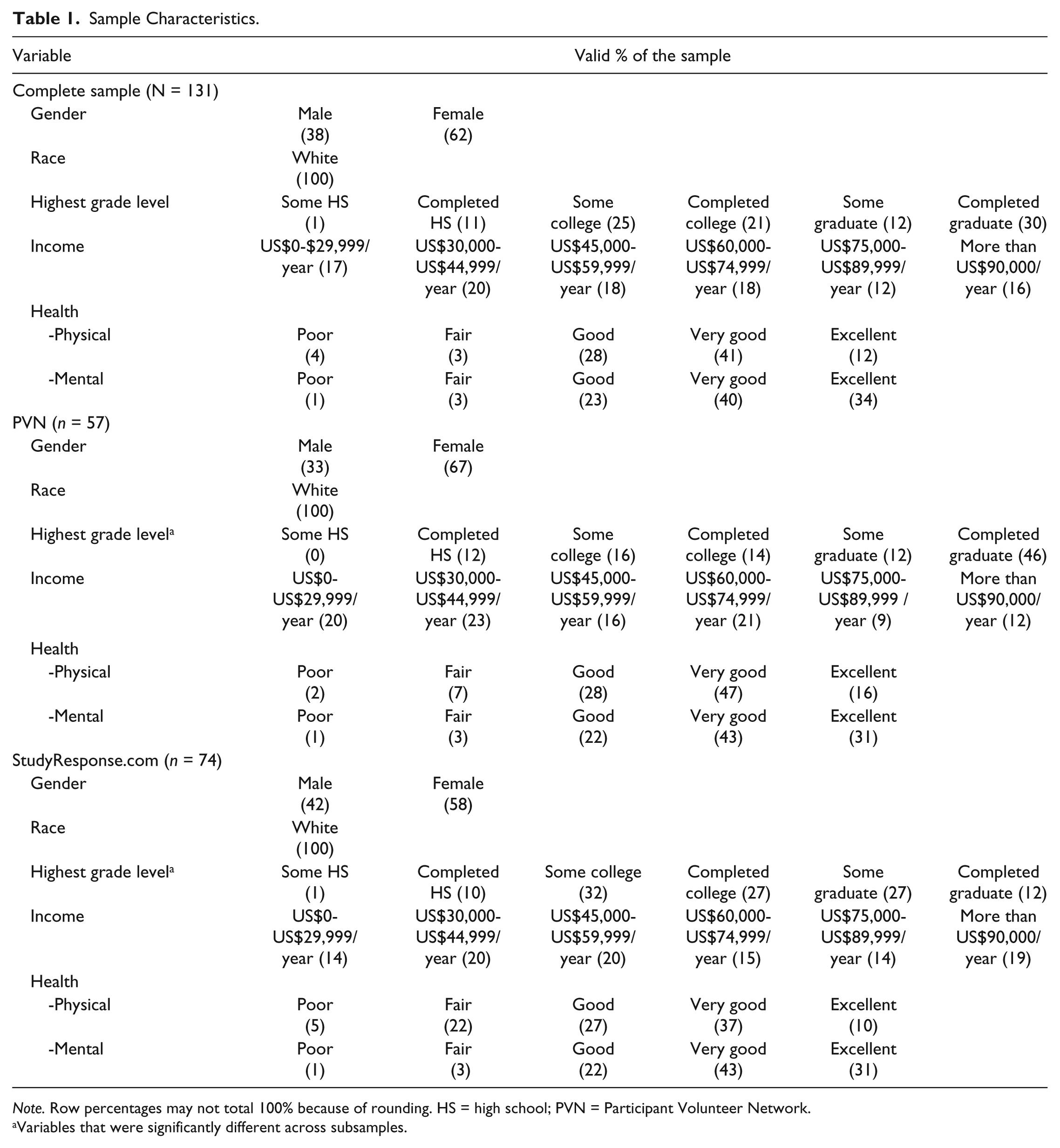
Note. Row percentages may not total 100% because of rounding. HS = high school; PVN = Participant Volunteer Network.
Variables that were significantly different across subsamples.
We conducted means comparisons across the two samples, which revealed that they were significantly different on a number of variables of interest to this study, such that the PVN respondents were generally more positive toward the criminal justice system. Because our analyses focus on relationships among and not levels of these items and constructs, the differences between the samples and with the general older adult population in the United States are cause for little concern but do constitute a limitation. To address the differences between samples statistically, we report the convergent validity of the analyses for each group separately (as well as for the entire sample). Note, however, that we did not conduct separate confirmatory factor analyses (CFAs) for each group because the especially limited sizes of the subsamples would challenge the latent analyses ability to detect ill fit and, therefore, be biased toward indicating unwarranted good fit.
The online questionnaire included two sections presented in counterbalanced order: (a) a brief vignette study and (b) the CLI scale items. Only the results examining the CLI scale are described here, as the results of the vignette study were reported elsewhere (Brank et al., 2012). Participants also completed demographic questions that included age, gender, income, and education level. In addition to these measures that were directly relevant to this evaluation, participants were also asked additional demographic questions about mental and physical health because of their relevance to the vignette materials. Relationships between confidence and these characteristics are reported in the tables, but because they were not expected to relate to the CLI scale items and did not show significant relationships, we will discuss them no further here. All questionnaire responses were recorded on 1 to 7 Likert-type scales ranging from strongly disagree to strongly agree. All items are available upon request from the first author.
CLI
To assess confidence in legal institutions, participants completed a series of confidence-related items. As suggested by others (Cao, 2015), our items focused largely on how the participant believes that the institutions approach and accomplish their job. Six of the items were developed by Tyler and Huo (2002), and another six were developed by the National Center for State Courts (1999) to address a variety of concerns such as whether the courts “do their job well,” “treat people with respect,” and “have too much power.” These items were then slightly modified to address law enforcement, creating another 12 items 2 (see Table 2).
CLI Scale Items, Standardized Loadings, Means, and Standard Deviations, and Latent Model Fit and Reliability.

Note. Omega (ω) is a model-based reliability estimate. Recommended global fit values ω > .70 (Hamm et al., 2013); RMSEA < .1, CFI > .95, TLI > .95, SRMR < .08 (Hu & Bentler, 1998). Stand. Loading = standardized loading; CLI = Confidence in Legal Institutions; RMSEA = root mean square error of approximation; CFI = comparative fit index; TLI = Tucker–Lewis index; SRMR = standardized root mean square residual.
All loadings significant at p < .001.
Convergent Validity Measures
Several measures were also included to examine the convergent validity of the CLI scale. First, to assess whether the scale was significantly related to single item measures used in previous research, we asked participants to rate their confidence in the courts and law enforcement using a single item for each institution. To examine whether the CLI scale was significantly related to other theoretically relevant constructs, participants also completed two subscales of Tyler and Huo’s (2002) legitimacy measure. Specifically, we included the Obligation to Obey subscale to measure participants’ felt obligation to obey the law and the Cynicism subscale to assess participants’ belief that the law was against them. Furthermore, participants completed a three-item Trust in Governmental Institutions measure—modified from items regularly used in the American National Election Survey (NES) 3 —that asked participants how often they believe federal, state, and local government institutions can be trusted to “do what is right.” Finally, we included a three-item Dispositional Trust measure regularly used in the General Social Survey (GSS) 4 that asked participants to respond to several statements regarding the motives of “most people.”
Results
Phase 1—Dimensionality and Reliability
Prior to examining relationships across constructs, we evaluated the dimensionality (i.e., whether items load onto a single factor) and reliability (i.e., whether the items hypothesized to load on the same factor are internally consistent) of the two CLI subscales: Confidence in the Courts and Confidence in Law Enforcement. Specifically, we evaluated the items via institution-specific CFAs using a maximum likelihood-robust estimator. This estimator is recommended because it includes a correction factor for slightly non-normal data. In the presence of normal data, however (correction factor = 1), the results converge to those of the standard maximum likelihood estimator.
Our initial Confidence in the Courts subscale model fit moderately to the data but suggested problematically low loadings or statistical redundancy for two items (most judges in my community treat people with respect and the basic rights of citizens in my community are well protected by the courts). Thus, we estimated a second model that included only the remaining 10 items. The model fit well to the data, χ2(35) = 42.80, p = .17; root mean square error of approximation (RMSEA) = .04, p = .61; comparative fit index (CFI) = .98; Tucker–Lewis index (TLI) = .97; standardized root mean square residual (SRMR) = .04, all items loaded significantly on the latent factor greater than .50 (see Table 2), and model-based reliability was good for this scale (ω = .91).
Our initial Confidence in Law Enforcement subscale model similarly fit moderately to the data and suggested removing three items (most police officers in my community treat people with respect, police officers protect citizens’ constitutional rights, and police officers are generally honest and fair in dealing with citizens). We, therefore, estimated a second model with the remaining nine items that fit well to the data, χ2(27) = 32.95, p = .20; RMSEA = .04, p = .59; CFI = .98; TLI = .98; SRMR = .03, and revealed significant loadings greater than .55 on the factor (see Table 2). Model-based reliability was also good for this scale (ω = .91).
Phase 2—Convergent Validity
We next examined the subscales’ convergent validity—that is, whether the two CLI subscales were significantly associated with constructs hypothesized to be related to confidence in courts and law enforcement (i.e., single item confidence measures, Obligation to Obey, Cynicism, Trust in Governmental Institutions, and Dispositional Trust). We also examined whether the CLI subscales were related to sample characteristics such as age and education. To that end, we created observed scale scores by averaging the items within each of the scales (see Table 3). Because Obligation to Obey had insufficient internal reliability (α = .40), we used the three items independently in the subsequent analyses. Bivariate analyses suggested that although the Confidence in the Courts and Confidence in Law Enforcement subscale scores were related (r = .63, p < .001), older adults were more confident in law enforcement (M = 5.07, SD = 1.03) than the courts (M = 4.76, SD = 1.07, t(130) = 3.95, p < .001).
Observed Measures Statistics.

Note. Items were all measured on a 7-point scale ranging from 1 (strongly agree) to 7 (strongly disagree). CLI = Confidence in Legal Institutions.
Variables that were significantly different across subsamples (p < .05).
We then investigated the convergent validity of the CLI subscales (see Table 4). As hypothesized, both CLI subscale scores were significantly related to both single item confidence measures, Obligation to Obey Items 1 and 2 (see below), Cynicism, Trust in Governmental Institutions, and Dispositional Trust. Notably, each of the CLI subscale scores were most strongly related to their respective single item confidence measure (i.e., confidence in law enforcement was more related to the single law enforcement confidence item than the other convergent validity measures) indicating that, as would be expected, the single and multi-item measures were assessing similar but not completely overlapping constructs. With respect to the Obligation to Obey items, although both CLI subscale scores were related to Item 1 (I feel I should accept decisions made by legal authorities.) and Item 2 (People should obey the law even when it goes against what they think is right.), only the courts subscale score was related to Item 3 (It is difficult to break the law and keep one’s self-respect.). Trust in Governmental Institutions was significantly correlated with both CLI subscale scores but was more related to confidence in the courts than confidence in law enforcement. Conversely, Dispositional Trust was more related to confidence in law enforcement than confidence in the courts. Finally, as expected, Cynicism was negatively related to all of the CLI measures and, other than the corresponding single item confidence measure, was the validity measure most related to the CLI subscale scores.
Convergent Reliability of the CLI Scales.
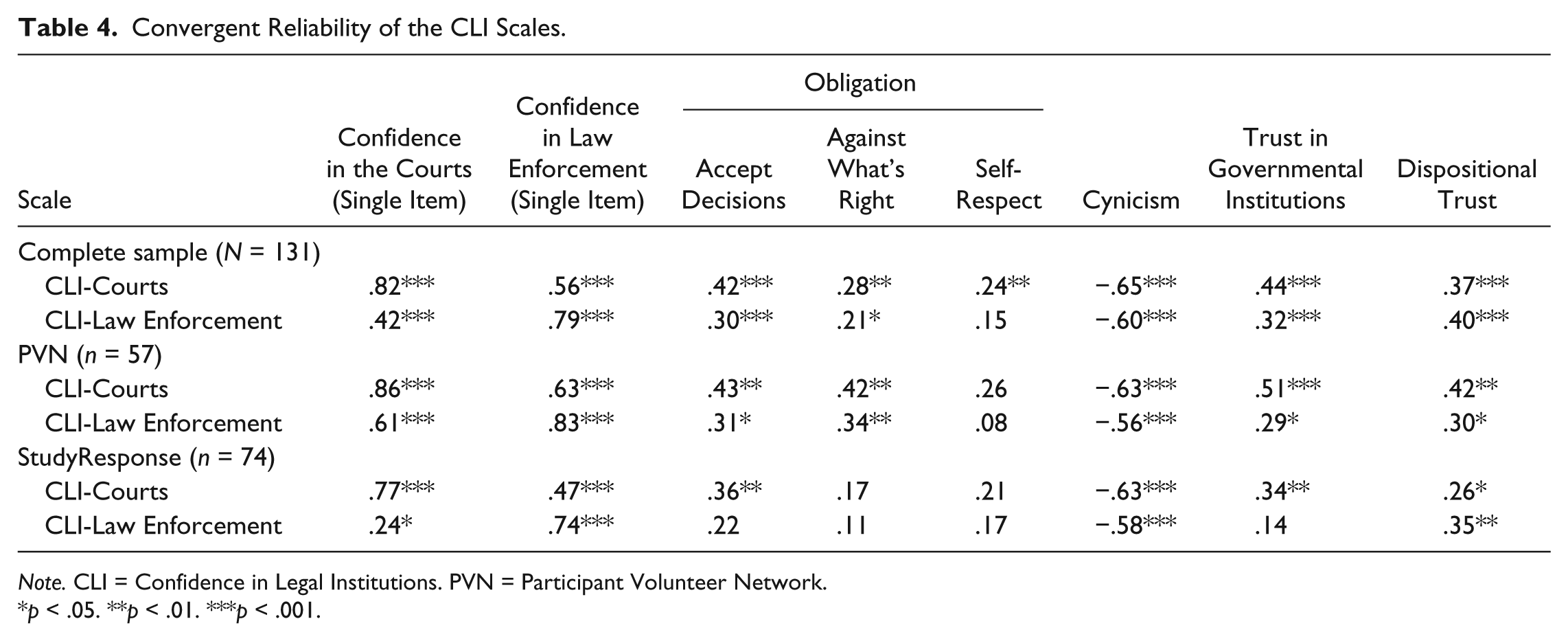
Note. CLI = Confidence in Legal Institutions. PVN = Participant Volunteer Network.
p < .05. **p < .01. ***p < .001.
Because of the significant differences across the samples utilized, we also conducted the convergent reliability analyses separately for each sample. As reported in Table 4, the relationships for each sample were largely comparable, other than a decrease in the relationship between the confidence measures and the second Obligation item for the StudyResponse sample.
Finally, we evaluated the relationships between the CLI subscales and our sample characteristics (see Table 5). Age and education were related to confidence in both institutions whereas physical health, mental health, and gender were not. Specifically, older, older adults were more confident than younger, older adults, and older adults with more education were more confident than older adults with less education.
Relationships of CLI Scales and Sample Characteristics.
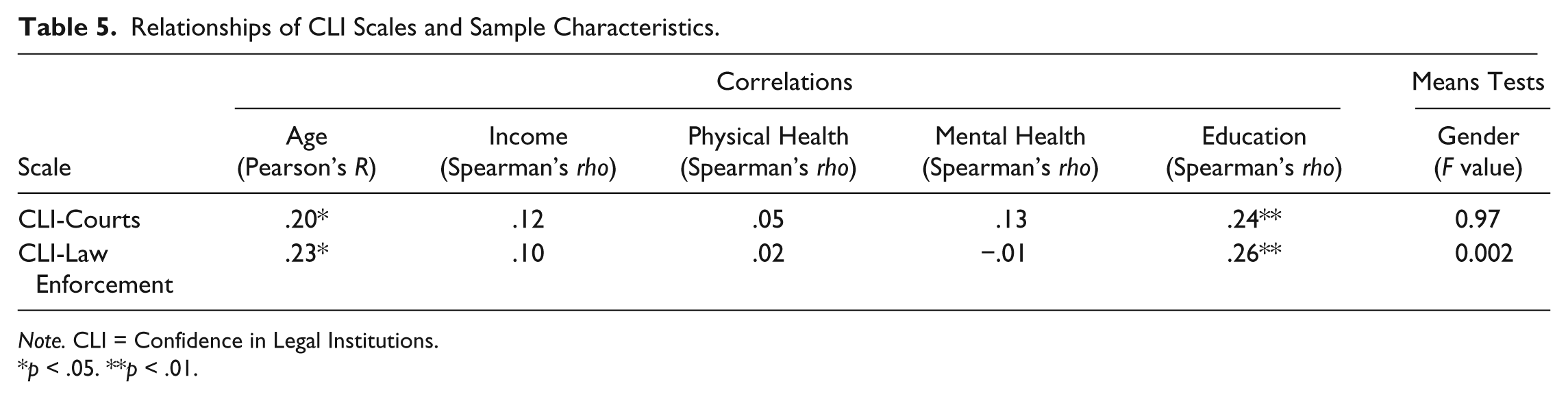
Note. CLI = Confidence in Legal Institutions.
p < .05. **p < .01.
Discussion
The current research reports on a psychometric evaluation of the CLI scale in a sample of older adults. The Phase 1 results provided evidence of the unidimensionality and reliability of both subscales. This is an important finding because of the paucity of research that has evaluated confidence measures, especially in specific legally relevant subsamples like older adults. Our results support the use of these scales with older adult samples, thereby providing researchers and practitioners with a viable measure of confidence in legal institutions for this population.
The Phase 2 convergent validity analyses also confirmed our hypotheses by suggesting that both subscales were significantly correlated, but not completely redundant, with a number of theoretically relevant constructs, namely, the single item confidence measures, Cynicism, Trust in Governmental Institutions, and Dispositional Trust. The subscales were also correlated with two of the Obligation to Obey items, but only Confidence in the Courts was correlated with the third. This comports with both theoretical and empirical scholarship on perceptions of legal institutions (e.g., Hamm et al., 2011; Tyler & Huo, 2002) and lends some credence to suggestions that confidence is a relatively global evaluation of an institution (see Cao, 2015) that relates strongly to other, often more specific evaluations of it (Benesh, 2006; Hamm et al., 2013; Hamm et al., 2011).
The results also suggest that the confidence subscales were both correlated with some of the sample characteristics but not with others. Specifically, they suggest that older and more educated older adults are more confident in legal institutions when compared with younger and less educated older adults. As a result, efforts to improve older adult perceptions of the criminal justice system may be best served by targeting these less confident individuals. Indeed, these effects may even provide the basis for arguments regarding the mechanisms by which confidence is affected in this subpopulation. Although the baby boomers were born within an 18-year time frame (1946-1964), they are still a notably heterogeneous group. The oldest baby boomers, for instance, entered adulthood during the Vietnam War, whereas the youngest group entered adulthood during the Reagan years (Pruchno, 2012). It is, therefore, likely that cohort effects may have contributed to developing more or less CLI. Although the current study does not examine the youngest boomers (i.e., those who had not yet turned 60 when our data were collected), our data do suggest the oldest Vietnam-era boomers are less confident in legal institutions. Future research should examine this relationship between age and confidence, especially in light of the potential political, cultural, cohort, and individual difference effects.
Neither CLI subscales were significantly related to gender or income, which is consistent with other general sample studies that have failed to identify significant, independent effects for these variables in regression models predicting confidence (e.g., Benesh & Howell, 2001; Wenzel et al., 2003). This suggests that confidence may not be systematically distributed as a function of either characteristic and may even indicate that they exert no influence over confidence building, but again, this postulation should be seen only as a plausible but not directly confirmed possibility. One demographic factor that is likely to have a significant effect on confidence, but which was not investigated here for lack of variability, is race. Research consistently identifies important differences in perceptions of legal institutions by race, especially when comparing Black respondents with other racial groups (e.g., Rottman & Tomkins, 1999; Sunshine & Tyler, 2003), and there is every reason to expect this effect to persist in older adult samples.
The data here also suggest patterns of relationships that are similar to other work on CLI. Although somewhat beyond the scope of the article and not reported here because of concerns with sample size, an additional structural equation model with these data regressed both CLI subscale latent factors on scale scores of Trust in Governmental Institutions, Dispositional Trust, Cynicism, and Obligation to Obey and revealed that although Dispositional Trust was also predictive for the police, the only significant predictor of CLI-Courts subscale was Cynicism. When considered in light of other work in the courts context with similar measures (Hamm et al., 2013; Hamm et al., 2011), the current results suggest an especially important role for cynicism for older adults. In the previous work with more general samples, Cynicism was often predictive but always eclipsed in effect size by either Dispositional Trust or Trust in Governmental Institutions. In the current analyses with older adults, however, Cynicism was always the most related convergent validity scale, after the single item confidence measures. This construct, as measured here and in the previous research, focused specifically on the participants’ perception that the law was “against them” (Tyler & Huo, 2002) using two indicators that asked whether the law is used by the powerful to control people like the participant and whether the law protects the interests of the participant. Our results suggest that efforts to increase older adults’ confidence may be bolstered by a specific focus on addressing these concerns, as these perceptions seem to be particularly salient for older adults in determining their confidence generally but especially in the courts.
Conclusion and Future Directions
Overall, our findings support the use of the CLI subscales as measures of older adults’ confidence in the courts and law enforcement. Although the current research explores the relationships between confidence and relevant constructs like obligation to obey the law, trust in government, cynicism, and specific participant characteristics, there is work left to be done. For example, the literature would benefit from a more in-depth evaluation of the relationships between the sample characteristics and confidence. Why is it that older, older adults report more confidence in the criminal justice system than younger, older adults? Does this reflect a cohort effect or individual differences? In addition, future research should examine whether these confidence subscales predict willingness to engage or actual engagement in legal activities such as jury service, reporting crimes (as a victim or witness), or initiating litigation as well as they do in more general samples. Finally, future researchers could advance this literature by conducting further evaluations of the psychometric qualities of these scales with older adult subpopulations whose perceptions of legal institutions may be especially critical but were underrepresented in this research (e.g., low socioeconomic status [SES] and racial, religious, or other minority groups).
Footnotes
Authors’ Note
Any opinions, findings, conclusions, or recommendations expressed in this material are those of the authors and do not necessarily reflect those of American Psychology-Law Society (AP–LS).
Declaration of Conflicting Interests
The author(s) declared no potential conflicts of interest with respect to the research, authorship, and/or publication of this article.
Funding
The author(s) disclosed receipt of the following financial support for the research, authorship, and/or publication of this article: This work was supported by an American Psychology-Law Society (AP–LS) Minority Grant-in-Aid awarded to the first and second author.