



Abstract
There are more than 100,000 military veterans incarcerated in prisons throughout the United States. Nevertheless, almost nothing is known about these veterans or their incarceration experiences. In this article, we present results from a survey of more than 1,100 inmates in a large state correctional system to determine how inmates who are military veterans compare with inmates who have not served in the military in terms of their willingness to serve alternative sanctions to avoid imprisonment. The data reveal that, with the exception of military service, inmates who are military veterans are significantly less likely than their counterparts who have not served in the military to accept a variety of community sanctions over prison. In addition, Black inmates who have not served in the military are somewhat different than White inmates who have served in the military in those choices. Implications of these findings for future research are discussed.
For decades, military service has been viewed as a route through which individuals could improve their life circumstances while serving their country. The military offers stability, training, monetary incentives, and a number of other benefits to those individuals who choose to serve. Service in the military has provided a number of educational and career opportunities for veterans that they might not have achieved otherwise. For some Americans, military service is a way of life and some criminologists suggest that military service is a key turning point that leads to criminal desistance (Sampson & Laub, 1993).
Despite the aforementioned benefits of military service, in general, military service has been declining over previous decades, with large decreases in the number of enlisted males and slight increases in the number of enlisted females (Mumola, 2000). As of 2015, there were 1.3 million active duty military personnel and 800,000 people in the reserves (Department of Defense, 2015). The number of active duty personnel is about 9% smaller than it was in 1995, when there were 1.5 million active duty service members (Office of the Deputy Assistant Secretary of Defense, 2014). The military is typically viewed as a male institution, with women representing close to 15% of military personnel. In terms of race and ethnicity, more than 30% of military personnel identify as a minority, with African Americans and Hispanics comprising 16.5% and 11.6% of the total military population, respectively (Office of the Deputy Assistant Secretary of Defense, 2014).
Military service has profound impacts on those individuals who serve and a large body of research exists around those impacts. Nevertheless, one area of research that is much smaller is veteran involvement in the criminal justice system. In this article, we hope to expand that area of research by using data from more than 1,100 inmates incarcerated in a Midwestern state to compare the perceptions of the punitiveness of prison among incarcerated veterans with those of their incarcerated counterparts who have not served in the military. We determine that military service does affect those perceptions and the impact differs substantially between Blacks and Whites.
Predictors of Military Enlistment
Individuals join the military for a variety of reasons. Previous research has examined many factors that affect an individual’s motivation to enlist in the military, including gender, socioeconomic status, geographic location, family composition, and the presence of a military family member (Elder, Wang, Spence, Adkins, & Brown, 2010). Each of these factors is discussed briefly below.
Although women have begun to enlist in the military in greater numbers, and recent congressional decisions now allow females to serve in combat jobs where they had previously been excluded (Losey, 2015), their presence in the armed forces still remains relatively small. In fact, women remain about half as likely as men to join the military (Bachman, Segal, Freedman-Doan, & O’Malley, 2000; Kleykamp, 2006; Segal, Segal, Bachman, Freedman-Doan, & O’Malley, 1998). Segal and colleagues (1998) found that women’s military enlistment is only slightly greater in areas where there is a greater military visibility.
In addition, individuals from lower socioeconomic status and from states located in the southern region of the United States are more likely to enlist in the military compared with other states (Bachman et al., 2000). Enlistment likelihood appears to be greatest among men living in single-parent families and lowest among individuals with higher levels of parental education (Bachman et al., 2000). Individuals with at least one parent who has previously served or is currently serving in the military are also more likely to both have a pro-military attitude and enlist in the military themselves (Bachman et al., 2000; Kleykamp, 2006).
Problems Specific to Military Personnel and Veterans
A major concern regarding those who enlist in the military revolves around how they will respond to civilian life after completing their military service. Research has documented adverse psychological effects of military service, especially among veterans with combat experience (Greenberg & Rosenheck, 2009; Negrusa & Negrusa, 2014). Of particular concern is posttraumatic stress disorder (PTSD) which is precipitated by a traumatic event a person experienced or observed. PTSD can result in distress and can impede social interactions (American Psychiatric Association, 2015). An estimated 30% of veterans from the Vietnam War have PTSD, as do 11% who served in the Iraqi War, and 20% who served in the Afghanistan War (U.S. Department of Veterans Affairs, 2015).
Veterans may also struggle with substance use. In 2004, 60% of incarcerated veterans struggled with alcohol or drugs. At the time of the offense for which they were arrested, 25% of veterans were under the influence of drugs (Noonan & Mumola, 2007). These problems may be present during military service as well. Using data from the National Survey on Drug Use and Health from 2004-2010, Golub, Vazan, Bennett, and Liberty (2013) found the majority of veterans engaged in substance use. Slightly less than half (44%) binge drank (consuming five or more drinks in one sitting), 11% used marijuana, and 4% used prescription drugs (Golub et al., 2013). In congruence with previous literature, Vazan, Golub, and Bennett (2013) found that nearly half of all veterans returning to a low-income neighborhood have either a mental health or substance use disorder, and 18% have both disorders. These problems are found among all veterans, but are likely particularly acute for those veterans involved in the criminal justice system.
Military Veterans and the Criminal Justice System
In previous decades, there has been relatively little research devoted to understanding the number of military veterans involved in the criminal justice system. Even less research has looked at whether there are differences in the number of veterans incarcerated from the five military branches: Air Force, Army, Coast Guard, Navy, and Marines.
The most recent estimates suggest the number of veterans in prison has been declining. In 1986, 20% of all state and federal inmates were military veterans. However, the proportion of the total number of state and federal prisoners who have served in the military was reduced by half by 2004. In 2004, there were 140,000 veterans imprisoned, comprising an estimated 10% of the prison population, not including inmates held under military jurisdiction (Noonan & Mumola, 2007). This decline mirrors that of the decline in military enlistment in the Air Force and Army over the past three decades. From 1995 to 2013, although the number of enlistees in the Marines and Army increased slightly, there was an overall decline of 9% in enlistment across all branches of active duty service (Office of the Deputy Assistant Secretary of Defense, 2014). Nevertheless, although some of this decline in incarcerated veterans may be due to an overall decline in military enlistment, no research of which we are aware has examined this relationship.
Veterans from all five branches of the military are housed in United States’s state and federal prisons. In 2004, Army veterans (59% of all inmates who had served in the military) made up the largest proportion of incarcerated veterans. Compared with veterans in the general population, Army veterans were disproportionately represented among the prison population. The next most prevalent group of incarcerated veterans was from the Navy (17%), followed by the Marines (16%), Air Force (9%), and Coast Guard (1%) (Noonan & Mumola, 2007). Reasons for these differences and overall declines in the number of veterans incarcerated may be attributed, at least in part, to the number of personnel serving in these branches, as more than one third of all active duty military are in the Army (Office of the Deputy Assistant Secretary of Defense, 2014). Among the 3.4 million military personnel enlisted in 2004, 39,006 Coast Guard members and 1.4 million military personnel were on active duty. These numbers included 494,291 soldiers serving in the Army, 368,211 sailors serving in the Navy, 372,611 personnel serving in the Air Force, and 177,020 individuals serving in the Marines (Office of the Deputy Under Secretary of Defense, 2005).
Apart from veterans in state and federal prison, there were also 1,400 inmates under military jurisdiction in 2013. Of these inmates, the majority were from the Army (48%), followed by the Marines (19%), Air Force (18%), Navy (15%), and Coast Guard (1%) (Carson, 2014). Although the number of personnel incarcerated under military jurisdiction decreased from 2012, the length of their incarceration increased by 4% (Carson, 2014).
Differences Among Veterans and Nonveterans
Although the figures above reveal that a number of veterans eventually end up in prison upon their release from the military, veterans are still incarcerated at a lower rate than individuals who have not served in the military (hereafter referred to as nonveterans). In 2004, the incarceration rate among nonveteran males was more than twice the incarceration rate among veteran males (1,390 nonveteran males vs. 630 veteran males per 100,000 adult males; Noonan & Mumola, 2007). However, these dissimilarities may be due in part to differences in age composition; veterans are typically older than nonveterans when incarcerated. The average veteran incarcerated in the United States is 55 years of age (Noonan & Mumola, 2007) while the average inmate is in his early 30s (Carson, 2014).
As with civilians, race plays a factor in the likelihood of incarceration. Veterans of color, particularly African American and Hispanic veterans, are more likely to be incarcerated than Whites. Although the disparity is lower for veterans than nonveterans, this racial inconsistency remains. Current incarceration data reflect that imprisonment rates among African American males are approximately 6 times higher than rates for White males (Carson, 2015). Similar trends can be observed among veterans. Both African American veterans (with rates 5.6 times higher than White veterans) and Hispanic veterans (with rates 4.3 times higher than White veterans) are more likely to be incarcerated than White veterans (Tsai, Rosenheck, Kasprow, & McGuire, 2013).
Veterans are more likely to be incarcerated for violent crimes (31%) and sexual offenses (9%) than non-military personnel (Culp, Youstin, Englander, & Lynch, 2013). Although a popular explanation is that combat experience leads to future engagement in violent crime, rates for property and drug crimes are comparable between non-military inmates, military inmates with combat experience, and military inmates without combat experience (Culp et al., 2013). On average, veterans serve sentences that are 50 months longer than nonveterans (Mumola, 2000).
While the research presented above is important, one area where research about veterans is lacking concerns their experiences during incarceration. Little is known about how veterans view the prison experience, and whether their views are different than those of prisoners who have not served time in the military. Given that certain settings in the military experience have many similarities with the prison experience (e.g., few individual decision-making opportunities, rigorous adherence to schedule, harsh conditions), it is possible that inmates who have served in the military will find prison less punitive than inmates who have not. Yet, to our knowledge, only limited research has examined these differences. One method through which researchers might examine these differences involves comparing exchange rates of veteran and nonveteran inmates to determine how punitive each group perceives prison to be in comparison with other alternative sanctions. A discussion of the exchange rates methodology, and how it might be used to estimate these differences, is included below.
Estimating Exchange Rates: Preferences for Alternative Sanctions Over Prison
Over the past two decades, a number of researchers have explored how people involved in the criminal justice system perceive the punitiveness of prison as compared with community sanctions. One method regularly used to examine these perceptions is the use of exchange rates. To estimate exchange rates, respondents are provided a description of a number of sanctions regularly used in lieu of imprisonment and then are asked to indicate how many months of various types of alternative sanctions they would be willing to serve to avoid a sentence of 12-months imprisonment in a medium-security prison (May & Wood, 2010). Exchange rates allow prisoners to estimate how punitive each alternative is in comparison with prison and also allow researchers to rank these alternatives along a continuum of severity based on the inmates’ response. Inmates who are willing to serve 12 or fewer months of an alternative sanction to avoid 12 months of incarceration consider the alternative as more punitive than prison; inmates willing to serve longer than 12 months of a sanction to avoid serving 12 months of incarceration consider imprisonment as more punitive than that sanction. For example, an inmate willing to serve 15 months on electronic monitoring in lieu of 12 months in a medium-security prison would have an exchange rate of 15, and would view electronic monitoring as less punitive than prison (because his exchange rate of 15 months for electronic monitoring is higher than the 12 months of prison to which it is compared). On the other hand, an inmate willing to serve 6 months in jail in lieu of 12 months in a medium-security prison would have an exchange rate of 6, and would view jail as more punitive than prison. This strategy gives respondents a flexible way to compare the punitiveness of imprisonment with a wide variety of alternative sanctions (May & Wood, 2010).
Using exchange rates, researchers have examined the punitiveness of prison compared with the punitiveness of boot camp, standard probation, day reporting, county jail, electronic monitoring, intensive supervision probation, halfway house, community service, day fine, and intermittent incarceration. This research reveals that a wide variety of respondents (inmates, probationers, parolees, judges, probation officers) agree that regular probation is the least punitive of the aforementioned sanctions and jail and boot camp are the most punitive sanctions. The remaining sanctions generally fall on a continuum of perceived severity with probation on one end and boot camp and county jail on the other (May & Wood, 2010).
This research has also revealed significant demographic differences in exchange rates. Males, Blacks, older prisoners, and offenders who have been previously incarcerated do not view prison as severe as females, Whites, younger prisoners, and offenders with no history of incarceration, respectively. These researchers have also determined that a number of inmates prefer to serve their sentence in prison until they are unconditionally released instead of taking part in alternative sanctions (Applegate, 2014; Crouch, 1993; Flory, May, Minor, & Wood, 2006; Frana & Schroeder, 2008; May, Applegate, Ruddell, & Wood, 2014; May, Minor, Wood, & Mooney, 2004; May & Wood, 2005, 2010; May, Wood, Mooney, & Minor, 2005; Milburn, May, & Wood, 2014; Moore, May, & Wood, 2008; Petersilia & Deschenes, 1994a, 1994b; Spelman, 1995; Williams, May, & Wood, 2008; Wood & Grasmick, 1999; Wood & May, 2003; Wood, May, & Grasmick, 2005). Explanations for why each specific group perceives prison as less onerous than alternatives vary (May & Wood, 2010), but the results nonetheless are in direct conflict with the traditional continuum of sanctions with probation at the lenient end and prison at the punitive end (Morris & Tonry, 1990).
Differences in Exchange Rates for Veterans and Nonveterans
Despite the numerous studies that have demonstrated differences in exchange rates across the variety of contextual factors discussed above, no research of which we are aware has compared veterans’ perceptions of the punitiveness of prison with perceptions of nonveterans across a variety of intermediate sanctions. In fact, limited research has examined veterans’ perceptions of the punitiveness of prison at all. We were able to uncover only one study that even considered exchange rates among veteran and nonveteran inmates. We review that study in detail below.
Milburn et al. (2014) used data from 969 inmates in the continental United States to examine whether veteran inmates were more or less willing than nonveteran inmates to agree to serve in the military in lieu of incarceration in prison. Milburn and his colleagues asked the inmates to indicate “ . . . the maximum number of months of military service they would take to avoid serving 12 months actual time in prison.” Respondents indicated that they were willing to serve 16.94 months of military service to avoid 12 months in prison, suggesting that, in general, the inmates found the military less punitive than prison.
Using multivariate linear regression models, Milburn et al. (2014) then examined whether veteran inmates were willing to serve more time in the military to avoid 12 months in prison than nonveteran inmates, controlling for gender, race, and other variables known to predict exchange rates in previous research. Milburn and his colleagues determined that an inmate’s race interacted with their veteran status in predicting preferences for the military over prison (the military exchange rate). They determined that Black veterans, White veterans, and White nonveterans would serve significantly more military service to avoid 12-months imprisonment than Black nonveterans. Milburn et al. (2014) suggested that Black veterans mirror both White veterans and White nonveterans in perceiving military service as having more benefits, including providing greater opportunity for employment and the potential for a career and a steady income source, than do Black nonveterans.
To our knowledge, the work by Milburn and his colleagues is the only work that compares exchange rates for veteran inmates with those of nonveteran inmates. In this research, we extend the work by May and Wood (2010) and Milburn et al. (2014) by comparing exchange rates for veteran inmates with those of nonveteran inmates for military service and 10 additional alternative sanctions. We designed this research to explore two research questions.
The first research question is, “Will veteran inmates find prison less punitive than nonveteran inmates?” To our knowledge, with the exception of military service, no one has ever explored this question. Although there are certainly important differences by service and by time of service in the types of experience individuals encounter during their military service, we suspect that veteran inmates will find prison less punitive than nonveteran inmates. Veteran inmates, regardless of whether they served during wartime or peacetime, and regardless of the branch of service in which they served, shared many common experiences in the military, particularly during their basic training experiences. They left the area where they had grown up and were placed in a situation with many individuals of diverse backgrounds and diverse personalities, then were given a rigorous schedule with little flexibility. Their supervisors expected them to adhere closely to the schedule and they were punished when they did not. At least during their initial training, they had little control over their activities, little freedom or free time, and had already endured a “quasi-prison” experience before they served 1 day in prison.
In many ways, the experience offered through military enlistment, “boot camp,” and military service embodies immersion into the social and institutional environment of what Goffman and others termed “total institutions.” The impact of total institutions on those who have spent time in them has been a focus of sociological investigation for decades (Davies, 1989; Farrington, 1992; Foucault, 1995; Goffman, 1958, 1961). Recently, Scott (2011) extended Goffman’s concept to what she terms “reinventive institutions,” which are different from historic total institutions like prison or asylums in that they are defined by voluntary rather than coercive membership. Although comparing military service to a prison term generates some obvious inconsistencies, the military, like prison, aims to re-socialize its members—to de-individualize them while promoting an institutionalized identity. Similarly, the military, like prison, involves a focus on rules and rule violations, inflexible daily schedules that specify when members must awaken, eat, and sleep, and a loss of agency. Much like prison, the military also uses degradation ceremonies to punish, and the inculcation of a “military code” may often result in reintegration difficulties when veterans return to the civilian or “real world” (Irwin, 2005). Consequently, one might assume that personal experience of military service would ease the adjustment to prison, and cause inmates with military service to see prison as less punitive compared with those without such service and to be more willing to serve prison as opposed to alternative sanctions.
As discussed earlier, Milburn et al. (2014) determined that the impact of military service on one’s perceptions of the punitiveness of the military as a sanction in lieu of prison varied by race. Our second research question builds on their research by asking “Does the impact of race and military service on perceptions of the punitiveness of prison vary by the type of sanction under consideration?” Again, no research of which we are aware has examined this relationship.
Given the dearth of research around both of these research questions, this research is an exploratory attempt to answer both those questions. Our hope is that the answers to these research questions will provide further insight into how veteran inmates rate a variety of alternative sanctions in comparison with prison to eventually provide a better understanding of how they perceive their prison experience.
Method
Sample Selection
To collect the data used in this research, in consultation with a Department of Corrections in a Midwestern state, we selected six prisons that would yield large enough proportions of Black and female inmates to make meaningful comparisons between racial and gender groups in terms of their perceptions of the punitiveness of prison. Because one purpose of the original survey from which this research emerged was also to examine predictors of the inmates’ perceptions of their likelihood of recidivism upon release, we worked with the Department of Corrections to identify only those inmates who were within 12 months of their parole hearing or release date to best examine data from inmates who we felt were seriously considering life outside of prison upon release. In conjunction with the Department of Corrections, we targeted five prisons that housed both minimum- and medium-security inmates throughout the state and the only public institution that housed females in the state. The final sample consisted of 1,234 respondents, which represented 11% of the approximately 11,500 inmates housed in minimum- and medium-security facilities operated by the state in July 2010 (as listed on the state’s Department of Corrections website for the minimum- and medium-security institutions). The data collection protocol received human subjects approval from the university where the lead author was employed and the Department of Corrections Research Division.
Data Collection
On the day of survey administration, the researchers arrived at the prison between 7:00 and 9:00 a.m. and were placed in a location that insured privacy for the respondents yet allowed between 50 and 100 inmates to complete the questionnaire in one sitting (e.g., cafeteria, visiting area, chapel). We began surveying inmates immediately after the morning “count” was completed. As inmates arrived to that location, members of the research team welcomed them, then “called roll” to insure that all inmates who were present fit the criteria of being within 12 months of their parole hearing or their release date. The research team then described the purpose of the study, its voluntary and anonymous nature, asked that all inmates who did not want to participate return to their daily activities, then had the remaining inmates provide informed consent for the research. The lead author then read the survey aloud to all inmates so they could mark their own responses. The other member of the research team circulated throughout the room to answer any questions that respondents might have.
As with any institutional setting, a response rate for this survey is difficult to calculate. In the institution where the females were housed, with the help of the correctional staff, we were able to offer the opportunity for every inmate who was on the provided list to participate in the survey. In that institution, only eight of the 305 eligible inmates refused to participate in the research. In the other institutions, we were never able to speak to all inmates who were on the list generated by the institution in the week prior to our visit because of academic programming, work details, court, and so on. Nevertheless, of those inmates who we were able to meet and give the opportunity to complete the survey, only one in 10 chose not to participate. Data were gathered from 1,234 respondents across all institutions.
Survey instrument
The instrument used to collect the data was a 15-page questionnaire adapted from the one used by Wood, May, and their colleagues in a number of studies (see May & Wood, 2010, for a review of those studies). The original instruments used in those studies were developed after extensive consultation with incarcerated prisoners in focus groups in Oklahoma and Mississippi. Because several studies have demonstrated the reliability of the aforementioned instrument, we sought to replicate the instruments used for those analyses as closely as we possibly could in this effort. Thus, respondents were presented with a series of questions designed to assess demographic characteristics and their own correctional experiences, along with a number of questions asking them about the causes and consequences of their criminal involvement, their experiences with correctional programming while incarcerated, and their perceptions of the punitiveness of prison as compared with a number of alternative sanctions, county jail, and boot camp. We also collected background information on age, education, marital status, employment status prior to incarceration, and whether the inmate had ever served time in the military.
Given that the purpose of this research was to compare the perceptions of the punitiveness of prison among inmates who had served in the military with those who had not served in the military, we began by deleting all cases that did not provide a response to the question asking whether or not the respondent had ever served in the military. Seventy respondents did not provide a response to that question. Deletion of those respondents reduced the sample size to 1,164 inmates. Of that sample, 117 (10.1%) were veterans and 1,047 (89.9%) did not serve in the military.
Dependent variable
The dependent variables for this study were a series of alternative sanctions that respondents were asked to compare to 12 months in a medium-security prison. For each of the alternative sanctions listed in Table 1, respondents were given a brief description of the sanction and were then asked to “think about 12 months actual time in a medium-security correctional center. What is the maximum number of months of (Insert alternative sanction here) you would take to avoid serving 12 months actual time in prison?” Respondents thus created exchange rates for each of the alternative sanctions.
Descriptive Statistics for Alternative Sanctions.
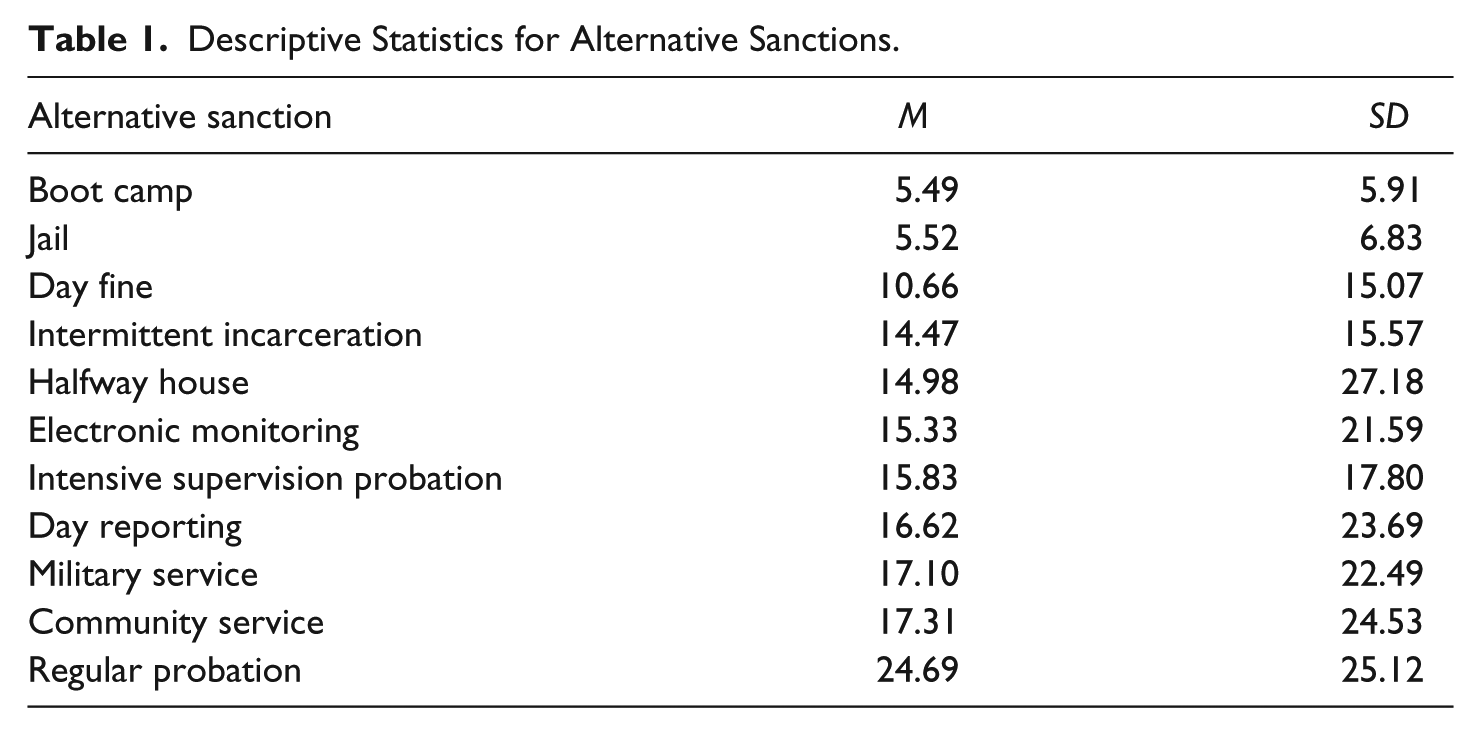
The results presented in Table 1 indicate that inmates found boot camp and jail as the most onerous sanctions and were generally willing to serve about half as much boot camp (5.49 months) and jail (5.52 months) as prison (based on the 12 months medium-security incarceration under consideration). Inmates also found day fines slightly more punitive than prison (10.66 months). Inmates found regular probation least punitive (exchange rate of 24.69 months), with military service (17.10 months) and community service (17.31 months) the least punitive sanctions outside of regular probation. The remaining sanctions were rated slightly less punitive than prison and generally equivalent to one another by the inmate sample.
Because the purpose of this research was to examine how veteran inmates differed from nonveteran inmates regarding their perceptions of alternative sanctions, the mean responses for both veteran and nonveteran inmates are included in Table 2. Independent-sample t tests were then estimated to determine if the mean differences between the two samples were significantly different.
Independent-Sample t Test Comparisons of Exchange Rates for Nonveteran and Veteran Inmates for 11 Alternative Sanctions to be Served in Lieu of Medium-Security Incarceration.
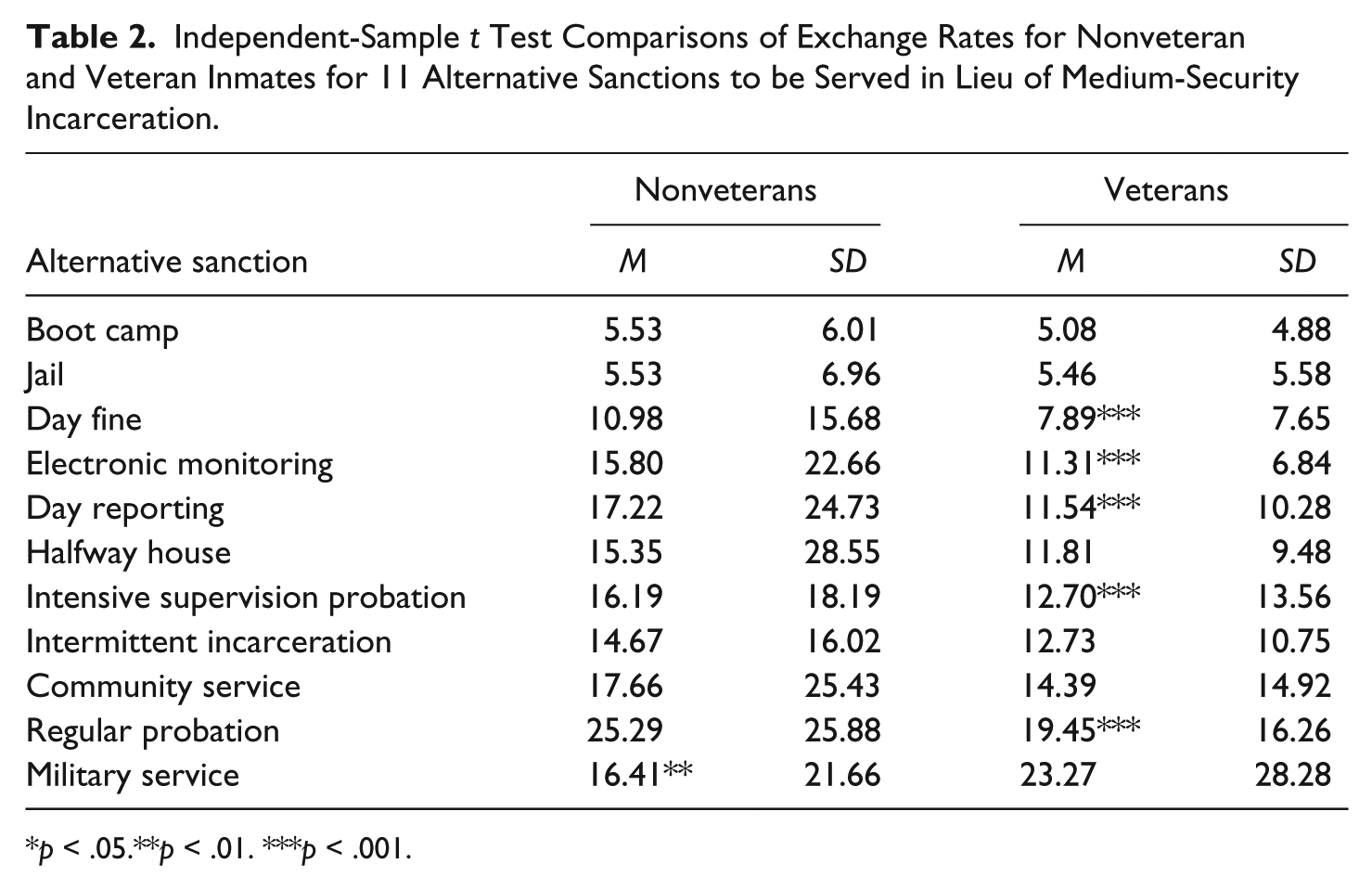
p < .05.**p < .01. ***p < .001.
As the results presented in Table 2 suggest, with the exception of military service, veteran inmates were willing to serve less time than nonveteran inmates for each of the alternative sanctions to avoid 12 months in prison, and for five of the 10 sanctions (day fine, electronic monitoring, day reporting, intensive supervision probation, and regular probation), these differences were statistically significant. Interestingly, for seven of the 11 sanctions, nonveteran inmates were willing to serve an average of 12 or more months on that sanction to avoid prison, indicating that they found those sanctions less punitive than prison. With the exception of military service, veteran inmates were willing to serve more than 12 months of the alternative sanction for only four sanctions (intensive supervision probation, intermittent incarceration, community service, and regular probation). Thus, veteran inmates appear to be more willing than nonveteran inmates to serve their time in prison rather than in the community.
It was unsurprising that there were no differences between veteran and nonveteran inmates in jail and boot camp, as a number of researchers have found little demographic or contextual differences in willingness to serve these two sanctions in lieu of prison. May and Wood (2010) argued that the universal animosity toward both sanctions cuts across all gender, race, age, and previous incarceration experiences. We expected that veterans would find prison less punitive than nonveterans but we did not expect that the strength of those differences would vary by type of community sanction. Upon further reflection, there do appear to be similarities between community service, halfway house, and intermittent incarceration that make that group of alternative sanctions somewhat different than regular probation, intensive supervision probation, electronic monitoring, day reporting, and day fine. An explanation for these differences is provided in the discussion section.
Another interesting finding from this research concerns the difference in the military exchange rates between veteran and nonveteran inmates. Veterans were willing to serve significantly more time in the military (23.27 months) than nonveterans (16.41 months, p < .01) to avoid 12 months in prison. In addition, of all the sanctions considered, veteran inmates considered the military the least punitive of the alternative sanctions. For nonveteran inmates, military service ranked as the ninth most punitive, with day reporting, community service, and regular probation all viewed as less punitive than the military. This finding is considered in greater detail in the discussion below.
As reviewed earlier, Milburn et al. (2014) determined that the intersection of race and veteran status was important in determining which inmates were more willing to serve time in the military in lieu of prison. Milburn and his colleagues determined that Black, nonveteran inmates were willing to serve significantly less likely time in the military to avoid prison than Black veteran inmates and both veteran and nonveteran White inmates. To examine whether that finding held true for alternative sanctions other than military service, we first created a four category race/veteran subgroup variable and coded inmates into one of four categories: Black veterans, Black nonveterans, White veterans, and White nonveterans. We then estimated one-way ANOVAs for each of the alternative sanctions’ exchange rates and compared the exchange rates for each alternative sanction across the four categories. The results of those analyses are presented in Table 3.
One-Way ANOVA Results of Comparing Exchange Rates Race/Veteran Subgroups.
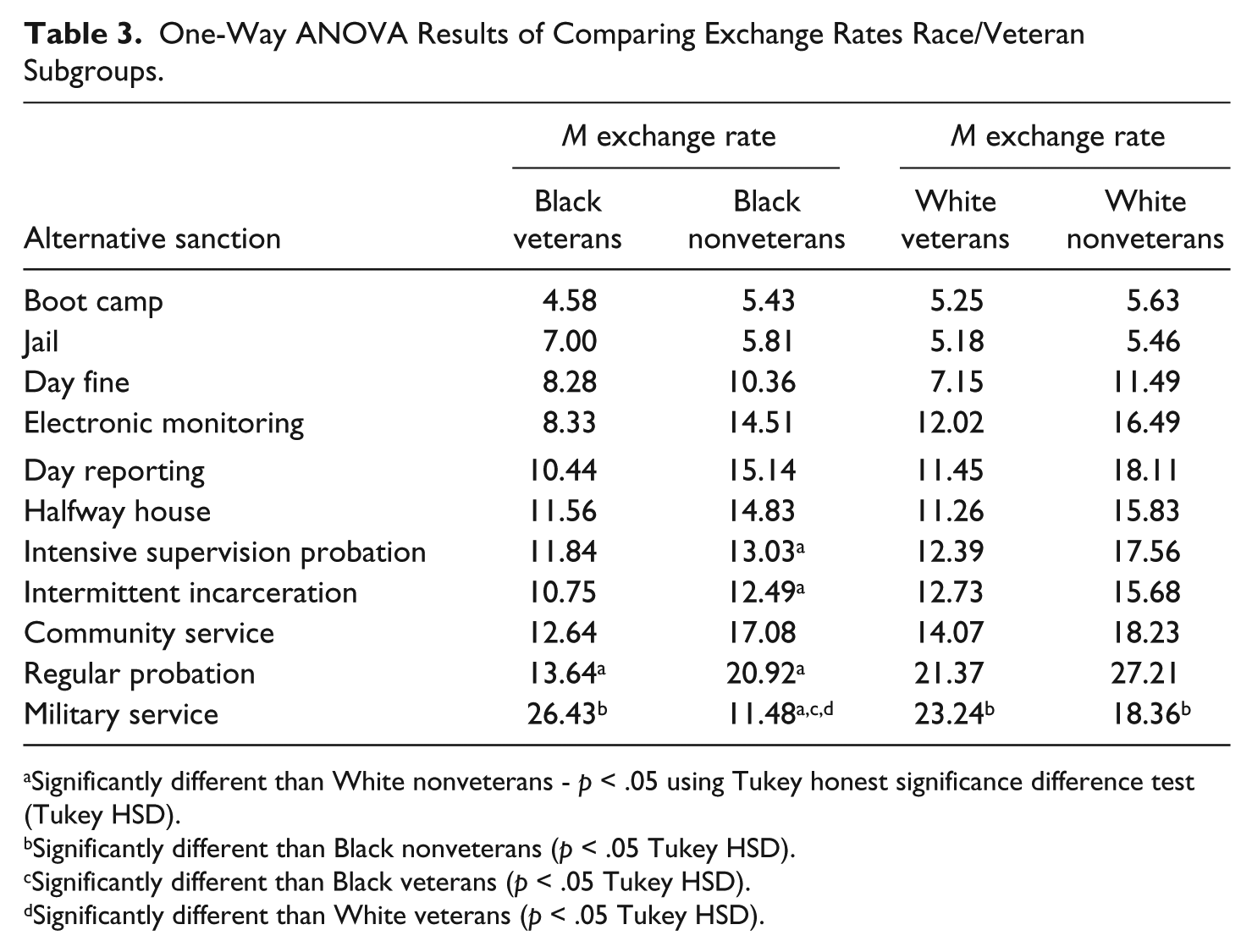
Significantly different than White nonveterans - p < .05 using Tukey honest significance difference test (Tukey HSD).
Significantly different than Black nonveterans (p < .05 Tukey HSD).
Significantly different than Black veterans (p < .05 Tukey HSD).
Significantly different than White veterans (p < .05 Tukey HSD).
The results presented in Table 3 largely confirm those presented in Table 2, with a few minor exceptions. First, dividing the veteran and nonveteran inmates by race did not affect the exchange rates for boot camp, jail, day fine, electronic monitoring, day reporting, halfway house, or community service. For those sanctions, there were no statistically significant differences between the four groups in the exchange rates they provided. Second, the findings presented here confirm those of Milburn et al. (2014) that Black nonveterans were significantly different than all other groups on their military exchange rates—Black nonveteran inmates were willing to serve significantly less time in the military to avoid prison than any other subgroup. In fact, Black nonveteran inmates rated the military (11.48 months) as more punitive than prison. Black nonveteran inmates were also willing to serve significantly fewer months on intensive supervision probation (13.03 vs. 17.56 months), intermittent incarceration (12.49 vs. 15.68 months), and regular probation (20.92 vs. 27.21 months) than White nonveteran inmates. The only other comparison where there were significant differences between the subgroups was for regular probation, where Black veterans were willing to serve significantly less time on regular probation to avoid 12 months in prison than White nonveteran inmates (13.64 vs. 27.21 months).
In addition to the significant differences outlined above, the results presented in Table 3 reveal another interesting finding. Black veteran inmates rated eight of 11 sanctions as more punitive than prison (as evidenced by an exchange rate less than 12), while both Black nonveterans and White nonveterans only rated three sanctions (boot camp, jail, and day fine) as more punitive than prison. White veterans rated five sanctions as more punitive than prison. Thus, veterans, and particularly Black veterans, feel that prison is not as punitive as a number of the other sanctions.
Given the significant interaction between race and veteran status in preferences for military service in lieu of prison uncovered by Milburn and his colleagues (2014), we created three dummy variables to represent the interaction between race and veteran status. Using White nonveteran inmates as the reference group, we included these variables in a series of multivariate linear regression models to examine whether these variables affected exchange rates when controlling for a number of known predictors of preferences for alternative sanctions over prison. 1 The results of those multivariate linear regression models are presented in Table 4.
Multivariate Linear Regression Model Results Estimating Exchange Rates on Gender, Age, and Race/Veteran Subgroup Variables.
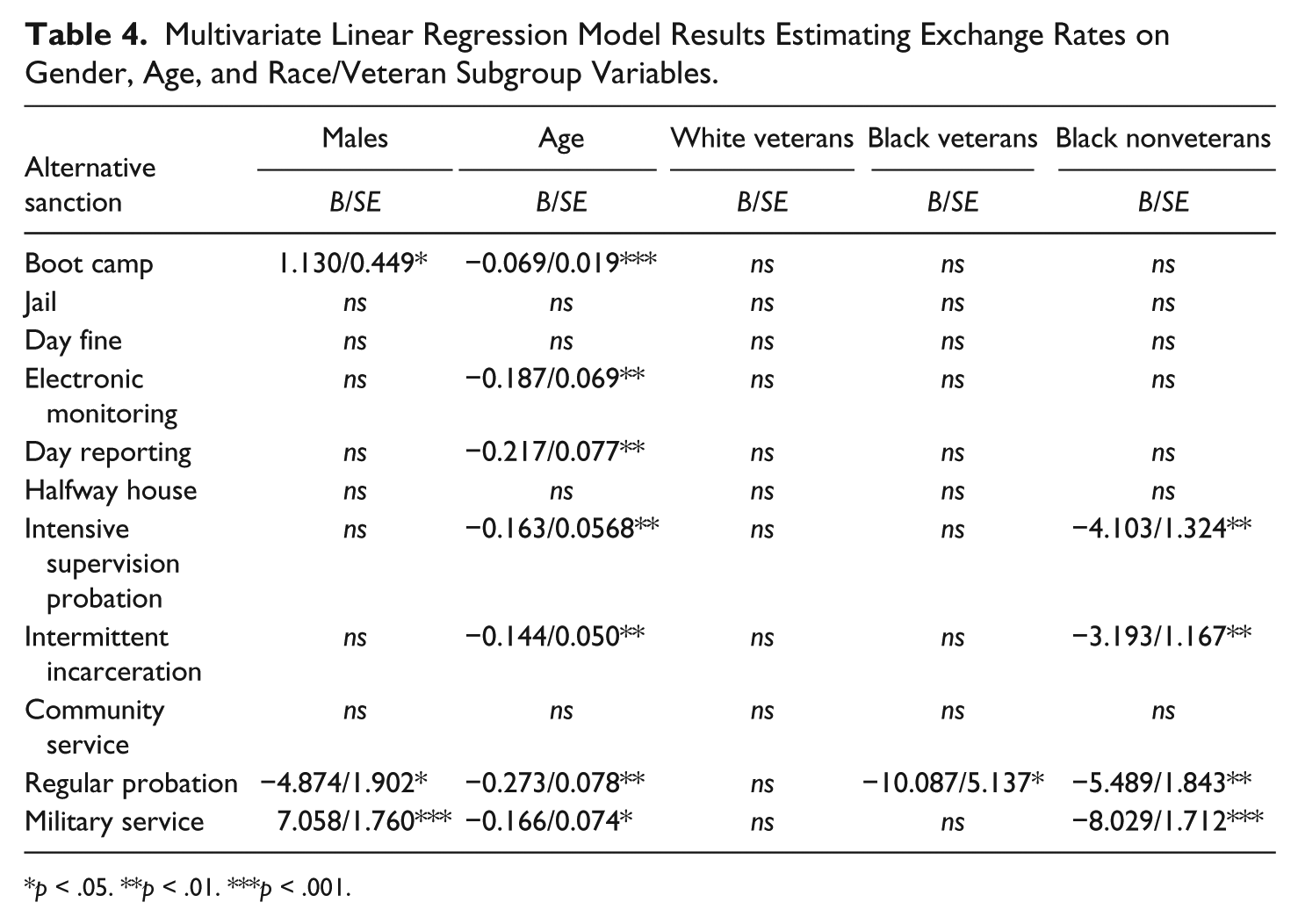
p < .05. **p < .01. ***p < .001.
The multivariate linear regression results presented in Table 4 indicate the most important predictor of exchange rates was age, as older respondents were willing to serve significantly less time than younger respondents on seven of the 11 sanctions under consideration (boot camp, electronic monitoring, day reporting, intensive supervision probation, intermittent incarceration, regular probation, and military service). Males were willing to serve significantly more time in boot camp and military service to avoid prison than females, while females were willing to serve significantly more time on probation to avoid prison than males. Black nonveterans were willing to serve significantly less time on intensive supervision probation, intermittent incarceration, regular probation, and military service than White nonveterans while Black veterans were willing to serve significantly less time on regular probation than White nonveterans. After controlling for gender and age, White veterans were no different than White nonveterans in their preference for alternative sanctions over prison.
Discussion and Conclusion
We began this effort in an attempt to further understand difference between veterans and nonveterans in terms of their perceptions of the punitiveness of prison as compared with alternative sanctions that might be used in lieu of prison, including military service. Using data from 1,164 currently incarcerated inmates, we determined that there were important differences in the ways veteran inmates (as compared with nonveteran inmates) perceived prison. We further extended the research in this area by finding that race and veteran status interact to predict perceptions of the punitiveness of military service (as Milburn et al., 2014, had already uncovered) but other alternative sanctions as well.
Our first research question under examination considered whether veteran inmates would find prison less punitive than nonveteran inmates. The answer is, with the exception of military service, is a resounding yes. Veteran inmates were willing to serve more than 12 months of only four of the traditionally used alternative sanctions (intensive supervision probation, intermittent incarceration, community service, and regular probation) while nonveteran inmates were willing to serve more than 12 months for seven of the sanctions. In addition, with the exception of military service, veteran inmates were willing to serve less time for each of the alternative sanctions to avoid 12 months in prison, and for 5 of the 10 sanctions (day fine, electronic monitoring, day reporting, intensive supervision probation, and regular probation), these differences were statistically significant.
Perhaps the most interesting finding in this study was found in the mean differences between veteran and nonveteran inmates discussed in Table 2. Veteran inmates were willing to serve less time in the community to avoid 12 months in medium-security prison for each of the 10 sanctions that did not involve military service; however, for only half of the sanctions was this difference statistically significant. A close examination of the types of sanctions may shed light on why these differences varied in strength by sanction. The 11 alternative sanctions can be roughly categorized into four types of sanctions: punitive, incarcerative sanctions (jail, boot camp); halfway in/halfway out sanctions (community service, halfway house, and intermittent incarceration); in-community sanctions (regular probation, day reporting, day fines, electronic monitoring, intensive supervision probation); and military service.
Significant differences between veterans and nonveterans were only found for the in-community sanctions and for military service. As expected, veterans had significantly higher exchange rates for military service than nonveterans and this finding mirrored that of Milburn et al. (2014). Veterans were willing to serve significantly more time in the military (23.27 months) than nonveterans (16.41 months, p < .01) to avoid 12 months in prison. In addition, of all the sanctions considered, veteran inmates considered the military the least punitive of the alternative sanctions, even less punitive than regular probation. For nonveteran inmates, military service ranked as the ninth most punitive sanction. Thus, the two groups had clear differences of opinion about military service, and veterans clearly preferred military service over prison.
For the in-community sanctions, however, nonveterans were willing to serve significantly longer time in the community than veteran inmates to avoid 12 months in prison. Although we did not ask the reasons for their choices, it appears that nonveteran inmates place more value on in-community sanctions than veteran inmates, suggesting that the experience of serving in the military might make prison more bearable and time in the community less valued. It could also be that veteran inmates are better able to tolerate the predictable, regimentalized nature of prison over the uncertain nature of community sanctions. Although research is lacking in this area, anecdotal evidence and some scholarly evidence (Sayers, Farrow, Ross, & Oslin, 2009) suggests that veterans may be more anxious, irritable, and less patient with others than their nonveteran counterparts. Anyone who has ever experienced community corrections understands how difficult it might be for anxious, irritable, impatient clients to successfully complete a community sanction. Thus, it is possible that these veteran inmates realize this about themselves and feel that prison is a better (or at least faster) sanction for them in terms of overall time served. Additional research is needed to fully understand this finding.
The findings from this study were not as unequivocal for the second research question. For that research question, we asked whether Milburn et al.’s (2014) findings of race/veteran interactions for preference for military service in lieu of prison might be found for other sanctions as well. The answer to that question is largely that the interaction between race and veteran status has a significant impact on military service exchange rates but does not affect the exchange rates inmates offer for most sanctions, particularly after controlling for known predictor variables of exchange rates. Confirming the findings of Milburn et al. (2014), Black nonveteran inmates were willing to serve significantly less time in the military to avoid prison than any other subgroup—in fact, Black nonveteran inmates rated the military (11.48 months) as more punitive than prison.
For the remaining sanctions, however, there was little difference in the race/veteran subgroups. ANOVA results in Table 3 highlighted that Black nonveterans had similar responses to Black veterans, White veterans, and White nonveterans in the exchange rates for boot camp, jail, day fine, electronic monitoring, day reporting, halfway house, and community service. For regular probation, intensive supervision probation, and intermittent incarceration, however, there were race/veteran interactions. For those sanctions, Black nonveterans were willing to serve significantly less time in the community than White nonveterans and were not significantly different than Black veterans or White veterans. The only other comparison where there were significant differences between the subgroups was for regular probation, where Black veterans were willing to serve significantly less time on regular probation to avoid 12 months in prison than White nonveteran inmates.
After controlling for gender, race, and age, the differences between veterans and nonveterans by race were diluted even further. White veterans were not significantly different than White nonveterans for any of the alternatives to prison, including military service. Black veterans would serve significantly less time on regular probation than White nonveterans; with that exception, Black veterans were not significantly different than White nonveterans on any of the other alternative sanctions. With the addition of the control variables to the model, the key differences appear to be between Black nonveterans and White nonveterans. Black nonveterans were willing to serve significantly fewer months on intensive supervision probation, intermittent incarceration, regular probation, and military service than White nonveterans. Thus, the regressions results suggest that Black, nonveteran inmates are distinctly different than all other race-veteran subgroups in this sample.
Milburn et al. (2014) argued that Black veterans are similar to both White veterans and White nonveterans in perceiving military service as having more benefits than do Black nonveterans, and thus are more willing to do military service than Black nonveterans, who do not perceive the same benefits. This reasoning may also explain why White nonveterans would agree to serve significantly longer times on intermittent incarceration, regular probation, and intensive supervision probation. White nonveterans see the benefit in serving their time outside prison for those sanctions; Black nonveterans do not. As May and Wood (2010) have argued, Black inmates typically view community sanctions as more of a hassle than White inmates. In these cases, Black inmates may feel their chances of success on those alternatives are low, so they choose to stay in prison rather than serve time in the community. They are not willing to “gamble” their freedom on these correctional alternatives. In-depth interviews with Black inmates in general, but Black inmates who have not served in the military in particular, could shed light on the reasons for that reluctance.
Limitations
Although we believe this research has made an important contribution, this research does have limitations. First, generalizing from these results to all veteran inmates in all states is problematic. Participants were limited to those nearing release so that the respondents would realistically be thinking about life outside prison; consequently, the sample includes only inmates whose sentence expired in the next 12 months or who were eligible for parole in the next 12 months. If the incarceration experience of these inmates had been particularly difficult or particularly easy, this may have changed the likelihood that they would choose military service in lieu of prison in ways that were unique to their situation or this sample. Furthermore, one of the reasons for such a small body of literature on this topic is that the focus in this research, incarcerated military veterans, is a unique group. Given the unique sample and the limited available evidence, we can only guess why race and veteran status interact in the way they do to predict exchange rates, or why veterans do not find prison as punitive as nonveterans. Finally, additional insight into the factors that influence veterans’ perceptions of the punitiveness of prison might also be gained by considering a number of factors about an individual’s military experience for which data were not collected here. Important differences may exist between veterans based on when, where, and how they served their time in the military. For example, interesting comparisons could be made by comparing (a) veterans who served during wartime with those who served during times of peace, (b) veterans who served in Vietnam with those who served in Iraq or Afghanistan, and/or (c) veterans who experienced combat with those who did not. Future research should replicate this work, and include both qualitative and quantitative measures to allow for deeper exploration of the explanations and unanswered questions offered here.
Footnotes
Declaration of Conflicting Interests
The author(s) declared no potential conflicts of interest with respect to the research, authorship, and/or publication of this article.
Funding
The author(s) disclosed receipt of the following financial support for the research, authorship, and/or publication of this article: The author(s) would like to thank the College of Justice and Safety Research Committee who provided funding for the initial data collection for this article. The authors would also like to thank the Kentucky Department of Corrections for their cooperation in allowing us to collect the data untilized in this study.