



Abstract
In the aftermath of tragic campus-based incidents causing injury and death, it has become common to see discussions concerning the safety measures institutions should be taking to prevent or mitigate the harm of such events. The recommended approaches reflect a degree of face validity but largely lack empirical grounding or clear evidence of support from the largest population they seek to protect—college students. Using survey data from six Illinois colleges, this study examines the level of student support for campus safety practices. Applying a framework derived from literature on fear of crime and other salient concepts, multivariate modeling is used to explain variation in the observed level of student support. The explanatory models offer limited insight into the factors shaping why students do or do not support campus safety practices. The findings demonstrate the importance of considering the views of students when institutions make decisions about campus safety policies.
Introduction
Shortly after the Virginia Tech and Northern Illinois University shootings, a number of federal and state task forces formed to address safety and security issues on college and university campuses (Campus Security Task Force, 2008; Randazzo & Plummer, 2009; Report of the Review Panel, 2007). These entities were typically charged with analyzing current campus safety and security issues, as well as making recommendations to improve relevant policies and procedures. For example, in Illinois, the Campus Security Task Force (2008) established that colleges and universities should adopt an all-hazards approach in planning for emergency situations and their response. The Task Force further noted that mental-illness-related incidents could be reduced when campuses promote mental health awareness and offer mental health services to at-risk students. Based on these recommendations, the Illinois Legislature passed the 2008 Campus Security Enhancement Act, which requires Illinois colleges and universities to develop all-hazards emergency response plans, develop comprehensive violence prevention and threat assessment plans, implement these plans, and annually train key staff to respond to emergencies.
In addition to all-hazards emergency response, violence prevention, and threat assessment plans, college and university officials and policy makers have suggested several policies with the intent of enhancing campus safety. Among other normative recommendations, institutions of higher education have been advised to implement alert systems to inform faculty, staff, students, and parents about emergencies on campus; make campus safety and security information widely available to faculty, staff, students, and parents; train both campus police and local law enforcement to prepare for hazards and violent incidents; and increase foot patrol on campus to promote police visibility and increase interactions and improve relations between campus public safety officials and student, faculty, and staff (Campus Security Task Force, 2008; Chancellor’s Task Force on Critical Incident Management, 2007; Davis, 2008; Gubernatorial Task Force For University Campus Safety, 2007; Leavitt, Spelling, & Gonzales, 2007; Northern Illinois University, n.d.; Report of the Review Panel, 2007). Many schools nationwide have been mandated or elected to adopt these or similar policies and safeguards. For example, the Midwestern Higher Education Compact (2008) found that more than 20% of schools planned to establish formal policies for securing their campus perimeter following the Virginia Tech shooting. A survey by Reader’s Digest (2008) reported that more than 90% of responding institutions had implemented an all-hazards emergency response plan.
Although a common core of campus safety policy recommendations is often proposed and discussed, it is unclear whether those ostensibly being protected—college students—support the recommended measures. Campus safety policies and protocols are intended to provide for the well-being of students and often focus on how students are treated by colleges and universities throughout their academic career, from admission through graduation. Despite the commonalities among the practices institutions have explored and adopted, there is a paucity of research examining how students perceive the very policies designed to ensure their safety. Policy makers have presumed implicit student support, despite the absence of empirical evidence supporting that conclusion. This study explores the level of support students have for campus safety and security policies, as well as the factors that explain variation in their support. A greater knowledge of students’ support provides important public policy implications for legislative bodies, higher education professional organizations, and college and university officials as they continue to explore the decision to adopt and implement campus safety policies. Furthermore, untangling factors that explain variation in students’ support for campus safety policies can assist school officials in crafting strategies of local relevance that can be implemented in a manner that will ensure student approval and cooperation.
Literature Review
History suggests that concerns by parents, students, and university administrators about campus safety and security issues can motivate legislative and policy changes. The 1986 murder of Jeanne Clery initiated federal legislation and administrative requirements to increase accessibility of campus crime data, enhance crime prevention efforts, and instill greater transparency about campus security and safety. The Student Right-to-Know and Campus Security Act of 1990 (Fisher, 1995; Janosik, 2001; Student Right-to-Know and Campus Security Act of 1990, 1990) has been updated several times to mandate colleges and universities facilitating student access to federal student loan programs publish their annual crime statistics and implement campus crime prevention initiatives (Higher Education Amendments Act of 1998, 1998). Other provisions have expanded the Campus Security Act of 1990, mandating the adoption of policies and practices including sexual assault reporting, hate crime reporting, emergency response guidelines, timely notification requirements, and domestic violence and stalking procedures.
Despite these legislative and administrative policy changes, there is a dearth of information whether students and their families access Clery data or whether they support campus safety provisions. Although dominant recommendations intended to facilitate critical incident prevention and response have face validity, it is unknown whether students support specific strategies beyond anecdotal accounts often reported by advocacy groups. Furthermore, there have been no attempts to date to understand how support for campus safety initiatives might be influenced by conceptually relevant variables, including prior victimization, perceived capacity, fear of crime, and perceived risk. The following literature review briefly considers the major campus safety recommendations issued in the aftermath of the Virginia Tech and Northern Illinois shootings. It then examines the conceptual salience of clusters of potential predictors of support for campus safety policies and procedures.
Common Campus Safety Initiatives
Recommendations made in the aftermath of the 2008 Virginia Tech tragedy include efforts to enhance the visibility of public safety officials and resources, to provide greater access control to campuses and buildings, and to improve information sharing between public safety personnel, mental health officials, and campus faculty and staff. Although these initiatives would appear to have an intuitive face validity, their rationale is not clearly couched in any empirical grounding. Students often disagree with campus protocols and practices, such as admissions policies (Kealy & Rockel, 1987), adjudicating academic integrity (Jordan, 2001; Thakkar & Weisfeld-Spolter, 2012), and responding to student use of alcohol (Marshall, Roberts, Donnelly, & Rutledge, 2011; Oster-Aaland & Neighbors, 2007). It is unclear whether student can be correctly presumed to support dominant campus safety initiatives.
Calls for enhanced police visibility and presence, whether from politicians or citizens, are often believed to deter crime and reduce fear of crime; however, studies have found mixed support for these presumed outcomes (Kelling, Pate, Dieckman, & Brown, 1974; Salmi, Gronroos, & Keskinen, 2004; Winkel, 1986). Campus safety personnel perceive their visibility on campus as an effective strategy to deter criminal activities (Sloan, 1992). Campus public safety agencies reported a substantial increase in the implementation of bicycle and foot patrols (from 24% in 1986 to 80% in 2006) to enhance police visibility, increase police presence, and build greater police–university relations (Peak, Barthe, & Garcia, 2008). In 2006, responding agencies perceived that they had experienced improved relations with campus faculty/staff, students, and administrators, though none of these groups provided validating data in this study. Not all increases in visibility generate the same outcomes (Brady, Balmer, & Phenix, 2007). Increased police presence and interaction with the university community was found to erode police–student relations when encounters emphasized enforcement activities, such as the issuance of citations (Miller & Pan, 1987). In another study, physical proximity to a police station increased the likelihood that college students took protective behaviors (e.g., carrying a gun or knife) as the facility served as a “relatively constant reminder of the presence of crime” (Tewksbury & Mustaine, 2003, p. 317).
Since 2008, there has been heightened consideration of how campus administrators can regulate access to their facilities through a range of methods, from modified admissions review processes to enhanced crime prevention strategies (e.g., locks, security checkpoints, restricted access to buildings and rooms). Campus representatives reported that their institutions had discussed implementation (15%), had planned to start implementation (2%), or had implemented criminal background checks (3%) on prospective students (Midwestern Higher Education Compact, 2008). In addition, fewer than 5% of respondents suggested that their institutions had added admission policies that asked if applicants had taken medication to treat a psychiatric or psychological condition, received psychiatric or psychological treatment, been convicted of a crime, been convicted of an aggressive or violent crime, or been convicted of a felony. Some colleges and universities have considered creating or revising their policies and procedures to address the return of students who had been expelled from campus for psychiatric or psychological reasons.
Campus public safety officials frequently play a broader role than their municipal police counterparts, with the role of the former including ensuring the provision of law enforcement and crime prevention efforts, offering drug and alcohol abuse awareness education to students, acting as sexual assault service providers, and meeting crime reporting obligations (Polensky, 2002). Since 2008, campus public safety officials have frequently been given the added responsibility of being part of comprehensive violence prevention initiatives. These types of campus-based efforts can include serving on violence prevention committees and threat assessment teams (Campus Security Task Force, 2008; Fox & Savage, 2009). Campus public safety officials enjoy some opportunities other law enforcement agencies do not, such as stronger connections with mental health experts servicing the campus community. For example, comprehensive violence prevention plans frequently require public safety personnel to identify problem students and share information about these students with university officials and mental health providers. Institutionalizing communication between public safety, mental health, faculty, and staff representatives is thought to increase the ability of campuses to identify and intervene when aberrant or high-risk behavior is detected from a member of the university community.
Hypothesized Predictors of Safety Policies
Despite the absence of an existing theoretical framework considering attitudes, some factors might be expected to predict student perceptions of campus safety policies. These factors (victimization, perceived capacity, fear of crime, perceived risk, and associated demographic variables) are drawn from broader extant scholarship examining perceptions of crime and protective behaviors. Such concepts might reasonably be expected to condition how students view campus safety policies.
Victimization
Victimization experiences have been shown to condition crime-related perceptions (Ferguson & Mindel, 2007; Fisher & Sloan, 2003; K. A. Fox, Nobles, & Piquero, 2009; Garofalo, 1979; Gibson, Zhao, Lovrich, & Gaffney, 2002; Skogan & Maxfield, 1981), although contrary findings can be noted (Baumer, 1985; Hindelang, Gottfredson, & Garofalo, 1978; Kaminski, Koons-Witt, Thompson, & Weiss, 2010; McGarrell, Giacomazzi, & Thurman, 1997; Nofzinger & Williams, 2005). Victimization experiences have been found to increase fear of crime (Jackson & Gray, 2010; Rader, 2004; Reese, 2009) and the actual risk of future victimization (Fisher, Cullen, & Turner, 2000). Campus safety initiatives are not solely focused on the prevention or mitigation of large-scale incidents of mass violence. They are ostensibly intended to reduce broader risk of victimization through target hardening, to increase communication among safety authorities, and to identify students who might pose a security risk. Students with recent victimization experiences might be expected to offer more support for campus safety initiatives. Crime victims should be more fearful, and that fear should translate into support for campus policies intended to enhance the security and control capacity of campus officials.
Perceived self-capacity
Most campus safety policies rely upon formal social control measures. Although campus officials encourage students to use common sense and exercise precautions (e.g., walk in groups, protect valuables), institutions themselves assume much of the responsibility for ensuring the safety of their population. Institutions establish notification systems, evacuation protocols, law enforcement response policies, and student-related provisions intended to secure a campus. These safety initiatives become a type of formal social control intended to keep campus environments safe and orderly and to ensure the best-possible response when critical events occur. When individuals have confidence in formal mechanisms of social control, they might be less likely to feel the need to engage in self-initiated activities to provide for their safety and well-being. For example, college students who believed that the campus police could perform their responsibilities well (i.e., being able to solve a case) were less likely to be fearful of crime than their counterparts (Miller & Pan, 1987). Similarly, when the perceptions of local police are questionable, individuals are more likely to take steps on their own to enhance safety, such as acquiring a weapon (Smith & Uchida, 1988).
It would be erroneous to assume that self-help, or individual action, only emerges when formal control mechanisms are weak. Scholars have argued, “Self-help is a form of nonlegal social control that varies inversely with the amount of governmental social control” (Smith & Uchida, 1988, p. 95; see also Black, 1983). Students who perceive that they are capable of protecting themselves might be expected to express less support for greater levels of formal control and intervention directed at campus safety. The less formal or personal control mechanisms—carrying a weapon, taking a self-defense class, or settling disputes through crime—may all be deemed preferable to more formal interventions. On a college campus, students may reject initiatives that restrict movement and physical access (especially when those restrictions are deemed inconvenient by users), limit student admissions, or are perceived to invade privacy if students have identified alternatives to protect themselves (e.g., self-help).
Prior research has tended to examine only perceptions of the police as a measure of capacity. In this study, perceived self-capacity and faculty capacity are also examined. This broader focus is important when examining campus-based critical incidents, in which students and faculty are often cast as playing key roles in both prevention and actual incident response. If students believe they are capable of protecting themselves, it would be expected that they will be less supportive of broad campus safety policies because those measures are presumptively unrelated to the students’ ability to mitigate the risk of harm. Likewise, if students believe faculty are capable of identifying high-risk students and helping ensure safety in the event of a critical incident, they might be expected to show less support for expansive or invasive safety policies.
Fear of crime and perceived risk
Fear of crime is an emotional response to potential victimization that can affect an individual’s behavior (Ferraro, 1995; Rader, May, & Goodrum, 2007). A college student who perceives that areas of campus are dangerous may choose to walk in a group at night, only travel in lighted areas of campus, or carry a defensive weapon. The crime rate on college and university campuses is normally lower than that in the surrounding community; nevertheless, many students are still fearful of crime (Baum & Klaus, 2005; Bromley, 1992). Although estimations of actual crime rates and risks are inaccurate in comparison with objective crime data, these estimations tend to generate fearful reactions. Contemporary scholarship links consideration of perceived risk with fear of crime because these two concepts are regarded as conceptually distinct but are statistically correlated (Fisher & Wilkes, 2003). Students expressing fear and/or perceiving risk should be more likely to support campus safety initiatives, as these measures presumably serve to protect students from actual harm. Although research has not yet established how demographics relate with perceptions of campus safety, there is a robust body of literature exploring demographics and fear/risk. These variables often serve to contextualize and explain student perceptions and behaviors, making their inclusion relevant in this study.
Criminological inquiry has repeatedly established that women express more fear of crime than men, including in samples of college and university students (Fisher, 1995; K. A. Fox et al., 2009; Jennings, Gover, & Pudrzynska, 2007; Kaminski et al., 2010; Lane, Gover, & Dahod, 2009). Among females, the fear of sexual victimization has been hypothesized to overshadow fear of other victimization experiences (Dobbs, Waid, & Shelley, 2009; Ferraro, 1995; Fisher & Sloan, 2003; Lane et al., 2009). This “shadow hypothesis” suggests, for example, that a man views burglary as simply a property offense, while a woman may additionally fear becoming a victim of sexual assault in the course of that property crime. While college women perceived that they were at a greater risk of victimization than college men (Wilcox, Jordan, & Pritchard, 2007), offense type may condition whether females or males perceive they are at higher odds of being victimized (Fisher & Sloan, 2003). For example, college males perceive a greater risk of robbery, while college females perceive a greater risk of sexual assault (Lane et al., 2009) and saw their bodies as objects to be defended (Kelly & Torres, 2006). It is expected that female students will offer more support for campus safety initiatives.
Age is another consistent predictor in criminological inquiry assessing fear and risk. College samples tend to have respondents truncated within a restricted age range; however, younger college students often express more fear and greater perceived risk than older college students (Fisher & Sloan, 2003; Kaminski et al., 2010). These outcomes run counter to normal trends in fear of crime scholarship, but suggest that age (a proxy for tenure at a school) might decrease fear through greater acclimation and experience. Older students have spent more time in campus environments, giving them a greater sense of safety and confidence in their ability to preserve their well-being. Older students would be expected to show less support for campus safety initiatives.
Non-White college students express higher levels of fear (K. A. Fox et al., 2009; Kaminski et al., 2010; Lane et al., 2009), even though data suggest that White students have slightly higher rates of actual violent crime victimization (Baum & Klaus, 2005). Hispanic males were more fearful of robbery at night than non-Hispanic males and perceived that they were at greater risk of victimization (Lane et al., 2009). These findings mirror general population studies that suggest racial/ethnic minorities had greater levels of perceived risk of victimization because they tend to live in high-crime neighborhoods (Ferraro, 1995). Non-White students would be expected to show more support for campus safety initiatives than their White peers.
Research Objectives
This study seeks to understand support for campus safety initiatives using data derived from student surveys administered on the campuses of six Illinois colleges and universities. Respondents were asked to rate their support for a range of common safety policies and procedures. These are grouped into measures intended to ensure access control, to identify potentially dangerous students or situations, and to allow firearms on campus. The results are considered using multivariate modeling to determine if levels of support are associated with student demographics, victimization experiences, fear, and perceived capacity. The intent of this effort is to understand the overall support for safety initiatives from those protected by those measures and to determine if conceptually relevant variables explain variation in support across the sample.
Method
Sample
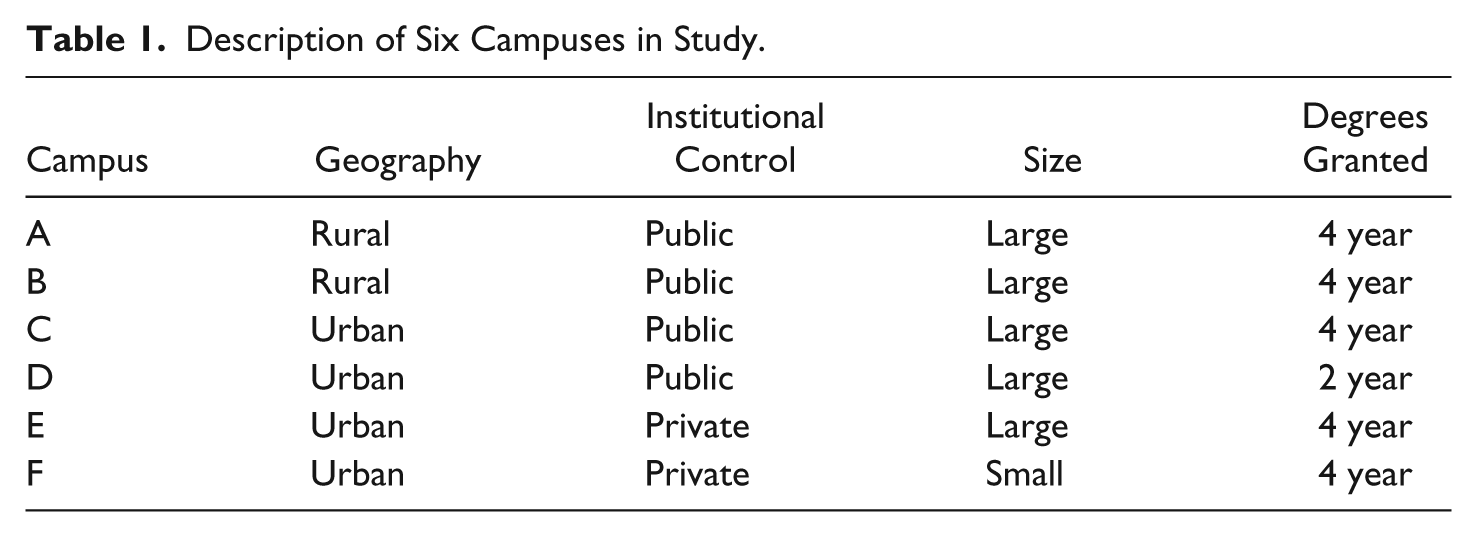
We purposively selected schools from Illinois in 2009 to 2010 for campus variation based on geography (urban vs. rural), institutional control (public vs. private), size (10,000+ students vs. less than 10,000 students), and degrees granted (2-year vs. 4-year). Six campuses were selected: two large, public, and rural 4-year universities; a large, public, and urban 4-year university; a large, public, and urban community college; a large, private, and urban 4-year university; and a small, private, and urban 4-year university. Table 1 labels and categorizes the six schools across these dimensions. Prior to data collection, all six institutions’ Institutional Review Boards (IRBs) and the authors’ own IRB granted human subjects approval. Participating schools were assured that their identities would not be disclosed.
Description of Six Campuses in Study.
To maximize the coverage of the student populations at each campus, we used the semester course offerings as the sampling frame to draw a random sample of four classes across dominant time offerings on 2 consecutive days (e.g., Monday–Tuesday or Wednesday–Thursday). Course lists were provided by each of the six institutions to ensure that the most accurate and updated records were being used. For each institution, approximately 1 month before data collection we e-mailed the instructors of record for permission to distribute surveys during the beginning or end of the scheduled class session on a specified date. If an instructor declined or failed to respond, we attempted to replace it with a different course selected at random from that time slot. Independent studies, field placements, internships, online, and off-campus courses were excluded from this process.
Campus-specific cooperation rates from instructors varied from a low of 30% at the small private university to a high of 49% at a large public 4-year university. Two-day site visits were conducted at each of the six institutions. At that time, a member of the research team went to each participating class, explained the survey, explained associated human subjects issues (voluntary participation, anonymity in responses, etc.), and sought student participation. The research team distributed and collected all survey booklets. Survey participation was not linked with assessment in any of the classes, and instructors of record never observed or handled any of the completed survey booklets. Student participation for each campus was more than 97%. Taking into account student enrollment in selected participating classes, the response rate was lower but still considerable. Across all six campuses, at least two thirds of students enrolled in the participating courses completed the survey; omissions were generally the result of student absences from class on the date of the survey administration. Overall, 5,150 students provided usable data (completed or partially completed survey responses). Using listwise deletion, 4,329 cases had full data across all the predictors in the regression models (about 16% of total cases had missing data). An examination across predictors, however, showed that no variable had more than 5% missing cases. We, therefore, assume that these missing data were missing completely at random. 1
Dependent Variables
Nine measures were used to compute three dependent variables reflecting different forms of proposed campus safety policies: restricting access to campus, improving reporting about potentially dangerous students, and allowing the carrying of firearms on campus. Five independent variables serve as predictors that were regressed on each of these policies: perceived risk of victimization, fear of crime, self-capacity, faculty capacity, and victim of crime. Also, six background variables were used as controls: White, female, age, class rank, lives on campus, and criminal justice (CJ) major. Finally, the six campuses were used as a control with the urban campus serving as the reference category.
To predict students’ support for restricting access to campus for problematic persons, four survey items were summed into a single scale: “Campus should restrict campus access”; “Threatening students should be removed from campus”; “Campus should deny admissions to convicts”; and “Campus should deny admissions to those with campus misconduct.” The original four items were measured on a 5-point Likert-type scale: (1) strongly disagree, (2) disagree, (3) neither agree nor disagree, (4) agree, (5) strongly agree. The scale’s reliability was close to the accepted .700 cutoff (α = .665). This and other scales had the number of items subtracted to the total, so that 0 represents no support for the policy. The descriptive statistics for all of the variables are reported in Table 2.
Dependent Variable Descriptive Statistics for 4,329 Student Respondents.
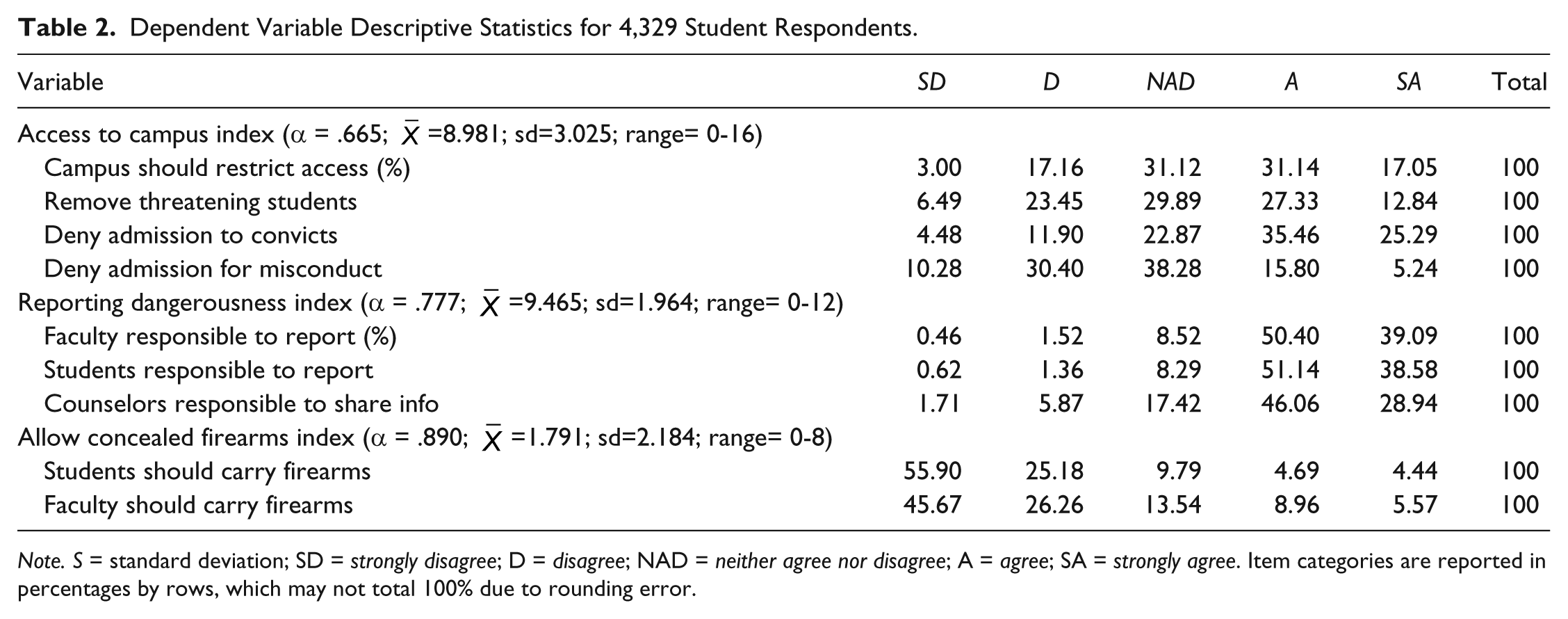
Note. S = standard deviation; SD = strongly disagree; D = disagree; NAD = neither agree nor disagree; A = agree; SA = strongly agree. Item categories are reported in percentages by rows, which may not total 100% due to rounding error.
The second policy outcome, improve reporting dangerousness across campus, was scaled from three variables on the same 5-point Likert-type scale: “Faculty have responsibility to report dangerous students”; “Students have responsibility to report dangerous students”; and “Counseling services should share information with public safety.” This scale showed internal reliability (α = .777). The scale measured support for reporting from 0 (no support) to 12 (full support). Finally, allow concealed firearms on campus was measured with two items: “Students should be allowed to carry concealed firearms on campus” and “Faculty members should be allowed to carry concealed firearms on campus.” The internal reliability for these two items was high (α = .890). A score of 0 represented no support, and a score of 8 represented full support.
Independent Variables
Six ordered categorical variables asked respondents to assess their risk of victimization (“What do you think is the likelihood or chance of the following incidents happening to you while on campus?”) on a 5-point Likert-type scale: (0) very unlikely, (1) somewhat unlikely, (2) just as likely as unlikely, (3) somewhat likely, (4) very likely. Victimization was asked on three crimes at night and during the day: daytime assault; daytime rape; daytime shooting; nighttime assault; nighttime rape; and nighttime shooting, where 0 represents no risk of victimization and 24 represents high risk of victimization. The scale showed a high degree of internal reliability (α = .888). Similarly, the measure for fear of crime summed 10 categorical variables on a 0 to 9 scale (“How would you rate your fear of the following incidents happening to you while on campus?” Respondents expressed their fear for each of the five crimes both during the day and at night): stalking, rape, robbery, assault, and shooting. The fear variable ranged from 0 (no fear) to 90 (fearful) and had a high internal reliability (α = .957). The independent variable descriptive statistics are reported in Table 2.
We measured respondents’ perceptions of capability about what to do in the event of an incident through two measures: self-capacity and faculty capacity. We measured self-capacity through three items on a 5-point Likert agreement scale (0 = strongly disagree; 4 = strongly agree): “In the event that severe weather (such as a tornado) strikes while I am in the classroom, I understand the university-recommended actions that I am supposed to take”; “In the event that gunfire is heard outside my classroom, I understand the university-recommended actions that I am supposed to take”; and “In the event of a crime-related incident on campus, I am capable of protecting myself from harm.” The three measures were summed to form an index from 0 to 12 (α = .710). Faculty capacity was also an index created from two items on the same agreement scale (0-4): “Faculty are well equipped to assist in critical incidents” and “Faculty can recognize students in need of referral.” Both items were summed to measure students’ perceptions of faculty capabilities to handle emergencies (α = .732). We also measured victim of crime from the sum of two measures of past violent victimization (on campus experiences in the prior 12 months) for assault and robbery (0 = no prior victimization; 1 = victim of one or two of these types of crimes).
We used several control variables in the models. The race of the respondents was coded 1 for White and 0 for minority. Female was coded 1 for female respondent. The respondents’ age was coded as age at the time of the survey. Class rank was coded as (1) freshman, (2) sophomore, (3) junior, (4) senior, and (5) graduate student. If the respondent lived on campus at the time of the survey, the variable lives on campus was coded 1. Finally, several of the participating schools offered CJ degree programs. CJ major is coded 1 when respondents reported being a CJ major and 0 for all others.
Analysis Plan
The three policy-dependent variables were separately regressed on the predictor variables using ordinary least squares (OLS) regression. In addition to the predictor variables, each of the surveyed schools was dummy coded and added to the models (large rural university A was left out as the reference category). Because age and class rank were significantly and moderately correlated (r = .500, p < .05), multicollinearity was considered; however, the variance inflation factor (VIF) for the regression models indicated that multicollinearity was not an appreciable concern (e.g., VIF < 2).
Results
The levels of support for the three campus policies (access, reporting, and allowing concealed firearms) are reported in Table 2. The average for the access to campus policy variable was a little over the midpoint of the 16-point scale (
The improve reporting dangerousness policy mean showed a high level of support (
Descriptive statistics for all independent variables are shown in Table 3. Both fear of crime and risk of crime were fairly low across the five campuses (
Independent Variable Descriptive Statistics for 4,329 Student Respondents.
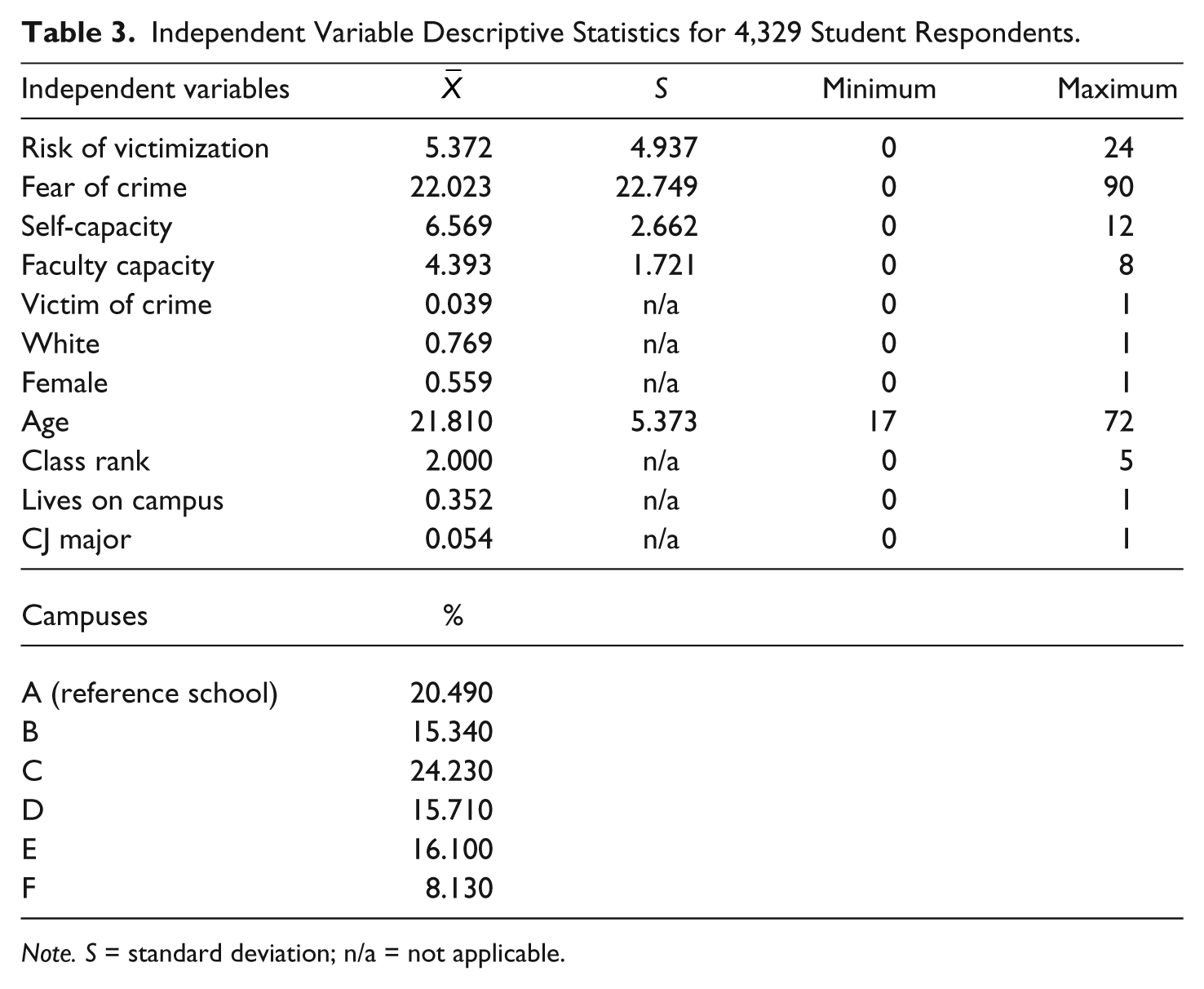
Note. S = standard deviation; n/a = not applicable.
The OLS regressions for the three dependent variables are reported in Table 4. The first model regressed support for the access to campus policy on the predictors and campus variables. Overall, the model was significant (p < .050); the model explained 5% of the variation in support for the policy (R2 = .050). Risk of victimization and fear of crime were the strongest predictors (β = .099 and β = .092, respectively). Self-capacity, faculty capacity, female, and age were the other significant positive predictors. Compared with the first large rural campus, there was stronger support for the policy from the community college, urban campus, and second large rural campus. The other two campuses were not significantly different from the first large rural campus.
OLS Regression for Safety Policies (N = 4,329).
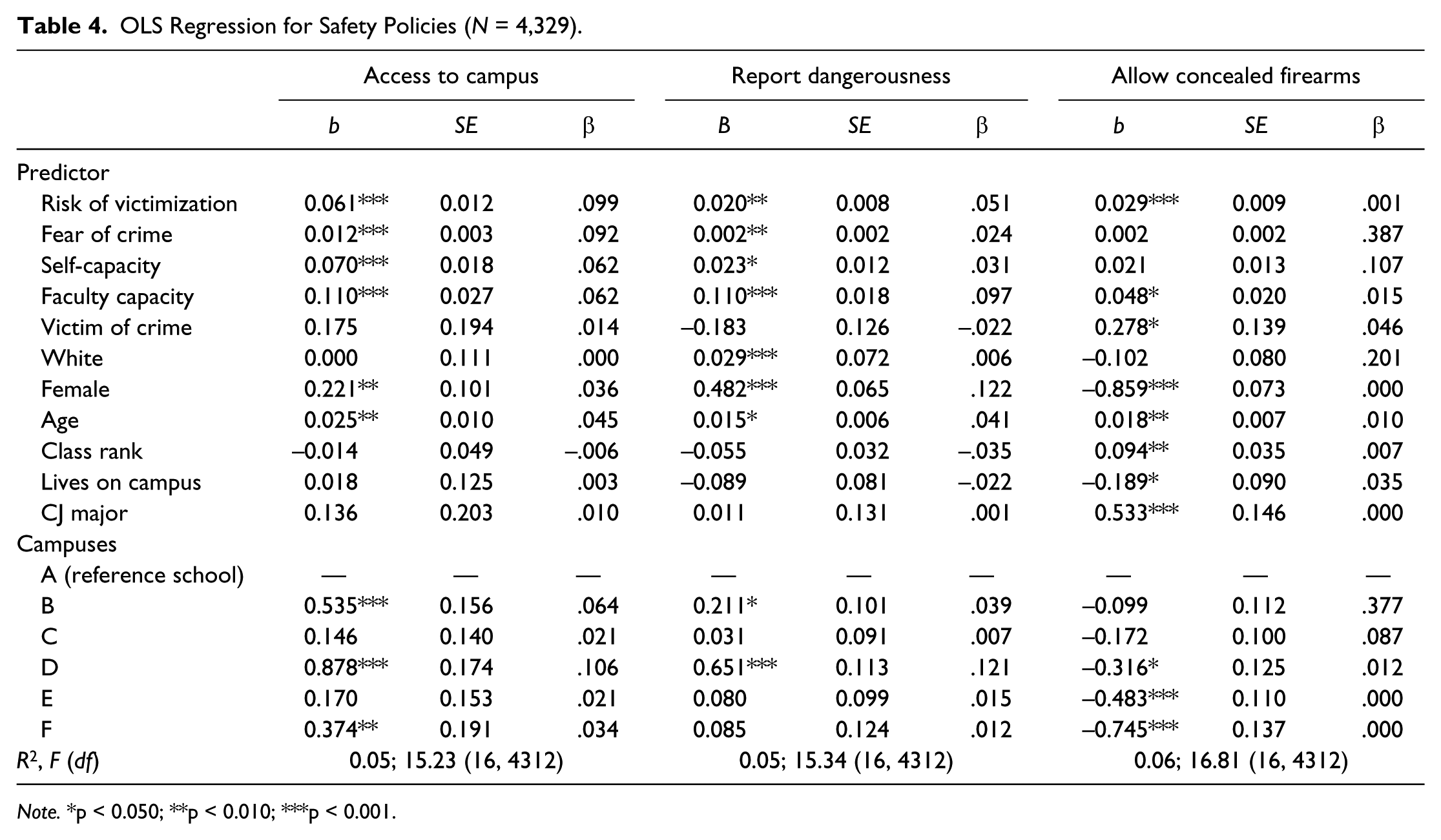
Note. * p < 0.050; **p < 0.010; ***p < 0.001.
For the reporting dangerousness policy, the model was significant (p < .05) and explained 5% of the variation (R2 = .050). Being female and faculty capacity were positive and the strongest predictors in this model (β = .122 and .051, respectively). Fear of crime and risk of victimization were also significant and positive as was being White and a 1-year increase in age. Only the community college and second large rural university were significantly different from the reference campus.
Finally, the model predicting allowing concealed firearms was also significant (p < .05) and explained about 6% of the variation (R2 = .060). Being female was the strongest predictor for the model: Females were less likely to support the policy (β = −.195). Living on campus also reduced support for carrying concealed weapons. The risk of victimization, a 1-year increase in age, higher-class rank, and being a CJ major all increased support for the policy. This policy was less supported at the community college, the small urban university, and the large urban university compared with the first rural university.
Discussion
The mean scores for the three dependent variables (reflecting the three categories of campus safety policies) demonstrate that each has varying levels of support. Although on different scales, the reporting dangerousness policy had the highest level of support (about 3.5 points above the scale’s midpoint) followed by the limiting access to campus policy (just above its midpoint). The dependent variable reflecting support for allowing concealed firearms by faculty or students was below the support scale’s midpoint (by about 2 points). Thus, there is clearly variation in support for the different types of safety policies that campus officials may seek to implement. Students were quite supportive of restricting access to campus, but far less inclined to support allowed concealed carry of firearms. It should be noted that the measure used in this study to reflect support for restricting access did not specifically assess the varying types of physical controls campuses might use (e.g., locks, key/ID card controls, security personnel monitoring entrances, etc.).
When attempting to predict the factors leading to support for the policies, all three multivariate models were significant, but the amount of variation explained was low (around 5% for each model). Thus, this study shows that predicting support is not greatly determined by perceptions of conceptually related crime and safety matters, respondent demographics, respondent experiences with crime victimization, or by the context or location of the campus, at least within the state of Illinois. For the access to campus and reporting dangerousness variables, most of the same predictors were significant and positive: risk of victimization, fear of crime, self-capacity, faculty capacity, female, and age. White respondents were more likely to support policies and practices associated with improving dangerousness reporting. For policies associated with allowing concealed firearms on campus, risk, faculty capacity, being a victim of crime, age, and being a CJ major increased support, while being female and living on campus lowered support. Based on these models, it is clear that the limiting access and improving reporting dangerousness have similar predictors of support, while allowing concealed firearms is somewhat different. Support for allowing concealed firearms appears to be more a function of student demographics (particularly being male and a CJ major), while campus safety protocols related with access and reporting are more influenced by clusters of other crime and safety perceptions.
The explanatory variables discussed above are consistent with rational models of individual action. Considerable research shows that people, students included, engage in individual protective behaviors to offset risks, compensate for perceived institutional (i.e., police) limitations, or address prior victimization (e.g., Kleck, Kovandzic, Saber, & Hauser, 2011; Lab & Stanich, 1994; Luxenburg, Cullen, Langworthy, & Kopache, 1994; Smith & Uchida, 1988). The underlying assumption guiding the present study was that the same predictors that explained why people take protective measures would explain why student attitudes galvanize around more rigid or crime-control-oriented policies. Yet, the variables that predict individual action failed to explain much of the variation in attitudes about institutional policies. Student support for campus policies was modest, at best.
Several explanations might be offered for the weak outcome of the predictive efforts in this study. Extant literature on fear of crime, perceptions of risk, and victimization experiences in college environments would suggest that the independent and control variables included in this study should explain more of the variation observed in the three dependent variables. Strong explanatory outcomes were not, however, observed in the context of student support for campus safety initiatives. This might simply be a function of other unmeasured independent variables serving to account for variation in the dependent measures. Alternatively, students are perhaps more likely to act alone than they are to rely upon campus authorities to protect them. Students might also be far less thoughtful about campus safety matters than would otherwise be presumed. While conceptual relationships can be seen between fear, risk, victimization, and support for campus safety policies, in actuality students might give these concepts and concerns little thought or consideration. This would not be wholly unexpected, given the tendency for youth to have a fear of crime that is not proportional to their actual risk of victimization (Ferraro, 1995). In the context of allowing concealed carry of firearms, limitations on the survey’s length precluded the inclusion of measures of student’s political ideologies. Prior research considering attitudes toward firearms policies has demonstrated that political ideology is an important predictor of these types of attitudes (Holbert, Shah, & Kwak, 2004; Kleck, 1996; Wolpert & Gimpel, 1998).
Despite the inability of these variables to explain variation, campus officials may still find it worthwhile to gauge student perceptions of campus policies. While the explanatory results attempted here achieved limited success, the descriptive results demonstrate that student views varied based on the type of safety approaches being considered. The results in Tables 2 and 4 establish that, while the explanatory efforts in this study achieved limited strength, there are clearly varying levels of student support for campus safety initiatives. Students expressed limited support for allowing concealed firearms but offered relatively strong support for protocols intended to limit and regulate access to campus spaces and facilities. Campus administrators might consider whether such approaches should be given greater consideration in light of the strong support found in this study, though support might certainly vary across institutional settings and student bodies. In the context of concealed carry policies, legislative bodies (which often have the initial authority to either allow or disallow campuses from permitting concealed carry at a specific institution) would do well to recognize allowing firearms on campus, while often a subject of political and advocacy rhetoric, appears to have limited student support.
There is also considerable value in providing campus constituents with a voice in policy-related matters. As recent events on college campuses suggest, safety policies are of significant concern to members of the campus community. On public university campuses in Texas, constituents are working to shape the specific provisions of already passed concealed carry legislation that goes into effect in 2016 (Nagourney & Turkewitz, 2015). Although a consensus often proves elusive, organizational research indicates that students may be more likely to accept campus administrators’ policy decisions if those choices are reached in a fair way, even if the specific policy decision runs against an individual’s own interests or beliefs (Cohen-Charash & Spector, 2001; Colquitt, Conlon, Wesson, Porter, & Ng, 2001; Greenberg, 1990; Leventhal, 1980). Providing a voice to the constituents enhances perceptions of fairness, informs administrators about the general attitudes on campus, and signals a level of campus responsiveness (Leventhal, 1980). University administrators might consider the importance in seeking the input of their own student body, as well as the views of faculty and staff, before implementing new support to campus safety initiatives. Although administrators might only seek input from representative bodies (i.e., campus student government), this project’s methodology provides a cost-effective mechanism to secure broader student input. Seeking input should, of course, be more than a symbolic process; when students believe that they have had a legitimate voice in the decision-making process, they will arguably be more likely to accept the outcome.
Conclusion
The survey results suggest that students from a diverse mix of Illinois colleges and universities were supportive of some common recommended practices intended to enhance campus safety and security. The variable level of support observed across categories of initiatives demonstrates that institutions should not presume universal support for these practices. In particular, students expressed limited support for allowing concealed carry of firearms, despite the fact that concealed carry has become a frequently discussed policy response arising from each successive campus-based shooting. Institutions should not necessarily base their policy decisions solely on the support expressed by students. Contemporaneously, it should be recognized that an institution’s student body is the largest group of constituents campus safety measures are intended to protect, and their views and desires cannot be discounted. Institutions should be mindful that high levels of student support for particular practices do not, by themselves, justify those approaches. There is a probability of false positives in any risk assessment approach. Students might not always realize that a protective measure they support is not empirically well grounded and might represent a policy approach that actually does harm, rather than good, to the student body.
Institutions might be wise to integrate student support into their decision-making schemes, while being mindful that many dominant recommended practices have not been proven effective in achieving desired outcomes. In addition to needing more research about effective safety practices that would support evidence-based policy approaches, the research community should continue to explore the nature of support students (and other salient populations) express for those practices. The weak predictive results achieved in this study suggest that, while support is variable, conceptually relevant explanatory models are of limited use in helping understand that variation within the context of campus safety initiatives. The latter information, while clearly of academic value, would also help in the policy formulation and implementation process. When an institution determines an unpopular policy still must be implemented, knowing where support and resistance can be expected can assist in ensuring understanding, acceptance, and institutionalization of policy change.
Footnotes
Declaration of Conflicting Interests
The author(s) declared no potential conflicts of interest with respect to the research, authorship, and/or publication of this article.
Funding
The author(s) disclosed receipt of the following financial support for the research,authorship, and/or publication of this article: This project was supported by Grant #06-JB-FX-0018 to the Illinois Criminal Justice Information Authority by the Bureau of Justice Assistance, Office of Justice Programs, U.S. Department of Justice. Points of view or opinions contained within this document are those of the authors and do not necessarily represent the official position or policies of the Authority or the U.S. Department of Justice.