




Abstract
A growing body of research indicates that there are thousands of sexual assault kits (SAKs) in police property storage facilities that have never been submitted for DNA forensic testing. Some of these rape kits may be quite dated, and the statute of limitations (SOL) for prosecution of the case may have expired. Whether testing such kits could still provide useful information for criminal justice system personnel is unknown. To address this gap in the literature and to inform policy regarding rape kit testing, we randomly sampled 700 previously untested SAKs from Detroit, MI: 350 were presumed to be beyond the SOL for prosecution (based on the date the SAK was collected), and 350 were still within the SOL. All SAKs were submitted for DNA testing, and then we quantified and compared the forensic testing outcomes. At issue was whether these older SAKs would yield DNA profiles that were eligible for entry into Combined DNA Index System (CODIS), the federal DNA forensic database, and whether these profiles would match (“hit”) to other criminal offenses catalogued in CODIS. Rates for presumed SOL-expired SAKs and unexpired SAKs were compared via a continuation-ratio model and equivalence tests. The rates of CODIS-eligible DNA profiles, CODIS hits, and serial sexual assault CODIS hits were statistically equivalent in the SOL-expired and SOL-unexpired groups. Testing older SAKs has potential utility to the criminal justice system because these kits produced DNA matches to other crimes, including other sexual assault crimes, at a rate equivalent to current, SOL-unexpired SAKs.
Keywords
A growing number of social science studies and media reports indicate that thousands—perhaps hundreds of thousands—of sexual assault kits (SAKs) have never been tested for DNA evidence (Campbell, Feeney, Fehler-Cabral, Shaw & Horsford, 2016; Human Rights Watch, 2009, 2010; Lovrich et al., 2004; Peterson, Johnson, Herz, Graziano, & Oehler, 2012; Reilly, 2015; Strom & Hickman, 2010). An SAK, also termed a “rape kit,” contains biological specimens (e.g., semen, blood, saliva) that are collected by medical professionals from the victim’s body after an assault (Department of Justice [DOJ], 2013). Law enforcement personnel are responsible for taking the completed SAKs into custody and submitting them to forensic laboratories so that the samples can be analyzed for DNA (DOJ, 2013). If a profile can be extracted, it may be entered into Combined DNA Index System (CODIS), the national forensic DNA database, which consists of reference DNA profiles from arrestees/convicted offenders as well as samples obtained at crime scenes (Butler, 2005; Jobling & Gill, 2004; Stevens, 2001). When a new DNA profile is entered into CODIS, it is compared with those reference DNA samples, and if there is a match (termed a “hit”), then law enforcement personnel have a strong investigative lead, possible corroboration of the offender’s identity, and/or the discovery of a serial offender through DNA matches across multiple crimes. However, many law enforcement officers are not routinely submitting SAKs for DNA testing and instead are storing them in evidence property facilities, unexamined and unanalyzed (Strom & Hickman, 2010). Large numbers of untested SAKs have been documented in multiple cities, including New York City (~16,000 SAKs); Los Angeles (~13,000); Memphis (~12,000); Detroit (~11,000); Houston (~6,000); Cleveland, Dallas, and Las Vegas (~4,000 in each city); and Milwaukee, Phoenix, San Diego, and Toledo (~2,000-3,000 in each city; www.endthebacklog.org).
A pressing issue for practitioners and policy makers is what jurisdictions should do with older SAKs if they have accumulated large numbers of untested rape kits over many years. Would forensic testing of kits that date back five, 10, or even 20 years provide useful and actionable information for criminal justice system personnel? A key issue to consider is the statute of limitations (SOL) for the sexual assault case associated with the SAK. In eight states, there is no SOL for felony-level sexual assault crimes, but most states do have time limits on prosecution (National Center for Victims of Crime, 2013). If a case can no longer be prosecuted, should the rape kit be tested? This is a complicated issue because even if the SOL has expired, the evidence within those kits could still be useful to police and prosecutors. For example, if the offender has committed other crimes, there is a possibility that the DNA in the rape kit will match to other criminal offenses in CODIS. Prosecutors can present evidence of prior crimes (e.g., an old, SOL-expired sexual assault case) in current cases (e.g., another sexual assault crime or other criminal offenses that are still within the SOL), per 404(b) Federal Rules of Evidence (FRE; Brauser, 1994; Federal Evidence Review, 2005; Weissenberger, 1985). As such, there is potential utility in testing older SAKs from SOL-expired cases, but to date, there has been no research regarding how probable it is that such testing would yield a CODIS hit. DNA analysis testing requires time, effort, and resources, so it is important to consider whether testing kits associated with cases that can no longer be prosecuted is reasonable practice.
Therefore, the purpose of this study was to examine whether testing older rape kits could provide useful data for criminal justice system personnel by quantifying forensic testing outcomes (number of kits that have CODIS-eligible DNA profiles, number of CODIS hits) and then comparing those rates for SAKs that are associated with cases that are still within the SOL to those that are most likely SOL-expired. If older kits do not yield many CODIS-eligible DNA profiles and CODIS hits, then testing these SAKs may not be a key priority when a jurisdiction discovers it has large number of untested SAKs. However, if the forensic outcomes are statistically equivalent between older, SOL-expired SAKs and current, SOL-unexpired SAKs, that would suggest that testing older kits can provide useful data to law enforcement and prosecutors, so testing protocols should have provisions for testing older SAKs. 1 To explore these questions, we randomly selected a sample of 700 SAKs from Detroit’s population of previously untested SAKs. All SAKs were outsourced for DNA testing, and then we compared forensic testing outcomes as a function of SOL status. To set the stage for this study, we will begin with a brief review of how SAKs are collected, analyzed, and cross-referenced within CODIS to identify offenders and patterns of repeat offending. Then, we will review the findings from the few studies that have documented SAK forensic testing outcomes and then consider issues specific to testing older SAKs that may be beyond the SOL for prosecution.
The Collection, Testing, and Potential Utility of SAKs
After a sexual assault, victims are advised to have a medical forensic exam (MFE), which includes diagnosing and treating injuries, offering emergency contraception to prevent pregnancy (if applicable), and administering prophylaxis for sexually transmitted infections that might have been contracted during the assault (DOJ, 2013). An SAK might also be collected to preserve the physical evidence from victims’ bodies to aid in the prosecution of the crime (Campbell, Patterson, & Lichty, 2005; Du Mont & White, 2007; Ledray, 1999). Collecting an SAK is time-consuming and highly invasive for victims, as it includes plucking head and pubic hairs; obtaining fingernail scrapings in the event the assailant was scratched during the attack; and swabbing the vagina, anus, mouth, breasts, and/or other body areas to collect semen, blood, or saliva (DOJ, 2013). The completed SAK is released by medical personnel—if the victim consents—to law enforcement, who are tasked with submitting the kit to a forensic laboratory for DNA analysis (DOJ, 2013).
DNA testing is a multi-stage process that typically begins with a serology screening of the samples in the kit to determine whether they contain biological evidence (e.g., semen, saliva, blood; see Figure 1 for an overview of this process; Butler, 2005, 2010, 2012). If the samples in the kit do contain bodily fluids, then the DNA is extracted, quantified, separated, analyzed, and interpreted. A DNA profile can be entered into CODIS if it meets specified standards regarding biological quality of the sample and reasonable assurances, based on the documentation in the police report, that a crime was in fact committed and that the forensic sample is most likely from the alleged perpetrator (Butler, 2005). Once a profile has been entered into CODIS, it is compared with reference samples in two different indexing systems. First, the offender index contains known DNA profiles from arrestees/convicted offenders obtained at a “qualifying offense” (i.e., a prior criminal offense that met requirements for CODIS entry). If a rape kit DNA profile hits to an offender reference sample, then police have a promising investigational lead as to the identity of the offender (in stranger-perpetrated sexual assaults) or possible confirmation of the offender (in non-stranger perpetrated sexual assaults). Second, the forensic index contains unknown DNA profiles obtained at crime scenes; the offender’s identity is not yet known, but the DNA is held in CODIS in the event that it could match a future sample in CODIS. A hit to a forensic reference sample is still helpful to police in that it stores associations across multiple crime scenes while they continue to investigate the identity of the perpetrator.

Testing sexual assault kits for DNA: The steps of the forensic testing process.
If testing yields a CODIS hit, it is useful to check whether the qualifying offense was also a sexual assault, which would reveal a pattern of serial sexual offending. For example, if a rape kit DNA profile hits to an offender reference sample in which the perpetrator’s qualifying offense was a prior sexual assault, then there is a DNA match across two sexual criminal offenses (i.e., serial sexual offending; Caldwell, 2010; Lisak & Miller, 2002; Lussier & Cale, 2013). If an SAK profile hits to a forensic sample from a prior, unsolved sexual assault case, then testing revealed a pattern of serial sexual offending through multiple DNA samples from multiple victims, though the identity of the offender may not yet be known. In summary, testing a rape kit could yield no DNA evidence, but it might produce a CODIS-eligible DNA profile, which might hit to another crime, and possibly to another sexual assault (see Figure 1).
Prior Research on SAK Testing Forensic Outcomes and the Complications of Testing Older Kits
To date, few studies have documented SAK forensic testing outcomes to help us gauge how probable it is that testing yields CODIS-eligible profiles, CODIS hits, and serial sexual assault CODIS hits. One of the first studies on this topic was Johnson, Peterson, Sommers, and Baskin’ (2012) analysis of 602 sexual assault police reports from five jurisdictions (one in Los Angeles and four in Indiana) in the year 2003 (cases were within SOL at the time this study was conducted). In approximately half of these reported rapes (n = 322, 54%), there was biological evidence (presumably an SAK) that could be analyzed, but in only 136 cases was that evidence actually submitted by the police to a lab for forensic analysis (23% of the total sample; 42% of the cases in which biological evidence collected), and in only 89 cases was it actually tested (15% of the total sample; 65% of the evidence submitted cases). From that testing, nine cases had DNA profiles entered into CODIS (1% of the total sample; 10% of the evidence tested cases), resulting in four CODIS hits (.06% of the total sample; 44% of the profiles entered). The rate of serial sexual assault CODIS hits was not reported in this study.
Markedly higher rates were documented in two other studies. Nelson’s (2013) analysis of 830 previously untested SAKs in New Orleans that were collected prior to 2011 (unknown how many were SOL-expired) yielded 83 CODIS hits (10% of the total sample tested; the percentage of CODIS-eligible profiles and serial sexual assault CODIS hits was not reported). In Peterson and colleagues’ (2012) in-depth examination of 1,320 SAKs randomly sampled from 10,895 “backlogged/untested” rape kits from Los Angeles that dated back to 1982, there were 699 DNA profiles entered into CODIS (53% of the total sample tested), resulting in 347 CODIS hits (26% of the total sample tested, 50% of profiles entered into CODIS; serial sexual assault rate not reported). These CODIS hits rates are similar to the results from an analysis of DNA forensic testing outcomes for 1,079 burglary cases from 2005 to 2007 (which were within SOL at the time the study was conducted), which found that 55% of the samples yielded a CODIS-eligible profile, of which 43% produced a CODIS hit (Roman, Reid, Chalfin, & Knight, 2009). Violent crimes against a person are markedly different from property crimes in many ways, and yet the DNA forensic testing outcomes across these studies were comparable: about half of the cases analyzed yielded CODIS-eligible profiles and then roughly 40% to 50% of those profiles produced CODIS hits.
If an SAK does produce a CODIS hit, those results may be directly actionable (e.g., identification of the suspect and charges filed), but sometimes the information is not directly useful because the SOL on the case has expired. In an analysis of sexual assault SOL state laws, the National Center for Victims of Crime (2013) found that only one state (Delaware) has no SOL for any sexual offense. Eight states have no limitations for felony sexual assaults but do have time limits for misdemeanor sex crimes, typically 1 to 5 years. In the remaining 42 states and the District of Columbia, there are SOL limitations for both felony (typically 10 years) and non-felony sex crimes (typically 1 to 6 years). Some state laws take into consideration the age of the victim such that there is no SOL limit until the victim reaches particular age (e.g., in Kentucky, SOL expires 5 years after the victim turns 18) and/or when the crime was reported to law enforcement (e.g., in Connecticut, SOL expires 30 years after the victim attains the age of majority or 5 years after the crime is reported to authorities, whichever is earlier). Twenty-seven states have “DNA exemption laws” that can toll a statute, essentially “pausing” or “restarting” time limits, in the event relevant DNA evidence is later found. For example, in Kansas, prosecutors have 1 year from the date on which the suspect is conclusively established by DNA testing to file charges, and in New Mexico, the SOL do not commence until a DNA profile is matched with a suspect. Therefore, the direct utility of SAK testing results to police and prosecutors will vary, depending on SOL laws in a specific jurisdiction, particularly if there are DNA exemptions to toll the statutes.
However, there may be situations in which a case is simply no longer eligible for prosecution (i.e., too much time has elapsed and/or there are no exemptions for DNA evidence); in these instances, the forensic findings from the rape kit could still have indirect utility to police and prosecutors. A large body of literature indicates that most sexual offenders commit multiple crimes (of many different types; see Lussier & Cale, 2013, for a review), and a sizable percentage commit multiple sexual assaults (i.e., serial sexual offending; Abbey & McAuslan, 2004; Abbey, Wegner, Pierce, & Jacques-Tiura, 2012; Lisak & Miller, 2002; McWhorter, Stander, Merrill, Thomsen, & Milner, 2009; K. M. Swartout et al., 2015; A. G. Swartout et al., 2011). When an older rape kit is tested, the DNA therein might match to a reference sample in CODIS and to other crimes committed by the offender, some of which may still be within the SOL. Per 404(b) FRE, prosecutors may be able to present “evidence of other crimes, wrongs, or acts,” if they have bearing regarding motive, opportunity, intent, preparation, planning, and knowledge in a current pending case (Giannelli, 2009). For example, the forensic testing results associated with Case A may not be directly actionable because the SOL has expired in that case, but if the perpetrator committed subsequent crimes in which DNA evidence was tested, there could be a match between Case A and a recent crime (Case B); if so, the prosecutor may be able to admit the rape kit evidence from Case A into the legal proceedings of Case B, if there is a reasonable argument to be made regarding the relevance of that evidence to the current case. Thus, the SAK results were not directly actionable in the original case but could be indirectly actionable in another case.
These arguments regarding the potential utility of testing older rape kits are predicated on the assumption that the testing would yield a CODIS-eligible profile and CODIS hit—and possibly a serial sexual assault CODIS hit. Prior studies have not examined forensic testing outcomes as a function of the SOL status, so it is unknown whether testing older SAKs yields profiles and hits at rates similar to current/SOL-unexpired SAKs. If it is relatively uncommon for older SAKs to yield hits, then practitioners and policy makers need to take such likelihood into account when developing testing prioritization plans. In communities that have large numbers of untested SAKs, it may be too resource-intensive and impractical to conduct a careful pre-screening of each SAK/case to determine its SOL status and the potential utility that a hit could have for current/pending legal cases. As such, it would be useful to know for policy development whether rape kits that are associated with cases that are likely beyond the SOL have a reasonable probability of producing DNA profiles and CODIS hits.
The Current Study
The purpose of the current study was to examine forensic testing outcomes as a function of SOL status by comparing rates of CODIS-eligible DNA profiles, CODIS hits, and CODIS serial sexual assault hits for SOL-expired and SOL-unexpired SAKs. This research was conducted in Detroit MI, which in August 2009 was found to have approximately 11,000 rape kits in police property, dating back to 1980 (see Campbell, Shaw & Fehler-Cabral, 2015). To address this problem, a multi-disciplinary action research project was formed that brought together researchers and practitioners from law enforcement, forensic sciences, prosecution, nursing/medical, and victim advocacy to develop empirically guided testing protocols (Campbell, Fehler-Cabral et al., 2015). At the time this project was conducted, Detroit did not have the financial resources to test all previously unsubmitted SAKs, so the research team worked with local, county, and state-level practitioners to develop short- and long-term testing plans. Stakeholders from all disciplines noted that SOL status was an important factor to evaluate: Practitioners discussed many possible benefits of testing older SAKs, but with limited financial resources, it was unclear whether doing so would be beneficial.
Therefore, the research team proposed a study in which a random sample of SAKs that were associated with cases that were presumably SOL-expired would be tested and compared to a random sample of SOL-unexpired SAKs/cases. If the forensic testing outcomes of these two groups were statistically equivalent, that would suggest that SAK testing plans would need provisions for testing older kits because they are likely to yield useful, actionable information (either directly or indirectly). Michigan’s laws regarding the SOL for criminal sexual conduct are complicated, as there were legislative changes in the early 2000s that extended SOL limits to 10 years and provided provisions for tolling the statute based on DNA identification of the offender. These changes affected some but not all of the previously unsubmitted SAKs/cases in Detroit, which spanned 30 years, from 1980 to 2009. Because a pre-testing review of each case to determine its specific SOL eligibility was impractical, attorneys from the county prosecutor’s office and the state prosecuting attorney’s association reviewed relevant law and determined that 2002 was a defensible “cut point” for the SOL status variable modeled in this study. Although some cases prior to 2002 may still be eligible for prosecution (based on the case-specific circumstances), most likely, cases from 1980 to 2001 would be SOL-expired (the “presumed SOL-expired” group). We randomly sampled and tested SAKs from 1980 to 2001, and compared the rates of CODIS-eligible profiles, CODIS hits, and serial sexual assault CODIS hits to a random sample of SAKs from 2002 to 2009 (the “SOL-unexpired” group) via continuation-ratio models and equivalence tests to determine whether these two groups had equivalent forensic testing outcomes.
Method
Sample
A census of all SAKs in police property was conducted at the start of this action research project, which revealed that there were 11,219 SAKs in police custody (dating back to 1980, current to November 1, 2009). Given how long the kits had been accumulating, state police forensic science personnel conducted an independent audit to assess how this evidence had been secured and stored (see Campbell, Fehler-Cabral et al., 2015). This review found that the security and chain of custody of the kits had not been compromised. The SAKs had been stored at room temperature (not cold storage) in different physical locations over the years as property facilities expanded over time. Although some kits were quite old (30 years), DNA does not significantly degrade from the passage of time (Butler, 2005), 2 but rather from contamination—for example, exposure to ionizing radiation (Sutherland, Bennett, Sidorkina, & Laval, 2000), UV light (Cadet, Sage, & Douki, 2005), or formalin (Tang, 2006)—or from exposure to extreme heat (i.e., >266 °F; Karni, Zidon, Polak, Zalevsky, & Shefi, 2013) or humidity (i.e., 100% humidity; Lund & Dissing, 2004). The state police review concluded that the SAKs had not been exposed to extreme conditions, nor had they been opened for possible contamination of the samples (see Campbell, Fehler-Cabral et al., 2015). Therefore, it is unlikely that there was significant degradation of the samples, despite the age of some kits.
To obtain a sample of SOL-expired SAKs for this study, we randomly selected 350 kits from the list of untested SAKs from the years 1980 to 2001. 3 Given that the audit of the police storage procedures indicated that there are no serious concerns about possible degradation of the samples, there was no need to screen kits for biological quality prior to selection and shipment for forensic testing (i.e., all SAKs that were selected for inclusion in the sample were shipped for forensic testing and all forensic testing results were included in our analyses). In practice, the final sample size for the SOL-expired group was 351 kits. When one of the selected kits was opened at the lab, it contained biological samples from two different victims (hence +1, n = 351, not 350). All of the SOL-expired SAKs were tested with a traditional DNA testing method.
To obtain a comparison sample of SOL-unexpired SAKs, we generated a list of all untested SAKs from the years 2002 to 2009 and randomly selected 350 kits; again, no addition screening was necessary, and all selected kits were shipped for testing. The SAKs in this comparison sample of SOL-unexpired SAKs were also used for a different study in the action research project that examined different methods of DNA testing (see Campbell, Fehler-Cabral et al., 2015). After the SOL-unexpired SAKs were selected, they were randomly assigned to two testing conditions (traditional vs. selective degradation). This methodological difference between SOL-expired (all traditional testing) and SOL-unexpired SAKs (half traditional testing and half selective degradation testing) should not pose a threat to the validity of the results presented below because DNA testing method had no significant effect on forensic outcomes (see Campbell, Fehler-Cabral et al., 2015). Therefore, these samples could be reasonably combined when comparing forensic outcomes as a function of SOL status.
To analyze the effect of SOL status on forensic testing rates, the SOL-expired and SOL-unexpired SAKs were combined into a single sample. The two groups were designed to be equal in size, so the combined sample had to be weighted to better reflect the relative frequency of SOL-expired and SOL-unexpired SAKs observed in previously unpublished data from a pilot project of 400 randomly selected SAKs from the overall population of Detroit SAKs (Pierce & Zhang, 2011; Shaw, 2014). Those pilot data indicated that 63.6% of the SAKs in that subpopulation resulted from SOL-expired assaults and 36.4% resulted from SOL-unexpired assaults; these proportions became the sampling weights used when combining the groups into a larger sample. The weighted data set properly accounted for the disproportionate, stratified sampling design used to obtain the SOL-expired and SOL-unexpired SAKs, made the variance estimates more accurate, and made analysis results more generalizable to the intended population (Valliant, Dever, & Kreuter, 2013).
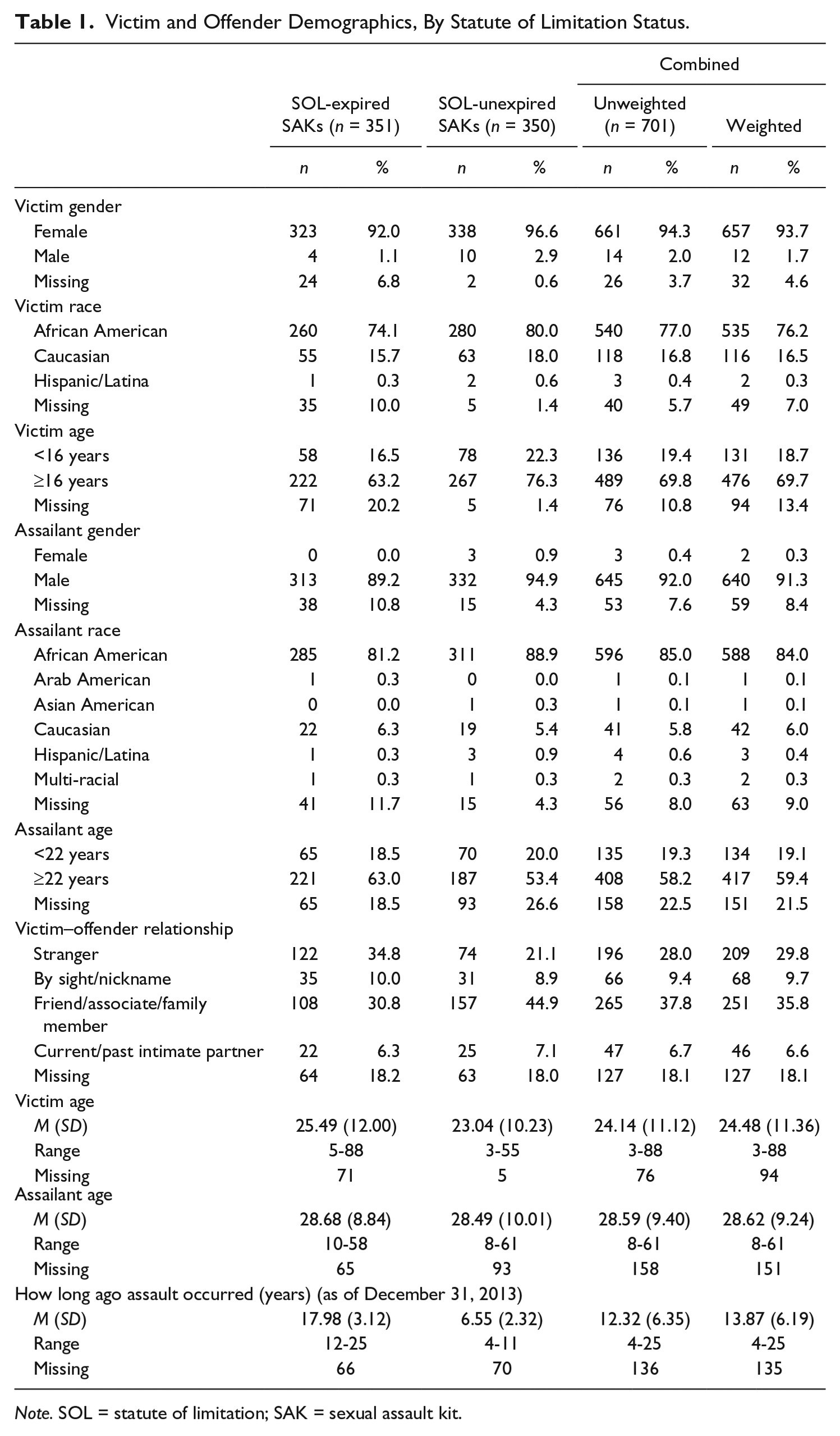
Table 1 summarizes descriptive characteristics of the victims, suspects, and sexual assaults associated with the SAKs (to the extent the relevant variables were documented in police reports) for the SOL-expired SAKs, SOL-unexpired SAKs, and for the combined samples (both raw and weighted summaries). Nearly all of these victims were female (94.3%; 93.7% in the weighted sample) and nearly all of the assailants were male (92.0%; 91.3% in the weighted sample). 4 Consistent with the racial composition of Detroit, most of the victims were African American (77.0%; 76.2% in the weighted sample), as were most of the assailants (85.0%; 84.0% in the weighted sample). The victims were young adults at the time of the assault (24.14 years old on average; 24.48 in the weighted sample); almost one fifth (19.4%; 18.7% in the weighted sample) were under the age of 16 years. The assailants were a bit older (28.59 years old; 28.62 in the weighted sample); still, about 19.3% (19.1% in the weighted sample) were less than 22 years old when they committed the assaults. These SAKs were associated with assaults that had occurred nearly 13 years ago on average (12.32; 13.87 in the weighted sample), with a range of 4 to 25 years ago. Accounting for missing data, among the SOL-expired SAKs, 34.8% were stranger-perpetrated sexual assaults and 47.1% were committed by someone known to the victim; in the SOL-unexpired group, 21.1% were stranger rapes and 60.9% were non-stranger rapes.
Victim and Offender Demographics, By Statute of Limitation Status.
Note. SOL = statute of limitation; SAK = sexual assault kit.
Procedures and Measures
The state police outsourced the forensic testing of the SAKs to two laboratories; site visits were conducted at both vendors to ensure that the testing methods used in each lab were identical. As described in the literature review, and as depicted in Figure 1, forensic testing is a multi-step process whereby SAKs pass on from one stage to the next only if they meet stage-specific transition criteria. The maximum stage reached by each SAK was crucial to constructing our focal dependent variable.
In the first step, forensic scientists screen the samples from the kit to determine whether they contain bodily fluids (serology screening, Step 0), and if so, the DNA is extracted and analyzed (DNA testing, Step 1). If the DNA profile meets eligibility requirements, it is then uploaded into CODIS (Step 2); therefore, the probability that a kit will proceed from Step 1 to Step 2 can be quantified as the “CODIS Entry Rate.” The profile is then compared with DNA samples in the offender index (DNA profiles from arrestees/convicted offenders) and the forensic index (DNA samples obtained at crime scenes, offender identity currently unknown). If the profile matches an existing DNA sample in CODIS, it is referred to as a “hit” (Step 3), and the probability that a kit will proceed from Step 2 to Step 3 can be quantified as the “CODIS Hit Rate.” Serial sexual assaults (i.e., two or more sexual assault offenses with matching DNA evidence) can be identified by checking the qualifying offense type, qualifying crime scene evidence type, or the offense type of case-to-case associations. For instance, the DNA might match an offender whose qualifying offense in CODIS was a previous sexual assault case; or the DNA in the SAK might match a forensic sample from a previously unsolved sexual assault; or the DNA in the SAK might hit to another SAK that has just been tested (i.e., SAKs tested in this study hitting to other SAKs tested in the project). All of these scenarios highlight how CODIS can reveal serial sexual offending (Step 4). The probability that a kit will pass from Step 3 to Step 4 can be quantified as the “Serial Sexual Assault Hit Rate.”
After the vendor laboratories completed testing Steps 0 and 1, state police forensic scientists reviewed their results, identified and entered eligible profiles into CODIS (Step 2), and recorded which SAKs matched other CODIS records (Step 3). SAKs with CODIS hits were then reviewed to determine which ones were associated with additional sexual assaults (Step 4); this involved examining the qualifying offense (for offender hits), crime scene type (for forensic hits), and checking for case-to-case associations. The data regarding which kits passed through which steps of this process were provided to the research team after they were reviewed for accuracy by two state police forensic science personnel.
Data Analytic Plan
We quantified how many SAKs proceeded from one stage of forensic testing to the next via continuation ratios, which are rates expressed as proportions. The CODIS entry rate is the proportion of tested SAKs that yielded DNA profiles eligible for upload into CODIS; this proportion is an unconditional rate, which means that the denominator is the total number of SAKs tested. The CODIS hit rate is the proportion of CODIS entries that yield hits to other CODIS records. This is a conditional rate, as the denominator includes only the subset of SAKs that meet particular conditions (i.e., having yielded a CODIS entry). The serial sexual assault hit rate is the proportion of CODIS hits that are associated with serial sexual assaults. This is also a conditional rate, as the denominator is the number of CODIS hits. In our presentation of the results, we will also discuss unconditional versions of the various hit rates mentioned above and will explicitly denote them unconditional rates when doing so.
We used a single continuation-ratio model (Agresti, 2002; Hosmer, Lemeshow, & Sturdivant, 2013) to quantify and compare all three forensic outcome rates (CODIS entry, CODIS hit, and serial sexual assault hit) as a function of SOL status simultaneously. Continuation-ratio models are excellent for modeling how far cases proceed through a sequential selection process (Agresti, 2002), which aligns well with our goal of examining SAK progression through the forensic testing process (Figure 1). Our model included main effects for stage and SOL status, plus a stage by SOL status interaction. Omitting the normal intercept term made it more convenient to use individual coefficients and contrasts (estimable linear functions of the coefficients) to directly estimate the CODIS entry, CODIS hit, and serial sexual assault hit rates for SOL-expired and SOL-unexpired SAKs. It also allowed us to use contrasts to separately estimate the simple main effect of SOL status on each rate. Our continuation-ratio model treated the observations as independent because the sample was so sparsely clustered (i.e., few instances of multiple SAKs associated with the same offender) that neither generalized linear mixed models (Hox, 2010) nor generalized estimating equation models (Hardin & Hilbe, 2013) were viable (for further details, see Campbell, Fehler-Cabral et al., 2015, pp. 434-436).
We computed two additional statistics to aid in the interpretation of the model results: relative risk (RR = pu / pe), which reflects how much more likely an event (e.g., a CODIS entry) is in one group (e.g., SOL-unexpired) than in another group (e.g., SOL-expired); and number needed to submit (NNS = 1/[pu − pe]), which is based on the number needed to treat (NNT; Altman, 1998; Schechtman, 2002). NNS further clarifies the implications of CODIS entry rate differences between two groups by illustrating how many SAKs from the focal group (SOL-unexpired) need to be submitted for testing to get one more event than we would have gotten by submitting the same number of SAKs in the reference group (SOL-expired). Large departures from NNS = 1.00 mean one must submit more SAKs to obtain a one-unit difference between the groups (one extra CODIS entry); 5 if one has to submit many SAKs from the focal group to net just a one extra CODIS entry, it may not make practical sense to selectively test only SAKs from that group.
In addition to traditional null hypothesis significance testing, we also conducted equivalence tests. Rejecting a null hypothesis or failing to reject a traditional null hypothesis cannot tell us whether two groups have equivalent outcomes, but equivalence tests can provide affirmative evidence that any plausible differences in outcomes between the two groups are trivially small in substantive terms (Barker, Luman, McCauley, & Chu, 2002; Rogers, Howard, & Vessey, 1993; Stegner, Bostrom, & Greenfield, 1996; Tunes da Silva, Logan, & Klein, 2009; Wellek, 2010). The key to equivalence tests lies in explicitly defining an a priori criterion for what constitutes a substantively important effect size; this criterion is the boundary between equivalent and non-equivalent outcomes. We used parameters from our continuation-ratio model to conduct equivalence tests, expressing the hypotheses in an odds ratio (OR) metric (Mascha & Sessler, 2011; Tunes da Silva et al., 2009). We reasoned that only large differences in rates between the two groups would be sufficient to justify prioritizing SAK testing based on SOL status, so we set the margin of equivalence conservatively at δOR = 2.50, which is a very conservative definition of a large effect given (Rosenthal, 1996).
We used R 3.2.2 (R Development Core Team, 2015) and several R packages (Aquino, Enzmann, Schwartz, Jain, & Kraft, 2015; Harrell, 2014; Lumley, 2004, 2010, 2014; Sarkar, 2008; Warnes, Bolker, Lumley, & Johnson, 2015; Wickham & Francois, 2015) to perform the analyses presented in this article. We have deposited all data, statistical output, and R code necessary to reproduce our results into the National Archive of Criminal Justice Data (NACJD).
Results
Descriptive Findings Regarding Forensic Testing Outcomes
Of the 351 SOL-expired SAKs tested in this project, 173 yielded CODIS-eligible profiles (49% CODIS entry rate). There were 90 CODIS hits from these entries (52% unweighted conditional CODIS hit rate), and from those hits, 29 connected to another sexual assault via a sexual assault qualifying offense, a forensic sample from a previously unsolved rape case, or a case-to-case association to another Detroit SAK (32% unweighted conditional serial sexual assault rate). From the 350 SOL-unexpired SAKs, 193 yielded CODIS-eligible profiles (55% CODIS entry rate). There were 106 CODIS hits from those entries (55% unweighted conditional CODIS hit rate), and 29 of those hits connected to another sexual assault (27% unweighted conditional serial sexual assault rate).
The Effect of SOL Status on Forensic Testing Outcomes
Do forensic testing outcomes (i.e., the CODIS entry rates, CODIS hit rates, and serial sexual assault rates) significantly differ as a function of SOL status? Are the rates for SOL-expired SAKs functionally equivalent to those for SOL-unexpired SAKs? To answer these questions, we combined the data from the SOL-expired and SOL-unexpired SAKs, which are both samples from the subpopulation of previously untested Detroit SAKs. In these analyses, we dummy coded SOL status into a binary variable, using SOL-expired SAKs as the reference group. Table 2 shows the parameter estimates and fit statistics for the continuation-ratio model; Figure 2 shows all three rates of interest for both SOL-expired and unexpired SAKs. The CODIS entry rate represents the transition from Stage 1 to Stage 2, so the CODIS entry rate in Figure 2 is an unconditional estimate because all SAKs start at Stage 1 when submitted for testing. The other two rates in Figure 2 are conditional estimates because the CODIS hit rate depends on an SAK having already reached Stage 2 (CODIS Entry) and the serial sexual assault hit rate depends on having already reached Stage 3 (CODIS Hit). The unconditional CODIS entry rates for SOL-unexpired and SOL-expired SAKs were 55.1% (95% confidence interval [CI] = [49.8, 60.3]) and 49.3% (95% CI = [44.1, 54.5]), respectively (Figure 2, first panel; see also Table 2). SOL status clearly exerts only a very small and statistically non-significant effect (OR = 1.27, 95% CI = [0.94, 1.70], p = .121). The odds of an SOL-unexpired SAK generating a CODIS entry are only about 1.27 times higher than the odds of an SOL-expired SAK doing so. The asymmetrical CI tells us that SOL could at best exert a tiny negative effect or a small, positive effect; on balance, a positive effect is more likely than a negative one, but no effect at all is entirely plausible. The 90% CI for this OR (90% CI = [0.98, 1.63]) fell entirely within our margin of equivalence, indicating that even if the difference between these CODIS entry rates is not zero, it is small enough to conclude that they are functionally equivalent, p < .05.
Continuation-Ratio Model for Statute of Limitations Effects.

Note. These estimates were obtained from a model of SAK progression across Stages 1 to 4, after applying sampling weights for the disproportionate stratified sampling design (unweighted N = 701 SAKs; 351 SOL-expired assaults and 350 SOL-unexpired assaults) to ensure they generalize to the population of untested Detroit SAKs (regardless of adjudication status or victim–offender relationship). Model fit statistics: total df = 1263, residual df = 1257, null deviance = 1751, residual deviance = 1715, Akaike information criterion = 1723. CI = confidence interval; OR = odds ratio; CODIS = Combined DNA Index System; SOL = statute of limitation; SAK = sexual assault kit.
We omitted the odds ratios and corresponding CIs for these contrasts because it is more meaningful to transform these contrasts back into stage-specific transition rates for particular groups of SAKs.
We omit the rates and corresponding CIs because these contrasts directly quantify the simple main effect of SOL status on the rate for a particular stage transition; odds ratios are a better metric for examining differences between two rates.

The effect of statute of limitations on CODIS entry, CODIS hits, and serial sexual assault CODIS hit rates.
In this study, unexpired SAKs were only RR = 1.12 (95% CI = [0.96, 1.28]) times more likely to yield CODIS entries than expired SAKs; a NNS of 17.08 (95% CI = [−4.46, 38.62]) means we could expect one extra CODIS entry if we submit about 17 SOL-unexpired SAKs than we should expect from submitting about 17 SOL-expired SAKs (i.e., 9.42 vs. 8.42 entries). The lower bound of that CI suggests that we might even average one less CODIS entry per 4.46 SOL-unexpired SAKs tested than we could expect from testing a similar number of SOL-expired SAKs. Of course, the upper bound suggests it is equally plausible that it would require selectively testing as many as 38 or 39 SOL-unexpired SAKs to yield one more CODIS entry than we could expect from testing the same number of SOL-expired SAKs.
Among the SAKs that had eligible profiles that were uploaded to CODIS, the conditional CODIS hit rate was 54.9% (95% CI = [47.8, 61.9]) for SOL-unexpired SAKs and 52.0% (95% CI = [44.6, 59.4]) for presumed SOL-expired SAKs (Figure 2, second panel and Table 2). This is a trivially small and non-significant effect of SOL status on the odds of a CODIS hit (OR = 1.12, 95% CI = [0.74, 1.70], p = .579). The CI for the OR gives us no clear signal about the direction of the effect, but it plainly shows that SOL is unlikely to exert more than a small effect either way. Unsurprisingly, the corresponding equivalence test indicated that the conditional CODIS hit rates were equivalent (OR 90% CI = [0.79, 1.59], p < .05). It is highly unlikely that SOL status exerts a large influence on the CODIS hit rate. CODIS entries for SOL-unexpired SAKs are only RR = 1.06 (95% CI = [0.85, 1.26]) times more likely to yield a hit than CODIS entries for SOL-expired SAKs. It would take NNS = 34.49 (95% CI = [−87.29, 156.28]) CODIS entries from SOL-unexpired SAKs to yield one more hit than expected from the same number of SOL-expired SAKs (18.94 vs. 17.94 hits).
The conditional serial sexual assault hit rate was 27.4% (95% CI = [19.6, 36.7]) for SOL-unexpired SAKs with CODIS hits and 32.2% (95% CI = [23.4, 42.5]) for SOL-expired SAKs with CODIS hits (see third panel of Figure 2). This is a very small, statistically non-significant negative effect of SOL status (OR = 0.79, 95% CI = [0.43, 1.48], p = .458) on the odds of detecting a serial assault. The CI is consistent with possible effect sizes ranging from a medium, negative effect on the low end to a small, positive one at the high end, without strongly suggesting the likely direction of the effect. The equivalence test indicated that the conditional CODIS serial sexual assault hit rates were equivalent (OR 90% CI = [0.47, 1.33], p < .05). The RR statistic shows that CODIS hits from SOL-unexpired assaults are 0.85 (95% CI = [0.48, 1.22]) times less likely to be serial assaults than CODIS hits from SOL-expired assaults. The NNS = −20.83 (95% CI = [−74.92, 33.80]) means that on average examining 20.83 CODIS hits from SOL-unexpired assaults would likely detect one less serial assault than we would expect in a similar number of CODIS hits from SOL-expired assaults (i.e., 5.63 vs. 6.63 serial assaults).
Figure 3 depicts the unconditional rates, which are useful to compare with the conditional rates in Figure 2. The DNA testing rate is 100% regardless of SOL status because all SAKs are submitted for testing at Stage 1, and the CODIS entry rates remain the same across both figures because they represent the first-stage transition. The unconditional hit and serial assault rates are different between Figures 2 and 3 because the rates in Figure 3 use the total number of SAKs submitted at Stage 1 as the denominator rather than the number of kits reaching the previous stage (as in Figure 2).
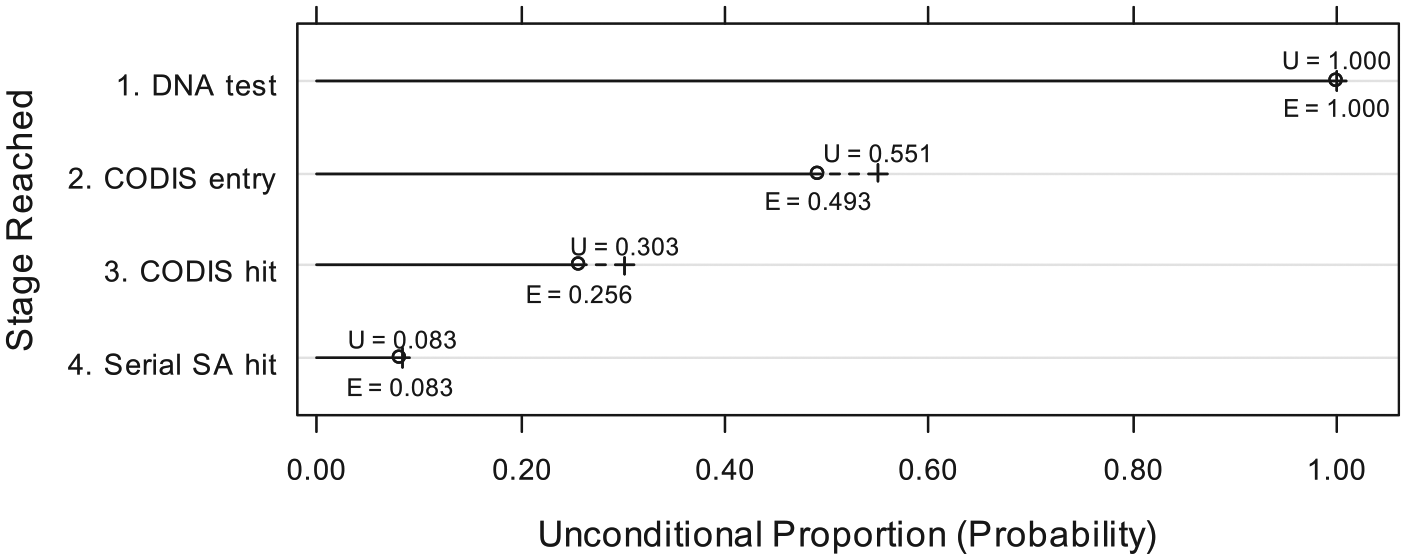
Unconditional CODIS entry, CODIS hit, and serial sexual assault CODIS hit rates, by statute of limitations.
The unconditional CODIS hit rate for SOL-unexpired SAKs was 30.3% (95% CI = [25.5, 35.1]), and the corresponding rate for SOL-expired SAKs was 25.6% (95% CI = [21.1, 30.2]; Figure 3). The RR indicates that testing an SOL-unexpired SAK is only 1.18 (95% CI = [0.90, 1.46]) times more likely to yield a CODIS hit than testing an SOL-expired SAK. Similarly, the NNS statistic shows that on average it would be necessary to submit 21.53 (95% CI = [−9.24, 52.30]) SOL-unexpired SAKs for DNA testing to obtain just one more CODIS hit (6.52 hits) than we would find by submitting a similar number of SOL-expired SAKs (5.52 hits).
The unconditional serial assault rate for both SOL-unexpired and SOL-expired SAKs was 8.3% (95% CI = [5.4, 11.2] and [5.4, 11.1], respectively; Figure 3). The RR = 1.00 (95% CI = [0.51, 1.50]), which means that we will be equally likely to detect a serial sexual assault regardless of SOL status of the SAK submitted. Because the rates are nearly identical, the NNS = 4,236.21 ([95% CI = [−727,994.73, 736,467.14]) indicates that it is effectively impossible to detect more serial sexual assault CODIS hits by selectively testing based on SOL status.
Discussion
The problem of untested rape kits is a growing national concern, as an increasing number of U.S. cities have disclosed that they have substantial numbers of untested SAKs in police property (Campbell et al., 2016,). In jurisdictions that have not been routinely submitting SAKs for many years, a sizable proportion of those kits may be associated with cases that are beyond the SOL for criminal prosecution. Given that testing rape kits requires substantial resources, it is important to consider whether these older kits could still provide useful, actionable information to criminal justice system personnel. To examine this issue, we randomly sampled SAKs that were associated with cases that were most likely SOL-expired and a comparison sample that were SOL-unexpired from the population of Detroit’s untested SAKs. Comparing the forensic testing outcomes of these two groups provided one way of assessing the potential utility of testing older SAKs: If the rates of CODIS-eligible profiles, CODIS hits, and serial sexual assault CODIS hits are statistically equivalent between SOL-expired and SOL-unexpired SAKs, then testing older kits is worthwhile, as they may still provide actionable data for criminal justice system personnel.
In this study, we found that of the 351 presumed SOL-expired SAKs tested, 173 had CODIS-eligible profiles (49% weighted unconditional rate), and of the 350 SOL-unexpired SAKs tested, 193 yielded eligible profiles (55% weighted unconditional rate). These rates are similar to the results of Peterson and colleagues’ (2012) analysis of the untested SAKs in Los Angeles, which found a 53% unweighted CODIS entry rate. In our continuation-ratio model, there was no significant difference between the groups, which means that we cannot reject the null hypothesis that the rates are different. Therefore, we also conducted equivalence tests, which examined whether the outcomes for the groups are equivalent because the difference between the groups is not large enough to be important. In those tests, the 90% CI for the OR fell entirely within our margin of equivalence, indicating that the difference in the CODIS entry rates is estimated precisely enough to confidently conclude that these rates are functionally equivalent, p < .05. The RR and NNS statistics further underscored that the difference in the odds of generating a CODIS-eligible profile for an expired-SAK versus an unexpired-SAK was negligible. Taken together, the findings from these different analytic approaches lead to the same conclusion: The likelihood of generating a DNA profile that meets requirements for entry into CODIS is no different for older kits as compared with current kits.
Once a profile had been entered into CODIS, 52% of the SOL-expired and 55% of the unexpired SAKs yielded CODIS hits (weighted, conditional rates). The CODIS hit rate in this study was similar to the results from Peterson et al. (2012), which found 50% conditional CODIS hit rate among the previously untested Los Angeles rape kits. To the best of our knowledge, this study was the first to examine serial sexual assault CODIS hits (i.e., hits to other sexual assault crimes in CODIS). The weighted conditional rate for serial sexual assault CODIS hits was 32% for the SOL-expired SAKs and 27% for the SOL-unexpired SAKs. The effect of SOL status on CODIS hit rates and serial sexual assault CODIS hit rates was non-significant in the continuation-ratio model, and the equivalence tests showed that the 90% CIs for the ORs fell entirely within the margin of equivalence; similarly, the RR and NNS indices indicated no clear advantage to testing SOL-unexpired SAKs over expired SAKs. Therefore, these findings suggest that testing older, presumed SOL-expired SAKs may have utility to the criminal justice system in that they are just as likely to yield a CODIS hit and serial sexual assault hit as current, SOL-unexpired SAKs.
There are several limitations of this study that must be acknowledged in effort to prevent overgeneralizations based on these findings. First, as has been common practice in this developing literature, the study was an in-depth analysis of untested SAKs in only one city—Detroit. Detroit is unique among U.S. cities in many ways, including its racial composition (82% Black in the 2000 Census, 83% in the 2010 Census), violent crime rate (second highest rate in the nation in the 2000 FBI Uniform Crime Report [UCR], highest rate in the nation in the 2010 UCR), and economic hardships (see Campbell, Shaw et al., 2015). The extent to which these macro-level factors (particularly violent crime rate) might influence SAK forensic testing outcomes is unknown, so the national generalizability of these findings cannot be evaluated. Our results are similar to findings from other urban, high-crime cities (Los Angeles, and to a lesser extent, New Orleans), but whether these rates would be similar in other U.S. cities is not yet known. Collecting SAK forensic testing outcome data is time and labor intensive in a single city, so national-scale work on this topic would be quite challenging, but future research with representative, multi-city samples is necessary to assess the extent to which there are jurisdiction-to-jurisdiction variations in testing results.
Second, the focal outcomes in this study were the number of CODIS-eligible profiles, CODIS hits, and serial sexual assault CODIS hits, which is only one way to assess the utility of SAK testing. Quantifying and comparing CODIS entry and CODIS hits rates is an important first step in this literature because many of the arguments regarding SAK testing are predicated on the assumption that testing would yield CODIS hits—and then, depending on the specific circumstances of the case, those hits may be directly or indirectly useful to criminal justice practitioners. Given time, scope, and budget limitations of this action research project, we were not able to examine “what happened next” regarding whether and how these hits were indeed acted up on by police and prosecutors. As such, the direct and indirect use of the CODIS hits documented in this study is not yet known. The probative value of CODIS hits, particularly for older, presumably SOL-expired SAKs, is critical to examine in future research. For instance, how many hits among SOL-expired cases matched to current cases, and was the evidence from the rape kit presented in court, per 404(b) rules of evidence? How many hits were to an offender already in prison? If so, were the forensic testing results used in parole considerations? We do not have answers to these and other critical utilization questions, but our results do support “proof of concept” that testing older SAKs has potential utility to the criminal justice system, given that rates of CODIS entries, CODIS hits, and serial sexual assault CODIS hits were no different between older, presumed SOL-expired SAKs and current, unexpired SAKs.
Third, it was beyond the scope of this study to evaluate the biological quality of the specimens in the kits and possible degradation of the samples, though it is important to reiterate that the independent audit by state police forensic science personnel found no evidence that the SAKs had been contaminated or were stored in conditions of extreme temperatures/humidity, which are factors that can affect DNA degradation (Bruskov, Malakhova, Masalimov, & Chernikov, 2002; Cadet et al., 2005; Karni et al., 2013; Lund & Dissing, 2004; Sutherland et al., 2000; Tang, 2006). However, in the event there was DNA degradation in some of the SAKs we examined, this would not affect the conditional CODIS hit rates or conditional serial sexual assault hit rates reported here because those outcomes are derived from database searches conducted with DNA profiles that were already deemed eligible for CODIS entry. So, the only plausible consequence of DNA degradation among older kits is that our analysis could have underestimated the CODIS entry rate for the SOL-expired kits relative to what we might have seen had they all been tested in a more timely way. Specimen degradation among older SAKs might explain why the point estimate of the CODIS entry rate of 49% for SOL-expired is lower than the 55% rate seen among SOL-unexpired SAKs, but that small difference may simply reflect random sampling variability (i.e., it was not significant). Furthermore, we demonstrated that these two rates are statistically equivalent within a pre-specified margin. This suggests that DNA degradation had a negligible impact on our findings.
Finally, whereas our results suggest that it may be useful to test older, presumed SOL-expired SAKs, this study did not evaluate the relative priority such kits should have in testing protocols. In other words, our data indicate that there is merit in testing presumed SOL-expired SAKs, but we did not examine when they should be tested and the implications of different testing prioritizations. Some cities that have had large quantities of untested SAKs have adopted the so-called “forklift” approach (e.g., New York City, Los Angeles), whereby all previously unsubmitted rape kits are outsourced en masse for forensic testing (i.e., there is no pre-screening or prioritization ranking; all kits are submitted for testing; see Bashford, 2013). In this study, we examined whether there are differences in forensic outcomes as a function of SOL status as a screening variable (there were not), which suggests that testing all SAKs, regardless of age/date of the kit has potential utility to the criminal justice system, but we did not formally evaluate the “forklift” approach to document the benefits, challenges, and forensic testing outcomes associated with that particular testing strategy.
With these limitations in mind, the results of this study can inform policies regarding previously untested SAKs. Locally, Detroit-area stakeholders decided that testing all rape kits in police custody was warranted, and they sought out and obtained funding to test all remaining SAKs that were not examined as part of this action research project (see Campbell, Fehler-Cabral et al., 2015). Whether that practice would be prudent for other jurisdictions was not something we could evaluate in this study. However, our data do suggest that policies that exclude older, presumed-SOL expired SAKs from testing may be problematic, as there may be substantial numbers of CODIS-eligible DNA profiles within those kits that would never be entered into the federal database. Populating CODIS is critical for its long-term utility to police and prosecutors and policies that systematically exclude certain types of eligible profiles may decrease the value of CODIS as a tool for identifying serial criminal offenders. Policies that promote DNA testing and populating CODIS with eligible profiles can have long-term positive benefits for identifying criminals and holding them accountable for their crimes.
Footnotes
Authors’ Note
The opinions or points of view expressed in this document are those of the authors and do not reflect the official position of the U.S. Department of Justice.
Declaration of Conflicting Interests
The author(s) declared no potential conflicts of interest with respect to the research, authorship, and/or publication of this article.
Funding
The author(s) disclosed receipt of the following financial support for the research, authorship, and/or publication of this article: Preparation of this article was supported by a grant from the National Institute of Justice (2011-DN-BX-0001).