



Abstract
Recently, the number of veteran treatment courts (VTCs) has greatly expanded. These courts, based on drug treatment court processes, attempt to handle the underlying causes of criminal conduct as well as the instant offense. There is, however, no research that addresses how the military manifests in VTC. We suggest that participants import military culture into VTC processes and that the military will have an influence on VTC proceedings. The purpose of this study is to examine how military and specialty court approaches appear in the VTC. Using results from field research in a VTC in Texas, we find the military has profound influences in VTC proceedings. Military references serve the purpose of structuring the court docket, helping develop rapport between court staff and participants, as well as creating a familiar context for participants. We highlight the value and potential problems of relying on military culture. Policy implications and directions for future research are discussed.
Introduction
More than two million members of the U.S. Armed Forces have served in Iraq (Operation Iraqi Freedom) or Afghanistan (Operation Enduring Freedom) since 9/11 (Tan, 2009). Soldiers serving in Iraq and Afghanistan have an increased risk of post-traumatic stress disorder (PTSD) and traumatic brain injury (TBI); as many as 31% of veterans have PTSD or TBI (Tanielian & Jaycox, 2008). Multiple deployments to combat zones and the high incidence of major injuries caused by improvised explosive devices (IEDs) have led to higher rates of PTSD and TBI (W. B. Brown, 2008; Zoroya, 2013). The length and number of deployments to active combat zones, as well as diagnoses of PTSD or TBI resulting from such service, have been linked to abuse of alcohol and drugs as coping mechanisms (Brown, 2011). These factors, and others, affect the ability of veterans to follow society’s rules leading to an increased number of veterans arrested for alcohol, drug, and other offenses (W.B. Brown, 2011; Smith & True, 2014). Thus, the veteran treatment court (VTC) was created to address social, psychological, and economic strains of veterans experiencing injury from combat, in addition to problems of readjustment after deployment, as these factors are thought to contribute to veterans’ involvement in the criminal justice system (Russell, 2009).
Foremost, VTCs are specialty treatment courts emphasizing rehabilitation. Many courts require veterans to be diagnosed with a treatable mental illness such as PTSD, TBI, or substance abuse to participate in the program (Frederick, 2013). Jurisdictions may limit VTC cases to non-violent, misdemeanor, or victimless crimes (Frederick, 2013). Since 2008, the number of VTCs has grown rapidly, yet these courts are a relatively understudied phenomenon. In particular, little is known regarding the characteristics of VTCs that differentiate it from drug or mental health treatment courts, other than the composition of its clientele.
An underexplored difference between the VTC and other specialty courts is the unique social context in which defendants find themselves while participating in the treatment court process. Unlike defendants in other specialty courts, defendants in the VTC share a common social link with one another from the beginning. Veteran defendants in treatment court will sit alongside other veterans in the courtroom—they may further be supervised by veteran probation officers, and may be held accountable to veteran judges. Although the VTC is a unique context for a specialty court, no known studies exist that explore how aspects of the military manifest in VTCs. We believe the time is right to explore the nature of this type of court, and in particular to describe how military culture appears in the VTC.
To that end, we review the existing literature on the experience of specialty courts and the military to provide a context for evaluating the VTC. We then present the findings from field research conducted in a VTC in Texas. We had the unique opportunity to observe the interactions of veteran probationers, probation officers, treatment personnel, court staff, and the VTC judge over a period of 6 months. In analyzing detailed field notes on the setting, the discourse, and interactions, we describe characteristics of the VTC that presumably differentiate it from other specialty courts, and identify strengths and potential problems associated with such a court. This article specifically examines the coexistence of therapeutic and militaristic characteristics of the VTC.
Literature Review
With the goal of investigating the militaristic aspects of the VTC, we review research documenting the culture of the military. However, to place our study in an appropriate context, we acknowledge that the VTC is a non-traditional court and review stated goals and objectives, as well as the underlying philosophical and theoretical orientations to specialty court practice. In reviewing these separate veins of research, we ask how one would expect the VTC to operate as seemingly different militaristic and specialty court contexts converge in such a setting. These expectations form a broad conceptual basis for which we can evaluate the nature of the VTC.
Specialty Courts
The initial problem-solving courts were drug courts that began in the late 1980s (Listwan, Sundt, Holsinger, & Latessa, 2003). These courts subsequently expanded to include mental health courts and other types of specialty courts, ultimately including VTCs. Since 2008, the number of VTCs has grown rapidly due, in part, to the reports of VTC success, and notions that military service of combat veterans was likely a factor in their criminal justice involvement (Frederick, 2013; Holbrook & Anderson, 2011). As of early 2014, more than 220 VTCs were in operation (Justice for Vets, 2015).
State legislatures may establish statutory requirements for VTCs, and many focus on the relationship between mental health and criminal justice involvement. For example, in 2009, the State of Texas passed legislation, similar to many other states, allowing for the creation of specialty courts for veterans (Texas Government Code Chapter 124.001). By statute, counties in Texas may establish VTCs that meet certain criteria: An eligible defendant must (1) be a veteran or current member of the U.S. armed forces and (2) must suffer from a brain injury, such as TBI, or a mental disorder, such as PTSD, as a result of military service in a combat zone and (3) the brain injury or mental disorder must have materially affected the conduct of the defendant in regard to the crime committed.
As VTCs typically have components that address mental health and substance abuse issues underlying the criminal conduct of military veterans, we draw on research on drug treatment courts (DTCs), mental health courts (MHCs) as well as VTCs. These problem-solving courts are different from traditional courts in three significant ways.
First, these courts focus on the root causes, not outcomes of criminal behavior. For example, DTCs focus on offender’s drug addiction (Hora, Schma, & Rosenthal, 1999) and MHCs provide psychological treatment to address emotional or mental health problems leading to offending (Goldkamp & Irons-Guynn, 2000). Judge Robert T. Russell, Jr., noted that many veteran defendants experienced issues with alcoholism, drug abuse, homelessness, mental illness, and strained family relations. These factors were thought to contribute to veterans’ criminal justice involvement (Russell, 2009). Russell’s experience working in drug and mental health courts led him to believe that a court process that addressed the specific needs of veterans might be more successful than a traditional court, hence his establishment of a VTC in New York in 2008. Generally, VTCs combine the treatment regimens of both DTCs and MHCs and focus on individualized treatment.
Second, these courts utilize a collaborative rather than an adversarial approach. Unlike the process of the traditional court setting, the judge, prosecutor, defense attorney, and probation officer act as a team to promote the best interest of the defendant. In specialty courts, judges take a more active role and regularly monitor the compliance of offenders, rather than act as referee between the prosecutor and defense attorney (Wexler & Winick, 1996). In one study that provided an in-depth examination of the nature of the VTC, Baldwin and Rukus (2015) found evidence that the VTC emphasized a collaborative and non-adversarial approach to case management. They found that nearly all respondents (VTC team members) reported that confrontation was not at all present between court staff and probationers during court sessions (Baldwin & Rukus, 2015). In general, specialty courts were developed as a community-based, team-oriented, criminal justice intervention that utilizes community support and resources (Listwan et al., 2003). An additional facet of specialty court practice arising from the collaborative and ongoing nature of monitoring is that probationer successes, large and small, are often recognized by court personnel and other probationers through praise or applause (Redlich, Steadman, Monahan, Robbins, & Petrila, 2006).
Third, these courts focus on outcomes beneficial to the offender, the victim, and society, not on punishment (Frederick, 2013). Specialty courts focus on the cause of the criminal behavior, not solely the symptoms that bring the offender into the criminal justice system. By addressing the root of the problem, specialty courts hone in on the dysfunction that improves the health of the offender and the safety of society (W.B. Brown, 2011). Specialty courts, such as drug courts, have found a lower rate of recidivism in participants who complete the program, ultimately helping the offender, family, and their community (Listwan et al., 2003). In addition, successful completion of a specialty court can lead to deferred adjudication as opposed to a misdemeanor or felony conviction. A successful participant is therefore not labeled and can recreate a life with better employment opportunities, fewer child custody issues, and other community support (Cooper, 2007). Ultimately, the primary focus of specialty courts is to provide supervision, treatment, and service to reduce future involvement in the criminal justice system (Burns, Hiday, & Ray, 2012).
Context of Therapeutic Jurisprudence
VTCs can be seen as operating on the backcloth of the philosophy of therapeutic jurisprudence, and they may even draw on therapeutic jurisprudence principles to enhance their procedures (Wexler & Winick, 1996). Therapeutic jurisprudence broadly contends that laws and legal procedures through which laws are applied may therapeutically affect all actors involved in the legal process (Wexler & Winick, 1996; Winick, 2003). Another important consideration drawn from this philosophy is that an offender’s perception of fairness and transparency in the decision-making process may influence success in specialty courts (Frazer, 2007). For the purposes of this study, the key contribution of therapeutic jurisprudence to specialty court philosophy is that court officials view offender’s problems from a broader point of view—these actors rely on treatment and resources as opposed to punishment to induce desistance (Castellano, 2011). Furthermore, this process unfolds in a collaborative, rather than an adversarial manner. In this way, judges, attorneys, and other court personnel act as therapeutic agents, attempting to “heal” the defendant through this non-traditional court process to resolve the underlying issues causing the offender to be involved in the criminal justice system (Russell, 2009; Wexler & Winick, 1996).
Taken together, the specialty court and therapeutic jurisprudence literature paint a broad picture of how VTCs, as well as MHCs and DTCs, are different from traditional courts (Castellano, 2011; Drug Court Programs Office, Office of Justice Programs, 1997; Russell, 2009; Wexler & Winick, 1996; Winick, 2003). The general point is that specialty courts, like the VTC, often take a therapeutic approach instead of a solely punitive approach. Therefore, we refer to the specialty court approach as a therapeutic one, keeping in mind that specialty courts are not necessarily linked to the specific philosophies of therapeutic jurisprudence.
The Military and VTC
VTCs are unique because they support the idea that combat-injured military offenders should be honored for their service to the country by diverting them from traditional court and sentencing (Cartwright, 2011). There is, however, little to no research that examines how the military influences VTC practices or procedures. In the one study that has discussed the role of the military in VTC procedures, Baldwin and Rukus (2015) found that the military community provided a support network for veteran defendants—this network was characterized by a sense of camaraderie instilled in the military community. In building on this prior research, a logical place to continue exploring is the presumption that because the court defendants are veterans (and perhaps court personnel), a shared culture is imported into the VTC process. In other words, because VTC defendants are, by definition, either currently or previously enlisted in the U.S. military (and to an unknown extent, this may also be true of VTC staff), we may reasonably assume that some form of assimilation to the military culture has taken place prior to the entry of defendants (and staff) into the VTC process, and as a result this culture pervades the court.
The culture of an organization is described as the values, philosophies, and traditions that animate the organization (Collins, 1998). Furthermore, cultures typically have their own language, norms, belief systems, rituals, and dress (Reger, Etherage, Reger, & Gahm, 2008). Military organizations have a distinct culture from that of the greater society. In a report on military culture in the 20th century, Collins (1998) reported though similarities exist between the values of the civilian and military culture, differences necessarily exist. The military imposes strict values, norms, and expectations on soldiers who are in training, deployed, and in combat. Society, however, has a different set of norms, values, and expectations that govern behavior. The total institution (TI) is one model for explaining how these differences in society’s norms and the military’s norms come to exist.
The total institution
The TI (Goffman, 1961), by definition, requires symbolic or actual divisions between outside society and the institutional culture that imposes constraints on individual’s thoughts, behaviors, and values. Zurcher (1967) studied naval recruits under the conceptual framework of Goffman’s (1961) TI. This study found that the Naval training center controlled every aspect of recruits’ lives, and served as a place where the civilian self could be supplanted with the “sanctioned role of sailor” (, p. 97). In short, total assimilation occurs in the training of soldiers, such that they fully adopt the ideologies, norms, and values of the military.
In the TI model, the values and expectations of the outside world are no longer useful to the institution because the primary objective is to complete the organization’s mission or goal. This implies that the values of civil society are replaced by military goals or objectives. For example, though self-preservation or self-protection represents a legitimate norm in civil society, the expectation to complete the mission at any cost supplants self-preservation with self-sacrifice (W. B. Brown, 2008). If these norms and expectations of civil society are replaced, as the TI model implies, then the only culture one would expect to be imported by VTC participants would be the military culture. The elements of this culture provide a useful starting point to identify ways in which the military may have an impact on the VTC.
Elements of military culture
The organizationally endorsed values in the armed forces of the United States vary by branch; however, there are some similarities among the branches. Among the most pervasive of these values are discipline, self-sacrifice, obedience, loyalty, honor, integrity, courage, uniformity, camaraderie, and hard work (Bonn, 2005; Simmons & Yoder, 2013; The Center for Strategic and International Studies, 2000). Importantly, cultural elements of the military are all rooted in the imperative of military effectiveness (The Center for Strategic and International Studies, 2000). As such, each value serves to facilitate the ultimate goal of any military: to complete the mission.
Each branch has some form of the value service or duty. Duty is doing one’s best to accomplish the mission (Bonn, 2005). This involves the performance of all responsibilities, as well as the willingness to do anything to win or accomplish the goal of the military. Foundational to the culture of the U.S. military is willingness to risk one’s own life to protect the country (Simmons & Yoder, 2013). The corollary of duty is selflessness or self-sacrifice. Bacevich points to self-sacrifice, self-denial, and physical courage as values that are wholly embraced by the military, but are generally absent in greater society (by Collins, 1998). Demers (2011) found absolute dedication to the mission in that soldiers described living every day of their deployment as if it were their last day because of the constant threat of IED, sniper fire, or other hazards.
The demand for obedience also shapes the culture of the military. Obedience is necessary to fulfill the mission of the military; the soldier, as the instrument of war, must be willing to submit to orders so that the commanding officer may achieve the necessary objectives (W. B. Brown, 2008; Mohammed, 2008). Cohesion is also important to military culture. In fact, above patriotism or ideology, Stouffer et al. (1949) found soldiers were motivated by the bonds formed with their fellow soldiers. Given the trials of combat, camaraderie and cohesion are essential to the operation of the military and to completing missions. Seibold (2007) highlighted the importance of cohesion and camaraderie: “combat group members try to develop strong bonding as a collective good, at least in part, because it is in their own self-interest for survival to do so” (p. 289). Closely related to cohesion is trust; combat members must have faith in those around them.
Masculinity plays a central role in the recruitment and training of soldiers (Arkin & Dobrofsky, 1978) and is the linchpin of military culture; all military recruits receive basic combat training, though a substantial number are never deployed in combat roles (Defense Business Board, 2010). Defining the U.S. Army soldier as a “Professional at Arms,” the Army Training and Doctrine Command (2010) stated, “the core purpose and reason the army exists is to apply lethal force.” The approach to training for combat creates the image of soldiers as “warriors”–the masculine participants involved in the physical contest of war (Allsep, 2013). In fact, Goldstein (2001) noted that the warrior is an image often used to define manhood or masculinity. As such, the two are closely related. The components of this masculine image include toughness and mental stability (Simmons & Yoder, 2013).
There are, however, consequences of the pervasive expectation of toughness and mental stability. Mainly, these values have been viewed as inhibitors to veterans seeking help for mental illness, suicidal thoughts, and alcohol and drug dependency (Seamone, 2013). Masculinity has been shown to increase aggression toward fellow soldiers (Koeszegi, Zedlacher, & Hudribusch, 2014). Mental health problems also play a role in violence perpetration on returning home from service. In the review by Marshall, Panuzio, and Taft (2005), the rates of interpersonal violence of veteran and active duty soldiers were found to be up to 3 times higher than in civilian samples.
Upon returning home, veterans also lose the close contact they shared with other like-minded individuals. Embedded in the relationships with fellow soldiers are shared experiences, close bonds, and camaraderie (Stouffer et al., 1949), as well as mutual respect and understanding (Demers, 2011). The interactions that take place between veterans and civilians on return home are vastly different from the interactions that took place among veterans while active, further increasing the civilian–military cultural gap (Collins, 1998). Such a gap reinforces the feeling that soldiers are alone despite being surrounded by family and friends. Veterans may feel as if they do not fit into civil society, or may perceive themselves as not normal, therefore, wishing to return to war where they were understood and had an identity (Demers, 2011).
The Current Study
We had the unique opportunity to study a VTC in central Texas as part of a larger study, including 6 months of court docket observation, attendance of staff meetings, and interviews with participants. We took, as our point of departure, the question, “What is the veteran treatment court experience?” In this article, we present findings from our observation of VTC docket calls, the regular meetings held between the judge and defendants in court. We investigate whether each orientation, therapeutic and militaristic, is present in the court proceedings. We developed preliminary expectations concerning each orientation utilizing the current theory and research surrounding specialty courts and justice-involved veterans. Regarding military orientations, we asked the question “What military values, references, or mannerisms appear in the VTC?” We expected, based on the assumption that defendants would import an existing culture (Goffman, 1961; Zurcher, 1967), that we would observe at least some aspects of the military in play. However, how the military influences the court procedures is unknown. Although no research to date has documented the role of the military in the VTC, we suspect it is an important factor that differentiates VTCs from DTCs and MHCs. For the purposes of the present study, we broadly approach military influence, taking a first step toward describing this unique context.
To place the military influence in proper context, we asked a parallel question, “Does the VTC operate similar to other specialty courts?” We drew on specialty court research that suggests that regardless of whether or not the VTC was militaristic, the VTC would emphasize treatment, collaboration, and support for the veteran participant and family. Furthermore, specialty courts typically employ teams of criminal justice, social work, treatment, and veterans’ assistance working together to help and support the veteran defendant (Listwan et al., 2003). This research aims to broadly address the therapeutic orientation of the VTC to describe the differences and similarities from other specialty courts’ practices. In other words, we do not investigate specifically how elements of therapeutic jurisprudence manifest in VTC. Rather, we gauge whether the court operates in a way generally consistent with specialty court philosophy—a philosophy that is typically therapeutic (Goldkamp & Irons-Guynn, 2000; Hora et al., 1999; Russell, 2009).
Method
After gaining access through the court administrator, the researchers planned to observe the court dockets in a VTC in southwest Texas. The court docket is a regular meeting between judge and VTC participants, in which each veteran goes before the judge to report on his or her progress. This particular VTC uses a promotion system, consisting of four phases. Veterans are supervised less as they are promoted through the program. As a function of graduated contact standards, all veterans were required to attend the first docket call of the month whereas veterans in later phases are not required to attend the second docket call of the month. Defendants have direct contact with the judge and court officials when they attend these docket calls. Each defendant attending docket call is required to stand before the judge and answer the judge’s questions regarding progress or non-compliance.
In this setting, the researchers developed a plan for observation on meeting with court administrators and after their first attendance at the court’s docket. To understand the VTC, the researchers observed the bi-monthly court docket over a 6-month period. The observation plan centered on exploring both the therapeutic and militaristic aspects of court by documenting details of the environment, procedures, and activities of the court docket. The plan also entailed detailing each interaction between the judge and participants. In particular, the researchers focused on the exchanges between the judge and the individual veteran offenders, and the “unit” of veteran offenders in the gallery. We emphasized collecting information about the quality and content of these exchanges by recording their spoken words as well as information about the defendant’s posture, body language, or other relevant details. We collected these details to inform our broader purpose: to explore the nature of the court. We did not aim to detail the specific experiences of the veterans, and how characteristics of the veterans were related to the therapeutic and militaristic approaches. The present study takes a narrow view of the behaviors of individuals as contributing to the overall environment, and does not investigate whether the presence of therapeutic or militaristic aspects contributes to differences in individual behavior.
Procedures
At each docket, two (of three) researchers were present and utilized laptop computers to record observations by taking detailed notes. 1 The researchers could be clearly seen by the court personnel and the veteran offenders. At certain dockets (the first, and about every other docket throughout the study), the court administrator informed the defendants of the researchers’ presence and activity. There were slight, unavoidable deviations in our procedures, such as laptop failure resulting in hand-recorded notes for one observer on one day, and limited seating availability resulting in one observer recording from within the gallery on one day. There were no noticeable differences in the participants’ behaviors when the administrator announced the researchers’ presence, or when there were variations in our collection procedures.
The researchers were complete observers, having no interaction with the veteran offenders. At each docket call, one researcher sat in the witness stand directly next to the judge and had complete visual and auditory access to each individual proceeding (See Figure 1 for diagram of observer locations). The second researcher sat in the jury box close to the front of the courtroom. This observer focused on the body language of the veteran offender while in front of the judge, the interaction between the veteran offender and other court personnel standing with him or her, and the interaction between the veteran offender “unit” and the veteran offender before the judge (see Figure 1). The researchers also took note of the reactions of those in the gallery as the interaction with the judge played out before them.
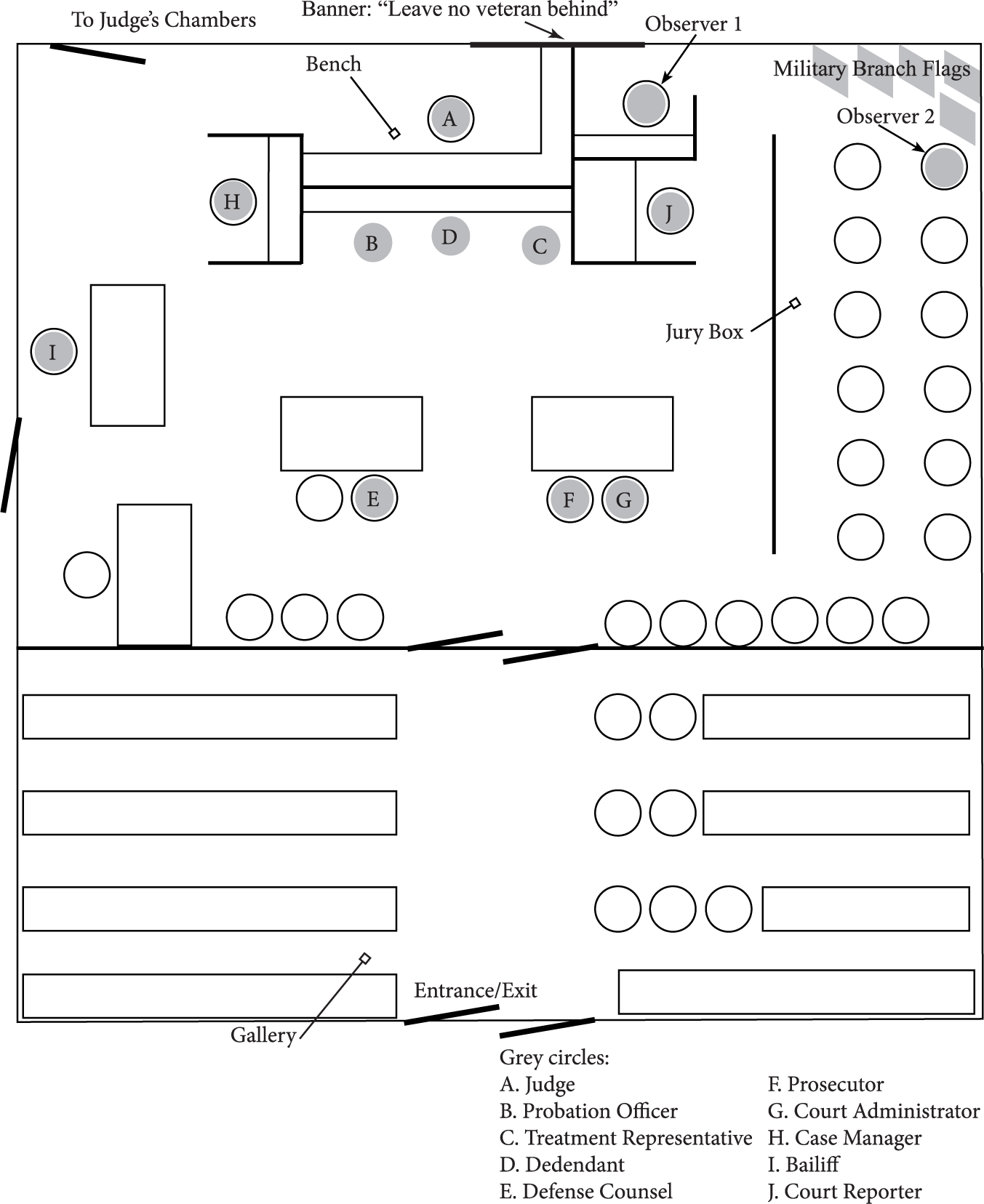
Diagram of Court Proceedings including locations of observers.
At the end of each docket call, the researchers dated their field notes and saved them in a password protected folder. The field notes of the researchers included (a) the content of the exchange (i.e., discussion or verbal exchange), (b) the emotional or affective response of the defendant and other veteran defendants in the courtroom, (c) the tone and expression of the judges and court officials, and (d) the structure, flow, atmosphere, and climate of the entire docket call. The collection procedures resulted in two sets of notes. The notes made by each individual researcher were combined into a single Microsoft© Word file so that the notes for each observer for each interaction were paired. The dockets were divided into segments: pre-docket announcements, graduate speeches, interactions, and post-docket announcements. The two sets of notes created by each observer were collapsed into a single observation for each pre-docket address, each graduate speech, and so forth. As a result, each type of interaction could be examined as a complete picture with each observer’s notes being combined.
Although the researchers commonly recorded the same information for a given interaction, there were times where one observer purposefully recorded details the other observer did not. The researcher in the witness box commonly recorded as much detail about the interaction between the judge and the defendant as possible, and the observer in the jury box recorded more details about the reactions of observers and the environment. This tended to be due to the amount of activity at any given time as observers would be attentive to different aspects of the exchange. The decision was made to have two observers present, to capture a more detailed, comprehensive picture of the court. 2
Researcher Perspectives
Each researcher brought a unique lens to the courtroom observation and each pairing of researchers brought a different combination of lenses into the courtroom. As we present mainly descriptive findings, we present information on these lenses to frame our findings. The first researcher, a White male, has not served in the military, nor has close ties with members of the armed forces. This researcher has experience with VTCs in Texas. Having worked with VTC personnel, this researcher’s perspective of the court is likely influenced by the goals and communicated intentions of the court leading to an emphasis of goals and intentions in his observation of this VTC. However, implicit expectations are a part of norms and the transmission of norms, so sensitivity to different interpretations of judge and defendant interactions will be important. The second researcher, a White female, formerly worked with victims of domestic violence to access court services and certified probation officers. Her experience in courtrooms and with probation may increase her attentiveness toward the offender/service provider interactions. Furthermore, this researcher has a close circle of friends who have served in the military for varying terms and both her father and brother served 4 years each in the Navy. Although the researcher has never served in the military, her exposure to those who have allows for some knowledge of the culture of the military, which may affect this researcher’s observation of the VTC. The third researcher, a White female, formerly practiced as a criminal defense attorney for many years in central Texas. Her experience in the traditional courtroom environment may have increased her awareness of differences between traditional courts and the VTC. In addition, this researcher has never served in the military and has no close ties to members currently serving in the military. Lack of familiarity about the informal subculture of the military may affect this researcher’s observation of the VTC. Collectively, these lenses provided a balanced view of the VTC, as one researcher was attuned to the differences in therapeutic and traditional court approaches, one was familiar with military culture, and one was familiar with the scholarly/theoretical approaches of each, therefore making a mediator for points of view.
Data
The findings presented are based on 422 exchanges that were observed over the study period. For the present study, exchanges were instances in open court where one or more individuals addressed another person. This includes pre- and post-docket announcements made by the court personnel or defendants. The announcements commonly included information about job fairs, the purpose of the court, or reminders about the court procedure. Also included in the term exchanges are the speeches given to the court by defendants on their graduation. The majority of exchanges though occurred between a defendant and the judge (364 of 422 exchanges)—we referred to these exchanges as interactions throughout the remainder of the article, as they are more focused than the pre- and post-docket addresses and graduate speeches. We also recorded and detailed the observations made about the courtroom environment and announcements made at each visit. We ended our observation after 6 months due to saturation, that is, the docket was quite predictable, and the environment was very consistent. Because there were no new occurrences or themes that emerged late in the period of observation, the researchers ceased the field observations to begin later phases of the research.
Despite varying researcher perspectives, the two features we examined were the therapeutic and militaristic nature of the VTC. Below, we present findings based on the fieldwork and development of themes that took place between the researchers. The researchers met throughout the fieldwork to discuss each aspect of the treatment court. We also conducted “member checks”—discussing our observations with court personnel who were able to clarify the meaning of terms or procedures in the VTC process. The field notes for each date were transcribed into NVivo, a software program that aids in the collection, storage, and analysis of non-numeric data (Bazeley & Jackson, 2014). The researchers read each observer’s notes, considered the totality of field research data, and developed themes separately. On comparing the themes that were developed individually, three themes were ultimately constructed collaboratively. The themes we identified as forming the basis for examining the general presence of therapeutic and militaristic contexts were “Help,” “Reinforcement,” and “Military Reference.” Each theme was, for the most part, structural. In other words, we emphasized the aspects of the court that were manifest or concrete in our observations. These themes were then coded in NVivo. Two independent coders reviewed each interaction to identify times where help was offered, given, or requested (three sub-themes to Help), where reinforcement was given in the form of applause, incentives, or positive evaluation (three sub-themes to Reinforcement), and where a military reference or allusion was made.
Findings
Descriptive Themes
Help
The theme “Help” drew on the exchanges between court personnel and veterans, most often occurring between the judge and the veterans. We identified the theme of help broadly, and the interrater reliability was found to be high. We used any circumstance where the potential for assistance to be provided was mentioned by court personnel as an example of offering help. When assistance was explicitly provided, we coded these instances as giving help. Although occurring less frequently, we also included a sub-theme of requesting help that we identified as any time where assistance was explicitly asked for by a veteran participant in court. The interrater reliability for these sub-themes after the initial round of coding was calculated by averaging the kappa coefficients for each exchange. The levels (80.9, 98.8, and 92.6, respectively) were in the excellent range for interrater reliability. These codes were not altered after our first wave of coding.
Positive reinforcement
We also broadly identified instances of positive reinforcement in our field notes for coding. We define positive reinforcement as a reward for behavior, whether that was in language (positive evaluation), explicit rewards (such as incentives or promotion), or in applause. The sub-theme of applause was used to identify instances where clapping occurred in response to an interaction. We also coded times where the progress of a veteran was mentioned or praised as times of positive evaluation. When monetary rewards were given, we coded these interactions as incentivized. In all, the averaged kappa for each sub-theme was 88.0, 60.4, and 90.9, respectively. The kappa coefficient for applause was below acceptable levels because of confusion between the researchers after the first wave of coding. 3 The discrepancies were discussed and each interaction was recoded in a second wave resulting in the reported levels of agreement.
Military reference
Of the three descriptive themes, military references were the most abstract theme that was constructed. This theme captured any military mannerism or comment whether that was the behavior of a probationer or a joke made in reference to service. The types of references are discussed in more depth in the results. The interrater reliability of this theme was good (average κ = 66.7). The themes described are broad areas meant to assist in examining each segment of the court: the therapeutic segment and the militaristic segment. Below, we detail how each segment manifested in our examination of the VTC experience based on the time spent observing and the analysis of field notes.
Therapeutic Context of the VTC
The therapeutic context of the VTC manifested in ways that were generally consistent with the underlying philosophy and motivation for specialty courts. As expected, much of the initial theme construction for “help” and “positive reinforcement” informed the therapeutic context. The administrators and court personnel frequently explained the purpose of the court to the participants through pre-docket addresses, as well as during interactions with individual veterans. The court was described by court personnel to the veteran participants as non-adversarial, collaborative, and treatment oriented. For example, the judge or court administrator announced to veterans on multiple occasions phrases such as Non-adversarial/Collaborative: “The thing about VTC is the prosecutors and defense attorneys are a team, in most courts, this is an adversarial relationship”; “everyone works together to ensure that veterans get the treatment they need”; “[The] focus of the court is treatment and we have a team; in our meetings we discuss the cases, we do it regularly.” Treatment Oriented: “The treatment providers and POs are here for you, we don’t want you to go to jail, we want you to complete the program”; “Before you have to stand there and get thrown in jail, come see us,” “We don’t want treatment to become punishment.”
These court officials referred to “we” as the entirety of the court staff and used the term to signal collaborative interest. It was apparent from their comments to veteran participants that each of the treatment providers, probation officers, court administrative staff, and the judge maintained a common interest in improving the veterans’ lives as a unified treatment team. One address to the veteran participants in particular characterized the environment of the court quite well and was delivered from the criminal defense attorney to the veteran participants: You don’t hear much from me because we are here to help rehabilitate you. You have heard the judge talk about MTR [motion to revoke probation] and you don’t want one because you will then hear from the prosecutor and me. We will be in an adversarial role and I will be defending you before the judge. . . . As the judge says, he will pull that trigger. So don’t make me work hard . . . the DA doesn’t want to prosecute you. We all want to help you. If you need to, seek out help.
Veteran defendants were also given a chance to address the remaining defendants when they graduated from the court. Veterans commonly used this address as a way to encourage their veteran peers and to emphasize how the court personnel were motivated to assist defendants. For example, one veteran emphasized how versatile the court personnel were and how many resources were at their disposal: “Everyone here is a resource, if you need anything, someone in this room can find it for you.” Another veteran identified how salient his experience was with a probation officer: “I can’t imagine where I would be without this place; I have had experiences with probation officers that I can’t explain; they came and did a home visit and they left food for me for about a week.”
We also found that interactions between the judge and the individual veterans were on display for everyone in court. Like other specialty courts, participants’ compliant and noncompliant behaviors were known to each observer in court, including their peers. This means that every interaction was an opportunity for the court personnel and the judge to emphasize the goals and purpose of the treatment court. We found that it was common for court personnel to take this opportunity and would interject this information into exchanges between veterans and themselves.
One way that the judge communicated the purpose of the court was offering help to participants. This particular judge offered help regularly at the end of his interaction with participants; in 178 of 364 (48.9%) one-on-one interactions between the judge and a participant, the judge explicitly offered help to the veteran. These offers were most often of a routine nature; this judge had made a habit of asking veterans “Is there anything else going on we can help you with?” This was especially true of interactions between the judge and participants who were being seen for the first time in court.
We also found the court to applaud good behavior, both figuratively and literally. We found the collaborative approach emphasized positive evaluation of probationers’ behavior. In no less than 230 of 364 interactions (63%), a member of the court personnel explicitly expressed a positive evaluation of a participant’s progress. These evaluations took on several forms. An obvious example of positive evaluation is promotion. In our observations, the court used positive evaluation and praise alongside promotion. The judge often made an example of veteran participants who were progressing and rewarded them with promotion in front of their peers by saying, “they say you’re doing so well that we get to promote you!”
The probation and treatment personnel flanking the participants as they stood before the judge also frequently voiced praise and positive evaluation of the veteran participant’s progress. Probation officers reported their satisfaction with communication, compliance, progress in required courses (Driving while intoxicated prevention education, anger management, among others), clean urinalyses, and having a positive attitude generally. Treatment personnel reported to the judge on the veteran participant’s progress in group or individual treatments, and commonly praised them for consistent attendance and engagement.
Veterans were also given monetary incentives for exceptional behavior. The court sometimes singled out participants who were overcoming particularly difficult life circumstances and persisting in their effort in court for special recognition. Veterans who were working hard to comply or were fighting back from previous misbehavior were also recognized. This particular court used gift cards for groceries or food as an incentive for good behavior. The judge made sure that the incentive was clearly announced to the veterans sitting in the gallery. While we were observing, a total of 39 incentives were given (10.7%). Clearly these rewards were reserved for a specific cross-section of the veteran participants.
This specialty court also followed the practice of applauding after positive interactions between the judge and a participant. Of the 364 interactions, the veterans observing the interactions applauded at the end of 298 (81.8%). The court administrator also announced to the veterans the purpose of applause: Look, if one of our veterans is up there at the bench getting his butt chewed, I don’t want to hear a peep. The reason we do that is to encourage people who have done a good job. If someone’s getting chewed, I don’t want to hear anything. The good stuff, we want you to encourage one another.
Military and the VTC
We found this particular court to incorporate a number of militaristic elements, mannerisms, and sayings. Through the court personnel themselves, through procedure, and through language and behavior, there was apparent military influence. In all, we observed and recorded 1,107 references to the military during our study; this amounted to about two to three references per interaction. Simply put, the military was a pervasive influence in the court proceedings.
How the military or military references affect court proceedings is a complex question. We observed several circumstances in which military references were utilized. The simplest example of how the military affected this court was in their selection of employees. During the course of our fieldwork, we observed that the positions of court manager, case manager, judge, and defense attorney were filled by veterans. These individuals identified themselves as veterans to the court. Participants in the VTC knew of their service. The courtroom also provided visual cues as to the influence of the military in proceedings. Where you might see only an American Flag in a traditional courtroom, this court displayed each military branch’s flag as well. Furthermore, the judge preferred to don a camouflage robe instead of the traditional black robe.
The procedures used by the court also took on a structured form that was based in a military context. The most prominent example of how the military was apparent in this court was how it routinized the court docket. This court observed several practices that structured the docket proceedings from beginning to end. This particular court observed the practice of a court official announcing the judge into the court by shouting “VTC Attention!” or “VTC on your feet!” as opposed to the usual “All rise.” Each person in the courtroom then stood at attention as the judge entered, and then saluted the flag as they would say the pledge of allegiance of the United States. After the pledge, the defendants would shout, “Leave no veteran behind, sir!” The phrase was also visible hanging on the wall behind the judge on a large banner. We observed this procedure at every court docket.
In addition, we observed veteran defendants being called by their name and rank at every court docket without fail. The judge always called court personnel by their name and rank as well. The participants in court were also aware of the context and the expectations the judge had of them with regard to their behavior in court. Quite frequently, when veterans were called by their name and rank, they would stand up out of their seat in the gallery with a sense of urgency, meanwhile shouting “Moving, sir,” or “Moving, Your Honor,” or “Here, sir,” and walk to the bench. Once they arrived, veterans commonly stood before the judge with their feet shoulder-width apart and their hands behind their back, a posture known in the military as parade rest.
A number of other instances arose where the language used by the court personnel or veteran participants reflected some type of military reference. Importantly, there was term substitution, in that the court staff would use terms with a military flavor instead of, or in addition to, standard terms. For example, in reacting to other veteran’s exchanges or to announcements made by court personnel, veterans in the gallery would say “hooah” or “oorah” in addition to applauding, an affirmative utterance used by members of various branches. The judge frequently commented on the importance of veterans communicating with probation officers, but did so in a way that emphasized the importance of “commo”—sometimes referring to communication as being as important as life or death—a clear allusion to the importance of communication in combat or battle. The judge also used terms such as green light to signal permission. For example, the judge would remark on probation officer’s plans for moving the veteran through the court program by “green lighting” the plan, or granting permission to move forward.
The judge also referenced the military to admonish probationers. For example, the judge, finding a veteran in non-compliance told the veteran: “[I am going to] defer a motion to revoke probation until a future time and let you soldier your way out of it.” In a similar instance, the judge remarked on second chances in the treatment court: “just like the military, we will give you a chance to soldier your way out.” This judge clearly meant that the defendant would have to work hard but could overcome prior mistakes. The judge used military references for humor as well, noting that veterans who were not present for docket had “missed the chopper,” or making casual jokes toward veterans of particular ranks or military branches. In response to a veteran of the Navy completing classes and payments, the judge remarked, “Let’s give him a seal clap” and proceeded to bark like a seal, making reference to the special Naval unit, the Navy Seals. In a very serious manner though, the judge also drew on military experience to explain the expectations of the VTC, telling one Marine, “this should be easier to do than the Marine Corps [MC]. Here you gotta be good. In the MC you had to be bad, but you had to focus it on the bad guys.”
Discussion
In the course of our field study, we observed two interacting orientations toward the administration of the VTC. Importantly, we found that court officials described the nature of the court to the veteran defendants in a way that was consistent with the purpose and philosophy of a therapeutic or specialty court. However, we were also able to detail the military’s influence in the proceedings. Based on our observations, we found the military to contribute to the environment of the court dockets, but that ultimately the court was a specialty court with militaristic aspects. We found each approach to be valuable and present a cursory examination on how these two different entities co-exist.
First, our examination provided numerous positive findings for the therapeutic aspects of treatment in the VTC. Foremost among these findings was the communication between court personnel and defendants about the nature and purpose of the court. The exchanges that took place in this court contained numerous references to the goals of treatment court personnel. The staff in this court frequently told the participants they wanted to rehabilitate them, and that they did not want to punish participants. We also observed typical specialty court practices, including positive evaluation of the veterans’ behaviors and progress by the court personnel and by the other court participants. These evaluations, whether explicit in nature or routinized, not only communicated to specific veterans how to continue working toward graduation but also occurred in a way that veterans observing could learn what behaviors are commended. Therefore, this procedure vicariously reinforced other court participants.
We suspect these are salient factors that influence treatment court participants’ perceptions of the proceedings and likelihood of success in the program. It is plausible that veterans perceiving the use of positive reinforcement or hearing the court speak of the philosophy and goals of the court may be more invested in the court process. Such an investment is likely to increase perceptions of fairness and increase their likelihood of complying with the treatment court program. Overall, this court operated in a manner consistent with the principles that guide many specialty courts.
In general, we found military references served important roles in the court. Foremost, the court staff were veterans and it was clear that the behavior of the court staff stemmed from their intimate knowledge of the military based on their service. Military references seemed to form a context that was familiar for treatment court defendants. We witnessed defendants who were observing the proceedings tended to react positively to the judge’s use of particular terms, whether that was laughter at a military reference or the use of “hooah” to acknowledge a staff member. Because this formed a positive context, it is plausible that the use of military mannerisms or sayings eased the development of rapport between treatment court personnel and the defendants. The common understanding of the context may have led defendants to be more committed to the court, or to have a greater sense of trust in court staff.
We found that military references structured the court docket from beginning to end. Foremost among these references was the court reciting “Leave no veteran behind!” at the beginning and end of each docket. Therefore, reference to the military coincided with the routinized nature of the court. Although this court was not heavy handed in terms of disciplinary action (we observed only two motions to revoke probation completed), the court proceedings were disciplined—there was a sense of efficiency that ran parallel to the mannerisms that we found to be military oriented. This type of consistency and structure could be beneficial for a number of reasons. One, the routinized nature of the court may contribute to a familiar military context. The structure of the court docket mirrors the structure that one would expect in military activities. Furthermore, the efficiency with which the docket is carried out—in a consistent and routine nature, mirrors the highly routinized and disciplined lives that soldiers may lead.
The routinized nature of the court also seemed to promote vicarious learning. We observed veterans reporting to court for the first time, who typically went in front of the judge toward the end of the docket, approach the bench in the same way as other veterans, saying “moving, sir,” and standing at parade rest in front of the judge. Based on this evidence, defendants may have learned to behave in a certain way because of the way the court docket was structured. We are not suggesting that the routinized nature of the court teaches the participants to behave similar to the way they would have behaved in the military. We are suggesting that participants learned through observing the docket, that it was appropriate to act like a soldier during the docket. The fact that veteran defendants observed other veterans’ behavior in court and before the judge was one way that defendants adopted the soldier role during the proceedings. A defendant’s adoption of the role of soldier in the specialty court context suggests that there may be advantages to running the VTC in a militaristic manner. Military personnel, for example, are expected to submit to authority. Applying this role to the defendant, a militaristic context could potentially increase compliance because the defendants adopt a role that is obedient. Thus, it is possible that such a context promotes compliance, a claim that merits further investigation.
Finally, we observed the court was disciplined in terms of structuring the docket call, but was not disciplinary in that the docket was not typically used to administer punishments to participants. Although we did observe cases where individuals were demoted or had probation revoked, the type of admonishment used emphasized accountability rather than the judge’s power. In this way, we observed that the discipline of the military was drawn on to create an environment that participants were familiar with, but that this orientation toward the military yielded to the court’s core purpose of rehabilitation.
Conclusion
Our findings further suggest that a unique specialty court context may exist in VTCs that draws on military references in particular ways. The whole of the evidence presented suggests there is value in an approach that balances militaristic and therapeutic orientations in the administration of VTC. One potential benefit is that the overlapping context of the military and therapy may provide fertile grounds for growing therapeutic communities within the VTC, specifically. The common pro-social links between participants and court personnel, as well as the expression of that link in terms of the manifestation of the military in VTC procedures may provide a context conducive to reform for veteran participants. Compared with other specialty courts, veterans beginning the treatment court process can be expected to have more in common with other participants, and as such, have a greater degree of investment in, and camaraderie among, one another.
This suggests that certain military values may be especially useful to the VTC. As we alluded to above, camaraderie and loyalty appear to be important aspects of growing trust and positive relationships between court personnel and participants, as well as among participants. The common link may ease the development of rapport and increase the efficacy of treatment court procedures. This may also grow a supportive community or support system for veterans. However, there may be military values or aspects of military culture that hamper progress in VTC. As Seamone (2013) found masculinity to be a hindrance in requesting help for substance abuse, this military value could create opposition to the philosophy of the treatment court.
Whether and how a mixed orientation toward the administration of the VTC is beneficial to participants are questions that merit further investigation. Our study is limited in that we were only able to investigate one VTC. The extent to which our findings transfer to other courts depends on the similarity of court staff characteristics; because this court had key players who were veterans themselves, we would expect courts with non-veteran personnel to operate in a different way, at least with regard to the behavior of the court staff. A next step in addressing this question is determining how other courts use military references. Although our study is limited to one court, it provides evidence that VTCs can be distinguished from other specialty courts that address drug and mental health issues. Essentially, VTCs can draw on their clients’ experiences with the military and incorporate elements of the military into their procedures and practices, in a way that drug and mental health courts not specifically aimed at veterans cannot. This provides a number of routes for further inquiry into the VTCs’ efficacy.
Research exploring this VTC context will have profound implications for administering the VTC. Most importantly, the interaction of these two contexts raises important questions about the therapeutic and specialty court environment of the VTC. How ought a VTC operate with regard to its orientation to the military? Should VTC operate in a militaristic manner? Although the structure of a VTC that appears like the military may provide an environment conducive to completing such a treatment program, the long-term rehabilitative ability of such a court may be suspect. That is, courts that take a pure military orientation can be expected to have high rates of graduation because the court environment leads participants to adopt compliant roles. These courts may, however, be less successful at preparing veterans to return to lives with less supervision unless military orientations are balanced with a rehabilitative emphasis. Our findings show there is clear value to the use of military references or orientations when a balanced approach is taken. However, there is evidence to suggest that cultural values of the military may be detrimental to rehabilitation in a number of ways (Allsep, 2013; Seamone, 2013; Simmons & Yoder, 2013). How and when military values are drawn on during the court process to induce compliance is an important question.
Future research should investigate the qualities of VTCs that are influenced heavily by military culture. How the military interacts with therapeutic aspects of VTCs should be identified. We found these orientations to be overlapping, but our investigation of the separate contexts does not identify how they interact. Here, we suggest that the importation of military culture in the VTC may positively and negatively affect the therapeutic context of the VTC. Research that addresses the nature of the treatment court in terms of its operation and its use of the military culture will contribute a wealth of knowledge to administrators in constructing a specialty court context that balances perceptions of fairness, compliance, and rehabilitation.
Research addressing the effects of the pervasiveness of the military on defendants in the VTC would prove beneficial as well. For instance, research addressing the efficacy of a militaristic or traditional context of admonishment and positive reinforcement for VTC participants may identify useful procedures for VTCs to adopt and detrimental procedures that VTCs should avoid. In addition to addressing the effect of military influences on compliance with the VTC process, investigating the effect of a militaristic orientation on rehabilitation should be probed. We suggested that a pure military orientation would be detrimental because (re-)assimilation into the broader culture should be a part of the rehabilitative process for justice-involved veterans dealing with social adjustment issues. Such adjustment may be impeded by processing justice-involved veterans in a context more like the military than society. If this is the case, an additional socialization element should be built into VTCs. Although these courts have clear drug and mental health treatment components, to address social adjustment issues due to military assimilation, a component in the VTC addressing social adjustment may be needed. Addressing how these orientations affect veterans will prove to be useful for the administration of the VTC and in helping veterans to lead meaningful lives.
Footnotes
Acknowledgements
An earlier version of this article was presented at the 2015 American Society of Criminology Meetings. We would like to thank Dr. Scott Bowman for his invaluable guidance throughout this study, the court staff for the opportunity to study their VTC, and the anonymous reviewers for their helpful comments.
Declaration of Conflicting Interests
The author(s) declared no potential conflicts of interest with respect to the research, authorship, and/or publication of this article.
Funding
The author(s) received no financial support for the research, authorship, and/or publication of this article.