




Abstract
Decades of research on public opinion about crime reveal varying, yet relatively punitive attitudes that are often riddled with misconceptions. Sparked by the increased media and legislative attention devoted to sex offenders beginning in the 1990s, researchers began to more closely examine public opinion about sexual offenses. Findings suggest the public adheres to several misconceptions about sexual offenses and supports harsh sanctions for offenders. However, further research is warranted to more closely examine the relationships among these variables. Thus, the goal of the present study was to survey Pennsylvania residents to examine the degree to which misconceptions about sexual offenses inform punitiveness. The results supported the hypotheses in that a high level of support for misconceptions and punitiveness was identified, and adherence to misconceptions was the strongest predictor of punitiveness. These findings demonstrate a clear need for educational and awareness efforts to dispel public misconceptions about sexual offending and victimization.
Public opinion about crime has been a salient issue in the United States and other democratic nations for decades (Roberts & Stalans, 1997). Evidence suggests that a substantial portion of the public adheres to myths about crime (e.g., believes the crime rate to be steadily rising), is fearful of crime (e.g., afraid to walk home alone at night), and is quite punitive toward offenders (e.g., belief that the courts are too lenient) (Costelloe, Chiricos, & Gertz, 2009; Cullen, Fischer, & Applegate, 2000; Roberts & Stalans, 1997; Toch & Maguire, 2014). However, findings have oscillated over time and vary according to a number of factors such as respondent demographics (e.g., sex, race/ethnicity, education level), offense characteristics, political environment, and media (Applegate, Cullen, & Fisher, 2002; Callanan, 2005; Costelloe et al., 2009; Toch & Maguire, 2014). As such, public opinion about crime is an important topic to continue to examine due to its palpable impact on the criminal justice system (e.g., decision to report a crime, jury trials) and crime policy (Mears, Mancini, Gertz, & Bratton, 2008; Toch & Maguire, 2014; Wood, 2009).
While many researchers have assessed public opinion about crime in general, some have focused on specific types of offenses. Following the increasing media and legislative attention devoted to sex crimes during the latter portion of the 20th century, several studies emerged examining public attitudes about sexual offenses and offenders. However, despite the increased attention to these attitudes over the past few decades, further research is needed to more closely examine these perceptions among public samples. A number of researchers have assessed these opinions among student and practitioner samples, which, while certainly valuable, may not be representative of the general public due to education level and other important differences. Moreover, additional research examining predictors of attitudes about sexual offenses is warranted to determine whether opinions are based on myths and misconceptions. Such misinformed opinions would lend themselves to change through awareness and educational efforts about the realities of sexual offending and victimization risk. Thus, the goal of this study was to assess public perceptions about sexual offenses with a focus on the extent to which misconceptions predict punitiveness.
Literature Review
The public’s reaction to sexual offenses is one that is often marked by horror and disgust, particularly over the past few decades due to the moral panic elicited by media coverage of the most horrific sex crimes and the resulting laws to control and monitor sex offenders in the community (e.g., registration, residence restrictions) (Anderson & Sample, 2008; Callanan, 2005; Galeste, Fradella, & Vogel, 2012; Levenson, 2003; Pickett, Mancini, & Mears, 2013; Quinn, Forsyth, & Mullen-Quinn, 2004; Sample & Bray, 2003). Given the potential influence of public opinion on criminal justice policy and case processing, it is important to examine the origins of these sentiments since public knowledge about crime in general has been found to commonly be based on media consumption, personal experience, or anecdotal evidence gleaned from others (Callanan, 2005; Costelloe et al., 2009; Roberts & Stalans, 1997; Wood, 2009). In fact, research indicates not only that public opinion about sexual offenses is indeed heavily influenced by media but also that opinions are frequently riddled with myths and stereotypes (Galeste et al., 2012; Malinen, Willis, & Johnston, 2014; Pickett et al., 2013; Thakker, 2012).
Misconceptions
A common misconception about sexual offenses is that their occurrence is steadily increasing, particularly those involving child victims and unknown perpetrators (Anderson & Sample, 2008; Fuselier, Durham, & Wurtele, 2002; Galeste et al., 2012; Mears et al., 2008; Pickett et al., 2013; Quinn et al., 2004). For example, over three quarters of the participants in Levenson, Brannon, Fortney, and Baker’s (2007) study believed that sex crimes rates were increasing and almost 30% of Craun and Theriot’s (2009) sample indicated more concern about a child being sexually victimized by a stranger than by someone they know. Despite these findings, official statistics and victimization data indicate that crime rates, including those for rape and sexual assault, are significantly lower than those observed prior to the mid-1990s (Bureau of Justice Statistics [BJS], n.d.; Federal Bureau of Investigation, n.d.). In addition, research suggests that adults and children are much more likely to be sexually victimized by someone known to them than by a stranger (Association for the Treatment of Sexual Abusers [ATSA], 2008; Center for Sex Offender Management [CSOM], 2000). There exist a number of misconceptions specifically about sex offenders as well. Some of the most prominent of these include the notions that all sex offenders will recidivate and that treatment is ineffective (Galeste et al., 2012; Levenson, 2003; Quinn et al., 2004; Sample & Bray, 2003). For example, the participants in Fuselier et al.’s (2002) study estimated that most child molesters were recidivists with an average of 11 to 50 assaults and Brown’s (1999) survey revealed that while 95% of the sample supported rehabilitation for sex offenders in prison, only 15% strongly believed treatment would actually be effective in reducing recidivism. Reflecting the beliefs that all sex offenders are untreatable, perpetual recidivists, one of the respondents in Brown, Spencer, and Deakin’s (2008) study stated, “The only sure way to control them is to keep them behind bars until they die” (p. 266).
In contrast to these findings about public opinion, research suggests that sex offenders have lower recidivism rates than many other offenders (ATSA, 2008; BJS, 2002; CSOM, 2001; Sample & Bray, 2003; Tewksbury, Jennings, & Zgoba, 2012). While sex offenders are more likely than other offenders to recidivate with a sexual offense, the risk remains relatively low, and they are actually more likely to recidivate with a nonsexual offense than a sexual offense (Babchishin, Hanson, & Blais, 2016; BJS, 2002; Hanson & Bussiére, 1998; Tewksbury et al., 2012). In regard to treatment efficacy, a large body of research indicates that certain sex offender treatment models can be effective in recidivism reduction, particularly for younger offenders (ATSA, 2008; CSOM, 2001; Hanson et al., 2002; Kim, Benekos, & Merlo, 2016; Schumucker & Losel, 2015). Furthermore, sex offenders comprise a diverse group of individuals upon which blanket assumptions about risk, recidivism, and treatment amenability are likely to be invalid (CSOM, 2001; Quinn et al., 2004; Tewksbury et al., 2012). Once again, these widely held public beliefs are in stark contrast to empirical evidence.
One of the collateral consequences of the public’s adherence to misconceptions about sex crimes is fear, oftentimes misplaced fear (Galeste et al., 2012). Research consistently reveals a high level of fear of sexual victimization, particularly by women about themselves or children being victimized (Craun & Theriot, 2009; Galeste et al., 2012; Kernsmith, Craun, & Foster, 2009; Pickett et al., 2013). For example, surveys of two samples of adult females in two different cities indicated that rape was rated among the most feared crimes among both groups (Warr, 1995). Similar findings were reported by Sims and Johnston (2004) in that respondents were most fearful for themselves or someone close to them being burglarized or sexually assaulted, and this fear was more pronounced among females. In light of these findings, it is not surprising that 94% of Mears and colleagues’ (2008) sample agreed or strongly agreed that sex crimes should be a top policy priority. It is important to note, however, that many studies only assess overall fear of rape or sexual assault. In contrast, Wilcox, Jordan, and Pritchard (2007) identified a greater fear of stranger-perpetrated sexual assault than acquaintance perpetrated. Thus, the level of fear of sexual victimization identified in many studies may actually be based on the myth that assault by a stranger is more likely or more harmful.
Punitiveness
The adherence to myths about sexual offenses, coupled with the high degree of fear of sexual victimization, has likely fueled the intense punitiveness toward those convicted of sexual offenses (Pickett et al., 2013). To be sure, the public’s punitiveness toward criminals in general is well documented (Costelloe et al., 2009). However, the addition of the public fear and repulsion surrounding sexual offending further intensifies this punitiveness. In fact, several studies have found attitudes toward sex offenders to be significantly more negative and punitive than attitudes toward other types of offenders (Craig, 2005; Hogue, 1993; McCorkle, 1993; Mears et al., 2008; Weekes, Pelletier, & Beaudette, 1995).
In regard to opinions about sentencing, almost all of Mears et al.’s (2008) sample suggested incarceration as the appropriate punishment for the rape or sexual assault of an adult or child. The participants in Levenson and colleagues’ (2007) study indicated the mean prison sentence a sex offender should serve is 38.8 years, although the mode was 99 years, which was the largest number that would fit in the space provided. Reflecting similar punitiveness, Comartin, Kernsmith, and Kernsmith (2009) reported that almost half of their sample supported a sentence of life in prison for sex offenders, and more than 40% supported castration. Importantly, however, support for these harsh policies was more prevalent among respondents with young children, lower education levels, or lower income levels (Comartin et al., 2009). In regard to the most severe punishment, Mancini and Mears (2010) found strong public support for the use of the death penalty for convicted sex offenders.
Another measure of punitiveness is support for sex offender management policies such as registration, community notification, and residence restrictions. Research consistently finds strong public support for these laws. For example, more than 80% of the respondents in Phillips’s (1998) survey indicated that community notification was very important and an overwhelming majority believed that notification increased public safety, despite the fact that few reported a change in behavior based on notification. Similarly, Anderson and Sample (2008) reported that while the majority of the respondents were aware of sex offender registration and reported it made them feel safer, less than 40% had accessed it or taken any precautions based on the information. Kernsmith and colleagues (2009) assessed registration support for different types of sex offenders and found the greatest support for those who had offended against children, though support for all types of offenders was high.
The Present Study
Overall, researchers have identified a great deal of public fear and punitiveness toward sex offenders, though the extent to which these opinions are informed by myths warrants further exploration. This is important because dynamic factors like adherence to misconceptions can be changed through educational efforts, whereas other predictors such as demographic characteristics are less likely to be malleable. To that end, two samples of Pennsylvania residents were surveyed for this study. A scale to measure these perceptions was developed and several demographic and experiential correlates of these attitudes were also measured. The primary hypotheses for this study were:
Method
Sample Selection Procedures
The samples for this study were comprised of Pennsylvania residents. Pennsylvania houses a relatively diverse population in terms of sex, age, marital status, education, and socioeconomic status (U.S. Census Bureau, 2010). In addition, a large portion of Pennsylvania is rural (i.e., 48 rural counties, 19 urban counties, 27% of residents live in a rural county), which made it an ideal location from which to sample residents from a variety of rural and urban areas (U.S. Census Bureau, 2010). This is important as city type (e.g., rural, urban) has been shown to affect punitiveness (Unnever & Cullen, 2010).
Mail survey
The samples for this study were selected via two distinct procedures to accommodate two different survey modes. For the mail survey, multistage cluster sampling was used in which incorporated cities/towns, zip codes, and carrier routes served as the clusters. The sample was also stratified into four strata based on population size to ensure the final sample included residential addresses from larger, urban areas and smaller, rural areas. Because the strata were of unequal size (i.e., few large cities, numerous small towns), the strata were disproportionately sampled relative to stratum size to include an equal amount of sampling units from each stratum (i.e., 100 residential addresses from each population size group). Without stratification, it is possible that a simple random sample would have excluded the larger cities in the state. The final sample was comprised of 400 Pennsylvania residential addresses from both large and small cities/towns across the state. The adult household resident with the most recent birthday was asked to complete the survey (Dillman, Smyth, & Christian, 2009).
Online survey
For the online version of the survey, completed surveys were purchased from a survey research company. The sampling frame from which the sample was selected consisted of adult Pennsylvania resident panel members who had opted in to receive email invitations to participate in research surveys. Email addresses were randomly sampled by the survey research company and the first 100 completed surveys were purchased for this study. While this limits the generalizability of the findings, it was deemed the most time- and cost-efficient method to obtain a sample of Pennsylvania resident online survey participants for this study. Comparisons of the samples with the target population are discussed in detail below, as are comparisons between the mail and online survey respondents.
Measures and Variables
Due to some limitations, the choice was made to construct a scale for this study to measure perceptions about sexual offenses, rather than utilize an existing scale. For instance, despite its use by several researchers, Hogue’s (1993) Attitudes Toward Sexual Offenders Scale (ATS) has been criticized for its failure to address stereotypes specific to sex offenders as it was adapted from Melvin, Gramling, and Gardner’s (1985) Attitudes Toward Prisoners Scale by simply replacing the word “prisoners” with “sex offenders” (Church, Wakeman, Miller, Clements, & Sun, 2008; Willis, Levenson, & Ward, 2010). Another measure that has been frequently used in recent years is the Community Attitudes Toward Sex Offenders Scale (CATSO) developed by Church and colleagues (2008). Unlike the ATS, the CATSO does target perceptions specifically about sex offenders including domains of social isolation, capacity to change, severity/dangerousness, and deviancy (Church et al., 2008). However, similar to the ATS, the CATSO does not include items to measure some of the misconceptions about sexual offenses that were of interest in this study.
Based on these limitations, the 12-item Perceptions About Sexual Offenses Scale (PASO) was created to measure misconceptions and punitiveness. Some of the scale items are similar to those from the CATSO but were altered for the purposes of this study. Scale items intended to measure misconceptions tapped into perceptions about sex crimes rates, victim–offender relationship and risk, recidivism, and treatment. Measures of punitiveness examined opinions about harsh prison sentences for sex offenders, registration, community notification, electronic monitoring, and residence restrictions. Each statement was followed by a 5-point Likert-type scale ranging from strongly agree to strongly disagree. Possible scores ranged from 12 to 60 in which higher scores indicated more misinformed, punitive perceptions.
The last section of the survey asked a variety of questions intended to serve as control variables. These included demographic questions about sex, race/ethnicity, age, education, approximate annual household income, and whether the respondent had children under the age of 18. Previous research has identified more fear and punitiveness among females, respondents with children, and those with less education or lower income levels (Comartin et al., 2009; Craig, 2005; Kernsmith et al., 2009; Levenson et al., 2007; Mears et al., 2008; Phillips, 1998; Shackley, Weiner, Day, & Willis, 2014; Willis, Malinen, & Johnston, 2013). A number of questions were also asked about experiences as some studies have indicated that previous victimization and experience with sexual offenders has a positive effect (e.g., greater leniency, less support for myths) on attitudes about sex crimes (Ferguson & Ireland, 2006; Fuselier et al., 2002; Hogue, 1993; Nelson, Herlihy, & Oescher, 2002; Weekes et al., 1995; Willis et al., 2010). As such, participants were asked whether they had ever been the victim of a rape or sexual assault, personally knew someone who had been the victim of a rape or sexual assault, had ever been convicted of a sexual offense, and personally knew someone who had been convicted of a sexual offense.
Survey Procedures
After securing Institutional Review Board approval, mail survey packets were sent out via first class mail to the 400 residential addresses. The packets included a cover letter, informed consent document, the survey, and a prepaid return envelope. It was explained to respondents that their participation was entirely voluntary, and if they chose to participate, their responses were anonymous. About two weeks after the survey packets were mailed, reminder/thank you postcards were sent to all respondents, including contact information for those who had questions about the survey or needed to request another packet.
The online survey respondents received an email with similar verbiage to the mail survey cover letter. If they were interested in participating, they were instructed to click on the provided link and were first taken to the informed consent document which explained the same information as the mail survey consent document. Those who consented to participate were then taken to the first question of the survey. Reminders were not necessary as 100 completed surveys were achieved in less than 48 hours.
Results
Once data collection was complete, descriptive statistics and frequencies of the sample were calculated. These data were compared with the population to determine the extent to which the sample was representative of Pennsylvania residents. Cross-tabulations and t tests were also conducted to examine any differences between the mail and online survey respondents. Next, frequencies and descriptive statistics of the PASO scale were computed, including reliability assessment, followed by bivariate and multivariate analyses to examine support for misconceptions and punitive attitudes.
Sample Characteristics
Despite the use of Dillman et al.’s (2009) Tailored Design Method, the response rate for the mail survey mode was low. This was not surprising, however, given the trend of declining survey response rates in recent years (Wright, 2015). Out of the 400 survey packets sent, 74 were returned resulting in an 18.5% response rate. While a low response rate is traditionally believed to lead to nonresponse error, recent research casts doubt on this notion as response rates as low as 10% have been found to yield reliable estimates (Wright, 2015). The response rate for the online survey is unknown as the first 100 completed surveys were purchased from a survey research company. While the sample selection procedure used for the online survey and the response rate for the mail survey may affect the generalizability of the findings, comparisons of the entire sample with the target population reveal many similarities, suggesting the sample is representative of the population on many important factors. In addition, assuming a medium effect size, the sample size of 174 was large enough for sufficient statistical power (Cohen, 1992).
The demographic characteristics of the entire sample are displayed in Table 1, in addition to separate figures for the mail and online survey samples. The total sample was slightly disproportionately female which is similar to the Pennsylvania population in which 51.3% are female (U.S. Census Bureau, 2010). Although the mail survey sample had a greater proportion of female respondents compared with the online survey sample, the differences between the two survey modes on this variable were not statistically significant (χ2 = 2.893, p > .05). In regard to racial/ethnic identity, 84.9% of the total sample identified as White/Caucasian, 9.3% African American, 2.3% Asian, and 3.5% Hispanic/Latino, which is generally consistent with the racial/ethnic characteristics of Pennsylvania (U.S. Census Bureau, 2010). Racial/ethnic identities between the two survey modes were similar and any observed differences were not statistically significant (χ2 = 0.654, p > .05).
Sample Characteristics.

Differences between mail and survey respondents are statistically significant at p < .05.
Whereas 98.3% of all respondents reported a high school diploma or higher, 86.9% of Pennsylvanians aged 25 or older had received a high school diploma (U.S. Census Bureau, 2010). Although the entire sample was slightly more educated than the target population, the differences between the mail and online survey respondents were not statistically significant (χ2 = 1.347, p > .05). The majority of the respondents reported annual household incomes of US$60,000 or less (71.1%) and the median income reported was US$40,001 to US$60,000. According to the 2010 Census, the median household income in Pennsylvania was US$49,501, suggesting the sample was comparable with the target population, and any observed differences between the two survey modes were not statistically significant (χ2 = 1.347, p > .05).
Approximately one quarter of all respondents indicated they had children below the age of 18, which is comparable with the population in which 20.3% of Pennsylvanians had children below the age of 18 (U.S. Census Bureau, 2010). However, online survey respondents were significantly more likely to have young children than mail survey respondents (χ2 = 4.219, p < .05). Respondent age ranged from 20 to 88 years for the entire sample, with a mean of about 49 and a median of 51. In 2010, the median age of Pennsylvanians was 40.1 (Census), which suggests that the entire sample was older than the target population. In addition, mail survey respondents were significantly older than online survey respondents (t = −3.928, p < .01).
Almost 11% of the entire sample indicated they had been the victim of rape or sexual assault, which was slightly lower than expected based on the results of nationally representative studies of lifetime sexual victimization such as the National Violence Against Women Survey (Tjaden & Thoennes, 2000) and the National Intimate Partner and Sexual Violence Survey (Black et al., 2010). It is possible that some individuals who had experienced sexual victimization chose not to complete the survey due to its content. The two survey modes were similar on this variable (χ2 = 0.891, p > .05). The second experiential item asked whether respondents personally knew someone who had ever been the victim of a rape or sexual assault. Almost 38% of the total sample responded affirmatively, which was slightly lower than expected based on other studies (Nelson et al., 2002; Willis et al., 2013). The mail and online survey samples were similar on this variable as well (χ2 = 1.543, p > .05). Last, none of the respondents reported ever having been convicted of a sexual offense, though 20.1% of the entire sample personally knew someone who had been convicted of a sexual offense. The two survey modes were also comparable in regard to this variable (χ2 = 0.002, p > .05).
Overall, in comparison with the population, the entire sample was similar in terms of sex, race/ethnicity, annual income, and parental status. However, the total sample was older and more educated than the target population which could affect perceptions about sexual offenses. The only significant differences between the two survey modes were that online survey respondents were younger and more likely to have children under the age of 18 than mail survey respondents. Because the two samples were similar on most of the demographic and experiential variables, the entire sample was used to test the hypotheses. However, a survey mode control variable is included in the regression models discussed below.
Scale Item Frequencies and Descriptives
Prior to calculating sample statistics for the PASO scale, the internal consistency of the measure was examined. The analysis revealed a Cronbach’s alpha of .886, supporting its use as a reliable measure for this study, as well as its potential use for future studies on this topic. In addition, bivariate analyses identified significant, positive relationships (p < .05) among the scale items, ranging from .169 to .666, and each individual item was significantly, positively related (p < .01) to total PASO scores, ranging from .337 to .807.
The PASO contained a total of 12 items to measure perceptions about sexual offenses pertaining to misconceptions and punitiveness in which higher scores indicated more punitive attitudes and adherence to misconceptions about sexual offenses. Sample scale scores ranged from 21 to 60 with a mean of 44.56 (SD = 8.29). Assuming a midpoint of 36 (i.e., a response of “neutral” to all), the sample mean was significantly higher, t(173) = 13.629, p < .01, suggesting relatively negative and misinformed perceptions. Table 2 displays each scale item and corresponding frequencies for agreement (strongly agree and agree collapsed) and disagreement (strongly disagree and disagree collapsed).
PASO Scale Item Frequencies.

Note. PASO = Perceptions About Sexual Offenses Scale; CATSO = Community Attitudes Toward Sex Offenders Scale.
Item was slightly altered from Church, Wakeman, Miller, Clements, and Sun’s (2008) CATSO for this study.
As expected (Hypothesis 1), a large proportion of respondents revealed some misinformed opinions about sexual offenses (Items 1-4). More than 80% agreed that teaching children about stranger danger is one of the best ways to protect them from sexual victimization, and more than 70% agreed that sexual offense rates have increased in recent years. While 63% agreed that almost all sex offenders will recidivate if released from prison, only one quarter of the sample agreed that treatment for sex offenders is a waste of resources.
The remaining items (5-12) identified a considerable amount of punitiveness toward sex offenders (Hypothesis 1). In regard to sex offender management in the community, almost 88% supported sex offender registration, just over three quarters supported community notification, and about one third supported residence restrictions. Although not necessarily a component of sex offender management policies, almost 65% also agreed that sex offenders should be forced to wear tracking devices once released. In regard to incarceration, more than 70% of respondents agreed that prison sentences for sex offenders should be longer and that repeat sex offenders should remain in prison indefinitely. In addition, close to 50% agreed that sex offenders should receive longer sentences than other offenders. While just under half of the sample disagreed that sex offender treatment is a waste, only about one quarter endorsed treatment in the community rather than in prison. Thus, it seems as though while some respondents see the utility in sex offender treatment, they are not agreeable to it occurring in the community.
Predicting Punitiveness
It was hypothesized that punitiveness toward sex offenders would be predicted by adherence to misconceptions about sexual offenses (Hypothesis 2). To test this, the PASO items were broken down into two indices: misconceptions (i.e., total scale score on the first four items ranging from 4 to 20) and punitiveness (i.e., total scale score on the last eight items ranging from 8 to 40). A bivariate analysis between these two variables was first run. As expected, a significant, positive correlation was identified between misconceptions and punitiveness (r = .728, p < .01).
Next, an ordinary least squares (OLS) regression model was constructed in which the misconceptions variable and several control variables (i.e., the demographic, experiential, and survey mode variables) were used to predict punitiveness. Diagnostics were first examined to determine whether all of the assumptions of OLS were met. These analyses (not shown; available upon request) revealed that the assumptions were met: homoscedasticity, absence of autocorrelation, correlations between the error term and each independent variable were all equal to zero; normally distributed error term with a mean of zero; and the absence of multicollinearity (bivariate correlations among the independent variables all below .380).
The model constructed to predict punitiveness is displayed in Table 3. It was significant (F = 18.768, p < .01), and the predictor variables explained 56.9% of the variance in punitiveness. The misconceptions variable had the greatest impact on the model, and it was positively related to punitiveness (β = .717, p < .01). In fact, the only other significant predictor was respondent sex in that female respondents had higher levels of punitiveness (β = .154, p < .01), which is consistent with previous research. However, contrary to previous research, the other demographic and experiential variables included in the model did not have a significant effect on punitiveness. In addition, despite some demographic differences between mail and online survey respondents (i.e., age and parental status), the survey mode variable was not statistically significant in the model.
Full OLS Regression Model (Dependent Variable = Punitiveness).
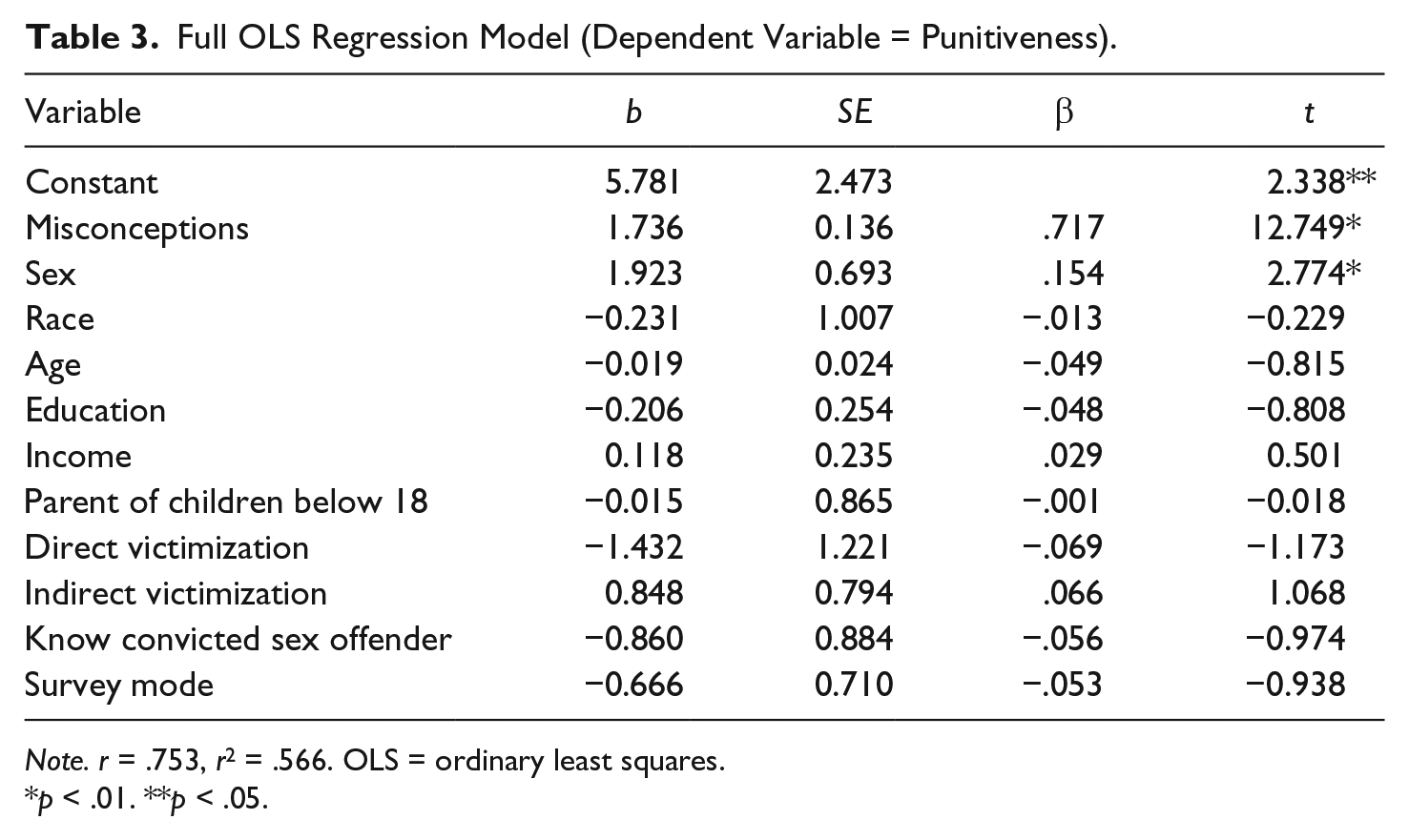
Note. r = .753, r2 = .566. OLS = ordinary least squares.
p < .01. **p < .05.
Given the significance of misconceptions in predicting punitiveness, another OLS regression model was run to examine the impact of each individual misconception on punitiveness (see Table 4). Diagnostics again indicated that the assumptions of OLS regression were met (not shown; output available upon request). The overall model was significant (F = 55.609, p < .01), explained 56.8% of the variance in punitiveness, and each of the misconception items were significant predictors of punitiveness. The belief that almost all sex offenders will commit another sex offense if released from prison had the greatest effect on the model (β = .470, p < .01), followed by the notion that treatment programs for sex offenders are a waste of time and money (β = .285, p < .01), the rate of sexual offenses has increased in recent years (β = .162, p < .01), and teaching children about stranger danger is one of the best ways to protect them from sex offenders (β = .125, p < .05). In addition, this model was a better fit than the full model displayed in Table 3 as it explained almost the exact same amount of variance with fewer parameters. As such, these findings suggest that adherence to misconceptions about sexual offenses significantly increases punitive attitudes toward sex offenders, even more so than the demographic and experiential items identified in other studies.
Misconceptions OLS Regression Model (Dependent Variable = Punitiveness).

Note. r = .754, r2 = .568. OLS = ordinary least squares.
p < .01. **p < .05.
To examine predictors of adherence to misconceptions about sexual offenses, one final OLS model was constructed. Regression diagnostics were satisfactory (not shown; available upon request), and the model is displayed in Table 5. The model was significant (F = 2.432, p < .05) and explained 13.3% of the variance in misconceptions. Education had the greatest impact on the model such that more advanced levels of education resulted in decreased adherence to misconceptions about sexual offenses (β = −.248, p < .01). In this model, the survey mode variable was significant, indicating that mail survey respondents were less accepting of misconceptions than online survey respondents (β = −.183, p < .05). Despite the significance of this variable in the model, additional analyses (not shown; available upon request) revealed that average misconception scale scores between the two groups were not significantly different as the mean for online respondents was 14.69 (SD = 2.541) compared with 13.97 (SD = 2.601) for mail respondents (t = 1.822, p > .05).
Predictors of Misconceptions OLS Model.
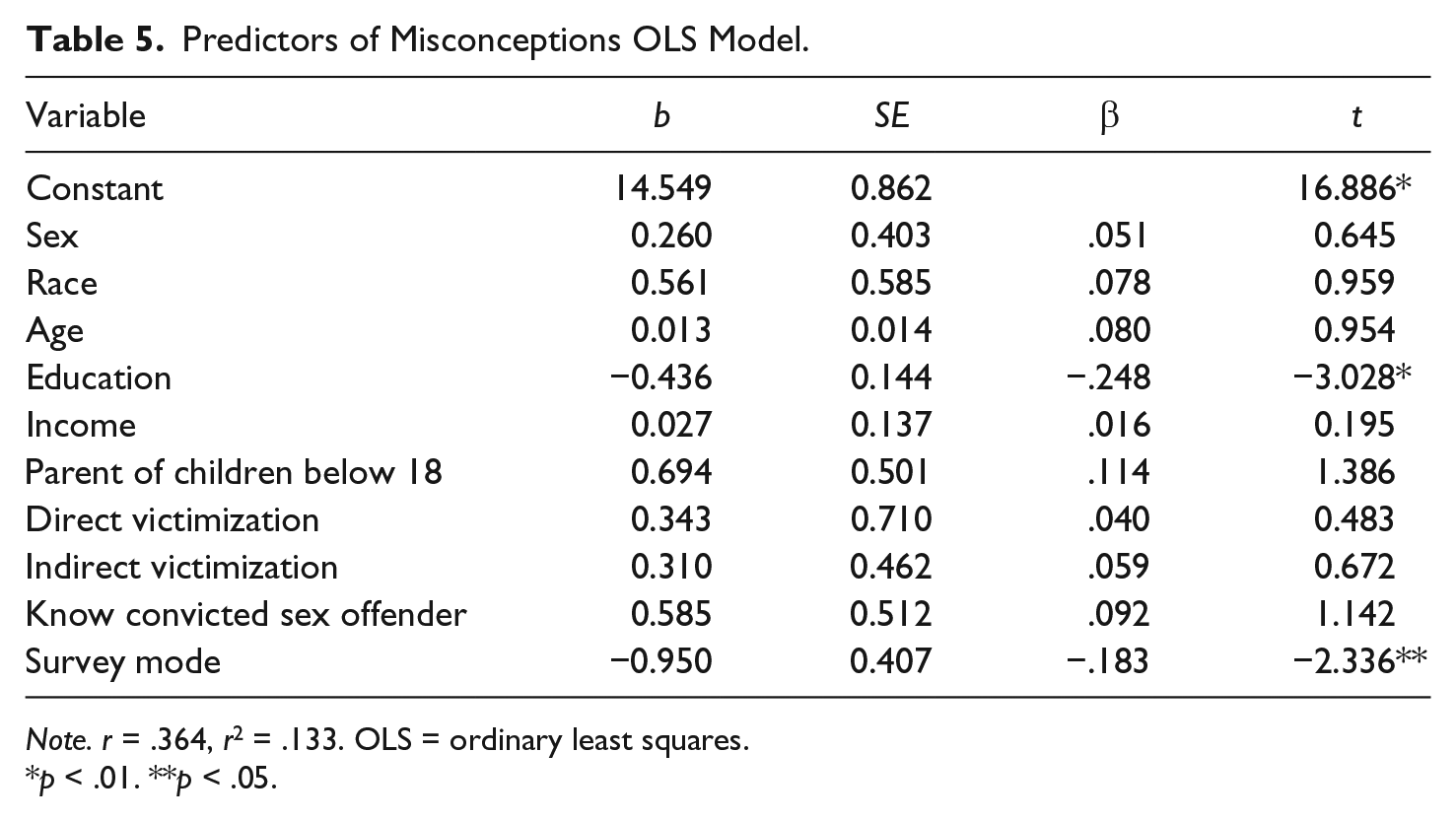
Note. r = .364, r2 = .133. OLS = ordinary least squares.
p < .01. **p < .05.
Discussion
Given the increased media, legislative, and research attention devoted to sexual offenses over the past two decades, and the variable nature of public opinion about crime, this study sought to measure public perceptions about sexual offenses with a focus on misconceptions and punitiveness. Although several studies have identified intense public punitiveness toward sex offenders, few researchers have examined factors that influence those opinions apart from demographic and experiential variables, and further research with public samples is warranted to provide a comprehensive assessment of public sentiment on these issues. Determining whether these perceptions are informed by myths is important for education and prevention, as well as the impact of public opinion on sex offender policy.
As anticipated, support for several misinformed perceptions was identified. Consistent with previous research (e.g., Levenson et al., 2007; Pickett et al., 2013), the majority of respondents agreed that sex crimes rates have increased in recent years though official statistics and victimization data contradict this notion. More importantly, over three quarters of respondents believed that teaching children about “stranger danger” is one of the best ways to protect them from sex offenders. These findings are similar to other studies in that the occurrence of stranger assaults is overestimated (e.g., Craun & Theriot, 2009; Levenson et al., 2007). In contrast, research indicates that 80% to 90% of sexually abused children are molested by a friend or family member, and more than 75% of adult rape/sexual assault victims are assaulted by someone with whom they had a previous relationship (ATSA, 2008; CSOM, 2000). This myth in particular distorts the reality of sexual violence and diverts attention away from where the greatest risk lies: friends, relatives, intimate partners, neighbors, and so on. Also consistent with previous research (e.g., Brown et al., 2008; Fuselier et al., 2002), some misperceptions about sex offender recidivism rates and the utility of sex offender treatment programs were identified, both of which impact fear and punitiveness. It is important to consider that these myths also have the potential to affect released sex offenders in the community in terms of stigmatization and their ability to reintegrate, which could have a direct or indirect impact on recidivism.
The results revealed a relatively high level of punitiveness toward sex offenders, which is consistent with the body of research in this area (e.g., Comartin et al., 2009; Kernsmith et al., 2009; Levenson et al., 2007; Mears et al., 2008; Pickett et al., 2013). In addition to PASO scale scores, which were significantly above the midpoint, individual item frequencies indicated intense punitiveness through support for long or indefinite prison sentences and targeted monitoring in the community. Several of the qualitative responses left in the comments section at the end of the survey indicated a great deal of punitiveness as well. For example, one mail survey respondent stated, “This is where our judicial system is too soft, death penalty all the way,” whereas another suggested, “Perhaps we could put them [sex offenders] on an island.”
In addition to measuring public adherence to misconceptions about sexual offenses and punitiveness toward offenders, it was also found that these two constructs are positively related. More importantly, support for misconceptions was found to be the strongest predictor of punitive attitudes with misinformed opinions about sex offender recidivism having the greatest impact, followed by opinions about sex offender treatment efficacy, rising sex crimes rates, and the utility of teaching children about “stranger danger.” Indeed, support for these misconceptions accounted for almost 57% of the variance in punitiveness. Perhaps the most concerning misconception, which received agreement from more than 80% of the sample, highlighted the importance of teaching children about “stranger danger” as the most effective way to protect them from sex offenders. This belief could lead to incidents of nonstranger sexual assault, particularly of children, evading detection and appropriate response. Although this survey item applied specifically to protecting children, its implications extend to adults as well in terms of understanding the true nature of sexual victimization risk.
The impact of these misconceptions on public punitiveness is an important consideration for policy makers to the extent that public opinion is harnessed as support for punitive sentences and sex offender management policies. While incorporating public opinion in the formation and reformation of policy should be evident in any democracy, allowing that opinion to influence policy when it is based on empirically contradicted information would be inappropriate and irresponsible. Rather, efforts should be made to promote evidence-based policies and practices, and to dispel these commonly held, misinformed beliefs about sexual offenses.
Given the large proportion of respondents who agreed with important misconceptions about sexual offenses, educational and awareness initiatives should be undertaken to target these beliefs. Recall from the model displayed in Table 5 that education level was the strongest predictor of adherence to misconceptions, and these variables were inversely related. This finding, in addition to similar findings in other studies, suggests that education has the potential to temper these misinformed beliefs. If education in general is able to reduce adherence to misconceptions, it is possible that education and awareness efforts targeted specifically at information about sexual offenses would have an even greater impact.
Although some studies have cast doubt on the ability of brief educational materials to affect attitudes about sexual offenses (Willis et al., 2010), a recent study suggests that dissemination of factual material in educational settings does have the potential to change attitudes and misperceptions about sexual offending. Kleban and Jeglic (2012) used an experimental design to examine the effect of a psychoeducational model (i.e., a one-page document of factual information about sexual offenses) on undergraduate students’ attitudes about sex offenders. The findings indicated that education had a significant effect on attitudes toward sex offender treatment and that this finding was most pronounced when the educational component was delivered in a group discussion format. While this study was conducted with a university population, a similar educational program could be used for other student populations. For example, secondary schools could include information on these topics in their health/sex education curriculum. Adding factual information about sexual offending and victimization in these courses would be a relatively low-cost intervention, and it would dovetail nicely with education on consent and healthy relationships.
It may be advantageous to enlist the media’s help as well because public opinion about crime is often based on information reported by the media, and this would help to reach nonstudent populations. In 2014, Malinen and colleagues used an experimental design to examine the effect of various media reports on university students’ attitudes toward sex offenders. The findings revealed that participants who received the informative media portrayal, which contained factual information about sexual offending, had significantly more positive attitudes toward sex offenders than the control group. Thus, it is possible that the dissemination of empirical research, transformed by researchers to a more publicly digestible format, could make headway in dispelling the misconceptions that persist.
While the findings of this study have a number of potential implications, there are some limitations that are important to consider. First, the low response rate for the mail survey and the sample selection strategy for the online survey suggest the possibility of sampling bias and nonresponse error. However, comparisons of the sample with the population revealed many demographic similarities and, as noted earlier, a low response rate is not necessarily a reliable predictor of nonresponse error. Nevertheless, caution should be taken in generalizing these findings. In a similar vein, this study was conducted only among Pennsylvania residents. It is possible that residents from other areas and backgrounds would have different perceptions. In addition, this study assessed broad opinions about sexual offenses. It could be that opinions vary based on offense characteristics such as offender sex, victim age, and victim–offender relationship.
Future research should continue to examine misconceptions about sexual offenses and punitiveness toward offenders among diverse samples such as the general public, criminal justice system personnel, and legislators. Researchers should also evaluate the efficacy of educational and awareness efforts to reduce these potentially harmful, misinformed beliefs. Agencies such as the Office on Violence Against Women which manages grant funding under the Violence Against Women Act (Department of Justice, 2016), State Departments of Health and Welfare, or the CSOM might consider offering small funding opportunities to aid in the development and evaluation of interventions aimed at reducing these misconceptions. Such efforts could make significant strides toward promoting evidence-based sex crimes policies and educating the public on how to best protect themselves and their loved ones from sexual victimization.
Footnotes
Acknowledgements
The author would like to thank the reviewers for taking the time to review this work, as well as providing the valuable feedback that has greatly improved this manuscript.
Declaration of Conflicting Interests
The author(s) declared no potential conflicts of interest with respect to the research, authorship, and/or publication of this article.
Funding
The author(s) disclosed receipt of the following financial support for the research, authorship, and/or publication of this article: This research was partially funded by a small institutional research grant (US$1,000) I received from my graduate institution - Indiana University of Pennsylvania Graduate Research Grant.