



Abstract
This study explores the instrumental function of hot spot policing. Although prior research has examined deterrent effects in crime hot spots, less is known about its citywide effects and varying effects across different types of crime and disorder. Also, there still exist gaps in the literature about what strategies are most likely to deter crime and disorder. Using data on crime and law enforcement in Buffalo, this study uses interrupted time-series models to determine whether symbolic Special Weapons and Tactics (SWAT) raids have any citywide impacts on drug arrests, calls for service, and different types of crimes. There is no evidence of a deterrent effect on drug arrests and calls for service. However, the SWAT intervention resulted in significant decreases in street crimes involving property (robberies and larcenies). Its crime control effects are mostly abrupt and temporary, but there are lingering effects of the intervention. Finally, implications of the results are discussed.
Introduction
This study examines the instrumental function of a police agency’s use of Special Weapons and Tactics (SWAT) teams to crackdown on high-crime locations to reduce crime and disorder. Aggressive law enforcement is often expected by the public as a crime control tactic (Chermak, McGarrell, & Weiss, 2001; Shaw, 1995), and using SWAT for crime control is arguably the highest level of aggressive law enforcement. However, it may be just a ceremonial and symbolic action demonstrating that the police are actively engaged in dealing with crime, even if there is no actual crime reduction.
In the business world, a company is expected to provide a product or service in an effective and efficient manner; those that fail in this endeavor will not succeed in the marketplace and will eventually close their doors (Crank, 2003). Public sector agencies, such as the police, do not function in the same context as businesses (Crank & Langworthy, 1992). Although being labeled “institutionalized organizations,” they should insure organizational survival by fulfilling the public’s values and expectations rather than simply pursuing effective and efficient product or service delivery (Meyer & Rowan, 1977). If these agencies succeed in living up to the values and expectations of their external environments and setting up “correct” organizational structures and processes (Scott & Meyer, 1983, p. 149), they are considered legitimate and rewarded with continued public support.
An important consideration in understanding institutionalized organizations is that the social reality of their external environments is often based on the myth of what is expected (Meyer & Rowan, 1977). Essentially, the public has an opinion or view of social reality concerning product or service delivery that institutionalized organizations must satisfy. Using ceremonial and symbolic actions, they formally demonstrate how they conform to and fulfill the public’s myths without overt or ongoing pursuit of that behavior. As a result, institutionalized organizations behave ceremonially; their activity dramatically reflects what is expected and helps maintain organizational legitimacy and survival regardless of its instrumental utility.
Police departments should be viewed as institutional organizations and understood in highly institutionalized contexts (Crank & Langworthy, 1992). The public has certain expectations of policing capabilities that are often based on mythical social realities. For example, law enforcement has been viewed as the foremost, prevalent, and effective mission of policing for crime control. That is, the crime fighter is our primary image of policing. Although law enforcement was historically important and has received more media and public attention than other policing missions, it constitutes a relatively small proportion of police work. Only 10% to 20% of calls to the police require a law enforcement response, and the remaining segment of calls to the police are related to order maintenance and public service (Kappeler & Potter, 2005). Second, this crime fighter image created the public’s misconception that aggressive and confrontational policing such as police militarization is the most effective way to address crime problems. SWAT teams become ever more popularized and spread across the United States. They have been criticized, mostly due to their inability to reduce crime and the increased threat to civil liberties from the excessive use of force. Police departments must fulfill those myths if they are expected to remain legitimate and receive continued support. They often use ceremony and symbols to demonstrate the expected myths and their conformity to them, which improves prospects for their organizational survival (Crank, 2003; Crank & Langworthy, 1992; Manning, 1977).
Scholars have made the distinction between the symbolic and instrumental dimensions of law and policy (for general discussions, Freiberg, 2001; Howard, 1999; Oliver & Marion, 2008; for prohibition and temperance legislation, Gusfield, 1967; for hate crime legislation, Grattet & Jenness, 2008; for sex offender legislation, Sample, Evans, & Anderson, 2011). Crime control laws and policies were often passed in response to moral panics about increasing crime problems and appeased public concern by demonstrating that something dramatic had been done to address the problems. Despite these alleged symbolic functions, they have been criticized, mostly due to their ineffectiveness in addressing the underlying problems (Gusfield, 1967; Oliver & Marion, 2008). Scholars have empirically examined whether these symbolic laws and policies have any discernable instrumental effect. The findings of prior research failed to find instrumental effects of sex offender legislation (Anderson & Sample, 2008; Sample et al., 2011). However, Grattet and Jenness (2008) found that hate crime laws can be rendered instrumental if agencies are more integrated in and accountable to local communities at the phase of the law enforcement process. Their effects are mostly contingent upon agency and community processes.
This study examines the impact of using SWAT for drug raids in locations that are characterized as “high crime.” At one level, using SWAT is a symbolic indicator of the expected myths of policing, such as engaging in the “drug war” as well as the assumed danger of policing (Manning, 2001). At another level, using SWAT has an instrumental component. For example, the mayor of Buffalo declared that using SWAT would “ratchet up the pressure on the criminal element.” 1 The police chief in Buffalo added that these raids will “send a message that our crackdown from quality of life issues to violent crime issues is in full force . . . Crime in the city continues to fall because of our commitment to get[ting] criminals off the street.” The chief further stated that “A lot of intelligence was gained, including information on recent homicides and the shooting.” It was expected that SWAT raids would help solve crime and disorder problems in Buffalo.
Despite the alleged instrumental function of SWAT, scholars have not yet evaluated its citywide deterrent effect on crime and disorder. Due to the ceremonial and symbolic nature of SWAT raids, they usually receive intense media coverage and public attention and can exert widespread effects beyond the targeted locations. An assessment of the citywide instrumental value of using SWAT for crackdowns is clearly warranted. Finally, after the events in Ferguson, Missouri, in the late summer of 2014, police agencies should have an understanding of the value of SWAT as a crime control tactic. If success can be demonstrated, police agencies could have a rational argument for their continued use in reducing crime and disorder. This study begins with a review of the literature on institutional theory, application of institutional theory to the police, and the available research on hot spot policing.
Literature Review
Institutional Theory and the Police
Formal organizations are commonly associated with a structure that values controlled and rational behavior as a means of gaining success in the market (Meyer & Rowan, 1977). Effectiveness and efficiency are vital to the promotion of their organizational legitimacy and survival. However, many organizations in post-industrial society should be understood in “highly institutionalized contexts” (Meyer & Rowan, 1977, p. 340). Independent of the effectiveness and efficiency of work performances, they should reflect the myths of their external environments. Specifically, organizations have an external environment that entails a view of social reality concerning their products and services. The values and expectations associated with that social reality are institutionalized in society and used to construct myths about what is expected. These organizations should show that they act on the expected myths of the external environment in a proper and adequate fashion. However, conformity to the myths does not necessarily help fulfill the demands of work efficiency and reach their instrumental goals when they provide institutionalized products or services.
The myths regarding social reality are so valued by the external environment that they take on a rule-like quality for an organization. The rationale behind an organization’s commitment to institutionalized myths and rules is that organizational legitimacy is earned, increased, or reestablished (Meyer & Rowan, 1977; Scott & Meyer, 1983). When an institutionalized organization has legitimacy, it can obtain the resources and support needed for organizational survival. Furthermore, an organization uses ceremony and symbols in a formal and theatrical manner to demonstrate its association with institutionalized myths and rules, resulting in the improvement of legitimacy and survival prospects (see also DiMaggio & Powell, 1983). The demonstration is not necessarily done with constant pomp or showiness, nor is there a need for overt or ongoing pursuit of that behavior. If an organization abandons the essential ceremony and symbols having “ritual significance” (Meyer & Rowan, 1977, p. 355), the organization may sacrifice legitimacy, and prospects for organizational survival may decrease.
Crank and Langworthy (1992) argued that policing structures and policies reflect their external environment (i.e., the public’s values and expectations) amounting to organizational myths. Police agencies actively rebuild existing myths to maintain or regain legitimacy. Working with myths provide a “dramaturgy of exchange,” allowing the police to ceremonially demonstrate their worth (Crank, 2003). Policing is naturally dramatic because of the excitement and danger associated with the work (Manning, 2001). Although the level of excitement and danger is, in reality, quite low in policing (Famega, 2005; Frank, Brandl, & Watkins, 1997), police agencies maintain the myths of “crime fighting” with the continued use of random patrols and a rapid response to calls for service (CFSs; Crank & Langworthy, 1992).
Several authors have explored specific police agency policies and their links to dramatic myths. Katz (2001) reported that the police department in a large Midwest city created a gang-unit as “a symbolic act to the community, potential offenders, and police officers that the police department is taking a specific problem seriously” (p. 38), despite the fact that the city had no gang problem. Giblin (2006) stated that police agencies developed crime analysis units to gain organizational legitimacy rather than improve an agency’s crime fighting ability. Others have found that many small police departments accessed federal grant funding “to demonstrate, via ceremonial myth-building, a community policing philosophy” (Phillips & Gayadeen, 2014, p. 57).
In sum, law enforcement policies and practices are often symbolic exercises because they re-affirm the ideological commitment of police agencies to law and social order. In addition, their effects can be instrumental or tangible when these policies result in changes in the behavior of people or address crime and justice problems. Thus, they can have a symbolic effect, an instrumental effect, or both. The purpose of the current study is to empirically examine whether SWAT raids as a special ceremonial and symbolic police operation have any discernable instrumental effect on crime and disorder.
Hot Spot Policing
There is a large body of scholarship examining the “criminology of place” (Sherman, Gartin, & Buerger, 1989). Sherman and his colleagues examined CFSs in Minneapolis, finding that a small number of locations received the greatest number of CFSs. They used the term “hot spot” to describe these areas. Hot spot areas are fairly consistent over time (Weisburd, Bushway, Lum, & Yang, 2004). Thus, once a hot spot is identified, the police can focus their attention on those locations to reduce a city’s overall crime rate (Weisburd & Telep, 2010).
Various scholars have defined hot spot locations based on the level of violent crimes (i.e., homicides, aggravated assault, and robbery; Braga, Hureau, & Papachristos, 2011; Braga et al., 1999; Ratcliffe, Taniguchi, Groff, & Wood, 2011), assaults with deadly weapons (Braga, Hureau, & Winship, 2008; Rosenfeld, Deckard, & Blackburn, 2014), or general property crime or violent crime levels (Andresen & Malleson, 2011; Jang, Lee, & Hoover, 2012; Taylor, Koper, & Woods, 2010). Others selected hot spots based on the number of drug crimes (Lawton, Taylor, & Luongo, 2005; Sherman & Rogan, 1995). More recently, crime-related CFSs and crime incidents (Telep, Mitchell, & Weisburd, 2014) or Part I “serious” and Part II “less serious” crime incidents (Kochel, Burruss, & Weisburd, 2016) were used to identify hot spots. 2
A variety of strategies has been used to address the problems in hot spots. Some agencies required mere police presence at the location (Koper, 1995; Sherman & Weisburd, 1995). Other research used “directed patrols,” where officers would patrol slowly in hot spot areas, avoiding self-initiated activity (Rosenfeld et al., 2014), or patrol a targeted location for 11 to 15 min per hour (Kochel et al., 2016). Some studies quantified the number of pedestrian and vehicle stops, citations issued, as well as location arrests (Jang et al., 2012). Ratcliffe et al. (2011) reported that officers in Philadelphia used foot and vehicle patrols, and stopped suspicious persons. Some police agencies used problem-oriented interventions (Groff et al., 2015), including code enforcement and reclaiming abandoned buildings and vacant lots (Braga et al., 1999). Other hot spot interventions applied crackdowns in the form of increased police patrols in an area (Hinkle & Weisburd, 2008; Smith, 2001; Weisburd & Green, 1995).
When hot spot locations had an overlap of drug and crime problems, the policing interventions were characterized as “raids” (Bynum & Worden, n.d.; Cohen, Gorr, & Singh, 2003; Sherman & Rogan, 1995). Cohen and his colleagues (2003) and Sherman and Rogan (1995) reported that police raids were successful at reducing crime, but their effect diminished within a short period. Bynum and Worden (n.d.) stated that drug raids had no impact on predatory crime, and there was no statistically significant change in calls to a drug tip hotline.
Although the literature has consistently found a slight deterrent effect of hot spots policing in randomized experiments, it is still an open question about the most effective policing tactics at those micro places (Groff et al., 2015; Weisburd & Telep, 2014). In a recent meta-analysis, Braga, Papachristos, and Hureau (2012) found that problem-oriented policing strategies tended to have more evidence than traditional policing approaches, such as increased patrols or crackdowns. It should be noted that the relative success of hot spot policing is one of the motivations for Durlauf and Nagin’s (2011) call to shift resources from imprisonment to the police, but Tonry (2011) warns of the increased threat to civil liberties from increased policing.
SWAT Teams as a Hot Spot Policing Intervention
This study uses SWAT raids as a hot spot intervention and explores their instrumental effects. SWAT teams are a unit in police forces that include the use of military tactics and equipment (e.g., assault rifles, advanced night vision optics, body armor, and armored vehicles). The militarization of policing became popular in the late 1970s. In the war on drugs, the police could use military weapons and tactics to combat the threats of illegal drug trades. The amendment of the 1878 Posse Comitatus Act authorized the “transfer of military training and weaponry to federal, state, and local police agencies” (Hill & Beger, 2009, p. 29). Furthermore, Nunn (2002) reported that a 1994 Memorandum of Understanding between the Defense Department and the Justice Department allowed police agencies access to military items and technology commonly used only in war.
SWAT teams were originally created to deal with situations of unusual danger such as hostages, armed suspects, and terrorist attacks. Later in the 1980s and 1990s, the use of SWAT has expanded in routine law enforcement operations. SWAT raids, which are usually abrupt in onset and short in duration, are different from other hot spot interventions of relatively longer duration, including foot patrols (Ratcliffe et al., 2011), offender-focused strategies (Groff et al., 2015), and problem-oriented policing interventions (Braga & Bond, 2008; Braga et al., 1999). Wyrick (2013) found that police militarization (i.e., SWAT teams) increased public confidence in the police, especially when a citizen had little fear of and a positive attitude toward the police. In the literature, however, less is known about its instrumental effects.
The present study examines whether SWAT raids have any instrumental effects on crime and disorder. This study is justified for several reasons. First, the literature has found that some hot spot policing strategies were successful at reducing crime and disorder. However, the mode with which the police carry out a particular hot spot policing strategy can have implications for the effectiveness of the strategy. This study uses the example of SWAT raids to explore any instrumental effects of hot spot policing. Second, while the success of hot spot policing in general is uncontroversial, their effects diminished in a short period of time and were geographically restricted to local areas (i.e., targeted and immediately surrounding locations). It is thus uncertain whether SWAT raids affect citywide crime and disorder beyond the targeted and surrounding areas and how long the initial instrumental effects remain at the city level. Third, the effects of hot spot policing may vary across different types of crime and disorder. This study includes a broad range of crime and disorder (i.e., drug arrests, CFSs, various types of crimes) to determine whether there is any variation among them. Certain types of crimes and disorders may be more amenable to SWAT raids. Finally, police science has determined that hot spot policing is effective, but it is still important to accumulate further evidence for the effectiveness of different hot spot policing tactics using a variety of data sources and research designs. This study will fill a gap in the literature by examining the citywide efficacy of highly visible and publicized SWAT raids.
Current Research
The site of the study is Buffalo, a mid-sized city with a population of approximately more than 250,000 residents. Buffalo is located in a metropolitan statistical area of more than 1 million people in western New York, near Lake Erie, and is considered a rust belt city due to the decline of its manufacturing sector, population loss, and urban decay. Roughly 50% of the city’s population is White, 38% is African American, and 10% is Hispanic. The median age of the city population is 34. The Buffalo Police Department (BPD) has more than 750 sworn officers. Two thirds of the officers are White, 24% are African American, and 8.3% are listed as “Other.” Seventy-seven percent of the officers are male. The department has several specialized divisions for homicides, sex crimes, narcotics, and accident investigations. Also, the department has adopted a variety of crime investigation and prevention methods such as a Safe Cam program, a gun buyback program, and a SWAT program. In 2011, its total crime rate was 6,688 per 100,000 residents. Specifically, the violent crime rate was 1,238, and the property crime rate was 5,449. Both rates were much higher than the national average for violent crimes (386) and property crimes (2,909).
Under “Operation Street Sweeper” (OSS), the BPD used SWAT teams as part of a crackdown to execute arrest warrants and raid homes on June 6 and 7, 2012. On its website, the BPD indicates this SWAT intervention intended to address crime and quality of life problems. SWAT teams used no-knock drug raids to target specific locations or homes involved in drug sales. There were a total of 39 drug raids in the areas where violence and drug activities were prevalent (see Note 1).
There were 76 arrests and the raids netted 16 guns, 6.5 oz. of crack, 20 g of heroin, and 61 oz. of marijuana. Some additional pills and drug paraphernalia were also collected. The targeted approach of OSS lasted only 2 days, and there were no increased patrols or other follow-up policing activities in the targeted locations. Figure 1 provides a map of all 39 raid locations.

Thirty-nine raid locations in Buffalo, New York.
This study examines the deterrent effect of SWAT raids when they are briefly applied to targeted locations known for high levels of violence, drugs, and gang activities. It is hypothesized that SWAT raids have a deterrent effect on crime and disorder, conveying to offenders an increasing threat of apprehension. Although the use of SWAT teams at crime hot spots should reduce crime at the targeted locations, it is plausible that there are more widespread crime reduction effects. There are two reasons. First, crime and disorder are not randomly distributed and instead geographically concentrated in particular areas with high rates of social disorganization (Brantingham & Brantingham, 1981; Weisburd et al., 2004; Weisburd, Maher, & Sherman, 1992). Second, the use of SWAT raids usually sparks intensive media coverage and captures public attention; their effects can spread out quickly across the entire city. Offenders beyond the targeted locations may have increased perceptions of arrest risk due to increased media attention. Thus, it is likely that there will be citywide effects on reducing crime and disorder if highly visible and publicized raids are used at high crime places. If this is the case, any analysis at the micro level may underestimate the deterrent effect of the raids, especially if control units are drawn from nearby areas. 3 Given that the penultimate goal of any particular policing tactic is to reduce crime and disorder citywide, researchers should conduct an analysis of whether an intervention has a citywide deterrent effect. This is a legitimate and imperative policy and scholarly question.
In the United States, SWAT teams are currently seen as “the most expedient route to solving social problems” (Kraska & Kappeler, 1997, p. 12). There is, however, little evidence exploring the effectiveness of SWAT teams as a successful crime reduction tactic (Weisburd & Eck, 2004). 4 The current study uses interrupted time-series analyses to test the hypothesis that if SWAT teams are used for short-term crackdowns in specific crime-ridden areas, there will be a citywide reduction in crime and disorder.
Data and Method
Data
Citywide drug arrests, CFSs, and crime information for the BPD was provided by the Erie County Crime Analysis Center, a centralized repository for crime data from Erie County law enforcement agencies. This study covers the period from October 2011 to January 2013. Because the temporal unit of analysis is the weekly count of events, each variable is presented as the number of incidents per week. The time frame for the study includes 35 weeks prior to June 6 and 7, and 35 weeks after the raids occurred, resulting in a total 70 observations.
Dependent and Independent Variables
To gain a fuller understanding of the possible deterrent effect of SWAT teams, this study examines three dependent variables: drug arrests, CFSs, and Part I crimes. First, drug arrests are used as a measure of deterrence specific to drug activities. The BPD identified the target locations that recently experienced increases in violence, drugs, and gang activities. The targeted locations may have been selected based on the assumed nexus between crime, guns and drugs (Blumstein, 1995). More serious types of offenses targeted by the SWAT tactic, such as gun possession, do not occur with enough frequency to study a deterrent effect of SWAT teams. Thus, it is assumed that low-level drug users would be those most likely deterred from additional offenses, even for a short period of time. For example, low-level drug users likely violate the law fairly routinely, and they may view the possession of drugs as too risky in light of the SWAT raids.
Second, CFSs and Part I crimes provide the additional outcome measures (see, Sherman & Rogan, 1995; Sherman & Weisburd, 1995). It is assumed that the show of force displayed by the SWAT raids reduces crime and disorder that often result in calls to the police. CFSs data include any requests for police service made by citizens. Based on the Uniform Crime Reporting (UCR) program, Part I crimes refer to serious criminal incidents (i.e., for violent crimes, assault, and rape, robbery; for property crimes, burglary, larceny, and motor vehicle theft). Homicide and arson are not included in the current study because they did not happen with sufficient frequency to allow for accurate and reliable statistical assessments. Using more specific types of crimes, this study also conducts additional analyses to examine whether there exists any variation in the effects of the intervention across the crime types.
The independent variable in this study is the intervention of SWAT teams, which is defined as a dummy variable that indicates the absence of the state prior to the intervention (coded as 0) and the presence of the state during and after the intervention (coded as 1). In addition, a dummy variable is included to control for seasonality, as crime rates are related to variation in the weather and associated changes in social life (Baron & Ransberger, 1978; Cohn, 1990; Cohn & Rotton, 2000; Field, 1992; Lawton et al., 2005; Rotton & Cohn, 2000). This seasonal variable is coded as one (1) for both fourth and first quarters of the year and zero (0) otherwise. Buffalo is located on the Great Lakes, a Northern location that experiences long winter periods of heavy snows and low temperatures, which have significantly interfered with socio-economic activities. Crime and disorder fall when there are fewer production and consumption activities during the winter months (October-March), which in turn produce fewer crime targets and instead more guardianship.
Descriptive Statistics
Figure 2 shows a graphic illustration of the changes in the levels of drug arrests, CFSs, and crimes in Buffalo from October 2011 to January 2013. The vertical line represents the intervention week.

Buffalo weekly drug arrests, CFS, Part I crimes, violent crimes, and property crimes: Citywide.
First, there was a sharp drop in drug arrests immediately after the intervention. Subsequently, there were overall declining trends although they fluctuated substantially over time. It should be noted that there were sudden spikes in the levels of drug arrests following the intervention in June, July, and September 2012. The reason for these spikes is unclear as there were no follow-up drug raids or other enhanced police activity targeting drugs.
Second, there were general upward trends in CFSs following the intervention. This increase, however, began before the intervention and would likely have continued even without the intervention. Several weeks later, the increasing trends in CFSs were reversed. They began to drop significantly and continued to decline.
Third, there were small drops in the levels of violent crimes immediately after the intervention. Several weeks later, however, violent crimes surged dramatically and reached their highest peak in August 2012. Afterward, violent crimes bounced up and down with declining patterns in general.
Fourth, there were sharp spikes in property crimes. These increases began immediately after the intervention and continued to increase for almost 2 months despite small fluctuations. Property crimes reached their highest peak in July 2012. Afterward, there were substantial declining trends. Finally, Table 1 presents the pre- and post-intervention mean differences. Contrary to expectations, the post-intervention mean is higher than the pre-intervention mean for most of the dependent variables.
Pre- and Post-Intervention Means of Drug Arrests, Calls for Service, Part I Crimes, Violent Crimes, and Property Crimes: Citywide.

Note. Pre-intervention period: October 3, 2011 to May 28, 2012 (35 weeks); Post-intervention period: July 4, 2012 to January 28, 2013 (35 weeks).
Statistical Methods
This study used interrupted time-series analyses to examine whether SWAT teams reduce drug arrests, CFSs, and crimes while controlling for secular trends in the data. There is a two-step procedure: determining an Autoregressive Integrated Moving Average (ARIMA) model and building a full impact assessment model.
First, this study formally tested for unit roots in the time series using the Dickey–Fuller Generalized Least Squares (DF-GLS), Elliott–Rothenberg-Stock Point-Optimal (ERSPO), and Phillips–Perron (PP) tests. As seen in Table 2, drug arrests, Part I crimes, violent crimes, assault, rape, robbery, property crimes, larceny, and motor vehicle theft are stationary. On the contrary, CFSs and burglary have a unit root and are thus differenced.
Results for Unit Root Tests of the Time Series, October 3, 2011 to January 28, 2012 (70 Weeks).

Note. Figures for DF-GLS, ERSPO, and PP tests represent a test statistic in a regression model. ARIMA = Autoregressive Integrated Moving Average; DF-GLS = Dickey–Fuller Generalized Least Squares; ERSPO = Elliott–Rothenberg-Stock Point-Optimal; PP = Phillips–Perron; CFSs = calls for service.
Significant at α = .10. *Significant at α = .05. **Significant at α = .01.
Using both the Autocorrelation Function (ACF) and the Partial Autocorrelation Function (PACF), this study determined whether each time series is autoregressive or moving average and then the order of the process. The patterns of serial correlation in the ACF and PACF suggested the following ARIMA models: ARIMA (1, 0, 1) for drug arrests, ARIMA (0, 1, 1) for CFSs, ARIMA (2, 0, 0) for Part I crimes, ARIMA (1, 0, 1) for violent crimes, ARIMA (1, 0, 1) for assault, ARIMA (0, 0, 0) for rape, ARIMA (1, 0, 0) for robbery, ARIMA (1, 0, 1) for property crimes, ARIMA (0, 1, 1) for burglary, ARIMA (1, 0, 0) for larceny, and ARIMA (0, 0, 0) for motor vehicle theft. Finally, this study checked on the model adequacy of ARIMA models using the Breusch–Godfrey Serial Correlation Lagrange Multiplier (B-G LM) and Ljung–Box Q tests. Both diagnostic checks of the residuals indicate no autocorrelation, so all the models are adequate.
Second, this study developed impact assessment models by adding an intervention component to the ARIMA model. There are three typical impact patterns differing in terms of onset and duration: an abrupt-temporary change, a gradual-permanent change, and an abrupt-permanent change (for more detailed discussion, see McCleary, Hay, Meidinger, & McDowall, 1980; McDowall, McCleary, Meidinger, & Hay, 1980; for practical application, see Phillips, Kim, & Sobol, 2013). There are three factors to consider when choosing among the alternative impact models: theoretical appropriateness, empirical evidence, and parsimonious consideration.
From the theoretical perspective, the SWAT intervention may have abrupt-temporary decreasing impact on drug arrests, CFSs, and crimes when the intervention gains publicity in earnest, right after the intervention. The impact may last for only a few weeks because it is implausible to expect that several drug raids on a single day permanently eliminate all offenses and associated CFSs on the streets.
From the empirical perspective, Figure 2 lends more support to the abrupt-temporary impact hypothesis for the analyses of drug arrests and violent crimes. The time series for drug arrests and violent crimes in general decreased immediately after the intervention, but returned to its pre-intervention levels a few weeks later. The intervention might be effective only for a short period of time. On the contrary, for the analyses of CFSs and property crimes, the gradual-permanent impact hypothesis might be more plausible in consideration of the general declining trends after the intervention (see Figure 2). There were no immediate effects, but its effects were more gradual. It might take several weeks until the intervention gained publicity and awareness and finally exerted its full effects. Specifically, offenders learned about the drug raids, thus they were less involved in drug offenses, and drug arrests and associated CFSs declined gradually.
For parsimonious modeling, the abrupt-permanent model has an advantage over the other models. It has the fewer parameters and the greater number of degrees of freedom among all the models (McDowall et al., 1980). Finally, given that no one impact model dominates other models in all criteria, this study tests all the impact models. It not only begins with testing the abrupt-temporary intervention hypothesis but also considers other rival impact hypotheses for comparison. These exhaustive model estimations will help us be confident about the effectiveness of SWAT raids on drug arrests, CFSs, and crimes.
Findings
Analysis of Drug Arrests, CFSs, and Part I Crimes
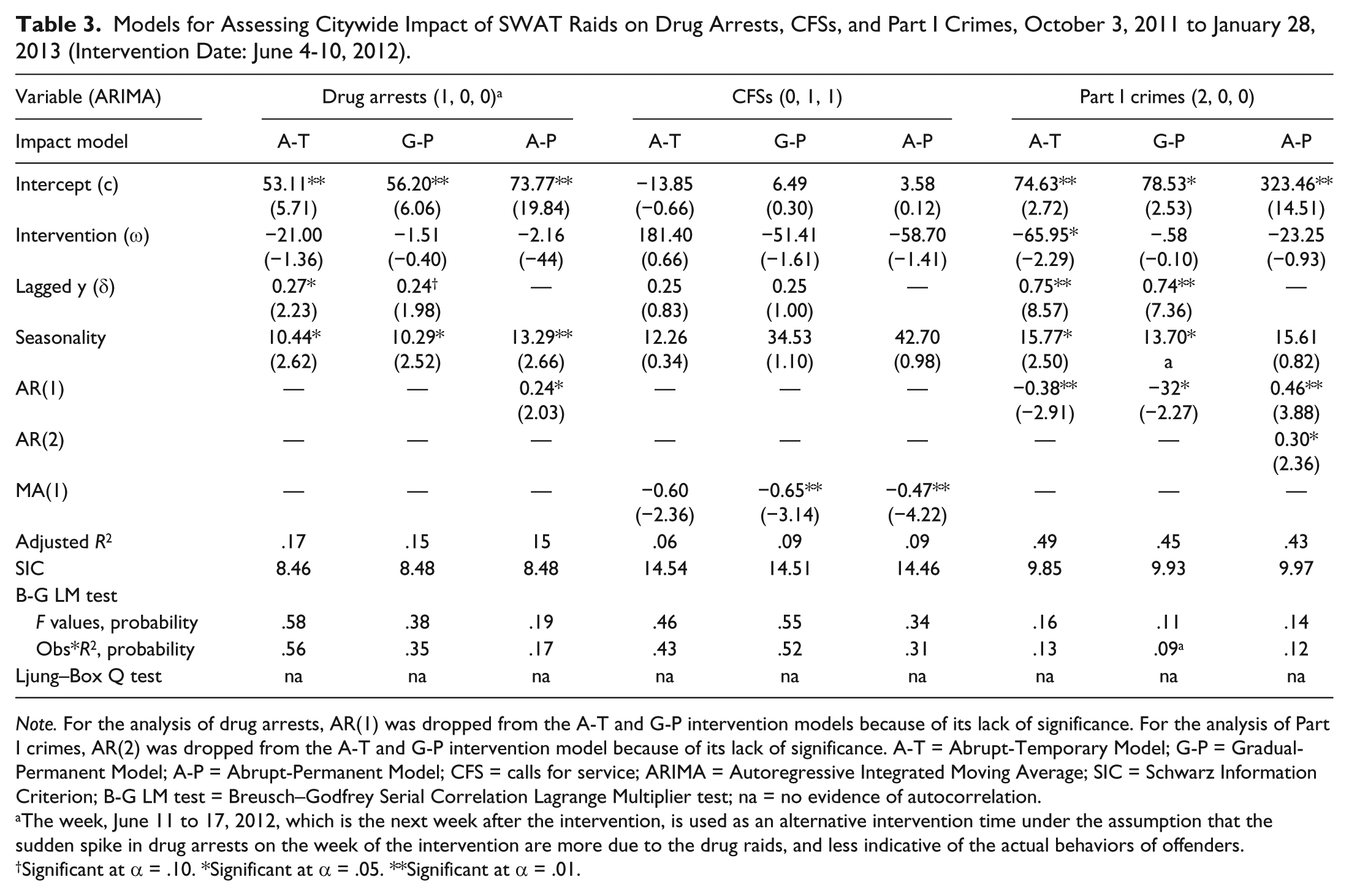
Table 3 presents the results for testing for all impact models of SWAT teams on drug arrests, CFSs, and Part I crimes. Diagnostic checks of the residuals for all the models indicate no serial correlation, so all the models are acceptable. ARIMA components are statistically significant at the conventional level (p < .05 or .01). Their estimates are less than unity in absolute; thus, they are constrained to the bounds of stationarity/invertibility. According to both Schwarz Information Criterion (SIC) and adjusted R2 values, the abrupt-temporary model has a better fit than the gradual-permanent and abrupt-permanent models for both analyses of drug arrests and Part I crimes. For the analyses of CFSs, however, the abrupt-permanent estimate is preferable to other impact models.
Models for Assessing Citywide Impact of SWAT Raids on Drug Arrests, CFSs, and Part I Crimes, October 3, 2011 to January 28, 2013 (Intervention Date: June 4-10, 2012).
Note. For the analysis of drug arrests, AR(1) was dropped from the A-T and G-P intervention models because of its lack of significance. For the analysis of Part I crimes, AR(2) was dropped from the A-T and G-P intervention model because of its lack of significance. A-T = Abrupt-Temporary Model; G-P = Gradual-Permanent Model; A-P = Abrupt-Permanent Model; CFS = calls for service; ARIMA = Autoregressive Integrated Moving Average; SIC = Schwarz Information Criterion; B-G LM test = Breusch–Godfrey Serial Correlation Lagrange Multiplier test; na = no evidence of autocorrelation.
The week, June 11 to 17, 2012, which is the next week after the intervention, is used as an alternative intervention time under the assumption that the sudden spike in drug arrests on the week of the intervention are more due to the drug raids, and less indicative of the actual behaviors of offenders.
Significant at α = .10. *Significant at α = .05. **Significant at α = .01.
Drug arrests
For all the impact models of drug arrests, the estimates of the SWAT intervention are negative, but the intervention failed to result in significant decreases in drug arrests. The seasonal control variable is significant at conventional levels of significance for all the impact models. On average, there were 8.40 to 12.56 more drug arrests in the second and third quarters (April-September) of the year than in the fourth and first quarters of the year. It should be noted that the week, June 11 to 17, 2012, which is the next week after the intervention, is used as an alternative intervention time under the assumption that the sudden spike in drug arrests on the week of the intervention may be more due to the drug raids, and less indicative of the actual behaviors of offenders (see Figure 2).
Using the original intervention week (June 4-10, 2012), additional analyses were also conducted to statistically test whether the SWAT intervention resulted in significant increases in drug arrests. The estimate of the intervention was significant under the abrupt-temporary hypothesis, which indicates that the SWAT teams identified and arrested a considerable number of drug offenders during the intervention period.
CFSs
For all the impact models, the estimates of the SWAT intervention were not significant and also differ from negative to positive in direction. The seasonality variable was also insignificant. Given the values of the SIC and adjusted R2, the models of SWAT raids on CFSs did not fit the data well.
Part I crimes
When an abrupt-temporary model was used, the SWAT intervention had a statistically significant impact on Part I crimes. There was an immediate decrease of 65.95 Part I crimes in the week following the intervention. Even though the SWAT intervention was short-lived, its impact lasted many weeks due to the autoregressive nature of the dependent variable (yt). According to McDowall and his colleagues (1980), the long-term effect of the intervention can be calculated by ω/(1 − δ). The total number of Part I crimes decreased by 263.80 as a result of the intervention [−65.95 / (1 − .75) = −263.80]. Since the gradual parameter (δ) is relatively large, the effects of SWAT teams decayed slowly during the post-intervention period. In addition, the seasonality variable was consistently significant for all the impact models.
Analysis of Specific Types of Crimes
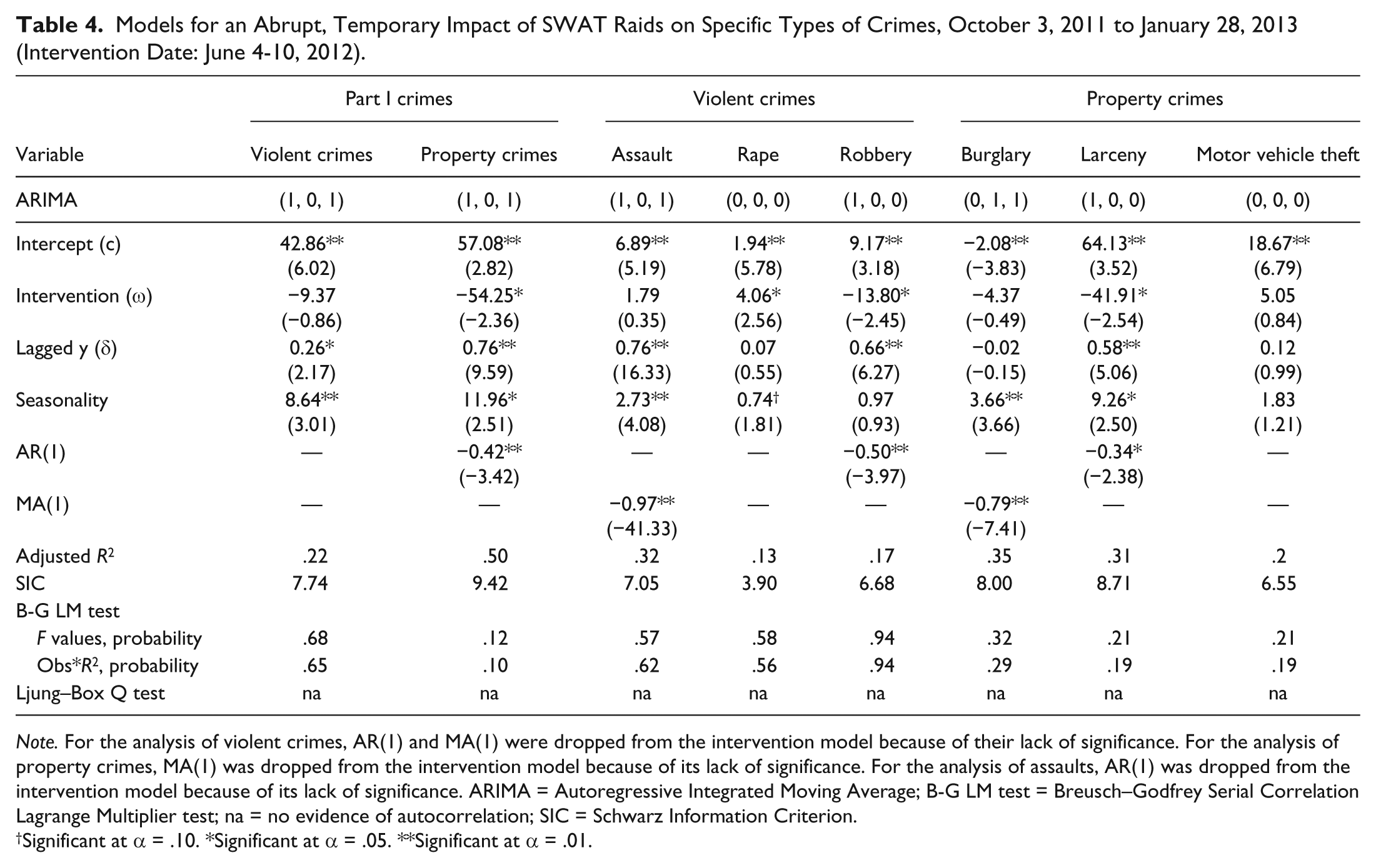
This study conducted additional analyses to see whether there is any variation in outcomes across different crime types. Table 4 presents the results for testing for an abrupt and temporary impact of SWAT raids on specific types of crimes. Diagnostic checks of the residuals for all the models indicated no autocorrelation, so all the models were acceptable. ARIMA components were statistically significant at conventional levels (p < .05 or .01). Their estimates lay within the bounds of stationarity/invertibility. It should be noted that this study considered other impact models such as the gradual and permanent model and the abrupt and permanent model. There was no significant estimate of the intervention across any crime types. Results were not reported due to page limitations.
Models for an Abrupt, Temporary Impact of SWAT Raids on Specific Types of Crimes, October 3, 2011 to January 28, 2013 (Intervention Date: June 4-10, 2012).
Note. For the analysis of violent crimes, AR(1) and MA(1) were dropped from the intervention model because of their lack of significance. For the analysis of property crimes, MA(1) was dropped from the intervention model because of its lack of significance. For the analysis of assaults, AR(1) was dropped from the intervention model because of its lack of significance. ARIMA = Autoregressive Integrated Moving Average; B-G LM test = Breusch–Godfrey Serial Correlation Lagrange Multiplier test; na = no evidence of autocorrelation; SIC = Schwarz Information Criterion.
Significant at α = .10. *Significant at α = .05. **Significant at α = .01.
Violent crimes
The SWAT intervention resulted in a decrease in violent crimes, but its effects were insignificant. Using more specific crime types, this study found that there were significant decreases in robberies (−13.80). The long-term effect of the intervention was estimated to be −40.59 robberies [−13.80 / (1 − .66) = − 40.59]. For rapes, the level of the time series increased by 4.06 incidents. This finding appears counterintuitive. The reason for this increase is unclear. One possible, but speculative explanation is that the SWAT intervention might significantly interfere with people’s social activities in public places and instead increase their household activities, which in turn produces more crime targets for rapes. Rapes often occur in private places among acquaintances. Rapes were more likely to occur during the post-intervention period when suitable targets and an offender’s awareness space (work, home, or friend’s residence) overlap (see Cohen & Felson, 1979). Although the abrupt impact parameter (ω) was significant, the gradual parameter (δ) failed to reach statistically significant levels. There was no significant lingering impact of the intervention on rapes.
Property crimes
Under the abrupt-temporary hypothesis, the SWAT intervention had a significant impact on property crimes at the .05 level. There was a decrease of 54.25 property crimes immediately following the intervention. In addition, its impact existed for some time afterward. The long-term effect of the intervention was estimated to be −226.04 property crimes [−54.25 / (1 − .76) = −226.04].
When more specific types of property crimes were used, the intervention had a significant impact on larcenies. The level of the series dropped by 41.91 larcenies in the first post-intervention observation. Also, there was an eventual reduction of nearly 100 larcenies during the post-intervention period [−41.91 / (1 − .58) = −99.79].
In sum, the abrupt-temporary model was preferable to other impact models. During the post-intervention period, Part I crimes declined significantly. The impact of the intervention was greatest for “street crimes” such as robberies and larcenies in which property is stolen or taken by force or threat. Its impact lasted for some time and diminished gradually. On the other hand, violent crimes often occurring in private places among friends did not decline nearly as much as property crimes. Rapes increased significantly during the post-intervention period. There is no clear reason. It is just speculated that the interference of the intervention in the lives of citizens in public places led to increases in household activities and generated more crime targets for rapes. There was also no significant evidence of a deterrent effect on drug arrests and CFSs. Finally, the seasonality was an important factor predicting all types of crimes.
Discussion and Conclusion
This article examined the instrumental function of SWAT, especially determining whether SWAT raids have any citywide effects on reducing crime and disorder. The findings of this study offered no simple, consistent answer. None of the estimates of the intervention reached statistical significance in both gradual-permanent and abrupt-permanent models. Only in the abrupt-temporary model was there consistent evidence that the SWAT intervention resulted in significant “abrupt and temporary” decreases in street crimes involving property, such as robberies and larcenies.
The current finding offers implications for policy development and future research. One of the most important findings is that the degree to which the SWAT intervention influences crimes varied across different types of crimes. The strongest deterrence appeared to be for robberies and larcenies. For more exhaustive model estimations, it included a broad range of offenses to see if there is any variation among them. The aggregate index of Part I crimes can be skewed by the offense with the highest number of reports-typically larceny-theft (see Table 1), which leads to an underappreciation of the impact of SWAT raids on more serious and violent crimes. The large volume of larceny-theft crimes overshadows more serious but less frequently committed violent crimes. Therefore, it is important to use specific crime types rather than the aggregate index of Part I crimes to evaluate the deterrent effect of SWAT teams.
For more effective law enforcement, the BPD should focus extra patrol attention on street crimes involving property in hot spot areas with high rates of social disorganization and crime. Given the geographical concentrations of crime and disorder, focusing police resources on particular crimes in high-crime areas will make the agency’s decision-making process more efficient and finally lead to a substantial decrease in crimes citywide.
Another important finding is that the deterrent effects of SWAT raids were temporary due to the nature of the short-term intervention. This study confirms the findings of prior research (Cohen et al., 2003; Sherman & Rogan, 1995; Sorg, Haberman, Ratcliffe, & Groff, 2013; Wyant, 2014). For example, Sorg and his colleagues (2013) found that foot patrols did not have lasting deterrent effects on crime in hot spots. Wyant (2014) also reported that the deterrent effects of quick and precise firearm arrests were short-lived. Given the consistent findings of a quickly decaying deterrent effect of hot spot policing, it is imperative to develop a strategy to deter crime in the long term. More holistic policing strategies (e.g., problem-oriented policing, community policing, and intelligence-led policing) should be adopted beyond strictly enforcement-based responses to achieve long-term crime reductions (Braga et al., 2012; Sorg et al., 2013).
Despite its contribution to the existing literature, there are several methodological limitations of this study. First, the study occurred in only one city, thus the generalizability is limited. To the degree that the use of SWAT raids varies across cities, it is unlikely that the findings from Buffalo can be generalized to other cities. Future researchers should examine whether the findings of this study hold across different locations or whether there is any geographical variation.
Second, this study was designed post hoc to evaluate the effectiveness of SWAT raids using interrupted time-series analyses. The time-series quasi-experimental design has been widely used for testing policy impact, but there are internal validity threats, especially history (Cook & Campbell, 1979). Several features of the current study may reduce some historical effects by design. This study covers the period from October 2011 to January 2013. During such a short-term study period, there were no major demographic changes in the study areas. In addition, since the time intervals are measured on a weekly basis (rather than monthly or yearly), historical events are less likely to affect study outcomes within the narrow interval. Finally, in this interrupted time-series design, the pre-intervention series plays a role as a control series by controlling for regular patterns in which drug arrests, CFSs, and crimes have been fluctuating up and down over the years.
Research concerning the effectiveness of SWAT has become very important, as hot spot policing has received scholarly attention. SWAT raids are frequently used when the police deal with “high-risk warrant work” (Kraska & Kappeler, 1997, p. 4), “no knock” drug warrants (Kraska & Paulsen, 1997, p. 260) and “small-time drug users and dealers” (Kraska, 1999, p. 151). The use of SWAT in Ferguson, Missouri, in the late summer of 2014 threatened policing legitimacy. Nevertheless, this study partially supports the instrumental function of SWAT teams. Causal inferences are limited to the place chosen for this study. In the future, a wide range of research is necessary to reach a consensus on the effectiveness of SWAT interventions.
Finally, evidence-based policing scholars evaluated the instrumental function of policing, but little empirical attention has been paid to the importance of its symbolic function (Freiberg, 2001; Thacher, 2001). Police activities serve symbolic functions in addition to, or sometimes despite, instrumental concerns. Both instrumental and symbolic functions must be seen as complementary, not competing or contradictory, elements of police work. Despite the alleged symbolic function of policing, scholars have not yet assessed public opinions and attitudes toward SWAT raids. The use of SWAT raids is a symbolic indicator of expected myths of crime fighting and has a symbolic and affective element. The following research agenda should be pursued (e.g., see Haberman, Groff, Ratcliffe, & Sorg, 2016; Ratcliffe, Groff, Sorg, & Haberman, 2015): 1) Whether SWAT raids increase public satisfaction with police in crime hot spots; 2) Whether SWAT raids enhance the public’s faith in the criminal justice system, especially police agencies; 3) Whether SWAT raids reinforce social cohesion in crime hot spots; 4) whether SWAT raids improve public perceptions of crime, disorder, and safety.
Footnotes
Declaration of Conflicting Interests
The author(s) declared no potential conflicts of interest with respect to the research, authorship, and/or publication of this article.
Funding
The author(s) received no financial support for the research, authorship, and/or publication of this article.