



Abstract
Debate persists as to the amount of influence criminal history should have in determining the severity of imposed legal sanction for a criminal offense. One position maintains that the punishment for repeat and first-time offenders convicted for the same type of offense should be similar, whereas an alternative viewpoint argues that the state should sanction repeat offenders more harshly. We contribute to this discourse by investigating whether the amount of weight given to an offender’s prior criminal record in sentencing affects the likelihood of repeat offending. Although initial findings showed that a substantive negative bivariate relationship existed at the county level between the weight-accorded prior criminal record in sentencing and repeat offending, this association disappeared in a more sophisticated nonlinear multilevel analysis. Our findings suggest that sanctioning repeat offenders more harshly than first-time offenders for similar offenses has little effect on attenuating repeat offending once other factors are controlled.
Background
Americans began to question the criminal justice system’s ability to rehabilitate incarcerated offenders during the late 1960s and early 1970s because rehabilitation programs had minimal effects on decreasing recidivism (Lipton, Martinson, & Wilks, 1975). In concert with reports purporting the failure of rehabilitation, studies further demonstrated that indeterminate sentencing systems were inconsistent in the imposition of punitive sanctions (Frankel, 1973; Kapardis & Farrington, 1981) and that repressive state control was a potential threat within such sentencing systems (Allen, 1981). Because the benefits of rehabilitation were seldom realized and the potential for abuse was substantial, some advocated a return to the “just deserts” position on punishment (von Hirsch, 1976). This viewpoint caught the public’s attention and led to increased political pressure to initiate reform.
Sentencing reform eventually manifested itself in the establishment of determinate sentencing systems throughout the country. Determinate sentencing systems strive to establish an equitable sentence for offenders convicted for similar type offenses by limiting capricious judicial discretion (Wilkins, 1981). However, though the seriousness of the criminal offense plays the primary role in determining severity of sanction within these types of sentencing systems, the criminal history of the convicted offender is also salient. The offender’s prior criminal record is a valid sentencing criterion to enhance the utilitarian aspect of punishment (von Hirsch, 1976).
However, controversy persists regarding the amount of weight that should be given to an offender’s prior criminal record in determining severity of punitive sanction. Two differing positions currently exist in the literature. The first viewpoint derived primarily from retribution theory argues that both repeat and first-time offenders convicted for comparable offenses should be punished similarly because the social harm of a criminal offense is the same without consideration to the prior record of the offender (Banks, 2012). It is simply unjust to amplify the punishment for offenders with a prior record because their previous criminal misconduct was already sanctioned and because the culpability and blameworthiness of the defendant for the current criminal offense has not increased from the individual committing the prior offense(s) (Dubber, 1996; Singer, 1979). The harm to the victim and to society engendered by the current offense is also not amplified because the offender committed one or more previous offenses. If society was to punish a repeat offender more harshly for his or her current offense, the social harm caused by the crime would no longer be the overriding purpose of punishment because a repeat offender might receive a harsher punishment than a first-time offender who committed an identical crime or even a more serious crime. Punishing repeat offenders more severely is also costly for society and does little to reduce crime because many empirical studies fail to find a substantive incapacitation effect (Raphael & Stoll, 2009).
It is also argued that repeat offenders do not need to be sentenced more severely than first-time offenders because they are more apt to be apprehended and punished (Covey, 2011). Repeat offenders encounter a higher probability of detection by authorities because fingerprints, DNA, photographs, and personal background information on previously arrested individuals, as well as criminal accomplices and modus operandi, are maintained by police departments (Dana, 2001). It is also likely that many ex-offenders have a higher proclivity of being arrested for their illegal activities because they are on probation or parole and are being closely monitored by the state (Miller, 2014).
Research also finds that the likelihood of criminal conviction is substantially greater for defendants possessing a prior criminal record (Laudan & Allen, 2011). Although prior criminal history is typically not deemed legally relevant in determining guilt, a defendant’s prior criminal record can be introduced in criminal court proceedings to impeach his or her testimony (Covey, 2011). Such a situation can increase the likelihood of conviction because juries tend to have an unfavorable view of defendants who have a criminal record. Defendants with a criminal record are also more apt to accept a plea bargain, which effectively circumvents the onerous beyond a reasonable doubt standard of proof threshold required for a criminal conviction (Covey, 2011). Although the severity of punishment for most plea bargains is less oppressive than for nonplea bargained cases, plea bargains still enhance deterrence because of the rise in the certainty of punishment. Increasing the certainty rather than the severity of punishment is more effective in attenuating crime (Katyal, 1997). Research further shows that repeat offenders are more likely to be confined in jail before trial (Stolzenberg, D’Alessio, & Eitle, 2013), which in turn engenders longer sentences because of increased difficulties the defendant faces in preparation for his or her defense (Spohn, 2009). In sum, then, the criminal sanctioning of a repeat offender should be no different from a first-time offender for the same crime, notwithstanding the number or the type of crimes previously committed by the repeat offender. 1
A second alternative position argues that a convicted criminal offender’s propensity to commit future criminal offenses should be strongly considered, in addition to the severity of the current offense, in determining the harshness of punishment to further the utilitarian aims of deterrence and incapacitation. Strong policy-relevant justifications exist for using prior criminal record as a valid criterion in determining severity of imposed criminal sanction. First, because repeat offenders are responsible for much of the crime that we experience in society, a substantial reduction in crime can be actualized by incapacitating them. This claim is rooted in evidence drawn from research on career criminals. In their landmark study, Wolfgang, Figlio, and Sellin (1972) examined the criminal offending of a cohort of 9,945 boys born in Philadelphia in 1945 through their 18th birthday in 1963. The major finding of this study was that 6% of the juvenile offenders, who were arrested 5 or more times by age 18, accounted for 52% of all arrests of cohort members. These same boys were also arrested for the majority of the serious crimes committed by the cohort. They were arrested for 71% of the homicides, 73% of the rapes, 82% of the robberies, and 69% of the aggravated assaults. Wolfgang et al.’s findings pertaining to the existence of chronic offenders in the population have had a major influence on the study of crime (Sullivan & Piquero, 2016). The policy implication of this research is obvious in that a substantial reduction in crime can be achieved if society is able to incapacitate the relatively small number of repeat offenders in the population. Somewhat surprisingly, however, empirical evidence on the effectiveness of incapacitation in reducing crime is mixed (Piquero & Blumstein, 2007).
Second, the mark of a criminal record has a number of adverse consequences for an individual in our society such as impeding the ability of an individual to vote (Jones, 2015), attenuating the prospect of marriage (Edin, 2000), reducing the likelihood of going to college (Boettke, Coyne, & Hall, 2013), and hindering employment opportunities (Decker, Ortiz, Spohn, & Hedberg, 2015). However, though the mark of a criminal record has many negative consequences for an individual, the reputational loss from a second, third, or fourth conviction is substantially less than that generated from the first conviction (Polinsky & Shavell, 1998). It is thus argued that any deterrent effect gleaned from the reputational loss of a criminal conviction will decrease as a person’s criminal record becomes more extensive. Empirical studies buttress this position by showing that prior criminal record is correlated strongly with recidivism (Gendreau, Little, & Goggin, 1996).
Third, repeat offenders are more difficult for the police to detect and arrest because they likely learn from their previous failures (Mungan, 2010). Many repeat offenders also probably obtain new criminally based skills from other offenders during their confinement. Serving time in prison not only results in the deterioration of legitimate knowledge and labor market skills (Visher, Debus-Sherrill, & Yahner, 2011), but the confined offender also interacts socially with other inmates during his or her confinement. This social interaction often represents a form of tutelage whereby previous criminal skills are honed and new criminal skills are acquired (Bayer, Hjalmarsson, & Pozen, 2009). The supplanting of legitimate labor market skills with criminally based skills acts to harden incarcerated offenders (Katz, Levitt, & Shustorovich, 2003), which in turn escalates their likelihood of recidivating after release from prison. A study by Chen and Shapiro (2007) furnishes some support for this logic by showing that the placement of a marginally dangerous inmate into a low rather than a minimum security facility increases recidivism by about 33%, with recidivism being measured as rearrest within 3 years from prison release. Other studies also find that people sentenced to prison rather than to community corrections have an enhanced proclivity to recidivate (Clear, 2007).
Finally, it seems likely that many first-time offenders committed their initial offense due to a lapse in judgment because the vast majority of first-time offenders desist from offending after their first contact with the criminal justice system (Rubinstein, 1980). Conversely, repeat offenders are more deserving of enhanced punitive sanctions because they are already familiar with the workings of the criminal justice system and, as a consequence, are more culpable or blameworthy for their continued illegal behavior (O’Neill, Maxfield, & Harer, 2004). Thus, if a repeat offender commits a crime, we are more likely to believe that he or she did so intentionally. This attribution of intentionality justifies the judgment that the repeat offender is more blameworthy for his or her behavior than is the first-time offender.
In the current study, we use judicial processing data drawn from 39 large urban U.S. counties and a hierarchical generalized linear model to assess the effect of the weight given to an offender’s prior criminal record in determining severity prison sentence on the likelihood of repeat offending. Specifically, we investigate whether criminal offenders are less likely to be repeat offenders in counties that give more credence to an offender’s prior criminal history in determining severity of sanction. The multilevel model used here is advantageous for a number of reasons. First, it enables the consideration of the influence of both offender-level and county-level factors in predicting the probability of repeat offending (Raudenbush, Bryk, Cheong, & Congdon, 2001). Second, criminal offenders prosecuted in one county may be more similar to each other than to criminal offenders prosecuted in another county. Multilevel models avoid violating the assumption of independence among observations because they explicitly recognize the clustering of criminal offenders within each of the counties. Third, hierarchical models are beneficial for estimating cross-level effects because all the estimates are adjusted for covariates, despite whether they are measured at the offender or county level. Finally, hierarchical models can statistically separate the variance of the micro-level parameters from sampling variance. This situation affords a more powerful test of the county-level variables included in the analysis.
Dataset and Variables
We analyze data drawn from the State Court Processing dataset on the prosecution of felony criminal offenders in 39 of the 75 most populous counties in the United States for 2009 (Bureau of Justice Statistics, 2009). 2 This dataset contains information on the prosecution of felony cases filed in May of even numbered years. Each felony case prosecuted in state court is tracked until the final disposition of the case is reached or until 1 year has passed since the filing of the case. Information relating to arrest charges, demographic characteristics, criminal history, pretrial detention, adjudication, and sentencing outcome for each offender is included in the dataset. The dataset, which is archived at the Inter-university Consortium for Political and Social Science Research at the University of Michigan, has wide geographical breadth that allows for a broad generalization of our results.
Our dependent variable is the probability of repeat offending. Repeat offenders are coded as 1 and first-time offenders are coded as 0. Criminal offenders with one or more prior felony or misdemeanor convictions are defined as repeat offenders. We use repeat offender/first-time offender as our dichotomous dependent variable because the use of prior record in sanctioning should only influence the criminal activity of repeat offenders. There should be no effect for first-time offenders. It is not salient whether individuals defined as first-time offenders engaged in illegal activities prior to their being arrested. What is germane is whether the offender has at least one prior conviction at the time of his or her arrest because prior convictions were taken into consideration in the offender’s sanctioning for previous crimes.
Our analysis also includes arrest charges, demographic characteristics of the offender, and county-level aggregate variables that one might speculate have an impact on criminal activity. The three arrest charge variables account for whether the offender was charged for a violent, property or drug offense. The offender characteristic variables include the age of the offender, race of the offender, sex of the offender, and whether the offender is Hispanic. 3
Several variables measured at the county level are also incorporated into the multilevel analysis. These contextual variables were obtained from the 2010 Census with the exception of the prior record-severity of punishment variable and the crime rate Uniform Crime Reports (UCR) variable. The prior record-severity of punishment variable is the variable of theoretical interest in this study because it measures the amount of variation (R2) an offender’s prior criminal record has in explaining the length of prison sentence in each of the counties. The following offender prior record variables were used in 39 ordinary least squares regression analyses to generate an R2 for each of the counties: the number of prior felony convictions, the number of prior misdemeanor convictions, whether the offender has a prior adult felony conviction for a violent offense, the number of prior prison sentences, and the number of prior jail sentences.
The other contextual variables theorized to influence the likelihood of repeat offending include the unemployment rate, population density, percent Black population, the crime rate, and community disadvantage. The unemployment rate is measured as the percentage of the civilian labor force unemployed in 2009. Several studies report a noteworthy relationship between unemployment and repeat offending (Blumstein, Cohen, & Farrington, 1988; D’Alessio, Stolzenberg, & Eitle, 2014; Wang, Mears, & Bales, 2010). Population density is incorporated into the analysis to examine how urbanization affects repeat offending. This variable measures population per square mile of land area. The percentage of the population between the ages of 15 and 24 is a contextual variable because young people are disproportionately involved in serious criminal activity. We also include the crime rate and percent Black population in the analysis as statistical controls. Last, we created a community disadvantage composite variable derived from a principal components analysis of several variables (see Table 1). These variables include percentage of households headed by a single female with children, percentage of the population (age 25+) that never graduated from high school, percentage of households with public assistance income, and percentage of families below the poverty level in 2009. A high score on this composite variable indicates an elevated level of community disadvantage. Table 2 displays the means, standard deviations, and definitions for all the variables used in the multilevel analysis.
Principal Components Analysis for Community Disadvantage.
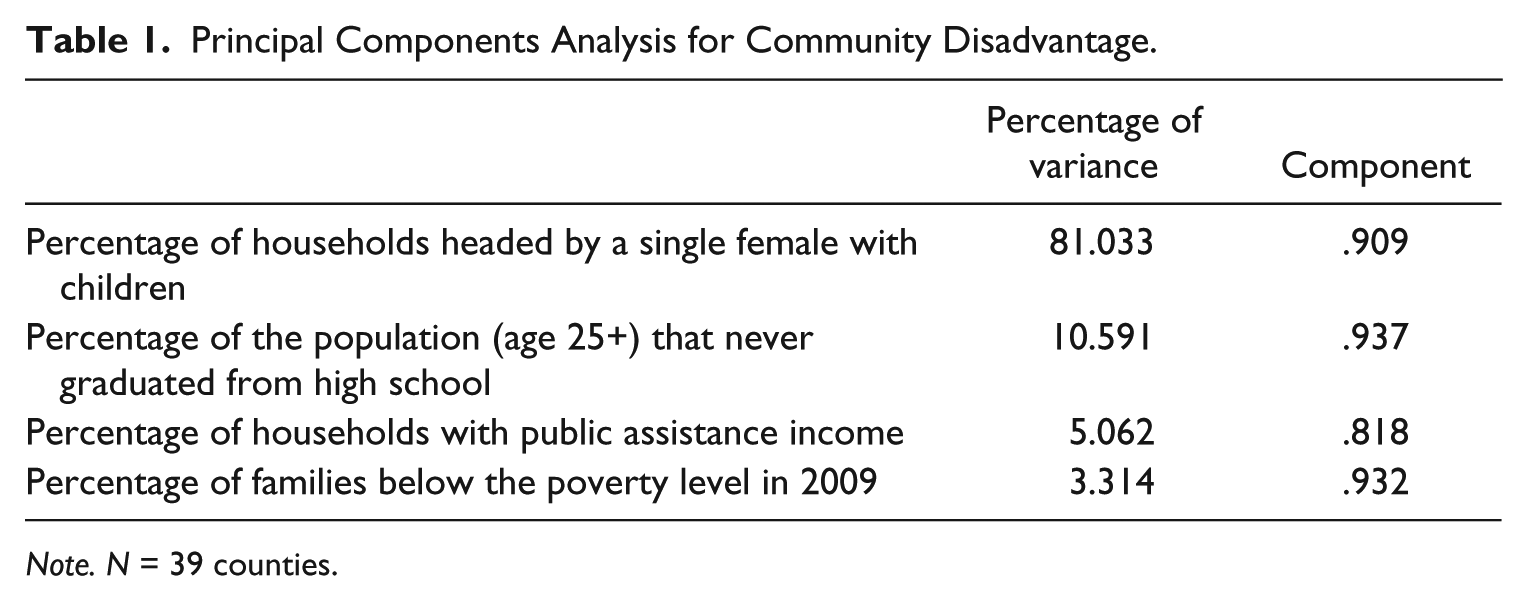
Note. N = 39 counties.
Means, Standard Deviations, and Definitions for the Variables Used in the Analysis.
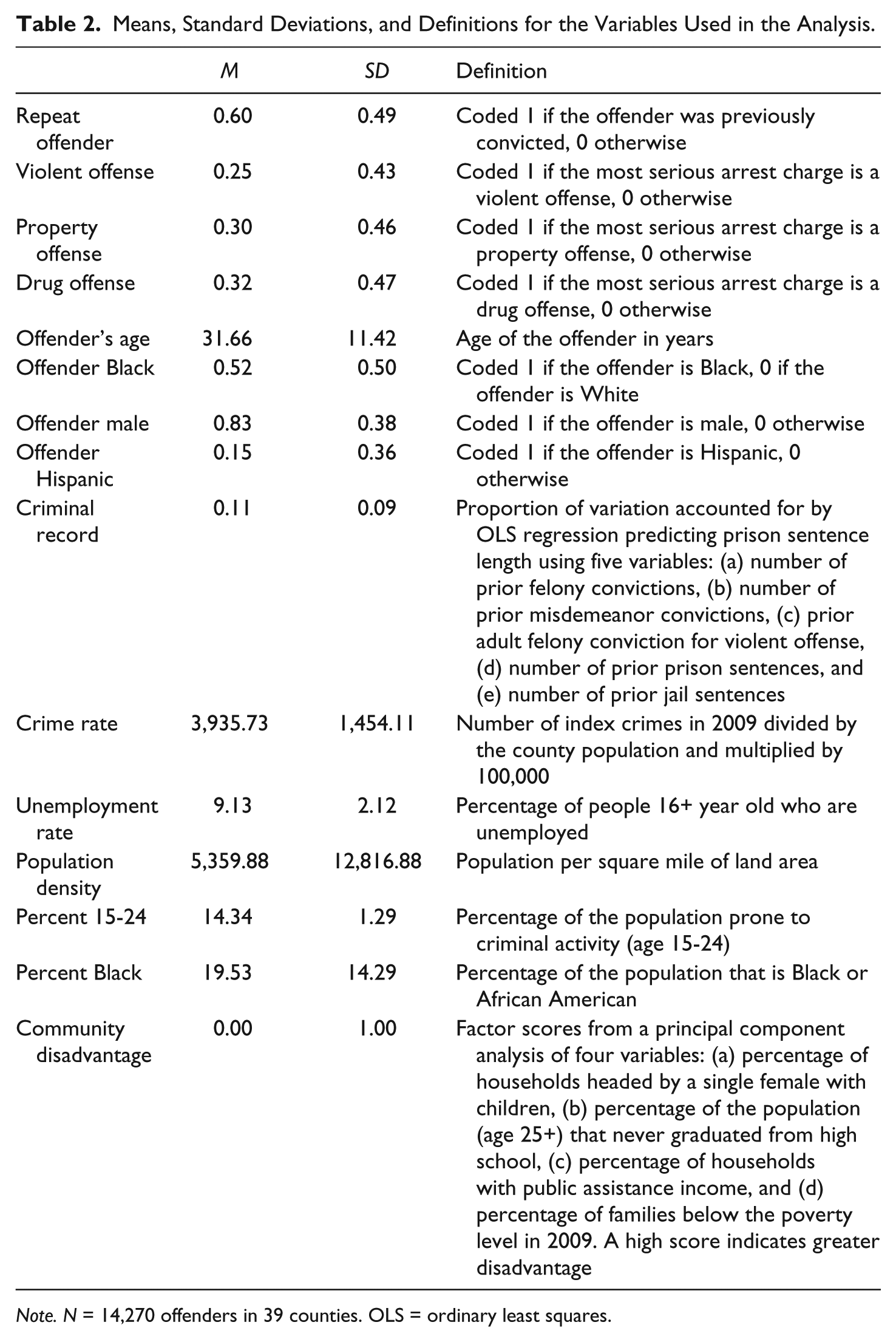
Note. N = 14,270 offenders in 39 counties. OLS = ordinary least squares.
Descriptive Analysis
We initially constructed a figure depicting in ascending order the amount of importance each county assigns to an offender’s prior criminal history in determining severity of punishment. A visual examination of Figure 1 shows that there is a striking difference among the counties for the weight given to prior criminal record in determining length of prison sentence. Although some counties place less emphasis on prior criminal history, other counties deem a criminal offender’s prior criminal record to be an important factor in determining of severity of punishment.

Proportion of variation accounted for by criminal record in predicting prison sentence length.
We next constructed a figure of the relationship between the amount of variation that prior criminal record explains in determining prison sentence length and the percentage of repeat offending in each of the counties. Figure 2 readily shows that there is a discernable negative association between the weight given to prior criminal record in the sanctioning of offenders and the percentage of repeat offending in a county. The percentage of criminal offenders with a prior criminal record prosecuted for a felony crime in a county decreases as the importance of prior record in sanctioning rises. This finding suggests that sanctioning repeat offenders more severely for their crimes acts to attenuate repeat offending.

Proportion of repeat offenders at ascending levels of criminal record.
Although the negative bivariate relationship depicted in Figure 2 is interesting, it does not inform us about whether other factors are also predictive of repeat offending. To investigate this issue further, we estimated a multilevel model that affords us the opportunity to appraise a variety of individual and aggregate factors that might also be influencing the likelihood of repeat offending.
Results
We used a penalized quasi-likelihood procedure to generate parameter estimates because the data are multilevel and the dependent variable is a dichotomy (Breslow & Clayton, 1993). Except for the intercept, which is a randomly varying parameter, all the micro-level offender variables in the analysis are fixed. The coefficient for the intercept is the mean level of repeat offending in the counties after adjusting for the independent variables included in the model. Because intercept varies across counties, we can model any observable difference in the likelihood of repeat offending between the counties with the prior record-severity of sanction variable and with the other contextual variables.
We initially estimated a within-county regression model using just the offender variables to predict the probability of an offender being a repeat offender. As the intercept can vary, we are able to examine the size and significance of its estimated variance to determine whether it was worthwhile to use the prior record-severity of sanction variable and the other contextual variables to predict between-county differences in its slope. A chi-square test indicated that the likelihood of repeat offending varied considerably among the counties. A statistically significant chi-square test means that the probability of repeat offending is substantially higher in some counties than in other counties even after controlling for the arrest charging and offender demographic variables. The contextual variables in the between-county model attempt to account for this unexplained variation.
Table 3 reports the results for the full multilevel model. An examination of this table reveals that a consequential relationship does not exist between the aggregate prior record-severity of sanction variable and the likelihood of repeat offending. After the offender and county variables are taken into account, the amount of weight given to an offender’s prior criminal record in sanctioning is not salient in explaining variation among the counties regarding the probability of repeat offending. 4 Our failure to evince a substantive negative effect calls into question the assertion that repeat offenders should be sanctioned more severely than first-time offenders for similar type crimes.
Nonlinear Hierarchical Model Estimating the Probability of Repeat Offending.
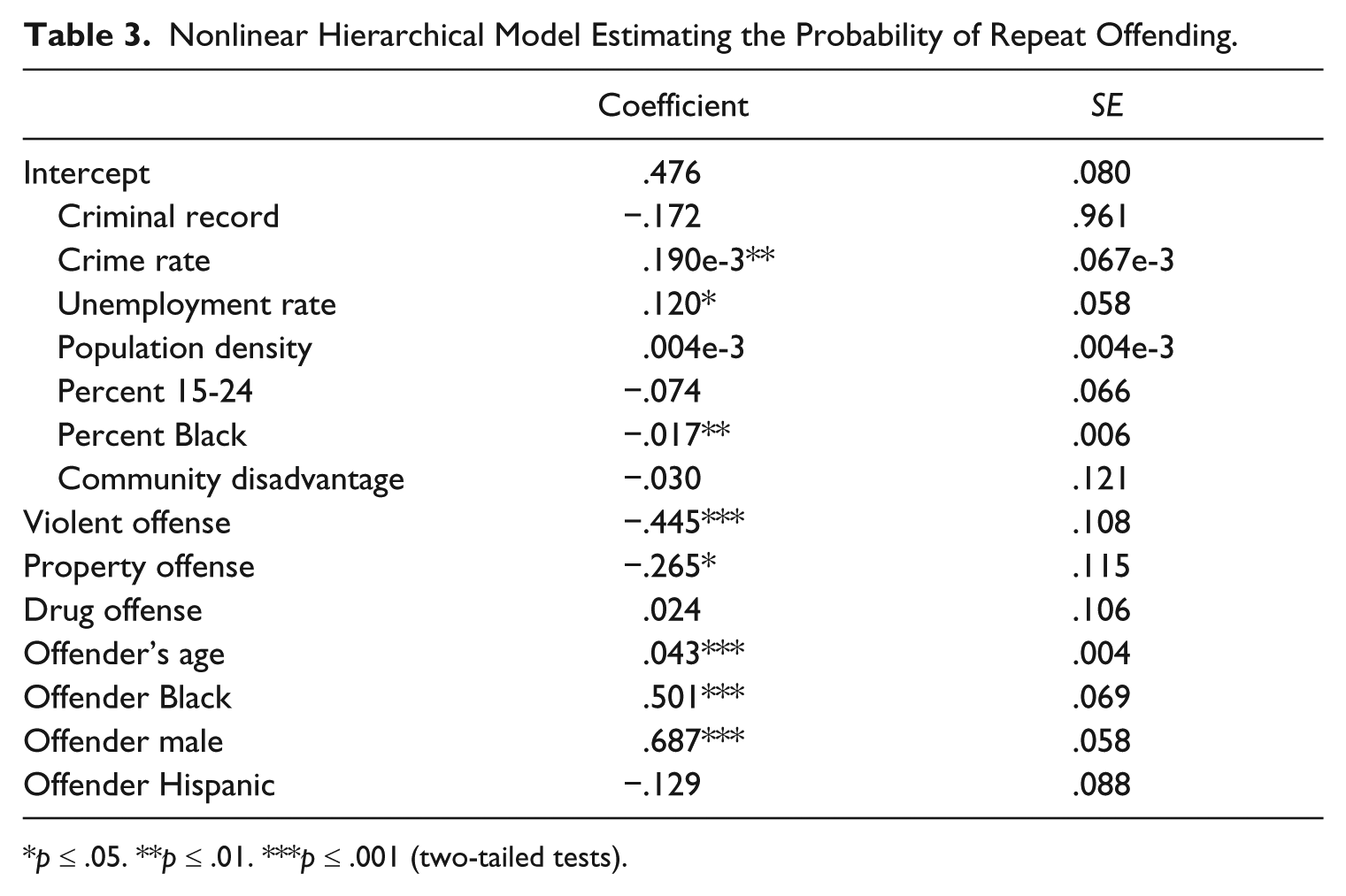
p ≤ .05. **p ≤ .01. ***p ≤ .001 (two-tailed tests).
The results displayed in Table 3 also reveal that at the micro-level, the coefficients for two of the charging variables, race, age, and sex of the offender are all noteworthy in model. A first-time offender is more apt to be charged for a violent or property crime than is a repeat offender. A Black offender is more likely than a White offender to have a prior criminal record. Repeat offenders are also more inclined to be male and to be older. Ethnicity plays no role in predicting the likelihood of repeat offending.
At the macro-level of analysis, the variables of import are the crime rate, unemployment rate, and percent Black population. A positive relationship exists between the crime rate and the probability of repeat offending. The likelihood of an offender having a criminal record is elevated in counties that have a high crime rate.
There is also a substantive association between the unemployment rate and repeat offending. As the unemployment rate rises in a county, there is an increase in repeat offending. Such a finding supports previous research suggesting that unemployment induces more repeat offending than first-time offending (D’Alessio et al., 2014). The expectation that a high unemployment rate engenders more repeat than initial offending is theoretically grounded in the literature. Obtaining a quality job for someone who is stigmatized by a criminal record is often difficult. Individuals with a criminal record are 50% less likely to be recontacted by an employer after the initial job interview than are people without an official criminal record (Pager, 2003). Many employers are simply unwilling to hire a person with a criminal record because a criminal record signifies that the individual is unskilled, untrustworthy, and may pose a potential danger to customers (Holzer, Raphael, & Stoll, 2007). When economic conditions deteriorate and hiring slows, there is even a greater reluctance among employers to hire a person with a criminal record. Research finds that repeat offenders have an enhanced proclivity to offend when the unemployment rate is high because it is more difficult for them to find legitimate work (Schmitt & Warner, 2011). In sum, then, it seems reasonable to expect that criminal activity is more apt to increase among people with a criminal record when economic conditions deteriorate and jobs are more difficult to acquire.
There is also a substantive relationship between percent Black population and repeat offending. As the percentage of the Black population rises in a county, the likelihood of repeat offending declines markedly. First-time offending becomes more prevalent in a county as the Black population grows progressively larger. This finding is interesting because at the micro-level, Black offenders are more likely than are White offenders to have a prior criminal record.
Although our data do not permit us to specify the precise casual mechanisms responsible for this difference, one plausible explanation that warrants some consideration is that the concentration of repeat offenders living in a community may act to engender an increase in the criminal activities of the nonoffending population. There are theoretical justifications to buttress this assertion. The number of people incarcerated in prison has grown dramatically since the 1970s. Although Blacks comprise approximately 13% of the U.S. population, they represent about 37% of our nation’s prison population (Guerino, Harrison, & Sabol, 2011). Once released from prison, most of these individuals return to the same communities where they lived prior to their incarceration (Clear, Rose, Waring, & Scully, 2003). For example, La Vigne, Mamalian, Travis, and Visher (2003) found that 53% of Illinois prisoners released in 2001 returned to Chicago. Thirty-four percent of these released inmates were concentrated in only six of 77 communities in Chicago. It is certainly plausible that a large number of repeat offenders living in a given community may act to initiate crime among the nonoffending population by overtaxing the ability of police to enforce the law.
The efficiency of an organization is dependent on workload. This assertion is especially true for law enforcement organizations because policing is a labor-intensive activity (Skogan & Hartnett, 1997) and because police resources tend to be relatively inelastic (McCarty, Ren, & Zhao, 2012). A high crime rate generated by the concentration of a large number of repeat offenders living in a community can affect police performance adversely by intensifying the demand on finite police resources. This situation then decreases the ability of police to arrest criminal offenders (Freeman, Grogger, & Sonstelie, 1996). It also impedes the state’s ability to prosecute, convict, and incarcerate offenders. If people are rational actors who engage in criminal behavior after contemplating the possible benefits and liabilities associated with such behavior, the large number of repeat offenders living in many Black neighborhoods may make criminal activity more likely among all residents by decreasing deterrence.
It is also plausible that nonoffenders may feel that little stigma or reputational cost will result from their participation in illegal activities when a large number of individuals already living in their community possess a criminal record. In addition, if criminal behavior is relatively common in an individual’s neighborhood, a typically nonoffending person may also view participation in such activity as a way to enhance his or her status. Research supporting this view shows that the perception as to whether a person’s peers will or will not express an unfavorable opinion of his or her criminal behavior exerts a much stronger influence on the person’s actions than does the threat of punishment by the state. To illustrate, Lott and Mustard (1997) found that the threat of reputational sanctions as measured by the arrest rate had a much greater effect on reducing crime than did the conviction rate. Research also shows a relationship between compliance to the law and a person’s perception that others are subscribing to the law (Grasmick & Green, 1980). People are simply more likely to obey the law when they believe that others are also obeying the law (Gibbs, 1978). Moreover, a large number of repeat offenders in a community may foster crime among other members of the community by promoting legal cynicism. Legal cynicism tends to be greater in neighborhoods with a high concentration of released prison inmates (Kirk, 2016).
Conclusion
We endeavored in this study to determine whether the amount of salience prior criminal record has on criminal sanctioning influences the likelihood of repeat offending. We identified and discussed two opposing perspectives relating to whether an offender’s prior criminal history should play a role in criminal sanctioning. One viewpoint proffers that the punishment for first-time offenders and repeat offenders should be similar. A second contravening position argues that prior criminal record ought to be a valid consideration when deciding the punishment of a convicted offender.
The results from a multilevel analysis of the prosecution of felony offenders in 39 urban counties show that the likelihood of repeat offending is not substantially lower in counties that punish repeat offenders more severely than first-time offenders for similar type crimes. However, despite this finding, readers should contemplate the following limitations when evaluating the import of our findings. First, the data preclude a complete determination of causal direction because we cannot rule out the possibility that the amount of repeat offending in a county influences the sanctioning of repeat offenders. Longitudinal analyses are needed to determine causal direction. We leave this task to other researchers. Second, because we were unable to vary the sanctioning of repeat offenders in counties randomly like in an experiment, it is impossible to dismiss alternative explanations for the findings reported here. Counties with high or low levels of repeat offending may differ in ways not captured by the control variables included in this study. Third, the results generated in this study pertain to urban counties and may not hold true for rural areas. Representativeness is accordingly problematic and appreciable changes in sample composition might alter some of the effects observed in this study. Researchers should consider replicating this analysis in other jurisdictions. The more frequently such research is undertaken, the greater confidence one can place on the generalizability of our findings.
Despite these caveats, several cogent reasons have been adduced in the literature for why repeat offenders and first-time offenders should be treated similarly by the criminal justice system. The use of prior criminal history in determining punishment is not only unjust because the offender was previously sanctioned by the state for his or her crime(s), but also the consideration of prior record may result in the repeat offender being punished more severely than a first-time offender who committed an identical crime despite the damage done to society being similar in both instances. The certainty of punishment is also probably greater for repeat than for first-time offenders because the state usually maintains fingerprints, DNA, photographs, and personal background information on previously arrested individuals.
A policy of not considering prior criminal history in determining sanction severity has implications in regard to the issue of race and punishment. Empirical research consistently shows that legal factors such as the seriousness of the criminal offense and prior criminal record primarily determine a criminal defendant’s criminal justice outcome (Spohn, 2000). However, the use of prior record in determining severity of punishment has a much greater effect on Black criminal offenders because they are more apt than are White offenders to have a prior criminal record (Spohn, Gruhl, & Welch, 1981-1982). Thus, a race-neutral policy aimed at eliminating the use of prior record in criminal sentencing should help to reduce the Black incarceration rate while having little if any influence on repeat offending levels.
Our findings also have implications beyond the typical prosecution and punishment context. The crime-fighting effectiveness of recidivist laws, which impose a harsher sentence on a convicted offender if he or she has a lengthy prior criminal history, continues to be debated. Some studies find that habitual offender legislation such as three-strike laws are effective in attenuating crime (Helland & Tabarrok, 2007), whereas others do not (Stolzenberg & D’Alessio, 1997). However, our current understanding of the effectiveness of habitual offender laws in decreasing crime derives primarily from studies that focus exclusively on the crime-reducing ability of these laws. The findings generated in this study add an important element to this literature. If the use of prior criminal history in determining severity of punishment for the typical offender has little effect on lessening repeat offending generally, it is rather difficult to image a situation whereby the use of habitual offender laws would act to attenuate overall crime levels to any substantial degree.
Finally, though policymakers often favor harsh criminal sanctions for repeat offenders, our findings suggest that alternative policy initiatives might be better suited to decrease repeat offending. Ban the box laws are one recent policy initiative that have shown some effectiveness in reducing repeat offending. These laws seek to diminish the difficulty ex-offenders encounter in securing meaningful employment by removing the criminal conviction question from employment application forms. Empirical research finds that these types of laws help to attenuate repeat offending. A recent study found that a criminal defendant prosecuted in Honolulu County for a felony crime was 57% less likely to have a prior criminal conviction after the implementation of Hawaii’s ban the box law (D’Alessio, Stolzenberg, & Flexon, 2015). This finding not only highlights the role that unemployment plays in influencing repeat offending, but it also suggests that policy initiatives aimed at helping ex-offenders secure employment can be a viable strategy for reintegrating individuals with a criminal record into the society.
Footnotes
Declaration of Conflicting Interests
The author(s) declared no potential conflicts of interest with respect to the research, authorship, and/or publication of this article.
Funding
The author(s) received no financial support for the research, authorship, and/or publication of this article.