



Abstract
State sex offender statutes have been shown to vary widely in the United States. The rules found in some state statutes targeting registered sex offenders who are students or employees at higher education institutions have never been studied. I analyzed sex offender statutes and public sex offender registry websites from all U.S. states and territories and found 10 unique rules across 20 states for sex offenders in higher education. In addition, the websites of 31 states and territories listed the name or address of the institution where a registrant attends or works, and nine websites allow users to search for registrants by institution. Although research suggests higher education may be an effective rehabilitation strategy for sex offenders, some of these policies may be barriers to pursuing a college degree. I offer recommendations for reducing barriers to higher education through policymaking and for conducting future policy evaluations.
Research has shown that sex offender statutes and registry websites vary widely between states (Brewster, DeLong, & Moloney, 2012; Lytle, 2015; Mancini, Barnes, & Mears, 2011). Some state statutes contain special rules for registered sex offenders (RSOs) enrolled or employed at higher education institutions, and some websites display the college name or address where a registrant is a student or employee. These rules, and their variations, are problematic in that they inhibit access to people who could benefit from the rehabilitative effects of higher education, including reduced recidivism and improved employability (Davis et al., 2014). In addition, members of the campus community and college administrators may face unintended consequences of the varying policies, such as misperceptions of safety and issues of policy enforcement. No research has been conducted to examine how many states have higher education rules for sex offenders, what those rules require, or the extent of variation in those rules across states. In this study, I analyzed state sex offender statutes and registry websites for content related to higher education to advance the scholarship on sex offender policy variation and to raise awareness about an understudied issue of access in higher education.
To begin, I review three selected studies that address variation in sex offender statutes, followed by a brief review of the effectiveness of prison higher education. Next, I identify how sex offender statutes implicate U.S. higher education and how variations in these laws are problematic. Then, the purpose, design, and methods for this original study are presented, followed by findings. In the “Discussion” section, I consider the consequences of these policies for RSO college students, and finally, I propose an agenda for policy evaluation and recommendations for reducing the stigmatizing effects of sex offender laws on students.
Literature Review
In this section, I review the research literature on variation in sex offender policies. The three studies selected address variation in sex offender statutes in all 50 states, sex offender registry websites, and registration and community notification laws in a sample of five states. Then, I review the most up-to-date literature evaluating prison higher education programs.
Variation in Sex Offender Laws
Federal laws provide states the framework for sex offender registration. In short, the Adam Walsh Child Protection and Safety Act of 2006 (also known as Sex Offender Registration and Notification Act) required all jurisdictions to adopt unified standards for the management of sex offenders (Terry & Ackerman, 2015). As such, all jurisdictions are supposed to have sex offender registration and notification laws with common core features. Even so, researchers have found considerable variation in laws and registry websites (Brewster et al., 2012; Lytle, 2015; Mancini et al., 2011).
Mancini et al. (2011) compiled statutes from all 50 states to examine the extent of variation in seven policies: sex offender registries, community notification, residence restrictions, civil commitment, lifetime supervision, driver’s license notation, and chemical castration. They counted where these policies existed state-by-state and then examined variation within policy areas. Overall, they found no variability in the enactment of sex offender registries and community notification (because of federal laws) but found considerable policy variation in five other areas: 33 states had residence restrictions, 19 had civil commitment laws, 14 had lifetime supervision requirements, 11 required driver’s license notations, and eight allowed for chemical castration. They also found wide variation within policies. For example, in residence restriction laws, the closest distance an RSO could live to a school or other protected area ranged from 500 to 2,000 feet. The variations in the content and number of laws indicated some states are harsher on sex offenders than others (Mancini et al., 2011).
Lytle (2015) took a closer look at the registration and community notification policies of five Midwestern states to understand differences and changes in state policymaking over time. He found states differed in their definitions of sexual predators, the extent to which juveniles were required to register, and the types of crimes that warranted registration. The five states varied in how frequently they amended policies, and 89% of that variation was attributed to within-state factors, such as political ideology and economic structure. Thus, states may vary not just in policy content but also in how often and why they amend statutes (Lytle, 2015).
Brewster et al. (2012) analyzed the content of registry websites from 50 states and D.C. to evaluate federal compliance and to examine variation between states. The researchers found most of the websites complied with federal mandates, but there was variation in the features of public sex offender registry websites, including offender details, offense details, victim information, search features, disclaimers and warning statements, Spanish translation availability, and mapping capabilities. Relevant to this study, they found 14 states disclosed the college address where registrants are students, and six states allowed users to search for registrants by college address (Brewster et al., 2012).
The variation uncovered in these studies could be the result of uneven implementation of federal laws (Brewster et al., 2012), ideological differences in how “tough” states should be on sex offenders (Mancini et al., 2011), differences in public fears, or differences in the policymaking process (Lytle, 2015). Regarding the consequences of sex offender policy variation, Lytle (2015) argued,
Variation in the methods by which the public identifies and monitors sex offenders may mean that offenders required to register in one state may not be required to register in another. Therefore, as the public travels from one state to another, perceived public safety may be affected by the variation in the types of offenders included in the registry, as well as the methods by which citizens may identify and monitor sex offenders. (p. 212)
Thus, there may be unintended consequences of each state having a unique combination of sex offender laws. Additional research is needed to explain how and why these variations in policy occur and what effects they have on the registrants, enforcing agencies, and society.
Higher Education as Rehabilitation
Higher education is shown to be an important rehabilitative strategy for returning citizens. Success is typically measured by postrelease employment rates and reductions in recidivism. According to the most robust meta-analysis of prison higher education research from 1980 to 2011, “[adult] inmates who participated in correctional education programs had a 43 percent lower odds of recidivating than inmates who did not” (Davis et al., 2014, p. xv), and adult inmates who participated in educational programs were 13% more likely to find postrelease employment than those who did not (Davis et al., 2014).
In recent studies not included in that meta-analysis, researchers reported a 9-year, postrelease recidivism rate of 19% for participants in a North Carolina prison higher education program, compared with 49% in the state’s general prison population (Anders & Noblit, 2011). Using propensity score matching, Kim and Clark (2013) compared prisoners in New York who earned a college degree or certificate in prison with similar offenders who did not participate in a higher education program. Although self-selection bias accounted for differences in recidivism rates 1 and 2 years after release, prisoners who earned a degree in prison were significantly less likely to recidivate 3 years after release compared with those who did not participate. Overall, the recidivism rate for participants was 9.4% compared with 17.1% for nonparticipants (Kim & Clark, 2013). In a 5-year follow-up study of Indiana former inmates, those with less than a high school diploma had lower employment rates (57%) and higher recidivism rates (56%) compared with those with a college education, 67% and 31%, respectively (Lockwood, Nally, Ho, & Knutson, 2012). In sum, there is little doubt that higher education can be an effective rehabilitation strategy for some individuals.
However, the available literature only addresses higher education obtained in prison, and there is no research on people who completed higher education after being released from prison. In addition, the prison higher education literature does not specify if or how higher education might be an effective rehabilitation strategy for sex offenders, specifically. Thus, some caution is warranted in generalizing the results of prison higher education evaluations that aggregate effects for offenders of all types. Nevertheless, higher education appears to be a promising strategy for successful reentry into society. As such, one might expect that many parolees, including sex offenders, would consider enrolling in college. As explained below, however, state laws can be barriers for RSOs who enroll in college, and the variation in those laws presents additional challenges.
The Problem for Higher Education
One group of stakeholders affected by the variation in sex offender statutes is U.S. higher education, including students and employees who are RSOs, the campus community, and the administration. Before developing this argument further, it is important to start with a description of the federal laws that enjoin sex offender laws to higher education: the Campus Sex Crimes Prevention Act of 2000 (CSCPA) and the Adam Walsh Act of 2006.
Federal Laws
In 2000, Congress passed the Victims of Trafficking and Violence Protection Act, which contained the CSCPA. CSCPA created three new requirements. First, it extended preexisting registration requirements by requiring sex offenders to report to law enforcement agencies “each institution of higher education in that State at which the person is employed, carries on a vocation, or is a student” and each time the offender changes that status (Victims of Trafficking and Violence Protection Act, 2000, p. 1537). Second, state police were required to report that information to the law enforcement agency having jurisdiction over the institution and to enter the information into a state database. Third, institutions of higher education (IHEs) were required to publish “a statement advising the campus community where law enforcement agency information provided by a State . . . concerning registered sex offenders may be obtained, such as the law enforcement office of the institution, a local law enforcement agency with jurisdiction for the campus, or a computer network address” (Victims of Trafficking and Violence Protection Act, 2000, p. 1538). IHEs often satisfy this mandate by posting the statement to an institutional website or in the Annual Security Report required by the Jeanne Clery Disclosure of Campus Security Policy and Campus Crime Statistics Act of 1990. CSCPA also amended higher education’s federal student privacy law (Family Educational Rights and Privacy Act of 1974) by allowing the information reported by a sex offender to be released to the public, which otherwise would have been protected student information. Individuals from the campus community can request to view a registrant’s information from the campus police department. No research has been conducted on the implementation or outcomes of this law.
The Adam Walsh Child Protection and Safety Act (2006) created a national public sex offender registry and required states to collect and publish uniform information about sex offenders on public websites (Brewster et al., 2012). Consistent with CSCPA, RSOs must register the name and address of each IHE where one is or will be a student or employee (42 USC § 16914), but jurisdictions have the option of exempting the name of a registrant’s employer or IHE from public websites (42 USC § 16918). Thus, some states choose to publish IHE information on sex offender registry websites and others do not, which helps to explain the variation found in previous research (Brewster et al., 2012). Additional research is needed to understand how and why some states choose to disclose this information while others do not.
Variation as a Problem for Higher Education
Federal sex offender laws directly implicated higher education, and students and employees who are RSOs may face the most consequences of these laws. First, as shown above, formerly incarcerated students stand to gain much from higher education, though it is unclear whether RSOs specifically experience the same benefits shown of prisoners generally. Still, any policies that impede the ability of RSOs to attend college could have the effect of withholding an effective rehabilitative intervention. Next, as Brewster et al. (2012) found, some registry websites contain information about a registrant’s college (typically the address), which discloses more of a registrant’s personal information to the public. Some state sex offender statutes have special rules for RSOs enrolled or employed at a college (the subject of this study), which add to the burdens placed on RSOs. Furthermore, if some states are harsher on RSOs than others (Mancini et al., 2011), RSO college students and employees may be subject to different rules in different states. In addition, RSOs face steep penalties for violating any of these statutory rules, including fines and imprisonment.
Extending Lytle’s (2015) argument about people who travel between states, variation in state policies could mislead members of the campus community. Many students attend college in states other than their home state, and students may be unfamiliar with or misinformed about sex offender laws when moving to a different state. In other words, students attending a university in a new state may not understand the differences in how that state addresses sex offenders who are enrolled or employed at a university compared with their home state. Misinformation could result in misperceptions about personal safety.
Variation in sex offender statutes also has consequences for higher education institutions. An institution’s administration must be aware of how state laws affect its students. Campus police departments are often responsible for implementing state rules for RSO students and employees, which consumes time and resources. Some IHEs develop their own policies that reflect or extend state policies, causing even more variation (Tewksbury & Lees, 2006). For these reasons, an exploratory study of higher education rules in state sex offender statutes is needed to document the prevalence and variation of policies.
Purpose of the Study
Higher education is shown to be an effective rehabilitation strategy for justice-involved individuals, yet state sex offender statutes contain rules that may be barriers for RSOs seeking to enroll in college. In addition, considerable variation has been documented in many areas of sex offender statutes, which suggests there could be variation in the rules for RSOs in higher education. Because these rules have never been examined, the purpose of this study is to explore U.S. sex offender statutes and public sex offender registry websites to document the existing rules related to higher education. This study differs from earlier research on sex offender policy variation in that it focuses on one policy component: higher education rules. For criminal justice scholars, this adds to the literature additional context for understanding the complexity of variation in state laws, and for higher education scholars, it shines a light on the hurdles this population of students must clear to access higher education.
Research Questions
Method
First, I analyzed the sex offender statutes of each U.S. state, territory, and the District of Columbia. I started by consulting the list of 100 statutes compiled by Mancini et al. (2011), of which nearly half were duplicated or not relevant to this study. I added six statutes for the District of Columbia and the U.S. Territories (American Samoa, Guam, Northern Mariana Islands, Puerto Rico, and U.S. Virgin Islands), yielding a sample of 59 relevant statutes (see Appendix). I examined the most recently updated version of each statute available online, typically from 2015 or 2016. As described above, Mancini et al. (2011) studied the variation of seven policies in state sex offender statutes (i.e., sex offender registries, community notification, residence restrictions, civil commitment, lifetime supervision, driver’s license notation, and chemical castration). I emulated their methods and extended their findings by searching for an eighth policy: rules for higher education institutions, students, and employees. In addition to reading each state’s statutes, I searched for key terms, such as education, higher learning, school, institution, postsecondary, enrolled, student, colleges, and universities. I recorded instances where states required anything of higher education institutions, their employees, or their students. Given my research questions, I did not make note of rules that were reflections of federal laws.
Second, I analyzed the content of public sex offender registry websites. Federal law requires each U.S. jurisdiction (states, D.C., territories, and Indian tribes) to maintain a sex offender registry. Due to the large number of tribal sex offender registry websites (≈142), I did not review tribal registries. In total, I visited 56 public sex offender registry websites for each of the U.S. jurisdictions. Links to each website are available on the U.S. Department of Justice’s National Sex Offender Public Website (www.nsopw.gov). For each website, I explored the available search functions and the types of information provided for each registrant. Specifically, I looked for IHE information (name or address) listed on registrant profiles and for search functions that allow users to filter results by IHE name or address, which follows the work of Brewster et al. (2012).
Findings
State Sex Offender Statutes
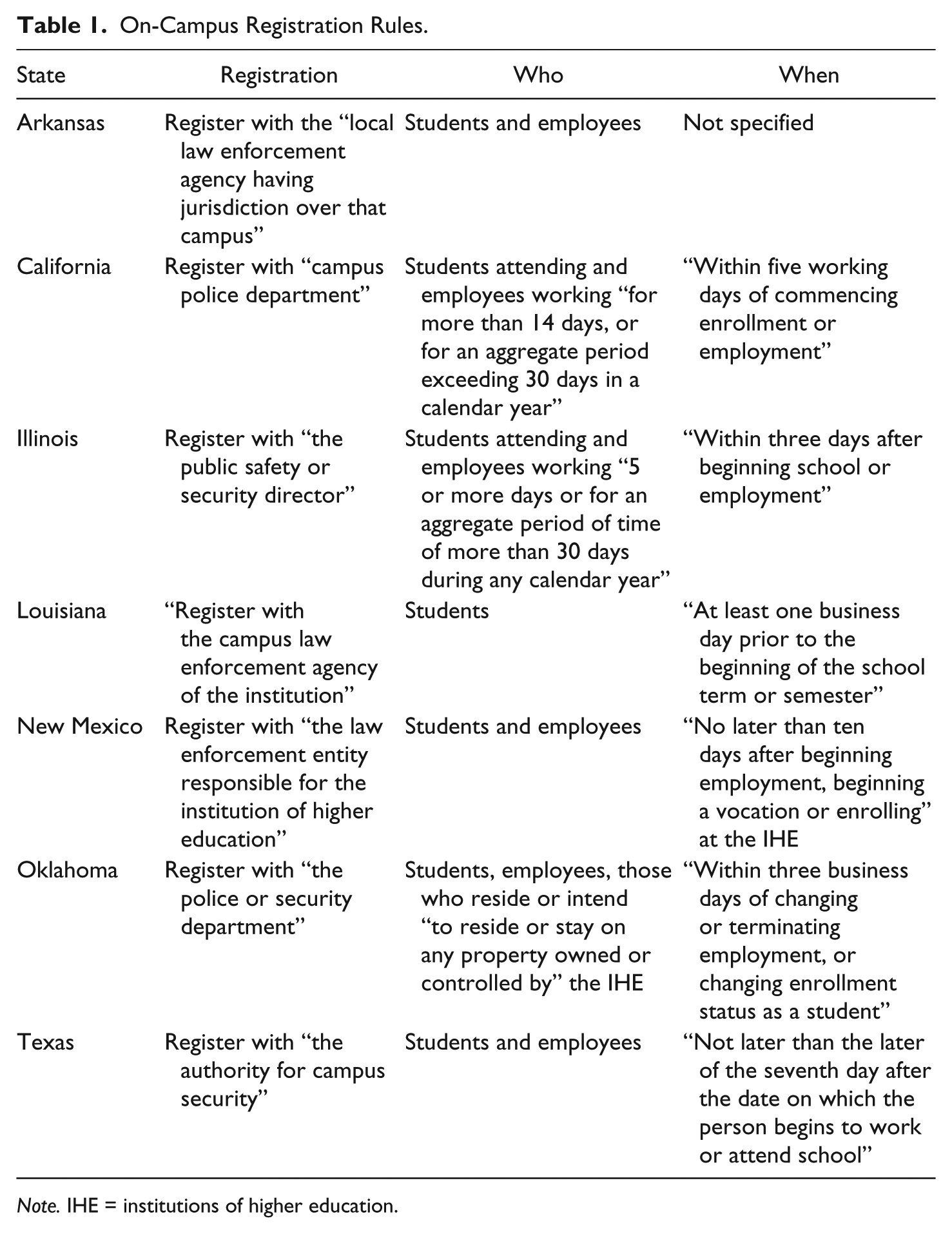
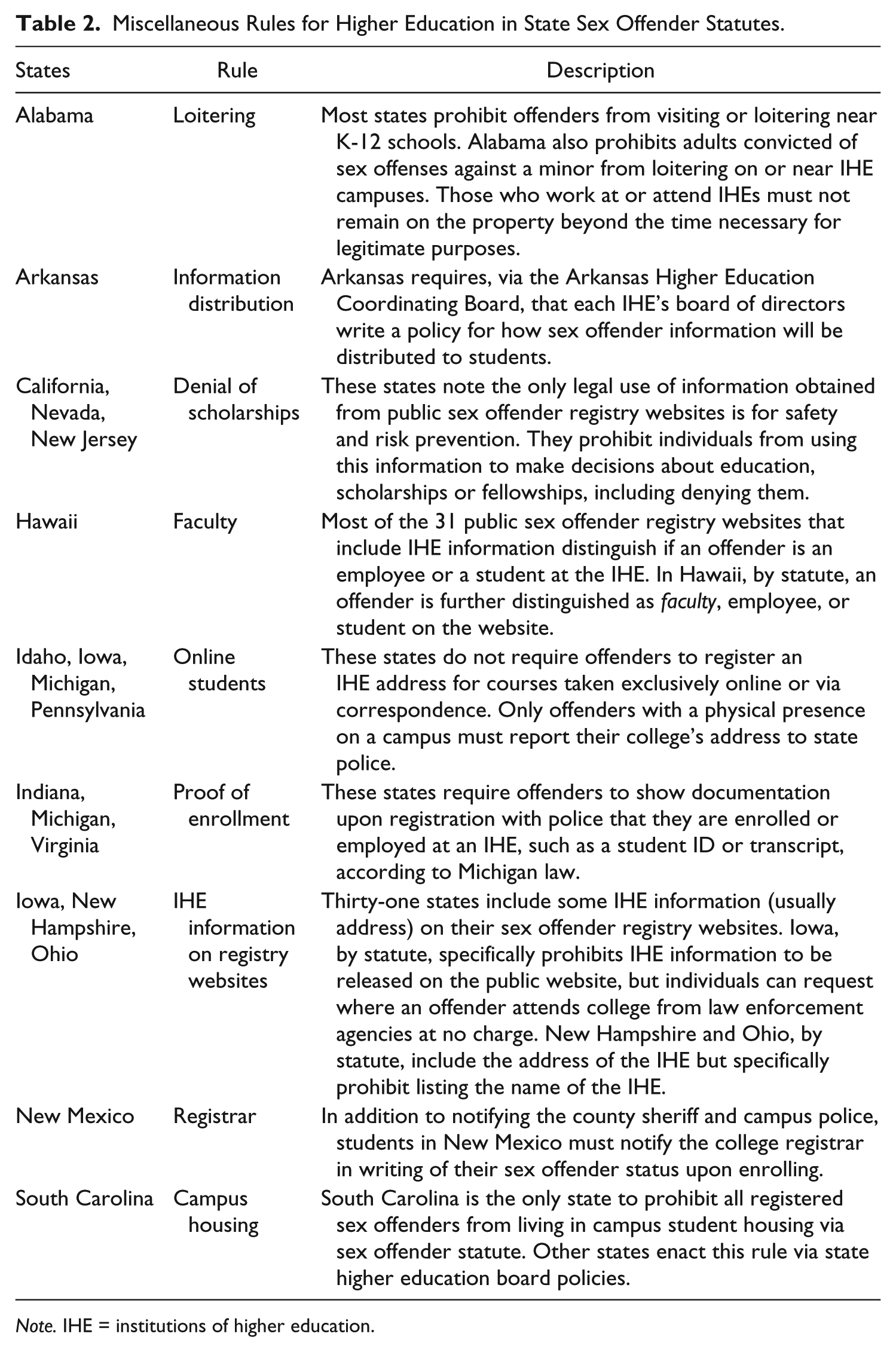
Overall, I found 10 unique rules in 20 states that pertained to higher education, and 35 states and territories did not appear to have any special rules for higher education other than what was required by federal law. The most commonly occurring rule was on-campus registration (see Table 1), and the nine other rules are displayed in Table 2.
On-Campus Registration Rules.
Note. IHE = institutions of higher education.
Miscellaneous Rules for Higher Education in State Sex Offender Statutes.
Note. IHE = institutions of higher education.
On-campus registration
On-campus registration was the most commonly occurring policy (n = 7) in state sex offender statutes that pertained to higher education (Table 1). In addition to reporting IHE enrollment or employment to local law enforcement in the jurisdiction where an RSO resides as per federal law, RSOs in Arkansas, California, Illinois, Louisiana, New Mexico, Oklahoma, and Texas are required to register directly with the campus police department. RSOs are typically required to register the same information provided to other law enforcement agencies, and campus safety departments make that information available to the public upon request. There are differences among the seven states in how campus police departments are described, who is required to register, and when RSOs must register, ranging from 1 day before to 10 days after starting class or work.
Miscellaneous rules
Sixteen states have additional rules for RSO students and/or employees at IHEs (Table 2). The rules address RSO behavior, definitions of students, website content, how the public can use website information, and more. These nine rules further demonstrate wide variation across states.
Online Registries
IHE address
After reviewing laws, I analyzed the content of 56 public sex offender registry websites and found 31 (55%) listed the address and/or name of the IHE where a registrant is enrolled or employed (Table 3). The field is most often labeled “school address.” Brewster et al. (2012), who did not include the territories in their review, found 14 websites listed a registrant’s school address; my finding of 31 websites (26 states, D.C., and four territories) represents a substantial increase in the public dissemination of IHE information over the past four years.
Higher Education Information on Sex Offender Websites and in State Statutes, as of 2016.

Note. IHE = institutions of higher education. Each ‘x’ represents the presence of one element or rule identified by the column. In some cases, ‘xx’ represents two different rules within the same category.
IHE search features
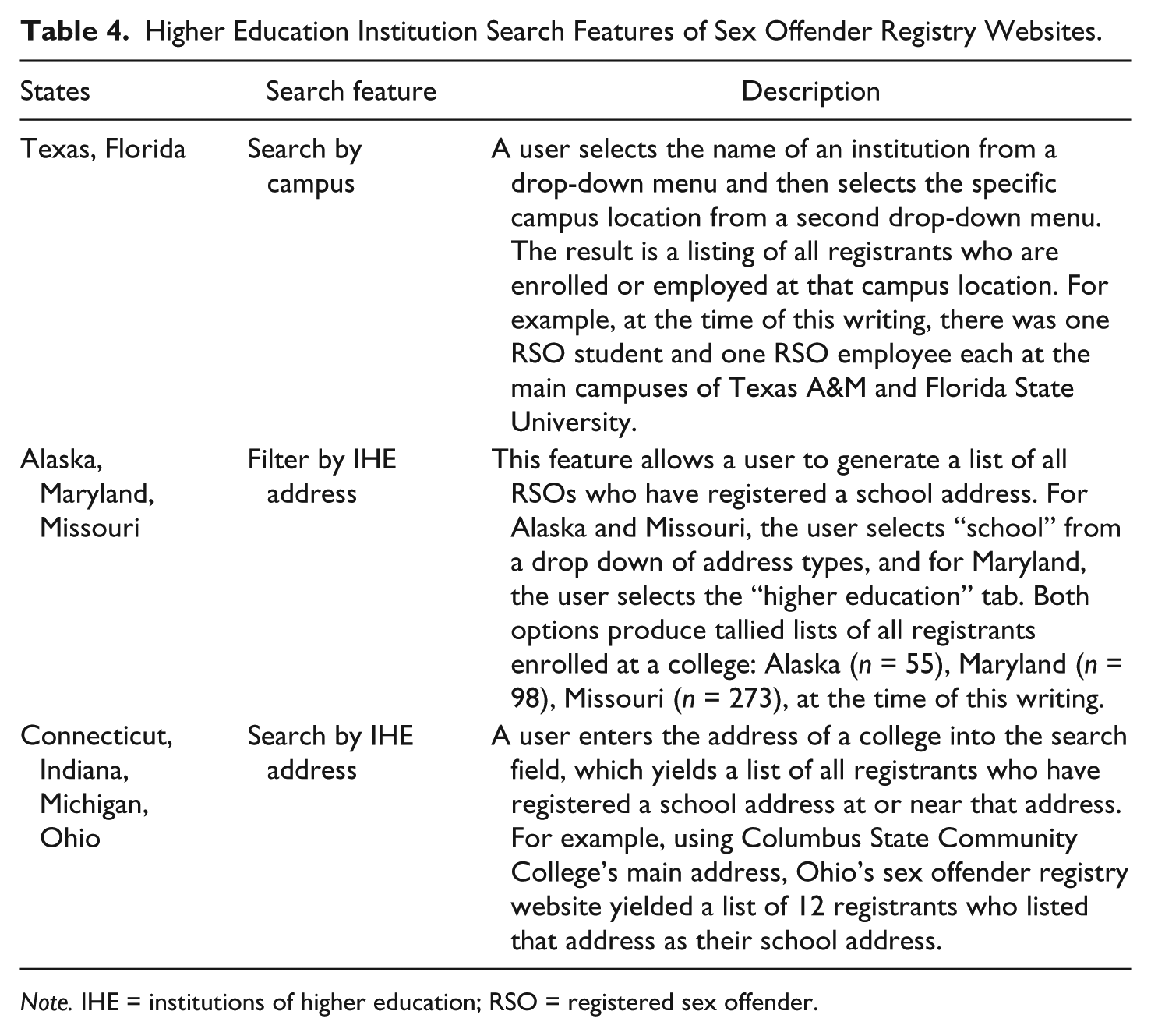
In addition, nine websites allow users to search for offenders by IHE, which is an increase of three from the last analysis (Brewster et al., 2012). There are three variations of this search feature (Table 4).
Higher Education Institution Search Features of Sex Offender Registry Websites.
Note. IHE = institutions of higher education; RSO = registered sex offender.
Across all jurisdictions, there were 65 higher education rules in statutes and features on websites, ranging from zero in some states to as many as four in one state. The average number of rules and features per state was 1.16, the mode was 1, and the median was 1 (Table 3).
Discussion
There are four important findings from this study in response to the research questions. First, there were 10 unique rules for higher education in sex offender statutes across 20 states that have been overlooked in previous studies. Second, within the 10 rules, there was considerable variation in the policy details. Third, 31 states and territories displayed information about a registrant’s college on the sex offender registry website, and nine states allowed users to search for registrants by college name or address. Fourth, there were three distinct variations of those search features. These findings of policy variations are consistent with other studies of sex offender statutes and websites (Brewster et al., 2012; Lytle, 2015; Mancini et al., 2011), and the widely varying higher education rules and features documented here for the first time add to the complexity of sex offender laws.
Some of the higher education rules in state sex offender statutes are punitive and may deter RSOs from enrolling in college. For example, in seven states, students must register with campus police in addition to registering with state police; because federal law already requires state police to share an RSO student’s information with law enforcement agencies at or near colleges, this is a redundant and burdensome requirement. Registrants in Texas and Florida are easily exposed to the campus community because of the campus search feature on the registry website. In New Mexico, RSO students must report themselves in writing to the college registrar, which may be personally humiliating, and it is not clear what the registrar does with that information. In Alabama, RSO students may feel unwelcome by the loitering rule; although it does not prevent RSOs from enrolling, it limits their ability to be on campus. In South Carolina, RSO students are uniformly denied on-campus housing. In these examples, RSO students face harsh rules that no other group of students face. When added to the litany of restrictions placed on the formerly incarcerated (i.e., housing, employment, public assistance, voting, etc.), these rules likely add to a feeling of disenfranchisement. The collateral consequences of sex offender laws on registrants are well documented (e.g., stigmatization, isolation, physical or verbal abuse, loss of relationships, employment, or housing), and punitive higher education rules may contribute to hardships experienced by registrants (Tewksbury, 2005). To avoid these consequences, RSOs may forgo enrolling in college altogether, even though there is strong evidence showing the benefits of higher education for justice-involved individuals (Davis et al., 2014).
Policy Implications
To understand the impact of these policies, it is important to understand the size of the RSO college student population. I use study findings to estimate the number of RSO college students in the United States. Then, I consider policy strategies for improving the accessibility of higher education for RSOs. Finally, I offer an agenda for policy evaluation.
RSO College Student Population
No previous research has estimated the number of RSOs enrolled in college. An unexpected finding from this study uncovered the number of RSO college students in three states: Alaska (n = 55), Maryland (n = 98), and Missouri (n = 273) (Table 4). In each of these states, about 1.5% of RSOs listed on registry websites were college students. 1 It is estimated there are more than 700,000 RSOs in the United States (Harris, Levenson, & Ackerman, 2014), and if 1.5% are students, this could mean there are approximately 10,500 RSOs enrolled in college. Though seemingly small, this represents a unique population of students that has never been quantified or studied. This population might be larger without the restrictive state laws, which is a proposition that deserves testing. Additional research is needed to better estimate this population, to explore RSO college student characteristics, to understand their needs as college students, and to examine outcomes (i.e., academic achievement, graduation rates).
Reducing Collateral Consequences
Assuming some of the identified sex offender statutes inhibit RSOs’ access to higher education, and assuming that completing college is a net benefit to RSOs and to society, I would argue that there is a need to eliminate the punitive rules in state laws related to higher education. However, there appears to be no historical precedence for rolling back sex offender policies. In fact, states continue to add rules, as in the case of Illinois’s adoption of campus-based registration in 2011 (Novak, 2011) and Florida’s adoption of the university search-function on its public sex offender registry website in 2013 (Candea, 2013). Even within the current movement of criminal justice reform, which is primarily focused on relieving nonviolent drug offenders of lengthy prison sentences, it is unlikely that state policymakers will become sympathetic to RSOs. Instead, proposals that reduce collateral consequences for registrants and minimize making policymakers appear soft on crime are more feasible (Wagner, 2010), as described next.
Although some of the state rules are punitive, others are designed to protect the rights of RSOs in college. In three states, rules protect RSO students from being denied education, scholarships, or fellowships based solely on information from the sex offender registry. Four states do not require RSOs who are exclusively enrolled in online education programs to register a school address. Many institutions of all types (public and private universities, community colleges, for-profit institutions) increasingly offer fully-online courses, degrees, and certificate programs (Bejerano, 2008). This rule for online students encourages students to enroll in online programs while protecting their privacy as students. Even more broadly, 25 states do not list a school address on a registrant’s public profile. Although that information is still collected and distributed per federal law, the public in these states does not have immediate access to where a registrant attends college. Implementing these policies nationwide could protect the rights of RSOs attending college and could shield them from stigmatizing public exposure. As a final policy recommendation, policymakers should refrain from implementing additional rules for RSOs in higher education until more evidence is available to evaluate costs, effects, and unintended consequences (Mancini et al., 2011).
Policy Evaluation
In addition to the recommendations for future research offered above and in the following section, this study illuminates the need for policy evaluation. Because there have been no policy evaluations conducted on these higher education rules for RSOs, evaluations are warranted in the areas of needs, theory, implementation, impact, and efficiency (Rossi, Lipsey, & Freeman, 2004). I use the New Mexico law as an illustrative example throughout this section (Table 2), but the following proposals could be applied to each of the state policies identified in this study. First, a needs evaluation might uncover the extent of the “problem” of RSOs in higher education. Research is needed to estimate the RSO college student population and to consider what policies, if any, are needed to control them. For example, how many RSOs in New Mexico are college students, and is there a need for them to report to the college registrar? A parallel line of research might explore policy theory. What is the intended outcome of requiring RSO students in New Mexico to report to the registrar? Next comes policy implementation. How do college registrars in New Mexico collect information from the RSO students, and what do they do with that information? How does the state of New Mexico enforce this rule? Importantly, impact evaluation is needed to examine the outcomes of the policy. Does having RSO students notify the registrar reduce recidivism? Are there any unintended consequences (i.e., reduced enrollment, collateral consequences for RSO, broader societal impacts)? Finally, if there is an observed effect, efficiency analysis is needed to weigh the costs against the benefits. What is the cost of enforcing this rule for the state and higher education institutions, and how does the cost compare to the observed benefits? In absence of prior research, any of these forms of policy evaluation can contribute to a better understanding of these unique rules in state laws.
Limitations
This study has several limitations. First, this review was limited to state sex offender statutes. I did not review states’ higher education policies or other laws where there may also be provisions for sex offenders. Second, in my review of statutes, it is possible that I missed rules that should have been included. Although I reviewed each statute twice, some are much longer and more complex than others, increasing the possibility that I missed a relevant rule. Third, despite mentioning rules for employees throughout, my analysis was focused on students. Many more laws within a state restrict the employment of RSOs at IHEs, and future research should explore variations in employment laws for sex offenders working in higher education. Fourth, it was outside of the scope of this article to examine sex offender policies at the institutional level. Hundreds of higher education institutions operate campus-based sex offender registry websites (Tewksbury & Lees, 2006), and many also have policies addressing the admission, employment, and housing of sex offender students on campus. Additional research is needed to explore institution-level policies and the extent of variation across institutions. Finally, these findings were observed in October 2016, and additional research is needed to track changes in the laws. With this baseline inventory of policies, additional policy research can be conducted on how, when, and why these rules for higher education were implemented.
Conclusion
This study of state sex offender statutes uncovered 10 unique policies across 20 states that affect RSO students, RSO employees, or institutions. In addition, 31 states included information about a registrant’s college on public sex offender websites, and nine allowed users to search for registrants by institution name or address. This evidence extends the research literature on variation in sex offender policies by adding a new layer of complexity. It also has serious implications for RSOs. These rules may be significant barriers for RSOs seeking higher education. If, as the literature suggests, higher education is an effective rehabilitation strategy for returning citizens, any policies that limit access to RSOs could be detrimental to both the individual and society. Additional policy research is needed to understand the impacts of the state laws identified in this study.
Footnotes
Appendix
Declaration of Conflicting Interests
The author(s) declared no potential conflicts of interest with respect to the research, authorship, and/or publication of this article.
Funding
The author(s) received no financial support for the research, authorship, and/or publication of this article.