



Abstract
Volunteer police are used in both the United States and the Unite Kingdom to expand the services provided by full-time police personnel. The models of volunteer policing that have developed in the United States and the United Kingdom are based on the same concept, but differ in their level of operational preparedness and training. The utilization and confidence of these volunteer police in performing the functions of the police has been understudied. This current study builds on previous studies to develop a broader understanding of the confidence in training of part-time volunteer police officers by using a convenience sampling of three U.K. Northern Police Forces and three U.S. Florida Sheriff’s Offices. Results show the impact of individual-level variables on confidence in training preparation, with time since initial training having the largest impact. Later formal professional training appears to have little to no impact on confidence. Limitations and policy implications are discussed.
Introduction
The use of volunteers to assist the government in providing services can increase civic engagement and collaboration in governance (Wolf, Pepper, & Dobrin, 2017; see also Bryer, 2015). As a government service, policing is no exception, and volunteer police officers are used in many countries throughout the world to supplement the duties of regular, paid police officers. Volunteer police officers can be found in countries where at some point in history there was a British influence, including the United Kingdom, Ireland, Hong Kong, India, Singapore, Canada, the Bahamas, the Cayman Islands, the United States, and New Zealand. To a lesser degree, they can also be found in countries without English roots, including China, Russia, Israel, Hungary, Germany, and the Netherlands (Bartels, 2014). In many communities, volunteer police may be more representative of the demographics of the community being policed than the regular police force (Newburn, 2008; Pepper & Wolf, 2015). Volunteer police can be used to provide routine police services, such as foot or vehicle patrol, or more specialized functions, such as horse patrols, emergency response teams, or investigations. The community volunteers who serve in these roles receive varying amounts of training, authority, and responsibility based on the geographic location where they are used, state and local laws or federal regulations, and the duties for which they are responsible (Dobrin, 2017b).
The modern U.S. system of policing is largely based on the same model that developed in the United Kingdom, and is founded on the Metropolitan Police Act of 1829, which was introduced by Sir Robert Peel. Although volunteer police had been used throughout Anglo-Saxon history, British Parliament passed the Special Constable act in 1831, which formed the basis for modern-day volunteer policing in the United Kingdom. The U.S. system of volunteer policing is based on this U.K. model (Dobrin, 2017b). In the history of the United States, volunteers supplemented police in a variety of ways, and many of today’s volunteer units grew out of Civil Defense units during World War II (Greenberg, 1984, 2005).
Today, in the United States, these volunteers are typically called reserve or auxiliary police officers, but may have other various titles (including special deputy, special constable, peace officer). They are generally characterized into two ways: those with “sworn” powers (the power to make an arrest) and those without these powers. Because of the vast decentralization in the United States of law enforcement agencies, jurisdictions, and policies, it is nearly impossible to create a standard definition of volunteer police in the United States. 1 In the southern and western United States, these volunteers often complete some level of police training and have at least some police powers (such as arrest). In the northern and eastern United States, it is far more common to find volunteer police with no police powers, very little training, and the authority only to act as the “eyes and ears” of the police (Dobrin & Wolf, 2016; see also Wolf, Holmes, & Jones, 2016). To add to the confusion, an “Auxiliary Police Officer” may be defined in one state as a volunteer with partial or full-law enforcement power, and in another state the same title might be used to define a volunteer with no police power or authority.
Today, in the United Kingdom, special constables serve as volunteer unarmed citizen police officers with full police powers (rather than calling these powers “sworn” as in the United States, the United Kingdom denotes these as “warranted”). They are used in every U.K. territorial police service with the exception of the Police Service of Northern Ireland. Although special constables have the same powers to uphold the law as their full-time counterparts, they have significantly less initial training, and often work in teams but can receive additional on-the-job training to work in a solo capacity (Wolf et al., 2016). Across England and Wales, the process for recruiting and selecting special constables is standardized. Special constables are trained through elements of the Policing National Curriculum traditionally taught over weekends and evenings in the “Initial Learning for Special Constables” (IL4SC). Once initial training is complete, special constables receive their authority as a police officer and begin mentored accompanied patrol (Wolf et al., 2016).
Although the number of volunteer officers in the United States is poorly documented, recent research has found there may be as many as 58,500 sworn auxiliary or reserve volunteer police officers and volunteer sheriff’s deputies (Dobrin, 2017a), with another 19,000 nonsworn reserve and auxiliary police and sheriff’s deputies in the United States for a total of more than 77,500 sworn and nonsworn volunteer police (Dobrin, 2017a; Dobrin & Wolf, 2016). It is also estimated that there are as many as 16,700 special constables across England and Wales, and another 5,000 in the boroughs of London. Therefore, volunteer police make up about 12% of the 635,781 full-time city and county police officers in the United States (these numbers exclude state and federal officers; Dobrin, 2017a; Federal Bureau of Investigation [FBI], 2016), and volunteer officers make up about 17% of the number of full-time police (127,000) in the United Kingdom (Dobrin & Wolf, 2016; Wolf et al., 2016). These numbers indicate that volunteer police are an important piece of the police organization in both the United Kingdom and the United States, but remain relatively understudied in academic literature.
Review of the Literature
Volunteer Policing in the United Kingdom
Volunteer policing across England and Wales continues to evolve in terms of the needs and expectations of the service for which they volunteer. The role of the contemporary special constabulary, trained volunteer police officers, continues to be focused on supporting, working alongside, and supplementing regular police officers conducting their lawful duties (Newburn, 2008; Stuart, 2008). The volunteer special constabulary has a long history, it was first formally recognized in 1662 (Swift, 2007). In 1831, the role of the special constabulary was brought more in line with that of a police officer, when on-duty special constables were given the same warranted powers as a regular police officer. In the 1950s, the special constabulary had some 67,000 volunteers (Gaston & Alexander, 2001), but the number has fallen over recent years (College of Policing, 2017; Dhani, 2012).
New regular full-time police officers across England and Wales are educated and trained to a National Occupational Standard (NOS) through the Initial Police Learning and Development Programme (IPLDP), which forms part of the National Policing Curriculum. Stuart (2008) acknowledges that volunteer special constables are unlikely to have the opportunity to achieve the NOS requirements of a regular police officer, but should be given the chance to develop the appropriate knowledge, skills, and abilities to perform their role.
A national training program has been adapted from the IPLDP and adopted for the special constabulary, which trains new special constables up to the level of “safe and lawful accompanied patrol”; however, the program does not currently lead to any formal qualification and has some variation as to how it is delivered. This IL4SC program covers criminal law and procedure, human rights legislation, decision-making models, use of police equipment (such as police radios and batons), custody procedures, searching individuals, officer safety, and first aid. The program is delivered locally within each police force, and can vary. For example, Durham Constabulary (2017) deliver the IL4SC across a number of phases, which includes an induction weekend, evening classroom-based learning over 19 weeks, and online study, followed by a block week of personal safety training; this is followed by “work-based” tutoring, leading to accompanied patrol and is then extended beyond the IL4SC to enable independent patrol after 52 weeks. Whereas in North Yorkshire Police (2017), special constables study the IL4SC over 26 full days, online study, and a block week, with new special constables usually achieving accompanied patrol and then again extending to independent patrol after 60 weeks.
Durham Constabulary (2015) estimate the costs of training and equipping a special constable as being just over £1,350 (US$1,760) and providing the uniform and equipment as just under £500 (US$650), far less expensive than training a full-time regular officer, although the cost of equipment is similar.
Volunteer Policing in the United States
The U.S. system of government prides itself on being representative of the people, and protecting the right of state and local governments to control policy. This decentralization has allowed states and local jurisdictions to have their own laws, regulations, and rules—including those governing the use and utilization of volunteer police (Greenberg, 1984). This decentralization can be clearly seen in the more than 18,000 law enforcement agencies in the United States (FBI, 2016), most with less than 10 officers (Blair, 2010). Whereas some police agencies in the United States utilize volunteer police with the same authority, training, and responsibility given to full-time personnel, other jurisdictions sharply curtail the ability of citizens to use police powers (Wolf, Pepper, & Dobrin, 2016, Wolf, 2013).
The fact that all U.S. police are armed also separates them from their counterparts in the United Kingdom. Whereas U.K. special constables may carry handcuffs, a baton, and capsaicin spray, most jurisdictions in the United States authorize their volunteer police (with the proper training) to carry firearms. Arming of volunteer police is not consistent across the United States (particularly the Northeast), but in Florida, the state of focus for this research, volunteer police are armed (Wolf et al., 2016; see also Wolf & Beary, 2010).
Florida volunteer police are categorized in two ways: auxiliary police with less training and less authority than full-time police, who must be supervised by—or in contact with—a fully certified officer; and, part-time police who can be paid or volunteer but who have equal authority and training to their full-time counterparts, and are fully certified in the state of Florida as law enforcement officers (Wolf, 2014; Wolf & Beary, 2010). Fully certified full-time and part-time law enforcement officers in the state of Florida must complete a law enforcement academy of approximately 800 hr and successfully pass a state exam for certification. Auxiliary officers must complete an auxiliary academy of more than 319 hr (soon to increase by 40 hr). Law enforcement agencies also require all new recruits to complete some level of on-the-job training, called “field training” under the supervision of a specially trained field training officer (Pepper & Wolf, 2015). In addition to state-mandated training and field training, law enforcement officers in the state of Florida must complete at least 40 hr of mandatory retraining every 4 years, but most agencies require far more than that in ongoing retraining.
Whereas U.K. police services have mandatory maximum ages to continue to serve (Coles, 2017), more than 80% of the 100 largest local police agencies in the United States do not have a mandatory retirement age (Pascarella, 2006). This means that when U.S. law enforcement officers are able to retire, they may be interested in staying with their agency as a volunteer police officer. A portion of the volunteer police who serve in the United States are former full-time regular officers who have retired or left regular service (Ferranto, 2011; Hunter, 2012; Pepper & Wolf, 2015).
Research Question
Police organizations in the United States utilize volunteers in a variety of different ways, with varying amounts of authority and responsibility. Police organizations in the United Kingdom utilize volunteer police to perform general policing functions with substantially less initial training than their full-time counterparts. The researchers for this current study developed the following research question:
Method
Sample
The data for the current study were collected to supplement data used in previous related research (see Pepper & Wolf, 2015; Wolf et al., 2017). The original sample included volunteer special constabularies from the Cleveland (U.K.) Police and volunteer reserve deputies from the Orange County (Florida) Sheriff’s Office (OCSO). Using the identical survey, the current sample added two new agencies from the United Kingdom: the North Yorkshire Police and the Durham Constabulary. Two additional Florida agencies were also added: the Palm Beach County Sheriff’s Office (PBSO) and the Brevard County Sheriff’s Office (BCSO).
The affiliated universities’ institutional review board (United States) and Ethics Committee (United Kingdom) approved of the research, as did the authorities in each of the police agencies. Informed consent was obtained from each respondent, and confidentiality was assured throughout the data collection, analysis, and reporting of the findings. The agencies were selected by convenience. The affiliated researchers selected large nearby agencies within which they had professional contacts. Paper surveys were distributed during a regularly scheduled monthly meeting in each of the volunteer units, and those who attended the meetings were the sampling pool, except in the case of the North Yorkshire Police. Distribution at a meeting was not possible, so the surveys were distributed using their internal police mailing system to 100 special constables, receiving 21 responses. Thirty-one of the 32 attending Cleveland Police participants responded, and 16 of the 25 attending in Durham participated. In the Florida agencies, 41 of the 47 OCSO attendees, 28 of the 28 BCSO attendees, and 36 of the 39 PBSO attendees completed the surveys. The total sample was 173 respondents.
Recognizing the convenience sampling bias of the agency selection, and the self-selection biases of the respondents who attended the meetings in which the survey was distributed (or responded to the email in North Yorkshire), and also the self-selection bias of those who filled out the survey, the researchers acknowledge that various probability sampling techniques would have enhanced the overall reliability of the data. The external validity, or the ability to generalize the current research findings across a much wider population of police volunteers, is limited by these restrictions. However, utilizing six different agencies for the current research, three each from two different countries, adds to the generalizability of the data.
The survey solicited various information on demographics, years of service, and training, presented in Table 1. Missing data made up for less than 5% of responses and were not found to be systematically present. A little more than 60% of the sample was from the United States/Florida, and more than 86% were male. The sample skewed a bit older, 26.6% were above 55 years and 40.5% were 35 to 54 years, but this may be an indication of the utilization, in the United States, of retired police officers to serve as volunteers. With the average age for police officers nationwide in the United States being 39.6 years (Data, 2017), and almost half of all English police are above 40 years (Hales, 2017), the current sample is likely older given that 31.8% were between the ages of 18 and 34 years. There is very little information on the general demographics of volunteer police (see Dobrin & Wolf, 2016), but the data presented here are consistent with the one study that does try to estimate these distributions in the United States (see Wolf, Albrecht, & Dobrin, 2015).
Descriptive Statistics (n = 173).
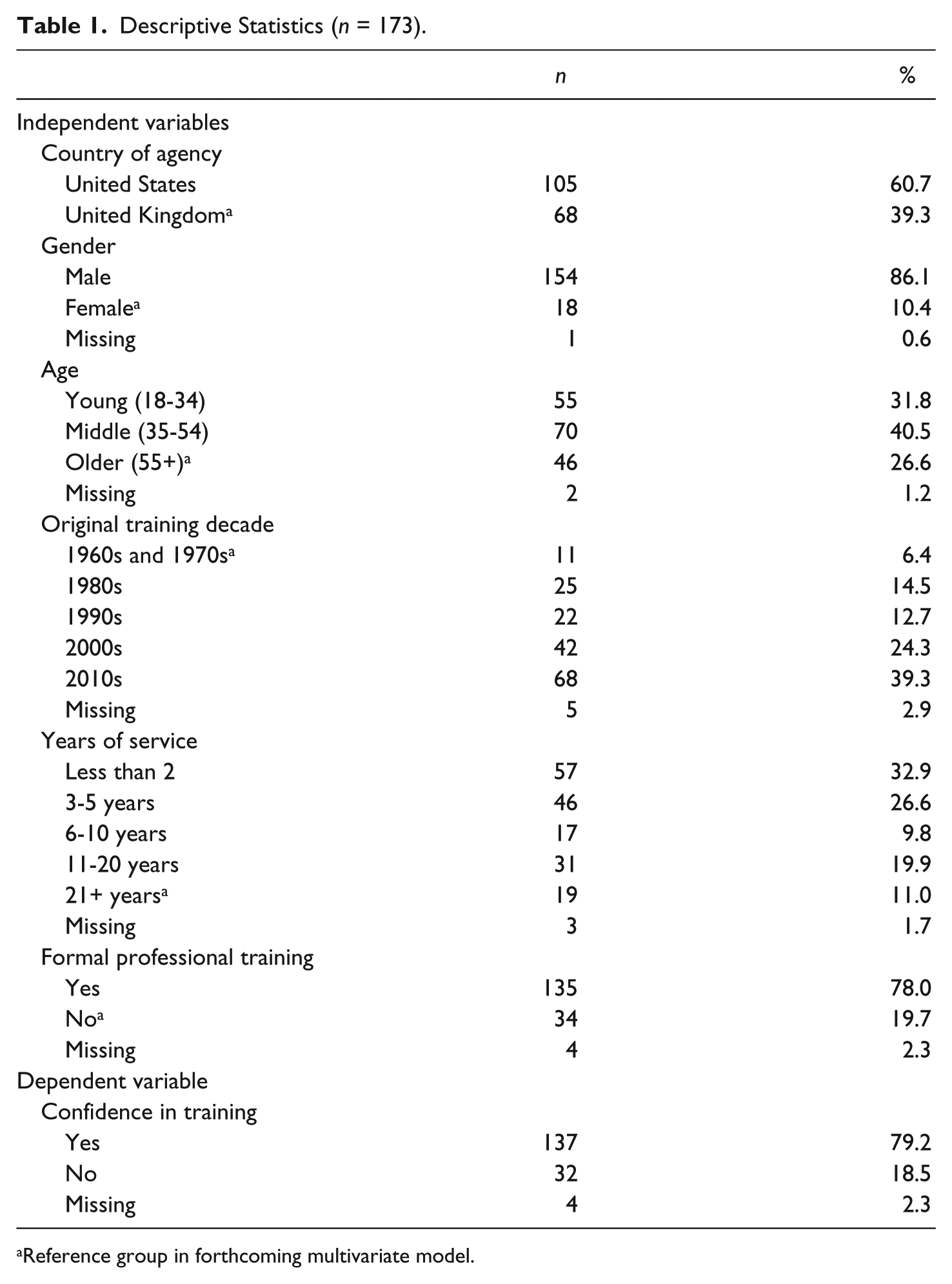
Reference group in forthcoming multivariate model.
There is great variation among the respondents when indicating the decade in which they first began their training. Almost 40% were trained in the 2010s, making them relatively new officers. Almost a quarter (24%) of the sample trained in the 2000s, and the numbers decrease (as would be expected) as the decades go further back. Most of the officers (23%) had less than 2 years of service, and 27% had 3 to 5 years.
The dependent variable of interest is a dummy variable that asked, “Do you feel that the initial training prepared you for operational policing?” Later analyses are presented that examine the impact of individual-level variables on confidence in training preparation. Almost 80% of the sample reported that they had confidence in their training.
Analysis
Bivariate chi-square tests (not depicted) were done with each of the independent variables in Table 1 with the dependent variable of confidence in training, showing whether the observed proportional difference were significantly different than expected. The only two that differed significantly were those who had their original training in the 2010s (χ2 = 7.203, p < .01), and those with 6 to 10 years of service (χ2 = 6.092, p < .05). A correlation matrix (not depicted) was done to test for the interconnectivity of the independent variables. None of them breached the conservative 0.6 threshold. Furthermore, training decade and years of service (all of them, including 6-10 years) were not significantly correlated at the .4 threshold (−.226 for 6-10 years). If they were, it would suggest the same phenomenon is being measured, but they are unlikely to be measuring the same concept. Finally, tolerance and variance inflation factor tests for multicollinearity were conducted (not depicted). Tolerance estimates that fall below the conservative threshold of .2 and have variance inflation factors greater than a conservative 10 are unsuitable for estimation in a multivariate model. None of the identified variables breached these thresholds, which indicated that they are suitable for estimation in multivariate modeling (see Menard, 2010).
The multivariate model that was used to predict confidence in training employed binary logistical regression (see Table 2). The 13 variables predicted 20.6% of the variance in the respondents’ confidence in their training. Despite this relatively high r2 score, only one variable was a significant predictor of confidence in training (i.e., having received your original training after 2009). Respondents who reported that they received their original training after 2009 were 10.91 times more likely to feel confident in their training (b = 2.390, p < .05), controlling for the other variables. The confidence in training reduces as time from training increases, with those trained in the 2000s were 4 times more confident, those in the 1990s 1.76 times, and those who trained in the 1980s had a 1.34 times reduction in confidence.
Binary Logistical Regression Model Predicting Confidence in Training.
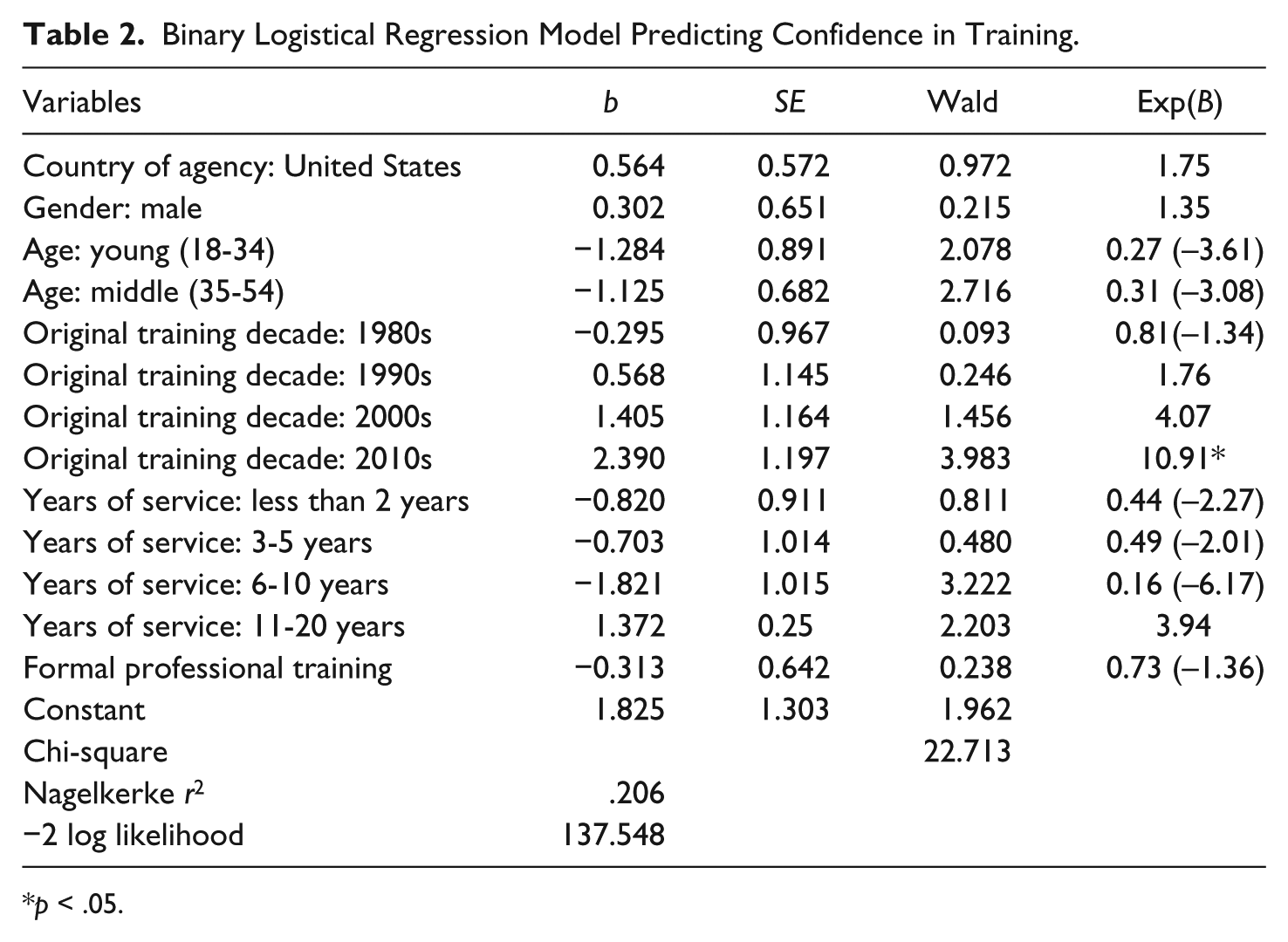
p < .05.
As expected from the crosstabs discussed above, 6 to 10 years of service had a substantial odds ratio (the inverse was calculated for ease of interpretation, −6.17), but it was not significant. It appears that less than 11 years of service reduces confidence in training, but more than 11 increases it, net the other control variables. Americans are slightly more confident in their training than their English counterparts (nonsignificantly), and formal professional training appears to have little to no impact on confidence.
Limitations
As noted above, the primary limitations for this study result from the convenience sampling techniques used to collect the data. The agencies are not statistically representative of agencies within their respective countries, nor are the samples from each agency a probability sample. Future research needs to take into account probability sampling techniques to increase reliability and validity. However, for exploratory research, the initial findings from these data are meaningful.
An additional limitation is that this study is measuring the confidence in training, not the actual capabilities of the volunteer officers after training (Camp, Auten, Fuller, Locklear, & Locklear, 2013; McCarty & Lawrence, 2016). This is an important distinction. Officers may be capably trained but have low confidence in themselves or their training, or poorly trained with an inflated sense of capabilities (Kruger & Dunning, 1999). The relationship between training, confidence in training, and the actual performance of volunteer officers is the next needed step in this research topic.
Discussion
Police training is a critical element of public safety (Bradford & Pynes, 1999; Marion, 1998; Ness, 1991). Inadequately trained officers are a potential risk to themselves and the community. As volunteer police officers are often tasked to do the same jobs as full-time officers, they must, therefore, be adequately trained to carry out policing duties. The variation in training of volunteer officers in both the United Kingdom (variation from full-time officers primarily) and the United States (variation between states and between different agencies primarily, but also variation between full-time and volunteers) highlights the need for policy makers to dedicate evidence-based actions to guide the training guidelines for volunteer officers.
The training that both full-time and volunteer officers receive, both in the United Kingdom and the United States, has focused on skill-based training, legal issues, physical capabilities, and agency protocols. What current police training often fails to do is teach critical thinking and field-based problem solving approaches or skills. Police academy training has struggled to stay current and to be consistent with the roles and functions that police play in modern society (Bradford & Pynes, 1999). Police officers value training that is interesting and engaging and that is applicable to their role and their responsibilities (Oliva & Compton, 2010). As policing has become more and more sophisticated over time, it has become even more important to implement a problem-based learning approach to academy and in-service training. Both the U.K. and U.S. models utilize problem-based learning in field training, but initial training could be improved by including common field situations and applying them to information learned in the classroom regarding specific legal authority, evidence collection, communication skills, officer safety skills, and possible appropriate uses of force (Makin, 2016).
The current study shows that confidence in training is affected by how recent the training of the volunteer officer has been, both in the United States and the United Kingdom. This may be a result of a boost of confidence that follows the intense training in the initial police training academies that decays over time. It may also be a recognition of peak performance immediately after intense training, and the declining confidence reflects declining performance potential. Regardless, policy makers should recognize this declining confidence in training that volunteer police officers manifest over time and respond by requiring ongoing meaningful training of the volunteer officers to maintain confidence in training.
Future research will need to look at the variation between the confidence in training volunteer officers have in agencies that have rigorous continuing training programs as compared with those with relaxed training standards. In addition, it would be useful for researchers to compare the impact of decay in confidence from initial training of volunteer officers with the same possible decay in confidence of full-time officers. And finally, as noted above, the relationship between confidence in training and actual performance of volunteer officers would be worthwhile data to guide evidence-based policies for volunteer police.
Footnotes
Declaration of Conflicting Interests
The author(s) declared no potential conflicts of interest with respect to the research, authorship, and/or publication of this article.
Funding
The author(s) received no financial support for the research, authorship, and/or publication of this article.