



Abstract
Researchers interested in registered sex offenders (RSOs) and sex offender registration and community notification laws (SORN) legislation have noted that there is a perpetual moral panic associated with the topic. Community members frequently call for increased crime control policies to monitor RSOs, despite the research suggesting these laws do not effectively reduce recidivism levels for this offender group. The current study seeks to predict participant support for punitive change to the registry and SORN legislation, based on the idea that a perpetual moral panic continuously exists concerning RSOs. Using a stepwise ordinary least squares (OLS) regression analytical approach, the findings suggest that the theoretical elements of a moral panic are strongly predictive of punitive support and mediate other predictor variables normally associated with punitive attitudes toward sex offenders and the sex offender registry.
Introduction
The supervision of sexual offenders has been a constant topic of debate and concern for community members and legislators alike. Since the early 1990s, a slew of legislative reforms have been passed at the state and federal level to supervise sex offenders postconviction, and to notify community members about where these sex offenders reside. Beginning with the Jacob Wetterling Act of 1994, federal mandates required states to establish a state sex offender registry. Two years later, Megan’s Law (1996) required states to comply with federal legislation mandating community notification of registered sex offender’s (RSO) demographic and residence information postconviction. More commonly known as sex offender registration and community notification laws (SORN), these separate legislative efforts have continued to expand and have subsequently created a more restrictive environment for RSOs to reside while living under different aspects of sex offender laws as applied to the registry system (Burchfield, Sample, & Lytle, 2014).
Many of these policy expansions are thought to be the result of the public’s fear of RSOs and the myths surrounding this offender group. Researchers have suggested that many community members believe sex offenders to be chronic recidivists who cannot be rehabilitated (Dowler, 2006), and who are likely to rape and abduct children (Sample & Kadleck, 2008). However, the community often believes what it ingests; the role of the media is a strong influential factor in promoting and perpetuating these myths about RSOs (Galeste, Fradella, & Vogel, 2012; Klein, 2016). The strong concern or anxiety associated with sex offenders and the consequential calls for increased punitive or restrictive legislation are often classified as being part of a moral panic (Cohen, 1972, 2002).
Moral panics, as originally theorized by Cohen (1972) and later expanded by Goode and Ben-Yehuda (1994), suggest that communities fear a specific group—the “folk devil”—and react accordingly to the level of fear and anger associated with the threat. However, typically moral panics flare and fade away rather quickly. When discussing the moral panic associated with sex offenders, the panic has not faded as originally theorized (Burchfield et al., 2014). This article examines the theory that a perpetual panic is occurring, and because of its continuous nature, community members are likely to be more punitive toward sex offenders as a way to control the perceived threat that they pose. Using a sample of 877 community members, this study examines the factors that influence support for increased punitive behaviors and legal changes to the sex offender registry in general. The results are viewed from the theoretical lens of a moral panic to evaluate how the elements proposed by Cohen (1972) will have an impact on community members’ support for punitive change in legislation.
Background
As previously discussed, the legislation of the early 1990s was mandated as a way to control and supervise sex offenders while increasing community member awareness of the whereabouts of sex offenders postconviction. These laws are associated with unintended consequences, and researchers have consistently documented that RSOs have problems with unemployment (Klein, Tolson, & Collins, 2014; Tewksbury, 2004, 2005; Tolson & Klein, 2015); finding permanent, suitable housing (Chajewski & Mercado, 2008; Levenson & D’Amora, 2007; Tewksbury, 2007; Zgoba, Levenson, & McKee, 2009); and experience verbal or physical harassment from community members (Tewksbury & Lees, 2006) as a result of SORN laws. These laws were meant to provide formal and informal social controls over RSOs to reduce recidivism while providing protection for community members, but research has suggested that the opposite has occurred. RSOs have reported feeling socially isolated from their communities and have experienced a breakdown in personal relationships postconviction, which is associated with recidivism (Bailey & Sample, 2017; Levenson & Cotter, 2005; Tolson & Klein, 2015). Although research suggests that there is a correlation between SORN laws and the aforementioned unintended consequences, community members could still learn about an individual’s registered status through other means besides accessing the registry. Informal notification structures, such as news being passed via word of mouth, can contribute to social isolation. Others may have problems finding employment due to background checks and felony reporting laws. However, SORN legislation is still the primary mechanism through which these unintended consequences occur.
The majority of research suggests that these laws have had no effect in reducing recidivism, which was one of the original goals of SORN legislation (Levenson & Cotter, 2005; Levenson, D’Amora, & Hern, 2007; Sample & Kadleck, 2008; Tewksbury & Lees, 2006). In one of the few studies that does suggest a reduction in recidivism, Vasquez, Maddan, and Walker (2008) report a statistically significant reduction in rape recidivism in Hawaii, Idaho, and Ohio. However, when those three states are studied, in the aggregate of the 10 states examined in the study that reduction in recidivism disappears. Vasquez et al. (2008) conclude that, “taken collectively, the findings reported here indicate that sex offender registration and notification laws have had little general deterrent effects on the incidence of rape offenses analyzed” (p. 188).
Often SORN laws are described as inefficient and emotionally driven laws that serve a memorial purpose after high-profile crimes occurred, specifically when the crimes were against children (Surette, 2011). Although ineffective in reducing RSO recidivism levels, these laws have served their emotional and symbolic purpose for community members in identifying the perceived threat (Sutherland, 1950). As the basis of supporting a moral panic, the opportune moment to pass this type of legislation is when fear is high and when blame can be attributed to a specific occurrence, such as the sexually based homicides of Jacob Wetterling, Megan Kanka, or Adam Walsh (Valier, 2005). Moral panics are often present when a specific group is feared, and when there is a large call for the target group to be contained, often with a punitive response, such as with SORN laws (Cohen, 1972, 2002; Goode & Ben-Yehuda, 1994).
The Development of a Moral Panic
For a moral panic to occur, Cohen suggests that a “folk devil” must be identified (1972); in this case, RSOs are the targeted group. The folk devil group is used as a moral scapegoat for communities, allowing individuals to use the deviant group as an example of what behaviors are wrong and that contradict societal norms (Klein, 2014). In addition, moral panics are said to be comprised of five elements: concern, hostility, consensus, volatility, and disproportionality (Goode & Ben-Yehuda, 1994). Concern suggests that individuals are aware of the threat that the RSOs pose, and are worried that they might be directly or indirectly targeted by this folk devil group. However, concern cannot be equated with fear, as fear suggests the threat from RSOs is imminent (Best, 1990). Prior to the legislation of the 1990s, the issue of sexual offenders may have been one best described as “out of sight, out of mind.” Yet, as all states were mandated to create sex offender registries, and later make them available online, the public has had the opportunity to identify any and all RSOs living in their immediate vicinity. Yet, as one study suggests, that even when RSOs live in close proximity to community members (within one tenth of a mile), only roughly 31% of residents are aware of the RSOs’ presence despite community notification efforts (Craun, 2010). This brings concern over the alleged threat that RSOs may pose to the forefront of community member attention, and makes them active participants in the continuation of the panic (O’Hear, 2008). Furthermore, as Burchfield et al. (2014) suggest, states with mandatory reporting laws create environments in which community members are forced to participate in the panic, regardless of whether they want to.
The element of hostility reflects the level of community anger directed toward RSOs and extends to the perceived threatening behavior. This hostility allows for the majority to situate themselves apart from the folk devil group, creating an “us and them” environment (Cohen, 1972, 2002), consequentially isolating RSOs and marking them as predators (Jenkins, 2004; Tolson & Klein, 2015). Societal consensus was developed as the third element of Cohen’s moral panic argument, illustrating the need for overarching agreement among communities. Researchers suggest that the constant attention paid to the issue of RSOs by community members indicates that consensus is present among the majority (Fox, 2013). Once the majority is united against the folk devil group, they will take action against the RSOs, which may be represented as legislative reform in the expansion of SORN laws.
Volatility suggests that as quickly as the panic arrived, it will just as quickly disappear. Yet, that does not seem to be the case with regard to the sex panic surrounding RSOs, and instead, a perpetual panic may be occurring that is exemplified by shorter, more temporary spikes in volatility caused by media and legislative attention brought to the issue (Burchfield et al., 2014). However, it is not simply the media coverage that causes volatility, but the manner in which the media reports on these incidences. The tone, language used in the reporting, and the facts reported all may differ based on the geographic location of the story or the political leanings of the media outlet. For example, headlines may report that a “sex offender” has been arrested but the subsequent details of the report reveal that the individual has no prior offenses and, therefore, cannot, by legal definition, be a sex offender—only someone arrested for a sex crime. Yet, once the term “sex offender” is used, the rest of the details no longer matter.
Cohen’s final element, disproportionality, suggests that the response (which may be a legislative response) to the threat is often put together in a haphazard format or is implemented as a knee-jerk reaction to the threat. A disproportionate response is classified as any implemented action that goes “above and beyond that which a realistic appraisal could sustain” (Davis & Stasz, 1990, p. 129). Disproportionate responses are more retaliatory in nature, and are not often successful in removing the perceived risk posed by the targeted group (Goode & Ben-Yehuda, 1994). Empirically, researchers suggest that the legislative response implemented as a way to control RSOs postconviction has not been effective in reducing recidivism, as was the desired goal (Kernsmith, Craun, & Foster, 2009). Instead, there have been a variety of unintended consequences associated with SORN laws indicating that a disproportionate response may indeed be occurring as per Goode and Ben-Yehuda’s (1994) expansion of Cohen’s work.
Using the moral panics literature as a theoretical base, previous research has sought to determine whether or not a moral panic is occurring with regard to sex offenders (Burchfield et al., 2014; Fox, 2013; Jenkins, 2004; Lytle, 2016). Burchfield and colleagues (2014) suggest that once the registry system took shape, the amount of media attention and public interest regarding RSOs has remained constant both before and after the passage of the Adam Walsh Act in 2006. This constant interest indicates that the moral panic surrounding RSOs and SORN laws is more of a perpetual panic, rather than a flash panic that will die out after a short amount of time. Due to this development in how we understand moral panics, it is possible that the constancy of the panic may have a continuous impact on beliefs about RSOs and, thus, create a cyclical effect between the panic and the attention paid to issues surrounding RSOs. For example, if the media is routinely covering sexual offenses, this then makes community members more concerned and angry that the problem has not yet gone away, thus providing rationale for legislative expansions focusing on the control of RSOs postconviction (O’Hear, 2008). Instead of one large peak occurring, this perpetual panic suggests that short bursts of panic occur at different intervals whenever another high-profile sex crime occurs (Burchfield et al., 2014). Building on the findings from Burchfield and colleagues (2014), this study did not seek to predict whether or not the panic is occurring. Instead, using their suggestion that the panic is perpetual in nature, this study used the five elements of moral panic as theoretical predictors of participants’ support for increased punitive behaviors and legal changes to the sex offender registry.
Current Study
Sex offenders are often considered some of the most hated and feared criminal offenders today (Sample & Kadleck, 2008). As they are a commonly vilified population of offenders, many community members call for increased prison sentences or for offenders to spend longer periods of time on the sex offender registry (Kernsmith, Comartin, Craun, & Kernsmith, 2009; Kernsmith, Craun, & Foster, 2009), all in an attempt to reduce sex offender recidivism. However, these calls are often emotional responses to the problem. Moral panics often expire or burn out after a short duration but, with regard to sex offenders, the panic seems to be persistent in nature. Traditionally, researchers attempt to predict whether or not a moral panic is occurring. As it has been established that a moral panic consistently exists with regard to this population of offenders (Burchfield et al., 2014), this study, instead, used the elements of a moral panic as theoretical predictors for participant support for increased punitive behaviors and legal changes to the sex offender registry in general. At the point of the article’s submission, we were not aware of any other research in which the elements of moral panic were used in a predictive sense. Therefore, this study is somewhat exploratory in nature and our hypotheses will be general enough to reflect our exploratory efforts.
This study also tested to see whether a mediation effect is occurring between three sets of variables: control variables, current registry attitudes and access variables, and the theoretical predictor variables (moral panic). The mediation effect was examined based on the proposed strength of the moral panic and the perpetual nature of the panic, which might have an impact on the salience of RSO issues among community members. These three sets of variables will be introduced into the models through a stepwise analysis plan, to see whether the mediation of previous statistically significant variables is occurring. If a mediation effect is occurring once, the moral panic variables are introduced; this would suggest that no matter the participant demographics or how they feel about the current form of their state’s registry system, the threat posed by RSOs is affecting all individuals and, therefore, driving their punitive responses. This study tests five hypotheses related to the dependent variable, participant support for increased punitive behaviors and legal changes related to the sex offender registry. Hypotheses 1 to 3 address the introduction of specific variable groups, whereas Hypothesis 4 addresses the mediation effect of the current registry attitudes and access variables. Hypothesis 5 explores the mediation effect of the moral panic variables as they are introduced into the final analysis model.
Hypotheses
Method
Sample
This study utilized a convenience sample of community members recruited from across the United States, through the online participant pool Mechanical Turk (MTurk). MTurk is administered through Amazon.com, and provides an online marketplace where researchers (employers) can provide incentives to participants (employees) to complete a variety of work, including online surveys. The researchers advertised the survey through MTurk and participants were paid a US$1 incentive—redeemable through the Amazon.com website—to complete this survey, which took between 15 and 30 min to complete. These data were collected using an online instrument designed with Qualtrics Research Suite™ (“Qualtrics,” 2015). MTurk serves as a third-party administrator for payment purposes, and requires the researcher to prepay an account for the payment of participant incentives. Participants were able to self-select into the survey and, therefore, the response rate for this survey is unknown. Participants were prohibited from taking the survey more than once, to prevent duplicate responses. Before beginning the survey, an informed consent form was completed. Participants could then begin the survey, and were asked to answer a variety of questions addressing their perceptions of sex offenders and of their state’s sex offender registry.
The survey was available during October 2013, and 877 participants completed surveys. These individuals reside in all 50 states across the country, with higher concentrations of participants living in the Southeastern and Northern states. Each state was represented by at least three participants, but as participants self-selected into the survey, we did not control for geographic location. Participants commonly identified as being male (53.0%), White (59.4%), between 30 and 34 years of age (median age group), and non-Hispanic (89.1%). The majority of participants did not have children (56.0%), but did have at minimum a bachelor’s degree (59.3%), and lived in areas with populations more than 50,000 residents (collectively 72.9%). These demographics will serve as control variables for the regression analyses used in this article.
Education level was chosen due to the large number of participants indicating that they have at least a bachelor’s degree and, in some cases, an advanced postbaccalaureate degree. Furthermore, research suggests that those individuals with higher levels of education tend to be less punitive in their attitudes (Dowler, 2003). In addition, population size was used due to the concentration of sex offenders found in larger cities (Mustaine & Tewksbury, 2006). Theoretically, participants living in areas with larger sex offender populations may be more punitive in their attitudes due to that concentration. Finally, parental status was used instead of gender due to issues with multicollinearity between the two variables. All the control variables were tested for multicollinearity with the dependent variable, and no additional issues existed; all variance inflation factor (VIF) levels were below 1.5 for these variables.
Measures
Independent variables
Current registry attitudes and access
Participants were asked to answer three items regarding the sex offender registry in its current form. First, participants were asked “Do you support the use of your state’s publicly available sex offender registry system in its current form?” This item was measured on a 4-point Likert-type scale with response options ranging from definitely not (1) to definitely yes (4). Most frequently, participants reported that they definitely did support their state’s publicly available sex offender registry system in its current form (46.9%).
Next, participants were asked “How strict do you think the current laws are concerning your state’s sex offender registry system?” Response options were measured on a 5-point Likert-type scale ranging from way too strict (1) to way too lax (5). Most frequently, participants reported that they felt the strictness of the current laws is just right (40.3%).
Finally, participants were asked “Have you ever searched your state’s sex offender registry website for sex offenders living in the areas nearby your home?” Response options were dichotomously measured using no (0) and yes (1) response options. Despite the reported support for the registry system, there was a nearly even split as to whether participants actually searched for sex offenders in their area. Most frequently, participants reported that they had never searched their state’s sex offender registry website to look for sex offenders living in the areas nearby their homes (51.2%).
Moral panic variables
The five elements of the theoretical construct of a moral panic were measured through the use of five scales, each representing one of the five elements: concern, hostility, consensus, volatility, and disproportionality. These measures are unique to the study, have not been used before now, and were created based on theoretical reasoning derived from the general moral panics literature (Cohen, 1972, 2002; Goode & Ben-Yehuda, 1994). These variables are used as theoretical predictors rather than as the outcome of interest, as it has been established that the panic over sex offenders remains persistent as per the findings developed by Burchfield et al. (2014). Instead, the panic renews itself each time the media reports on a sexual crime. Therefore, this study proposes that the moral panic variables should predict support for punitive behaviors and legal changes to the sex offender registry.
Five items were used to create the Concern scale: (a) Are you worried about sex offenders living nearby your home? (b) Are you worried that children in your community (your own children or children in general) may be at risk of becoming the victim of a sexual offense? (c) Are you worried that you personally may become the victim of a sexual offense? (d) Are you worried about children in your community (your own children or children in general) being approached by a sexual offender? (e) Are you worried that as sex offenders continue to live in the community, more sex offenses will occur? All five items were measured on a 4-point Likert-type scale, with response options ranging from definitely not (1) to definitely yes (4). Factor analysis confirmed that all five items loaded onto the same factor at .794 or higher, and reliability analysis confirmed that the scale was reliable and appropriate to use in the models (Cronbach’s α = .841).
Five items were also used to create the Hostility scale: (a) Are you angry that sex offenders are allowed to live in the community? (b) Do you feel any resentment over the fact that some of your neighbors may be sex offenders? (c) Do you feel any anger toward the criminal justice system for releasing sex offenders from jails and prisons? (d) Are you angry that sex offenders may be working at businesses where you may frequently shop or visit? (e) Are you angry that children in your community (your own children or children in general) might come into contact with sex offenders? All five items were measured on a 4-point Likert-type scale, with response options ranging from definitely not (1) to definitely yes (4). Factor analysis confirmed that all five items loaded onto the same factor at .782 or higher, and reliability analysis confirmed that the scale was reliable and appropriate to use in the models (Cronbach’s α = .915).
Five items were also used to create the Consensus scale: (a) Do you think that a majority of community members are in agreement about the risk that sex offenders pose? (b) Do you think that many community members feel that changes must be made in the supervision of sex offenders? (c) Do you think that community members in general feel threatened by sex offenders as a group? (d) Do you think that a majority of community members are in agreement that children are at risk of being sexually victimized? (e) Do you think that many community members feel that sex offenders are too dangerous to be living in the community? All five items were measured on a 4-point Likert-type scale, with response options ranging from definitely not (1) to definitely yes (4). Factor analysis confirmed that all five items loaded onto the same factor at .745 or higher, and reliability analysis confirmed that the scale was reliable and appropriate to use in the models (Cronbach’s α = .892).
Five items were also used to create the Volatility scale: (a) Do you think that law enforcement reacts quickly when a sexual offense takes place? (b) Do you think that legislators work fast enough to get necessary registry laws passed to further keep track of sex offenders? (c) Do you think that the media reports on sex offense cases too quickly before all the facts are gathered? (d) Do you think that the quick response of the media makes communities safer because people are made aware of the sex offense? (e) Do you think that police are too slow to catch sex offenders when sex offenses take place? All five items were measured on a 4-point Likert-type scale, with response options ranging from definitely not (1) to definitely yes (4). Factor analysis confirmed that all five items loaded onto the same factor at .713 or higher, and reliability analysis confirmed that the scale was reliable and appropriate to use in the models (Cronbach’s α = .852).
Four items were also used to create the Disproportionality scale: (a) Do you feel that the current state of the sex offender registry is too harsh? (b) Do you think that keeping sex offenders on electronic monitoring/ GPS tracking for more than 5 years without a break is too severe a punishment? (c) Do you think that sex offenders should report to law enforcement more than 2 times per year? (d) Do you think that the media overreacts in their reporting of sex offenses when they occur in a community? All four items were measured on a 4-point Likert-type scale, with response options ranging from definitely not (1) to definitely yes (4). Item 3 was the only one not reverse coded for directionality purposes. Originally, this scale contained five items like the previous four moral panic scales, but one item was removed due to a low factor loading. The completed factor analysis confirmed that four of the original five items loaded onto the same factor at .748 or higher, and reliability analysis confirmed that the scale was reliable and appropriate to use in the models (Cronbach’s α = .835).
Dependent variable
The current study sought to predict whether participants were in support of increased punitive behaviors and legal changes to the sex offender registry in general. This was achieved through the creation of a scaled dependent variable, which consisted of six items specifically measuring punitive attitudes. Participants were asked, “Thinking about the concept of sex offenders and the sex offender registry in a general sense I believe that . . .” (a) individuals who retaliate against sex offenders should be subject to legal action; (b) all sex offenders should be released into the community after their prison sentences; (c) after a certain number of years, an RSO should be able to be removed from the sex offender registry: (d) it would be too harsh to require sex offenders to wear a special kind of marker, at all times on their person, which identifies them as a sex offender; (e) having to register on the sex offender registry is cruel and unusual punishment; and (f) I support the use of residency restrictions that would prevent all sex offenders, no matter their crime, from living too closely to schools, playgrounds, and other areas where children frequently gather.
Responses were recorded for each item using a 5-point Likert-type scale with response options ranging from strongly disagree (1) to strongly agree (5). Items 1 to 5 were reverse coded for directionality purposes; then a scaled variable was created by averaging participant responses across all six items. Factor analysis confirmed that all six items loaded on one factor with a factor loading of .785 or higher, and reliability analysis produced a Cronbach’s alpha of .761, which suggests that the scale is reliable and appropriate to use in the following analyses. Table 1 shows the univariate statistics for the six items comprising the dependent variable scale.
Frequencies for Six Items Comprising the Punitive Behaviors and Legal Changes Scale.

Measure was reverse coded for directionality.
Analytic Plan
This study uses participant demographics (control variables), current registry attitudes and access variables, and the theoretical predictors of a moral panic to predict participant support for increased punitive behaviors and legal changes to the sex offender registry. Before any analyses were conducted, the data were assessed for missing variables and only a small number was found (less than 5%), suggesting that median replacement was appropriate. In addition, multicollinearity was explored and no extreme correlations were found beyond what was discussed previously regarding the gender and parental status variables.
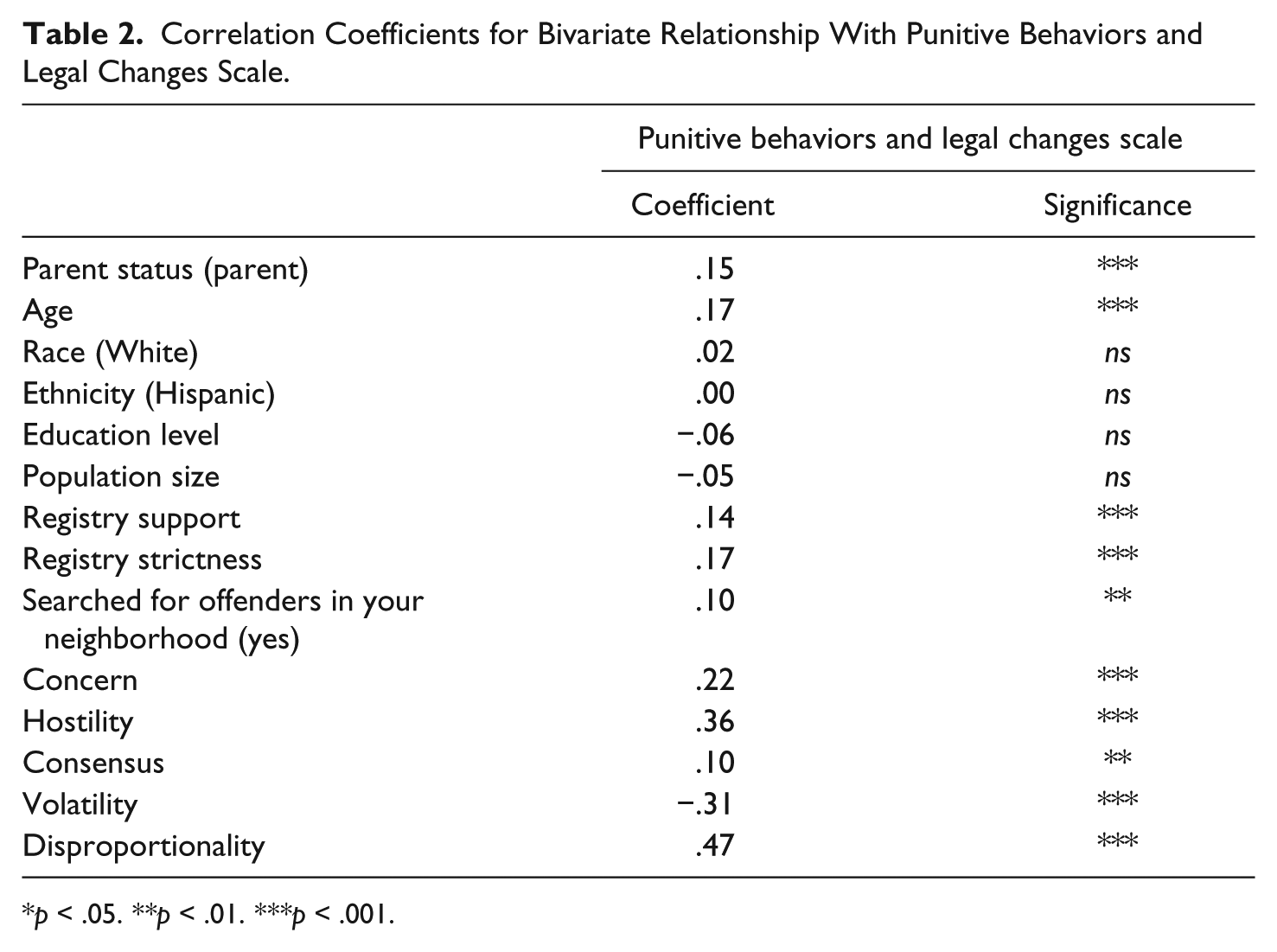
Independent sample t tests and chi-square analyses were conducted to see whether there were any statistically significant mean differences between group characteristics with regard to the moral panic measures. Bivariate correlations were then conducted to examine which independent variables were related to the outcome of interest, participant support for increased punitive behaviors and legal changes to the sex offender registry. This was necessary before the multivariate regressions could be performed. Table 2 (discussed below) shows any significant correlations that exist between the independent and dependent variables.
Correlation Coefficients for Bivariate Relationship With Punitive Behaviors and Legal Changes Scale.
p < .05. **p < .01. ***p < .001.
As the dependent variable was a continuous scale, using ordinary least squares (OLS) regression analysis was an appropriate choice for this study. Had the dependent variable been a count variable rather than a scale, the use of either negative binomial or Poisson regression analyses would have been better suited to the data. For this study, three OLS regression analyses were used to account for any potential mediation that occurred after the stepwise introduction of the control variables (Model A), current registry attitudes and access variables (Model B), and the theoretical predictors of a moral panic (Model C) to the existing variables present in the previous models. The study’s results are discussed below.
Results
The t Tests and Chi-Square Analyses
Independent sample t tests were conducted to examine mean differences for the control variables of parental status, race, ethnicity, and education level with regard to the five moral panic scale variables. Overall, there were some significant mean differences for the parental status and race variables, but the mean differences were often very small and within one tenth of a point. There were significant mean differences for the parental status variable for the Concern, Hostility, and Disproportionality scales. As for the race variable, there were significant mean differences present for all five moral panic variables. There were no statistically significant differences for the ethnicity and education level variable conditions for the concern, hostility, consensus, and volatility variables. Ethnicity continued to show no statistically significant mean difference for the disproportionality variable. Chi-square tests were conducted to examine age and population size in relation to all five moral panic variables, but no statistically significant differences exist.
The t tests and chi-square analyses were completed examining the participant demographics against the moral panic measures to determine whether there were group-level differences regarding the five elements of a moral panic. This was done to establish whether one group was more cognizant of the panic occurring over another. The parental status and race variables showed the most statistically significant mean differences for the five moral panic variables, but often that mean difference was rather small. Ethnicity, education level, age, and population size showed no statistically significant mean differences for any of the five moral panic variables, with the exception of education for the disproportionality variable. These findings suggest that the moral panic variables may be affecting everyone similarly across all variable conditions with the exception of some parental status and race differences.
Bivariate Correlation Analysis
Of the six control variables, two had significant correlations with p values at or below .001, as they are related to support for increased punitive behaviors and legal changes to the sex offender registry: parental status and age. Both had positive correlations with the dependent variable. This only provides partial support for Hypothesis 1, as not all the control variables exhibited significant correlations with the dependent variable.
All three of the current registry attitude and access variables had significant, positive correlations with the dependent variable. Registry support and registry strictness had significant p values at or below .001, and the search for offenders in your neighborhood variable was significant at or below the p value of .01. As all three of these variables showed significant correlations with the dependent variable, Hypothesis 2 is fully supported.
Finally, all five moral panic variables were significantly correlated with the dependent variable with a p value at or below .01. As all five moral panic variables were significantly correlated with support for increased punitive behaviors and legal changes to the sex offender registry, Hypothesis 3 is fully supported. Table 2 shows the results for all bivariate correlations.
Although parental status and age were the only two control variables to exhibit significant correlations with the dependent variable, the researchers made the choice to keep the remaining control variables in the multivariate analyses due to the relationship of the control variables to the dependent variable as seen in prior literature (Dowler, 2003).
Multivariate Regression Analyses
As the dependent variable was scaled, using OLS regression analysis was an appropriate methodological approach. Using a sample of 877 responses, a triplet of OLS regressions was conducted to predict support for increased punitive behaviors and legal changes to the sex offender registry. Model A used the control variables only to predict the dependent variable. For this model, a total of 3.9% of the variation was explained by the predictor variables, F(2, 875) = 5.87, p < .001. Of the six control variables, parental status and age were significant. This indicates that parents (b = .16, p < .001) and older individuals (b = .04, p < .001) were more likely to support increased punitive behaviors and legal changes regarding the sex offender registry.
In Model B, the current registry attitude and access variables were added to the control variables introduced in Model A. For this model, a total of 8.0% of the variance was explained by the predictor variables, F(2, 875) = 8.41, p < .001. Of the control variables, parental status and age remained significant, but the strength of the parental status variable was partially mediated by the introduction of the current registry attitude and access variables. The age variable coefficient remained consistent in strength and size. These findings once again suggest that parents (b = .14, p < .001) and older individuals (b = .04, p < .001) were more likely to support increased punitive behaviors and legal changes regarding the sex offender registry. All three of three registry attitude and support variables were significant at a p value of .05 or lower. These results suggest that those with higher levels of support for the registry in its current form (b = .08, p < .05), those who believe the registry is more lax than it is strict (b = .13, p < .001), and those who have searched their state’s registry website for sex offenders living nearby (b = .12, p < .05) were more likely to support increased punitive behaviors and legal changes regarding the sex offender registry. As the parental status variable was partially mediated by the inclusion of the registry attitudes and access variables, Hypothesis 4 was partially supported.
In Model C, the moral panic variables were added to the control variables and the current registry attitude and access variables introduced in Models A and B. For this model, a total of 52.5% of the variance was explained by the predictor variables, F(2, 875) = 68.12, p < .001. Of the control variables, only age remained significant but was partially mediated by the introduction of the moral panic measures. Once again, older individuals (b = .02, p < .05) were more likely to support increased punitive behaviors and legal changes regarding the sex offender registry. Parental status was completely mediated out of the model, and no other control variables were statistically significant.
Of the current registry attitude and access variables, only registry strictness remained significant in the model, with both the registry support and search for sex offender variables being completely mediated out of the model. Although the registry strictness variable remained consistent in terms of statistical strength, the coefficient decreased in size, suggesting a partial mediation by the moral panic variables. Still, those who believe the registry is more lax than it is strict (b = .07, p < .001) are still more likely to support increased punitive behaviors and legal changes regarding the sex offender registry.
Finally, four of the five moral panic measures were significant predictors of the dependent variable. Concern was the only variable lacking statistical significance. Those participants who felt more hostility (b = .37, p < .001) toward sex offenders were more likely to support increased punitive behaviors and legal changes regarding the sex offender registry. Consensus and volatility were both significant, but presented a negative predictive relationship with the dependent variable. Those participants who felt less consensus in the community (b = −.16, p < .001) and those who believed that a volatile response toward sex offenders was not occurring (b = −.71, p < .001) were more likely to support increased punitive behaviors and legal changes regarding the sex offender registry. Finally, those participants who did not believe that a disproportionate response was occurring against sex offenders (b = .42, p < .001) were more likely to support increased punitive behaviors and legal changes regarding the sex offender registry. As all previously significant variables from Models A and B were either completely or partially mediated by the inclusion of the moral panic measures, Hypothesis 5 was supported.
The directionality of the four statistically significant variables was consistent with the theoretical arguments developed in the literature review. When individuals were angry (hostility), did not believe that there is a united front against the problem (consensus), did not believe that rash action was occurring (volatility), and did not believe that the response was too harsh (disproportionality), then they were more likely to support reforms and change to solve the problem that they perceive to still be occurring. In other words, as participants exhibit beliefs that a moral panic regarding sex offenders is currently occurring and ever renewing, then the natural response is to call for an increased, punitive response against sex offenders in the belief that this will decrease sexual offending behaviors. Table 3 shows the results of all three OLS regression analyses.
OLS Regression Models Predicting Punitive Behaviors and Legal Changes Regarding the Sex Offender Registry.

Note. OLS = ordinary least squares.
p < .05. **p < .01. ***p < .001.
Discussion
This article sought to advance the literature surrounding moral panics by building on the findings of Burchfield and colleagues (2014), who established that the panic surrounding RSOs appears to be perpetual in nature rather than a temporary moral panic. When a perpetual panic occurs, there is a continuous call for new laws or an increase in sanctioning to “assuage public fears in the wake of a moral panic, reinforce or redraw moral boundaries, and scapegoat entire classes of people whose behaviors trigger our most personal and subconscious fears” (Burchfield et al., 2014, p. 97). The results of the current study suggest that participants do want an increase in the amount of informal and formal social control levied against RSOs postconviction.
Community members and legislators alike support the use of increasingly punitive laws against RSOs; however, they seem to be more symbolic in nature rather than instrumental in purpose (Sample, Evans, & Anderson, 2011). These memorial laws give the illusion that they are keeping the community safe and are assuaging fears, but when evaluated empirically do not seem to have much of an effect on reducing RSO recidivism levels. One of the primary purposes of SORN legislation is to notify the community about the whereabouts of RSOs. Publicly available sex offender registry websites allow community members to access that information. However, it does not seem as though community members are actively seeking out that information like they were intended to do. In the current study, 51.2% of participants had never accessed their state’s sex offender registry website to search for RSOs living in their communities. Community members are not participating in their own safety in the way this legislation intended for them to do, which is negating the instrumental function of SORN laws focused on community notification efforts (Sample et al., 2011).
As SORN laws are not effectively reducing RSO’s recidivism levels and community members are not accessing the resources they so strongly support, it may be time to review the structure and function of SORN legislation to find more effective legislative alternatives that could successfully implement the original legislative goals of recidivism reduction. Despite the laws being symbolic in nature, they are deeply rooted in the current “crime control theater” environment (Griffin & Miller, 2008), which makes these legislative changes unlikely. This will likely continue to result in additional legislation that will “increase penalties for sex offending and registration violations, and broaden the scope of people whose risk needs to be managed and behaviors need to be regulated” (Burchfield et al., 2014, p. 110).
The results of this study support previous findings on punitive attitudes and moral panics, but this study expands on previous research by introducing new and reliable measures of moral panic in relation to RSOs. The scale variables measuring the five elements of moral panic were created specifically for this study, and served as predictor variables rather than as outcomes of interest. To the researchers’ knowledge at the time of submission, this has not been done before. Although this design is unique, the moral panic measures proved to be the strongest predictors of participant support for increased punitive behaviors and legal changes to the sex offender registry, thus supporting the choice to use the elements of moral panic as independent variables.
This strength was shown when the explained variance jumped from 8.0% in Model B to 52.5% in Model C. This is a very large increase in the total explained variance just by including the theoretical predictor variables associated with moral panic. The five elements of moral panic were able to partially or completely mediate all the significant control variables and current registry support and access variables that were introduced in the first two models of the OLS regression analyses. In particular, the parental status variable was partially mediated in Model B and was completely mediated by Model C. This finding is surprising as parents typically have strong fears about their children’s chances of victimization by strangers and, subsequently, monitor their children’s surroundings more strongly (Foster, Villanueva, Wood, Christian, & Giles-Corti, 2014).
The moral panic measures also completely mediated current registry support and partially mediated current registry strictness. Because this study was predicting support for future punitive changes to the sex offender registry system, the mediation of those variables further support the idea that community members are not satisfied with current legislative efforts and are in favor of making laws stricter than they currently are. Once again, this may be due to the blanket support for crime control measures, regardless of their effectiveness; community members desire the appearance of safety, not necessarily the function of it.
Limitations
One of the limitations of the study rests in the sample. This study utilized a nationwide sample of 877 community members who were asked questions about the sex offender registry in a general sense. We were not able to control for whether the participants had any SORN associations (e.g., were RSOs, were family members of an RSO, or were victims of a sex crime), so it is possible that there is respondent bias in these responses. Like with all samples, there is minor concern regarding participants providing socially desirable responses. But, beyond this concern and those extending to the normal external validity and generalizability concerns, we do not anticipate that the sample is overly biased more so than any other sample providing self-report data regarding opinions and perceptions on a topic. As there is no consistency in the application of SORN laws across all states, it was beyond the researchers’ capacity to create 50 different surveys to account for each state’s sex offender registry and community notification systems. Instead, the questions were asked in a general sense so that participants could still answer the attitudinal questions while thinking specifically about their own state’s sex offender registry system. Future research would benefit from state-to-state comparisons of punitive beliefs regarding the sex offender registry with a focus on geographic location, political ideation, or concentration of sex offenders in the state. In addition, future measures may benefit from asking community members about sex offenders in more of a heterogeneous way rather than just asking about sex offenders as a blanket group.
In addition, this study would benefit from variables focused on the participant’s level of knowledge concerning issues related to SORN legislation. In other words, would participants still support punitive changes to the sex offender registry if they were more or less knowledgeable about the unintended consequences resulting from that legislation? Although those variables are not present in this study, it would be beneficial to be able to measure participant knowledge to see whether community members are aware that issues with unemployment, homelessness, and harassment are occurring. Dependent on those responses, researchers could then determine whether this is an issue of ignorance or simply an additional level of punitive thinking. Furthermore, future research should consider the source of information that participants are receiving their information from. Unofficial sources have the potential to instill bias in community members, leading their level of support for punitive changes to fall in line with the beliefs of the original information source.
Conclusion
As the moral panic surrounding RSOs seems to be perpetual in nature, and unending in the near future, concern must be focused on the continued legislative impact that SORN laws will have on the postconviction reintegration efforts of RSOs. Researchers have established that RSOs experience a variety of unintended consequences associated with SORN legislation, but the most concerning issue is the continued physical and social isolation of these individuals from the communities in which they live, once their social support systems breakdown (Tolson & Klein, 2015). The more they are outcast, the less social capital they will have with their communities and the more they will be feared because of that ostracism. This study suggests that the panic community members feel is driving their support for punitive behaviors and legal changes to the sex offender registry, so much so that it is overriding any participant demographic characteristics. This indicates that individuals are similarly panicked and reacting accordingly to that panic, with legislators attempting to calm the masses through the passage of knee-jerk reactionary legislation that only serves a symbolic purpose (Sample et al., 2011).
Footnotes
Declaration of Conflicting Interests
The author(s) declared no potential conflicts of interest with respect to the research, authorship, and/or publication of this article.
Funding
The author(s) received no financial support for the research, authorship, and/or publication of this article.