




Abstract
Minority criminal defendants are more likely than White defendants to exercise their right to trial, which is concerning given that research also consistently finds trial sentences to be harsher than those obtained via pleas. However, guilty pleas are not the only disposition available for avoiding a trial; pretrial diversions and case dismissals also serve as mechanisms for trial avoidance. Using hierarchical linear modeling, we find that Black criminal defendants are more likely than Whites to go to trial rather than receive other case disposition. Relationships for Hispanic defendants are less consistent. Fewer county-level effects emerge than expected, providing little to no support for racial threat theory. Results suggest that Black defendants are less often able or willing to avoid a trial, a finding which highlights and perhaps helps to explain racial disparities in final sentencing outcomes.
Introduction
More than 20 million cases are filed in criminal courts in the United States each year (Administrative Office of the U.S. Courts, 2016; LaFountain, Schauffler, Strickland, & Holt, 2012). For the defendants in these cases, presentence outcomes such as plea deals, pretrial diversions, and case dismissals are important both because of their independent impacts on justice and because of their strong effects on subsequent punishment (Free, 2002; Johnson, 2003; Schlesinger, 2013). These outcomes, which all represent alternatives to risky and laborious trials, are a defining part of every criminal defendant’s experience. Trials can result in longer sentences for defendants (see LaFree, 1985; Nardulli, Eisenstein, & Flemming, 1988; Ulmer & Bradley, 2006) and also consume significant resources from both the prosecution and defense (Bernstein, Kick, Leung, & Schulz, 1977; Johnson, King, & Spohn, 2016). Thus, ensuring equal treatment throughout the guilty plea, diversion, and dismissal decision-making processes is essential for maintaining fairness in the criminal justice system.
However, these processes are subject to considerably less oversight and regulation than punishment decisions. Prosecutors in particular retain immense power to make decisions regarding charges, plea offers, and diversionary programming, and unlike judicial decision-making, this discretion is subject to little scrutiny. With few formal review procedures in place, pretrial outcomes are largely insulated from both public inspection and legal challenges (Frederick & Stemen, 2012; Free, 2002; Johnson et al., 2016). Moreover, empirical work on the criminal courtroom focuses heavily on the determinants and effects of criminal punishment, leaving the role of earlier case processes in achieving justice largely unexplained. We have seen limited progress in this area of research. Much of what is known about equality in pretrial processing, for instance, is derived from scholarship focused on sentencing decisions, and our understanding of the plea process is still “remarkably anemic,” as Johnson and colleagues (2016, p. 3) characterize it. Ultimately, though, a thorough understanding of courtroom justice will only be possible with better insight into pre-sentence decision-making.
While scores of studies have evaluated racial and ethnic disparities in sentencing, reaching a general consensus that unwarranted disparities persist in spite of various policy reforms designed to more closely regulate sentencing and reduce judicial discretion (see Baumer, 2013; Spohn, 2000; Zatz, 2000 for reviews), disparities in earlier case dispositions are often overlooked. Disadvantages for certain groups of offenders during the guilty plea process, pretrial diversion, and case dismissal processes may either exacerbate or obscure disparities at sentencing, so closer examination into these interconnected dispositions is warranted (Free, 2002). This study assists in that endeavor. Using data from the State Court Processing Statistics, it examines both racial and ethnic disparities in courtroom dispositions in 40 large urban counties between 2000 and 2009.
With this study, we contribute to the body of case disposition research in two distinct ways. First, we conceptualize guilty pleas, dismissals, and diversions as interdependent decision nodes that serve as mechanisms for trial avoidance in the pretrial process. The decision to dismiss a case after initial filing, the decision to offer or accept a plea deal, and the decision to agree to pretrial diversion are not made independently. Rather, they are a collection of trial alternatives that prosecutors, other court actors, and defendants jointly mull over during the pretrial process. Disposing of cases therefore involves a complex interplay between court actor and defendant decision-making. By incorporating case dismissals and pretrial diversion into our assessment of racial disparities and pleading guilty, we escape the tendency to treat guilty pleas as the only alternative to trials and provide a more nuanced picture of pretrial decision-making. Second, this study situates race/ethnicity and guilty pleas within a larger social context. Much like Franklin’s (2010) evaluation of county-level variation in the effects of race on case dismissal, in this study, we acknowledge the importance of community characteristics in shaping the norms and operating procedures of various courtrooms. We use a multilevel modeling procedure to consider static county-level racial and ethnic demographics, as well as changes in racial and ethnic demographic makeup over time.
Prior Empirical Research
Contemporary discourse about prosecutorial discretion and early case processing in the criminal justice system acknowledges the importance of studying pretrial outcomes, including plea bargains/offers, dismissals, diversions, and their extralegal determinants such as race (Johnson et al., 2016; Kutateladze, Andiloro, & Johnson, 2016; Redlich, Bibas, Edkins, & Madon, 2017). Legal factors such as offense severity and criminal history as well as process factors like evidentiary strength are irrefutably the most important determinants of pretrial outcomes (Edkins, 2011; Holmes, Daudistel, & Farrell, 1987; LaFree, 1980b; Rosett & Cressey, 1976; Spohn & Spears, 1996), but broad discretionary power for prosecutors coupled with limited oversight opens the door for unobserved social inequality in earlier case processing that may also have substantial effects on subsequent treatment (Hagan, 1974; Kutateladze, Andiloro, Johnson, & Spohn, 2014; Piehl & Bushway, 2007; Shermer & Johnson, 2010; Wooldredge & Thistlethwaite, 2004). However, due to a lack of quality data and a slew of policy reforms that centered attention on judicial discretion in sentencing, empirical research on race and pretrial outcomes lags behind (Forst, 2002; Johnson et al., 2016).
Guilty Pleas
The ubiquity of guilty pleas in the criminal justice system makes guilty pleas a particularly critical area for empirical scrutiny. The limited research in this area provides some evidence that minority defendants are less likely to plead guilty than their White counterparts, though a few studies find no racial or ethnic differences in guilty pleas (e.g., Kingsnorth, Lopez, Wentworth, & Cummings, 1998; Miethe, 1987; Wooldredge & Griffin, 2005). In one of the early investigations focused on social disparities in guilty pleas, Miethe and Moore (1986) argued that research on racial disparities in the criminal justice process typically ignores the potential for conditional race effects. In support of this argument, they identified both main and interactive effects of race on negotiated plea deals in a sample of Minnesota felony defendants, with separate factors generating disparities for Black and White offenders. Albonetti (1990) built on this and found that after controlling for various types of evidence, Black male defendants were still slightly less likely than White males to plead guilty in Norfolk, Virginia. Moreover, the effects of both legal and extralegal factors differentially impacted Black and White offenders in her study. Metcalfe and Chiricos (2018) conducted a similar assessment in Florida, likewise concluding that Black defendants plead guilty less often and receive sentences that are determined by different factors than Whites. Their analysis, however, was unable to differentiate between Hispanic and non-Hispanic White defendants.
Frenzel and Ball’s (2007) evaluation of pleas among both felony and misdemeanor defendants in Pennsylvania differentiated between negotiated and non-negotiated pleas, finding that Black defendants were more likely to go to trial than Whites. Interestingly, they observed no racial differences between negotiated and non-negotiated pleas, which suggests that it may be minority defendants’ decision-making that generates a racial gap rather than discrepancies in prosecutors’ plea offers. Sommers, Goldstein, and Baskin (2014) used a sample of homicide, robbery, and aggravated assault defendants from five urban jurisdictions to assess the joint influence of defendant and victim characteristics on pretrial processing. They found that Black males, and Hispanic males to a lesser degree, were less likely to receive a plea deal regardless of victims’ race/ethnicity or gender.
Altogether, the evidence pointing to racial and ethnic disparities in guilty pleas is mounting, which is particularly troublesome in light of the existence of a “trial penalty” in which defendants who exercise their right to trial and are convicted receive more severe sentences (Kautt, 2002; Ulmer & Bradley, 2006). Estimates tend to vary across crime types and jurisdictions (see King, Soule, Steen, & Weidner, 2005), but research suggests that trial convictions tend to earn sentences that are as much as 30% harsher than convictions by plea (Abrams, 2011; Smith, 1986; Spohn, 1992; Ulmer, Eisenstein, & Johnson, 2010). Evidence regarding racial and ethnic differences in the trial penalty is rather mixed—some research finds that trial penalties are larger for Black defendants (Johnson, 2003; Ulmer, 1997; Ulmer & Bradley, 2006), while other work finds larger penalties for White defendants or no difference at all (Spohn, 1992; Steffensmeier & Demuth, 2001; Ulmer et al., 2010)—making it difficult to hypothesize about the role that expected trial penalties play in the plea decision-making process. Still, additional work is needed to determine how White and minority defendants stack up when pleas are positioned within a larger pretrial decision-making framework.
Case Dismissals
Though more research concentrates on prosecutors’ initial charging decisions (e.g., Baumer, Messner, & Felson, 2000; Beichner & Spohn, 2005; Frederick & Stemen, 2012; Free, 2002; Kutateladze, Lynn, & Liang, 2012; Wooldredge & Griffin, 2005), a small but developing literature focuses on modeling the effects of defendants’ race on case dismissals after initial charging. Running counter to the idea of a cumulative disadvantage in which small racial disparities that impair minority defendants accrue throughout the criminal justice process (Kutateladze et al., 2014; Schlesinger, 2007; Wooldredge, Frank, Goulette, & Travis, 2015), the findings gleaned from this body of research are somewhat inconsistent but hint at a disadvantage in case dismissals for White rather than minority defendants. A handful of studies do identify a disparity in case dismissals favoring minority defendants, such that Whites are more likely to have their cases fully prosecuted rather than dismissed (Barnes & Kingsnorth, 1996; Baumer et al., 2000; Spears & Spohn, 1996). For example, Wooldredge and Thistlethwaite (2004) found among intimate assault cases in Ohio that Black defendants more likely to have their charges dismissed, though the effect of race on case dismissal did vary across neighborhoods. In Kutateladze and colleagues’ (2014) study of cumulative disadvantage throughout the court process in New York City, White defendants were the least likely racial or ethnic group to have their cases dismissed; Black, Latino, and Asian defendants had substantially higher odds of dismissal.
Other evaluations of racial disparities in case dismissals obtain results that refute the existence of a pervasive minority advantage in dismissals. Some detect little to no difference between White and minority defendants (Franklin, 2010; Sommers et al., 2014; Spohn & Horney, 1993), and some even observe advantages for White defendants (Baumer et al., 2000; Kingsnorth & MacIntosh, 2007). During the course of an examination into gender disparities in prosecutorial decision-making for intimate partner violence cases, Kingsnorth and MacIntosh (2007) found that Asian and Hispanic men were less likely to have their cases dismissed than White men, while Black and White defendants had comparable odds of receiving a dismissal. Baumer and colleagues’ (2000) study of murder cases likewise concluded that White defendants were less likely than non-Whites to have their cases carried forward after being charged and indicted. These conflicting studies underscore the need to expand research on race and case dismissals, particular in light of the contrast in findings between case dismissal research and other court processing research.
Pretrial Diversion
Research evaluating racial disparities in assignment to pretrial diversion, which allow defendants to have their charges deferred or dismissed following completion of community-based programming (Bellassai, 2010), is scarce. Although pretrial diversion programs typically have specific criteria used to determine which defendants are eligible (National Association of Pretrial Services Agencies, 2009), prosecutors still make discretionary decisions about which qualified defendants will be offered diversions, leaving ample room for racial disparities in this step of the pretrial process. Barnes and Kingsnorth (1996) examined the decision to grant pretrial diversion rather than a guilty plea or go to trial in the context of a larger study of racial disparities in the processing of drug offenses in Sacramento County, California’s court system. Their descriptive statistics suggested that among defendants charged with a single drug felony, White defendants were more likely to be assigned to diversionary programming than African American or Latino defendants. However, the authors attributed this difference entirely to diversion eligibility, as the White defendants were more likely to be charged with simple possession and less likely to have prior felony convictions. Though the authors were unable to evaluate this assertion using regression models, they concluded that there was no evidence for racial discrimination in pretrial diversion assignment (Barnes & Kingsnorth, 1996).
In the same year, Albonetti and Hepburn (1996) focused an investigation on the diversion of felony drug defendants away from prosecution into a drug treatment program in Phoenix, Arizona. They found that while the main effect of racial minority status on pretrial diversion was not significant, it did exert an effect among young defendants and those with no prior arrests, such that being a minority reduced the odds of pretrial diversion rather than plea or trial. Among defendants with prior arrests, the opposite was true: minority defendants actually had greater odds of being diverted. Noting some limitations of this study (including a focus on drug offenses and grouping Blacks and Hispanics into one category), Schlesinger (2013) expanded on Albonetti and Hepburn’s (1996) evaluation, using data from metropolitan counties on a variety of felony offenses committed by White, Black, and Latino defendants. In contrast to Albonetti and Hepburn (1996), Schlesinger (2013) found significant main effects of race on pretrial diversion; both Black and Latino defendants were less likely to receive pretrial diversion than Whites. The findings from these pretrial diversion studies differ substantially, perhaps due to their varying methodological approaches. It thus remains difficult to draw firm conclusions about the nature of racial disparity in prosecutors’ decision to offer pretrial diversion. Given the growth in popularity of diversionary programming and the discretion allotted to court actors to make diversion decisions, this is a topic that warrants further attention.
The Relationship Between Racial and Ethnic Context and Criminal Justice Processing
An additional area of influence for criminal justice outcomes is the setting in which a defendant is charged, processed, and sentenced. The salience of social context has been underscored in recent decades, most notably by sentencing research, which finds that a variety of community factors impact courtroom decision-making (Britt, 2000; Crow & Johnson, 2008; Ulmer & Johnson, 2004; Wang & Mears, 2010, 2015) The influence of environmental factors on disparities in courtroom processing has been evaluated in studies of prosecutorial discretion and pretrial processing as well, though less frequently. For example, Wooldredge and Thistlethwaite (2004) found that Black–White disparities in prosecution varied significantly across neighborhoods in a sample of Ohio intimate assault cases. These studies highlight the importance of community factors during the courtroom process and the need for continued focus on the effects of social context on individual-level disparities.
Racial and ethnic contexts in particular have been proposed as community-level factors that could impact disparities. Research has evaluated the influence of macro-level racial and ethnic composition on racial and ethnic disparities in various case processing outcomes, including the imposition of mandatory minimums (Ulmer et al., 2007), habitual offender designations (Caravelis, Chiricos, & Bales, 2011), and case dismissals (Franklin, 2010). To capture the concept of minority threat, empirical examinations typically measure the number and growth of individual minority populations. For example, Ulmer and colleagues (2007) include the percentage of the county that is Black in their evaluation of prosecutorial discretion in Pennsylvania, and Franklin (2010) also uses two separate measures for counties’ percent Black and percent Hispanic to predict case dismissals. Though Franklin (2010) finds little impact of these contextual measures, Ulmer and colleagues (2007) found that as the Black population in a county increased, differences between Blacks and Whites in the application of mandatory sentences also increased. While their findings provide “complex and mixed implications for racial threat theory,” they offer further evidence that our understanding of criminal case processing can be improved with inclusion of contextual information (Ulmer et al., 2007, p. 451).
Moreover, the demographic landscape of urban America is changing (Perez & Hirschman, 2009); increased heterogeneity may be the result of additive effects of various minority groups, including Blacks, Hispanics, and others together. As Britt (2000) argued, more heterogeneous communities without a clearly defined racial minority may have higher perceptions of racial threat. Thus, in communities with a diverse array of races and ethnicities, focusing on the Black population or the Hispanic population alone may not fully capture the minority threat that White residents experience. Rather than focusing only on the relative size or change in relative size of individual minority groups, then it would be beneficial to instead consider the relative size of the White population (Wooldredge & Thistlethwaite, 2004).
Conclusion
Overall, the evidence supports claims of unequal outcomes for White and minority defendants during pretrial decision-making, but the magnitude and direction of this inequality varies by decision point. While racial disparities in guilty pleas and pretrial diversion appear to favor White defendants, such that minorities are more likely to go to trial and less likely to be diverted, disparities in case dismissals seem to go the opposite direction, favoring minorities. Though scholars have posited that case dismissal trends are actually corrections for racial differences in prior case processing rather than evidence that minority defendants are treated more leniently (Kutateladze et al., 2014), it remains difficult to interpret these disparate findings altogether because the comparison groups used in each body of research differs. Studies of guilty pleas typically pit pleas against trials, excluding pretrial diversions and case dismissals from their samples. Studies of case dismissals often contrast dismissals to all other outcomes, lumping together pleas, trials, and if applicable, pretrial diversions. Most studies of pretrial diversion use a comparison group that does not differentiate between pleas and trials and does not include case dismissals. To provide further clarity to our understanding of racialized treatment during the pretrial process, it is important to consider these outcomes in concert with each other rather than to treat them as isolated decisions. Plea, diversion, and dismissal decisions are concomitant pretrial decisions that can all be used to avoid a trial, and as select other scholars have recognized (e.g., Sommers et al., 2014), a choice made regarding one of these outcomes influences choices regarding others.
Theoretical Perspectives and Hypotheses
Plea deals, pretrial diversion programs, and case dismissals are all mechanisms for trial avoidance. Criminal trials, though historically prominent, comprise only a small portion of final dispositions in modern U.S. courts, and this is because the cost of a trial is high for all parties involved. Trials require substantial time and financial resources from prosecutors, defendants and defense attorneys, and judges alike (Alschuler, 1968, 1975; Nardulli, Eisenstein, & Flemming, 1988; Johnson et al., 2016). These resource expenditures are particularly difficult to swallow in light of the uncertainty associated with trial convictions; neither the prosecution nor the defense can be sure that they will win or lose their cases. For prosecutors, proceeding to trial in one case also necessitates less ability to prosecute other cases; this opportunity cost makes trials desirable to prosecutors only in the most serious of circumstances (Savitsky, 2012). For defendants, trials may also entail extra time spent in pretrial detention, which can in turn limit their ability to care for dependents, damage their social networks, or even cause them to lose their jobs (Rankin, 1964). In addition, the trial penalty associated with going to trial rather than pleading guilty makes trial sentences the harshest of all possible courtroom outcomes (Kautt, 2002; Ulmer & Bradley, 2006; Ulmer et al., 2010). Thus, each party has substantial motivation to avoid a trial through either a plea, pretrial diversion programming, or a case dismissal.
However, there are reasons why some defendants, namely, racial and ethnic minority defendants, may be more likely to go to trial than others. Focal concerns theory provides one explanation for such disparities. Drawing from uncertainty avoidance perspective (Albonetti, 1991), focal concerns theory posits that courtroom decisions are made in contexts with high levels of uncertainty (Steffensmeier, Ulmer, & Kramer, 1998). To compensate for having incomplete information about defendants and their cases, court actors use stereotypes to inform their decision-making. These stereotypes link extralegal characteristics such as defendants’ race and ethnicity to the three important concerns: defendants’ blameworthiness, protection of the community, and practical constraints related to case processing and punishment (Steffensmeier et al., 1998). Research indicates that minorities are often portrayed as more threatening outside the courtroom setting; African Americans have long been portrayed as more criminal, more violent, and more likely to use drugs (Gibbs, 1988; Steffensmeier et al., 1998), and Hispanics have been ascribed similar characteristics in more recent times as well (Anderson, 1995; Demuth, 2003). These stereotypes may be mirrored inside the courtroom, leading prosecutors to form perceptions of minority defendants as more blameworthy, more dangerous and likely to recidivate, and more suited for harsh punishment. In the focal concerns framework, racial and ethnic disparities in case outcomes are therefore the product of these differential perceptions (Steffensmeier et al., 1998). Prosecutors may be less likely to treat minority defendants leniently, opting to proceed to trial rather than to offer desirable plea deals, pretrial diversion, or case dismissals.
A second theoretical perspective relevant for this discussion factors in defendants’ agency. Though case dismissal decisions typically lie in the hands of prosecutors, plea deals and pretrial diversion programming both require the informed consent of defendants. In some cases, even when prosecutors offer plea bargains or pretrial diversion, defendants may choose to proceed to trial. For defendants, the disposition choice may be tied to defendants’ perceptions of the criminal justice system. Defendants who believe the criminal justice system is fair and just are more likely to agree to trial alternatives, trusting that their best interests will be appropriately weighed against the interests of the system if they cooperate (Alschuler, 1983). Trials, which check prosecutorial discretion and offer defendants the opportunity to present all relevant facts, may seem preferable for defendants who are concerned about being treated fairly by the system. If there are racial and ethnic differences in perceptions of fairness and justice, the differences would generate disparities in defendants’ decision to accept either a plea deal or pretrial diversion. Frenzel and Ball (2008) make this argument after finding that Black defendants were more likely to proceed to trial than Whites, speculating that trials may represent the fairest disposition for minority defendants who distrust the system’s ability to treat them equitably.
Empirical research indeed finds differences in perceptions of the criminal justice system along racial and ethnic lines. Hagan and Albonetti (1982) found that Black survey respondents were more likely to believe that defendants’ constitutional rights were violated frequently in the courtroom, especially in the context of guilty pleas. Other survey data indicate that Black respondents are substantially less likely to believe that the justice system treats everyone fairly and that criminal courts can provide everyone a fair trial (Hurwitz & Peffley, 2005). Research including both Black and Hispanic respondents concludes that Hispanics similarly perceive disparities in the court system and other injustices (Buckler, Wilson, Hartley, & Davila, 2011; Carter, 1983). Racialized perceptions of fairness in the justice system have not been connected empirically to defendants’ decision-making during the pretrial process, so one next step for this body of research will be to link perceived injustice with the decision to accept or reject trial alternatives. Still, based on prior research that generally indicates disadvantages for minority defendants in pretrial processing and the evidence that suggests racial differences in perceptions of injustice, we expect to find in this study that prosecutors are less likely to offer and/or defendants are more likely to accept plea deals, pretrial diversion programming, and case dismissals when the defendant is a racial or ethnic minority. This is our first research hypothesis.
As we describe above, it is also instructive to consider whether or not racial and ethnic disparities in pretrial processing may depend upon the racial and ethnic context of the areas in which defendants are tried. These potential contextual effects form the basis for our final three hypotheses, which are informed by racial threat theory. The minority threat perspective can be used to explain the potential association between minority population size and courtroom disparities. This perspective maintains that large racial and ethnic populations represent a threat to the White majority; they are better able to compete for the social, economic, and political power so long enjoyed by Whites (Blalock, 1967). As minority groups become a larger portion of the total population, White individuals in power seek out ways to protect their own group position (Blumer, 1958). Because minority populations are often associated with crime (Anderson, 1995; Gibbs, 1988), the criminal justice system can be used as an instrument of social control; less favorable case processing and harsher punishments for minority offenders are intended to constrain the upward mobility of the minority population as a whole (Liska & Chamlin, 1984).
As minority populations grow larger, then, social control should increase and greater racial and ethnic disparities should emerge in criminal justice processing. However, this social control is not expected to increase monotonically (see Wang & Mears, 2015, for an additional example). As racial and ethnic minority populations eventually begin to eclipse Whites, it is likely that minority residents will be able to exercise their power more effectively and compel accommodation from Whites (Stolzenberg, D’Alessio, & Eitle, 2004; Stults & Baumer, 2007). Racial threat effects should therefore be larger in areas where Whites are a clear majority of the population. In areas where Whites are outnumbered, however, minority groups are better able to mobilize, and the effects of incremental differences in counties’ racial/ethnic makeup on disparities will be smaller or even reversed. Importantly, measuring the size and growth of the White population rather than measuring each minority population allows us to estimate the totality of the non-White “threat,” whether that threat is derived from a single minority population or several. Based upon these considerations, we make the following additional hypotheses:
Data and Methods
Data Sources
We address these hypotheses with two different data sources. The first source is State Court Processing Statistics (SCPS), 1990-2009: Felony Defendants in Large Urban Counties, which is archived at the Inter-University Consortium for Political and Social Science Research (ICPSR). SCPS is well-suited for this evaluation because it includes a variety of pretrial measures and contains data from many jurisdictions. Specifically, SCPS begins with a stratified random sample of 40 of 75 of the largest urban counties in the United States and includes defendants who are charged with felonies. We use individual-level data from the SCPS data collection in 2000, 2002, 2004, 2006, and 2009 to assemble a total sample of 58,248 cases. Second, county-level characteristics for this study come from the 2000 United States Census and the 2009 American Community Survey. These data were obtained for each county from online Census resources.
Dependent Variable
The outcome is a four-category dependent variable that captures whether each defendant pled guilty, was assigned to pretrial diversion/deferral, had the case dismissed, or proceeded to trial. Going to trial, which includes both those who were convicted at trial and those who were acquitted, serves as the reference category for the analyses. 1 Though trials are relatively rare, 2 making up only a small portion of all case dispositions, we argue that they loom as a “threat” to all parties during case decision-making. Guilty pleas, pretrial diversions, and case dismissals are mechanisms for avoiding the resource expenditure and uncertainty associated with trials, which makes the trial outcome an appropriate group for comparison.
Independent Variable
The main independent variables are defendants’ race and ethnicity, captured by two mutually exclusive dummy variables indicating whether each defendant is Black or Hispanic. White is used as the reference category for all analyses.
Case-Level Controls
We also use a number of controls at the individual level for both legal and extralegal characteristics of the offense and the offender. We control for age both as age in years and age squared, which allows for potentially nonlinear impacts of age (see Steffensmeier, Kramer, & Ulmer, 1995). Gender is included as a dichotomous variable indicating whether the defendant is male. Offense type is captured by a series of 12 dummy variables, with driving/public order crimes as the reference category: murder, rape, robbery, assault/violent, burglary, theft, forgery/fraud, other property, drug sale, other drug, and weapons offenses. Criminal history of the defendant is accounted for several variables. First, we include a count of prior felony convictions 3 and also prior felony convictions squared. This squared term allows for a potential nonlinear effect of prior felonies; it is possible that after defendants have accumulated extensive prior records, each additional felony conviction becomes less meaningful. Additional criminal history variables include whether defendants had an active criminal justice status (on probation, parole, or another warrant pending at the time of arrest) or were detained pretrial. We also take into account attorney type. Dummies are included for public defender, assigned, attorney missing/other type of representation, with private attorney used as the omitted category. Finally, dummies for years are also included to account for potential differences in outcomes by year. 4
County-Level Predictors
To assess contextual-level race and ethnicity effects on disparities, we include measures of the proportion of the county that is White in 2000 and the proportion White in 2000 squared, as well as the change in proportion of the county that is White from 2000 to 2009. These measures allow for an understanding of the role of both static racial and ethnic threat and also dynamic threat effected by how the demographics of an area change over time (Caravelis et al., 2011). 5
Analytic Plan
Because we examine both individual-level and county-level effects on pretrial outcomes, two-level hierarchical generalized linear modeling (HGLM) is used for the analyses (Bryk & Raudenbush, 2002, is a helpful resource for additional information on multilevel modeling). We utilized HLM 7.0 software by SSI, Inc. to run the models. As mentioned above, the multinomial outcome has four categories: pleading guilty, diversion/deferral, dismissal, and going to trial. We utilize going to trial as the reference category to assess our theory of trial avoidance. As such, Level 1 of the analyses models case-level effects; we interpret individual-level coefficients as the impact of case factors on the odds of a guilty plea, diversion, or case dismissal rather than a trial. Level 2 is the county level of analysis, which allows us to examine differences in the probability of these case dispositions across counties.
To address Hypotheses 1 and 2, we first construct a model that includes all individual-level predictors of case dispositions and also allows the odds of guilty pleas, diversions, and case dismissals, as well as the effects of race and ethnicity, to vary freely across counties. County-level predictors are excluded from this model. With this model, we are able to assess both whether or not there are overall racial/ethnic differences in the odds of case dispositions and whether or not such differences vary across the counties in our sample.
In the second step of our analysis, we evaluate Hypotheses 3 and 4 by incorporating county-level predictors into the model. The three county-level measures, percent White, percent White squared, and percent change in White, are included both as direct influences on pretrial outcomes via the individual-level intercepts and in cross-level interactions with defendants’ individual race and ethnicity. At the intercept, the inclusion of these variables allows for examination of whether the percent White, percent White squared, or change in percent White impacts the overall odds of pleading guilty, being diverted/deferred, or being dismissed rather than going to trial for each county. With the cross-level interactions, we are able to examine whether the racial makeup of the county influences the relationship between the individual’s race and these pretrial outcomes.
Results
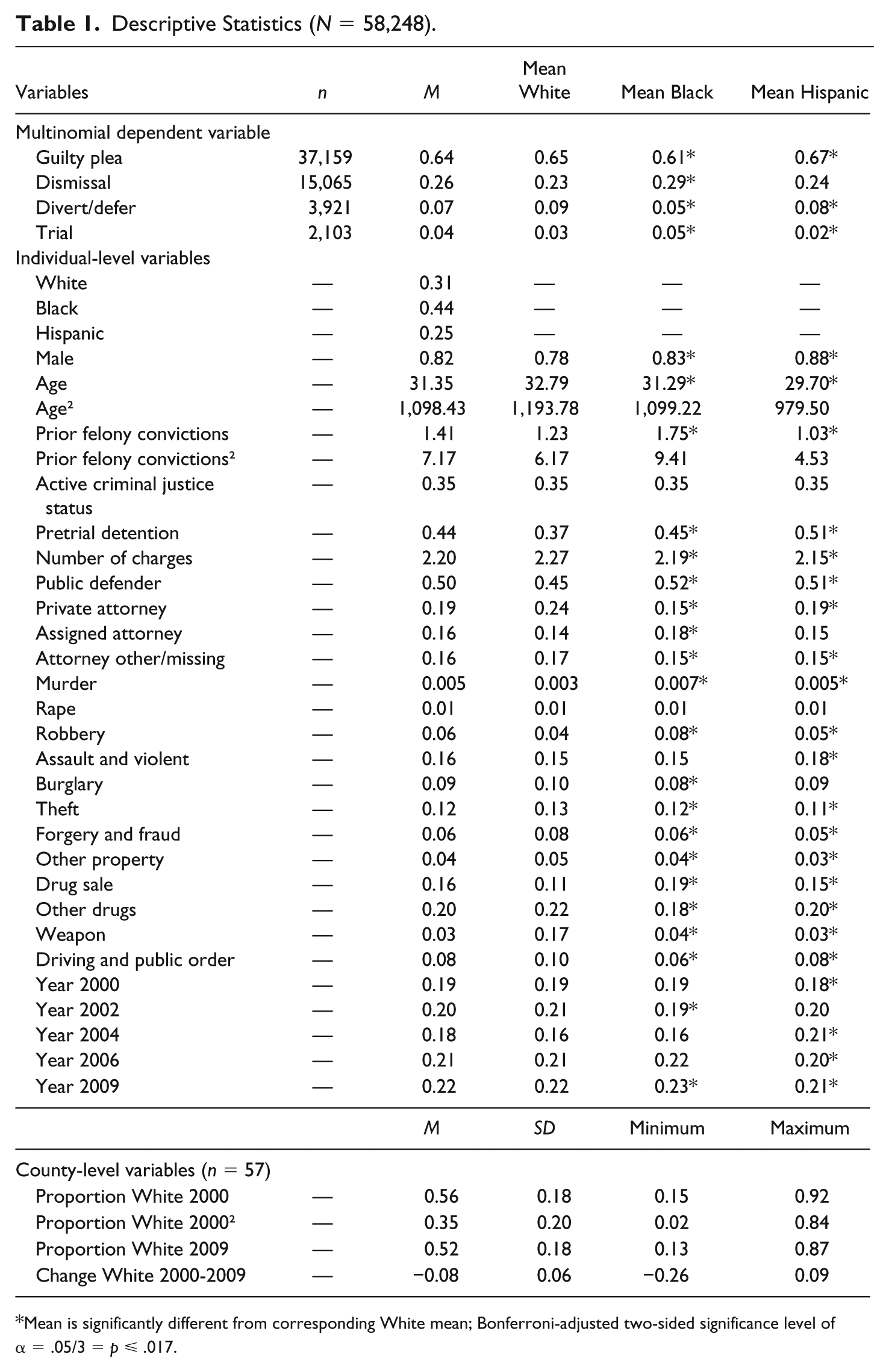
This section begins with a discussion of the descriptive statistics of the sample before continuing to a discussion of the results from the hierarchical models. Looking to Table 1, one can see that the modal outcome for all racial and ethnic groups in this sample is a guilty plea (approximately 64%). The next most common outcome is case dismissal at 26%, while about 7% of these cases are deferred and close to 4% proceed to trial. These outcomes are not distributed evenly across the different racial and ethnic categories; Black defendants are less likely to plead guilty or be diverted/deferred and more likely to be dismissed or go to trial in comparison to White defendants. Hispanic defendants have higher rates of guilty pleas, slightly higher rates of diversions, and lower rates of going to trial, as compared with Whites. Moreover, these differences are all statistically significant, with the exception of the White versus Hispanic dismissals comparison. This suggests that there are racial differences in courtroom outcomes irrespective of legal and case processing characteristics. Moving to the main individual-level independent variable, about 31% of the sample is White, 44% is Black, and the remaining 25% are Hispanic.
Descriptive Statistics (N = 58,248).
Mean is significantly different from corresponding White mean; Bonferroni-adjusted two-sided significance level of α = .05/3 = p ⩽ .017.
Turning to other case-level variables, there continue to be significant differences when comparing White defendants to Black and Hispanic defendants. First, this sample is overwhelmingly male, with about 82% male and only 18% female, on average. Interestingly, the Hispanic and Black samples have significantly higher proportions of male defendants than the White sample. The average age in the sample is 31.35 years. The average number of prior felony convictions in this sample is 1.4 and approximately one-third (35%) of the individuals had an active criminal justice status at the time of their arrest. Almost half (44%) were detained pretrial (with both Black and Hispanic defendants detained at significantly higher rates than Whites), and the vast majority of these individuals are also indigent; public defenders represented half of the sample (50%) and assigned attorneys represented 16%. Individuals retained private attorneys in only about 19% of cases, and information for the attorney type was either missing or listed as “other” in 16% of cases. White defendants retained private counsel at the highest rate (24%), which is significantly higher than both Black and Hispanic defendants.
As to the offense types, not surprisingly, more serious offenses occurred the least frequently. Murder charges account for only 5% of the sample, rape 1%, and robbery 6%. Assault/other violent crimes comprise 16% of the sample, burglaries account for 9%, and 12% of the cases are theft. Forgery/fraud cases (6%) and other property offenses (4%) are relatively rare, while drug crimes are very frequent; 15.5% of the sample was charged with drug sale and 20% were charged with other drug offenses (including possession). The remaining two offense categories are weapons offenses (3%) and driving/public order (approximately 8%). There are statistically significant differences in most of the offense types when comparing across racial and ethnic groups, with the exception of rape charges. The distribution of cases over time is fairly even. Of the sample, 19% is from 2000, 20% from 2002, and approximately 18% from 2004. The remaining years (2006 and 2009) account for 21% and 22% of the sample, respectively. There are also significant differences in the racial and ethnic composition of cases across years, with no distinct pattern. For example, Hispanic defendants constitute a larger proportion of cases than White defendants in 2004, but a lower proportion in 2000, 2006, and 2009.
County-level descriptive statistics are also detailed in Table 1. The average proportion of the county’s population that is White in 2000 is 0.56. Despite the fact that the counties in the sample are all within the top 75 of the largest urban counties in the United States, there is still dramatic variation in their racial makeup; White population proportions in 2000 ranged from 0.15 to 0.92. In 2009, the average proportion of White individuals in the county was 0.52, with a range of 0.13 to 0.87. Consistent with national trends (Perez & Hirschman, 2009), the county proportion of Whites, on average, decreased in this sample. The average change in the White population from 2000 to 2009 was a decrease of approximately 8%, with a standard deviation of 0.06. The minimum was a 26% decrease and the maximum value for this variable is a 9% increase. So, while there is variation, White populations were generally decreasing across large urban counties during the study period.
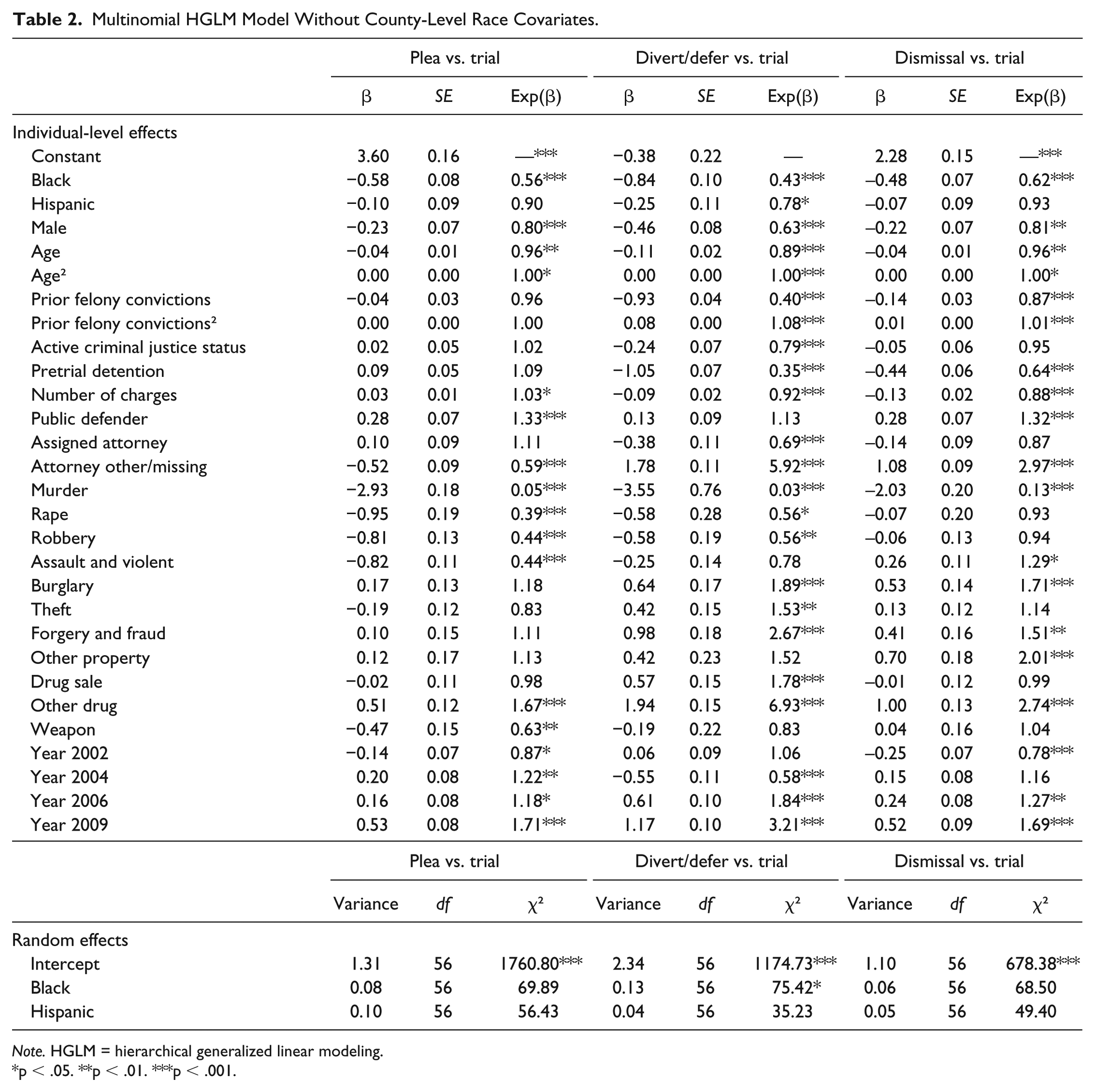
Table 2 provides results for the initial HGLM model, which assesses Hypotheses 1 and 2. Looking to Table 2, we can see that our first hypothesis holds for Black defendants but not Hispanic defendants when assessing the odds of pleading guilty versus going to trial. Consistent with prior literature (see Albonetti, 1990; Metcalfe & Chiricos, 2018), Black defendants are 44% less likely than Whites to plead guilty rather than go to trial (p < .001). Though the coefficient for Hispanic defendants is negative (β = −0.10), it is not statistically significant. There is a curvilinear relationship for age; the odds of pleading guilty as opposed to going to trial decrease as defendants age, but this negative relationship attenuates as age increases. Males are less likely to plead guilty than go to trial than women. The criminal history variables are not overly predictive in this comparison, with the exception of number of charges; each additional charge increases the odds of pleading guilty rather than going to trial by 3%. As one might expect, the odds of pleading guilty are lower among more serious crimes such as murder and rape than the reference category of driving/public order crimes. Defendants represented by public defenders as opposed to private attorneys and defendants sentenced in 2004 or later are also more likely to plead guilty rather than go to trial. The effect for public defenders could be indicative of tightly-knit courtroom workgroups where public defenders have close relationships with prosecutors and are able to negotiate more favorable deals for their clients. The higher plea bargaining rate in later years is consistent with general trends showing an increase in the use of plea bargaining nationally over time (Fisher, 2003).
Multinomial HGLM Model Without County-Level Race Covariates.
Note. HGLM = hierarchical generalized linear modeling.
p < .05. **p < .01. ***p < .001.
A comparison of pretrial diversion and trial shows further support for Hypothesis 1; both Black and Hispanic defendants are significantly less likely than Whites to receive pretrial diversion/deferral as opposed to going to trial, though the substantive significance varies considerably across the two effects. Black defendants are 57% less likely than Whites to receive diversion/deferral, as compared with 22% for Hispanic defendants. When looking to the remainder of the controls in the model, several others are statistically significant. Men are less likely to be diverted or deferred as compared to women, while age continues to have a significant impact, with a negative relationship that weakens as age increases. Unsurprisingly, those charged with more serious crimes such as murder and rape are less likely to receive diversion/deferral, while those charged with drug offenses are more likely to be diverted or deferred. More prior felony convictions also decrease the odds of diversion, though the squared term is positive and significant, indicating a waning effect of prior convictions as they accumulate. In addition, representation by assigned counsel instead of private attorney, active criminal justice status, the number of initial charges, and pretrial detention also decreases the odds of diversion.
Looking at the third pairing (case dismissals vs. trial), racial/ethnic effects resemble the first comparison of pleading guilty versus going to trial. Black defendants are 38% less likely than Whites to have their cases dismissed as compared with go to trial, and there are no significant effects present for Hispanic defendants. 6 In addition to the defendants’ race, a number of other covariates also predict this outcome. The consistent finding of a curvilinear relationship for age continues, as does the negative impact of male gender. Those charged with murder are far less likely (87%) than those charged with driving/public order crimes to be dismissed as compared with go to trial, but there is a deviation from prior results here in that rape cases are not dismissed at a different rate than driving/public order. This is consistent with prior work that notes high attrition rates in rape cases and may reflect the unique evidentiary difficulties associated with rape prosecutions (Frazier & Haney, 1996; LaFree, 1980a). As one might expect, we observe a negative relationship with prior felony convictions (though again we see that the squared term is significant in the positive direction—suggesting a curvilinear relationship) and dismissals. Those who are detained prior to trial are also less likely to be dismissed than those who were released. Defendants with public defenders are actually 32% more likely to have their cases dismissed than those with private attorneys, another finding that may be due to public defenders’ close familiarity with prosecutors and a resultant advantage in securing better outcomes for defendants.
Thus, we find mixed support for Hypothesis 1 overall. There are some important significant racial and ethnic differences in case disposition outcomes. Black defendants are significantly less likely than Whites to plead guilty, receive pretrial diversion or deferral, or have their case dismissed, options which all provide more certainty and typically more lenient punishment than going to trial. Hispanic defendants, however, are only significantly less likely than Whites to have their cases diverted or deferred as opposed to going to trial. These results indicate that there are differences in case disposition type by race and that when a disparity exists, it is minorities who are disadvantaged. The next step in our analysis is to examine whether these differences are the same across jurisdictions in our sample of large, urban counties.
In Hypothesis 2, we predicted that racial and ethnic effects in defendants’ likelihood of pleading guilty, receiving pretrial diversion, or having a case dismissed rather than going to trial would vary across counties. In the first HGLM model, we find some support for this prediction, but only for Black defendants. Looking to the random effects in Table 2, there is only one significant effect for the six total racial and ethnic covariates. The only significant variation in the effect of being Black is on the odds of diversion/deferral as compared with trial. This significant random effect indicates that there is variation across counties for this outcome. Random effects for Hispanic defendants are not significant for any of the three comparisons, demonstrating a lack of significant variation in the effect of being Hispanic across the counties and years included in this sample. All in all, we find limited support for Hypothesis 2 in the effects of race and no support for it with respect to ethnicity.
Because we do find some significant variation across counties in the differences for Black defendants, we then assess the evidence for Hypothesis 3: racial and ethnic differences in defendants’ likelihood of pleading guilty, receiving pretrial diversion, or having a case dismissed rather than going to trial will be smaller in counties in which the White population is larger; this relationship will be nonlinear and will weaken among counties in which the White population is very small. To examine this hypothesis, we introduce county-level covariates into the model; the results of this iteration can be found in Table 3. Here, we focus our attention on explaining cross-county variation in racial effects, as there is no indication that the random effects of ethnicity are significant across counties. In short, we find no evidence for Hypothesis 3. Neither the White proportion interaction nor the squared White proportion interaction emerges as a significant determinant of pleading guilty, diversion/deferral, or dismissal, compared with trial. From the findings on this hypothesis, racial threat theory is not supported.
Multinomial HGLM Model—County-Level Race Effects and Cross-Level Interactions.

Note. HGLM = hierarchical generalized linear modeling.
p < .05. **p < .01. ***p < .001.
Finally, we consider whether or not capturing the change over time in White populations is a more predictive indicator of racial threat (Hypothesis 4). In Table 3, the interaction terms between offender race and the change in White population are substantively small and do not reach statistical significance. 7 Therefore, we again do not find any support for Hypothesis 4 or for racial threat theory. Neither the White population nor changes in the White population significantly influence racial disparities in this sample. Instead, these results suggest a consistent disadvantage for Black defendants across the counties in the sample. Black defendants are more likely to go to trial relative to any other outcome than White defendants, and there is little variation in this effect across jurisdictions.
Discussion and Conclusion
In this sample of large, urban counties, we find support for some of our hypotheses. The strongest support is found for our predictions in Hypothesis 1, which are confirmed in each instance for Black defendants. Black defendants are less likely than Whites to plead guilty, to receive pretrial diversion/deferral, and to have their cases dismissed compared with going to trial. In contrast, Hispanic defendants are less likely to be diverted or deferred, but we find no significant relationships for the other two comparisons. With regard to the second hypothesis, we find variation in the association between race and our outcomes across counties for Black defendants particularly in pretrial diversion, though this prediction is not supported for Hispanics. Finally, we find little evidence that disparities depend on the racial makeup in each county. County-level variables, which capture the size of the White population as well as changes in the White population over time, do not significantly influence individual-level race predictors. Taken together, these findings have important implications for final case dispositions in large urban counties in the United States and indicate that racial and ethnic minority defendants may be facing less favorable outcomes than their White counterparts.
This study has the advantage of generating novel comparisons between trials and other case outcomes. Most notably, while a large number of studies evaluate whether or not minority defendants are more likely to have their cases dismissed compared with pleading guilty (Baumer et al., 2000; Kutateladze et al., 2014; Spears & Spohn, 1996; Wooldredge & Thistlethwaite, 2004), information about the odds of dismissals relative to proceeding to trial has been unavailable. Our finding that dismissals are less likely for Black defendants than White defendants when the reference category is a trial indicates that Black defendants may actually be disadvantaged when it comes to dismissal decisions. One could envision a scenario in which a defendant refuses to plead guilty and the prosecutor is thus forced to decide between dismissing a case or proceeding to trial. Our results indicate that in this situation, cases involving Black defendants may be less likely to be dismissed than those involving White defendants.
Also notable is the finding that Black defendants are more likely to go to trial relative to every other outcome studied, all of which could be conceptualized as mechanisms to avoid a trial. First, our results are consistent with prior literature which finds that minorities are less likely to plead guilty as compared with going to trial. According to focal concerns theory, this may be a consequence of court actors using negative stereotypes about minority offenders to form their perceptions of those offenders’ criminality, risk, and dangerousness (Steffensmeier et al., 1998). These perceptions may lead prosecutors to seek harsher punishment for minorities, offering less favorable plea deals and remaining more open to trials. Other potential explanations proffered have often centered on a lack of trust in the criminal justice system and guilty plea process (Albonetti, 1990; Frenzel & Ball, 2008; Hagan & Albonetti, 1982). Second, diversions and deferrals can be viewed as a less harsh alternative to conviction because offenders may receive treatment for their criminogenic needs and will not have a(nother) felony conviction tarnishing their record (Bellassai, 2010). Again, our findings are consistent with some prior work that indicates that minorities are less likely to be sentenced to pretrial diversion (e.g., Schlesinger, 2013), and again they are consistent with the focal concerns narrative, which posits that minority offenders will be viewed as more dangerous and more deserving of harsh punishment (Steffensmeier et al., 1998). This too may reflect a choice on the defendant’s part as much as the prosecutor’s choice; certain individuals may not prefer pretrial diversion due to a lack of trust in the integrity of the criminal justice system and revocation procedures (see Johnson & DiPietro, 2012; Wood & May, 2003 for similar arguments regarding intermediate sanctions). Finally, the finding that Black defendants are less likely to have cases dismissed compared with Whites when the comparison outcome is a trial further bolsters the argument that racial minority defendants may be disadvantaged when it comes to avoiding a trial.
As for the contextual effects studied, our results demonstrate less inter-county variation than predicted. Results indicate that there is significant variation across these counties for different outcomes between White and Black defendants when comparing diversion/deferral to trial. However, beyond that, we find little variation across counties in the relationship between race and the odds of these case disposition outcomes, suggesting that the disadvantage for Black defendants is a consistent trend across the jurisdictions in this study. Though prior research suggests that community-level differences may influence both prosecutors’ and defendants’ decision-making and affect racial and ethnic disparities (Britt, 2000; Ulmer & Johnson, 2004; Wang & Mears, 2010, 2015), we do not find support for racial threat theory. This study adds to the prior literature on racial threat theory by conceptualizing and operationalizing the “threat” to White individuals as the decrease in White population, which takes into account the fact that there may be more than one increasing minority population (Perez & Hirschman, 2009). While the results we obtain here do not support racial threat theory, this may be due to the sample of large, urban counties; it would be an interesting avenue for future research to examine these same relationships in smaller and/or rural counties.
Despite the fact that very few cases proceed to trial (in our sample, less than 5%), the findings of this study reinforce the importance of comparing trials to other outcomes. There is significant evidence that courtroom actors will go to great lengths to avoid the costs and time associated with a trial, and their motivations to do so vary (Alschuler, 1968, 1975). Trials can be used by prosecutors as a threat to induce a plea (Bibas, 2003) or by a defendant to encourage a more lenient sentence, diversion, or even dismissal. No matter the situation, a trial is always in the back of the courtroom workgroup’s mind as an option during decision-making, and every other disposition can be thought of as a mechanism for avoiding it. Our results indicate that Black defendants are less likely than Whites to avoid this uncertain and potentially harsher disposition regardless of the comparative outcome. In contrast, we find very little evidence that defendants’ ethnicity exerts a substantial effect on case dispositions; Hispanic defendants in our sample are less likely to be diverted/deferred than Whites, but there are no significant differences in guilty pleas and case dismissals. Future research should work to better understand whether these results are the consequences of prosecutorial decision-making, bargaining between parties, or the defendant’s refusal of plea offer or diversion/deferral offers.
This study has important policy implications related to achieving justice for all defendants in case processing. Though our analyses cannot speak to the sources of disparity in case dispositions, they do lend credence to the notion that there are racial disparities in guilty pleas, pretrial diversion/deferral, and case dismissals that may ultimately generate substantial unwarranted differences in punishment. More oversight of the plea process, pretrial diversion decisions, and case dismissal decisions is thus justified to identify and prevent these disparities (Alschuler, 1983; Bibas, 2003). For example, the implementation of guidelines for plea offer and case dismissal decisions may help reduce the occurrence of disparate outcomes by structuring decision-making and providing a straightforward way to review decisions. Some prosecutor’s offices have internal policies that help guide prosecutorial decision-making, such as plea offer guidelines and dismissal rules, but more formal mechanisms for directing and monitoring decision-making may assist in the reduction of unwarranted disparities (Pfaff, 2017). In addition, if these results are indicative of racial differences in defendant decision-making, minority defendants’ lack of confidence in the justice system may be a particularly useful target for reform. Efforts to promote legitimacy and trust within minority communities as well as non-minority communities should be explored by actors involved throughout the criminal justice process.
There are a few limitations to note in this study. First, the SCPS data set, while helpful in that it provides information on pretrial outcomes across a large number of jurisdictions, does have some shortcomings. Due to a variety of individuals inputting and submitting information from each county, there are likely discrepancies across jurisdictions. There is also significant variation in diversion programs across counties, and it is possible that there are differences not captured in our data. Because each individual in the data set is only coded as one final outcome (as in many sentencing data sets), the data are unable to capture whether a person received diversion, failed, and then pled guilty. There are no measures of sentencing enhancements, and we were only able to capture severity using a number of dummy variables for offense type. There is also no information on evidence, which has recently been explored as an important determinant of prosecutorial decision-making (Kutateladze et al., 2016). It is possible that some cases would be more likely to be dismissed because they lack evidentiary support or that they might be resolved via guilty plea because the evidence against the defendant is so strong. If minority individuals are more likely to be arrested than Whites when evidence is weak (see Kochel, Wilson, & Mastrofski, 2011 for indirect evidence of this), then racial/ethnic differences in evidentiary strength may influence patterns of disparity in case dispositions. Future research assessing dismissals, guilty pleas, and trials could be improved by the inclusion of additional case information such as physical evidentiary measures, circumstances of the arrest, and police contact. It would also be helpful to have information about courtroom workgroup characteristics, as they have proved important in prior research (see Hoskins Haynes, Ruback, & Cusick, 2010, for an example).
As mentioned before, the SCPS sample only includes large, urban counties. The findings from this study may not be generalizable to other smaller or suburban/rural counties. Future work in this area should examine alternate case disposition types in different types of jurisdictions. Finally, additional contextual measures at the county level could also be examined more in future research (see Wang & Mears, 2010, for an example). Prior work shows that community factors such as political environment, unemployment rates, crime rates, and racial and ethnic representation may all impact courtroom decision-making (Britt, 2000; Crow & Johnson, 2008; Ulmer & Johnson, 2004; Wang & Mears, 2015). These and other contextual determinants of punishment should be investigated further.
In spite of these limitations, this study helps to increase understanding of case processing and final outcomes by conceptualizing case disposition types as different decision nodes that are utilized to avoid the expense of a trial. These results indicate that Black defendants are more likely to go to trial than their White counterparts, a finding that persisted when comparing trials to diversion/deferrals, pleading guilty, and dismissals. This may be the result of Black defendants receiving poorer treatment in the courtroom process, spurred on by perceptions of Black individuals as riskier and more dangerous (Steffensmeier et al., 1998). Another potential explanation for this pattern is that when able to exercise their own agency, Black defendants choose the riskier trial option. This could be due to a lack of trust in the system, weaker plea offers from prosecutors, or a desire to avoid intermediate sanctions (see Wood & May, 2003).
Although there is growing recognition that case processing decisions prior to sentencing are important determinants of fairness in the American criminal justice system, empirical research on inequalities in these decisions remain relatively scarce. This study contributes to the literature by providing an assessment of racial and ethnic disparities in an assortment of case dispositions not typically captured holistically in courtroom evaluations and examining these disparities at both the individual and county levels. By focusing on mechanisms for trial avoidance and identifying a consistent pattern of disparities that disadvantage Black (though not Hispanic) defendants in the case disposition process, we hope to stimulate further discussion and research into inequalities in case processing outcomes. Any finding of racial differences in court outcomes, especially one which indicates minority disadvantage, should be more closely examined to advance our understanding of how to achieve justice and fairness in American courtrooms.
Footnotes
Acknowledgements
We would like to thank Dr. Brian Johnson for his assistance and feedback on prior drafts of this paper. We would also like to thank John Ropp for his help in preparing the references and tables. Finally, we express our gratitude to the three anonymous reviewers for their valuable time and insight.
Declaration of Conflicting Interests
The author(s) declared no potential conflicts of interest with respect to the research, authorship, and/or publication of this article.
Funding
The author(s) received no financial support for the research, authorship, and/or publication of this article.