



Abstract
Prisoner reentry has been a dominant focus of correctional policy for roughly 2 decades. The strong current of reform that underlays this policy focus means that present correctional practices and conditions should be noticeably different than previous ones. An area where change should be readily observable is in pivotal reentry environments, such as post-prison supervision (PPS). Whereas the reentry literature has concentrated on documenting offender needs, promoting certain strategies, and evaluating the effects of interventions or variables on post-prison recidivism, the current study aims to document the sorts of changes, if any, that have occurred in PPS practice. The impact of the reentry movement on PPS is measured using statewide survey data from 286 PPS professionals with The Florida Department of Corrections. Perceptions of the movement’s impact on supervision emphasis, workplace roles and responsibilities, and resource allocation for services for returning offenders are examined.
Prisoner reentry is a correctional policy issue of great contemporary significance. Mears and Cochran (2015) have remarked that, several decades ago, prisoner reentry “barely registered in the public consciousness” (p. 1). Burke and Tonry (2006) have further claimed that “interest in reentry is evidence of a virtual sea change in how communities and corrections professionals think about prisons, offenders, and community safety” (p. 7). This sentiment has been echoed by Garland and Wodahl (2014), who call reentry a “full-fledged correctional movement that has transformed thinking about correctional practice” (p. 400).
A common thread in these various statements is the wedding of prisoner reentry to the notion of correctional change or a movement. When used in this context, the term reentry has been generally construed as a turning away from the get-tough era. The presumed effect of this turning is that the once-dominant support for prison entry, containing risk, and mass incarceration has now given way to support for the very opposite. This new policy focus recognizes that most offenders will return to their communities and that programs for meeting their needs before and after release are essential to their success. Put differently, reentry as a movement marks what Visher (2017) has called a “resurgence” of interest across research, policy, and practice in the reintegration of offenders (p. 747).
In the correctional research, this interest has largely taken the form of documenting offender challenges and needs, promoting certain prison and community-based strategies to address these challenges and needs, and evaluating the impact of various treatment and other interventions on post-prison recidivism. There has been less research interest, however, in documenting actual change in pivotal reentry environments, especially post-prison supervision (PPS). This relative disinterest is unusual as PPS professionals are key overseers of the literal reentry process and, thus, well-positioned to observe what changes, if any, have occurred in the name of the reentry movement.
The current study examines the impact of the reentry movement on PPS practice in Florida. Roughly 33,000 inmates exit Florida’s prison system annually, with 33% of those released being subject to some form of PPS (Florida Department of Corrections Population Data, n.d.). To advance understanding of the implications of the reentry movement for PPS practice, and ultimately released offenders, the study draws on statewide survey data from PPS professionals throughout the ranks of the Florida Department of Corrections (FDOC). Professionals’ perceptions of the movement’s impact on several operational dimensions of PPS are examined. One dimension is the importance workplace superiors place on the performance of certain activities in supervising released offenders. Other dimensions include perceived changes in workplace roles and responsibilities, and resource allocation for services for released offenders.
Prior Literature
Research on reentry has evolved in several different directions. Much of the reentry literature has accented the challenges facing returning offenders, with and without PPS. These challenges involve access to housing, employment, legal identification, and health and mental health care, just to name a few (Gaes & Kendig, 2003; Pager, 2003; Petersilia, 2003; Roman & Travis, 2004; Travis, 2000). With the goal of mitigating these challenges, the reentry literature has also advocated agency partnerships (Byrne, Taxman, & Young, 2001; Parent & Barnett, 2004), justice reinvestment (Clear, 2011), and the lifting of collateral sanctions and other stigmatizing policies (American Bar Association, 2004; Pager, 2003; Uggen & Manza, 2002; Uggen, Manza, & Behrens, 2004).
A different but just as substantial segment of the reentry literature has evaluated the effects of some intervention or variable on post-prison recidivism. This “what works” research is exemplified in Seiter and Kadela’s (2003) review of prisoner reentry program effectiveness. This research is also illustrated in evaluations of a variety of correctional practices. They include, but are not limited to, the effectiveness of boot camps (Kurlychek & Kempinen, 2006), reentry courts (Hamilton, 2011; Maruna & LeBel, 2003), enhanced parole supervision (Veysey, Ostermann, & Lanterman, 2014; Visher, Lattimore, Barrick, & Tueller, 2017), evidence-based treatment (Cullen & Gendreau, 2000; MacKenzie & Hickman, 1998), religious and spiritual support (Stansfield, Mowen, O’Connor, & Boman, 2017), pre-release programs (Wilson & Davis, 2006), work-release centers (Wright & Rosky, 2011), community supervision techniques (e.g., Bouffard & Bergeron, 2006), risk/needs assessment, inmate visitation (Bales & Mears, 2008), employment programs and desistance signaling (Bushway & Apel, 2012), and social ties in the community (Berg & Huebner, 2011; Boman & Mowen, 2017). Although generating a range of useful results, this body of work as a whole has also prompted criticism. It has been suggested that the term reentry has been over-applied (Lynch, 2006) and that not every supervision program, technique, or instrument should fall under the banner of reentry (Crow & Smykla, 2014).
Examining reentry within the context of PPS is unlikely to suffer such criticism, yet research in this area has been scarce by comparison. The vantage point of PPS professionals has even been called the “invisible side of reentry” (Lutze, 2014) and parole an often-neglected stakeholder in the reentry movement (Burke & Tonry, 2006). This is not to suggest that PPS has been entirely overlooked in the literature, but much of the research to date has not directly or fully addressed the impact of the reentry movement on PPS. For instance, the study of parole-based reentry initiatives (e.g., the Serious and Violent Offender Reentry Initiative [SVORI], Reentry Partnership Initiative) implemented in select sites may not reflect changes to PPS that are more mainstream or sustained past the point of initial funding. Research on evidence-based techniques in PPS (e.g., Risk/Needs, Dual Role Relationship Inventory, Level of Service Inventory) is an equally dubious indicator of reentry-based change, especially because these techniques are also utilized in non-reentry-based settings (e.g., probation).
Research involving PPS professionals as informants on reentry issues is more compatible with the aims of the current study. Nevertheless, changes to PPS that are inspired by the reentry movement are not at the core of these analyses. For example, Seiter’s (2002) Missouri study investigates probation and parole officers’ perceptions of available reentry programming in the community and what they personally deem to be most important in reentry programming. On both questions, officers identified job training/vocational-rehabilitation/employment assistance and substance abuse treatment.
Gunnison and Helfgott’s (2007, 2011) studies of state and federal community corrections (CC) officers in Washington examine these same questions, but in somewhat reverse fashion. They investigate factors that hinder reentry success, such as the social distance between offender and officer and the environment to which the offender returns (Gunnison & Helfgott, 2011). They found officers were in touch with offender needs and believed lack of access to treatment and diminished employment opportunities due to a felony conviction contributed to reentry failure.
Bond and Gittell’s (2010) study of inter-agency coordination of services best approaches the idea of reentry as a movement and, thus, a potential game-changer for PPS. Their survey of 45 Massachusetts’ administrators/ managers in the fields of probation, parole, police, employment, and substance abuse analyzes collaboration between these agencies. Although the authors’ ultimate goal is to assess the impact of collaboration on recidivism, 94% of respondents indicated their agencies had been impacted by reentry trends, at least where service coordination was concerned.
Claims that reentry constitutes a “sea change” or movement in correctional practice establishes the need to investigate these claims more fully. The current study does so by analyzing the impact of the reentry movement on PPS in Florida. Instead of measuring officers’ personal beliefs about important reentry programming or hindrances to reentry success, dynamics of inter-agency coordination, or post-intervention recidivism, the study explores perceptions of changes to PPS practice. Notably, these perceptions are explored in a state that—unlike Massachusetts, Missouri, and Washington—has maintained one of the highest incarceration rates in the country and been ranked among the most punitive on a number of indicators (Kutateladze, 2009). These perceptions also derive from a setting that has not been structured by a pilot project or research initiative that is funded externally and/or temporarily.
Research Design
Three research questions guided the analysis.
Research Question 1: What PPS activities have emerged in recent years as most important in supervising offenders released from prison?
Research Question 2: Have roles and responsibilities of PPS professionals changed because of the reentry movement and, if so, how?
Research Question 3: Have PPS agencies and communities in which they reside received new resources for services that aid reentry at the point of PPS, and, if so, what are they?
Sampling and Data Collection
The population of professionals targeted by this study were CC directors, regional managers, circuit administrators, supervisors of CC line staff, and line staff (probation/parole officers) employed statewide by the Florida Department of Corrections (FDOC). The precise size of this population could not be determined, however, because the FDOC does not compile figures on the numbers of employees by position within CC or by whether line staff are assigned to PPS cases. Estimates provided by FDOC and acquired through visual inspection of the agency’s online organizational chart yielded the following rough estimates. The number of CC professionals construed as upper level, namely, directors, regional managers, and circuit administrators, totaled 44. The number of CC professionals categorized as line staff supervisory totaled 126. Finally, the number of CC professionals categorized as line staff were those who, in the past 5 years, had supervised offenders released from the state’s prison system. According to FDOC’s metric of having supervised “at least 1 released prisoner in the past five years,” potentially 1,450 CC officers were eligible for the study. Yet, the number of CC officers that supervise this post-prison population on a regular basis and have a caseload that regularly consists of post-prison cases is considerably smaller. Because the FDOC could only identify CC officers using this very broad metric and because many CC officers oversee a mixed caseload of probationers and post-prison cases, officials could not provide an exact number of officers within the targeted population.
Upon approval from institutional review boards at the university and FDOC, a Qualtrics online survey link was distributed by the FDOC to all CC professionals throughout the state. The survey link was provided in a workplace e-mail and in an announcement on the FDOC employee website. The survey link was distributed via e-mail on March 31, 2014, with two follow-up e-mails being sent at various intervals. Access to the survey closed on September 8, 2014.
Basic information about the survey and eligibility was provided in the e-mail and FDOC website announcement. This included an assurance that identifying information on participants was not compiled by Qualtrics. Thus, knowledge of who participated was not available to the FDOC or researcher at any time during or after the data collection process. To ensure only the targeted population participated in the survey, eligibility criteria were again highlighted in an opening section of the survey. These criteria consisted of the following two conditions: “You are eligible to participate in this survey if, in the past 5 years, you have supervised adult offenders released from prison as an employee of the Florida Department of Corrections” and “You are eligible to participate in this survey if you are currently employed in a supervisory/managerial/ director capacity with the FDOC in a unit or division that has oversight over the supervision of adult offenders released from prison.” Individuals who did not meet at least one of these conditions were instructed to exit the survey.
Of the CC professionals solicited to complete the online survey, 307 opened the link, 21 of whom promptly exited, presumably due to ineligibility. Thus, 286 persons completed the survey, with varying response rates for questions. Most questions achieved an 85% to 89% response rate. The lowest response rates came from questions eliciting personal information, such as gender, race, and current position; these response rates ranged between 83% and 87%. Cases with missing data were not dropped from the sample, except when group analyses based on the missing data triggered their automatic removal. For example, group analysis based on current position dropped cases with missing data on this variable. Because of these variations in response rates, sample size is reported for all analyses performed.
Survey Construction
Survey questions explored the potential impact of the reentry movement on three dimensions of PPS: the relative importance of certain PPS activities, roles and responsibilities of PPS professionals, and resources for services for offenders on PPS. Importantly, the concept or assumption of reentry as a movement or catalyst of change—as opposed to simply meaning parole or the process of release to the community—was communicated throughout the survey. This assumption was first defined in the introductory information about the study and in initial survey questions (that are not the subject of this study) concerning the term’s use and salience within FDOC’s mission statements and other official documents and correspondence. This assumption was also made apparent in carefully worded questions referring to PPS changes brought about by reentry-based policy.
Other assumptions were key in developing valid measures of change in PPS practice. Based on the reentry literature, it was assumed that change would translate to greater importance being placed on meeting transition needs (e.g., housing, health care, employment, legal identification) as opposed to monitoring risk and enforcing violations. This same literature also informed the assumption that change would be reflected in an emphasis on certain strategies for meeting those needs (e.g., agency partnerships, new resources/reinvestment, evidence-based practice). Last, it was assumed that Florida might add to or modify these reentry trends based on conditions unique to the state.
The impact of the reentry movement on the three dimensions of PPS was measured through seven survey questions. For the sake of precision, many of these questions consisted of several items, which were also informed by the prior literature and direct knowledge of reentry-based services and PPS activities. 1 The first dimension was measured through the 12-item question, “How important is it to your superiors that the following activities are performed by officers when supervising an offender released from prison?” Rating the importance of supervision activities has a long history in CC research and the measurement of organizational change in the wake of policy reform (Lutze, 2014; Ohlin, Piven, & Pappenfort, 1956; Payne & DeMichele, 2011; Seiter & West, 2003). To better isolate changes in official policy and practice, the question solicited input on what was deemed important to one’s superiors as opposed to oneself.
The second dimension was measured with the following straightforward question: “Within the past 5 years, policies identified as being ‘offender reentry-based’ have changed my role and responsibilities at work. Please explain, specifically, how your job has been affected.” The third and final dimension of change was measured through the following four and equally straightforward questions on resources: “Within the past 5 years, the agency I work for has received new resources for community corrections to assist with offender reentry. Please explain what these resources are and how they are being used”; “Has the community corrections agency you work for hired separate staff OR do they have a contract with other agencies to provide the following services free of charge or at a reduced rate for indigent offenders (10 items)?”; “How would you rate the availability of the following services/programs in your community (9 items)?” The 5-year time frame was used to create a reference point (2008-2013) that ensured overlap with FDOC’s expressed interest in reentry policy.
Survey questions employed fixed-response options based on either a yes/no/not sure or 5-point Likert-type scale; the latter scale was used overwhelmingly to increase the exactness of responses. As is typical in research on perceptions, the Likert-type scales employed measured degrees of importance, agreement, and quality (Schuman & Presser, 1996). The only exceptions to this format were the two open-ended questions seeking elaboration on fixed responses. This open-ended format enabled more detailed insights and other information not anticipated by the author. These elaborations were reviewed and provisional categories created to capture the dominant themes. Upon repeated readings of these qualitative data, categories were refined and a final coding scheme established.
Data Analysis
Analysis based primarily on descriptive statistics suited the mostly exploratory aims of the study. Frequencies were computed for each question and supplemented with qualitative input from open-ended questions. Qualitative data were analyzed by content and distilled into discrete response categories. Frequencies were then computed for these response categories.
Means comparison tests (ANOVA, with Bonferroni correction) and chi-square analysis were also performed. These analyses were based on the variable current position (line staff, supervisors, administrators/managers), which has been shown to be relevant in the study of policy reform. Research in the correctional setting suggests upper management and line staff may differ in their interpretation and acceptance of reform practices (e.g., DeMichele & Payne, 2012; Rudes, Lerch, & Taxman, 2011; Steiner, Travis, & Makarios, 2011).
Findings
A brief review of Florida’s PPS system lends important context to the findings that follow; to make sense of PPS practices, one must first know how PPS is structured. There are four types of PPS in Florida. Offenders sentenced prior to 1983, when Florida abolished parole, are still released under the discretionary parole system. As of May 2016, 4,552 inmates were eligible for the retroactive parole and new post-1983 parole qualifiers (Florida Department of Corrections [FDOC]Population Data, n.d.). 2 Conditional Release, a type of non-discretionary mandatory supervision, is reserved for habitual offenders, violent career criminals, court-designated sexual predators, or those who have a prior felony commitment to a state or federal institution. Offenders on Conditional Release are supervised for a period equal to the gain-time received in prison. In 2013-2014, roughly 5,305 inmates were released to this type of supervision (FDOC Population Data, n.d.). A third type of PPS, Addiction Recovery Supervision, is mandatory for reentering offenders with a history of substance abuse (FDOC Population Data, n.d.). Last, there is PPS that involves a term of probation or community control; this is known as a split sentence. In this instance, the terms of supervision are determined by the original court of conviction. In 2013-2014, roughly 5,174 inmates were under split-sentence supervision (FDOC Population Data, n.d.).
Of the survey respondents that had actively supervised released offenders within the past 5 years (n = 186), 84% reported having a mixed caseload of probationers and PPS cases. According to FDOC officials, a mixed caseload is typical. The remaining 16% supervised PPS cases exclusively. In addition, 39% reported that a term of less than 90 days was typical for the post-prison cases they supervised; 50% reported a term of more than 1 year as typical. By extension, 11% reported a PPS term of between 4 and 12 months as typical. A total of 33% indicated the average number of post-prison cases on their caseload was typically less than 50.
Respondent characteristics are reported in Table 1, along with the number of missing cases per variable. Missing data notwithstanding, the sample was equally male and female and primarily White (68.5%). Owing to the fact that a college degree is required for these positions, all possessed at least a 4-year college degree. Inasmuch as the statewide population of CC professionals is primarily CC officers, the bulk of the sample was comprised of line staff (74.2%). As for number of years employed, 59.4% of respondents had been in their current position for more than 10 years, while 82.3% had been working in the field of CC in general for more than 10 years. This suggests that most respondents had a pre/post-reentry movement perspective of PPS.
Sample Descriptives: Respondent Characteristics (N = 286).
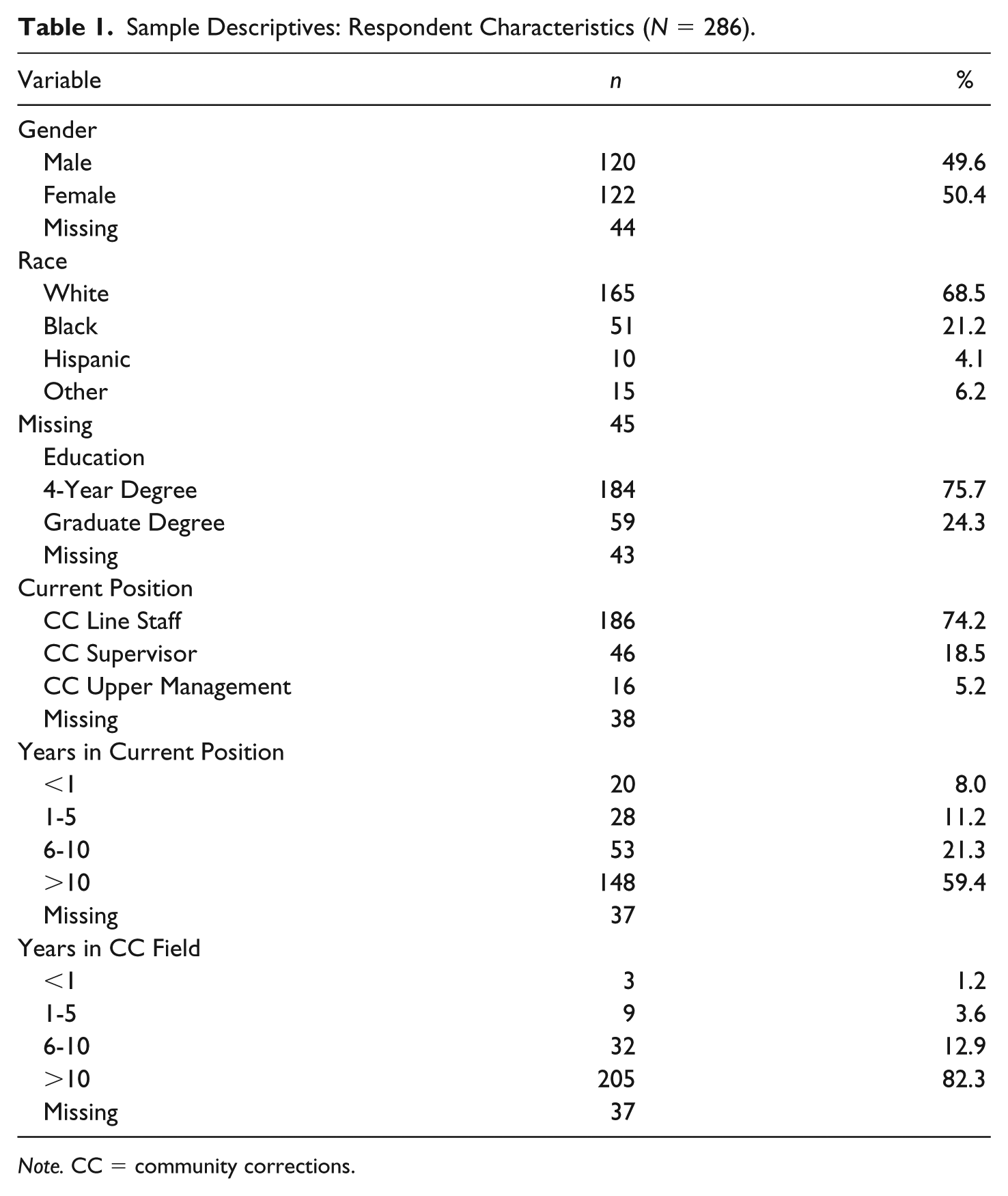
Note. CC = community corrections.
The findings reported in the following sections are best understood in view of prior research by this author on the discourse and meaning of reentry in Florida’s CC system (Lucken & Fandetti, 2018). This research found that the term offender reentry had, indeed, permeated the workplace discourse and was prominently communicated as the agency’s “new” “goal,” “mission,” and “direction” in official documents, correspondence, and training seminars. The current analysis goes beyond verbalizations to consider the impact of this “new” reentry “mission” on PPS practice. The first set of findings addresses impact in terms of the importance workplace superiors place on the performance of certain supervision activities. The second set addresses perceived changes in workplace roles and responsibilities. The third set of findings looks at the reentry movement’s impact on new resource allocation for offender services within the agency and community.
PPS Priorities
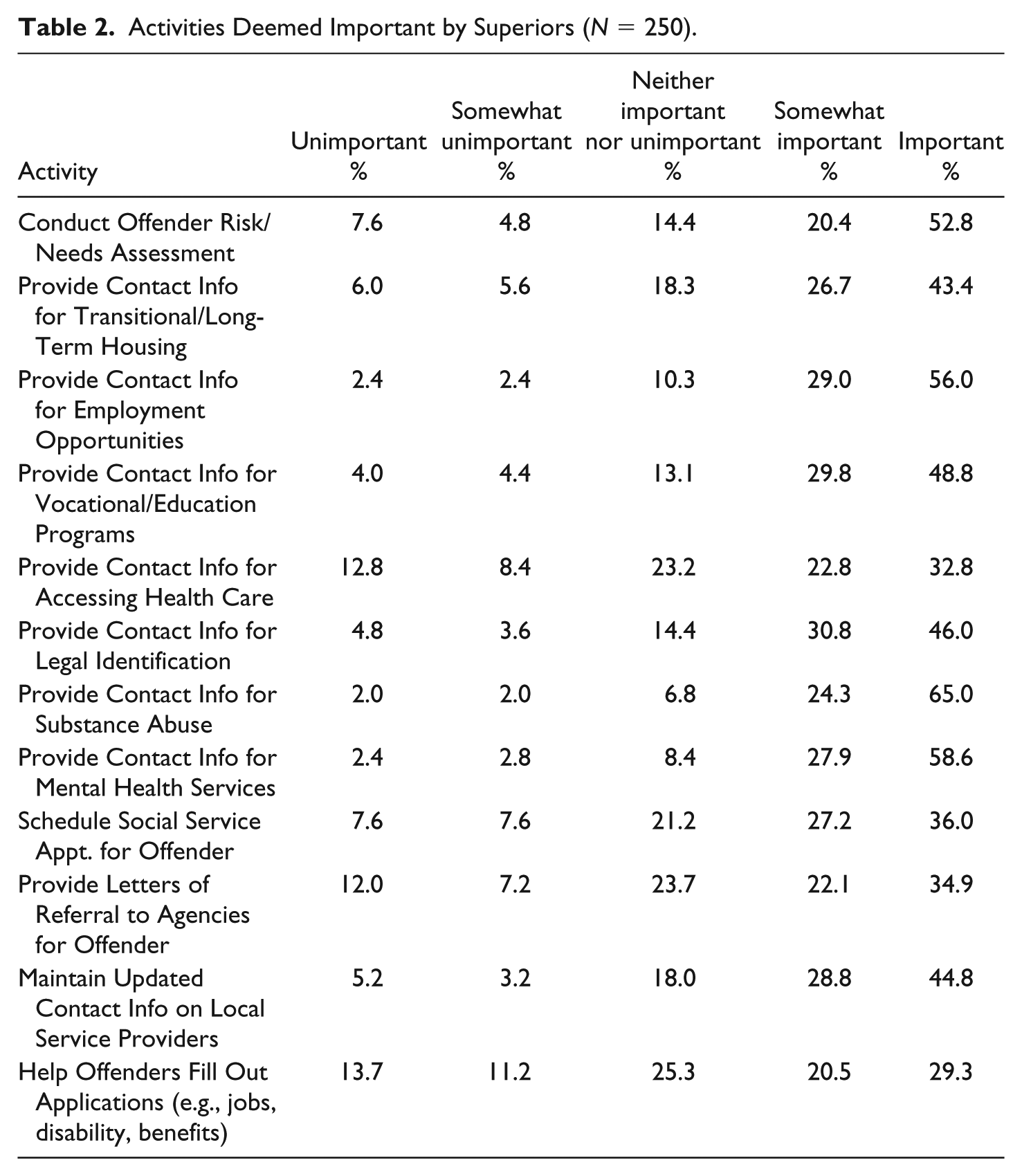
Table 2 reports perceptions of the importance superiors place on a range of PPS activities. Specifically, the table reports the distribution of responses to the question, “How important is it to your superiors that the following activities are performed by CC officers when supervising an offender released from prison?” Based on the sample as a whole, four activities stand out as receiving the highest percentage of “important” responses. In rank order, they include providing contact information for substance abuse programs (65%), mental health services (58.6%), and employment opportunities (56%), and risk/needs assessment (52.8%). Activities receiving the highest percentage of responses on the spectrum of unimportance (i.e., combined response of unimportant and somewhat unimportant) were helping offenders fill out applications for jobs, disability, and other government services (24.9%); contact information for health care (21.2%); letters of referral to agencies (19.2%); and scheduling social service appointments for offenders (15.2%). These four activities were also least-often rated as important and also received the highest percentage of responses indicating some degree of ambivalence (i.e., neither important/nor unimportant).
Activities Deemed Important by Superiors (N = 250).
PPS Roles and Responsibilities
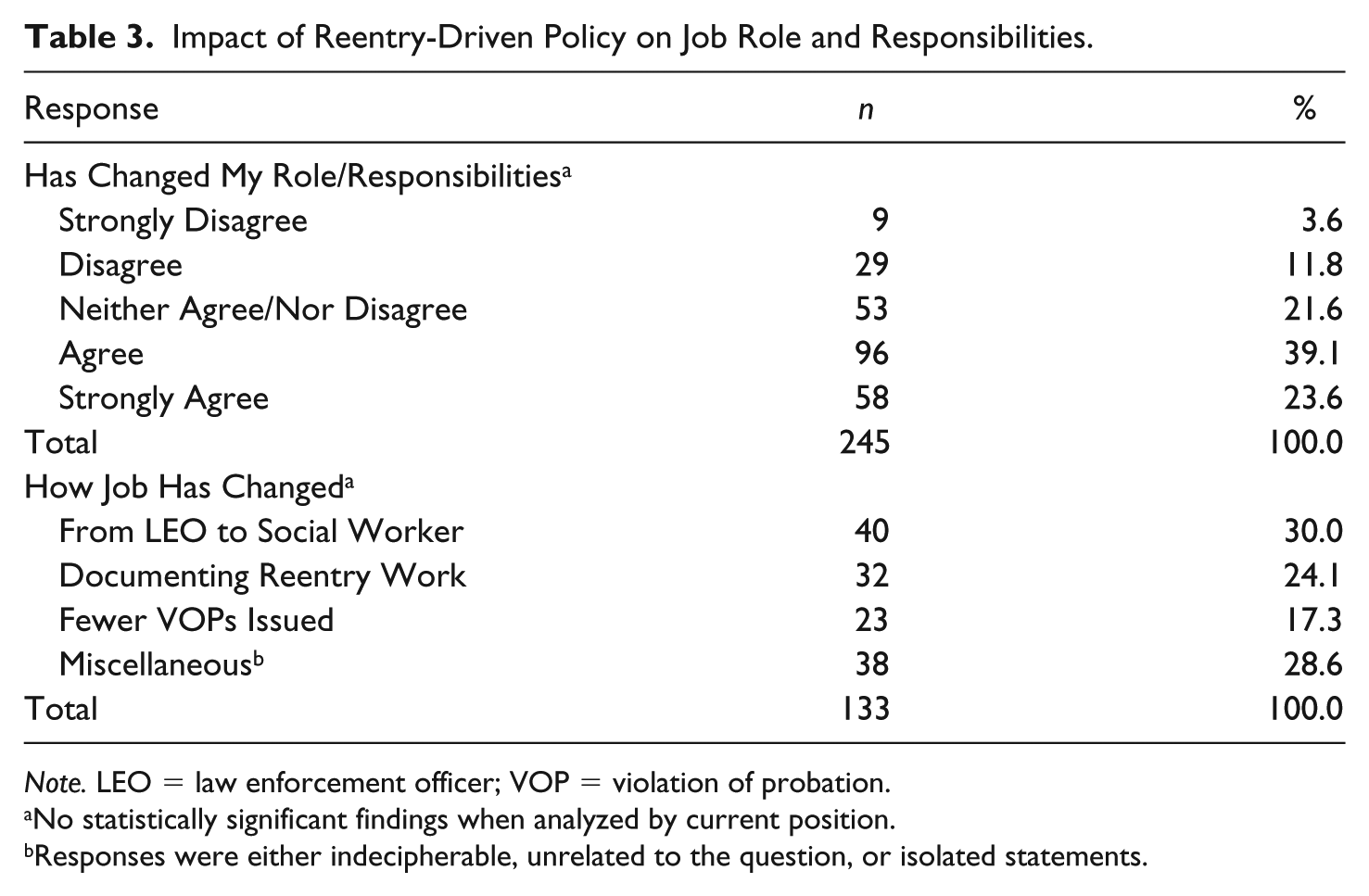
The impact of reentry on PPS was also assessed through perceptions of changes in workplace roles and responsibilities. Table 3 reports findings from a two-part question. The first part measured level of agreement with the statement, “Policies identified as being offender reentry-based have changed my role and responsibilities at work.” This was followed by an open-ended question asking for an explanation of how the job had been affected.
Impact of Reentry-Driven Policy on Job Role and Responsibilities.
Note. LEO = law enforcement officer; VOP = violation of probation.
No statistically significant findings when analyzed by current position.
Responses were either indecipherable, unrelated to the question, or isolated statements.
The findings in Table 3 indicate in simple but fairly strong terms that reentry-based policy has changed the role and responsibilities of PPS professionals. On the spectrum of agreement, 23.6% strongly agree and 39.1% agree (a total of 62.7%) that their role and responsibilities have changed. On the spectrum of disagreement, 3.6% strongly disagree and 11.8% disagree (a total of 15.4%) that their roles and responsibilities have changed. ANOVA tests (with Bonferroni correction) showed there were no significant differences (at p ⩽ .05) in perceptions based on the variable of current position.
Open-ended responses (n = 133) describing the change experienced by PPS officers coalesced around three themes. 3 The first theme, indicated in 30% of responses, can be summarized as the change of moving from a law enforcement officer to a social worker role. Statements to this effect were remarkably similar, including, “We have turned into a social service agency from a law enforcement agency”; “gone to being more of a social worker again”; “My agency has gone from a zero tolerance mentality to a reentry based ‘social worker’ mentality”; “more of a social worker now than a probation officer”; “Everything changed. Our role went from enforcer for the court to social worker”; “Instead of law enforcement protecting the community it is now social work to provide assistance to those that want the hand outs and free things without working for them.” The same theme was expressed in other statements that did not use the exact terms of law enforcement and social worker. For example, some expressed this theme as, “went from zero tolerance to reentry minded so now we are more focused on rehabilitation”; “tasked with spending more one on one time with offenders”; “More extensive, and more referrals in general and a shifted focus to the needs of the offender to successfully assimilate into society”; or “We have to give offenders tools to succeed where before it was just supervision.”
A second theme, indicated in 24% of responses, can be summarized as the change of having to document more and/or complete more paperwork because of reentry. In short, reentry-based policies meant a noticeable increase in workload. The clearest statements to this effect included “more work”; “More paperwork and tracking”; “I now have to do more paperwork to justify my position, and what I do exactly for reentry”; and “more paper work has been added to insure this process is being done.” Other responses lent more insight into what this paperwork entailed, such as “more documentation of my efforts towards offenders”; “needs assessments and evidence-based bean counting”; “more paperwork documenting how we are assisting offenders”; and “now required to ask about and create goals at intake and follow up as needed”; or the “mandatory establishment of goals for the offender at the beginning of supervision.”
Others identifying the theme of more paperwork were more cynical in their appraisals. They asserted the paperwork had little impact on the real goals of reentry or was, in fact, thwarting the goals of reentry. Statements to this effect included, “more reports have been created and more data collection is occurring which has decreased public safety”; “We are now placing much more of our working day within the office completing reports and less time actually out helping and supervising offenders”; “more work that takes away from supervision”; “it increases an already high work rate due to overly high caseloads in terms of time management makes scheduling time to assist each offender with their needs more difficult”; and “more work and paperwork but not many resources or compensation provided.” Perhaps the most clarifying statement on this point was the following:
In order to complete most administrative duties officers must complete offender based reentry paperwork. This is paperwork only and has no actual function in reentry. Example would be Individual Supervision Plan. Must be signed by the offender and placed in the file . . .
The third and final dominant theme revolved around violations and enforcement of conditions. However, the 17% identifying this issue did not always delineate the type of violation to which they were referring. Many noted, “a reduction in violation reports and recommendations for incarceration”; “I do less violations and more referrals”; “Getting officers on board to always think of Re-entry and not to be so quick to violate and send back to jail/prison”; “focus on reentry than violations”; and that “we are definitely providing less stringent enforcement of supervision.” Others clarified by citing a reduction in technical violations, commenting there were “Less violations reports with warrants and more Technical Violation Notification letters to the Court,” or “More Technical Violation Notifications as opposed to Violation Reports.” One regarded the de-emphasis on violations as providing “multiple second chances.” Still others seemed to associate this change in violation policy with their purported new role, as indicated by the statements, “report less violation to courts, try to not recommend revocation, be a social worker NOT law enforcement”; “less re-arrest and more positive help”; and “concerned more w/individuals than with violating them.”
Both sets of findings in Table 3 comport with the idea of change instigated by a reentry-focused policy. These perceived departures from roles and responsibilities of the past are also intertwined. For example, the change of fewer violations and returns to prison coincides with the shift from a law enforcement role to a social worker role. This, in turn, coincides with the increased paperwork documenting adherence to this new role and the associated responsibility of facilitating reentry through goal-setting and individualized planning for offenders.
PPS Resource Availability
A concept that lives in close proximity to the reentry movement and has ramifications for its success is justice reinvestment. Justice reinvestment refers to the idea of directing savings accrued from reducing mass incarceration into CC agencies (Kleiman, 2011) or communities most affected by mass incarceration (Clear, 2011). The Vera (Subramanian, Moreno, & Broomhead, 2014) and Urban Institutes (LaVigne et al., 2014) have each reported that several states have passed reinvestment-based legislation to reduce prison populations, expand or strengthen CC, and support reentry in the community (Subramanian et al., 2014). This has resulted in strategies for more in-prison support prior to release and resources or supports after release.
While Florida is not a subject of these reports, reentry efforts along these lines have been undertaken independently. For example, FDOC annual reports tout increases in prison substance abuse and educational/vocational programs and transition support prior to release (e.g., 30-day supply of medicine, community resource information). The FDOC also notes the development of a few reentry institutions for soon-to-be-released inmates and a few one-stop community service referral and registration portals in jurisdictions with large numbers of returning offenders (FDOC, 2015); these can be used by returning offenders regardless of supervision status. What is not detailed in these annual reports is whether new resources have gone to CC agencies to meet the needs of offenders on PPS.
Four survey questions addressed the issue of resource availability. When asked if in the past 5 years, the agency had received new resources for CC to assist with reentry, 31% said yes, 45% said no, while 24% were unsure. When asked to elaborate on those resources and how they were being used, few if any recurring themes were reported. Of those who elaborated (n = 75), some indicated new funding to create a reentry division at the FDOC Central Office. Others reported funding for a cognitive-based counseling program (Thinking for a Change), or grant funds for officer training in evidence-based practice. The remainder reiterated the point of either not knowing or refuting the notion of new resources due to “budgets being slashed,” “budgetary issues,” or “at the end of the year, what we do have is cut.” Still others reported resources were no different or remained “insufficient.” Some indicated relationships with outside community agencies (i.e., substance abuse), but most were agencies with whom they were not partnered. Others mistakenly mentioned resources that were institution rather than community-based.
Delving further into the issue of resources, Table 4 reports findings from the question, “Has the community corrections agency you work for hired separate staff OR do they have a contract with other agencies to provide the following services free of charge or at a reduced rate for indigent offenders?” Two types of services received a high percentage of “yes” responses, namely, substance abuse evaluations/treatment (89.1%) and mental health evaluation/treatment (63.2%); it should be noted that open-ended responses scattered throughout the survey indicated that contracts with other agencies—namely, for substance abuse—was the method by which indigent offenders received services. For each of the remaining eight services, well over half answered “no.” These “no” responses were especially pronounced for health care (74%), transitional/low-income housing (69.1%), and government benefits application assistance (66.7%). As indicated in the table, chi-square tests for variation by current position could not be performed due to small cell counts.
Services for Indigent Offenders In-House or by Contract (N = 247).

Note. GED = General Equivalency Diploma.
Chi-square tests for current position could not be performed due to small cell counts.
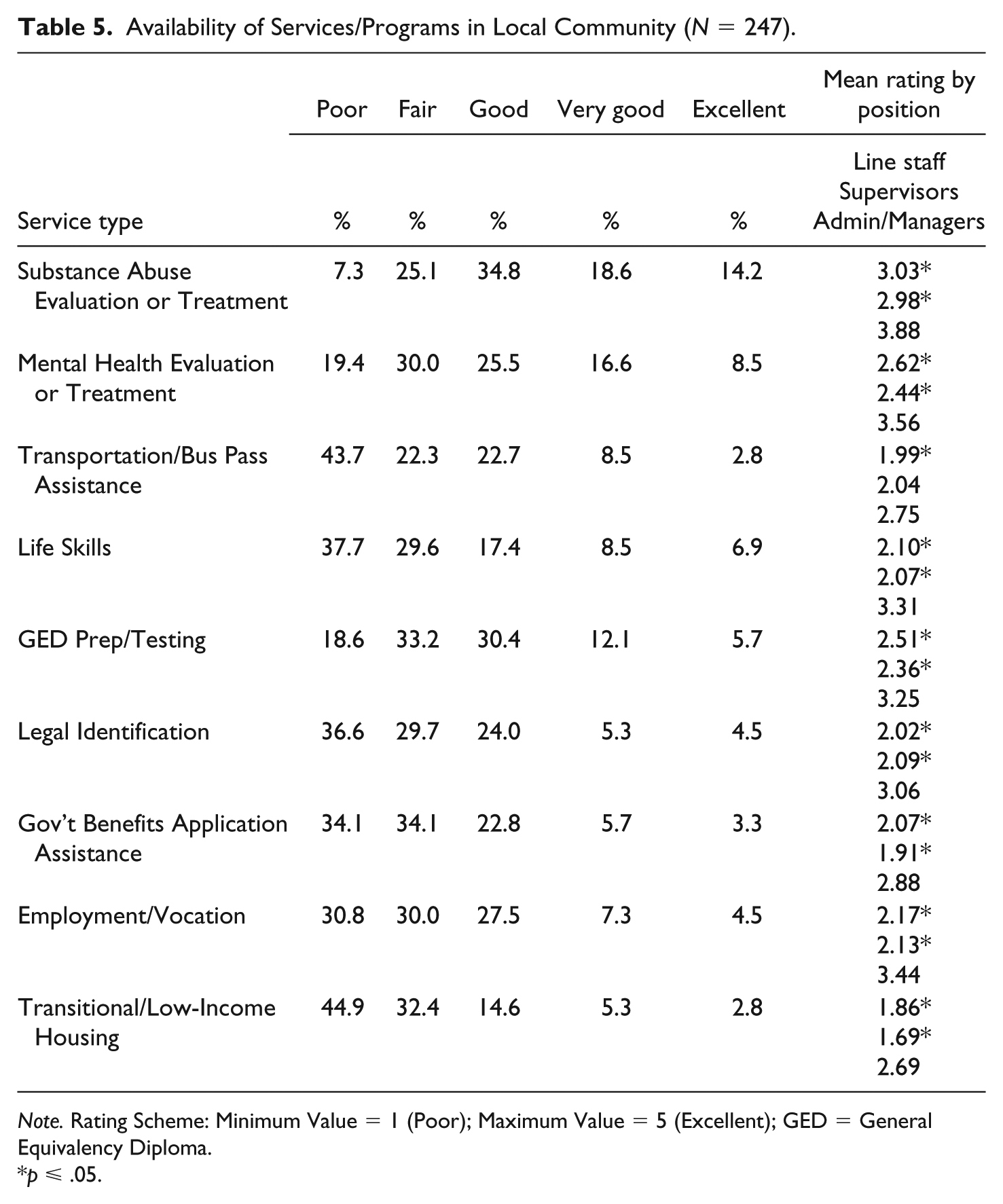
Table 5 addresses the final component of resources, namely, availability of offender services in the community. Respondents rated the availability of nine types of services. Operating on the premise that a response or rating of good, very good, or excellent suggests a more than sufficient level of offender access to services, the highest combined percentage of good to excellent responses was for substance abuse (67.6%) and mental health (50.6%). These were followed by General Equivalency Diploma (GED) Testing, where a combined total of 48.2% of responses fell within the range of good to excellent. At the other end of the spectrum, six of the nine services listed were rated as poor by more than one third of respondents. The highest percentage of poor ratings were for transitional/low-income housing (44.9%), transportation/bus pass assistance (43.7%), and life skills (37.7%). Poor ratings were high, but less so, for identification (36.6%), government benefits application assistance (34.1%), and employment/vocation (30.8%).
Availability of Services/Programs in Local Community (N = 247).
Note. Rating Scheme: Minimum Value = 1 (Poor); Maximum Value = 5 (Excellent); GED = General Equivalency Diploma.
p ⩽ .05.
Beyond substance abuse, mental health, and GED services, it does not appear that PPS agencies or communities are sufficiently equipped to meet the diversity of transition needs. It is also notable that significant differences in rating the availability of resources existed for every service category when the variable of current position was isolated. ANOVA tests (with Bonferroni correction) revealed significant differences at p ⩽ .05 across two occupational levels, with Administrators/Managers consistently providing the highest ratings. To interpret, with substance abuse, significant differences in mean rating existed between Line Staff and Administrators/Managers (3.03 vs. 3.88 at p ⩽ .05) and Supervisors and Administrators/Managers (2.98 vs. 3.88 at p ⩽ .05). The same held for mental health, where significant differences existed between Line Staff and Administrators/Managers (2.62 vs. 3.56 at p ⩽ .05) and Supervisors and Administrators/Managers (2.44 vs. 3.56 at p ⩽ .05). With the exception of Transportation/Bus Pass Assistance, where a significant difference only existed between Line Staff and Administrators/Managers (1.99 vs. 2.75 at p ⩽ .05), this dual level difference in rating was present for all remaining categories of service, suggesting Administrators/Managers—the most removed from direct offender supervision—may be slightly overestimating or overly optimistic about the extent of services in communities across the state. Just as interesting, in seven of the nine categories of service, Supervisors had a slightly lower mean rating than Line Staff. While this study is not prepared to explain this difference, it can be theorized that supervisors may be less familiar with what is available in the community or, conversely, better attuned to the gap between the expectations of higher-ups and conditions under which their staff have to operate.
Summary and Conclusion
Prisoner reentry continues to be a “high profile issue on state and national policy agendas” (Burke & Tonry, 2006, p. 7). However, particulars on how this issue has been effectuated in the realm of PPS could be better understood. The current study has enhanced understanding of this phenomenon by examining the impact of the reentry movement on PPS in Florida. Findings show the reentry agenda has translated primarily into risk/needs assessment and providing contact information for a trio of services, namely, employment, substance abuse, and mental health. The high level of importance placed on these supervision activities was further corroborated by perceptions that the availability of substance abuse and mental health services in the community were good to excellent.
Equally noteworthy as findings were supervision activities that did not register as especially important and resources/services that were far less available to offenders. The least important supervision activities included information for health care, helping with job and benefits applications, scheduling social service appointments, and letters of referral to agencies. In-house resources and community services deemed to be lacking were in the areas of assisting with transportation/bus passes, benefits applications, identification, and transitional housing.
The findings also indicated that roles and responsibilities of PPS professionals had gravitated toward social work. This was illustrated in job responsibilities, such as the recording of efforts to facilitate reentry and developing individualized plans and goals for offenders. This new orientation was also exhibited in the official policy of reducing technical violations and, thus, the re-arrest and re-incarceration of certain offenders.
Although the above findings lend added insight into reentry’s impact on PPS, there are methodological limitations to the study that warrant mentioning. Most obviously, the findings cannot be generalized outside the state of Florida. Although prior research conducted elsewhere confirms some of what has been documented here with regard to areas of supervision focus, other findings may not be germane beyond this state; Florida’s various types of PPS (e.g., conditional release, parole, addiction recovery supervision, split sentence) make this a distinct possibility. The current findings are also subject to the limitations of a low response rate and missing data on certain substantive questions and the variable of current position.
Finally, there is the inevitable problem of measurement. For example, measuring change through the lens of perceptions puts respondents in the position of engaging in a type of self-directed pre-post analysis. Despite time frame prompting in survey questions, poor recall or ordering of policy events may have distorted responses. Measurement of change may have also been adversely affected by the respondents’ inability to disentangle their own personal values and preferences from actual FDOC policy or reality. The reliability of responses is a potential concern as well. Given the complex and dynamic community network in which PPS agencies operate, it is not inconceivable that these same questions, if asked some months later, may generate different results.
Despite the study’s real and potential limitations, the findings do have worthwhile implications for research and policy. Overall, these implications fall into two categories. First, there is the overarching question of what these findings say about the relationship between reentry and change in PPS. On this point, it is fair to say that the added importance Florida places on substance abuse and employment suggests a PPS practice that represents a constant more than a change; brokerage activities in these areas have always been an integral part of PPS (e.g., Glaser, 1964/1983; Pownall, 1969). In fact, in Florida, contracts with substance abuse providers date back to the war on drugs. It is also the case that the relative importance placed on this pair of activities is not exclusive to Florida. The emphasis on substance abuse and employment is affirmed in Veysey et al.’s (2014) study of New Jersey’s SVORI parole intervention and Seiter’s (2002) and others’ research (e.g., Gunnison & Helfgott, 2011; Latessa, 2012) in states such as Missouri, Washington, and Ohio. In this respect then, in Florida and perhaps elsewhere, the reentry agenda in PPS is plainly traditional.
The change narrative of reentry becomes a bit more apparent with the prioritization of risk/needs assessment and mental health services. Comparatively speaking, these are less traditional focal points in PPS and consistent with reentry-era trends documented in the literature (Latessa, Lemke, Makarios, & Smith, 2010; Lurigio, Rollins, & Fallon, 2004; Morgan, Kroner, & Mills, 2012; Wilson & Draine, 2006). Evidence of change grows more compelling, however, when roles and responsibilities are considered. The return to a social worker role, the requirement of setting individualized offender goals and plans, and the diminished importance of offender monitoring and control via technical violations are convincing signs of change in Florida’s PPS practice.
With that being said, the kind of change demonstrated remains in question. Based on Florida’s experience, it can be argued that the change exhibited is mostly a return to the “old” rather than the emergence of something “new.” Reasserting “old penology” (Feeley & Simon, 1992) norms merely confirms that the proverbial correctional pendulum (rehabilitative vs. punitive policies) has swung back again, without breaking any real new ground along the way. For example, an agenda that breaks from this “old” rehabilitative mold would concentrate more completely on PPS supervision activities and services that are specific to transitioning and stabilization (e.g., assistance with housing, health care, benefits applications, identification, transportation). These reentry activities and services equip offenders, allowing the employment, mental health, or drug abstinence deemed so important to be feasibly pursued.
This leads to the second implication for research and policy, namely, how to assign value to offender reentry services. Findings here and elsewhere suggest a strong policy preference for activities and services that focus on fixing/changing offenders (e.g., substance abuse, cognitive-based “Thinking for a Change” program). This preference is undoubtedly shaped by the “what works” paradigm, where value is determined by recidivism outcomes (see Visher et al., 2017). However, the valuation of reentry activities and services is and should be seen as more complex. Findings on recidivism reduction are often weak and inconsistent, and research shows that equipping/practical services (transportation, identification, housing) are what offenders value most (Veysey et al., 2014). Moreover, completion rates for practical services (employment/job/training) are substantially higher than for change-based services (Visher et al., 2017).
The factors of time in prison and time under PPS are also likely to be relevant in this valuation assessment. For example, in Florida, PPS is partly reserved for offenders whose crimes have resulted in very lengthy sentences (see Note 2). This circumstance would seem to undercut the value of substance abuse or other change-based services and enhance the value of equipping services. Appropriating value based on what can be reasonably accomplished given the time allotted for supervision is another salient consideration. In Florida, 39% of PPS officers indicated a supervision period of less than 90 days and 11% a supervision period between 4 and 12 months. Emphasis on longer term change-based services when the offender will no longer be subject to supervision may be misplaced.
Each of these circumstances implicates the need for continued study of the reentry movement’s impact on PPS. This study has raised several questions for future research and policy with regard to supervision priorities, resource availability, and the valuation of offender services. Redoubling efforts to understand these matters benefits not only PPS agencies, but the roughly 874,800 offenders being supervised nationwide on state and federal parole (Kaeble, 2018).
Footnotes
Declaration of Conflicting Interests
The author(s) declared no potential conflicts of interest with respect to the research, authorship, and/or publication of this article.
Funding
The author(s) received no financial support for the research, authorship, and/or publication of this article.