



Abstract
In the current study, we examine prosecutorial decisions that affect the certainty, celerity, and severity of punishment at the county level in the state of Florida. Leveraging a unique data set, we investigate the effect of the rate at which prosecuting agencies within each county filed formal charges against offenders (certainty), the swiftness of criminal case resolution (celerity), and the rate at which cases were pled to less severe punishments (severity). We test for the effect of those covariates on aggregate county-level crime rates over a 5-year period. We find that prosecutors’ effect on the certainty and celerity of punishment was associated with lower levels of crime, whereas their effect on the severity of punishment was not. Together, these findings highlight the role of the prosecutor in shaping the general deterrent environment within a county.
The government’s ability to deter crime through formal sanctions is one of the essential functions of government. A long history of research demonstrates the ability to deter crime rests on a government’s ability to control the three pillars of deterrence theory: the certainty, celerity, and severity of punishment (Beccaria, 1764; Braga & Weisburd, 2012). Although there is considerable research examining the effectiveness of police in deterring crime (e.g., Bertelli & Richardson, 2008; Eck & Spelman, 1987; Kennedy, Braga, & Piehl, 2001; Levitt, 1997; Marvell & Moody, 1996; Mourtgos, Wise, & Petros, 2018; Sampson & Cohen, 1988; Weisburd & Green, 1995) and the length of prison sentences in deterring crime (e.g., Loughran et al., 2009; Snodgrass, Blokland, Haviland, Nieuwbeerta, & Nagin, 2011), there is currently a dearth of evidence regarding prosecutors’ effect on deterrence (Pfaff, 2017).
The lack of attention paid to prosecutors’ effect on deterrence is likely not because of simple disregard by researchers, but rather because it is difficult to obtain the necessary data for such research. Accordingly, although the prosecutor’s influence on deterrence, and the criminal justice system writ large, is substantial (Dunahoe, 2005), the workings of prosecutors largely remain a black box (Pfaff, 2017).
Understanding prosecutors’ role in deterrence is crucial because the assumed cost–benefit analysis offenders make when deciding to commit a crime (Hirschi, 2014) is not based solely on the probability of being apprehended by the police and being sentenced to prison by a judge. Rather, deterrence theory considers the probability of apprehension by the police, the probability of being formally charged by a prosecuting agency if apprehended, and the severity of formal sanction (Nagin, Solow, & Lum, 2015). In this article, we further the understanding of prosecutors’ influence on deterring crime.
In the present study, we provide an empirical test of deterrence theory by investigating the role of the prosecutor, a key player in the criminal justice system. First, we review the current state of knowledge on deterrence theory. Within this review, we derive research questions to investigate how prosecutors’ actions should affect deterrence, given the theoretical guidance. We develop research questions rather than specific hypotheses due to the current void in knowledge regarding prosecutors’ effect on deterrence (Pfaff, 2017).
Second, we address those research questions through multivariate analysis of data that have recently become available. We operationalize the data at the county level for the entirety of one state (Florida). We model data to examine the percentage of cases that prosecutors formally file charges on (certainty), the percentage of the resulting cases that are adjudicated in an expeditious manner (celerity), and the percentage of cases that are pled to lesser charges (severity). We find that the certainty of prosecution and the celerity with which criminal cases move through the court system are associated with lower levels of crime. At the same time, the proportion of cases that are pled to less severe sentences is not associated with the level of crime within a county. We conclude with a discussion of our findings and their implication for criminal justice policy and future research.
Deterrence Theory
Most modern theories of deterrence can be traced back to Beccaria’s (1764) treatise, On Crime and Punishments. Beccaria argued that the three key ingredients to deterrence are the certainty, celerity, and severity of punishment. The logic of this model is based on rational choice theory where would-be offenders balance the benefits and costs of crime (Nagin, 2018; Nagin et al., 2015). The offender is assumed to pursue pleasure over pain, can predict and balance future benefits and costs, and acts to maximize his or her well-being (Hirschi, 2014). With this cost–benefit analysis in mind, it should follow that the higher the certainty of punishment, the less likely an offender will commit a crime because of the increased risk of punishment; swift punishments for crimes should be more effective in deterring crime than delayed punishment even when the same punishment is imposed; and the severity of punishment should also influence the effectiveness of deterrence (Hamilton, Campbell, Van Wormer, Kigerl, & Posey, 2016).
The fact that these three components are still discussed today when considering almost any crime deterrence policy is a testament to Beccaria’s intellect and influence. We will examine each component in turn, and how each directs our research questions with the data used in the current study.
Certainty
Previous deterrence research supports the hypothesis that the certainty of punishment has the most substantial impact on deterrence (Apel & Nagin, 2011; Durlauf & Nagin, 2011; Nagin, 2013a, 2013b). Certainty is central to theories of deterrence—for an offender to be punished, he or she must first be apprehended. If apprehension is unlikely, there is little cost to outweigh the benefit(s) of crime.
Police agencies are the institutions with the most significant effect on the certainty of apprehension, as they are charged with detecting, pursuing, and capturing those who break the law. Police departments often advocate for increasing their ranks, linking increased numbers of officers to an increased ability to deter crime (Walker, 1999). When offenders believe that there is an increased police presence in their vicinity, they will be less likely to commit crime because of the higher risk of being caught and punished (Kovandzic & Sloan, 2002). Indeed, an increase in the levels of police has been shown to deter crime (Kovandzic & Sloan, 2002; Levitt, 1997; Marvell & Moody, 1996). As Nagin (2018) states, research generally agrees there is “substantial evidence that increasing the visibility of the police by hiring more officers and allocating existing officers in ways that materially heighten the perceived risk of apprehension deters crime” (p. 158). The inverse has also been demonstrated. Mourtgos et al. (2018) establish that when offenders recognize police are restricted from arresting them for a wide range of offenses, the amount of crime committed increases.
Moreover, apprehension by the police is not the only factor that may affect offenders’ perceptions of the certainty of punishment. As mentioned previously, one of the probabilities likely taken into consideration by offenders is the probability of being formally charged by a prosecuting agency if apprehended by the police. Although being arrested by the police plays a role in the perception of the certainty of punishment, the effect on any resulting deterrence would logically decrease if formal charges are never filed. That is, if an offender is arrested, but not formally charged, and this pattern continually repeats itself, arrest becomes seen as an inconvenience rather than a deterrent. If the probability of prosecution does indeed weigh on offenders’ cost–benefit analysis, one would expect an increase in deterrence as the proportion of cases formally charged after apprehension also increases. As such, we investigate the following:
Celerity
The role of celerity of punishment on deterrence has received much less attention than certainty and severity. Indeed, celerity is the least studied of all three principles of deterrence theory (Nagin, 2018), likely because the celerity of punishment occurs at the point in the criminal justice system that historically has been least available to examination: the prosecutor (Pfaff, 2017). Prosecutors have broad discretion and influence over how quickly or slowly a case is adjudicated, as well as the punishment imparted. A prosecutor’s discretion is extensive, but not limitless, and is affected by other stakeholders. Victims of crime influence the process by expressing their desires on how a prosecutor handles the case. Offenders and their counsel influence how quickly a criminal case reaches the punishment phase by their decisions in the adjudication process. However, the prosecutor often has immense control over the processing of the case he or she is responsible for (Pfaff, 2017), and the immunity of prosecutors, in all but the most egregious circumstances, provides a legal and institutional bulwark against outside influence.
Despite little research examining the effect of celerity of punishment on deterrence, there is evidence that shows celerity does play a role. An assessment of the Hawaii Opportunity Probation With Enforcement (HOPE) program (Hawken & Kleiman, 2009) shows probationers who violate probation and are subject to immediate and certain penalties are significantly less likely to be arrested, have fewer positive drug tests, and have fewer missed probation appointments, when compared with probationers who have uncertain and delayed penalties for violating probation. More evidence was found in a quasi-experimental test of a program similar to the HOPE program implemented in Washington State (Hamilton et al., 2016). Like Hawken and Kleiman (2009), the authors found the use of swift and sure punishments for probationers helped deter probation violations. Furthermore, the authors show that probationers subjected to quicker, more certain punishments had lower rates of recidivism and committed fewer crimes, compared with those probationers in the control group who were not subjected to swift and sure punishments.
The above studies demonstrate that the certainty and celerity of punishment make the short-term costs more salient, and, thus, recalibrate the cost–benefit analysis an offender makes when considering whether to commit a crime. Indeed, there is substantial evidence that indicates offenders are present oriented and have a shortened time horizon (Jolliffe & Farrington, 2009; Moffitt, 1993; White et al., 1994; Wilson & Herrnstein, 1985). That is, if an offender believes that they are more likely to get caught and the punishment will be immediate, they may be less likely to commit the crime because the costs are more immediate than a possible punishment more temporally distant. The issue with these studies for our purposes, however, is that it is impossible to parse whether it was the certainty of punishment, the celerity of punishment, or a combination of the two that provided the positive effects.
Furthermore, the above studies examined the specific deterrent effect on offenders rather than the general deterrent effect on a population writ large. Briefly, specific deterrence occurs when an offender is punished for a crime, and that punishment deters them from committing future crimes. General deterrence occurs when offenders’ perceptions of the threat of punishment deter them from committing crime (Mourtgos et al., 2018). In the current study, we are concerned with general deterrence, as we are dealing with aggregate data for prosecutorial actions, which create the perception of the general threat of punishment.
Although much of the available evidence regarding the effect of deterrence comes from examining the effect of specific deterrence, and general deterrence has generally been found to be less effective than specific deterrence (Kleck, Sever, Li, & Gertz, 2005), it is often difficult to isolate the two during analysis as they are often not mutually exclusive (Mourtgos et al., 2018). For example, when a police officer arrests a suspect, the officer is specifically deterring not only that individual but also others who are aware of the arrest. Similarly, if there is a general knowledge that being arrested for a crime is followed by certain, swift, and severe prosecution, this likely has a general deterrent effect, along with the specific deterrent effect on those prosecuted. In this study, we examine aggregate data for prosecutorial actions, which may create the perception of a general threat of punishment, but are unable to tease out the specific deterrent effect on those prosecuted. Regardless, utilizing aggregate data allows us to further our understanding of prosecutorial-based general deterrence. For simplicity’s sake, we refer to general deterrence throughout this article as deterrence.
There are a small number of cases that have examined the effect of reduced court case processing time (i.e., celerity) on deterrence. The results of these studies, however, are mixed. Bouffard and Bouffard (2011) linked accelerated case resolution in a specialized Driving Under the Influence (DUI) court with deterrence toward DUI violations. Other scholars, however, establish that decreased processing time was not associated with a decrease in deterrence for offenders processed in a drug court (Granfield, Eby, & Brewster, 1998). Finally, very recent work identified an increased recidivism rate with offenders diverted to a specialized Early Case Resolution (ECR) Court (Butters, Prince, Walker, Worwood, & Sarver, 2018).
Reconciling the mixed findings in the above studies is difficult. A possible cause of the mixed findings relates to the fact that all the above studies involved specialized courts. Specialized courts (e.g., Drug Court, DUI Court, ECR Court) primarily focus on therapeutic and preventive interventions rather than punitive punishment (Hannah-Moffat & Maurutto, 2012). As such, there may be an interaction occurring between increased celerity but decreased severity. Furthermore, as with the Hamilton et al. (2016) and Hawken and Kleiman (2009) studies, the specialized court studies are examining the specific deterrent effect on offenders rather than the general deterrent effect on a population. Again, we are interested in evaluating the effect prosecutors have on general deterrence.
Although we are aware of no research that associates the celerity of punishment with general deterrence, there is some evidence (as described above) that the celerity of punishment does affect specific deterrence. Moreover, although specific deterrence and general deterrence are neither mutually exclusive nor mutually dependent, no evidence suggests celerity would not affect general deterrence. If offenders accept the general proposition that punishment is delayed, and they are primarily present oriented, it is logical to imagine that celerity of punishment would affect general deterrence. As such, we investigate the following:
Severity
The current evidence on the deterrent effect from the severity of punishment is conflicting. For example, Helland and Tabarrock (2007) examined the deterrent effect of California’s “three strikes” law. They found strong evidence that the severe penalty of the “three strikes” law did indeed deter arrest rates for those already convicted of two eligible offenses. Kennedy et al. (2001) found that Operation Ceasefire, implemented by the Boston Police Department, deterred crime by increasing the severity of punishment for gang members who committed violent crimes. At the same time, Raphael and Ludwig (2003) found that the federal program called Project Exile, which increased the severity of punishment for weapon use, did not have a deterrent effect. Later research concurs, as Hjalmarsson (2009) found the knowledge of more severe penalties in the adult criminal justice system, rather than the juvenile criminal justice system, did not affect the self-reported criminal behavior of individuals after reaching the age of 18.
With the above in mind, we attempt to ascertain the effect of the severity of punishment by evaluating prosecutors’ use of plea bargains. Plea bargaining is a process by which a person accused of a crime pleads guilty to a lesser crime to receive a less severe punishment (Helm & Reyna, 2017). When an offender is charged with a crime, the prosecutor will often offer a plea to the offender and their attorney (Caldwell, 2011) as a way of securing a conviction and saving on litigation costs and time (Franzoni, 1999; Kobayashi, 1992). Thus, examining the use of plea bargains offers a novel way of examining whether a lesser punishment affects levels of deterrence.
Following previous scholarship, we acknowledge the difficulty in cleanly separating the celerity and severity motivations in plea bargaining, as defendants’ motivation may be to capture both a lesser sentence and a quicker resolution to their criminal case(s). However, although a plea bargain may or may not affect the time to adjudication, this is not as certain an effect as is the reduction in severity of punishment. Still, caution is justified in understanding the operationalization of severity as done here, and the “Limitations” section below gives further caution.
Despite the conflicting findings regarding the deterrent effect from the severity of punishment, we repeat our logic from above: In a county where punishment severity is consistently lower, the assumptions of classical deterrence theory predict a decrease in the general deterrence environment. Indeed, we are not the first to propose that plea bargaining may result in a decrease in deterrence (Franzoni, 1999; Miceli, 1996).
With the relatively sparse research in this area and the conflicting findings, we derive the following:
Method
The present study focuses on one primary research question: What role do prosecutors and prosecutorial decisions play in deterrence? We attempt to answer this question by running a regression analysis utilizing data at the county level for the entire state of Florida. It was essential to utilize county-level data because most serious crimes are prosecuted at the county level. Furthermore, criminal justice policies in the United States, specifically prosecutorial policies, often occur at the county level (Pfaff, 2017).
Measures
Crime
The dependent variable in our analysis is the number of Uniform Crime Report (UCR) Part I crimes reported to police during the entirety of our studied time period: 2009 to 2013. This specific time period was selected because those were the years prosecutorial data were available for, as described in more detail below. The UCR compiles official data on crime in the United States and is published by the FBI. UCR data are obtained from states on a voluntary basis. Although this does not allow for a complete picture of crime in the United States, it has standardized the types of crimes that states collect information for, specifically Part I crimes. Part I crimes include murder, rape, robbery, aggravated assault, burglary, larceny, auto theft, and arson. The FBI does not report UCR data at each state’s county level. Therefore, we obtained the Part I crime UCR data at the county level from the Florida Department of Law Enforcement (FDLE). The FDLE makes these data publicly available on their website. The Part I crime of arson was not reported by the FDLE and was, therefore, excluded. The amount of Part I crime was summed across the 2009 through 2013 time period for each county (n = 67).
Prosecutors’ effect on deterrence
The data for the independent variables were obtained from the organization Measures for Justice’s (MFJ) data portal. MFJ was founded in 2011 with the help of a grant from the Department of Justice’s Bureau of Justice Assistance. Their stated mission is to bring transparency to the criminal justice system at the county level. The data used, as well as more detailed descriptions regarding the information about the MFJ data explained below, can be found at the organization’s website https://measuresforjustice.org.
MFJ collects data from statewide and court data sets, and when feasible, the organization contacts local agencies for supplemental data. MFJ utilizes a process, outlined on their website, to clean and code the obtained data, and then runs the data through three audits—two internal and one external—to ensure their validity and accuracy. Although MFJ provides multiple measures regarding the criminal justice process for a small number of states, we chose the data set for Florida because it represents the most complete data set for the study of prosecutors’ effect on deterrence.
We select several independent variables of interest to investigate the role of prosecutorial decisions on the certainty, celerity, and severity roots of deterrence: first, declined, the percentage of 2009 to 2013 cases referred to prosecutors by law enforcement or a complainant that were declined for prosecution (certainty); second, 1 year, the percentage of 2009 to 2013 felony cases (the clear majority of Part I crimes are felony category crimes) that were resolved within 365 days of filing in court (celerity); finally, reduced, the percentage of 2009 to 2013 guilty plea cases for which the severity of the most severe conviction charge was less than the severity of the most severe filing charge (severity).
To standardize the definition of a “case” across jurisdictions, MFJ counts all charges associated with the same defendant that were filed (or declined) on the same date as a single case. Moreover, MFJ only reports adult criminal cases.
Controls
Several controls are used to account for other possibly confounding factors. First, because our dependent variable is the total count of Part I crimes known to police within a county, we control for population. Logically, we expect the more populated a county is, the larger the count of crimes within it will be. Furthermore, there is the question of resource allocation. In rural counties with minimally staffed prosecutors’ offices, prosecutors may decide to decline cases or enter plea deals in cases that might otherwise go to trial. However, it can also be argued that prosecutors’ offices in larger jurisdictions are overwhelmed with higher caseloads and may take the same actions to reduce stress on available resources. We are not able to parse whether these specific actions are being taken based on population in different counties with the data available to us. Regardless, we statistically control for population size, which allows us to hold the variable constant and isolate any effect it may have on our independent variables. Due to the nonnormal distribution and variability of population across counties, we use a natural logarithm transformation on the population data.
Second, the number of police officers within a county per 100,000 residents is controlled to isolate the deterrent effect of police apprehension, as discussed previously in this article. Third, the percentage of residents within a county who are males aged 15 to 24 is controlled for in the model. Young males commit the majority of crime in the United States (Latzer, 2016; Wilson & Herrnstein, 1985), and so we control for this factor in the model. Fourth, the percentage of residents within a county who are unemployed is controlled for in the model. Whereas some research has found that unemployment has a negative association with crime (e.g., Allen, 1996), other research has found a positive association with crime (e.g., Raphael & Winter-Abmer, 2001). Furthermore, we recognize that Florida has a large retired population, which may confound unemployment measures (calculated as not currently employed and looking for work and available to accept a job). Despite the conflicting research and demographic note, we include the variable as a control as it is a socioeconomic factor often accounted for in the criminology literature, but interpret it with caution.
Fifth, the percentage of residents within a county who have a high school education or greater is controlled for, as not graduating from high school has been found to be significantly associated with crime (Lochner & Moretti, 2004). Drug use has also been associated with crime (French et al., 2000). To account for drug use within a county, we control for the number of drug-related hospitalizations per 100,000 residents as a proxy measurement for the prevalence of drug use within a county. We also control for the percentage of single female-headed households with children within a county, resident mobility within a county (measured as the percentage of residents who changed their place of residence in the previous year), and median income within a county. All three of these factors have been associated with criminality and crime rates in past research (Boggess & Hipp, 2010; Freeman, 1999; Mackey & Mackey, 2003).
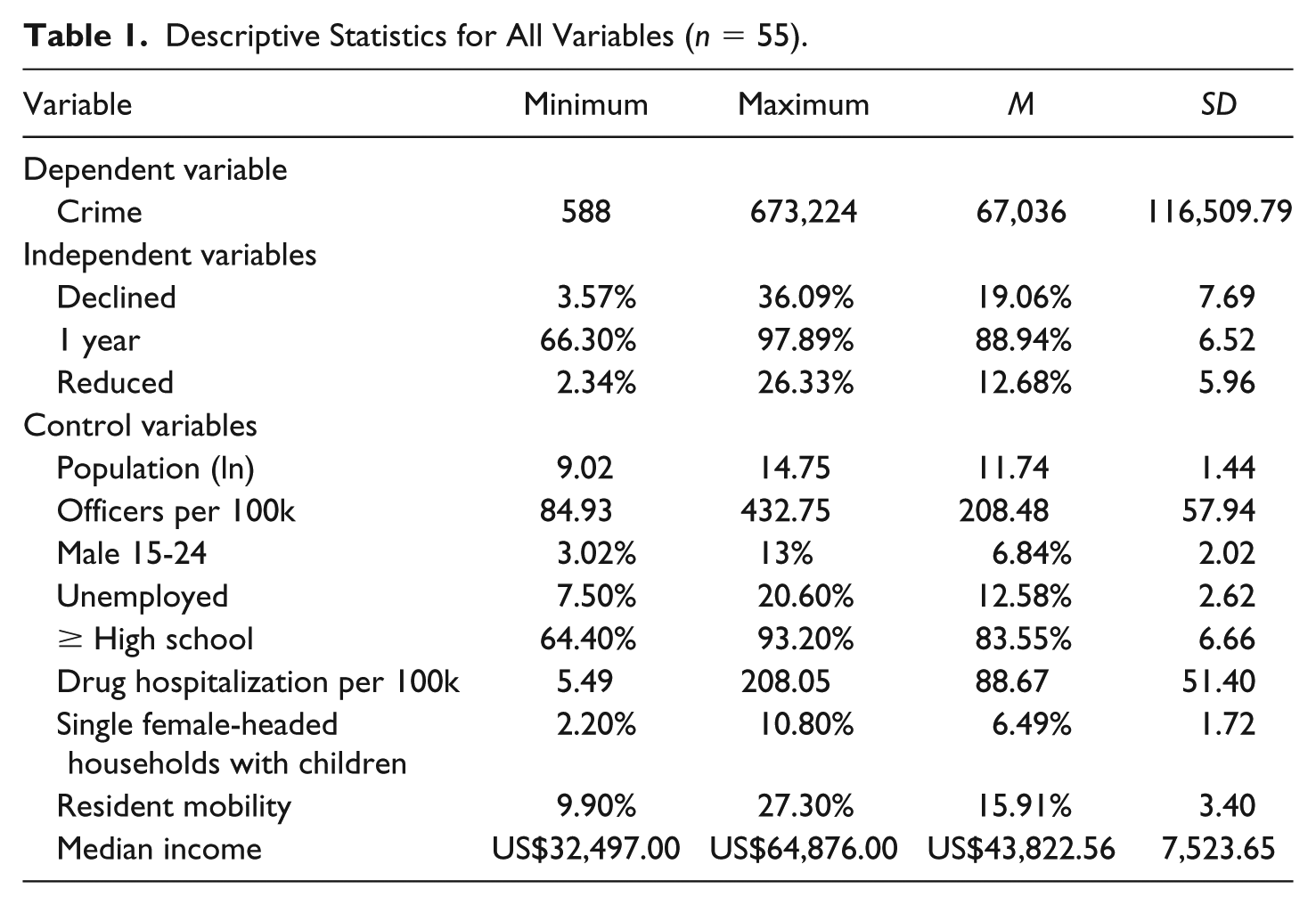
Data for all control variables were obtained from MFJ. MFJ reports the data from the U.S. Census Bureau’s American Community Survey, the U.S. Bureau of Justice Statistics’ Census of State and Local Law Enforcement Agencies, and the Florida Department of Health. Descriptive statistics for all variables are listed in Table 1. Twelve counties were excluded due to data for the dependent variable, one of the independent variables, or one of the control variables not being available for those counties (n = 55).
Descriptive Statistics for All Variables (n = 55).
Missingness
Across the MFJ data set used here, we find 14.93% of drug hospitalization data, 2.99% of the “reduced” sentence data, and 1.49% of the “1 year” data are unreported and, thus, missing. These levels of missing data within a single correlate do not signal a significant bias to the findings, though data missingness should be considered before applying the findings to any specific county, as it may be the source of missing data along a specific covariate.
Model Description
The dependent variable, number of UCR Part I crimes committed within a county, is a summed scale with the resulting outcome variable being an event count. As such, the dependent variable can attain only nonnegative, whole integer values. Although a Poisson distribution is more commonly used to model such event counts, it assumes equidispersion of the mean and variance. In the case here, the Pearson goodness-of-fit indicates the distribution significantly differs from the Poisson distribution, as the conditional variance is higher than the conditional mean. In such cases, a negative binomial regression is more appropriate (Dowler & Zawilski, 2007; Hilbe, 2011). Negative binomial regression allows us to assess how a one-unit change in each of the independent variables affects the number of crimes committed within a county. Moreover, use of the negative binomial variant of Poisson regression has been shown to be preferable to least-squares analysis when working with aggregate crime data (Haynie, 2001; Osgood, 2000; Shingleton, 2012). Analyses were conducted with IBM® SPSS® Statistics Version 25.
Collinearity diagnostics were examined. None of the zero-order correlations were above the generally accepted threshold of .80 (Field, 2013). Variance inflation factors (VIFs) statistics were below 7. VIF statistics below 10 are commonly considered acceptable (Field, 2013; Hair, Anderson, Tatham, & Black, 1995; O’Brien, 2007). In sum, multicollinearity was not indicated as an issue. Residual analysis was also conducted. A scatter plot of the standardized deviance residuals and the predicted values of the mean response was created. Ninety-five percent of the residuals were less than an absolute value of 2.0, indicating that the model fits the data.
Results
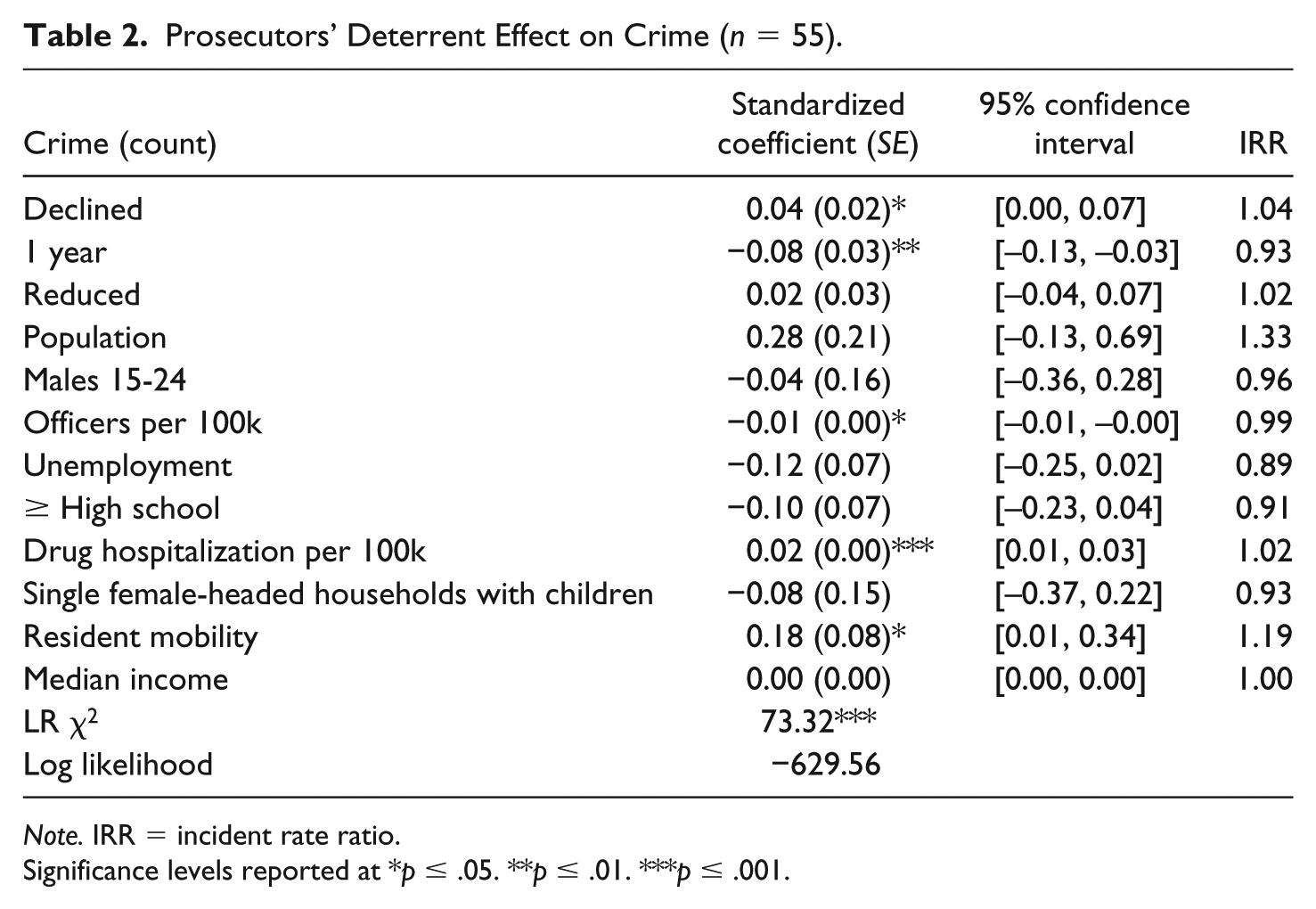
We conducted this study using negative binomial regression to analyze the individual-level correlates associated with a count-level variable measuring the amount of Part I UCR crimes committed within each county of Florida. The general picture emerging from the analysis is that prosecutors’ actions dictating the certainty and celerity of punishment affect crime rates at the county level, whereas their actions affecting the severity of punishment (as operationalized in this study) do not. Table 2 presents the results of the model.
Prosecutors’ Deterrent Effect on Crime (n = 55).
Note. IRR = incident rate ratio.
Significance levels reported at *p ≤ .05. **p ≤ .01. ***p ≤ .001.
The chi-square statistic demonstrates that all nested iterations of the complete model are significant, χ2(12, n = 55) = 73.32, p < .001. Statistical significance was accepted at the .05 level for independent variables. The two independent variables of declined (p < .05) and 1 year (p < .01) had a significant effect on deterrence levels. The independent variable reduced did not (p = .53).
Three control variables had a significant effect on crime levels: the number of police officers per 100,000 residents (p < .05), the number of drug hospitalizations within a county (p < .001), and resident mobility (p < .05). All variables with a significant effect on the count outcome were in the direction expected.
The results provide substantial answers for Research Questions 1 (certainty) and 2 (celerity). We provide interpretation for the finding by converting the coefficient for each correlate into an incident rate ratio (IRR). For each unit change in the number of cases a county declined to file charges for, the county is expected to have a rate 1.04 times greater for aggregate crime levels, holding all other model variables constant. Although not a staggering increase, when one takes 4% of the average number of known Part I crimes across counties, that is an additional 2,681 Part I criminal acts across the examined 5-year time frame.
A more substantial effect can be identified in the tests of celerity. For each unit of change in the number of cases a county adjudicated swiftly (i.e., less than a year), the county’s rate of crime count would be expected to decrease by a factor of 0.93, while holding all other model variables constant. However, given the semielastic nature of coefficients in the generalized Poisson models, it is useful to examine the conditional marginal effects, portrayed below in Figure 1. The figure examines the celerity measure across its general range and shows the conditional marginal effects. This analysis reveals a dramatic decrease in the average number of crimes as prosecutors increase the percentage of cases adjudicated within a year from the minimum 66% to 86% (representing a move from the bottom quartile to the third quartile). The effect shows diminishing returns, which may reflect a trade-off as prosecutors encroach on the highest levels of celerity.
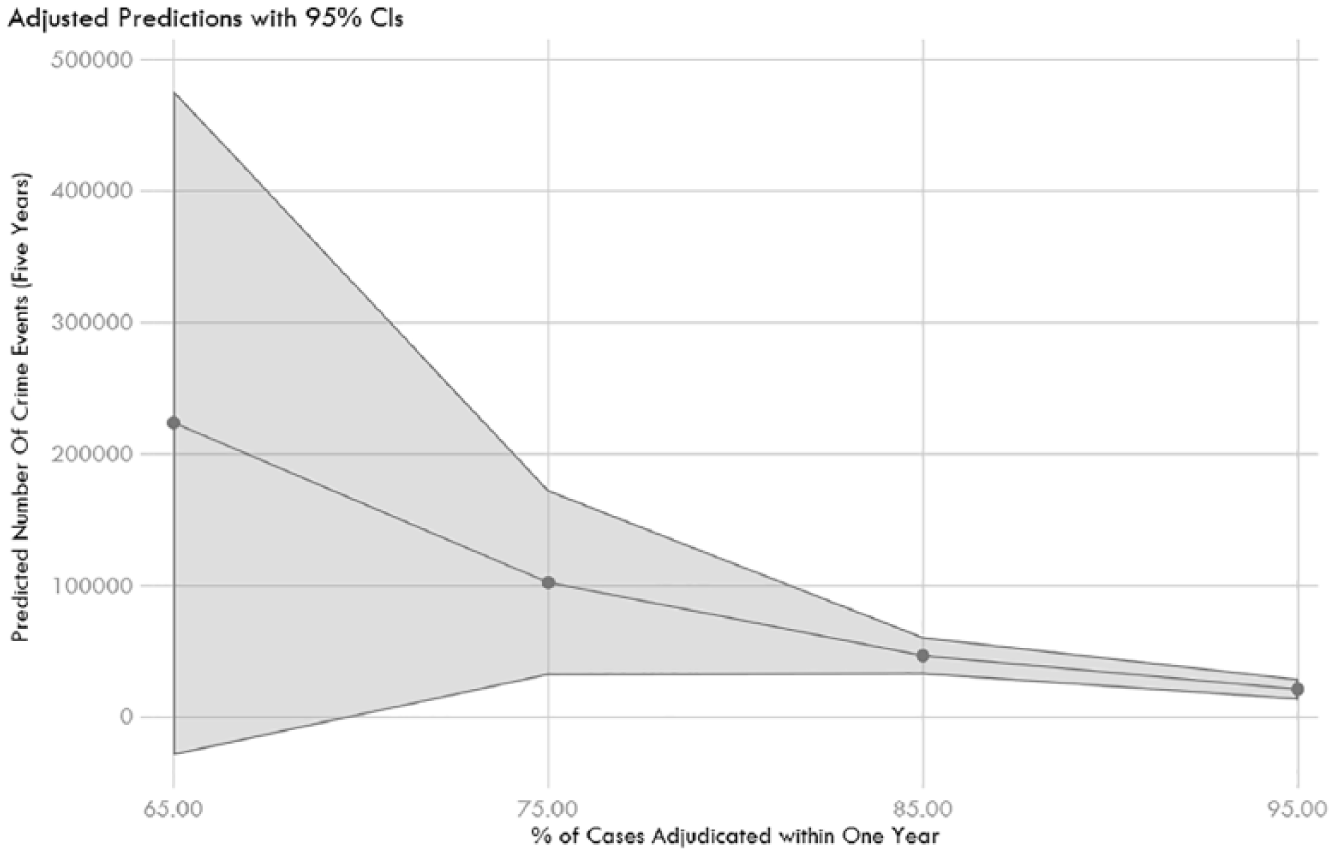
Marginal effects of celerity on crime count, 95% CI (n = 55).
This tipping-point effect may shed some understanding on the observed increase in recidivism in Butters et al.’s (2018) study of a Salt Lake City “Early Case Resolution” program. Our results signal that at a certain point, celerity gains result in diminishing returns. Remember that in Butters et al.’s (2018) study, it examines the effect of celerity in a specialized court. If such a court experiences a substantial influx of cases, the system may be overwhelmed. With the increased demand, there is a natural urge to resolve cases very quickly, which may dilute the severity of the punishments for defendants who would benefit from a longer process. Butters et al. (2018) allude to this by postulating that the court process in and of itself may be part of the perceived punishment, joining previous authors who suggest the process itself is punishment (Earl, 2008; Feeley, 1979). If this is true, once that tipping point is met, an increase in celerity may result in offender perceptions of lesser severity, thus offsetting any gains celerity may provide. Although beyond the scope of this article to tease out the ideal level of celerity, the data point to a significant research problem: Which cases are the “right” ones to move quickly through the system?
As noted above, the act of reducing the severity of the punishment via plea bargaining was not associated with reduced crime. We will explore the possible reasons behind this in the “Discussion” section below. However, in line with prior research, the model does show a higher number of police officers per 100,000 residents within a county decreased the amount of crime across the studied 5-year time span, although only moderately so (approximately 1%).
Other control variables were also significantly associated with the amount of crime across the studied 5-year time span. For each unit of change in the number of drug hospitalizations per 100,000 within a county (a proxy measurement for the prevalence of drug use within a county), a county is expected to experience a higher number of crimes by a factor of 1.02. For every unit of change in the percentage of resident mobility, the county experienced 1.19 times more criminal acts.
The variables of population (p = .18), males aged 15 to 24 years (p = .80), unemployment (p = .10), high school education or greater (p = .15), single female-headed household with children (p = .62), and median income (p = .56) were not statistically significant.
As a robustness check on our model, we ran the same analysis with the following dependent variables: all violent crimes combined, all property crimes combined, and each UCR Part I crime individually. 1 Table 3 contains the direction of the coefficient and statistical significance for all independent and control variables across all disaggregated crime data. Regardless of the dependent variable used, the overall model remained statistically significant (p < .001). Furthermore, celerity remained statistically significant, and severity remained nonsignificant, throughout all analyses. It is interesting to note, however, that certainty falls below statistical significance when the dependent variables of homicide (p = .18), aggravated assault (p = .07), or burglary (p = .07) are analyzed alone. The disparity indicates that the act of prosecutorial declination has unique effects on these three crimes, most notably homicide, and raises research questions beyond what can be explained with the data available at this time, but which subsequent research should explore.
Direction and Significance of Variables Across Disaggregated Crime Counts (n = 55).
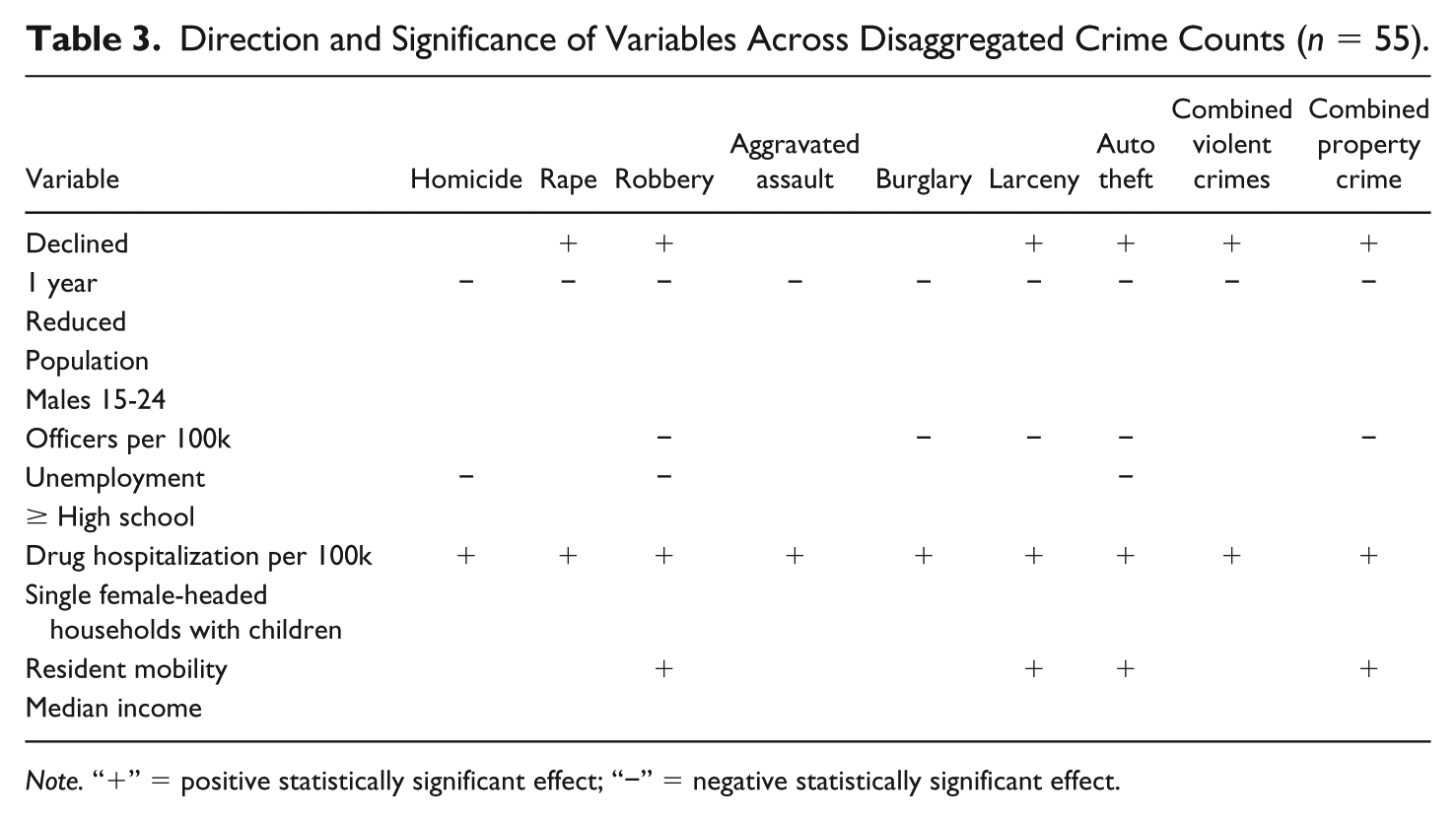
Note. “+” = positive statistically significant effect; “−” = negative statistically significant effect.
Discussion
The results of the current research contribute to our understanding of prosecutors’ effect on deterrence. Understanding how prosecutors’ actions affect the criminal justice system and general deterrence is a largely unexplored area of criminal justice policy research (Pfaff, 2017). We contribute new empirical evidence of deterrence by examining prosecutors’ effects on the certainty, celerity, and severity of punishment.
As mentioned at the beginning of our article, the certainty of punishment is dependent on not only apprehension by the police but also the probability of being formally charged by a prosecuting agency (Nagin et al., 2015). Our research shows that even when controlling for population size and social correlates of crime, the rate at which prosecutors formally file charges for cases referred to them significantly effects deterrence. We found that the rate of filing formal charges acts as a deterrent at a rate even higher than that of increased police levels. This finding is not all that surprising. Although being arrested by the police certainly plays a role in the perception of the certainty of punishment (Mourtgos et al., 2018), the effect on any resulting deterrence would logically falter if a suspect is never formally held to account for the offense. When an offender is arrested, but not formally charged, he or she is released from jail within several days, if not sooner. With delayed or absent prosecution, the arrest can be seen as an inconvenience rather than a deterrent.
Our research also demonstrates the celerity of punishment does indeed matter for general deterrence, which is a substantial contribution, given the deficit of existent empirical evidence on the matter. With offenders often having a shortened time horizon (Wilson & Herrnstein, 1985), the celerity of punishment is likely to weigh more in their cost–benefit analysis of criminal activity than uncertain and delayed punishment. Our findings would seem to add to the psychological literature that offenders tend to respond to costs and benefits that are nearer to the present (Jolliffe & Farrington, 2009; Moffitt, 1993). As shown in Figure 1, the most dramatic decreases in crime are expected to happen as the bottom quartile of prosecutors, who resolve just two thirds of cases in less than a year, increase that ratio to the midrange percentages. Again, this finding held even when holding population size, social correlates of crime, and the certainty and severity of punishment constant.
We did not find evidence that severity in punishment, operationalized through the use of plea agreements, affects general criminal deterrence. There are two possible explanations for this. First, our operationalization for the severity of punishment may not be effective. We do not have data on the actual severity of punishments given (i.e., sentence lengths), so plea deals are used as a proxy measure. Importantly, the way MFJ calculates the reduction in charges is by calculating the number of guilty plea cases for which the severity of the most severe conviction charge is less than the severity of the most severe filing charge divided by the number of guilty plea cases. In many plea deals, several charges are dropped altogether, whereas the most severe “top charge” is entered as a guilty plea. The data from MFJ would not capture these cases, as there would not have been a reduction in the most severe conviction charge from the most severe filing charge. When examining the descriptive statistics for the reductions variable, this is a strong possibility. The MFJ data show a range in the reduction variable of 2.34% to 26.33%, well below the estimated 90% to 95% of criminal cases in the United States resolved by plea deal (Bureau of Justice Statistics, 2005; Flanagan & Maguire, 1990).
A second possibility is that the severity of punishments adjudicated by prosecutors has little effect on deterrence. A logical case can be made for this alternative when one considers the progenitor of deterrence theory offered a more nuanced view on the effect of severity of punishment than is often advocated for in political rhetoric, which often consists of the “more is better” sentiment (Pratt, 2008). When speaking of severity, Beccaria did not advocate for severe penalties for severity’s sake. Instead, he argued that the severity of the punishment should be in proportion to the crime committed. In his view, if the punishment for the crime is disproportionally severe, people may commit additional crimes to escape the punishment of the original crime (Beccaria, 1764; Bruinsma, 2018).
As outlined by Bruinsma (2018), Beccaria’s deterrence theory makes the above nuance clear when outlining his following primary principles of deterrence: Punishment should be in proportion to the crime that has been committed . . . The goal of penal law is not the infliction of severe, cruel, and inhuman punishment, but rather preventing people from engaging in crime. The citizens should realize that crime is always followed by punishment . . . When punishment is prompt and inevitable (certain) to all crimes, punishment is effective as a deterrent to crime. Even though a punishment is moderate but certain, its effect is more fearful than a severe punishment that is accompanied with hope of potential offenders to escape punishment. (p. 22)
Of course, the severity of the punishment does play a role in deterrence (Braga & Weisburd, 2012). If there were no cost to committing a crime, even if apprehension were inevitable, there would be no deterrent effect to speak of (Nagin, 2018). The question then is one of degree.
The less nuanced version of deterrence theory often provides policy makers with the voter-friendly message of getting “tough on crime,” by increasing penalties to the point where no rational person (in theory) would dare engage in criminal activity. This interpretation of deterrence theory has led policy makers since the 1970s to “get tough on crime” by increasing the severity of punishment for crime (Pratt, 2008). Legislators accomplish this via tougher sentencing laws. During the last two decades of the 20th century, states nationwide approved a large array of mandatory minimum sentence structures to accomplish an increase in costs. Some states abolished parole, many adopted “truth-in-sentencing laws” that require violent offenders to serve at least 85% of their sentence before being eligible for parole, and some adopted “three-strike” laws that automatically impose a life sentence after a third felony conviction (Latzer, 2016; Pfaff, 2017).
Although some evidence shows stricter sentencing laws have a deterrent effect (Helland & Tabarrock, 2007; Kennedy et al., 2001), it is often questioned whether the observed deterrent effect is worth the cost of incarcerating offenders for extended periods (Helland & Tabarrock, 2007; Pfaff, 2017). Some suggest that some politicians pass more punitive sentencing laws for political gain, while expecting prosecutors to plea offenders down to lesser punishments (Pfaff, 2017). Regardless of the explanation, we do not find evidence to support the supposition that prosecutors’ effect on the severity of punishment is associated with general criminal deterrence.
In sum, from our findings, if a county desires to deter additional crime, it should enact policies that facilitate an increase in proportions of filing formal charges in cases that are referred to its prosecuting agency, as well as allowing for the expeditious resolution of those cases. Often, this is a matter of funding. Prosecuting agencies who receive a large number of criminal referrals in proportion to their staffing must often decline to file cases for issues that are resolvable with additional effort. Given the number of cases they receive, however, those issues add up, and if there are not enough prosecutorial resources, the most efficient way for prosecuting agencies to deal with the overburdening is to decline the cases that present challenges. Moreover, to increase prosecutors’ ability to resolve cases expeditiously, caseloads must be reasonable. The fewer prosecutors available, the less able they are to resolve cases efficiently.
Although there have been many conversations in recent years about reducing the amount of money spent on the criminal justice system, it must be remembered that at the peak of state spending on criminal justice in the 1990s, states dedicated only 7% of all spending to criminal justice. By 2012, the amount of spending had dropped to around 5.5% (Pfaff, 2017). If states and counties are serious about reducing crime, increased spending to allow for adequate staffing of prosecuting agencies may be necessary.
Limitations
Although our findings contribute to the understanding of prosecutors’ role in deterrence, this study is not without limitations. First, the MFJ data used in the study aggregate a 5-year period. It was not possible for us to examine the variable of time, which may have an effect on deterrence levels if the independent variables fluctuated from year to year. Second, as mentioned in the “Discussion” section, our operationalization for the severity of punishment is not ideal and may not fully capture prosecutors’ role in influencing the severity of punishment. Third, from the data available, we were not able to separate misdemeanor crimes from felony crimes, problematizing our measure for celerity, which is based on the swiftness of punishment for felony cases. Although the vast majority of Part I UCR crimes are of the felonious type, there are undoubtedly some misdemeanor crimes encompassed within the data. Future research would benefit from being able to parse misdemeanor from felony crimes and the celerity of punishment for each type. Fourth, deterrence is measured via UCR Part I crime data. It has long been established that not all crime is reported to police (Langton, Planty, & Lynch, 2017), and there are additional crimes outside of Part I crimes. Our results may change if a different measure of crime committed during the study period examined was developed. Fifth, these results pertain only to counties within Florida. Whether these results would generalize to other states is a question future research must address.
Our research also assumes that the environment of punishment based on prosecutorial actions (i.e., the rate of filing charges, the swiftness of adjudication, and utilization of plea deals), and, thus, deterrence levels, within each county during the 5-year time period was known to the population of offenders operating within each. If this were not so, the independent variables likely would not affect levels of deterrence within a county. Moreover, although some previous research indicates offender populations are aware of the punishment environment they operate within (Mourtgos et al., 2018), and offenders perceive deterrence communications from police actions (Kohfeld & Sprague, 1990; Vaa, 1997; Wyant, Taylor, Ratcliffe, & Wood, 2012), there is no specific evidence of the same in relation to prosecutors’ actions. As such, although logical, our assumption remains just that.
Conclusion
Chief Justice Burger (1970) warned against a faltering general deterrence environment, noting that “inefficiency and delay will drain even a just judgment of its value” and lead to community perceptions of a hapless criminal justice system. Deterrence of crime is of great societal import and an essential function of government. Prosecutors play an immense role in the criminal justice system, a role that demands more data and research on their position and influence (Pfaff, 2017). The results presented in this study, even given limitations in data, ought to spur additional study with more complete data and methods. What is clear from our current work, however, is that prosecutors do play an integral role in deterring crime, whether by increasing the certainty of punishment or the celerity of its imposition.
Prosecutors are a central participant in the criminal justice system. Moreover, it is just that: a system. To better understand deterrence and how to reduce crime and more effectively and impartially administer justice, it is vital the prosecutor’s role be studied and better understood. We cannot wholly understand the criminal justice system’s influence on deterrence of crime solely by looking at the police or prison system. Prosecutors are a critical component of the larger criminal justice system, and more resources and attention should be focused on understanding their role and influence within it.
Footnotes
Declaration of Conflicting Interests
The author(s) declared no potential conflicts of interest with respect to the research, authorship, and/or publication of this article.
Funding
The author(s) received no financial support for the research, authorship, and/or publication of this article.
