



Abstract
When extralegal factors correlate with differences in bond amount and pretrial detention, justice may be compromised. Prior research has identified disparity related to defendant characteristics, such as income and race. This article offers insight into a less explored source of disparity, neighborhood context, and a particularly disadvantaged population, defendants, or pretrial detainees, unable to afford their bail in court and booked into a county jail. Considering the desire for community safety, the difficulty of predicting dangerousness and court attendance, and the impact of ecological factors on other court outcomes, it is hypothesized that neighborhood context heightens disparity in the pretrial process. Findings support this argument. Offense elements best predict bond amount; however, there exists disparity based on neighborhood characteristics. When assessing the same factors in relation to detention length, bond amount is not significant, but rather individual- and neighborhood-level characteristics. Implications are discussed in light of current bail reform efforts.
While the United States maintains a presumption of innocence, concerns have been raised regarding the cash bail system and, particularly, that pretrial detention punishes innocent people. For decades, bail decisions have revolved around two interests, including (a) the perceived safety risk that the defendant poses to the community, and (b) the perceived likelihood that the defendant will return for future court appearances (Goldkamp & Gottfredson, 1985). Assessing defendants’ dangerousness and court attendance, however, is a difficult task. As evidence is still being collected in the pretrial period, many decisions are made with incomplete information (Albonetti, 1989; Nagel, 1983), involving “highly subjective evaluations” (Demuth, 2003, p. 881). For instance, in a qualitative study of interviews with judges, one judge described the pretrial stage as the “toughest” because “you really don’t know a lot about the case so you have to consider as much information as you have in front of you and, um, do your best” (Clair & Winter, 2016, p. 345).
Most research on pretrial decisions focuses on individual-level defendant characteristics (e.g., race or income) and their contribution to disparity. Although valuable, one must remember that individuals do not exist in a vacuum—They are situated in communities that vary in their cultural norms and levels of social (dis)advantage. Ecological characteristics are well integrated into the literature, explaining individual offending and differences in crime rates across communities (e.g., DuBois, 1899; Sampson et al., 1997; Shaw & McKay, 1942). In addition, over the past decade, more scholars have examined the impact of neighborhood-level characteristics on court processes, such as sentencing outcomes (Rodriguez, 2013; Wooldredge, 2007). Just as neighborhood context—specifically, concentrated disadvantage, residential stability, and racial/ethnic homogeneity—affects other criminal justice outcomes, it may heighten the already problematic levels of disparity in the cash bail system. 1 For example, as there are greater criminal opportunities in socially disorganized neighborhoods (e.g., Shaw & McKay, 1942), court actors may consider the neighborhood as a risk factor in determining defendants’ likelihood of reoffending. Moreover, court actors may deem defendants from a socially disorganized neighborhood more dangerous (Kutateladze et al., 2014; Wooldredge et al., 2016). Alternatively, court actors may treat defendants who reside in socially organized communities more harshly as they are perceived to threaten the social order within affluent communities (J. H. Williams & Rosenfeld, 2016). As such, there is reason to believe that neighborhood characteristics affect pretrial decisions, including bond amount and pretrial detention length.
Achieving a better understanding of disparity in the pretrial process is essential. Defendants held in pretrial detention are legally innocent and face a host of challenges when removed from their families, homes, communities, jobs, and society. Examples of this include (a) being held in a dangerous environment with an increased chance of victimization (Appleman, 2012), (b) uninhabitable living conditions due to jail overcrowding (Appleman, 2012; Petteruti & Walsh, 2008), (c) heightened physical and mental health issues (Noonan, 2016; Petteruti & Walsh, 2008; Zeng, 2019), (d) loss of employment (Wiseman, 2013) alongside administrative fees and consequences for missing payments (Appleman, 2012; Diller, 2010), and finally, (e) their children being put into foster care (Petteruti & Walsh, 2008). Moreover, recent research has highlighted that being detained pretrial negatively affects subsequent case outcomes (Dobbie et al., 2018; Goulette et al., 2015; Gupta et al., 2016; Heaton et al., 2017; Leslie & Pope, 2017; Omori, 2019; Schlesinger, 2007; Spohn, 2009; Stevenson, 2018; Sutton, 2013; Wooldredge et al., 2015). Given the consequences of pretrial detention, it is important to assess all potential sources of disparity in the pretrial process.
This article utilizes a sample of 95 unsentenced, pretrial detainees who have been granted bail, but were unable to afford immediate release (i.e., being bailed directly out of court and instead booked into jail until able to post bond). Three research questions are answered, including (a) Do neighborhood characteristics associated with a defendant’s home address affect their bond amount when controlling for demographic characteristics and offense elements/criminal histories? (b) Do neighborhood characteristics affect a defendant’s number of days in pretrial detention when controlling for demographic characteristics and offense elements/criminal histories? and (c) Does bond amount predict pretrial detention length when accounting for neighborhood context, demographic characteristics, and other offense elements/criminal histories? Through a series of stepwise ordinary least squares (OLS) and negative binomial regression models, findings highlight the contribution of neighborhood context to disparity in bond amount and pretrial detention length.
Background
Theoretical Framework
Social disorganization theory and its evolution
A wide body of literature has introduced and developed the idea that neighborhood characteristics, or neighborhood context, contribute to crime. A series of studies published by Shaw and McKay (1942) asserted that, in certain Chicago neighborhoods, high delinquency rates persisted for decades despite resident turnover. They concluded that crime and delinquency is not the result of individual demographics, but rather, the characteristics of the neighborhoods in which they call home. This finding shaped their social disorganization theory, which was defined as the ability of residents to realize common goals and values, affecting their ability to maintain effective informal social control over crime and delinquency. Shaw and McKay (1942) further identified three neighborhood-level factors that contributed to the social disorganization of a community: socioeconomic status (SES), residential instability, and the racial/ethnic heterogeneity of residents. High resident turnover can prevent neighborly friendships and inhibit residents’ investment into their communities when their stay is short-term. The potential for friendships among residents and their ability to engage in informal social control can also be affected by a diversity of residents who do not share racial/ethnic, cultural, and/or religious backgrounds (Bursik, 1988; Sampson & Groves, 1989).
While Shaw and McKay (1942) focused on economic factors to measure SES, other scholars have since promoted a broader concept of concentrated disadvantage. This stems from structural research surrounding neighborhood “concentration effects” and their contribution to social disorganization (Sampson & Wilson, 1995; Wilson, 1987). Specifically, social-economic status was not determined solely by residents’ finances but rather, the combined effect of poverty, joblessness, and broken families on residents and their high concentration in certain communities due to neighborhood segregation. Furthermore, concentrated disadvantage was theorized to measure the disconnect between communities and supporting institutions, such as religious or civic groups, that promote prosocial attitudes; prosocial attitudes ultimately contributed to informal social control, and therefore crime and delinquency, within neighborhoods (Sampson, 1987; Sampson & Groves, 1989). Today, research on social disorganization theory largely examines concentrated disadvantage, as opposed to SES, to measure the structural concentration of interrelated social disadvantages within and across neighborhoods (Kubrin & Weitzer, 2003).
When measuring these aggregated ecological characteristics, however, there exists debate as to classifying what a neighborhood is. In other words, how do we know the shape of a neighborhood, what are the roles of physical and social boundaries in defining a neighborhood, and what is the most appropriate manner to measure a neighborhood? Hipp et al. (2012) highlighted that central to most definitions of the neighborhood was its physical location; neighborhoods were most often defined as “geographical entities” comprised of “adjoining units” (Hunter, 1974; Schwirian, 1983). Moreover, neighborhood boundaries were often generated to maximize the homogeneity of residents based on their demographic characteristics (e.g., race, ethnicity, and income) or, in other words, boundaries were established where residents’ characteristics change (Hipp et al., 2012). Accordingly, algorithms in the geography literature were designed to identify neighborhoods by maximizing homogeneity within, and heterogeneity across, neighborhoods (Duque et al., 2007).
Neighborhoods were constructed in this manner in an attempt to measure the potential for social ties between residents based on their homogeneity, corresponding with the principles of social disorganization theory. While some scholars have relied on formal boundaries designated for a practical purpose (e.g., zip codes designed for the U.S. Postal Service and voting districts designed for elections), the majority of the neighborhood context literature utilizes low-level aggregate units (i.e., Census tracts or block groups) created by the U.S. Census Bureau to be as internally homogeneous as possible (Hipp et al., 2012; Wooldredge, 2007). Accordingly, this study relies on Census tracts to assess neighborhood context and the pretrial process, measured through the three evolved tenants of social disorganization theory: concentrated disadvantage, residential stability, and racial/ethnic homogeneity.
Neighborhood context and the pretrial process
There is reason to believe that neighborhood context, and specifically social disorganization theory, not only affects crime but also responds to crime. Scholars have suggested that court actors may rely on “perceptual shorthands” to aid in their pretrial decisions (Albonetti, 1991, 1997; Hawkins, 1981; Johnson et al., 2008, 2011). Sutton (2013) described these shorthands as “practical logics” shared by practitioners within and across agencies, informed by stereotypes about typical cases and typical offenders (Sudnow, 1965), the norms and priorities of particular agencies (Emerson, 1969, 1983), and local “images of danger and culpability” (Steen et al., 2005). There is evidence that these shorthands lead to Black and Latino defendants being stereotyped as aggressive and disrespectful criminals who are both dangerous to the community and less able to be rehabilitated (Bridges & Steen, 1998; Everett & Wojtkiewicz, 2002; Kennedy, 2009; Mann et al., 2006; Schlesinger, 2007; Spohn & Holleran, 2000; Stolzenberg et al., 2013; Tittle & Curran, 1988). Extending this concept further, neighborhood factors may be used as a shorthand in pretrial decisions when defendants from disadvantaged areas are perceived as more likely to reoffend and those from areas of high residential mobility are viewed as less likely to appear for future proceedings.
This argument can be further understood through focal concerns theory (Steffensmeier et al., 1998). Focal concerns theory suggests that court actors’ decisions are based on three interrelated factors: (a) blameworthiness of the defendant, or the level of harm inflicted on the victim and/or society; (b) protection of the community from future harm; and (c) the practical implications of incarcerating the defendant (e.g., cost and bed space). While originated to better understand sentencing decisions, scholars have applied focal concerns theory to the pretrial process largely surrounding bail decisions (Demuth, 2003; Demuth & Steffensmeier, 2004; Wooldredge et al., 2015, 2016). In theory, pretrial decisions are based primarily on perceptions of community safety and court attendance; however, in practice, blameworthiness may also be considered. Minority defendants, and particularly young, Black and Latino men, were perceived as more blameworthy or a greater risk to community safety (Steffensmeier et al., 1998). As a result, they faced increased penalty in the pretrial period through higher bonds and a greater likelihood of pretrial detention (Demuth, 2003; Wooldredge et al., 2015). The potential impact of neighborhood context on pretrial decisions can also be understood through the focal concerns perspective.
Wooldredge and colleagues (2016) explained there is an ongoing movement to crack down on crime in socially disorganized communities. This pursuit of “community justice” (Karp & Clear, 2000), however, has led to a greater number of poor people from poor places “absorbed” into the criminal justice system. Court actors may target defendants from socially disorganized communities for harsher treatment in the pretrial process just as suspects from socially disorganized communities have been more likely to experience police stops and aggressive tactics (Fagan & Davies, 2000; Smith, 1986; Smith et al., 1984; Terrill & Reisig, 2003). Alternatively, court actors may not attempt to “clean up” socially disorganized neighborhoods, but rather, protect affluent communities. J. H. Williams and Rosenfeld (2016) suggested, according to group threat theory, that court actors were protective of higher status communities when threatened with crime, particularly crime committed by members of subordinate groups (Blalock, 1967; Liska, 1992). Therefore, defendants residing in affluent communities may have faced harsher treatment in the pretrial process as court actors were more concerned with protecting communities where racially or socioeconomically dominant groups reside (J. H. Williams & Rosenfeld, 2016). The existing literature examining ecological contributors to disparity in pretrial decisions yielded support for both of these contrasting hypotheses. These are discussed further below.
Prior Research
Despite the large body of literature on defendant characteristics (e.g., race and income) and disparity in the cash bail system, few studies have considered disparity based on neighborhood context. Of those that do, many focused on county- or jurisdictional-level factors (e.g., Pinchevsky & Steiner, 2016; Sutton, 2013). While interesting, these larger units of aggregation do not account the variation that exists within cities and towns, ZIP codes, and, most notably, Census tracts, block groups, and block faces. Only two works assessed pretrial decisions focusing on smaller units of aggregation.
First, Wooldredge and colleagues (2016) examined the relevance of neighborhood context in determining bond amount and pretrial detention. Specifically, they focused on areas in which crimes were committed in comparison with defendants’ own neighborhoods. Utilizing a random sample of 2,677 individuals across 830 Census blocks, multilevel models indicated that (a) defendants were more likely to be held in pretrial detention when they offended in more disadvantaged neighborhoods, and (b) the odds of pretrial detention were higher for defendants who offended in more advantaged neighborhoods relative to their own (Wooldredge et al., 2016).
Second, J. H. Williams and Rosenfeld (2016) assessed the role of tract-level ecological factors on three legal outcomes: bond amount, pretrial detention, and imprisonment. Focusing on the areas in which the crime was committed, their sample included 136 Black males charged with unlawful possession or use of a firearm. Using individual-level regressions, they found that defendants arrested in affluent neighborhoods received higher bail amounts, spent more time in pretrial detention, and were more likely to be sentenced to prison. They concluded their work with a call for future research on neighborhood context and legal outcomes, noting that it should be a “high priority” (J. H. Williams & Rosenfeld, 2016, p. 383).
Current Study
The current study assessed the potential of neighborhood context-related disparity in bond amount and pretrial detention length through three neighborhood indicators: concentrated disadvantage, residential stability, and racial/ethnic homogeneity. Unlike the prior two studies, this analysis relied on defendants’ home addresses as opposed to the locations of their alleged crimes. Moreover, the sample focused on defendants admitted into jail so as to assess the potential for disparity within this subgroup of already disadvantaged individuals. It is essential to assess different places that could be of importance to court actors and to see how these effects affect different subgroups of defendants. Three research questions guided this inquiry:
First, I hypothesized that offense elements/criminal histories would be the strongest predictors of bond amount; however, there would remain disparity related to defendants’ demographics and neighborhood context. This was due to a large body of literature concluding that the available evidence and severity of charges were most important to pretrial decisions (Bock & Frazier, 1977; Demuth, 2003; Goldkamp et al., 1981; Goldkamp & Gottfredson, 1985; Gottfredson & Gottfredson, 1987; Kutateladze et al., 2014; Nagel, 1983; Schlesinger, 2005; Spohn, 2009; Wooldredge et al., 2016). However, as the two related studies identified disparity due to neighborhood characteristics (J. H. Williams & Rosenfeld, 2016; Wooldredge et al., 2016), it was presumed that concentrated disadvantage, residential stability, and racial/ethnic homogeneity would continue to predict bond amount (Hypothesis 1) and pretrial detention length (Hypothesis 2) when controlling for offense elements/criminal histories.
Related to Research Question 3, defendants given a higher bond amount should theoretically be those spending the most amount of time in pretrial detention as the cash bail system is based on the premise that defendants with a US$500,000 bail will spend more time gathering those funds than those with a US$250 bail, resulting in increased pretrial detention. Yet, when bond amount is determined without consideration of a defendant’s financial status, increased periods in pretrial detention may be due to their inability to afford even a US$250 bail as opposed to their bond amount (Brangan v. Commonwealth, 2017). Moreover, given that proportionately more defendants from disadvantaged communities would be held in pretrial detention if they were not able to post their bond (Richey-Mann, 1993), it was anticipated that neighborhood characteristics would also affect pretrial detention length. Therefore, Hypothesis 3 was as follows: When accounting for offense elements/criminal histories as well as both defendants’ demographics and neighborhood context, bond amount will have less of an impact on pretrial detention length.
Methods
Study Site: Massachusetts
One of the first decisions in the pretrial process is whether or not a defendant should be released during the pretrial period and, if so, whether they should be released on personal recognizance or after posting cash bail. In Massachusetts, bail can be denied for three reasons: (a) if the defendant is charged with a major felony (e.g., murder and rape), (b) if the defendant committed additional violations (e.g., violating a restraining order), or (c) if the defendant violated their probation or electronic bracelet requirements (Mass.gov, 2018d). If a defendant is granted pretrial release, they can be released on personal recognizance, meaning the court relies on the defendant’s word/promise to appear at their next court date. Alternatively, if there is a question of whether or not the defendant will appear in court, a monetary incentive may be assigned where the defendant cannot be released until they pay their bail. Should the defendant not be able to afford this amount, they can ask for it to be reconsidered or appeal the bail decision (Mass.gov, 2018a). Otherwise, they are held in a local jail until their next court date or until they can gather the funds required for their release (Mass.gov, 2018c). If ultimately released and the defendant does not attend court (and does not have a reasonable explanation of their absence), this balance is kept by the state. Otherwise, bail is returned at the conclusion of their case (Mass.gov, 2018e). There are no private bail companies, or bail bond agents, in the state of Massachusetts.
These pretrial decisions are made by either a bail magistrate (a public officer) or a Superior Court judge. Bail magistrates can set bail on nights and weekends when the court is closed and, if bail is granted, charge a US$40 fee for their services (Mass.gov, 2018e). Otherwise, bail is set during a Superior Court arraignment, prior to which the defendant is interviewed by a probation officer to collect information for the judge, prosecutor, and defense. The defense also interviews the defendant prior to this proceeding to learn as much as possible about them, including what happened, where they live and work, and if they have family in the area (Mass.gov, 2018c). At either the Superior Court proceeding or the session with the bail magistrate, pretrial decisions are based on a wide number of factors, such as (a) the type of offense and its potential punishment; (b) if the defendant is a flight risk, or may not appear for future proceedings; (c) the defendant’s criminal record; (d) the defendant’s history of failing to appear; (e) if the defendant is on probation or parole; (f) if the defendant is from the area or has local family members; (g) the defendant’s employment status; and (h) if the defendant may harm the community or the victim, particularly in domestic violence cases (Mass.gov, 2018e). Bail can be revisited by the court (and can be revoked) if certain circumstances change, such as reoffending, violating curfews or restraining orders, and/or failing to appear for a scheduled court date (Mass.gov, 2018b).
This analysis relies on the assumption that court actors know of defendants’ neighborhoods and have preconceived notions about these areas. In Massachusetts, court actors have access to files listing the defendants’ addresses, such as their criminal records (Mass.gov, 2018c). These records are provided to judges during bail hearings, as seen in the example “you be the judge” videos of bail hearings produced by the Massachusetts Trial Court Public Outreach Committee and Suffolk University (Mass.gov, 2019). This is also included on the mass.gov webpage titled “The bail process: Pretrial hearing process” (Mass.gov, 2018c), which notes that the Probation Department provides the defendants’ record to the judge, prosecutor, and defense attorney. Furthermore, the webpage outlines facts about the case that are collected in preparation for the bail argument, which includes where the defendant lives. Both bail magistrates and judges are permitted to consider whether the defendant is “from the area” (Mass.gov, 2018e).
Not only are court actors aware of defendants’ home addresses, but prior qualitative research has highlighted judges’ knowledge of defendants’ neighborhoods. One judge knew not only a defendant’s current addresses but also their address history: “The family shuffled from friend’s house to friend’s house until they moved into their current apartment at the beginning of August. They live on (location) which is a poor neighborhood” (Rodriguez, 2013, p. 202). Another judge emphasized the defendant’s neighborhood as a source of concern due to the high rates of alcohol and drug use: “He lives in a very poor, high-risk neighborhood and most of his associates use alcohol and other drugs” (Rodriguez, 2013, p. 204). A third judge directly mentioned the court’s consideration of neighborhood-level factors, stating, “The court should be aware that the family lives in a poor neighborhood in (location)” (Rodriguez, 2013, p. 204). Finally, in another study containing interviews with court actors, a judge attributed a defendant’s probation violation to “his neighborhood and school environment” (Clair & Winter, 2016, p. 342).
Data and Participants
Located in Massachusetts, the sample of 95 randomly selected pretrial detainees (across 69 Census tracts) were all processed through the same urban district court and held at the same county jail. This court was selected as it processes the highest number of cases in the county of the jail; moreover, of the defendants held at the jail, the largest number were arraigned through this court. Defendants were processed through the court and confined to the jail between July 1, 2015, and June 30, 2016. Due to missing criminal history data (n = 9), defendants residing out of state (n = 2), homelessness (n = 3), missing bail information (n = 1), and one Asian participant, 2 the final sample size was 95 pretrial detainees. As the jail is a male-only facility, all participants were male. The initial sample of 110 defendants was approximately 20% of the study population: 562 men granted bail through the local court, but booked into the local jail during this 1-year period. 3
Data collection included both public and institutional administrative records for each of the 95 participants, such as their court mittimus files, 4 classification information, and criminal histories from the correctional facility’s Offender Management System (OMS) and the state’s Criminal Offender Record Information (CORI). Court mittimus files were used to obtain information related to each defendant’s bail, charges, and last known address. Classification information from the facility’s OMS included the defendants’ demographic characteristics. Finally, CORI provided access to all of the defendants’ prior cases, including their processes and their outcomes. These were used to code defendants’ criminal histories, including their prior failure to appear. 5
To clarify, as data were provided from the jail as opposed to the court, defendants released on their own recognizance (ROR) or bailed directly out of court were not accounted for in the sample. The disproportionalities in ROR and bond amount decisions at the hands of court actors are well documented in the literature (e.g., Demuth, 2003; Goldkamp, 1979). Accordingly, as this sample comprised defendants admitted into the county jail, it could be argued that more well-off defendants were not accounted for in the sampling frame. This provided a unique lens of analyzing disproportionalities: If these continued to exist even within a relatively underprivileged group of defendants subjected to pretrial detention, there was greater disparity in the cash bail system than already recognized. Furthermore, this group of defendants was the focus of a subsequent Massachusetts Supreme Court decision, which stated that setting an unaffordable bond amount that results in long-term pretrial detention was the “functional equivalent” of denying bail altogether (Brangan v. Commonwealth, 2017). Given the relevance of this population to current policy debates, J. H. Williams and Rosenfeld’s (2016) related study examined a sample of detained defendants, though they focused on Black males charged with unlawful possession or use of a firearm. The current study expanded their sampling frame to better understand the role of neighborhood context in the pretrial process through a wider lens.
Measures
Dependent variables
Bond amount
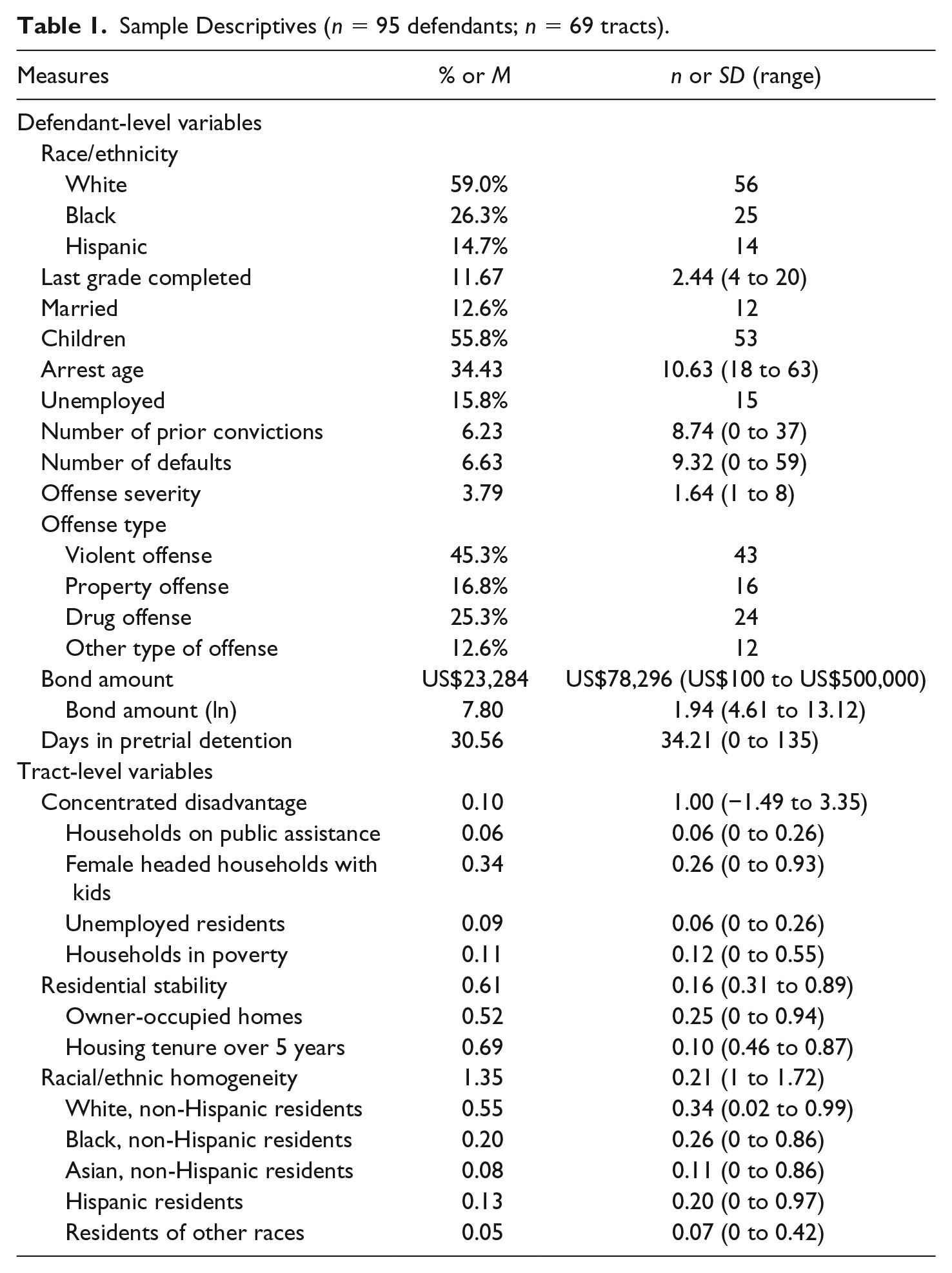
The local jail provided court mittimus files, allowing for the identification of participants’ bail-related information. The bond amount ranged from US$100 to US$500,000, with a mean of US$23,284 (SD = US$78,296). Due to its positively skewed distribution, this variable was log-transformed (M = 7.80, SD = 1.94; range = 4.61–13.21). Numerous other studies examining bond amount have completed the same transformation technique (Demuth, 2003; Wooldredge et al., 2016). Bond amount also serves as an independent variable in models assessing pretrial detention length.
Pretrial detention length
Participants’ intake and release dates were included in the jail’s data, which were used to calculate the number of days they spent in pretrial detention. If a defendant was convicted and sentenced to the same facility, they would be “released” and immediately rebooked; this ensured that these lengths of time included only pretrial detention as opposed to criminal sentences. Participants, on average, spent 30.56 days in pretrial detention (SD = 34.21; range = 0–135).
Independent variables
Offense elements/criminal histories
First, defendants’ history of failing to appear for court, or default history, was measured through a continuous variable. Derived from CORI data, participants had defaulted a mean of 6.63 court appearances (SD = 9.32; range = 0–59). Second, criminal history was incorporated through a continuous variable of a defendant’s number of prior convictions (M = 6.23, SD = 8.74; range = 0–37). Third, a continuous variable measuring offense severity (M = 3.79; SD = 1.64) was coded using the Massachusetts Sentencing Commission’s “Master Crime List” (Lu, 2015). This document outlines all chargeable offenses in MA, and their severity is classified on a scale of 1 to 8. Crimes such as trespassing and threatening to commit a crime are considered a “1,” whereas home invasion and rape are labeled an “8.” Fourth, and finally, analyses controlled for offense type of the arresting charge: violent (45.3%; n = 43), property (16.8%; n = 16; reference category), drug (25.3%; n = 23), and other types of offenses (12.6%; n = 12).
Defendants demographics
Race/ethnicity was trichotomized into White (56.0%; n = 56; reference category), Black (26.3%; n = 25), and Hispanic (14.7%; n = 14). Second, the last grade completed included with a mean of 11.67 years of schooling (SD = 2.44; range = 4–20). Ties to the community were measured though two binary variables: married defendants (12.6%; n = 12) and defendants with children (55.8%; n = 53). Fifth, a continuous measure of defendants’ age was included with a mean age of 34.43 (SD = 10.63; range = 18–63) years. Sixth, and finally, unemployment was measured through a binary variable, where “1” signified unemployed defendants (15.8%; n = 15).
Neighborhood context
The local jail also provided participants’ last known addresses, which the institution obtained during their intake process. These addresses were then geo-coded and matched with 69 Census tracts (2010). American Community Survey data (2011–2015 estimates) were used to generate three indicators related to social disorganization: concentrated disadvantage, residential stability, and racial/ethnic homogeneity. Concentrated disadvantage (M = 0.10, SD = 1.00; range = −1.49 to 3.35) was created by standardizing and averaging the following indicators: (a) the percentage of families below the poverty line, (b) the percentage of households receiving public assistance (financial assistance and/or food stamps), (c) the percentage unemployed, and (d) the percentage of female-headed families with children. Residential stability (M = 0.61, SD = 0.16; range = 0.31–0.89) was constructed by averaging (a) the percentage of owner-occupied homes, and (b) the percentage of residents living in the community for more than 5 years. Finally, a racial/ethnic homogeneity indicator (M = 1.35, SD = 0.21; range = −1 to 1.72) was generated by reverse-coding Blau’s equation: 1 − ∑pi2, where pi is the proportion of the population identifying as each racial/ethnic group (White, Black, Native American, Asian, Hispanic, and Other). See Table 1 for descriptive statistics of the neighborhood-level variables used to generate these three scales.
Sample Descriptives (n = 95 defendants; n = 69 tracts).
Analytical Strategy
The following analysis of bond amount and pretrial detention length included five regression models conducted at the individual level. All models were examined for appropriate assumptions and sensitivity analyses were conducted. The first three models examined bond amount through OLS regression. The first focused on individual-level demographic variables, the second incorporated neighborhood-level factors, and the third accounted for offense elements/criminal histories. This order was selected to first identify any disparity in bond amount due to demographic factors and to see whether those remained when accounting for neighborhood context. Offense elements/criminal histories were incorporated finally so as to assess whether any identified disparity, whether individual- or neighborhood-related, persisted even when accounting for offense elements/criminal histories. In the second and third regression models, standard errors were clustered for the 69 Census tracts as both included neighborhood variables. As there were not enough participants situated within communities to conduct analyses of within-unit variation, the vce(cluster clustvar) option was utilized (Froot, 1989; White, 1980; R. L. Williams, 2000). This relaxed independent observation assumptions to accommodate for the intergroup correlation of standard errors.
The next set of regression models examined the number of days that defendants spent in pretrial detention. As this was a count variable, both models utilized negative binomial regressions. While Poisson analyses were initially conducted, goodness-of-fit tests indicated the presence of overdispersion, thus warranting the use of a negative binomial (Osgood, 2000). First, the bond amount was assessed in relation to detention length to examine whether higher bonds led to longer periods of pretrial detention. The second model incorporated individual demographics, neighborhood characteristics, and offense elements/criminal histories to assess (a) the impact of neighborhood context on pretrial detention length, and (b) whether the bond amount still predicted pretrial detention when accounting for these indicators. Similar to the bond amount analyses, the second model featured clustered standard errors due to the inclusion of neighborhood contextual variables.
Results
Bond Amount
When accounting only for defendants’ demographics, results revealed the presence of ethnic disparity: Hispanic defendants were given a higher bail with a 1.84 (p = .007) increase in the logged bond amount (Table 2, Model 1). This finding persisted even when incorporating neighborhood characteristics. Hispanic defendants were given a 1.76 (p = .028) higher logged bond amount compared with White defendants (Table 2, Model 2). Results of this model also indicated the importance of neighborhood context in setting bail. Defendants residing in Census tracts with higher levels of residential stability received lower bonds or, in other words, residential mobility was associated with higher bonds. A one-unit increase in residential stability led to a 0.3.45 (p = .039) decrease in defendants’ logged bond amount. In addition, defendants from tracts with higher levels of concentrated disadvantage received lower bonds. A one-unit increase in neighborhood disadvantage led to a 0.55 (p = .033) decrease in defendants’ logged bond.
OLS Regression Analyses for Variables Predicting Bond Amount (ln; N = 95).

Note. OLS = ordinary least squares; VIF = variance inflation factor.
Standard errors were not clustered in Model 1 as it included only individual-level variables.
p < .05. **p < .01. ***p < .001.
Model 3 (Table 2) introduced offense elements/criminal histories into the analysis, highlighting the importance of offense severity and offense type. A one-unit increase in offense severity led to a 0.78 (p = .000) increase in defendants’ logged bond amount. In addition, defendants who allegedly committed a drug offense were given a 1.02 (p = .022) higher logged bond amount than those arrested for a property offense; those arrested for an “other” type of offense were given a 1.49 (p = .017) higher logged bond amount. Even when controlling for offense elements/criminal histories, however, there existed disproportionalities related to defendants’ demographics and neighborhood context. While the Hispanic variable no longer predicted bond amount, neighborhood characteristics continued to significantly affect bail decisions. A one-unit increase in residential stability led to a 2.53 (p = .028) decrease in defendants’ logged bond amount, and a one-unit increase in neighborhood disadvantage led to a 0.48 (p = .006) decrease in defendants’ logged bail. Though, as anticipated, offense elements were the most important in predicting bail as the R2 value increased from .21 (Table 2, Model 2) to .58 (Table 2, Model 3) when accounting for offense elements/criminal histories.
Pretrial Detention Length
Two models were used to assess pretrial detention length, the first accounting only for bond amount (Table 3, Model 1) and the second controlling for offense elements/criminal histories, defendant characteristics, and neighborhood context (Table 3, Model 2). Findings of Model 1 (Table 3) suggested that bond amount significantly affected detention length. A one-unit increase in defendants’ logged bond amount led to a 20% (p = .013) increase in the number of days in pretrial detention. When accounting for offense elements/criminal histories, defendants’ demographics, and neighborhood characteristics (Table 3, Model 2), however, bond amount no longer predicted detention length. Hypothesis 3 was therefore supported as detention length was predicted solely by offense elements, defendant characteristics, and neighborhood context as opposed to bond amount.
Negative Binomial Regression Analyses for Variables Predicting Detention Length (N = 95).

Note. IRR = incidence rate ratio.
Standard errors were not clustered in Model 1 as it included only an individual-level variable.
p < .05. **p < .01. ***p < .001.
Related to offense elements/criminal histories, offense history significantly affected pretrial detention length. For every one-unit increase in offense severity, the number of days in pretrial detention increased by 29% (p = .012). Aligning with Hypothesis 2, findings also highlighted disparity in detention length based on both individual- and neighborhood-level defendant characteristics. Unemployed defendants spent 58% (p = .001) less days in pretrial detention than defendants with legitimate employment. In addition, residential stability again predicted detention length where defendants who resided in tracts of high residential stability experienced shorter periods of pretrial detention. In other words, defendants from neighborhoods with highly transient residents spent more days in pretrial detention. For every one-unit increase in residential stability, the number of days that defendants spent in pretrial detention decreased by 32% (p = .006).
Discussion
Findings initially concluded that Hispanic defendants were given higher bonds than their White counterparts. Demuth (2003) similarly found that Hispanic defendants were the most burdened during the pretrial process, as they received higher bail than both White and Black defendants. Also situating his research in the focal concerns perspective, he explained that Hispanic defendants may be deemed more of a flight risk due to their immigration status or lack of community ties; moreover, they may be stereotyped as more dangerous and crime-prone (Demuth, 2002, 2003). In the current research, this finding persisted even when accounting for community factors, highlighting that there can exist disparity due to both defendants’ demographics and neighborhood context. However, when controlling for offense elements/criminal histories, ethnicity no longer predicted bond amount as offense severity and offense type yielded significance. While seemingly a “warranted” disparity, as what was presumed to be ethnic disparity is actually due to offense-related factors, this finding raised questions related to “race-salient criminal laws, differential offending, differential policing, and differential criminal processing” (Schlesinger, 2007, pp. 261–262).
Defendants’ employment status was also linked to the pretrial process, where unemployed defendants spent less days in pretrial detention. While counterintuitive, there are a few explanations as to this finding. First, this measure accounted for any type of legitimate employment that could range from a part-time minimum wage job to a full-time job with a high salary. Therefore, even employed defendants could be living paycheck-to-paycheck and not have the funds required for their release. Relatedly, as noted, this sample consisted of defendants who could not afford to be bailed directly out of court and were admitted to the local jail. As such, employed defendants with high paying jobs may have bailed themselves directly out of court, avoiding jail altogether. The remaining defendants classified as employed would, in turn, be those who could not immediately afford their bail. Third, unemployed defendants may have had money saved through government assistance programs, such as disability or unemployment, which they could have put toward their release. Finally, this measure accounted for legitimate employment and, with approximately 40% of participants charged with a property or drug offense, defendants may have had other means of acquiring income that they put toward their bail (which this variable did not capture).
When controlling for defendants’ demographics and offense elements/criminal histories, neighborhood context was found to heighten pretrial disproportionalities. First, defendants residing in tracts with higher levels of residential stability received significantly lower bonds and spent significantly less days in pretrial detention. Court actors may have inferred that defendants from residentially stable neighborhoods were more likely to return to court, or that defendants living in communities with high residential mobility were less likely to appear. Rodriguez (2013), in her mixed-methods study of adjudication outcomes for youthful offenders, noted that court officials had concerns regarding their ability to provide effective supervision for those living in residentially unstable communities. A similar argument could be applied to the current research where court actors may have used a “perceptual shorthand” (Hawkins, 1981, p. 230) of referencing neighborhood residential (in)stability to assess a defendant’s likelihood of returning to court. 6 The result was that defendants from tracts of high residential mobility spent an increased number of days in pretrial detention. Therefore, residing in a tract with high residential mobility could be a double burden for defendants: They received higher bonds and spent more time in pretrial detention even when controlling for their heightened bail.
A second finding related to neighborhood context emerged where defendants from advantaged neighborhoods received significantly higher bonds. While Wooldredge and colleagues (2016) suggested that court actors may attempt to “clean up” socially disorganized neighborhoods by giving higher bail to defendants offending in these areas, J. H. Williams and Rosenfeld (2016) asserted that defendants offending in more affluent communities were given higher bail to protect higher status areas threatened with crime. The current research yielded support for the latter argument as applied to defendants’ home addresses: Those residing in advantaged tracts received higher bonds. 7 I would further argue that this can be attributed to defendants’ perceived blameworthiness as court actors may have penalized those from advantaged communities where more resources and opportunities were available. As stated, blameworthiness technically should not be considered in pretrial decisions; however, prior research on focal concerns theory has suggested otherwise (see Steffensmeier et al., 1998). While neighborhood disadvantage did not predict pretrial detention length, this was likely because residents of affluent areas had a greater ability to afford their bail despite it being heightened. As such, defendants residing in affluent communities were given higher bail; however, perhaps due to their affluent ties, they did not spend significantly more days in pretrial detention.
While neighborhood context did predict pretrial decisions and outcomes, as anticipated, offense elements were the most important determinants. When court officials evaluated defendants’ dangerousness, blameworthiness, and likelihood of failing to appear (Steffensmeier et al., 1998), it is intuitive that those charged with more serious crimes were given a higher bond. Although the seriousness of their charges and potential punishments may make fleeing seem favorable, the loss of a high bail would likely deter this behavior. Massachusetts specifically outlines this on their government webpage titled “Learn how bail is set” (Mass.gov, 2018e). It states, “the severity of the crime may play into the determination of whether the defendant will appear in court.” In fact, offense severity was so essential to these decisions that defendants charged with more severe offenses spent more days in pretrial detention when controlling for their heightened bond amount. As noted, scholars have also found evidence supporting this argument in other jurisdictions—that bail and pretrial detention were determined primarily based on the severity of charges and available evidence (Bock & Frazier, 1977; Demuth, 2003; Goldkamp et al., 1981; Goldkamp & Gottfredson, 1985; Gottfredson & Gottfredson, 1987; Kutateladze et al., 2014; Nagel, 1983; Schlesinger, 2005; Spohn, 2009; Wooldredge et al., 2016).
Offense type also predicted bond amount where defendants charged with drug offenses or other types of offenses (i.e., not violent, property, or drug) were given higher bail. Considering the heightened criminalization of drug use (Alexander, 2012), it was not surprising that alleged drug offenders were given higher bonds. They were likely deemed to be a risk to the community and perceived as particularly blameworthy given the debate of drug use as a disease versus a choice and the stance that drug traffickers, suppliers, and sellers profit off the suffering of others. Even decades prior, President Reagan (1986) depicted “drug criminals [as] pilfering human dignity and pandering despair” (para. 5) in his speech on the Anti-Drug Abuse Act of 1986. Relatedly, defendants charged with “other” types of offenses may have also been deemed as a risk to the community. Examples of these included restraining order violations, drunk driving, and other public order offenses. While minor crimes relative to assault and battery or larceny, they are relatively easy to repeat. This is why Massachusetts outlined that bail decisions should consider the potential harm to victims, particularly in domestic cases (Mass.gov, 2018e).
Finally, when assessing bond amount in relation to pretrial detention length, another interesting finding emerged. While it appeared as though higher bail led to longer periods of pretrial detention, this effect was lessened when controlling for offense elements/criminal histories, defendants’ demographics, and neighborhood context. This aligns with the “shopping cart” example outlined in the Brangan v. Commonwealth (2017) decision, which noted that low-income defendants will spend longer periods in pretrial detention if their bail is not set in accordance with their “financial status.” The Court stated that A $250 cash bail will have little impact on the well-to-do, for whom it is less than the cost of a night’s stay in a downtown Boston hotel, but it will probably result in detention for a homeless person whose entire earthly belongings can be carried in a cart. (p. 16)
In other words, bail means different things to different defendants: a day’s paycheck, an entire savings account, or an unattainable amount. Even decades prior, Foote (1954) highlighted that disadvantaged defendants’ inability to afford financial release resulted in similar detention lengths as those who were denied bail altogether. As such, when controlling defendants’ demographics, neighborhood context, and offense elements/criminal histories, higher bonds did not predict pretrial detention length.
Conclusion
This research sought to better understand sources of disparity in the cash bail system by focusing on defendants’ demographics and neighborhood context and their impact on bond amount and pretrial detention length. Minimizing all potential sources of disparity is essential due to the plethora of negative effects that even days of incarceration can have on legally innocent defendants. As such, this work allowed for a more holistic understanding of the factors that can affect bail and pretrial detention above and beyond offense elements/criminal histories. With the limited amount of studies examining neighborhood context, these findings are part of an initial few that suggest community characteristics matter. Even when controlling for offense elements/criminal histories, findings indicate that neighborhood context affected both bond amount and detention length. Defendants from disadvantaged areas received lower bonds, as did those from areas of high residential stability. Moreover, defendants from areas of high residential stability spent shorter periods in pretrial detention. While offense elements, such as offense severity, were the strongest predictors of bond amount, bond amount did not predict detention length when controlling for neighborhood context, defendants’ demographics, and offense elements/criminal histories. These disproportionalities are particularly problematic given the already disadvantaged nature of defendants held in pretrial detention, thus highlighting that disparity continued to prevail even within this subpopulation of defendants.
Limitations and Future Directions
There are limitations to this analysis that should be addressed in future works. First, participants’ SES, length of time at their home address, quality of evidence during their bail hearing, type and quality of counsel representation, and other relevant factors were not provided in the data. These omitted variables could affect the results of the current study and, therefore, future research should account for these indicators (when possible) to provide stronger evidence of a causal relationship. Second, there were not enough defendants from each Census tract to meaningfully cluster participants and conduct a multilevel analysis. While disaggregating neighborhood-level variables to the individual level is not the ideal, as noted, the vce(cluster clustvar) command was applied (Froot, 1989; White, 1980; R. L. Williams, 2000). To reiterate, this relaxed independent observation assumptions to accommodate for the intergroup correlation of standard errors. As neighborhood characteristics were disaggregated to the individual level, future research should further explore these relationships through more sophisticated analyses, such as multilevel modeling.
Third, readers should keep in mind that this data set included individuals held at one jail who were sentenced out of one court within one county and, therefore, the above results are not generalizable to a larger population of pretrial detainees. Relatedly, the sample size of 95 defendants heightened the potential for unstable results. To acknowledge this, a stepwise sensitivity analysis was conducted, yielding no notable differences in different groupings of model variables. This gave us confidence that the results were not due to statistical abnormalities related to the sample size. Moreover, one of the two prior studies on this topic utilized a sample of 109 participants (J. H. Williams & Rosenfeld, 2016). Finally, as the local jail provided data, rather than the court, it was not possible to examine a larger group of defendants, such as those released without bail or those bailed directly out of court. Future research should fill this knowledge gap. Despite its limitations, the results of this study are interesting and warrant further exploration in subsequent research, particularly given the consequences of pretrial detention and current calls for reforming the pretrial process.
Implications
Bail reform is essential to lessen the consequences of pretrial detention, to reduce disparity in the cash bail system, and to aid court actors with their pretrial decisions. Recent bail reform efforts have made great strides toward making bail more affordable. As noted, in Massachusetts, the study site, the Supreme Judicial Court unanimously ruled that defendants’ financial resources should be considered in determining bond amount where the set amount should not be so high that it results in long-term detention or “functional equivalent” of denying bail altogether (Brangan v. Commonwealth, 2017). This “functional equivalent” is the topic of focus in this article, examining a sample of defendants granted bail but unable to afford their bond amount. Other states have enacted similar legislation, relying on risk assessment tools to reduce disparity. For example, California recently ended their cash bail system “so that rich and poor alike are treated fairly” (Fuller, 2018, p. 2). With the change in policy, California court actors now have greater discretion in making pretrial decisions, but rely more heavily on risk assessment tools to inform these (Fuller, 2018). In the same year, the state of Alaska eliminated cash bail for most defendants, instead relying on a computerized algorithm to determine a defendant’s likelihood of offending during pretrial release and failing to appear for court (Equal Justice Initiative, 2018). As Massachusetts does not rely on risk assessment tools in their pretrial decisions, this is an avenue worthy of exploration for local policy makers seeking reform.
Concluding Remarks
Overall, the findings of this work highlight different sources of disparity present in the pretrial process, and, notably, that neighborhood characteristics influence both bond amount and pretrial detention length. Therefore, not only should bail reform effects focus on a defendant’s race and income (among other factors) but also the neighborhoods in which they call home. Just as defendants should not be given a high bond due to the color of their skin, they also should not face a high bond because they live in a neighborhood with transient residents. In the same sense that research brought about reform surrounding the affordability of bail, this study and future works on multilevel sources of disparity in the cash bail system can affect policies surrounding unconvicted and legally innocent people.
Footnotes
Acknowledgements
The author would like to thank Dr. Natasha A. Frost, Dr. Gregory M. Zimmerman, Dr. Ekaterina V. Botchkovar, and the anonymous reviewers for their helpful comments on earlier drafts of this article. In addition, the author thanks Michelle Chen and Sarina Dass for their assistance with data entry and other project-related tasks.
Declaration of Conflicting Interests
The author(s) declared no potential conflicts of interest with respect to the research, authorship, and/or publication of this article.
Funding
The author(s) received no financial support for the research, authorship, and/or publication of this article.
