



Abstract
Holistic defense is a model of public defense rooted in the early 20th century recognition that lawyers and social workers should cooperate to advocate with and for individuals and communities in need. Prior work on holistic defense highlighted its potential to transform the lives of public defender clients by transforming the legal practice of attorneys. Comparatively, social workers’ roles in these transformations have been neglected. Yet many holistic defense programs begin by integrating social workers onto legal teams. In this article, I describe and evaluate a social work centric holistic defense model piloted in Santa Barbara, California. My research supports recent findings that holistic defense improves case outcomes and substantially reduces incarceration without negatively affecting public safety. I discuss my results in the context of prior research and the potential for holistic defense to reform criminal justice. I then make recommendations for the design of future holistic defense evaluations.
Keywords
Holistic defense is a model of public defense with origins in the early 20th century recognition that public interest lawyers and social workers should cooperate to advocate with and for disadvantaged people and communities (Bost, 1932; Bradway, 1929; Collins, 1932; Pound, 1927; Woods, 1905). In recent decades, this long history of overlapping interests and complementary professional goals among public interest lawyers and social workers has coalesced into a movement toward “holistic advocacy” within public defense (Clarke, 2001, p. 408; Deck, 2016; Steinberg & Feige, 2002). Holistic public defense models broaden the scope of traditional public defense models to match the scope of social work (Galowitz, 1999).
There are fundamental differences between models of public defense that can be called holistic and more traditional public defense models. Whereas holistic defense is client-centered, traditional defense is case-centered. Whereas multidisciplinary teams provide holistic defense, traditional defense is oriented around the work of criminal defense attorneys. Finally, whereas holistic defense includes a community component that draws on the community defense movement of the mid-20th century, traditional defense generally does not.
The most fundamental difference between models of public defense that are holistic and traditional public defense models is a client-centered versus a case-centered orientation (Lee et al., 2014). Traditional public defense models are case-centered: They orient around resolving criminal cases advantageously in the shorter term, mainly through attorneys’ zealous representation of clients vis-à-vis the court. Although many traditional public defender offices employ social workers, in such offices their work primarily supports attorneys’ efforts to resolve criminal cases (Steinberg & Feige, 2002). For example, a social worker might secure a client a spot in a substance abuse treatment program. The attorney can then leverage the client’s treatment to negotiate a better sentencing outcome, such as probation instead of jail time. After the case closes, the attorney, social worker, and client are likely to interact again only if, for example, the client violates probation or is arraigned on new charges. In traditional public defense models, clients have longer term relationships with attorneys and social workers mainly through the “revolving doors” of clients’ ongoing legal problems (Lipsky, 2010, p. 78).
The desire to more effectively address clients’ ongoing justice involvement—to close those revolving doors—motivated the movement toward holistic advocacy (Steinberg & Feige, 2002). Underlying this movement is the understanding that the legal problems public defender clients face are often the inevitable consequences of their unaddressed extralegal problems. Nearly a century of legal, criminological, and sociological research has shown that the extralegal challenges justice-involved people face are socially rooted in poverty and neighborhood disadvantage, which create instability in people’s lives. This instability manifests as, for example, untreated physical and mental health conditions (Duncan & Kawachi, 2018), violence (Sampson & Wilson, 1995; Western, 2015), substance abuse (Boardman et al., 2001; Karriker-Jaffe, 2011), residential instability (Shaw & McKay, 1942), unemployment (Wilson, 1987), and a dearth of social support (Turney & Harknett, 2010). Until these underlying challenges are addressed, public defender clients are likely to remain entrenched in the criminal justice system because their lives will remain destabilized (Clarke, 2001; Steinberg, 2013). Moreover, resolving a single criminal case does little to address these underlying extralegal challenges—and may even exacerbate them. Pleading guilty can result in job loss, family separation, and civic disenfranchisement (Pinard, 2004; Smyth, 2005). Holistic public defense models seek to mitigate these consequences and to address these underlying challenges.
Holistic public defense models extend zealous representation from a single criminal case to the client’s life course, which necessitates a team-based, multidisciplinary approach that leverages and expands community resources. Each client’s needs dictate the work of the holistic defense team. In many holistic models, this also means that clients’ needs determine the composition of the team itself. For example, some holistic offices employ immigration attorneys who only work on teams with clients in need of their services.
Holistic public defense models also include a community component that leverages and builds community problem-solving resources. A community-based approach is a natural extension of the recognition that clients’ problems have evolved over time in disadvantaged local environments. Addressing such problems requires understanding how clients’ life courses connect to the communities where they live—how they became destabilized and how they can be stabilized. Such an approach further recognizes that meeting clients’ needs may require specialized community-based social services external to public defender offices. Thus, addressing the challenges faced by whole clients situated in whole communities necessitates a multidisciplinary and community-specific skillset that grows as holistic practices deepen (Clarke, 2001; Craige & Saur, 1981; Galowitz, 1999; Steinberg, 2013).
These features of holistic defense—that it is client-centered, team-based, multidisciplinary, and community-oriented—suggest that holistic defense models will vary considerably with clients’ needs and resources, public defender resources and capabilities, and community resources and capabilities. 1 No holistic defense model is likely to replicate any other. Although holistic defense models are likely to vary, the objectives of holistic defense for clients are generally similar. 2 They include improved criminal case outcomes, life stabilization, and reduced recidivism (Anderson et al., 2019; Buchanan & Orme, 2018; National Symposium on Indigent Defense, 2000; Wald, 1972). As more holistic defense models are evaluated, the core features of each can be identified and evaluated to determine how they achieve these objectives. However, at present, so few holistic defense models have been evaluated that the most fundamental information about holistic defense—whether some or all of its potential models achieved these objectives—has not yet been provided.
Prior Holistic Defense Evaluations
Only two prior studies assessed the impact of a model of holistic defense on clients’ criminal case and recidivism outcomes (Anderson et al., 2019; Buchanan & Orme, 2018). Together they indicated that, compared with public defender clients who did not receive holistic services, holistic defense clients experienced better sentencing outcomes and about equal chances of recidivism. Sarah Buchanan and John Orme (2018) assessed 2-year recidivism outcomes for public defender clients in Knox County, Tennessee, using a propensity score–matched design. Some public defender clients received social work services; others did not. After 2 years, clients who received social work services were 3.8% less likely to be charged with a misdemeanor (t = 2.03) and were charged with 0.81 fewer misdemeanors (t = 2.03). However, clients who received social work services were also 7.9% more likely to be charged with a felony (t = 2.94). The frequency of felony charges did not differ by group. These somewhat equivocal results may be attributable to key omitted variables. For example, baseline differences in clients’ needs may have determined whether they received social services.
James Anderson and his colleagues (2019) compared the legal case and recidivism outcomes of Bronx Defenders clients with those of Legal Aid clients in the Bronx, New York. Bronx Defenders clients receive holistic representation from the originators of holistic defense. Legal Aid clients receive more traditional public defense services, although Legal Aid has moved toward more holistic representation over time (Anderson et al., 2019). The clients of both agencies were equally likely to be convicted, but Bronx Defender clients were 16% less likely to be incarcerated and, when incarcerated, experienced 24% shorter sentences. Holistic defense was not associated with recidivism in any year of the 10-year follow-up. Thus, Anderson et al. (2019) concluded that holistic defense improved sentencing outcomes and reduced incarceration without negatively affecting public safety.
The Santa Barbara Model of holistic defense and its associated pilot study was conceived, funded, and implemented before either of these prior studies had been published. In the sections that follow, I describe the circumstances that led to the development, implementation, and evaluation of the Santa Barbara Model of holistic defense. I present the results of that evaluation and discuss them in relation to prior holistic defense research, current trends in criminal justice reform, and how they can inform future evaluations of holistic defense models.
Designing the Santa Barbara Model of Holistic Defense
Santa Barbara County is located on California’s central coast. It is home to approximately 450,000 people, 92,000 of whom live in the county seat, Santa Barbara, and 102,000 of whom live in the largest city, Santa Maria. The county’s residents are 45% White, 45% Latino, 2% Black, and 5% Asian American (SBC, 2017). In 2017, crime rates in Santa Barbara County were lower than the California average. The violent and property crime rates in Santa Barbara County were 340 and 1,942 per 100,000, respectively, whereas they were 451 and 2,491 per 100,000 statewide (Lofstrom & Martin, 2018).
The seeds of the Santa Barbara Model of holistic defense were planted when the Director of Operations at Family Service Agency (FSA), a social services agency that serves 16,000 clients annually, read a newspaper article about the Bronx Defenders, a public defense office that operates one of the best known holistic defense models in the United States (Anderson et al., 2019; Lee et al., 2014; Smyth, 2005; Steinberg, 2013; Steinberg & Feige, 2002; Steinberg & Keeney, 2016). FSA leadership recognized that their deep knowledge of the Santa Barbara community, which dates to 1899, and broad-based social services offerings, which include substance abuse treatment and mental health counseling, could help indigent criminal defendants in Santa Barbara address the underlying problems in their lives that promote and perpetuate criminal justice involvement. FSA then approached the Santa Barbara County Office of the Public Defender (OPD) about creating an holistic defense program. The OPD in Santa Barbara was established in 1969 after the U.S. Supreme Court ruled in Gideon v. Wainwright (1963) that indigent defendants facing criminal charges in state court have the right to legal representation. By 2014, the OPD employed 37 attorneys who handled about 23,000 cases each year. The OPD agreed to partner with FSA to instantiate an holistic defense program in their office. In 2015, FSA and the OPD approached me to help them develop, seek funding for, and evaluate their holistic defense program. In 2016, Arnold Ventures (then the Laura and John Arnold Foundation) funded our proposed pilot program and evaluation. 3 Concurrently, a new Public Defender assumed office—an event that could have derailed the project (Sherman, 1992). Fortunately, support for holistic defense only grew under her leadership. 4
At the outset of this project, we recognized that we would not be able to implement and evaluate a fully formed model of holistic defense at both the individual and community levels. We therefore proposed to lay the foundation of an holistic public defense model, beginning with the core of holistic defense as depicted by Clarke (2001)—client-centered, holistic advocacy—and to design our evaluation of that model around assessing clients’ outcomes.
The Santa Barbara Model of Holistic Defense
In the Santa Barbara Model, public defender attorneys in the OPD’s main office in downtown Santa Barbara work collaboratively with each client and a social worker employed and trained by FSA. 5 The social worker, attorney, and client form the core of each holistic defense team. The core holistic defense team may be augmented by each client’s social support system, if they have one, 6 other professionals (e.g., investigators) who may work on their criminal cases, and one or more of the 34 community-based social service agencies that partner with FSA to provide a broad range of social services to holistic defense clients, including substance abuse treatment, mental health counseling, housing and employment assistance, and noncriminal legal services, such as family and immigration law. 7
The introduction of the FSA social worker inherently creates a team-based holistic defense model through which holistic defense clients’ needs and objectives can be better understood, addressed, and achieved. Each team cooperates to determine the client’s legal and extralegal needs, understand her desired case and life course outcomes, resolve her legal case, and address her extralegal needs. However, the social worker’s interaction with OPD clients and attorneys differentiate the holistic services they receive from the OPD’s more traditional public defense services in which clients interact mainly with their attorneys. 8
In the Santa Barbara Model, the initial interaction between the holistic defense client and the social worker is an interview that can take place wherever possible including in jail, arraignment court, the social worker’s office at the OPD, and the client’s home. The initial interview, which lasts between 30 min and 2 hr, helps the social worker build more robust relationships with clients, understand their life histories and current life circumstances, and identify their needs, resources, and objectives related to their criminal cases and life courses. 9 The nature of each holistic defense client’s criminal case and extralegal needs determine how intensively the team interacts and the specific actions each team member takes. Indigent defense clients typically have varied needs—employment, housing, mental health, and substance abuse—to address and resources—cognitive, emotional, physical, and symbolic—that they can leverage to address them (Link & Phelan, 1995; Massey & Brodmann, 2014). The content of the intervention therefore inherently varies across clients.
Yet each team member in the Santa Barbara Model has core responsibilities. The holistic defense client is responsible for identifying and working toward their desired case and life stabilization outcomes, a process that the social worker and attorney inform and facilitate. For example, many clients—even those who have been involved with the criminal justice system for many years—do not really understand the processes happening around them. Nor do they believe they can influence them. Together the attorney and the social worker help holistic defense clients understand what is happening and the proactive extralegal steps they can take that might improve their legal case outcomes, such as finding stable housing, repairing familial relationships, getting mental health care, or becoming employed. This process empowers clients and can give attorneys and social workers leverage in negotiations with judges and prosecutors (Harris, 2018; Steinberg & Keeney, 2016).
The attorney is primarily responsible for addressing the criminal legal needs of the client, a process that often overlaps with addressing her extralegal needs and is therefore informed by the client and the social worker. In addition to resolving the criminal case, holistic defense attorneys are responsible for understanding and communicating the collateral consequences different case resolutions might have (Pinard, 2004; Smyth, 2011). Collateral consequences associated with criminal convictions, which include ineligibility for certain jobs, eviction from public housing, loss of education loans, and family separation, are often the greatest concerns of public defender clients—and were for holistic defense clients in Santa Barbara (Harris, 2018; Steinberg, 2013). Attorneys practicing holistically are attentive to the ways in which these consequences might be mitigated. Nevertheless, attorneys often report misalignment between the outcomes they believe are possible and outcomes clients expect. The social worker can often bridge this gap. By learning more about the client, she may be able to help the client characterize the circumstances that led to their arrest more completely so that the attorney can see more potential in the case. Or, she may be better able to explain to the client what the constraints of their situation are in relation to the court, help the client identify ways to improve that situation, and thereby give the attorney more options in negotiations with the court (Harris, 2018). For example, if the social worker encourages the client to enroll in mental health treatment, the attorney can use that program participation as leverage to downgrade charges or punishment (e.g., probation instead of jail time to avoid interrupting treatment).
The social worker is primarily responsible for helping the client address her extralegal needs, a process that is informed by the client, constrained by her legal problems, and therefore also informed by the attorney. In addition, she is also typically involved in the resolution of clients’ legal cases. For example, the social worker often advocates for clients directly with the court. In this capacity, the social worker gives clients a voice in adjudication processes wherein they are rarely given the opportunity to advocate for themselves. She does this orally and through written reports. Moreover, with respect to extralegal issues, the court often perceives her “voice” to be more credible than either the clients’ or the attorneys’ because she is an expert in social work. Thus, her recommendation for a particular treatment plan that justifies a reduced sentence proposed by the attorney is typically accepted (Buchanan & Nooe, 2017; Harris, 2018; Steinberg & Keeney, 2016).
Concurrently, the social worker addresses the extralegal aspects of the client’s situation in cooperation with the client and the attorney. The social worker may begin to address some of the holistic defense client’s needs immediately and directly by providing informational and emotional support. The informational support she provides is multifaceted and interdisciplinary, requiring knowledge of individual and community resources. Such assistance includes finding places to stay, applying for public assistance, obtaining identification, identifying appropriate programs and referring and transporting clients to them, and reaching out to and consulting with clients’ family and friends (Buchanan & Nooe, 2017; Craige & Saur, 1981; Harris, 2018).
The social worker also provides intensive emotional support to holistic defense clients. Many clients are in crisis at the time of their arraignment. They report feeling confused, exhausted, depressed, and even suicidal. Many are in withdrawal. The social worker can help clients through these crises—and beyond them. Over time, as their relationships deepen, holistic defense clients reach out to the social worker when they experience challenges and to share their successes. Although the social worker is neither a clinician nor a therapist, she typically becomes the point of reference for holistic defense clients (and their families) who view her as a resource who can help navigate the criminal justice system, social service agencies, and general problems that arise in their lives (Buchanan & Nooe, 2017; Craige & Saur, 1981; Harris, 2018).
Holistic defense clients in Santa Barbara develop stronger relationships with their social worker than with their attorney for at least two reasons. First, the social worker’s work traverses multiple life-course domains, whereas the attorney mainly focuses on the criminal legal domain. Second, even after their criminal cases resolve, the social worker continues working with clients. For example, if a client absconds from probation, but immediately calls her social worker, the two can work together to identify what happened and why, and then collaborate with probation and the court to find a solution that avoids a custodial sanction. Thus, the social worker can act as a mediator between the holistic defense client, her probation officer, and the court. By their own admission, attorneys rarely have time to address these types of postconviction problems. Moreover, without the social worker, they likely would not know that the problem had occurred until the client was apprehended for the probation violation (Harris, 2018).
Improving Case Outcomes, Stabilizing Lives, and Reducing Recidivism
The outcomes we sought to achieve during the pilot were the core client-based objectives of holistic defense: improved criminal case outcomes, life stabilization, and reduced recidivism. 10 We conceptualized these outcomes as a causal sequence of events in clients’ life courses. Improved criminal case outcomes set the stage for life stabilization, which promotes reduced recidivism, which we conceptualized as reduced justice involvement (e.g., arrests).
Relative to regular public defender clients, we expected holistic defense clients’ criminal case outcomes to improve because the holistic defense team provides “enhanced information” about clients and their potential for reform that addresses the focal concerns of judges and prosecutors (Harris, 2018; Lee et al., 2014, p. 1222; Steffensmeier et al., 1998). As described above, enhanced information is garnered by interviewing clients to understand the circumstances that led them to be criminally charged and what might be done to address those charges (Steinberg, 2013; Steinberg & Keeney, 2016). The focal concerns of the court include preserving public safety, ensuring just outcomes, and maximizing scarce community resources (Steffensmeier et al., 1998). By addressing these concerns, we anticipated that holistic defense team members would reframe the meaning of justice so that judges and prosecutors would be likelier to adopt a rehabilitative stance that emphasizes life stabilization in the community rather than a retributive stance that prioritizes isolation from the community via incarceration (Wald, 1972). Therefore, in practice, we expected that as the social worker and client worked to address the client’s immediate extralegal issues, the attorney would be able to leverage that effort to secure better case and sentencing outcomes (e.g., charge reductions, dismissals, and shorter jail sentences).
Prior desistance research suggests that holistic defense may promote life stabilization and reduced recidivism through mechanisms such as role modeling and informational and emotional social support, which spark clients’ cognitive transformations and help them engage in prosocial institutions (Bandura, 1977; Giordano et al., 2002; Harris, 2018; Maruna, 2001). Many public defender clients lead lives of profound disadvantage that have been decimated by intergenerational poverty, physical and emotional abuse, mental illness, substance use, and prolonged involvement with the criminal justice system. The social interactions that they have are often damaging, rather than supportive (Mowen & Visher, 2015). Moreover, they lack basic information such as how to apply for social services and educational support, identify jobs for which they might be eligible, and present themselves in interviews for those jobs. The ongoing, supportive interactions that clients have with other holistic defense team members can provide the guidance and reinforcement they need to learn how to “discard old habits, and begin the process of crafting a different way of life” (Giordano et al., 2002: 1000; Kahneman, 2011).
Each holistic defense team member is a role model who directly and indirectly supports clients. However, social workers seem to interact most intensively with clients, particularly in newer holistic defense models (Buchanan & Nooe, 2017; Hisle et al., 2012). This was also true in Santa Barbara where the FSA social worker was the primary catalyst through which the objectives of holistic defense were met.
Evaluating the Santa Barbara Model of Holistic Defense
In the Santa Barbara Model, the work of the holistic defense team, as indicated by the presence of the social worker, was the locus of change or, from the perspective of program evaluation, the intervention to evaluate. During the pilot, all OPD clients interacted with their attorneys. Only holistic defense clients interacted with the FSA social worker. Therefore, OPD clients served in the more traditional style of public defense could be differentiated from those who were served by the holistic defense program.
This does not mean, however, that holistic defense in Santa Barbara amounts to the effort of one individual, the social worker, rather than of the holistic defense program. Holistic defense is a multidisciplinary, team-based, and client-centered intervention. The introduction of the holistically trained social worker created a team that worked on behalf of clients, often through multiple cases (Harris, 2018; Steinberg & Keeney, 2016). Importantly, although OPD attorneys were also trained in holistic defense (see Note 5), not all attorneys had the opportunity to work as members of holistic defense teams. By definition, they could not practice holistic defense. And most OPD clients received a traditional legal defense provided on a case-by-case basis mainly by attorneys. Of course, a complete separation of intervention and control environments is rarely possible in real-world studies (e.g., Cook et al., 2012). In Santa Barbara, the main contamination was information sharing. If an attorney serving a traditional defense client needed information the social worker could provide (typically about what programs might be available or appropriate), naturally she would provide it. However, the social worker, client, and attorney worked as collaborative teams on an ongoing basis only for holistic defense clients.
We designed the evaluation to determine whether the Santa Barbara Model of holistic defense improved clients’ outcomes by comparing the criminal case and recidivism outcomes of holistic defense clients relative to those of a propensity score–matched control group. 11 Although we did not ignore life stabilization outcomes, we were only able to measure them for holistic defense clients, so I cannot compare their life stabilization outcomes to those of their control counterparts. 12 However, I do know some of the ways in which the lives of holistic defense clients and controls were destabilized at enrollment. That is, I know their social service needs. To be eligible for enrollment in the study, both holistic defense clients and control subjects needed to express challenges (and the desire to address them) in at least one of five focal life-course domains: housing, employment, substance use, mental illness, and noncriminal legal, which primarily included immigration and family law. People who are involved in the criminal justice system typically experience challenges in at least one of these five domains as well as many others (Kirk & Wakefield, 2018; Turney & Conner, 2019; Visher et al., 2004). Although our study subjects could have needs and receive social services related to any life course domain, we only collected information about their needs in these five focal domains. 13
Eligibility and Enrollment
FSA and the OPD began piloting holistic defense on February 1, 2017. Study subjects were identified and enrolled in arraignment court in Santa Barbara. 14 OPD attorneys screened individuals for study eligibility using an augmented version of their intake form. 15 Eligible OPD clients were then consented by an FSA employee who was trained by the research team. Holistic defense clients and controls were enrolled via a two-armed consent process so that the controls could be blinded from the availability of holistic defense. 16 Holistic defense clients consented to receive the program and participate in the study; the controls consented to participate in the study, but were not informed about the program. 17 Three times as many controls were enrolled to support propensity score matching.
Although they enrolled via separate processes, holistic defense clients and their control counterparts were required to meet the same five criteria so that they would be as similar as possible, mainly in terms of their core social services needs and willingness to address them. First, all subjects were required to be indigent and, therefore, eligible to receive OPD services. Second, they were required to be English or Spanish speaking. Although literacy was not required, the small-scale pilot could not accommodate other languages. 18 Third, they needed to self-identify as having a need in at least one of the five focal life-course domains: housing, employment, mental health, substance use, and noncriminal legal services. In practice, this was not a limitation. Nearly all OPD clients have at least one of these social services needs. Fourth, they needed to express the willingness to address those needs. Holistic defense—a potentially beneficial intervention—could only be offered to a fraction of OPD clients. The experimental criminology literature, exemplified by Sherman (2007), indicates that such interventions should be delivered to the “power few” who stand to cause the most harm and/or to benefit most from the intervention. OPD clients with the most significant needs who also wanted to address those needs were therefore the power few in Santa Barbara. Finally, all subjects needed to be likely, in the attorney’s judgment, to spend no more than 90 days incarcerated on the arraigned charges. 19 This criterion was imposed to ensure that holistic defense clients would be able to engage with community-based services during most of the 1-year pilot study. Importantly, this criterion did not limit the sample to those charged with misdemeanors or nonviolent offenses. Of the holistic defense clients, 29.3% were charged with at least one violent crime, 40.2% were charged with at least one felony, and 19.5% were charged with at least one violent felony.
Between February 1, 2017, and February 28, 2018, 366 subjects, 82 holistic defense clients and 284 controls, enrolled in the study. Refusal rates were 12.8% (12 of 94) for holistic defense clients and 12.9% (42 of 326) for controls. One control subject withdrew from the study; zero clients did. Within the 6-month follow-up (through August 31, 2018), zero holistic defense clients and two control subjects died, both from overdoses.
Implementation Challenges and Their Consequences
Most pilot programs experience implementation challenges (Cook et al., 2012; Kilburn, 2012; Sherman, 1992; Visher et al., 2004). Ours was no exception. In the initial evaluation design, controls were to be propensity score matched from administrative records without consent. However, the administrative records we planned to use were not available and the OPD decided that control subjects would need to consent to the release of their criminal histories. We therefore designed a consent process to accommodate and blind control subjects and identified and secured access to alternative sources of criminal history information. In addition, a misunderstanding about how many clients the social worker would serve over what time period forced us to reduce the number of holistic defense clients from 200 to 80.
Combined, these challenges had significant consequences. First, the delays associated with addressing them reduced the follow-up period from 1 year to 6 months. Thus, I can only examine shorter term recidivism outcomes. Second, reducing the number of holistic defense clients reduced the power of the study—the chance of concluding that holistic defense improves outcomes if it does—from about 80% to about 58%. Finally, as the study progressed, the single social worker often could not be in court as clients enrolled because she was serving existing clients. Therefore, some holistic defense clients met with the social worker immediately, whereas others did not. As a result, client engagement with the social worker ranged from heavy (n = 20) to none (n = 13). However, the social worker may have been involved in the cases of clients that she did not meet. Attorneys viewed the social worker as a valuable resource. Therefore, they would typically consult her on cases involving her clients. 20
Data
To determine whether holistic defense has the potential to improve criminal case outcomes for and reduce the recidivism of indigent defendants who use public defense services in Santa Barbara County, the project data specialist and I compiled data from multiple sources: OPD intake data, information on the legal case each subject faced as they enrolled in the study from OPD (“E-Defender”) and Santa Barbara Superior Court (“Odyssey”) databases, and adult Criminal Offender Record Information (CORI) data from the California Department of Justice (DOJ). 21 Collectively, the data include demographic characteristics, criminal history information, focal life-course domain needs, conditions of the arrest that brought each subject into arraignment court, characteristics of their arraignment charges, and OPD attorney characteristics.
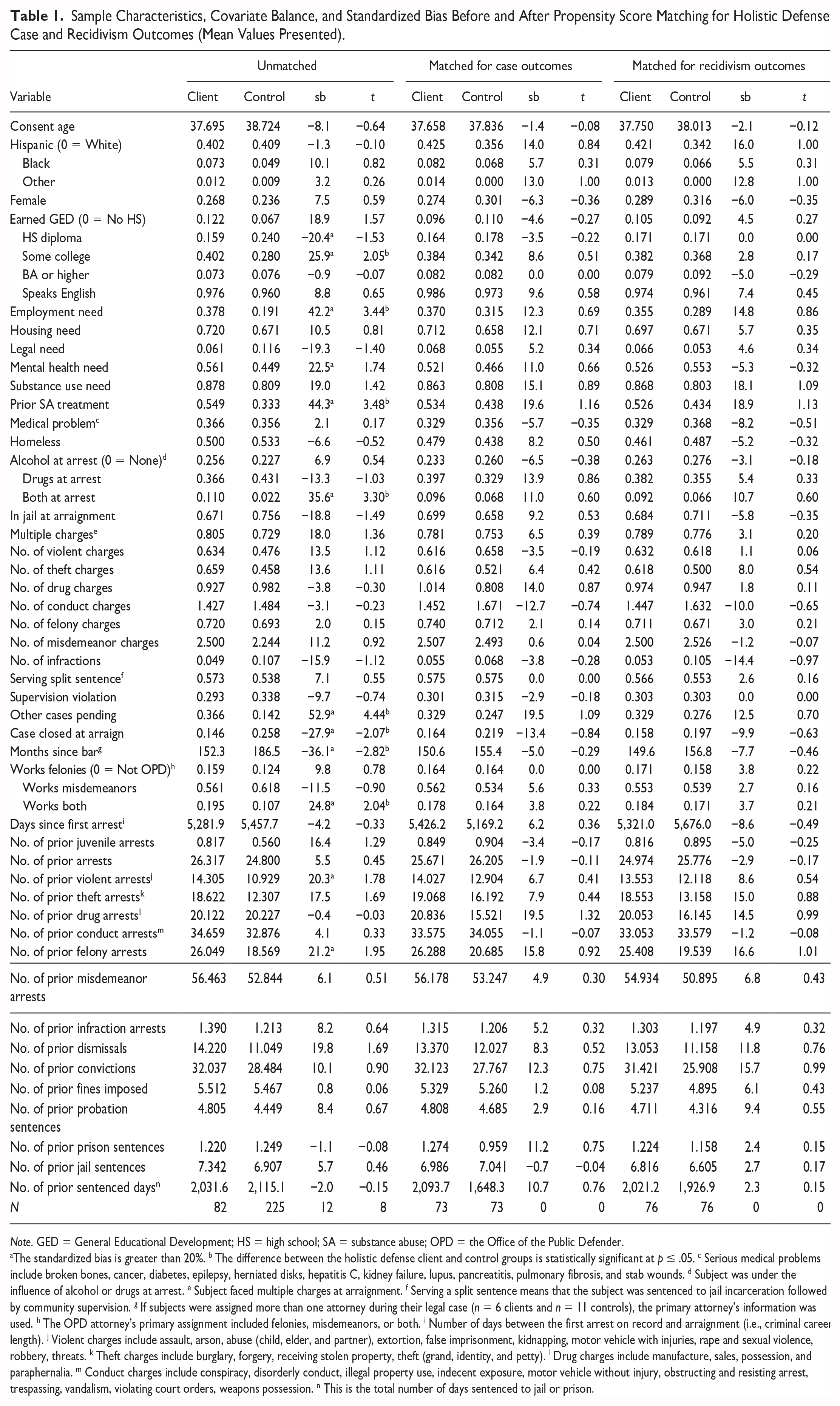
Not all subjects had complete intake data. I populated some missing data by referencing other fields on the intake form. 22 For holistic defense clients, I also leveraged the more extensive data collection from the interview. In addition, DOJ could not locate CORI for two holistic defense clients and 25 controls. To avoid excluding the clients, the project data specialist created CORI compatible criminal histories by searching the E-Defender and Odyssey databases. 23 The resultant recidivism outcomes sample includes 82 holistic defense clients and 225 controls with complete data, as shown in the first panel of Table 1.
Sample Characteristics, Covariate Balance, and Standardized Bias Before and After Propensity Score Matching for Holistic Defense Case and Recidivism Outcomes (Mean Values Presented).
Note. GED = General Educational Development; HS = high school; SA = substance abuse; OPD = the Office of the Public Defender.
The standardized bias is greater than 20%. b The difference between the holistic defense client and control groups is statistically significant at p ≤ .05. c Serious medical problems include broken bones, cancer, diabetes, epilepsy, herniated disks, hepatitis C, kidney failure, lupus, pancreatitis, pulmonary fibrosis, and stab wounds. d Subject was under the influence of alcohol or drugs at arrest. e Subject faced multiple charges at arraignment. f Serving a split sentence means that the subject was sentenced to jail incarceration followed by community supervision. g If subjects were assigned more than one attorney during their legal case (n = 6 clients and n = 11 controls), the primary attorney’s information was used. h The OPD attorney’s primary assignment included felonies, misdemeanors, or both. i Number of days between the first arrest on record and arraignment (i.e., criminal career length). j Violent charges include assault, arson, abuse (child, elder, and partner), extortion, false imprisonment, kidnapping, motor vehicle with injuries, rape and sexual violence, robbery, threats. k Theft charges include burglary, forgery, receiving stolen property, theft (grand, identity, and petty). l Drug charges include manufacture, sales, possession, and paraphernalia. m Conduct charges include conspiracy, disorderly conduct, illegal property use, indecent exposure, motor vehicle without injury, obstructing and resisting arrest, trespassing, vandalism, violating court orders, weapons possession. n This is the total number of days sentenced to jail or prison.
At enrollment, holistic defense clients and their control counterparts were an older justice-involved sample. On average, they were about 38 years old. The youngest holistic defense client was 19, whereas the oldest was 72. About one quarter of subjects in both groups were female. A little more than half of the subjects where White, 40% were Hispanic, and about 5% were Black. Their educational experiences varied widely. As is the case in most justice-involved samples, many had not completed high school. One quarter of clients and one third of controls did not graduate. However, 40% of clients and only 25% of controls had enrolled in college at some point (t = 2.05).
Eighty percent of subjects reported challenges in two or more focal life-course domains. The primary challenge reported by subjects in both groups was substance use: 87.8% of clients and 80.9% of controls reported a substance use need. Most subjects had received substance abuse treatment in the past and more than two thirds were under the influence of drugs or alcohol at the time of their arrest. About 70% of subjects also expressed a housing need. More than half (52.4%) were homeless. About half of all subjects also reported a mental illness at arraignment. Holistic defense clients were more likely than controls to report an employment need (37.8% vs. 19.1%, t = 3.44). Only about 10% of subjects reported noncriminal legal needs.
Many of the subjects were charged with serious crimes and the overwhelming majority had committed serious crimes in the past. About one third of subjects were charged with at least one felony. More than one quarter were arraigned on a violent charge. Twelve percent were arraigned on multiple violent charges. According to the CORI data, 80% of subjects had a prior violent arrest. About one third of subjects reported spending time in juvenile detention. One quarter had served at least one state prison sentence.
Criminal case and recidivism outcomes
I examine several criminal case and recidivism outcomes. The criminal case refers to the charges on which the subjects were arraigned when they enrolled in the study. Recently researchers have advocated exploring criminal case outcomes that reflect the relationship between arraigned and disposed charges and, more generally, nondichotomous outcomes (Johnson et al., 2016; Sweeten, 2012). I therefore create percent dismissed and percent guilty measures that capture how the number of arraigned charges in the denominator relates to the number of dismissed or guilty charges in the numerator. 24 On average, subjects are arraigned on 3.7 charges (SD = 2.9), 54.8% of which are found guilty and 32.9% of which are dismissed. I also examine the length of incarceration (in jail or prison) sentences in days, a measure that includes zeroes when subjects are not sentenced to incarceration. I then assess recidivism as measured by rearrest and rearraignment within 6 months. 25 Rearrest outcomes include any arrest in California; rearraignment outcomes include arraignments in Santa Barbara County only. All recidivism outcomes are binary: whether the subject was rearrested, rearrested for a felony, or rearrested for a violent offense, and whether the client was rearraigned on a new case or a new felony case. 26
Propensity Score and Postmatching Regression Analysis
I assessed whether holistic defense clients experienced improved case and recidivism outcomes relative to a control group constructed via propensity score matching (Rosenbaum & Rubin, 1983). I then applied outcome-appropriate regression techniques to the matched sample (Ho et al., 2007). Therefore, the analyses I present are intent to treat: The impact of holistic defense is determined relative to whether the subjects enrolled in the holistic defense program, not whether they engaged or how actively they engaged with the program.
In nonexperimental studies, propensity score matching can reduce bias in the estimated association between dependent and independent variables, in this case, recidivism and enrolling in holistic defense. Under the “unconfoundedness” assumption that omitted variables do not render holistic defense clients incomparable to controls, propensity score matching leads to causal inference. Holistic defense can be said to have caused increased or decreased recidivism. However, that assumption is difficult to meet and impossible to test (Apel & Sweeten, 2010; Loughran et al., 2015; Shadish, 2013).
Relative to regression analysis, propensity score matching has many advantages. Propensity score analysis can generally accommodate more control variables because collinearity is not a concern. Thus, the estimates may be less biased. Propensity score analysis also leads to more appropriate comparisons. Holistic defense clients who do not match to control subjects and vice versa can be excluded from the analysis.
Postmatching diagnostics assess the similarity of holistic defense clients to matched controls relative to the control variables. Mean differences between the two groups should not be statistically significant for more than 5% of control variables, and no more than 5% of control variables should exhibit standardized bias in excess of 20 (Apel & Sweeten, 2010). After matching and even when the observed covariates appear balanced, regression techniques can remove any residual covariate bias (Ho et al., 2007).
Finally, the robustness of the propensity score effect estimates can be assessed (Rosenbaum, 2002). The gamma statistic (Γ) indicates how large “hidden biases” (i.e., the collective influence of all omitted variables) would have to be to reverse the effect (Loughran et al., 2015). In typical applications, Γ, which is interpreted like an odds ratio, ranges from 1 to 2. Lower values (e.g., 1.3) suggest that a propensity score estimate might be easily negated, if less information were omitted. Only if Γ is relatively large should causal claims be made.
Modeling enrollment in holistic defense
My propensity score model accounts for the process by which public defender clients enrolled in the study as either holistic defense clients or controls (Apel & Sweeten, 2010). OPD attorneys recorded the inclusion criteria each subject met: focal life-course domain needs, primary language spoken, and current case and criminal history information. I include those variables and information about the professional experience and primary caseload of the attorney—factors that may influence their judgment about clients’ needs and their potential sentencing outcomes. I also include information about the subjects that may have influenced whether they agreed to enroll in the study: age, race, education, physical health, prior substance abuse treatment, substance use at arrest, custody status at arraignment, and whether the criminal case closed at arraignment. In all, 46 covariates factor into the propensity score model that matches holistic defense clients to appropriate controls.
I present two propensity score–matched models, one for recidivism outcomes (n = 82 clients) and one for case outcomes (n = 80 clients), as shown in Table 1. The sample sizes differ because some subjects’ criminal cases had not yet closed. I assess the quality of the matches by examining covariate balance and propensity score support. As a sensitivity analysis, I test for hidden bias. Finally, I apply regression techniques to the matched sample.
Results
After attempting several matching strategies using psmatch2 in STATA version 15.1, 27 I settled on a one-to-one, nearest neighbor, without replacement strategy that maximized covariate balance, minimized standardized bias, and matched the largest number of clients to controls. Prior to matching, eight of the 46 covariates (17.4%) were out of balance and 12 (26.1%) exhibited standardized bias. After matching for recidivism and case outcomes, all covariates were balanced and none exhibited standardized bias in excess of 20.0, as shown in Table 1.
That each covariate balanced and none exhibited bias beyond the standard threshold is encouraging. However, these pieces of information do not demonstrate that all potential sources of variation in the receipt of holistic defense have been controlled. Unobserved heterogeneity may yet complicate causal inference. For example, the standardized bias is near the threshold for prior substance abuse treatment, some prior criminal history variables, and pending cases at arraignment. Each of these biases suggests that holistic defense clients will receive harsher sentences and be more likely to recidivate than the controls.
The lack of support of the propensity score distribution also suggests the potential for hidden bias. Holistic defense clients and control group members met the same inclusion criteria. Yet comparison of the propensity score distributions for each group, presented in Figure 1, indicates substantial dissimilarity between the two groups with respect to their probability of receiving holistic defense. Controls have a far lower average probability of receiving holistic defense (36.5%, SD = 17.8) than the holistic defense clients (46.8%, SD = 24.8). In fact, six holistic defense clients (seven for case outcomes) cannot be matched to an appropriate control because so few control group members have propensity scores above 0.75.

Common support of the propensity score distribution for recidivism outcomes.
Examination of the covariate imbalances between the two groups before matching suggests why the groups are dissimilar. Prior to matching, holistic defense clients are more likely than controls to have reported employment and mental health problems. Although they are no more likely than controls to report a substance use problem, holistic defense clients are more likely to have been under the influence of both drugs and alcohol during their arrest and to have received substance use treatment in the past. Holistic defense clients have more serious criminal records that include more violent and felony charges. Holistic defense clients are also more likely to be facing other criminal cases and their cases are less likely to close at arraignment. Collectively, these differences suggest that, on average, holistic defense clients have more serious criminal histories, more recent interaction with the court system, and more immediate extralegal problems. Therefore, holistic defense clients may be better known to or have had more recent interactions with the attorneys making study inclusion decisions, which suggests over-enrollment in holistic defense of the people perceived to need it most. 28
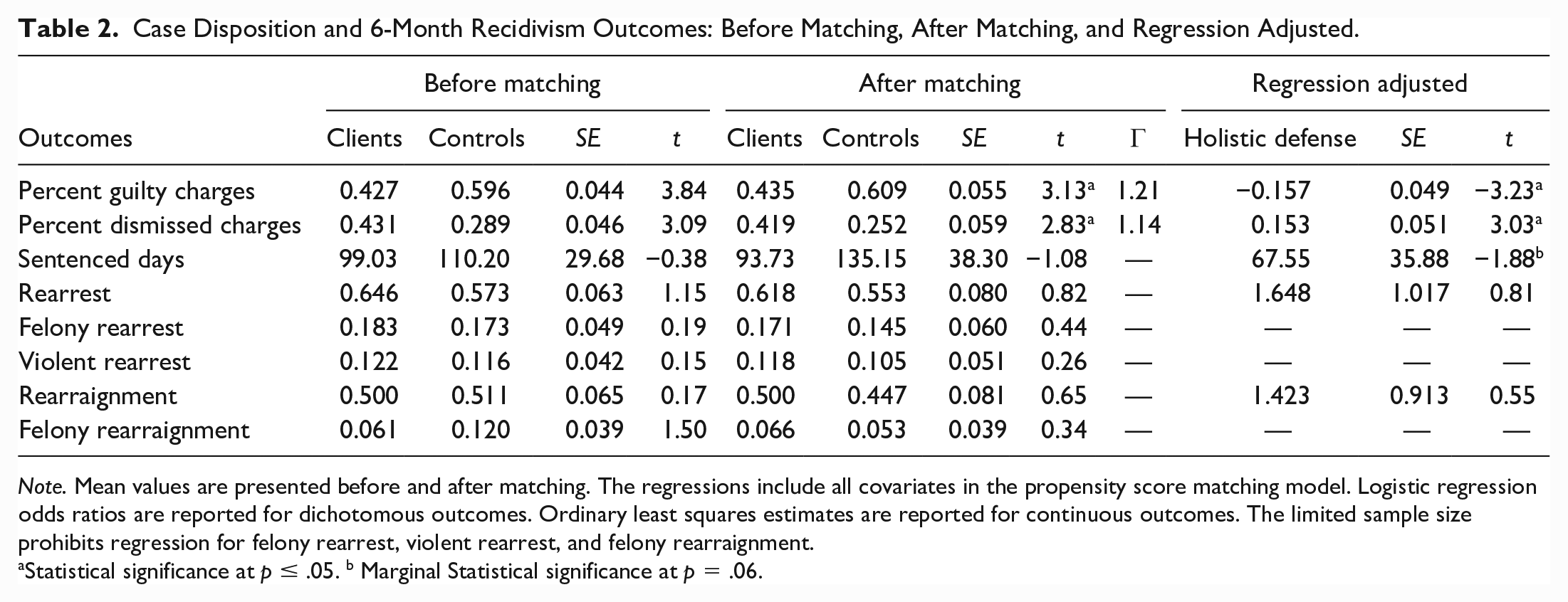
I present regression-adjusted criminal case and recidivism outcomes in Table 2. Holistic defense clients experience more favorable case outcomes and are no more likely to recidivate than controls. Put another way, holistic defense clients seem to have been punished less harshly than their control counterparts, yet public safety does not seem to have been negatively impacted. However, even these regression-adjusted results are likely susceptible to hidden bias.
Case Disposition and 6-Month Recidivism Outcomes: Before Matching, After Matching, and Regression Adjusted.
Note. Mean values are presented before and after matching. The regressions include all covariates in the propensity score matching model. Logistic regression odds ratios are reported for dichotomous outcomes. Ordinary least squares estimates are reported for continuous outcomes. The limited sample size prohibits regression for felony rearrest, violent rearrest, and felony rearraignment.
Statistical significance at p ≤ .05. b Marginal Statistical significance at p = .06.
Holistic defense clients saw a higher percentage their arraignment charges dismissed: 40.5% of the charges on which clients were arraigned were dismissed, whereas only 25.2% of the charges on which controls were arraigned were dismissed, a statistically significant (t = 3.03) difference of 15.3 percentage points. Likewise, holistic defense clients plead guilty to a lower percentage their arraignment charges. Holistic defense clients plead guilty to 42.3% of charges, whereas controls plead guilty to 60.9% of charges, a statistically significant (t = 3.23) difference of 15.7 percentage points.
Although the difference is only marginally statistically significant, holistic defense clients were sentenced to 67.5 fewer days of incarceration than their control counterparts (p = .06). Relative to the average sentence length of 135.1 days among controls, this represents a 50% decrease in the sentence lengths of the 48 holistic defense clients who were sentenced to incarceration. This result aligns with recent work in New York City that found that holistic defense reduced the length of incarceration sentences by 24%, saving the city US$165 million in incarceration costs (Anderson et al., 2019).
Savings were more modest in Santa Barbara because they are associated with the outcomes of a single legal case. Individuals incarcerated in the Santa Barbara County Jail serve approximately half of their sentence, at a cost of approximately US$160/bed/day (CGL Companies, 2015). Therefore the holistic defense pilot reduced the costs associated with incarcerating 48 holistic defense clients after a single legal case by approximately US$250,000, which exceeds the US$110,000 cost of providing holistic defense to 82 clients for 1 year. 29
The gamma statistics associated with the statistically significant case outcomes indicate that these findings should be interpreted cautiously, not causally. Loughran et al. (2015) described matched comparisons associated with Γ = 1.3 as “vulnerable to even small hidden biases capable of materially changing the substantive conclusion” (p. 643). Neither of the case outcome gamma statistics is that large. In addition, the regression adjusted outcomes are substantively similar to the propensity score–matched outcomes, suggesting that these hidden biases remain. I therefore also caution against attributing causality to those associations.
During the first 6 months after clients enrolled in holistic defense, there were no statistically significant differences between the holistic defense client and control groups in terms of the prevalence of rearrest, felony rearrest, or violent rearrest in California. Likewise, there were no statistically significant differences in the probability of rearraignment on new charges or new felony charges in Santa Barbara County. Thus, I conclude that holistic defense seems to be associated with improved criminal case outcomes for holistic defense clients relative to a propensity score–matched control group, which seems to have saved Santa Barbara County US$250,000 without negatively affecting public safety.
Discussion
Between February 1, 2017, and August 31, 2018, FSA and the OPD piloted holistic defense in Santa Barbara County. Relative to their control counterparts, holistic defense clients saw a higher percentage of their arraignment charges dismissed and they plead guilty to a lower percentage of them. Holistic defense clients were sentenced to approximately 1,500 fewer days of incarceration than controls, which saved Santa Barbara County approximately US$250,000 in incarceration costs. Six-month rearrest and rearraignment rates did not differ for holistic defense clients relative to controls.
Why Are the Santa Barbara Estimates Larger Than the New York Estimates?
In Santa Barbara, holistic defense was associated with improvements in case dispositions on the order of 15 percentage points and marginally associated with a 50% reduction in sentence lengths—double the New York estimates. Yet small hidden biases, such as in subjects’ willingness to change—to actively work to improve their outcomes—could have contributed to these differences. Although we required both clients and controls to express willingness to address their needs before consenting them into the study, holistic defense clients may have been more willing to change because they enrolled in the program and the study, whereas controls only consented to allow us to use their administrative data.
Unobserved willingness to change also may explain the difference in the magnitudes of the associations between holistic defense and sentence length outcomes in New York and Santa Barbara. Holistic defense in Santa Barbara was a targeted intervention offered to public defender clients with extralegal needs who expressed an upfront willingness to address those needs. The New York study was purely observational. Indigent defendants who were quasi-randomly assigned to the Bronx Defenders Model of holistic defense were treated as if they received holistic defense whether they engaged with holistic services or not—a de facto intent-to-treat analysis similar to our own. Although more than half of the Santa Barbara holistic defense clients either never engaged (n = 13) or engaged at a low level (n = 31) with the social worker, as volunteers their motivation to change may still have been stronger than that of the nonvoluntary Bronx Defenders clients. Thus, my findings support a “power few” argument: Voluntary clients of targeted holistic defense interventions may benefit more than nonvoluntary clients who receive holistic defense by default, even though both types of clients seem to benefit (Sherman, 2007). Future evaluations of holistic defense should explore how level of engagement—and the types of services clients receive—affects outcomes.
Why Did Case Outcomes Improve, Whereas Recidivism Outcomes Did Not?
Holistic defense clients may have been better advised than the controls about immediate actions they could take to address the focal concerns of the court so that the holistic defense team could secure better case outcomes. In fact, other evidence from the study suggests that the holistic defense clients were more effectively meeting their obligations to the court. Judges issued bench warrants for six of the 76 matched control subjects (7.9%), whereas they issued none for holistic defense clients (p = .03) even though the clients on average spent more time adjudicating their cases: 85.5 (SD = 12.0) days versus 53.5 (SD = 9.7) days (t = 2.07).
By contrast, desistance, which was measured imperfectly as reduced official justice involvement, is a process that takes time to unfold and that typically unfolds inconsistently. People often recidivate even as their lives stabilize in other life-course domains (Giordano et al., 2002; Harris & Harding, 2019; Paternoster & Bushway, 2009). The Santa Barbara Model of holistic defense was designed to serve clients throughout their longer term desistance processes. It is therefore unsurprising (although perhaps disappointing) that it was not associated with reductions in rearrest or rearraignment within 6 months. Future evaluations of holistic defense should consider planning for long-term follow-ups, such as Anderson et al.’s (2019).
If Holistic Defense Does Not Reduce Recidivism, Can It Reform Criminal Justice?
The potential benefits of improving case outcomes and reducing postconviction incarceration have more profound implications for criminal justice reform than a null impact on public safety. The collateral consequences of even short bouts of incarceration are well known. For the people who experience incarceration, they include reduced social support, decreased employment opportunities, lower wages, housing insecurity, civic disenfranchisement, and poor mental and physical health. These collateral consequences likewise extend to families and communities, degrading, for example, children’s school performance and health, the quality of romantic relationships, and communities’ political representation (Comfort, 2016; Kirk & Wakefield, 2018; Pinard & Thompson, 2005; Turney & Conner, 2019). Reducing individuals’ probability of being incarcerated—and of being incarcerated for extended periods—can ameliorate these far-reaching collateral consequences.
But convictions that do not lead to incarceration also incur collateral consequences. In particular, prior convictions can increase the chance that an accused person will be incarcerated before they are convicted of a crime. As states, including California, have sought to minimize or eliminate money bail as a means of making pretrial release or detention decisions, they have begun to use pretrial risk assessment instruments to inform decisions about who to release and who to detain. Many pretrial risk assessment instruments use information on past convictions to assign risk classification levels (e.g., low or high) to people. Those classifications are often translated directly into release or detention decisions (Harris et al., 2019).
If holistic defense reduces the chances of conviction—or even reduces the level of a conviction charge from felony to misdemeanor—it may also reduce at least one collateral consequence of conviction: the probability of being detained pretrial on any subsequent charges. Incarceration associated with pretrial detention leads to poorer criminal case outcomes, increased recidivism, and reduced employment (Dobbie et al., 2018; Heaton et al., 2017). Therefore, in concert with pretrial justice reforms, holistic defense has the potential to interrupt this chain of collateral consequences and to indirectly reduce recidivism.
Toward More Robust Holistic Defense Evaluations
Holistic defense is a long-term, client-centered, team-based, multidisciplinary, and community-oriented intervention intended to address client and community-based problems that have likewise developed over long periods. The results of this shorter term pilot study support the existing evidence that holistic defense has the potential to improve case outcomes and reduces incarceration. However, more robust evaluations can provide more information about how holistic defense affects these and other outcomes, such as life stabilization and desistance, and under what circumstances. Holistic defense evaluations can be made more robust by defining the specific holistic defense model clearly, determining how that model achieves its goals, and paying careful attention to measurement (Harris, 2018; Lee et al., 2014).
Improving criminal case outcomes: Timing and measurement
Improved criminal case outcomes take months, not days or weeks, to emerge. The average case in Santa Barbara took 2 to 3 months to resolve. Some cases remained ongoing after more than 1 year. After cases resolve, determining whether the outcomes were favorable then becomes the challenge. In court data, case outcomes are often limited to disposition and sentence, with little information about initial charges. How charges shift between arraignment and sentencing is lost (Piehl & Bushway, 2007). In an attempt to incorporate that information, I created measures that reflect the percentage of arraigned charges that are dismissed or to which clients plead guilty—a potential improvement over binary outcomes (Sweeten, 2012). However, in client-centered models, clients define optimal case outcomes—and their definitions may be at odds with “objective” court records (Steinberg, 2013). For example, court records do not indicate which defendants plead guilty to be released from pretrial detention (Heaton et al., 2017). Therefore, the court-sourced outcomes in this study may not reflect clients’ wishes. Overcoming this limitation in future research would require enhanced data collection either by the public defender or the courts.
Stabilizing lives and reducing recidivism: Timing and measurement
Stabilizing lives and reducing recidivism take even longer—on the order of years rather than months. 30 Many holistic defense clients’ lives have been decimated by intergenerational joblessness, physical abuse, mental health problems, persistent substance use, and prolonged justice involvement. Prior research indicates that people in such circumstances benefit from repeated interactions with reliable role models who support them as they reshape their lives to align with their shifting self-concepts (Giordano et al., 2002). This reality is often at odds with the fast pace of program evaluation and policymaking. However, even when stabilization and desistance processes remain incomplete, evidence that they are ongoing can be collected.
Collecting the data to measure intermediate and final outcomes is daunting for complex interventions like holistic defense. However, the challenges associated with determining what data to collect, collecting it, and interpreting it can be overcome (Lynch, 2018). Enrollment in social services and variation in utilization can be tracked at multiple stages (Heckman & Smith, 2004). For example, we were able to collect multisource data from the attorneys and social workers about their relationships and their work with holistic defense clients. We also collected data from social services providers on holistic defense clients’ referrals, enrollment, engagement, and life stabilization outcomes, such as reduced substance use, becoming housed, and finding employment. More robust future studies can collect and analyze similar data for all subjects.
Recidivism is perhaps the more complicated construct. Setting aside the confounding of offending with enforcement in criminal justice data, the more fundamental question of what should constitute recidivism remains. Even minor criminal justice contact might constitute recidivism because it suggests disregard for socially defined rules. But who those rules target and why should also be considered (Alexander, 2010). For example, when housing is unattainable, as was the case for half of our study subjects, should sleeping outside be illegal (Mitchell, 1997)? If addiction is a disease, which seems to have afflicted 87.8% of the holistic defense clients, should substance use be criminalized (Hora & Stalcup, 2008)? Providing multiple recidivism measures does not answer these fundamental questions, but it does allow policymakers to determine whether programs like holistic defense can meet their needs. Future work on holistic defense should consider whether all arrests should count as recidivism and whether holistic defense might reduce recidivism for some types of crimes, but not others (Anderson et al., 2019).
Understand the unique holistic defense model being evaluated
Holistic defense models differ in part because contexts differ. Some jurisdictions have public defender offices, whereas others provide indigent defense through private attorneys. Social service agencies whose services can be leveraged on behalf of the justice-involved are unevenly distributed (Hipp et al., 2010). Some communities have greater existing cohesion that public defenders can mobilize for the common good (Sampson et al., 1997). These and other persistent contextual differences suggest that holistic defense models will incorporate different elements of holistic defense differently. For example, the Santa Barbara Model reflects, but does not mirror, the Bronx Defenders Model upon which it was based.
One key way the Santa Barbara Model seems to differ from the Bronx Defenders Model is in the locus of change. Bronx Defenders attorneys, who have been practicing holistic defense for decades, have reported that holistic defense has transformed their practices such that they have become the primary change agents in their clients’ lives (Smyth, 2011; Steinberg, 2013). By contrast, in the Santa Barbara Model and other nascent holistic defense practices, the social worker is the primary change agent (Buchanan & Nooe, 2017). Brook Hisle and her colleagues (2012) in Maryland, for example, referred to social workers as the “heart” of holistic defense (p. 131). However, this may be because newer holistic defense models typically begin by integrating social workers onto legal teams, which highlights their contributions. Understanding whether the social worker or the attorney is the locus of change—and whether that locus shifts over time—will be critical to operationalizing the elements holistic defense, such as relationships between team members, which may affect clients’ outcomes. 31
Evaluate how holistic defense works
In observational studies, propensity score matching can provide critical information about the average intent-to-treat effect of holistic defense on clients’ outcomes. This information about whether holistic defense works is fundamental to assessing its effectiveness. However, propensity score matching is not an ideal strategy for determining how holistic defense works. Even the most robust propensity score model only models the process that enrolls people in holistic defense, and not how they progress through it. In addition, propensity score matching may not eliminate the hidden biases that contribute to real-world decisions about who receives programming and who does not. Even though they met the same inclusion criteria, holistic defense clients in Santa Barbara were 12.2 percentage points likelier to receive holistic defense than the controls.
Randomized controlled trials (RCTs) can reduce the chances of this type of manipulation. RCTs can also be designed to determine how and for whom holistic defense works. Mechanism evaluations provide information about how interventions work, which increases their generalizability (Ludwig et al., 2011). Mechanism evaluations of holistic defense could, for example, examine whether social support and role modeling help stabilize lives and reduce recidivism (Giordano et al., 2002). To do that, RCTs of holistic defense will need to account for the sources of variation in holistic defense interventions. For example, clients enter holistic defense with varied needs. Variation in the treatment they receive necessarily results and potentially deepens over time. One way treatment variation deepens is through differential engagement with the program, a problem not unique to holistic defense (Hamilton et al., 2018; Hawken, 2012). To understand whether and how holistic defense works for different types of clients who engage differently, researchers should consider analyzing experimental data with methods such as instrumental variables or local instrumental variables, which can estimate person-level effects under such circumstances (Angrist, 2006; Harris et al., 2018; Heckman & Vytlacil, 2005).
Finally, more appropriately evaluating programs like holistic defense, which seeks to promote life stabilization and desistance, requires statistical methods that accommodate the intermittent setbacks that characterize those processes (Maruna, 2001). Most people are rearrested. They relapse. They lose jobs. These setbacks do not necessarily indicate the end of desistance or life stabilization; they are part of the process. Although current theory indicates that these types of fits and starts characterize desistance processes, how to appropriately model them remains a challenge for future research (Paternoster & Bushway, 2009).
Footnotes
Acknowledgements
I am grateful to my project partners, Family Service Agency and the Santa Barbara County Office of the Public Defender, for overcoming barriers large and small to implement and evaluate holistic defense. I also thank Aaron Cicourel for introducing me to his daughter, Denise, without whom this project would never have happened. I am similarly indebted to David J. Harding for the guidance he provided throughout this project. The Laura and John Arnold Foundation (now Arnold Ventures) funded this work.
Declaration of Conflicting Interests
The author(s) declared no potential conflicts of interest with respect to the research, authorship, and/or publication of this article.
Funding
The author(s) disclosed receipt of the following financial support for the research, authorship, and/or publication of this article: This work was funded by the Laura and John Arnold Foundation.
