




Abstract
As the United States enters a decarceration era, the factors predicting reentry success have received a rapidly growing body of research attention. Numerous studies expand beyond individual-level attributes to assess the contextual effect of neighborhoods to which released prisoners return. However, past studies predominantly used neighborhood structural/economic characteristics as the proxies of neighborhood context, leaving the roles of community cohesion and disorder understudied in the context of reentry. Using longitudinal data, this study examines the influence of neighborhood cohesion and disorder on reentry outcomes, represented by released prisoners’ determination to desist and social isolation. The results of linear regression analyses show that net of the effects of individual-level risk factors, released prisoners’ perception of neighborhood disorder exhibit profound influence on reentry outcomes. Implications for reentry programming and interventions are presented.
Introduction
The U.S. “imprisonment binge”—a prolonged period of mass incarceration from the last two decades of the 20th century to the beginning of the 21st century—has led the United States to the top of the incarceration rankings compared with other industrialized and democratic nations (Pratt, 2009). While federal and state governments find themselves facing the heavy economic toll of housing large prison populations (Gartner et al., 2011), there is also an intimidating toll that mass incarceration takes on criminal justice–involved individuals. Past studies document various collateral damages of a criminal record, such as the blockage of access to education and housing support (Bushway, 2004; Travis, 2002), the rejection from family members (Austin & Irwin, 2001; Covington & Bloom, 2007; Liu & Visher, 2019; Travis et al., 2001), and the difficulty in securing a job (Visher et al., 2004; Western et al., 2001). Individuals re-entering society from prison face insurmountable hurdles to socially and financially survive (Liu et al., 2020; Myers & Olson, 2013; Western, 2018), and too often they are ensnared by the revolving door of prison. According to the recidivism report by the Bureau of Justice Statistics, nearly 60% of prisoners released to a term of community supervision returned to prison within 5 years (Markman et al., 2016). If the recent reentry failure data holds up, we can expect that nearly 360,000 out of the 600,000 former prisoners that reenter society each year will be reincarcerated within 5 years. How to best integrate former prisoners back into society is one of the most pressing issues for researchers, practitioners, and policymakers (Liu, Visher, O’Connell, 2020).
While the majority of reentry studies draw heavily from desistance theories (e.g., Farrington, 2001; Laub et al., 1998) or risk assessment models (e.g., Andrews, Bonta, & Hoge, 1990; Andrews et al., 2011) to identify released prisoners’ criminogenic needs, a relatively thinner line of research attention has been paid to the factors that go beyond individual attributes (Hipp et al., 2010; Kubrin & Stewart, 2006). The individual attributes—attitudes, education, job skills—only provide one dimension of factors that explain reentry failure. To provide a complete and comprehensive picture of reentry outcomes, it is imperative to address the conditions of the communities to which released prisoners return (Hipp et al., 2010; Kubrin & Stewart, 2006).
Among the extant integrative studies bridging neighborhood conditions and individual risk factors in evaluating reentry success, the majority of them used neighborhood economic characteristics (e.g., income and poverty rate) to represent community context (Hipp et al., 2010; Hipp & Yates, 2009; Kubrin & Stewart, 2006; Tillyer & Vose, 2011). This prism illustrates how the structural disadvantage and resource depletion of a neighborhood creates a difficult context for released prisoners to obtain access to employment opportunities and social services (Hipp et al., 2010, p. 953; Kubrin & Stewart, 2006, p. 166). For example, with limited access to community-based programs such as job training and substance abuse treatment, released prisoners fall victim to the “resource desert” environment and are at high risk to experience varied aspects of reintegration failure.
Another primary prism that is derived from the social disorganization perspective is that community-level informal social control inhibits crime and deviance in a neighborhood (Bursik & Grasmick, 1993; Sampson et al., 1997). A community, similar to other social institutions such as family and church, undertakes the function of social control. With strong networks and social cohesion, neighbors can collectively achieve better results on a range of social issues (Liu, 2020a; Sampson, 1999; Sampson et al., 1997, 1999; Sampson & Wikström, 2008). Crimes are discouraged when a community is cohesive and residents share a perception that neighbors will intervene to solve community problems (Liu, 2020b). Until now the concept of community cohesion has yet to be fully extended to the examination of individuals’ reentry outcomes (see review by Morenoff & Harding, 2014). To some extent, this research work has yet to be conducted because of the difficulty and expense of collecting the relevant data. Information on neighborhood cohesion is not available from public records such as the U.S. Census. Such data requires a reentry study that captures both released prisoners’ individual-level risk factors and measures of their neighborhood cohesion.
This study addresses the aforementioned literature gaps by illustrating how released prisoners’ perceived community social cohesion is connected to reentry outcomes. In addition, we use a wider scope of individual-level risk factors than past integrative studies. The effects of a limited range of individual-level risk factors—demographic factors and prior records—were controlled in previous integrative studies (for an exception, see Tillyer & Vose, 2011). The omission of salient individual risk factors in the model renders the results on neighborhood contextual influence less robust. Drawing insights from the risk–need–responsivity (RNR) model that was developed by Andrew and his colleagues (Andrews & Bonta, 2010; Andrews et al., 1990), we include individual risk factors that are illustrated by the RNR model such as family relationships, antisocial attitudes and values, and financial difficulty (Andrews et al., 1990). Finally, past reentry studies predominantly treated re-arrests or reincarceration as proxies of reentry outcomes. However, individual social isolation (Blevins et al., 2010; Jiang & Winfree, 2006; Listwan et al., 2013) and unreadiness to give up an offender identity (Bushway & Paternoster, 2013; Giordano et al., 2002; Paternoster & Bushway, 2009)—two other consequential markers of reentry failure—have received limited attention. It is largely unknown how reentry risk factors can shape these markers during people’s transition from prison to the community. In this study, we focus on predicting social isolation and respondents’ determination to desist by regressing these outcomes on predictors that may be modified through intervention.
We use released prisoners’ self-reported measurements of neighborhood cohesion and disorder to capture their neighborhood context rather than structural measurements such as the area poverty rate. This methodological approach is quite different from that used in other social disorganization studies in which objective, aggregated measures of household income and employment rate are used to capture community context, yet is uniquely suited to answer the current research questions. The reentry experiences of individuals should be understood based on their subjective cognition of social circumstances (Agnew, 1992; Merton, 1938). Perceived neighborhood conditions have proved to be relevant in understanding individual residents’ various aspects of well-being (Duncan et al., 2002; Frye, 2007; Lenzi et al., 2012; Wickes et al., 2013). Given that our analysis focuses on individual respondents’ reentry outcomes, their perceived community context can legitimately shed light on how this contextual influence affects reentry outcomes.
Literature Review
Extending Social Disorganization Perspective to the Examination of Reentry
People’s behaviors are affected by the environment of their communities (Bursik & Grasmick, 1993; Sampson, 2012; Sampson et al., 1997). To capture the neighborhood contextual influences on individuals’ reentry and reintegration outcomes, researchers mainly draw insights from the social disorganization perspective to conduct studies. There has been a growing body of integrative studies that aim to capture the confluence of contextual and individual risk factors on reentry outcomes (Chamberlain & Wallace, 2016; Hipp et al., 2010; Huebner et al., 2007; Kubrin & Stewart, 2006; Tillyer & Vose, 2011; Wehrman, 2010), which can be categorized into two camps. One camp assesses the effects of neighborhood structural characteristics on reentry outcomes, whereas the other, instead of using structural measures, draws insights from the neighborhood cohesion and collective efficacy perspective (Sampson et al., 1997) and tests the social processual aspect of neighborhood—how neighborhood cohesion and networks affect individuals’ reentry outcomes.
Accordingly, two distinct sets of measures on neighborhood conditions are used by the two camps of studies. The structural camp uses structural indicators such as poverty and unemployment to predict reentry outcomes, based on the rationale that neighborhoods with structural advantages provide resources to released prisoners to successfully reintegrate into society (e.g., Hipp et al., 2010; Kubrin & Stewart, 2006). Released prisoners who want to find a job and fulfill parole requirements can benefit from a high neighborhood employment rate and a well-maintained institutional structure of public transportation in a neighborhood.
In contrast, the processual camp highlights the crime-buffering function of social cohesion—a non-structural community context that reflects people’s informal interactions, networks, and community sentiment (Cancino, 2005; Clear, 2008; Clear et al., 2001; Sampson, 2004; Sampson et al., 1997, 1999). Researchers underscore that structural characteristics are not the only predictors of crime and delinquency; the non-structural aspect of community context is also relevant to understanding crime. Neighborhood cohesion and collective efficacy buffer crime (Sampson et al., 1997, 1999). Individuals can experience fear of crime, vandalism, and drugs in their neighborhoods. However, when residents have mutually supportive bonds, they can exert collective efficacy to change the threatening environment by taking care of their houses and apartments and intervening when seeing incivilities (Sampson et al., 1997, 1999). Conversely, when social cohesion is destroyed in a community, crime follows (Clear, 1996, 2008; Clear et al., 2001). Clear and his colleagues found that the social cohesion of urban communities collapsed after the incarceration of a large number of residents. Coercively removing males from a community undermined its social control capacity, destabilized the area, and destroyed neighbors’ networks. The results were a subsequent increase of female-headed households, insufficient supervision for youth, and soaring crime rates (Clear, 1996, 2008).
Community cohesion buffers crime. However, the question remains whether it facilitates released prisoners’ reintegration. It is probable that when released prisoners return to communities with limited resources of public transportation or employment centers, they draw strength from the cohesiveness of their communities to minimize the risk of reentry failure.
First, those who return to a cohesive community may have an easier time building relationships, engaging in civic activity, and developing a feeling of connectedness to the community. The bond to the community could motivate former prisoners to be committed to a conventional, pro-social life. Second, with the networks and ties with neighbors, released prisoners can receive neighbors’ help and support in various aspects of life such as being introduced to a job or help with childcare while they go to work. Finally, released prisoners can be deterred from engaging in wayward behaviors because a deviant behavior will soon be known to the community as the networks enable neighbors to efficiently pass information onto each other.
Examining empirical studies on individuals’ criminal behaviors that used the perspectives of these two camps, mixed findings emerged. From the structural camp, some empirical studies found significant effects of neighborhood structural factors on reentry outcomes (Chamberlain & Wallace, 2016; Hipp et al., 2010; Huebner et al., 2007; Kubrin & Stewart, 2006) while others found a null effect (Tillyer & Vose, 2011; Wehrman, 2010). For example, Kubrin and Stewart found that structural disadvantages of a neighborhood such as poverty and unemployment rate could explain recidivism over and beyond individual-level factors. In contrast, in Tillyer and Vose’s analysis, none of the community structural factors exhibited significant influence on residents’ recidivism when individual-level variables were adjusted (Tillyer & Vose, 2011).
From the second camp, there has been a handful of tests on the relationship between perceived neighborhood cohesion and individuals’ delinquent behaviors; however, when it comes to predicting reentry outcomes, little research from this framework has been conducted. Thus, we draw upon extant studies of perceived community cohesion and youth delinquency. Mixed results merged from these tests (Cohen et al., 2000; Lanctot & Smith, 2001; Simons et al., 2004; South & Baumer, 2001). For example, one study found that perceived neighborhood disorder significantly and positively affected residents’ drug use, whereas perceived neighborhood cohesion inhibited this type of delinquency (Lin et al., 2012). Nonetheless, from another study, perceived neighborhood cohesion did not affect residents’ willingness to enact informal intervention for intimate partner violence (Frye, 2007). The divergent results of neighborhood cohesion might be attributed to the disparate outcomes researchers focused on or diverse samples of neighborhoods and offenders they used.
Individual Risk Factors in Reentry: The Criminogenic Needs From RNR Model
The RNR model of rehabilitation is a theoretical framework that outlines both the central causes of persistent criminal behavior and principles for reducing engagement in crime. This model illustrates three components: causes/risks for persistent offending behavior, goals to neutralize these risks, and implementation of interventions. First, offenders’ risks for crime vary. Second, their heterogeneity of risks requires correction agencies to develop different levels and focuses for treatments. Finally, intervention programs should be matched to offender characteristics such as learning style, level of motivation, and other life circumstances. In this study, we draw insights from RNR’s first dimension of component—risk—to identify the risk factors that are proposed to undermine released prisoners’ successful reintegration.
Andrews and Bonta (1998) present a set of “risk/need” factors which are related to one’s likelihood to continue offending. The broad risk factors include antisocial attitudes and associates, antisocial temperament, and a history of criminal and antisocial behavior. Moderate risk factors include family circumstances (Liu, Miller, Qiu, & Sun, 2020; Liu, Sun, & Lin, 2019), education/employment circumstances (Jin et al., 2020; Liu & Miller, 2020), recreation, and substance abuse (Visher et al., 2019). The order from broad to moderate is based on meta-analytic results (Andrews & Bonta, 1998). In the current analysis, we primarily investigate whether three out of the “Central Eight” needs (Andrews et al., 2011)—family relationship, financial circumstance, and deviant values—are related to reentry outcomes. In addition, because respondents’ education level was assessed in our model as a control variable, the current analysis will lend insight on the effect of education on reentry outcomes.
Family can provide much-needed pro-social ties (Liu, Miller, & Visher, 2020; McKiernan et al., 2013; Naser & La Vigne, 2006; Phillips & Lindsay, 2011), help offenders reestablish themselves in society (Uggen et al., 2004), and offer a level of supervision and accountability for an offender (Western et al., 2015). However, many individuals face severe difficulty in reestablishing broken family ties when reentering the community (e.g., Liu & Visher, 2019; Travis, 2005). By using qualitative interviews, Breese and colleagues (2000) found that some respondents were treated like the “black sheep” of the family (p. 14) when they came home. For other respondents, their families had moved away from the area during their incarceration. After their reincarceration, they placed considerable blame on the lack of familial support for their post-release failure (Breese et al., 2000). Meanwhile, studies also revealed that for those whose families were willing to face reentry challenges with them together, family support and bonding did exert a salient protective effect against reentry failure (Shapiro & Schwartz, 2001).
Moving onto the second criminogenic risk factor informed by the RNR model—financial difficulty, it is another salient hurdle for released prisoners when they strive for a pro-social life (Andrews et al., 2011). Financial survival and independence can lower an individual’s likelihood of recidivism because it neutralizes the financial strain and thus inhibits the risk of seeking illegitimate income (Bushway & Apel, 2012). Accordingly, community programs can strengthen job readiness for former prisoners to hasten their desistance (Drake et al., 2009). In a study evaluating the Center for Employment Opportunities (CEO)—an employment-based reentry program, researchers found that CEO program completers had much better employment outcomes than CEO non-completers (Redcross et al., 2009). For example, only 9% of the CEO completers had no formal employment in the first 2 years after release, whereas 45% of the CEO non-completers had no formal employment in that period (Redcross et al., 2009). In another study, researchers compared the effects of instrumental (e.g., providing housing and transportation), interactional (e.g., providing guidance and support), and emotional (e.g., providing love and belongingness) support released prisoners received (Mowen et al., 2019). They found that only instrumental support exerted a significant and inhibitive effect on reentry failures. Neither interacting with family nor family’s emotional support achieved a significant effect (Mowen et al., 2019).
Switching to the last dimension of individual criminogenic risk/need in this study—deviance values—a handful of studies assessed its role in reentry outcomes (Fagan & Piquero, 2007; Skilling & Sorge, 2014). If an individual’s values coincide with the law, they are more likely to cooperate with the law (Gibson et al., 2010). Reentry studies documented that “legal cynicism” placed released prisoners at a high risk of reentry failure in both youth (Fagan & Piquero, 2007; Soller et al., 2014) and adult samples (Skilling & Sorge, 2014; Smith et al., 2012; Walters & Lowenkamp, 2016). Walters and Lowenkamp (2016) created the Psychological Inventory of Criminal Thinking Styles (PICTS) as an instrument that used antisocial values to predict reentry outcomes. Antisocial cognition was found to predict recidivism among both males and females (Walters & Lowenkamp, 2016). In another study, researchers found Effective Practices in Community Supervision, a program that focused on challenging and diminishing the antisocial attitudes of offenders, significantly decreased recidivism among justice-involved adults (Smith et al., 2012).
While the literature above has added a great deal to what we know, most research examined perceived neighborhood cohesion and individual-level criminogenic needs separately; limited efforts have been made to test these two dimensions of factors simultaneously in predicting reentry outcomes. Meanwhile, as we noted above, social isolation (Blevins et al., 2010; Listwan et al., 2013) and individual’s willingness to sever a criminal past (Bushway & Paternoster, 2013) are consequential markers of reentry success. Nonetheless, it is largely unknown how contextual factors and individual criminogenic needs jointly affect these two reentry outcomes.
In an effort to fill these literature gaps, we analyze data from Returning Home: Understanding the Challenges of Prisoner Reentry, a multistate, longitudinal study that was conducted by the Urban Institute from 2002 to 2005 (Visher et al., 2003). In the original study, researchers focused on the effects of family bonds, financial difficulty, and substance use on reentry outcomes. In the current analysis, we examine how respondents’ perceived neighborhood conditions as well as individual-level criminogenic needs were related to reentry failure. Figure 1 presents a framework that is used to guide this research. Based on the social disorganization and RNR theoretical propositions, we hypothesize that neighborhood cohesion exhibits a negative effect while neighborhood disorder exhibits a positive effect on respondents’ social isolation and willingness to continue an offender lifestyle. Furthermore, financial difficulty, attenuation of family relationships, and legal cynicism should exhibit positive effects on these two outcomes.
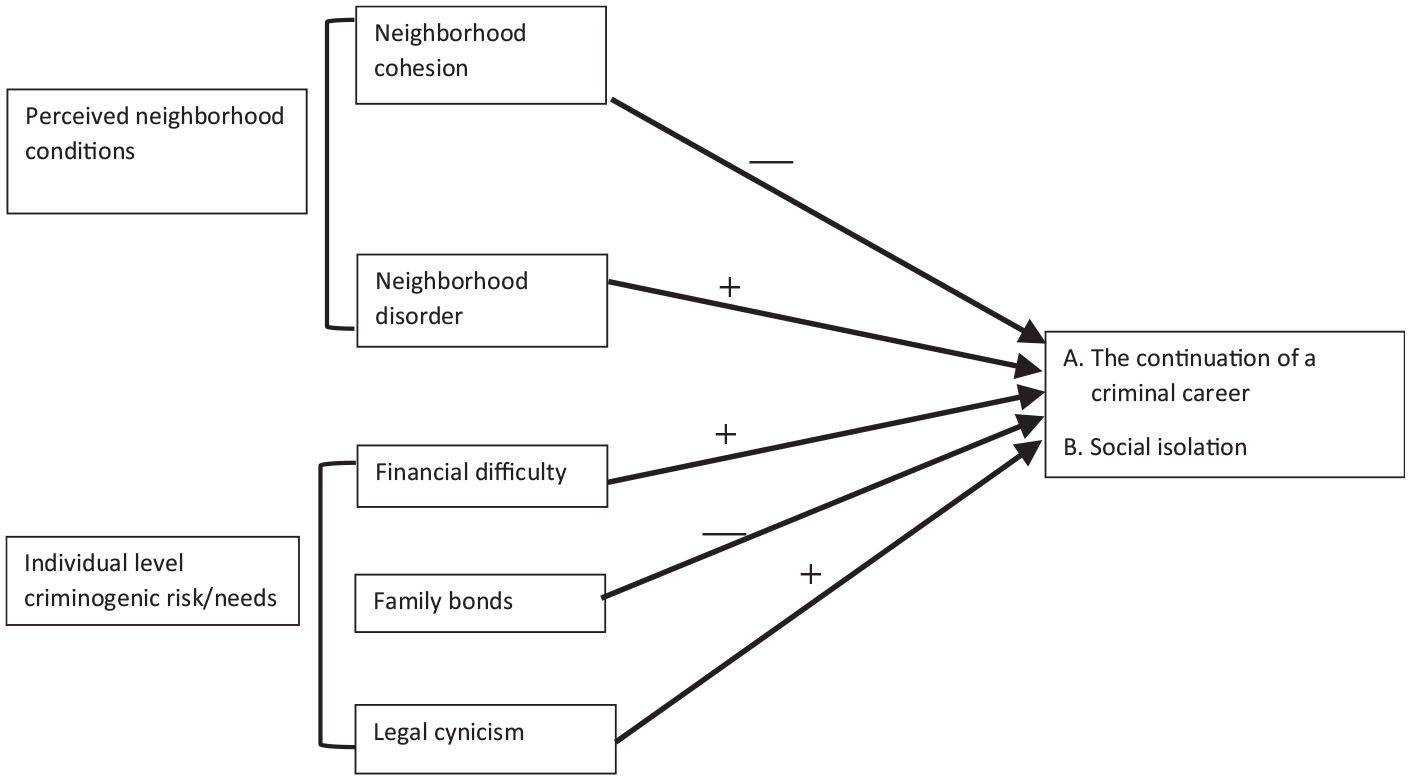
Integrative model on reentry outcomes.
Method
Data
From 2002 to 2005, researchers from the Returning Home study identified prisoners serving at least 1 year in state prisons of Ohio, Illinois, and Texas who returned to Cleveland, Chicago, and Houston, respectively. Potential respondents were identified either through compulsory prerelease programs where prisoners were already convened (Illinois and Texas) or from lists of individuals who were within 60 days of release (Ohio). The Ohio and Illinois cohorts consisted of male respondents while the Texas cohort was a mixed-gender sample. A member of the research team provided an overview of the study and details of informed consent to assembled groups of potential respondents. Individuals who agreed to participate (more than 80%) were given consent forms and asked to complete a self-administered survey. The samples of prisoners in each state were generally representative of all the prisoners being released to the study areas in the previous year in terms of race, sentence length, and time served.
After each prisoner’s release, experienced interviewers conducted two personal interviews within 12 months, which included interviews with those who had returned to prison. Individuals were paid US$25 for each interview. Information about respondents’ experiences after release such as family bonds, financial stress, social isolation, and determination to refrain from crime was collected. The current analyses utilized the data from the prerelease survey (T1 survey) and the two post-release interviews (T2 and T3 interviews, respectively). Questions about neighborhood disorder were only asked during the second interview. We used individual characteristics (from T1 survey) and initial reentry experiences (from T2 interview) to predict reentry outcomes at the last interview. The sample used in this study consists of 740 male respondents from the three states 1 who participated in all three waves of studies. We noticed some missed values in our data; 27 of the 740 cases had some missing values on the variables to be used. Because the observations were missing at random, we used SAS PROC MI procedure, a multiple imputation procedure (Little & Rubin, 2002), to impute the missing values. Following past practices (Nix & Wolfe, 2016), we created 20 imputed datasets and analyzed each imputed data set separately. Then we pooled results across imputed datasets using Rubin’s (1987) rules to yield a final single set of estimates.
Measures
Dependent variables
T3 determination to desist
This measure of reentry success was assessed with three questions assessing their self-reported likelihood to reoffend. The first question asked, “If you thought you could do it without getting caught, how likely you would commit a crime in the next six months?” The responses were on a Likert-type scale ranging from (1) very likely to (4) very unlikely. The second question asked, “how easy or hard it has been for you to not commit crimes?” and the third question asked, “how easy or hard it has been for you to stay out of prison?” The responses for these two questions were on a Likert-type scale ranging from (1) very hard to (4) very easy. Confirmatory factor analysis (CFA) verified the unidimensionality of the three items (Appendix). There was only one factor with an eigenvalue larger than one and all three items loaded relatively strongly onto this factor. Standardized factor scores were used to construct the value of T3 determination to desist.
T3 social isolation
Social isolation is assessed by three Likert-type-scale questions asking about respondents’ agreement with the statements: (1) It is difficult to be socially accepted again after imprisonment, (2) It is difficult to renew relationships with old friends, and (3) I feel I am of little importance to other people. The answers ranged from (1) strongly disagree to (4) strongly agree. CFA verified the unidimensionality of the items and standardized factor scores were used to construct its value (Appendix).
Independent variables
T2 post-release financial difficulty
This variable was assessed with three questions asking the respondents how hard it was to make enough money to support themselves, find and keep a job, and pay off debts. The answers ranged from (1) very easy to (4) very hard. CFA verified the unidimensionality of the items and standardized factor scores were used to create financial difficulty (Appendix).
T2 post-release family support
Post-released family support was created adaptively from the scale for family support from the Medical Outcomes Study Social Support Survey (Sherbourne & Stewart, 1991). It was assessed with three questions asking whether the respondent agreed he had someone in the family to get together with to relax, to do something enjoyable with, and to spend time with to help him get his mind off things. Answers ranged from (1) strongly disagree to (4) strongly agree. CFA verified the unidimensionality of this construct and standardized factor scores were used to create family support (Appendix).
T1 legal cynicism
We used Sampson and Bartusch’s (1998) legal cynicism scale, in which legal cynicism was measured by five items asking about respondents’ agreement on the statements: (1) Laws are made to be broken; (2) It’s okay to do anything you want as long as you don’t hurt anyone; (3) To make money, there are no right and wrong ways, only easy and hard ways; (4) Fighting between friends or within families is nobody else’s business; and (5) Nowadays a person has to live pretty much for today and let tomorrow take care of itself. The answers ranged from (1) strongly disagree to (4) strongly agree. CFA test results confirmed the unidimensionality of this construct and standardized factor scores were used to calculate legal cynicism (Appendix).
Respondents’ perception of neighborhood cohesion 2
We used the construct of neighborhood cohesion developed by the Urban Institute (Lynch & Sabol, 2001). This variable was a composite constructed from four items about respondents’ perception of their neighborhood social cohesion. The items asked the magnitude of respondents’ agreement with the statements: (1) You think your neighborhood is a good place for you to live; (2) You care about what your neighbors think of your actions; (3) If there is a problem in your neighborhood, people who live there can get it solved; and (4) You expect to live in this neighborhood for a long time. Likert-type-scale response categories ranged from (1) strongly disagree to (4) strongly agree. Reliability test results showed that this construct was internally consistent (Cronbach’s alpha = .74).
Respondents’ perception of neighborhood disorder
This construct was also developed by the Urban Institute (Lynch & Sabol, 2001). It was a composite based on five items. The items assessed the magnitude of respondents’ agreement with the statements: (1) Your neighborhood is a safe place to live, (2) It is hard to stay out of trouble in your neighborhood, (3) You are nervous about seeing certain people in your neighborhood, (4) Drug selling is a major problem in your neighborhood, and (5) Living in this neighborhood makes it hard for you to stay out of prison. The answers ranged from (1) strongly disagree to (4) strongly agree. We recoded the first item so that a higher score indicated a higher level of disorder respondents perceived about their community. Reliability test results showed that this construct was internally consistent (Cronbach’s alpha = .81).
Control variables
We included control variables widely used in reentry studies, which include T1 age, T1 race (1 = White, 2 = Black, 3 = other), T1 prior prison terms, the number of prior incarcerations respondents reported (ranged from 0, 0 = prior prison term, to 6, 6 = prior prison terms or more), and T1 education attainment (1 = 6th grade or less, 2 = 7th to 9th grade, 3 = 10th to 11th grade, 4 = high school grade, 5 = GED, 6 = some college, 7 = college graduate, 8 = post-graduate study).
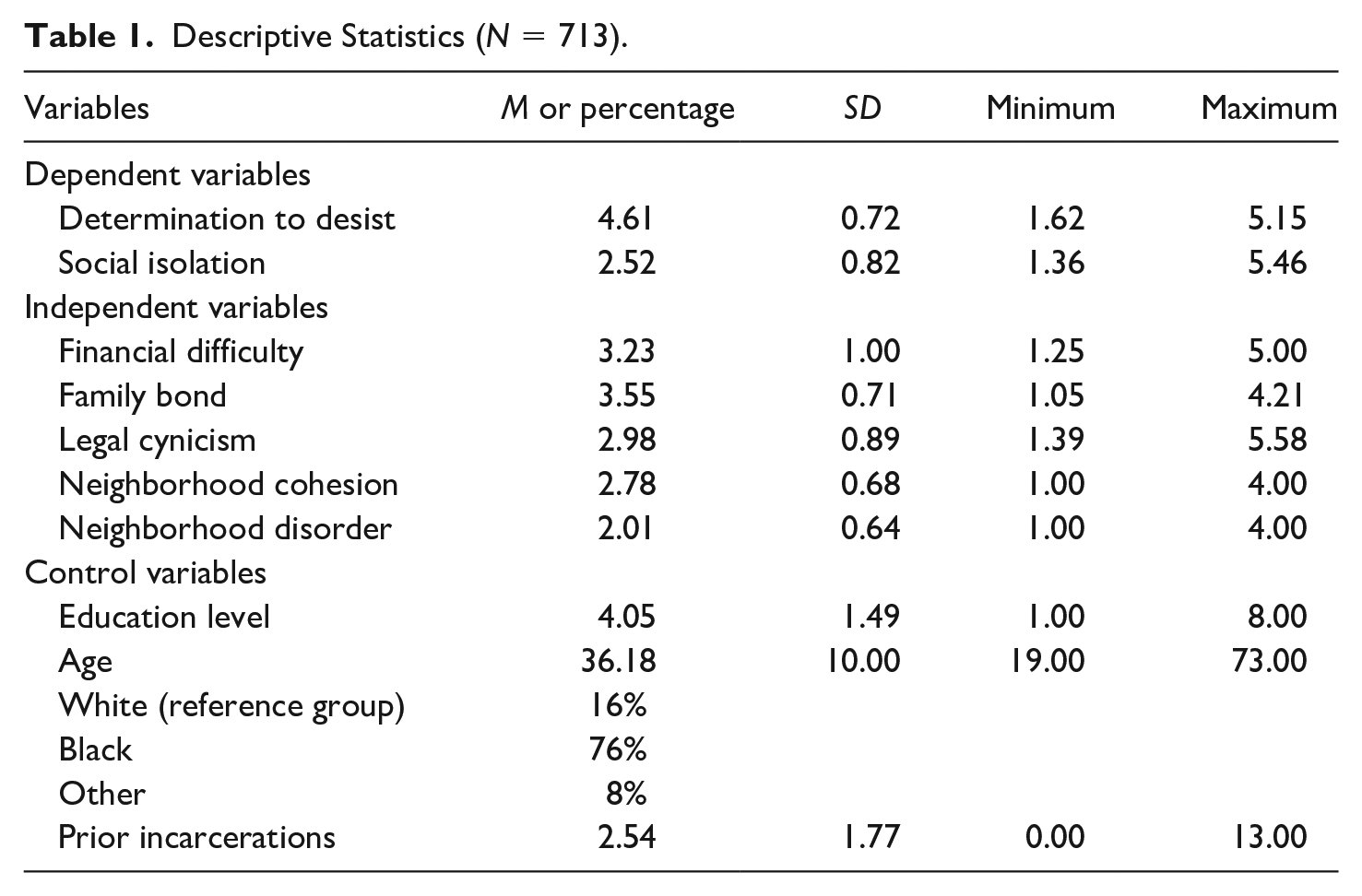
Table 1 reports the descriptive statistics for all variables used in the regression analysis. The average age of the respondents was 36 years, and their prior incarcerations ranged from 0 to 13. About 76% of them were African American while nearly 16% of them were White. On a scale from 1 to 4, the neighborhoods to which respondents returned had an average disorder level of 2. Similarly, on a scale of 1 to 4, their neighborhoods had an average social cohesion level of 2.78. Table 2 presents a correlation matrix for all the variables included in the analysis. In line with the propositions of social disorganization, neighborhood disorder appeared to be negatively correlated with neighborhood cohesion. Respondents who perceived cohesion in their communities were less likely to report disorder issues. The variables that were also correlated with neighborhood disorder were determination to desist and social isolation; those who reported disorder issues in their communities were more willing to continue an offender lifestyle and more likely to experience social isolation. To examine whether multicollinearity was an issue in the analysis, we obtained the variance inflation factor (VIF) scores of the variables in the model. The highest value was 1.15, much lower than the generally accepted limit (Neter et al., 1996). Thus, multicollinearity was not a concern in this analysis.
Descriptive Statistics (N = 713).
Correlation Matrix.

Results
Because our outcome variables were latent factors that were naturally numeric variables, we used linear regression in our analysis. Furthermore, we adopted a stepwise examination to explore the effects of different clusters of predictors: static measures (age, race, education, and prior incarcerations), criminogenic needs from the RNR model (financial difficulty, family bonds, and legal cynicism), and perceived neighborhood cohesion and disorder. This stepwise structure of assessment can illustrate how much more variation in the outcome variables is explained by adding additional predictors to the model.
The results of the linear regression analysis on two reentry outcomes are illustrated in Table 3, with the first three models predicting released prisoners’ determination to desist and the latter three models predicting their social isolation. In Model 1 (Table 3), age and prior incarceration significantly affected one’s determination to desist. Older released prisoners were less likely to continue an offender lifestyle compared to their younger counterparts (b = .02). In contrast, those with more prior incarcerations demonstrated a stronger determination to keep an offender lifestyle (b = −.08). Neither education attainment nor race achieved a significant effect in the model. Proceeding to Model 2 (Table 3), three criminogenic needs from the RNR model were added to the model and they all exerted significant influence on respondents’ determination to sever a criminal past. Financial difficulty predicted an increase in one’s wiliness to keep an offender’s lifestyle. In contrast, family bonds protected released prisoners when it comes to severing a criminal past. A one-unit increase in the strength of family bonds aided in a decrease in the determination to desist by 0.14 units. Finally, legal cynicism emerged as a risk factor for reentry. Respondents who had little respect to or trust in authorities were found to demonstrate a weaker determination to desist. Across the standardized effects of these three variables, family bonds held the strongest influence on one’s determination to desist (B = .19).
Linear Regression Results on Reentry Outcomes.
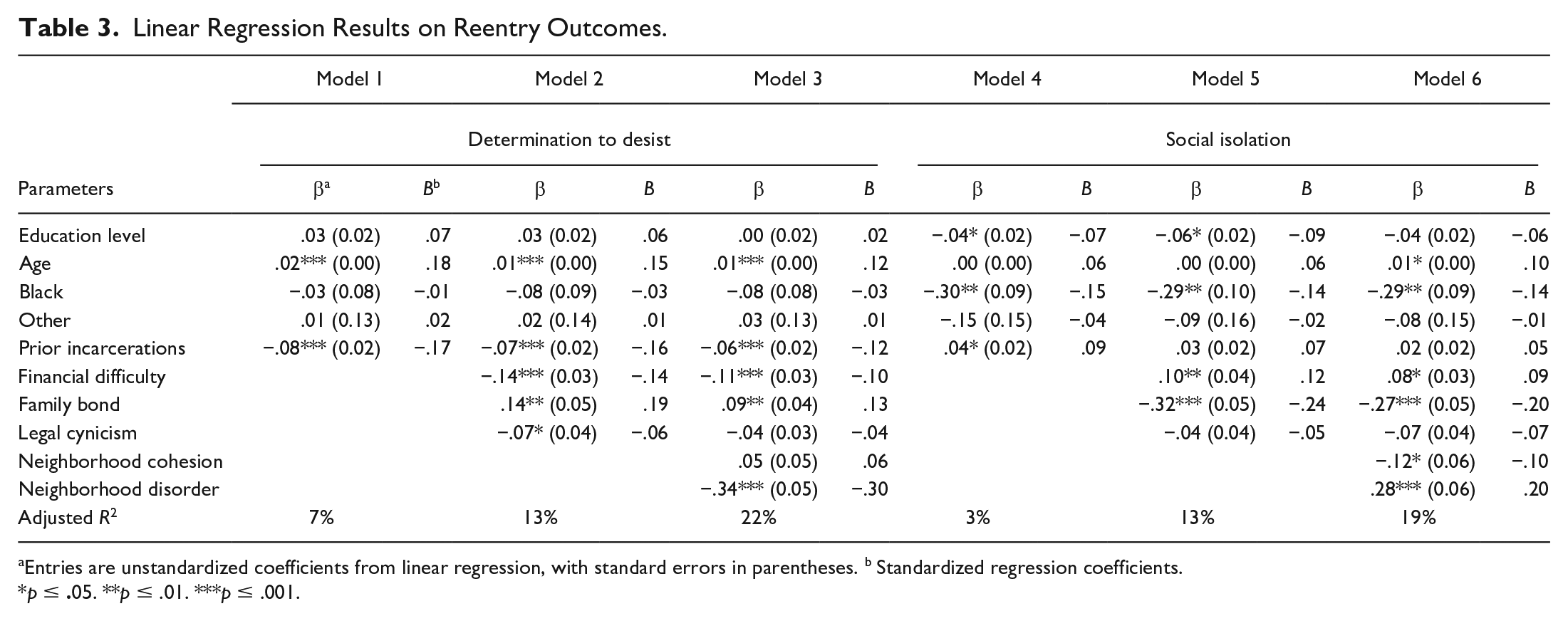
Entries are unstandardized coefficients from linear regression, with standard errors in parentheses. b Standardized regression coefficients.
p ≤ .05. **p ≤ .01. ***p ≤ .001.
In Model 3 (Table 3), we introduced the two predictors representing respondents’ perceptions of their neighborhood conditions. We found that neighborhood disorder but not cohesion emerged as a significant predictor of respondents’ determination to desist. Those who reported a higher level of neighborhood disorder also reported less willingness to desist; they perceive themselves to be more likely to commit another crime and experience another incarceration. Comparing all the standardized coefficients of the predictors in the model, neighborhood disorder had the strongest predictive power (B = .30), with a commanding large margin—more than two times larger than the predictor that yielded the second largest effect (family bonds, B = −.13). An increase of one standard deviation in neighborhood disorder aided in a 0.30 standard deviation decrease in respondents’ determination to desist. The R2 statistic increased by 69% when these two variables of perceived neighborhood conditions were added. We were able to explain more variation of respondents’ determination to desist by including perceived neighborhood conditions.
Moving forward to the second dimension of reentry outcome, former prisoners’ social isolation, Model 4 in Table 3 displays the effects of static measures (age, race, education, and prior incarcerations). We found that education level, race, and prior incarcerations had significant predictive power on social isolation. Respondents who had higher education attainment encountered less difficulty in seeking civil engagement and social connectedness after release. Meanwhile, compared to White respondents, Black respondents encountered less difficulty in staying connected and combat isolation. They had a lower level of social isolation by 0.30 units. Finally, prior incarcerations undermined respondents’ reentry by aiding in the increase of their social isolation. The more prior incarcerations respondents had, the more difficulty they had building relationships and networks during reentry.
In Model 5 (Table 3), three criminogenic needs were added to the model. We found that financial difficulty and family bonds but not legal cynicism demonstrated significant effects on social isolation. Respondents who experienced financial difficulty after release encountered more rejection when trying to make themselves socially accepted. It seems that being financially handicapped increased the risk of being socially isolated. While financial vulnerability hindered respondents from building networks, family bonds alleviated the pain from social isolation. Social isolation was less of an issue for those who had strong family bonds. A glimpse at the standardized effect sizes of these three variables, we found family bonds exhibited the strongest effect. A one standard deviation increase in family bonds was associated with a 0.24 standard deviation decrease in social isolation.
Finally, in Model 6 (Table 3), we included respondents’ perceptions of their neighborhood conditions. Both perceived social cohesion and disorder exhibited significant influence on social isolation during reentry, but in different directions of effect. Neighborhood cohesion alleviated social isolation for respondents; those who went back to more cohesive communities had a lower level of social isolation. In contrast, neighborhood disorder undermined former prisoners’ reentry by aiding in the risk of social isolation. Those who reported disorder issues in their neighborhoods also experienced a noticeably higher level of social isolation. By comparing the standardized coefficients in the model, we found that neighborhood disorder exhibited the largest effect on released prisoners’ social isolation (B = .20), which was two times the effect size of neighborhood cohesion (B = −.10). We observed that the R2 statistic increased by 46% after perceived neighborhood conditions were added to the model. These two variables explained more of the variation in respondents’ social isolation.
Discussion
Despite a long-standing tradition in criminology to consider the impact of neighborhood context on aggregated crime rates in a community, limited research attention has focused on the influence of social ecology on individual reentry outcomes. Drawing insights from the RNR and social disorganization perspectives, we conducted an integrative analysis to assess the confluence of individuals’ criminogenic needs and their perceived neighborhood conditions on reentry outcomes. Unlike past studies that treated official re-arrest records as reentry outcomes, this study used respondents’ social isolation and determination to desist as markers of reentry outcomes. This operation allows us to illustrate how social factors influenced psychological outcomes. Overall, we found support for both perspectives. We would like to highlight several major findings that emerged from the study.
First, we found strong support for the tenets of the RNR model. We focused on three dimensions of criminogenic needs from the RNR model in this study: family problems, financial difficulty, and antisocial values. These factors had significant influence on reentry outcomes, in line with the propositions of the RNR model (Andrews & Bonta, 2010). When it comes to predicting determination to desist, all three variables demonstrated significant and independent effects. What is worth noticing is that for the outcome of social isolation, family problems and financial difficulty but not legal cynicism exerted significant effects. This illustrates that the role of a criminogenic need in reentry outcomes may depend on the scope of outcomes on which researchers focus. The deviant value of legal cynicism is relevant when it comes to explaining released prisoners’ determination to desist but not social isolation. Having antisocial values does not necessarily make a person socially isolated. People can connect themselves to different social circles. To battle social isolation, released prisoners can go back to their antisocial peers or join a new group of criminally prone friends. Therefore, their deviant attitudes do not necessarily pose a challenge to building connectedness and relationships. Future studies can benefit from investigating the type of relationships (pro-social, deviant) released prisoners build, which can illustrate whether legal cynicism increases one’s association with criminally prone peers but not pro-social networks.
Second, the concepts of social disorganization are applicable to the individual reentry process: We find empirical support for the effect of perceived neighborhood conditions on former prisoners’ reentry outcomes. Past studies underscored the relevance of perceived neighborhood conditions in predicting individuals’ mental health and behavioral outcomes (e.g., Wickes et al., 2013); our study extended this line of inquiry by illustrating their relevance in explaining reentry outcomes. Although attenuated family bonds and financial difficulty are individual-level risk factors that undermine reentry, they represent only part of the story. When individual risk factors were taken into account, perceived neighborhood conditions still exhibited significant influence on individuals’ reentry outcomes over and beyond the individual-level factors. From the findings in this study, neighborhood disorder undermined the reentry process by providing a conducive environment for former prisoners to keep an offender’s lifestyle as well as increasing their risk of social isolation. Meanwhile, perceived community cohesion decreased former prisoners’ risk of social isolation. From standardized coefficients of the predictors, these two variables held much stronger predictive power on reentry outcomes than some individual-level factors. We maintain that the impact of the neighborhood context should be considered as a central factor in developing an explanation for reentry success and failure. Meanwhile, given that both objective neighborhood measures (e.g., Hipp et al., 2010; Kubrin & Stewart, 2006) and perceived neighborhood conditions, as examined in this study, exhibit significant influence on reentry outcomes, future studies should compare the roles of objective and subjective measures of community conditions to further our understanding of the reentry process.
Third, neighborhood cohesion and disorder exert disparate levels of influences on former prisoners’ reentry outcomes. Perceived neighborhood disorder undermined former prisoners’ determination to desist and increased their risk of social isolation. It is possible that former prisoners living in more pernicious and dangerous neighborhoods have more exposure to opportunities for engaging in deviant behaviors that, in turn, renders them more likely to slip back to a criminal path and fall victim to social isolation. Returning to neighborhoods ridden with destructive and injurious activities, respondents can find few avenues to reengage in civic activities and foster pro-social networks and relationships.
One of the appraisal criteria researchers rely on to assess the relevancy of a theoretical concept in predicting a certain outcome is generalizability. Neighborhood social cohesion and collective efficacy have been touted to exert positive effects on residents’ health outcomes (e.g., Echeverría et al., 2008) and life satisfaction (e.g., Dassopoulos & Monnat, 2011), and inhibit neighborhood physical disorder (e.g., Bjornstrom et al., 2013). However, it seems the protective effect of neighborhood cohesion is task-specific rather than universal: An important reentry outcome—willingness to sever a criminal past— is not affected by neighborhood cohesion. Although neighborhood cohesion was found to ameliorate respondents’ social isolation, its effect size was only half of that of neighborhood disorder. Thus, former prisoners were particularly sensitive and vulnerable to negative neighborhood contexts such as disorder.
To understand this finding, we should consider the primary needs many released prisoners have: finding a home, acquiring a job, attending education programs, and honing job skills (Phillips & Lindsay, 2011; Travis, 2005; Visher et al., 2004, 2011). However, to meet these needs, the social cohesion of a community seems to provide limited solutions. No doubt a cohesive community is more likely to successfully achieve a set of goals such as to socially control children, curtail alcohol retailing, and secure education resources (e.g., Sampson, 2003; Wickes et al., 2013), but providing help for former prisoners in the form of housing and counseling services is not a shared need in the community. If assisting released prisoners’ reentry does not fall into the scope of residents’ shared goals—one study even found that residents were punitive toward released prisoners and thus were reluctant to interact with them (Bottoms & Wilson, 2004)—social cohesion may provide limited facilitation to reentry success.
Although this study has made a genuine contribution to the existing literature of neighborhood context and former prisoners’ reentry, a few limitations should be noted. First, the data used in this study were collected more than 10 years ago; thus, the influence of recent trends in community life was not captured. For example, the ways in which gentrification impacted released prisoners’ reentry was not assessed in this study. As a resident group who are already marginalized and stigmatized by criminal records, released prisoners may face a particularly huge challenge of displacement and social bonding when gentrification hits their communities (Mitchell et al., 2020). Future studies should investigate the impact of gentrification on reentry outcomes. Second, although this study illustrated the contextual effects of community cohesion and disorder, due to data limitations, the structural aspect of community context was not examined in this study. Future studies should assess how employment rate and social service resources in a community affect individuals’ reentry process. Studies are also needed to compare the predictive power of both objective and subjective measures of neighborhood conditions on reentry outcomes. Third, of the eight dimensions of risk factors from the RNR model, we assessed the three dimensions of family relationship, financial circumstance, and deviant values. Future studies should collect data that tap into all eight dimensions of risk factors and assess their joint effect on reentry outcomes.
We must note that this study is exploratory in nature and we refrain from drawing any causal associations given that our data were not from a randomized experimental design. Thus, it is difficult to provide an entire set of blueprints for correctional or community programming. We would like to highlight some general policy recommendations informed by the findings. First, to assist individuals in the transition from prison to the community, some programs may be provided to individuals prior to release to help them prepare for what they may face when returning home. Neighborhood disorder and injurious acts deteriorate a community and take a toll on the people dwelling there. Released prisoners are particularly vulnerable to this situation due to the fact that having been imprisoned, they are less informed of the community situation and thus may not be as adapted as other residents. Perhaps appropriate programming can help them develop some strategies to manage the challenges caused by returning to a disordered community.
Second, released prisoners can benefit from programs providing job training, facilitating reunion with family, and addressing antisocial attitudes. We found that legal cynicism undermined released prisoners’ reentry. Training programs for community supervision officers should be implemented to address the importance of demonstrating trustworthiness, professionalism, and fairness during interactions with released prisoners. This is found to help increase perceptions of fairness and distributive justice and neutralize legal cynicism among released prisoners (Gleicher et al., 2013; Smith et al., 2012). Meanwhile, there should be joint efforts from correctional and social service agencies to enhance released prisoners’ capacity to maintain stable employment and build family relationships. Supervision officers should be able to provide useful information to released prisoners on employment, education, and housing resources, or refer them to the appropriate social service agencies. Cooperation between correctional and social service agencies is likely to enhance the compatibility of both community supervision and social service programs.
Third, the efficacy of neighborhood cohesion is task-specific; when it comes to securing reentry success for released prisoners, it has limited relevance. Instead of counting on a community’s cohesion to solve the challenges released prisoners face, policymakers should consider sending formal and systematic supplies of resources to neighborhoods. Some studies have found that the formal and systematic supplies of support—such as public transportations, counseling programs, and job training programs—yielded significant and promising effects (e.g., Begun et al., 2016; Liu, 2020; Rossman, 2003). Local government agencies should develop policies to institutionalize the supply of public transportation services, employment centers, and health organizations to released prisoners, especially in troubled neighborhoods.
Fourth, policymakers should properly address the disorder issue in communities. This is not to suggest that authorities should impose tough policing in disordered neighborhoods. Community disorder should be resolved based on mutual trust and collaboration between community and criminal justice authorities, which is more likely to happen when authorities address procedural justice and provide resources (Horspool et al., 2016; Liu et al., 2020; Stein & Griffith, 2017). With concerted efforts by criminal justice agencies, community organizations, and social service institutions to administer resources and address disorder properly, released prisoners may have a real chance to break the cycle of release and reentry failure.
Footnotes
Appendix
Item Loadings of Latent Variables.

| Latent factors | Factor loadings |
|---|---|
| Financial difficulty | — |
| How hard is it to make enough money to support yourself? (1) very easy to (4) very hard | 0.86 |
| How hard is it to find a job? | 0.77 |
| How hard is it to pay off debts? | 0.76 |
| Social isolation | |
| To what extent do you agree with the statement? | |
| It is difficult to be socially accepted again after imprisonment. (1) strongly disagree to (4) strongly agree | 0.79 |
| It is difficult to renew relationships with old friends. | 0.71 |
| I feel I am of little importance to other people. | 0.70 |
| Determination to desist | — |
| If you thought you could do it without getting caught, how likely you would commit a crime in the next 6 months? (1) very likely to (4) very unlikely | 0.61 |
| How hard it has been to not commit crimes? (1) very hard to (4) very easy | 0.87 |
| How hard it has been to stay out of prison? (1) very hard to (4) very easy | 0.81 |
| Family bond | — |
| To what extent do you agree with the statement? | |
| There was someone in the family with whom I can relax. (1) strongly disagree to (4) strongly agree | 0.94 |
| There was someone in the family with whom I can do enjoyable things. | 0.96 |
| There was someone in the family with whom I can spend time and get my mind off things. | 0.92 |
| Legal cynicism | — |
| To what extent do you agree with the statement? | |
| Laws are made to be broken. (1) strongly agree to (4) strongly disagree | 0.73 |
| It’s okay to do anything you want as long as you don’t hurt anyone. | 0.78 |
| To make money, there are no right and wrong ways, only easy and hard ways. | 0.79 |
| Fighting between friends or within families is nobody else’s business. | 0.67 |
| Nowadays a person has to live pretty much for today and let tomorrow take care of itself. | 0.69 |
Declaration of Conflicting Interests
The author(s) declared no potential conflicts of interest with respect to the research, authorship, and/or publication of this article.
Funding
The author(s) received no financial support for the research, authorship, and/or publication of this article.
